Business IntelligencePresented  by:Vijaykanth.RVenkatakondan.R
IntroductionBI refers to application and technology, which is used to gather, provide access to, and analyze data and information about the company operations BI is neither a product nor a system. It is an architecture and a collection of integrated operational as well as decision-support applications and databases that provide the business community easy access to business data
History Of Business Intelligencein 1979, John Rockart published the article “Chief Executives Define Their Own Data Needs” proposing that systems used by corporate leaders ought to give them data about the key jobs the company must do well to succeed. Ten years later, in 1999, Howard Dresner coined the term “business intelligence” to describe systems that help decision makers throughout the organization understand the state of their company’s world.In January 2006, Thomas Davenport published the results of a two year study “Competing on Analytics”. His research identified that virtually all the organizations identified as “aggressive analytics competitors” were the clear leaders in their fields, and they attribute much of their success to the masterful exploitation of data. Such companies included: Tesco, Wal-Mart, Dell, Marriott Hotels and Progressive Insurance.
How do I make decissionsin my business? • How does the company make decissions? Using intuition? You have to make business decisions based on reality (facts and numbers!) • EPM (Enterprise Performance Management) is a management style focused on measuring companies • Several Methodologies / Strategies: • Balanced Scorecard • Six Sigma, ABC - Activity Based Costing, TQM - Total 	Quality Management
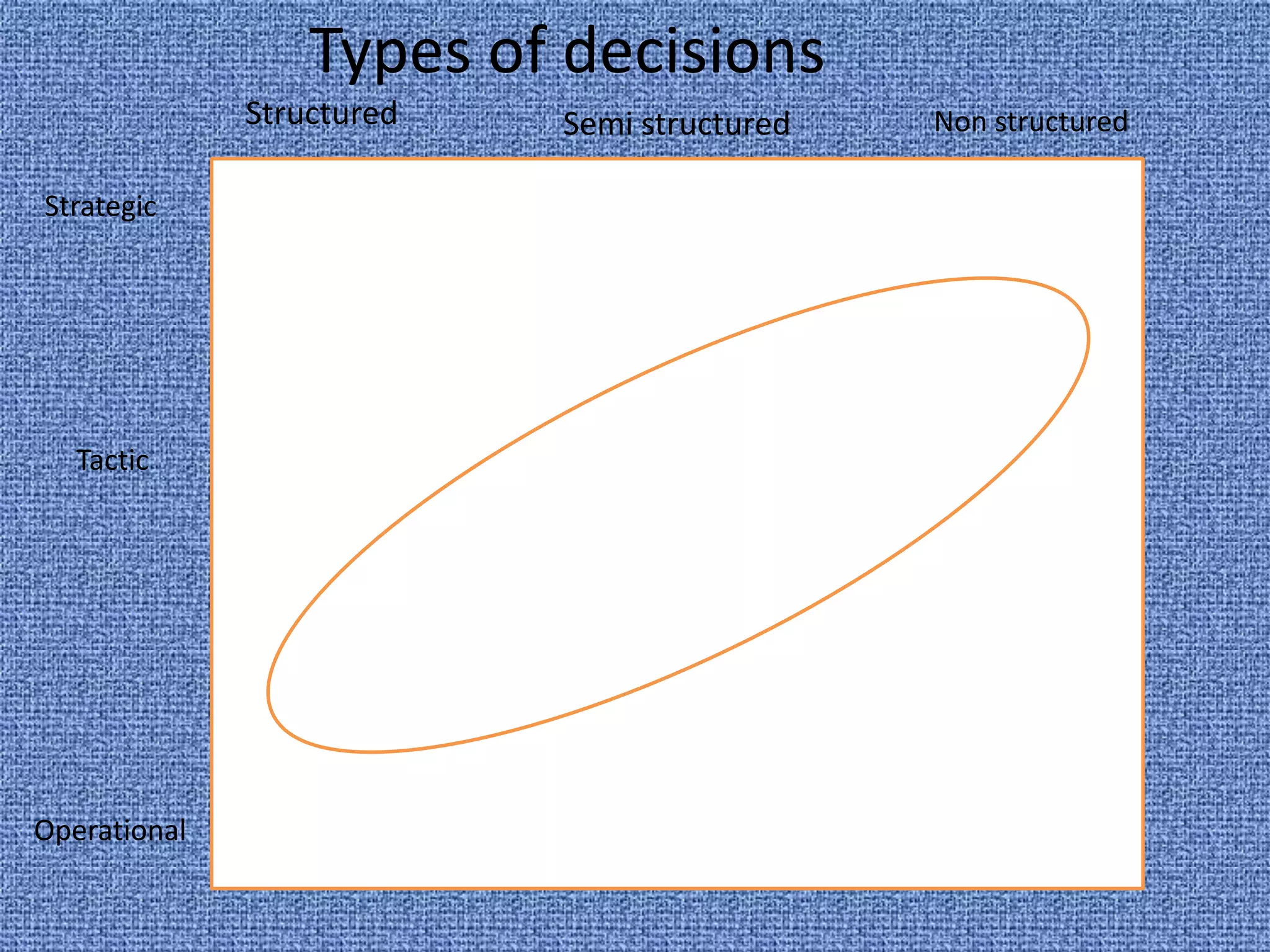
Types of decisionsStructuredSemi structuredNon structuredStrategicTacticOperational
Business Problem • Where is the problem? • Marketing Mgr is right: the data IS in the servers • IT Mgr is also right: is not easy to give data the right 	structure to answers questions  • For IT is just enough to deal with data, Marketing 	needs to extract information from this data.
Data and information are not the same  • Companies always maintain several systems to run 	their everyday business  • All of the company workers add and check data from 	this systems all the time  • However sometimes this data, presented in this way, 	is not enough to make business decisions
objectivesIdentify market opportunitiesKnow where market share is unsatisfactoryBetter understand their profitability driversIdentify unacceptable cost areasGain an accurate view of sale and/or distribution costs, per channel, per customer, per transaction, per dayRecognize business areas of high performanceIdentify the key performance indicators [KPI's] to use to measure capabilityCalculate sales commissions, number of sales closed, highlight good and poor performersTrack whether strategies for certain markets or customers are working and driving business valueGet instant insight to the exact profit by company of each sale
What is Business Intelligence (BI)?IT-enabled business decision making based on simple to complex data analysis processesDatabase development and administrationData miningData queries and report writingData analytics and simulationsBenchmarking of business performanceDashboardsDecision support systems
Why BI?Make more informed business decisions:Competitive and location analysisCustomer behavior analysisTargeted marketing and sales strategiesBusiness scenarios and forecastingBusiness service managementBusiness planning and operation optimizationFinancial management and compliance
Knowledge of database systems and data warehousing technologiesAbility to manage database system integration, implementation and testingAbility to manage relational databases and create complex reportsKnowledge and ability to implement data and information policies, security requirements, and state and federal regulationsCritical Technology Knowledge and Skills
Understanding of the flow of information throughout the organization
Ability to effectively communicate with and get support from technology and business specialists
Ability to understand the use of data and information in each organizational units
Ability to present data in a user-centric framework
Ability to understand the decision making process and to focus on business objectives
Ability to train business users in information management and interpretationCritical Business and Customer Skills and Knowledge
BI Technologiesneed to have a secure computer system which can specify different levels of user access to the data 'warehouse', need to have sufficient data capacity, a plan for how long data will be stored (data retention). BI analysts have developed software tools to gather and analyze large quantities of unstructured data such as production metrics, sales statistics, attendance reports,customer attrition figures.
BI ToolsAQL – Associatede Query LogicBalanced ScorecardBusiness Activity MonitoringBusiness Performance ManagementBusiness Planning Business Process Re-engineeringCompetitive AnalysisUser/End-User Query and ReportingEnterprise Management SystemExecutive Information SystemSCM – Supply Chain ManagementDemand Chain Managementand Finance and Budgeting tools.
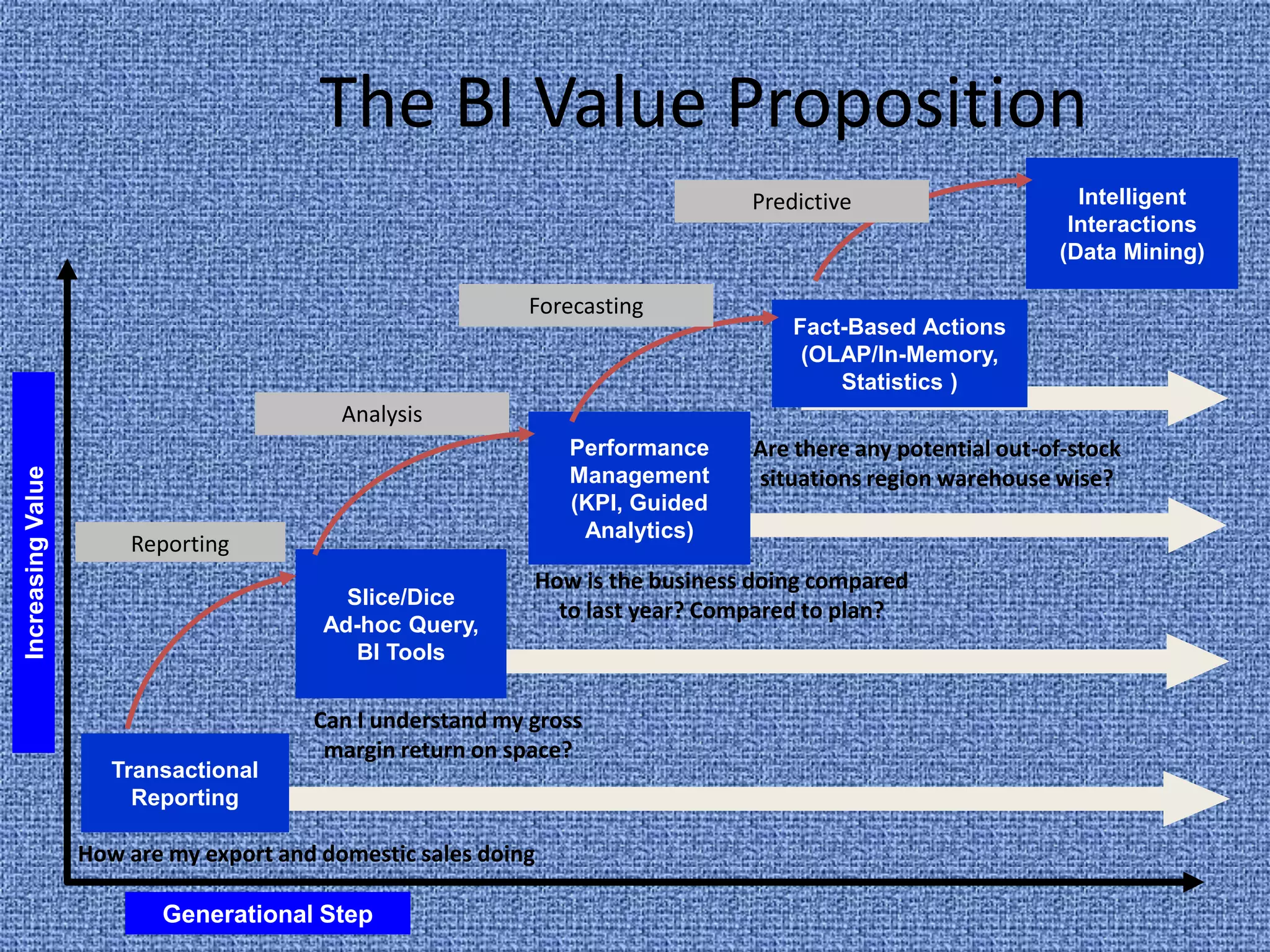
The BI Value PropositionIntelligentInteractions (Data Mining)PredictiveForecastingFact-Based Actions (OLAP/In-Memory, Statistics )AnalysisPerformanceManagement (KPI, Guided Analytics)Are there any potential out-of-stock situations region warehouse wise?ReportingIncreasing ValueSlice/DiceAd-hoc Query,BI ToolsHow is the business doing compared to last year? Compared to plan?Can I understand my gross margin return on space?TransactionalReportingHow are my export and domestic sales doingGenerational Step
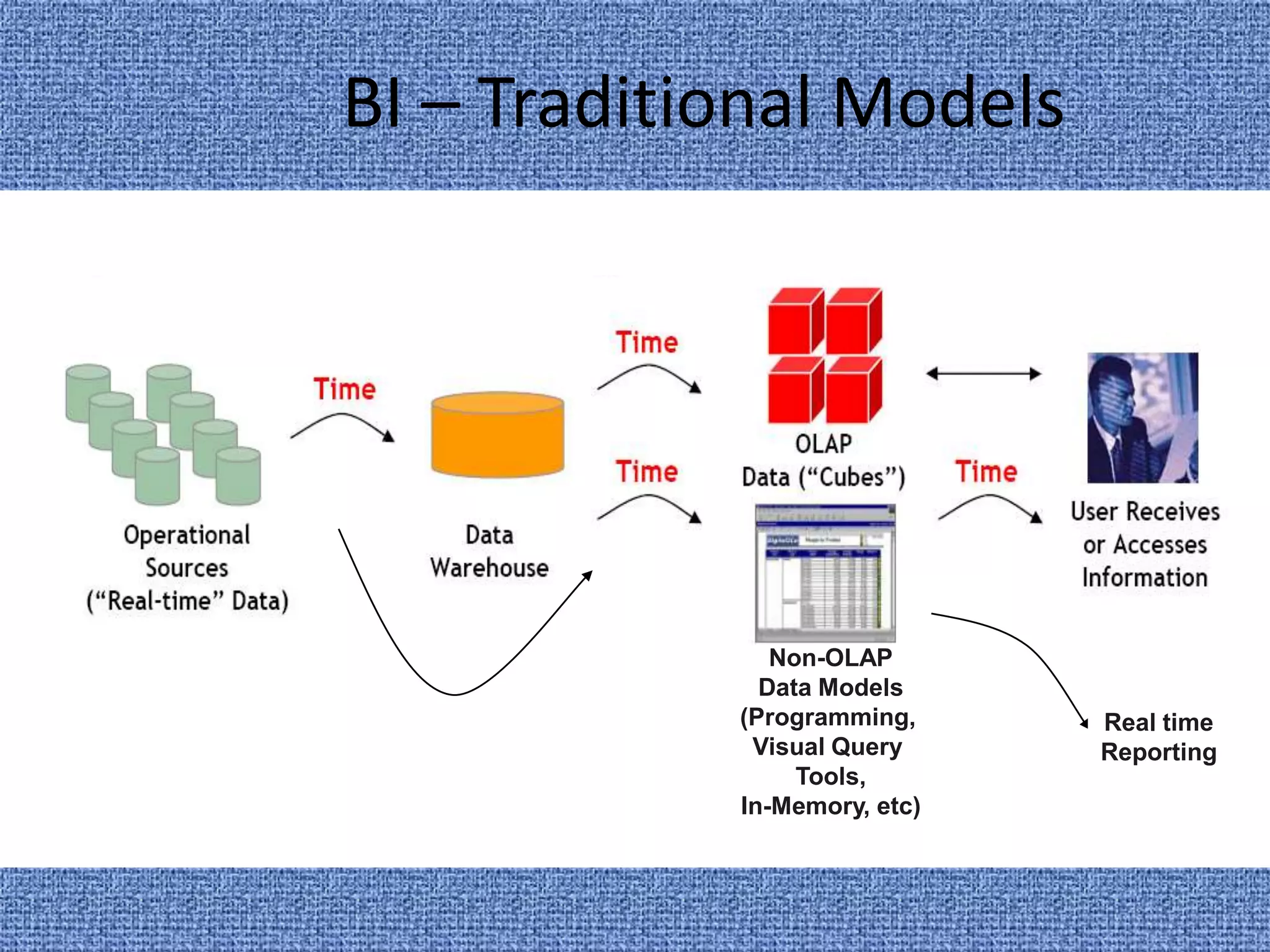
BI – Traditional ModelsNon-OLAPData Models(Programming, Visual Query Tools,In-Memory, etc)Real timeReporting
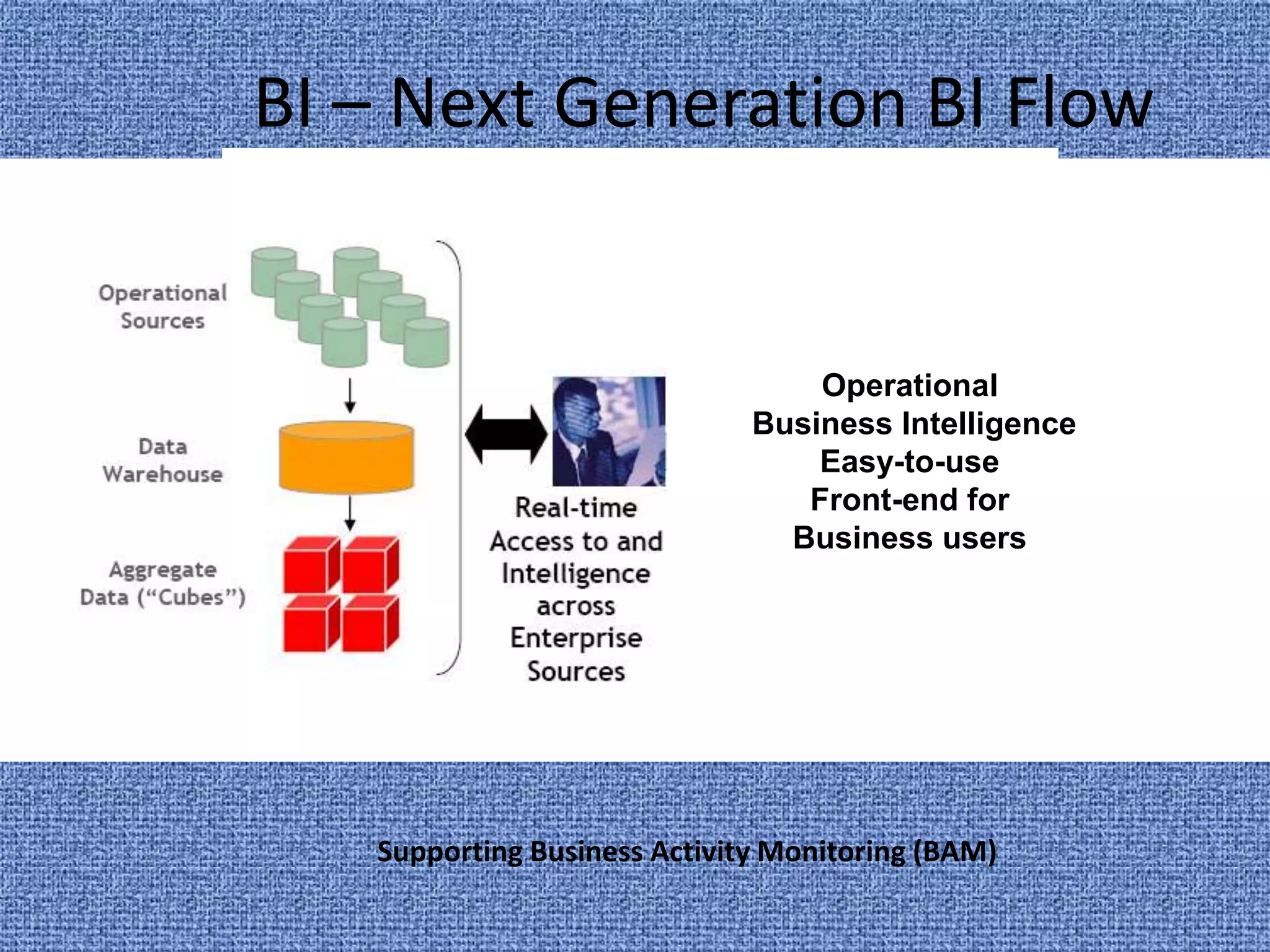
BI – Next Generation BI FlowOperational Business IntelligenceEasy-to-use Front-end for Business usersSupporting Business Activity Monitoring (BAM)
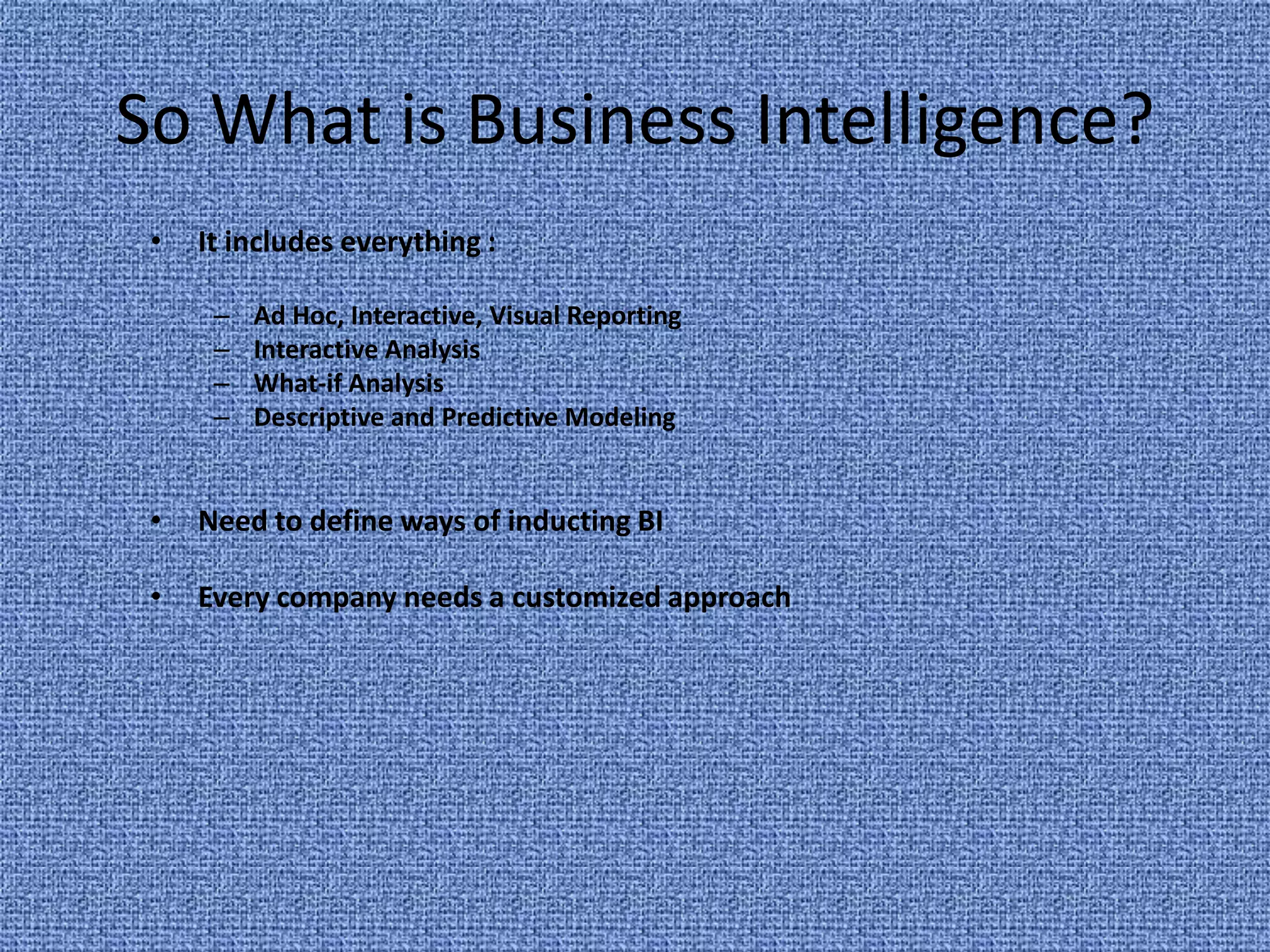
So What is Business Intelligence?It includes everything :Ad Hoc, Interactive, Visual ReportingInteractive AnalysisWhat-if AnalysisDescriptive and Predictive ModelingNeed to define ways of inducting BIEvery company needs a customized approach
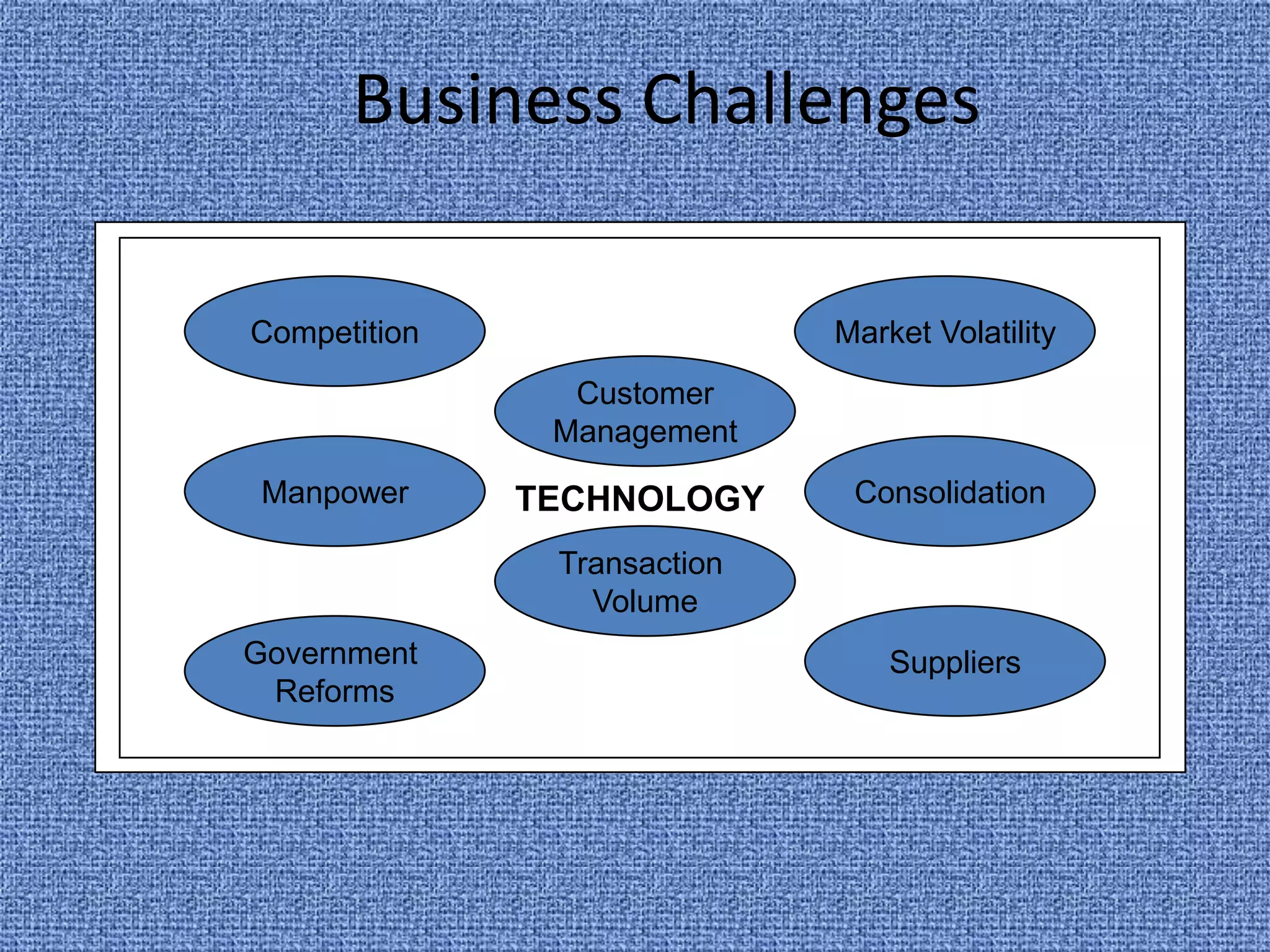
Business ChallengesTECHNOLOGYMarket VolatilityCompetitionCustomerManagementConsolidationManpowerTransaction VolumeSuppliersGovernment Reforms
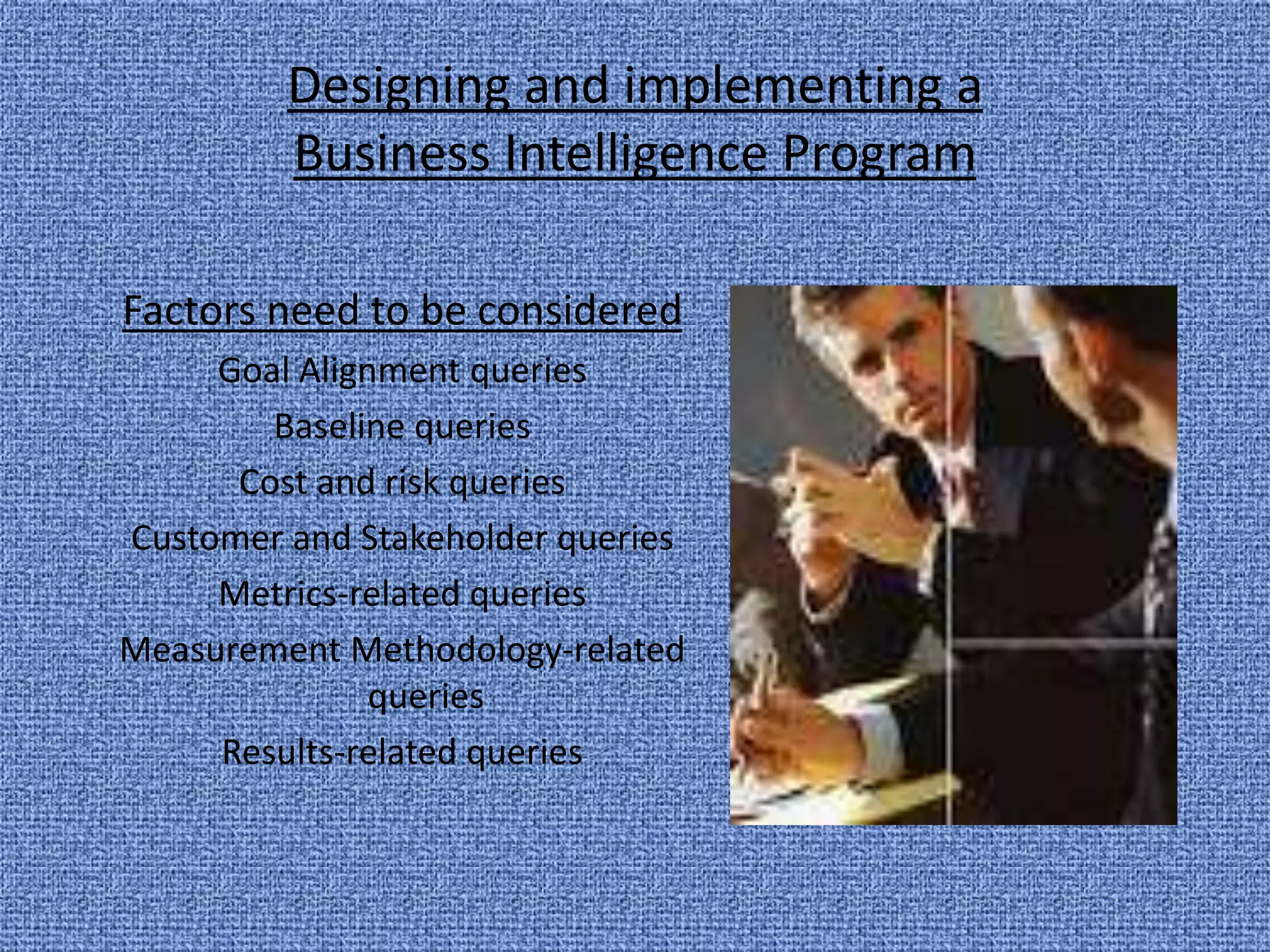
Designing and implementing a Business Intelligence ProgramFactors need to be consideredGoal Alignment queriesBaseline queriesCost and risk queriesCustomer and Stakeholder queriesMetrics-related queriesMeasurement Methodology-related queriesResults-related queries

bi

  • 1.
    Business IntelligencePresented by:Vijaykanth.RVenkatakondan.R
  • 2.
    IntroductionBI refers toapplication and technology, which is used to gather, provide access to, and analyze data and information about the company operations BI is neither a product nor a system. It is an architecture and a collection of integrated operational as well as decision-support applications and databases that provide the business community easy access to business data
  • 3.
    History Of BusinessIntelligencein 1979, John Rockart published the article “Chief Executives Define Their Own Data Needs” proposing that systems used by corporate leaders ought to give them data about the key jobs the company must do well to succeed. Ten years later, in 1999, Howard Dresner coined the term “business intelligence” to describe systems that help decision makers throughout the organization understand the state of their company’s world.In January 2006, Thomas Davenport published the results of a two year study “Competing on Analytics”. His research identified that virtually all the organizations identified as “aggressive analytics competitors” were the clear leaders in their fields, and they attribute much of their success to the masterful exploitation of data. Such companies included: Tesco, Wal-Mart, Dell, Marriott Hotels and Progressive Insurance.
  • 4.
    How do Imake decissionsin my business? • How does the company make decissions? Using intuition? You have to make business decisions based on reality (facts and numbers!) • EPM (Enterprise Performance Management) is a management style focused on measuring companies • Several Methodologies / Strategies: • Balanced Scorecard • Six Sigma, ABC - Activity Based Costing, TQM - Total Quality Management
  • 5.
    Types of decisionsStructuredSemistructuredNon structuredStrategicTacticOperational
  • 6.
    Business Problem •Where is the problem? • Marketing Mgr is right: the data IS in the servers • IT Mgr is also right: is not easy to give data the right structure to answers questions  • For IT is just enough to deal with data, Marketing needs to extract information from this data.
  • 7.
    Data and informationare not the same  • Companies always maintain several systems to run their everyday business  • All of the company workers add and check data from this systems all the time  • However sometimes this data, presented in this way, is not enough to make business decisions
  • 8.
    objectivesIdentify market opportunitiesKnowwhere market share is unsatisfactoryBetter understand their profitability driversIdentify unacceptable cost areasGain an accurate view of sale and/or distribution costs, per channel, per customer, per transaction, per dayRecognize business areas of high performanceIdentify the key performance indicators [KPI's] to use to measure capabilityCalculate sales commissions, number of sales closed, highlight good and poor performersTrack whether strategies for certain markets or customers are working and driving business valueGet instant insight to the exact profit by company of each sale
  • 9.
    What is BusinessIntelligence (BI)?IT-enabled business decision making based on simple to complex data analysis processesDatabase development and administrationData miningData queries and report writingData analytics and simulationsBenchmarking of business performanceDashboardsDecision support systems
  • 10.
    Why BI?Make moreinformed business decisions:Competitive and location analysisCustomer behavior analysisTargeted marketing and sales strategiesBusiness scenarios and forecastingBusiness service managementBusiness planning and operation optimizationFinancial management and compliance
  • 11.
    Knowledge of databasesystems and data warehousing technologiesAbility to manage database system integration, implementation and testingAbility to manage relational databases and create complex reportsKnowledge and ability to implement data and information policies, security requirements, and state and federal regulationsCritical Technology Knowledge and Skills
  • 12.
    Understanding of theflow of information throughout the organization
  • 13.
    Ability to effectivelycommunicate with and get support from technology and business specialists
  • 14.
    Ability to understandthe use of data and information in each organizational units
  • 15.
    Ability to presentdata in a user-centric framework
  • 16.
    Ability to understandthe decision making process and to focus on business objectives
  • 17.
    Ability to trainbusiness users in information management and interpretationCritical Business and Customer Skills and Knowledge
  • 18.
    BI Technologiesneed tohave a secure computer system which can specify different levels of user access to the data 'warehouse', need to have sufficient data capacity, a plan for how long data will be stored (data retention). BI analysts have developed software tools to gather and analyze large quantities of unstructured data such as production metrics, sales statistics, attendance reports,customer attrition figures.
  • 19.
    BI ToolsAQL –Associatede Query LogicBalanced ScorecardBusiness Activity MonitoringBusiness Performance ManagementBusiness Planning Business Process Re-engineeringCompetitive AnalysisUser/End-User Query and ReportingEnterprise Management SystemExecutive Information SystemSCM – Supply Chain ManagementDemand Chain Managementand Finance and Budgeting tools.
  • 20.
    The BI ValuePropositionIntelligentInteractions (Data Mining)PredictiveForecastingFact-Based Actions (OLAP/In-Memory, Statistics )AnalysisPerformanceManagement (KPI, Guided Analytics)Are there any potential out-of-stock situations region warehouse wise?ReportingIncreasing ValueSlice/DiceAd-hoc Query,BI ToolsHow is the business doing compared to last year? Compared to plan?Can I understand my gross margin return on space?TransactionalReportingHow are my export and domestic sales doingGenerational Step
  • 21.
    BI – TraditionalModelsNon-OLAPData Models(Programming, Visual Query Tools,In-Memory, etc)Real timeReporting
  • 22.
    BI – NextGeneration BI FlowOperational Business IntelligenceEasy-to-use Front-end for Business usersSupporting Business Activity Monitoring (BAM)
  • 23.
    So What isBusiness Intelligence?It includes everything :Ad Hoc, Interactive, Visual ReportingInteractive AnalysisWhat-if AnalysisDescriptive and Predictive ModelingNeed to define ways of inducting BIEvery company needs a customized approach
  • 24.
  • 25.
    Designing and implementinga Business Intelligence ProgramFactors need to be consideredGoal Alignment queriesBaseline queriesCost and risk queriesCustomer and Stakeholder queriesMetrics-related queriesMeasurement Methodology-related queriesResults-related queries
  • 26.
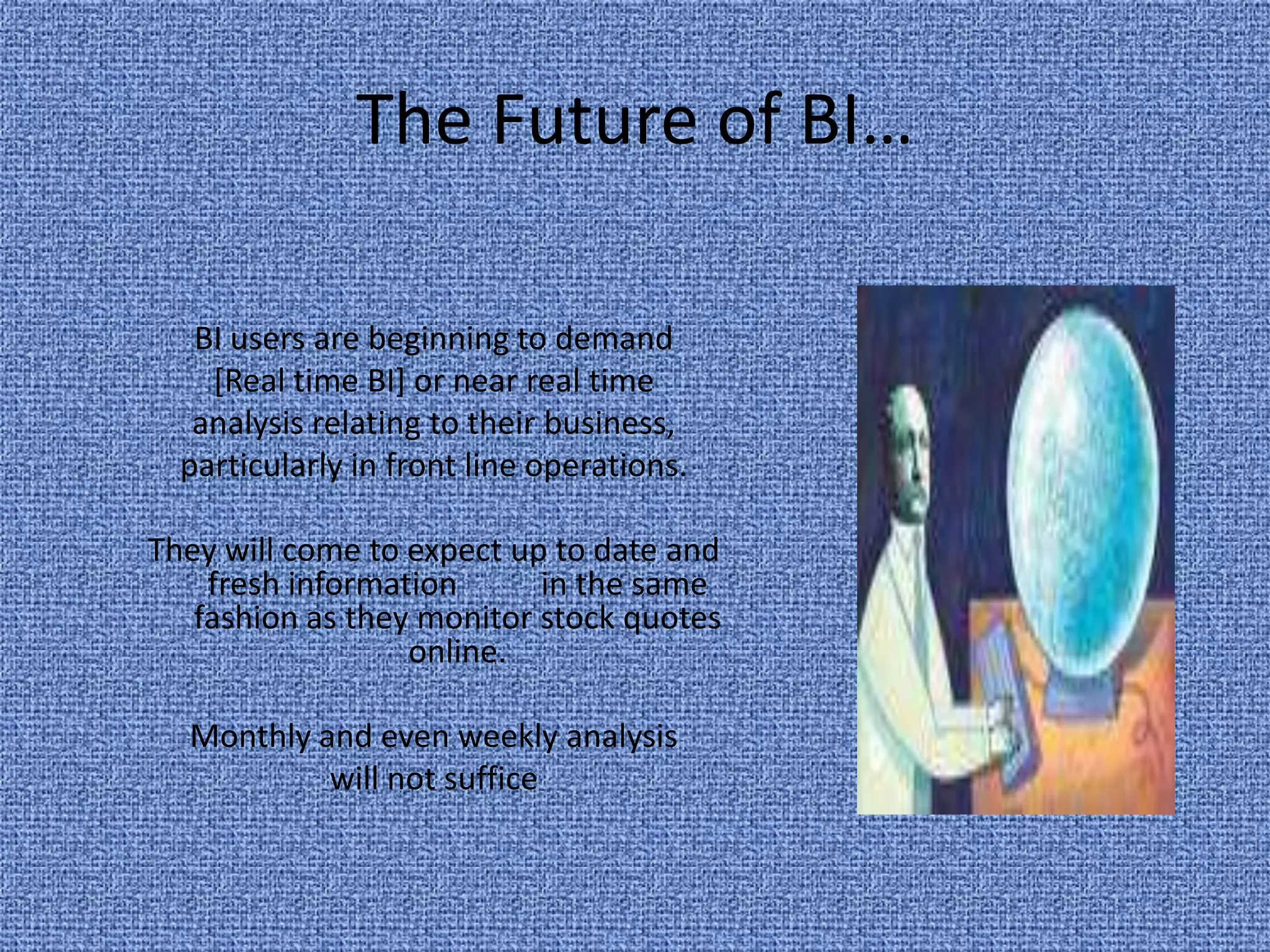
    The Future ofBI…BI users are beginning to demand [Real time BI] or near real time analysis relating to their business, particularly in front line operations. They will come to expect up to date and fresh information in the same fashion as they monitor stock quotes online. Monthly and even weekly analysis will not suffice
  • 27.
    The Future ofBI… "Business users don't want to wait for information. Information needs to be always on and never out of date. This is the way we live our lives today. Why should Business Intelligence be any different?" Charles Nicholls, CEO of SeeWhy, a Software company, Windsor UK
  • 28.
    BI 2.0 “BI 2.0"is the recently-coined term which is part of the continually developing BI industry and heralds the next step for BI. “BI 2.0" is used to describethe acquisition, provision and analysis of "real time" data.
  • 29.
    "Real Time BI…apipe dream”As long as Business Intelligence relies upon some kind of data warehouse structure (including web-based virtual data "warehouses"), data will have to be converted into "a lowest common denominator consistent set." When it comes to dealing with multiple, disparate data sources and the constantly changing, often volatile, business environment which requires tweaking and restructuring of IT systems, getting BI data in a genuinely true, "real time" format remains, "a pipe dream.....Hayler
  • 30.
    "Real Time BI- Get Real""The mismatch between fantasy and reality is driven by two factors. The first is that business rules and structures (general ledgers, product classification, asset hierarchies, etc.) are not in fact uniform, but are spread out among many disparate transaction system implementations...The second problem is that the landscape of business structures is itself in constant flux, as groups reorganize, subsidiaries are sold or new companies acquired".…Veteran Analyst… Andy Hayler…