Institute Of Engineering Studies (IES,Bangalore)

Formulae Sheet in ECE/TCE Department

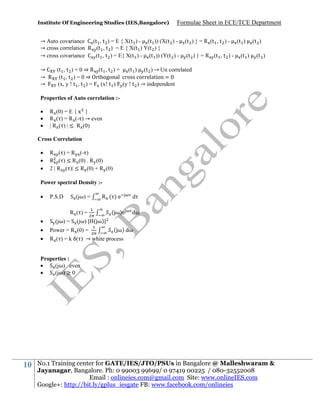
Communication Systems
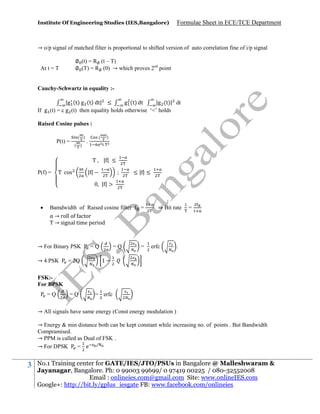
Amplitude Modulation :
DSB-SC :
u (t) =
m(t) cos 2π t
Power P =
Conventioanal AM :
u (t) = [1 + m(t)] Cos 2π t . as long as |m(t)| ≤ 1 demodulation is simple .
Practically m(t) = a m (t) .
()
()
Modulation index a = ( ) , m (t) =
| ( )|
Power =

+

SSB-AM :
→ Square law Detector SNR =

()

Square law modulator
↓
= 2a / a → amplitude Sensitivity
Envelope Detector R C (i/p) < < 1 /

R C (o/P) >> 1/

R C << 1/ω

≥
Frequency & Phase Modulation : Angle Modulation :u (t) =
∅ (t)

Cos (2π t + ∅ (t) )
( ) →

2π

phase & frequency deviation constant

m(t) . dt →

→ max phase deviation ∆∅ =
max | m(t) |
→ max requency deviation ∆ = max |m(t) |
Bandwidth :
Effective Bandwidth

= 2 (β + 1)

→ 98% power

Noise in Analog Modulation :→ (SNR)
R = m(t) cos 2π

1

=

=

=

∴

=

/2

No.1 Training center for GATE/IES/JTO/PSUs in Bangalore @ Malleshwaram &
Jayanagar, Bangalore. Ph: 0 99003 99699/ 0 97419 00225 / 080-32552008
Email : onlineies.com@gmail.com Site: www.onlineIES.com
Google+: http://bit.ly/gplus_iesgate FB: www.facebook.com/onlineies
Institute Of Engineering Studies (IES,Bangalore)

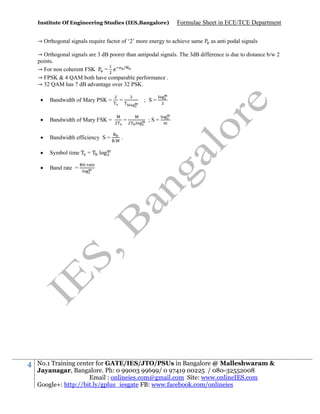
→ (SNR)

=

/

→ (SNR)

=

/

=

/

/

=

=

=

.

=

=
=

=

= (SNR)

= (SNR)

= η

Formulae Sheet in ECE/TCE Department

.

η=

Noise in Angle Modulation :-

=

PCM :→ Min. no of samples required for reconstruction = 2ω =
→ Total bits required = v
→ Bandwidth = R /2 = v

; ω = Bandwidth of msg signal .

bps . v → bits / sample
/2=v.ω

→ SNR = 1.76 + 6.02 v
→ As Number of bits increased SNR increased by 6 dB/bit . Band width also increases.
Delta Modulation :→ By increasing step size slope over load distortion eliminated [ Signal raised sharply ]
→ By Reducing step size Grannualar distortion eliminated . [ Signal varies slowly ]

Digital Communication
Matched filter:
→ impulse response a(t) =

( T – t) . P(t) → i/p

→ Matched filter o/p will be max at multiples of ‘T’ . So, sampling @ multiples of ‘T’ will give max SNR
(2nd point )
→ matched filter is always causal a(t) = 0 for t < 0
→ Spectrum of o/p signal of matched filter with the matched signal as i/p ie, except for a delay factor ;
proportional to energy spectral density of i/p.
∅ ()=

(f) ∅(f) = ∅(f) ∅*(f) e

∅ ( ) = |∅( )| e

2

No.1 Training center for GATE/IES/JTO/PSUs in Bangalore @ Malleshwaram &
Jayanagar, Bangalore. Ph: 0 99003 99699/ 0 97419 00225 / 080-32552008
Email : onlineies.com@gmail.com Site: www.onlineIES.com
Google+: http://bit.ly/gplus_iesgate FB: www.facebook.com/onlineies
Institute Of Engineering Studies (IES,Bangalore)

Formulae Sheet in ECE/TCE Department

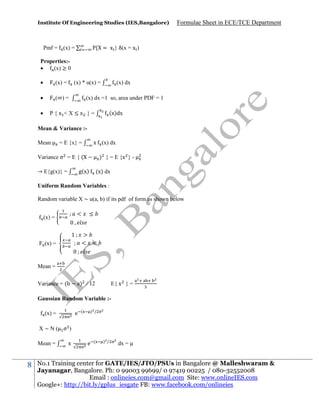
→ o/p signal of matched filter is proportional to shifted version of auto correlation fine of i/p signal
∅ (t) = R ∅ (t – T)
∅ (T) = R ∅ (0) → which proves 2nd point

At t = T

Cauchy-Schwartz in equality :|g (t) g (t) dt| ≤
|g (t)| dt
g (t) dt
If g (t) = c g (t) then equality holds otherwise ‘<’ holds
Raised Cosine pulses :
P(t) =

( )
( )

(

.

)

|| ≤
P(f) =

cos

||

≤||≤
||



Bamdwidth of Raised cosine filter
α → roll o actor
→ signal time period

→ For Binary PSK
→ 4 PSK

=Q

=Q

= 2Q

=

⇒ Bit rate

erfc

=

.

1

=Q

=

= erfc

FSK:For BPSK
=Q

→ All signals have same energy (Const energy modulation )
→ Energy & min distance both can be kept constant while increasing no. of points . But Bandwidth
Compramised.
→ PPM is called as Dual of FSK .
→ For DPSK
= e /

3

No.1 Training center for GATE/IES/JTO/PSUs in Bangalore @ Malleshwaram &
Jayanagar, Bangalore. Ph: 0 99003 99699/ 0 97419 00225 / 080-32552008
Email : onlineies.com@gmail.com Site: www.onlineIES.com
Google+: http://bit.ly/gplus_iesgate FB: www.facebook.com/onlineies
Institute Of Engineering Studies (IES,Bangalore)

Formulae Sheet in ECE/TCE Department

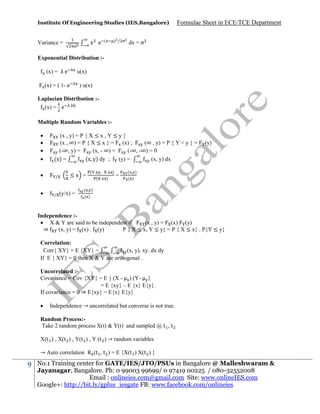
→ Orthogonal signals require factor of ‘2’ more energy to achieve same

as anti podal signals

→ Orthogonal signals are 3 dB poorer than antipodal signals. The 3dB difference is due to distance b/w 2
points.
→ For non coherent FSK
= e /
→ FPSK & 4 QAM both have comparable performance .
→ 32 QAM has 7 dB advantage over 32 PSK.



Bandwidth of Mary FSK =



Bandwidth efficiency S =



Symbol time



4

Bandwidth of Mary PSK =

Band rate =

=

=

; S=

=

.

;S=

.

log

No.1 Training center for GATE/IES/JTO/PSUs in Bangalore @ Malleshwaram &
Jayanagar, Bangalore. Ph: 0 99003 99699/ 0 97419 00225 / 080-32552008
Email : onlineies.com@gmail.com Site: www.onlineIES.com
Google+: http://bit.ly/gplus_iesgate FB: www.facebook.com/onlineies
Institute Of Engineering Studies (IES,Bangalore)

Formulae Sheet in ECE/TCE Department

Signals & Systems
→ Energy of a signal

| [ ]|

|x(t)| dt =

→ Power of a signal P = lim
→ x (t) →
; x (t) →
x (t) + x (t) → +

|x(t)| dt = lim

→

→

|x[n]|

iff x (t) & x (t) orthogonal

→ Shifting & Time scaling won’t effect power . Frequency content doesn’t effect power.
→ if power = ∞ → neither energy nor power signal
Power = 0 ⇒ Energy signal
Power = K ⇒ power signal
→ Energy of power signal = ∞ ; Power of energy signal = 0
→ Generally Periodic & random signals → Power signals
Aperiodic & deterministic → Energy signals
Precedence rule for scaling & Shifting :
x(at + b) → (1) shift x(t) by ‘b’ → x(t + b)
(2) Scale x(t + b) by ‘a’ → x(at + b)
x( a ( t + b/a)) → (1) scale x(t) by a → x(at)
(2) shift x(at) by b/a → x (a (t+b/a)).
→ x(at +b) = y(t) ⇒ x(t) = y


Step response s(t) = h(t) * u(t) =
S[n] =
[ ]




e



Rect (t / 2T) * Rect (t / 2T) = 2T tri(t / T)

h(t)dt
S’ (t) = h(t)
h[n] = s[n] – s[n-1]

u(t) * e
u(t) =
[e
- e ] u(t) .
Rect (t / 2 ) *
Rect(t / 2 ) = 2
min ( ,

) trapezoid ( ,

)

Hilbert Transform Pairs :
e

/

dx = σ 2π ;

x e

/

dx = σ

2π σ > 0

Laplace Transform :-

5

No.1 Training center for GATE/IES/JTO/PSUs in Bangalore @ Malleshwaram &
Jayanagar, Bangalore. Ph: 0 99003 99699/ 0 97419 00225 / 080-32552008
Email : onlineies.com@gmail.com Site: www.onlineIES.com
Google+: http://bit.ly/gplus_iesgate FB: www.facebook.com/onlineies
Institute Of Engineering Studies (IES,Bangalore)

Formulae Sheet in ECE/TCE Department

(s) e ds

x(t) =
x(t) e

X(s) =

ds

Initial & Final value Theorems :
x(t) = 0 for t < 0 ; x(t) doesn’t contain any impulses /higher order singularities @ t =0 then
x(

) = lim

x(∞) = lim

( )

→
→

( )

Properties of ROC :1. X(s) ROC has strips parallel to jω axis
2. For rational laplace transform ROC has no poles
3. x(t) → finite duration & absolutely integrable then ROC entire s-plane
4. x(t) → Right sided then ROC right side of right most pole excluding pole s = ∞
5. x(t) → left sided

ROC left side of left most pole excluding s= - ∞

6. x(t) → two sided

ROC is a strip

7. if x(t) causal

ROC is right side of right most pole including s = ∞

8. if x(t) stable

ROC includes jω-axis

Z-transform :x[n] =
X(z) =

x( )

dz

x[n]

Initial Value theorem :
If x[n] = 0 for n < 0 then x[0] = lim
Final Value theorem :lim→ [ ] = lim → (

→

( )

1) X(z)

Properties of ROC :1.ROC is a ring or disc centered @ origin
2. DTFT of x[n] converter if and only if ROC includes unit circle
3. ROC cannot contain any poles

6

No.1 Training center for GATE/IES/JTO/PSUs in Bangalore @ Malleshwaram &
Jayanagar, Bangalore. Ph: 0 99003 99699/ 0 97419 00225 / 080-32552008
Email : onlineies.com@gmail.com Site: www.onlineIES.com
Google+: http://bit.ly/gplus_iesgate FB: www.facebook.com/onlineies
Institute Of Engineering Studies (IES,Bangalore)

Formulae Sheet in ECE/TCE Department

4. if x[n] is of finite duration then ROC is enter Z-plane except possibly 0 or ∞
5. if x[n] right sided then ROC → outside of outermost pole excluding z = 0
6. if x[n] left sided then ROC → inside of innermost pole including z =0
7. if x[n] & sided then ROC is ring
8. ROC must be connected region
9.For causal LTI system ROC is outside of outer most pole including ∞
10.For Anti Causal system ROC is inside of inner most pole including ‘0’
11. System said to be stable if ROC includes unit circle .
12. Stable & Causal if all poles inside unit circle
13. Stable & Anti causal if all poles outside unit circle.
Phase Delay & Group Delay :When a modulated signal is fixed through a communication channel , there are two different delays to be
considered.
(i) Phase delay:
Signal fixed @ o/p lags the fixed signal by ∅(ω ) phase
∅( )
=where ∅(ω ) = K H(jω)

Group delay

∅(

=

↓
Frequency response of channel
)
for narrow Band signal

↓
Signal delay / Envelope delay
Probability & Random Process:→ P (A/B) =

(

)
( )

→ Two events A & B said to be mutually exclusive /Disjoint if P(A B) =0
→ Two events A & B said to be independent if P (A/B) = P(A) ⇒ P(A B) = P(A) P(B)
→ P(Ai / B) =

(

)
( )

=

CDF :Cumulative Distribution function

(

)
(

)

(x) = P { X ≤ x }

Properties of CDF :






(∞) = P { X ≤ ∞ } = 1
(- ∞) = 0
(x ≤ X ≤ x ) = (x ) - (x )
Its Non decreasing function
P{ X > x} = 1 – P { X ≤ x} = 1- (x)

PDF :Pdf =

7

(x) =

(x)

No.1 Training center for GATE/IES/JTO/PSUs in Bangalore @ Malleshwaram &
Jayanagar, Bangalore. Ph: 0 99003 99699/ 0 97419 00225 / 080-32552008
Email : onlineies.com@gmail.com Site: www.onlineIES.com
Google+: http://bit.ly/gplus_iesgate FB: www.facebook.com/onlineies
Institute Of Engineering Studies (IES,Bangalore)

Formulae Sheet in ECE/TCE Department

= x } δ(x = x )

Pmf = (x) =
Properties:
(x) ≥ 0


(x) =



(∞) =



(x) * u(x) =

(x) dx

(x) dx =1 so, area under PDF = 1
(x)dx

P{x <X≤x }=

Mean & Variance :Mean

x (x) dx

= E {x} =

Variance σ = E { (
→ E{g(x)} =

) } = E {x } -

g(x)

(x) dx

Uniform Random Variables :
Random variable X ~ u(a, b) if its pdf of form as shown below
<

(x) =

≤

1
<

(x) =

<

Mean =
Variance = (

a) / 12

E{ x } =

Gaussian Random Variable :e

(x) =

(

) /

X~N( σ )
Mean =

8

x

e

(

) /

dx =

No.1 Training center for GATE/IES/JTO/PSUs in Bangalore @ Malleshwaram &
Jayanagar, Bangalore. Ph: 0 99003 99699/ 0 97419 00225 / 080-32552008
Email : onlineies.com@gmail.com Site: www.onlineIES.com
Google+: http://bit.ly/gplus_iesgate FB: www.facebook.com/onlineies
Institute Of Engineering Studies (IES,Bangalore)

x e

Variance =

(

) /

Formulae Sheet in ECE/TCE Department

dx = σ

Exponential Distribution :(x) = λ e

u(x)

(x) = ( 1- e

) u(x)

Laplacian Distribution :(x) = e | |
Multiple Random Variables :






(x , y) = P { X ≤ x , Y ≤ y }
(x , ∞) = P { X ≤ x } = (x) ;
(∞ , y) = P { Y < y } =
(-∞, y) =
(x, - ∞) =
(-∞, -∞) = 0
(x y) dy ;
(x) =
(y) =
(x, y) dx
/

/

≤x =
(y/x) =

(

=

(y)

( )
( )

)

( )

Independence : X & Y are said to be independent if
(x , y) = (x) (y)
⇒
(x, y) = (x) . (y)
P { X ≤ x, Y ≤ y} = P { X ≤ x} . P{Y ≤ y}
Correlation:
Corr{ XY} = E {XY} =
(x, y). xy. dx dy
If E { XY} = 0 then X & Y are orthogonal .
Uncorrelated :Covariance = Cov {XY} = E { (X - ) (Y- }
= E {xy} – E {x} E{y}.
If covariance = 0 ⇒ E{xy} = E{x} E{y}


Independence → uncorrelated but converse is not true.

Random Process:Take 2 random process X(t) & Y(t) and sampled @ t , t
X(t ) , X(t ) , Y(t ) , Y (t ) → random variables
→ Auto correlation R (t , t ) = E {X(t ) X(t ) }

9

No.1 Training center for GATE/IES/JTO/PSUs in Bangalore @ Malleshwaram &
Jayanagar, Bangalore. Ph: 0 99003 99699/ 0 97419 00225 / 080-32552008
Email : onlineies.com@gmail.com Site: www.onlineIES.com
Google+: http://bit.ly/gplus_iesgate FB: www.facebook.com/onlineies
Institute Of Engineering Studies (IES,Bangalore)

Formulae Sheet in ECE/TCE Department

→ Auto covariance C (t , t ) = E { X(t ) - (t )) (X(t ) → cross correlation R (t , t ) = E { X(t ) Y(t ) }
→ cross covariance C (t , t ) = E{ X(t ) - (t )) (Y(t ) -

(t ) } = R (t , t ) (t ) } = R (t , t ) -

(t )
(t )

(t )
(t )

→ C (t , t ) = 0 ⇒ R (t , t ) = (t ) (t ) → Un correlated
→ R (t , t ) = 0 ⇒ Orthogonal cross correlation = 0
→
(x, y ! t , t ) = (x! t ) (y ! t ) → independent
Properties of Auto correlation :



R (0) = E { x }
R ( ) = R (- ) → even
| R ( ) | ≤ R (0)

Cross Correlation




R ( ) = R (- )
R ( ) ≤ R (0) . R (0)
2 | R ( )| ≤ R (0) + R (0)

Power spectral Density :

P.S.D

S (jω) =

R ( )e

R ( )=

( ω)e

d
dω



S (jω) = S (jω) | ( ω)|




( ω) dω
Power = R (0) =
R ( ) = k δ( ) → white process

Properties :
 S (jω) even
 S (jω) ≥ 0

10

No.1 Training center for GATE/IES/JTO/PSUs in Bangalore @ Malleshwaram &
Jayanagar, Bangalore. Ph: 0 99003 99699/ 0 97419 00225 / 080-32552008
Email : onlineies.com@gmail.com Site: www.onlineIES.com
Google+: http://bit.ly/gplus_iesgate FB: www.facebook.com/onlineies
Institute Of Engineering Studies (IES,Bangalore)

Formulae Sheet in ECE/TCE Department

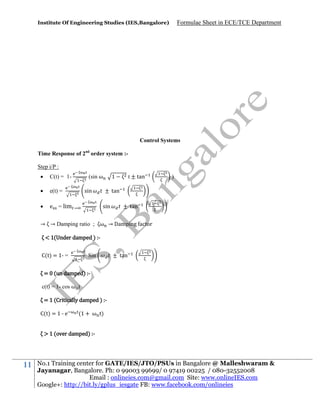
Control Systems
Time Response of 2nd order system :Step i/P :


C(t) = 1-



e(t) =



e

= lim

(sin ω
sin

1

t ± tan

tan
sin

→

)

tan

→ → Damping ratio ; ω → Damping actor
< 1(Under damped ) :C(t) = 1- =

Sin

tan

= 0 (un damped) :c(t) = 1- cos ω t
= 1 (Critically damped ) :C(t) = 1 - e

(1 + ω t)

> 1 (over damped) :-

11

No.1 Training center for GATE/IES/JTO/PSUs in Bangalore @ Malleshwaram &
Jayanagar, Bangalore. Ph: 0 99003 99699/ 0 97419 00225 / 080-32552008
Email : onlineies.com@gmail.com Site: www.onlineIES.com
Google+: http://bit.ly/gplus_iesgate FB: www.facebook.com/onlineies
Institute Of Engineering Studies (IES,Bangalore)

Formulae Sheet in ECE/TCE Department

C(t) = 1 T=
>

>

>

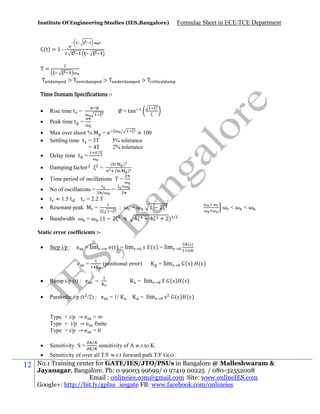
Time Domain Specifications :∅



Rise time t =



Peak time t =





/
Max over shoot %
=e
× 100
Settling time t = 3T
5% tolerance
= 4T
2% tolerance
.
Delay time t =



Damping actor



Time period of oscillations T =



No of oscillations =




t ≈ 1.5 t
t = 2.2 T
Resonant peak
=



Bandwidth ω = ω (1

∅ = tan

=

/

(

)
(

)

=
; ω =ω
2

1

2

+

ω <ω <ω

+ 2)

/

Static error coefficients :

Step i/p : e

= lim →

e

=

( ) = lim

( ) = lim

→

→

= lim

→

(positional error)
= lim



Ramp i/p (t) : e



Parabolic i/p (t /2) : e

=
= 1/

→

( ) ( )

( ) ( )

→

= lim

( )

s

( ) ( )

Type < i/p → e = ∞
Type = i/p → e finite
Type > i/p → e = 0
/
/




12

Sensitivity S =

Sensitivity of over all T/F w.r.t forward path T/F G(s) :

sensitivity of A w.r.to K.

No.1 Training center for GATE/IES/JTO/PSUs in Bangalore @ Malleshwaram &
Jayanagar, Bangalore. Ph: 0 99003 99699/ 0 97419 00225 / 080-32552008
Email : onlineies.com@gmail.com Site: www.onlineIES.com
Google+: http://bit.ly/gplus_iesgate FB: www.facebook.com/onlineies
Institute Of Engineering Studies (IES,Bangalore)

Open loop:

S =1

Closed loop :

S=

Formulae Sheet in ECE/TCE Department

( ) ( )



Minimum ‘S’ value preferable



Sensitivity of over all T/F w.r.t feedback T/F H(s) : S =

( ) ( )
( ) ( )

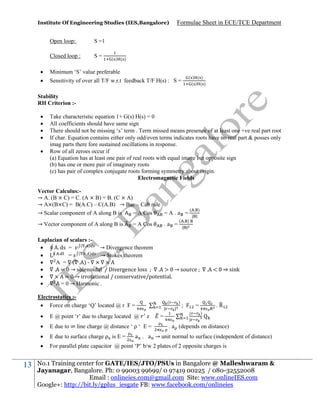
Stability
RH Criterion :





Take characteristic equation 1+ G(s) H(s) = 0
All coefficients should have same sign
There should not be missing ‘s’ term . Term missed means presence of at least one +ve real part root
If char. Equation contains either only odd/even terms indicates roots have no real part & posses only
imag parts there fore sustained oscillations in response.
Row of all zeroes occur if
(a) Equation has at least one pair of real roots with equal image but opposite sign
(b) has one or more pair of imaginary roots
(c) has pair of complex conjugate roots forming symmetry about origin.
Electromagnetic Fields

Vector Calculus:→ A. (B × C) = C. (A × B) = B. (C × A)
→ A×(B×C) = B(A.C) – C(A.B) → Bac – Cab rule
( . )
→ Scalar component of A along B is
= A Cos
=A.a = | |
→ Vector component of A along B is

.a =

= A Cos

( . )
| |

Laplacian of scalars :( . )

. ds =
→ Divergence theorem
(
)
.

=
→ Stokes theorem

A = ( . )
. = → solenoidal / Divergence loss
.
→ source

= → irrotational / conservative/potential.

= 0 → Harmonic .
Electrostatics : Force on charge ‘Q’ located @ r F =

(
|

)
|

;

. < ⇒ sink

.R

=
(

)




E due to ∞ line charge @ distance ‘ ρ ‘ E =



E due to surface charge ρ is E =



13

E @ point ‘r’ due to charge located @

For parallel plate capacitor @ point ‘P’ b/w 2 plates of 2 opposite charges is

=

|

. a (depends on distance)

a . a → unit normal to surface (independent of distance)

No.1 Training center for GATE/IES/JTO/PSUs in Bangalore @ Malleshwaram &
Jayanagar, Bangalore. Ph: 0 99003 99699/ 0 97419 00225 / 080-32552008
Email : onlineies.com@gmail.com Site: www.onlineIES.com
Google+: http://bit.ly/gplus_iesgate FB: www.facebook.com/onlineies
Institute Of Engineering Studies (IES,Bangalore)

a -

E=


(

Formulae Sheet in ECE/TCE Department

)
a .

‘E’ due to volume charge E =

→ Electric flux density D =
Flux Ψ = s .

D → independent of medium

Gauss Law :→ Total flux coming out of any closed surface is equal to total charge enclosed by surface .
Ψ=
⇒ D . ds =
= ρ . dv
ρ = .D
→ Electric potential

=

a . dr a =

=

. d (independent of path)

= -

-

(for point charge )

Potential @ any point (distance = r), where Q is located same where , whose position is vector @ r
V=
|
|

→ V(r) =

+ C . [ if ‘C’ taken as ref potential ]

→ × E = 0, E = - V
→ For monopole E ∝ ; Dipole E ∝

.




V∝ ;
V ∝
Electric lines of force/ flux /direction of E always normal to equipotential lines .
Energy Density
=
=
D. dv =
dv



Continuity Equation



ρ =ρ

e

/

.J = -

where

.

= Relaxation / regeneration time = /σ (less for good conductor )

Boundary Conditions :=
 Tangential component of ‘E’ are continuous across dielectric-dielectric Boundary .
 Tangential Components of ‘D’ are dis continues across Boundary .

=
;
= / .




Normal components are of ‘D’ are continues , where as ‘E’ are dis continues.
D - D =ρ ;
=
;
= =
=
=

=

t

=

Maxwell’s Equations :→ faraday law
=
.d = → Transformer emf =

14

.d = -

. ds
ds ⇒

×E=-

No.1 Training center for GATE/IES/JTO/PSUs in Bangalore @ Malleshwaram &
Jayanagar, Bangalore. Ph: 0 99003 99699/ 0 97419 00225 / 080-32552008
Email : onlineies.com@gmail.com Site: www.onlineIES.com
Google+: http://bit.ly/gplus_iesgate FB: www.facebook.com/onlineies
Institute Of Engineering Studies (IES,Bangalore)

Formulae Sheet in ECE/TCE Department

s
→ Motional emf =
→

×

=

× ( × B).

×H=J+

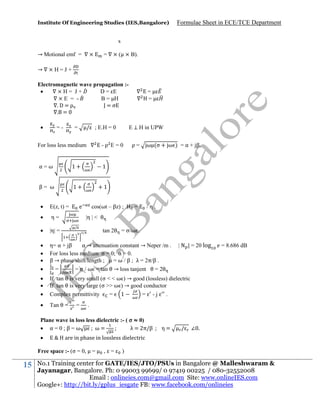
Electromagnetic wave propagation :
×H= J+
D= E
×E = B= H
.D=ρ
J=σ
. =


=-

/ ; E.H = 0

=

=
=

E ⊥ H in UPW

For loss less medium

-ρ E=0

α=ω

1+

1

β= ω

1+

ρ=

ω (σ + ω ) = α + jβ.

+1



E(z, t) =



η=



|η| =






η= α + jβ
α → attenuation constant → Neper /m .
For loss less medium σ = 0; α = 0.
β → phase shift/length ;
= ω / β ; λ = 2π/β .
=
= σ / ω = tan → loss tanjent
=2





If tan is very small (σ < < ω ) → good (lossless) dielectric
If tan is very large (σ >> ω ) → good conductor
Complex permittivity
= 1
= -j
.



Tan

e

cos(ωt – βz) ;

=

/η.

|η | <
/

tan 2

/

=

=

= σ/ω .

η=

/

∠ .

E & H are in phase in lossless dielectric

Free space :- (σ = 0,

15

= 8.686 dB

.

Plane wave in loss less dielectric :- ( σ ≈ 0)
 α=0;β=ω
ω=
λ = 2π/β


| N | = 20 log

=

, =

)

No.1 Training center for GATE/IES/JTO/PSUs in Bangalore @ Malleshwaram &
Jayanagar, Bangalore. Ph: 0 99003 99699/ 0 97419 00225 / 080-32552008
Email : onlineies.com@gmail.com Site: www.onlineIES.com
Google+: http://bit.ly/gplus_iesgate FB: www.facebook.com/onlineies
Institute Of Engineering Studies (IES,Bangalore)

 α=0,β=ω
; u = 1/
Here also E & H in phase .

Formulae Sheet in ECE/TCE Department

, λ = 2π/β

Good Conductor :σ >>ω
σ/ω → ∞ ⇒ σ = ∞

=

η=

/

< = 12 π ∠

=



α = β = π σ ; u = 2ω/ σ ; λ = 2π / β ; η =




Skin depth δ = 1/α
η=
2e / =



Skin resistance R =



R

=



R

=

∠

=

.

.

Poynting Vector :(
) ds = 
S

+

[

] dv – σ

v



δ



Total time avge power crossing given area

(z) =

| |

e

dv

cos

a
(s) ds

=
S

Direction of propagation :- (
a ×a =a

)

a ×a =a
→ Both E & H are normal to direction of propagation
→ Means they form EM wave that has no E or H component along direction of propagation .
Reflection of plane wave :(a) Normal incidence
Reflection coefficient Γ =
=
coefficient Τ =

=

Medium-I Dielectric , Medium-2 Conductor :>
:Γ
there is a standing wave in medium
Max values of | | occurs
= - nπ/β =
n = 1 2….
=

16

(

)

=

(

wave in medium ‘2’.

)

No.1 Training center for GATE/IES/JTO/PSUs in Bangalore @ Malleshwaram &
Jayanagar, Bangalore. Ph: 0 99003 99699/ 0 97419 00225 / 080-32552008
Email : onlineies.com@gmail.com Site: www.onlineIES.com
Google+: http://bit.ly/gplus_iesgate FB: www.facebook.com/onlineies
Institute Of Engineering Studies (IES,Bangalore)

<

occurs @ β

:-

β

(

=

= nπ ⇒

)

=

⇒

Formulae Sheet in ECE/TCE Department
=

(

)

=

(

)

=

min occurs when there is |t |max
| |
| |
| |
S=| |
= | |
= | |;|Γ|=

Since |Γ| < 1 ⇒ 1 ≤ δ ≤ ∞

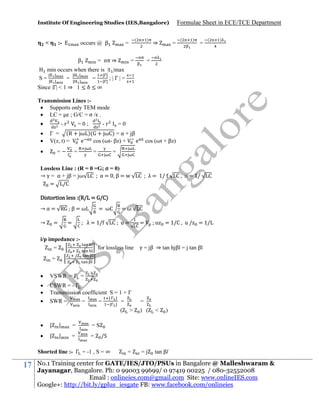
Transmission Lines : Supports only TEM mode
 LC = ; G/C = σ / .




-r

-r

=0;

=0

Γ = (R + ω )( + ωC) = α + jβ
V(z, t) =
e
cos (ωt- βz) +
e



=

=

=

cos (ωt + βz)

=

Lossless Line : (R = 0 =G; σ = 0)
→ γ = α + jβ = jω C α = β = w
= /C

C

λ = 1/

C , u = 1/

C

Distortion less :(R/L = G/C)
→α= R
→

=

β=ω
=

= ωC
λ = 1/

i/p impedance :=

=ω

C; u=

C
=

for lossless line

;u

= 1/C , u /

= 1/L

γ = jβ ⇒ tan hjβl = j tan βl

=


VSWR = Γ =





CSWR = - Γ
Transmission coefficient S = 1 + Γ
| |
SWR =
=
=
=
|

|

(


|

|

=

|

|

=

=

<

)

=j

tan βl

/S

Shorted line :- Γ = -1 , S = ∞

17

) (

=S



>

=

=

No.1 Training center for GATE/IES/JTO/PSUs in Bangalore @ Malleshwaram &
Jayanagar, Bangalore. Ph: 0 99003 99699/ 0 97419 00225 / 080-32552008
Email : onlineies.com@gmail.com Site: www.onlineIES.com
Google+: http://bit.ly/gplus_iesgate FB: www.facebook.com/onlineies
Institute Of Engineering Studies (IES,Bangalore)



Γ = -1 , S = ∞



=

Formulae Sheet in ECE/TCE Department

tan βl.

=j

may be inductive or capacitive based on length ‘0’
If l < λ / 4 → inductive (
+ve)
< l < λ/2 → capacitive ( -ve)

Open circuited line :=
= -j cot βl
Γ =1 s=∞

l < λ / 4 capacitive
< l < λ/2 inductive

=
Matched line : ( = )
=
Γ = 0 ; s =1
No reflection . Total wave

. So, max power transfer possible .

Behaviour of Transmission Line for Different lengths :l = λ /4 →
l = λ /2 :

→ impedance inverter @ l = λ /4
=

⇒

impedance reflector @ l = λ /2

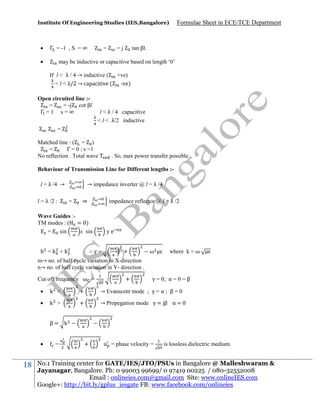
Wave Guides :TM modes : ( = )
=
sin
x sin
h =k +k

ye

∴γ=

+

ω

where k = ω

m→ no. of half cycle variation in X-direction
n→ no. of half cycle variation in Y- direction .
Cut off frequency ω =

+

γ = 0; α = 0 = β



k <

+

→ Evanscent mode ; γ = α ; β = 0



k >

+

→ Propegation mode γ = β α =

β= k


18

=

+

u = phase velocity =

is lossless dielectric medium

No.1 Training center for GATE/IES/JTO/PSUs in Bangalore @ Malleshwaram &
Jayanagar, Bangalore. Ph: 0 99003 99699/ 0 97419 00225 / 080-32552008
Email : onlineies.com@gmail.com Site: www.onlineIES.com
Google+: http://bit.ly/gplus_iesgate FB: www.facebook.com/onlineies
Institute Of Engineering Studies (IES,Bangalore)

Formulae Sheet in ECE/TCE Department



λ =u/ =



β=β



u = ω/β λ = 2π/β = u /f → phase velocity & wave length in side wave guide



η

=

η

=η

=

( )

1

β = ω/ W

=-

=

β = phase constant in dielectric medium.

1

=

1

TE Modes :- (
→

( )

η → impedance of UPW in medium

= 0)

cos

e

cos

→η

=

= η / 1

→ η

>η

→

Dominant mode

Antennas :Hertzian Dipole :-

=

sin

e

=η

Half wave Dipole :=

=η

;

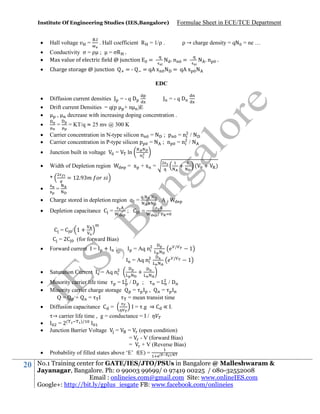
EDC & Analog







19

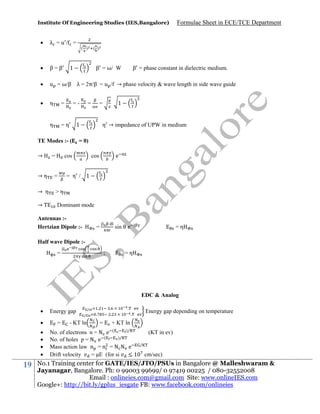
Energy gap
=

.

/
/

- KT ln

.
.

.

=

.

Energy gap depending on temperature

.

+ KT ln

)/
No. of electrons n = N e (
)/
No. of holes p = N e (
Mass action law n = n = N N e
Drift velocity
= E (for si
≤1

(KT in ev)
/

cm/sec)

No.1 Training center for GATE/IES/JTO/PSUs in Bangalore @ Malleshwaram &
Jayanagar, Bangalore. Ph: 0 99003 99699/ 0 97419 00225 / 080-32552008
Email : onlineies.com@gmail.com Site: www.onlineIES.com
Google+: http://bit.ly/gplus_iesgate FB: www.facebook.com/onlineies
Institute Of Engineering Studies (IES,Bangalore)
.



Hall voltage




Conductivity σ = ρ ; = σR .
Max value of electric field @ junction



Charge storage @ junction

=

Formulae Sheet in ECE/TCE Department

. Hall coefficient R = 1/ρ .

=-

= -

ρ → charge density = qN = ne …

N .n

= -

N .n

.

= qA x N = qA x N
EDC



Diffusion current densities J = - q D




Drift current Densities = q(p + n )E
,
decrease with increasing doping concentration .



=

J =-qD

= KT/q ≈ 25 mv @ 300 K




Carrier concentration in N-type silicon n = N ; p = n / N
Carrier concentration in P-type silicon p = N ; n = n / N



Junction built in voltage



Width of Depletion region

ln
= x +x =

+

(

+

)

= 12.9

*


=

=



Charge stored in depletion region q =



Depletion capacitance C =

.

; C =

.A.
/

C =C / 1+
C = 2C


(for forward Bias)

Forward current I =

+

;

= Aq n
= Aq n



Saturation Current




Minority carrier life time
=
Minority carrier charge storage
Q=
+
= I



Diffusion capacitance C =






20

= Aq n

/
/

1
1

+
/D ;
=
/D
=
,
=
= mean transist time
I = .g ⇒ C ∝ I.

→ carrier life time , g = conductance = I /
)/
= 2(
Junction Barrier Voltage
=
= (open condition)
= - V (forward Bias)
=
+ V (Reverse Bias)
Probability of filled states above ‘E’ f(E) =
(
)/

No.1 Training center for GATE/IES/JTO/PSUs in Bangalore @ Malleshwaram &
Jayanagar, Bangalore. Ph: 0 99003 99699/ 0 97419 00225 / 080-32552008
Email : onlineies.com@gmail.com Site: www.onlineIES.com
Google+: http://bit.ly/gplus_iesgate FB: www.facebook.com/onlineies
Institute Of Engineering Studies (IES,Bangalore)



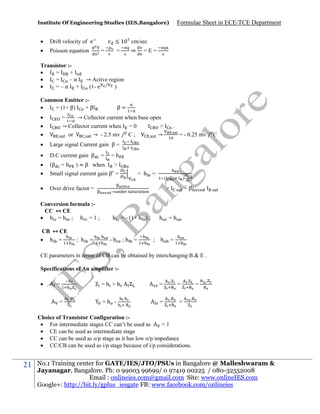
Drift velocity of e



Poisson equation

Transistor :
=
+

=
–α

=–α +

≤1

cm/sec

=

⇒

=

=E=

→ Active region
(1- e / )

Common Emitter :
= (1+ β)
+β




Formulae Sheet in ECE/TCE Department

β=

=
→ Collector current when base open
→ Collector current when = 0
>
or
→ - 2.5 mv / C ;
→



D.C current gain β



(β



Small signal current gain β =



Over drive factor =

= - 0.25 mv / C

Large signal Current gain β =



.

=h

=

=h

) ≈ β when

>

Conversion formula :CC ↔ CE
 h =h ; h =1;
CB ↔ CE
 h =

; h =

C
R

= h =

(

∵

→

h = - (1+ h ) ;

-h

)

;h =

h

; h

h
C

=β

=h

=

CE parameters in terms of CB can be obtained by interchanging B & E .
Specifications of An amplifier :

=
=

=h +h

=

=h -

=

.

.

=
=

.

=

.

.

Choice of Transistor Configuration : For intermediate stages CC can’t be used as
<1
 CE can be used as intermediate stage
 CC can be used as o/p stage as it has low o/p impedance
 CC/CB can be used as i/p stage because of i/p considerations.

21

No.1 Training center for GATE/IES/JTO/PSUs in Bangalore @ Malleshwaram &
Jayanagar, Bangalore. Ph: 0 99003 99699/ 0 97419 00225 / 080-32552008
Email : onlineies.com@gmail.com Site: www.onlineIES.com
Google+: http://bit.ly/gplus_iesgate FB: www.facebook.com/onlineies
Institute Of Engineering Studies (IES,Bangalore)

Formulae Sheet in ECE/TCE Department

Stability & Biasing :- ( Should be as min as possible)


For S =
∆

∆
∆

S =

= S. ∆

+S ∆

∆
∆

S =

∆
∆

+ S ∆β



For fixed bias S =



Collector to Base bias S =



Self bias S =



R =



For thermal stability [

=1+β
0 < s < 1+ β =

≈ 1+

βR > 10 R

; R =
- 2 (R + R )] [ 0.07

. S] < 1/

;

<

Hybrid –pi(π)- Model :g =|

|/

r
= h /g
r =h -r
r =r /h
g = h - (1+ h ) g
For CE :
=


=h

(

)

=

(

;

)

=

C = C + C (1 + g R )

=

= S.C current gain Bandwidth product
= Upper cutoff frequency
For CC :

For CB:
=

22

≈

=

(

=

)

=

= (1 + h )

(

)

= (1 + β)

No.1 Training center for GATE/IES/JTO/PSUs in Bangalore @ Malleshwaram &
Jayanagar, Bangalore. Ph: 0 99003 99699/ 0 97419 00225 / 080-32552008
Email : onlineies.com@gmail.com Site: www.onlineIES.com
Google+: http://bit.ly/gplus_iesgate FB: www.facebook.com/onlineies
Institute Of Engineering Studies (IES,Bangalore)



=

>

Ebress moll model :=-α
+
(1- e
=-α
α

/

>

)

/

(1- e

+

Formulae Sheet in ECE/TCE Department

)

=α

Multistage Amplifiers :
* =
2 /
1 ;
.



Rise time t =



t = 1.1 t

+t

= 1.1

+

+



= 1.1

+

/

+



=
.
.

+

=

Differential Amplifier :

= h + (1 + h ) 2R = 2 h R ≈ 2βR
|



g =



|

CMRR =

= g of BJT/4

=

;

R ↑,→

Darlington Pair :
= (1 + β ) (1 + β ) ;


=

(

)



R =(

)



α → DC value of α
↑

↑

C RR ↑

≈ 1 ( < 1)

g = (1 + β ) g

Ω

[ if

&

have same type ] =

R

+

Tuned Amplifiers : (Parallel Resonant ckts used ) :


23

=

Q → ‘Q’ factor of resonant ckt which is very high

No.1 Training center for GATE/IES/JTO/PSUs in Bangalore @ Malleshwaram &
Jayanagar, Bangalore. Ph: 0 99003 99699/ 0 97419 00225 / 080-32552008
Email : onlineies.com@gmail.com Site: www.onlineIES.com
Google+: http://bit.ly/gplus_iesgate FB: www.facebook.com/onlineies
Institute Of Engineering Studies (IES,Bangalore)



B.W =



=

-



=

+



Formulae Sheet in ECE/TCE Department

/Q
∆
∆

For double tuned amplifier 2 tank circuits with same

used .

=

.

MOSFET (Enhancement) [ Channel will be induced by applying voltage]





NMOSFET formed in p-substrate
If
≥ channel will be induced & i (Drain → source )
→ +ve for NMOS
i ∝(
- ) for small



↑ → channel width @ drain reduces .
=

channel width ≈ 0 → pinch off further increase no effect

-



For every



i =

>

[(

there will be

-

)

-

→ triode region (

]

=


i =



r

[

=

(






24

[(

)

] → saturation

)

→ Drain to source resistance in triode region

→ induced channel

i =

-

C

PMOS : Device operates in similar manner except
,
,
 i enters @ source terminal & leaves through Drain .
≤

<

) -

≥
]

→ Continuous channel

=

are –ve

C

≤
→ Pinched off channel .
NMOS Devices can be made smaller & thus operate faster . Require low power supply .
Saturation region → Amplifier
For switching operation Cutoff & triode regions are used
NMOS

PMOS

No.1 Training center for GATE/IES/JTO/PSUs in Bangalore @ Malleshwaram &
Jayanagar, Bangalore. Ph: 0 99003 99699/ 0 97419 00225 / 080-32552008
Email : onlineies.com@gmail.com Site: www.onlineIES.com
Google+: http://bit.ly/gplus_iesgate FB: www.facebook.com/onlineies
Institute Of Engineering Studies (IES,Bangalore)

≥

≤

Formulae Sheet in ECE/TCE Department

→ induced channel

-

>

-

<

→ Continuous channel(Triode region)

≥

-

≤

-

→ Pinchoff (Saturation)

Depletion Type MOSFET :- [ channel is physically implanted . i flows with


For n-channel



i -



Value of Drain current obtained in saturation when

→ +ve → enhances channel .
→ -ve → depletes channel
is –ve for n-channel

characteristics are same except that

∴

=0]

=

=0⇒

.

.

MOSFET as Amplifier :


For saturation
>
To reduce non linear distortion



i =




(

)

⇒

g =

)
(

)

=-g R
Unity gain frequency

JFET :
≤

≤

≤

=

(

)

⇒ i = 0 → Cut off
≤ 0,
≤
i



< < 2(

≤0 ,

=

2 1
≥

→ Triode

⇒
|

→ Saturation

|

|

|

Zener Regulators :

25

For satisfactory operation

≥

+

No.1 Training center for GATE/IES/JTO/PSUs in Bangalore @ Malleshwaram &
Jayanagar, Bangalore. Ph: 0 99003 99699/ 0 97419 00225 / 080-32552008
Email : onlineies.com@gmail.com Site: www.onlineIES.com
Google+: http://bit.ly/gplus_iesgate FB: www.facebook.com/onlineies
Institute Of Engineering Studies (IES,Bangalore)



R

Formulae Sheet in ECE/TCE Department

=



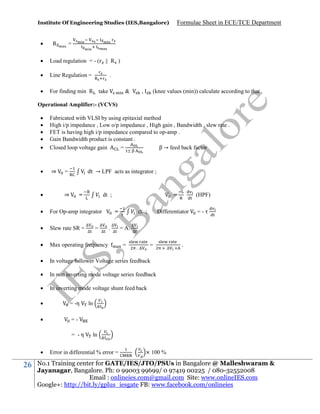
Load regulation = - (r || R )



Line Regulation =



For finding min R

.
take

&

,

(knee values (min)) calculate according to that .

Operational Amplifier:- (VCVS)






Fabricated with VLSI by using epitaxial method
High i/p impedance , Low o/p impedance , High gain , Bandwidth , slew rate .
FET is having high i/p impedance compared to op-amp .
Gain Bandwidth product is constant .
Closed loop voltage gain
=
β → feed back factor



⇒



dt → LPF acts as integrator ;

=

⇒

=

dt ;

=



For Op-amp integrator



Slew rate SR =



Max operating frequency



In voltage follower Voltage series feedback



In non inverting mode voltage series feedback



In inverting mode voltage shunt feed back



= -η



∆
∆

=

∆
∆

=
.

∆
∆

dt ;
= A.
=

Differentiator

=-

∆
∆

=

. ∆

∆

.

== -η



26

(HPF)

ln

ln

Error in differential % error =

× 100 %

No.1 Training center for GATE/IES/JTO/PSUs in Bangalore @ Malleshwaram &
Jayanagar, Bangalore. Ph: 0 99003 99699/ 0 97419 00225 / 080-32552008
Email : onlineies.com@gmail.com Site: www.onlineIES.com
Google+: http://bit.ly/gplus_iesgate FB: www.facebook.com/onlineies
Institute Of Engineering Studies (IES,Bangalore)

Formulae Sheet in ECE/TCE Department

Power Amplifiers :

Fundamental power delivered to load



Total Harmonic power delivered to load

R

=

=

=

+

=

+

1+

R
..
+

+ ……

= [ 1+ D ]
Where D =

+D +

. . +D

D =

D = total harmonic Distortion .
Class A operation : o/p flows for entire
 ‘Q’ point located @ centre of DC load line i.e.,
=
/ 2 ; η = 25 %
 Min Distortion , min noise interference , eliminates thermal run way
 Lowest power conversion efficiency & introduce power drain

=
-i
if i = 0, it will consume more power

is dissipated in single transistors only (single ended)
Class B:




flows for 18 ; ‘Q’ located @ cutoff ; η = 78.5% ; eliminates power drain
Higher Distortion , more noise interference , introduce cross over distortion
Double ended . i.e ., 2 transistors .
= 0 [ transistors are connected in that way ]
=i
= 0.4
→ power dissipated by 2 transistors .

=i

Class AB operation :




flows for more than 18 & less than
‘Q’ located in active region but near to cutoff ; η = 60%
Distortion & Noise interference less compared to class ‘B’ but more in compared to class ‘A’
Eliminates cross over Distortion

Class ‘C’ operation :
flows for < 180 ; ‘Q’ located just below cutoff ; η = 87.5%
 Very rich in Distortion ; noise interference is high .
Oscillators : For RC-phase shift oscillator f =
f=

27

h ≥ 4k + 23 +

where k = R /R

> 29

No.1 Training center for GATE/IES/JTO/PSUs in Bangalore @ Malleshwaram &
Jayanagar, Bangalore. Ph: 0 99003 99699/ 0 97419 00225 / 080-32552008
Email : onlineies.com@gmail.com Site: www.onlineIES.com
Google+: http://bit.ly/gplus_iesgate FB: www.facebook.com/onlineies
Institute Of Engineering Studies (IES,Bangalore)



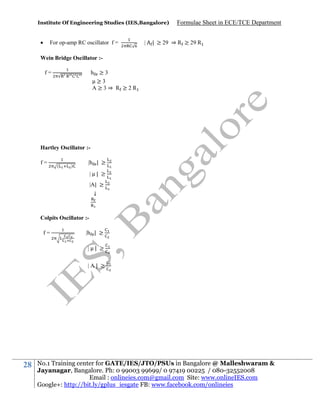
For op-amp RC oscillator f =

|

Formulae Sheet in ECE/TCE Department

| ≥ 29 ⇒ R ≥ 29 R

Wein Bridge Oscillator :h ≥3
≥3
A≥3⇒ R ≥2R

f=

Hartley Oscillator :f=

(

)

|h | ≥
| | ≥
|A| ≥
↓

Colpits Oscillator :f=

|h | ≥
|

| ≥

|A| ≥

28

No.1 Training center for GATE/IES/JTO/PSUs in Bangalore @ Malleshwaram &
Jayanagar, Bangalore. Ph: 0 99003 99699/ 0 97419 00225 / 080-32552008
Email : onlineies.com@gmail.com Site: www.onlineIES.com
Google+: http://bit.ly/gplus_iesgate FB: www.facebook.com/onlineies
Institute Of Engineering Studies (IES,Bangalore)

Formulae Sheet in ECE/TCE Department

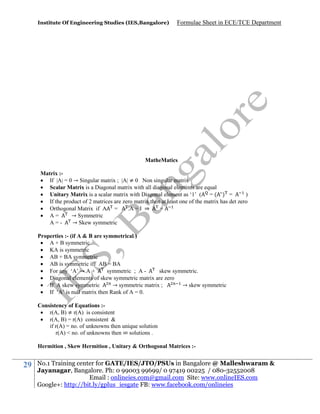
MatheMatics
Matrix : If |A| = 0 → Singular matrix ; |A| ≠ 0 Non singular matrix
 Scalar Matrix is a Diagonal matrix with all diagonal elements are equal
 Unitary Matrix is a scalar matrix with Diagonal element as ‘1’ ( = ( ) =
)
 If the product of 2 matrices are zero matrix then at least one of the matrix has det zero
 Orthogonal Matrix if A =
.A = I ⇒
=
 A=
→ Symmetric
A=→ Skew symmetric
Properties :- (if A & B are symmetrical )
 A + B symmetric
 KA is symmetric
 AB + BA symmetric
 AB is symmetric iff AB = BA
 For any ‘A’ → A +
symmetric ; A skew symmetric.
 Diagonal elements of skew symmetric matrix are zero
 If A skew symmetric
→ symmetric matrix ;
→ skew symmetric
 If ‘A’ is null matrix then Rank of A = 0.
Consistency of Equations : r(A, B) ≠ r(A) is consistent
 r(A, B) = r(A) consistent &
if r(A) = no. of unknowns then unique solution
r(A) < no. of unknowns then ∞ solutions .
Hermition , Skew Hermition , Unitary & Orthogonal Matrices :-

29

No.1 Training center for GATE/IES/JTO/PSUs in Bangalore @ Malleshwaram &
Jayanagar, Bangalore. Ph: 0 99003 99699/ 0 97419 00225 / 080-32552008
Email : onlineies.com@gmail.com Site: www.onlineIES.com
Google+: http://bit.ly/gplus_iesgate FB: www.facebook.com/onlineies
Institute Of Engineering Studies (IES,Bangalore)








Formulae Sheet in ECE/TCE Department

=
→ then Hermition
=
→ then Hermition
Diagonal elements of Skew Hermition Matrix must be purely imaginary or zero
Diagonal elements of Hermition matrix always real .
A real Hermition matrix is a symmetric matrix.
|KA| =
|A|

Eigen Values & Vectors : Char. Equation |A – λI| = 0.
Roots of characteristic equation are called eigen values . Each eigen value corresponds to non zero
solution X such that (A – λI)X = 0 . X is called Eigen vector .
 Sum of Eigen values is sum of Diagonal elements (trace)
 Product of Eigen values equal to Determinent of Matrix .
 Eigen values of
& A are same
| |
 λ is igen value o then 1/ λ →
&
is Eigen value of adj A.


λ , λ …… λ are Eigen values of A then
→

λ , K λ …….. λ

→ λ , λ ………….. λ .
A + KI
→ λ + k , λ + k , …….. λ + k
(
) → (λ
k) , ……… (λ
k)






Eigen values of orthogonal matrix have absolute value of ‘1’ .
Eigen values of symmetric matrix also purely real .
Eigen values of skew symmetric matrix are purely imaginary or zero .
λ , λ , …… λ distinct eigen values of A then corresponding eigen vectors
linearly independent set .
adj (adj A) = | |
; | adj (adj A) | = | |( )

,

, .. …

for

Complex Algebra :

Cauchy Rieman equations
Neccessary & Sufficient Conditions for f(z) to be analytic






30

( )/(

a)

f(z) = f( ) + ( )

dz =
(

)

[

(a) ] if f(z) is analytic in region ‘C’ & Z =a is single point
( )

(

)

(

)

+ …… + ( )
+ ………. Taylor Series
⇓
( )
if
= 0 then it is called Mclauren Series f(z) =
a (
) ; when a =
If f(z) analytic in closed curve ‘C’ except @ finite no. of poles then
+

No.1 Training center for GATE/IES/JTO/PSUs in Bangalore @ Malleshwaram &
Jayanagar, Bangalore. Ph: 0 99003 99699/ 0 97419 00225 / 080-32552008
Email : onlineies.com@gmail.com Site: www.onlineIES.com
Google+: http://bit.ly/gplus_iesgate FB: www.facebook.com/onlineies
Institute Of Engineering Studies (IES,Bangalore)

Formulae Sheet in ECE/TCE Department

( )d = 2πi (sum of Residues @ singular points within ‘C’ )
Res f(a) = lim

(

→

= Φ(a) /
= lim

( )
(a)

→ (

)

((

a) f(z) )

Calculus :Rolle’s theorem :If f(x) is
(a) Continuous in [a, b]
(b) Differentiable in (a, b)
(c) f(a) = f(b) then there exists at least one value C (a, b) such that

(c) = 0 .

Langrange’s Mean Value Theorem :If f(x) is continuous in [a, b] and differentiable in (a, b) then there exists atleast one value ‘C’ in (a, b)
such that

(c) =

( )

( )

Cauchy’s Mean value theorem :If f(x) & g(x) are two function such that
(a) f(x) & g(x) continuous in [a, b]
(b) f(x) & g(x) differentiable in (a, b)
(c) g (x) ≠ 0 ∀ x in (a, b)
Then there exist atleast one value C in (a, b) such that
(c) / g (c) =

( )
( )

( )
( )

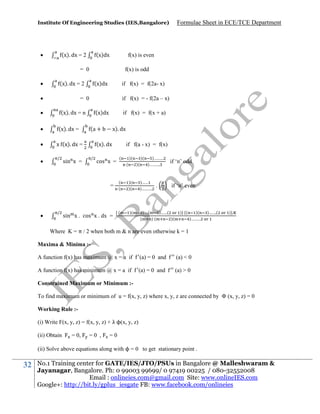
Properties of Definite integrals :


31

(x). dx =
(x). dx +
a<c<b
(x)dx =
(a x)dx

(x). dx

No.1 Training center for GATE/IES/JTO/PSUs in Bangalore @ Malleshwaram &
Jayanagar, Bangalore. Ph: 0 99003 99699/ 0 97419 00225 / 080-32552008
Email : onlineies.com@gmail.com Site: www.onlineIES.com
Google+: http://bit.ly/gplus_iesgate FB: www.facebook.com/onlineies
Institute Of Engineering Studies (IES,Bangalore)



(x). dx = 2

(x)dx

f(x) is even

= 0


f(x) is odd

(x). dx = 2



(x)dx

if f(x) = f(2a- x)
if f(x) = - f(2a – x)

= 0



(x). dx = n



(x). dx =



/

(x)dx

x (x). dx =



if f(x) = f(x + a)

(a +

x). dx

(x). dx
/

sin x =

cos x =

=



/

Formulae Sheet in ECE/TCE Department

sin x . cos x . dx =

if f(a - x) = f(x)
(

)(
(

)(
)(

(
(

)(
)(

(

)(

)………
)……….

)……
)……….

if ‘n’ even

.

)….(
(

if ‘n’ odd

)……(
)(

) (
)(

)(
)………

)…….(

).

Where K = π / 2 when both m & n are even otherwise k = 1
Maxima & Minima :A function f(x) has maximum @ x = a if

(a) = 0 and

(a) < 0

A function f(x) has minimum @ x = a if

(a) = 0 and

(a) > 0

Constrained Maximum or Minimum :To find maximum or minimum of u = f(x, y, z) where x, y, z are connected by Φ (x, y, z) = 0
Working Rule :(i) Write F(x, y, z) = f(x, y, z) + λ ϕ(x, y, z)
(ii) Obtain

= 0,

=0 ,

=0

(ii) Solve above equations along with ϕ = 0 to get stationary point .

32

No.1 Training center for GATE/IES/JTO/PSUs in Bangalore @ Malleshwaram &
Jayanagar, Bangalore. Ph: 0 99003 99699/ 0 97419 00225 / 080-32552008
Email : onlineies.com@gmail.com Site: www.onlineIES.com
Google+: http://bit.ly/gplus_iesgate FB: www.facebook.com/onlineies
Institute Of Engineering Studies (IES,Bangalore)

Formulae Sheet in ECE/TCE Department

Laplace Transform :

L



L { t f(t) } = ( 1)

( ) = s f(s) - s

()




⇔

f(0) - s

(0) ……

(0)

f(s)

(s) ds

(u) du ⇔ f(s) / s .

Inverse Transforms :



(

)

(

)

(

)

=

t sin at

=

[ sin at + at cos at]

=

[ sin at - at cos at]



= Cos hat



= Sin hat

Laplace Transform of periodic function : L { f(t) } =

()

Numerical Methods :Bisection Method :(1) Take two values of x & x such that f(x ) is +ve & f(x ) is –ve then x =
+ve then root lies between x & x otherwise it lies between x & x .

find f(x ) if f(x )

Regular falsi method :Same as bisection except x = x -

(

)

(

)

f(x )

Newton Raphson Method :x

=x –

( )
( )

Pi cards Method :-

33

No.1 Training center for GATE/IES/JTO/PSUs in Bangalore @ Malleshwaram &
Jayanagar, Bangalore. Ph: 0 99003 99699/ 0 97419 00225 / 080-32552008
Email : onlineies.com@gmail.com Site: www.onlineIES.com
Google+: http://bit.ly/gplus_iesgate FB: www.facebook.com/onlineies
Institute Of Engineering Studies (IES,Bangalore)

y

=y +

(x y )

←

Formulae Sheet in ECE/TCE Department

= f(x, y)

Taylor Series method := f(x, y)

y = y + (x- x ) (y ) +

(

)

(y) + ………….

(

)

+

)

(y)

Euler’s method :y = y + h f(x , y )
y

←

= f(x, y

( )

= y + [f(x , y ) + f(x + h, y )

( )

= y + [f(x , y ) + f(x

y

,y

( )

)]

:
:
Calculate till two consecutive value of ‘y’ agree
y = y + h f(x + h, y )
y

( )

= y + [f(x + h, y ) + f(x + 2h, y )

………………

Runge’s Method :k = h f(x , y )
k = h f( x + , y +

)

finally compute K = (

+4

+

finally compute K = (

+2

+2

)

k = h f(x +h , y + k )
k = h ( f (x +h , y + k ))

Runge Kutta Method :k = h f(x , y )
k = h f( x + , y +

34

)

No.1 Training center for GATE/IES/JTO/PSUs in Bangalore @ Malleshwaram &
Jayanagar, Bangalore. Ph: 0 99003 99699/ 0 97419 00225 / 080-32552008
Email : onlineies.com@gmail.com Site: www.onlineIES.com
Google+: http://bit.ly/gplus_iesgate FB: www.facebook.com/onlineies
Institute Of Engineering Studies (IES,Bangalore)

k = h f(x + , y +

Formulae Sheet in ECE/TCE Department

∴ approximation vale

)

y =y +K.

k = h f (x +h , y + k )
Trapezoidal Rule :(x). dx =

[ ( y + y ) + 2 (y + y + ……. y

)]

f(x) takes values y , y …..
@ x , x , x ……..
Simpson’s one third rule :(x). dx =

[ ( y + y ) + 4 (y + y + ……. y

) + 2 (y + y +

….+ y

)]

Simpson three eighth rule :(x). dx =

[ ( y + y ) + 3 (y + y + y + y + ……. y

)+ 2 (y + y +

….+ y

)]

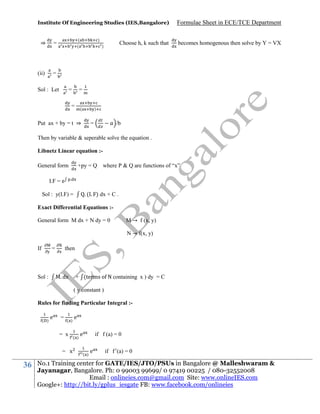
Differential Equations :Variable & Seperable :f(y) dy = ϕ(x) dx

General form is

(y) dy = ϕ(x) dx + C .

Sol:

Homo generous equations :General form

=

(
(

⇒

Sol : Put y = Vx

)
)

f(x, y) & ϕ(x y) Homogenous of same degree
=V+x

& solve

Reducible to Homogeneous :General form
(i)

≠

Sol : Put

35

=

x=X+h

y=Y+k

No.1 Training center for GATE/IES/JTO/PSUs in Bangalore @ Malleshwaram &
Jayanagar, Bangalore. Ph: 0 99003 99699/ 0 97419 00225 / 080-32552008
Email : onlineies.com@gmail.com Site: www.onlineIES.com
Google+: http://bit.ly/gplus_iesgate FB: www.facebook.com/onlineies
Institute Of Engineering Studies (IES,Bangalore)

⇒

(ii)

(
(

=

)

Formulae Sheet in ECE/TCE Department

=

Sol : Let

=

Choose h, k such that

)

becomes homogenous then solve by Y = VX

=

=

(

)

Put ax + by = t ⇒

=

/b

Then by variable & seperable solve the equation .
Libnetz Linear equation :+py = Q where P & Q are functions of “x”

General form
.

I.F = e

. ( . ) dx + C .

Sol : y(I.F) =

Exact Differential Equations :M → f (x, y)

General form M dx + N dy = 0

N → f(x, y)
If

y

=

N
x

then

. dx

Sol :

+ (terms o N containing x ) dy = C
( y constant )

Rules for finding Particular Integral :( )

e

=

( )

= x
= x

36

e

( )

e

( )

if f (a) = 0
e

if

(a) = 0

No.1 Training center for GATE/IES/JTO/PSUs in Bangalore @ Malleshwaram &
Jayanagar, Bangalore. Ph: 0 99003 99699/ 0 97419 00225 / 080-32552008
Email : onlineies.com@gmail.com Site: www.onlineIES.com
Google+: http://bit.ly/gplus_iesgate FB: www.facebook.com/onlineies
Institute Of Engineering Studies (IES,Bangalore)

(

sin (ax + b) =

)

(

= x

(

f(- a ) = 0

sin (ax + b)

)

=x

( )

f(- a ) ≠ 0

sin (ax + b)

)

(

Formulae Sheet in ECE/TCE Department

Same applicable for cos (ax + b)

sin (ax + b)

)

x = [ (D)] x

( )

e

f(x) = e

(

f(x)

)

Vector Calculus :Green’s Theorem :(ϕ dx +

Ψ
x

dy) =

ϕ
y

dx dy

This theorem converts a line integral around a closed curve into Double integral which is special case of
Stokes theorem .
Series expansion :Taylor Series :f(x) = f(a) +
f(x) = f(0) +

( )

( )

x +

(1 + x) = 1+ nx +
e = 1+x+

( )

(x-a) +

(x

a) + …………+

( )

x + …………+

)

(x

a)

x + …… | nx| < 1

(

( )

( )

x

+ ……. (mc lower series )

+ ……..

Sin x = x -

+

- ……..

Cos x = 1 -

+

- ……..
Digital Electronics





37

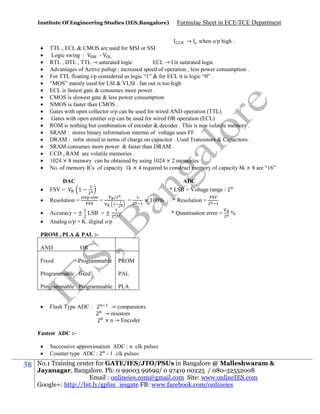
Fan out of a logic gate =

Noise margin :
or
Power Dissipation
=

or
=

→

when o/p low

No.1 Training center for GATE/IES/JTO/PSUs in Bangalore @ Malleshwaram &
Jayanagar, Bangalore. Ph: 0 99003 99699/ 0 97419 00225 / 080-32552008
Email : onlineies.com@gmail.com Site: www.onlineIES.com
Google+: http://bit.ly/gplus_iesgate FB: www.facebook.com/onlineies
Institute Of Engineering Studies (IES,Bangalore)

Formulae Sheet in ECE/TCE Department




















→ when o/p high .
TTL , ECL & CMOS are used for MSI or SSI
Logic swing :
RTL , DTL , TTL → saturated logic
ECL → Un saturated logic
Advantages of Active pullup ; increased speed of operation , less power consumption .
For TTL floating i/p considered as logic “1” & for ECL it is logic “0” .
“MOS” mainly used for LSI & VLSI . fan out is too high
ECL is fastest gate & consumes more power .
CMOS is slowest gate & less power consumption
NMOS is faster than CMOS .
Gates with open collector o/p can be used for wired AND operation (TTL)
Gates with open emitter o/p can be used for wired OR operation (ECL)
ROM is nothing but combination of encoder & decoder . This is non volatile memory .
SRAM : stores binary information interms of voltage uses FF.
DRAM : infor stored in terms of charge on capacitor . Used Transistors & Capacitors .
SRAM consumes more power & faster than DRAM .
CCD , RAM are volatile memories .
1024 × 8 memory can be obtained by using 1024 × 2 memories
No. of memory ICs of capacity 1k × 4 required to construct memory of capacity 8k × 8 are “16”



DAC
FSV =
1



Resolution =




Accuracy = ± LSB = ±
Analog o/p = K. digital o/p

ADC
* LSB = Voltage range / 2
=

/

=

1

%

* Resolution =
* Quantisation error =

%

PROM , PLA & PAL :AND
Fixed

OR
Programmable

Programmable fixed

PROM
PAL

Programmable Programmable PLA


Flash Type ADC : 2
→ comparators
2 → resistors
2 × n → Encoder

Fastest ADC :


38

Successive approximation ADC : n clk pulses
Counter type ADC : 2 - 1 clk pulses

No.1 Training center for GATE/IES/JTO/PSUs in Bangalore @ Malleshwaram &
Jayanagar, Bangalore. Ph: 0 99003 99699/ 0 97419 00225 / 080-32552008
Email : onlineies.com@gmail.com Site: www.onlineIES.com
Google+: http://bit.ly/gplus_iesgate FB: www.facebook.com/onlineies
Institute Of Engineering Studies (IES,Bangalore)



Dual slope integrating type : 2

Formulae Sheet in ECE/TCE Department

clock pulses .

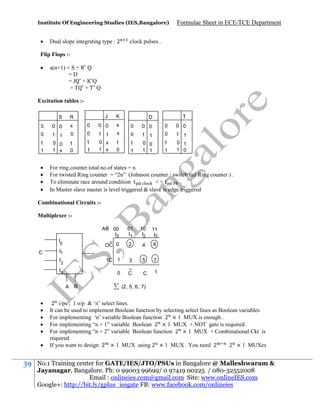
Flip Flops :

a(n+1) = S + R Q
=D
=J + Q
=T + Q

Excitation tables :J

K

0

0 0

x

0

0 0

0

0 0

0

0

x

0

1
0

1
0

1

1 1
0 0
1 1

0

1

1 1
0 x
1 x

1 1
0 1
1 0

S

R

0

0 0

x

0

1 1
0 0
1 x

1
1






1

T

D

1

1
1

For ring counter total no.of states = n
For twisted Ring counter = “2n” (Johnson counter / switch tail Ring counter ) .
To eliminate race around condition t
<<t
.
In Master slave master is level triggered & slave is edge triggered

Combinational Circuits :Multiplexer :AB 00
I0
_
OC 0

C

2

I3

39

2

4

6

3
_
C

5

7

C

1

0
A



11
I3

I1
I







10
I2

1C 1

I0

01
I1

B

(2, 5, 6, 7)

2 i/ps ; 1 o/p & ‘n’ select lines.
It can be used to implement Boolean function by selecting select lines as Boolean variables
For implementing ‘n’ variable Boolean function 2 × 1 MUX is enough .
For implementing “n + 1” variable Boolean 2 × 1 MUX + NOT gate is required .
For implementing “n + 2” variable Boolean function 2 × 1 MUX + Combinational Ckt is
required
If you want to design 2 × 1 MUX using 2 × 1 MUX . You need 2
2 × 1 MUXes

No.1 Training center for GATE/IES/JTO/PSUs in Bangalore @ Malleshwaram &
Jayanagar, Bangalore. Ph: 0 99003 99699/ 0 97419 00225 / 080-32552008
Email : onlineies.com@gmail.com Site: www.onlineIES.com
Google+: http://bit.ly/gplus_iesgate FB: www.facebook.com/onlineies
Institute Of Engineering Studies (IES,Bangalore)

Formulae Sheet in ECE/TCE Department

Decoder :




n i/p & 2 o/p’s
used to implement the Boolean function . It will generate required min terms @ o/p & those terms
should be “OR” ed to get the result .
Suppose it consists of more min terms then connect the max terms to NOR gate then it will give the
same o/p with less no. of gates .
If you want to Design m × 2 Decoder using n × 2 Decoder . Then no. of n × 2 Decoder
required =




.

In Parallel (“n” bit ) total time delay = 2 t
For carry look ahead adder delay = 2 t .

.

Microprocessors

40

No.1 Training center for GATE/IES/JTO/PSUs in Bangalore @ Malleshwaram &
Jayanagar, Bangalore. Ph: 0 99003 99699/ 0 97419 00225 / 080-32552008
Email : onlineies.com@gmail.com Site: www.onlineIES.com
Google+: http://bit.ly/gplus_iesgate FB: www.facebook.com/onlineies
Institute Of Engineering Studies (IES,Bangalore)






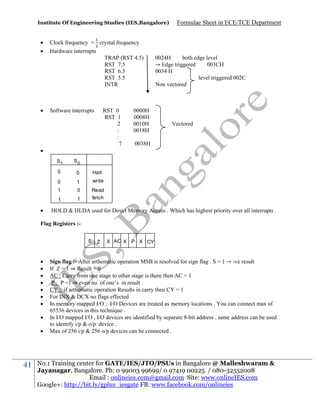
Clock frequency = crystal frequency
Hardware interrupts
TRAP (RST 4.5)
RST 7.5
RST 6.5
RST 5.5
INTR

Software interrupts

RST 0
RST 1
2
:
:
7


S1

1
0

1

1

0038H

write

1

Vectored

Halt

0



0

0024H
both edge level
→ Edge triggered
003CH
0034 H
level triggered 002C
Non vectored

S0

0

0000H
0008H
0010H
0018H

Formulae Sheet in ECE/TCE Department

Read
fetch

HOLD & HLDA used for Direct Memory Access . Which has highest priority over all interrupts .

Flag Registers :S











41

Z

X AC X P X CY

Sign flag :- After arthematic operation MSB is resolved for sign flag . S = 1 → -ve result
If Z = 1 ⇒ Result = 0
AC : Carry from one stage to other stage is there then AC = 1
P : P =1 ⇒ even no. of one’s in result .
CY : if arthematic operation Results in carry then CY = 1
For INX & DCX no flags effected
In memory mapped I/O ; I/O Devices are treated as memory locations . You can connect max of
65536 devices in this technique .
In I/O mapped I/O , I/O devices are identified by separate 8-bit address . same address can be used
to identify i/p & o/p device .
Max of 256 i/p & 256 o/p devices can be connected .

No.1 Training center for GATE/IES/JTO/PSUs in Bangalore @ Malleshwaram &
Jayanagar, Bangalore. Ph: 0 99003 99699/ 0 97419 00225 / 080-32552008
Email : onlineies.com@gmail.com Site: www.onlineIES.com
Google+: http://bit.ly/gplus_iesgate FB: www.facebook.com/onlineies
Institute Of Engineering Studies (IES,Bangalore)

Formulae Sheet in ECE/TCE Department

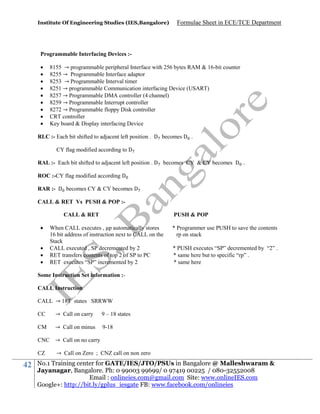
Programmable Interfacing Devices :









8155 → programmable peripheral Interface with 256 bytes RAM & 16-bit counter
8255 → Programmable Interface adaptor
8253 → Programmable Interval timer
8251 → programmable Communication interfacing Device (USART)
8257 → Programmable DMA controller (4 channel)
8259 → Programmable Interrupt controller
8272 → Programmable floppy Disk controller
CRT controller
Key board & Display interfacing Device

RLC :- Each bit shifted to adjacent left position . D becomes D .
CY flag modified according to D
RAL :- Each bit shifted to adjacent left position . D becomes CY & CY becomes D .
ROC :-CY flag modified according D
RAR :- D becomes CY & CY becomes D
CALL & RET Vs PUSH & POP :CALL & RET





PUSH & POP

When CALL executes , p automatically stores
16 bit address of instruction next to CALL on the
Stack
CALL executed , SP decremented by 2
RET transfers contents of top 2 of SP to PC
RET executes “SP” incremented by 2

* Programmer use PUSH to save the contents
rp on stack
* PUSH executes “SP” decremented by “2” .
* same here but to specific “rp” .
* same here

Some Instruction Set information :CALL Instruction
CALL → 18T states SRRWW
CC

→ Call on carry

9 – 18 states

CM

→ Call on minus

9-18

CNC → Call on no carry
CZ

42

→ Call on Zero ; CNZ call on non zero

No.1 Training center for GATE/IES/JTO/PSUs in Bangalore @ Malleshwaram &
Jayanagar, Bangalore. Ph: 0 99003 99699/ 0 97419 00225 / 080-32552008
Email : onlineies.com@gmail.com Site: www.onlineIES.com
Google+: http://bit.ly/gplus_iesgate FB: www.facebook.com/onlineies
Institute Of Engineering Studies (IES,Bangalore)

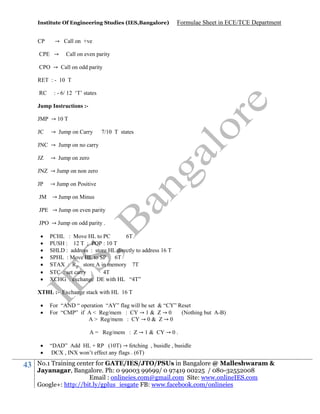
CP

Formulae Sheet in ECE/TCE Department

→ Call on +ve

CPE →

Call on even parity

CPO → Call on odd parity
RET : - 10 T
RC

: - 6/ 12 ‘T’ states

Jump Instructions :JMP → 10 T
JC

→ Jump on Carry

7/10 T states

JNC → Jump on no carry
JZ

→ Jump on zero

JNZ → Jump on non zero
JP
JM

→ Jump on Positive
→ Jump on Minus

JPE → Jump on even parity
JPO → Jump on odd parity .








PCHL : Move HL to PC
6T
PUSH : 12 T ; POP : 10 T
SHLD : address : store HL directly to address 16 T
SPHL : Move HL to SP 6T
STAX : R store A in memory 7T
STC : set carry
4T
XCHG : exchange DE with HL “4T”

XTHL :- Exchange stack with HL 16 T



For “AND “ operation “AY” flag will be set & “CY” Reset
For “CMP” if A < Reg/mem : CY → 1 & Z → 0
(Nothing but A-B)
A > Reg/mem : CY → 0 & Z → 0
A = Reg/mem : Z → 1 & CY → 0 .




43

“DAD” Add HL + RP (10T) → fetching , busidle , busidle
DCX , INX won’t effect any flags . (6T)

No.1 Training center for GATE/IES/JTO/PSUs in Bangalore @ Malleshwaram &
Jayanagar, Bangalore. Ph: 0 99003 99699/ 0 97419 00225 / 080-32552008
Email : onlineies.com@gmail.com Site: www.onlineIES.com
Google+: http://bit.ly/gplus_iesgate FB: www.facebook.com/onlineies
Institute Of Engineering Studies (IES,Bangalore)



44

Formulae Sheet in ECE/TCE Department

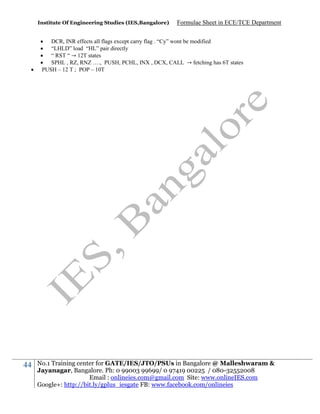
 DCR, INR effects all flags except carry flag . “Cy” wont be modified
 “LHLD” load “HL” pair directly
 “ RST “ → 12T states
 SPHL , RZ, RNZ …., PUSH, PCHL, INX , DCX, CALL → fetching has 6T states
PUSH – 12 T ; POP – 10T

No.1 Training center for GATE/IES/JTO/PSUs in Bangalore @ Malleshwaram &
Jayanagar, Bangalore. Ph: 0 99003 99699/ 0 97419 00225 / 080-32552008
Email : onlineies.com@gmail.com Site: www.onlineIES.com
Google+: http://bit.ly/gplus_iesgate FB: www.facebook.com/onlineies

Ece formula sheet

  • 1.
    Institute Of EngineeringStudies (IES,Bangalore) Formulae Sheet in ECE/TCE Department Communication Systems Amplitude Modulation : DSB-SC : u (t) = m(t) cos 2π t Power P = Conventioanal AM : u (t) = [1 + m(t)] Cos 2π t . as long as |m(t)| ≤ 1 demodulation is simple . Practically m(t) = a m (t) . () () Modulation index a = ( ) , m (t) = | ( )| Power = + SSB-AM : → Square law Detector SNR = () Square law modulator ↓ = 2a / a → amplitude Sensitivity Envelope Detector R C (i/p) < < 1 / R C (o/P) >> 1/ R C << 1/ω ≥ Frequency & Phase Modulation : Angle Modulation :u (t) = ∅ (t) Cos (2π t + ∅ (t) ) ( ) → 2π phase & frequency deviation constant m(t) . dt → → max phase deviation ∆∅ = max | m(t) | → max requency deviation ∆ = max |m(t) | Bandwidth : Effective Bandwidth = 2 (β + 1) → 98% power Noise in Analog Modulation :→ (SNR) R = m(t) cos 2π 1 = = = ∴ = /2 No.1 Training center for GATE/IES/JTO/PSUs in Bangalore @ Malleshwaram & Jayanagar, Bangalore. Ph: 0 99003 99699/ 0 97419 00225 / 080-32552008 Email : onlineies.com@gmail.com Site: www.onlineIES.com Google+: http://bit.ly/gplus_iesgate FB: www.facebook.com/onlineies
  • 2.
    Institute Of EngineeringStudies (IES,Bangalore) → (SNR) = / → (SNR) = / = / / = = = . = = = = = (SNR) = (SNR) = η Formulae Sheet in ECE/TCE Department . η= Noise in Angle Modulation :- = PCM :→ Min. no of samples required for reconstruction = 2ω = → Total bits required = v → Bandwidth = R /2 = v ; ω = Bandwidth of msg signal . bps . v → bits / sample /2=v.ω → SNR = 1.76 + 6.02 v → As Number of bits increased SNR increased by 6 dB/bit . Band width also increases. Delta Modulation :→ By increasing step size slope over load distortion eliminated [ Signal raised sharply ] → By Reducing step size Grannualar distortion eliminated . [ Signal varies slowly ] Digital Communication Matched filter: → impulse response a(t) = ( T – t) . P(t) → i/p → Matched filter o/p will be max at multiples of ‘T’ . So, sampling @ multiples of ‘T’ will give max SNR (2nd point ) → matched filter is always causal a(t) = 0 for t < 0 → Spectrum of o/p signal of matched filter with the matched signal as i/p ie, except for a delay factor ; proportional to energy spectral density of i/p. ∅ ()= (f) ∅(f) = ∅(f) ∅*(f) e ∅ ( ) = |∅( )| e 2 No.1 Training center for GATE/IES/JTO/PSUs in Bangalore @ Malleshwaram & Jayanagar, Bangalore. Ph: 0 99003 99699/ 0 97419 00225 / 080-32552008 Email : onlineies.com@gmail.com Site: www.onlineIES.com Google+: http://bit.ly/gplus_iesgate FB: www.facebook.com/onlineies
  • 3.
    Institute Of EngineeringStudies (IES,Bangalore) Formulae Sheet in ECE/TCE Department → o/p signal of matched filter is proportional to shifted version of auto correlation fine of i/p signal ∅ (t) = R ∅ (t – T) ∅ (T) = R ∅ (0) → which proves 2nd point At t = T Cauchy-Schwartz in equality :|g (t) g (t) dt| ≤ |g (t)| dt g (t) dt If g (t) = c g (t) then equality holds otherwise ‘<’ holds Raised Cosine pulses : P(t) = ( ) ( ) ( . ) || ≤ P(f) = cos || ≤||≤ ||  Bamdwidth of Raised cosine filter α → roll o actor → signal time period → For Binary PSK → 4 PSK =Q =Q = 2Q = ⇒ Bit rate erfc = . 1 =Q = = erfc FSK:For BPSK =Q → All signals have same energy (Const energy modulation ) → Energy & min distance both can be kept constant while increasing no. of points . But Bandwidth Compramised. → PPM is called as Dual of FSK . → For DPSK = e / 3 No.1 Training center for GATE/IES/JTO/PSUs in Bangalore @ Malleshwaram & Jayanagar, Bangalore. Ph: 0 99003 99699/ 0 97419 00225 / 080-32552008 Email : onlineies.com@gmail.com Site: www.onlineIES.com Google+: http://bit.ly/gplus_iesgate FB: www.facebook.com/onlineies
  • 4.
    Institute Of EngineeringStudies (IES,Bangalore) Formulae Sheet in ECE/TCE Department → Orthogonal signals require factor of ‘2’ more energy to achieve same as anti podal signals → Orthogonal signals are 3 dB poorer than antipodal signals. The 3dB difference is due to distance b/w 2 points. → For non coherent FSK = e / → FPSK & 4 QAM both have comparable performance . → 32 QAM has 7 dB advantage over 32 PSK.   Bandwidth of Mary FSK =  Bandwidth efficiency S =  Symbol time  4 Bandwidth of Mary PSK = Band rate = = = ; S= = . ;S= . log No.1 Training center for GATE/IES/JTO/PSUs in Bangalore @ Malleshwaram & Jayanagar, Bangalore. Ph: 0 99003 99699/ 0 97419 00225 / 080-32552008 Email : onlineies.com@gmail.com Site: www.onlineIES.com Google+: http://bit.ly/gplus_iesgate FB: www.facebook.com/onlineies
  • 5.
    Institute Of EngineeringStudies (IES,Bangalore) Formulae Sheet in ECE/TCE Department Signals & Systems → Energy of a signal | [ ]| |x(t)| dt = → Power of a signal P = lim → x (t) → ; x (t) → x (t) + x (t) → + |x(t)| dt = lim → → |x[n]| iff x (t) & x (t) orthogonal → Shifting & Time scaling won’t effect power . Frequency content doesn’t effect power. → if power = ∞ → neither energy nor power signal Power = 0 ⇒ Energy signal Power = K ⇒ power signal → Energy of power signal = ∞ ; Power of energy signal = 0 → Generally Periodic & random signals → Power signals Aperiodic & deterministic → Energy signals Precedence rule for scaling & Shifting : x(at + b) → (1) shift x(t) by ‘b’ → x(t + b) (2) Scale x(t + b) by ‘a’ → x(at + b) x( a ( t + b/a)) → (1) scale x(t) by a → x(at) (2) shift x(at) by b/a → x (a (t+b/a)). → x(at +b) = y(t) ⇒ x(t) = y  Step response s(t) = h(t) * u(t) = S[n] = [ ]   e  Rect (t / 2T) * Rect (t / 2T) = 2T tri(t / T) h(t)dt S’ (t) = h(t) h[n] = s[n] – s[n-1] u(t) * e u(t) = [e - e ] u(t) . Rect (t / 2 ) * Rect(t / 2 ) = 2 min ( , ) trapezoid ( , ) Hilbert Transform Pairs : e / dx = σ 2π ; x e / dx = σ 2π σ > 0 Laplace Transform :- 5 No.1 Training center for GATE/IES/JTO/PSUs in Bangalore @ Malleshwaram & Jayanagar, Bangalore. Ph: 0 99003 99699/ 0 97419 00225 / 080-32552008 Email : onlineies.com@gmail.com Site: www.onlineIES.com Google+: http://bit.ly/gplus_iesgate FB: www.facebook.com/onlineies
  • 6.
    Institute Of EngineeringStudies (IES,Bangalore) Formulae Sheet in ECE/TCE Department (s) e ds x(t) = x(t) e X(s) = ds Initial & Final value Theorems : x(t) = 0 for t < 0 ; x(t) doesn’t contain any impulses /higher order singularities @ t =0 then x( ) = lim x(∞) = lim ( ) → → ( ) Properties of ROC :1. X(s) ROC has strips parallel to jω axis 2. For rational laplace transform ROC has no poles 3. x(t) → finite duration & absolutely integrable then ROC entire s-plane 4. x(t) → Right sided then ROC right side of right most pole excluding pole s = ∞ 5. x(t) → left sided ROC left side of left most pole excluding s= - ∞ 6. x(t) → two sided ROC is a strip 7. if x(t) causal ROC is right side of right most pole including s = ∞ 8. if x(t) stable ROC includes jω-axis Z-transform :x[n] = X(z) = x( ) dz x[n] Initial Value theorem : If x[n] = 0 for n < 0 then x[0] = lim Final Value theorem :lim→ [ ] = lim → ( → ( ) 1) X(z) Properties of ROC :1.ROC is a ring or disc centered @ origin 2. DTFT of x[n] converter if and only if ROC includes unit circle 3. ROC cannot contain any poles 6 No.1 Training center for GATE/IES/JTO/PSUs in Bangalore @ Malleshwaram & Jayanagar, Bangalore. Ph: 0 99003 99699/ 0 97419 00225 / 080-32552008 Email : onlineies.com@gmail.com Site: www.onlineIES.com Google+: http://bit.ly/gplus_iesgate FB: www.facebook.com/onlineies
  • 7.
    Institute Of EngineeringStudies (IES,Bangalore) Formulae Sheet in ECE/TCE Department 4. if x[n] is of finite duration then ROC is enter Z-plane except possibly 0 or ∞ 5. if x[n] right sided then ROC → outside of outermost pole excluding z = 0 6. if x[n] left sided then ROC → inside of innermost pole including z =0 7. if x[n] & sided then ROC is ring 8. ROC must be connected region 9.For causal LTI system ROC is outside of outer most pole including ∞ 10.For Anti Causal system ROC is inside of inner most pole including ‘0’ 11. System said to be stable if ROC includes unit circle . 12. Stable & Causal if all poles inside unit circle 13. Stable & Anti causal if all poles outside unit circle. Phase Delay & Group Delay :When a modulated signal is fixed through a communication channel , there are two different delays to be considered. (i) Phase delay: Signal fixed @ o/p lags the fixed signal by ∅(ω ) phase ∅( ) =where ∅(ω ) = K H(jω) Group delay ∅( = ↓ Frequency response of channel ) for narrow Band signal ↓ Signal delay / Envelope delay Probability & Random Process:→ P (A/B) = ( ) ( ) → Two events A & B said to be mutually exclusive /Disjoint if P(A B) =0 → Two events A & B said to be independent if P (A/B) = P(A) ⇒ P(A B) = P(A) P(B) → P(Ai / B) = ( ) ( ) = CDF :Cumulative Distribution function ( ) ( ) (x) = P { X ≤ x } Properties of CDF :      (∞) = P { X ≤ ∞ } = 1 (- ∞) = 0 (x ≤ X ≤ x ) = (x ) - (x ) Its Non decreasing function P{ X > x} = 1 – P { X ≤ x} = 1- (x) PDF :Pdf = 7 (x) = (x) No.1 Training center for GATE/IES/JTO/PSUs in Bangalore @ Malleshwaram & Jayanagar, Bangalore. Ph: 0 99003 99699/ 0 97419 00225 / 080-32552008 Email : onlineies.com@gmail.com Site: www.onlineIES.com Google+: http://bit.ly/gplus_iesgate FB: www.facebook.com/onlineies
  • 8.
    Institute Of EngineeringStudies (IES,Bangalore) Formulae Sheet in ECE/TCE Department = x } δ(x = x ) Pmf = (x) = Properties: (x) ≥ 0  (x) =  (∞) =  (x) * u(x) = (x) dx (x) dx =1 so, area under PDF = 1 (x)dx P{x <X≤x }= Mean & Variance :Mean x (x) dx = E {x} = Variance σ = E { ( → E{g(x)} = ) } = E {x } - g(x) (x) dx Uniform Random Variables : Random variable X ~ u(a, b) if its pdf of form as shown below < (x) = ≤ 1 < (x) = < Mean = Variance = ( a) / 12 E{ x } = Gaussian Random Variable :e (x) = ( ) / X~N( σ ) Mean = 8 x e ( ) / dx = No.1 Training center for GATE/IES/JTO/PSUs in Bangalore @ Malleshwaram & Jayanagar, Bangalore. Ph: 0 99003 99699/ 0 97419 00225 / 080-32552008 Email : onlineies.com@gmail.com Site: www.onlineIES.com Google+: http://bit.ly/gplus_iesgate FB: www.facebook.com/onlineies
  • 9.
    Institute Of EngineeringStudies (IES,Bangalore) x e Variance = ( ) / Formulae Sheet in ECE/TCE Department dx = σ Exponential Distribution :(x) = λ e u(x) (x) = ( 1- e ) u(x) Laplacian Distribution :(x) = e | | Multiple Random Variables :      (x , y) = P { X ≤ x , Y ≤ y } (x , ∞) = P { X ≤ x } = (x) ; (∞ , y) = P { Y < y } = (-∞, y) = (x, - ∞) = (-∞, -∞) = 0 (x y) dy ; (x) = (y) = (x, y) dx / / ≤x = (y/x) = ( = (y) ( ) ( ) ) ( ) Independence : X & Y are said to be independent if (x , y) = (x) (y) ⇒ (x, y) = (x) . (y) P { X ≤ x, Y ≤ y} = P { X ≤ x} . P{Y ≤ y} Correlation: Corr{ XY} = E {XY} = (x, y). xy. dx dy If E { XY} = 0 then X & Y are orthogonal . Uncorrelated :Covariance = Cov {XY} = E { (X - ) (Y- } = E {xy} – E {x} E{y}. If covariance = 0 ⇒ E{xy} = E{x} E{y}  Independence → uncorrelated but converse is not true. Random Process:Take 2 random process X(t) & Y(t) and sampled @ t , t X(t ) , X(t ) , Y(t ) , Y (t ) → random variables → Auto correlation R (t , t ) = E {X(t ) X(t ) } 9 No.1 Training center for GATE/IES/JTO/PSUs in Bangalore @ Malleshwaram & Jayanagar, Bangalore. Ph: 0 99003 99699/ 0 97419 00225 / 080-32552008 Email : onlineies.com@gmail.com Site: www.onlineIES.com Google+: http://bit.ly/gplus_iesgate FB: www.facebook.com/onlineies
  • 10.
    Institute Of EngineeringStudies (IES,Bangalore) Formulae Sheet in ECE/TCE Department → Auto covariance C (t , t ) = E { X(t ) - (t )) (X(t ) → cross correlation R (t , t ) = E { X(t ) Y(t ) } → cross covariance C (t , t ) = E{ X(t ) - (t )) (Y(t ) - (t ) } = R (t , t ) (t ) } = R (t , t ) - (t ) (t ) (t ) (t ) → C (t , t ) = 0 ⇒ R (t , t ) = (t ) (t ) → Un correlated → R (t , t ) = 0 ⇒ Orthogonal cross correlation = 0 → (x, y ! t , t ) = (x! t ) (y ! t ) → independent Properties of Auto correlation :   R (0) = E { x } R ( ) = R (- ) → even | R ( ) | ≤ R (0) Cross Correlation    R ( ) = R (- ) R ( ) ≤ R (0) . R (0) 2 | R ( )| ≤ R (0) + R (0) Power spectral Density : P.S.D S (jω) = R ( )e R ( )= ( ω)e d dω  S (jω) = S (jω) | ( ω)|   ( ω) dω Power = R (0) = R ( ) = k δ( ) → white process Properties :  S (jω) even  S (jω) ≥ 0 10 No.1 Training center for GATE/IES/JTO/PSUs in Bangalore @ Malleshwaram & Jayanagar, Bangalore. Ph: 0 99003 99699/ 0 97419 00225 / 080-32552008 Email : onlineies.com@gmail.com Site: www.onlineIES.com Google+: http://bit.ly/gplus_iesgate FB: www.facebook.com/onlineies
  • 11.
    Institute Of EngineeringStudies (IES,Bangalore) Formulae Sheet in ECE/TCE Department Control Systems Time Response of 2nd order system :Step i/P :  C(t) = 1-  e(t) =  e = lim (sin ω sin 1 t ± tan tan sin → ) tan → → Damping ratio ; ω → Damping actor < 1(Under damped ) :C(t) = 1- = Sin tan = 0 (un damped) :c(t) = 1- cos ω t = 1 (Critically damped ) :C(t) = 1 - e (1 + ω t) > 1 (over damped) :- 11 No.1 Training center for GATE/IES/JTO/PSUs in Bangalore @ Malleshwaram & Jayanagar, Bangalore. Ph: 0 99003 99699/ 0 97419 00225 / 080-32552008 Email : onlineies.com@gmail.com Site: www.onlineIES.com Google+: http://bit.ly/gplus_iesgate FB: www.facebook.com/onlineies
  • 12.
    Institute Of EngineeringStudies (IES,Bangalore) Formulae Sheet in ECE/TCE Department C(t) = 1 T= > > > Time Domain Specifications :∅  Rise time t =  Peak time t =    / Max over shoot % =e × 100 Settling time t = 3T 5% tolerance = 4T 2% tolerance . Delay time t =  Damping actor  Time period of oscillations T =  No of oscillations =   t ≈ 1.5 t t = 2.2 T Resonant peak =  Bandwidth ω = ω (1 ∅ = tan = / ( ) ( ) = ; ω =ω 2 1 2 + ω <ω <ω + 2) / Static error coefficients : Step i/p : e = lim → e = ( ) = lim ( ) = lim → → = lim → (positional error) = lim  Ramp i/p (t) : e  Parabolic i/p (t /2) : e = = 1/ → ( ) ( ) ( ) ( ) → = lim ( ) s ( ) ( ) Type < i/p → e = ∞ Type = i/p → e finite Type > i/p → e = 0 / /   12 Sensitivity S = Sensitivity of over all T/F w.r.t forward path T/F G(s) : sensitivity of A w.r.to K. No.1 Training center for GATE/IES/JTO/PSUs in Bangalore @ Malleshwaram & Jayanagar, Bangalore. Ph: 0 99003 99699/ 0 97419 00225 / 080-32552008 Email : onlineies.com@gmail.com Site: www.onlineIES.com Google+: http://bit.ly/gplus_iesgate FB: www.facebook.com/onlineies
  • 13.
    Institute Of EngineeringStudies (IES,Bangalore) Open loop: S =1 Closed loop : S= Formulae Sheet in ECE/TCE Department ( ) ( )  Minimum ‘S’ value preferable  Sensitivity of over all T/F w.r.t feedback T/F H(s) : S = ( ) ( ) ( ) ( ) Stability RH Criterion :     Take characteristic equation 1+ G(s) H(s) = 0 All coefficients should have same sign There should not be missing ‘s’ term . Term missed means presence of at least one +ve real part root If char. Equation contains either only odd/even terms indicates roots have no real part & posses only imag parts there fore sustained oscillations in response. Row of all zeroes occur if (a) Equation has at least one pair of real roots with equal image but opposite sign (b) has one or more pair of imaginary roots (c) has pair of complex conjugate roots forming symmetry about origin. Electromagnetic Fields Vector Calculus:→ A. (B × C) = C. (A × B) = B. (C × A) → A×(B×C) = B(A.C) – C(A.B) → Bac – Cab rule ( . ) → Scalar component of A along B is = A Cos =A.a = | | → Vector component of A along B is .a = = A Cos ( . ) | | Laplacian of scalars :( . )  . ds = → Divergence theorem ( ) .  = → Stokes theorem  A = ( . ) . = → solenoidal / Divergence loss . → source  = → irrotational / conservative/potential.  = 0 → Harmonic . Electrostatics : Force on charge ‘Q’ located @ r F = ( | ) | ; . < ⇒ sink .R = ( )   E due to ∞ line charge @ distance ‘ ρ ‘ E =  E due to surface charge ρ is E =  13 E @ point ‘r’ due to charge located @ For parallel plate capacitor @ point ‘P’ b/w 2 plates of 2 opposite charges is = | . a (depends on distance) a . a → unit normal to surface (independent of distance) No.1 Training center for GATE/IES/JTO/PSUs in Bangalore @ Malleshwaram & Jayanagar, Bangalore. Ph: 0 99003 99699/ 0 97419 00225 / 080-32552008 Email : onlineies.com@gmail.com Site: www.onlineIES.com Google+: http://bit.ly/gplus_iesgate FB: www.facebook.com/onlineies
  • 14.
    Institute Of EngineeringStudies (IES,Bangalore) a - E=  ( Formulae Sheet in ECE/TCE Department ) a . ‘E’ due to volume charge E = → Electric flux density D = Flux Ψ = s . D → independent of medium Gauss Law :→ Total flux coming out of any closed surface is equal to total charge enclosed by surface . Ψ= ⇒ D . ds = = ρ . dv ρ = .D → Electric potential = a . dr a = = . d (independent of path) = - - (for point charge ) Potential @ any point (distance = r), where Q is located same where , whose position is vector @ r V= | | → V(r) = + C . [ if ‘C’ taken as ref potential ] → × E = 0, E = - V → For monopole E ∝ ; Dipole E ∝ .   V∝ ; V ∝ Electric lines of force/ flux /direction of E always normal to equipotential lines . Energy Density = = D. dv = dv  Continuity Equation  ρ =ρ e / .J = - where . = Relaxation / regeneration time = /σ (less for good conductor ) Boundary Conditions :=  Tangential component of ‘E’ are continuous across dielectric-dielectric Boundary .  Tangential Components of ‘D’ are dis continues across Boundary .  = ; = / .    Normal components are of ‘D’ are continues , where as ‘E’ are dis continues. D - D =ρ ; = ; = = = = = t = Maxwell’s Equations :→ faraday law = .d = → Transformer emf = 14 .d = - . ds ds ⇒ ×E=- No.1 Training center for GATE/IES/JTO/PSUs in Bangalore @ Malleshwaram & Jayanagar, Bangalore. Ph: 0 99003 99699/ 0 97419 00225 / 080-32552008 Email : onlineies.com@gmail.com Site: www.onlineIES.com Google+: http://bit.ly/gplus_iesgate FB: www.facebook.com/onlineies
  • 15.
    Institute Of EngineeringStudies (IES,Bangalore) Formulae Sheet in ECE/TCE Department s → Motional emf = → × = × ( × B). ×H=J+ Electromagnetic wave propagation : ×H= J+ D= E ×E = B= H .D=ρ J=σ . =  =- / ; E.H = 0 = = = E ⊥ H in UPW For loss less medium -ρ E=0 α=ω 1+ 1 β= ω 1+ ρ= ω (σ + ω ) = α + jβ. +1  E(z, t) =  η=  |η| =     η= α + jβ α → attenuation constant → Neper /m . For loss less medium σ = 0; α = 0. β → phase shift/length ; = ω / β ; λ = 2π/β . = = σ / ω = tan → loss tanjent =2    If tan is very small (σ < < ω ) → good (lossless) dielectric If tan is very large (σ >> ω ) → good conductor Complex permittivity = 1 = -j .  Tan e cos(ωt – βz) ; = /η. |η | < / tan 2 / = = = σ/ω . η= / ∠ . E & H are in phase in lossless dielectric Free space :- (σ = 0, 15 = 8.686 dB . Plane wave in loss less dielectric :- ( σ ≈ 0)  α=0;β=ω ω= λ = 2π/β  | N | = 20 log = , = ) No.1 Training center for GATE/IES/JTO/PSUs in Bangalore @ Malleshwaram & Jayanagar, Bangalore. Ph: 0 99003 99699/ 0 97419 00225 / 080-32552008 Email : onlineies.com@gmail.com Site: www.onlineIES.com Google+: http://bit.ly/gplus_iesgate FB: www.facebook.com/onlineies
  • 16.
    Institute Of EngineeringStudies (IES,Bangalore)  α=0,β=ω ; u = 1/ Here also E & H in phase . Formulae Sheet in ECE/TCE Department , λ = 2π/β Good Conductor :σ >>ω σ/ω → ∞ ⇒ σ = ∞ = η= / < = 12 π ∠ =  α = β = π σ ; u = 2ω/ σ ; λ = 2π / β ; η =   Skin depth δ = 1/α η= 2e / =  Skin resistance R =  R =  R = ∠ = . . Poynting Vector :( ) ds =  S + [ ] dv – σ v  δ  Total time avge power crossing given area (z) = | | e dv cos a (s) ds = S Direction of propagation :- ( a ×a =a ) a ×a =a → Both E & H are normal to direction of propagation → Means they form EM wave that has no E or H component along direction of propagation . Reflection of plane wave :(a) Normal incidence Reflection coefficient Γ = = coefficient Τ = = Medium-I Dielectric , Medium-2 Conductor :> :Γ there is a standing wave in medium Max values of | | occurs = - nπ/β = n = 1 2…. = 16 ( ) = ( wave in medium ‘2’. ) No.1 Training center for GATE/IES/JTO/PSUs in Bangalore @ Malleshwaram & Jayanagar, Bangalore. Ph: 0 99003 99699/ 0 97419 00225 / 080-32552008 Email : onlineies.com@gmail.com Site: www.onlineIES.com Google+: http://bit.ly/gplus_iesgate FB: www.facebook.com/onlineies
  • 17.
    Institute Of EngineeringStudies (IES,Bangalore) < occurs @ β :- β ( = = nπ ⇒ ) = ⇒ Formulae Sheet in ECE/TCE Department = ( ) = ( ) = min occurs when there is |t |max | | | | | | S=| | = | | = | |;|Γ|= Since |Γ| < 1 ⇒ 1 ≤ δ ≤ ∞ Transmission Lines : Supports only TEM mode  LC = ; G/C = σ / .    -r -r =0; =0 Γ = (R + ω )( + ωC) = α + jβ V(z, t) = e cos (ωt- βz) + e  = = = cos (ωt + βz) = Lossless Line : (R = 0 =G; σ = 0) → γ = α + jβ = jω C α = β = w = /C C λ = 1/ C , u = 1/ C Distortion less :(R/L = G/C) →α= R → = β=ω = = ωC λ = 1/ i/p impedance := =ω C; u= C = for lossless line ;u = 1/C , u / = 1/L γ = jβ ⇒ tan hjβl = j tan βl =  VSWR = Γ =    CSWR = - Γ Transmission coefficient S = 1 + Γ | | SWR = = = = | | (  | | = | | = = < ) =j tan βl /S Shorted line :- Γ = -1 , S = ∞ 17 ) ( =S  > = = No.1 Training center for GATE/IES/JTO/PSUs in Bangalore @ Malleshwaram & Jayanagar, Bangalore. Ph: 0 99003 99699/ 0 97419 00225 / 080-32552008 Email : onlineies.com@gmail.com Site: www.onlineIES.com Google+: http://bit.ly/gplus_iesgate FB: www.facebook.com/onlineies
  • 18.
    Institute Of EngineeringStudies (IES,Bangalore)  Γ = -1 , S = ∞  = Formulae Sheet in ECE/TCE Department tan βl. =j may be inductive or capacitive based on length ‘0’ If l < λ / 4 → inductive ( +ve) < l < λ/2 → capacitive ( -ve) Open circuited line := = -j cot βl Γ =1 s=∞ l < λ / 4 capacitive < l < λ/2 inductive = Matched line : ( = ) = Γ = 0 ; s =1 No reflection . Total wave . So, max power transfer possible . Behaviour of Transmission Line for Different lengths :l = λ /4 → l = λ /2 : → impedance inverter @ l = λ /4 = ⇒ impedance reflector @ l = λ /2 Wave Guides :TM modes : ( = ) = sin x sin h =k +k ye ∴γ= + ω where k = ω m→ no. of half cycle variation in X-direction n→ no. of half cycle variation in Y- direction . Cut off frequency ω = + γ = 0; α = 0 = β  k < + → Evanscent mode ; γ = α ; β = 0  k > + → Propegation mode γ = β α = β= k  18 = + u = phase velocity = is lossless dielectric medium No.1 Training center for GATE/IES/JTO/PSUs in Bangalore @ Malleshwaram & Jayanagar, Bangalore. Ph: 0 99003 99699/ 0 97419 00225 / 080-32552008 Email : onlineies.com@gmail.com Site: www.onlineIES.com Google+: http://bit.ly/gplus_iesgate FB: www.facebook.com/onlineies
  • 19.
    Institute Of EngineeringStudies (IES,Bangalore) Formulae Sheet in ECE/TCE Department  λ =u/ =  β=β  u = ω/β λ = 2π/β = u /f → phase velocity & wave length in side wave guide  η = η =η = ( ) 1 β = ω/ W =- = β = phase constant in dielectric medium. 1 = 1 TE Modes :- ( → ( ) η → impedance of UPW in medium = 0) cos e cos →η = = η / 1 → η >η → Dominant mode Antennas :Hertzian Dipole :- = sin e =η Half wave Dipole := =η ; EDC & Analog       19 Energy gap = . / / - KT ln . . . = . Energy gap depending on temperature . + KT ln )/ No. of electrons n = N e ( )/ No. of holes p = N e ( Mass action law n = n = N N e Drift velocity = E (for si ≤1 (KT in ev) / cm/sec) No.1 Training center for GATE/IES/JTO/PSUs in Bangalore @ Malleshwaram & Jayanagar, Bangalore. Ph: 0 99003 99699/ 0 97419 00225 / 080-32552008 Email : onlineies.com@gmail.com Site: www.onlineIES.com Google+: http://bit.ly/gplus_iesgate FB: www.facebook.com/onlineies
  • 20.
    Institute Of EngineeringStudies (IES,Bangalore) .  Hall voltage   Conductivity σ = ρ ; = σR . Max value of electric field @ junction  Charge storage @ junction = Formulae Sheet in ECE/TCE Department . Hall coefficient R = 1/ρ . =- = - ρ → charge density = qN = ne … N .n = - N .n . = qA x N = qA x N EDC  Diffusion current densities J = - q D   Drift current Densities = q(p + n )E , decrease with increasing doping concentration .  = J =-qD = KT/q ≈ 25 mv @ 300 K   Carrier concentration in N-type silicon n = N ; p = n / N Carrier concentration in P-type silicon p = N ; n = n / N  Junction built in voltage  Width of Depletion region ln = x +x = + ( + ) = 12.9 *  = =  Charge stored in depletion region q =  Depletion capacitance C = . ; C = .A. / C =C / 1+ C = 2C  (for forward Bias) Forward current I = + ; = Aq n = Aq n  Saturation Current   Minority carrier life time = Minority carrier charge storage Q= + = I  Diffusion capacitance C =    20 = Aq n / / 1 1 + /D ; = /D = , = = mean transist time I = .g ⇒ C ∝ I. → carrier life time , g = conductance = I / )/ = 2( Junction Barrier Voltage = = (open condition) = - V (forward Bias) = + V (Reverse Bias) Probability of filled states above ‘E’ f(E) = ( )/ No.1 Training center for GATE/IES/JTO/PSUs in Bangalore @ Malleshwaram & Jayanagar, Bangalore. Ph: 0 99003 99699/ 0 97419 00225 / 080-32552008 Email : onlineies.com@gmail.com Site: www.onlineIES.com Google+: http://bit.ly/gplus_iesgate FB: www.facebook.com/onlineies
  • 21.
    Institute Of EngineeringStudies (IES,Bangalore)  Drift velocity of e  Poisson equation Transistor : = +  = –α  =–α + ≤1 cm/sec = ⇒ = =E= → Active region (1- e / ) Common Emitter : = (1+ β) +β    Formulae Sheet in ECE/TCE Department β= = → Collector current when base open → Collector current when = 0 > or → - 2.5 mv / C ; →  D.C current gain β  (β  Small signal current gain β =  Over drive factor = = - 0.25 mv / C Large signal Current gain β =  . =h = =h ) ≈ β when > Conversion formula :CC ↔ CE  h =h ; h =1; CB ↔ CE  h = ; h = C R = h = ( ∵ → h = - (1+ h ) ; -h ) ;h = h ; h h C =β =h = CE parameters in terms of CB can be obtained by interchanging B & E . Specifications of An amplifier : = = =h +h = =h - = . . = = . = . . Choice of Transistor Configuration : For intermediate stages CC can’t be used as <1  CE can be used as intermediate stage  CC can be used as o/p stage as it has low o/p impedance  CC/CB can be used as i/p stage because of i/p considerations. 21 No.1 Training center for GATE/IES/JTO/PSUs in Bangalore @ Malleshwaram & Jayanagar, Bangalore. Ph: 0 99003 99699/ 0 97419 00225 / 080-32552008 Email : onlineies.com@gmail.com Site: www.onlineIES.com Google+: http://bit.ly/gplus_iesgate FB: www.facebook.com/onlineies
  • 22.
    Institute Of EngineeringStudies (IES,Bangalore) Formulae Sheet in ECE/TCE Department Stability & Biasing :- ( Should be as min as possible)  For S = ∆ ∆ ∆ S = = S. ∆ +S ∆ ∆ ∆ S = ∆ ∆ + S ∆β  For fixed bias S =  Collector to Base bias S =  Self bias S =  R =  For thermal stability [ =1+β 0 < s < 1+ β = ≈ 1+ βR > 10 R ; R = - 2 (R + R )] [ 0.07 . S] < 1/ ; < Hybrid –pi(π)- Model :g =| |/ r = h /g r =h -r r =r /h g = h - (1+ h ) g For CE : =  =h ( ) = ( ; ) = C = C + C (1 + g R ) = = S.C current gain Bandwidth product = Upper cutoff frequency For CC : For CB: = 22 ≈ = ( = ) = = (1 + h ) ( ) = (1 + β) No.1 Training center for GATE/IES/JTO/PSUs in Bangalore @ Malleshwaram & Jayanagar, Bangalore. Ph: 0 99003 99699/ 0 97419 00225 / 080-32552008 Email : onlineies.com@gmail.com Site: www.onlineIES.com Google+: http://bit.ly/gplus_iesgate FB: www.facebook.com/onlineies
  • 23.
    Institute Of EngineeringStudies (IES,Bangalore)  = > Ebress moll model :=-α + (1- e =-α α / > ) / (1- e + Formulae Sheet in ECE/TCE Department ) =α Multistage Amplifiers : * = 2 / 1 ; .  Rise time t =  t = 1.1 t +t = 1.1 + +  = 1.1 + / +  = . . + = Differential Amplifier : = h + (1 + h ) 2R = 2 h R ≈ 2βR |  g =  | CMRR = = g of BJT/4 = ; R ↑,→ Darlington Pair : = (1 + β ) (1 + β ) ;  = ( )  R =( )  α → DC value of α ↑ ↑ C RR ↑ ≈ 1 ( < 1) g = (1 + β ) g Ω [ if & have same type ] = R + Tuned Amplifiers : (Parallel Resonant ckts used ) :  23 = Q → ‘Q’ factor of resonant ckt which is very high No.1 Training center for GATE/IES/JTO/PSUs in Bangalore @ Malleshwaram & Jayanagar, Bangalore. Ph: 0 99003 99699/ 0 97419 00225 / 080-32552008 Email : onlineies.com@gmail.com Site: www.onlineIES.com Google+: http://bit.ly/gplus_iesgate FB: www.facebook.com/onlineies
  • 24.
    Institute Of EngineeringStudies (IES,Bangalore)  B.W =  = -  = +  Formulae Sheet in ECE/TCE Department /Q ∆ ∆ For double tuned amplifier 2 tank circuits with same used . = . MOSFET (Enhancement) [ Channel will be induced by applying voltage]     NMOSFET formed in p-substrate If ≥ channel will be induced & i (Drain → source ) → +ve for NMOS i ∝( - ) for small  ↑ → channel width @ drain reduces . = channel width ≈ 0 → pinch off further increase no effect -  For every  i = > [( there will be - ) - → triode region ( ] =  i =  r [ = (     24 [( ) ] → saturation ) → Drain to source resistance in triode region → induced channel i = - C PMOS : Device operates in similar manner except , ,  i enters @ source terminal & leaves through Drain . ≤ < ) - ≥ ] → Continuous channel = are –ve C ≤ → Pinched off channel . NMOS Devices can be made smaller & thus operate faster . Require low power supply . Saturation region → Amplifier For switching operation Cutoff & triode regions are used NMOS PMOS No.1 Training center for GATE/IES/JTO/PSUs in Bangalore @ Malleshwaram & Jayanagar, Bangalore. Ph: 0 99003 99699/ 0 97419 00225 / 080-32552008 Email : onlineies.com@gmail.com Site: www.onlineIES.com Google+: http://bit.ly/gplus_iesgate FB: www.facebook.com/onlineies
  • 25.
    Institute Of EngineeringStudies (IES,Bangalore) ≥ ≤ Formulae Sheet in ECE/TCE Department → induced channel - > - < → Continuous channel(Triode region) ≥ - ≤ - → Pinchoff (Saturation) Depletion Type MOSFET :- [ channel is physically implanted . i flows with  For n-channel  i -  Value of Drain current obtained in saturation when → +ve → enhances channel . → -ve → depletes channel is –ve for n-channel characteristics are same except that ∴ =0] = =0⇒ . . MOSFET as Amplifier :  For saturation > To reduce non linear distortion  i =   ( ) ⇒ g = ) ( ) =-g R Unity gain frequency JFET : ≤  ≤ ≤ = ( ) ⇒ i = 0 → Cut off ≤ 0, ≤ i  < < 2( ≤0 , = 2 1 ≥ → Triode ⇒ | → Saturation | | | Zener Regulators : 25 For satisfactory operation ≥ + No.1 Training center for GATE/IES/JTO/PSUs in Bangalore @ Malleshwaram & Jayanagar, Bangalore. Ph: 0 99003 99699/ 0 97419 00225 / 080-32552008 Email : onlineies.com@gmail.com Site: www.onlineIES.com Google+: http://bit.ly/gplus_iesgate FB: www.facebook.com/onlineies
  • 26.
    Institute Of EngineeringStudies (IES,Bangalore)  R Formulae Sheet in ECE/TCE Department =  Load regulation = - (r || R )  Line Regulation =  For finding min R . take & , (knee values (min)) calculate according to that . Operational Amplifier:- (VCVS)      Fabricated with VLSI by using epitaxial method High i/p impedance , Low o/p impedance , High gain , Bandwidth , slew rate . FET is having high i/p impedance compared to op-amp . Gain Bandwidth product is constant . Closed loop voltage gain = β → feed back factor  ⇒  dt → LPF acts as integrator ; = ⇒ = dt ; =  For Op-amp integrator  Slew rate SR =  Max operating frequency  In voltage follower Voltage series feedback  In non inverting mode voltage series feedback  In inverting mode voltage shunt feed back  = -η  ∆ ∆ = ∆ ∆ = . ∆ ∆ dt ; = A. = Differentiator =- ∆ ∆ = . ∆ ∆ . == -η  26 (HPF) ln ln Error in differential % error = × 100 % No.1 Training center for GATE/IES/JTO/PSUs in Bangalore @ Malleshwaram & Jayanagar, Bangalore. Ph: 0 99003 99699/ 0 97419 00225 / 080-32552008 Email : onlineies.com@gmail.com Site: www.onlineIES.com Google+: http://bit.ly/gplus_iesgate FB: www.facebook.com/onlineies
  • 27.
    Institute Of EngineeringStudies (IES,Bangalore) Formulae Sheet in ECE/TCE Department Power Amplifiers : Fundamental power delivered to load  Total Harmonic power delivered to load R = = = + = + 1+ R .. + + …… = [ 1+ D ] Where D = +D + . . +D D = D = total harmonic Distortion . Class A operation : o/p flows for entire  ‘Q’ point located @ centre of DC load line i.e., = / 2 ; η = 25 %  Min Distortion , min noise interference , eliminates thermal run way  Lowest power conversion efficiency & introduce power drain  = -i if i = 0, it will consume more power  is dissipated in single transistors only (single ended) Class B:    flows for 18 ; ‘Q’ located @ cutoff ; η = 78.5% ; eliminates power drain Higher Distortion , more noise interference , introduce cross over distortion Double ended . i.e ., 2 transistors . = 0 [ transistors are connected in that way ] =i = 0.4 → power dissipated by 2 transistors . =i Class AB operation :    flows for more than 18 & less than ‘Q’ located in active region but near to cutoff ; η = 60% Distortion & Noise interference less compared to class ‘B’ but more in compared to class ‘A’ Eliminates cross over Distortion Class ‘C’ operation : flows for < 180 ; ‘Q’ located just below cutoff ; η = 87.5%  Very rich in Distortion ; noise interference is high . Oscillators : For RC-phase shift oscillator f = f= 27 h ≥ 4k + 23 + where k = R /R > 29 No.1 Training center for GATE/IES/JTO/PSUs in Bangalore @ Malleshwaram & Jayanagar, Bangalore. Ph: 0 99003 99699/ 0 97419 00225 / 080-32552008 Email : onlineies.com@gmail.com Site: www.onlineIES.com Google+: http://bit.ly/gplus_iesgate FB: www.facebook.com/onlineies
  • 28.
    Institute Of EngineeringStudies (IES,Bangalore)  For op-amp RC oscillator f = | Formulae Sheet in ECE/TCE Department | ≥ 29 ⇒ R ≥ 29 R Wein Bridge Oscillator :h ≥3 ≥3 A≥3⇒ R ≥2R f= Hartley Oscillator :f= ( ) |h | ≥ | | ≥ |A| ≥ ↓ Colpits Oscillator :f= |h | ≥ | | ≥ |A| ≥ 28 No.1 Training center for GATE/IES/JTO/PSUs in Bangalore @ Malleshwaram & Jayanagar, Bangalore. Ph: 0 99003 99699/ 0 97419 00225 / 080-32552008 Email : onlineies.com@gmail.com Site: www.onlineIES.com Google+: http://bit.ly/gplus_iesgate FB: www.facebook.com/onlineies
  • 29.
    Institute Of EngineeringStudies (IES,Bangalore) Formulae Sheet in ECE/TCE Department MatheMatics Matrix : If |A| = 0 → Singular matrix ; |A| ≠ 0 Non singular matrix  Scalar Matrix is a Diagonal matrix with all diagonal elements are equal  Unitary Matrix is a scalar matrix with Diagonal element as ‘1’ ( = ( ) = )  If the product of 2 matrices are zero matrix then at least one of the matrix has det zero  Orthogonal Matrix if A = .A = I ⇒ =  A= → Symmetric A=→ Skew symmetric Properties :- (if A & B are symmetrical )  A + B symmetric  KA is symmetric  AB + BA symmetric  AB is symmetric iff AB = BA  For any ‘A’ → A + symmetric ; A skew symmetric.  Diagonal elements of skew symmetric matrix are zero  If A skew symmetric → symmetric matrix ; → skew symmetric  If ‘A’ is null matrix then Rank of A = 0. Consistency of Equations : r(A, B) ≠ r(A) is consistent  r(A, B) = r(A) consistent & if r(A) = no. of unknowns then unique solution r(A) < no. of unknowns then ∞ solutions . Hermition , Skew Hermition , Unitary & Orthogonal Matrices :- 29 No.1 Training center for GATE/IES/JTO/PSUs in Bangalore @ Malleshwaram & Jayanagar, Bangalore. Ph: 0 99003 99699/ 0 97419 00225 / 080-32552008 Email : onlineies.com@gmail.com Site: www.onlineIES.com Google+: http://bit.ly/gplus_iesgate FB: www.facebook.com/onlineies
  • 30.
    Institute Of EngineeringStudies (IES,Bangalore)       Formulae Sheet in ECE/TCE Department = → then Hermition = → then Hermition Diagonal elements of Skew Hermition Matrix must be purely imaginary or zero Diagonal elements of Hermition matrix always real . A real Hermition matrix is a symmetric matrix. |KA| = |A| Eigen Values & Vectors : Char. Equation |A – λI| = 0. Roots of characteristic equation are called eigen values . Each eigen value corresponds to non zero solution X such that (A – λI)X = 0 . X is called Eigen vector .  Sum of Eigen values is sum of Diagonal elements (trace)  Product of Eigen values equal to Determinent of Matrix .  Eigen values of & A are same | |  λ is igen value o then 1/ λ → & is Eigen value of adj A.  λ , λ …… λ are Eigen values of A then → λ , K λ …….. λ → λ , λ ………….. λ . A + KI → λ + k , λ + k , …….. λ + k ( ) → (λ k) , ……… (λ k)      Eigen values of orthogonal matrix have absolute value of ‘1’ . Eigen values of symmetric matrix also purely real . Eigen values of skew symmetric matrix are purely imaginary or zero . λ , λ , …… λ distinct eigen values of A then corresponding eigen vectors linearly independent set . adj (adj A) = | | ; | adj (adj A) | = | |( ) , , .. … for Complex Algebra : Cauchy Rieman equations Neccessary & Sufficient Conditions for f(z) to be analytic    30 ( )/( a) f(z) = f( ) + ( ) dz = ( ) [ (a) ] if f(z) is analytic in region ‘C’ & Z =a is single point ( ) ( ) ( ) + …… + ( ) + ………. Taylor Series ⇓ ( ) if = 0 then it is called Mclauren Series f(z) = a ( ) ; when a = If f(z) analytic in closed curve ‘C’ except @ finite no. of poles then + No.1 Training center for GATE/IES/JTO/PSUs in Bangalore @ Malleshwaram & Jayanagar, Bangalore. Ph: 0 99003 99699/ 0 97419 00225 / 080-32552008 Email : onlineies.com@gmail.com Site: www.onlineIES.com Google+: http://bit.ly/gplus_iesgate FB: www.facebook.com/onlineies
  • 31.
    Institute Of EngineeringStudies (IES,Bangalore) Formulae Sheet in ECE/TCE Department ( )d = 2πi (sum of Residues @ singular points within ‘C’ ) Res f(a) = lim ( → = Φ(a) / = lim ( ) (a) → ( ) (( a) f(z) ) Calculus :Rolle’s theorem :If f(x) is (a) Continuous in [a, b] (b) Differentiable in (a, b) (c) f(a) = f(b) then there exists at least one value C (a, b) such that (c) = 0 . Langrange’s Mean Value Theorem :If f(x) is continuous in [a, b] and differentiable in (a, b) then there exists atleast one value ‘C’ in (a, b) such that (c) = ( ) ( ) Cauchy’s Mean value theorem :If f(x) & g(x) are two function such that (a) f(x) & g(x) continuous in [a, b] (b) f(x) & g(x) differentiable in (a, b) (c) g (x) ≠ 0 ∀ x in (a, b) Then there exist atleast one value C in (a, b) such that (c) / g (c) = ( ) ( ) ( ) ( ) Properties of Definite integrals :  31 (x). dx = (x). dx + a<c<b (x)dx = (a x)dx (x). dx No.1 Training center for GATE/IES/JTO/PSUs in Bangalore @ Malleshwaram & Jayanagar, Bangalore. Ph: 0 99003 99699/ 0 97419 00225 / 080-32552008 Email : onlineies.com@gmail.com Site: www.onlineIES.com Google+: http://bit.ly/gplus_iesgate FB: www.facebook.com/onlineies
  • 32.
    Institute Of EngineeringStudies (IES,Bangalore)  (x). dx = 2 (x)dx f(x) is even = 0  f(x) is odd (x). dx = 2  (x)dx if f(x) = f(2a- x) if f(x) = - f(2a – x) = 0  (x). dx = n  (x). dx =  / (x)dx x (x). dx =  if f(x) = f(x + a) (a + x). dx (x). dx / sin x = cos x = =  / Formulae Sheet in ECE/TCE Department sin x . cos x . dx = if f(a - x) = f(x) ( )( ( )( )( ( ( )( )( ( )( )……… )………. )…… )………. if ‘n’ even . )….( ( if ‘n’ odd )……( )( ) ( )( )( )……… )…….( ). Where K = π / 2 when both m & n are even otherwise k = 1 Maxima & Minima :A function f(x) has maximum @ x = a if (a) = 0 and (a) < 0 A function f(x) has minimum @ x = a if (a) = 0 and (a) > 0 Constrained Maximum or Minimum :To find maximum or minimum of u = f(x, y, z) where x, y, z are connected by Φ (x, y, z) = 0 Working Rule :(i) Write F(x, y, z) = f(x, y, z) + λ ϕ(x, y, z) (ii) Obtain = 0, =0 , =0 (ii) Solve above equations along with ϕ = 0 to get stationary point . 32 No.1 Training center for GATE/IES/JTO/PSUs in Bangalore @ Malleshwaram & Jayanagar, Bangalore. Ph: 0 99003 99699/ 0 97419 00225 / 080-32552008 Email : onlineies.com@gmail.com Site: www.onlineIES.com Google+: http://bit.ly/gplus_iesgate FB: www.facebook.com/onlineies
  • 33.
    Institute Of EngineeringStudies (IES,Bangalore) Formulae Sheet in ECE/TCE Department Laplace Transform : L  L { t f(t) } = ( 1) ( ) = s f(s) - s ()   ⇔ f(0) - s (0) …… (0) f(s) (s) ds (u) du ⇔ f(s) / s . Inverse Transforms :   ( ) ( ) ( ) = t sin at = [ sin at + at cos at] = [ sin at - at cos at]  = Cos hat  = Sin hat Laplace Transform of periodic function : L { f(t) } = () Numerical Methods :Bisection Method :(1) Take two values of x & x such that f(x ) is +ve & f(x ) is –ve then x = +ve then root lies between x & x otherwise it lies between x & x . find f(x ) if f(x ) Regular falsi method :Same as bisection except x = x - ( ) ( ) f(x ) Newton Raphson Method :x =x – ( ) ( ) Pi cards Method :- 33 No.1 Training center for GATE/IES/JTO/PSUs in Bangalore @ Malleshwaram & Jayanagar, Bangalore. Ph: 0 99003 99699/ 0 97419 00225 / 080-32552008 Email : onlineies.com@gmail.com Site: www.onlineIES.com Google+: http://bit.ly/gplus_iesgate FB: www.facebook.com/onlineies
  • 34.
    Institute Of EngineeringStudies (IES,Bangalore) y =y + (x y ) ← Formulae Sheet in ECE/TCE Department = f(x, y) Taylor Series method := f(x, y) y = y + (x- x ) (y ) + ( ) (y) + …………. ( ) + ) (y) Euler’s method :y = y + h f(x , y ) y ← = f(x, y ( ) = y + [f(x , y ) + f(x + h, y ) ( ) = y + [f(x , y ) + f(x y ,y ( ) )] : : Calculate till two consecutive value of ‘y’ agree y = y + h f(x + h, y ) y ( ) = y + [f(x + h, y ) + f(x + 2h, y ) ……………… Runge’s Method :k = h f(x , y ) k = h f( x + , y + ) finally compute K = ( +4 + finally compute K = ( +2 +2 ) k = h f(x +h , y + k ) k = h ( f (x +h , y + k )) Runge Kutta Method :k = h f(x , y ) k = h f( x + , y + 34 ) No.1 Training center for GATE/IES/JTO/PSUs in Bangalore @ Malleshwaram & Jayanagar, Bangalore. Ph: 0 99003 99699/ 0 97419 00225 / 080-32552008 Email : onlineies.com@gmail.com Site: www.onlineIES.com Google+: http://bit.ly/gplus_iesgate FB: www.facebook.com/onlineies
  • 35.
    Institute Of EngineeringStudies (IES,Bangalore) k = h f(x + , y + Formulae Sheet in ECE/TCE Department ∴ approximation vale ) y =y +K. k = h f (x +h , y + k ) Trapezoidal Rule :(x). dx = [ ( y + y ) + 2 (y + y + ……. y )] f(x) takes values y , y ….. @ x , x , x …….. Simpson’s one third rule :(x). dx = [ ( y + y ) + 4 (y + y + ……. y ) + 2 (y + y + ….+ y )] Simpson three eighth rule :(x). dx = [ ( y + y ) + 3 (y + y + y + y + ……. y )+ 2 (y + y + ….+ y )] Differential Equations :Variable & Seperable :f(y) dy = ϕ(x) dx General form is (y) dy = ϕ(x) dx + C . Sol: Homo generous equations :General form = ( ( ⇒ Sol : Put y = Vx ) ) f(x, y) & ϕ(x y) Homogenous of same degree =V+x & solve Reducible to Homogeneous :General form (i) ≠ Sol : Put 35 = x=X+h y=Y+k No.1 Training center for GATE/IES/JTO/PSUs in Bangalore @ Malleshwaram & Jayanagar, Bangalore. Ph: 0 99003 99699/ 0 97419 00225 / 080-32552008 Email : onlineies.com@gmail.com Site: www.onlineIES.com Google+: http://bit.ly/gplus_iesgate FB: www.facebook.com/onlineies
  • 36.
    Institute Of EngineeringStudies (IES,Bangalore) ⇒ (ii) ( ( = ) Formulae Sheet in ECE/TCE Department = Sol : Let = Choose h, k such that ) becomes homogenous then solve by Y = VX = = ( ) Put ax + by = t ⇒ = /b Then by variable & seperable solve the equation . Libnetz Linear equation :+py = Q where P & Q are functions of “x” General form . I.F = e . ( . ) dx + C . Sol : y(I.F) = Exact Differential Equations :M → f (x, y) General form M dx + N dy = 0 N → f(x, y) If y = N x then . dx Sol : + (terms o N containing x ) dy = C ( y constant ) Rules for finding Particular Integral :( ) e = ( ) = x = x 36 e ( ) e ( ) if f (a) = 0 e if (a) = 0 No.1 Training center for GATE/IES/JTO/PSUs in Bangalore @ Malleshwaram & Jayanagar, Bangalore. Ph: 0 99003 99699/ 0 97419 00225 / 080-32552008 Email : onlineies.com@gmail.com Site: www.onlineIES.com Google+: http://bit.ly/gplus_iesgate FB: www.facebook.com/onlineies
  • 37.
    Institute Of EngineeringStudies (IES,Bangalore) ( sin (ax + b) = ) ( = x ( f(- a ) = 0 sin (ax + b) ) =x ( ) f(- a ) ≠ 0 sin (ax + b) ) ( Formulae Sheet in ECE/TCE Department Same applicable for cos (ax + b) sin (ax + b) ) x = [ (D)] x ( ) e f(x) = e ( f(x) ) Vector Calculus :Green’s Theorem :(ϕ dx + Ψ x dy) = ϕ y dx dy This theorem converts a line integral around a closed curve into Double integral which is special case of Stokes theorem . Series expansion :Taylor Series :f(x) = f(a) + f(x) = f(0) + ( ) ( ) x + (1 + x) = 1+ nx + e = 1+x+ ( ) (x-a) + (x a) + …………+ ( ) x + …………+ ) (x a) x + …… | nx| < 1 ( ( ) ( ) x + ……. (mc lower series ) + …….. Sin x = x - + - …….. Cos x = 1 - + - …….. Digital Electronics    37 Fan out of a logic gate = Noise margin : or Power Dissipation = or = → when o/p low No.1 Training center for GATE/IES/JTO/PSUs in Bangalore @ Malleshwaram & Jayanagar, Bangalore. Ph: 0 99003 99699/ 0 97419 00225 / 080-32552008 Email : onlineies.com@gmail.com Site: www.onlineIES.com Google+: http://bit.ly/gplus_iesgate FB: www.facebook.com/onlineies
  • 38.
    Institute Of EngineeringStudies (IES,Bangalore) Formulae Sheet in ECE/TCE Department                   → when o/p high . TTL , ECL & CMOS are used for MSI or SSI Logic swing : RTL , DTL , TTL → saturated logic ECL → Un saturated logic Advantages of Active pullup ; increased speed of operation , less power consumption . For TTL floating i/p considered as logic “1” & for ECL it is logic “0” . “MOS” mainly used for LSI & VLSI . fan out is too high ECL is fastest gate & consumes more power . CMOS is slowest gate & less power consumption NMOS is faster than CMOS . Gates with open collector o/p can be used for wired AND operation (TTL) Gates with open emitter o/p can be used for wired OR operation (ECL) ROM is nothing but combination of encoder & decoder . This is non volatile memory . SRAM : stores binary information interms of voltage uses FF. DRAM : infor stored in terms of charge on capacitor . Used Transistors & Capacitors . SRAM consumes more power & faster than DRAM . CCD , RAM are volatile memories . 1024 × 8 memory can be obtained by using 1024 × 2 memories No. of memory ICs of capacity 1k × 4 required to construct memory of capacity 8k × 8 are “16”  DAC FSV = 1  Resolution =   Accuracy = ± LSB = ± Analog o/p = K. digital o/p ADC * LSB = Voltage range / 2 = / = 1 % * Resolution = * Quantisation error = % PROM , PLA & PAL :AND Fixed OR Programmable Programmable fixed PROM PAL Programmable Programmable PLA  Flash Type ADC : 2 → comparators 2 → resistors 2 × n → Encoder Fastest ADC :  38 Successive approximation ADC : n clk pulses Counter type ADC : 2 - 1 clk pulses No.1 Training center for GATE/IES/JTO/PSUs in Bangalore @ Malleshwaram & Jayanagar, Bangalore. Ph: 0 99003 99699/ 0 97419 00225 / 080-32552008 Email : onlineies.com@gmail.com Site: www.onlineIES.com Google+: http://bit.ly/gplus_iesgate FB: www.facebook.com/onlineies
  • 39.
    Institute Of EngineeringStudies (IES,Bangalore)  Dual slope integrating type : 2 Formulae Sheet in ECE/TCE Department clock pulses . Flip Flops : a(n+1) = S + R Q =D =J + Q =T + Q Excitation tables :J K 0 0 0 x 0 0 0 0 0 0 0 0 x 0 1 0 1 0 1 1 1 0 0 1 1 0 1 1 1 0 x 1 x 1 1 0 1 1 0 S R 0 0 0 x 0 1 1 0 0 1 x 1 1     1 T D 1 1 1 For ring counter total no.of states = n For twisted Ring counter = “2n” (Johnson counter / switch tail Ring counter ) . To eliminate race around condition t <<t . In Master slave master is level triggered & slave is edge triggered Combinational Circuits :Multiplexer :AB 00 I0 _ OC 0 C 2 I3 39 2 4 6 3 _ C 5 7 C 1 0 A  11 I3 I1 I      10 I2 1C 1 I0 01 I1 B (2, 5, 6, 7) 2 i/ps ; 1 o/p & ‘n’ select lines. It can be used to implement Boolean function by selecting select lines as Boolean variables For implementing ‘n’ variable Boolean function 2 × 1 MUX is enough . For implementing “n + 1” variable Boolean 2 × 1 MUX + NOT gate is required . For implementing “n + 2” variable Boolean function 2 × 1 MUX + Combinational Ckt is required If you want to design 2 × 1 MUX using 2 × 1 MUX . You need 2 2 × 1 MUXes No.1 Training center for GATE/IES/JTO/PSUs in Bangalore @ Malleshwaram & Jayanagar, Bangalore. Ph: 0 99003 99699/ 0 97419 00225 / 080-32552008 Email : onlineies.com@gmail.com Site: www.onlineIES.com Google+: http://bit.ly/gplus_iesgate FB: www.facebook.com/onlineies
  • 40.
    Institute Of EngineeringStudies (IES,Bangalore) Formulae Sheet in ECE/TCE Department Decoder :    n i/p & 2 o/p’s used to implement the Boolean function . It will generate required min terms @ o/p & those terms should be “OR” ed to get the result . Suppose it consists of more min terms then connect the max terms to NOR gate then it will give the same o/p with less no. of gates . If you want to Design m × 2 Decoder using n × 2 Decoder . Then no. of n × 2 Decoder required =   . In Parallel (“n” bit ) total time delay = 2 t For carry look ahead adder delay = 2 t . . Microprocessors 40 No.1 Training center for GATE/IES/JTO/PSUs in Bangalore @ Malleshwaram & Jayanagar, Bangalore. Ph: 0 99003 99699/ 0 97419 00225 / 080-32552008 Email : onlineies.com@gmail.com Site: www.onlineIES.com Google+: http://bit.ly/gplus_iesgate FB: www.facebook.com/onlineies
  • 41.
    Institute Of EngineeringStudies (IES,Bangalore)    Clock frequency = crystal frequency Hardware interrupts TRAP (RST 4.5) RST 7.5 RST 6.5 RST 5.5 INTR Software interrupts RST 0 RST 1 2 : : 7  S1 1 0 1 1 0038H write 1 Vectored Halt 0  0 0024H both edge level → Edge triggered 003CH 0034 H level triggered 002C Non vectored S0 0 0000H 0008H 0010H 0018H Formulae Sheet in ECE/TCE Department Read fetch HOLD & HLDA used for Direct Memory Access . Which has highest priority over all interrupts . Flag Registers :S          41 Z X AC X P X CY Sign flag :- After arthematic operation MSB is resolved for sign flag . S = 1 → -ve result If Z = 1 ⇒ Result = 0 AC : Carry from one stage to other stage is there then AC = 1 P : P =1 ⇒ even no. of one’s in result . CY : if arthematic operation Results in carry then CY = 1 For INX & DCX no flags effected In memory mapped I/O ; I/O Devices are treated as memory locations . You can connect max of 65536 devices in this technique . In I/O mapped I/O , I/O devices are identified by separate 8-bit address . same address can be used to identify i/p & o/p device . Max of 256 i/p & 256 o/p devices can be connected . No.1 Training center for GATE/IES/JTO/PSUs in Bangalore @ Malleshwaram & Jayanagar, Bangalore. Ph: 0 99003 99699/ 0 97419 00225 / 080-32552008 Email : onlineies.com@gmail.com Site: www.onlineIES.com Google+: http://bit.ly/gplus_iesgate FB: www.facebook.com/onlineies
  • 42.
    Institute Of EngineeringStudies (IES,Bangalore) Formulae Sheet in ECE/TCE Department Programmable Interfacing Devices :         8155 → programmable peripheral Interface with 256 bytes RAM & 16-bit counter 8255 → Programmable Interface adaptor 8253 → Programmable Interval timer 8251 → programmable Communication interfacing Device (USART) 8257 → Programmable DMA controller (4 channel) 8259 → Programmable Interrupt controller 8272 → Programmable floppy Disk controller CRT controller Key board & Display interfacing Device RLC :- Each bit shifted to adjacent left position . D becomes D . CY flag modified according to D RAL :- Each bit shifted to adjacent left position . D becomes CY & CY becomes D . ROC :-CY flag modified according D RAR :- D becomes CY & CY becomes D CALL & RET Vs PUSH & POP :CALL & RET     PUSH & POP When CALL executes , p automatically stores 16 bit address of instruction next to CALL on the Stack CALL executed , SP decremented by 2 RET transfers contents of top 2 of SP to PC RET executes “SP” incremented by 2 * Programmer use PUSH to save the contents rp on stack * PUSH executes “SP” decremented by “2” . * same here but to specific “rp” . * same here Some Instruction Set information :CALL Instruction CALL → 18T states SRRWW CC → Call on carry 9 – 18 states CM → Call on minus 9-18 CNC → Call on no carry CZ 42 → Call on Zero ; CNZ call on non zero No.1 Training center for GATE/IES/JTO/PSUs in Bangalore @ Malleshwaram & Jayanagar, Bangalore. Ph: 0 99003 99699/ 0 97419 00225 / 080-32552008 Email : onlineies.com@gmail.com Site: www.onlineIES.com Google+: http://bit.ly/gplus_iesgate FB: www.facebook.com/onlineies
  • 43.
    Institute Of EngineeringStudies (IES,Bangalore) CP Formulae Sheet in ECE/TCE Department → Call on +ve CPE → Call on even parity CPO → Call on odd parity RET : - 10 T RC : - 6/ 12 ‘T’ states Jump Instructions :JMP → 10 T JC → Jump on Carry 7/10 T states JNC → Jump on no carry JZ → Jump on zero JNZ → Jump on non zero JP JM → Jump on Positive → Jump on Minus JPE → Jump on even parity JPO → Jump on odd parity .        PCHL : Move HL to PC 6T PUSH : 12 T ; POP : 10 T SHLD : address : store HL directly to address 16 T SPHL : Move HL to SP 6T STAX : R store A in memory 7T STC : set carry 4T XCHG : exchange DE with HL “4T” XTHL :- Exchange stack with HL 16 T   For “AND “ operation “AY” flag will be set & “CY” Reset For “CMP” if A < Reg/mem : CY → 1 & Z → 0 (Nothing but A-B) A > Reg/mem : CY → 0 & Z → 0 A = Reg/mem : Z → 1 & CY → 0 .   43 “DAD” Add HL + RP (10T) → fetching , busidle , busidle DCX , INX won’t effect any flags . (6T) No.1 Training center for GATE/IES/JTO/PSUs in Bangalore @ Malleshwaram & Jayanagar, Bangalore. Ph: 0 99003 99699/ 0 97419 00225 / 080-32552008 Email : onlineies.com@gmail.com Site: www.onlineIES.com Google+: http://bit.ly/gplus_iesgate FB: www.facebook.com/onlineies
  • 44.
    Institute Of EngineeringStudies (IES,Bangalore)  44 Formulae Sheet in ECE/TCE Department  DCR, INR effects all flags except carry flag . “Cy” wont be modified  “LHLD” load “HL” pair directly  “ RST “ → 12T states  SPHL , RZ, RNZ …., PUSH, PCHL, INX , DCX, CALL → fetching has 6T states PUSH – 12 T ; POP – 10T No.1 Training center for GATE/IES/JTO/PSUs in Bangalore @ Malleshwaram & Jayanagar, Bangalore. Ph: 0 99003 99699/ 0 97419 00225 / 080-32552008 Email : onlineies.com@gmail.com Site: www.onlineIES.com Google+: http://bit.ly/gplus_iesgate FB: www.facebook.com/onlineies