Ch 12: Developing Photos
Photoshop CS6 Essentials
By Scott Onstott
Ch 12: Developing Photos
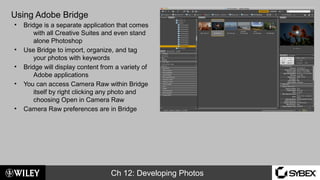
Using Adobe Bridge
• Bridge is a separate application that comes
with all Creative Suites and even stand
alone Photoshop
• Use Bridge to import, organize, and tag
your photos with keywords
• Bridge will display content from a variety of
Adobe applications
• You can access Camera Raw within Bridge
itself by right clicking any photo and
choosing Open in Camera Raw
• Camera Raw preferences are in Bridge
Ch 12: Developing Photos
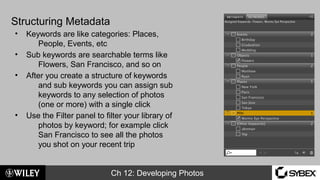
Structuring Metadata
• Keywords are like categories: Places,
People, Events, etc
• Sub keywords are searchable terms like
Flowers, San Francisco, and so on
• After you create a structure of keywords
and sub keywords you can assign sub
keywords to any selection of photos
(one or more) with a single click
• Use the Filter panel to filter your library of
photos by keyword; for example click
San Francisco to see all the photos
you shot on your recent trip
Ch 12: Developing Photos
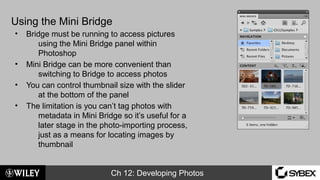
Using the Mini Bridge
• Bridge must be running to access pictures
using the Mini Bridge panel within
Photoshop
• Mini Bridge can be more convenient than
switching to Bridge to access photos
• You can control thumbnail size with the slider
at the bottom of the panel
• The limitation is you can’t tag photos with
metadata in Mini Bridge so it’s useful for a
later stage in the photo-importing process,
just as a means for locating images by
thumbnail
Ch 12: Developing Photos
Basic Development
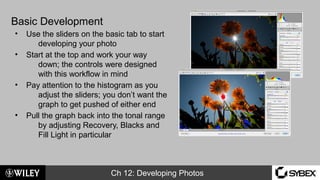
• Use the sliders on the basic tab to start
developing your photo
• Start at the top and work your way
down; the controls were designed
with this workflow in mind
• Pay attention to the histogram as you
adjust the sliders; you don’t want the
graph to get pushed of either end
• Pull the graph back into the tonal range
by adjusting Recovery, Blacks and
Fill Light in particular
Ch 12: Developing Photos
Adjusting the Tone Curve
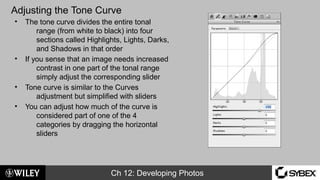
• The tone curve divides the entire tonal
range (from white to black) into four
sections called Highlights, Lights, Darks,
and Shadows in that order
• If you sense that an image needs increased
contrast in one part of the tonal range
simply adjust the corresponding slider
• Tone curve is similar to the Curves
adjustment but simplified with sliders
• You can adjust how much of the curve is
considered part of one of the 4
categories by dragging the horizontal
sliders
Ch 12: Developing Photos
Sharpening and Reducing Noise
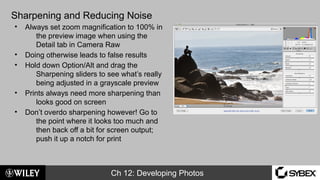
• Always set zoom magnification to 100% in
the preview image when using the
Detail tab in Camera Raw
• Doing otherwise leads to false results
• Hold down Option/Alt and drag the
Sharpening sliders to see what’s really
being adjusted in a grayscale preview
• Prints always need more sharpening than
looks good on screen
• Don’t overdo sharpening however! Go to
the point where it looks too much and
then back off a bit for screen output;
push it up a notch for print
Ch 12: Developing Photos
Adjusting by Color
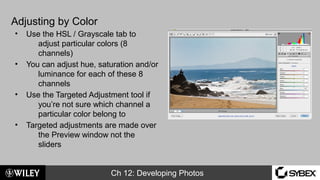
• Use the HSL / Grayscale tab to
adjust particular colors (8
channels)
• You can adjust hue, saturation and/or
luminance for each of these 8
channels
• Use the Targeted Adjustment tool if
you’re not sure which channel a
particular color belong to
• Targeted adjustments are made over
the Preview window not the
sliders
Ch 12: Developing Photos
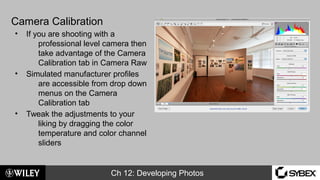
Camera Calibration
• If you are shooting with a
professional level camera then
take advantage of the Camera
Calibration tab in Camera Raw
• Simulated manufacturer profiles
are accessible from drop down
menus on the Camera
Calibration tab
• Tweak the adjustments to your
liking by dragging the color
temperature and color channel
sliders
Ch 12: Developing Photos
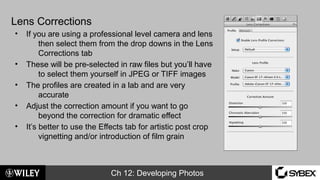
Lens Corrections
• If you are using a professional level camera and lens
then select them from the drop downs in the Lens
Corrections tab
• These will be pre-selected in raw files but you’ll have
to select them yourself in JPEG or TIFF images
• The profiles are created in a lab and are very
accurate
• Adjust the correction amount if you want to go
beyond the correction for dramatic effect
• It’s better to use the Effects tab for artistic post crop
vignetting and/or introduction of film grain

Chapter12

  • 1.
    Ch 12: DevelopingPhotos Photoshop CS6 Essentials By Scott Onstott
  • 2.
    Ch 12: DevelopingPhotos Using Adobe Bridge • Bridge is a separate application that comes with all Creative Suites and even stand alone Photoshop • Use Bridge to import, organize, and tag your photos with keywords • Bridge will display content from a variety of Adobe applications • You can access Camera Raw within Bridge itself by right clicking any photo and choosing Open in Camera Raw • Camera Raw preferences are in Bridge
  • 3.
    Ch 12: DevelopingPhotos Structuring Metadata • Keywords are like categories: Places, People, Events, etc • Sub keywords are searchable terms like Flowers, San Francisco, and so on • After you create a structure of keywords and sub keywords you can assign sub keywords to any selection of photos (one or more) with a single click • Use the Filter panel to filter your library of photos by keyword; for example click San Francisco to see all the photos you shot on your recent trip
  • 4.
    Ch 12: DevelopingPhotos Using the Mini Bridge • Bridge must be running to access pictures using the Mini Bridge panel within Photoshop • Mini Bridge can be more convenient than switching to Bridge to access photos • You can control thumbnail size with the slider at the bottom of the panel • The limitation is you can’t tag photos with metadata in Mini Bridge so it’s useful for a later stage in the photo-importing process, just as a means for locating images by thumbnail
  • 5.
    Ch 12: DevelopingPhotos Basic Development • Use the sliders on the basic tab to start developing your photo • Start at the top and work your way down; the controls were designed with this workflow in mind • Pay attention to the histogram as you adjust the sliders; you don’t want the graph to get pushed of either end • Pull the graph back into the tonal range by adjusting Recovery, Blacks and Fill Light in particular
  • 6.
    Ch 12: DevelopingPhotos Adjusting the Tone Curve • The tone curve divides the entire tonal range (from white to black) into four sections called Highlights, Lights, Darks, and Shadows in that order • If you sense that an image needs increased contrast in one part of the tonal range simply adjust the corresponding slider • Tone curve is similar to the Curves adjustment but simplified with sliders • You can adjust how much of the curve is considered part of one of the 4 categories by dragging the horizontal sliders
  • 7.
    Ch 12: DevelopingPhotos Sharpening and Reducing Noise • Always set zoom magnification to 100% in the preview image when using the Detail tab in Camera Raw • Doing otherwise leads to false results • Hold down Option/Alt and drag the Sharpening sliders to see what’s really being adjusted in a grayscale preview • Prints always need more sharpening than looks good on screen • Don’t overdo sharpening however! Go to the point where it looks too much and then back off a bit for screen output; push it up a notch for print
  • 8.
    Ch 12: DevelopingPhotos Adjusting by Color • Use the HSL / Grayscale tab to adjust particular colors (8 channels) • You can adjust hue, saturation and/or luminance for each of these 8 channels • Use the Targeted Adjustment tool if you’re not sure which channel a particular color belong to • Targeted adjustments are made over the Preview window not the sliders
  • 9.
    Ch 12: DevelopingPhotos Camera Calibration • If you are shooting with a professional level camera then take advantage of the Camera Calibration tab in Camera Raw • Simulated manufacturer profiles are accessible from drop down menus on the Camera Calibration tab • Tweak the adjustments to your liking by dragging the color temperature and color channel sliders
  • 10.
    Ch 12: DevelopingPhotos Lens Corrections • If you are using a professional level camera and lens then select them from the drop downs in the Lens Corrections tab • These will be pre-selected in raw files but you’ll have to select them yourself in JPEG or TIFF images • The profiles are created in a lab and are very accurate • Adjust the correction amount if you want to go beyond the correction for dramatic effect • It’s better to use the Effects tab for artistic post crop vignetting and/or introduction of film grain