
Human Values and
Ethical Theories
Prepared by:
Mariah Kyle Carmel A. Gonzaga LPT
Republic of the Philippines
CEBU TECHNOLOGICAL UNIVERSITY
San Francisco Campus
Northern Poblacion, San Francisco, Cebu
Website: http://www.sanfran.ctu.edu.ph
Email: ctusanfran@gmail.com Email: info-sanfran@ctu.edu.ph
Contact No: (032) 318-8163 Contact No: (032) 318-8164
 Refer to those values which are at the core of being
human.
 Convey a positive and affective surge, which
reinforces the rationale of moral values.
 A tool to manage human relations and permit us to
live together in harmony, and personally contribute
to peace.
 Considered universal, timeless and eternal applying
to all human beings.
The pillar of all values.
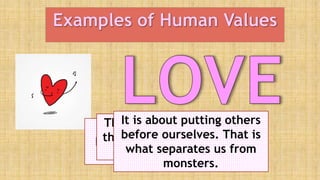
Because LOVE conquers
all.
The irony is, people love
the idea of love. But love
is real hard work.
It is about putting others
before ourselves. That is
what separates us from
monsters.
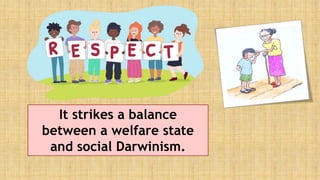
It is two-way
street.
You can disagree with
someone and still respect
them and their opinion.
It strikes a balance
between a welfare state
and social Darwinism.
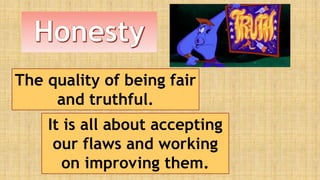
The quality of being fair
and truthful.
It is all about accepting
our flaws and working
on improving them.
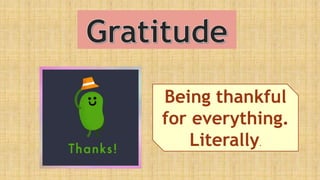
Being thankful
for everything.
Literally.
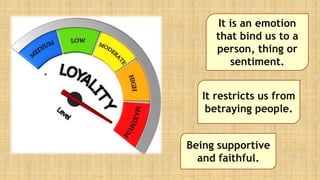
It is an emotion
that bind us to a
person, thing or
sentiment.
It restricts us from
betraying people.
Being supportive
and faithful.
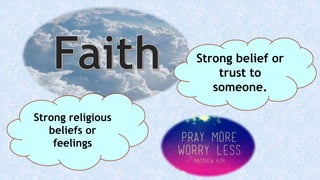
Strong belief or
trust to
someone.
Strong religious
beliefs or
feelings
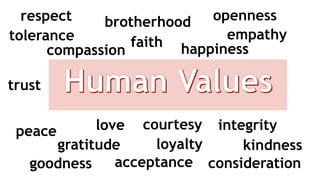
faith
love integrity
loyalty
brotherhood
tolerance empathy
goodness
courtesy
respect openness
happiness
gratitude
acceptance consideration
trust
kindness
peace
compassion
Ethical Theories
 Ethical theories provide part of the decision-making
foundation for these theories represent the viewpoints
from which individuals seek guidance as they make
decisions.
 Each theory emphasizes different points – a different
decision-making style or a decision rule—such as
predicting the outcome and following one’s duties to
others in order to reach what the individual considers
an ethically correct decision.
 In order to further understand ethical theory, there
must be some understanding of a common set of
goals that decision makers seek to achieve in order
to be successful. Four of these goals include
beneficence, least harm, respect for autonomy, and
justice.
 In order to understand ethical decision making, it is
important to realize that not everyone makes
decisions in the same way, using the same
information, employing the same decision rules.
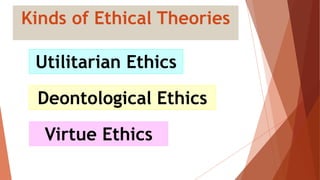
Kinds of Ethical Theories
Utilitarian Ethics
Deontological Ethics
Virtue Ethics
 The greatest good for the greatest number of
people
 An action is right if and only it produces the
greatest balance of pleasure over pain of every
one.
 “Actions are right in proportion as they tend to
promote happiness, wrong as they tend to produce
the reverse of happiness."
 “Millennials will use utilitarian reasoning to avoid
confrontation and achieve consensus.”
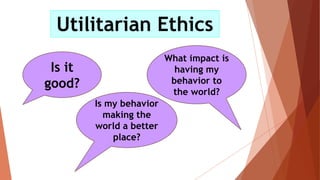
Utilitarian Ethics
Utilitarian Ethics
Is it
good?
Is my behavior
making the
world a better
place?
What impact is
having my
behavior to
the world?
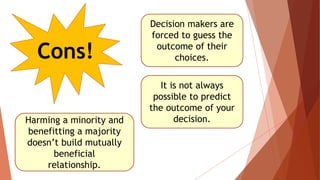
Cons!
Decision makers are
forced to guess the
outcome of their
choices.
It is not always
possible to predict
the outcome of your
decision.Harming a minority and
benefitting a majority
doesn’t build mutually
beneficial
relationship.
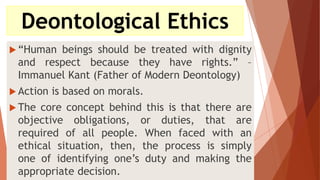
 “Human beings should be treated with dignity
and respect because they have rights.” –
Immanuel Kant (Father of Modern Deontology)
 Action is based on morals.
 The core concept behind this is that there are
objective obligations, or duties, that are
required of all people. When faced with an
ethical situation, then, the process is simply
one of identifying one’s duty and making the
appropriate decision.
Deontological Ethics
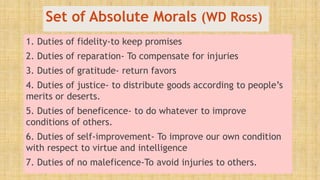
Set of Absolute Morals (WD Ross)
1. Duties of fidelity-to keep promises
2. Duties of reparation- To compensate for injuries
3. Duties of gratitude- return favors
4. Duties of justice- to distribute goods according to people’s
merits or deserts.
5. Duties of beneficence- to do whatever to improve
conditions of others.
6. Duties of self-improvement- To improve our own condition
with respect to virtue and intelligence
7. Duties of no maleficence-To avoid injuries to others.
Deontological Ethics
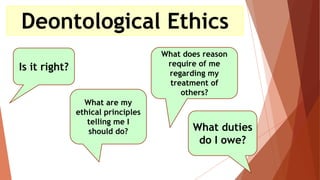
Is it right?
What duties
do I owe?
What are my
ethical principles
telling me I
should do?
What does reason
require of me
regarding my
treatment of
others?
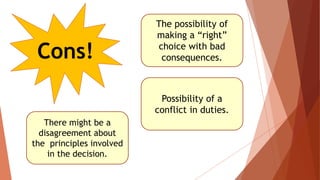
Cons!
The possibility of
making a “right”
choice with bad
consequences.
There might be a
disagreement about
the principles involved
in the decision.
Possibility of a
conflict in duties.
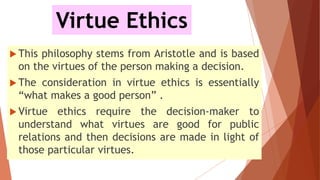
 This philosophy stems from Aristotle and is based
on the virtues of the person making a decision.
 The consideration in virtue ethics is essentially
“what makes a good person” .
 Virtue ethics require the decision-maker to
understand what virtues are good for public
relations and then decisions are made in light of
those particular virtues.
Virtue Ethics
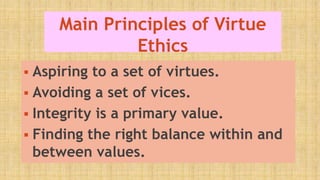
Main Principles of Virtue
Ethics
 Aspiring to a set of virtues.
 Avoiding a set of vices.
 Integrity is a primary value.
 Finding the right balance within and
between values.
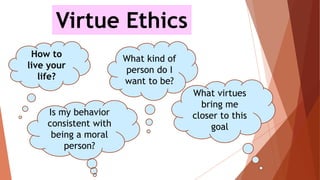
Virtue Ethics
How to
live your
life?
What kind of
person do I
want to be?
What virtues
bring me
closer to this
goal
Is my behavior
consistent with
being a moral
person?
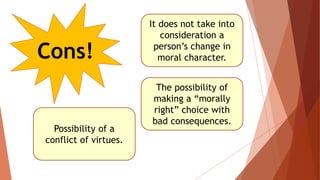
Cons!
It does not take into
consideration a
person’s change in
moral character.
The possibility of
making a “morally
right” choice with
bad consequences.
Possibility of a
conflict of virtues.
HUMAN VALUES AND ETHICAL THEORIES

HUMAN VALUES AND ETHICAL THEORIES

  • 1.
    Human Values and EthicalTheories Prepared by: Mariah Kyle Carmel A. Gonzaga LPT Republic of the Philippines CEBU TECHNOLOGICAL UNIVERSITY San Francisco Campus Northern Poblacion, San Francisco, Cebu Website: http://www.sanfran.ctu.edu.ph Email: ctusanfran@gmail.com Email: info-sanfran@ctu.edu.ph Contact No: (032) 318-8163 Contact No: (032) 318-8164
  • 3.
     Refer tothose values which are at the core of being human.  Convey a positive and affective surge, which reinforces the rationale of moral values.  A tool to manage human relations and permit us to live together in harmony, and personally contribute to peace.  Considered universal, timeless and eternal applying to all human beings.
  • 4.
    The pillar ofall values. Because LOVE conquers all. The irony is, people love the idea of love. But love is real hard work. It is about putting others before ourselves. That is what separates us from monsters.
  • 5.
    It is two-way street. Youcan disagree with someone and still respect them and their opinion. It strikes a balance between a welfare state and social Darwinism.
  • 6.
    The quality ofbeing fair and truthful. It is all about accepting our flaws and working on improving them.
  • 7.
  • 8.
    It is anemotion that bind us to a person, thing or sentiment. It restricts us from betraying people. Being supportive and faithful.
  • 9.
    Strong belief or trustto someone. Strong religious beliefs or feelings
  • 10.
    faith love integrity loyalty brotherhood tolerance empathy goodness courtesy respectopenness happiness gratitude acceptance consideration trust kindness peace compassion
  • 11.
  • 12.
     Ethical theoriesprovide part of the decision-making foundation for these theories represent the viewpoints from which individuals seek guidance as they make decisions.  Each theory emphasizes different points – a different decision-making style or a decision rule—such as predicting the outcome and following one’s duties to others in order to reach what the individual considers an ethically correct decision.
  • 13.
     In orderto further understand ethical theory, there must be some understanding of a common set of goals that decision makers seek to achieve in order to be successful. Four of these goals include beneficence, least harm, respect for autonomy, and justice.  In order to understand ethical decision making, it is important to realize that not everyone makes decisions in the same way, using the same information, employing the same decision rules.
  • 14.
    Kinds of EthicalTheories Utilitarian Ethics Deontological Ethics Virtue Ethics
  • 15.
     The greatestgood for the greatest number of people  An action is right if and only it produces the greatest balance of pleasure over pain of every one.  “Actions are right in proportion as they tend to promote happiness, wrong as they tend to produce the reverse of happiness."  “Millennials will use utilitarian reasoning to avoid confrontation and achieve consensus.” Utilitarian Ethics
  • 16.
    Utilitarian Ethics Is it good? Ismy behavior making the world a better place? What impact is having my behavior to the world?
  • 17.
    Cons! Decision makers are forcedto guess the outcome of their choices. It is not always possible to predict the outcome of your decision.Harming a minority and benefitting a majority doesn’t build mutually beneficial relationship.
  • 18.
     “Human beingsshould be treated with dignity and respect because they have rights.” – Immanuel Kant (Father of Modern Deontology)  Action is based on morals.  The core concept behind this is that there are objective obligations, or duties, that are required of all people. When faced with an ethical situation, then, the process is simply one of identifying one’s duty and making the appropriate decision. Deontological Ethics
  • 19.
    Set of AbsoluteMorals (WD Ross) 1. Duties of fidelity-to keep promises 2. Duties of reparation- To compensate for injuries 3. Duties of gratitude- return favors 4. Duties of justice- to distribute goods according to people’s merits or deserts. 5. Duties of beneficence- to do whatever to improve conditions of others. 6. Duties of self-improvement- To improve our own condition with respect to virtue and intelligence 7. Duties of no maleficence-To avoid injuries to others.
  • 20.
    Deontological Ethics Is itright? What duties do I owe? What are my ethical principles telling me I should do? What does reason require of me regarding my treatment of others?
  • 21.
    Cons! The possibility of makinga “right” choice with bad consequences. There might be a disagreement about the principles involved in the decision. Possibility of a conflict in duties.
  • 22.
     This philosophystems from Aristotle and is based on the virtues of the person making a decision.  The consideration in virtue ethics is essentially “what makes a good person” .  Virtue ethics require the decision-maker to understand what virtues are good for public relations and then decisions are made in light of those particular virtues. Virtue Ethics
  • 23.
    Main Principles ofVirtue Ethics  Aspiring to a set of virtues.  Avoiding a set of vices.  Integrity is a primary value.  Finding the right balance within and between values.
  • 24.
    Virtue Ethics How to liveyour life? What kind of person do I want to be? What virtues bring me closer to this goal Is my behavior consistent with being a moral person?
  • 25.
    Cons! It does nottake into consideration a person’s change in moral character. The possibility of making a “morally right” choice with bad consequences. Possibility of a conflict of virtues.