Ethics: Discovering
Right and Wrong
Louis P. Pojman and James Fieser
8th edition
Chapter Three: Moral
Objectivism
 The people who enslaved Seba violated at least three
basic moral principles:
 Respect the freedom of rational beings.
 Don’t cause unnecessary suffering.
 Always treat people as ends in themselves, never merely
as means.
© 2017 Cengage Learning. All Rights Reserved.
Moral Objectivism (continued)
 There are objective universal moral principles, valid for
all people and all social environments.
 This chapter examines several versions of objectivism,
but ultimately accepts a view called moderate
objectivism.
© 2017 Cengage Learning. All Rights Reserved.
Moral Absolutism vs.
Moral Objectivism
 Moral absolutism is the view that there are
nonoverrideable and exceptionless moral principles that
one ought never violate.
 Moral objectivism shares the notion that principles have
universal, objective validity.
 Denies that moral norms are necessarily exceptionless.
 Aquinas’s Objectivism and Absolutism
 Thomas Aquinas (1225–1274) follows an objectivist
approach called natural law theory.
 Aquinas was a moral absolutist, and he developed the
doctrine of double effect.
© 2017 Cengage Learning. All Rights Reserved.
Natural Law Theory (1 of 2)
 An eternal moral law exists that can be discovered
through reason by looking at the nature of humanity and
society.
 Introduced by the Stoics (first century BCE), who believed
humans have a divine spark, logos spermatikos, enabling
discovery of eternal laws.
 The universe is governed by rational laws that all creation
obeys, but humans have the power of choice.
© 2017 Cengage Learning. All Rights Reserved.
Natural Law Theory (2 of 2)
 Aquinas combined the Stoic’s cosmic law with Aristotle’s
concept that humans, like every natural object, have a
specific nature, purpose, and function.
 For Aquinas, reason’s deliberative processes discover
the natural laws.
© 2017 Cengage Learning. All Rights Reserved.
Key Ideas of the
Natural Law Tradition
 Humans have an essential rational nature established by
God, who designed us to live and flourish in prescribed
ways.
 Even without knowledge of God, reason, as the essence
of our nature, can discover laws necessary for human
flourishing.
 The natural laws are universal and unchangeable, and
one should use them to judge individual societies and
their positive laws.
© 2017 Cengage Learning. All Rights Reserved.
Doctrine of Double Effect
 It provides a tidy method for solving all moral disputes
in which an act will have two effects, one good and the
other bad.
 It is always wrong to do a bad act intentionally to bring
about good consequences, but it is sometimes
permissible to do a good act despite knowing that it will
bring about bad consequences.
© 2017 Cengage Learning. All Rights Reserved.
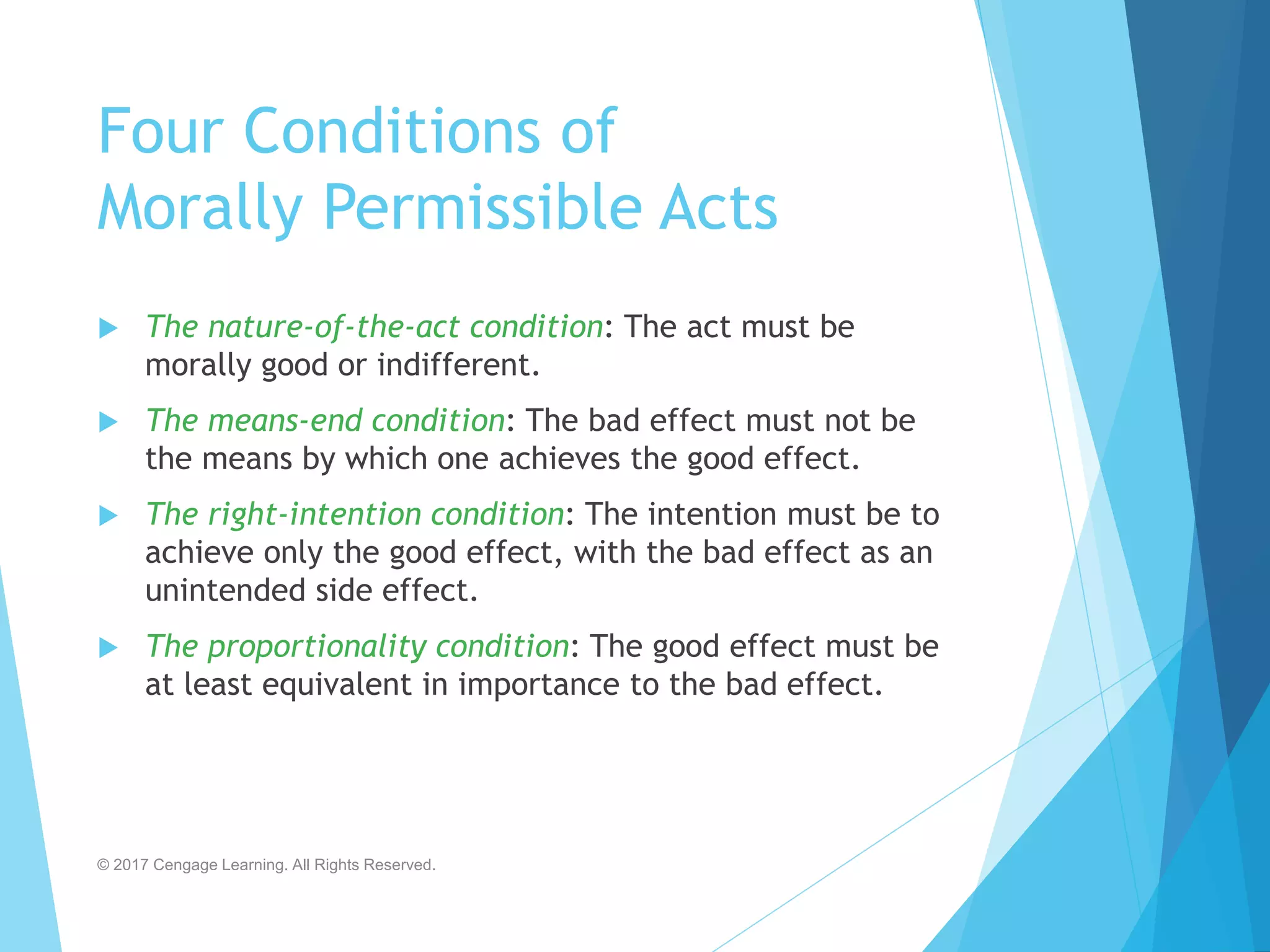
Four Conditions of
Morally Permissible Acts
 The nature-of-the-act condition: The act must be
morally good or indifferent.
 The means-end condition: The bad effect must not be
the means by which one achieves the good effect.
 The right-intention condition: The intention must be to
achieve only the good effect, with the bad effect as an
unintended side effect.
 The proportionality condition: The good effect must be
at least equivalent in importance to the bad effect.
© 2017 Cengage Learning. All Rights Reserved.
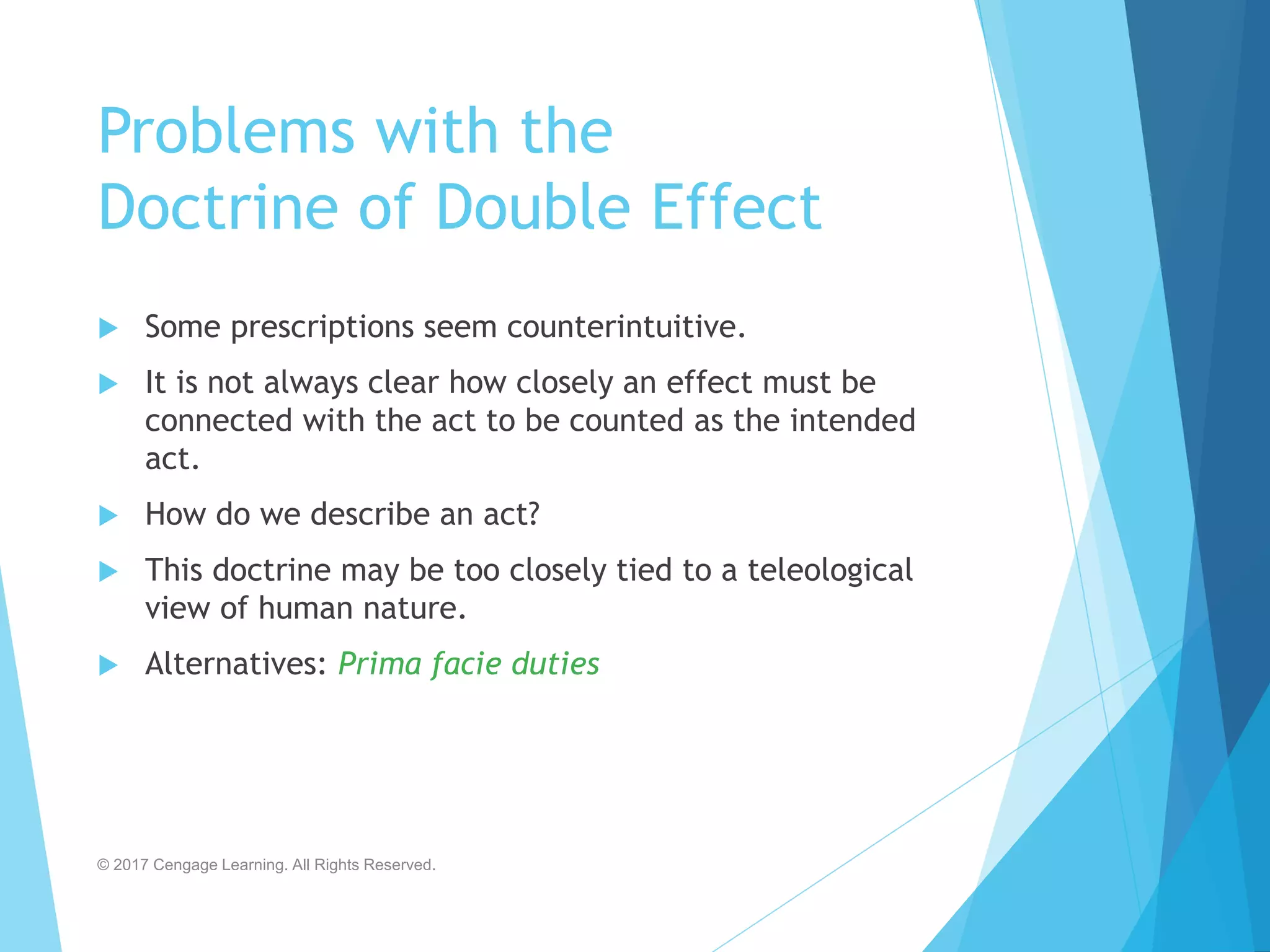
Problems with the
Doctrine of Double Effect
 Some prescriptions seem counterintuitive.
 It is not always clear how closely an effect must be
connected with the act to be counted as the intended
act.
 How do we describe an act?
 This doctrine may be too closely tied to a teleological
view of human nature.
 Alternatives: Prima facie duties
© 2017 Cengage Learning. All Rights Reserved.
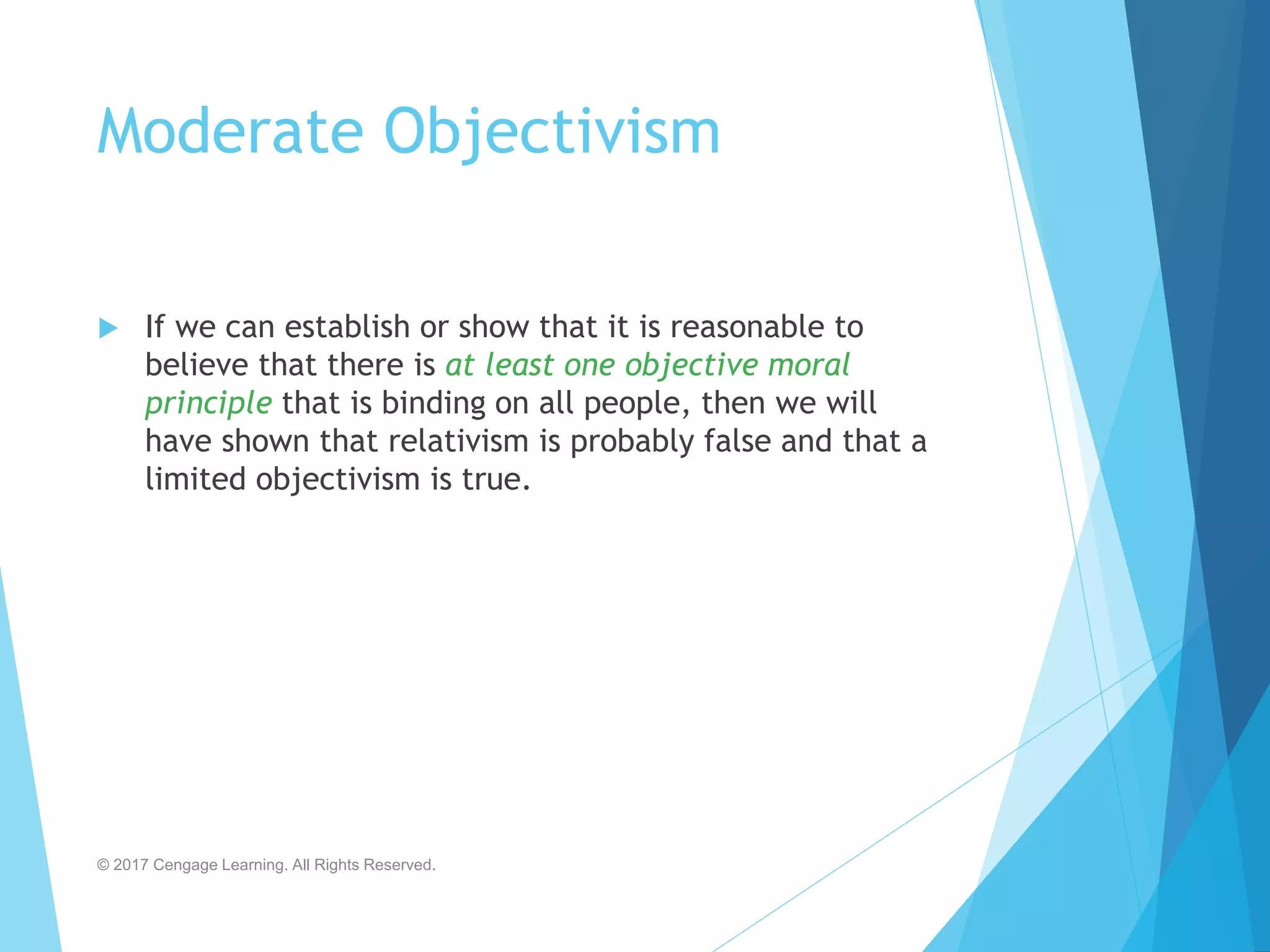
Moderate Objectivism
 If we can establish or show that it is reasonable to
believe that there is at least one objective moral
principle that is binding on all people, then we will
have shown that relativism is probably false and that a
limited objectivism is true.
© 2017 Cengage Learning. All Rights Reserved.
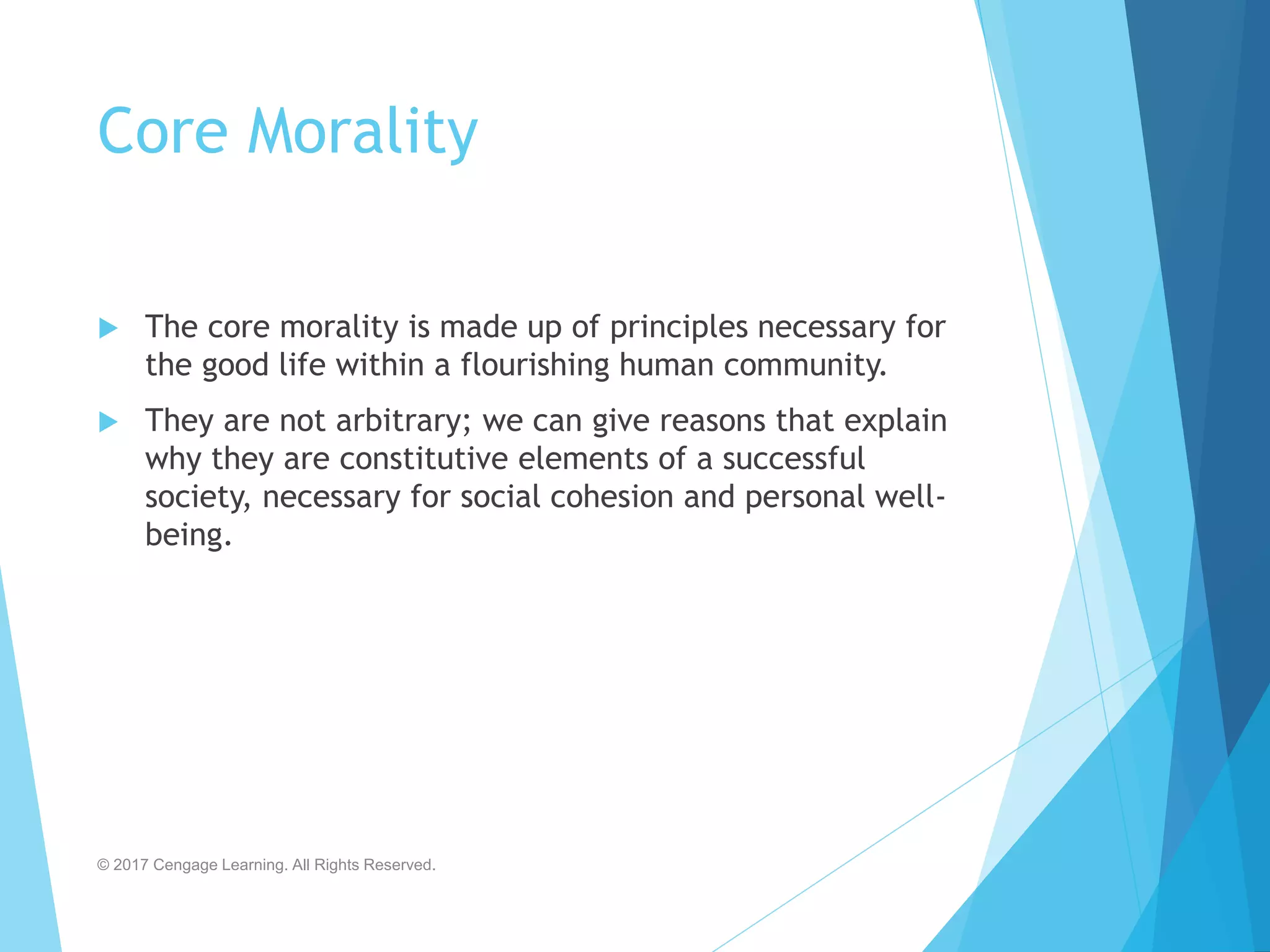
Core Morality
 The core morality is made up of principles necessary for
the good life within a flourishing human community.
 They are not arbitrary; we can give reasons that explain
why they are constitutive elements of a successful
society, necessary for social cohesion and personal well-
being.
© 2017 Cengage Learning. All Rights Reserved.
Ten Principles that are
Examples of Core Morality
 Do not kill innocent
people.
 Do not cause
unnecessary pain or
suffering.
 Do not lie or deceive.
 Do not steal or cheat.
 Keep your promises and
honor your contracts.
 Do not deprive another
person of his or her
freedom.
 Do justice, treating
people as they deserve
to be treated.
 Reciprocate: Show
gratitude for services
rendered.
 Help other people,
especially when the cost
to oneself is minimal.
 Obey just laws.
© 2017 Cengage Learning. All Rights Reserved.
Our Common Human Nature
 An objectivist bases his or her moral system on a
common human nature with common needs and desires.
 There is more that unites all humanity than divides us.
© 2017 Cengage Learning. All Rights Reserved.
Arguments for Objectivism (1 of 2)
 Human nature is relatively similar, having a common set
of basic needs and interests.
 Moral principles are functions of human needs and
interests, instituted by reason to meet human needs
and promote their most significant interests.
 Some moral principles meet needs and promote
interests better than others.
© 2017 Cengage Learning. All Rights Reserved.
Arguments for Objectivism (2 of 2)
 Moral principles that meet essential needs and promote
the most significant interests are objectively valid.
 Therefore, because there is a common human nature,
there is an objectively valid set of moral principles,
applicable to all humanity.
© 2017 Cengage Learning. All Rights Reserved.
Ethical Situationalism
 Objective moral principles are to be applied differently
in different contexts.
 Ethical situationalism is different from ethical
relativism, which denies universal ethical principles
altogether.
© 2017 Cengage Learning. All Rights Reserved.
Conclusion
 Moderate objectivism holds that a core set of moral
principles is universally valid.
 Morality is situational.
 A functional account of objective morality comes from
the notion that morality serves specific human functions
in promoting the human good.
 A naturalistic account establishes the core morality.
© 2017 Cengage Learning. All Rights Reserved.

Pojman ethics 8e_ppt_ch03

  • 1.
    Ethics: Discovering Right andWrong Louis P. Pojman and James Fieser 8th edition
  • 2.
    Chapter Three: Moral Objectivism The people who enslaved Seba violated at least three basic moral principles:  Respect the freedom of rational beings.  Don’t cause unnecessary suffering.  Always treat people as ends in themselves, never merely as means. © 2017 Cengage Learning. All Rights Reserved.
  • 3.
    Moral Objectivism (continued) There are objective universal moral principles, valid for all people and all social environments.  This chapter examines several versions of objectivism, but ultimately accepts a view called moderate objectivism. © 2017 Cengage Learning. All Rights Reserved.
  • 4.
    Moral Absolutism vs. MoralObjectivism  Moral absolutism is the view that there are nonoverrideable and exceptionless moral principles that one ought never violate.  Moral objectivism shares the notion that principles have universal, objective validity.  Denies that moral norms are necessarily exceptionless.  Aquinas’s Objectivism and Absolutism  Thomas Aquinas (1225–1274) follows an objectivist approach called natural law theory.  Aquinas was a moral absolutist, and he developed the doctrine of double effect. © 2017 Cengage Learning. All Rights Reserved.
  • 5.
    Natural Law Theory(1 of 2)  An eternal moral law exists that can be discovered through reason by looking at the nature of humanity and society.  Introduced by the Stoics (first century BCE), who believed humans have a divine spark, logos spermatikos, enabling discovery of eternal laws.  The universe is governed by rational laws that all creation obeys, but humans have the power of choice. © 2017 Cengage Learning. All Rights Reserved.
  • 6.
    Natural Law Theory(2 of 2)  Aquinas combined the Stoic’s cosmic law with Aristotle’s concept that humans, like every natural object, have a specific nature, purpose, and function.  For Aquinas, reason’s deliberative processes discover the natural laws. © 2017 Cengage Learning. All Rights Reserved.
  • 7.
    Key Ideas ofthe Natural Law Tradition  Humans have an essential rational nature established by God, who designed us to live and flourish in prescribed ways.  Even without knowledge of God, reason, as the essence of our nature, can discover laws necessary for human flourishing.  The natural laws are universal and unchangeable, and one should use them to judge individual societies and their positive laws. © 2017 Cengage Learning. All Rights Reserved.
  • 8.
    Doctrine of DoubleEffect  It provides a tidy method for solving all moral disputes in which an act will have two effects, one good and the other bad.  It is always wrong to do a bad act intentionally to bring about good consequences, but it is sometimes permissible to do a good act despite knowing that it will bring about bad consequences. © 2017 Cengage Learning. All Rights Reserved.
  • 9.
    Four Conditions of MorallyPermissible Acts  The nature-of-the-act condition: The act must be morally good or indifferent.  The means-end condition: The bad effect must not be the means by which one achieves the good effect.  The right-intention condition: The intention must be to achieve only the good effect, with the bad effect as an unintended side effect.  The proportionality condition: The good effect must be at least equivalent in importance to the bad effect. © 2017 Cengage Learning. All Rights Reserved.
  • 10.
    Problems with the Doctrineof Double Effect  Some prescriptions seem counterintuitive.  It is not always clear how closely an effect must be connected with the act to be counted as the intended act.  How do we describe an act?  This doctrine may be too closely tied to a teleological view of human nature.  Alternatives: Prima facie duties © 2017 Cengage Learning. All Rights Reserved.
  • 11.
    Moderate Objectivism  Ifwe can establish or show that it is reasonable to believe that there is at least one objective moral principle that is binding on all people, then we will have shown that relativism is probably false and that a limited objectivism is true. © 2017 Cengage Learning. All Rights Reserved.
  • 12.
    Core Morality  Thecore morality is made up of principles necessary for the good life within a flourishing human community.  They are not arbitrary; we can give reasons that explain why they are constitutive elements of a successful society, necessary for social cohesion and personal well- being. © 2017 Cengage Learning. All Rights Reserved.
  • 13.
    Ten Principles thatare Examples of Core Morality  Do not kill innocent people.  Do not cause unnecessary pain or suffering.  Do not lie or deceive.  Do not steal or cheat.  Keep your promises and honor your contracts.  Do not deprive another person of his or her freedom.  Do justice, treating people as they deserve to be treated.  Reciprocate: Show gratitude for services rendered.  Help other people, especially when the cost to oneself is minimal.  Obey just laws. © 2017 Cengage Learning. All Rights Reserved.
  • 14.
    Our Common HumanNature  An objectivist bases his or her moral system on a common human nature with common needs and desires.  There is more that unites all humanity than divides us. © 2017 Cengage Learning. All Rights Reserved.
  • 15.
    Arguments for Objectivism(1 of 2)  Human nature is relatively similar, having a common set of basic needs and interests.  Moral principles are functions of human needs and interests, instituted by reason to meet human needs and promote their most significant interests.  Some moral principles meet needs and promote interests better than others. © 2017 Cengage Learning. All Rights Reserved.
  • 16.
    Arguments for Objectivism(2 of 2)  Moral principles that meet essential needs and promote the most significant interests are objectively valid.  Therefore, because there is a common human nature, there is an objectively valid set of moral principles, applicable to all humanity. © 2017 Cengage Learning. All Rights Reserved.
  • 17.
    Ethical Situationalism  Objectivemoral principles are to be applied differently in different contexts.  Ethical situationalism is different from ethical relativism, which denies universal ethical principles altogether. © 2017 Cengage Learning. All Rights Reserved.
  • 18.
    Conclusion  Moderate objectivismholds that a core set of moral principles is universally valid.  Morality is situational.  A functional account of objective morality comes from the notion that morality serves specific human functions in promoting the human good.  A naturalistic account establishes the core morality. © 2017 Cengage Learning. All Rights Reserved.