
NATURALISTIC, QUALITATIVE
AND ETHNOGRAPHIC
RESEARCH
© LOUIS COHEN, LAWRENCE
MANION & KEITH MORRISON
STRUCTURE OF THE CHAPTER
• Foundations of naturalistic, qualitative and
ethnographic inquiry
• Planning naturalistic, qualitative and
ethnographic research
• Features and stages of a qualitative study
• Critical ethnography
• Some problems with ethnographic and
naturalistic approaches
NATURALISTIC METHODS ASK . . .
• What are the characteristics of a social
phenomenon?
• What are the causes of the social
phenomenon?
• What are the consequences of the social
phenomenon?
MAIN KINDS OF
NATURALISTIC ENQUIRY
• Case study
• Comparative studies
• Retrospective studies
• Snapshots
• Longitudinal studies
• Ethnography
• Grounded theory
• Biography
• Phenomenology
MAIN METHODS OF
NATURALISTIC ENQUIRY
• Participant observation
• Interviews and conversations
• Documents and field notes
• Accounts
• Notes and memos
THE QUALITATIVE PARADIGM
• Humans actively construct their own meanings of situations;
• Meaning arises out of social situations and is handled through
interpretive processes;
• Behaviour and data are socially situated, context-related,
context-dependent and context-rich.
• Realities are multiple, constructed, and holistic;
• Knower and known are interactive, inseparable;
• Only context-bound working hypotheses are possible;
• Inquiry is influenced by the choice of the paradigm, theory and
values that guide the investigation into the problem;
• Research must include ‘thick descriptions’;
• The attribution of meaning is continuous and evolving over
time;
• People are deliberate, intentional and creative in their actions;
• History and biography intersect;
• Social research needs to examine situations through the eyes
of the participants;
• Researchers are the instruments of the research;
THE QUALITATIVE PARADIGM
• Researchers generate rather than test hypotheses;
• Researchers do not know in advance what they will see;
• Humans are anticipatory beings;
• Human phenomena seem to require even more conditional
stipulations than do other kinds;
• Meanings and understandings replace proof;
• Situations are unique;
• The processes of research and behaviour are as important as the
outcomes;
• People, situations, events and objects have meaning conferred
upon them rather than possessing their own intrinsic meaning;
• Social research should be conducted in natural, uncontrived, real
world settings with as little intrusiveness as possible by the
researcher;
• Social reality, experiences and social phenomena are capable of
multiple, sometimes contradictory interpretations;
• All factors have to be taken into account;
• Data are analyzed inductively;
• Theory generation is derivative and grounded.
PROCESSES OF QUALITATIVE ENQUIRY
• Studies must take place in their natural settings as context
influences meaning;
• Humans are the research instrument;
• Utilization of tacit knowledge is inescapable;
• Qualitative methods sit more comfortably than quantitative
methods with the notion of the human-as-instrument;
• Purposive sampling can explore the full scope of issues;
• Data analysis is inductive rather than deductive;
• Theory emerges (is grounded) rather than is pre-ordinate.
• Research designs emerge over time;
• Research outcomes are negotiated;
• The natural mode of reporting is the case study;
• Idiographic interpretation replaces nomothetic interpretation;
• Applications are tentative and pragmatic;
• Trustworthiness and its components replace conventional
views of reliability and validity.
TEN ELEMENTS OF SYMBOLIC
INTERACTIONISM
• People construct their own actions – they are deliberate
intentional and creative;
• People attribute to, and construct meanings of, their
situations and behaviour; people impose meanings on
situations; situations themselves do not necessarily possess
intrinsic meaning.
• Significance of subjective meanings and the symbols and
symbol systems (e.g. language and communication) by
which they are produced and represented;
• The need to understand individuals’ ‘definitions of the
situation’ in their terms, i.e. in any situation there are many
definitions of the situation – multiple realities; the self is a
social product, constructed through interaction with
‘significant others’ which occurs in relation to multiple
‘reference groups’;
TEN ELEMENTS OF SYMBOLIC
INTERACTIONISM
• Significance of negotiation – the process by which meanings
are constructed;
• Significance of the natural, social context/environment/
setting in understanding meaning and meaning construction;
• Situations and people are unique and individual (idiographic);
• The nature of a ‘career’ – the moving perspective in which
people regard their own and others’ lives, based on the
meanings which are being formed; ‘career’ includes notions
of commitment and identity;
• Research must include ‘thick description’ – detailed accounts
of the situation and participants’ meanings and behaviour;
• Analysis is ‘emic’ rather than ‘etic’ – generating meaning
through presenting participants’ subjective accounts rather
than utilizing ‘objective’ research.
ETHNOGRAPHIES CONCERN . . .
• The production of descriptive cultural knowledge of a
group;
• The description of activities in relation to a particular
cultural context from the point of view of the members
of that group themselves;
• The production of a list of features constitutive of
membership in a group or culture;
• The description and analysis of patterns of social
interaction;
• The provision as far as possible of ‘insider accounts’;
• The development of theory.
CRITICAL ETHNOGRAPHY
• Whereas conventional ethnography is concerned with
what is, critical ethnography concerns itself with what
could be.
• Theoretical basis in critical theory and ideology
critique.
• Concerned to expose oppression and inequality in
society with a view to emancipating individuals and
groups towards collective empowerment.
• Research is an inherently political enterprise:
ethnography with a political intent.
• It has an explicit agenda and ‘ethical responsibility’ to
promote freedom, social justice, equity and well-being.
• It takes power, control and social exploitation as
problematic, and to be changed, rather than simply to
be interrogated and discovered
• Its basis echoes Habermas’s emancipatory interest
CRITICAL ETHNOGRAPHY
• Research and thinking are mediated by power relations;
• These power relations are socially and historically
located;
• Facts and values are inseparable;
• Relationships between objects and concepts are fluid
and mediated by the social relations of production;
• Language is central to perception;
• Certain groups in society exert more power than others;
• Inequality and oppression are inherent in capitalist
relations of production and consumption;
• Ideological domination is strongest when oppressed
groups see their situation as inevitable, natural or
necessary;
• Forms of oppression mediate each other and must be
considered together (e.g. race, gender, class).
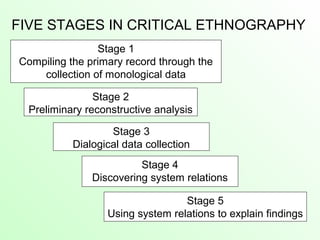
FIVE STAGES IN CRITICAL ETHNOGRAPHY
Stage 1
Compiling the primary record through the
collection of monological data
Stage 2
Preliminary reconstructive analysis
Stage 3
Dialogical data collection
Stage 4
Discovering system relations
Stage 5
Using system relations to explain findings
PLANNING A QUALITATIVE STUDY
1. Locate a field of study.
2. Decide research questions (where appropriate)
3. Address ethical issues.
4. Decide from whom to obtain data (sampling).
5. Find a role and manage entry into the context.
6. Find informants:
– reliability;
– Importance in giving accounts;
– Knowledge/knowledgeability;
– Status;
– Contacts – gatekeepers;
– Representativeness;
– Centrality;
– Relationships to others.
PLANNING A QUALITATIVE STUDY
7. Develop and maintain relationships in the field:
trust; confidence; rapport; discretion; sensitivity;
empathy;
8. Collect data in situ and in several contexts
(field notes and triangulation);
9. Collect other data (where relevant);
10. Analyze data;
11. Leave the field; decide when, how, how to
close relationships.
12. Write the final report.
REFLEXIVITY
• Researchers are part of the social world that
they are researching
• This social world is an already interpreted
world by the actors
• Researchers bring their own biographies to
the research situation
• Researchers should acknowledge and
disclose their own selves in the research,
seeking to understand their part in, or
influence on, the research.
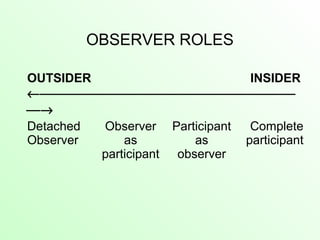
OBSERVER ROLES
OUTSIDER INSIDER
←
→
Detached
Observer
Observer
as
participant
Participant
as
observer
Complete
participant
CONCERNS IN CONDUCTING
ETHNOGRAPHIES
• How do you negotiate your way into a situation; how to
minimize threat.
• Timing the point of entry.
• Finding a role for yourself.
• To be a participant observer or non-participant observer?
• How to maintain naturalism and to avoid people playing
to what they perceive are your expectations of them.
• How to retain your distance from those involved.
• How to gain access to certain ‘difficult’ groups.
• Who to regard as key/important informants.
• How to record multiple perspectives and multiple realities.
CONCERNS IN CONDUCTING
ETHNOGRAPHIES
• How to address emic and etic approaches.
• Who owns the data; how much control do
respondents/participants have over the data; when does
ownership pass from the respondents/participants to the
researcher?
• How to write up the report.
• What if the researcher sees what the respondents/
participants do not see?
• Reactivity of participants (Hawthorne effect).
• Halo effect.
• Focusing on the known/familiar only.
• Consider generalizability.
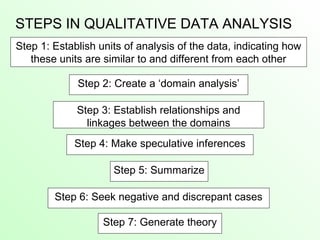
STEPS IN QUALITATIVE DATA ANALYSIS
Step 2: Create a ‘domain analysis’
Step 3: Establish relationships and
linkages between the domains
Step 4: Make speculative inferences
Step 5: Summarize
Step 6: Seek negative and discrepant cases
Step 7: Generate theory
Step 1: Establish units of analysis of the data, indicating how
these units are similar to and different from each other
SOME DIFFICULTIES IN
QUALITATIVE RESEARCH
• Definition of the situation
• Reactivity
• Halo effect
• Implicit conservatism
• Focusing on the familiar
• Open-endedness and diversity
• Neglect of wider social contexts and
constraints
• Generalizability
• Writing up multiple realities
• Ownership of the data

Chapter11

  • 1.
    NATURALISTIC, QUALITATIVE AND ETHNOGRAPHIC RESEARCH ©LOUIS COHEN, LAWRENCE MANION & KEITH MORRISON
  • 2.
    STRUCTURE OF THECHAPTER • Foundations of naturalistic, qualitative and ethnographic inquiry • Planning naturalistic, qualitative and ethnographic research • Features and stages of a qualitative study • Critical ethnography • Some problems with ethnographic and naturalistic approaches
  • 3.
    NATURALISTIC METHODS ASK. . . • What are the characteristics of a social phenomenon? • What are the causes of the social phenomenon? • What are the consequences of the social phenomenon?
  • 4.
    MAIN KINDS OF NATURALISTICENQUIRY • Case study • Comparative studies • Retrospective studies • Snapshots • Longitudinal studies • Ethnography • Grounded theory • Biography • Phenomenology
  • 5.
    MAIN METHODS OF NATURALISTICENQUIRY • Participant observation • Interviews and conversations • Documents and field notes • Accounts • Notes and memos
  • 6.
    THE QUALITATIVE PARADIGM •Humans actively construct their own meanings of situations; • Meaning arises out of social situations and is handled through interpretive processes; • Behaviour and data are socially situated, context-related, context-dependent and context-rich. • Realities are multiple, constructed, and holistic; • Knower and known are interactive, inseparable; • Only context-bound working hypotheses are possible; • Inquiry is influenced by the choice of the paradigm, theory and values that guide the investigation into the problem; • Research must include ‘thick descriptions’; • The attribution of meaning is continuous and evolving over time; • People are deliberate, intentional and creative in their actions; • History and biography intersect; • Social research needs to examine situations through the eyes of the participants; • Researchers are the instruments of the research;
  • 7.
    THE QUALITATIVE PARADIGM •Researchers generate rather than test hypotheses; • Researchers do not know in advance what they will see; • Humans are anticipatory beings; • Human phenomena seem to require even more conditional stipulations than do other kinds; • Meanings and understandings replace proof; • Situations are unique; • The processes of research and behaviour are as important as the outcomes; • People, situations, events and objects have meaning conferred upon them rather than possessing their own intrinsic meaning; • Social research should be conducted in natural, uncontrived, real world settings with as little intrusiveness as possible by the researcher; • Social reality, experiences and social phenomena are capable of multiple, sometimes contradictory interpretations; • All factors have to be taken into account; • Data are analyzed inductively; • Theory generation is derivative and grounded.
  • 8.
    PROCESSES OF QUALITATIVEENQUIRY • Studies must take place in their natural settings as context influences meaning; • Humans are the research instrument; • Utilization of tacit knowledge is inescapable; • Qualitative methods sit more comfortably than quantitative methods with the notion of the human-as-instrument; • Purposive sampling can explore the full scope of issues; • Data analysis is inductive rather than deductive; • Theory emerges (is grounded) rather than is pre-ordinate. • Research designs emerge over time; • Research outcomes are negotiated; • The natural mode of reporting is the case study; • Idiographic interpretation replaces nomothetic interpretation; • Applications are tentative and pragmatic; • Trustworthiness and its components replace conventional views of reliability and validity.
  • 9.
    TEN ELEMENTS OFSYMBOLIC INTERACTIONISM • People construct their own actions – they are deliberate intentional and creative; • People attribute to, and construct meanings of, their situations and behaviour; people impose meanings on situations; situations themselves do not necessarily possess intrinsic meaning. • Significance of subjective meanings and the symbols and symbol systems (e.g. language and communication) by which they are produced and represented; • The need to understand individuals’ ‘definitions of the situation’ in their terms, i.e. in any situation there are many definitions of the situation – multiple realities; the self is a social product, constructed through interaction with ‘significant others’ which occurs in relation to multiple ‘reference groups’;
  • 10.
    TEN ELEMENTS OFSYMBOLIC INTERACTIONISM • Significance of negotiation – the process by which meanings are constructed; • Significance of the natural, social context/environment/ setting in understanding meaning and meaning construction; • Situations and people are unique and individual (idiographic); • The nature of a ‘career’ – the moving perspective in which people regard their own and others’ lives, based on the meanings which are being formed; ‘career’ includes notions of commitment and identity; • Research must include ‘thick description’ – detailed accounts of the situation and participants’ meanings and behaviour; • Analysis is ‘emic’ rather than ‘etic’ – generating meaning through presenting participants’ subjective accounts rather than utilizing ‘objective’ research.
  • 11.
    ETHNOGRAPHIES CONCERN .. . • The production of descriptive cultural knowledge of a group; • The description of activities in relation to a particular cultural context from the point of view of the members of that group themselves; • The production of a list of features constitutive of membership in a group or culture; • The description and analysis of patterns of social interaction; • The provision as far as possible of ‘insider accounts’; • The development of theory.
  • 12.
    CRITICAL ETHNOGRAPHY • Whereasconventional ethnography is concerned with what is, critical ethnography concerns itself with what could be. • Theoretical basis in critical theory and ideology critique. • Concerned to expose oppression and inequality in society with a view to emancipating individuals and groups towards collective empowerment. • Research is an inherently political enterprise: ethnography with a political intent. • It has an explicit agenda and ‘ethical responsibility’ to promote freedom, social justice, equity and well-being. • It takes power, control and social exploitation as problematic, and to be changed, rather than simply to be interrogated and discovered • Its basis echoes Habermas’s emancipatory interest
  • 13.
    CRITICAL ETHNOGRAPHY • Researchand thinking are mediated by power relations; • These power relations are socially and historically located; • Facts and values are inseparable; • Relationships between objects and concepts are fluid and mediated by the social relations of production; • Language is central to perception; • Certain groups in society exert more power than others; • Inequality and oppression are inherent in capitalist relations of production and consumption; • Ideological domination is strongest when oppressed groups see their situation as inevitable, natural or necessary; • Forms of oppression mediate each other and must be considered together (e.g. race, gender, class).
  • 14.
    FIVE STAGES INCRITICAL ETHNOGRAPHY Stage 1 Compiling the primary record through the collection of monological data Stage 2 Preliminary reconstructive analysis Stage 3 Dialogical data collection Stage 4 Discovering system relations Stage 5 Using system relations to explain findings
  • 15.
    PLANNING A QUALITATIVESTUDY 1. Locate a field of study. 2. Decide research questions (where appropriate) 3. Address ethical issues. 4. Decide from whom to obtain data (sampling). 5. Find a role and manage entry into the context. 6. Find informants: – reliability; – Importance in giving accounts; – Knowledge/knowledgeability; – Status; – Contacts – gatekeepers; – Representativeness; – Centrality; – Relationships to others.
  • 16.
    PLANNING A QUALITATIVESTUDY 7. Develop and maintain relationships in the field: trust; confidence; rapport; discretion; sensitivity; empathy; 8. Collect data in situ and in several contexts (field notes and triangulation); 9. Collect other data (where relevant); 10. Analyze data; 11. Leave the field; decide when, how, how to close relationships. 12. Write the final report.
  • 17.
    REFLEXIVITY • Researchers arepart of the social world that they are researching • This social world is an already interpreted world by the actors • Researchers bring their own biographies to the research situation • Researchers should acknowledge and disclose their own selves in the research, seeking to understand their part in, or influence on, the research.
  • 18.
  • 19.
    CONCERNS IN CONDUCTING ETHNOGRAPHIES •How do you negotiate your way into a situation; how to minimize threat. • Timing the point of entry. • Finding a role for yourself. • To be a participant observer or non-participant observer? • How to maintain naturalism and to avoid people playing to what they perceive are your expectations of them. • How to retain your distance from those involved. • How to gain access to certain ‘difficult’ groups. • Who to regard as key/important informants. • How to record multiple perspectives and multiple realities.
  • 20.
    CONCERNS IN CONDUCTING ETHNOGRAPHIES •How to address emic and etic approaches. • Who owns the data; how much control do respondents/participants have over the data; when does ownership pass from the respondents/participants to the researcher? • How to write up the report. • What if the researcher sees what the respondents/ participants do not see? • Reactivity of participants (Hawthorne effect). • Halo effect. • Focusing on the known/familiar only. • Consider generalizability.
  • 21.
    STEPS IN QUALITATIVEDATA ANALYSIS Step 2: Create a ‘domain analysis’ Step 3: Establish relationships and linkages between the domains Step 4: Make speculative inferences Step 5: Summarize Step 6: Seek negative and discrepant cases Step 7: Generate theory Step 1: Establish units of analysis of the data, indicating how these units are similar to and different from each other
  • 22.
    SOME DIFFICULTIES IN QUALITATIVERESEARCH • Definition of the situation • Reactivity • Halo effect • Implicit conservatism • Focusing on the familiar • Open-endedness and diversity • Neglect of wider social contexts and constraints • Generalizability • Writing up multiple realities • Ownership of the data