UNIT- II: GENDER IDENTITY AND
SOCIALIZATION PROCESS
Gender identity and socialization practices in family,
school and organization - Role of school, peers,
teachers, curriculum and textbooks in challenging
gender equalities or reinforcing gender parity - gender
roles and responsibilities assigned in schools and
classrooms – Measurement of gender identity -
discrimination of gender in classroom interactions,
rituals and school/ routines - Processes of disciplining
techniques for boys and girls - Analysis of sex-roles
stereotype.
Gender identity is one's
personal experience of
one's own gender
Mrs.M.AMALA JANSI,Asst.prof.of
CS ,LCE,Chennai-34
+
 GENDER IDENTITY: An image of oneself as
masculine or feminine in characteristics
Mrs.M.AMALA JANSI,Asst.prof.of
CS ,LCE,Chennai-34
 Sociologists are particularly interested in
gender identity.
 Gender identity appears to form very early in
life.
 Most likely irreversible by age 4.
 Gender identity –based on
 Biological
 Psychological
 Social variables
Mrs.M.AMALA JANSI,Asst.prof.of
CS ,LCE,Chennai-34
+
Biological
 Evolutionary – emphasise ancestral
mating strategies as the basis for
differences in gender roles.
i.e. women bearing children, men hunting
for survival.
• Weaknesses: Does not account for
modern factors (cultural, financial) that
have changed how people live their lives.
• Increasing number of women choosing
not to have children
• Little empirical evidence for the
evolutionary account.
• Most data on gender differences in mate
selection through self-reports, therefore
very little behavioural support.
Mrs.M.AMALA JANSI,Asst.prof.of CS
,LCE,Chennai-34
+
Kohlberg’s stages of
gender development
 1) Gender Labeling (approx. 2yrs): the
knowledge that one is male or female
due to their anatomy
 2) Gender Stability (approx 4-5yrs): the
belief that their own gender is
permanent.
 3) Gender Constancy: the understanding
that gender will not change despite
changes to physical appearances (e.g. a
woman wearing pants is still a female)
 These children value their gender identity
positively and try to behave only in ways
that match their conception.
Mrs.M.AMALA JANSI,Asst.prof.of CS
,LCE,Chennai-34
Mrs.M.AMALA JANSI,Asst.prof.of
CS ,LCE,Chennai-34
• Most individuals learn gender identity
through socialization.
• * Gender is usually reinforced at birth
- blue for boys and pink for girls.
• * Differing gender expectations from parents
and society also create gender identity.
Mrs.M.AMALA JANSI,Asst.prof.of CS
,LCE,Chennai-34
Mrs.M.AMALA JANSI,Asst.prof.of CS
,LCE,Chennai-34
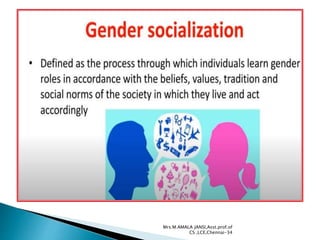
 Socialization is the process by which
children and adults learn from
others(society).
 People continue their social learning all
through life.
 Ex: learning is fun
 Sports and music –learn from friends
 Some times Social learning is painful
Mrs.M.AMALA JANSI,Asst.prof.of
CS ,LCE,Chennai-34
Mrs.M.AMALA JANSI,Asst.prof.of
CS ,LCE,Chennai-34
 Natural: infants and youngsters explore, play and discover
the social world around them.
 Planned : People take actions designed to teach or train
others began from infancy on. Good and bad features-choose good
one.
 Positive : pleasurable and exciting experiences. Ex:
positive motivation , loving care , rewarding opportunities
 Negative : others use punishment harsh criticisms or
anger
Mrs.M.AMALA JANSI,Asst.prof.of
CS ,LCE,Chennai-34
 Objective Socialization-refers to the society
acting upon the child (not influenced by personal
feelings or opinions in considering and representing facts)
 Subjective Socialization-the process by which
the society transmits its culture from one
generation to the next.(based on or influenced by
personal feelings, tastes, or opinions)
Mrs.M.AMALA JANSI,Asst.prof.of
CS ,LCE,Chennai-34
 Imitation: children imitate others , language
acquired by imitation
 Suggestion: Process of communicating
information, suggestion influences
behaviour.
 Identification: Through identification, he
becomes sociable
 Language: By language- one learns
folkways, mores
Mrs.M.AMALA JANSI,Asst.prof.of
CS ,LCE,Chennai-34
 To develop the skills and disciplines which
are needed by the individual
 To instill the aspirations and values and the
design for living which the particular society
possesses.
 To teach the social roles which individuals
must enact in society
Mrs.M.AMALA JANSI,Asst.prof.of
CS ,LCE,Chennai-34
 Socialization is vital to culture: process of
socialization –every society transmits its
culture to succeeding generations.
 Socialization is vital to personality :
formation and development(interaction with
others)
 Socialization is vital to sex role
differentiation: every individual the
expected role he or she is to play in the
society according to their sexes.
Mrs.M.AMALA JANSI,Asst.prof.of
CS ,LCE,Chennai-34
Mrs.M.AMALA JANSI,Asst.prof.of
CS ,LCE,Chennai-34
Mrs.M.AMALA JANSI,Asst.prof.of
CS ,LCE,Chennai-34
Mrs.M.AMALA JANSI,Asst.prof.of
CS ,LCE,Chennai-34
Mrs.M.AMALA JANSI,Asst.prof.of
CS ,LCE,Chennai-34
Mrs.M.AMALA JANSI,Asst.prof.of
CS ,LCE,Chennai-34
School creates :
 Emotional maturity
 Adjustment
 Building character
 Expected behaviour (reformed)
 Actor of the patriarchal (male controlled)
System
 Gender construction
 Attributes to masculinity and feminity
Mrs.M.AMALA JANSI,Asst.prof.of
CS ,LCE,Chennai-34
Mrs.M.AMALA JANSI,Asst.prof.of
CS ,LCE,Chennai-34
 an organized group of people with a
particular purpose, such as a business or
government department.
 Ex:
 Edu. Organization : NCTE,SE,SCERT,NAAC
 Cultural organization
 Health organization : WHO, NIH(National
Institute of Health)
 Clubs
Mrs.M.AMALA JANSI,Asst.prof.of
CS ,LCE,Chennai-34
Mrs.M.AMALA JANSI,Asst.prof.of
CS ,LCE,Chennai-34
Role of Family, Peer,
Teachers, Textbook,
Curriculum in
Challenging(சவால்) Gender
inequality (பாலின
சமத்துவமின
்மம)
பாலின சமத்துவத்மத
வலுப்படுத்துவதில்
குடும்பத்தின
் பங்கு
Mrs.M.AMALA JANSI,Asst.prof.of
CS ,LCE,Chennai-34
 Male & Female children are groomed
differently
 Playing materials & dresses –differently
 Activities assigned differently
 Ornaments –Different
 Parents love and affection(Boy & Girl)-
different
 Home Maker & Financial provider role Also
different.
Mrs.M.AMALA JANSI,Asst.prof.of
CS ,LCE,Chennai-34
Mrs.M.AMALA JANSI,Asst.prof.of
CS ,LCE,Chennai-34
பாலின சமத்துவத்மத வலுப்படுத்துவதில் குடும்பத்தின் பங்கு
பாலின சமத்துவத்மத
வலுப்படுத்துவதில்
பள்ளியின் பங்கு
Mrs.M.AMALA JANSI,Asst.prof.of
CS ,LCE,Chennai-34
Mrs.M.AMALA JANSI,Asst.prof.of
CS ,LCE,Chennai-34
Mrs.M.AMALA JANSI,Asst.prof.of
CS ,LCE,Chennai-34
Strict/severe
பாலின சமத்துவத்மத
வலுப்படுத்துவதில்
சகாக்களின் பங்கு
Mrs.M.AMALA JANSI,Asst.prof.of
CS ,LCE,Chennai-34
Mrs.M.AMALA JANSI,Asst.prof.of
CS ,LCE,Chennai-34
Mrs.M.AMALA JANSI,Asst.prof.of
CS ,LCE,Chennai-34
Mrs.M.AMALA JANSI,Asst.prof.of
CS ,LCE,Chennai-34
Mrs.M.AMALA JANSI,Asst.prof.of
CS ,LCE,Chennai-34
Mrs.M.AMALA JANSI,Asst.prof.of
CS ,LCE,Chennai-34
Mrs.M.AMALA JANSI,Asst.prof.of
CS ,LCE,Chennai-34
Mrs.M.AMALA JANSI,Asst.prof.of
CS ,LCE,Chennai-34
Mrs.M.AMALA JANSI,Asst.prof.of
CS ,LCE,Chennai-34
Gender inequality refers to
unequal treatment or
perceptions of individuals
wholly or partly due to their
gender.
Mrs.M.AMALA JANSI,Asst.prof.of
CS ,LCE,Chennai-34
Mrs.M.AMALA JANSI,Asst.prof.of
CS ,LCE,Chennai-34
 (1) Space utilization and sports
(2) extracurricular activities
(3) Leadership of boys and girls
(4) Perceived academic aptitude
(5) Perceived desirable and undesirable
characteristics of boys and girls(proper
conduct)
Mrs.M.AMALA JANSI,Asst.prof.of
CS ,LCE,Chennai-34
Mrs.M.AMALA JANSI,Asst.prof.of
CS ,LCE,Chennai-34
 The gender prejudices and biases have
certainly started through various school
practices and curriculum.
Mrs.M.AMALA JANSI,Asst.prof.of
CS ,LCE,Chennai-34
Mrs.M.AMALA JANSI,Asst.prof.of
CS ,LCE,Chennai-34
 Women look after their wellbeing as well as
their family
 Decision-making
 Against domestic violence
 Voice out against better sanitation, security
 Appointments of female subordinates and
male principals
 Girls encouraged to choose mathematics,
science and engineering
Mrs.M.AMALA JANSI,Asst.prof.of
CS ,LCE,Chennai-34
 Overcome peer pressure
 Gender segregation
 Peer socialization
 Used positively, can build self-
confidence, courage and
motivate others, respect
others, punctuality, join in
school activities
 Used negatively, aggression,
Unsocial behaviour and bad
habits.
Mrs.M.AMALA JANSI,Asst.prof.of
CS ,LCE,Chennai-34
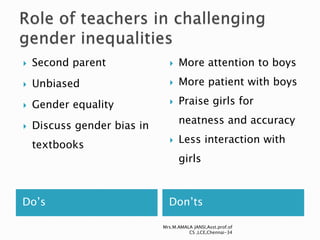
Do’s Don’ts
 Second parent
 Unbiased
 Gender equality
 Discuss gender bias in
textbooks
 More attention to boys
 More patient with boys
 Praise girls for
neatness and accuracy
 Less interaction with
girls
Mrs.M.AMALA JANSI,Asst.prof.of
CS ,LCE,Chennai-34
 Official curriculum
 State board, CBSE,
IGCSE
 Gender biased
curriculum
 Uneven
socialization of
boys and girls
 Sex education
Mrs.M.AMALA JANSI,Asst.prof.of
CS ,LCE,Chennai-34
 Men and women shown in
stereotypical roles and
professions
 Brave and strong vs passive,
self-sacrificing and caring.
 Overcome traditional roles,
subordination, peer pressure,
enemity, distractions,
inhibitions, oppression,
 aggression, untouchability
Mrs.M.AMALA JANSI,Asst.prof.of
CS ,LCE,Chennai-34
 Educational Setting-Gender Discrimination
 Girls perform more work than boys inside the
school
 Teachers-treat boys & girls differently.(pay
more attention –boys)
 Girls work-Book keeping, Garden
Maintenance ,Classroom cleaning
 Boys work- shifting , Lifting, etc..(more
physical labour & power).
 Classroom Interaction-boy dominate
Mrs.M.AMALA JANSI,Asst.prof.of
CS ,LCE,Chennai-34
 Gender equality
 Eliminate gender biased attitudes
 Create an understanding of gender
differences
 Distribution(rotation) of work
 Inculcate life skills
 Develop employment skills
 Treat each other with respect
Mrs.M.AMALA JANSI,Asst.prof.of
CS ,LCE,Chennai-34
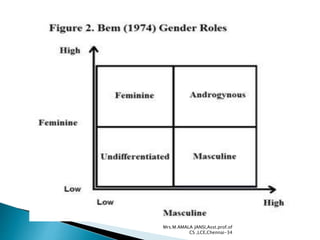
 Early gender identity –single bipolar
dimension of masculinity & feminity
 Unidimensional (one dimensional) model –
challenged stereotypes –led to develop –two
dimensional gender identity model.
 Two instruments: BSRI and PAQ
 BSRI- Bem Sex Role Inventory
 PAQ- Personality Attributes
Questionnaire
Mrs.M.AMALA JANSI,Asst.prof.of
CS ,LCE,Chennai-34
Mrs.M.AMALA JANSI,Asst.prof.of
CS ,LCE,Chennai-34
Mrs.M.AMALA JANSI,Asst.prof.of
CS ,LCE,Chennai-34
Androgynous(an-
drojenes)
Undifferentiated
 Partly male and partly
female in appearance ;
of indeterminate sex.
 Having the physical
characteristics of both
sexes
 Cross sex typed
 Male report themselves
as identifying primarily
with feminine traits.
 Female report
themselves as
identifying primarily
with masculine traits
 Either males or females
 Who report themselves
as low on both
masculine and
feminine traits.
Mrs.M.AMALA JANSI,Asst.prof.of
CS ,LCE,Chennai-34
Mrs.M.AMALA JANSI,Asst.prof.of
CS ,LCE,Chennai-34
 Student centered classes, group work,
students’ more talking time, critical and
analytical thinking, team spirit
• behavioral discriminations,
• achievement discrimination, and
• developmental discrimination.
REF: ARTICLE:3 SIGNS OF
GENDER DISCRIMINATION IN
THE CLASSROOM YOU NEED TO
KNOW
Mrs.M.AMALA JANSI,Asst.prof.of
CS ,LCE,Chennai-34
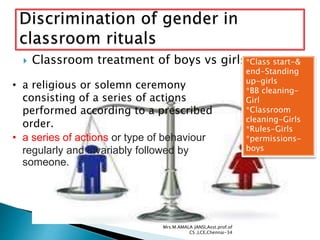
 Classroom treatment of boys vs girls
• a religious or solemn ceremony
consisting of a series of actions
performed according to a prescribed
order.
• a series of actions or type of behaviour
regularly and invariably followed by
someone.
Mrs.M.AMALA JANSI,Asst.prof.of
CS ,LCE,Chennai-34
*Class start-&
end-Standing
up-girls
*BB cleaning-
Girl
*Classroom
cleaning-Girls
*Rules-Girls
*permissions-
boys
 Adhere a routine
 Timings
 Period
 Prayer
 Books
 Bag
 Notebooks
 Uniform
 Shoes
 Responsibilities
 Socks
 Hairstyle
 Lunchbox
 Water bottle
 Class work
 Homework
 Group activities
 Physical exercises
 Discipline
 Obedience
Mrs.M.AMALA JANSI,Asst.prof.of
CS ,LCE,Chennai-34
Mrs.M.AMALA JANSI,Asst.Prof.of
CS ,LCE,chennai-34
Mrs.M.AMALA JANSI,Asst.Prof.of
CS ,LCE,chennai-34
What is discipline?
Mrs.M.AMALA JANSI,Asst.Prof.of
CS ,LCE,chennai-34
 To train someone physically, intellectually,
emotionally and socially
 When combined with love and respect, it helps
children to develop self-esteem and responsibility
 Parents, teachers, caregivers and others train
children when they talk, teach, hold and spend
time with them
Mrs.M.AMALA JANSI,Asst.Prof.of
CS ,LCE,chennai-34
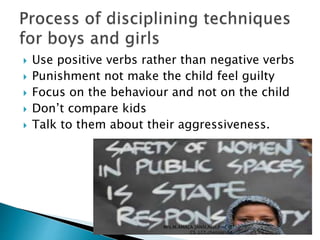
 Use positive verbs rather than negative verbs
 Punishment not make the child feel guilty
 Focus on the behaviour and not on the child
 Don’t compare kids
 Talk to them about their aggressiveness.
Mrs.M.AMALA JANSI,Asst.Prof.of
CS ,LCE,chennai-34
Mrs.M.AMALA JANSI,Asst.Prof.of
CS ,LCE,chennai-34
 Personality traits
 Domestic behaviours
 Occupations
 Physical appearances
 Stereotype is a
fixed, general
image of a
person or thing
shared by
many people.
Mrs.M.AMALA JANSI,Asst.prof.of
CS ,LCE,Chennai-34
Mrs.M.AMALA JANSI,Asst.prof.of CS
,LCE,Chennai-34
Most Common Gender Stereotypes
There are four basic examples of gender stereotypes:
1.Personality Traits: Women are supposed to be
shy, passive and submissive. Women are
organized and clean. Men are expected to be
tough, aggressive, dominant and self-confident.
Men are lazy and messy.
2.Domestic Behaviors: Women are supposed to
cook and do housework. Women are better at
raising children. Stay-at-home mothers are better
than working mothers. On the other hand: Men
are better at household repairs. Men cannot cook,
sew or care for their children. Men always tell
their wives what to do.
Mrs.M.AMALA JANSI,Asst.prof.of
CS ,LCE,Chennai-34
3.Occupations: Women are supposed to have “clean” jobs
such as teachers, nurses, secretaries and librarians.
Women are not good at math. Women are supposed to
make less money than men. Women are not politicians.
Women cannot be presidential candidates. On the other
hand: Men are supposed to have “dirty jobs” like
mechanics, construction workers, plumbers and
engineering. Men are all good at math. Men are better
doctors. Men are supposed to be in charge at work and
should make more money than women. Men are better
politicians.
Mrs.M.AMALA JANSI,Asst.prof.of
CS ,LCE,Chennai-34
 4.Physical Appearance: Generally speaking, women
are expected to be short and slender, small and delicate
while men are supposed to be tall with broad shoulders.
However, physical appearance gender stereotyping
varies from culture to culture. In cultures where men are
small in size, masculinity is determined by acting macho.
Acting macho for men would mean getting involved in
fights, drinking alcohol, smoking unfiltered cigarettes and
getting into fights. Female gender stereotype occurs for
women who act “macho” in some cultures. Women who
smoke, drink, and swear often are considered
“masculine”.
Mrs.M.AMALA JANSI,Asst.prof.of
CS ,LCE,Chennai-34

Unit2-GENDER IDENTITY AND SOCIALIZATION PROCESS -Notes.pptx

  • 1.
    UNIT- II: GENDERIDENTITY AND SOCIALIZATION PROCESS Gender identity and socialization practices in family, school and organization - Role of school, peers, teachers, curriculum and textbooks in challenging gender equalities or reinforcing gender parity - gender roles and responsibilities assigned in schools and classrooms – Measurement of gender identity - discrimination of gender in classroom interactions, rituals and school/ routines - Processes of disciplining techniques for boys and girls - Analysis of sex-roles stereotype.
  • 2.
    Gender identity isone's personal experience of one's own gender Mrs.M.AMALA JANSI,Asst.prof.of CS ,LCE,Chennai-34
  • 3.
    +  GENDER IDENTITY:An image of oneself as masculine or feminine in characteristics Mrs.M.AMALA JANSI,Asst.prof.of CS ,LCE,Chennai-34
  • 4.
     Sociologists areparticularly interested in gender identity.  Gender identity appears to form very early in life.  Most likely irreversible by age 4.  Gender identity –based on  Biological  Psychological  Social variables Mrs.M.AMALA JANSI,Asst.prof.of CS ,LCE,Chennai-34
  • 5.
    + Biological  Evolutionary –emphasise ancestral mating strategies as the basis for differences in gender roles. i.e. women bearing children, men hunting for survival. • Weaknesses: Does not account for modern factors (cultural, financial) that have changed how people live their lives. • Increasing number of women choosing not to have children • Little empirical evidence for the evolutionary account. • Most data on gender differences in mate selection through self-reports, therefore very little behavioural support. Mrs.M.AMALA JANSI,Asst.prof.of CS ,LCE,Chennai-34
  • 6.
    + Kohlberg’s stages of genderdevelopment  1) Gender Labeling (approx. 2yrs): the knowledge that one is male or female due to their anatomy  2) Gender Stability (approx 4-5yrs): the belief that their own gender is permanent.  3) Gender Constancy: the understanding that gender will not change despite changes to physical appearances (e.g. a woman wearing pants is still a female)  These children value their gender identity positively and try to behave only in ways that match their conception. Mrs.M.AMALA JANSI,Asst.prof.of CS ,LCE,Chennai-34
  • 7.
  • 8.
    • Most individualslearn gender identity through socialization. • * Gender is usually reinforced at birth - blue for boys and pink for girls. • * Differing gender expectations from parents and society also create gender identity. Mrs.M.AMALA JANSI,Asst.prof.of CS ,LCE,Chennai-34
  • 9.
  • 10.
     Socialization isthe process by which children and adults learn from others(society).  People continue their social learning all through life.  Ex: learning is fun  Sports and music –learn from friends  Some times Social learning is painful Mrs.M.AMALA JANSI,Asst.prof.of CS ,LCE,Chennai-34
  • 11.
  • 12.
     Natural: infantsand youngsters explore, play and discover the social world around them.  Planned : People take actions designed to teach or train others began from infancy on. Good and bad features-choose good one.  Positive : pleasurable and exciting experiences. Ex: positive motivation , loving care , rewarding opportunities  Negative : others use punishment harsh criticisms or anger Mrs.M.AMALA JANSI,Asst.prof.of CS ,LCE,Chennai-34
  • 13.
     Objective Socialization-refersto the society acting upon the child (not influenced by personal feelings or opinions in considering and representing facts)  Subjective Socialization-the process by which the society transmits its culture from one generation to the next.(based on or influenced by personal feelings, tastes, or opinions) Mrs.M.AMALA JANSI,Asst.prof.of CS ,LCE,Chennai-34
  • 14.
     Imitation: childrenimitate others , language acquired by imitation  Suggestion: Process of communicating information, suggestion influences behaviour.  Identification: Through identification, he becomes sociable  Language: By language- one learns folkways, mores Mrs.M.AMALA JANSI,Asst.prof.of CS ,LCE,Chennai-34
  • 15.
     To developthe skills and disciplines which are needed by the individual  To instill the aspirations and values and the design for living which the particular society possesses.  To teach the social roles which individuals must enact in society Mrs.M.AMALA JANSI,Asst.prof.of CS ,LCE,Chennai-34
  • 16.
     Socialization isvital to culture: process of socialization –every society transmits its culture to succeeding generations.  Socialization is vital to personality : formation and development(interaction with others)  Socialization is vital to sex role differentiation: every individual the expected role he or she is to play in the society according to their sexes. Mrs.M.AMALA JANSI,Asst.prof.of CS ,LCE,Chennai-34
  • 17.
  • 18.
  • 19.
  • 20.
  • 21.
  • 22.
    School creates : Emotional maturity  Adjustment  Building character  Expected behaviour (reformed)  Actor of the patriarchal (male controlled) System  Gender construction  Attributes to masculinity and feminity Mrs.M.AMALA JANSI,Asst.prof.of CS ,LCE,Chennai-34
  • 23.
  • 24.
     an organizedgroup of people with a particular purpose, such as a business or government department.  Ex:  Edu. Organization : NCTE,SE,SCERT,NAAC  Cultural organization  Health organization : WHO, NIH(National Institute of Health)  Clubs Mrs.M.AMALA JANSI,Asst.prof.of CS ,LCE,Chennai-34
  • 25.
    Mrs.M.AMALA JANSI,Asst.prof.of CS ,LCE,Chennai-34 Roleof Family, Peer, Teachers, Textbook, Curriculum in Challenging(சவால்) Gender inequality (பாலின சமத்துவமின ்மம)
  • 26.
  • 27.
     Male &Female children are groomed differently  Playing materials & dresses –differently  Activities assigned differently  Ornaments –Different  Parents love and affection(Boy & Girl)- different  Home Maker & Financial provider role Also different. Mrs.M.AMALA JANSI,Asst.prof.of CS ,LCE,Chennai-34
  • 28.
    Mrs.M.AMALA JANSI,Asst.prof.of CS ,LCE,Chennai-34 பாலினசமத்துவத்மத வலுப்படுத்துவதில் குடும்பத்தின் பங்கு
  • 29.
  • 30.
  • 31.
  • 32.
  • 33.
  • 34.
  • 35.
  • 36.
  • 37.
  • 38.
  • 39.
  • 40.
  • 41.
    Gender inequality refersto unequal treatment or perceptions of individuals wholly or partly due to their gender. Mrs.M.AMALA JANSI,Asst.prof.of CS ,LCE,Chennai-34
  • 42.
  • 43.
     (1) Spaceutilization and sports (2) extracurricular activities (3) Leadership of boys and girls (4) Perceived academic aptitude (5) Perceived desirable and undesirable characteristics of boys and girls(proper conduct) Mrs.M.AMALA JANSI,Asst.prof.of CS ,LCE,Chennai-34
  • 44.
  • 45.
     The genderprejudices and biases have certainly started through various school practices and curriculum. Mrs.M.AMALA JANSI,Asst.prof.of CS ,LCE,Chennai-34
  • 46.
  • 47.
     Women lookafter their wellbeing as well as their family  Decision-making  Against domestic violence  Voice out against better sanitation, security  Appointments of female subordinates and male principals  Girls encouraged to choose mathematics, science and engineering Mrs.M.AMALA JANSI,Asst.prof.of CS ,LCE,Chennai-34
  • 48.
     Overcome peerpressure  Gender segregation  Peer socialization  Used positively, can build self- confidence, courage and motivate others, respect others, punctuality, join in school activities  Used negatively, aggression, Unsocial behaviour and bad habits. Mrs.M.AMALA JANSI,Asst.prof.of CS ,LCE,Chennai-34
  • 49.
    Do’s Don’ts  Secondparent  Unbiased  Gender equality  Discuss gender bias in textbooks  More attention to boys  More patient with boys  Praise girls for neatness and accuracy  Less interaction with girls Mrs.M.AMALA JANSI,Asst.prof.of CS ,LCE,Chennai-34
  • 50.
     Official curriculum State board, CBSE, IGCSE  Gender biased curriculum  Uneven socialization of boys and girls  Sex education Mrs.M.AMALA JANSI,Asst.prof.of CS ,LCE,Chennai-34
  • 51.
     Men andwomen shown in stereotypical roles and professions  Brave and strong vs passive, self-sacrificing and caring.  Overcome traditional roles, subordination, peer pressure, enemity, distractions, inhibitions, oppression,  aggression, untouchability Mrs.M.AMALA JANSI,Asst.prof.of CS ,LCE,Chennai-34
  • 52.
     Educational Setting-GenderDiscrimination  Girls perform more work than boys inside the school  Teachers-treat boys & girls differently.(pay more attention –boys)  Girls work-Book keeping, Garden Maintenance ,Classroom cleaning  Boys work- shifting , Lifting, etc..(more physical labour & power).  Classroom Interaction-boy dominate Mrs.M.AMALA JANSI,Asst.prof.of CS ,LCE,Chennai-34
  • 53.
     Gender equality Eliminate gender biased attitudes  Create an understanding of gender differences  Distribution(rotation) of work  Inculcate life skills  Develop employment skills  Treat each other with respect Mrs.M.AMALA JANSI,Asst.prof.of CS ,LCE,Chennai-34
  • 54.
     Early genderidentity –single bipolar dimension of masculinity & feminity  Unidimensional (one dimensional) model – challenged stereotypes –led to develop –two dimensional gender identity model.  Two instruments: BSRI and PAQ  BSRI- Bem Sex Role Inventory  PAQ- Personality Attributes Questionnaire Mrs.M.AMALA JANSI,Asst.prof.of CS ,LCE,Chennai-34
  • 55.
  • 56.
  • 57.
    Androgynous(an- drojenes) Undifferentiated  Partly maleand partly female in appearance ; of indeterminate sex.  Having the physical characteristics of both sexes  Cross sex typed  Male report themselves as identifying primarily with feminine traits.  Female report themselves as identifying primarily with masculine traits  Either males or females  Who report themselves as low on both masculine and feminine traits. Mrs.M.AMALA JANSI,Asst.prof.of CS ,LCE,Chennai-34
  • 58.
  • 59.
     Student centeredclasses, group work, students’ more talking time, critical and analytical thinking, team spirit • behavioral discriminations, • achievement discrimination, and • developmental discrimination. REF: ARTICLE:3 SIGNS OF GENDER DISCRIMINATION IN THE CLASSROOM YOU NEED TO KNOW Mrs.M.AMALA JANSI,Asst.prof.of CS ,LCE,Chennai-34
  • 60.
     Classroom treatmentof boys vs girls • a religious or solemn ceremony consisting of a series of actions performed according to a prescribed order. • a series of actions or type of behaviour regularly and invariably followed by someone. Mrs.M.AMALA JANSI,Asst.prof.of CS ,LCE,Chennai-34 *Class start-& end-Standing up-girls *BB cleaning- Girl *Classroom cleaning-Girls *Rules-Girls *permissions- boys
  • 61.
     Adhere aroutine  Timings  Period  Prayer  Books  Bag  Notebooks  Uniform  Shoes  Responsibilities  Socks  Hairstyle  Lunchbox  Water bottle  Class work  Homework  Group activities  Physical exercises  Discipline  Obedience Mrs.M.AMALA JANSI,Asst.prof.of CS ,LCE,Chennai-34
  • 62.
  • 63.
  • 64.
    What is discipline? Mrs.M.AMALAJANSI,Asst.Prof.of CS ,LCE,chennai-34
  • 65.
     To trainsomeone physically, intellectually, emotionally and socially  When combined with love and respect, it helps children to develop self-esteem and responsibility  Parents, teachers, caregivers and others train children when they talk, teach, hold and spend time with them Mrs.M.AMALA JANSI,Asst.Prof.of CS ,LCE,chennai-34
  • 66.
     Use positiveverbs rather than negative verbs  Punishment not make the child feel guilty  Focus on the behaviour and not on the child  Don’t compare kids  Talk to them about their aggressiveness. Mrs.M.AMALA JANSI,Asst.Prof.of CS ,LCE,chennai-34
  • 67.
  • 68.
     Personality traits Domestic behaviours  Occupations  Physical appearances  Stereotype is a fixed, general image of a person or thing shared by many people. Mrs.M.AMALA JANSI,Asst.prof.of CS ,LCE,Chennai-34
  • 69.
  • 70.
    Most Common GenderStereotypes There are four basic examples of gender stereotypes: 1.Personality Traits: Women are supposed to be shy, passive and submissive. Women are organized and clean. Men are expected to be tough, aggressive, dominant and self-confident. Men are lazy and messy. 2.Domestic Behaviors: Women are supposed to cook and do housework. Women are better at raising children. Stay-at-home mothers are better than working mothers. On the other hand: Men are better at household repairs. Men cannot cook, sew or care for their children. Men always tell their wives what to do. Mrs.M.AMALA JANSI,Asst.prof.of CS ,LCE,Chennai-34
  • 71.
    3.Occupations: Women aresupposed to have “clean” jobs such as teachers, nurses, secretaries and librarians. Women are not good at math. Women are supposed to make less money than men. Women are not politicians. Women cannot be presidential candidates. On the other hand: Men are supposed to have “dirty jobs” like mechanics, construction workers, plumbers and engineering. Men are all good at math. Men are better doctors. Men are supposed to be in charge at work and should make more money than women. Men are better politicians. Mrs.M.AMALA JANSI,Asst.prof.of CS ,LCE,Chennai-34
  • 72.
     4.Physical Appearance:Generally speaking, women are expected to be short and slender, small and delicate while men are supposed to be tall with broad shoulders. However, physical appearance gender stereotyping varies from culture to culture. In cultures where men are small in size, masculinity is determined by acting macho. Acting macho for men would mean getting involved in fights, drinking alcohol, smoking unfiltered cigarettes and getting into fights. Female gender stereotype occurs for women who act “macho” in some cultures. Women who smoke, drink, and swear often are considered “masculine”. Mrs.M.AMALA JANSI,Asst.prof.of CS ,LCE,Chennai-34