INTRODUCTION TO
QUALITATIVE RESEARCH
FRITZIE L. FINMOROG
QUALITATIVE QUANTITATIVE
tends to focus on how people
or groups of people can have
(somewhat) different ways of
looking at reality (usually
social or psychological reality)
tends to focus on ways of
describing and understanding
reality by the discovery of
general “laws”
takes account of complexity
by incorporating the real-
world context – can take
different perspectives on
board
takes account of complexity
by precise definition of the
focus of interest and
techniques that mean that
external “noise” can be
discounted
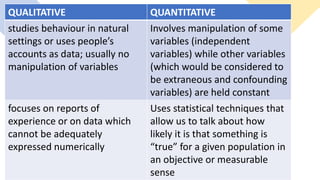
QUALITATIVE QUANTITATIVE
studies behaviour in natural
settings or uses people’s
accounts as data; usually no
manipulation of variables
Involves manipulation of some
variables (independent
variables) while other variables
(which would be considered to
be extraneous and confounding
variables) are held constant
focuses on reports of
experience or on data which
cannot be adequately
expressed numerically
Uses statistical techniques that
allow us to talk about how
likely it is that something is
“true” for a given population in
an objective or measurable
sense
QUALITATIVE QUANTITATIVE
Focuses on description and
interpretation and might lead
to development of new
concepts or theory, or to an
evaluation of an
organisational process
Focuses on cause & effect -
e.g. uses experiment to test
(try to disprove) an
hypothesis
employs a flexible, emergent
but systematic research
process
Requires the research
process to be defined in
advance
Qualitative research
is concerned with
developing
explanations of
social phenomena.
It aims to help us to
understand the social
world in which we live
and why things are the
way they are. It is
concerned with the
social aspects of our
world and seeks to
answer questions
about:
KEY QUESTIONS:
• Why people behave the way
they do
• How opinions and attitudes are
formed
• How people are affected by the
events that go on around them
• How and why cultures and
practices have developed in the
way they have
CONTEXT
•exploration or identification of concepts or views
•exploration of “implementability”
•the real-life context
• sensitive topics where flexibility is needed to
avoid causing distress
Exercise: Which of the following used qualitative? What
features of each research question lead to your decision?
•DETRMINE THE LEVEL OF ANXIETY OF SHS STUDENTS
IN RELATION TO DISTANCE LEARNING.
•AN EXPLORATION OF THE LIVED EXPERIENCES OF
SHS STUDENTS WHO HAVE ABSENTEE PARENTS.
•THE LEVEL OF RESEARCH CAPABILITY OF GRADE 11
STUDENTS IN PR 1.
•CHOOSING LIFE: A CASE STUDY ON THE LIVED
EXPERIENCES OF STUDENTS SUFFERING FROM
MENTAL BREAKDOWNS.
RESEARCH QUESTIONS
• Research questions are important because they guide
the whole research process
• WHY AND HOW QUESTIONS
• involve identifying what is happening or being experienced,
rather than measuring how much of something exists, or
focusing on the way changing one thing produces a change
in another
•As a qualitative study progresses, the research question
should be refined and may be reformulated. In contrast,
reformulation of a quantitative research question
requires a new study.
General characteristics
Seeks to explore a phenomenon
Instruments use a more flexible style of eliciting responses
Use semi-structured methods such as in-depth interviews, focused group
discussions and participant observation
Nonprobability sampling, usually purposive and snowball sampling
Question format is open-ended
Data format is textual (from field notes, audiotapes, videotapes)
Limited ability to generalize results to a larger population
IDENTIFYING A TOPIC
•ASK STUDENTS TO IDENTIFY THEIR
INTERESTS then READ….READ….READ….!
IDENTIFYING A TOPIC
• TRANSLATE CHOSEN INTEREST TO RESEARCH OBJECTIVES
What does measurable
mean in qualitative
research?
Availability of data that
directly respond to the
research objectives.
Qualitative Approaches
•Ethnography
•Grounded theory
•Interpretative phenomenological analysis
•Discourse analysis
•Conversation analysis
• Content analysis
•Narrative analysis
•Indigenous approaches
Ethnography
•Ethnography has a background
in anthropology.
•The term means “portrait of a
people” and it is a methodology
for descriptive studies of
cultures and peoples.
Ethnography
•The cultural parameter is that the
people under investigation have something
in common. Examples of parameters
include:
•geographical - a particular region or country
• religious
• social / familial
•shared experience
•Ethnography helps researchers to
elucidate the situation, uncovering
practices and developing cultural
awareness and sensitivity.
•Ethnographic studies entail extensive
fieldwork by the researcher. Data
collection techniques include both formal
and informal interviewing, often
interviewing individuals on several
occasions, and participant or non-
participant observation.
•Interpret data from the perspective of the
participants.
Grounded Theory
•The main feature is the development of new theory
through the collection and analysis of data about a
phenomenon.
•It is phenomenological (this means it attempts to
understand how participants make sense of their
experiences and does not assume that participants’
accounts refer to some verifiable reality); but it goes
beyond phenomenology because the explanations that
emerge are used to develop new theories.
•Theory about the grief process.
•This is not a new phenomenon, people have
been going through these stages for as long as
society has existed, but the research formally
acknowledged and described
•the experience.
Denial Anger
Accept
-ance
resolution
KEY FEATURES OF GROUNDED THEORY
its focus on “emergence”: in theory, research should
start from a position where the researcher knows
nothing about what they are studying so that all
concepts truly “emerge” from the data.
theoretical sampling: sampling is based on theoretically
relevant constructs
theoretical sensitivity: this is the ability to recognize what is
important in the data so that you can give it meaning.
Discourse Analysis
It focuses on text and talk as social practices.
How discourses are organized to be persuasive, or to present a particular
‘world view’, and would search for these patterns in the words that are used
(linguistic repertoire) and the way that they are utilized (rhetorical strategies).
Discourse analysis is the study of language in use, and any language use
(detailed transcripts of recorded speech for example, but also texts such as
newspapers, policy documents, etc.) can be considered in this way.
Researchers would also be interested in the function of
discourse as well as its content.
Conversation Analysis
Conversation analysis explores how social interactions are
structurally organized and does this by analyzing detailed
transcripts of tape recordings, examining such things as
turn-taking, lengths of pauses, inflections and so on.
This involves studying the social organization of conversation and is
concerned with establishing how that organization is achieved; as
such conversation analysis might only be used with ‘naturally
occurring’ speech and it is not an appropriate way of considering
interview data (where the organization of talk is established by the
formal interview process).
Content Analysis
•This approach is particularly
suitable when analyzing
documents e.g. newspaper
texts, responses to open-
ended questions.
PHENOMENOLOGY
• Phenomenology is the study of the lived experience of
persons who were involved with the phenomenon being
studied, and the essence of such experiences.
• It seeks to understand social and psychological phenomenon
from the perspective of the people actually involved
• The goal is to describe, rather than to explain or quantify the
lived experience. It involves the Identification of a common
or shared experience of a phenomenon.
PHENOMENOLOGY
• In general, “a phenomenological research is well
suited for studying affective, emotional, and often
intense human experiences” (Merriam, 2009)
• A good phenomenological study should elicit the
following response from the reader: “Now I
understand want it is like to have experienced that
particular phenomenon.”
• Disciplinary origin: Philosophy
Narrative Analysis
•This focuses on people’s
narratives/stories either
about themselves or a set
of events.
CASE STUDY
 It is a simple descriptive but in-depth account of
interesting characteristics observed in a group of
subjects, in order to address the research problem
investigated.
 The subjects do not necessarily have to be persons – they
can be organizations, institutions, political units (province,
municipality, barangay etc.)
 Case study subjects are generally selected because of
their peculiar characteristics and not because they are
typical of the target population
QUALITATIVE DATA COLLECTION METHODS
•1. INTERVIEWS
•Qualitative researchers usually employ “semi-
structured” interviews which involve a number of
open-ended questions based on the topic areas
that the researcher wants to cover.
•The open-ended nature of the questions posed
defines the topic under investigation but provides
opportunities for both interviewer and
interviewee to discuss some topics in more detail.
Preparation
for
semi-
structured
interviews
includes
drawing
up
a
“topic
guide”
which
is
a
list
of
topics
the
interviewer
wishes
to
discuss.
Interviewer: "I'd like to hear your
thoughts on whether changes in
government policy have changed the
work of the doctor in general practice.
Has your work changed at all?"
Interviewee: "Absolutely! The
workload has increased for a start."
Interviewer: "Oh, how is that?"
conducted
sensitively
and
flexibly
allowing
follow
up
of
points
of
interest
to
either
interviewer
or
interviewee
has the interviewee understood
it and got any questions?
he consent form (has it been
signed?)
the voice recorder (is it
switched on?)
Note
to
interviewers
A good interviewer needs to be able to put an interviewee at ease, needs
good listening skills and needs to be able to manage an interview
situation so as to collect data which truly reflect the opinions and
feelings of the interviewee concerning the chosen topic(s).
A quiet, comfortable location should be chosen and the interviewer
should give consideration to how s/he presents her/himself in terms of
dress, manner and so on, so as to be approachable.
Interviews may also be video-taped if details such
as non-verbal signals are needed for the analysis.
a reflexive diary should be kept by the
researcher/field notes
Focus
Group
Discussions
focus group transcripts can be analysed so as to explore
the ways in which the participants interact with each
other and influence each other’s expressed ideas, which
obviously cannot happen with one-to-one interview
material
focus group conveners use topic guides
to help them keep the discussion
relevant to the research question
more difficult to manage and more difficult to
convene simply because more people are
involved (approximately 8 people)
Points
to
consider
during
FGD
It is better if the discussion is not interrupted and so it
is a good idea to offer refreshments and to point out
toilet facilities beforehand.
Laying down of ground rules: confidentiality,
agreement of all involved
the researcher must allow all participants to express themselves and must
cope with the added problem of trying to prevent more than one person
speaking at a time, in order to permit identification of the speakers for the
purposes of transcription and analysis
Have an observer to be present
Take note of time
Observation
Observing in some situations is more
valid: it is possible to see how they
actually behave.
Observation can also produce data for
verifying or nullifying information
provided in face-to-face encounters.
Not only of people but
observation of the environment
Techniques
in
doing
observation
1. Written descriptions
2. Video recording
3. Artifacts- significant objects which
inform us about a phenomenon
under study
Collection of Documented Material such as
Letters, Diaries, Photographs
Documentation: policy documents, mission statements,
annual reports, minutes of meetings, codes of conduct,
web sites, series of letters or emails, case notes, health
promotion materials
Photographs are a good way of collecting information
which can be captured in a single shot or series of shots
any ethical implications of collecting documents should
be considered
Collection of Narrative
Data collected should be entirely naturally occurring, not shaped as
in a semi-structured interview or focus group.
Narrative data can however be collected in the course of a
form of interview.
The “narrative interview” begins with a “generative narrative question” which
invites the interviewee to relate his/her account of his/her life history or a part
of it.
questions are asked in order to gain further explanation of aspects of
the narrative
Sampling
methods
Convenience sampling: here researchers
select those who are available and likely
to participate, perhaps over a specific
period.
Typical case sampling: researchers
decide on the characteristics of “typical”
individuals and select the sample to fit
the characteristics of typical cases in
selecting people for focus groups etc.
Critical case sampling: researchers choose cases that they believe
to be especially important because of the position they hold (e.g.
because of their particular place within an organization) or
because they are especially well able to articulate a view (e.g.
spokesperson for a medical charity).
Maximum variation sampling: here researchers identify cases with
different characteristics to maximize diversity in the sample, usually to get
the widest range of views possible. This is best done using quota methods
and iteratively (e.g. refine your quotas based on the emergent analysis –
you may decide you need to investigate one group in more depth). Any
common themes that emerge can capture “core” experiences or views.
Snowball sampling: relies on referrals, one participant recruits
others. This can help researchers to capitalize on informal
networks that might otherwise be difficult to access (e.g. sex
workers, drug users, victims of domestic violence etc).
Intensity sampling: this is where researchers
sample the same characteristics over and over. It
tends to be used in interpretive
phenomenological analysis.
How do you Know When you Have an Adequate Sample?
Ideally this will occur when your quota (sampling
frame) is full, and when you have reached
theoretical saturation
Theoretical saturation occurs when new data from
new cases do not contribute to the development of
emerging theory even after you have tried to ensure
that your new cases are those most likely to extend
or challenge your ideas.

INTRODUCTION-TO-QUALITATIVE-RESEARCH.pptx

  • 1.
  • 2.
    QUALITATIVE QUANTITATIVE tends tofocus on how people or groups of people can have (somewhat) different ways of looking at reality (usually social or psychological reality) tends to focus on ways of describing and understanding reality by the discovery of general “laws” takes account of complexity by incorporating the real- world context – can take different perspectives on board takes account of complexity by precise definition of the focus of interest and techniques that mean that external “noise” can be discounted
  • 3.
    QUALITATIVE QUANTITATIVE studies behaviourin natural settings or uses people’s accounts as data; usually no manipulation of variables Involves manipulation of some variables (independent variables) while other variables (which would be considered to be extraneous and confounding variables) are held constant focuses on reports of experience or on data which cannot be adequately expressed numerically Uses statistical techniques that allow us to talk about how likely it is that something is “true” for a given population in an objective or measurable sense
  • 4.
    QUALITATIVE QUANTITATIVE Focuses ondescription and interpretation and might lead to development of new concepts or theory, or to an evaluation of an organisational process Focuses on cause & effect - e.g. uses experiment to test (try to disprove) an hypothesis employs a flexible, emergent but systematic research process Requires the research process to be defined in advance
  • 5.
    Qualitative research is concernedwith developing explanations of social phenomena.
  • 6.
    It aims tohelp us to understand the social world in which we live and why things are the way they are. It is concerned with the social aspects of our world and seeks to answer questions about:
  • 7.
    KEY QUESTIONS: • Whypeople behave the way they do • How opinions and attitudes are formed • How people are affected by the events that go on around them • How and why cultures and practices have developed in the way they have
  • 8.
    CONTEXT •exploration or identificationof concepts or views •exploration of “implementability” •the real-life context • sensitive topics where flexibility is needed to avoid causing distress
  • 9.
    Exercise: Which ofthe following used qualitative? What features of each research question lead to your decision? •DETRMINE THE LEVEL OF ANXIETY OF SHS STUDENTS IN RELATION TO DISTANCE LEARNING. •AN EXPLORATION OF THE LIVED EXPERIENCES OF SHS STUDENTS WHO HAVE ABSENTEE PARENTS. •THE LEVEL OF RESEARCH CAPABILITY OF GRADE 11 STUDENTS IN PR 1. •CHOOSING LIFE: A CASE STUDY ON THE LIVED EXPERIENCES OF STUDENTS SUFFERING FROM MENTAL BREAKDOWNS.
  • 10.
    RESEARCH QUESTIONS • Researchquestions are important because they guide the whole research process • WHY AND HOW QUESTIONS • involve identifying what is happening or being experienced, rather than measuring how much of something exists, or focusing on the way changing one thing produces a change in another •As a qualitative study progresses, the research question should be refined and may be reformulated. In contrast, reformulation of a quantitative research question requires a new study.
  • 11.
    General characteristics Seeks toexplore a phenomenon Instruments use a more flexible style of eliciting responses Use semi-structured methods such as in-depth interviews, focused group discussions and participant observation Nonprobability sampling, usually purposive and snowball sampling Question format is open-ended Data format is textual (from field notes, audiotapes, videotapes) Limited ability to generalize results to a larger population
  • 12.
    IDENTIFYING A TOPIC •ASKSTUDENTS TO IDENTIFY THEIR INTERESTS then READ….READ….READ….!
  • 13.
    IDENTIFYING A TOPIC •TRANSLATE CHOSEN INTEREST TO RESEARCH OBJECTIVES What does measurable mean in qualitative research? Availability of data that directly respond to the research objectives.
  • 14.
    Qualitative Approaches •Ethnography •Grounded theory •Interpretativephenomenological analysis •Discourse analysis •Conversation analysis • Content analysis •Narrative analysis •Indigenous approaches
  • 15.
    Ethnography •Ethnography has abackground in anthropology. •The term means “portrait of a people” and it is a methodology for descriptive studies of cultures and peoples.
  • 16.
    Ethnography •The cultural parameteris that the people under investigation have something in common. Examples of parameters include: •geographical - a particular region or country • religious • social / familial •shared experience
  • 17.
    •Ethnography helps researchersto elucidate the situation, uncovering practices and developing cultural awareness and sensitivity. •Ethnographic studies entail extensive fieldwork by the researcher. Data collection techniques include both formal and informal interviewing, often interviewing individuals on several occasions, and participant or non- participant observation. •Interpret data from the perspective of the participants.
  • 19.
    Grounded Theory •The mainfeature is the development of new theory through the collection and analysis of data about a phenomenon. •It is phenomenological (this means it attempts to understand how participants make sense of their experiences and does not assume that participants’ accounts refer to some verifiable reality); but it goes beyond phenomenology because the explanations that emerge are used to develop new theories.
  • 20.
    •Theory about thegrief process. •This is not a new phenomenon, people have been going through these stages for as long as society has existed, but the research formally acknowledged and described •the experience. Denial Anger Accept -ance resolution
  • 21.
    KEY FEATURES OFGROUNDED THEORY its focus on “emergence”: in theory, research should start from a position where the researcher knows nothing about what they are studying so that all concepts truly “emerge” from the data. theoretical sampling: sampling is based on theoretically relevant constructs theoretical sensitivity: this is the ability to recognize what is important in the data so that you can give it meaning.
  • 22.
    Discourse Analysis It focuseson text and talk as social practices. How discourses are organized to be persuasive, or to present a particular ‘world view’, and would search for these patterns in the words that are used (linguistic repertoire) and the way that they are utilized (rhetorical strategies). Discourse analysis is the study of language in use, and any language use (detailed transcripts of recorded speech for example, but also texts such as newspapers, policy documents, etc.) can be considered in this way. Researchers would also be interested in the function of discourse as well as its content.
  • 24.
    Conversation Analysis Conversation analysisexplores how social interactions are structurally organized and does this by analyzing detailed transcripts of tape recordings, examining such things as turn-taking, lengths of pauses, inflections and so on. This involves studying the social organization of conversation and is concerned with establishing how that organization is achieved; as such conversation analysis might only be used with ‘naturally occurring’ speech and it is not an appropriate way of considering interview data (where the organization of talk is established by the formal interview process).
  • 25.
    Content Analysis •This approachis particularly suitable when analyzing documents e.g. newspaper texts, responses to open- ended questions.
  • 27.
    PHENOMENOLOGY • Phenomenology isthe study of the lived experience of persons who were involved with the phenomenon being studied, and the essence of such experiences. • It seeks to understand social and psychological phenomenon from the perspective of the people actually involved • The goal is to describe, rather than to explain or quantify the lived experience. It involves the Identification of a common or shared experience of a phenomenon.
  • 28.
    PHENOMENOLOGY • In general,“a phenomenological research is well suited for studying affective, emotional, and often intense human experiences” (Merriam, 2009) • A good phenomenological study should elicit the following response from the reader: “Now I understand want it is like to have experienced that particular phenomenon.” • Disciplinary origin: Philosophy
  • 30.
    Narrative Analysis •This focuseson people’s narratives/stories either about themselves or a set of events.
  • 32.
    CASE STUDY  Itis a simple descriptive but in-depth account of interesting characteristics observed in a group of subjects, in order to address the research problem investigated.  The subjects do not necessarily have to be persons – they can be organizations, institutions, political units (province, municipality, barangay etc.)  Case study subjects are generally selected because of their peculiar characteristics and not because they are typical of the target population
  • 34.
    QUALITATIVE DATA COLLECTIONMETHODS •1. INTERVIEWS •Qualitative researchers usually employ “semi- structured” interviews which involve a number of open-ended questions based on the topic areas that the researcher wants to cover. •The open-ended nature of the questions posed defines the topic under investigation but provides opportunities for both interviewer and interviewee to discuss some topics in more detail.
  • 35.
    Preparation for semi- structured interviews includes drawing up a “topic guide” which is a list of topics the interviewer wishes to discuss. Interviewer: "I'd liketo hear your thoughts on whether changes in government policy have changed the work of the doctor in general practice. Has your work changed at all?" Interviewee: "Absolutely! The workload has increased for a start." Interviewer: "Oh, how is that?"
  • 36.
    conducted sensitively and flexibly allowing follow up of points of interest to either interviewer or interviewee has the intervieweeunderstood it and got any questions? he consent form (has it been signed?) the voice recorder (is it switched on?)
  • 37.
    Note to interviewers A good interviewerneeds to be able to put an interviewee at ease, needs good listening skills and needs to be able to manage an interview situation so as to collect data which truly reflect the opinions and feelings of the interviewee concerning the chosen topic(s). A quiet, comfortable location should be chosen and the interviewer should give consideration to how s/he presents her/himself in terms of dress, manner and so on, so as to be approachable. Interviews may also be video-taped if details such as non-verbal signals are needed for the analysis. a reflexive diary should be kept by the researcher/field notes
  • 38.
    Focus Group Discussions focus group transcriptscan be analysed so as to explore the ways in which the participants interact with each other and influence each other’s expressed ideas, which obviously cannot happen with one-to-one interview material focus group conveners use topic guides to help them keep the discussion relevant to the research question more difficult to manage and more difficult to convene simply because more people are involved (approximately 8 people)
  • 39.
    Points to consider during FGD It is betterif the discussion is not interrupted and so it is a good idea to offer refreshments and to point out toilet facilities beforehand. Laying down of ground rules: confidentiality, agreement of all involved the researcher must allow all participants to express themselves and must cope with the added problem of trying to prevent more than one person speaking at a time, in order to permit identification of the speakers for the purposes of transcription and analysis Have an observer to be present Take note of time
  • 40.
    Observation Observing in somesituations is more valid: it is possible to see how they actually behave. Observation can also produce data for verifying or nullifying information provided in face-to-face encounters. Not only of people but observation of the environment
  • 41.
    Techniques in doing observation 1. Written descriptions 2.Video recording 3. Artifacts- significant objects which inform us about a phenomenon under study
  • 42.
    Collection of DocumentedMaterial such as Letters, Diaries, Photographs Documentation: policy documents, mission statements, annual reports, minutes of meetings, codes of conduct, web sites, series of letters or emails, case notes, health promotion materials Photographs are a good way of collecting information which can be captured in a single shot or series of shots any ethical implications of collecting documents should be considered
  • 43.
    Collection of Narrative Datacollected should be entirely naturally occurring, not shaped as in a semi-structured interview or focus group. Narrative data can however be collected in the course of a form of interview. The “narrative interview” begins with a “generative narrative question” which invites the interviewee to relate his/her account of his/her life history or a part of it. questions are asked in order to gain further explanation of aspects of the narrative
  • 44.
    Sampling methods Convenience sampling: hereresearchers select those who are available and likely to participate, perhaps over a specific period. Typical case sampling: researchers decide on the characteristics of “typical” individuals and select the sample to fit the characteristics of typical cases in selecting people for focus groups etc.
  • 45.
    Critical case sampling:researchers choose cases that they believe to be especially important because of the position they hold (e.g. because of their particular place within an organization) or because they are especially well able to articulate a view (e.g. spokesperson for a medical charity). Maximum variation sampling: here researchers identify cases with different characteristics to maximize diversity in the sample, usually to get the widest range of views possible. This is best done using quota methods and iteratively (e.g. refine your quotas based on the emergent analysis – you may decide you need to investigate one group in more depth). Any common themes that emerge can capture “core” experiences or views.
  • 46.
    Snowball sampling: relieson referrals, one participant recruits others. This can help researchers to capitalize on informal networks that might otherwise be difficult to access (e.g. sex workers, drug users, victims of domestic violence etc). Intensity sampling: this is where researchers sample the same characteristics over and over. It tends to be used in interpretive phenomenological analysis.
  • 47.
    How do youKnow When you Have an Adequate Sample? Ideally this will occur when your quota (sampling frame) is full, and when you have reached theoretical saturation Theoretical saturation occurs when new data from new cases do not contribute to the development of emerging theory even after you have tried to ensure that your new cases are those most likely to extend or challenge your ideas.