APPROACHES TO
QUALITATIVE DATA ANALYSIS
© LOUIS COHEN, LAWRENCE
MANION & KEITH MORRISON
STRUCTURE OF THE CHAPTER
• Data analysis, thick description and reflexivity
• Ethics in qualitative data analysis
• Computer assisted qualitative data analysis
(CAQDAS)
QUALITATIVE DATA
• There is no one single or correct way to analyze
and present qualitative data
– Abide by fitness for purpose.
• Qualitative data analysis is often heavy on
interpretation, with multiple interpretations
possible.
• Data analysis and interpretation may often merge.
• Data analysis often commences early.
• Results of the analysis also constitute data for
further analysis.
 
TO TRANSCRIBE OR NOT TO
TRANSCRIBE INTERVIEWS
• Transcriptions can provide important detail
and an accurate verbatim record of the
interview.
• Transcriptions may omit non-verbal aspects,
and contextual features of the interview.
Transcriptions are very time consuming to
prepare.
• Transcriptions must clarify conventions used.
DATA ANALYSIS, THICK
DESCRIPTION AND REFLEXIVITY
• Fitness for purpose:
– To describe;
– To portray;
– to summarize;
– to interpret;
– to discover patterns;
– to generate themes;
– to understand individuals and idiographic
features;
– to understand groups and nomothetic features.
DATA ANALYSIS, THICK
DESCRIPTION AND REFLEXIVITY
• Fitness for purpose:
– to raise issues;
– to prove or demonstrate;
– to explain and seek causality;
– to explore;
– to test;
– to discover commonalities, differences and
similarities;
– to examine the application and operation of
the same issues in different contexts.
QUALITATIVE DATA ANALYSIS
• The movement is from description to
explanation and theory generation.
• Problems of data overload: data reduction and
display become important.
• Double hermeneutic: the researcher interprets
and already-interpreted world.
• The researcher is part of the world that is being
interpreted, therefore reflexivity is required.
• Subjectivity is inescapable.
• The researcher’s own memory may be fallible,
selective and over-interpreting a situation.
QUALITATIVE DATA ANALYSIS
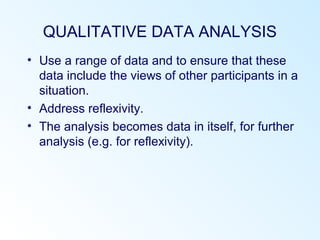
• Use a range of data and to ensure that these
data include the views of other participants in a
situation.
• Address reflexivity.
• The analysis becomes data in itself, for further
analysis (e.g. for reflexivity).
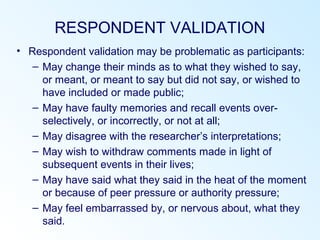
RESPONDENT VALIDATION
• Respondent validation may be problematic as participants:
– May change their minds as to what they wished to say,
or meant, or meant to say but did not say, or wished to
have included or made public;
– May have faulty memories and recall events over-
selectively, or incorrectly, or not at all;
– May disagree with the researcher’s interpretations;
– May wish to withdraw comments made in light of
subsequent events in their lives;
– May have said what they said in the heat of the moment
or because of peer pressure or authority pressure;
– May feel embarrassed by, or nervous about, what they
said.
ETHICS IN QUALITATIVE DATA
ANALYSIS
• Identifiability, confidentiality and privacy of
individuals
• Non-maleficence, loyalties (and to whom),
and beneficence
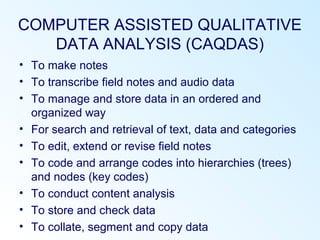
COMPUTER ASSISTED QUALITATIVE
DATA ANALYSIS (CAQDAS)
• To make notes
• To transcribe field notes and audio data
• To manage and store data in an ordered and
organized way
• For search and retrieval of text, data and categories
• To edit, extend or revise field notes
• To code and arrange codes into hierarchies (trees)
and nodes (key codes)
• To conduct content analysis
• To store and check data
• To collate, segment and copy data
COMPUTER ASSISTED QUALITATIVE
DATA ANALYSIS (CAQDAS)
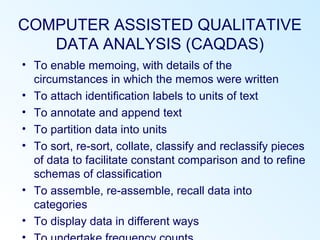
• To enable memoing, with details of the
circumstances in which the memos were written
• To attach identification labels to units of text
• To annotate and append text
• To partition data into units
• To sort, re-sort, collate, classify and reclassify pieces
of data to facilitate constant comparison and to refine
schemas of classification
• To assemble, re-assemble, recall data into
categories
• To display data in different ways
COMPUTER ASSISTED QUALITATIVE
DATA ANALYSIS (CAQDAS)
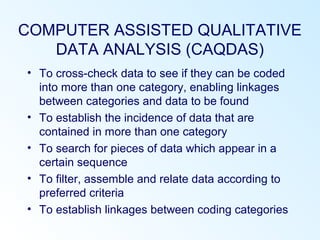
• To cross-check data to see if they can be coded
into more than one category, enabling linkages
between categories and data to be found
• To establish the incidence of data that are
contained in more than one category
• To search for pieces of data which appear in a
certain sequence
• To filter, assemble and relate data according to
preferred criteria
• To establish linkages between coding categories
COMPUTER ASSISTED QUALITATIVE
DATA ANALYSIS (CAQDAS)
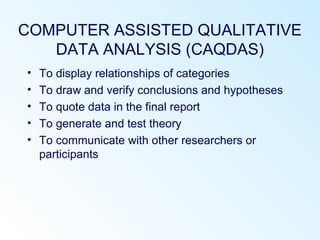
• To display relationships of categories
• To draw and verify conclusions and hypotheses
• To quote data in the final report
• To generate and test theory
• To communicate with other researchers or
participants
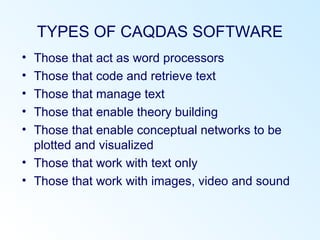
TYPES OF CAQDAS SOFTWARE
• Those that act as word processors
• Those that code and retrieve text
• Those that manage text
• Those that enable theory building
• Those that enable conceptual networks to be
plotted and visualized
• Those that work with text only
• Those that work with images, video and sound
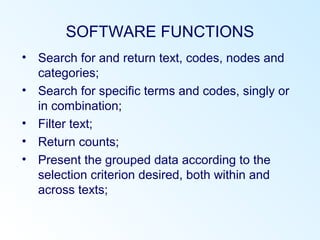
SOFTWARE FUNCTIONS
• Search for and return text, codes, nodes and
categories;
• Search for specific terms and codes, singly or
in combination;
• Filter text;
• Return counts;
• Present the grouped data according to the
selection criterion desired, both within and
across texts;
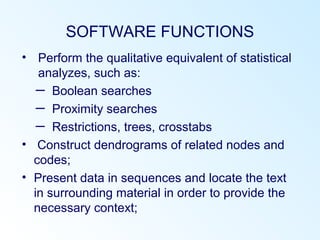
SOFTWARE FUNCTIONS
• Perform the qualitative equivalent of statistical
analyzes, such as:
─ Boolean searches
─ Proximity searches
─ Restrictions, trees, crosstabs
• Construct dendrograms of related nodes and
codes;
• Present data in sequences and locate the text
in surrounding material in order to provide the
necessary context;
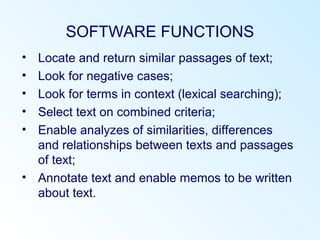
SOFTWARE FUNCTIONS
• Locate and return similar passages of text;
• Look for negative cases;
• Look for terms in context (lexical searching);
• Select text on combined criteria;
• Enable analyzes of similarities, differences
and relationships between texts and passages
of text;
• Annotate text and enable memos to be written
about text.
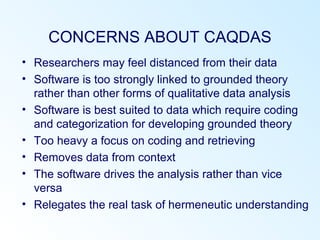
CONCERNS ABOUT CAQDAS
• Researchers may feel distanced from their data
• Software is too strongly linked to grounded theory
rather than other forms of qualitative data analysis
• Software is best suited to data which require coding
and categorization for developing grounded theory
• Too heavy a focus on coding and retrieving
• Removes data from context
• The software drives the analysis rather than vice
versa
• Relegates the real task of hermeneutic understanding

Chapter28

  • 1.
    APPROACHES TO QUALITATIVE DATAANALYSIS © LOUIS COHEN, LAWRENCE MANION & KEITH MORRISON
  • 2.
    STRUCTURE OF THECHAPTER • Data analysis, thick description and reflexivity • Ethics in qualitative data analysis • Computer assisted qualitative data analysis (CAQDAS)
  • 3.
    QUALITATIVE DATA • Thereis no one single or correct way to analyze and present qualitative data – Abide by fitness for purpose. • Qualitative data analysis is often heavy on interpretation, with multiple interpretations possible. • Data analysis and interpretation may often merge. • Data analysis often commences early. • Results of the analysis also constitute data for further analysis.  
  • 4.
    TO TRANSCRIBE ORNOT TO TRANSCRIBE INTERVIEWS • Transcriptions can provide important detail and an accurate verbatim record of the interview. • Transcriptions may omit non-verbal aspects, and contextual features of the interview. Transcriptions are very time consuming to prepare. • Transcriptions must clarify conventions used.
  • 5.
    DATA ANALYSIS, THICK DESCRIPTIONAND REFLEXIVITY • Fitness for purpose: – To describe; – To portray; – to summarize; – to interpret; – to discover patterns; – to generate themes; – to understand individuals and idiographic features; – to understand groups and nomothetic features.
  • 6.
    DATA ANALYSIS, THICK DESCRIPTIONAND REFLEXIVITY • Fitness for purpose: – to raise issues; – to prove or demonstrate; – to explain and seek causality; – to explore; – to test; – to discover commonalities, differences and similarities; – to examine the application and operation of the same issues in different contexts.
  • 7.
    QUALITATIVE DATA ANALYSIS •The movement is from description to explanation and theory generation. • Problems of data overload: data reduction and display become important. • Double hermeneutic: the researcher interprets and already-interpreted world. • The researcher is part of the world that is being interpreted, therefore reflexivity is required. • Subjectivity is inescapable. • The researcher’s own memory may be fallible, selective and over-interpreting a situation.
  • 8.
    QUALITATIVE DATA ANALYSIS •Use a range of data and to ensure that these data include the views of other participants in a situation. • Address reflexivity. • The analysis becomes data in itself, for further analysis (e.g. for reflexivity).
  • 9.
    RESPONDENT VALIDATION • Respondentvalidation may be problematic as participants: – May change their minds as to what they wished to say, or meant, or meant to say but did not say, or wished to have included or made public; – May have faulty memories and recall events over- selectively, or incorrectly, or not at all; – May disagree with the researcher’s interpretations; – May wish to withdraw comments made in light of subsequent events in their lives; – May have said what they said in the heat of the moment or because of peer pressure or authority pressure; – May feel embarrassed by, or nervous about, what they said.
  • 10.
    ETHICS IN QUALITATIVEDATA ANALYSIS • Identifiability, confidentiality and privacy of individuals • Non-maleficence, loyalties (and to whom), and beneficence
  • 11.
    COMPUTER ASSISTED QUALITATIVE DATAANALYSIS (CAQDAS) • To make notes • To transcribe field notes and audio data • To manage and store data in an ordered and organized way • For search and retrieval of text, data and categories • To edit, extend or revise field notes • To code and arrange codes into hierarchies (trees) and nodes (key codes) • To conduct content analysis • To store and check data • To collate, segment and copy data
  • 12.
    COMPUTER ASSISTED QUALITATIVE DATAANALYSIS (CAQDAS) • To enable memoing, with details of the circumstances in which the memos were written • To attach identification labels to units of text • To annotate and append text • To partition data into units • To sort, re-sort, collate, classify and reclassify pieces of data to facilitate constant comparison and to refine schemas of classification • To assemble, re-assemble, recall data into categories • To display data in different ways
  • 13.
    COMPUTER ASSISTED QUALITATIVE DATAANALYSIS (CAQDAS) • To cross-check data to see if they can be coded into more than one category, enabling linkages between categories and data to be found • To establish the incidence of data that are contained in more than one category • To search for pieces of data which appear in a certain sequence • To filter, assemble and relate data according to preferred criteria • To establish linkages between coding categories
  • 14.
    COMPUTER ASSISTED QUALITATIVE DATAANALYSIS (CAQDAS) • To display relationships of categories • To draw and verify conclusions and hypotheses • To quote data in the final report • To generate and test theory • To communicate with other researchers or participants
  • 15.
    TYPES OF CAQDASSOFTWARE • Those that act as word processors • Those that code and retrieve text • Those that manage text • Those that enable theory building • Those that enable conceptual networks to be plotted and visualized • Those that work with text only • Those that work with images, video and sound
  • 16.
    SOFTWARE FUNCTIONS • Searchfor and return text, codes, nodes and categories; • Search for specific terms and codes, singly or in combination; • Filter text; • Return counts; • Present the grouped data according to the selection criterion desired, both within and across texts;
  • 17.
    SOFTWARE FUNCTIONS • Performthe qualitative equivalent of statistical analyzes, such as: ─ Boolean searches ─ Proximity searches ─ Restrictions, trees, crosstabs • Construct dendrograms of related nodes and codes; • Present data in sequences and locate the text in surrounding material in order to provide the necessary context;
  • 18.
    SOFTWARE FUNCTIONS • Locateand return similar passages of text; • Look for negative cases; • Look for terms in context (lexical searching); • Select text on combined criteria; • Enable analyzes of similarities, differences and relationships between texts and passages of text; • Annotate text and enable memos to be written about text.
  • 19.
    CONCERNS ABOUT CAQDAS •Researchers may feel distanced from their data • Software is too strongly linked to grounded theory rather than other forms of qualitative data analysis • Software is best suited to data which require coding and categorization for developing grounded theory • Too heavy a focus on coding and retrieving • Removes data from context • The software drives the analysis rather than vice versa • Relegates the real task of hermeneutic understanding