Chapter Six: The
Purpose Statement
Chapter Outline
The Purpose Statement
Significance and Meaning of a Purpose Statement
A Qualitative Purpose Statement
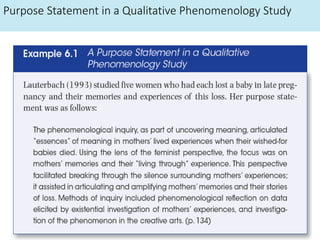
Example 6.1. A Purpose Statement in a Qualitative Phenomenology Study
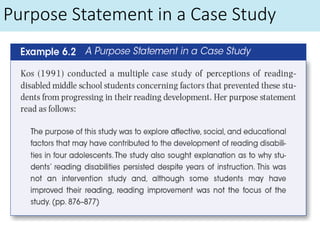
Example 6.2. A Purpose Statement in a Case Study
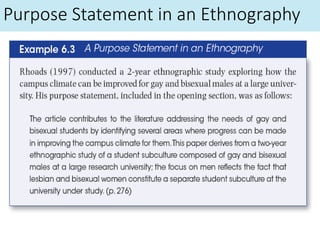
Example 6.3. A Purpose Statement in an Ethnography
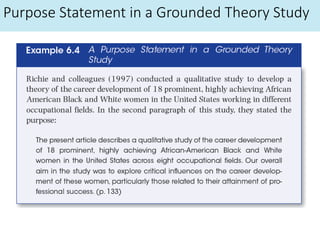
Example 6.4. A Purpose Statement in a Grounded Theory Study
A Quantitative Purpose Statement
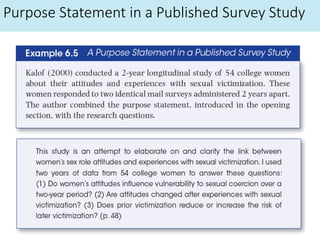
Example 6.5. A Purpose Statement in a Published Survey Study
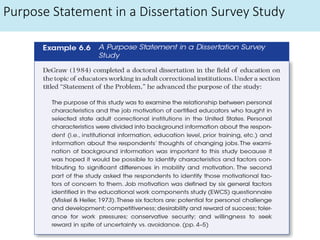
Example 6.6. A Purpose Statement in a Dissertation Survey Study
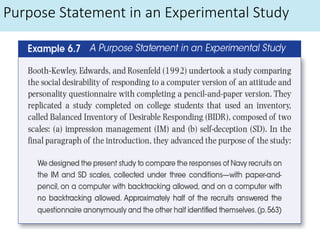
Example 6.7. A Purpose Statement in an Experimental Study
A Mixed Methods Purpose Statement
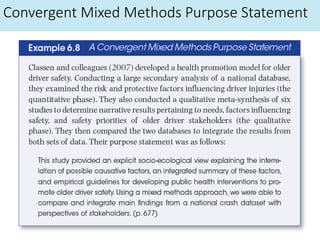
Example 6.8. A Convergent Mixed Methods Purpose Statement
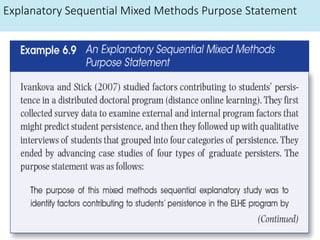
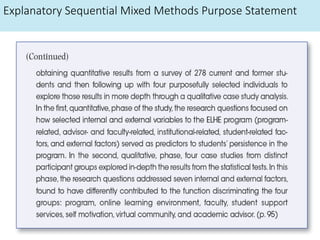
Example 6.9. An Explanatory Sequential Mixed Methods Purpose Statement
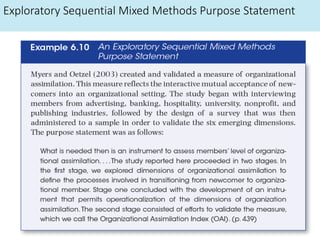
Example 6.10. An Exploratory Sequential Mixed Methods Purpose Statement
Significance and Meaning of a Purpose Statement
‱ The purpose statement
‱ Indicates why you want to do the study and what you intend to accomplish
‱ Is the central controlling idea in a study
‱ Is written in a sentence or several sentences
‱ Sets the objectives, the intent, or the major idea of a proposal or a study
‱ The purpose statement is NOT
‱ The problem leading to a need for the study (see Chapter 5)
‱ The questions to be answered by collecting data (see Chapter 7)
Qualitative Purpose Statements
‱ A good qualitative purpose statement contains:
‱ The central phenomenon
‱ The participants
‱ The research site
‱ Include language drawn from qualitative inquiry
‱ Use words such as purpose, intent, or objective to signal attention to this
statement as the central controlling idea.
‱ Focus on a single phenomenon, narrow the study to one idea to be explored or
understood. This statement should acknowledge that the study may evolve into
an exploration of relationships or comparisons among ideas.
Qualitative Purpose Statements Cont.
Include language drawn from qualitative inquiry cont.
‱ Use action verbs such as describe, understand, develop, examine the meaning
of, or discover to convey how learning will take place
‱ Use neutral words and phrases, nondirectional language such as “self-expression
experiences of individuals”
‱ Provide a general working definition of the central phenomenon or idea,
particularly those not typically understood by a broad audience
‱ Include words that indicate the strategy of inquiry to be used in data collection,
analysis and the process of research
‱ Mention the participants in the study
‱ Identify the site for the research
‱ Delimit the scope of participation or research sites in the study
A Script for Writing Qualitative Purpose Statements
The purpose of this _________________ (strategy of inquiry, such as
ethnography, case study, or other type) study is (was? will be?) to
___________________ (understand? explore? develop? discover?) the
___________ (central phenomenon being studied) for
______________(the participants, such as the individual, groups,
organization) at ______________ (research site). At this stage in the
research, the _________________ (central phenomenon being studied)
will be generally defined as ________________ (provide a general
definition).
Purpose Statement in a Qualitative Phenomenology Study
Purpose Statement in a Case Study
Purpose Statement in an Ethnography
Purpose Statement in a Grounded Theory Study
Quantitative Purpose Statements
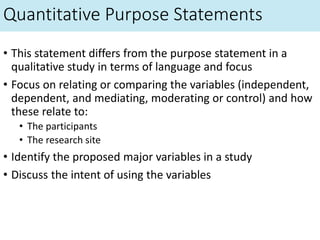
‱ This statement differs from the purpose statement in a
qualitative study in terms of language and focus
‱ Focus on relating or comparing the variables (independent,
dependent, and mediating, moderating or control) and how
these relate to:
‱ The participants
‱ The research site
‱ Identify the proposed major variables in a study
‱ Discuss the intent of using the variables
Quantitative Purpose Statements Cont.
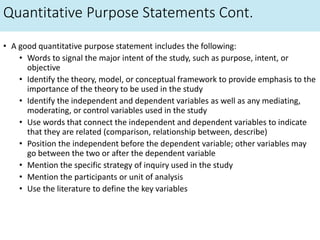
‱ A good quantitative purpose statement includes the following:
‱ Words to signal the major intent of the study, such as purpose, intent, or
objective
‱ Identify the theory, model, or conceptual framework to provide emphasis to the
importance of the theory to be used in the study
‱ Identify the independent and dependent variables as well as any mediating,
moderating, or control variables used in the study
‱ Use words that connect the independent and dependent variables to indicate
that they are related (comparison, relationship between, describe)
‱ Position the independent before the dependent variable; other variables may
go between the two or after the dependent variable
‱ Mention the specific strategy of inquiry used in the study
‱ Mention the participants or unit of analysis
‱ Use the literature to define the key variables
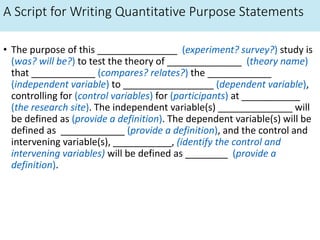
A Script for Writing Quantitative Purpose Statements
‱ The purpose of this _______________ (experiment? survey?) study is
(was? will be?) to test the theory of ______________ (theory name)
that ____________ (compares? relates?) the ____________
(independent variable) to _________________ (dependent variable),
controlling for (control variables) for (participants) at ___________
(the research site). The independent variable(s) ______________ will
be defined as (provide a definition). The dependent variable(s) will be
defined as ____________ (provide a definition), and the control and
intervening variable(s), ___________, (identify the control and
intervening variables) will be defined as ________ (provide a
definition).
Purpose Statement in a Published Survey Study
Purpose Statement in a Dissertation Survey Study
Purpose Statement in an Experimental Study
Mixed Methods Purpose Statements
‱ A good mixed methods purpose statement contains:
‱ The overall intent of the study from a content perspective
‱ Information about both the quantitative and qualitative strands of the study
‱ A rationale for combining both quantitative and qualitative data
‱ Guidelines include:
‱ Use words and phrases that signal intent such as: purpose, intent of, or
objective
‱ Indicate the overall purpose of the study from a content perspective
‱ Indicate the type of mixed methods design
Mixed Methods Purpose Statements Cont.
Guidelines include:
‱ Discuss the reasons for combining both quantitative and
qualitative data:
A convergent design
An explanatory sequential design
An exploratory sequential design
Multiphase design
Scripts for Writing Mixed Methods Purpose Statements
1. Convergent Mixed Methods Strategy
This mixed methods study will address ___________ [overall content aim]. A
convergent mixed methods design will be used, and it is a type of design in which
qualitative and quantitative data are collected in parallel, analyzed separately,
and then merged. In this study, ___________ [quantitative data] will be used to
test the theory of ___________ [the theory] that predicts that [independent
variables] will ___________ [positively, negatively] influence the ___________
[dependent variables] for ___________ [participants] at ___________ [the site].
The ___________ [type of qualitative data] will explore___________ [the central
phenomenon] for ___________ [participants] at ___________ [the site]. The
reason for collecting both quantitative and qualitative data is to ___________
[the mixing reason].
Scripts for Writing Mixed Methods Purpose Statements
2. Explanatory Sequential Design
This study will address ___________ [content aim]. An explanatory sequential mixed
methods design will be used, and it will involve collecting quantitative data first
and then explaining the quantitative results with in-depth qualitative data. In the
first, quantitative phase of the study, ___________ [quantitative instrument] data
will be collected from ___________ [participants] at ___________ [research site]
to test ___________ [name of theory] to assess whether ___________
[independent variables] relate to ___________ [dependent variables]. The
second, qualitative phase will be conducted as a follow up to the quantitative
results to help explain the quantitative results. In this exploratory follow-up, the
tentative plan is to explore ___________ [the central phenomenon] with
___________ [participants at a ___________ [research site].
Scripts for Writing Mixed Methods Purpose Statements
3. Exploratory sequential design
This study addresses ___________ [content aim]. The purpose of this exploratory
sequential design will be to first qualitatively explore with a small sample and
then to determine if the qualitative findings generalize to a large sample. The first
phase of the study will be a qualitative exploration of ___________ [the central
phenomenon] in which ___________ [types of data] will be collected from
___________ [participants] at ___________ [research site]. From this initial
exploration, the qualitative findings will be used to develop assessment measures
that can be administered to a large sample. In the tentatively planned
quantitative phase, ___________ [instrument data] will be collected from
___________ [participants] at ___________ [research site].
Convergent Mixed Methods Purpose Statement
Explanatory Sequential Mixed Methods Purpose Statement
Exploratory Sequential Mixed Methods Purpose Statement

Chapter Six The Purpose Statement

  • 1.
  • 2.
    Chapter Outline The PurposeStatement Significance and Meaning of a Purpose Statement A Qualitative Purpose Statement Example 6.1. A Purpose Statement in a Qualitative Phenomenology Study Example 6.2. A Purpose Statement in a Case Study Example 6.3. A Purpose Statement in an Ethnography Example 6.4. A Purpose Statement in a Grounded Theory Study A Quantitative Purpose Statement Example 6.5. A Purpose Statement in a Published Survey Study Example 6.6. A Purpose Statement in a Dissertation Survey Study Example 6.7. A Purpose Statement in an Experimental Study A Mixed Methods Purpose Statement Example 6.8. A Convergent Mixed Methods Purpose Statement Example 6.9. An Explanatory Sequential Mixed Methods Purpose Statement Example 6.10. An Exploratory Sequential Mixed Methods Purpose Statement
  • 3.
    Significance and Meaningof a Purpose Statement ‱ The purpose statement ‱ Indicates why you want to do the study and what you intend to accomplish ‱ Is the central controlling idea in a study ‱ Is written in a sentence or several sentences ‱ Sets the objectives, the intent, or the major idea of a proposal or a study ‱ The purpose statement is NOT ‱ The problem leading to a need for the study (see Chapter 5) ‱ The questions to be answered by collecting data (see Chapter 7)
  • 4.
    Qualitative Purpose Statements ‱A good qualitative purpose statement contains: ‱ The central phenomenon ‱ The participants ‱ The research site ‱ Include language drawn from qualitative inquiry ‱ Use words such as purpose, intent, or objective to signal attention to this statement as the central controlling idea. ‱ Focus on a single phenomenon, narrow the study to one idea to be explored or understood. This statement should acknowledge that the study may evolve into an exploration of relationships or comparisons among ideas.
  • 5.
    Qualitative Purpose StatementsCont. Include language drawn from qualitative inquiry cont. ‱ Use action verbs such as describe, understand, develop, examine the meaning of, or discover to convey how learning will take place ‱ Use neutral words and phrases, nondirectional language such as “self-expression experiences of individuals” ‱ Provide a general working definition of the central phenomenon or idea, particularly those not typically understood by a broad audience ‱ Include words that indicate the strategy of inquiry to be used in data collection, analysis and the process of research ‱ Mention the participants in the study ‱ Identify the site for the research ‱ Delimit the scope of participation or research sites in the study
  • 6.
    A Script forWriting Qualitative Purpose Statements The purpose of this _________________ (strategy of inquiry, such as ethnography, case study, or other type) study is (was? will be?) to ___________________ (understand? explore? develop? discover?) the ___________ (central phenomenon being studied) for ______________(the participants, such as the individual, groups, organization) at ______________ (research site). At this stage in the research, the _________________ (central phenomenon being studied) will be generally defined as ________________ (provide a general definition).
  • 7.
    Purpose Statement ina Qualitative Phenomenology Study
  • 8.
  • 9.
    Purpose Statement inan Ethnography
  • 10.
    Purpose Statement ina Grounded Theory Study
  • 11.
    Quantitative Purpose Statements ‱This statement differs from the purpose statement in a qualitative study in terms of language and focus ‱ Focus on relating or comparing the variables (independent, dependent, and mediating, moderating or control) and how these relate to: ‱ The participants ‱ The research site ‱ Identify the proposed major variables in a study ‱ Discuss the intent of using the variables
  • 12.
    Quantitative Purpose StatementsCont. ‱ A good quantitative purpose statement includes the following: ‱ Words to signal the major intent of the study, such as purpose, intent, or objective ‱ Identify the theory, model, or conceptual framework to provide emphasis to the importance of the theory to be used in the study ‱ Identify the independent and dependent variables as well as any mediating, moderating, or control variables used in the study ‱ Use words that connect the independent and dependent variables to indicate that they are related (comparison, relationship between, describe) ‱ Position the independent before the dependent variable; other variables may go between the two or after the dependent variable ‱ Mention the specific strategy of inquiry used in the study ‱ Mention the participants or unit of analysis ‱ Use the literature to define the key variables
  • 13.
    A Script forWriting Quantitative Purpose Statements ‱ The purpose of this _______________ (experiment? survey?) study is (was? will be?) to test the theory of ______________ (theory name) that ____________ (compares? relates?) the ____________ (independent variable) to _________________ (dependent variable), controlling for (control variables) for (participants) at ___________ (the research site). The independent variable(s) ______________ will be defined as (provide a definition). The dependent variable(s) will be defined as ____________ (provide a definition), and the control and intervening variable(s), ___________, (identify the control and intervening variables) will be defined as ________ (provide a definition).
  • 14.
    Purpose Statement ina Published Survey Study
  • 15.
    Purpose Statement ina Dissertation Survey Study
  • 16.
    Purpose Statement inan Experimental Study
  • 17.
    Mixed Methods PurposeStatements ‱ A good mixed methods purpose statement contains: ‱ The overall intent of the study from a content perspective ‱ Information about both the quantitative and qualitative strands of the study ‱ A rationale for combining both quantitative and qualitative data ‱ Guidelines include: ‱ Use words and phrases that signal intent such as: purpose, intent of, or objective ‱ Indicate the overall purpose of the study from a content perspective ‱ Indicate the type of mixed methods design
  • 18.
    Mixed Methods PurposeStatements Cont. Guidelines include: ‱ Discuss the reasons for combining both quantitative and qualitative data: A convergent design An explanatory sequential design An exploratory sequential design Multiphase design
  • 19.
    Scripts for WritingMixed Methods Purpose Statements 1. Convergent Mixed Methods Strategy This mixed methods study will address ___________ [overall content aim]. A convergent mixed methods design will be used, and it is a type of design in which qualitative and quantitative data are collected in parallel, analyzed separately, and then merged. In this study, ___________ [quantitative data] will be used to test the theory of ___________ [the theory] that predicts that [independent variables] will ___________ [positively, negatively] influence the ___________ [dependent variables] for ___________ [participants] at ___________ [the site]. The ___________ [type of qualitative data] will explore___________ [the central phenomenon] for ___________ [participants] at ___________ [the site]. The reason for collecting both quantitative and qualitative data is to ___________ [the mixing reason].
  • 20.
    Scripts for WritingMixed Methods Purpose Statements 2. Explanatory Sequential Design This study will address ___________ [content aim]. An explanatory sequential mixed methods design will be used, and it will involve collecting quantitative data first and then explaining the quantitative results with in-depth qualitative data. In the first, quantitative phase of the study, ___________ [quantitative instrument] data will be collected from ___________ [participants] at ___________ [research site] to test ___________ [name of theory] to assess whether ___________ [independent variables] relate to ___________ [dependent variables]. The second, qualitative phase will be conducted as a follow up to the quantitative results to help explain the quantitative results. In this exploratory follow-up, the tentative plan is to explore ___________ [the central phenomenon] with ___________ [participants at a ___________ [research site].
  • 21.
    Scripts for WritingMixed Methods Purpose Statements 3. Exploratory sequential design This study addresses ___________ [content aim]. The purpose of this exploratory sequential design will be to first qualitatively explore with a small sample and then to determine if the qualitative findings generalize to a large sample. The first phase of the study will be a qualitative exploration of ___________ [the central phenomenon] in which ___________ [types of data] will be collected from ___________ [participants] at ___________ [research site]. From this initial exploration, the qualitative findings will be used to develop assessment measures that can be administered to a large sample. In the tentatively planned quantitative phase, ___________ [instrument data] will be collected from ___________ [participants] at ___________ [research site].
  • 22.
    Convergent Mixed MethodsPurpose Statement
  • 23.
    Explanatory Sequential MixedMethods Purpose Statement
  • 24.
    Explanatory Sequential MixedMethods Purpose Statement
  • 25.
    Exploratory Sequential MixedMethods Purpose Statement