Moving and
Growing By: Anushay
Abrar
Bones and the Skeleton
● The hard parts inside your body
are called bones.
● There are 206 bones in the body of
an human adult.
● The bones form the skeleton of
your body.
● Babies are born with about 300
bones.
● Bones are made up of a mineral
called Calcium. (e.g Milk)
● Blood is made in the bone marrow
Functions of the Human Skeletons
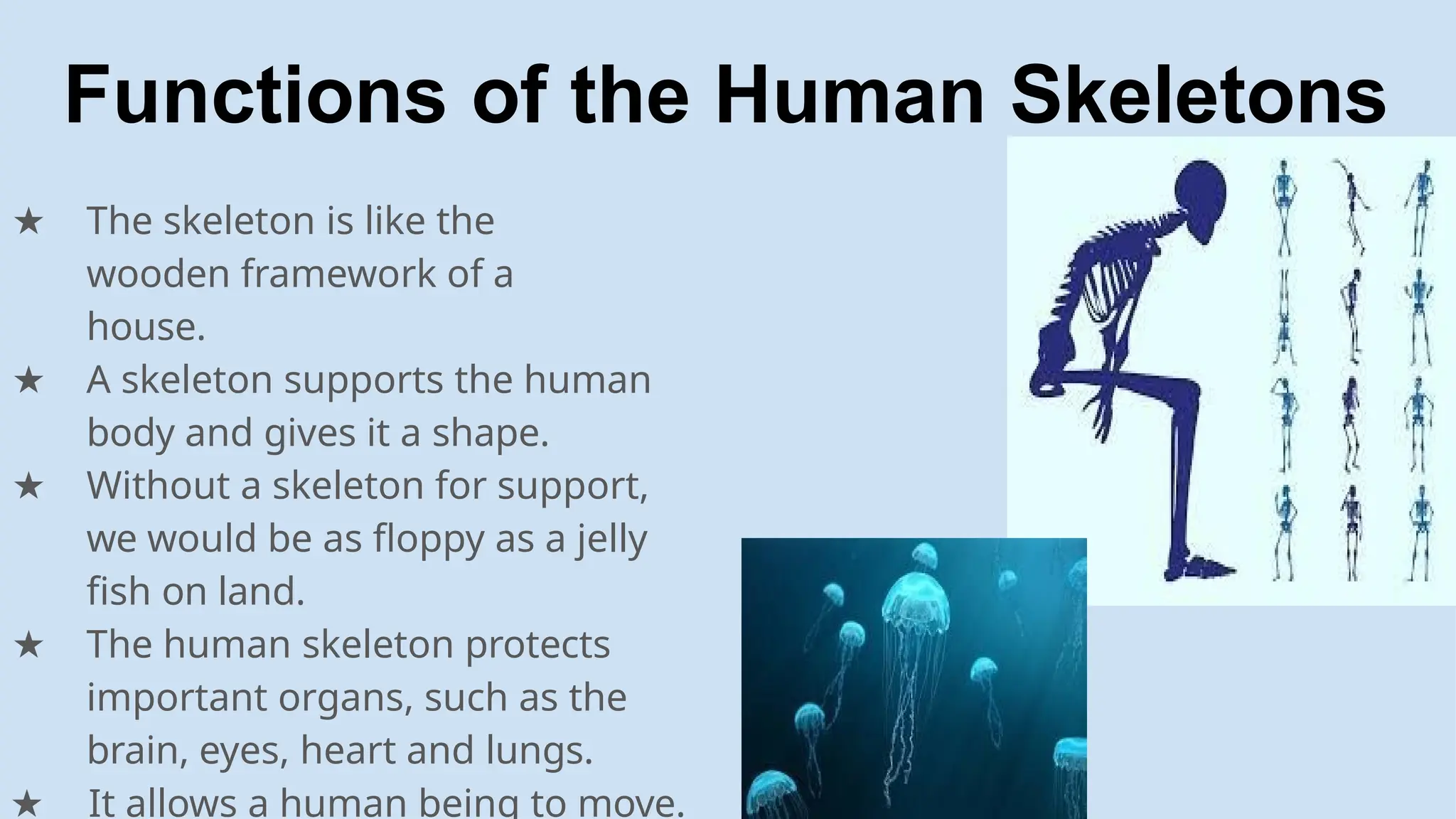
★ The skeleton is like the
wooden framework of a
house.
★ A skeleton supports the human
body and gives it a shape.
★ Without a skeleton for support,
we would be as floppy as a jelly
fish on land.
★ The human skeleton protects
important organs, such as the
brain, eyes, heart and lungs.
★ It allows a human being to move.
Skeletons of other animals
Skeleton of a
Snake
Skeleton of a
Fish
Skeleton of a
Bat
Skeleton of
Bird
Skeletons of other animals
➢ Not all animals have skeletons
inside their bodies. Some animals
have skeletons outside their
bodies, while others have no
skeletons at all.
➢ The animals that have skeletons
are outside their bodies are called
Exoskeletons.
➢ Crabs, Lobsters, Beetles and
Spiders are some examples of
Exoskeletons.
JOINTS
What is a Joint?
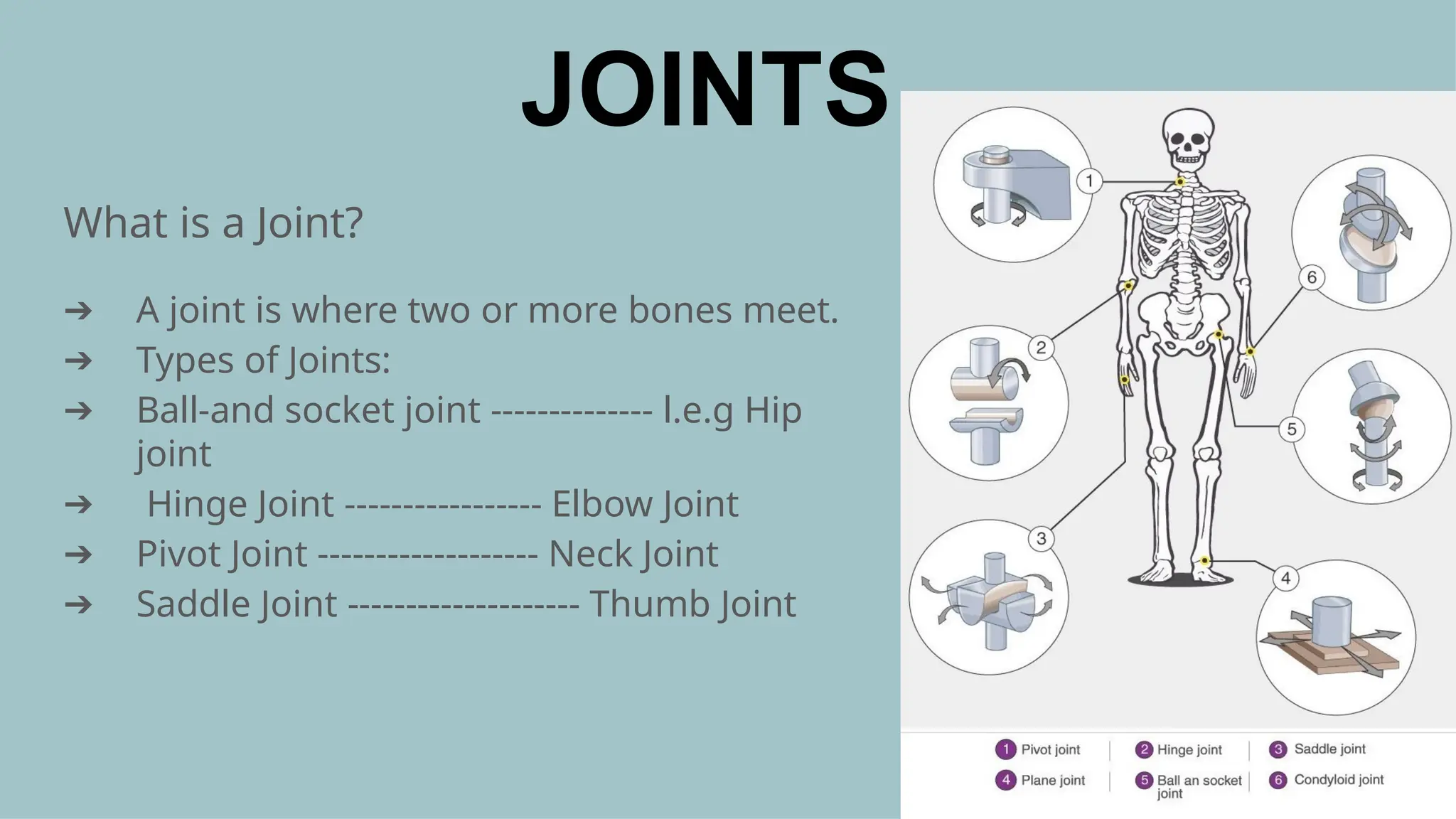
➔ A joint is where two or more bones meet.
➔ Types of Joints:
➔ Ball-and socket joint -------------- l.e.g Hip
joint
➔ Hinge Joint ----------------- Elbow Joint
➔ Pivot Joint ------------------- Neck Joint
➔ Saddle Joint -------------------- Thumb Joint
FUNCTION OF TYPES OF JOINTS
❖ Ball-Socket Joint: It allows movement in many directions, including back
and forth, side to side and circular movements. Some examples are Hip
joint and Shoulder Joint.
❖ Hinge Joint: A hinge joint works like a door. It allows back and forth
movements. Some examples of such joints are the knee joints, elbow
joints, finger joints and toe joints.
❖ Pivot Joint: A pivot joint allows the rotation of a bone about
another. An example of such joints is the neck joints.
❖ Saddle Joint: A saddle joint allows a bone to slide in two directions -------
back and forth, as well as side to side. An example of such joints is the
thumb joint.
● Muscles are made up of tough,
elastic fibres that contract
(shorten) and relax to enable you
to move.
● Muscles enable us to move.
● Without muscles, you will not
be able to walk, run, jump or
dance and even smile, talk,
chew and breathe.
● In fact, you will not be able to live
without muscles because your
heart is a muscular pump which
works non-stop to keep you alive.
MUSCLES AND
TENDONS
● Some muscles in your body, such as
your biceps,are attached to bones.
● When these skeletal muscles contract,
they pull on the bones and the bones
move.
● Skeletal muscles can only pull but
they cannot push.
● Thus, they have to work in pairs.
● Not all muscles are attached to bones,
your heart muscles and those in the walls
of your stomach and intestines are not
attached to bones.
● They contract and relax to enable
MUSCLES AND
TENDONS
TENDONS
❏ Tendons are strong cords in our body
that attach muscles to bones.
❏ When you bend and straighten your
arm, the tendon that connects your
biceps to your lower arm bone moves.
❏ The strongest and largest tendon is the
Achilles tendon that connects the
muscles in the lower leg to the heel
bone.
How did the Achille tendon got its name?
★ The Achilles tendon got its name
from a Greek warrior named Achilles.
20
The
human
movingandgrowinggrade4-210120122547.pptx

movingandgrowinggrade4-210120122547.pptx

  • 1.
  • 2.
    Bones and theSkeleton ● The hard parts inside your body are called bones. ● There are 206 bones in the body of an human adult. ● The bones form the skeleton of your body. ● Babies are born with about 300 bones. ● Bones are made up of a mineral called Calcium. (e.g Milk) ● Blood is made in the bone marrow
  • 3.
    Functions of theHuman Skeletons ★ The skeleton is like the wooden framework of a house. ★ A skeleton supports the human body and gives it a shape. ★ Without a skeleton for support, we would be as floppy as a jelly fish on land. ★ The human skeleton protects important organs, such as the brain, eyes, heart and lungs. ★ It allows a human being to move.
  • 4.
    Skeletons of otheranimals Skeleton of a Snake Skeleton of a Fish Skeleton of a Bat Skeleton of Bird
  • 5.
    Skeletons of otheranimals ➢ Not all animals have skeletons inside their bodies. Some animals have skeletons outside their bodies, while others have no skeletons at all. ➢ The animals that have skeletons are outside their bodies are called Exoskeletons. ➢ Crabs, Lobsters, Beetles and Spiders are some examples of Exoskeletons.
  • 7.
    JOINTS What is aJoint? ➔ A joint is where two or more bones meet. ➔ Types of Joints: ➔ Ball-and socket joint -------------- l.e.g Hip joint ➔ Hinge Joint ----------------- Elbow Joint ➔ Pivot Joint ------------------- Neck Joint ➔ Saddle Joint -------------------- Thumb Joint
  • 8.
    FUNCTION OF TYPESOF JOINTS ❖ Ball-Socket Joint: It allows movement in many directions, including back and forth, side to side and circular movements. Some examples are Hip joint and Shoulder Joint. ❖ Hinge Joint: A hinge joint works like a door. It allows back and forth movements. Some examples of such joints are the knee joints, elbow joints, finger joints and toe joints. ❖ Pivot Joint: A pivot joint allows the rotation of a bone about another. An example of such joints is the neck joints. ❖ Saddle Joint: A saddle joint allows a bone to slide in two directions ------- back and forth, as well as side to side. An example of such joints is the thumb joint.
  • 9.
    ● Muscles aremade up of tough, elastic fibres that contract (shorten) and relax to enable you to move. ● Muscles enable us to move. ● Without muscles, you will not be able to walk, run, jump or dance and even smile, talk, chew and breathe. ● In fact, you will not be able to live without muscles because your heart is a muscular pump which works non-stop to keep you alive. MUSCLES AND TENDONS
  • 10.
    ● Some musclesin your body, such as your biceps,are attached to bones. ● When these skeletal muscles contract, they pull on the bones and the bones move. ● Skeletal muscles can only pull but they cannot push. ● Thus, they have to work in pairs. ● Not all muscles are attached to bones, your heart muscles and those in the walls of your stomach and intestines are not attached to bones. ● They contract and relax to enable MUSCLES AND TENDONS
  • 11.
    TENDONS ❏ Tendons arestrong cords in our body that attach muscles to bones. ❏ When you bend and straighten your arm, the tendon that connects your biceps to your lower arm bone moves. ❏ The strongest and largest tendon is the Achilles tendon that connects the muscles in the lower leg to the heel bone. How did the Achille tendon got its name? ★ The Achilles tendon got its name from a Greek warrior named Achilles.
  • 12.