Chapter 9Esther Tharakaturi
IntroductionIn this power point I will be talking about :Urinary Tract Infection UTIKidney, Ureter, Bladder KUBUrine Culture UCChronic Renal Failure CRFBlood Urea Nitrogen BUN
Urinary Tract Infection UTIIt is an infection that starts in the urinary system. Any part of this system can get infected. Usually the urethra and the bladder get infected.Women are more at risk of getting infected than men.Generally the symptoms are strong urge to urinate, burning sensation, frequents small amounts  urine, blood or bacteria in urine.
Urinary Tract Infection UTIThere are different types of urinary infections, Kidneys (acute pyelonephritis) some symptoms upper and side pain, fever, chills or nausea.Bladder (cystitis) symptoms are pelvic pressure, frequent painful urination, low grade fever.Urethra (urethritis) symptom is Burning with urination
Urinary Tract Infection UTIThere are treatments available for a simple infection antibiotics such as Amoxil, Cipro, and Bactrim are few examples.For recurrent infections the doctor may give you stronger doses of antibiotics.For severe infectiona stay at the hospital may be required and treatment with intravenous antibiotics may be necessary.
Kidney, Ureter, Bladder KUBThere are two kidneys they can be found in the lumbar area of the back, and are placed on either side of the vertebral column. Kidneys are concave look like beans.The renal artery which enters into the kidney brings in blood that has waste to the kidney and the renal vein sends out cleaned blood. The ureters leave the kidney at the hilum to the bladder.
Kidney, Ureter, Bladder KUBUreters are narrow tubes that go from the renal pelvis to the bladder. Urine leaves out of the renal pelvis which comes from the ureter that carries it down the bladder.Mucous membranes line the ureters.
Kidney, Ureter, Bladder KUBBladder is a elastic muscular sac that lays at the base of pelvis.It has rugae which are folds that help it stretch out. The Bladder gets urine straight from the ureters.The internal sphincter helps hold the urine it is a involuntary muscle.The external sphincter which is voluntary which opens up to empty the bladder.
Urine Culture UCUrine Culture is a test that is done to find and identify germs that could be causing a urinary  tract infection.Urine sample is collected and then analyzed.The urine sample is then kept under certain conditions if few organism grow then test is negative but when many organisms are found then test is positive.
Chronic Renal Failure CRFChronic Renal Failure is when the kidneys gradually lose filtering ability, usually caused by high blood pressure or diabetes. People don’t know that they have CRF until their kidney function has gone down to less than 25 percent of normal. The goal of treatment is to stop or delay the progression of the disease until it is to late and dialysis is needed or a kidney transplant.
Chronic Renal Failure CRFThere are many signs and symptoms some are high blood pressure, dark colored urine, anemia, loss of appetite, swelling of feet and ankles.Causes can be chronic diseases for a period of years such as diabetes, hypertension, obstruction of urine flow, and toxins.
Chronic Renal Failure CRFThere are tests that can be done to help detect CRF such as, Ultrasound imaging, Computerized tomography (CT) scan, Magnetic resonance imaging (MRI), Kidney biopsy.There is no cure for CRF but there are treatments that can help the progression of disease or at least delay it. First thing to do is to control the problem that is responsible for CRF. Medications to lower blood pressure.Once the kidneys start to fail either dialysis or transplant are the options. Dialysis is an artificial way of getting rid of waste products and extra fluid from your blood when the kidneys are not able to perform these functions
Blood Urea Nitrogen BUNBUN is a test that is done to show how well the kidneys and liver are working.BUN test measures the amount of urea nitrogen. Urea is a chemical waste product that is in the blood. Kidneys that are functions well will remove urea and other wastes. If the test show high levels of urea it might means that kidneys are not working well. If the levels are low it could mean liver disease or damage, or malnutrition.
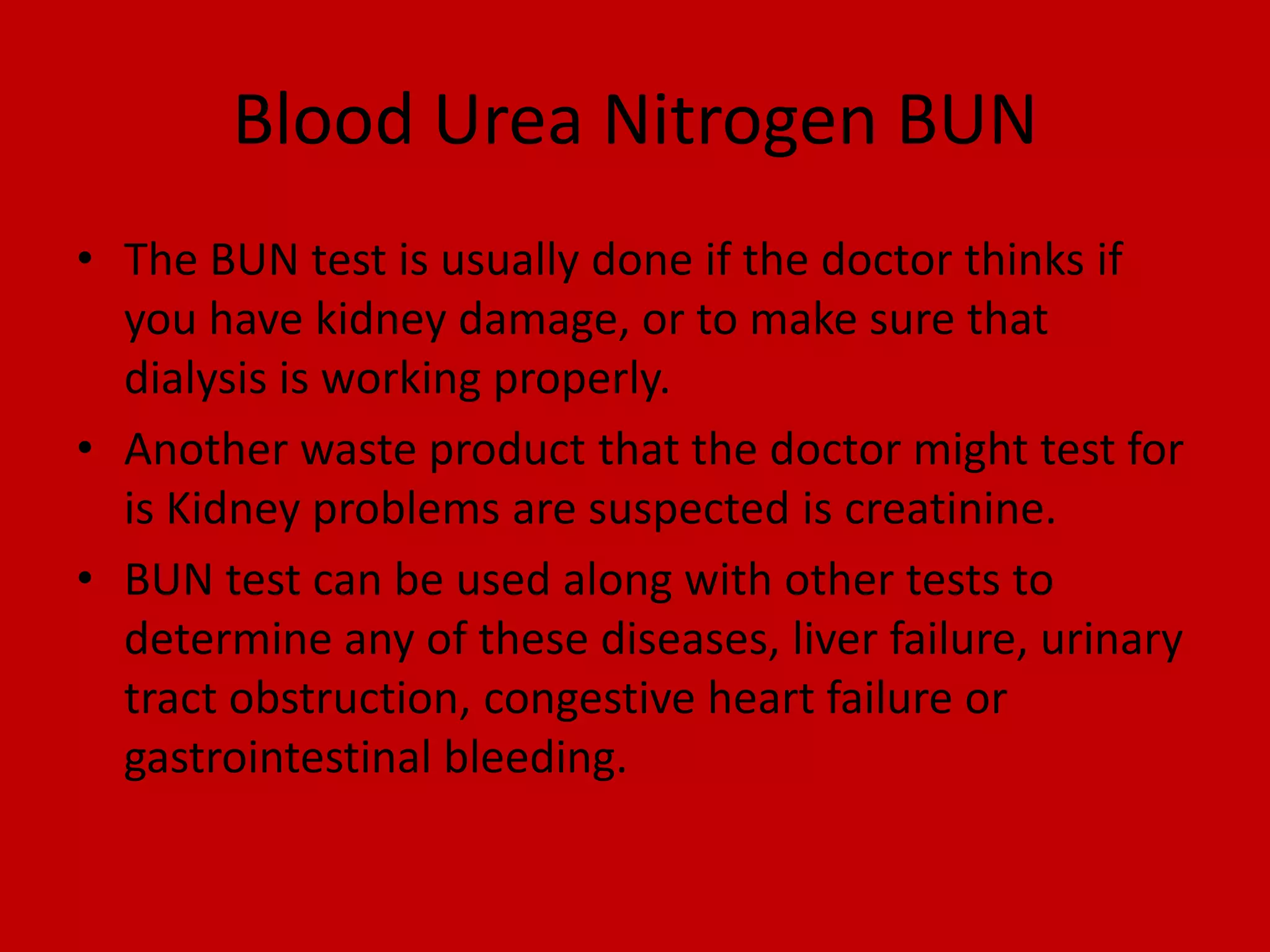
Blood Urea Nitrogen BUNThe BUN test is usually done if the doctor thinks if you have kidney damage, or to make sure that dialysis is working properly.Another waste product that the doctor might test for is Kidney problems are suspected is creatinine.BUN test can be used along with other tests to determine any of these diseases, liver failure, urinary tract obstruction, congestive heart failure or gastrointestinal bleeding.
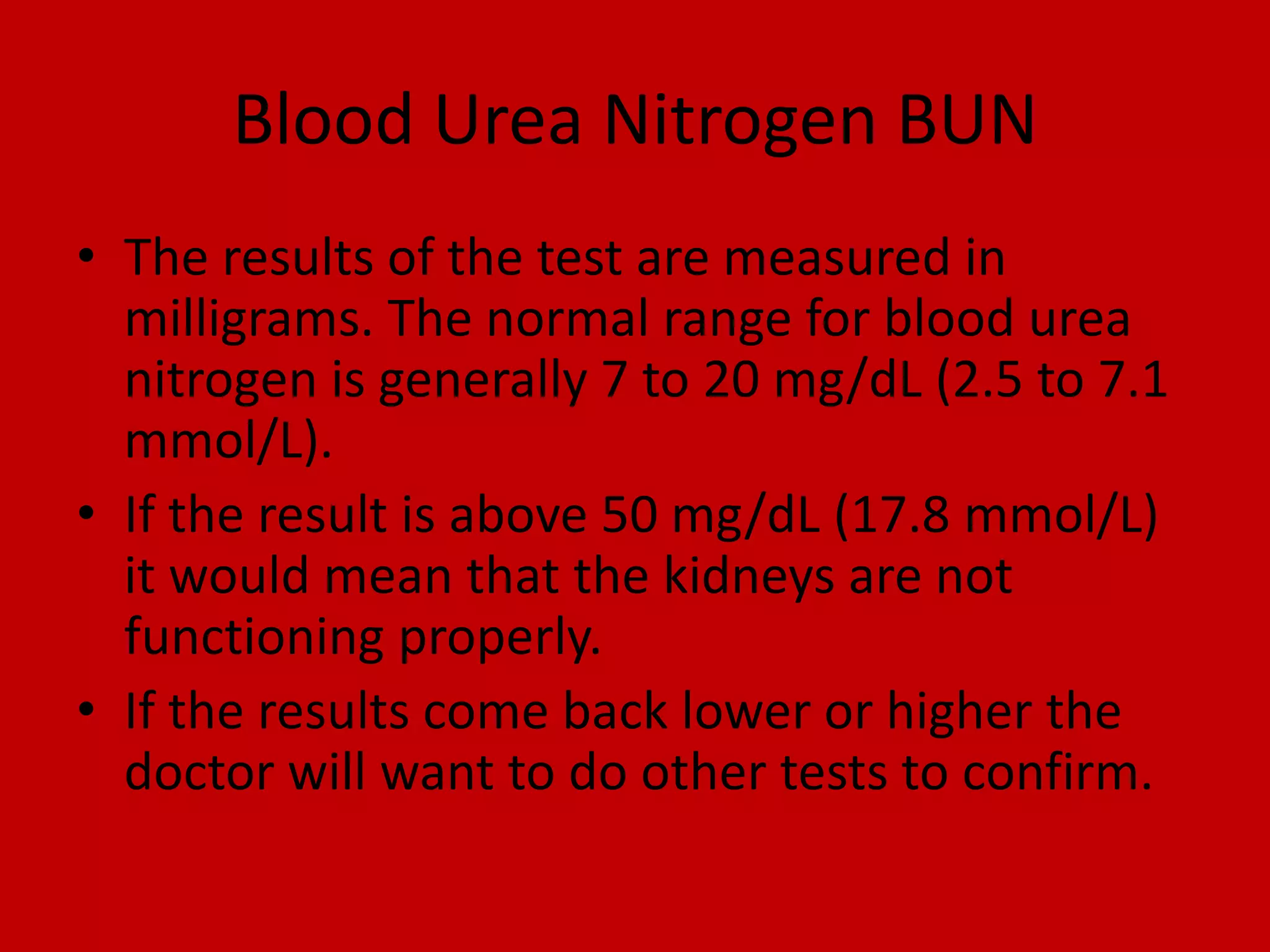
Blood Urea Nitrogen BUNThe results of the test are measured in milligrams.The normal range for blood urea nitrogen is generally 7 to 20 mg/dL (2.5 to 7.1 mmol/L). If the result is above 50 mg/dL (17.8 mmol/L) it would mean that the kidneys are not functioning properly.If the results come back lower or higher the doctor will want to do other tests to confirm.

Chapter 9

  • 1.
  • 2.
    IntroductionIn this powerpoint I will be talking about :Urinary Tract Infection UTIKidney, Ureter, Bladder KUBUrine Culture UCChronic Renal Failure CRFBlood Urea Nitrogen BUN
  • 3.
    Urinary Tract InfectionUTIIt is an infection that starts in the urinary system. Any part of this system can get infected. Usually the urethra and the bladder get infected.Women are more at risk of getting infected than men.Generally the symptoms are strong urge to urinate, burning sensation, frequents small amounts urine, blood or bacteria in urine.
  • 4.
    Urinary Tract InfectionUTIThere are different types of urinary infections, Kidneys (acute pyelonephritis) some symptoms upper and side pain, fever, chills or nausea.Bladder (cystitis) symptoms are pelvic pressure, frequent painful urination, low grade fever.Urethra (urethritis) symptom is Burning with urination
  • 5.
    Urinary Tract InfectionUTIThere are treatments available for a simple infection antibiotics such as Amoxil, Cipro, and Bactrim are few examples.For recurrent infections the doctor may give you stronger doses of antibiotics.For severe infectiona stay at the hospital may be required and treatment with intravenous antibiotics may be necessary.
  • 6.
    Kidney, Ureter, BladderKUBThere are two kidneys they can be found in the lumbar area of the back, and are placed on either side of the vertebral column. Kidneys are concave look like beans.The renal artery which enters into the kidney brings in blood that has waste to the kidney and the renal vein sends out cleaned blood. The ureters leave the kidney at the hilum to the bladder.
  • 7.
    Kidney, Ureter, BladderKUBUreters are narrow tubes that go from the renal pelvis to the bladder. Urine leaves out of the renal pelvis which comes from the ureter that carries it down the bladder.Mucous membranes line the ureters.
  • 8.
    Kidney, Ureter, BladderKUBBladder is a elastic muscular sac that lays at the base of pelvis.It has rugae which are folds that help it stretch out. The Bladder gets urine straight from the ureters.The internal sphincter helps hold the urine it is a involuntary muscle.The external sphincter which is voluntary which opens up to empty the bladder.
  • 9.
    Urine Culture UCUrineCulture is a test that is done to find and identify germs that could be causing a urinary tract infection.Urine sample is collected and then analyzed.The urine sample is then kept under certain conditions if few organism grow then test is negative but when many organisms are found then test is positive.
  • 10.
    Chronic Renal FailureCRFChronic Renal Failure is when the kidneys gradually lose filtering ability, usually caused by high blood pressure or diabetes. People don’t know that they have CRF until their kidney function has gone down to less than 25 percent of normal. The goal of treatment is to stop or delay the progression of the disease until it is to late and dialysis is needed or a kidney transplant.
  • 11.
    Chronic Renal FailureCRFThere are many signs and symptoms some are high blood pressure, dark colored urine, anemia, loss of appetite, swelling of feet and ankles.Causes can be chronic diseases for a period of years such as diabetes, hypertension, obstruction of urine flow, and toxins.
  • 12.
    Chronic Renal FailureCRFThere are tests that can be done to help detect CRF such as, Ultrasound imaging, Computerized tomography (CT) scan, Magnetic resonance imaging (MRI), Kidney biopsy.There is no cure for CRF but there are treatments that can help the progression of disease or at least delay it. First thing to do is to control the problem that is responsible for CRF. Medications to lower blood pressure.Once the kidneys start to fail either dialysis or transplant are the options. Dialysis is an artificial way of getting rid of waste products and extra fluid from your blood when the kidneys are not able to perform these functions
  • 13.
    Blood Urea NitrogenBUNBUN is a test that is done to show how well the kidneys and liver are working.BUN test measures the amount of urea nitrogen. Urea is a chemical waste product that is in the blood. Kidneys that are functions well will remove urea and other wastes. If the test show high levels of urea it might means that kidneys are not working well. If the levels are low it could mean liver disease or damage, or malnutrition.
  • 14.
    Blood Urea NitrogenBUNThe BUN test is usually done if the doctor thinks if you have kidney damage, or to make sure that dialysis is working properly.Another waste product that the doctor might test for is Kidney problems are suspected is creatinine.BUN test can be used along with other tests to determine any of these diseases, liver failure, urinary tract obstruction, congestive heart failure or gastrointestinal bleeding.
  • 15.
    Blood Urea NitrogenBUNThe results of the test are measured in milligrams.The normal range for blood urea nitrogen is generally 7 to 20 mg/dL (2.5 to 7.1 mmol/L). If the result is above 50 mg/dL (17.8 mmol/L) it would mean that the kidneys are not functioning properly.If the results come back lower or higher the doctor will want to do other tests to confirm.