1Opposing IdeologiesAt the Congress of Vienna, the powers of Europe tried to turn the clock back to the way things had been before 1789.Other voices, however, kept challenging the order imposed by the Congress of Vienna.  The clash of people with opposing ideologies, or systems of thought and belief, plunged Europe into more than 30 years of turmoil.
1What Were the Goals of Conservatives?Conservatives pursued the following goals:Restore royal families to the thrones they had lost when Napoleon swept across Europe.Maintain a social hierarchy in which lower classes respected and obeyed their social superiors. Maintain an established church.Suppress revolutionary ideas.
The Liberal and Nationalist Challenge1Challenging the conservatives at every turn were liberals and nationalists who were inspired by the Enlightenment and the French Revolution.LIBERALISMNATIONALISMNational groups who shared a common heritage set out to win their own states.Nationalism gave people with a common heritage a sense of identity. Nationalism often bred intolerance and led to persecution of other ethnic or national groups.Liberals wanted:Governments based on written constitutions and separation of powers.Natural rights of liberty, equality, and prosperity.Rulers elected by the people and responsible to them.A republican form of government.Laissez-faire economics.
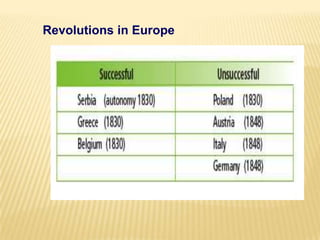
Revolutions in Europe
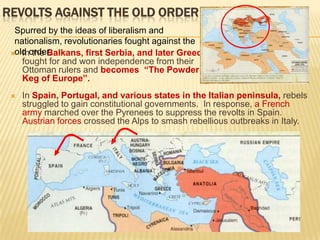
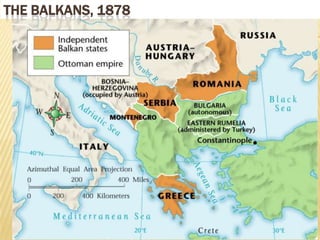
1Revolts Against the Old OrderSpurred by the ideas of liberalism and nationalism, revolutionaries fought against the old order.In the Balkans, first Serbia, and later Greece	fought for and won independence from their 	Ottoman rulers and becomes  “The Powder	Keg of Europe”.In Spain, Portugal, and various states in the Italian peninsula, rebels struggled to gain constitutional governments.  In response, a French army marched over the Pyrenees to suppress the revolts in Spain.  Austrian forces crossed the Alps to smash rebellious outbreaks in Italy.
The Balkans, 18784
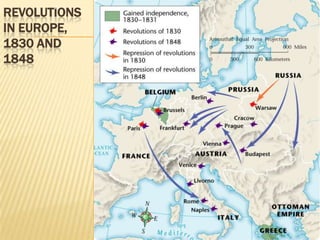
2Revolutions in Europe, 1830 and 1848
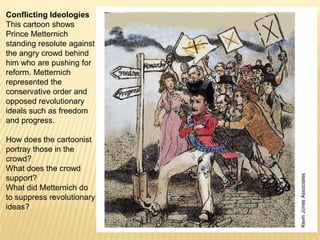
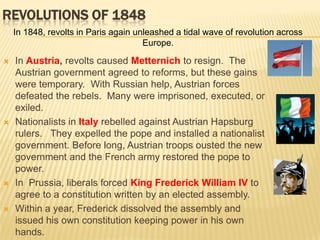
Conflicting IdeologiesThis cartoon shows Prince Metternich standing resolute against the angry crowd behind him who are pushing for reform. Metternich represented the conservative order and opposed revolutionary ideals such as freedom and progress.How does the cartoonist portray those in the crowd?What does the crowd support?What did Metternich do to suppress revolutionary ideas?
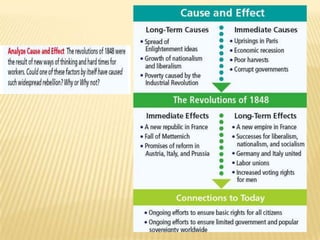
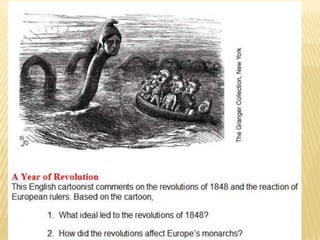
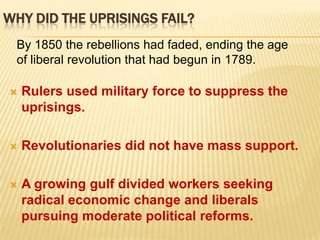
2Revolutions of 1848In 1848, revolts in Paris again unleashed a tidal wave of revolution across Europe.In Austria, revolts caused Metternich to resign.  The Austrian government agreed to reforms, but these gains were temporary.  With Russian help, Austrian forces defeated the rebels.  Many were imprisoned, executed, or exiled. Nationalists in Italy rebelled against Austrian Hapsburg rulers.   They expelled the pope and installed a nationalist government. Before long, Austrian troops ousted the new government and the French army restored the pope to power. In  Prussia, liberals forced King Frederick William IV to agree to a constitution written by an elected assembly.  Within a year, Frederick dissolved the assembly and issued his own constitution keeping power in his own hands.
      Metternich Flees Austria
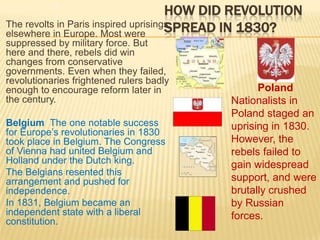
How Did Revolution Spread in 1830?2The revolts in Paris inspired uprisings elsewhere in Europe. Most were suppressed by military force. But here and there, rebels did win changes from conservative governments. Even when they failed, revolutionaries frightened rulers badly enough to encourage reform later in the century. Belgium  The one notable success for Europe’s revolutionaries in 1830 took place in Belgium. The Congress of Vienna had united Belgium and Holland under the Dutch king. The Belgians resented this arrangement and pushed for independence. In 1831, Belgium became an independent state with a liberal constitution. Poland  Nationalists in Poland staged an uprising in 1830.  However, the rebels failed to gain widespread support, and were brutally crushed by Russian forces.
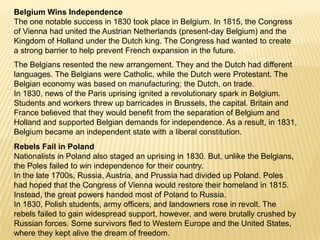
Belgium Wins IndependenceThe one notable success in 1830 took place in Belgium. In 1815, the Congress of Vienna had united the Austrian Netherlands (present-day Belgium) and the Kingdom of Holland under the Dutch king. The Congress had wanted to create a strong barrier to help prevent French expansion in the future.The Belgians resented the new arrangement. They and the Dutch had different languages. The Belgians were Catholic, while the Dutch were Protestant. The Belgian economy was based on manufacturing; the Dutch, on trade.In 1830, news of the Paris uprising ignited a revolutionary spark in Belgium. Students and workers threw up barricades in Brussels, the capital. Britain and France believed that they would benefit from the separation of Belgium and Holland and supported Belgian demands for independence. As a result, in 1831, Belgium became an independent state with a liberal constitution.Rebels Fail in PolandNationalists in Poland also staged an uprising in 1830. But, unlike the Belgians, the Poles failed to win independence for their country.In the late 1700s, Russia, Austria, and Prussia had divided up Poland. Poles had hoped that the Congress of Vienna would restore their homeland in 1815. Instead, the great powers handed most of Poland to Russia.In 1830, Polish students, army officers, and landowners rose in revolt. The rebels failed to gain widespread support, however, and were brutally crushed by Russian forces. Some survivors fled to Western Europe and the United States, where they kept alive the dream of freedom.
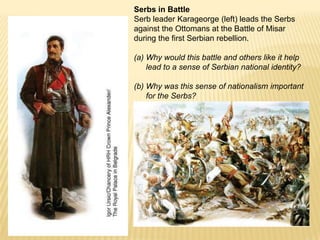
Serbs in BattleSerb leader Karageorge (left) leads the Serbs against the Ottomans at the Battle of Misar during the first Serbian rebellion. Why would this battle and others like it help lead to a sense of Serbian national identity? Why was this sense of nationalism important for the Serbs?
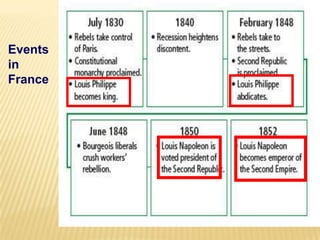
Events in France
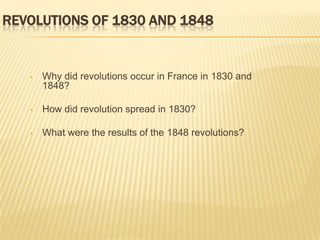
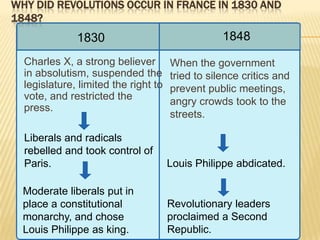
2Revolutions of 1830 and 1848Why did revolutions occur in France in 1830 and 1848?
How did revolution spread in 1830?
What were the results of the 1848 revolutions?Why Did Revolutions Occur in France in 1830 and 1848?Liberals and radicals rebelled and took control of Paris.218481830Charles X, a strong believer in absolutism, suspended the legislature, limited the right to vote, and restricted the press. When the government tried to silence critics and prevent public meetings, angry crowds took to the streets.Louis Philippe abdicated.Moderate liberals put in place a constitutional monarchy, and chose Louis Philippe as king.Revolutionary leaders proclaimed a Second Republic.
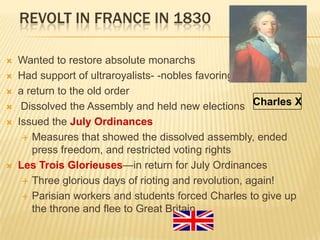
Revolt in France in 1830Wanted to restore absolute monarchsHad support of ultraroyalists- -nobles favoring a return to the old order  Dissolved the Assembly and held new electionsIssued the July Ordinances Measures that showed the dissolved assembly, ended press freedom, and restricted voting rightsLes TroisGlorieuses—in return for July OrdinancesThree glorious days of rioting and revolution, again!Parisian workers and students forced Charles to give up the throne and flee to Great Britain Charles X
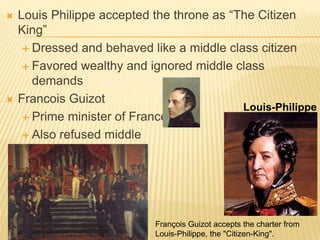
Louis Philippe accepted the throne as “The Citizen King”Dressed and behaved like a middle class citizenFavored wealthy and ignored middle class demands Francois GuizotPrime minister of FranceAlso refused middle class demandsLouis-Philippe IFrançois Guizot accepts the charter from Louis-Philippe, the "Citizen-King".
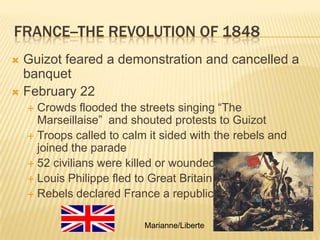
France--The Revolution of 1848Guizot feared a demonstration and cancelled a banquetFebruary 22Crowds flooded the streets singing “The Marseillaise”  and shouted protests to GuizotTroops called to calm it sided with the rebels and joined the parade52 civilians were killed or woundedLouis Philippe fled to Great Britain Rebels declared France a republic Marianne/Liberte
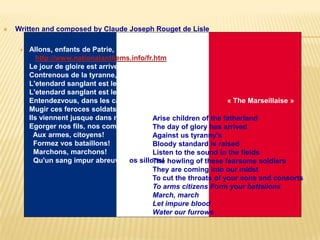
Written and composed by Claude Joseph Rouget de LisleAllons, enfants de Patrie,			http://www.nationalanthems.info/fr.htmLe jour de gloire est arrive;Contrenous de la tyranne,L'etendard sanglant est leve,L'etendard sanglant est leve,Entendezvous, dans les campagnes,			« The Marseillaise »Mugir ces feroces soldats?Ils viennent jusque dans nos bras,Egorger nos fils, nos compagnes.  Aux armes, citoyens!  Formez vos bataillons!  Marchons, marchons!  Qu'un sang impur abreuve nos sillons! Arise children of the fatherlandThe day of glory has arrivedAgainst us tyranny'sBloody standard is raisedListen to the sound in the fieldsThe howling of these fearsome soldiersThey are coming into our midstTo cut the throats of your sons and consortsTo arms citizens Form your battalionsMarch, marchLet impure bloodWater our furrows

Chapter 8.1.and 8.2

  • 1.
    1Opposing IdeologiesAt theCongress of Vienna, the powers of Europe tried to turn the clock back to the way things had been before 1789.Other voices, however, kept challenging the order imposed by the Congress of Vienna. The clash of people with opposing ideologies, or systems of thought and belief, plunged Europe into more than 30 years of turmoil.
  • 2.
    1What Were theGoals of Conservatives?Conservatives pursued the following goals:Restore royal families to the thrones they had lost when Napoleon swept across Europe.Maintain a social hierarchy in which lower classes respected and obeyed their social superiors. Maintain an established church.Suppress revolutionary ideas.
  • 3.
    The Liberal andNationalist Challenge1Challenging the conservatives at every turn were liberals and nationalists who were inspired by the Enlightenment and the French Revolution.LIBERALISMNATIONALISMNational groups who shared a common heritage set out to win their own states.Nationalism gave people with a common heritage a sense of identity. Nationalism often bred intolerance and led to persecution of other ethnic or national groups.Liberals wanted:Governments based on written constitutions and separation of powers.Natural rights of liberty, equality, and prosperity.Rulers elected by the people and responsible to them.A republican form of government.Laissez-faire economics.
  • 4.
  • 5.
    1Revolts Against theOld OrderSpurred by the ideas of liberalism and nationalism, revolutionaries fought against the old order.In the Balkans, first Serbia, and later Greece fought for and won independence from their Ottoman rulers and becomes “The Powder Keg of Europe”.In Spain, Portugal, and various states in the Italian peninsula, rebels struggled to gain constitutional governments. In response, a French army marched over the Pyrenees to suppress the revolts in Spain. Austrian forces crossed the Alps to smash rebellious outbreaks in Italy.
  • 6.
  • 7.
  • 8.
    Conflicting IdeologiesThis cartoonshows Prince Metternich standing resolute against the angry crowd behind him who are pushing for reform. Metternich represented the conservative order and opposed revolutionary ideals such as freedom and progress.How does the cartoonist portray those in the crowd?What does the crowd support?What did Metternich do to suppress revolutionary ideas?
  • 9.
    2Revolutions of 1848In1848, revolts in Paris again unleashed a tidal wave of revolution across Europe.In Austria, revolts caused Metternich to resign. The Austrian government agreed to reforms, but these gains were temporary. With Russian help, Austrian forces defeated the rebels. Many were imprisoned, executed, or exiled. Nationalists in Italy rebelled against Austrian Hapsburg rulers. They expelled the pope and installed a nationalist government. Before long, Austrian troops ousted the new government and the French army restored the pope to power. In Prussia, liberals forced King Frederick William IV to agree to a constitution written by an elected assembly. Within a year, Frederick dissolved the assembly and issued his own constitution keeping power in his own hands.
  • 10.
    Metternich Flees Austria
  • 11.
    How Did RevolutionSpread in 1830?2The revolts in Paris inspired uprisings elsewhere in Europe. Most were suppressed by military force. But here and there, rebels did win changes from conservative governments. Even when they failed, revolutionaries frightened rulers badly enough to encourage reform later in the century. Belgium The one notable success for Europe’s revolutionaries in 1830 took place in Belgium. The Congress of Vienna had united Belgium and Holland under the Dutch king. The Belgians resented this arrangement and pushed for independence. In 1831, Belgium became an independent state with a liberal constitution. Poland Nationalists in Poland staged an uprising in 1830. However, the rebels failed to gain widespread support, and were brutally crushed by Russian forces.
  • 12.
    Belgium Wins IndependenceTheone notable success in 1830 took place in Belgium. In 1815, the Congress of Vienna had united the Austrian Netherlands (present-day Belgium) and the Kingdom of Holland under the Dutch king. The Congress had wanted to create a strong barrier to help prevent French expansion in the future.The Belgians resented the new arrangement. They and the Dutch had different languages. The Belgians were Catholic, while the Dutch were Protestant. The Belgian economy was based on manufacturing; the Dutch, on trade.In 1830, news of the Paris uprising ignited a revolutionary spark in Belgium. Students and workers threw up barricades in Brussels, the capital. Britain and France believed that they would benefit from the separation of Belgium and Holland and supported Belgian demands for independence. As a result, in 1831, Belgium became an independent state with a liberal constitution.Rebels Fail in PolandNationalists in Poland also staged an uprising in 1830. But, unlike the Belgians, the Poles failed to win independence for their country.In the late 1700s, Russia, Austria, and Prussia had divided up Poland. Poles had hoped that the Congress of Vienna would restore their homeland in 1815. Instead, the great powers handed most of Poland to Russia.In 1830, Polish students, army officers, and landowners rose in revolt. The rebels failed to gain widespread support, however, and were brutally crushed by Russian forces. Some survivors fled to Western Europe and the United States, where they kept alive the dream of freedom.
  • 13.
    Serbs in BattleSerbleader Karageorge (left) leads the Serbs against the Ottomans at the Battle of Misar during the first Serbian rebellion. Why would this battle and others like it help lead to a sense of Serbian national identity? Why was this sense of nationalism important for the Serbs?
  • 16.
  • 17.
    2Revolutions of 1830and 1848Why did revolutions occur in France in 1830 and 1848?
  • 18.
    How did revolutionspread in 1830?
  • 19.
    What were theresults of the 1848 revolutions?Why Did Revolutions Occur in France in 1830 and 1848?Liberals and radicals rebelled and took control of Paris.218481830Charles X, a strong believer in absolutism, suspended the legislature, limited the right to vote, and restricted the press. When the government tried to silence critics and prevent public meetings, angry crowds took to the streets.Louis Philippe abdicated.Moderate liberals put in place a constitutional monarchy, and chose Louis Philippe as king.Revolutionary leaders proclaimed a Second Republic.
  • 20.
    Revolt in Francein 1830Wanted to restore absolute monarchsHad support of ultraroyalists- -nobles favoring a return to the old order Dissolved the Assembly and held new electionsIssued the July Ordinances Measures that showed the dissolved assembly, ended press freedom, and restricted voting rightsLes TroisGlorieuses—in return for July OrdinancesThree glorious days of rioting and revolution, again!Parisian workers and students forced Charles to give up the throne and flee to Great Britain Charles X
  • 21.
    Louis Philippe acceptedthe throne as “The Citizen King”Dressed and behaved like a middle class citizenFavored wealthy and ignored middle class demands Francois GuizotPrime minister of FranceAlso refused middle class demandsLouis-Philippe IFrançois Guizot accepts the charter from Louis-Philippe, the "Citizen-King".
  • 22.
    France--The Revolution of1848Guizot feared a demonstration and cancelled a banquetFebruary 22Crowds flooded the streets singing “The Marseillaise” and shouted protests to GuizotTroops called to calm it sided with the rebels and joined the parade52 civilians were killed or woundedLouis Philippe fled to Great Britain Rebels declared France a republic Marianne/Liberte
  • 23.
    Written and composedby Claude Joseph Rouget de LisleAllons, enfants de Patrie, http://www.nationalanthems.info/fr.htmLe jour de gloire est arrive;Contrenous de la tyranne,L'etendard sanglant est leve,L'etendard sanglant est leve,Entendezvous, dans les campagnes, « The Marseillaise »Mugir ces feroces soldats?Ils viennent jusque dans nos bras,Egorger nos fils, nos compagnes.  Aux armes, citoyens!  Formez vos bataillons!  Marchons, marchons!  Qu'un sang impur abreuve nos sillons! Arise children of the fatherlandThe day of glory has arrivedAgainst us tyranny'sBloody standard is raisedListen to the sound in the fieldsThe howling of these fearsome soldiersThey are coming into our midstTo cut the throats of your sons and consortsTo arms citizens Form your battalionsMarch, marchLet impure bloodWater our furrows