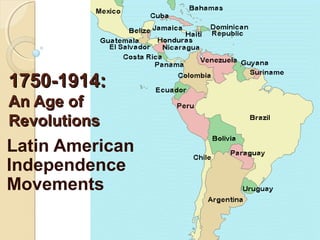
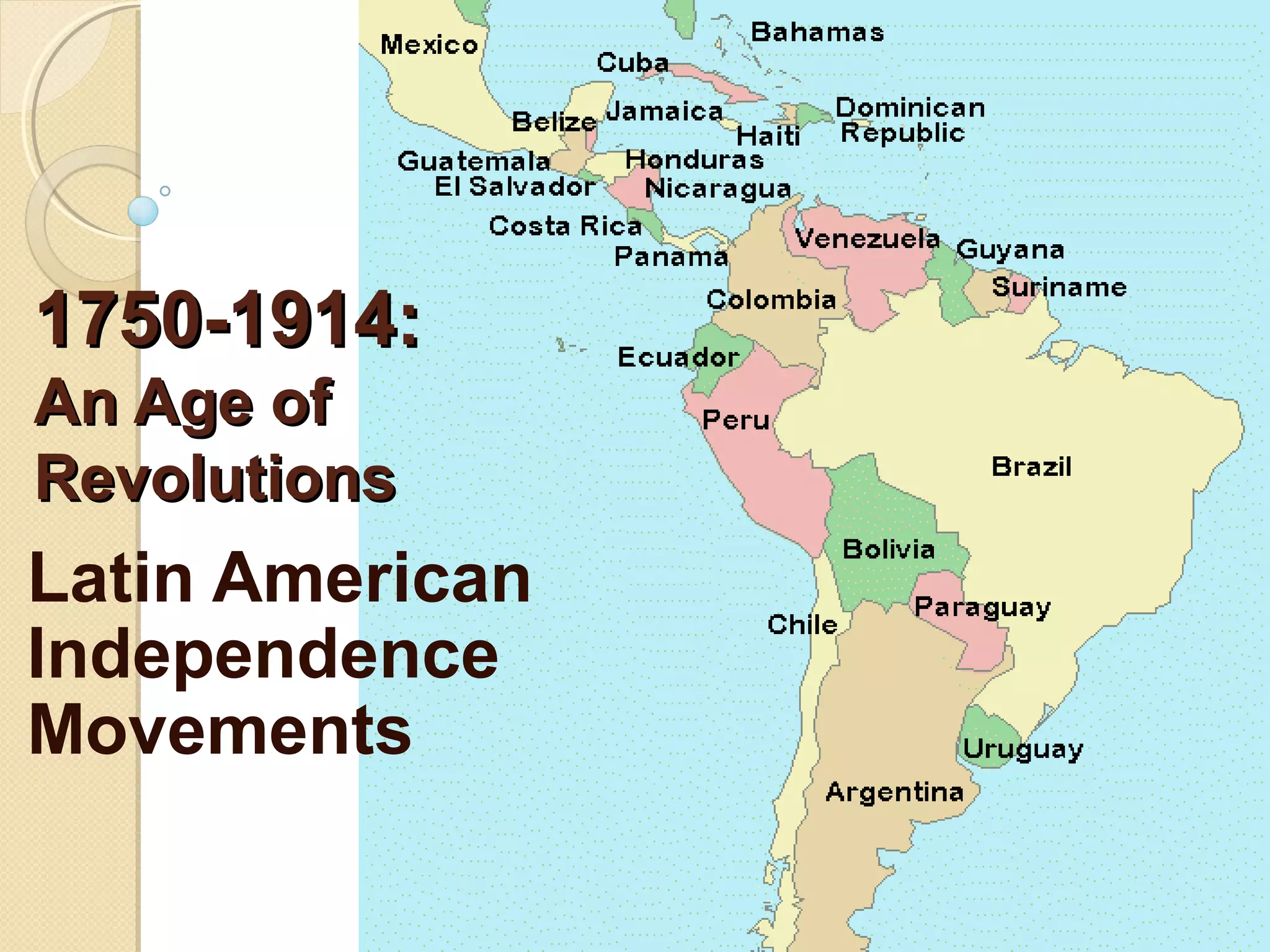
1750-1914:
An Age of
Revolutions
Latin American
Independence
Movements
Background
Indigenous   peoples and civilizations
 ◦ Maya, Aztec, Inca
European   Colonization, 1500s
 ◦ Spain, Portugal, France
American Revolution, 1776
French Revolution and Enlightenment,
 1789
Napoleon’s conquests within Europe,
 1800s
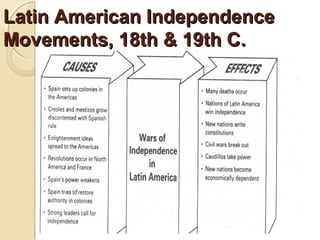
Latin American Independence
Movements, 18th & 19th C.
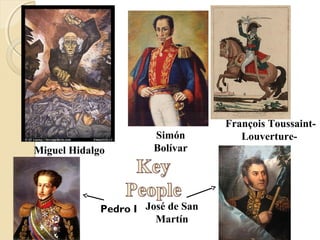
François Toussaint-
                       Simón          Louverture-
Miguel Hidalgo         Bolívar


             Pedro I José de San
                       Martín
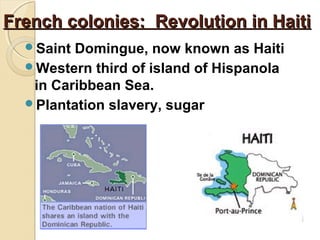
French colonies: Revolution in Haiti
  Saint Domingue, now known as Haiti
  Western third of island of Hispanola
   in Caribbean Sea.
  Plantation slavery, sugar
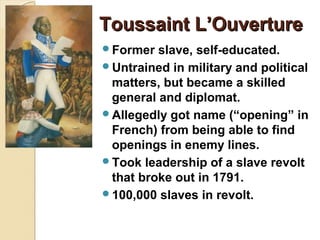
Toussaint L’Ouverture
Former  slave, self-educated.
Untrained in military and political
 matters, but became a skilled
 general and diplomat.
Allegedly got name (“opening” in
 French) from being able to find
 openings in enemy lines.
Took leadership of a slave revolt
 that broke out in 1791.
100,000 slaves in revolt.
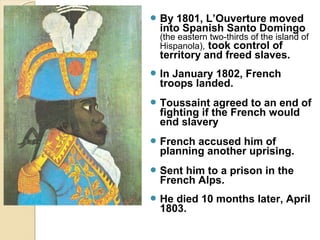
 By  1801, L’Ouverture moved
  into Spanish Santo Domingo
  (the eastern two-thirds of the island of
  Hispanola), took control of
  territory and freed slaves.
 In January 1802, French
  troops landed.
 Toussaint   agreed to an end of
  fighting if the French would
  end slavery
 French accused him of
  planning another uprising.
 Sent him to a prison in the
  French Alps.
 He died 10 months later, April
  1803.
Spanish Colonies

Revolutions against
Spanish Rule
Latin American social classes
Peninsulares  - men born in Spain
 ◦ held highest offices
Creoles   - Spaniards born in Latin America
 ◦ officers in army, but not in government
 ◦ often resented power of the peninsulares
Mestizos   - mixed European and Indian
Mulattos   - mixed European and African
Indians/Africans
European Background:
Napoleon
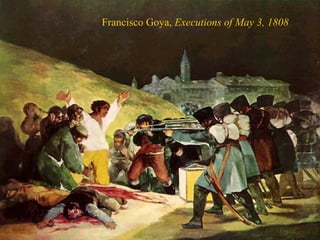
 Napoleon  invaded Spain in 1808.
 Removed Spain’s King Ferdinand VII and
  made Joseph (Nap’s brother) king of
  Spain.
 Creoles used it as a reason for revolution.
 1810 rebellion across Latin America.
 1814, Napoleon defeated and Ferdinand
  returned to power, but creoles cont’d their
  movement.
Francisco Goya, Executions of May 3, 1808
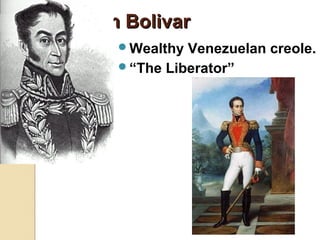
Simon Bolivar
     Wealthy Venezuelan creole.
     “The Liberator”
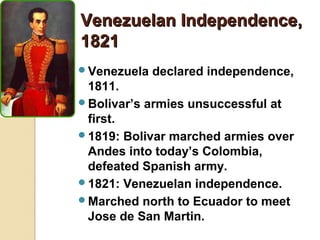
Venezuelan Independence,
1821
Venezuela   declared independence,
 1811.
Bolivar’s armies unsuccessful at
 first.
1819: Bolivar marched armies over
 Andes into today’s Colombia,
 defeated Spanish army.
1821: Venezuelan independence.
Marched north to Ecuador to meet
 Jose de San Martin.
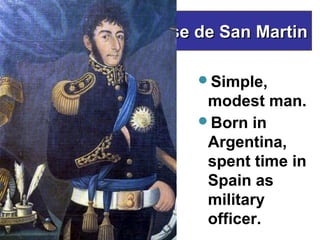
Jose de San Martin

     Simple,
      modest man.
     Born in
      Argentina,
      spent time in
      Spain as
      military
      officer.
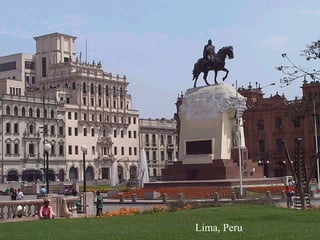
Lima, Peru
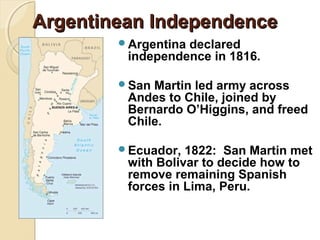
Argentinean Independence
        Argentinadeclared
         independence in 1816.

        San Martin led army across
         Andes to Chile, joined by
         Bernardo O’Higgins, and freed
         Chile.

        Ecuador,  1822: San Martin met
         with Bolivar to decide how to
         remove remaining Spanish
         forces in Lima, Peru.
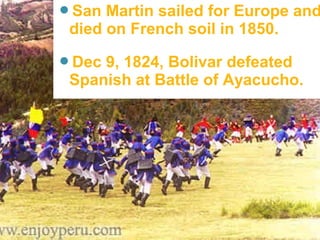
San Martin sailed for Europe and
died on French soil in 1850.
Dec9, 1824, Bolivar defeated
Spanish at Battle of Ayacucho.
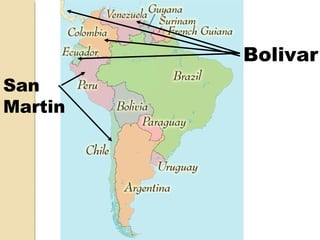
Bolivar
San
Martin
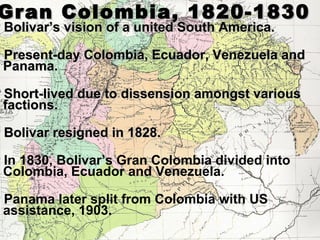
Gran Colombia, 1820-1830
Bolivar’s vision of a united South America.

Present-day Colombia, Ecuador, Venezuela and
 Panama.
Short-lived due to dissension amongst various
 factions.
Bolivar resigned in 1828.

In1830, Bolivar’s Gran Colombia divided into
 Colombia, Ecuador and Venezuela.
Panama  later split from Colombia with US
 assistance, 1903.
Mexico
Indians and mestizos, not creoles,
 played the key role in
 independence movements.

Creoles   sided with Spain to avoid
 violence of lower-class rebellions
 (until 1820).
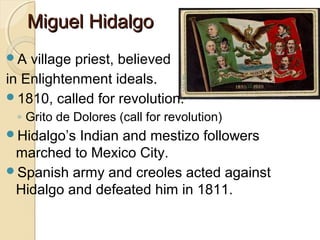
Miguel Hidalgo
A  village priest, believed
in Enlightenment ideals.
1810, called for revolution.
 ◦ Grito de Dolores (call for revolution)
Hidalgo’sIndian and mestizo followers
 marched to Mexico City.
Spanish army and creoles acted against
 Hidalgo and defeated him in 1811.
Mexican Independence, 1821
1820  revolution in Spain put a liberal
 government in power.
Mexican creoles feared loss of
 influence, so they united against
 Spain.
Agustin Iturbide declared himself
 emperor, but was overthrown.
1824: Establishment of the Mexican
 Republic.
French Rule
Conservative  rebels plotted with France to
 reconquer Mexico.
Napoleon III sent armies to Mexico.
Cinco de Mayo, 1862:
  ◦ Zaragoza won the Battle of Puebla against the French,
    but the French won the war.
Napoleon  III appointed a relative, Austrian
 archduke Maximilian, as emperor of Mexico.
Juarez resisted, US sent troops to Mexico - French
 gave up in 1867.
Juarez continued reforms.
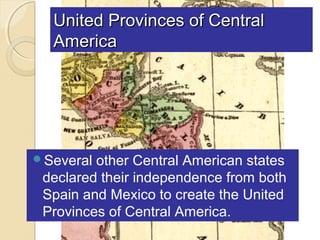
United Provinces of Central
  America


Several other Central American states
 declared their independence from both
 Spain and Mexico to create the United
 Provinces of Central America.
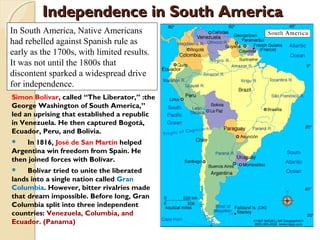
Independence in South America
             3


In South America, Native Americans
had rebelled against Spanish rule as
early as the 1700s, with limited results.
It was not until the 1800s that
discontent sparked a widespread drive
for independence.
Simon Bolívar, called “The Liberator,” :the
George Washington of South America,”
led an uprising that established a republic
in Venezuela. He then captured Bogotá,
Ecuador, Peru, and Bolivia.
   In 1816, José de San Martín helped
Argentina win freedom from Spain. He
then joined forces with Bolívar.
    Bolívar tried to unite the liberated
lands into a single nation called Gran
Columbia. However, bitter rivalries made
that dream impossible. Before long, Gran
Columbia split into three independent
countries: Venezuela, Columbia, and
Ecuador. (Panama)
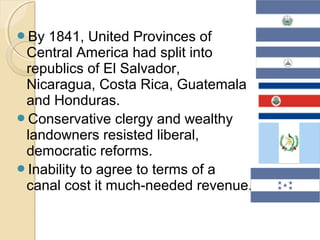
By 1841, United Provinces of
 Central America had split into
 republics of El Salvador,
 Nicaragua, Costa Rica, Guatemala
 and Honduras.
Conservative clergy and wealthy
 landowners resisted liberal,
 democratic reforms.
Inability to agree to terms of a
 canal cost it much-needed revenue.
Period of Consolidation, 1825-1850
 Breakdown       of original nations and groups:
  ◦ Gran Colombia
  ◦ an original union between Bolivia and Peru
  ◦ United Provinces of Central America
 Instability   of internal politics
  ◦ Bolivia experienced 60 revolts and coups.
  ◦ Venezuela experienced 52 revolts and coups
 Liberals   - free trade, representative govt, federal government
  system
 Conservatives - protect church and upper classes
  ◦ controlled most regimes between 1830 and 1870.
 Independence       movements and new governments run by
  Creoles
 Spanish administrators had excluded Creoles from political
  leadership, so few leaders could actually run a government.
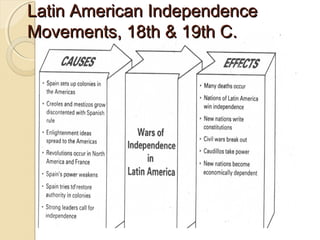
Latin American Independence
Movements, 18th & 19th C.
Latinamericanindependencemovementsandrevolutions 090319164612-phpapp02

Latinamericanindependencemovementsandrevolutions 090319164612-phpapp02

  • 1.
    1750-1914: An Age of Revolutions LatinAmerican Independence Movements
  • 2.
    Background Indigenous peoples and civilizations ◦ Maya, Aztec, Inca European Colonization, 1500s ◦ Spain, Portugal, France American Revolution, 1776 French Revolution and Enlightenment, 1789 Napoleon’s conquests within Europe, 1800s
  • 3.
  • 4.
    François Toussaint- Simón Louverture- Miguel Hidalgo Bolívar Pedro I José de San Martín
  • 5.
    French colonies: Revolutionin Haiti Saint Domingue, now known as Haiti Western third of island of Hispanola in Caribbean Sea. Plantation slavery, sugar
  • 6.
    Toussaint L’Ouverture Former slave, self-educated. Untrained in military and political matters, but became a skilled general and diplomat. Allegedly got name (“opening” in French) from being able to find openings in enemy lines. Took leadership of a slave revolt that broke out in 1791. 100,000 slaves in revolt.
  • 7.
     By 1801, L’Ouverture moved into Spanish Santo Domingo (the eastern two-thirds of the island of Hispanola), took control of territory and freed slaves.  In January 1802, French troops landed.  Toussaint agreed to an end of fighting if the French would end slavery  French accused him of planning another uprising.  Sent him to a prison in the French Alps.  He died 10 months later, April 1803.
  • 8.
  • 9.
    Latin American socialclasses Peninsulares - men born in Spain ◦ held highest offices Creoles - Spaniards born in Latin America ◦ officers in army, but not in government ◦ often resented power of the peninsulares Mestizos - mixed European and Indian Mulattos - mixed European and African Indians/Africans
  • 10.
    European Background: Napoleon Napoleon invaded Spain in 1808. Removed Spain’s King Ferdinand VII and made Joseph (Nap’s brother) king of Spain. Creoles used it as a reason for revolution. 1810 rebellion across Latin America. 1814, Napoleon defeated and Ferdinand returned to power, but creoles cont’d their movement.
  • 11.
  • 12.
    Simon Bolivar Wealthy Venezuelan creole. “The Liberator”
  • 13.
    Venezuelan Independence, 1821 Venezuela declared independence, 1811. Bolivar’s armies unsuccessful at first. 1819: Bolivar marched armies over Andes into today’s Colombia, defeated Spanish army. 1821: Venezuelan independence. Marched north to Ecuador to meet Jose de San Martin.
  • 14.
    Jose de SanMartin Simple, modest man. Born in Argentina, spent time in Spain as military officer.
  • 15.
  • 16.
    Argentinean Independence Argentinadeclared independence in 1816. San Martin led army across Andes to Chile, joined by Bernardo O’Higgins, and freed Chile. Ecuador, 1822: San Martin met with Bolivar to decide how to remove remaining Spanish forces in Lima, Peru.
  • 17.
    San Martin sailedfor Europe and died on French soil in 1850. Dec9, 1824, Bolivar defeated Spanish at Battle of Ayacucho.
  • 18.
  • 19.
    Gran Colombia, 1820-1830 Bolivar’svision of a united South America. Present-day Colombia, Ecuador, Venezuela and Panama. Short-lived due to dissension amongst various factions. Bolivar resigned in 1828. In1830, Bolivar’s Gran Colombia divided into Colombia, Ecuador and Venezuela. Panama later split from Colombia with US assistance, 1903.
  • 20.
    Mexico Indians and mestizos,not creoles, played the key role in independence movements. Creoles sided with Spain to avoid violence of lower-class rebellions (until 1820).
  • 21.
    Miguel Hidalgo A village priest, believed in Enlightenment ideals. 1810, called for revolution. ◦ Grito de Dolores (call for revolution) Hidalgo’sIndian and mestizo followers marched to Mexico City. Spanish army and creoles acted against Hidalgo and defeated him in 1811.
  • 22.
    Mexican Independence, 1821 1820 revolution in Spain put a liberal government in power. Mexican creoles feared loss of influence, so they united against Spain. Agustin Iturbide declared himself emperor, but was overthrown. 1824: Establishment of the Mexican Republic.
  • 23.
    French Rule Conservative rebels plotted with France to reconquer Mexico. Napoleon III sent armies to Mexico. Cinco de Mayo, 1862: ◦ Zaragoza won the Battle of Puebla against the French, but the French won the war. Napoleon III appointed a relative, Austrian archduke Maximilian, as emperor of Mexico. Juarez resisted, US sent troops to Mexico - French gave up in 1867. Juarez continued reforms.
  • 24.
    United Provinces ofCentral America Several other Central American states declared their independence from both Spain and Mexico to create the United Provinces of Central America.
  • 25.
    Independence in SouthAmerica 3 In South America, Native Americans had rebelled against Spanish rule as early as the 1700s, with limited results. It was not until the 1800s that discontent sparked a widespread drive for independence. Simon Bolívar, called “The Liberator,” :the George Washington of South America,” led an uprising that established a republic in Venezuela. He then captured Bogotá, Ecuador, Peru, and Bolivia.  In 1816, José de San Martín helped Argentina win freedom from Spain. He then joined forces with Bolívar.  Bolívar tried to unite the liberated lands into a single nation called Gran Columbia. However, bitter rivalries made that dream impossible. Before long, Gran Columbia split into three independent countries: Venezuela, Columbia, and Ecuador. (Panama)
  • 26.
    By 1841, UnitedProvinces of Central America had split into republics of El Salvador, Nicaragua, Costa Rica, Guatemala and Honduras. Conservative clergy and wealthy landowners resisted liberal, democratic reforms. Inability to agree to terms of a canal cost it much-needed revenue.
  • 27.
    Period of Consolidation,1825-1850  Breakdown of original nations and groups: ◦ Gran Colombia ◦ an original union between Bolivia and Peru ◦ United Provinces of Central America  Instability of internal politics ◦ Bolivia experienced 60 revolts and coups. ◦ Venezuela experienced 52 revolts and coups  Liberals - free trade, representative govt, federal government system  Conservatives - protect church and upper classes ◦ controlled most regimes between 1830 and 1870.  Independence movements and new governments run by Creoles  Spanish administrators had excluded Creoles from political leadership, so few leaders could actually run a government.
  • 28.