© Prentice Hall 2008
Pearson Education, Inc
Upper Saddle River, NJ 07458
Criminal Justice: A Brief Introduction, 7E
by Frank Schmalleger
1
The Courts
CHAPTER
7
© Prentice Hall 2008
Pearson Education, Inc
Upper Saddle River, NJ 07458
Criminal Justice: A Brief Introduction, 7E
by Frank Schmalleger
2
The United States has courts on both the
federal and state levels.
This dual system reflects the state’s need
to retain judicial autonomy separate
from the federal government.
Most criminal cases originate within state
courts.
America’s Dual
Court System
© Prentice Hall 2008
Pearson Education, Inc
Upper Saddle River, NJ 07458
Criminal Justice: A Brief Introduction, 7E
by Frank Schmalleger
3
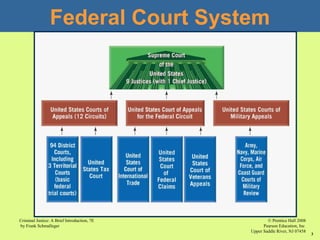
Federal Court System
© Prentice Hall 2008
Pearson Education, Inc
Upper Saddle River, NJ 07458
Criminal Justice: A Brief Introduction, 7E
by Frank Schmalleger
4
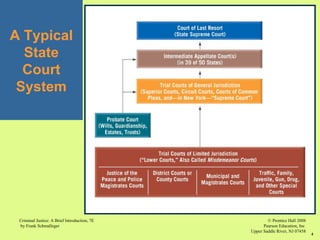
A Typical
State
Court
System
© Prentice Hall 2008
Pearson Education, Inc
Upper Saddle River, NJ 07458
Criminal Justice: A Brief Introduction, 7E
by Frank Schmalleger
5
Jurisdiction
The jurisdiction of a court refers
to those cases in which it may
exercise lawful authority.
 Determined by statute or
constitution
© Prentice Hall 2008
Pearson Education, Inc
Upper Saddle River, NJ 07458
Criminal Justice: A Brief Introduction, 7E
by Frank Schmalleger
6
The State Court System
© Prentice Hall 2008
Pearson Education, Inc
Upper Saddle River, NJ 07458
Criminal Justice: A Brief Introduction, 7E
by Frank Schmalleger
7
The Development of State
Courts
By 1776, each American colony had its
own court system, though trained lawyers
were lacking.
After the American Revolution, these
courts provided the basis for a system of
states’ courts.
© Prentice Hall 2008
Pearson Education, Inc
Upper Saddle River, NJ 07458
Criminal Justice: A Brief Introduction, 7E
by Frank Schmalleger
8
Early Court Systems
Structure of colonial courts were not
uniform.
Initially, most states made no
distinction between original and
appellate jurisdiction. (Many did not
allow for appeals.)
© Prentice Hall 2008
Pearson Education, Inc
Upper Saddle River, NJ 07458
Criminal Justice: A Brief Introduction, 7E
by Frank Schmalleger
9
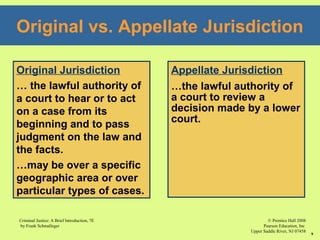
Original vs. Appellate Jurisdiction
Original Jurisdiction
… the lawful authority of
a court to hear or to act
on a case from its
beginning and to pass
judgment on the law and
the facts.
…may be over a specific
geographic area or over
particular types of cases.
Appellate Jurisdiction
…the lawful authority of
a court to review a
decision made by a lower
court.
© Prentice Hall 2008
Pearson Education, Inc
Upper Saddle River, NJ 07458
Criminal Justice: A Brief Introduction, 7E
by Frank Schmalleger
10
 Many differences among state courts.
 Most use the three-tiered structure.
- Trial courts of limited jurisdiction
- Trial courts of general jurisdiction
- Appellate courts
 The court reform movement continues
today, seeking to simplify and unify
court structures.
State Court Systems Today
© Prentice Hall 2008
Pearson Education, Inc
Upper Saddle River, NJ 07458
Criminal Justice: A Brief Introduction, 7E
by Frank Schmalleger
11
State Trial Courts
 Where criminal cases “begin.”
 Bail hearings
 Arraignments
 Enters pleas
 Conducts trials
 Sentences
 Two types of trial courts:
 Courts of limited, or special,
jurisdiction (lower courts)
 Courts of general jurisdiction
© Prentice Hall 2008
Pearson Education, Inc
Upper Saddle River, NJ 07458
Criminal Justice: A Brief Introduction, 7E
by Frank Schmalleger
12
State Trial Courts: Courts of
Limited Jurisdiction
Trial courts of limited jurisdiction are also
called lower courts. They are authorized to
hear:
 Misdemeanors
 Family disputes
 Traffic violations
 Small claims
© Prentice Hall 2008
Pearson Education, Inc
Upper Saddle River, NJ 07458
Criminal Justice: A Brief Introduction, 7E
by Frank Schmalleger
13
State Trial Courts: Courts of
Limited Jurisdiction
Lower courts:
 Rarely hold jury trials
 Do not maintain detailed records of
proceedings (just charge, plea, finding, and
sentence)
 Less formal than higher courts
© Prentice Hall 2008
Pearson Education, Inc
Upper Saddle River, NJ 07458
Criminal Justice: A Brief Introduction, 7E
by Frank Schmalleger
14
State Trial Courts: Courts of
General Jurisdiction
Also called: high courts, circuit courts, or
superior courts
Formal courts that make full use of juries,
witnesses, prosecutors, defense attorneys, and
other actors
Authorized to hear:
 Any criminal case
 Lower court appeals
Trial de novo
© Prentice Hall 2008
Pearson Education, Inc
Upper Saddle River, NJ 07458
Criminal Justice: A Brief Introduction, 7E
by Frank Schmalleger
15
Adversarial Process
Trial courts of general jurisdiction
operate under the adversarial process.
 Pits the interests of the state,
represented by prosecutors, against
the accused, represented by defense
counsel, in a process constrained by
procedural rules specified in law and
by tradition.
© Prentice Hall 2008
Pearson Education, Inc
Upper Saddle River, NJ 07458
Criminal Justice: A Brief Introduction, 7E
by Frank Schmalleger
16
State Appellate Courts
Most state appellate systems consist of
intermediate and high level appellate
courts.
 All states have supreme courts.
 39 states have intermediate level
appellate courts.
© Prentice Hall 2008
Pearson Education, Inc
Upper Saddle River, NJ 07458
Criminal Justice: A Brief Introduction, 7E
by Frank Schmalleger
17
Appeals
 Appeals are requests by a defendant
to a higher court asking it to review
the actions of a lower court.
 Some cases (involving death penalty
or life sentences) are automatically
appealed.
© Prentice Hall 2008
Pearson Education, Inc
Upper Saddle River, NJ 07458
Criminal Justice: A Brief Introduction, 7E
by Frank Schmalleger
18
Appeals: The Process
 Appellate court reviews transcripts
from lower trial courts and may
allow for lawyers from both sides to
make oral arguments.
© Prentice Hall 2008
Pearson Education, Inc
Upper Saddle River, NJ 07458
Criminal Justice: A Brief Introduction, 7E
by Frank Schmalleger
19
Appeals: The Results
 Most convictions are confirmed.
 Some decisions are reversed and
cases remanded.
 Recourse may be to a state supreme
court.
 Generally, the state supreme court is the
court of last resort.
© Prentice Hall 2008
Pearson Education, Inc
Upper Saddle River, NJ 07458
Criminal Justice: A Brief Introduction, 7E
by Frank Schmalleger
20
Cases can be appealed to the U.S.
Supreme Court if they are based on a
claimed violation of the defendant’s
rights as guaranteed under federal law or
the U. S. Constitution.
State defendants’ access to federal courts
are limited by the Keeney and Herrera
decisions.
Appeals: Moving to the
Federal System
© Prentice Hall 2008
Pearson Education, Inc
Upper Saddle River, NJ 07458
Criminal Justice: A Brief Introduction, 7E
by Frank Schmalleger
21
“A respondent is entitled to a federal
evidentiary hearing [only] if he can show cause
for his failure to develop the facts in the state
court proceedings and actual prejudice from
that failure...”
“It is hardly a good use of scarce judicial
resources to duplicate fact-finding in federal
court merely because petitioner has
negligently failed to take advantage of
opportunities in state court proceedings.”
Keeney v. Tamayo-
Reyes (1993)
© Prentice Hall 2008
Pearson Education, Inc
Upper Saddle River, NJ 07458
Criminal Justice: A Brief Introduction, 7E
by Frank Schmalleger
22
Evidence of innocence is no reason
for a federal court to order a new
trial if constitutional grounds are
lacking.
“Where a defendant has been afforded a fair trial
and convicted of the offense for which he was
charged, the constitutional presumption of
innocence disappears.”
Herrera v. Collins (1993)
© Prentice Hall 2008
Pearson Education, Inc
Upper Saddle River, NJ 07458
Criminal Justice: A Brief Introduction, 7E
by Frank Schmalleger
23
State Court Administration
State court administrators manage
the operational functions of the
court.
© Prentice Hall 2008
Pearson Education, Inc
Upper Saddle River, NJ 07458
Criminal Justice: A Brief Introduction, 7E
by Frank Schmalleger
24
State Court Administrator’s Duties
Prepare, present, oversee court system’s budget
Analyze case flow and determine allocation of
personnel and how to streamline cases
Gather and present statistics
Serve as liaison between legislators and court
Develop and coordinate funding requests
Manage court personnel (promotions, benefits)
Coordinate plans to train judges and other
personnel
Assign judges to judicial districts
Review payments to counsel for indigent
defendants
© Prentice Hall 2008
Pearson Education, Inc
Upper Saddle River, NJ 07458
Criminal Justice: A Brief Introduction, 7E
by Frank Schmalleger
25
Dispute Resolution
Centers
 Offer a way to resolve disputes
without a formal hearing
 Over 200 programs nationwide
 Frequently staffed by volunteers
 May or may not be run by the courts
 Central feature of restorative justice
© Prentice Hall 2008
Pearson Education, Inc
Upper Saddle River, NJ 07458
Criminal Justice: A Brief Introduction, 7E
by Frank Schmalleger
26
Community Courts
 Low-level official courts that focus on
quality-of-life crimes that erode
neighborhood morale
 Emphasize problem solving rather
than punishment
 Build on restorative principles such
as community service and restitution
© Prentice Hall 2008
Pearson Education, Inc
Upper Saddle River, NJ 07458
Criminal Justice: A Brief Introduction, 7E
by Frank Schmalleger
27
The Federal
Court System
© Prentice Hall 2008
Pearson Education, Inc
Upper Saddle River, NJ 07458
Criminal Justice: A Brief Introduction, 7E
by Frank Schmalleger
28
Article III, Section 1
“One Supreme Court, and such inferior
courts as the Congress may from time to
time ordain and establish.”
The Federal Court System
Established by the U.S.
Constitution
© Prentice Hall 2008
Pearson Education, Inc
Upper Saddle River, NJ 07458
Criminal Justice: A Brief Introduction, 7E
by Frank Schmalleger
29
Article III, Section 2
 Federal courts are to have jurisdiction
over cases arising under the
Constitution, federal law, and treaties.
 Federal courts are to settle disputes
between states and to have jurisdiction
in cases where one of the parties is a
state.
Jurisdiction of Federal Courts
© Prentice Hall 2008
Pearson Education, Inc
Upper Saddle River, NJ 07458
Criminal Justice: A Brief Introduction, 7E
by Frank Schmalleger
30
Three Levels of Courts
 U.S. Supreme Court
 U.S. Courts of Appeals
 U.S. District Courts
Structure of Federal Court System
© Prentice Hall 2008
Pearson Education, Inc
Upper Saddle River, NJ 07458
Criminal Justice: A Brief Introduction, 7E
by Frank Schmalleger
31
U.S. District Courts
There are 94 judicial districts.
 At least one district court per
state
 District courts in Puerto Rico, the
District of Columbia, and other
U.S. Territories
© Prentice Hall 2008
Pearson Education, Inc
Upper Saddle River, NJ 07458
Criminal Justice: A Brief Introduction, 7E
by Frank Schmalleger
32
U.S. District Courts
…the trial courts of the federal
system
…original jurisdiction over all cases
involving alleged violations of
federal statutes
© Prentice Hall 2008
Pearson Education, Inc
Upper Saddle River, NJ 07458
Criminal Justice: A Brief Introduction, 7E
by Frank Schmalleger
33
District Court Judges
 There are 650 district court judges.
 Appointed by the President and
confirmed by the Senate
 Serve for life
Assisted by magistrate judges, who:
 Conduct arraignments
 Set bail
 Issue warrants
 Try minor offenders
© Prentice Hall 2008
Pearson Education, Inc
Upper Saddle River, NJ 07458
Criminal Justice: A Brief Introduction, 7E
by Frank Schmalleger
34
U.S. Courts of Appeal:
Circuit Courts
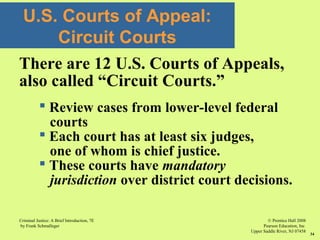
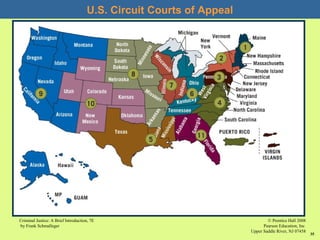
There are 12 U.S. Courts of Appeals,
also called “Circuit Courts.”
 Review cases from lower-level federal
courts
 Each court has at least six judges,
one of whom is chief justice.
 These courts have mandatory
jurisdiction over district court decisions.
© Prentice Hall 2008
Pearson Education, Inc
Upper Saddle River, NJ 07458
Criminal Justice: A Brief Introduction, 7E
by Frank Schmalleger
35
U.S. Circuit Courts of Appeal
© Prentice Hall 2008
Pearson Education, Inc
Upper Saddle River, NJ 07458
Criminal Justice: A Brief Introduction, 7E
by Frank Schmalleger
36
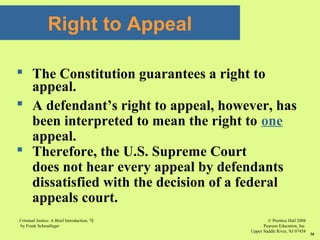
 The Constitution guarantees a right to
appeal.
 A defendant’s right to appeal, however, has
been interpreted to mean the right to one
appeal.
 Therefore, the U.S. Supreme Court
does not hear every appeal by defendants
dissatisfied with the decision of a federal
appeals court.
Right to Appeal
© Prentice Hall 2008
Pearson Education, Inc
Upper Saddle River, NJ 07458
Criminal Justice: A Brief Introduction, 7E
by Frank Schmalleger
37
U.S. Supreme Court
© Prentice Hall 2008
Pearson Education, Inc
Upper Saddle River, NJ 07458
Criminal Justice: A Brief Introduction, 7E
by Frank Schmalleger
38
U.S. Supreme Court
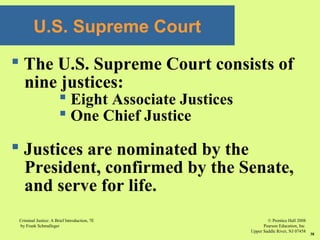
 The U.S. Supreme Court consists of
nine justices:
 Eight Associate Justices
 One Chief Justice
 Justices are nominated by the
President, confirmed by the Senate,
and serve for life.
© Prentice Hall 2008
Pearson Education, Inc
Upper Saddle River, NJ 07458
Criminal Justice: A Brief Introduction, 7E
by Frank Schmalleger
39
Justices of the U.S. Supreme Court (As of
January 2007)
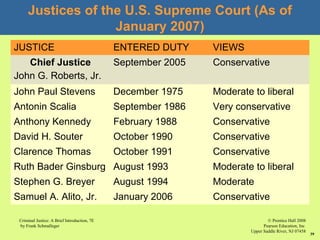
JUSTICE ENTERED DUTY VIEWS
Chief Justice
John G. Roberts, Jr.
September 2005 Conservative
John Paul Stevens December 1975 Moderate to liberal
Antonin Scalia September 1986 Very conservative
Anthony Kennedy February 1988 Conservative
David H. Souter October 1990 Conservative
Clarence Thomas October 1991 Conservative
Ruth Bader Ginsburg August 1993 Moderate to liberal
Stephen G. Breyer August 1994 Moderate
Samuel A. Alito, Jr. January 2006 Conservative
© Prentice Hall 2008
Pearson Education, Inc
Upper Saddle River, NJ 07458
Criminal Justice: A Brief Introduction, 7E
by Frank Schmalleger
40
Judicial Review
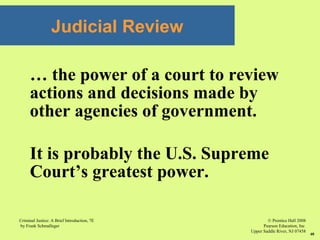
… the power of a court to review
actions and decisions made by
other agencies of government.
It is probably the U.S. Supreme
Court’s greatest power.
© Prentice Hall 2008
Pearson Education, Inc
Upper Saddle River, NJ 07458
Criminal Justice: A Brief Introduction, 7E
by Frank Schmalleger
41
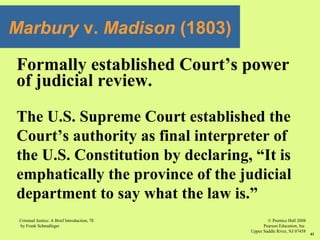
Formally established Court’s power
of judicial review.
The U.S. Supreme Court established the
Court’s authority as final interpreter of
the U.S. Constitution by declaring, “It is
emphatically the province of the judicial
department to say what the law is.”
Marbury v. Madison (1803)
© Prentice Hall 2008
Pearson Education, Inc
Upper Saddle River, NJ 07458
Criminal Justice: A Brief Introduction, 7E
by Frank Schmalleger
42
Jurisdiction of the U.S.
Supreme Court
Original jurisdiction
 Limited
 Reserved for disputes between states
and some cases of attorney disbarment
Appellate jurisdiction
 Reviews the decisions from U.S. Courts
of Appeals and state supreme courts
© Prentice Hall 2008
Pearson Education, Inc
Upper Saddle River, NJ 07458
Criminal Justice: A Brief Introduction, 7E
by Frank Schmalleger
43
U.S. Supreme Court: Appeals
 Of 5,000 annual requests for review, only
about 200 are heard.
 Four justices must vote in favor of a
hearing for a case to be heard.
 Usually the Court only reviews cases
that involve a substantial federal
question.
 The Court issues a writ of certiorari to a
lower court.
© Prentice Hall 2008
Pearson Education, Inc
Upper Saddle River, NJ 07458
Criminal Justice: A Brief Introduction, 7E
by Frank Schmalleger
44
Writ of Certiorari
… a writ issued from an appellate
court for the purpose of obtaining
from a lower court the record of
its proceedings in a particular
case.
© Prentice Hall 2008
Pearson Education, Inc
Upper Saddle River, NJ 07458
Criminal Justice: A Brief Introduction, 7E
by Frank Schmalleger
45
Supreme Court decisions are
rarely unanimous.
Types of opinions:
 Majority—Justices agree in
outcome and reasoning. This is
the opinion of the court.
 Concurring—Agree with outcome,
but for different reasons.
 Dissenting—Disagree with
outcome.
Opinions of the Court
© Prentice Hall 2008
Pearson Education, Inc
Upper Saddle River, NJ 07458
Criminal Justice: A Brief Introduction, 7E
by Frank Schmalleger
46
Pretrial Activities
© Prentice Hall 2008
Pearson Education, Inc
Upper Saddle River, NJ 07458
Criminal Justice: A Brief Introduction, 7E
by Frank Schmalleger
47
Pretrial Activities
Several activities take place before a
trial can begin:
 First appearance
 Pretrial release and bail
 The grand jury
 The preliminary hearing
 Arraignment and plea
© Prentice Hall 2008
Pearson Education, Inc
Upper Saddle River, NJ 07458
Criminal Justice: A Brief Introduction, 7E
by Frank Schmalleger
48
First Appearance
Defendants are brought before a judge
and:
 Formally notified of the charges
 Advised of their rights
 Given the opportunity to retain a
lawyer or have one appointed to
represent them
 May be afforded the opportunity for
bail
© Prentice Hall 2008
Pearson Education, Inc
Upper Saddle River, NJ 07458
Criminal Justice: A Brief Introduction, 7E
by Frank Schmalleger
49
First Appearance
…must be held “without unnecessary
delay.” Based on McNabb v. U.S. (1943),
the standard is 48 hours.
…may include a probable cause hearing, if
arrests were made without a warrant.
…some states waive the first appearance
for arrests made based on arrest warrants.
© Prentice Hall 2008
Pearson Education, Inc
Upper Saddle River, NJ 07458
Criminal Justice: A Brief Introduction, 7E
by Frank Schmalleger
50
 Most defendants are given the
opportunity for pretrial release.
 Pretrial release decisions consider risk of
flight or nonappearance in court and risk
to public safety. Decisions focus on:
 Seriousness of pending charges
 Prior record
 Information about the defendant
 Available supervisory options if released
Pretrial Release
© Prentice Hall 2008
Pearson Education, Inc
Upper Saddle River, NJ 07458
Criminal Justice: A Brief Introduction, 7E
by Frank Schmalleger
51
 The most common pretrial release
mechanism is bail, the posting of a bond
as a pledge that the accused will return
for court proceedings.
 Bail serves two purposes:
1. Helps ensure reappearance of the accused
in court
2. Prevents unconvicted persons from
suffering imprisonment unnecessarily
Pretrial Release
© Prentice Hall 2008
Pearson Education, Inc
Upper Saddle River, NJ 07458
Criminal Justice: A Brief Introduction, 7E
by Frank Schmalleger
52
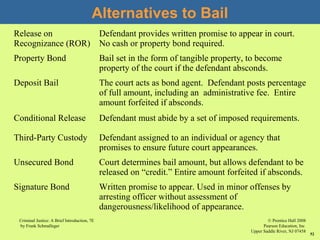
Alternatives to Bail
Release on
Recognizance (ROR)
Defendant provides written promise to appear in court.
No cash or property bond required.
Property Bond Bail set in the form of tangible property, to become
property of the court if the defendant absconds.
Deposit Bail The court acts as bond agent. Defendant posts percentage
of full amount, including an administrative fee. Entire
amount forfeited if absconds.
Conditional Release Defendant must abide by a set of imposed requirements.
Third-Party Custody Defendant assigned to an individual or agency that
promises to ensure future court appearances.
Unsecured Bond Court determines bail amount, but allows defendant to be
released on “credit.” Entire amount forfeited if absconds.
Signature Bond Written promise to appear. Used in minor offenses by
arresting officer without assessment of
dangerousness/likelihood of appearance.
© Prentice Hall 2008
Pearson Education, Inc
Upper Saddle River, NJ 07458
Criminal Justice: A Brief Introduction, 7E
by Frank Schmalleger
53
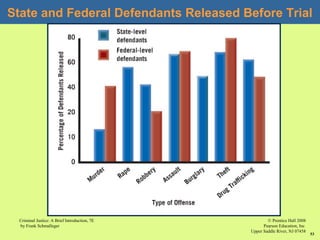
State and Federal Defendants Released Before Trial
© Prentice Hall 2008
Pearson Education, Inc
Upper Saddle River, NJ 07458
Criminal Justice: A Brief Introduction, 7E
by Frank Schmalleger
54
Most defendants are granted pretrial
release.
 A growing movement seeks to reduce the
number of defendants granted pretrial
release.
 Some states enacted danger laws, which
limit the right to bail to certain kinds of
offenders.
Pretrial Release and Public
Safety
© Prentice Hall 2008
Pearson Education, Inc
Upper Saddle River, NJ 07458
Criminal Justice: A Brief Introduction, 7E
by Frank Schmalleger
55
Used by the federal government and about
half of the states, grand juries:
 Are made of private citizens (usually 23).
 Hear evidence only from prosecutors.
 Are held in secret, and generally the
defendant is not there.
 Serve as filters to eliminate cases without
sufficient evidence.
 Move a case forward if the majority of
grand jurors on an indictment.
Grand Juries
© Prentice Hall 2008
Pearson Education, Inc
Upper Saddle River, NJ 07458
Criminal Justice: A Brief Introduction, 7E
by Frank Schmalleger
56
States that do not use grand juries rely on
preliminary hearings:
 They give the defendant an opportunity to
challenge the legal basis of his detention.
 A lower court judge summarizes the charges
and reviews the rights of criminal defendants.
 Competency to stand trial may be determined.
 They have many of the same characteristics as a
trial.
Preliminary Hearing
© Prentice Hall 2008
Pearson Education, Inc
Upper Saddle River, NJ 07458
Criminal Justice: A Brief Introduction, 7E
by Frank Schmalleger
57
 Arraignment is the first appearance before
the court with authority to try the case.
 Two purposes:
• Inform suspect of specific charges
• Allow defendant to enter a plea
 Types of pleas:
• Guilty
• Not guilty
• Nolo contendere
Arraignment
© Prentice Hall 2008
Pearson Education, Inc
Upper Saddle River, NJ 07458
Criminal Justice: A Brief Introduction, 7E
by Frank Schmalleger
58
Plea Bargaining
…the process of negotiating an agreement
among the defendant, the prosecutor, and
the court as to an appropriate plea and
associated sentence in a given case.
Plea bargaining circumvents the trial
process and dramatically reduces the time
required for the resolution of a criminal
case.
© Prentice Hall 2008
Pearson Education, Inc
Upper Saddle River, NJ 07458
Criminal Justice: A Brief Introduction, 7E
by Frank Schmalleger
59
Plea Bargaining
 Negotiated pleas are guilty pleas and
result
in conviction.
 Some surveys have found that 90% of all
criminal cases prepared for trial are
eventually resolved through a negotiated
plea.
 After a guilty plea has been entered, it
may be withdrawn with the consent of the
court.

Ch07bCourts

  • 1.
    © Prentice Hall2008 Pearson Education, Inc Upper Saddle River, NJ 07458 Criminal Justice: A Brief Introduction, 7E by Frank Schmalleger 1 The Courts CHAPTER 7
  • 2.
    © Prentice Hall2008 Pearson Education, Inc Upper Saddle River, NJ 07458 Criminal Justice: A Brief Introduction, 7E by Frank Schmalleger 2 The United States has courts on both the federal and state levels. This dual system reflects the state’s need to retain judicial autonomy separate from the federal government. Most criminal cases originate within state courts. America’s Dual Court System
  • 3.
    © Prentice Hall2008 Pearson Education, Inc Upper Saddle River, NJ 07458 Criminal Justice: A Brief Introduction, 7E by Frank Schmalleger 3 Federal Court System
  • 4.
    © Prentice Hall2008 Pearson Education, Inc Upper Saddle River, NJ 07458 Criminal Justice: A Brief Introduction, 7E by Frank Schmalleger 4 A Typical State Court System
  • 5.
    © Prentice Hall2008 Pearson Education, Inc Upper Saddle River, NJ 07458 Criminal Justice: A Brief Introduction, 7E by Frank Schmalleger 5 Jurisdiction The jurisdiction of a court refers to those cases in which it may exercise lawful authority.  Determined by statute or constitution
  • 6.
    © Prentice Hall2008 Pearson Education, Inc Upper Saddle River, NJ 07458 Criminal Justice: A Brief Introduction, 7E by Frank Schmalleger 6 The State Court System
  • 7.
    © Prentice Hall2008 Pearson Education, Inc Upper Saddle River, NJ 07458 Criminal Justice: A Brief Introduction, 7E by Frank Schmalleger 7 The Development of State Courts By 1776, each American colony had its own court system, though trained lawyers were lacking. After the American Revolution, these courts provided the basis for a system of states’ courts.
  • 8.
    © Prentice Hall2008 Pearson Education, Inc Upper Saddle River, NJ 07458 Criminal Justice: A Brief Introduction, 7E by Frank Schmalleger 8 Early Court Systems Structure of colonial courts were not uniform. Initially, most states made no distinction between original and appellate jurisdiction. (Many did not allow for appeals.)
  • 9.
    © Prentice Hall2008 Pearson Education, Inc Upper Saddle River, NJ 07458 Criminal Justice: A Brief Introduction, 7E by Frank Schmalleger 9 Original vs. Appellate Jurisdiction Original Jurisdiction … the lawful authority of a court to hear or to act on a case from its beginning and to pass judgment on the law and the facts. …may be over a specific geographic area or over particular types of cases. Appellate Jurisdiction …the lawful authority of a court to review a decision made by a lower court.
  • 10.
    © Prentice Hall2008 Pearson Education, Inc Upper Saddle River, NJ 07458 Criminal Justice: A Brief Introduction, 7E by Frank Schmalleger 10  Many differences among state courts.  Most use the three-tiered structure. - Trial courts of limited jurisdiction - Trial courts of general jurisdiction - Appellate courts  The court reform movement continues today, seeking to simplify and unify court structures. State Court Systems Today
  • 11.
    © Prentice Hall2008 Pearson Education, Inc Upper Saddle River, NJ 07458 Criminal Justice: A Brief Introduction, 7E by Frank Schmalleger 11 State Trial Courts  Where criminal cases “begin.”  Bail hearings  Arraignments  Enters pleas  Conducts trials  Sentences  Two types of trial courts:  Courts of limited, or special, jurisdiction (lower courts)  Courts of general jurisdiction
  • 12.
    © Prentice Hall2008 Pearson Education, Inc Upper Saddle River, NJ 07458 Criminal Justice: A Brief Introduction, 7E by Frank Schmalleger 12 State Trial Courts: Courts of Limited Jurisdiction Trial courts of limited jurisdiction are also called lower courts. They are authorized to hear:  Misdemeanors  Family disputes  Traffic violations  Small claims
  • 13.
    © Prentice Hall2008 Pearson Education, Inc Upper Saddle River, NJ 07458 Criminal Justice: A Brief Introduction, 7E by Frank Schmalleger 13 State Trial Courts: Courts of Limited Jurisdiction Lower courts:  Rarely hold jury trials  Do not maintain detailed records of proceedings (just charge, plea, finding, and sentence)  Less formal than higher courts
  • 14.
    © Prentice Hall2008 Pearson Education, Inc Upper Saddle River, NJ 07458 Criminal Justice: A Brief Introduction, 7E by Frank Schmalleger 14 State Trial Courts: Courts of General Jurisdiction Also called: high courts, circuit courts, or superior courts Formal courts that make full use of juries, witnesses, prosecutors, defense attorneys, and other actors Authorized to hear:  Any criminal case  Lower court appeals Trial de novo
  • 15.
    © Prentice Hall2008 Pearson Education, Inc Upper Saddle River, NJ 07458 Criminal Justice: A Brief Introduction, 7E by Frank Schmalleger 15 Adversarial Process Trial courts of general jurisdiction operate under the adversarial process.  Pits the interests of the state, represented by prosecutors, against the accused, represented by defense counsel, in a process constrained by procedural rules specified in law and by tradition.
  • 16.
    © Prentice Hall2008 Pearson Education, Inc Upper Saddle River, NJ 07458 Criminal Justice: A Brief Introduction, 7E by Frank Schmalleger 16 State Appellate Courts Most state appellate systems consist of intermediate and high level appellate courts.  All states have supreme courts.  39 states have intermediate level appellate courts.
  • 17.
    © Prentice Hall2008 Pearson Education, Inc Upper Saddle River, NJ 07458 Criminal Justice: A Brief Introduction, 7E by Frank Schmalleger 17 Appeals  Appeals are requests by a defendant to a higher court asking it to review the actions of a lower court.  Some cases (involving death penalty or life sentences) are automatically appealed.
  • 18.
    © Prentice Hall2008 Pearson Education, Inc Upper Saddle River, NJ 07458 Criminal Justice: A Brief Introduction, 7E by Frank Schmalleger 18 Appeals: The Process  Appellate court reviews transcripts from lower trial courts and may allow for lawyers from both sides to make oral arguments.
  • 19.
    © Prentice Hall2008 Pearson Education, Inc Upper Saddle River, NJ 07458 Criminal Justice: A Brief Introduction, 7E by Frank Schmalleger 19 Appeals: The Results  Most convictions are confirmed.  Some decisions are reversed and cases remanded.  Recourse may be to a state supreme court.  Generally, the state supreme court is the court of last resort.
  • 20.
    © Prentice Hall2008 Pearson Education, Inc Upper Saddle River, NJ 07458 Criminal Justice: A Brief Introduction, 7E by Frank Schmalleger 20 Cases can be appealed to the U.S. Supreme Court if they are based on a claimed violation of the defendant’s rights as guaranteed under federal law or the U. S. Constitution. State defendants’ access to federal courts are limited by the Keeney and Herrera decisions. Appeals: Moving to the Federal System
  • 21.
    © Prentice Hall2008 Pearson Education, Inc Upper Saddle River, NJ 07458 Criminal Justice: A Brief Introduction, 7E by Frank Schmalleger 21 “A respondent is entitled to a federal evidentiary hearing [only] if he can show cause for his failure to develop the facts in the state court proceedings and actual prejudice from that failure...” “It is hardly a good use of scarce judicial resources to duplicate fact-finding in federal court merely because petitioner has negligently failed to take advantage of opportunities in state court proceedings.” Keeney v. Tamayo- Reyes (1993)
  • 22.
    © Prentice Hall2008 Pearson Education, Inc Upper Saddle River, NJ 07458 Criminal Justice: A Brief Introduction, 7E by Frank Schmalleger 22 Evidence of innocence is no reason for a federal court to order a new trial if constitutional grounds are lacking. “Where a defendant has been afforded a fair trial and convicted of the offense for which he was charged, the constitutional presumption of innocence disappears.” Herrera v. Collins (1993)
  • 23.
    © Prentice Hall2008 Pearson Education, Inc Upper Saddle River, NJ 07458 Criminal Justice: A Brief Introduction, 7E by Frank Schmalleger 23 State Court Administration State court administrators manage the operational functions of the court.
  • 24.
    © Prentice Hall2008 Pearson Education, Inc Upper Saddle River, NJ 07458 Criminal Justice: A Brief Introduction, 7E by Frank Schmalleger 24 State Court Administrator’s Duties Prepare, present, oversee court system’s budget Analyze case flow and determine allocation of personnel and how to streamline cases Gather and present statistics Serve as liaison between legislators and court Develop and coordinate funding requests Manage court personnel (promotions, benefits) Coordinate plans to train judges and other personnel Assign judges to judicial districts Review payments to counsel for indigent defendants
  • 25.
    © Prentice Hall2008 Pearson Education, Inc Upper Saddle River, NJ 07458 Criminal Justice: A Brief Introduction, 7E by Frank Schmalleger 25 Dispute Resolution Centers  Offer a way to resolve disputes without a formal hearing  Over 200 programs nationwide  Frequently staffed by volunteers  May or may not be run by the courts  Central feature of restorative justice
  • 26.
    © Prentice Hall2008 Pearson Education, Inc Upper Saddle River, NJ 07458 Criminal Justice: A Brief Introduction, 7E by Frank Schmalleger 26 Community Courts  Low-level official courts that focus on quality-of-life crimes that erode neighborhood morale  Emphasize problem solving rather than punishment  Build on restorative principles such as community service and restitution
  • 27.
    © Prentice Hall2008 Pearson Education, Inc Upper Saddle River, NJ 07458 Criminal Justice: A Brief Introduction, 7E by Frank Schmalleger 27 The Federal Court System
  • 28.
    © Prentice Hall2008 Pearson Education, Inc Upper Saddle River, NJ 07458 Criminal Justice: A Brief Introduction, 7E by Frank Schmalleger 28 Article III, Section 1 “One Supreme Court, and such inferior courts as the Congress may from time to time ordain and establish.” The Federal Court System Established by the U.S. Constitution
  • 29.
    © Prentice Hall2008 Pearson Education, Inc Upper Saddle River, NJ 07458 Criminal Justice: A Brief Introduction, 7E by Frank Schmalleger 29 Article III, Section 2  Federal courts are to have jurisdiction over cases arising under the Constitution, federal law, and treaties.  Federal courts are to settle disputes between states and to have jurisdiction in cases where one of the parties is a state. Jurisdiction of Federal Courts
  • 30.
    © Prentice Hall2008 Pearson Education, Inc Upper Saddle River, NJ 07458 Criminal Justice: A Brief Introduction, 7E by Frank Schmalleger 30 Three Levels of Courts  U.S. Supreme Court  U.S. Courts of Appeals  U.S. District Courts Structure of Federal Court System
  • 31.
    © Prentice Hall2008 Pearson Education, Inc Upper Saddle River, NJ 07458 Criminal Justice: A Brief Introduction, 7E by Frank Schmalleger 31 U.S. District Courts There are 94 judicial districts.  At least one district court per state  District courts in Puerto Rico, the District of Columbia, and other U.S. Territories
  • 32.
    © Prentice Hall2008 Pearson Education, Inc Upper Saddle River, NJ 07458 Criminal Justice: A Brief Introduction, 7E by Frank Schmalleger 32 U.S. District Courts …the trial courts of the federal system …original jurisdiction over all cases involving alleged violations of federal statutes
  • 33.
    © Prentice Hall2008 Pearson Education, Inc Upper Saddle River, NJ 07458 Criminal Justice: A Brief Introduction, 7E by Frank Schmalleger 33 District Court Judges  There are 650 district court judges.  Appointed by the President and confirmed by the Senate  Serve for life Assisted by magistrate judges, who:  Conduct arraignments  Set bail  Issue warrants  Try minor offenders
  • 34.
    © Prentice Hall2008 Pearson Education, Inc Upper Saddle River, NJ 07458 Criminal Justice: A Brief Introduction, 7E by Frank Schmalleger 34 U.S. Courts of Appeal: Circuit Courts There are 12 U.S. Courts of Appeals, also called “Circuit Courts.”  Review cases from lower-level federal courts  Each court has at least six judges, one of whom is chief justice.  These courts have mandatory jurisdiction over district court decisions.
  • 35.
    © Prentice Hall2008 Pearson Education, Inc Upper Saddle River, NJ 07458 Criminal Justice: A Brief Introduction, 7E by Frank Schmalleger 35 U.S. Circuit Courts of Appeal
  • 36.
    © Prentice Hall2008 Pearson Education, Inc Upper Saddle River, NJ 07458 Criminal Justice: A Brief Introduction, 7E by Frank Schmalleger 36  The Constitution guarantees a right to appeal.  A defendant’s right to appeal, however, has been interpreted to mean the right to one appeal.  Therefore, the U.S. Supreme Court does not hear every appeal by defendants dissatisfied with the decision of a federal appeals court. Right to Appeal
  • 37.
    © Prentice Hall2008 Pearson Education, Inc Upper Saddle River, NJ 07458 Criminal Justice: A Brief Introduction, 7E by Frank Schmalleger 37 U.S. Supreme Court
  • 38.
    © Prentice Hall2008 Pearson Education, Inc Upper Saddle River, NJ 07458 Criminal Justice: A Brief Introduction, 7E by Frank Schmalleger 38 U.S. Supreme Court  The U.S. Supreme Court consists of nine justices:  Eight Associate Justices  One Chief Justice  Justices are nominated by the President, confirmed by the Senate, and serve for life.
  • 39.
    © Prentice Hall2008 Pearson Education, Inc Upper Saddle River, NJ 07458 Criminal Justice: A Brief Introduction, 7E by Frank Schmalleger 39 Justices of the U.S. Supreme Court (As of January 2007) JUSTICE ENTERED DUTY VIEWS Chief Justice John G. Roberts, Jr. September 2005 Conservative John Paul Stevens December 1975 Moderate to liberal Antonin Scalia September 1986 Very conservative Anthony Kennedy February 1988 Conservative David H. Souter October 1990 Conservative Clarence Thomas October 1991 Conservative Ruth Bader Ginsburg August 1993 Moderate to liberal Stephen G. Breyer August 1994 Moderate Samuel A. Alito, Jr. January 2006 Conservative
  • 40.
    © Prentice Hall2008 Pearson Education, Inc Upper Saddle River, NJ 07458 Criminal Justice: A Brief Introduction, 7E by Frank Schmalleger 40 Judicial Review … the power of a court to review actions and decisions made by other agencies of government. It is probably the U.S. Supreme Court’s greatest power.
  • 41.
    © Prentice Hall2008 Pearson Education, Inc Upper Saddle River, NJ 07458 Criminal Justice: A Brief Introduction, 7E by Frank Schmalleger 41 Formally established Court’s power of judicial review. The U.S. Supreme Court established the Court’s authority as final interpreter of the U.S. Constitution by declaring, “It is emphatically the province of the judicial department to say what the law is.” Marbury v. Madison (1803)
  • 42.
    © Prentice Hall2008 Pearson Education, Inc Upper Saddle River, NJ 07458 Criminal Justice: A Brief Introduction, 7E by Frank Schmalleger 42 Jurisdiction of the U.S. Supreme Court Original jurisdiction  Limited  Reserved for disputes between states and some cases of attorney disbarment Appellate jurisdiction  Reviews the decisions from U.S. Courts of Appeals and state supreme courts
  • 43.
    © Prentice Hall2008 Pearson Education, Inc Upper Saddle River, NJ 07458 Criminal Justice: A Brief Introduction, 7E by Frank Schmalleger 43 U.S. Supreme Court: Appeals  Of 5,000 annual requests for review, only about 200 are heard.  Four justices must vote in favor of a hearing for a case to be heard.  Usually the Court only reviews cases that involve a substantial federal question.  The Court issues a writ of certiorari to a lower court.
  • 44.
    © Prentice Hall2008 Pearson Education, Inc Upper Saddle River, NJ 07458 Criminal Justice: A Brief Introduction, 7E by Frank Schmalleger 44 Writ of Certiorari … a writ issued from an appellate court for the purpose of obtaining from a lower court the record of its proceedings in a particular case.
  • 45.
    © Prentice Hall2008 Pearson Education, Inc Upper Saddle River, NJ 07458 Criminal Justice: A Brief Introduction, 7E by Frank Schmalleger 45 Supreme Court decisions are rarely unanimous. Types of opinions:  Majority—Justices agree in outcome and reasoning. This is the opinion of the court.  Concurring—Agree with outcome, but for different reasons.  Dissenting—Disagree with outcome. Opinions of the Court
  • 46.
    © Prentice Hall2008 Pearson Education, Inc Upper Saddle River, NJ 07458 Criminal Justice: A Brief Introduction, 7E by Frank Schmalleger 46 Pretrial Activities
  • 47.
    © Prentice Hall2008 Pearson Education, Inc Upper Saddle River, NJ 07458 Criminal Justice: A Brief Introduction, 7E by Frank Schmalleger 47 Pretrial Activities Several activities take place before a trial can begin:  First appearance  Pretrial release and bail  The grand jury  The preliminary hearing  Arraignment and plea
  • 48.
    © Prentice Hall2008 Pearson Education, Inc Upper Saddle River, NJ 07458 Criminal Justice: A Brief Introduction, 7E by Frank Schmalleger 48 First Appearance Defendants are brought before a judge and:  Formally notified of the charges  Advised of their rights  Given the opportunity to retain a lawyer or have one appointed to represent them  May be afforded the opportunity for bail
  • 49.
    © Prentice Hall2008 Pearson Education, Inc Upper Saddle River, NJ 07458 Criminal Justice: A Brief Introduction, 7E by Frank Schmalleger 49 First Appearance …must be held “without unnecessary delay.” Based on McNabb v. U.S. (1943), the standard is 48 hours. …may include a probable cause hearing, if arrests were made without a warrant. …some states waive the first appearance for arrests made based on arrest warrants.
  • 50.
    © Prentice Hall2008 Pearson Education, Inc Upper Saddle River, NJ 07458 Criminal Justice: A Brief Introduction, 7E by Frank Schmalleger 50  Most defendants are given the opportunity for pretrial release.  Pretrial release decisions consider risk of flight or nonappearance in court and risk to public safety. Decisions focus on:  Seriousness of pending charges  Prior record  Information about the defendant  Available supervisory options if released Pretrial Release
  • 51.
    © Prentice Hall2008 Pearson Education, Inc Upper Saddle River, NJ 07458 Criminal Justice: A Brief Introduction, 7E by Frank Schmalleger 51  The most common pretrial release mechanism is bail, the posting of a bond as a pledge that the accused will return for court proceedings.  Bail serves two purposes: 1. Helps ensure reappearance of the accused in court 2. Prevents unconvicted persons from suffering imprisonment unnecessarily Pretrial Release
  • 52.
    © Prentice Hall2008 Pearson Education, Inc Upper Saddle River, NJ 07458 Criminal Justice: A Brief Introduction, 7E by Frank Schmalleger 52 Alternatives to Bail Release on Recognizance (ROR) Defendant provides written promise to appear in court. No cash or property bond required. Property Bond Bail set in the form of tangible property, to become property of the court if the defendant absconds. Deposit Bail The court acts as bond agent. Defendant posts percentage of full amount, including an administrative fee. Entire amount forfeited if absconds. Conditional Release Defendant must abide by a set of imposed requirements. Third-Party Custody Defendant assigned to an individual or agency that promises to ensure future court appearances. Unsecured Bond Court determines bail amount, but allows defendant to be released on “credit.” Entire amount forfeited if absconds. Signature Bond Written promise to appear. Used in minor offenses by arresting officer without assessment of dangerousness/likelihood of appearance.
  • 53.
    © Prentice Hall2008 Pearson Education, Inc Upper Saddle River, NJ 07458 Criminal Justice: A Brief Introduction, 7E by Frank Schmalleger 53 State and Federal Defendants Released Before Trial
  • 54.
    © Prentice Hall2008 Pearson Education, Inc Upper Saddle River, NJ 07458 Criminal Justice: A Brief Introduction, 7E by Frank Schmalleger 54 Most defendants are granted pretrial release.  A growing movement seeks to reduce the number of defendants granted pretrial release.  Some states enacted danger laws, which limit the right to bail to certain kinds of offenders. Pretrial Release and Public Safety
  • 55.
    © Prentice Hall2008 Pearson Education, Inc Upper Saddle River, NJ 07458 Criminal Justice: A Brief Introduction, 7E by Frank Schmalleger 55 Used by the federal government and about half of the states, grand juries:  Are made of private citizens (usually 23).  Hear evidence only from prosecutors.  Are held in secret, and generally the defendant is not there.  Serve as filters to eliminate cases without sufficient evidence.  Move a case forward if the majority of grand jurors on an indictment. Grand Juries
  • 56.
    © Prentice Hall2008 Pearson Education, Inc Upper Saddle River, NJ 07458 Criminal Justice: A Brief Introduction, 7E by Frank Schmalleger 56 States that do not use grand juries rely on preliminary hearings:  They give the defendant an opportunity to challenge the legal basis of his detention.  A lower court judge summarizes the charges and reviews the rights of criminal defendants.  Competency to stand trial may be determined.  They have many of the same characteristics as a trial. Preliminary Hearing
  • 57.
    © Prentice Hall2008 Pearson Education, Inc Upper Saddle River, NJ 07458 Criminal Justice: A Brief Introduction, 7E by Frank Schmalleger 57  Arraignment is the first appearance before the court with authority to try the case.  Two purposes: • Inform suspect of specific charges • Allow defendant to enter a plea  Types of pleas: • Guilty • Not guilty • Nolo contendere Arraignment
  • 58.
    © Prentice Hall2008 Pearson Education, Inc Upper Saddle River, NJ 07458 Criminal Justice: A Brief Introduction, 7E by Frank Schmalleger 58 Plea Bargaining …the process of negotiating an agreement among the defendant, the prosecutor, and the court as to an appropriate plea and associated sentence in a given case. Plea bargaining circumvents the trial process and dramatically reduces the time required for the resolution of a criminal case.
  • 59.
    © Prentice Hall2008 Pearson Education, Inc Upper Saddle River, NJ 07458 Criminal Justice: A Brief Introduction, 7E by Frank Schmalleger 59 Plea Bargaining  Negotiated pleas are guilty pleas and result in conviction.  Some surveys have found that 90% of all criminal cases prepared for trial are eventually resolved through a negotiated plea.  After a guilty plea has been entered, it may be withdrawn with the consent of the court.