Magruder’s 
American Government 
C H A P T E R 10 
Congress
C H A P T E R 10 
Congress 
SECTION 1 The National Legislature 
SECTION 2 The House of Representatives 
SECTION 3 The Senate 
SECTION 4 The Members of Congress
S E C T I O N 1 
The National Legislature 
• Why does the Constitution divide power 
between the two houses of Congress? 
• What is a term of Congress? 
• How have sessions of Congress changed over 
time?
Two Houses of Congress 
The Constitution creates a bicameral legislature for 
three reasons: 
Historical: The British Parliament consisted of two houses 
since the 1300s, and many colonial assemblies were similar 
in form. 
Practical: A bicameral legislature was necessary to 
compromise the Virginia and New Jersey plans of 
representation. 
Theoretical: The Framers favored a bicameral Congress in 
order that one house might act as a check on the other.
Terms 
A term is the length of time that officials serve 
after an election, as in a two- or six-year term. 
The date for the start of each new term has 
been set by the Twentieth Amendment 
(1933) as “noon of the 3d day of January” 
of every odd-numbered year.
Sessions of Congress 
A session is the regular period of time during 
which Congress conducts business. 
Congress adjourns, or suspends until the next session, each 
regular session as it sees fit. 
If necessary, the President has the power to prorogue, or 
adjourn, a session, but only when the two houses cannot 
agree on a date for adjournment. 
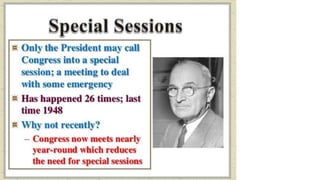
Only the President may call Congress into a special 
session—a meeting to deal with some emergency 
situation.
Comparative Government: Legislative Bodies
Section 1 Review 
1. The practical reason behind establishing a bicameral legislature 
was 
(a) the necessity to find compromise between the New Jersey and Virginia 
plans. 
(b) the need to mimic existing British institutions. 
(c) a desire to break from all tradition. 
(d) requirements set by the British monarchy. 
2. Special sessions of Congress 
(a) are called by the President to deal with some emergency situation. 
(b) are called whenever a senator filibusters. 
(c) are never called. 
(d) are used to handle the everyday business of Congress.
S E C T I O N 2 
The House of Representatives 
• What are the size and terms of the House of 
Representatives? 
• How are House seats reapportioned among the 
States after each census? 
• How can we describe a typical congressional 
election and congressional district? 
• What are the formal and informal qualifications 
for serving in the House?
Size and Terms 
• The exact size of the House of 
Representatives, currently at 
435 members, is determined by 
Congress. 
• The Constitution provides that 
the total number of seats in the 
House shall be apportioned 
(distributed) among the States 
on the basis of their respective 
populations. 
Members of the House of 
Representatives serve two-year 
terms. 
Although there have been 
recent movements to limit 
terms, there are no limits 
set on the number of terms 
a representative may 
serve.
Reapportionment 
Article I of the Constitution directs Congress to 
reapportion—redistribute—the seats in the House 
after each decennial census. 
As the United States grew in population, the number of 
representatives in the House also grew. 
The Reapportionment Act of 1929 set the “permanent” 
size of the House at 435 members, and provided for 
“automatic reapportionment.”
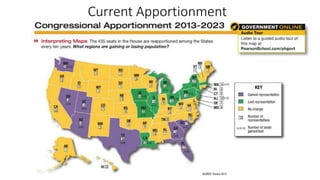
Current Apportionment
Congressional Elections 
•Congressional elections are held on the 
Tuesday following the first Monday in 
November of each even-numbered year. 
•Off-year elections are those congressional 
elections held between presidential elections.
Districts and Gerrymandering 
• Under the single-member 
district 
arrangement, the 
voter’s in each district 
elect one of the State’s 
representatives. 
• The general-ticket 
system, no longer in 
use, provided that all of 
a State’s seats were 
filled at-large. 
• Districts that have 
unusual shapes or even 
defy description have 
sometimes been 
gerrymandered. 
• Gerrymandering refers 
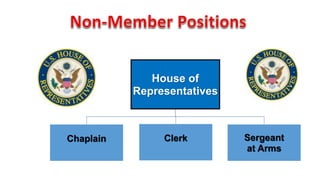
to the act of drawing 
congressional districts 
to the advantage of the 
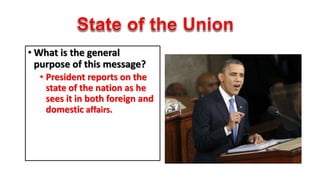
political party that 
controls the State 
legislature.
Qualifications for House Members 
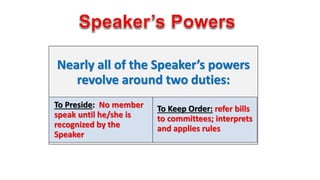
• The Constitution says that a member of the House 
(1) must be at least 25 years of age, 
(2) must have been a citizen of the United States for at least seven 
years, and 
(3) must have been an inhabitant of the State from which he or she is 
elected. 
• The realities of politics also require some informal qualifications, 
such as party identification, name familiarity, gender, ethnic 
characteristics, and political experience.
Section 2 Review 
1. Members of the House of Representatives are elected for 
(a) two-year terms. 
(b) six-year terms. 
(c) four-year terms. 

(d) five-year terms. 
2. The Constitution requires a member of Congress to be 
(a) an inhabitant of the State from which he or she is elected. 
(b) a property-owning male. 
(c) a natural-born citizen. 
(d) at least 40 years of age.
S E C T I O N 3 
The Senate 
• How does the size of the Senate differ from the 
size of the House? 
• How have States elected senators in the past and 
present? 
• How and why does a senator’s term differ from a 
representative’s term? 
• What are the qualifications for serving in the 
Senate?
Size, Election, and Terms 
• The Constitution says that the Senate “shall be composed of 
two Senators from each State.” Today’s Senate consists of 100 
Senators. 
• Originally, the Constitution provided that senators were chosen 
by the State legislatures. 
• In 1912 the Seventeenth Amendment was passed and called for 
the popular election of senators. 
• Senators serve for six-year terms. 
• The Senate is a continuous body, meaning that all of its seats 
are never up for election at the same time.
Qualifications for Senators 
• The requirements for the U.S. Senate are higher than for the 
House of Representatives. 
• The Constitution says that a Senator 
(1) must be at least 30 years of age, 
(2) must have been a citizen of the United States for at least nine 
years, and 
(3) must be an inhabitant of the State from which he or she is 
elected.
Section 3 Review 
1. Senators are elected for 
(a) two-year terms. 
(b) eight-year terms. 
(c) four-year terms. 
(d) six-year terms. 
2. The Senate is a continuous body, meaning that 
(a) Senators must continually reside in Washington, D.C. 
(b) all of its seats are always up for election every six years. 
(c) it never adjourns. 
(d) all of its seats are never up for election at one time.
S E C T I O N 4 
The Members of Congress 
• What are the personal and political backgrounds of 
the current members of Congress? 
• What are the duties of the job of serving in 
Congress? 
• How are members of Congress compensated, and 
what privileges do they have?
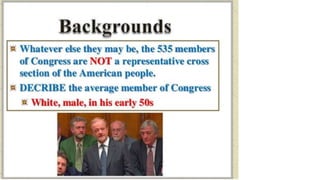
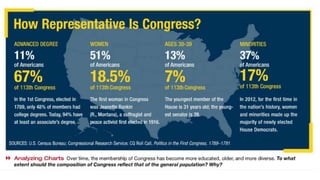
Profile of the 107th Congress
LGBT (8)
Representatives of the People 
Senators and representatives are elected to represent 
people. As legislators, they have four voting options: 
Trustees 
Trustees believe that 
each question they face 
must be decided on its 
merits. 
Delegates 
Delegates see themselves 
as agents of the people 
who elected them. 
Partisans 
Lawmakers who owe 
their first allegiance to 
their political party are 
partisans. 
Politicos 
Politicos attempt to 
combine the basic 
elements of the trustee, 
delegate, and partisan 
roles.
Committee Membership and Public 
Servants 
• As committee members, senators and 
representatives screen proposed laws 
before they are voted on. 
• Another vital part of their committee 
work involves the oversight function. 
• Oversight is the process by which 
Congress, through its committees, 
checks to see that the agencies of the 
executive branch are working 
effectively. 
• Members of the House and the Senate 
also act as servants of their 
constituents. 
• Requests from voters vary widely, and 
members of Congress take heed to 
many of them. Ignoring their 
constituencies would not bode well in 
the next election.
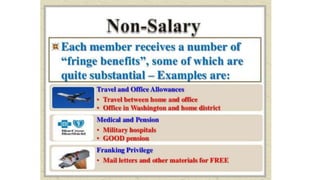
Compensation 
• Today, senators and representatives are paid a salary of $174,000 a year. 
Certain members, such as the Speaker of the House and the Senate’s 
president pro tem, are paid more. 
• The franking privilege allows members of Congress to mail letters and 
other materials postage-free by substituting their facsimile signature 
(frank) for the postage. 
• The Constitution says that Congress fixes its own “compensation.” 
Therefore, the only real limits to congressional pay are the President’s veto 
and fear of voter backlash against a pay increase.
Membership Privileges 
• Members of Congress are 
immune from arrest for 
noncriminal offenses while 
engaged in congressional 
business. 
• More importantly, the 
Speech and Debate Clause 
(Article I, Section 6, Clause 
1) protects representatives 
and senators from suits for 
libel or slander arising from 
their official conduct.
Section 4 Review 
1. Which of the following is a major role of members of 
Congress? 
(a) law enforcement 
(b) servant of their constituents 
(c) serving in the military 
(d) researching court cases 
2. The franking privilege allows members of Congress to 
(a) purchase as many hot dogs as necessary while in office. 
(b) mail letters and other materials postage-free. 
(c) vote on legislation. 
(d) receive a pension upon retirement from Congress.
Magruder’s 
American Government 
C H A P T E R 11 
Powers of Congress
C H A P T E R 11 
Powers of Congress 
SECTION 1 The Scope of Congressional Powers 
SECTION 2 The Expressed Powers of Money and Commerce 
SECTION 3 Other Expressed Powers 
SECTION 4 The Implied Powers 
SECTION 5 The Nonlegislative Powers
S E C T I O N 1 
The Scope of Congressional Powers 
• What are the three types of congressional power? 
• How does strict construction of the U.S. Constitution on the 
subject of congressional power compare to liberal 
construction?
Congressional Power 
The Constitution grants Congress a number of specific powers in 
three different ways. 
(1) The expressed powers are granted to Congress explicitly in the Constitution. 
(2) The implied powers are granted by reasonable deduction from the 
expressed powers. 
(3) The inherent powers are granted through the Constitution’s creation of a 
National Government for the United States.
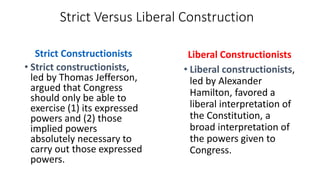
Strict Versus Liberal Construction 
Strict Constructionists 
• Strict constructionists, 
led by Thomas Jefferson, 
argued that Congress 
should only be able to 
exercise (1) its expressed 
powers and (2) those 
implied powers 
absolutely necessary to 
carry out those expressed 
powers. 
Liberal Constructionists 
• Liberal constructionists, 
led by Alexander 
Hamilton, favored a 
liberal interpretation of 
the Constitution, a 
broad interpretation of 
the powers given to 
Congress.
Section 1 Review 
1. The Constitution grants all of the following powers to Congress EXCEPT 
(a) the expressed powers. 
(b) the inherent powers. 
(c) the monarchical powers. 
(d) the reserved powers. 
2. Strict constructionists favored Congress exercising 
(a) only the expressed powers and those implied powers necessary to carry 
out the expressed powers. 
(b) unlimited power. 
(c) only the powers granted to it by State constitutions. 
(d) powers granted to Congress through acts of the President.
S E C T I O N 2 
The Expressed Powers of Money and Commerce 
• What powers does Congress have to tax? 
• How does Congress use its power to borrow 
money? 
• How important is Congress’s commerce power? 
• Why did the Framers give Congress the power to 
issue currency? 
• How does the bankruptcy power work?
The Power To Tax 
The Constitution gives Congress the power: 
“To lay and collect Taxes, Duties, Imposts and 
Excises, to pay the Debts and provide for the 
common Defense and general Welfare of the 
United States.…” 
—Article I, Section 8, Clause 1
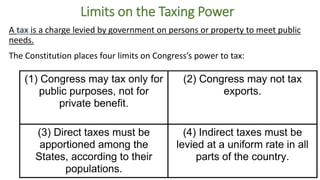
Limits on the Taxing Power 
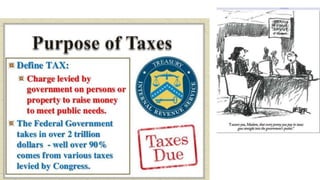
A tax is a charge levied by government on persons or property to meet public 
needs. 
The Constitution places four limits on Congress’s power to tax: 
(1) Congress may tax only for 
public purposes, not for 
private benefit. 
(2) Congress may not tax 
exports. 
(3) Direct taxes must be 
apportioned among the 
States, according to their 
populations. 
(4) Indirect taxes must be 
levied at a uniform rate in all 
parts of the country.
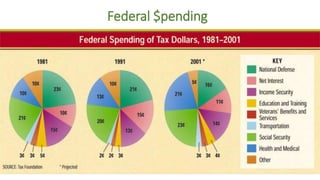
Federal $pending
The Borrowing Power 
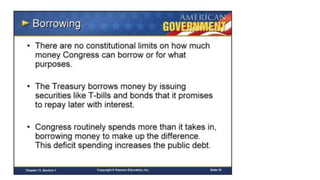
• Article I, Section 8, Clause 2 gives Congress the power “[t]o 
borrow Money on the credit of the United States.” 
• Deficit financing is the practice of spending more money 
than received in revenue and borrowing to make up the 
difference. 
• The public debt is all of the money borrowed by the 
government over the years and not yet repaid, plus the 
accumulated interest on that money.
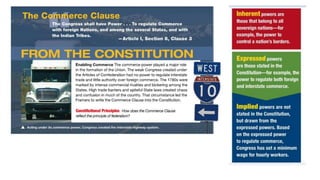
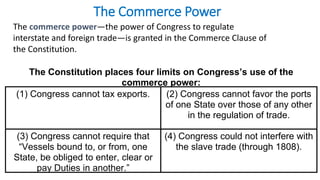
The Commerce Power 
The commerce power—the power of Congress to regulate 
interstate and foreign trade—is granted in the Commerce Clause of 
the Constitution. 
The Constitution places four limits on Congress’s use of the 
commerce power: 
(1) Congress cannot tax exports. (2) Congress cannot favor the ports 
of one State over those of any other 
in the regulation of trade. 
(3) Congress cannot require that 
“Vessels bound to, or from, one 
State, be obliged to enter, clear or 
pay Duties in another.” 
(4) Congress could not interfere with 
the slave trade (through 1808).
The Bankruptcy power 
• Article I, Section 8, Clause 4 gives Congress the power “[t]o establish…uniform 
Laws on the subject of Bankruptcies throughout the United States.” 
• Bankruptcy is the legal proceeding in which the bankrupt person’s assets are 
distributed among those to whom a debt is owed.
Section 2 Review 
1. Which of the following is a limit on Congress’s power to tax? 
(a) only being allowed to tax for private purposes 
(b) not being allowed to tax imports 
(c) apportioning all direct taxes equally among the States based on population 
(d) only being allowed to tax businesses 
2. The commerce power gives Congress the right to 
(a) regulate interstate and foreign trade. 
(b) establish proceedings for bankruptcies. 
(c) practice deficit financing. 
(d) create a national currency.
S E C T I O N 3 
Other Expressed Powers 
• What are the key sources of Congress’s foreign 
relations powers? 
• How does the power-sharing agreement between 
Congress and the President on the issues of war 
and national defense work? 
• What other key powers can Congress exercise?
Foreign Relations and War Powers 
• Congress has the inherent power to act on 
matters affecting the security of the nation. 
• Congress’s war powers are extensive and 
substantial, including: the power to raise and 
support armies, to provide and maintain a 
navy, and to organize, arm, and discipline the 
military. 
• Congress also has the power to restrict the 
use of American forces in combat in areas 
where a state of war does not exist (War 
Powers Resolution of 1973).
Other Expressed Powers 
Naturalization 
Naturalization is the process by which citizens of one country become 
citizens of another. 
The Postal Power 
Article I, Section 8, Clause 7 says that Congress has the power 
“[t]o establish Post Offices and post Roads.” Copyrights and Patents 
A copyright is the exclusive right of an author to reproduce, publish, 
and sell his or her creative work. 
A patent grants a person the sole right to manufacture, use, or sell 
“any new and useful art, machine, manufacture, or composition of 
matter.”
More Expressed Powers Weights and Measures 
Congress has the power to “fix the Standard of Weights and 
Measures” throughout the United States. 
Judicial Powers 
Congress may create all of the federal courts below the Supreme 
Court and structure the federal judiciary. 
Congress may also define federal crimes and set punishment for 
violators of federal law. 
Power Over Territories and Other Areas 
Congress has the power to acquire, manage, and dispose of 
various federal areas. 
One way of acquiring property is through eminent domain, the 
inherent power to take private property for public use.
Article I, 
Section 8
Section 3 Review 
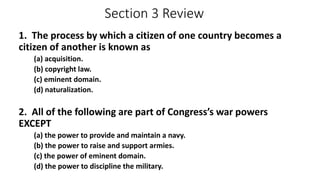
1. The process by which a citizen of one country becomes a 
citizen of another is known as 
(a) acquisition. 
(b) copyright law. 
(c) eminent domain. 
(d) naturalization. 
2. All of the following are part of Congress’s war powers 
EXCEPT 
(a) the power to provide and maintain a navy. 
(b) the power to raise and support armies. 
(c) the power of eminent domain. 
(d) the power to discipline the military.
S E C T I O N 4 
The Implied Powers 
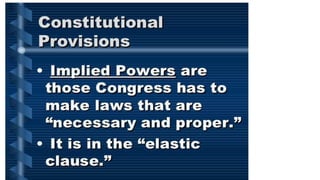
• How does the Necessary and Proper Clause give 
Congress flexibility in lawmaking? 
• What key developments have occurred in the battle 
over the implied powers of Congress?
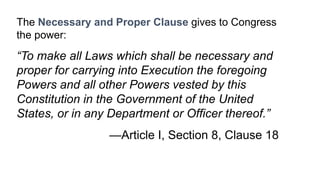
The Necessary and Proper Clause gives to Congress 
the power: 
“To make all Laws which shall be necessary and 
proper for carrying into Execution the foregoing 
Powers and all other Powers vested by this 
Constitution in the Government of the United 
States, or in any Department or Officer thereof.” 
—Article I, Section 8, Clause 18
The Battle Over Implied Powers 
• The formation of the Bank of the United States 
spawned controversy between strict and liberal 
constructionists. 
• In McCulloch v. Maryland, 1819, the formation of 
the Second Bank of the United States was 
challenged by strict constructionists. 
• Chief Justice John Marshall ruled in favor of the 
Second Bank, giving sweeping approval to the 
concept of implied powers.
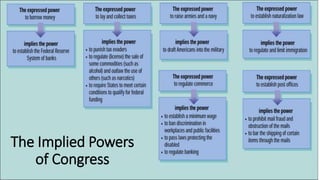
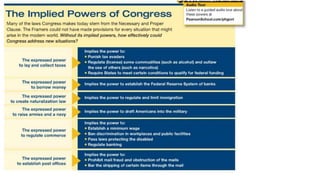
The Implied Powers 
of Congress
Section 4 Review 
1. The basis for the implied powers of Congress is found in 
(a) the Necessary and Proper Clause. 
(b) the Implied Clause. 
(c) the Articles of Confederation. 
(d) the Supremacy Clause. 
2. The Supreme Court upheld the idea of implied powers in its 
ruling in 
(a) Marbury v. Madison, 1803. 
(b) Dred Scott v. Sandford, 1857. 
(c) McCulloch v. Maryland, 1819. 
(d) Ex parte Milligan, 1866.
S E C T I O N 5 
The Nonlegislative Powers 
• What is Congress’s role in amending the Constitution and in 
deciding elections? 
• What is Congress’s impeachment power, and how has it been used 
in the past? 
• What are Congress’s executive powers? 
• What is Congress’s investigatory power?
Constitutional Amendments and Electoral 
Duties 
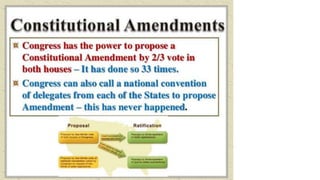
Constitutional Amendments 
Article V gives Congress the power to propose amendments by a 
two-thirds vote in each house. 
Electoral Duties 
• In certain circumstances, the Constitution gives Congress special electoral 
duties. 
• If no candidate for President receives a majority in the electoral college, 
the House decides the election. 
• If no candidate for Vice President receives a majority in the electoral 
college, the Senate decides the election. 
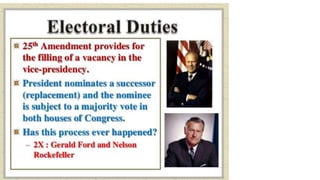
• Also, if the vice presidency is vacated, the President selects a successor, 
who faces congressional approval by a majority vote in both houses.
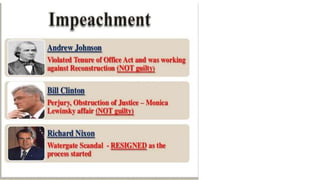
Impeachment Power 
• The Constitution grants Congress the power of removing the 
President, Vice President, or other civil officers from their office 
through impeachment. 
• The House has the sole power to impeach, or bring charges against 
the individual with a majority vote. 
• There is then a trial in the Senate. A two-thirds vote of the senators 
present is needed for conviction. 
• The Chief Justice of the Supreme Court presides over a case of 
impeachment. 
• The penalty for conviction is removal from office.
Executive Powers 
Appointments 
• All major appointments made by 
the President must be confirmed by 
the Senate by majority vote. 
• Only 12 of 600 Cabinet 
appointments to date have been 
declined. 
• “Senatorial courtesy” is the practice 
in which the Senate will turn down 
an appointment if it is opposed by a 
senator of the President’s party 
from the State involved. 
Treaties 
• The President makes treaties 
“by and with the Advice and 
Consent of the Senate,... 
provided two thirds of the 
Senators present concur.” 
• Presently, the President often 
consults members of the Senate 
Foreign Relations Committee.
Investigatory Power 
Congress may choose to conduc t 
i nvestigations through its standing committees 
for several reasons : 
(1) to gather information useful to Congress in the making 
of some legislation; 
(2) to oversee the 
(3) to focus public attention 
operations of various 
on a particular subject; 
executive branch agencies; 
(4) to expose the 
questionable activities of 
public officials or private 
persons; 
(5) to promote the particular 
interests of some members 
of Congress.
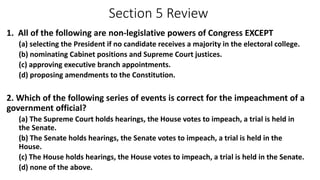
Section 5 Review 
1. All of the following are non-legislative powers of Congress EXCEPT 
(a) selecting the President if no candidate receives a majority in the electoral college. 
(b) nominating Cabinet positions and Supreme Court justices. 
(c) approving executive branch appointments. 
(d) proposing amendments to the Constitution. 
2. Which of the following series of events is correct for the impeachment of a 
government official? 
(a) The Supreme Court holds hearings, the House votes to impeach, a trial is held in 
the Senate. 
(b) The Senate holds hearings, the Senate votes to impeach, a trial is held in the 
House. 
(c) The House holds hearings, the House votes to impeach, a trial is held in the Senate. 
(d) none of the above.
Magruder’s 
American Government 
C H A P T E R 12 
Congress in Action
• Congress convenes 
(begins a new term) 
every 2 years on January 
3 of every odd-numbered 
year. 
• 113th Congress 
• 2013 until 2015
• Because all 435 members are up 
for reelection every 2 years the 
House technically has no sworn 
members, rules or organization 
until its opening day ceremonies 
are held.
• Oath of office is taken and the non-members positions 
are elected. 
• Who elects these officers? 
• The Majority Party 
• What about the rules of the House? 
• Have been developing for 200 years – readopted with little 
or no change
House of 
Representatives 
Chaplain Clerk Sergeant 
at Arms
• Finally the members of the 19 permanent 
committees of the House are appointed by a 
floor vote, and with that the House is 
organized.
• The Senate is a continuous body 
that has been organized without 
interruption since 1789. 
• How does this make the Senate 
different from the House? 
• Senate does not face large 
organizational problems at the 
beginning of a term.
• After Congress is organized, within 
a few weeks the President delivers 
the annual State of the Union 
message to a joint session of 
Congress. 
• The President will lay out the 
broad shape of the policies that 
his administration will follow and 
he may recommend specific 
legislation.
• What is the general 
purpose of this message? 
• President reports on the 
state of the nation as he 
sees it in both foreign and 
domestic affairs.
• Speaker of the House 
• By far the more important 
and powerful leadership 
position within the halls of 
Congress 
• Elected presiding officer 
and leader of majority 
party.
• Who is Speaker today? 
• John Boehner (R) Ohio 
• The Speaker follows the 
Vice President in the line 
of succession to the 
presidency.
Nearly all of the Speaker’s powers 
revolve around two duties: 
To Preside: No member 
speak until he/she is 
recognized by the 
Speaker 
To Keep Order: refer bills 
to committees; interprets 
and applies rules
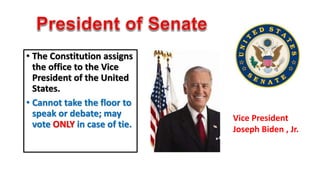
• The Constitution assigns 
the office to the Vice 
President of the United 
States. 
• Cannot take the floor to 
speak or debate; may 
vote ONLY in case of tie. 
Vice President 
Joseph Biden , Jr.
113th Congress, 2nd Session · The House is in session
• What is the president pro tempore? 
• Acts as presiding officer. 
• Usually longest serving member of majority party
• Congress is a political 
body and reflecting 
this political 
complexion, both 
houses are organized 
along party lines.
• The closed meeting of the 
members of each party in 
each house. 
• What does the caucus deal 
with? 
• Matters of party 
organization (party 
leaders and committee 
membership)
• Next to the Speaker, the 
majority and minority floor 
leaders in the House and 
Senate are the most important 
officers in Congress. 
http://www.house.gov/leadership/
• What do the Floor Leaders actually do? 
• They try to carry out the decisions of their party caucuses. 
• Also, steer floor action to benefit their party 
• KEY FOCUS: legislative strategies
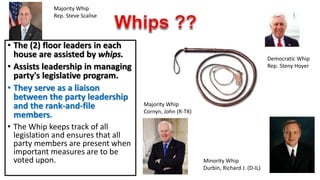
• The (2) floor leaders in each 
house are assisted by whips. 
• Assists leadership in managing 
party's legislative program. 
• They serve as a liaison 
between the party leadership 
and the rank-and-file 
members. 
• The Whip keeps track of all 
legislation and ensures that all 
party members are present when 
important measures are to be 
voted upon. Minority Whip 
Durbin, Richard J. (D-IL) 
Majority Whip 
Cornyn, John (R-TX) 
Majority Whip 
Rep. Steve Scalise 
Democratic Whip 
Rep. Steny Hoyer
• The bulk of the work of Congress is really done in 
committee – thus committee chairmen (members who 
head standing committees) hold strategic posts. 
• Why are the committee chairmen important? 
1. DECIDE - When committee meets 
2. Which bills they will take up 
3. When public hearing are held and what witnesses are 
called
• This is an unwritten custom, which provides that the 
most important posts will be held by those party 
members with the longest records of service in 
Congress. 
• Where is this applied most strictly? 
• Choice of committee chairmen
• Seniority rule ignores ability and 
discourages younger members. 
• May come from a “safe district” 
– why is this a problem? 
• Out of touch with current 
public opinion because no fear 
of losing office.
• Defenders of the rule argues that it 
ensures that a powerful and 
experienced member will head 
each committee. 
• What was the major change that 
the Republicans forged in 1995? 
• No GOP chair could serve for 
more than 6 years.
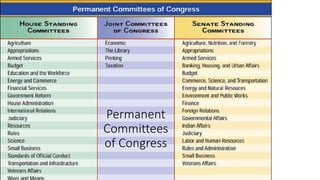
• Permanent committees are set 
up in both houses where bills 
are sent to be considered. 
• Committee Assignments 
• House members are 
normally assigned to 1 or 2; 
Senators to 3 or 4.
Permanent 
Committees 
of Congress
• How are these committees so 
vital to the lawmaking 
process? 
1. This is where a bill is discussed 
and reviewed thoroughly. 
2. Both houses usually follow 
the recommendations the 
committee makes.
• The members of each standing committee are formally 
elected by a floor vote at the beginning of each term in 
Congress. 
• Which party holds a majority of the seats in a standing 
committee? 
• The majority party in that house.
• Sometimes called the 
“traffic cop” in the Lower 
House. 
• Why is this committee 
necessary? 
• So many bills are 
introduced in the House, 
that some screening is 
necessary.
• Normally, a bill gets to the 
floor only if it has been 
granted a rule (scheduled for 
floor consideration) by the 
Rules committee. 
• How does this make the Rules 
Committee important? 
• They can speed up, delay or 
even kill a bill in the House.
• These groups are sometimes 
called special committees; 
they are set up of some 
specific purpose and for a 
limited time. 
• Why are these committees 
usually formed? 
• To investigate an 
important, current matter.
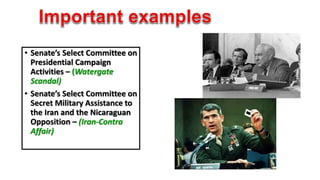
• Senate’s Select Committee on 
Presidential Campaign 
Activities – (Watergate 
Scandal) 
• Senate’s Select Committee on 
Secret Military Assistance to 
the Iran and the Nicaraguan 
Opposition – (Iran-Contra 
Affair)
• What is a joint committee? 
• One composed of members of both houses 
• Some joint committees are investigative in nature and 
issue periodic reports to the House and Senate
• What is a conference 
committee? 
• A temporary joint 
committee. 
• Why is it created? 
• To iron out the differences 
in a bill and produce a 
compromise that both 
houses will accept.
• As many as 10,000 
measures are introduced 
in the House and Senate 
during a term in Congress 
• Fewer than 10% ever 
become law.
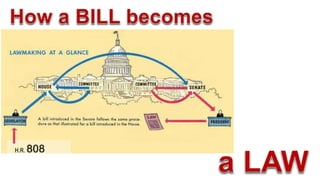
• What is a bill? 
• Proposed law presented to the House or Senate 
for consideration.
• Most bills do not originate with members of 
Congress – they are usually born somewhere in 
the executive branch. 
• Only members can introduce a bill in the House: 
how do they do this? 
• Drop them into a “hopper” = a box hanging on the 
edge of the clerk’s desk.
• A special box on the side 
of the clerk’s desk. 
• Representatives can only 
introduce bills in the U.S. 
House of Representatives.
Public/Private Bills 
• Public = apply to the nation as a whole 
• Private = apply to certain persons or places 
Joint Resolutions 
- A proposal for some action that has the force of law 
Concurrent Resolutions 
• Deal with matters in which the House and Senate must act jointly 
• Do not have force of law, or require president signature 
Resolutions 
• A measure dealing with some measure in house and does not have force of law – does NOT 
require president’s signature
• A rider is a provision not 
likely to pass on its own 
merit and thus is attached 
to an important measure 
certain to pass. 
• The sponsor hopes it will 
“ride” through the 
legislative process.
• Why are some bills 
called “Christmas 
trees”? 
• So many riders are 
“hanging” on the bill 
like ornaments on a 
tree.
• Bills are numbered according to where and when 
they are introduced: HR 13 or S. 8 
• The clerk then gives the bill a short title and then 
the bill is entered into the House Journal and in the 
Congressional Record. 
• Where does the bill go after the first reading? 
• The appropriate standing committee.
• Most of the of bills 
introduced in each session 
of Congress are 
pigeonholed: that is they 
DIE in committee. 
• How can a bill be blasted 
out of committee? 
• A discharge petition
• Bills that are considered in 
the committee are 
discussed at times chosen 
by the chairmen. 
• This takes place in the 
subcommittees.
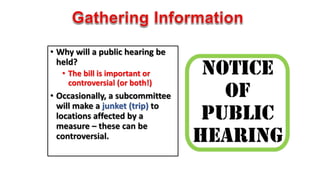
• Why will a public hearing be 
held? 
• The bill is important or 
controversial (or both!) 
• Occasionally, a subcommittee 
will make a junket (trip) to 
locations affected by a 
measure – these can be 
controversial.
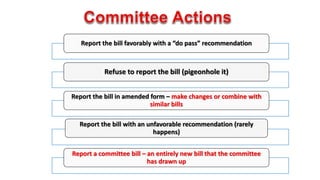
Report the bill favorably with a “do pass” recommendation 
Refuse to report the bill (pigeonhole it) 
Report the bill in amended form – make changes or combine with 
similar bills 
Report the bill with an unfavorable recommendation (rarely 
happens) 
Report a committee bill – an entirely new bill that the committee 
has drawn up
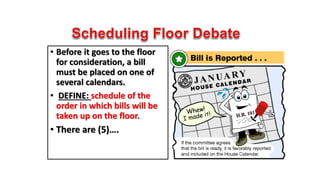
• Before it goes to the floor 
for consideration, a bill 
must be placed on one of 
several calendars. 
• DEFINE: schedule of the 
order in which bills will be 
taken up on the floor. 
• There are (5)….
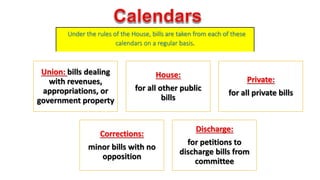
Under the rules of the House, bills are taken from each of these 
calendars on a regular basis. 
Union: bills dealing 
with revenues, 
appropriations, or 
government property 
House: 
for all other public 
bills 
Private: 
for all private bills 
Corrections: 
minor bills with no 
opposition 
Discharge: 
for petitions to 
discharge bills from 
committee
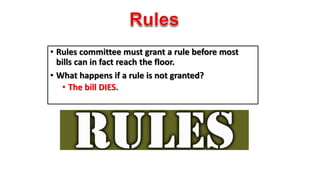
• Rules committee must grant a rule before most 
bills can in fact reach the floor. 
• What happens if a rule is not granted? 
• The bill DIES.
• If a bill reaches the 
floor, it receives its 
second reading in the 
House.
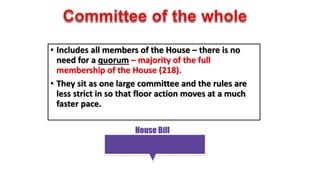
• Includes all members of the House – there is no 
need for a quorum – majority of the full 
membership of the House (218). 
• They sit as one large committee and the rules are 
less strict in so that floor action moves at a much 
faster pace.
• The large size of the House has forced it to impose 
severe limits on floor debate. For example: 
• An 1841 rule forbids any member from holding the floor 
for more than 1 hour without unanimous consent to 
speak for a longer time. 
• An 1880 rule allows for the Speaker to force a member to 
give up the floor if what happens? 
• Stray away from the subject at hand
• Time for debating a bill is 
usually split up between 
the floor leaders. 
• At any time a member “may 
move the previous 
question” - that is demand 
a vote on the issue before 
the House.
• A bill may be the subject 
of several votes on the 
floor; and it is very 
confusing!!! 
• Votes on various 
amendments, motions, 
etc.
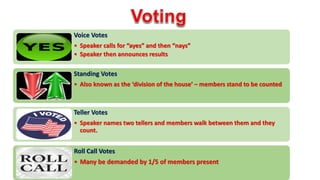
Voice Votes 
• Speaker calls for “ayes” and then “nays” 
• Speaker then announces results 
Standing Votes 
• Also known as the ‘division of the house’ – members stand to be counted 
Teller Votes 
• Speaker names two tellers and members walk between them and they 
count. 
Roll Call Votes 
• Many be demanded by 1/5 of members present
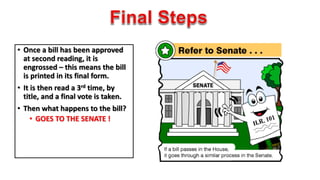
• Once a bill has been approved 
at second reading, it is 
engrossed – this means the bill 
is printed in its final form. 
• It is then read a 3rd time, by 
title, and a final vote is taken. 
• Then what happens to the bill? 
• GOES TO THE SENATE !
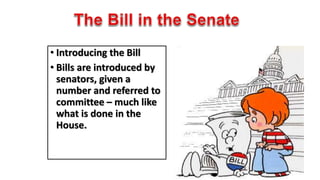
• Introducing the Bill 
• Bills are introduced by 
senators, given a 
number and referred to 
committee – much like 
what is done in the 
House.
• What are some differences 
between the House and the 
Senate? 
1. Less formal, rules less strict. 
2. One calendar 
3. Called to floor discussion at 
discretion of the majority 
floor leader.
• The major difference 
between the House and 
Senate procedures 
involve debate: 
• floor debate is strictly 
limited in the House but 
almost unrestrained in 
the Senate.
• As a general matter, 
senators may speak on the 
floor as long as they please. 
• What is the reason for this 
unlimited speech? 
• Encourages the fullest 
possible discussion of 
matters on the floor.
• An attempt to “talk a bill 
to death”. 
• It is a stalling tactic in 
which a minority of 
senators seeks to delay 
or prevent Senate action 
on a measure.
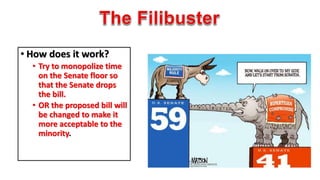
• How does it work? 
• Try to monopolize time 
on the Senate floor so 
that the Senate drops 
the bill. 
• OR the proposed bill will 
be changed to make it 
more acceptable to the 
minority.
• And the record is…… 
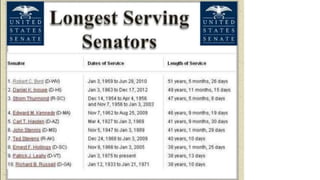
Senator Strom Thurmond 
held the floor for 24 hours 
+ 18 minutes in an 
unsuccessful attempt to 
block a civil rights bill.
• The Senate’s real check 
on the filibuster is its 
Cloture Rule. 
• What was the origin of 
this rule? 
• A filibuster before US 
entry into WW I; 3 
weeks long.
• Rule XXII provides for cloture (limiting debate) 
and requires 60 senators or 3/5 of the Senate 
to invoke cloture and then the measure must 
be voted on. 
• However, this rule is rarely invoked: There are 
two reasons why 
1. Dedication to free debate in the Senate 
2. Majority may want to use filibuster someday
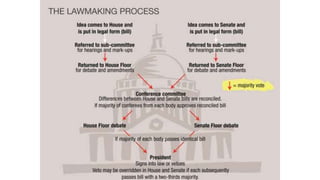
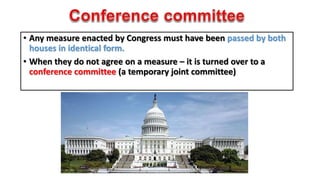
• Any measure enacted by Congress must have been passed by both 
houses in identical form. 
• When they do not agree on a measure – it is turned over to a 
conference committee (a temporary joint committee)
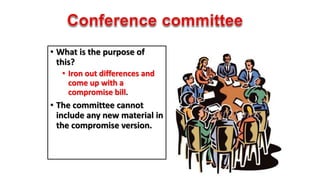
• What is the purpose of 
this? 
• Iron out differences and 
come up with a 
compromise bill. 
• The committee cannot 
include any new material in 
the compromise version.
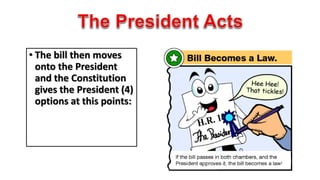
• The bill then moves 
onto the President 
and the Constitution 
gives the President (4) 
options at this points:
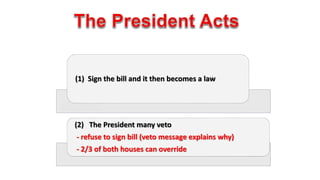
(1) Sign the bill and it then becomes a law 
(2) The President many veto 
- refuse to sign bill (veto message explains why) 
- 2/3 of both houses can override
(3) The President may allow the bill to become law 
without signing it; by not acting on it for 10 days 
(4) What is a pocket veto? 
Congress adjourns its session within 10 days of submitting bill to 
President – President does nothing it dies
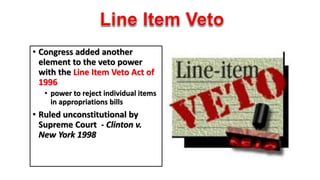
• Congress added another 
element to the veto power 
with the Line Item Veto Act of 
1996 
• power to reject individual items 
in appropriations bills 
• Ruled unconstitutional by 
Supreme Court - Clinton v. 
New York 1998
SECTION 1 Congress Organizes 
SECTION 2 Committees in Congress 
SECTION 3 How a Bill Becomes a Law: The House 
SECTION 4 The Bill in the Senate
S E C T I O N 1 
Congress Organizes 
• How and when does Congress convene? 
• What are the roles of the presiding officers in the Senate 
and the House? 
• What are the duties of party officers in Congress? 
• How are committee chairmen chosen, and what is their 
role in the legislative process?
Congress Convenes 
• Congress convenes every two years—on January 3 of every odd-numbered 
year. 
• The House has formal organizational meetings at the beginning of each term 
to determine committee membership and standing officers. 
• The Senate, because it is a continuous body, has fewer organizational issues 
to address at the start of each term. 
• When Congress is organized, the President presents a State of the Union 
message to a joint session of Congress. This message, in which the President 
reports on the state of the nation as he sees it, is given annually.
The Presiding Officers 
The Speaker of the House 
• The Speaker of the House is the 
presiding officer of the House of 
Representatives and the 
acknowledged leader of the majority 
party. 
• The Speaker’s main duties revolve 
around presiding over and keeping 
order in the House. 
• The Speaker names the members of 
all select and conference committees, 
and signs all bills and resolutions 
passed by the House. 
The President of the Senate 
• The job of president of the Senate is 
assigned by the Constitution to the 
Vice President. 
• The president of the Senate has 
many of the same duties as the 
Speaker of the House, but cannot 
cast votes on legislation. 
• The president pro tempore, the 
leader of the majority party, is 
elected from the Senate and serves 
in the Vice President’s absence.
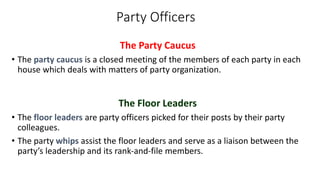
Party Officers 
The Party Caucus 
• The party caucus is a closed meeting of the members of each party in each 
house which deals with matters of party organization. 
The Floor Leaders 
• The floor leaders are party officers picked for their posts by their party 
colleagues. 
• The party whips assist the floor leaders and serve as a liaison between the 
party’s leadership and its rank-and-file members.
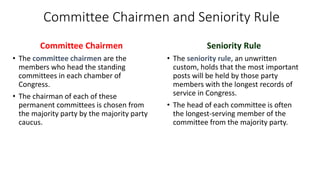
Committee Chairmen and Seniority Rule 
Committee Chairmen 
• The committee chairmen are the 
members who head the standing 
committees in each chamber of 
Congress. 
• The chairman of each of these 
permanent committees is chosen from 
the majority party by the majority party 
caucus. 
Seniority Rule 
• The seniority rule, an unwritten 
custom, holds that the most important 
posts will be held by those party 
members with the longest records of 
service in Congress. 
• The head of each committee is often 
the longest-serving member of the 
committee from the majority party.
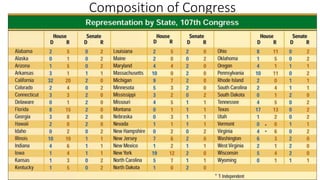
Composition of Congress
Section 1 Review 
1. The presiding officer of the House of Representatives is 
(a) the President. 
(b) the Speaker of the House. 
(c) the majority whip. 
(d) the president pro tempore. 
2. The party whips are responsible for all of the following EXCEPT 
(a) serving as a liaison between party leaders and rank-and-file members. 
(b) presiding over the House or Senate. 
(c) informing the floor leader of anticipated vote counts in key decisions. 
(d) seeing that all members of the party are present for important votes.
S E C T I O N 2 
Committees in Congress 
• How do the standing committees function? 
• What are the duties and responsibilities of the House Rules 
Committee? 
• What are the functions of joint and conference committees?
Standing Committees 
• Standing committees are permanent panels in Congress to which bills 
of similar nature could be sent. 
• Most of the standing committees handle bills dealing with particular 
policy matters, such as veterans’ affairs or foreign relations. 
• The majority party always holds a majority of the seats on each 
committee (the lone exception being the House Committee on 
Standards of Official Conduct).
The House Rules Committee and Select 
Committees 
The House Rules Committee 
• The Rules Committee decides 
whether and under what conditions 
the full House will consider a 
measure. 
• This places great power in the Rules 
Committee, as it can speed, delay, or 
even prevent House action on a 
measure. 
The Select Committees 
• Select committees are panels 
established to handle a specific 
matter and usually exist for a limited 
time. 
• Most select committees are formed 
to investigate a current matter.
Joint and Conference Committees 
• A joint committee is one composed of members of both houses. 
• Examples of joint committees include the Joint Economic Committee, 
the Joint Committee on Printing, and the Joint Committee on the 
Library of Congress 
• A conference committee—a temporary, joint body—is created to iron 
out differences between bills passed by the House and Senate before 
they are sent to the President.
Section 2 Review 
1. The House Rules Committee 
(a) establishes codes of conduct. 
(b) determines when and under what conditions the full House will consider a 
measure. 
(c) oversees the execution of bills once they are passed into law. 
(d) determines which members of the Senate may vote on a measure. 
2. A conference committee is formed to 
(a) iron out differences in bills passed by the House and Senate before they are sent 
to the President. 
(b) hold press conferences. 
(c) appoint Supreme Court justices. 
(d) determine rules for debate.
S E C T I O N 3 
How a Bill Becomes a Law: The House 
• What are the first steps in introducing a new bill to the House? 
• What happens to a bill once it enters a committee? 
• How do House leaders schedule debate on a bill? 
• What happens to a bill on the House floor? 
• What is the final step in passing a bill in the House?
The First Steps 
• A bill is a proposed law presented to the House or Senate for 
consideration. 
• A bill or resolution usually deals with a single matter, but 
sometimes a rider dealing with an unrelated matter is 
included. 
• The clerk of the House numbers each bill, gives it a short 
title, and enters it into the House Journal and the 
Congressional Record for the day. With these actions the bill 
has received its first reading.
Types of Bills 
and 
Resolutions
The Bill in Committee 
Discharge Petitions 
• Most bills die in committee, 
pigeonholed, or put away, never to 
be acted upon. 
• If a committee pigeonholes a bill 
that a majority of the House wishes 
to consider, it can be brought out of 
committee via a discharge petition. 
Gathering Information 
• Most committees do their work through 
several subcommittees— divisions of 
existing committees formed to address 
specific issues. 
• Committees and subcommittees often 
hold public hearings or make a junket 
(trip) to gather information relating to a 
measure.
Committee Actions 
When a subcommittee has completed its work on a bill, it 
returns to the full committee. The full committee may do 
one of several things: 
1. Report the bill favorably, with a “do pass” recommendation. 
2. Refuse to report the bill. 3. Report the bill in amended 
form. 
4. Report the bill with 
unfavorable recommendation. 
5. Report a committee bill.
Scheduling Floor Debate 
A bill is placed into one of five calendars before going to 
the floor for consideration: 
1. The Calendar of the Committee of the Whole House on the State of the Union 
2. The House Calendar 
3. The Calendar of the Committee of the Whole House 
4. The Consent Calendar 
5. The Discharge Calendar 
• Before most measures can be taken from a calendar, the Rules Committee 
must approve that step and set a time for its appearance on the floor.
The Bill on the Floor 
Committee of the Whole 
• The Committee of the Whole includes all members of the House, however, they sit as 
one large committee and not as the House itself. 
• When the Committee of the Whole resolves itself, the Speaker steps down and another 
member presides. General debate follows. 
Debate 
• Severe limits are placed on floor debate due to the House’s large size. 
• Majority and minority floor leaders generally decide in advance how they will split the 
time to be spent on a bill.
Voting on a Bill 
There are four methods of taking a floor 
vote in the House: 
1. During voice votes the Speaker 
calls for the “ayes” and then the 
“noes.” 
2. In a standing vote, members in 
favor of for and then those opposed 
to the bill rise and then are counted 
by the clerk. 
3. One fifth of a quorum can demand 
a teller vote, in which the Speaker 
names two tellers, for and against, 
and members pass by each one to 
be counted. 
4. A roll-call vote may be demanded 
by one fifth of the members present. 
Once a bill has been approved at second reading, it is engrossed, or printed in its final form. It 
is then read for a third time and a final vote is taken.
Section 3 Review 
1. Riders are 
(a) measures attached to a bill dealing with an unrelated matter. 
(b) bills dealing with transportation matters only. 
(c) measures included in a bill that are unconstitutional. 
(d) none of the above. 
2. All of the following are options for committees to take once they have 
finished reviewing a bill EXCEPT 
(a) refusing to report the bill. 
(b) reporting a bill in amended form. 
(c) reporting a committee bill. 
(d) passing the bill into law.
S E C T I O N 4 
The Bill in the Senate 
• How is a bill introduced in the Senate? 
• How do the Senate’s rules for debate differ from 
those in the House? 
• What is the role of conference committees in the 
legislative process? 
• What actions can the President take after both 
houses have passed a bill?
Introducing a Bill and Rules for Debate 
Introducing a Bill 
Bills are introduced by senators, who are formally recognized for that 
purpose. 
Proceedings are much less formal in the Senate compared to the 
House. 
Rules for Debate 
The major differences between House and Senate rules regard debate 
over measures. 
As a general matter, senators may speak on the floor for as long as 
they wish. 
This freedom of debate allows for the fullest possible discussion of 
matters on the floor.
Filibuster and Cloture 
The Cloture Rule 
• Rule XXII in the Standing Rules 
of the Senate deals with 
cloture, or limiting debate 
• If at least 60 senators vote for 
cloture, no more than another 
30 hours may be spent on 
debate, forcing a vote on a bill. 
Filibuster 
• A filibuster is an attempt to 
“talk a bill to death.” 
• A senator may exercise his or 
her right of holding the floor as 
long as necessary, and in 
essence talk until a measure is 
dropped.
Conference Committees 
• Any measure enacted by Congress must have been passed by 
both houses in identical form. 
• If one of the houses will not accept the other’s version of a bill, a 
conference committee is formed to iron out the differences. 
• Once a conference committee completes work on a bill, it is 
returned to both houses for final approval. It must be accepted 
or rejected without amendment.
The President Acts 
The Constitution provides four options for the 
President when he receives a bill: 
1. The President may sign the 
bill, and it then becomes law. 
2. The President may veto the 
bill, or refuse to sign it. The 
President’s veto can be 
overridden by a two-thirds vote 
of the members present in 
each house. 
3. If the President does not act 
upon a bill within 10 days of 
receiving it, it becomes law. 
4. A pocket veto occurs if 
Congress adjourns within 10 
days of submitting a bill and 
the President does not sign it. 
The bill then dies.
Section 4 Review 
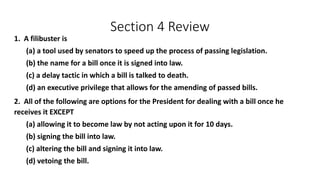
1. A filibuster is 
(a) a tool used by senators to speed up the process of passing legislation. 
(b) the name for a bill once it is signed into law. 
(c) a delay tactic in which a bill is talked to death. 
(d) an executive privilege that allows for the amending of passed bills. 
2. All of the following are options for the President for dealing with a bill once he 
receives it EXCEPT 
(a) allowing it to become law by not acting upon it for 10 days. 
(b) signing the bill into law. 
(c) altering the bill and signing it into law. 
(d) vetoing the bill.

The Legislative Branch

  • 1.
    Magruder’s American Government C H A P T E R 10 Congress
  • 2.
    C H AP T E R 10 Congress SECTION 1 The National Legislature SECTION 2 The House of Representatives SECTION 3 The Senate SECTION 4 The Members of Congress
  • 5.
    S E CT I O N 1 The National Legislature • Why does the Constitution divide power between the two houses of Congress? • What is a term of Congress? • How have sessions of Congress changed over time?
  • 7.
    Two Houses ofCongress The Constitution creates a bicameral legislature for three reasons: Historical: The British Parliament consisted of two houses since the 1300s, and many colonial assemblies were similar in form. Practical: A bicameral legislature was necessary to compromise the Virginia and New Jersey plans of representation. Theoretical: The Framers favored a bicameral Congress in order that one house might act as a check on the other.
  • 9.
    Terms A termis the length of time that officials serve after an election, as in a two- or six-year term. The date for the start of each new term has been set by the Twentieth Amendment (1933) as “noon of the 3d day of January” of every odd-numbered year.
  • 11.
    Sessions of Congress A session is the regular period of time during which Congress conducts business. Congress adjourns, or suspends until the next session, each regular session as it sees fit. If necessary, the President has the power to prorogue, or adjourn, a session, but only when the two houses cannot agree on a date for adjournment. Only the President may call Congress into a special session—a meeting to deal with some emergency situation.
  • 13.
  • 14.
    Section 1 Review 1. The practical reason behind establishing a bicameral legislature was (a) the necessity to find compromise between the New Jersey and Virginia plans. (b) the need to mimic existing British institutions. (c) a desire to break from all tradition. (d) requirements set by the British monarchy. 2. Special sessions of Congress (a) are called by the President to deal with some emergency situation. (b) are called whenever a senator filibusters. (c) are never called. (d) are used to handle the everyday business of Congress.
  • 17.
    S E CT I O N 2 The House of Representatives • What are the size and terms of the House of Representatives? • How are House seats reapportioned among the States after each census? • How can we describe a typical congressional election and congressional district? • What are the formal and informal qualifications for serving in the House?
  • 18.
    Size and Terms • The exact size of the House of Representatives, currently at 435 members, is determined by Congress. • The Constitution provides that the total number of seats in the House shall be apportioned (distributed) among the States on the basis of their respective populations. Members of the House of Representatives serve two-year terms. Although there have been recent movements to limit terms, there are no limits set on the number of terms a representative may serve.
  • 19.
    Reapportionment Article Iof the Constitution directs Congress to reapportion—redistribute—the seats in the House after each decennial census. As the United States grew in population, the number of representatives in the House also grew. The Reapportionment Act of 1929 set the “permanent” size of the House at 435 members, and provided for “automatic reapportionment.”
  • 21.
  • 22.
    Congressional Elections •Congressionalelections are held on the Tuesday following the first Monday in November of each even-numbered year. •Off-year elections are those congressional elections held between presidential elections.
  • 23.
    Districts and Gerrymandering • Under the single-member district arrangement, the voter’s in each district elect one of the State’s representatives. • The general-ticket system, no longer in use, provided that all of a State’s seats were filled at-large. • Districts that have unusual shapes or even defy description have sometimes been gerrymandered. • Gerrymandering refers to the act of drawing congressional districts to the advantage of the political party that controls the State legislature.
  • 25.
    Qualifications for HouseMembers • The Constitution says that a member of the House (1) must be at least 25 years of age, (2) must have been a citizen of the United States for at least seven years, and (3) must have been an inhabitant of the State from which he or she is elected. • The realities of politics also require some informal qualifications, such as party identification, name familiarity, gender, ethnic characteristics, and political experience.
  • 26.
    Section 2 Review 1. Members of the House of Representatives are elected for (a) two-year terms. (b) six-year terms. (c) four-year terms. (d) five-year terms. 2. The Constitution requires a member of Congress to be (a) an inhabitant of the State from which he or she is elected. (b) a property-owning male. (c) a natural-born citizen. (d) at least 40 years of age.
  • 28.
    S E CT I O N 3 The Senate • How does the size of the Senate differ from the size of the House? • How have States elected senators in the past and present? • How and why does a senator’s term differ from a representative’s term? • What are the qualifications for serving in the Senate?
  • 29.
    Size, Election, andTerms • The Constitution says that the Senate “shall be composed of two Senators from each State.” Today’s Senate consists of 100 Senators. • Originally, the Constitution provided that senators were chosen by the State legislatures. • In 1912 the Seventeenth Amendment was passed and called for the popular election of senators. • Senators serve for six-year terms. • The Senate is a continuous body, meaning that all of its seats are never up for election at the same time.
  • 31.
    Qualifications for Senators • The requirements for the U.S. Senate are higher than for the House of Representatives. • The Constitution says that a Senator (1) must be at least 30 years of age, (2) must have been a citizen of the United States for at least nine years, and (3) must be an inhabitant of the State from which he or she is elected.
  • 34.
    Section 3 Review 1. Senators are elected for (a) two-year terms. (b) eight-year terms. (c) four-year terms. (d) six-year terms. 2. The Senate is a continuous body, meaning that (a) Senators must continually reside in Washington, D.C. (b) all of its seats are always up for election every six years. (c) it never adjourns. (d) all of its seats are never up for election at one time.
  • 35.
    S E CT I O N 4 The Members of Congress • What are the personal and political backgrounds of the current members of Congress? • What are the duties of the job of serving in Congress? • How are members of Congress compensated, and what privileges do they have?
  • 36.
    Profile of the107th Congress
  • 40.
  • 43.
    Representatives of thePeople Senators and representatives are elected to represent people. As legislators, they have four voting options: Trustees Trustees believe that each question they face must be decided on its merits. Delegates Delegates see themselves as agents of the people who elected them. Partisans Lawmakers who owe their first allegiance to their political party are partisans. Politicos Politicos attempt to combine the basic elements of the trustee, delegate, and partisan roles.
  • 45.
    Committee Membership andPublic Servants • As committee members, senators and representatives screen proposed laws before they are voted on. • Another vital part of their committee work involves the oversight function. • Oversight is the process by which Congress, through its committees, checks to see that the agencies of the executive branch are working effectively. • Members of the House and the Senate also act as servants of their constituents. • Requests from voters vary widely, and members of Congress take heed to many of them. Ignoring their constituencies would not bode well in the next election.
  • 46.
    Compensation • Today,senators and representatives are paid a salary of $174,000 a year. Certain members, such as the Speaker of the House and the Senate’s president pro tem, are paid more. • The franking privilege allows members of Congress to mail letters and other materials postage-free by substituting their facsimile signature (frank) for the postage. • The Constitution says that Congress fixes its own “compensation.” Therefore, the only real limits to congressional pay are the President’s veto and fear of voter backlash against a pay increase.
  • 48.
    Membership Privileges •Members of Congress are immune from arrest for noncriminal offenses while engaged in congressional business. • More importantly, the Speech and Debate Clause (Article I, Section 6, Clause 1) protects representatives and senators from suits for libel or slander arising from their official conduct.
  • 49.
    Section 4 Review 1. Which of the following is a major role of members of Congress? (a) law enforcement (b) servant of their constituents (c) serving in the military (d) researching court cases 2. The franking privilege allows members of Congress to (a) purchase as many hot dogs as necessary while in office. (b) mail letters and other materials postage-free. (c) vote on legislation. (d) receive a pension upon retirement from Congress.
  • 51.
    Magruder’s American Government C H A P T E R 11 Powers of Congress
  • 54.
    C H AP T E R 11 Powers of Congress SECTION 1 The Scope of Congressional Powers SECTION 2 The Expressed Powers of Money and Commerce SECTION 3 Other Expressed Powers SECTION 4 The Implied Powers SECTION 5 The Nonlegislative Powers
  • 55.
    S E CT I O N 1 The Scope of Congressional Powers • What are the three types of congressional power? • How does strict construction of the U.S. Constitution on the subject of congressional power compare to liberal construction?
  • 56.
    Congressional Power TheConstitution grants Congress a number of specific powers in three different ways. (1) The expressed powers are granted to Congress explicitly in the Constitution. (2) The implied powers are granted by reasonable deduction from the expressed powers. (3) The inherent powers are granted through the Constitution’s creation of a National Government for the United States.
  • 58.
    Strict Versus LiberalConstruction Strict Constructionists • Strict constructionists, led by Thomas Jefferson, argued that Congress should only be able to exercise (1) its expressed powers and (2) those implied powers absolutely necessary to carry out those expressed powers. Liberal Constructionists • Liberal constructionists, led by Alexander Hamilton, favored a liberal interpretation of the Constitution, a broad interpretation of the powers given to Congress.
  • 60.
    Section 1 Review 1. The Constitution grants all of the following powers to Congress EXCEPT (a) the expressed powers. (b) the inherent powers. (c) the monarchical powers. (d) the reserved powers. 2. Strict constructionists favored Congress exercising (a) only the expressed powers and those implied powers necessary to carry out the expressed powers. (b) unlimited power. (c) only the powers granted to it by State constitutions. (d) powers granted to Congress through acts of the President.
  • 61.
    S E CT I O N 2 The Expressed Powers of Money and Commerce • What powers does Congress have to tax? • How does Congress use its power to borrow money? • How important is Congress’s commerce power? • Why did the Framers give Congress the power to issue currency? • How does the bankruptcy power work?
  • 63.
    The Power ToTax The Constitution gives Congress the power: “To lay and collect Taxes, Duties, Imposts and Excises, to pay the Debts and provide for the common Defense and general Welfare of the United States.…” —Article I, Section 8, Clause 1
  • 66.
    Limits on theTaxing Power A tax is a charge levied by government on persons or property to meet public needs. The Constitution places four limits on Congress’s power to tax: (1) Congress may tax only for public purposes, not for private benefit. (2) Congress may not tax exports. (3) Direct taxes must be apportioned among the States, according to their populations. (4) Indirect taxes must be levied at a uniform rate in all parts of the country.
  • 67.
  • 68.
    The Borrowing Power • Article I, Section 8, Clause 2 gives Congress the power “[t]o borrow Money on the credit of the United States.” • Deficit financing is the practice of spending more money than received in revenue and borrowing to make up the difference. • The public debt is all of the money borrowed by the government over the years and not yet repaid, plus the accumulated interest on that money.
  • 71.
    The Commerce Power The commerce power—the power of Congress to regulate interstate and foreign trade—is granted in the Commerce Clause of the Constitution. The Constitution places four limits on Congress’s use of the commerce power: (1) Congress cannot tax exports. (2) Congress cannot favor the ports of one State over those of any other in the regulation of trade. (3) Congress cannot require that “Vessels bound to, or from, one State, be obliged to enter, clear or pay Duties in another.” (4) Congress could not interfere with the slave trade (through 1808).
  • 74.
    The Bankruptcy power • Article I, Section 8, Clause 4 gives Congress the power “[t]o establish…uniform Laws on the subject of Bankruptcies throughout the United States.” • Bankruptcy is the legal proceeding in which the bankrupt person’s assets are distributed among those to whom a debt is owed.
  • 75.
    Section 2 Review 1. Which of the following is a limit on Congress’s power to tax? (a) only being allowed to tax for private purposes (b) not being allowed to tax imports (c) apportioning all direct taxes equally among the States based on population (d) only being allowed to tax businesses 2. The commerce power gives Congress the right to (a) regulate interstate and foreign trade. (b) establish proceedings for bankruptcies. (c) practice deficit financing. (d) create a national currency.
  • 76.
    S E CT I O N 3 Other Expressed Powers • What are the key sources of Congress’s foreign relations powers? • How does the power-sharing agreement between Congress and the President on the issues of war and national defense work? • What other key powers can Congress exercise?
  • 78.
    Foreign Relations andWar Powers • Congress has the inherent power to act on matters affecting the security of the nation. • Congress’s war powers are extensive and substantial, including: the power to raise and support armies, to provide and maintain a navy, and to organize, arm, and discipline the military. • Congress also has the power to restrict the use of American forces in combat in areas where a state of war does not exist (War Powers Resolution of 1973).
  • 81.
    Other Expressed Powers Naturalization Naturalization is the process by which citizens of one country become citizens of another. The Postal Power Article I, Section 8, Clause 7 says that Congress has the power “[t]o establish Post Offices and post Roads.” Copyrights and Patents A copyright is the exclusive right of an author to reproduce, publish, and sell his or her creative work. A patent grants a person the sole right to manufacture, use, or sell “any new and useful art, machine, manufacture, or composition of matter.”
  • 84.
    More Expressed PowersWeights and Measures Congress has the power to “fix the Standard of Weights and Measures” throughout the United States. Judicial Powers Congress may create all of the federal courts below the Supreme Court and structure the federal judiciary. Congress may also define federal crimes and set punishment for violators of federal law. Power Over Territories and Other Areas Congress has the power to acquire, manage, and dispose of various federal areas. One way of acquiring property is through eminent domain, the inherent power to take private property for public use.
  • 86.
  • 87.
    Section 3 Review 1. The process by which a citizen of one country becomes a citizen of another is known as (a) acquisition. (b) copyright law. (c) eminent domain. (d) naturalization. 2. All of the following are part of Congress’s war powers EXCEPT (a) the power to provide and maintain a navy. (b) the power to raise and support armies. (c) the power of eminent domain. (d) the power to discipline the military.
  • 88.
    S E CT I O N 4 The Implied Powers • How does the Necessary and Proper Clause give Congress flexibility in lawmaking? • What key developments have occurred in the battle over the implied powers of Congress?
  • 89.
    The Necessary andProper Clause gives to Congress the power: “To make all Laws which shall be necessary and proper for carrying into Execution the foregoing Powers and all other Powers vested by this Constitution in the Government of the United States, or in any Department or Officer thereof.” —Article I, Section 8, Clause 18
  • 91.
    The Battle OverImplied Powers • The formation of the Bank of the United States spawned controversy between strict and liberal constructionists. • In McCulloch v. Maryland, 1819, the formation of the Second Bank of the United States was challenged by strict constructionists. • Chief Justice John Marshall ruled in favor of the Second Bank, giving sweeping approval to the concept of implied powers.
  • 92.
    The Implied Powers of Congress
  • 96.
    Section 4 Review 1. The basis for the implied powers of Congress is found in (a) the Necessary and Proper Clause. (b) the Implied Clause. (c) the Articles of Confederation. (d) the Supremacy Clause. 2. The Supreme Court upheld the idea of implied powers in its ruling in (a) Marbury v. Madison, 1803. (b) Dred Scott v. Sandford, 1857. (c) McCulloch v. Maryland, 1819. (d) Ex parte Milligan, 1866.
  • 97.
    S E CT I O N 5 The Nonlegislative Powers • What is Congress’s role in amending the Constitution and in deciding elections? • What is Congress’s impeachment power, and how has it been used in the past? • What are Congress’s executive powers? • What is Congress’s investigatory power?
  • 99.
    Constitutional Amendments andElectoral Duties Constitutional Amendments Article V gives Congress the power to propose amendments by a two-thirds vote in each house. Electoral Duties • In certain circumstances, the Constitution gives Congress special electoral duties. • If no candidate for President receives a majority in the electoral college, the House decides the election. • If no candidate for Vice President receives a majority in the electoral college, the Senate decides the election. • Also, if the vice presidency is vacated, the President selects a successor, who faces congressional approval by a majority vote in both houses.
  • 111.
    Impeachment Power •The Constitution grants Congress the power of removing the President, Vice President, or other civil officers from their office through impeachment. • The House has the sole power to impeach, or bring charges against the individual with a majority vote. • There is then a trial in the Senate. A two-thirds vote of the senators present is needed for conviction. • The Chief Justice of the Supreme Court presides over a case of impeachment. • The penalty for conviction is removal from office.
  • 114.
    Executive Powers Appointments • All major appointments made by the President must be confirmed by the Senate by majority vote. • Only 12 of 600 Cabinet appointments to date have been declined. • “Senatorial courtesy” is the practice in which the Senate will turn down an appointment if it is opposed by a senator of the President’s party from the State involved. Treaties • The President makes treaties “by and with the Advice and Consent of the Senate,... provided two thirds of the Senators present concur.” • Presently, the President often consults members of the Senate Foreign Relations Committee.
  • 116.
    Investigatory Power Congressmay choose to conduc t i nvestigations through its standing committees for several reasons : (1) to gather information useful to Congress in the making of some legislation; (2) to oversee the (3) to focus public attention operations of various on a particular subject; executive branch agencies; (4) to expose the questionable activities of public officials or private persons; (5) to promote the particular interests of some members of Congress.
  • 118.
    Section 5 Review 1. All of the following are non-legislative powers of Congress EXCEPT (a) selecting the President if no candidate receives a majority in the electoral college. (b) nominating Cabinet positions and Supreme Court justices. (c) approving executive branch appointments. (d) proposing amendments to the Constitution. 2. Which of the following series of events is correct for the impeachment of a government official? (a) The Supreme Court holds hearings, the House votes to impeach, a trial is held in the Senate. (b) The Senate holds hearings, the Senate votes to impeach, a trial is held in the House. (c) The House holds hearings, the House votes to impeach, a trial is held in the Senate. (d) none of the above.
  • 119.
    Magruder’s American Government C H A P T E R 12 Congress in Action
  • 121.
    • Congress convenes (begins a new term) every 2 years on January 3 of every odd-numbered year. • 113th Congress • 2013 until 2015
  • 122.
    • Because all435 members are up for reelection every 2 years the House technically has no sworn members, rules or organization until its opening day ceremonies are held.
  • 123.
    • Oath ofoffice is taken and the non-members positions are elected. • Who elects these officers? • The Majority Party • What about the rules of the House? • Have been developing for 200 years – readopted with little or no change
  • 124.
    House of Representatives Chaplain Clerk Sergeant at Arms
  • 125.
    • Finally themembers of the 19 permanent committees of the House are appointed by a floor vote, and with that the House is organized.
  • 126.
    • The Senateis a continuous body that has been organized without interruption since 1789. • How does this make the Senate different from the House? • Senate does not face large organizational problems at the beginning of a term.
  • 127.
    • After Congressis organized, within a few weeks the President delivers the annual State of the Union message to a joint session of Congress. • The President will lay out the broad shape of the policies that his administration will follow and he may recommend specific legislation.
  • 128.
    • What isthe general purpose of this message? • President reports on the state of the nation as he sees it in both foreign and domestic affairs.
  • 129.
    • Speaker ofthe House • By far the more important and powerful leadership position within the halls of Congress • Elected presiding officer and leader of majority party.
  • 130.
    • Who isSpeaker today? • John Boehner (R) Ohio • The Speaker follows the Vice President in the line of succession to the presidency.
  • 131.
    Nearly all ofthe Speaker’s powers revolve around two duties: To Preside: No member speak until he/she is recognized by the Speaker To Keep Order: refer bills to committees; interprets and applies rules
  • 132.
    • The Constitutionassigns the office to the Vice President of the United States. • Cannot take the floor to speak or debate; may vote ONLY in case of tie. Vice President Joseph Biden , Jr.
  • 134.
    113th Congress, 2ndSession · The House is in session
  • 135.
    • What isthe president pro tempore? • Acts as presiding officer. • Usually longest serving member of majority party
  • 136.
    • Congress isa political body and reflecting this political complexion, both houses are organized along party lines.
  • 137.
    • The closedmeeting of the members of each party in each house. • What does the caucus deal with? • Matters of party organization (party leaders and committee membership)
  • 138.
    • Next tothe Speaker, the majority and minority floor leaders in the House and Senate are the most important officers in Congress. http://www.house.gov/leadership/
  • 139.
    • What dothe Floor Leaders actually do? • They try to carry out the decisions of their party caucuses. • Also, steer floor action to benefit their party • KEY FOCUS: legislative strategies
  • 140.
    • The (2)floor leaders in each house are assisted by whips. • Assists leadership in managing party's legislative program. • They serve as a liaison between the party leadership and the rank-and-file members. • The Whip keeps track of all legislation and ensures that all party members are present when important measures are to be voted upon. Minority Whip Durbin, Richard J. (D-IL) Majority Whip Cornyn, John (R-TX) Majority Whip Rep. Steve Scalise Democratic Whip Rep. Steny Hoyer
  • 141.
    • The bulkof the work of Congress is really done in committee – thus committee chairmen (members who head standing committees) hold strategic posts. • Why are the committee chairmen important? 1. DECIDE - When committee meets 2. Which bills they will take up 3. When public hearing are held and what witnesses are called
  • 142.
    • This isan unwritten custom, which provides that the most important posts will be held by those party members with the longest records of service in Congress. • Where is this applied most strictly? • Choice of committee chairmen
  • 143.
    • Seniority ruleignores ability and discourages younger members. • May come from a “safe district” – why is this a problem? • Out of touch with current public opinion because no fear of losing office.
  • 144.
    • Defenders ofthe rule argues that it ensures that a powerful and experienced member will head each committee. • What was the major change that the Republicans forged in 1995? • No GOP chair could serve for more than 6 years.
  • 146.
    • Permanent committeesare set up in both houses where bills are sent to be considered. • Committee Assignments • House members are normally assigned to 1 or 2; Senators to 3 or 4.
  • 147.
  • 148.
    • How arethese committees so vital to the lawmaking process? 1. This is where a bill is discussed and reviewed thoroughly. 2. Both houses usually follow the recommendations the committee makes.
  • 149.
    • The membersof each standing committee are formally elected by a floor vote at the beginning of each term in Congress. • Which party holds a majority of the seats in a standing committee? • The majority party in that house.
  • 150.
    • Sometimes calledthe “traffic cop” in the Lower House. • Why is this committee necessary? • So many bills are introduced in the House, that some screening is necessary.
  • 151.
    • Normally, abill gets to the floor only if it has been granted a rule (scheduled for floor consideration) by the Rules committee. • How does this make the Rules Committee important? • They can speed up, delay or even kill a bill in the House.
  • 152.
    • These groupsare sometimes called special committees; they are set up of some specific purpose and for a limited time. • Why are these committees usually formed? • To investigate an important, current matter.
  • 153.
    • Senate’s SelectCommittee on Presidential Campaign Activities – (Watergate Scandal) • Senate’s Select Committee on Secret Military Assistance to the Iran and the Nicaraguan Opposition – (Iran-Contra Affair)
  • 154.
    • What isa joint committee? • One composed of members of both houses • Some joint committees are investigative in nature and issue periodic reports to the House and Senate
  • 155.
    • What isa conference committee? • A temporary joint committee. • Why is it created? • To iron out the differences in a bill and produce a compromise that both houses will accept.
  • 158.
    • As manyas 10,000 measures are introduced in the House and Senate during a term in Congress • Fewer than 10% ever become law.
  • 159.
    • What isa bill? • Proposed law presented to the House or Senate for consideration.
  • 160.
    • Most billsdo not originate with members of Congress – they are usually born somewhere in the executive branch. • Only members can introduce a bill in the House: how do they do this? • Drop them into a “hopper” = a box hanging on the edge of the clerk’s desk.
  • 161.
    • A specialbox on the side of the clerk’s desk. • Representatives can only introduce bills in the U.S. House of Representatives.
  • 162.
    Public/Private Bills •Public = apply to the nation as a whole • Private = apply to certain persons or places Joint Resolutions - A proposal for some action that has the force of law Concurrent Resolutions • Deal with matters in which the House and Senate must act jointly • Do not have force of law, or require president signature Resolutions • A measure dealing with some measure in house and does not have force of law – does NOT require president’s signature
  • 163.
    • A rideris a provision not likely to pass on its own merit and thus is attached to an important measure certain to pass. • The sponsor hopes it will “ride” through the legislative process.
  • 164.
    • Why aresome bills called “Christmas trees”? • So many riders are “hanging” on the bill like ornaments on a tree.
  • 165.
    • Bills arenumbered according to where and when they are introduced: HR 13 or S. 8 • The clerk then gives the bill a short title and then the bill is entered into the House Journal and in the Congressional Record. • Where does the bill go after the first reading? • The appropriate standing committee.
  • 166.
    • Most ofthe of bills introduced in each session of Congress are pigeonholed: that is they DIE in committee. • How can a bill be blasted out of committee? • A discharge petition
  • 167.
    • Bills thatare considered in the committee are discussed at times chosen by the chairmen. • This takes place in the subcommittees.
  • 168.
    • Why willa public hearing be held? • The bill is important or controversial (or both!) • Occasionally, a subcommittee will make a junket (trip) to locations affected by a measure – these can be controversial.
  • 169.
    Report the billfavorably with a “do pass” recommendation Refuse to report the bill (pigeonhole it) Report the bill in amended form – make changes or combine with similar bills Report the bill with an unfavorable recommendation (rarely happens) Report a committee bill – an entirely new bill that the committee has drawn up
  • 170.
    • Before itgoes to the floor for consideration, a bill must be placed on one of several calendars. • DEFINE: schedule of the order in which bills will be taken up on the floor. • There are (5)….
  • 171.
    Under the rulesof the House, bills are taken from each of these calendars on a regular basis. Union: bills dealing with revenues, appropriations, or government property House: for all other public bills Private: for all private bills Corrections: minor bills with no opposition Discharge: for petitions to discharge bills from committee
  • 172.
    • Rules committeemust grant a rule before most bills can in fact reach the floor. • What happens if a rule is not granted? • The bill DIES.
  • 173.
    • If abill reaches the floor, it receives its second reading in the House.
  • 174.
    • Includes allmembers of the House – there is no need for a quorum – majority of the full membership of the House (218). • They sit as one large committee and the rules are less strict in so that floor action moves at a much faster pace.
  • 175.
    • The largesize of the House has forced it to impose severe limits on floor debate. For example: • An 1841 rule forbids any member from holding the floor for more than 1 hour without unanimous consent to speak for a longer time. • An 1880 rule allows for the Speaker to force a member to give up the floor if what happens? • Stray away from the subject at hand
  • 176.
    • Time fordebating a bill is usually split up between the floor leaders. • At any time a member “may move the previous question” - that is demand a vote on the issue before the House.
  • 177.
    • A billmay be the subject of several votes on the floor; and it is very confusing!!! • Votes on various amendments, motions, etc.
  • 178.
    Voice Votes •Speaker calls for “ayes” and then “nays” • Speaker then announces results Standing Votes • Also known as the ‘division of the house’ – members stand to be counted Teller Votes • Speaker names two tellers and members walk between them and they count. Roll Call Votes • Many be demanded by 1/5 of members present
  • 179.
    • Once abill has been approved at second reading, it is engrossed – this means the bill is printed in its final form. • It is then read a 3rd time, by title, and a final vote is taken. • Then what happens to the bill? • GOES TO THE SENATE !
  • 180.
    • Introducing theBill • Bills are introduced by senators, given a number and referred to committee – much like what is done in the House.
  • 181.
    • What aresome differences between the House and the Senate? 1. Less formal, rules less strict. 2. One calendar 3. Called to floor discussion at discretion of the majority floor leader.
  • 182.
    • The majordifference between the House and Senate procedures involve debate: • floor debate is strictly limited in the House but almost unrestrained in the Senate.
  • 183.
    • As ageneral matter, senators may speak on the floor as long as they please. • What is the reason for this unlimited speech? • Encourages the fullest possible discussion of matters on the floor.
  • 184.
    • An attemptto “talk a bill to death”. • It is a stalling tactic in which a minority of senators seeks to delay or prevent Senate action on a measure.
  • 185.
    • How doesit work? • Try to monopolize time on the Senate floor so that the Senate drops the bill. • OR the proposed bill will be changed to make it more acceptable to the minority.
  • 186.
    • And therecord is…… Senator Strom Thurmond held the floor for 24 hours + 18 minutes in an unsuccessful attempt to block a civil rights bill.
  • 187.
    • The Senate’sreal check on the filibuster is its Cloture Rule. • What was the origin of this rule? • A filibuster before US entry into WW I; 3 weeks long.
  • 188.
    • Rule XXIIprovides for cloture (limiting debate) and requires 60 senators or 3/5 of the Senate to invoke cloture and then the measure must be voted on. • However, this rule is rarely invoked: There are two reasons why 1. Dedication to free debate in the Senate 2. Majority may want to use filibuster someday
  • 189.
    • Any measureenacted by Congress must have been passed by both houses in identical form. • When they do not agree on a measure – it is turned over to a conference committee (a temporary joint committee)
  • 190.
    • What isthe purpose of this? • Iron out differences and come up with a compromise bill. • The committee cannot include any new material in the compromise version.
  • 191.
    • The billthen moves onto the President and the Constitution gives the President (4) options at this points:
  • 192.
    (1) Sign thebill and it then becomes a law (2) The President many veto - refuse to sign bill (veto message explains why) - 2/3 of both houses can override
  • 193.
    (3) The Presidentmay allow the bill to become law without signing it; by not acting on it for 10 days (4) What is a pocket veto? Congress adjourns its session within 10 days of submitting bill to President – President does nothing it dies
  • 194.
    • Congress addedanother element to the veto power with the Line Item Veto Act of 1996 • power to reject individual items in appropriations bills • Ruled unconstitutional by Supreme Court - Clinton v. New York 1998
  • 195.
    SECTION 1 CongressOrganizes SECTION 2 Committees in Congress SECTION 3 How a Bill Becomes a Law: The House SECTION 4 The Bill in the Senate
  • 196.
    S E CT I O N 1 Congress Organizes • How and when does Congress convene? • What are the roles of the presiding officers in the Senate and the House? • What are the duties of party officers in Congress? • How are committee chairmen chosen, and what is their role in the legislative process?
  • 197.
    Congress Convenes •Congress convenes every two years—on January 3 of every odd-numbered year. • The House has formal organizational meetings at the beginning of each term to determine committee membership and standing officers. • The Senate, because it is a continuous body, has fewer organizational issues to address at the start of each term. • When Congress is organized, the President presents a State of the Union message to a joint session of Congress. This message, in which the President reports on the state of the nation as he sees it, is given annually.
  • 198.
    The Presiding Officers The Speaker of the House • The Speaker of the House is the presiding officer of the House of Representatives and the acknowledged leader of the majority party. • The Speaker’s main duties revolve around presiding over and keeping order in the House. • The Speaker names the members of all select and conference committees, and signs all bills and resolutions passed by the House. The President of the Senate • The job of president of the Senate is assigned by the Constitution to the Vice President. • The president of the Senate has many of the same duties as the Speaker of the House, but cannot cast votes on legislation. • The president pro tempore, the leader of the majority party, is elected from the Senate and serves in the Vice President’s absence.
  • 199.
    Party Officers TheParty Caucus • The party caucus is a closed meeting of the members of each party in each house which deals with matters of party organization. The Floor Leaders • The floor leaders are party officers picked for their posts by their party colleagues. • The party whips assist the floor leaders and serve as a liaison between the party’s leadership and its rank-and-file members.
  • 200.
    Committee Chairmen andSeniority Rule Committee Chairmen • The committee chairmen are the members who head the standing committees in each chamber of Congress. • The chairman of each of these permanent committees is chosen from the majority party by the majority party caucus. Seniority Rule • The seniority rule, an unwritten custom, holds that the most important posts will be held by those party members with the longest records of service in Congress. • The head of each committee is often the longest-serving member of the committee from the majority party.
  • 201.
  • 202.
    Section 1 Review 1. The presiding officer of the House of Representatives is (a) the President. (b) the Speaker of the House. (c) the majority whip. (d) the president pro tempore. 2. The party whips are responsible for all of the following EXCEPT (a) serving as a liaison between party leaders and rank-and-file members. (b) presiding over the House or Senate. (c) informing the floor leader of anticipated vote counts in key decisions. (d) seeing that all members of the party are present for important votes.
  • 203.
    S E CT I O N 2 Committees in Congress • How do the standing committees function? • What are the duties and responsibilities of the House Rules Committee? • What are the functions of joint and conference committees?
  • 204.
    Standing Committees •Standing committees are permanent panels in Congress to which bills of similar nature could be sent. • Most of the standing committees handle bills dealing with particular policy matters, such as veterans’ affairs or foreign relations. • The majority party always holds a majority of the seats on each committee (the lone exception being the House Committee on Standards of Official Conduct).
  • 205.
    The House RulesCommittee and Select Committees The House Rules Committee • The Rules Committee decides whether and under what conditions the full House will consider a measure. • This places great power in the Rules Committee, as it can speed, delay, or even prevent House action on a measure. The Select Committees • Select committees are panels established to handle a specific matter and usually exist for a limited time. • Most select committees are formed to investigate a current matter.
  • 206.
    Joint and ConferenceCommittees • A joint committee is one composed of members of both houses. • Examples of joint committees include the Joint Economic Committee, the Joint Committee on Printing, and the Joint Committee on the Library of Congress • A conference committee—a temporary, joint body—is created to iron out differences between bills passed by the House and Senate before they are sent to the President.
  • 207.
    Section 2 Review 1. The House Rules Committee (a) establishes codes of conduct. (b) determines when and under what conditions the full House will consider a measure. (c) oversees the execution of bills once they are passed into law. (d) determines which members of the Senate may vote on a measure. 2. A conference committee is formed to (a) iron out differences in bills passed by the House and Senate before they are sent to the President. (b) hold press conferences. (c) appoint Supreme Court justices. (d) determine rules for debate.
  • 208.
    S E CT I O N 3 How a Bill Becomes a Law: The House • What are the first steps in introducing a new bill to the House? • What happens to a bill once it enters a committee? • How do House leaders schedule debate on a bill? • What happens to a bill on the House floor? • What is the final step in passing a bill in the House?
  • 209.
    The First Steps • A bill is a proposed law presented to the House or Senate for consideration. • A bill or resolution usually deals with a single matter, but sometimes a rider dealing with an unrelated matter is included. • The clerk of the House numbers each bill, gives it a short title, and enters it into the House Journal and the Congressional Record for the day. With these actions the bill has received its first reading.
  • 210.
    Types of Bills and Resolutions
  • 211.
    The Bill inCommittee Discharge Petitions • Most bills die in committee, pigeonholed, or put away, never to be acted upon. • If a committee pigeonholes a bill that a majority of the House wishes to consider, it can be brought out of committee via a discharge petition. Gathering Information • Most committees do their work through several subcommittees— divisions of existing committees formed to address specific issues. • Committees and subcommittees often hold public hearings or make a junket (trip) to gather information relating to a measure.
  • 212.
    Committee Actions Whena subcommittee has completed its work on a bill, it returns to the full committee. The full committee may do one of several things: 1. Report the bill favorably, with a “do pass” recommendation. 2. Refuse to report the bill. 3. Report the bill in amended form. 4. Report the bill with unfavorable recommendation. 5. Report a committee bill.
  • 213.
    Scheduling Floor Debate A bill is placed into one of five calendars before going to the floor for consideration: 1. The Calendar of the Committee of the Whole House on the State of the Union 2. The House Calendar 3. The Calendar of the Committee of the Whole House 4. The Consent Calendar 5. The Discharge Calendar • Before most measures can be taken from a calendar, the Rules Committee must approve that step and set a time for its appearance on the floor.
  • 214.
    The Bill onthe Floor Committee of the Whole • The Committee of the Whole includes all members of the House, however, they sit as one large committee and not as the House itself. • When the Committee of the Whole resolves itself, the Speaker steps down and another member presides. General debate follows. Debate • Severe limits are placed on floor debate due to the House’s large size. • Majority and minority floor leaders generally decide in advance how they will split the time to be spent on a bill.
  • 215.
    Voting on aBill There are four methods of taking a floor vote in the House: 1. During voice votes the Speaker calls for the “ayes” and then the “noes.” 2. In a standing vote, members in favor of for and then those opposed to the bill rise and then are counted by the clerk. 3. One fifth of a quorum can demand a teller vote, in which the Speaker names two tellers, for and against, and members pass by each one to be counted. 4. A roll-call vote may be demanded by one fifth of the members present. Once a bill has been approved at second reading, it is engrossed, or printed in its final form. It is then read for a third time and a final vote is taken.
  • 216.
    Section 3 Review 1. Riders are (a) measures attached to a bill dealing with an unrelated matter. (b) bills dealing with transportation matters only. (c) measures included in a bill that are unconstitutional. (d) none of the above. 2. All of the following are options for committees to take once they have finished reviewing a bill EXCEPT (a) refusing to report the bill. (b) reporting a bill in amended form. (c) reporting a committee bill. (d) passing the bill into law.
  • 217.
    S E CT I O N 4 The Bill in the Senate • How is a bill introduced in the Senate? • How do the Senate’s rules for debate differ from those in the House? • What is the role of conference committees in the legislative process? • What actions can the President take after both houses have passed a bill?
  • 218.
    Introducing a Billand Rules for Debate Introducing a Bill Bills are introduced by senators, who are formally recognized for that purpose. Proceedings are much less formal in the Senate compared to the House. Rules for Debate The major differences between House and Senate rules regard debate over measures. As a general matter, senators may speak on the floor for as long as they wish. This freedom of debate allows for the fullest possible discussion of matters on the floor.
  • 219.
    Filibuster and Cloture The Cloture Rule • Rule XXII in the Standing Rules of the Senate deals with cloture, or limiting debate • If at least 60 senators vote for cloture, no more than another 30 hours may be spent on debate, forcing a vote on a bill. Filibuster • A filibuster is an attempt to “talk a bill to death.” • A senator may exercise his or her right of holding the floor as long as necessary, and in essence talk until a measure is dropped.
  • 220.
    Conference Committees •Any measure enacted by Congress must have been passed by both houses in identical form. • If one of the houses will not accept the other’s version of a bill, a conference committee is formed to iron out the differences. • Once a conference committee completes work on a bill, it is returned to both houses for final approval. It must be accepted or rejected without amendment.
  • 221.
    The President Acts The Constitution provides four options for the President when he receives a bill: 1. The President may sign the bill, and it then becomes law. 2. The President may veto the bill, or refuse to sign it. The President’s veto can be overridden by a two-thirds vote of the members present in each house. 3. If the President does not act upon a bill within 10 days of receiving it, it becomes law. 4. A pocket veto occurs if Congress adjourns within 10 days of submitting a bill and the President does not sign it. The bill then dies.
  • 222.
    Section 4 Review 1. A filibuster is (a) a tool used by senators to speed up the process of passing legislation. (b) the name for a bill once it is signed into law. (c) a delay tactic in which a bill is talked to death. (d) an executive privilege that allows for the amending of passed bills. 2. All of the following are options for the President for dealing with a bill once he receives it EXCEPT (a) allowing it to become law by not acting upon it for 10 days. (b) signing the bill into law. (c) altering the bill and signing it into law. (d) vetoing the bill.