© Prentice Hall 2008
Pearson Education, Inc
Upper Saddle River, NJ 07458
Criminal Justice: A Brief Introduction, 7E
by Frank Schmalleger
1
The Courtroom
Work Group and
the Criminal Trial
CHAPTER
8
© Prentice Hall 2008
Pearson Education, Inc
Upper Saddle River, NJ 07458
Criminal Justice: A Brief Introduction, 7E
by Frank Schmalleger
2
The Courtroom Work
Group: Professional
Courtroom Actors
© Prentice Hall 2008
Pearson Education, Inc
Upper Saddle River, NJ 07458
Criminal Justice: A Brief Introduction, 7E
by Frank Schmalleger
3
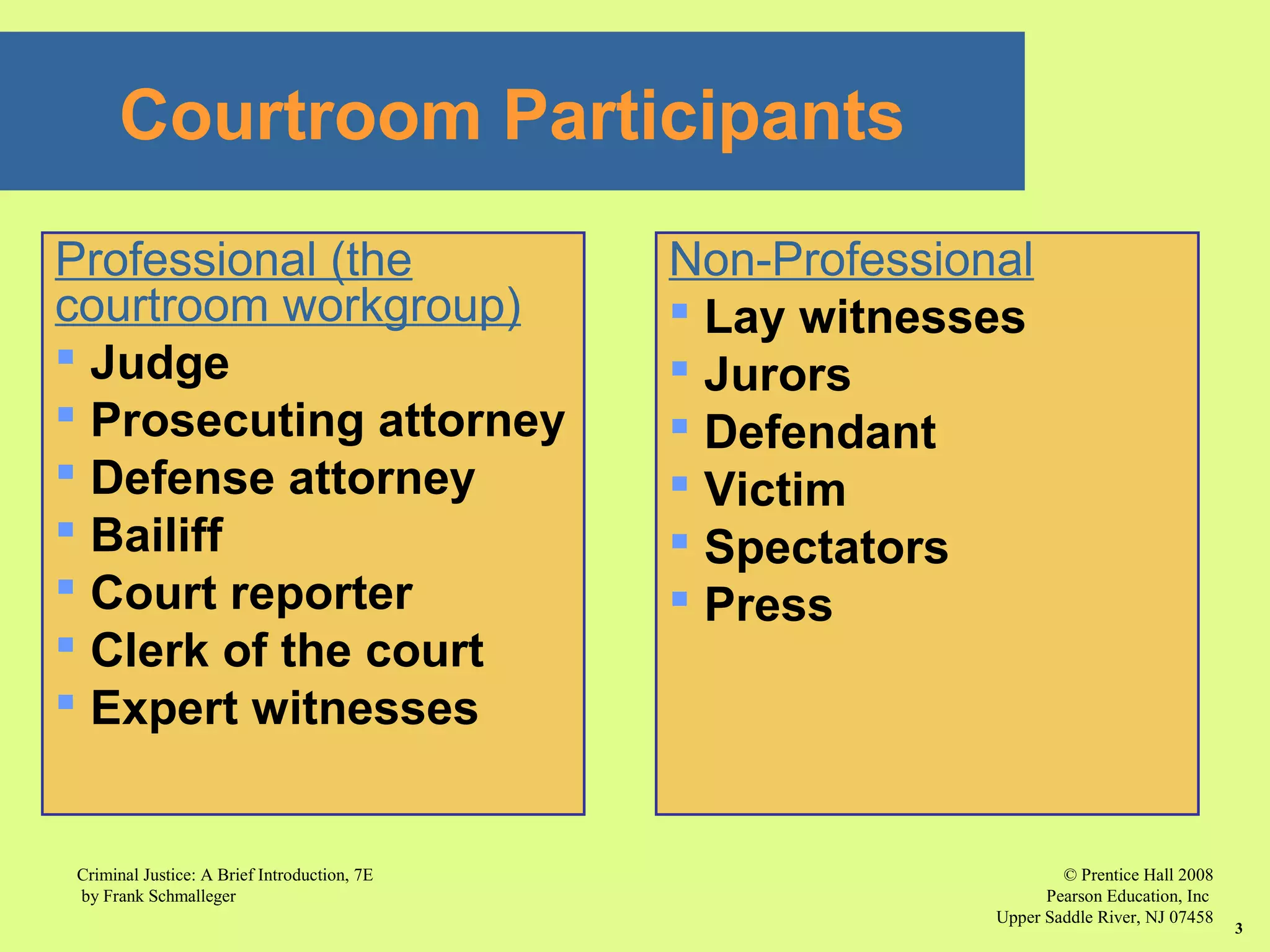
Courtroom Participants
Professional (the
courtroom workgroup)
 Judge
 Prosecuting attorney
 Defense attorney
 Bailiff
 Court reporter
 Clerk of the court
 Expert witnesses
Non-Professional
 Lay witnesses
 Jurors
 Defendant
 Victim
 Spectators
 Press
© Prentice Hall 2008
Pearson Education, Inc
Upper Saddle River, NJ 07458
Criminal Justice: A Brief Introduction, 7E
by Frank Schmalleger
4
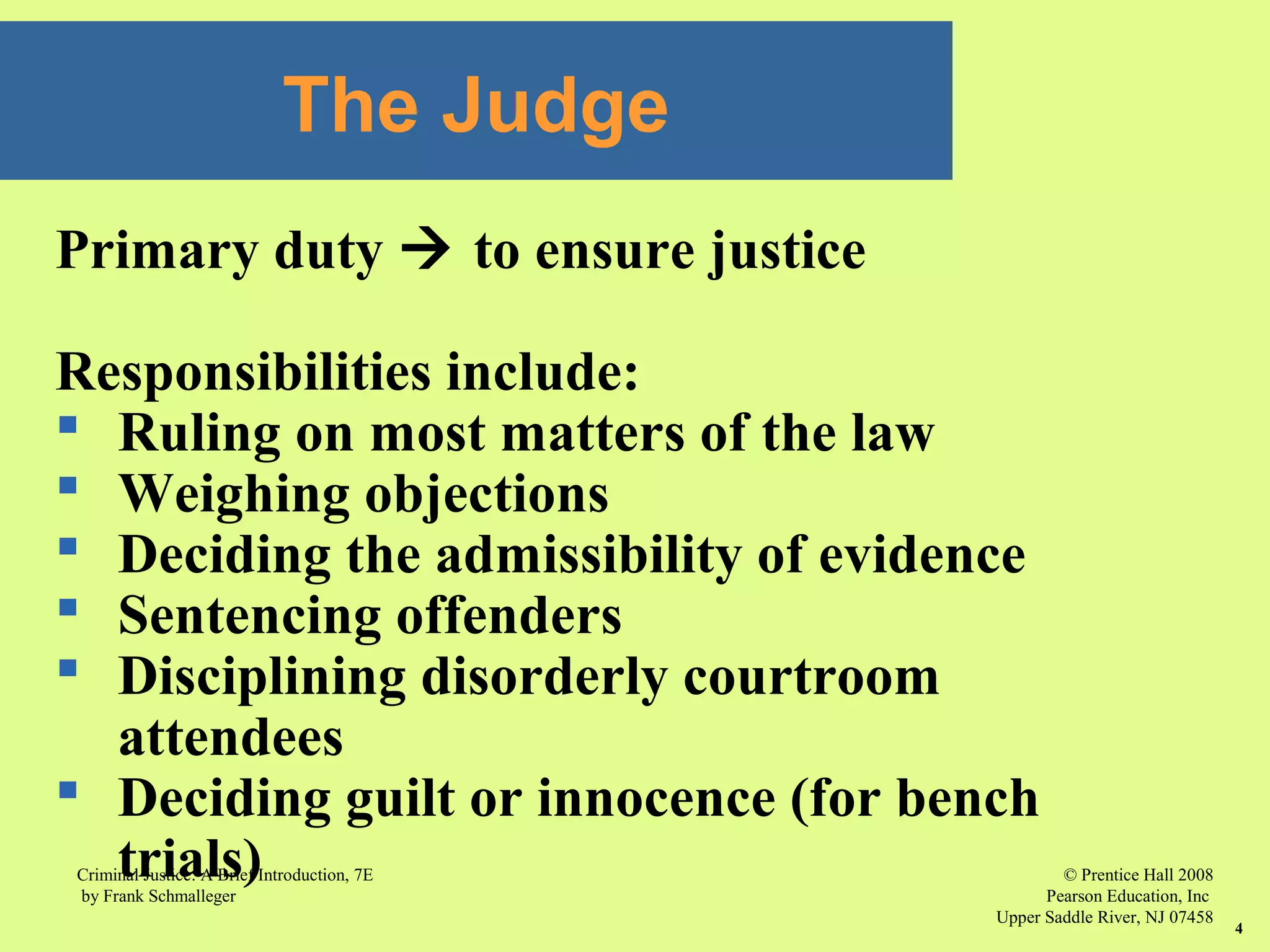
Primary duty  to ensure justice
Responsibilities include:
 Ruling on most matters of the law
 Weighing objections
 Deciding the admissibility of evidence
 Sentencing offenders
 Disciplining disorderly courtroom
attendees
 Deciding guilt or innocence (for bench
trials)
The Judge
© Prentice Hall 2008
Pearson Education, Inc
Upper Saddle River, NJ 07458
Criminal Justice: A Brief Introduction, 7E
by Frank Schmalleger
5
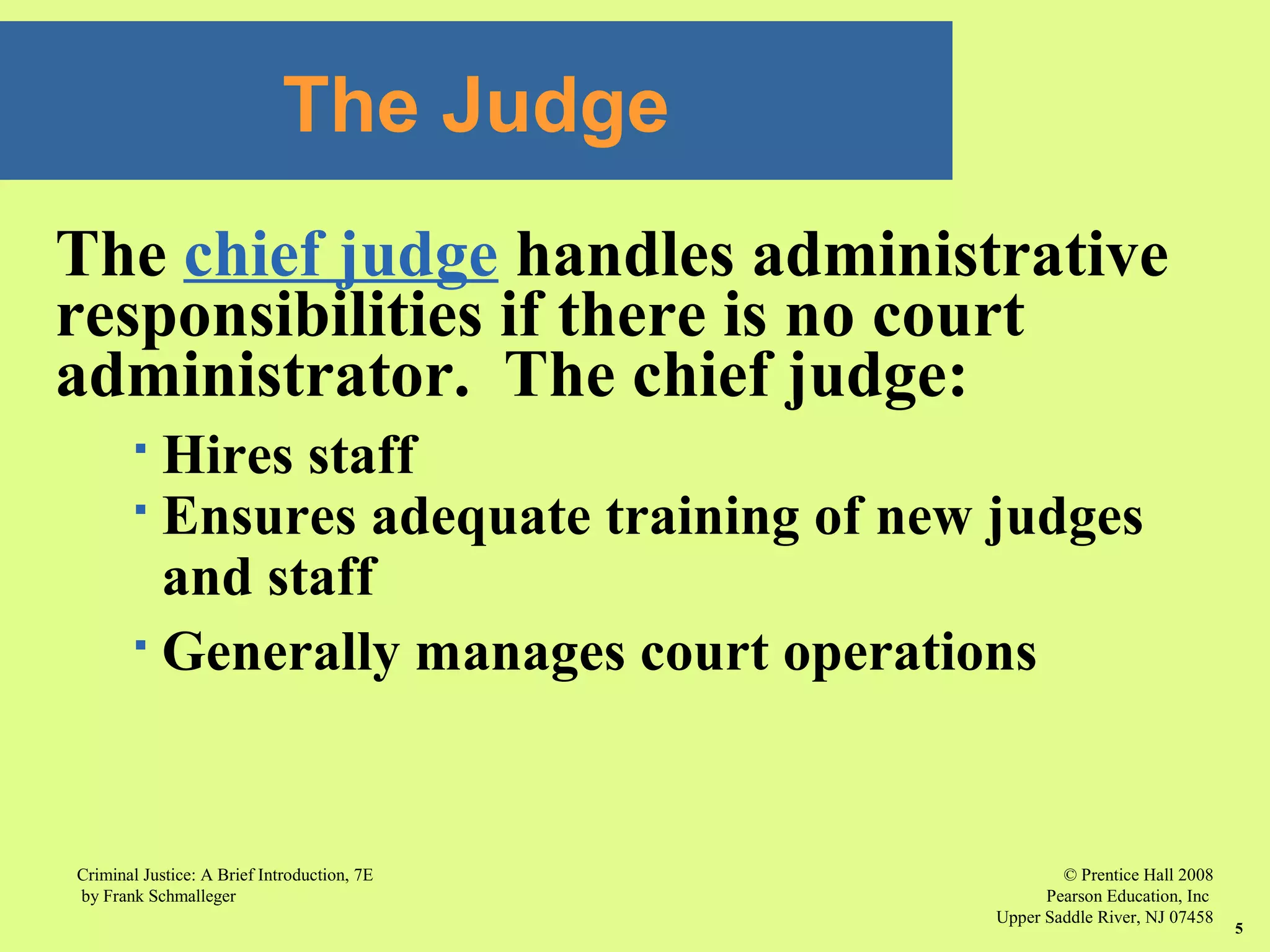
The chief judge handles administrative
responsibilities if there is no court
administrator. The chief judge:
 Hires staff
 Ensures adequate training of new judges
and staff
 Generally manages court operations
The Judge
© Prentice Hall 2008
Pearson Education, Inc
Upper Saddle River, NJ 07458
Criminal Justice: A Brief Introduction, 7E
by Frank Schmalleger
6
Judicial Selection
Federal Judges
 Nominated by
President
 Confirmed by
senate
State Judges
 Popular election
 Gubernatorial
appointment
 Missouri Plan
(combines
appointment and
election)
© Prentice Hall 2008
Pearson Education, Inc
Upper Saddle River, NJ 07458
Criminal Justice: A Brief Introduction, 7E
by Frank Schmalleger
7
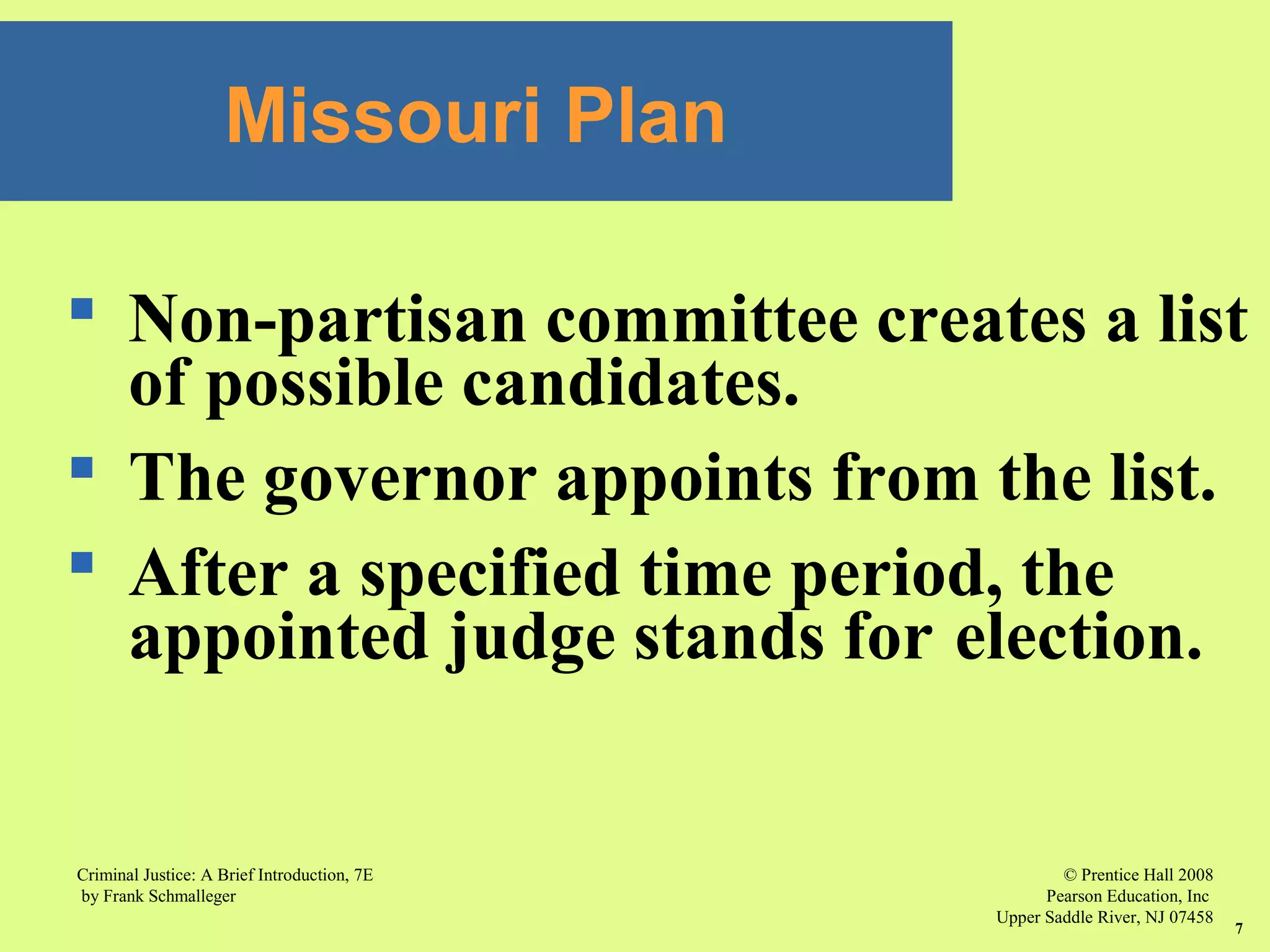
 Non-partisan committee creates a list
of possible candidates.
 The governor appoints from the list.
 After a specified time period, the
appointed judge stands for election.
Missouri Plan
© Prentice Hall 2008
Pearson Education, Inc
Upper Saddle River, NJ 07458
Criminal Justice: A Brief Introduction, 7E
by Frank Schmalleger
8
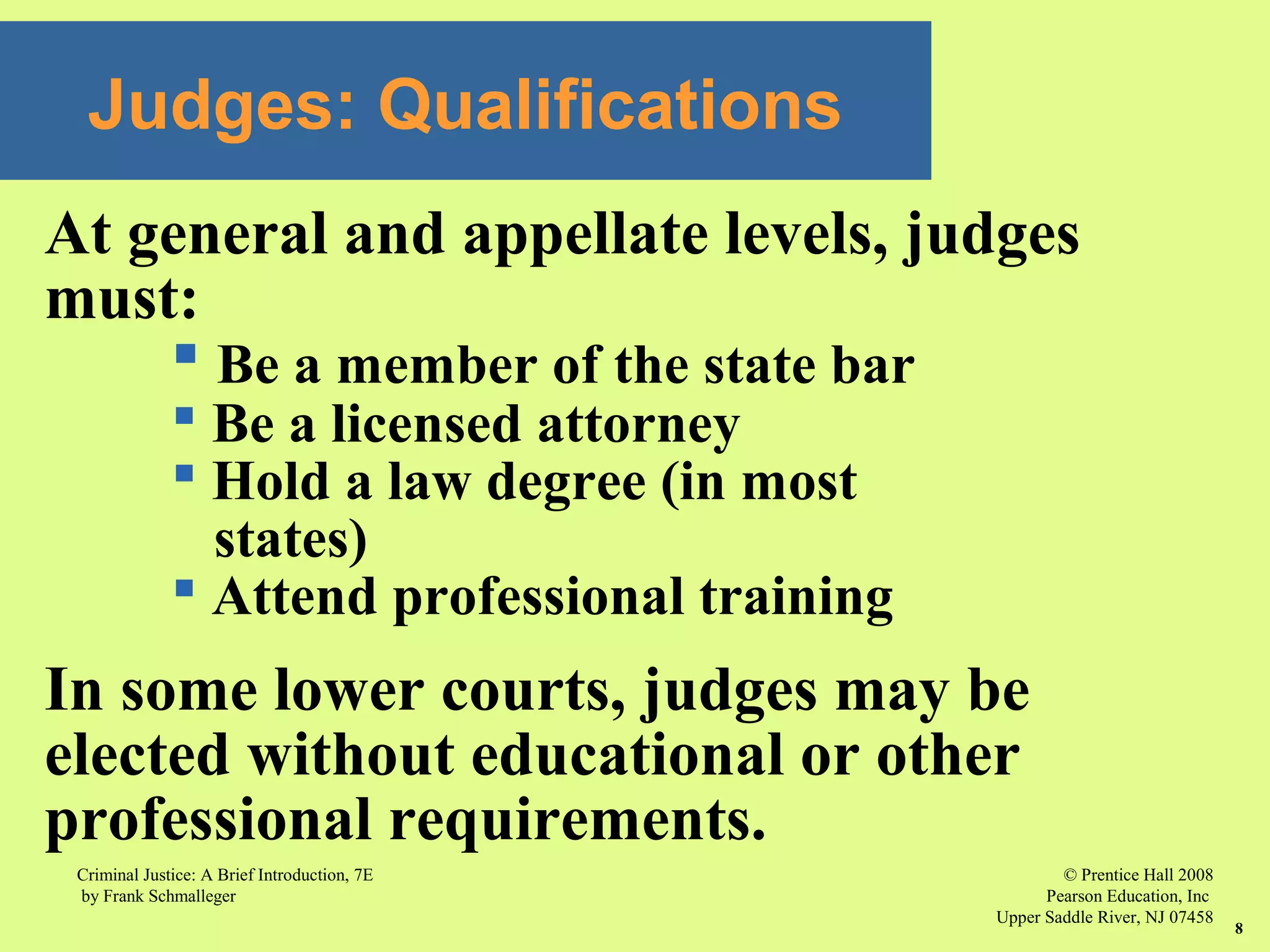
Judges: Qualifications
At general and appellate levels, judges
must:
 Be a member of the state bar
 Be a licensed attorney
 Hold a law degree (in most
states)
 Attend professional training
In some lower courts, judges may be
elected without educational or other
professional requirements.
© Prentice Hall 2008
Pearson Education, Inc
Upper Saddle River, NJ 07458
Criminal Justice: A Brief Introduction, 7E
by Frank Schmalleger
9
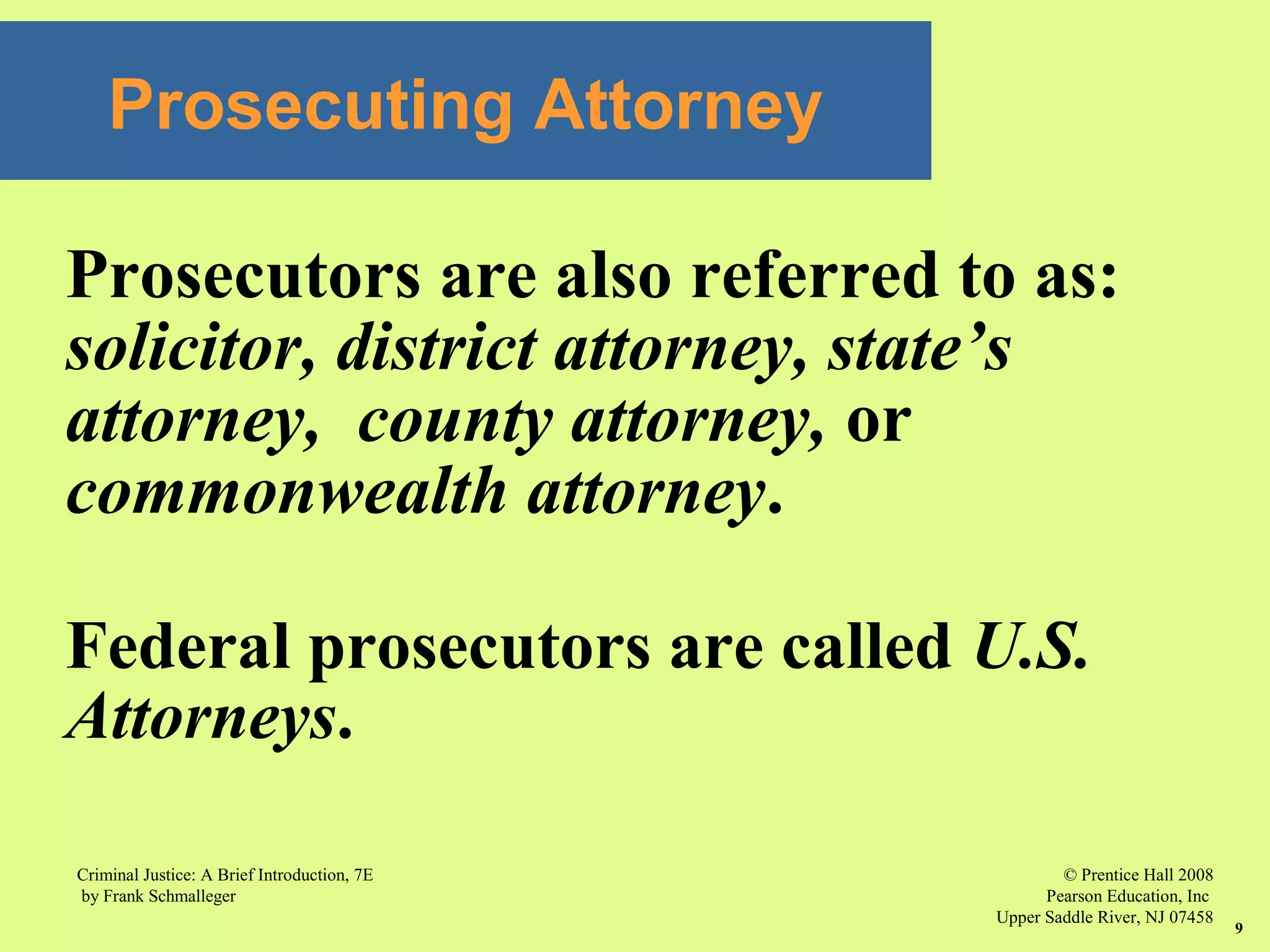
Prosecuting Attorney
Prosecutors are also referred to as:
solicitor, district attorney, state’s
attorney, county attorney, or
commonwealth attorney.
Federal prosecutors are called U.S.
Attorneys.
© Prentice Hall 2008
Pearson Education, Inc
Upper Saddle River, NJ 07458
Criminal Justice: A Brief Introduction, 7E
by Frank Schmalleger
10
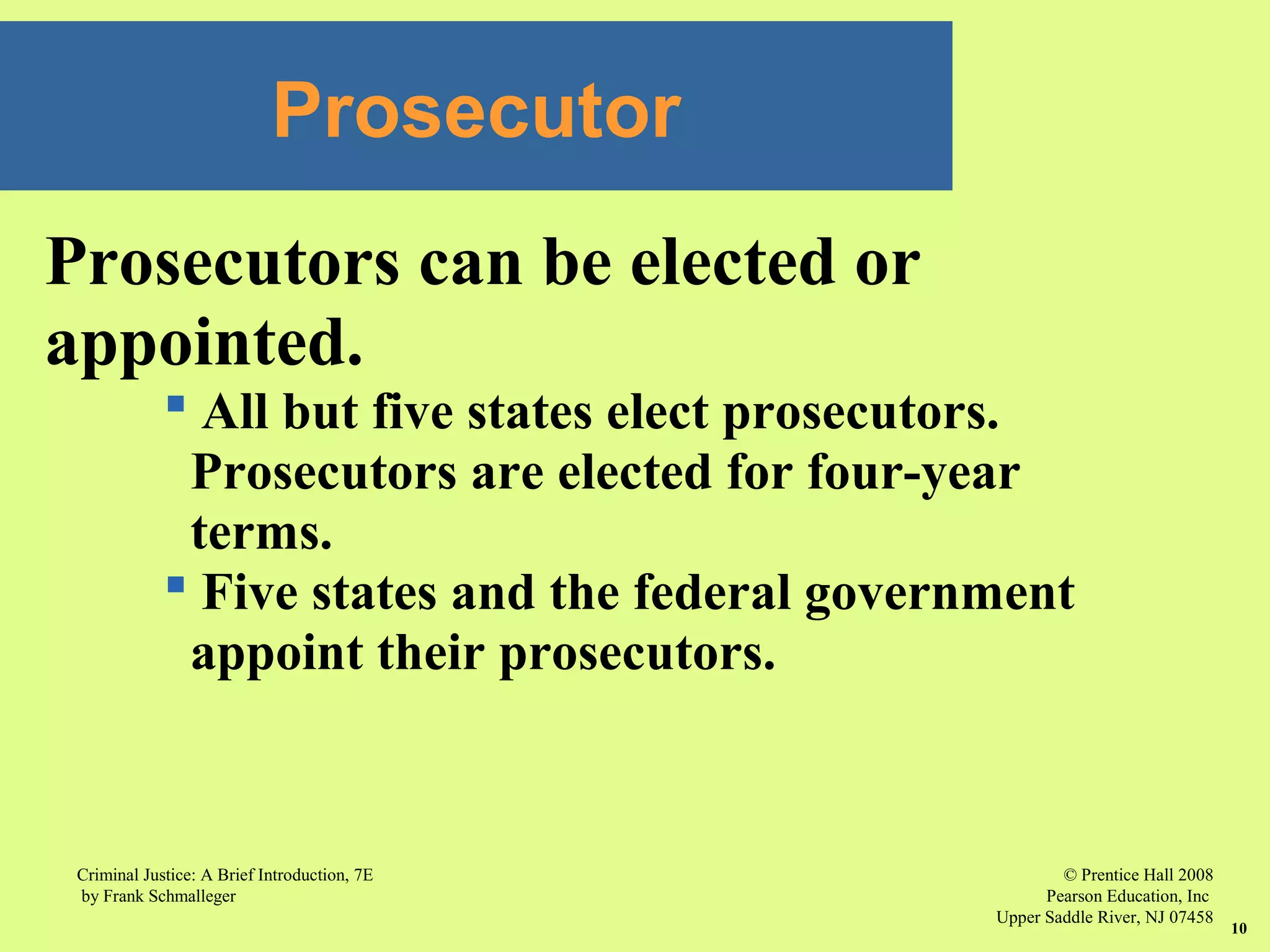
Prosecutors can be elected or
appointed.
 All but five states elect prosecutors.
Prosecutors are elected for four-year
terms.
 Five states and the federal government
appoint their prosecutors.
Prosecutor
© Prentice Hall 2008
Pearson Education, Inc
Upper Saddle River, NJ 07458
Criminal Justice: A Brief Introduction, 7E
by Frank Schmalleger
11
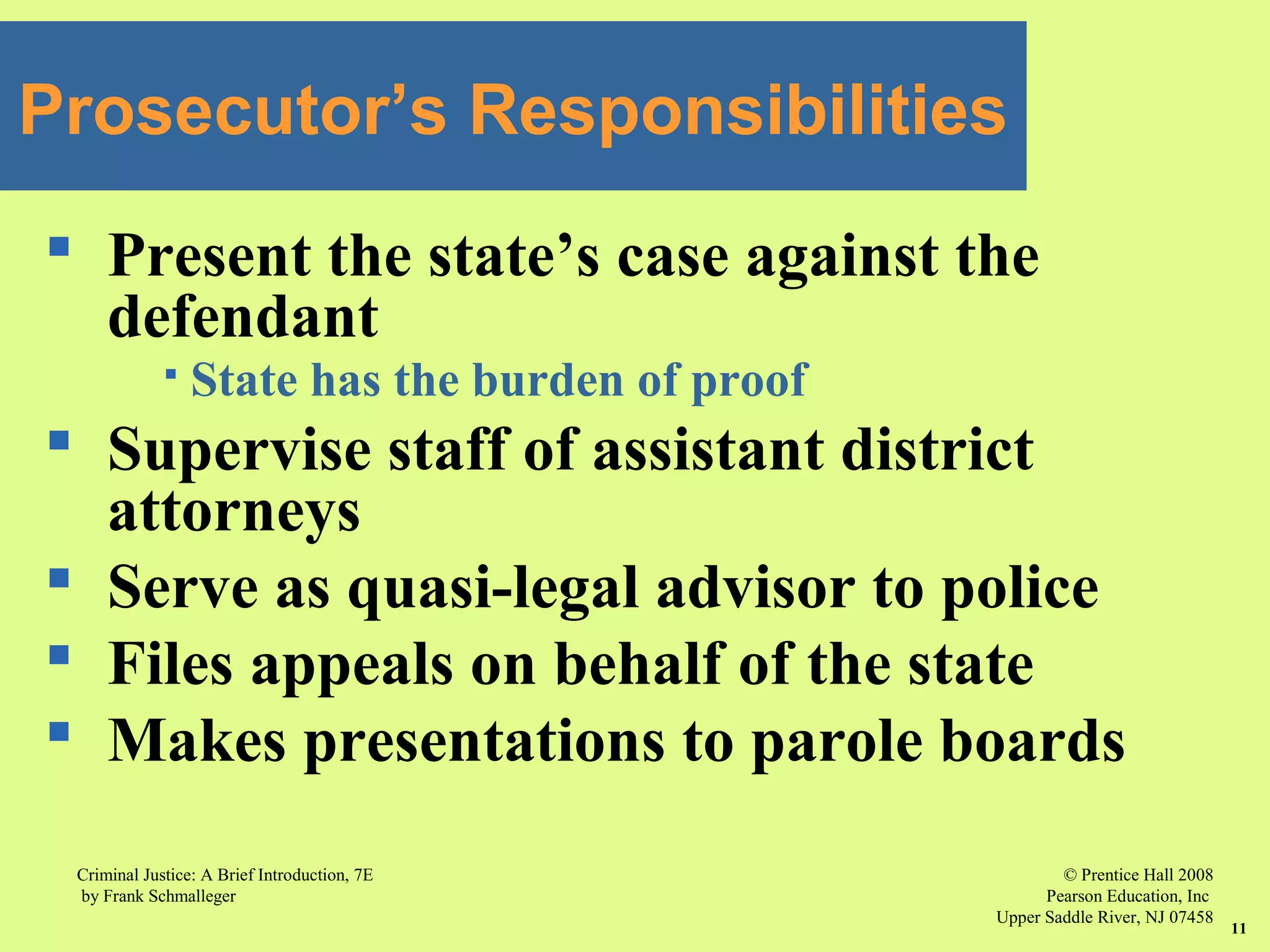
 Present the state’s case against the
defendant
 State has the burden of proof
 Supervise staff of assistant district
attorneys
 Serve as quasi-legal advisor to police
 Files appeals on behalf of the state
 Makes presentations to parole boards
Prosecutor’s Responsibilities
© Prentice Hall 2008
Pearson Education, Inc
Upper Saddle River, NJ 07458
Criminal Justice: A Brief Introduction, 7E
by Frank Schmalleger
12
…decision-making power, based on
the wide range of choices available
to them.
Prosecutorial Discretion
© Prentice Hall 2008
Pearson Education, Inc
Upper Saddle River, NJ 07458
Criminal Justice: A Brief Introduction, 7E
by Frank Schmalleger
13
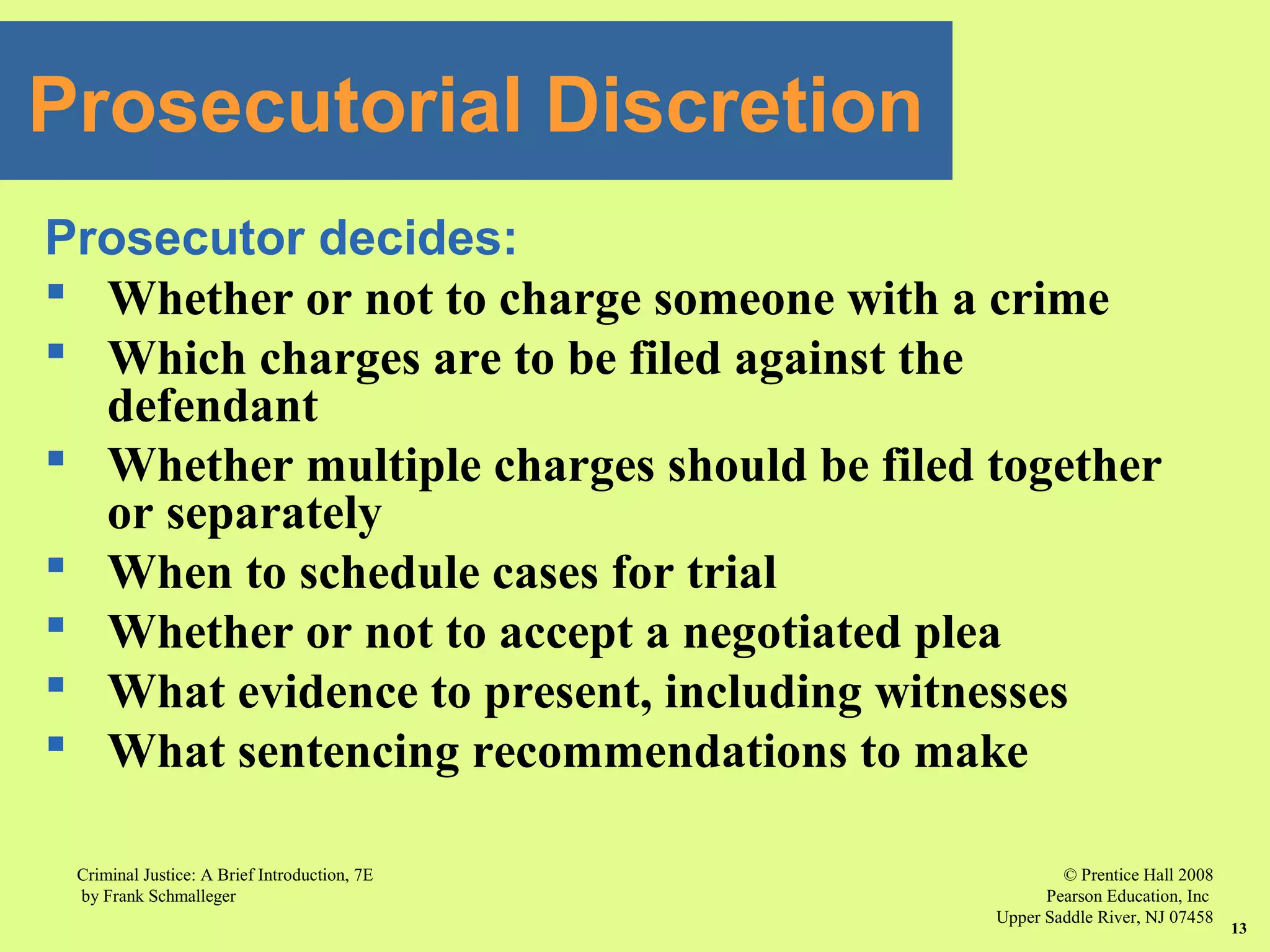
Prosecutor decides:
 Whether or not to charge someone with a crime
 Which charges are to be filed against the
defendant
 Whether multiple charges should be filed together
or separately
 When to schedule cases for trial
 Whether or not to accept a negotiated plea
 What evidence to present, including witnesses
 What sentencing recommendations to make
Prosecutorial Discretion
© Prentice Hall 2008
Pearson Education, Inc
Upper Saddle River, NJ 07458
Criminal Justice: A Brief Introduction, 7E
by Frank Schmalleger
14
Brady v. Maryland (1963)
The U.S. Supreme Court held that the
prosecution is required to disclose to the
defense any exculpatory evidence in its
possession that directly or indirectly relates
to claims of either guilt or innocence.
Disclosure of Evidence
© Prentice Hall 2008
Pearson Education, Inc
Upper Saddle River, NJ 07458
Criminal Justice: A Brief Introduction, 7E
by Frank Schmalleger
15
U.S. v. Bagley (1985)
The Court ruled that the prosecution must
disclose any evidence in its possession that
the defense requests.
To withhold evidence, even when it does not
directly relate to issues of guilt or
innocence, may mislead the defense into
thinking that such evidence does not exist.
Disclosure of Evidence
© Prentice Hall 2008
Pearson Education, Inc
Upper Saddle River, NJ 07458
Criminal Justice: A Brief Introduction, 7E
by Frank Schmalleger
16
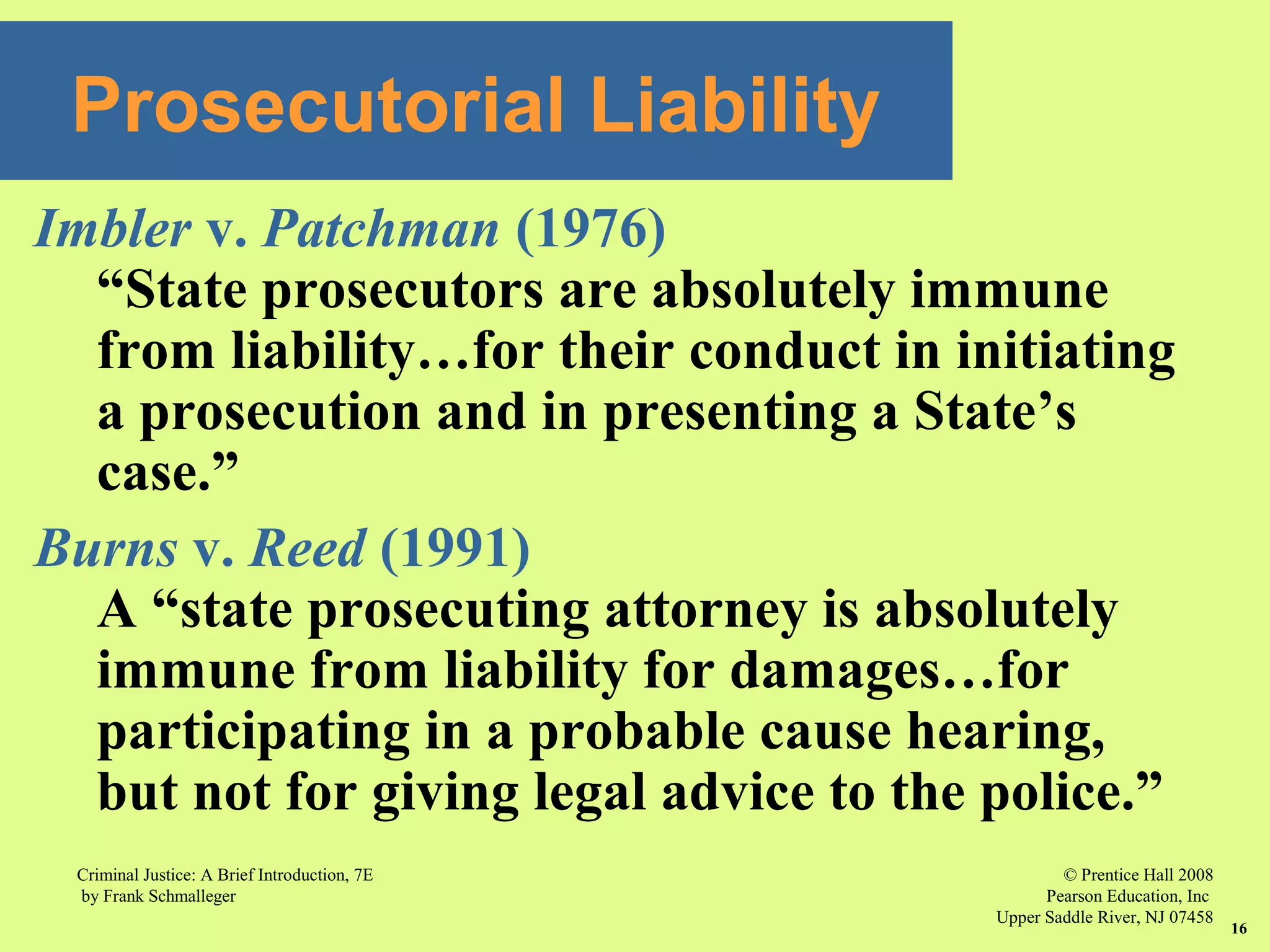
Imbler v. Patchman (1976)
“State prosecutors are absolutely immune
from liability…for their conduct in initiating
a prosecution and in presenting a State’s
case.”
Burns v. Reed (1991)
A “state prosecuting attorney is absolutely
immune from liability for damages…for
participating in a probable cause hearing,
but not for giving legal advice to the police.”
Prosecutorial Liability
© Prentice Hall 2008
Pearson Education, Inc
Upper Saddle River, NJ 07458
Criminal Justice: A Brief Introduction, 7E
by Frank Schmalleger
17
Abuse of Discretion
 Not prosecuting friends
 Accepting guilty pleas or reduced charges for
personal consideration
 Overzealous prosecution to gain visibility for
possible re-election
 Scheduling activities to make life difficult for
defendants, in an attempt to put pressure on
them to plead guilty
 Discrimination against minorities
 Withholding exculpatory evidence
Prosecutors may abuse their discretion by
© Prentice Hall 2008
Pearson Education, Inc
Upper Saddle River, NJ 07458
Criminal Justice: A Brief Introduction, 7E
by Frank Schmalleger
18
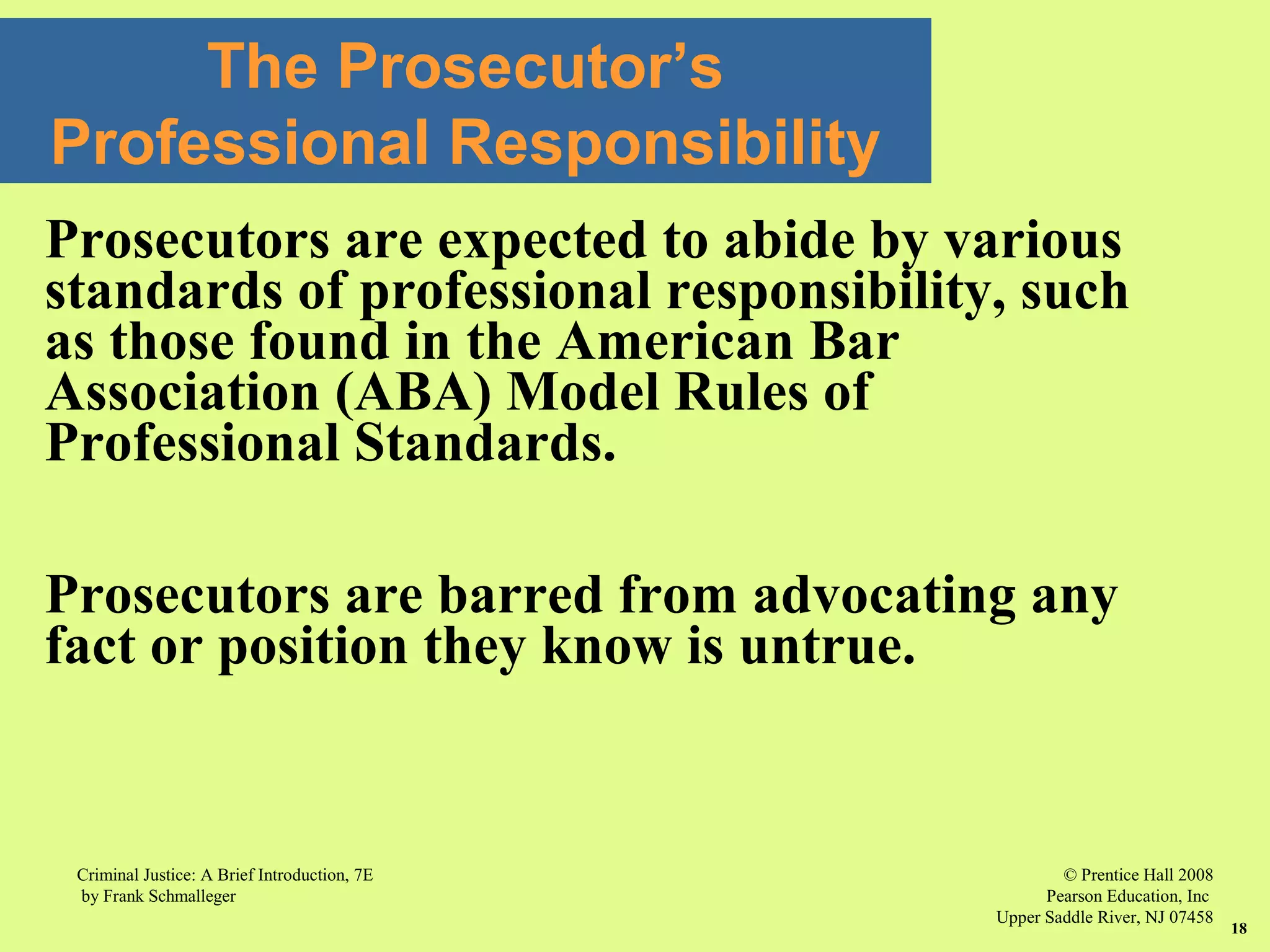
The Prosecutor’s
Professional Responsibility
Prosecutors are expected to abide by various
standards of professional responsibility, such
as those found in the American Bar
Association (ABA) Model Rules of
Professional Standards.
Prosecutors are barred from advocating any
fact or position they know is untrue.
© Prentice Hall 2008
Pearson Education, Inc
Upper Saddle River, NJ 07458
Criminal Justice: A Brief Introduction, 7E
by Frank Schmalleger
19
The defense counsel is a lawyer who:
 Represents the accused
 Participates in plea negotiations
 Prepares a defense
 Calls witnesses
 Refutes cases presented by prosecutor
 Presents arguments at time of sentencing
 Files appeals
Defense Counsel
© Prentice Hall 2008
Pearson Education, Inc
Upper Saddle River, NJ 07458
Criminal Justice: A Brief Introduction, 7E
by Frank Schmalleger
20
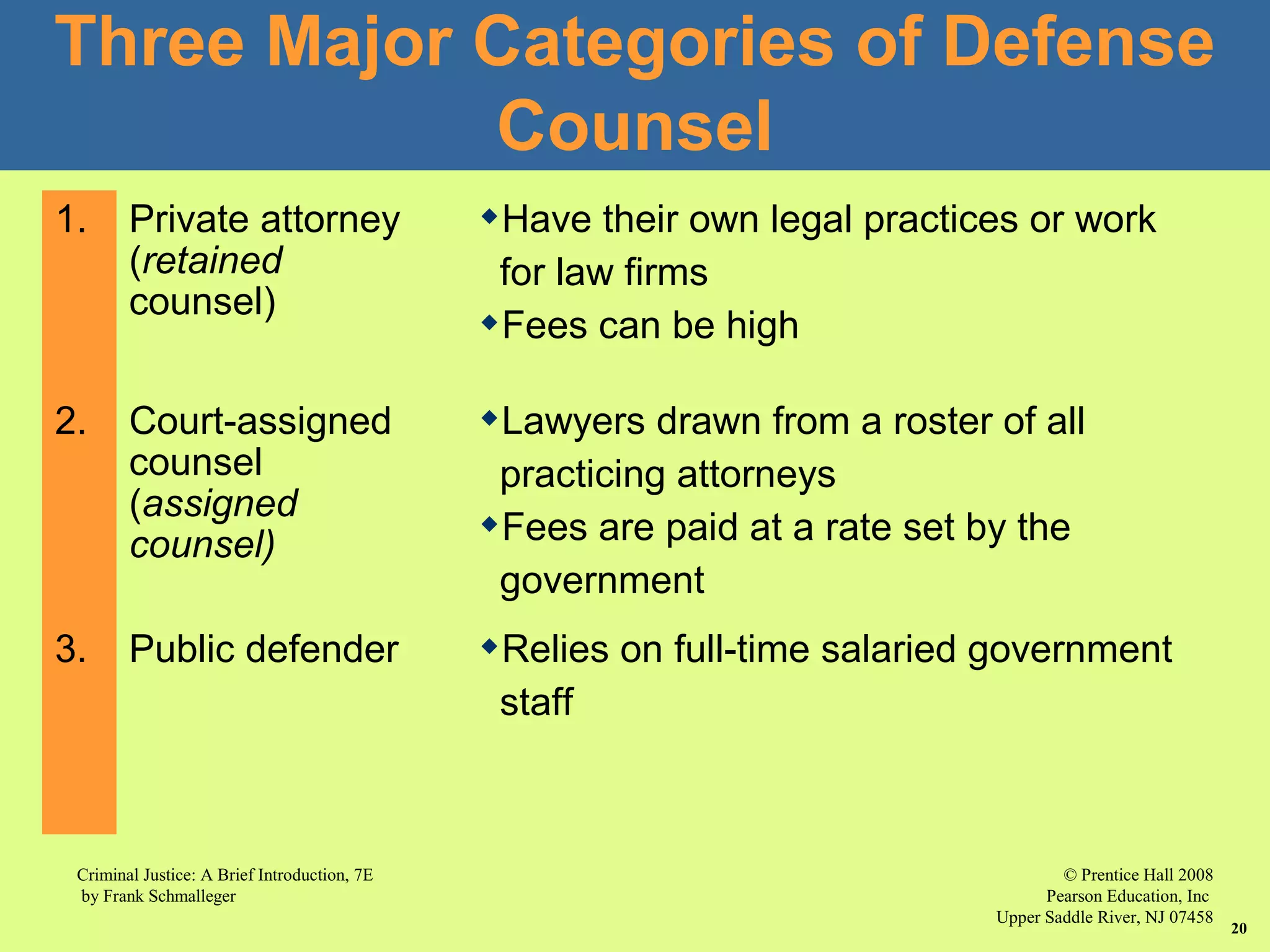
Three Major Categories of Defense
Counsel
1. Private attorney
(retained
counsel)
Have their own legal practices or work
for law firms
Fees can be high
2. Court-assigned
counsel
(assigned
counsel)
Lawyers drawn from a roster of all
practicing attorneys
Fees are paid at a rate set by the
government
3. Public defender Relies on full-time salaried government
staff
© Prentice Hall 2008
Pearson Education, Inc
Upper Saddle River, NJ 07458
Criminal Justice: A Brief Introduction, 7E
by Frank Schmalleger
21
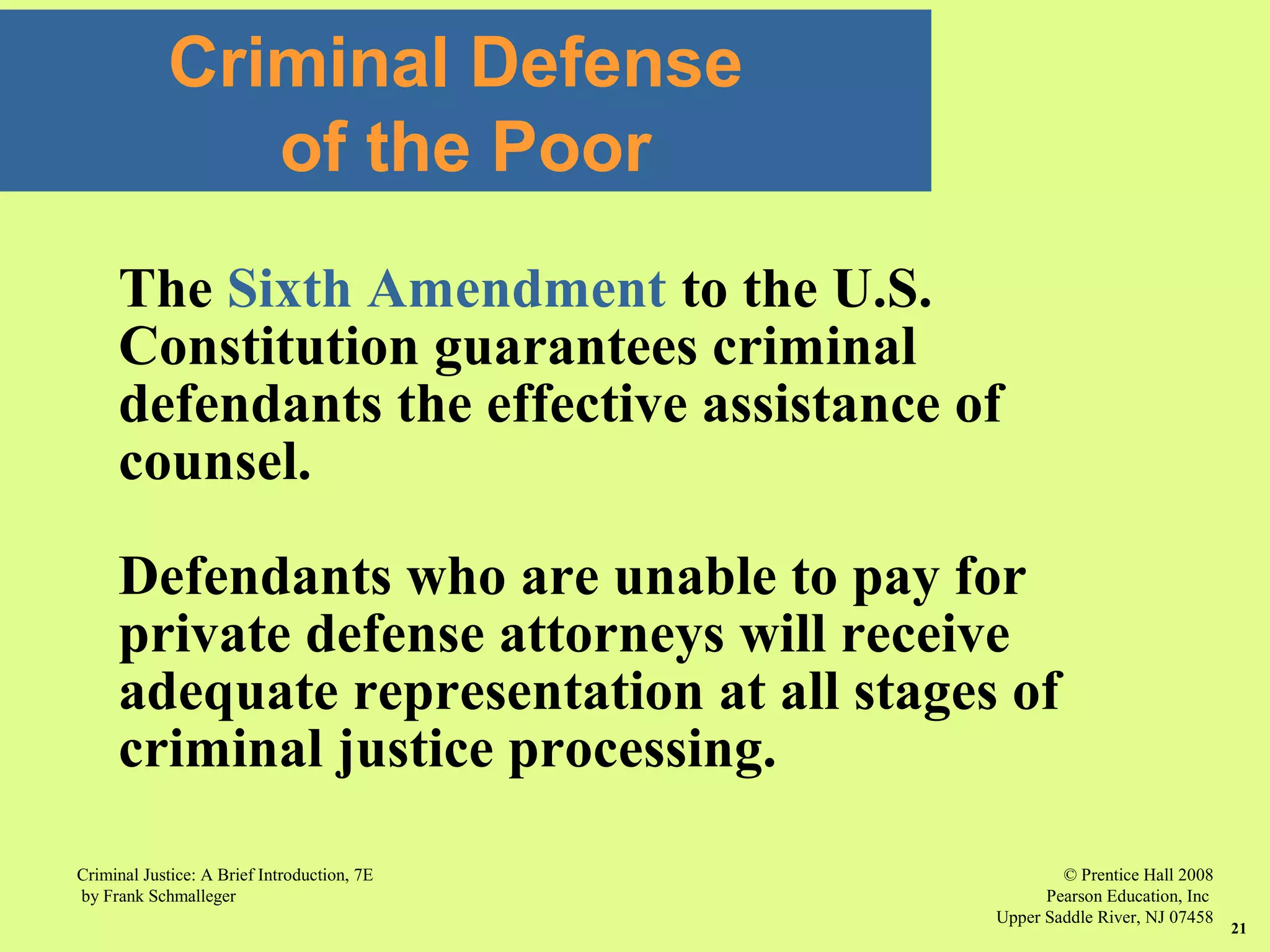
Criminal Defense
of the Poor
The Sixth Amendment to the U.S.
Constitution guarantees criminal
defendants the effective assistance of
counsel.
Defendants who are unable to pay for
private defense attorneys will receive
adequate representation at all stages of
criminal justice processing.
© Prentice Hall 2008
Pearson Education, Inc
Upper Saddle River, NJ 07458
Criminal Justice: A Brief Introduction, 7E
by Frank Schmalleger
22
The Court required that states
provide defense counsel for those
defendants who are unable to employ
their own counsel and are charged
with a capital offense.
Powell v. Alabama (1932)
© Prentice Hall 2008
Pearson Education, Inc
Upper Saddle River, NJ 07458
Criminal Justice: A Brief Introduction, 7E
by Frank Schmalleger
23
The U.S. Supreme Court established
the right of indigent offenders to
have legal counsel appointed for
them in all federal cases.
Johnson v. Zerbst (1938)
© Prentice Hall 2008
Pearson Education, Inc
Upper Saddle River, NJ 07458
Criminal Justice: A Brief Introduction, 7E
by Frank Schmalleger
24
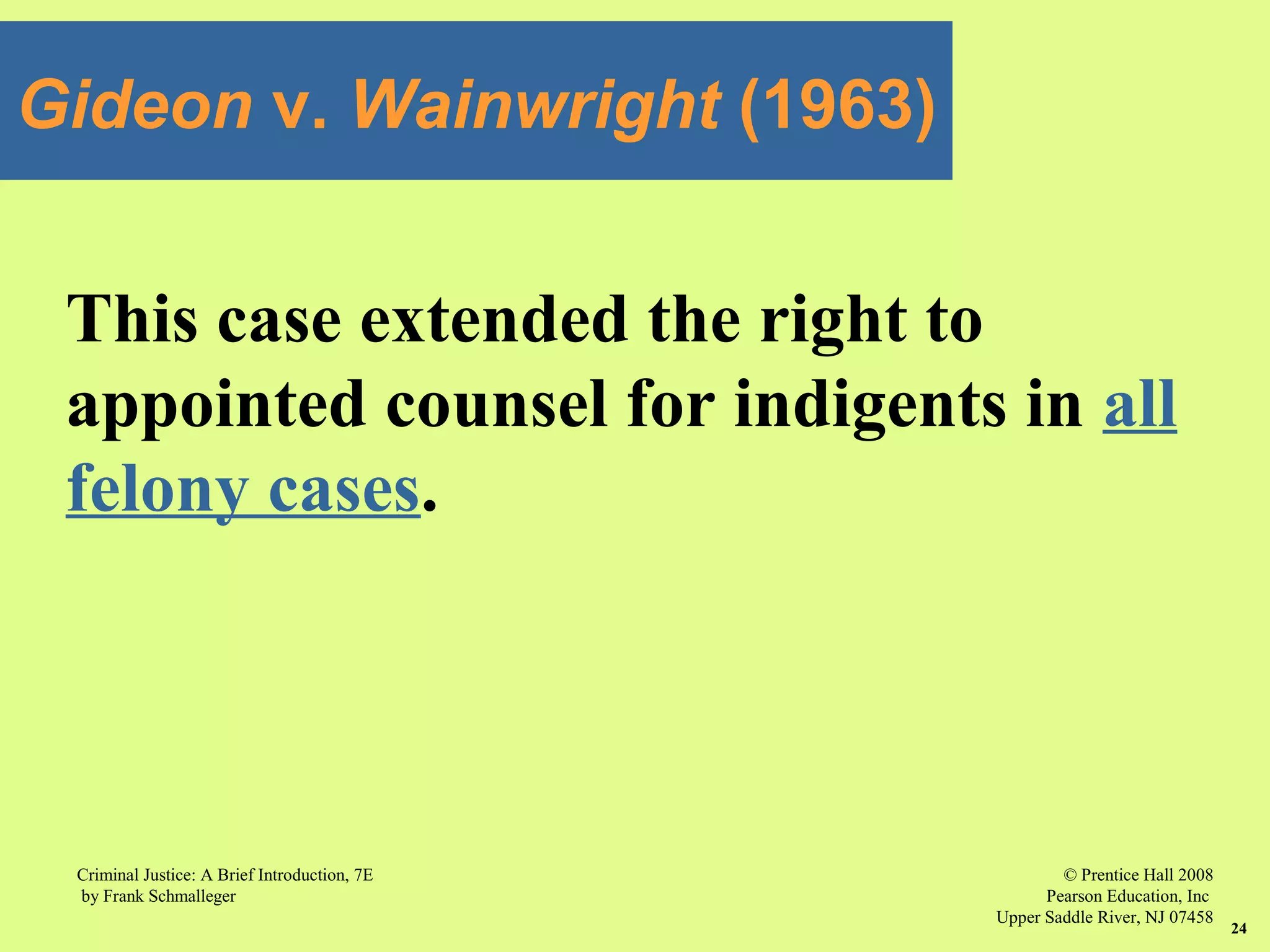
This case extended the right to
appointed counsel for indigents in all
felony cases.
Gideon v. Wainwright (1963)
© Prentice Hall 2008
Pearson Education, Inc
Upper Saddle River, NJ 07458
Criminal Justice: A Brief Introduction, 7E
by Frank Schmalleger
25
The U.S. Supreme Court extended
the right of indigent offenders to
have legal representation
in any case where they could lose
their liberty (including misdemeanor
cases).
Argersinger v. Hamlin (1972)
© Prentice Hall 2008
Pearson Education, Inc
Upper Saddle River, NJ 07458
Criminal Justice: A Brief Introduction, 7E
by Frank Schmalleger
26
The U.S. Supreme Court extended
the right to legal counsel for
juveniles charged with a delinquent
act.
In re Gault (1967)
© Prentice Hall 2008
Pearson Education, Inc
Upper Saddle River, NJ 07458
Criminal Justice: A Brief Introduction, 7E
by Frank Schmalleger
27
Defendants in state courts who are
facing relatively minor charges must
be provided with an attorney at
government expense even when they
face only the slightest chance of
incarceration.
Alabama v. Shelton (2002)
© Prentice Hall 2008
Pearson Education, Inc
Upper Saddle River, NJ 07458
Criminal Justice: A Brief Introduction, 7E
by Frank Schmalleger
28
Criminal Defense
of the Poor
1. Court-assigned counsel
2. Public defender
3. Contract attorney
Three Types of Programs
© Prentice Hall 2008
Pearson Education, Inc
Upper Saddle River, NJ 07458
Criminal Justice: A Brief Introduction, 7E
by Frank Schmalleger
29
 Fee paid based on state rate (most
widely used).
 Fee is usually low, raising questions
about the level of commitment of
defense attorneys.
 Roster of local attorneys who are
willing to take cases under established
fees.
Court-Assigned Counsel
© Prentice Hall 2008
Pearson Education, Inc
Upper Saddle River, NJ 07458
Criminal Justice: A Brief Introduction, 7E
by Frank Schmalleger
30
 Uses full-time salaried attorneys.
 28% of counties nationwide use
this system exclusively.
 64% of counties nationwide use
public defenders as part of their
system.
Public Defender Program
© Prentice Hall 2008
Pearson Education, Inc
Upper Saddle River, NJ 07458
Criminal Justice: A Brief Introduction, 7E
by Frank Schmalleger
31
 Local attorneys are maintained on
contract to handle all cases.
 This is the least widely used form
of indigent defense.
Contract Attorneys
© Prentice Hall 2008
Pearson Education, Inc
Upper Saddle River, NJ 07458
Criminal Justice: A Brief Introduction, 7E
by Frank Schmalleger
32
Criticisms relate to funding,
caseload, and quality of defense.
Criticisms of Indigent
Defense System
© Prentice Hall 2008
Pearson Education, Inc
Upper Saddle River, NJ 07458
Criminal Justice: A Brief Introduction, 7E
by Frank Schmalleger
33
 1% of federally charged
defendants and 3% of state level
defendants represent themselves.
 Faretta v. California (1975)
 Indigents are not required to accept counsel.
They may waive their right and represent
themselves.
Waiving the Right to an
Attorney
© Prentice Hall 2008
Pearson Education, Inc
Upper Saddle River, NJ 07458
Criminal Justice: A Brief Introduction, 7E
by Frank Schmalleger
34
Defendants who are not pleased with
their provided lawyer can request a
new one, but the court must
determine that there is a “clear
reason” for reassignment.
Requesting a Different
Attorney
© Prentice Hall 2008
Pearson Education, Inc
Upper Saddle River, NJ 07458
Criminal Justice: A Brief Introduction, 7E
by Frank Schmalleger
35
State-supported indigent defense
systems may also be called on to
provide representation during
appeals. If an attorney believes that
such an appeal would be frivolous,
he or she can request to be
withdrawn from the case.
Appeals and Indigent
Defense
© Prentice Hall 2008
Pearson Education, Inc
Upper Saddle River, NJ 07458
Criminal Justice: A Brief Introduction, 7E
by Frank Schmalleger
36
The Ethics of Defense
 Canons of Professional Ethics
 Model Code of Professional
Responsibility
 Model Rules of Professional
Conduct
 Standards for Criminal Justice
ABA Ethical Guidelines
© Prentice Hall 2008
Pearson Education, Inc
Upper Saddle River, NJ 07458
Criminal Justice: A Brief Introduction, 7E
by Frank Schmalleger
37
The bailiff is a law enforcement officer who:
 Ensures order in the courtroom
 Announces the judge’s entry
 Calls witnesses
 Maintains control over the defendant if the
person has not been released on bail
 Maintains physical custody of and
supervises jury during deliberations and
sequestering
Bailiff
© Prentice Hall 2008
Pearson Education, Inc
Upper Saddle River, NJ 07458
Criminal Justice: A Brief Introduction, 7E
by Frank Schmalleger
38
Many states employ court
administrators:
 Facilitate the smooth running of courts in
particular judicial districts
 Provide uniform court management
Local Court Administrators
© Prentice Hall 2008
Pearson Education, Inc
Upper Saddle River, NJ 07458
Criminal Justice: A Brief Introduction, 7E
by Frank Schmalleger
39
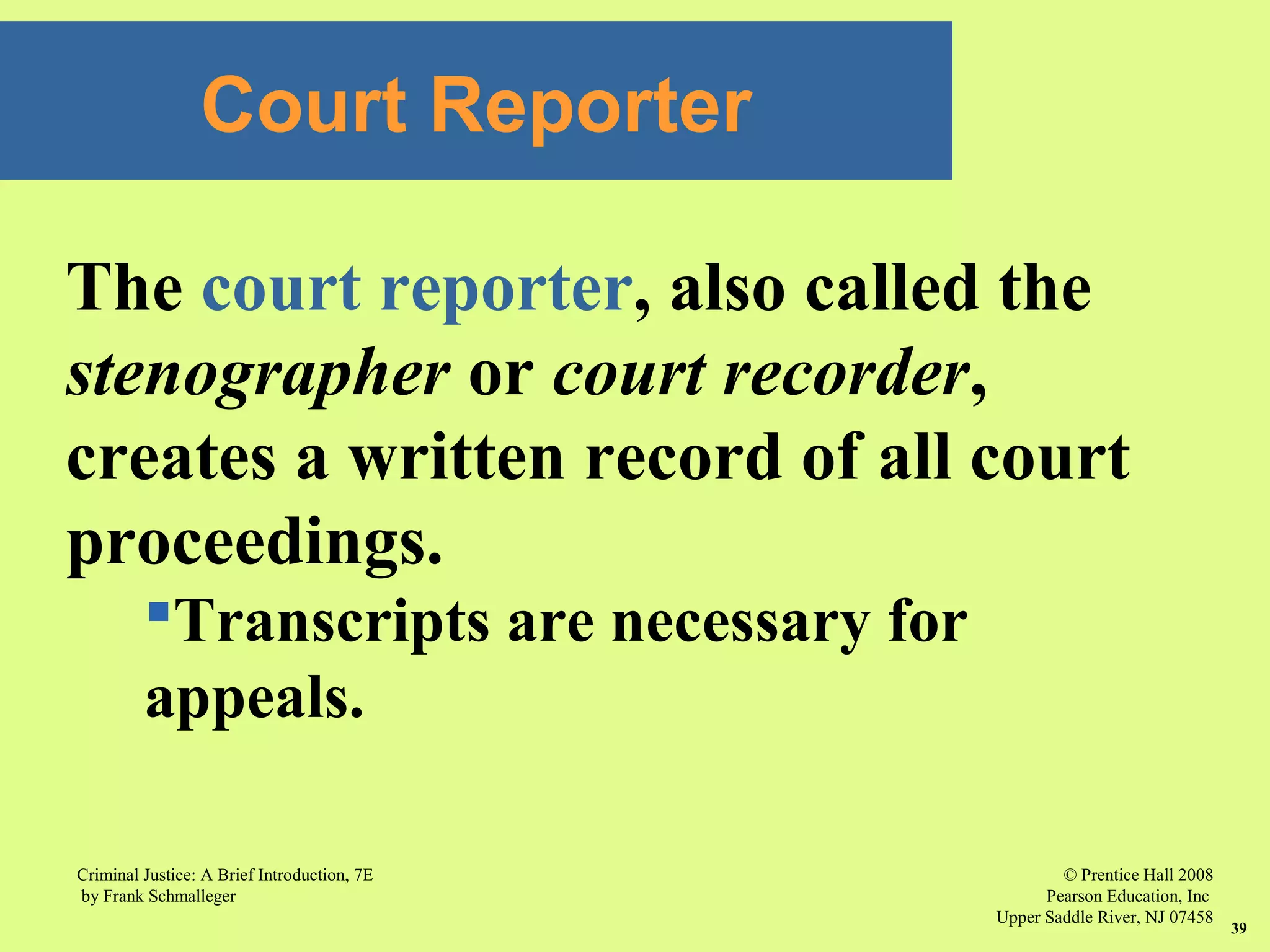
The court reporter, also called the
stenographer or court recorder,
creates a written record of all court
proceedings.
Transcripts are necessary for
appeals.
Court Reporter
© Prentice Hall 2008
Pearson Education, Inc
Upper Saddle River, NJ 07458
Criminal Justice: A Brief Introduction, 7E
by Frank Schmalleger
40
The duties of the clerk of court include:
 Maintaining all records of criminal cases
and verdicts
 Preparing the jury pool and issuing jury
summonses
 Subpoenaing witnesses
 Marking physical evidence for
identification at trial
 Swearing in witnesses
Clerk of Court
© Prentice Hall 2008
Pearson Education, Inc
Upper Saddle River, NJ 07458
Criminal Justice: A Brief Introduction, 7E
by Frank Schmalleger
41
Expert Witness
Expert witnesses have special
knowledge and skills in an established
profession or technical area. Usually,
this person is paid to testify.
Unlike lay witnesses, they may express
opinions and draw conclusions in their
testimony.
© Prentice Hall 2008
Pearson Education, Inc
Upper Saddle River, NJ 07458
Criminal Justice: A Brief Introduction, 7E
by Frank Schmalleger
42
Outsiders:
Nonprofessional
Courtroom
Participants
© Prentice Hall 2008
Pearson Education, Inc
Upper Saddle River, NJ 07458
Criminal Justice: A Brief Introduction, 7E
by Frank Schmalleger
43
 Non-expert witnesses are called lay
witnesses. They may be:
 Eyewitnesses
 Character witnesses
 Victim
 Lay witnesses are subpoenaed to
testify to that which they have
direct knowledge of.
Lay Witness
© Prentice Hall 2008
Pearson Education, Inc
Upper Saddle River, NJ 07458
Criminal Justice: A Brief Introduction, 7E
by Frank Schmalleger
44
Article III of the U.S. Constitution
 “trial of all crimes…shall be by jury”
 States determine the number of jurors.
Most use 12, plus 2 alternates.
 Jury duty…a civic responsibility
Jurors
© Prentice Hall 2008
Pearson Education, Inc
Upper Saddle River, NJ 07458
Criminal Justice: A Brief Introduction, 7E
by Frank Schmalleger
45
 Defendants have the right to have
their cases heard before a jury of
their peers.
 Peer juries are those composed of a
representative cross-section of the
community.
Peer Juries
© Prentice Hall 2008
Pearson Education, Inc
Upper Saddle River, NJ 07458
Criminal Justice: A Brief Introduction, 7E
by Frank Schmalleger
46
 In 2005, the American Bar
Association released a set of 19
principles intended to guide jury
reform…to improve treatment of
jurors and modernize the system.
Jury Reform
© Prentice Hall 2008
Pearson Education, Inc
Upper Saddle River, NJ 07458
Criminal Justice: A Brief Introduction, 7E
by Frank Schmalleger
47
 Not all crimes have clearly
identifiable or surviving victims.
 Victims often face hardships as
they participate in the court
process.
The Victim
© Prentice Hall 2008
Pearson Education, Inc
Upper Saddle River, NJ 07458
Criminal Justice: A Brief Introduction, 7E
by Frank Schmalleger
48
 Generally, they must be present at
trial.
 Defendants exercise choice in:
 Selecting and retaining counsel
 Planning a defense strategy with counsel
 Deciding what information to provide counsel
 Deciding what to plea
 Deciding whether or not to testify
 Determining whether or not to file an appeal
The Defendant
© Prentice Hall 2008
Pearson Education, Inc
Upper Saddle River, NJ 07458
Criminal Justice: A Brief Introduction, 7E
by Frank Schmalleger
49
 Spectators and the press may be
present at trial; with more at higher-
profile cases.
 The right of reporters to be there is
supported by the Sixth Amendment’s
requirement of a public trial.
 Most state courts allow cameras in the
courtroom…for television coverage.
Spectators and the Press
© Prentice Hall 2008
Pearson Education, Inc
Upper Saddle River, NJ 07458
Criminal Justice: A Brief Introduction, 7E
by Frank Schmalleger
50
The Criminal Trial
© Prentice Hall 2008
Pearson Education, Inc
Upper Saddle River, NJ 07458
Criminal Justice: A Brief Introduction, 7E
by Frank Schmalleger
51
The Nature and Purpose
of the Criminal Trial
 The trial process is highly
formalized and governed by rules
of evidence and other procedural
guidelines, as well as informal
rules and professional
expectations.
 The purpose is to determine the
defendant’s guilt or innocence.
© Prentice Hall 2008
Pearson Education, Inc
Upper Saddle River, NJ 07458
Criminal Justice: A Brief Introduction, 7E
by Frank Schmalleger
52
Factual vs. Legal Guilt
Factual Guilt
The defendant is
actually
responsible for
the crime of which
he is accused.
Legal Guilt
The defendant is
found guilty as
charged.
© Prentice Hall 2008
Pearson Education, Inc
Upper Saddle River, NJ 07458
Criminal Justice: A Brief Introduction, 7E
by Frank Schmalleger
53
The philosophy of the adversarial
system is that the most just outcomes
will occur when both sides are
allowed to argue their cases
effectively and vociferously before a
fair and impartial jury.
Adversarial System
© Prentice Hall 2008
Pearson Education, Inc
Upper Saddle River, NJ 07458
Criminal Justice: A Brief Introduction, 7E
by Frank Schmalleger
54
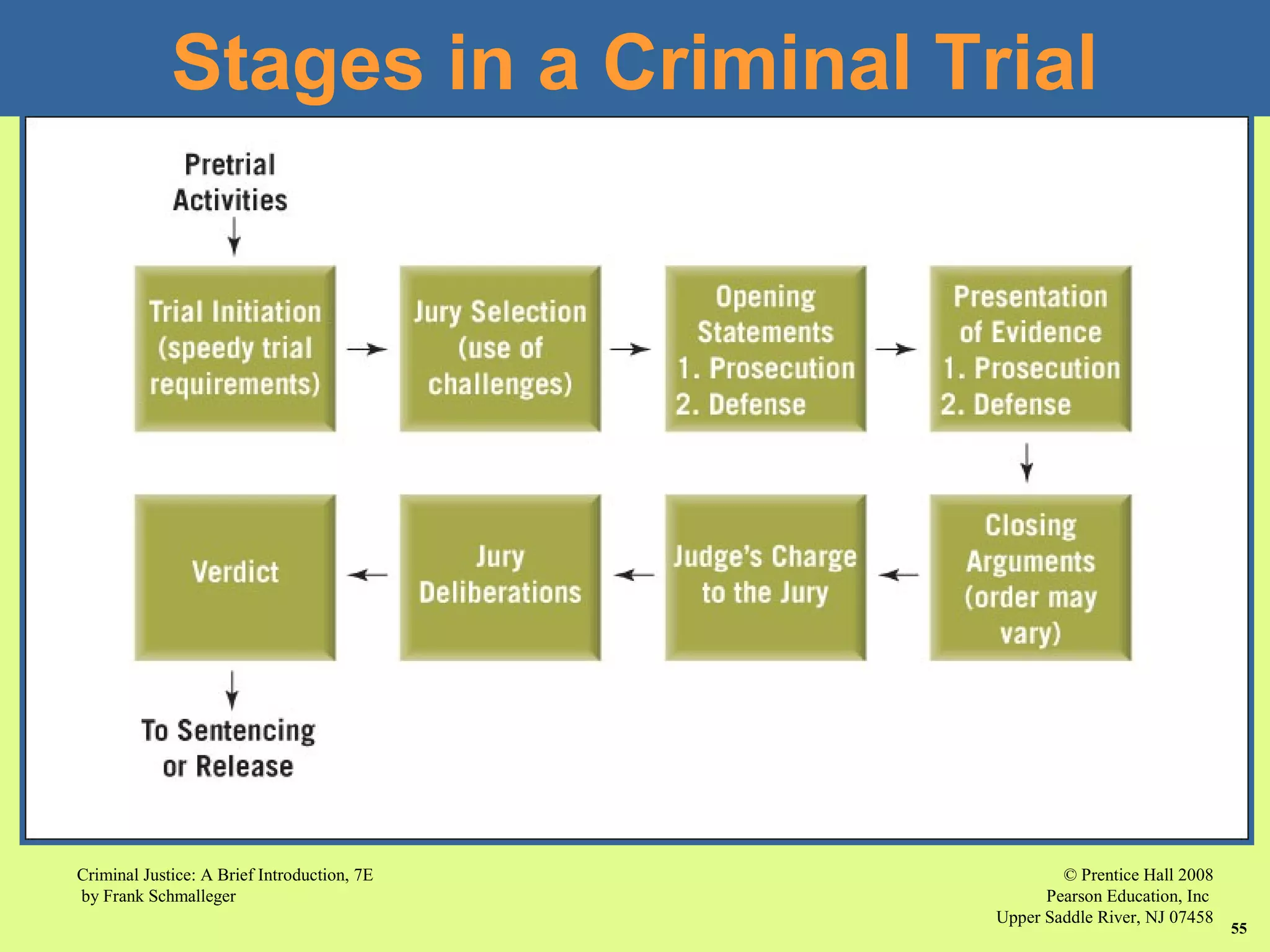
There are eight stages of a criminal trial.
1. Trial initiation
2. Jury selection
3. Opening statements
4. The presentation of evidence
5. Closing arguments
6. The judge’s charge to the jury
7. Jury deliberations
8. The verdict
Stages in a Criminal Trial
© Prentice Hall 2008
Pearson Education, Inc
Upper Saddle River, NJ 07458
Criminal Justice: A Brief Introduction, 7E
by Frank Schmalleger
55
Stages in a Criminal Trial
© Prentice Hall 2008
Pearson Education, Inc
Upper Saddle River, NJ 07458
Criminal Justice: A Brief Introduction, 7E
by Frank Schmalleger
56
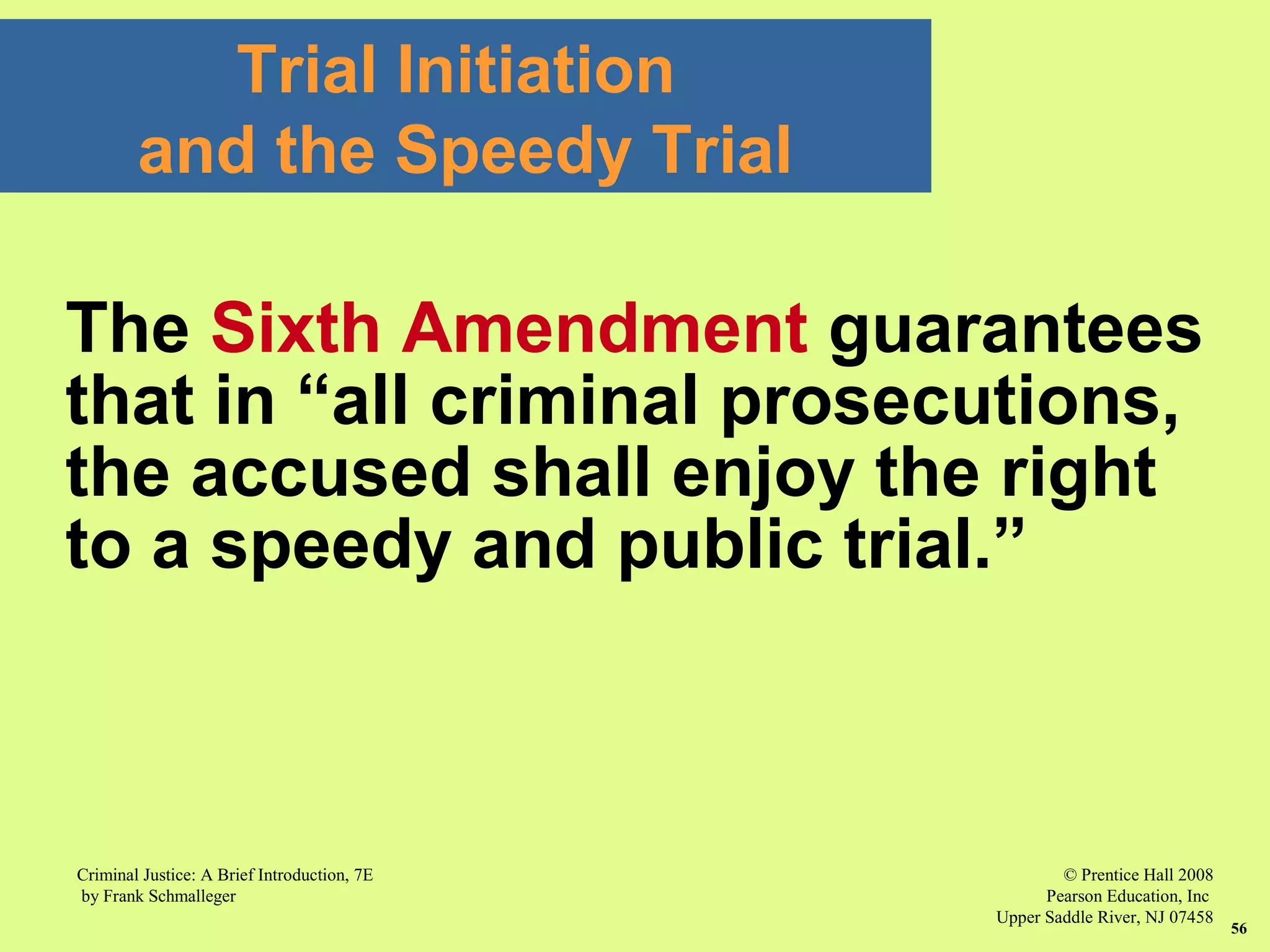
Trial Initiation
and the Speedy Trial
The Sixth Amendment guarantees
that in “all criminal prosecutions,
the accused shall enjoy the right
to a speedy and public trial.”
© Prentice Hall 2008
Pearson Education, Inc
Upper Saddle River, NJ 07458
Criminal Justice: A Brief Introduction, 7E
by Frank Schmalleger
57
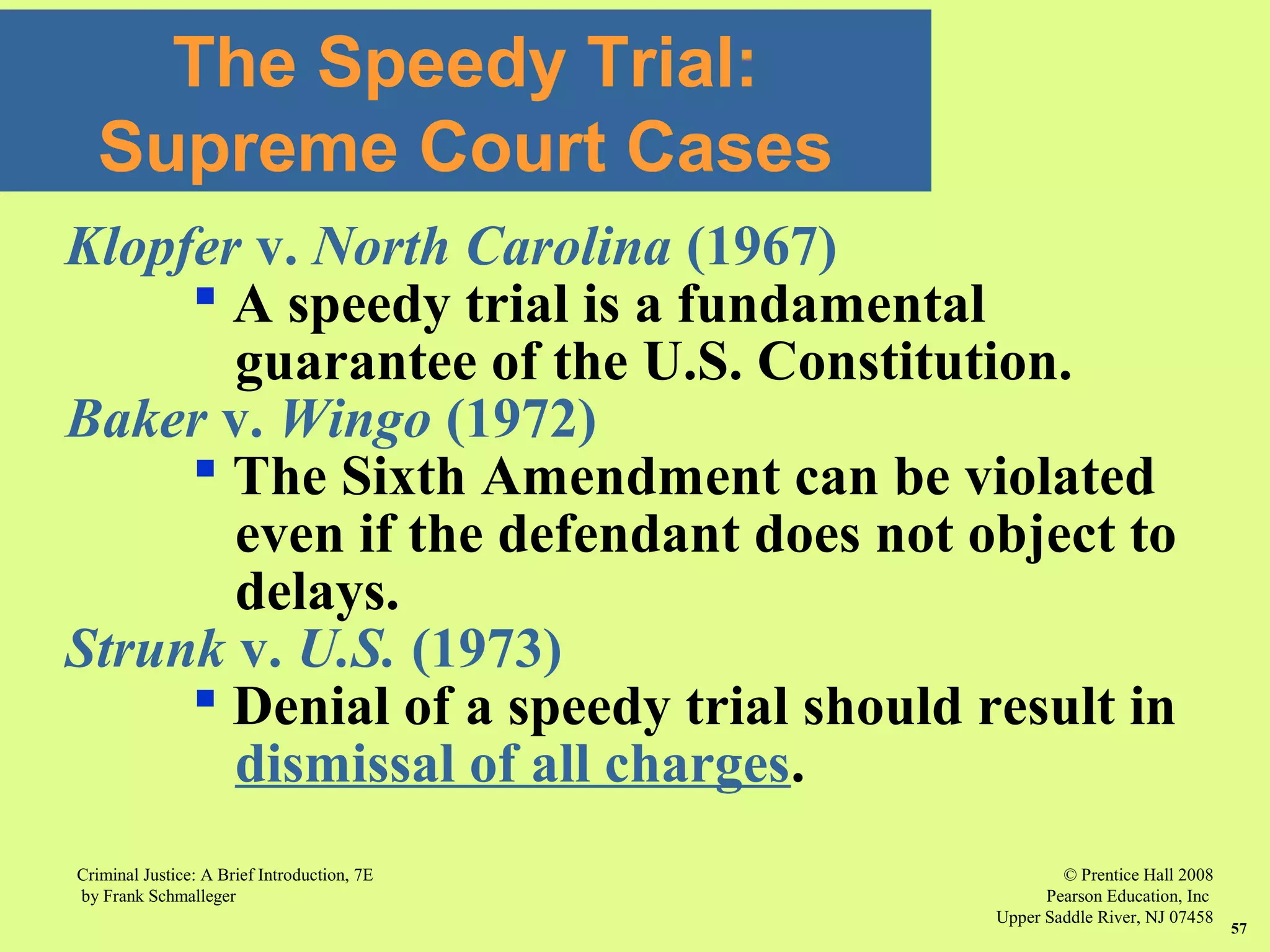
The Speedy Trial:
Supreme Court Cases
Klopfer v. North Carolina (1967)
 A speedy trial is a fundamental
guarantee of the U.S. Constitution.
Baker v. Wingo (1972)
 The Sixth Amendment can be violated
even if the defendant does not object to
delays.
Strunk v. U.S. (1973)
 Denial of a speedy trial should result in
dismissal of all charges.
© Prentice Hall 2008
Pearson Education, Inc
Upper Saddle River, NJ 07458
Criminal Justice: A Brief Introduction, 7E
by Frank Schmalleger
58
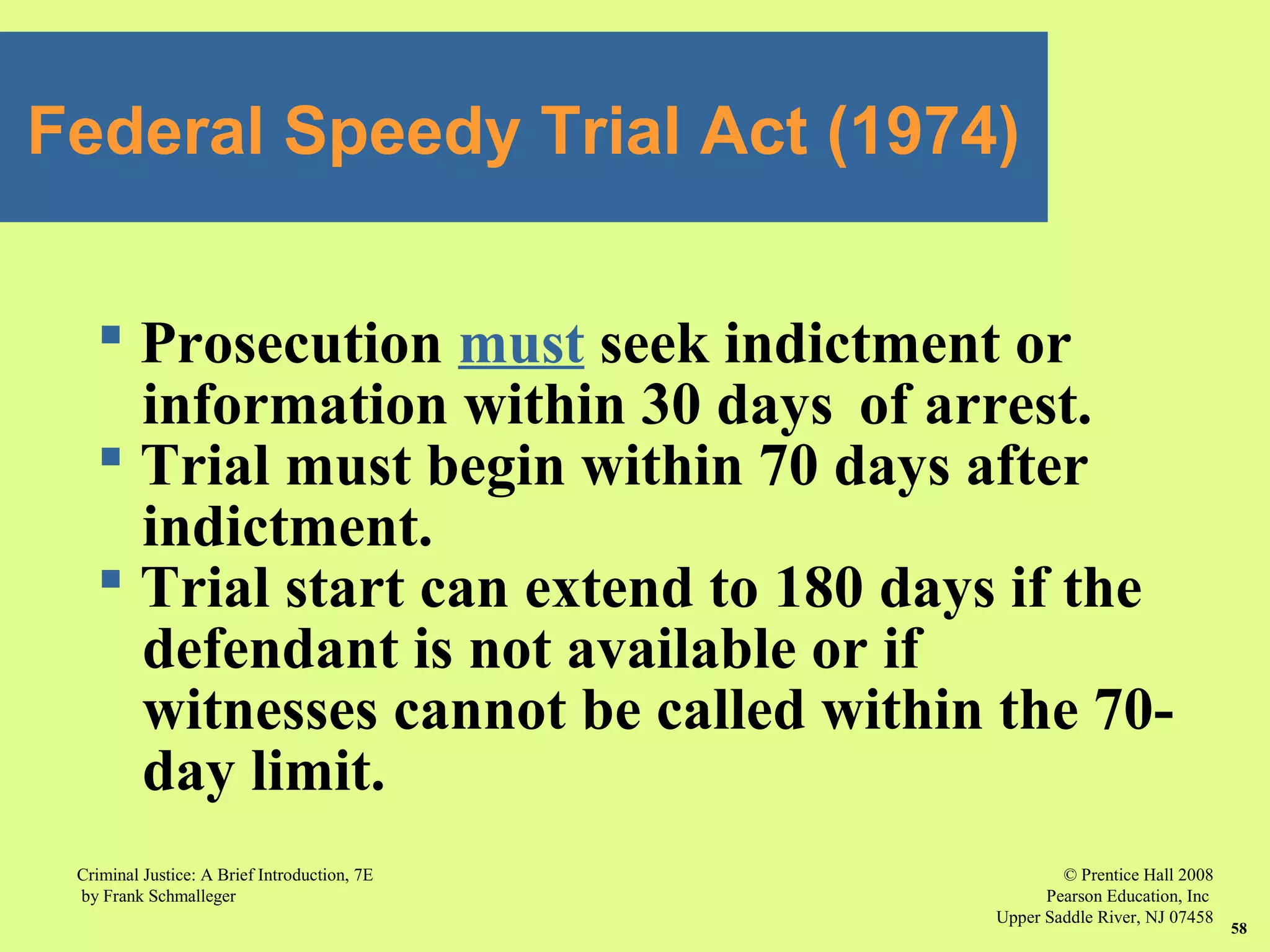
Federal Speedy Trial Act (1974)
 Prosecution must seek indictment or
information within 30 days of arrest.
 Trial must begin within 70 days after
indictment.
 Trial start can extend to 180 days if the
defendant is not available or if
witnesses cannot be called within the 70-
day limit.
© Prentice Hall 2008
Pearson Education, Inc
Upper Saddle River, NJ 07458
Criminal Justice: A Brief Introduction, 7E
by Frank Schmalleger
59
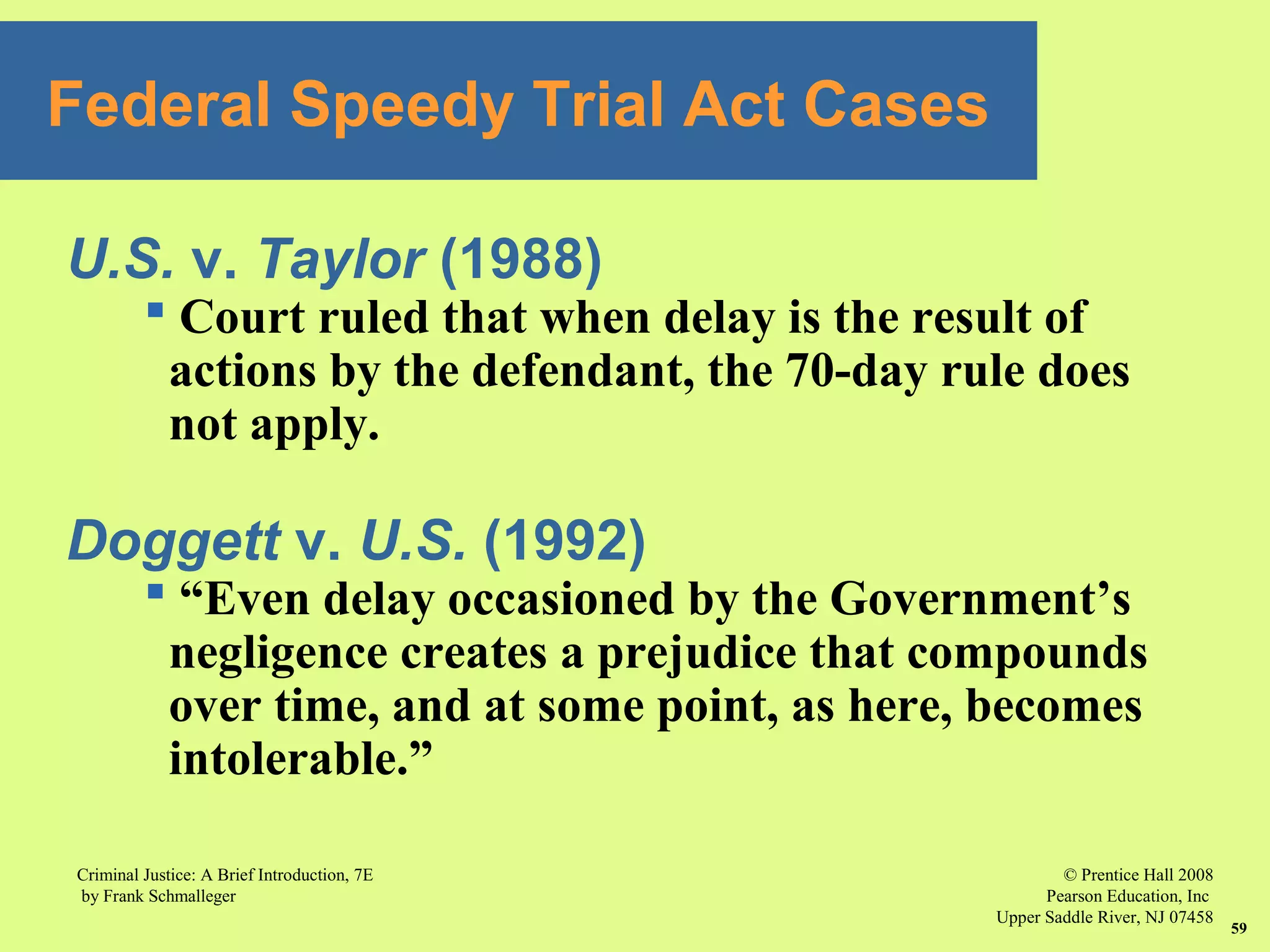
U.S. v. Taylor (1988)
 Court ruled that when delay is the result of
actions by the defendant, the 70-day rule does
not apply.
Doggett v. U.S. (1992)
 “Even delay occasioned by the Government’s
negligence creates a prejudice that compounds
over time, and at some point, as here, becomes
intolerable.”
Federal Speedy Trial Act Cases
© Prentice Hall 2008
Pearson Education, Inc
Upper Saddle River, NJ 07458
Criminal Justice: A Brief Introduction, 7E
by Frank Schmalleger
60
State Speedy Trial Acts
 Many states have enacted their own
speedy trial legislation.
 Most set a limit of 90 or 120 days as a
reasonable period of time for a trial to
begin.
© Prentice Hall 2008
Pearson Education, Inc
Upper Saddle River, NJ 07458
Criminal Justice: A Brief Introduction, 7E
by Frank Schmalleger
61
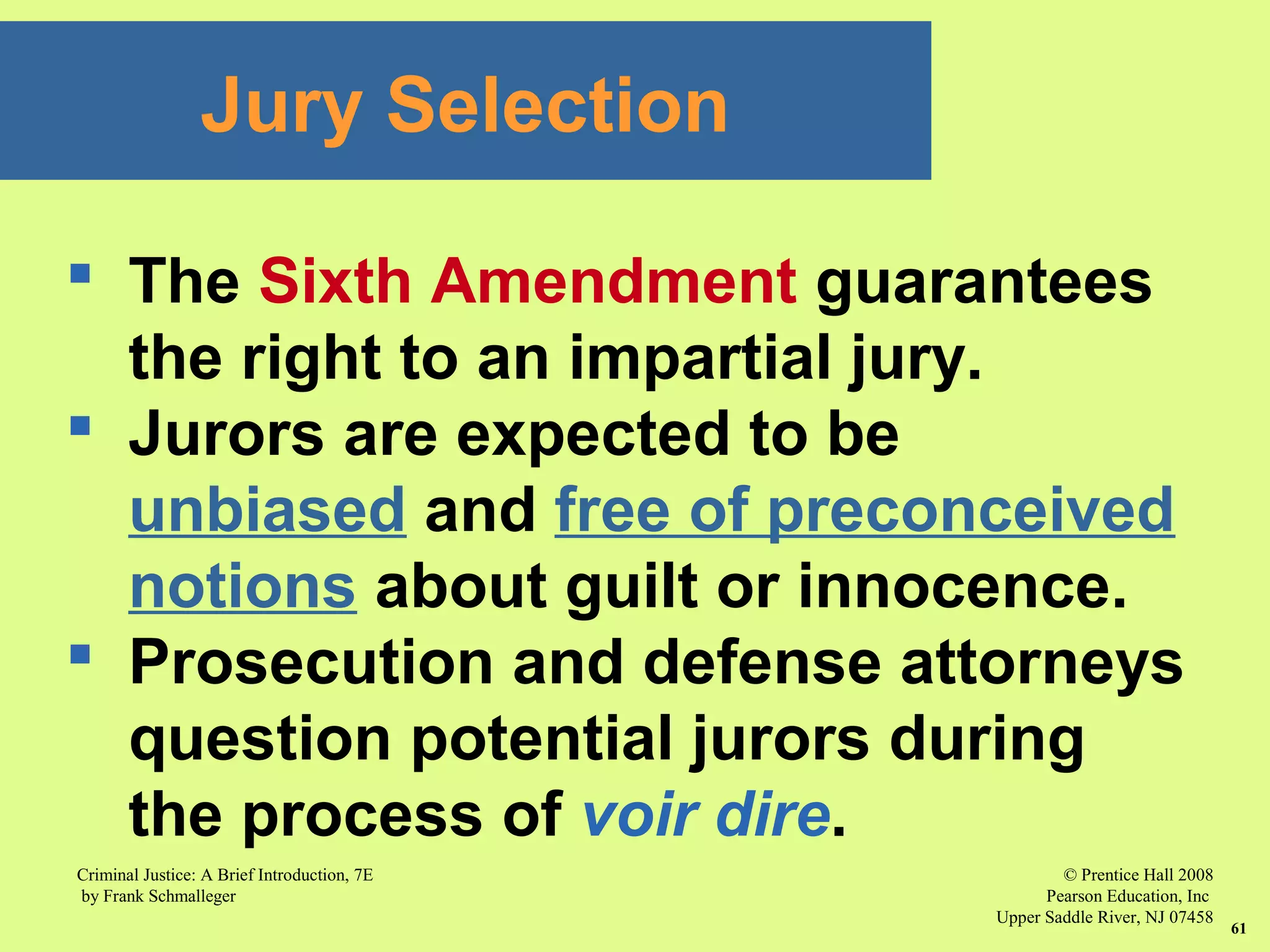
 The Sixth Amendment guarantees
the right to an impartial jury.
 Jurors are expected to be
unbiased and free of preconceived
notions about guilt or innocence.
 Prosecution and defense attorneys
question potential jurors during
the process of voir dire.
Jury Selection
© Prentice Hall 2008
Pearson Education, Inc
Upper Saddle River, NJ 07458
Criminal Justice: A Brief Introduction, 7E
by Frank Schmalleger
62
Jury Selection: Ensuring
Impartiality
 Challenge to the array
 Challenge for cause
 Peremptory challenge
Both the prosecution and defense
can use challenges to remove
prospective jurors from the jury pool.
© Prentice Hall 2008
Pearson Education, Inc
Upper Saddle River, NJ 07458
Criminal Justice: A Brief Introduction, 7E
by Frank Schmalleger
63
Challenge to the Array
 Claims that the pool from which
potential jurors are to be selected
is not representative of the
community.
 Argued in a motion before voir
dire.
© Prentice Hall 2008
Pearson Education, Inc
Upper Saddle River, NJ 07458
Criminal Justice: A Brief Introduction, 7E
by Frank Schmalleger
64
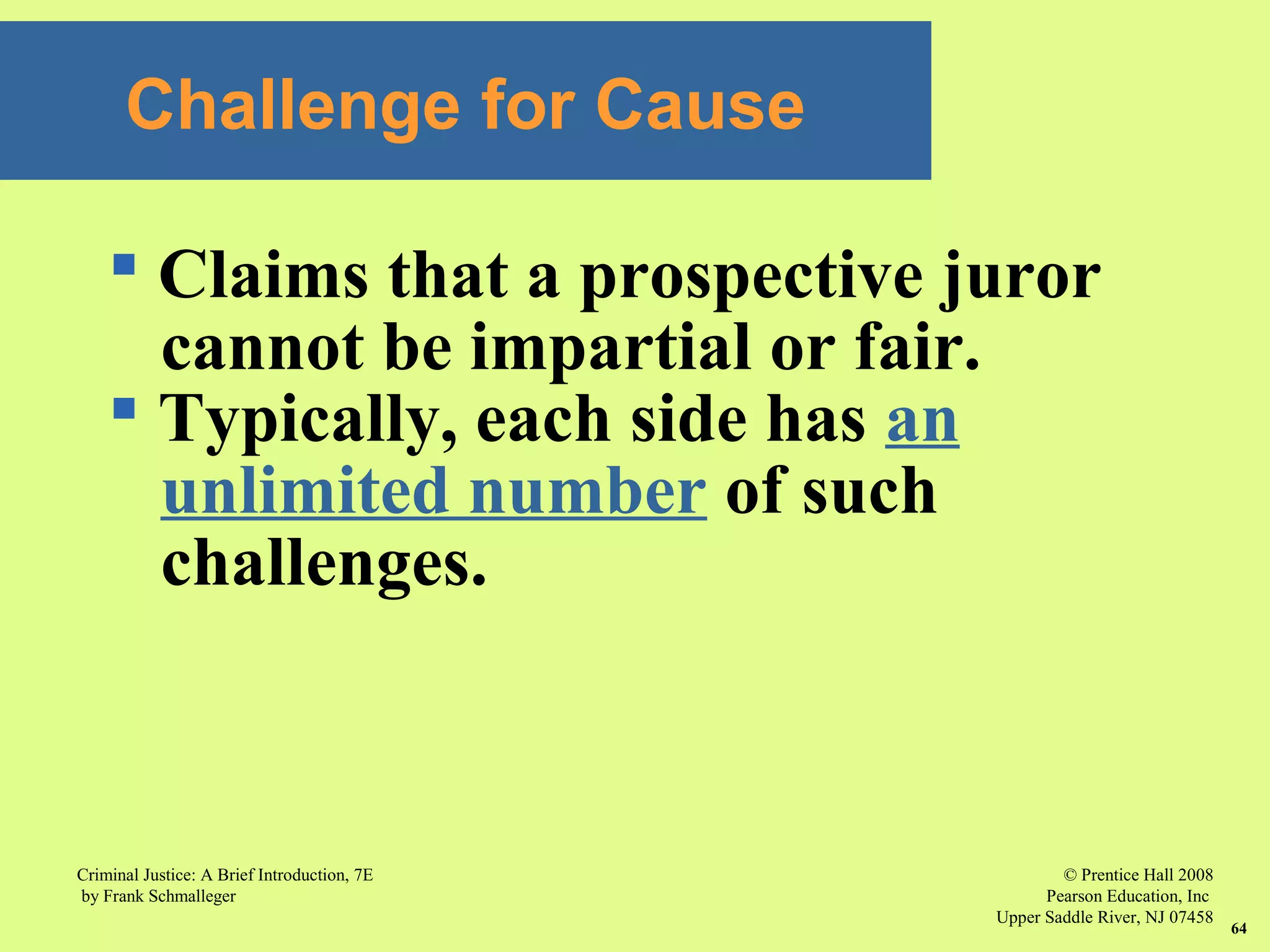
Challenge for Cause
 Claims that a prospective juror
cannot be impartial or fair.
 Typically, each side has an
unlimited number of such
challenges.
© Prentice Hall 2008
Pearson Education, Inc
Upper Saddle River, NJ 07458
Criminal Justice: A Brief Introduction, 7E
by Frank Schmalleger
65
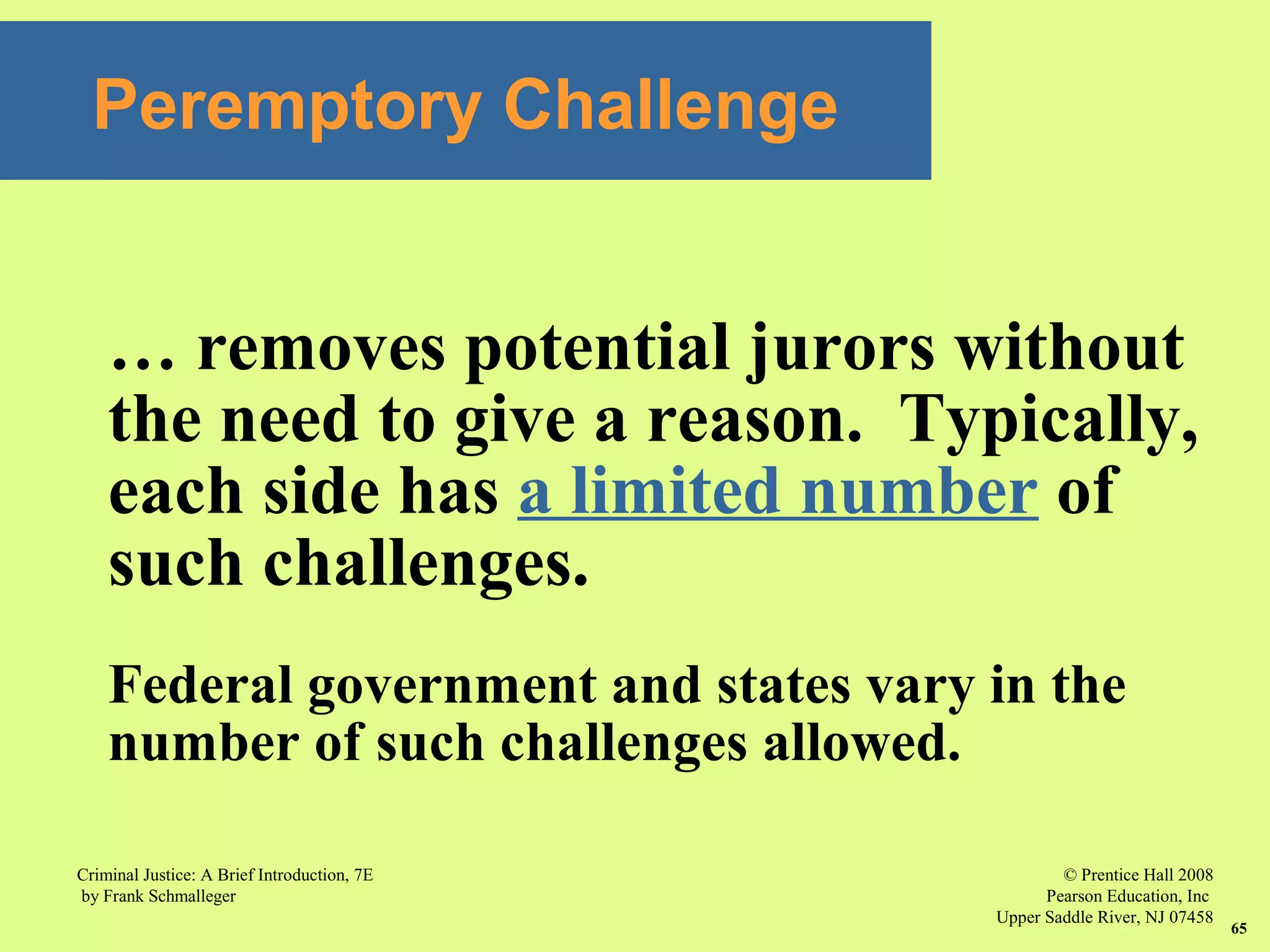
Peremptory Challenge
… removes potential jurors without
the need to give a reason. Typically,
each side has a limited number of
such challenges.
Federal government and states vary in the
number of such challenges allowed.
© Prentice Hall 2008
Pearson Education, Inc
Upper Saddle River, NJ 07458
Criminal Justice: A Brief Introduction, 7E
by Frank Schmalleger
66
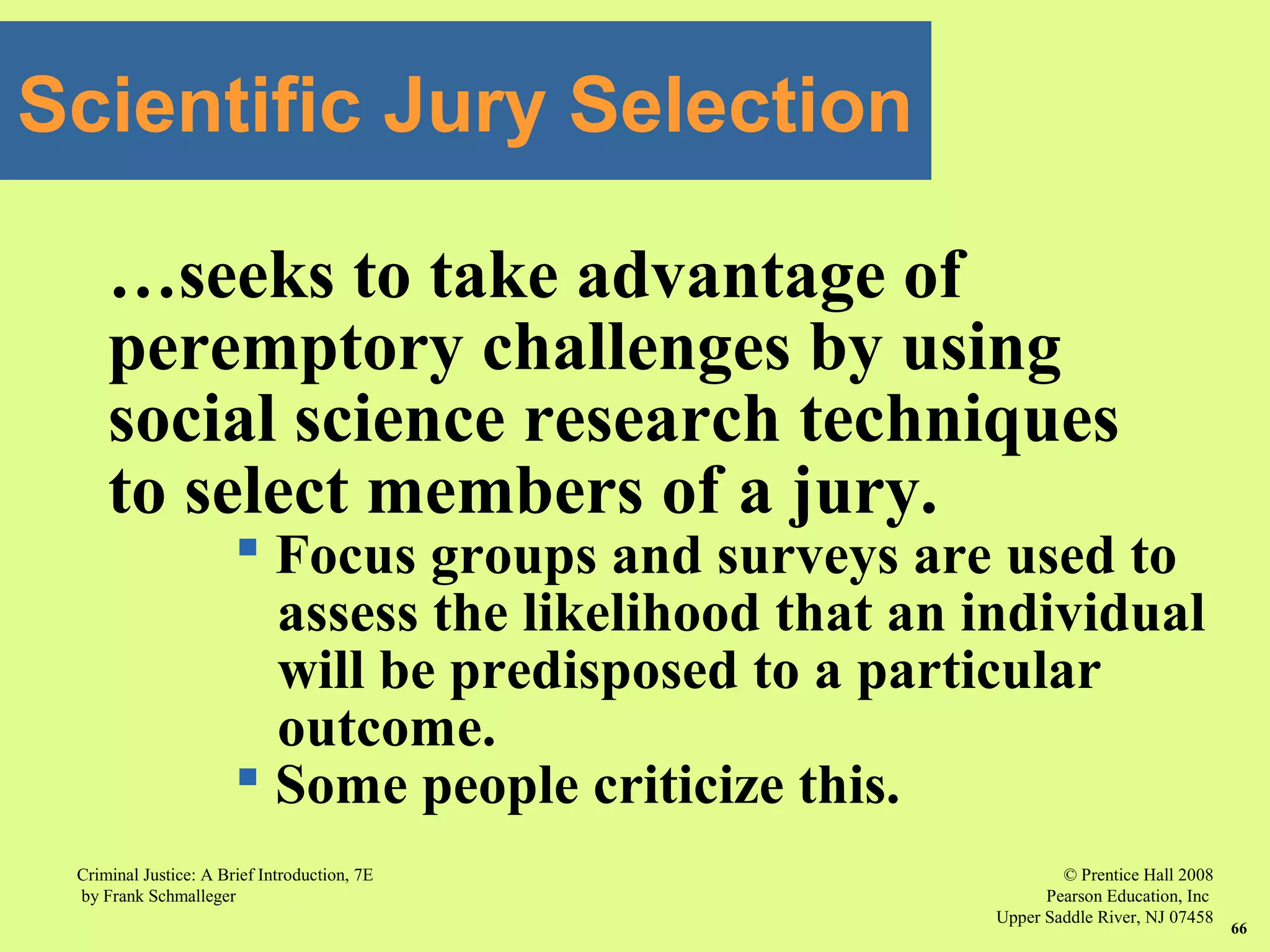
Scientific Jury Selection
…seeks to take advantage of
peremptory challenges by using
social science research techniques
to select members of a jury.
 Focus groups and surveys are used to
assess the likelihood that an individual
will be predisposed to a particular
outcome.
 Some people criticize this.
© Prentice Hall 2008
Pearson Education, Inc
Upper Saddle River, NJ 07458
Criminal Justice: A Brief Introduction, 7E
by Frank Schmalleger
67
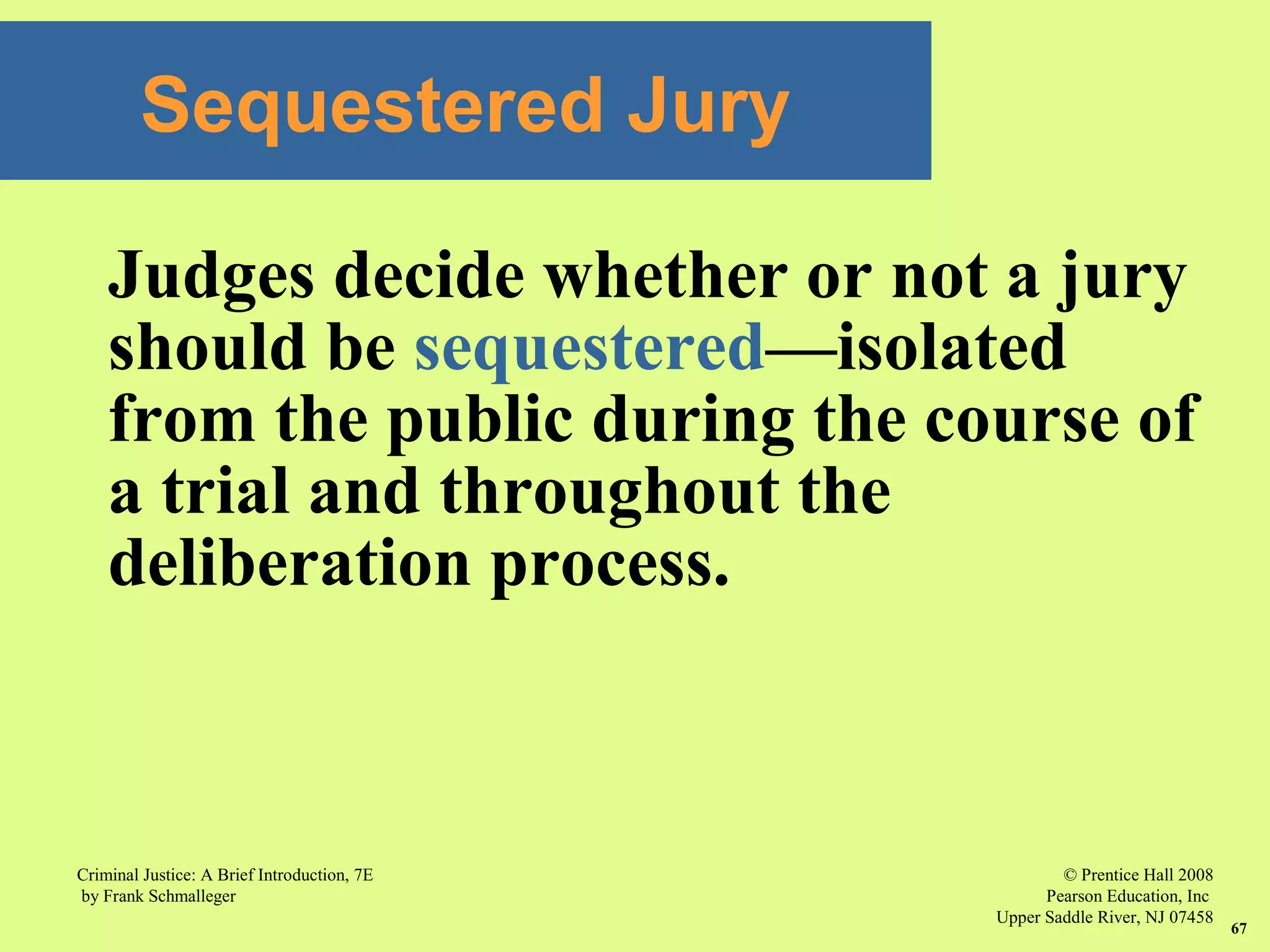
Sequestered Jury
Judges decide whether or not a jury
should be sequestered—isolated
from the public during the course of
a trial and throughout the
deliberation process.
© Prentice Hall 2008
Pearson Education, Inc
Upper Saddle River, NJ 07458
Criminal Justice: A Brief Introduction, 7E
by Frank Schmalleger
68
Jury Selection and Race
Batson v. Kentucky (1986)
 The use of peremptory challenges
for purposeful discrimination
constitutes a violation of the
defendant’s right to an impartial
jury.
© Prentice Hall 2008
Pearson Education, Inc
Upper Saddle River, NJ 07458
Criminal Justice: A Brief Introduction, 7E
by Frank Schmalleger
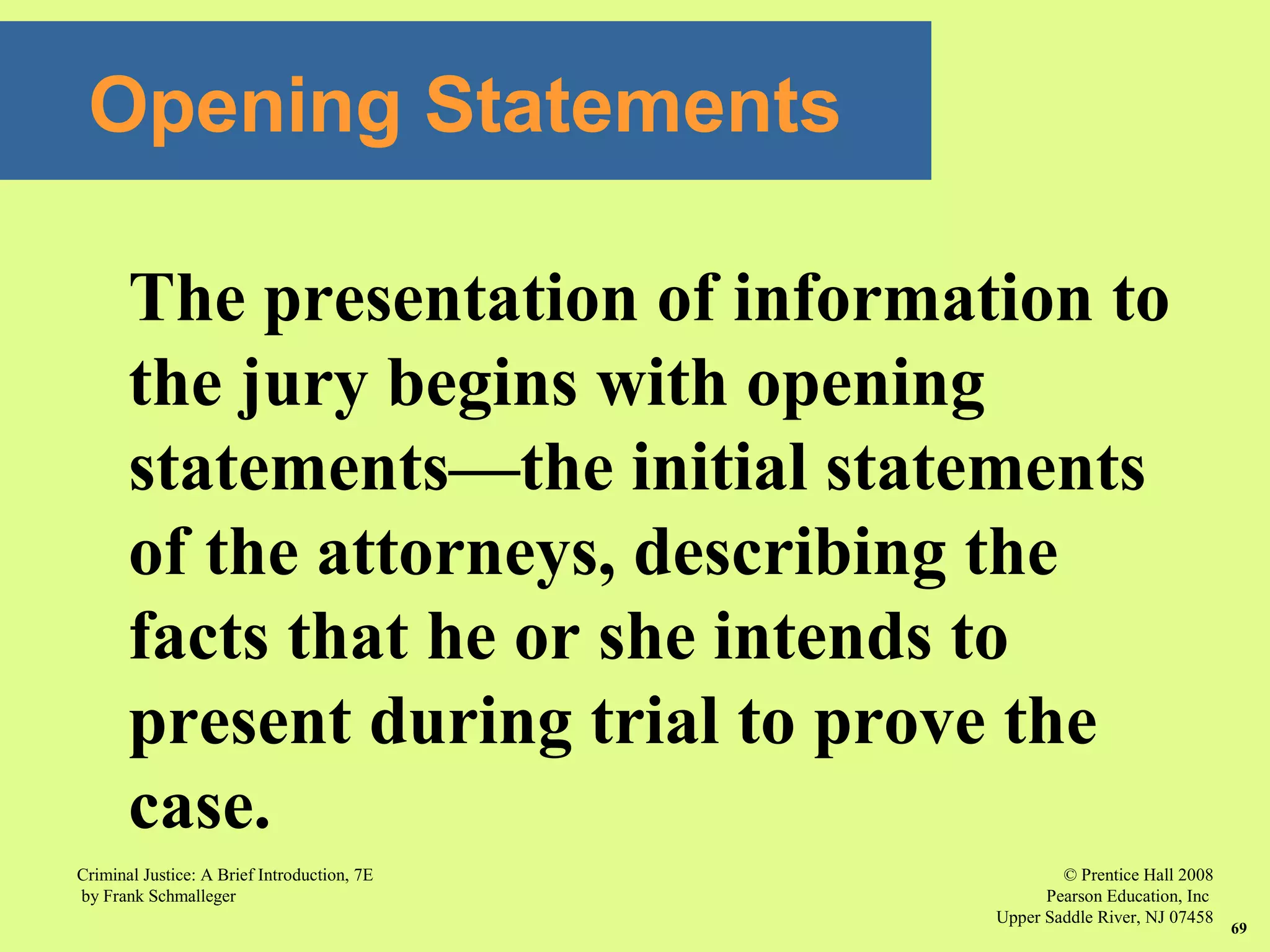
69
The presentation of information to
the jury begins with opening
statements—the initial statements
of the attorneys, describing the
facts that he or she intends to
present during trial to prove the
case.
Opening Statements
© Prentice Hall 2008
Pearson Education, Inc
Upper Saddle River, NJ 07458
Criminal Justice: A Brief Introduction, 7E
by Frank Schmalleger
70
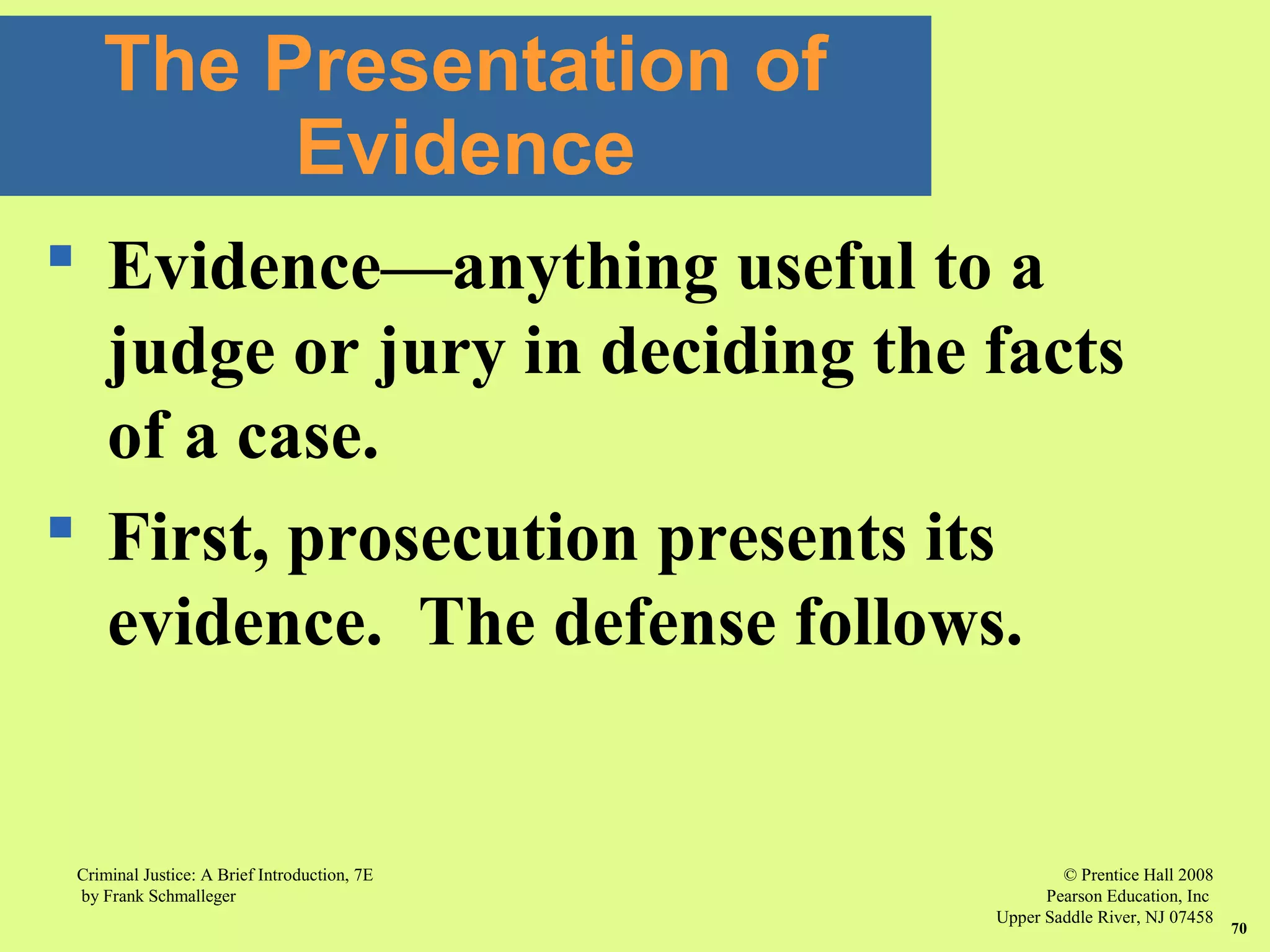
 Evidence—anything useful to a
judge or jury in deciding the facts
of a case.
 First, prosecution presents its
evidence. The defense follows.
The Presentation of
Evidence
© Prentice Hall 2008
Pearson Education, Inc
Upper Saddle River, NJ 07458
Criminal Justice: A Brief Introduction, 7E
by Frank Schmalleger
71
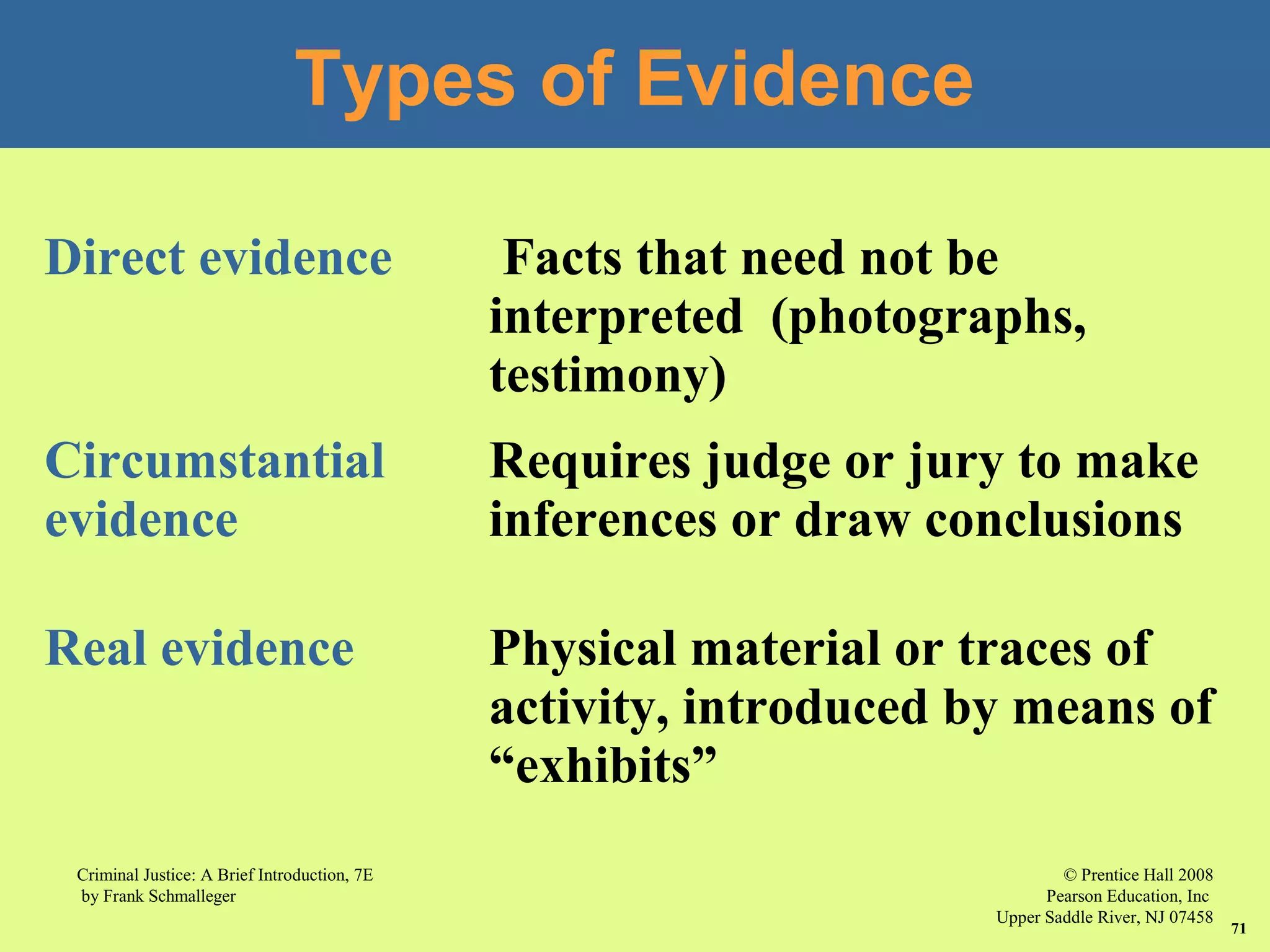
Types of Evidence
Direct evidence Facts that need not be
interpreted (photographs,
testimony)
Circumstantial
evidence
Requires judge or jury to make
inferences or draw conclusions
Real evidence Physical material or traces of
activity, introduced by means of
“exhibits”
© Prentice Hall 2008
Pearson Education, Inc
Upper Saddle River, NJ 07458
Criminal Justice: A Brief Introduction, 7E
by Frank Schmalleger
72
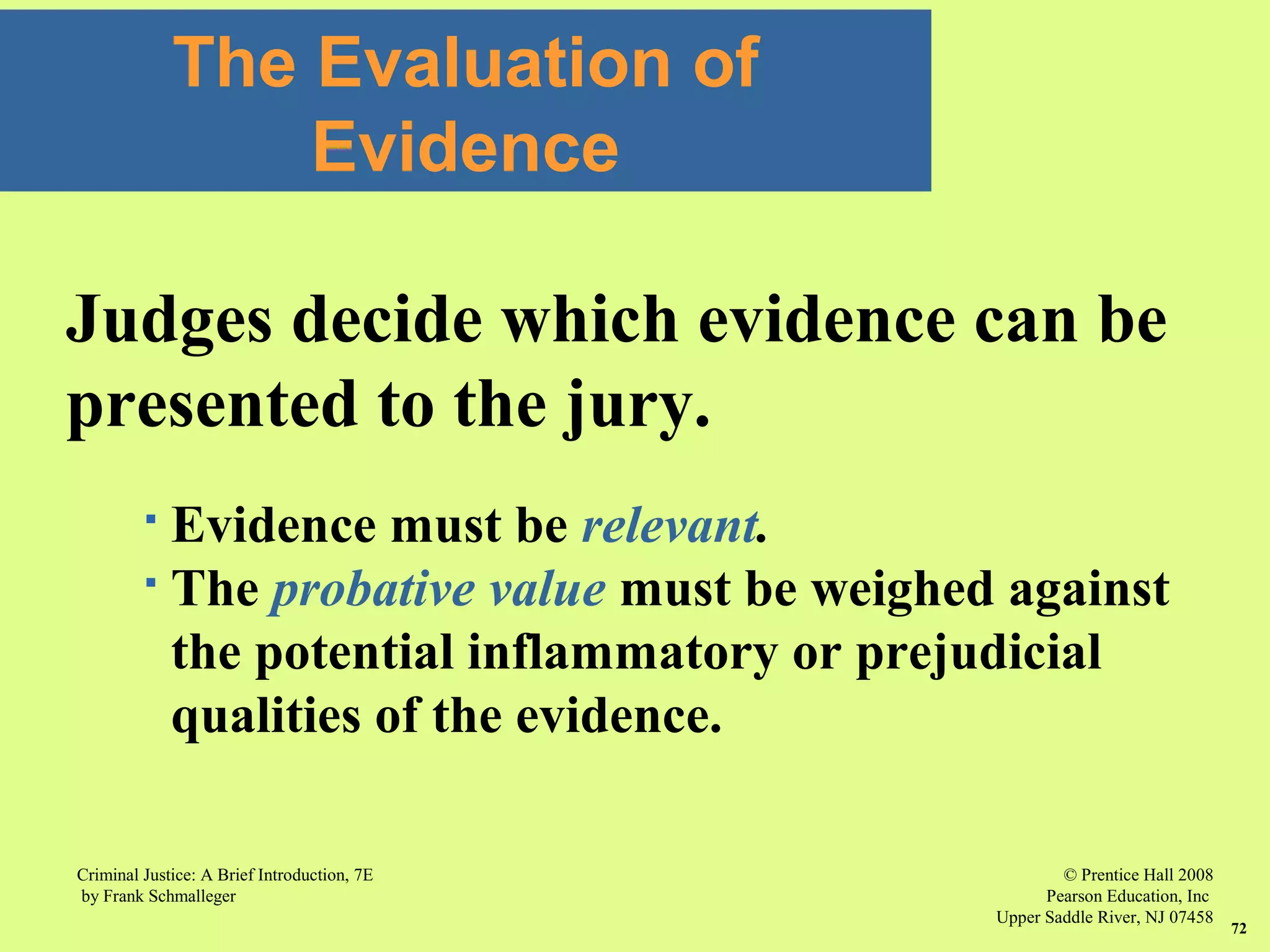
Judges decide which evidence can be
presented to the jury.
 Evidence must be relevant.
 The probative value must be weighed against
the potential inflammatory or prejudicial
qualities of the evidence.
The Evaluation of
Evidence
© Prentice Hall 2008
Pearson Education, Inc
Upper Saddle River, NJ 07458
Criminal Justice: A Brief Introduction, 7E
by Frank Schmalleger
73
Testimony—oral evidence presented by
witnesses, including victims, police officers,
the defendant, and specialists.
 Witnesses must be competent to testify.
 The defendant has the Fifth Amendment
right not to take the stand.
 Witnesses are subject to direct and cross
examination.
 Witnesses who lie under oath commit
perjury.
The Testimony of
Witnesses
© Prentice Hall 2008
Pearson Education, Inc
Upper Saddle River, NJ 07458
Criminal Justice: A Brief Introduction, 7E
by Frank Schmalleger
74
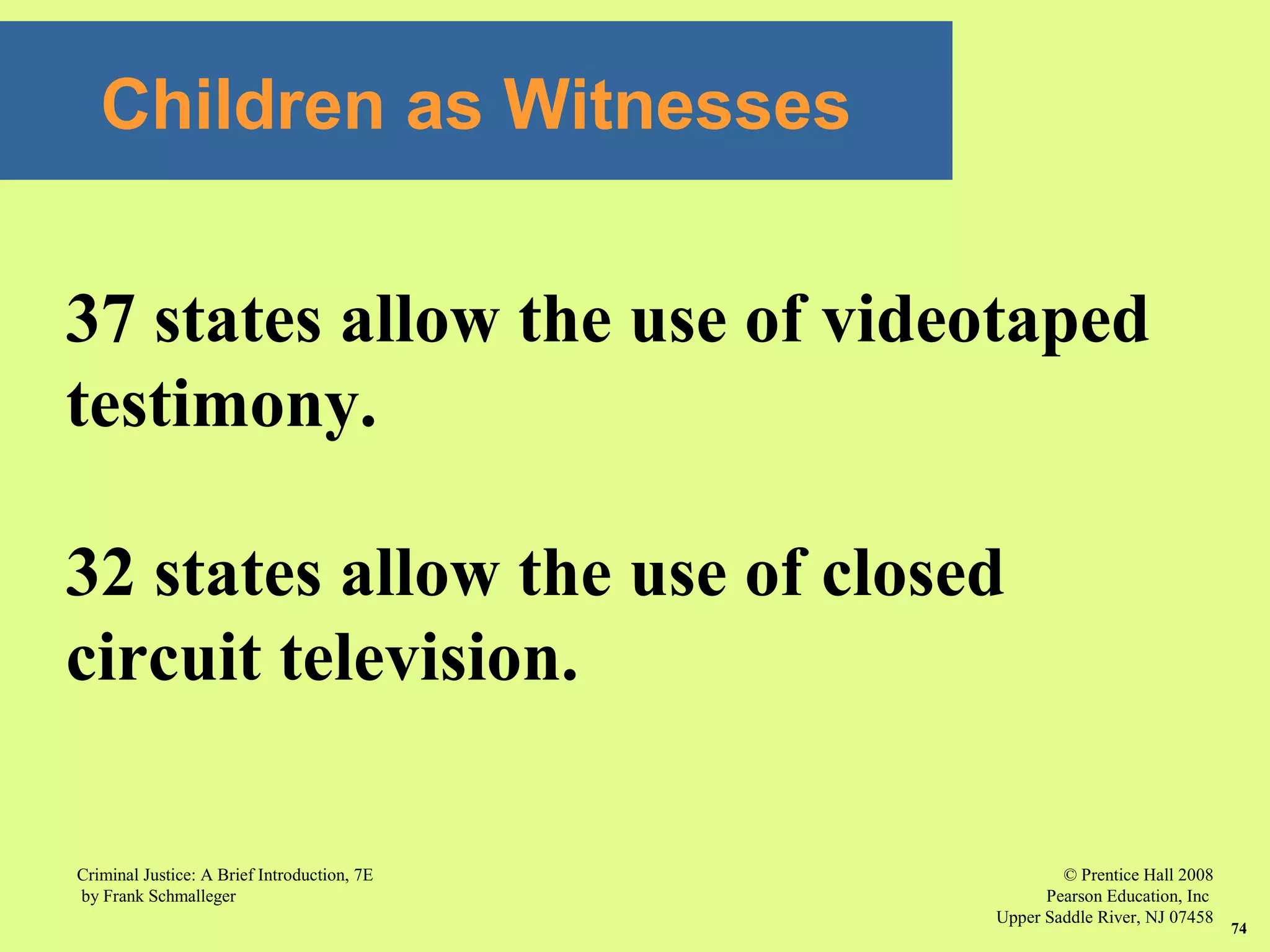
37 states allow the use of videotaped
testimony.
32 states allow the use of closed
circuit television.
Children as Witnesses
© Prentice Hall 2008
Pearson Education, Inc
Upper Saddle River, NJ 07458
Criminal Justice: A Brief Introduction, 7E
by Frank Schmalleger
75
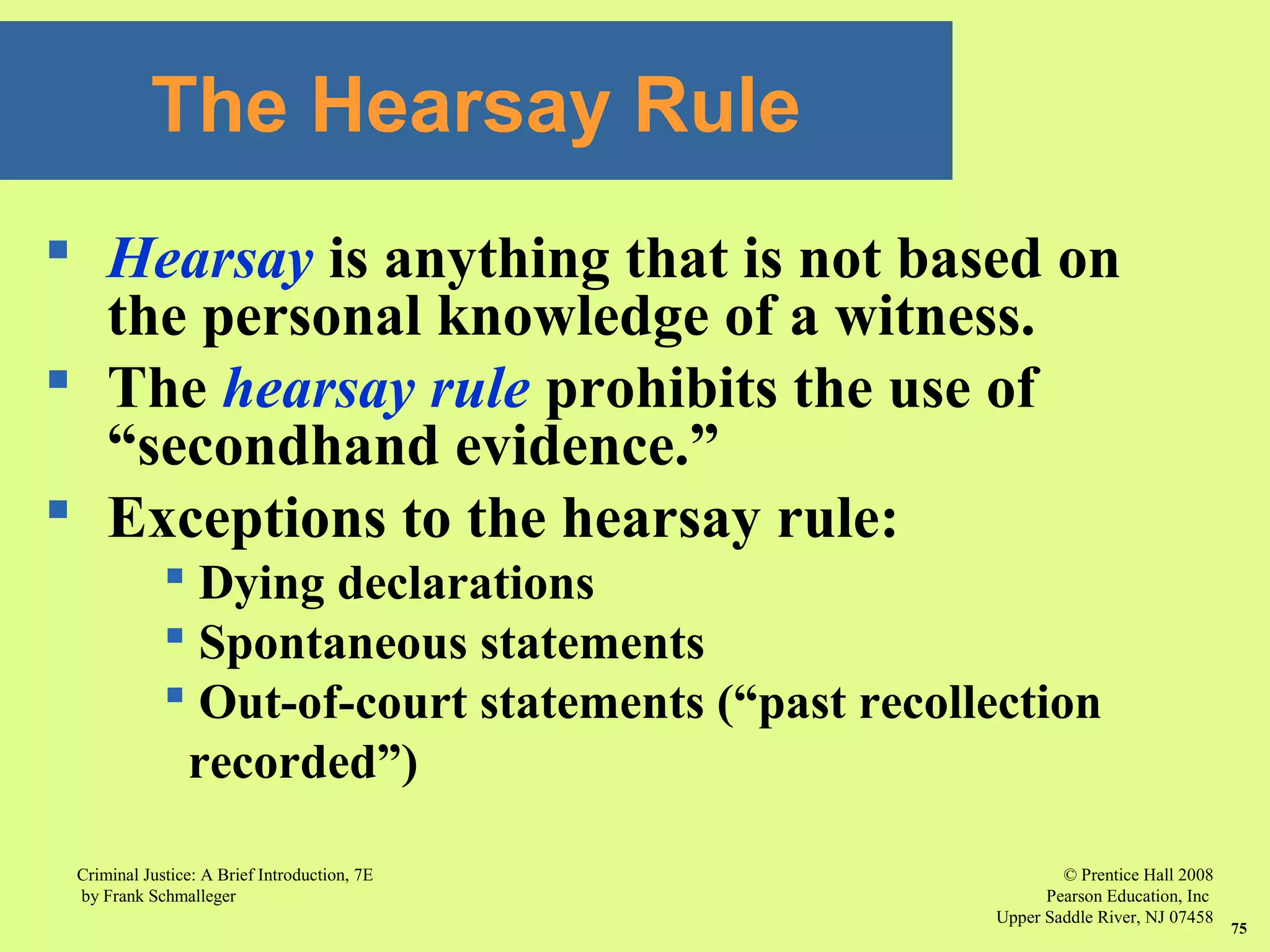
 Hearsay is anything that is not based on
the personal knowledge of a witness.
 The hearsay rule prohibits the use of
“secondhand evidence.”
 Exceptions to the hearsay rule:
 Dying declarations
 Spontaneous statements
 Out-of-court statements (“past recollection
recorded”)
The Hearsay Rule
© Prentice Hall 2008
Pearson Education, Inc
Upper Saddle River, NJ 07458
Criminal Justice: A Brief Introduction, 7E
by Frank Schmalleger
76
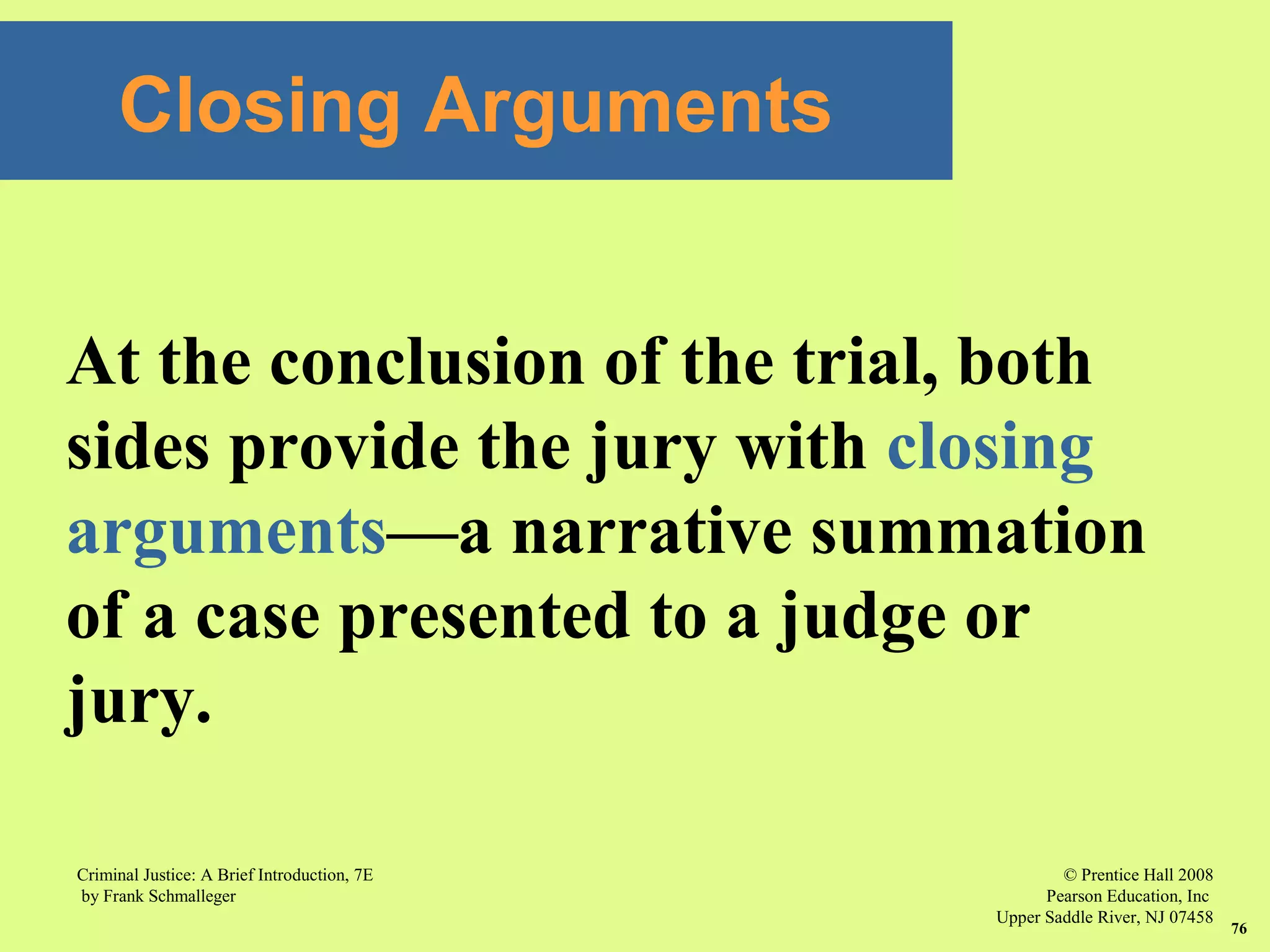
At the conclusion of the trial, both
sides provide the jury with closing
arguments—a narrative summation
of a case presented to a judge or
jury.
Closing Arguments
© Prentice Hall 2008
Pearson Education, Inc
Upper Saddle River, NJ 07458
Criminal Justice: A Brief Introduction, 7E
by Frank Schmalleger
77
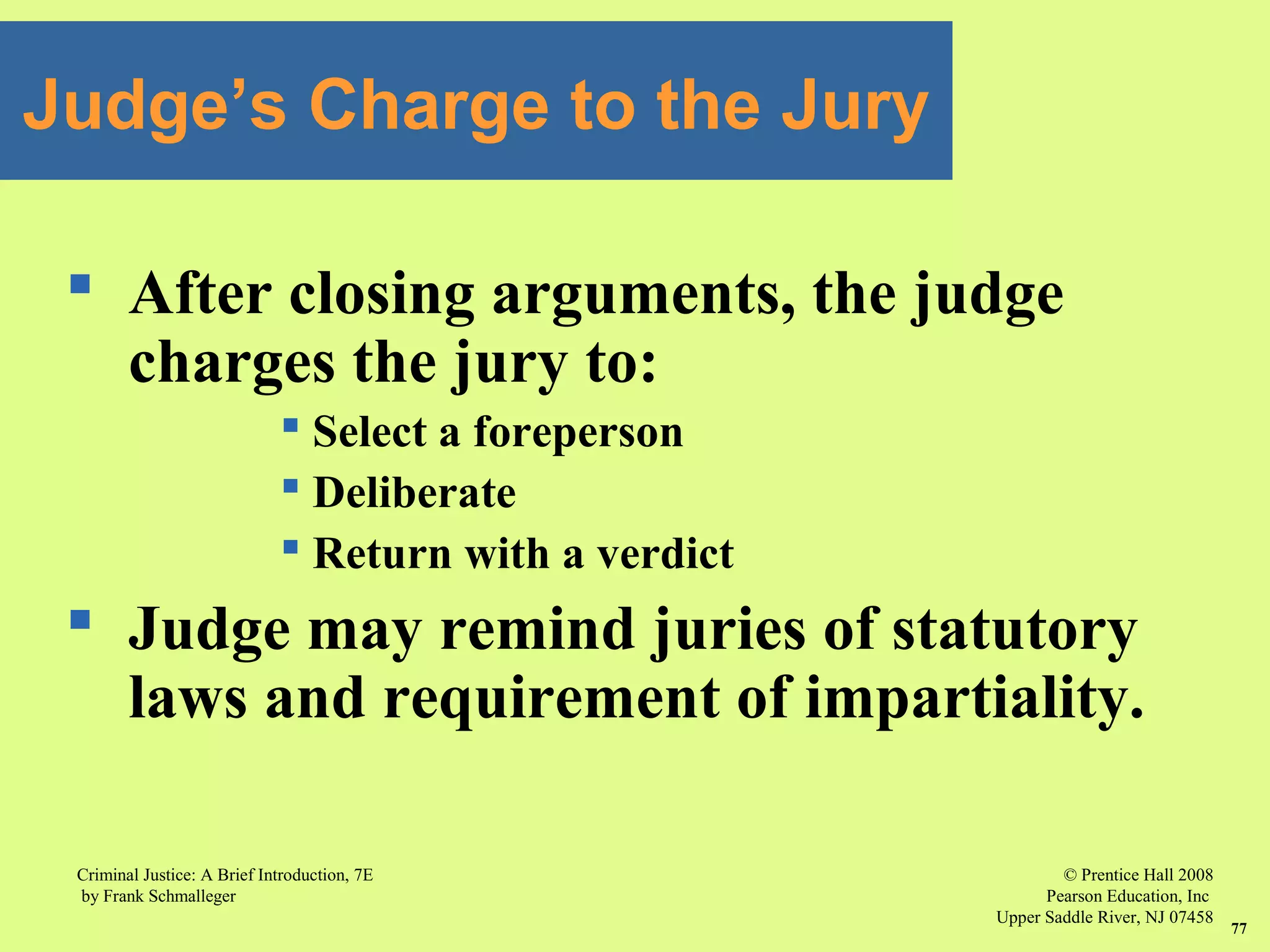
 After closing arguments, the judge
charges the jury to:
 Select a foreperson
 Deliberate
 Return with a verdict
 Judge may remind juries of statutory
laws and requirement of impartiality.
Judge’s Charge to the Jury
© Prentice Hall 2008
Pearson Education, Inc
Upper Saddle River, NJ 07458
Criminal Justice: A Brief Introduction, 7E
by Frank Schmalleger
78
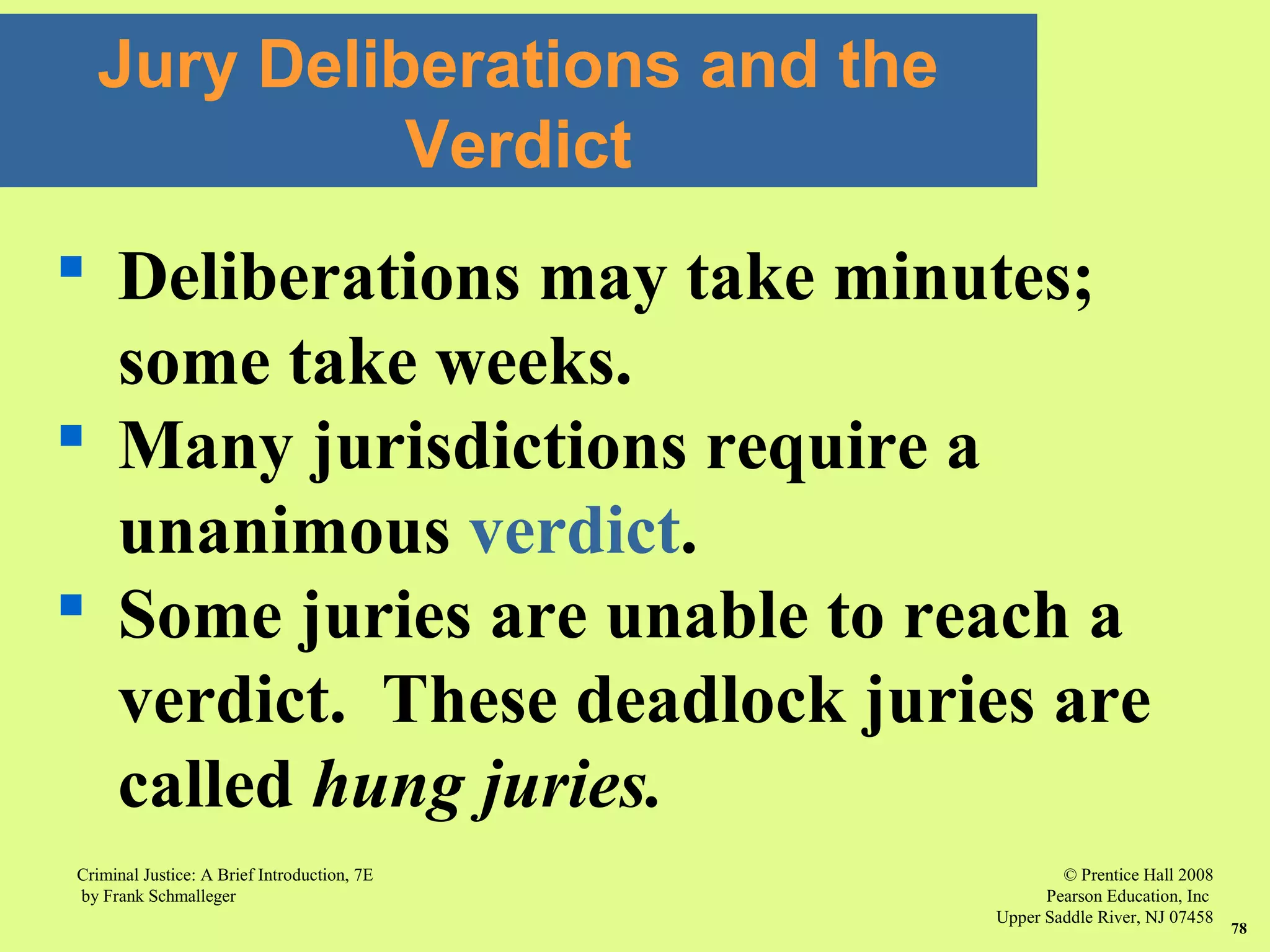
 Deliberations may take minutes;
some take weeks.
 Many jurisdictions require a
unanimous verdict.
 Some juries are unable to reach a
verdict. These deadlock juries are
called hung juries.
Jury Deliberations and the
Verdict
© Prentice Hall 2008
Pearson Education, Inc
Upper Saddle River, NJ 07458
Criminal Justice: A Brief Introduction, 7E
by Frank Schmalleger
79
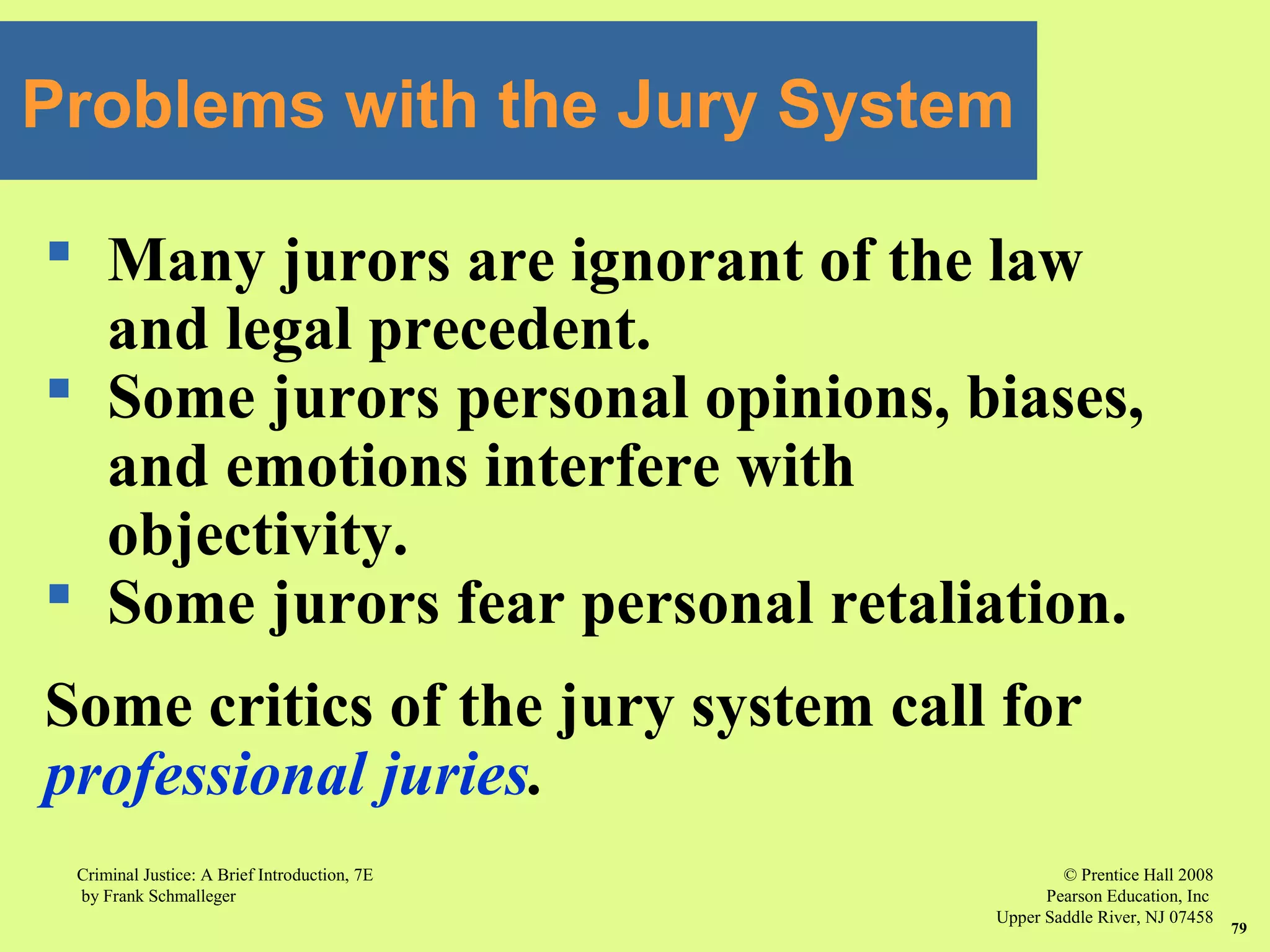
 Many jurors are ignorant of the law
and legal precedent.
 Some jurors personal opinions, biases,
and emotions interfere with
objectivity.
 Some jurors fear personal retaliation.
Some critics of the jury system call for
professional juries.
Problems with the Jury System
© Prentice Hall 2008
Pearson Education, Inc
Upper Saddle River, NJ 07458
Criminal Justice: A Brief Introduction, 7E
by Frank Schmalleger
80
Improving the process may involve:
 Greater unification and reducing the
number of jurisdictions.
 A growing number of court-watch
citizen groups.
 More accurate statistical
measurement of court performance.
Improving the Adjudication
Process

Ch08bCourtroom

  • 1.
    © Prentice Hall2008 Pearson Education, Inc Upper Saddle River, NJ 07458 Criminal Justice: A Brief Introduction, 7E by Frank Schmalleger 1 The Courtroom Work Group and the Criminal Trial CHAPTER 8
  • 2.
    © Prentice Hall2008 Pearson Education, Inc Upper Saddle River, NJ 07458 Criminal Justice: A Brief Introduction, 7E by Frank Schmalleger 2 The Courtroom Work Group: Professional Courtroom Actors
  • 3.
    © Prentice Hall2008 Pearson Education, Inc Upper Saddle River, NJ 07458 Criminal Justice: A Brief Introduction, 7E by Frank Schmalleger 3 Courtroom Participants Professional (the courtroom workgroup)  Judge  Prosecuting attorney  Defense attorney  Bailiff  Court reporter  Clerk of the court  Expert witnesses Non-Professional  Lay witnesses  Jurors  Defendant  Victim  Spectators  Press
  • 4.
    © Prentice Hall2008 Pearson Education, Inc Upper Saddle River, NJ 07458 Criminal Justice: A Brief Introduction, 7E by Frank Schmalleger 4 Primary duty  to ensure justice Responsibilities include:  Ruling on most matters of the law  Weighing objections  Deciding the admissibility of evidence  Sentencing offenders  Disciplining disorderly courtroom attendees  Deciding guilt or innocence (for bench trials) The Judge
  • 5.
    © Prentice Hall2008 Pearson Education, Inc Upper Saddle River, NJ 07458 Criminal Justice: A Brief Introduction, 7E by Frank Schmalleger 5 The chief judge handles administrative responsibilities if there is no court administrator. The chief judge:  Hires staff  Ensures adequate training of new judges and staff  Generally manages court operations The Judge
  • 6.
    © Prentice Hall2008 Pearson Education, Inc Upper Saddle River, NJ 07458 Criminal Justice: A Brief Introduction, 7E by Frank Schmalleger 6 Judicial Selection Federal Judges  Nominated by President  Confirmed by senate State Judges  Popular election  Gubernatorial appointment  Missouri Plan (combines appointment and election)
  • 7.
    © Prentice Hall2008 Pearson Education, Inc Upper Saddle River, NJ 07458 Criminal Justice: A Brief Introduction, 7E by Frank Schmalleger 7  Non-partisan committee creates a list of possible candidates.  The governor appoints from the list.  After a specified time period, the appointed judge stands for election. Missouri Plan
  • 8.
    © Prentice Hall2008 Pearson Education, Inc Upper Saddle River, NJ 07458 Criminal Justice: A Brief Introduction, 7E by Frank Schmalleger 8 Judges: Qualifications At general and appellate levels, judges must:  Be a member of the state bar  Be a licensed attorney  Hold a law degree (in most states)  Attend professional training In some lower courts, judges may be elected without educational or other professional requirements.
  • 9.
    © Prentice Hall2008 Pearson Education, Inc Upper Saddle River, NJ 07458 Criminal Justice: A Brief Introduction, 7E by Frank Schmalleger 9 Prosecuting Attorney Prosecutors are also referred to as: solicitor, district attorney, state’s attorney, county attorney, or commonwealth attorney. Federal prosecutors are called U.S. Attorneys.
  • 10.
    © Prentice Hall2008 Pearson Education, Inc Upper Saddle River, NJ 07458 Criminal Justice: A Brief Introduction, 7E by Frank Schmalleger 10 Prosecutors can be elected or appointed.  All but five states elect prosecutors. Prosecutors are elected for four-year terms.  Five states and the federal government appoint their prosecutors. Prosecutor
  • 11.
    © Prentice Hall2008 Pearson Education, Inc Upper Saddle River, NJ 07458 Criminal Justice: A Brief Introduction, 7E by Frank Schmalleger 11  Present the state’s case against the defendant  State has the burden of proof  Supervise staff of assistant district attorneys  Serve as quasi-legal advisor to police  Files appeals on behalf of the state  Makes presentations to parole boards Prosecutor’s Responsibilities
  • 12.
    © Prentice Hall2008 Pearson Education, Inc Upper Saddle River, NJ 07458 Criminal Justice: A Brief Introduction, 7E by Frank Schmalleger 12 …decision-making power, based on the wide range of choices available to them. Prosecutorial Discretion
  • 13.
    © Prentice Hall2008 Pearson Education, Inc Upper Saddle River, NJ 07458 Criminal Justice: A Brief Introduction, 7E by Frank Schmalleger 13 Prosecutor decides:  Whether or not to charge someone with a crime  Which charges are to be filed against the defendant  Whether multiple charges should be filed together or separately  When to schedule cases for trial  Whether or not to accept a negotiated plea  What evidence to present, including witnesses  What sentencing recommendations to make Prosecutorial Discretion
  • 14.
    © Prentice Hall2008 Pearson Education, Inc Upper Saddle River, NJ 07458 Criminal Justice: A Brief Introduction, 7E by Frank Schmalleger 14 Brady v. Maryland (1963) The U.S. Supreme Court held that the prosecution is required to disclose to the defense any exculpatory evidence in its possession that directly or indirectly relates to claims of either guilt or innocence. Disclosure of Evidence
  • 15.
    © Prentice Hall2008 Pearson Education, Inc Upper Saddle River, NJ 07458 Criminal Justice: A Brief Introduction, 7E by Frank Schmalleger 15 U.S. v. Bagley (1985) The Court ruled that the prosecution must disclose any evidence in its possession that the defense requests. To withhold evidence, even when it does not directly relate to issues of guilt or innocence, may mislead the defense into thinking that such evidence does not exist. Disclosure of Evidence
  • 16.
    © Prentice Hall2008 Pearson Education, Inc Upper Saddle River, NJ 07458 Criminal Justice: A Brief Introduction, 7E by Frank Schmalleger 16 Imbler v. Patchman (1976) “State prosecutors are absolutely immune from liability…for their conduct in initiating a prosecution and in presenting a State’s case.” Burns v. Reed (1991) A “state prosecuting attorney is absolutely immune from liability for damages…for participating in a probable cause hearing, but not for giving legal advice to the police.” Prosecutorial Liability
  • 17.
    © Prentice Hall2008 Pearson Education, Inc Upper Saddle River, NJ 07458 Criminal Justice: A Brief Introduction, 7E by Frank Schmalleger 17 Abuse of Discretion  Not prosecuting friends  Accepting guilty pleas or reduced charges for personal consideration  Overzealous prosecution to gain visibility for possible re-election  Scheduling activities to make life difficult for defendants, in an attempt to put pressure on them to plead guilty  Discrimination against minorities  Withholding exculpatory evidence Prosecutors may abuse their discretion by
  • 18.
    © Prentice Hall2008 Pearson Education, Inc Upper Saddle River, NJ 07458 Criminal Justice: A Brief Introduction, 7E by Frank Schmalleger 18 The Prosecutor’s Professional Responsibility Prosecutors are expected to abide by various standards of professional responsibility, such as those found in the American Bar Association (ABA) Model Rules of Professional Standards. Prosecutors are barred from advocating any fact or position they know is untrue.
  • 19.
    © Prentice Hall2008 Pearson Education, Inc Upper Saddle River, NJ 07458 Criminal Justice: A Brief Introduction, 7E by Frank Schmalleger 19 The defense counsel is a lawyer who:  Represents the accused  Participates in plea negotiations  Prepares a defense  Calls witnesses  Refutes cases presented by prosecutor  Presents arguments at time of sentencing  Files appeals Defense Counsel
  • 20.
    © Prentice Hall2008 Pearson Education, Inc Upper Saddle River, NJ 07458 Criminal Justice: A Brief Introduction, 7E by Frank Schmalleger 20 Three Major Categories of Defense Counsel 1. Private attorney (retained counsel) Have their own legal practices or work for law firms Fees can be high 2. Court-assigned counsel (assigned counsel) Lawyers drawn from a roster of all practicing attorneys Fees are paid at a rate set by the government 3. Public defender Relies on full-time salaried government staff
  • 21.
    © Prentice Hall2008 Pearson Education, Inc Upper Saddle River, NJ 07458 Criminal Justice: A Brief Introduction, 7E by Frank Schmalleger 21 Criminal Defense of the Poor The Sixth Amendment to the U.S. Constitution guarantees criminal defendants the effective assistance of counsel. Defendants who are unable to pay for private defense attorneys will receive adequate representation at all stages of criminal justice processing.
  • 22.
    © Prentice Hall2008 Pearson Education, Inc Upper Saddle River, NJ 07458 Criminal Justice: A Brief Introduction, 7E by Frank Schmalleger 22 The Court required that states provide defense counsel for those defendants who are unable to employ their own counsel and are charged with a capital offense. Powell v. Alabama (1932)
  • 23.
    © Prentice Hall2008 Pearson Education, Inc Upper Saddle River, NJ 07458 Criminal Justice: A Brief Introduction, 7E by Frank Schmalleger 23 The U.S. Supreme Court established the right of indigent offenders to have legal counsel appointed for them in all federal cases. Johnson v. Zerbst (1938)
  • 24.
    © Prentice Hall2008 Pearson Education, Inc Upper Saddle River, NJ 07458 Criminal Justice: A Brief Introduction, 7E by Frank Schmalleger 24 This case extended the right to appointed counsel for indigents in all felony cases. Gideon v. Wainwright (1963)
  • 25.
    © Prentice Hall2008 Pearson Education, Inc Upper Saddle River, NJ 07458 Criminal Justice: A Brief Introduction, 7E by Frank Schmalleger 25 The U.S. Supreme Court extended the right of indigent offenders to have legal representation in any case where they could lose their liberty (including misdemeanor cases). Argersinger v. Hamlin (1972)
  • 26.
    © Prentice Hall2008 Pearson Education, Inc Upper Saddle River, NJ 07458 Criminal Justice: A Brief Introduction, 7E by Frank Schmalleger 26 The U.S. Supreme Court extended the right to legal counsel for juveniles charged with a delinquent act. In re Gault (1967)
  • 27.
    © Prentice Hall2008 Pearson Education, Inc Upper Saddle River, NJ 07458 Criminal Justice: A Brief Introduction, 7E by Frank Schmalleger 27 Defendants in state courts who are facing relatively minor charges must be provided with an attorney at government expense even when they face only the slightest chance of incarceration. Alabama v. Shelton (2002)
  • 28.
    © Prentice Hall2008 Pearson Education, Inc Upper Saddle River, NJ 07458 Criminal Justice: A Brief Introduction, 7E by Frank Schmalleger 28 Criminal Defense of the Poor 1. Court-assigned counsel 2. Public defender 3. Contract attorney Three Types of Programs
  • 29.
    © Prentice Hall2008 Pearson Education, Inc Upper Saddle River, NJ 07458 Criminal Justice: A Brief Introduction, 7E by Frank Schmalleger 29  Fee paid based on state rate (most widely used).  Fee is usually low, raising questions about the level of commitment of defense attorneys.  Roster of local attorneys who are willing to take cases under established fees. Court-Assigned Counsel
  • 30.
    © Prentice Hall2008 Pearson Education, Inc Upper Saddle River, NJ 07458 Criminal Justice: A Brief Introduction, 7E by Frank Schmalleger 30  Uses full-time salaried attorneys.  28% of counties nationwide use this system exclusively.  64% of counties nationwide use public defenders as part of their system. Public Defender Program
  • 31.
    © Prentice Hall2008 Pearson Education, Inc Upper Saddle River, NJ 07458 Criminal Justice: A Brief Introduction, 7E by Frank Schmalleger 31  Local attorneys are maintained on contract to handle all cases.  This is the least widely used form of indigent defense. Contract Attorneys
  • 32.
    © Prentice Hall2008 Pearson Education, Inc Upper Saddle River, NJ 07458 Criminal Justice: A Brief Introduction, 7E by Frank Schmalleger 32 Criticisms relate to funding, caseload, and quality of defense. Criticisms of Indigent Defense System
  • 33.
    © Prentice Hall2008 Pearson Education, Inc Upper Saddle River, NJ 07458 Criminal Justice: A Brief Introduction, 7E by Frank Schmalleger 33  1% of federally charged defendants and 3% of state level defendants represent themselves.  Faretta v. California (1975)  Indigents are not required to accept counsel. They may waive their right and represent themselves. Waiving the Right to an Attorney
  • 34.
    © Prentice Hall2008 Pearson Education, Inc Upper Saddle River, NJ 07458 Criminal Justice: A Brief Introduction, 7E by Frank Schmalleger 34 Defendants who are not pleased with their provided lawyer can request a new one, but the court must determine that there is a “clear reason” for reassignment. Requesting a Different Attorney
  • 35.
    © Prentice Hall2008 Pearson Education, Inc Upper Saddle River, NJ 07458 Criminal Justice: A Brief Introduction, 7E by Frank Schmalleger 35 State-supported indigent defense systems may also be called on to provide representation during appeals. If an attorney believes that such an appeal would be frivolous, he or she can request to be withdrawn from the case. Appeals and Indigent Defense
  • 36.
    © Prentice Hall2008 Pearson Education, Inc Upper Saddle River, NJ 07458 Criminal Justice: A Brief Introduction, 7E by Frank Schmalleger 36 The Ethics of Defense  Canons of Professional Ethics  Model Code of Professional Responsibility  Model Rules of Professional Conduct  Standards for Criminal Justice ABA Ethical Guidelines
  • 37.
    © Prentice Hall2008 Pearson Education, Inc Upper Saddle River, NJ 07458 Criminal Justice: A Brief Introduction, 7E by Frank Schmalleger 37 The bailiff is a law enforcement officer who:  Ensures order in the courtroom  Announces the judge’s entry  Calls witnesses  Maintains control over the defendant if the person has not been released on bail  Maintains physical custody of and supervises jury during deliberations and sequestering Bailiff
  • 38.
    © Prentice Hall2008 Pearson Education, Inc Upper Saddle River, NJ 07458 Criminal Justice: A Brief Introduction, 7E by Frank Schmalleger 38 Many states employ court administrators:  Facilitate the smooth running of courts in particular judicial districts  Provide uniform court management Local Court Administrators
  • 39.
    © Prentice Hall2008 Pearson Education, Inc Upper Saddle River, NJ 07458 Criminal Justice: A Brief Introduction, 7E by Frank Schmalleger 39 The court reporter, also called the stenographer or court recorder, creates a written record of all court proceedings. Transcripts are necessary for appeals. Court Reporter
  • 40.
    © Prentice Hall2008 Pearson Education, Inc Upper Saddle River, NJ 07458 Criminal Justice: A Brief Introduction, 7E by Frank Schmalleger 40 The duties of the clerk of court include:  Maintaining all records of criminal cases and verdicts  Preparing the jury pool and issuing jury summonses  Subpoenaing witnesses  Marking physical evidence for identification at trial  Swearing in witnesses Clerk of Court
  • 41.
    © Prentice Hall2008 Pearson Education, Inc Upper Saddle River, NJ 07458 Criminal Justice: A Brief Introduction, 7E by Frank Schmalleger 41 Expert Witness Expert witnesses have special knowledge and skills in an established profession or technical area. Usually, this person is paid to testify. Unlike lay witnesses, they may express opinions and draw conclusions in their testimony.
  • 42.
    © Prentice Hall2008 Pearson Education, Inc Upper Saddle River, NJ 07458 Criminal Justice: A Brief Introduction, 7E by Frank Schmalleger 42 Outsiders: Nonprofessional Courtroom Participants
  • 43.
    © Prentice Hall2008 Pearson Education, Inc Upper Saddle River, NJ 07458 Criminal Justice: A Brief Introduction, 7E by Frank Schmalleger 43  Non-expert witnesses are called lay witnesses. They may be:  Eyewitnesses  Character witnesses  Victim  Lay witnesses are subpoenaed to testify to that which they have direct knowledge of. Lay Witness
  • 44.
    © Prentice Hall2008 Pearson Education, Inc Upper Saddle River, NJ 07458 Criminal Justice: A Brief Introduction, 7E by Frank Schmalleger 44 Article III of the U.S. Constitution  “trial of all crimes…shall be by jury”  States determine the number of jurors. Most use 12, plus 2 alternates.  Jury duty…a civic responsibility Jurors
  • 45.
    © Prentice Hall2008 Pearson Education, Inc Upper Saddle River, NJ 07458 Criminal Justice: A Brief Introduction, 7E by Frank Schmalleger 45  Defendants have the right to have their cases heard before a jury of their peers.  Peer juries are those composed of a representative cross-section of the community. Peer Juries
  • 46.
    © Prentice Hall2008 Pearson Education, Inc Upper Saddle River, NJ 07458 Criminal Justice: A Brief Introduction, 7E by Frank Schmalleger 46  In 2005, the American Bar Association released a set of 19 principles intended to guide jury reform…to improve treatment of jurors and modernize the system. Jury Reform
  • 47.
    © Prentice Hall2008 Pearson Education, Inc Upper Saddle River, NJ 07458 Criminal Justice: A Brief Introduction, 7E by Frank Schmalleger 47  Not all crimes have clearly identifiable or surviving victims.  Victims often face hardships as they participate in the court process. The Victim
  • 48.
    © Prentice Hall2008 Pearson Education, Inc Upper Saddle River, NJ 07458 Criminal Justice: A Brief Introduction, 7E by Frank Schmalleger 48  Generally, they must be present at trial.  Defendants exercise choice in:  Selecting and retaining counsel  Planning a defense strategy with counsel  Deciding what information to provide counsel  Deciding what to plea  Deciding whether or not to testify  Determining whether or not to file an appeal The Defendant
  • 49.
    © Prentice Hall2008 Pearson Education, Inc Upper Saddle River, NJ 07458 Criminal Justice: A Brief Introduction, 7E by Frank Schmalleger 49  Spectators and the press may be present at trial; with more at higher- profile cases.  The right of reporters to be there is supported by the Sixth Amendment’s requirement of a public trial.  Most state courts allow cameras in the courtroom…for television coverage. Spectators and the Press
  • 50.
    © Prentice Hall2008 Pearson Education, Inc Upper Saddle River, NJ 07458 Criminal Justice: A Brief Introduction, 7E by Frank Schmalleger 50 The Criminal Trial
  • 51.
    © Prentice Hall2008 Pearson Education, Inc Upper Saddle River, NJ 07458 Criminal Justice: A Brief Introduction, 7E by Frank Schmalleger 51 The Nature and Purpose of the Criminal Trial  The trial process is highly formalized and governed by rules of evidence and other procedural guidelines, as well as informal rules and professional expectations.  The purpose is to determine the defendant’s guilt or innocence.
  • 52.
    © Prentice Hall2008 Pearson Education, Inc Upper Saddle River, NJ 07458 Criminal Justice: A Brief Introduction, 7E by Frank Schmalleger 52 Factual vs. Legal Guilt Factual Guilt The defendant is actually responsible for the crime of which he is accused. Legal Guilt The defendant is found guilty as charged.
  • 53.
    © Prentice Hall2008 Pearson Education, Inc Upper Saddle River, NJ 07458 Criminal Justice: A Brief Introduction, 7E by Frank Schmalleger 53 The philosophy of the adversarial system is that the most just outcomes will occur when both sides are allowed to argue their cases effectively and vociferously before a fair and impartial jury. Adversarial System
  • 54.
    © Prentice Hall2008 Pearson Education, Inc Upper Saddle River, NJ 07458 Criminal Justice: A Brief Introduction, 7E by Frank Schmalleger 54 There are eight stages of a criminal trial. 1. Trial initiation 2. Jury selection 3. Opening statements 4. The presentation of evidence 5. Closing arguments 6. The judge’s charge to the jury 7. Jury deliberations 8. The verdict Stages in a Criminal Trial
  • 55.
    © Prentice Hall2008 Pearson Education, Inc Upper Saddle River, NJ 07458 Criminal Justice: A Brief Introduction, 7E by Frank Schmalleger 55 Stages in a Criminal Trial
  • 56.
    © Prentice Hall2008 Pearson Education, Inc Upper Saddle River, NJ 07458 Criminal Justice: A Brief Introduction, 7E by Frank Schmalleger 56 Trial Initiation and the Speedy Trial The Sixth Amendment guarantees that in “all criminal prosecutions, the accused shall enjoy the right to a speedy and public trial.”
  • 57.
    © Prentice Hall2008 Pearson Education, Inc Upper Saddle River, NJ 07458 Criminal Justice: A Brief Introduction, 7E by Frank Schmalleger 57 The Speedy Trial: Supreme Court Cases Klopfer v. North Carolina (1967)  A speedy trial is a fundamental guarantee of the U.S. Constitution. Baker v. Wingo (1972)  The Sixth Amendment can be violated even if the defendant does not object to delays. Strunk v. U.S. (1973)  Denial of a speedy trial should result in dismissal of all charges.
  • 58.
    © Prentice Hall2008 Pearson Education, Inc Upper Saddle River, NJ 07458 Criminal Justice: A Brief Introduction, 7E by Frank Schmalleger 58 Federal Speedy Trial Act (1974)  Prosecution must seek indictment or information within 30 days of arrest.  Trial must begin within 70 days after indictment.  Trial start can extend to 180 days if the defendant is not available or if witnesses cannot be called within the 70- day limit.
  • 59.
    © Prentice Hall2008 Pearson Education, Inc Upper Saddle River, NJ 07458 Criminal Justice: A Brief Introduction, 7E by Frank Schmalleger 59 U.S. v. Taylor (1988)  Court ruled that when delay is the result of actions by the defendant, the 70-day rule does not apply. Doggett v. U.S. (1992)  “Even delay occasioned by the Government’s negligence creates a prejudice that compounds over time, and at some point, as here, becomes intolerable.” Federal Speedy Trial Act Cases
  • 60.
    © Prentice Hall2008 Pearson Education, Inc Upper Saddle River, NJ 07458 Criminal Justice: A Brief Introduction, 7E by Frank Schmalleger 60 State Speedy Trial Acts  Many states have enacted their own speedy trial legislation.  Most set a limit of 90 or 120 days as a reasonable period of time for a trial to begin.
  • 61.
    © Prentice Hall2008 Pearson Education, Inc Upper Saddle River, NJ 07458 Criminal Justice: A Brief Introduction, 7E by Frank Schmalleger 61  The Sixth Amendment guarantees the right to an impartial jury.  Jurors are expected to be unbiased and free of preconceived notions about guilt or innocence.  Prosecution and defense attorneys question potential jurors during the process of voir dire. Jury Selection
  • 62.
    © Prentice Hall2008 Pearson Education, Inc Upper Saddle River, NJ 07458 Criminal Justice: A Brief Introduction, 7E by Frank Schmalleger 62 Jury Selection: Ensuring Impartiality  Challenge to the array  Challenge for cause  Peremptory challenge Both the prosecution and defense can use challenges to remove prospective jurors from the jury pool.
  • 63.
    © Prentice Hall2008 Pearson Education, Inc Upper Saddle River, NJ 07458 Criminal Justice: A Brief Introduction, 7E by Frank Schmalleger 63 Challenge to the Array  Claims that the pool from which potential jurors are to be selected is not representative of the community.  Argued in a motion before voir dire.
  • 64.
    © Prentice Hall2008 Pearson Education, Inc Upper Saddle River, NJ 07458 Criminal Justice: A Brief Introduction, 7E by Frank Schmalleger 64 Challenge for Cause  Claims that a prospective juror cannot be impartial or fair.  Typically, each side has an unlimited number of such challenges.
  • 65.
    © Prentice Hall2008 Pearson Education, Inc Upper Saddle River, NJ 07458 Criminal Justice: A Brief Introduction, 7E by Frank Schmalleger 65 Peremptory Challenge … removes potential jurors without the need to give a reason. Typically, each side has a limited number of such challenges. Federal government and states vary in the number of such challenges allowed.
  • 66.
    © Prentice Hall2008 Pearson Education, Inc Upper Saddle River, NJ 07458 Criminal Justice: A Brief Introduction, 7E by Frank Schmalleger 66 Scientific Jury Selection …seeks to take advantage of peremptory challenges by using social science research techniques to select members of a jury.  Focus groups and surveys are used to assess the likelihood that an individual will be predisposed to a particular outcome.  Some people criticize this.
  • 67.
    © Prentice Hall2008 Pearson Education, Inc Upper Saddle River, NJ 07458 Criminal Justice: A Brief Introduction, 7E by Frank Schmalleger 67 Sequestered Jury Judges decide whether or not a jury should be sequestered—isolated from the public during the course of a trial and throughout the deliberation process.
  • 68.
    © Prentice Hall2008 Pearson Education, Inc Upper Saddle River, NJ 07458 Criminal Justice: A Brief Introduction, 7E by Frank Schmalleger 68 Jury Selection and Race Batson v. Kentucky (1986)  The use of peremptory challenges for purposeful discrimination constitutes a violation of the defendant’s right to an impartial jury.
  • 69.
    © Prentice Hall2008 Pearson Education, Inc Upper Saddle River, NJ 07458 Criminal Justice: A Brief Introduction, 7E by Frank Schmalleger 69 The presentation of information to the jury begins with opening statements—the initial statements of the attorneys, describing the facts that he or she intends to present during trial to prove the case. Opening Statements
  • 70.
    © Prentice Hall2008 Pearson Education, Inc Upper Saddle River, NJ 07458 Criminal Justice: A Brief Introduction, 7E by Frank Schmalleger 70  Evidence—anything useful to a judge or jury in deciding the facts of a case.  First, prosecution presents its evidence. The defense follows. The Presentation of Evidence
  • 71.
    © Prentice Hall2008 Pearson Education, Inc Upper Saddle River, NJ 07458 Criminal Justice: A Brief Introduction, 7E by Frank Schmalleger 71 Types of Evidence Direct evidence Facts that need not be interpreted (photographs, testimony) Circumstantial evidence Requires judge or jury to make inferences or draw conclusions Real evidence Physical material or traces of activity, introduced by means of “exhibits”
  • 72.
    © Prentice Hall2008 Pearson Education, Inc Upper Saddle River, NJ 07458 Criminal Justice: A Brief Introduction, 7E by Frank Schmalleger 72 Judges decide which evidence can be presented to the jury.  Evidence must be relevant.  The probative value must be weighed against the potential inflammatory or prejudicial qualities of the evidence. The Evaluation of Evidence
  • 73.
    © Prentice Hall2008 Pearson Education, Inc Upper Saddle River, NJ 07458 Criminal Justice: A Brief Introduction, 7E by Frank Schmalleger 73 Testimony—oral evidence presented by witnesses, including victims, police officers, the defendant, and specialists.  Witnesses must be competent to testify.  The defendant has the Fifth Amendment right not to take the stand.  Witnesses are subject to direct and cross examination.  Witnesses who lie under oath commit perjury. The Testimony of Witnesses
  • 74.
    © Prentice Hall2008 Pearson Education, Inc Upper Saddle River, NJ 07458 Criminal Justice: A Brief Introduction, 7E by Frank Schmalleger 74 37 states allow the use of videotaped testimony. 32 states allow the use of closed circuit television. Children as Witnesses
  • 75.
    © Prentice Hall2008 Pearson Education, Inc Upper Saddle River, NJ 07458 Criminal Justice: A Brief Introduction, 7E by Frank Schmalleger 75  Hearsay is anything that is not based on the personal knowledge of a witness.  The hearsay rule prohibits the use of “secondhand evidence.”  Exceptions to the hearsay rule:  Dying declarations  Spontaneous statements  Out-of-court statements (“past recollection recorded”) The Hearsay Rule
  • 76.
    © Prentice Hall2008 Pearson Education, Inc Upper Saddle River, NJ 07458 Criminal Justice: A Brief Introduction, 7E by Frank Schmalleger 76 At the conclusion of the trial, both sides provide the jury with closing arguments—a narrative summation of a case presented to a judge or jury. Closing Arguments
  • 77.
    © Prentice Hall2008 Pearson Education, Inc Upper Saddle River, NJ 07458 Criminal Justice: A Brief Introduction, 7E by Frank Schmalleger 77  After closing arguments, the judge charges the jury to:  Select a foreperson  Deliberate  Return with a verdict  Judge may remind juries of statutory laws and requirement of impartiality. Judge’s Charge to the Jury
  • 78.
    © Prentice Hall2008 Pearson Education, Inc Upper Saddle River, NJ 07458 Criminal Justice: A Brief Introduction, 7E by Frank Schmalleger 78  Deliberations may take minutes; some take weeks.  Many jurisdictions require a unanimous verdict.  Some juries are unable to reach a verdict. These deadlock juries are called hung juries. Jury Deliberations and the Verdict
  • 79.
    © Prentice Hall2008 Pearson Education, Inc Upper Saddle River, NJ 07458 Criminal Justice: A Brief Introduction, 7E by Frank Schmalleger 79  Many jurors are ignorant of the law and legal precedent.  Some jurors personal opinions, biases, and emotions interfere with objectivity.  Some jurors fear personal retaliation. Some critics of the jury system call for professional juries. Problems with the Jury System
  • 80.
    © Prentice Hall2008 Pearson Education, Inc Upper Saddle River, NJ 07458 Criminal Justice: A Brief Introduction, 7E by Frank Schmalleger 80 Improving the process may involve:  Greater unification and reducing the number of jurisdictions.  A growing number of court-watch citizen groups.  More accurate statistical measurement of court performance. Improving the Adjudication Process