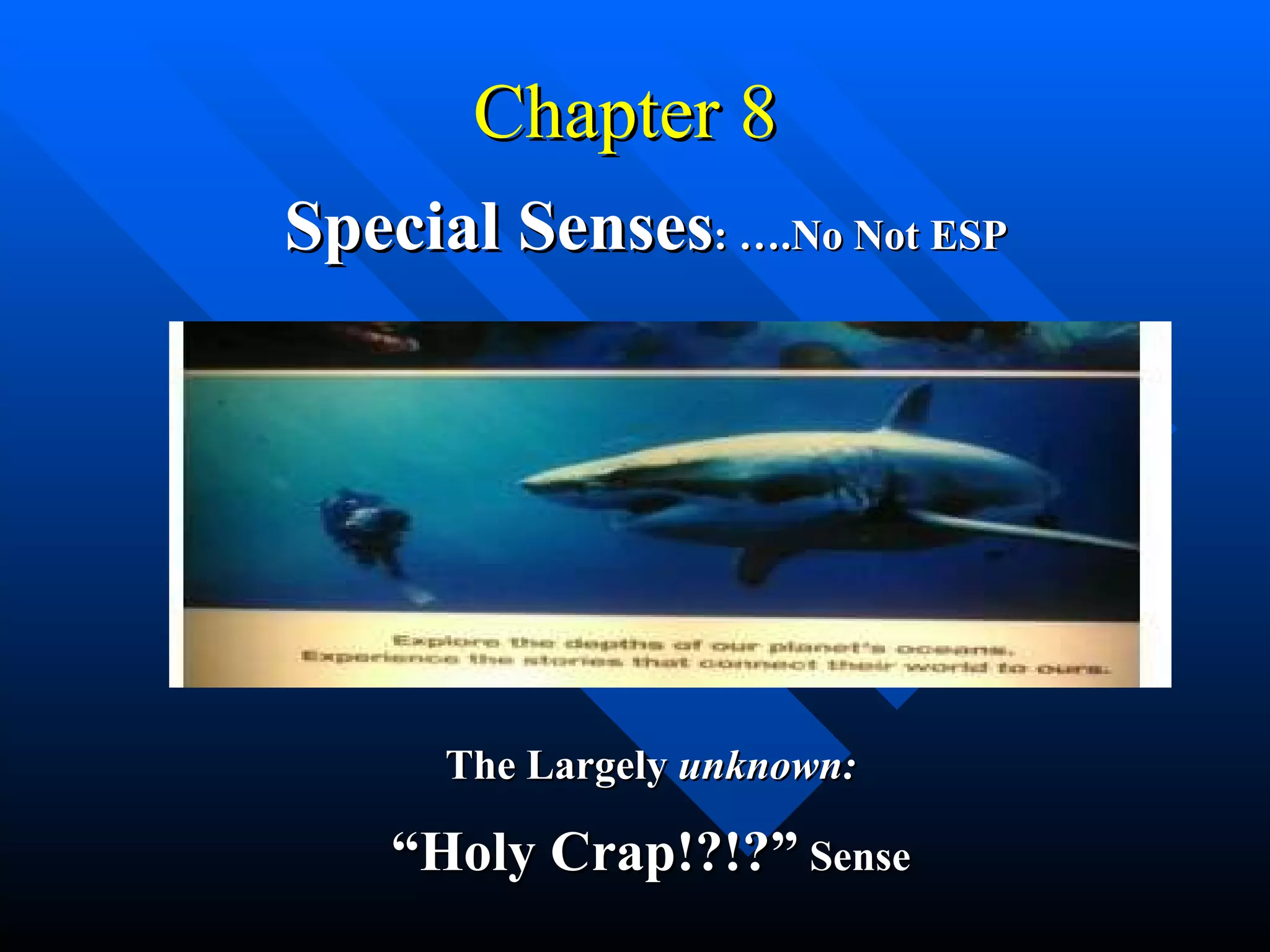
Chapter 8  Special Senses : ….No Not ESP The Largely  unknown: “ Holy Crap!?!?”  Sense
Lecture 2: Eyes and Ears Mostly just the Ear  Disclaimer:  Included in this presentation are  pictures and or images you will not find in your book, make note of the information and move on.  Working smarter is not working harder.   As My Better Half says EVERYTIME we go Shopping  “This will be quick I swear…” and the lies begin again…
This lecture was brought to you today by our sponsors. Humans against Humans that use Snuggies The You-Must-Be-Joking Snuggie The Thingthatshouldnotbe Snuggie Snuggie factory
Did you know? The first 4 years of life  are the most critical for speech and language development.  Auditory sense is present in the infant 24 weeks before birth.  Meaning they can hear you in the womb and its helps them develop mental and auditory connections?  A baby in the womb can hear conversations  12 feet  away?
Did you know? Sound travels better in water than in air?  So all that splashing in JAWS? They never stood a chance… Despite the size of ears an elephant’s hearing is poor?  But they can still stomp you in to paste if ticked off… Whales, Dolphins, Porpoise, Bats, Shrews (GF joke here), Swifts and Oilbirds use  Echolocation (also called Biosonar) ?   The 1 st  2 rules of “Fight Club” apply to all GF Jokes!!! Or I’m a DEAD DUCK!!!
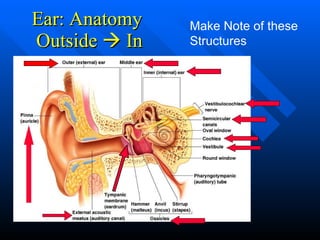
Ear: Anatomy  Outside    In Make Note of these Structures
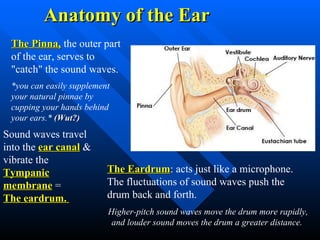
Anatomy of the Ear The Pinna,  the outer part of the ear, serves to "catch" the sound waves.  *you can easily supplement your natural pinnae by cupping your hands behind your ears.*  (Wut?)   Sound waves travel into the  ear canal  & vibrate the  Tympanic membrane   =  The eardrum.  The Eardrum : acts just like a microphone. The fluctuations of sound waves push the drum back and forth.  Higher-pitch sound waves move the drum more rapidly, and louder sound moves the drum a greater distance.
Anatomy of the Ear The middle ear: The ossicles  are the smallest bones in your body.  *Don’t write this down* They include:   The  malleus : the  hammer   The  incus : the  anvil   The  stapes:  the  stirrup   The cochlea:  consists of 3 tubes (the membrane so thin we consider it 1 tube) coiled in the shape of a snail shell  Endolymph (the fluid inside):  stimulates the  Auditory Nerve [Cranial Nerve VIII (8)]  and the signal travels to the brain and is then interpreted as sound.
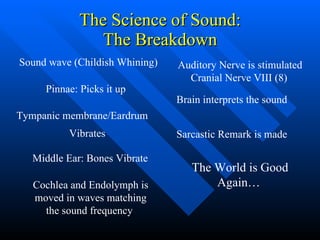
The Science of Sound: The Breakdown Sound wave (Childish Whining)   Pinnae: Picks it up  Tympanic membrane/Eardrum Vibrates  Middle Ear: Bones Vibrate   Cochlea and Endolymph is moved in waves matching the sound frequency  Auditory Nerve is stimulated Cranial Nerve VIII (8)   Brain interprets the sound  Sarcastic Remark is made  The World is Good Again…
Let’s see how it all works shall we? One Sec Please…
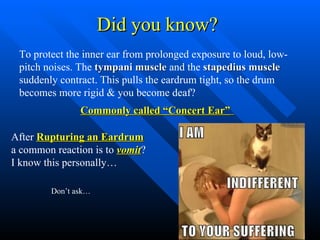
Did you know? To protect the inner ear from prolonged exposure to loud, low-pitch noises. The  tympani muscle  and the  stapedius muscle  suddenly contract. This pulls the eardrum tight, so the drum becomes more rigid & you become deaf? Commonly called “Concert Ear”   After  Rupturing an Eardrum  a common reaction is to  vomit ? I know this personally… Don’t ask…
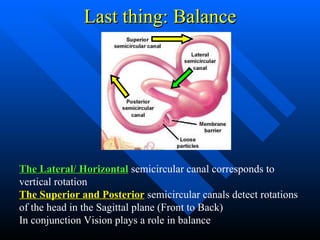
Last thing: Balance The Lateral/ Horizontal  semicircular canal corresponds to vertical rotation  The Superior and Posterior  semicircular canals detect rotations of the head in the Sagittal plane (Front to Back) In conjunction Vision plays a role in balance
Ok Lets Cut Stuff Up!!!

Chapter 8 lecture 2

  • 1.
    Chapter 8 Special Senses : ….No Not ESP The Largely unknown: “ Holy Crap!?!?” Sense
  • 2.
    Lecture 2: Eyesand Ears Mostly just the Ear Disclaimer: Included in this presentation are pictures and or images you will not find in your book, make note of the information and move on. Working smarter is not working harder. As My Better Half says EVERYTIME we go Shopping “This will be quick I swear…” and the lies begin again…
  • 3.
    This lecture wasbrought to you today by our sponsors. Humans against Humans that use Snuggies The You-Must-Be-Joking Snuggie The Thingthatshouldnotbe Snuggie Snuggie factory
  • 4.
    Did you know?The first 4 years of life are the most critical for speech and language development. Auditory sense is present in the infant 24 weeks before birth. Meaning they can hear you in the womb and its helps them develop mental and auditory connections? A baby in the womb can hear conversations 12 feet away?
  • 5.
    Did you know?Sound travels better in water than in air? So all that splashing in JAWS? They never stood a chance… Despite the size of ears an elephant’s hearing is poor? But they can still stomp you in to paste if ticked off… Whales, Dolphins, Porpoise, Bats, Shrews (GF joke here), Swifts and Oilbirds use Echolocation (also called Biosonar) ? The 1 st 2 rules of “Fight Club” apply to all GF Jokes!!! Or I’m a DEAD DUCK!!!
  • 6.
    Ear: Anatomy Outside  In Make Note of these Structures
  • 7.
    Anatomy of theEar The Pinna, the outer part of the ear, serves to "catch" the sound waves. *you can easily supplement your natural pinnae by cupping your hands behind your ears.* (Wut?) Sound waves travel into the ear canal & vibrate the Tympanic membrane = The eardrum. The Eardrum : acts just like a microphone. The fluctuations of sound waves push the drum back and forth. Higher-pitch sound waves move the drum more rapidly, and louder sound moves the drum a greater distance.
  • 8.
    Anatomy of theEar The middle ear: The ossicles are the smallest bones in your body. *Don’t write this down* They include: The malleus : the hammer The incus : the anvil The stapes: the stirrup The cochlea: consists of 3 tubes (the membrane so thin we consider it 1 tube) coiled in the shape of a snail shell Endolymph (the fluid inside): stimulates the Auditory Nerve [Cranial Nerve VIII (8)] and the signal travels to the brain and is then interpreted as sound.
  • 9.
    The Science ofSound: The Breakdown Sound wave (Childish Whining) Pinnae: Picks it up Tympanic membrane/Eardrum Vibrates Middle Ear: Bones Vibrate Cochlea and Endolymph is moved in waves matching the sound frequency Auditory Nerve is stimulated Cranial Nerve VIII (8) Brain interprets the sound Sarcastic Remark is made The World is Good Again…
  • 10.
    Let’s see howit all works shall we? One Sec Please…
  • 11.
    Did you know?To protect the inner ear from prolonged exposure to loud, low-pitch noises. The tympani muscle and the stapedius muscle suddenly contract. This pulls the eardrum tight, so the drum becomes more rigid & you become deaf? Commonly called “Concert Ear” After Rupturing an Eardrum a common reaction is to vomit ? I know this personally… Don’t ask…
  • 12.
    Last thing: BalanceThe Lateral/ Horizontal semicircular canal corresponds to vertical rotation The Superior and Posterior semicircular canals detect rotations of the head in the Sagittal plane (Front to Back) In conjunction Vision plays a role in balance
  • 13.
    Ok Lets CutStuff Up!!!