Damnjanović Ivana
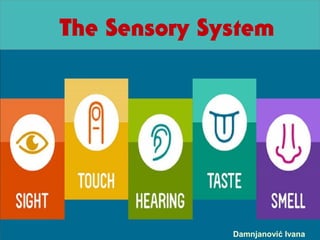
The Sensory System
Introduction
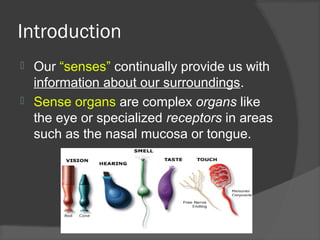
 Our “senses” continually provide us with
information about our surroundings.
 Sense organs are complex organs like
the eye or specialized receptors in areas
such as the nasal mucosa or tongue.
Introduction
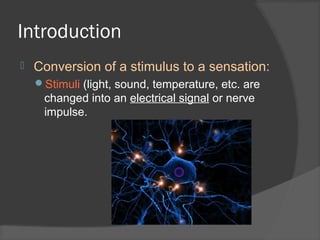
 Conversion of a stimulus to a sensation:
Stimuli (light, sound, temperature, etc. are
changed into an electrical signal or nerve
impulse.
Cutaneous Sensations
 Receptors of the general sense organs
are found in almost every part of the
body.
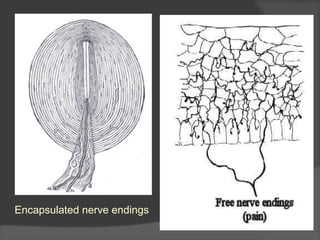
Encapsulated nerve endings – located in the
dermis; touch and pressure.
Free nerve endings – mainly in the dermis of
the skin, mucosa, internal organs. They
sense pain or crude touch.
Encapsulated nerve endings
Sense of Touch
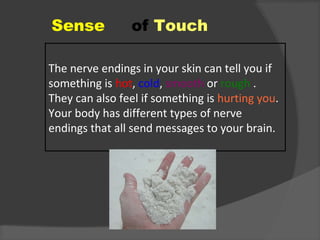
The nerve endings in your skin can tell you if
something is hot, cold, smooth or rough .
They can also feel if something is hurting you.
Your body has different types of nerve
endings that all send messages to your brain.
Sense of Taste
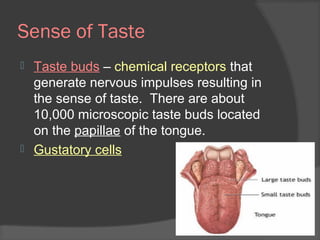
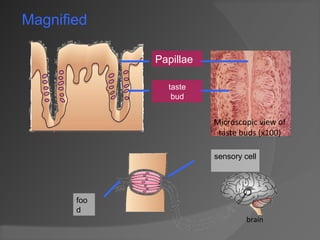
 Taste buds – chemical receptors that
generate nervous impulses resulting in
the sense of taste. There are about
10,000 microscopic taste buds located
on the papillae of the tongue.
 Gustatory cells
Sense of Taste
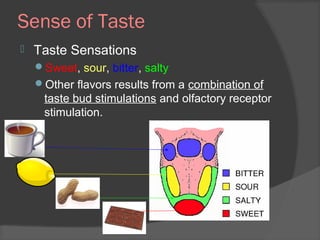
 Taste Sensations
Sweet, sour, bitter, salty
Other flavors results from a combination of
taste bud stimulations and olfactory receptor
stimulation.
Magnified
taste
bud
Papillae
Microscopic view of
taste buds (x100)
brain
foo
d
sensory cell
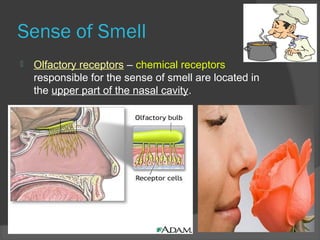
Sense of Smell
 Olfactory receptors – chemical receptors
responsible for the sense of smell are located in
the upper part of the nasal cavity.
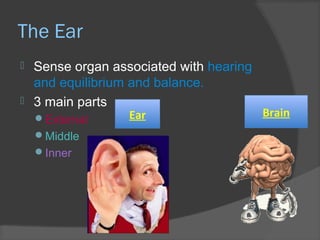
The Ear
 Sense organ associated with hearing
and equilibrium and balance.
 3 main parts
External
Middle
Inner
Ear Brain
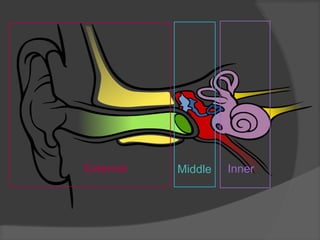
External Middle Inner
The Ear
 External ear
 Pinna
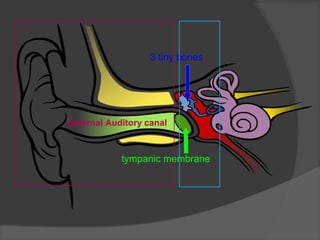
 External Auditory canal – a curving tube about one
inch long; extends into the temporal bone and end
at the tympanic membrane (eardrum)
 Middle ear
 Tympanic membrane
 3 tiny bones called ossicles (bones) transmit
sound waves.
External Auditory canal
tympanic membrane
3 tiny bones
The Ear
Inner Ear – contains mechanoreceptors
that are activated by vibration and
generate nerve impulses that result in
hearing and equilibrium.
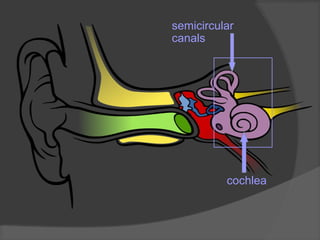
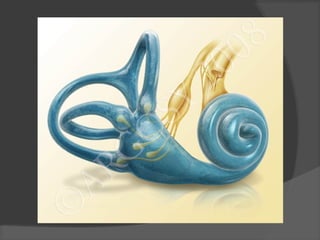
-Cochlea is the auditory portion of the inner
ear
Vestibule – membranous sacs (utricle and
saccule) adjacent to the oval window and
between the semicircular canals. Contains
receptors for equilibrium.
semicircular
canals
cochlea
The Eye
 Contains receptors for vision and a
refracting system that focuses light rays
on the receptors in the retina.
 Eyelids – contain skeletal muscle that allow us to
close them and totally cover the exterior eyeball.
 Eyelashes – help to keep dust out of our eyes.
 Tears
The Eye
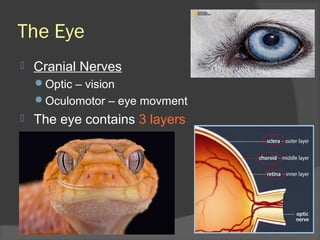
 Cranial Nerves
Optic – vision
Oculomotor – eye movment
 The eye contains 3 layers
The Eye
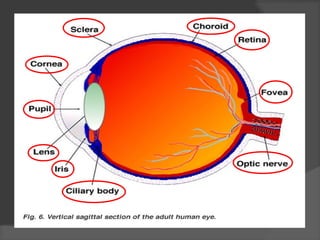
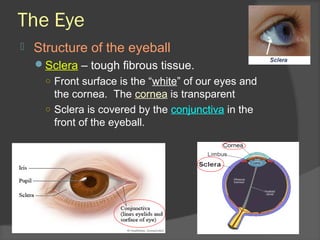
 Structure of the eyeball
Sclera – tough fibrous tissue.
○ Front surface is the “white” of our eyes and
the cornea. The cornea is transparent
○ Sclera is covered by the conjunctiva in the
front of the eyeball.
The Eye
 Structure of the eyeball
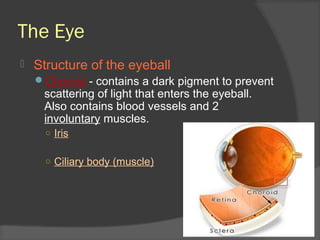
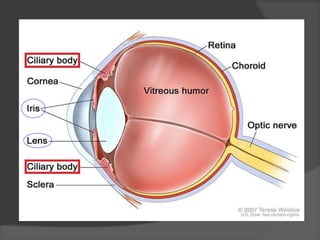
Choroid - contains a dark pigment to prevent
scattering of light that enters the eyeball.
Also contains blood vessels and 2
involuntary muscles.
○ Iris
○ Ciliary body (muscle)
The Eye
 Structure of the eyeball
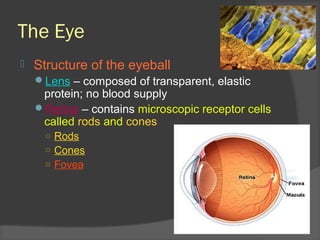
Lens – composed of transparent, elastic
protein; no blood supply
Retina – contains microscopic receptor cells
called rods and cones
○ Rods
○ Cones
○ Fovea
Čulni organi
Čulni organi

Čulni organi

  • 1.
  • 2.
    Introduction  Our “senses”continually provide us with information about our surroundings.  Sense organs are complex organs like the eye or specialized receptors in areas such as the nasal mucosa or tongue.
  • 3.
    Introduction  Conversion ofa stimulus to a sensation: Stimuli (light, sound, temperature, etc. are changed into an electrical signal or nerve impulse.
  • 4.
    Cutaneous Sensations  Receptorsof the general sense organs are found in almost every part of the body. Encapsulated nerve endings – located in the dermis; touch and pressure. Free nerve endings – mainly in the dermis of the skin, mucosa, internal organs. They sense pain or crude touch.
  • 5.
  • 6.
    Sense of Touch Thenerve endings in your skin can tell you if something is hot, cold, smooth or rough . They can also feel if something is hurting you. Your body has different types of nerve endings that all send messages to your brain.
  • 7.
    Sense of Taste Taste buds – chemical receptors that generate nervous impulses resulting in the sense of taste. There are about 10,000 microscopic taste buds located on the papillae of the tongue.  Gustatory cells
  • 8.
    Sense of Taste Taste Sensations Sweet, sour, bitter, salty Other flavors results from a combination of taste bud stimulations and olfactory receptor stimulation.
  • 9.
    Magnified taste bud Papillae Microscopic view of tastebuds (x100) brain foo d sensory cell
  • 10.
    Sense of Smell Olfactory receptors – chemical receptors responsible for the sense of smell are located in the upper part of the nasal cavity.
  • 11.
    The Ear  Senseorgan associated with hearing and equilibrium and balance.  3 main parts External Middle Inner Ear Brain
  • 13.
  • 14.
    The Ear  Externalear  Pinna  External Auditory canal – a curving tube about one inch long; extends into the temporal bone and end at the tympanic membrane (eardrum)  Middle ear  Tympanic membrane  3 tiny bones called ossicles (bones) transmit sound waves.
  • 15.
    External Auditory canal tympanicmembrane 3 tiny bones
  • 16.
    The Ear Inner Ear– contains mechanoreceptors that are activated by vibration and generate nerve impulses that result in hearing and equilibrium. -Cochlea is the auditory portion of the inner ear Vestibule – membranous sacs (utricle and saccule) adjacent to the oval window and between the semicircular canals. Contains receptors for equilibrium.
  • 17.
  • 19.
    The Eye  Containsreceptors for vision and a refracting system that focuses light rays on the receptors in the retina.  Eyelids – contain skeletal muscle that allow us to close them and totally cover the exterior eyeball.  Eyelashes – help to keep dust out of our eyes.  Tears
  • 23.
    The Eye  CranialNerves Optic – vision Oculomotor – eye movment  The eye contains 3 layers
  • 25.
    The Eye  Structureof the eyeball Sclera – tough fibrous tissue. ○ Front surface is the “white” of our eyes and the cornea. The cornea is transparent ○ Sclera is covered by the conjunctiva in the front of the eyeball.
  • 26.
    The Eye  Structureof the eyeball Choroid - contains a dark pigment to prevent scattering of light that enters the eyeball. Also contains blood vessels and 2 involuntary muscles. ○ Iris ○ Ciliary body (muscle)
  • 28.
    The Eye  Structureof the eyeball Lens – composed of transparent, elastic protein; no blood supply Retina – contains microscopic receptor cells called rods and cones ○ Rods ○ Cones ○ Fovea