Chapter 8 Capital Gains and Losses 2011 Cengage Learning Income Tax Fundamentals  2011  Gerald E. Whittenburg  Martha Altus-Buller
Learning Objectives 2011 Cengage Learning Define “capital asset” and holding period for long-term and short-term capital gains Calculate gain/loss on asset disposition Compute tax on long-term and short-term capital assets Identify treatment of §1231 assets Identify casualty  loss treatment for personal and business purposes Outline gain deferral provisions on various transactions
Define a Capital Asset A capital asset is any asset  other  than  inventory, receivables, copyrights, certain U.S. Government publications and depreciable or real property used in a trade or business. Capital assets are defined by exception 2011 Cengage Learning
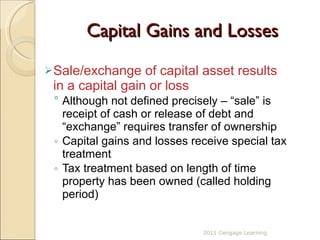
Capital Gains and Losses Sale/exchange of capital asset results in a capital gain or loss Although not defined precisely – “sale” is receipt of cash or release of debt and “exchange” requires transfer of ownership Capital gains and losses receive special tax treatment Tax treatment based on length of time property has been owned (called holding period) 2011 Cengage Learning
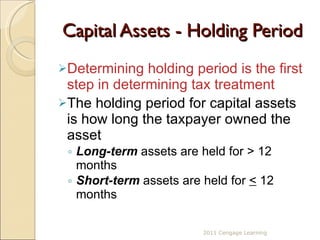
Capital Assets - Holding Period Determining holding period is the first step in determining tax treatment The holding period for capital assets is how long the taxpayer owned the asset Long-term  assets are held for > 12 months Short-term  assets are held for  <  12 months 2011 Cengage Learning
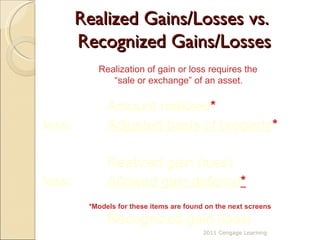
Realized Gains/Losses vs.  Recognized Gains/Losses Amount realized * less: Adjusted basis of property *   Realized gain (loss) less: Allowed gain deferral *   Recognized gain (loss ) *Models for these items are found on the next screens Realization of gain or loss requires the  “ sale or exchange” of an asset. 2011 Cengage Learning
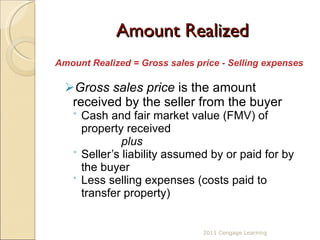
Amount Realized Amount Realized = Gross sales price - Selling expenses Gross sales price  is the amount received by the seller from the buyer Cash and fair market value (FMV) of property received plus Seller’s liability assumed by or paid for by the buyer  Less selling expenses (costs paid to transfer property) 2011 Cengage Learning
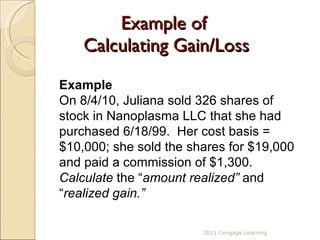
Example of  Calculating Gain/Loss Example On 8/4/10, Juliana sold 326 shares of stock in Nanoplasma LLC that she had purchased 6/18/99.  Her cost basis = $10,000; she sold the shares for $19,000 and paid a commission of $1,300.  Calculate  the “ amount realized”  and “ realized gain.” 2011 Cengage Learning
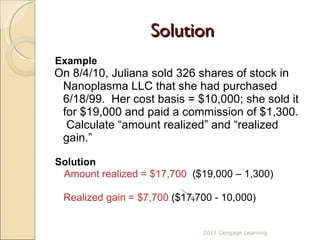
Solution Example On 8/4/10, Juliana sold 326 shares of stock in Nanoplasma LLC that she had purchased 6/18/99.  Her cost basis = $10,000; she sold it for $19,000 and paid a commission of $1,300.  Calculate “amount realized” and “realized gain.” Solution Amount realized = $17,700   ($19,000 – 1,300) Realized gain = $7,700  ($17,700 - 10,000) 2011 Cengage Learning
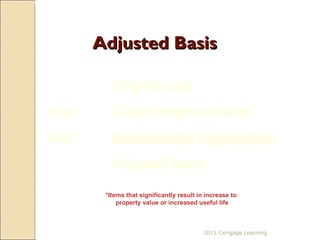
Adjusted Basis   Original cost plus:   Capital improvements* less:  Accumulated depreciation Adjusted basis *Items that significantly result in increase to  property value or increased useful life 2011 Cengage Learning
Cost Basis for Stock Oftentimes difficult for taxpayers to track adjusted basis of stock Depends upon whether stock was purchased, inherited or received as a gift Basis depends upon how acquired If inherited, heir’s basis is fair market value at time of death (may not apply to large inheritances after 2010) If acquired as gift, basis depends upon whether donee sells at a gain or loss Due to many errors in reporting basis on individual tax returns, Congress will be requiring brokers to report basis for some sales made as early as 2011 2011 Cengage Learning
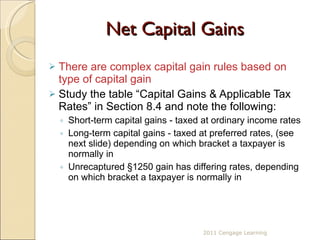
Net Capital Gains There are complex capital gain rules based on type of capital gain Study the table “Capital Gains & Applicable Tax Rates” in Section 8.4 and note the following: Short-term capital gains - taxed at ordinary income rates Long-term capital gains - taxed at preferred rates, (see next slide) depending on which bracket a taxpayer is normally in Unrecaptured  § 1250 gain has differing rates, depending on which bracket a taxpayer is normally in 2011 Cengage Learning
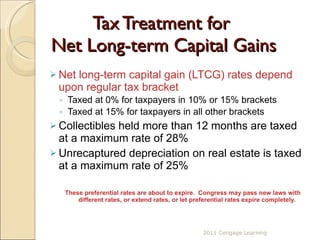
Tax Treatment for  Net Long-term Capital Gains Net long-term capital gain (LTCG) rates depend upon regular tax bracket Taxed at 0% for taxpayers in 10% or 15% brackets Taxed at 15% for taxpayers in all other brackets Collectibles held more than 12 months are taxed at a maximum rate of 28% Unrecaptured depreciation on real estate is taxed at a maximum rate of 25% These preferential rates are about to expire.  Congress may pass new laws with different rates, or extend rates, or let preferential rates expire completely. 2011 Cengage Learning
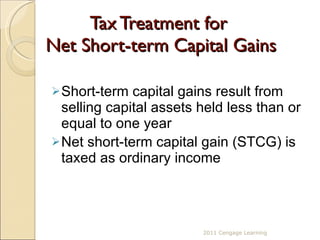
Tax Treatment for  Net Short-term Capital Gains Short-term capital gains result from selling capital assets held less than or equal to one year Net short-term capital gain (STCG) is taxed as ordinary income  2011 Cengage Learning
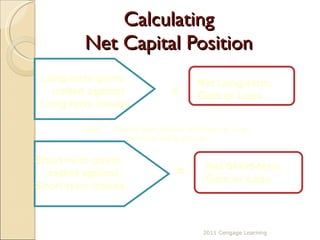
Calculating  Net Capital Position  Long-term gains netted against Long-term losses Net Long-term Gain or Loss Short-term gains netted against Short-term losses Net Short-term Gain or Loss = = Step 1:  Classify each item as short-term or long-term and net by groups 2011 Cengage Learning
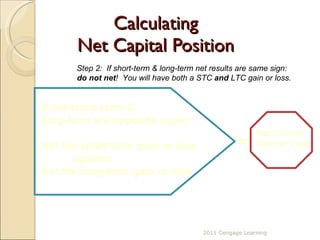
Calculating  Net Capital Position  If net short-term &  long-term are opposite signs: Net the short-term gain or loss against Net the long-term gain or loss Net Capital Gain or Loss = Step 2:  If short-term & long-term net results are same sign:  do not net !  You will have both a STC  and  LTC gain or loss. 2011 Cengage Learning
Net Capital Losses Note that net capital losses (short-term and long-term) limited to $3,000/year with an indefinite carry forward   Must maintain ‘nature’ of capital loss (i.e. – short-term or long-term) when carrying it forward In subsequent years, must deduct STCL  first Note:  Must comply with ordering rules (on next screen) 2011 Cengage Learning
Ordering Rules  for Capital Losses When taxpayer has net capital loss position, must offset capital gains using ordering rules Net STCL first reduce 28% gains Then reduce 25% gains Then reduce regular LTCG Net LTCL first reduce 28% gains Then reduce 25% gains Then reduce regular STCG Note:  Sale of personal capital assets (like personal residence or automobile) does not generate a tax-deductible loss 2011 Cengage Learning
Net Capital Position Example Example Shavril has the following capital gains and losses in the current year: Short-term capital loss ($ 2,000) Long-term capital gain   12,000 Long-term capital loss carryover  (7,000) * *Brought forward from prior year What is Shavril’s net capital position? In 2010, what are the tax implications for Shavril’s capital activities, if he’s in the 15% bracket? 2011 Cengage Learning
Solution Short-term (Step 1 – net short-term activities) Short-term capital gains $  0 Short-term capital loss     (2,000) Net ST position     $(2,000) Long-term (Step 2 – net long-term activities) Long-term capital gain    $ 12,000 Long-term capital loss carryover     (  7,000)   Net LT position   $  5,000 (Step 3 –first two steps go in different directions, so net ) Net long-term capital gain [(2,000) + 5,000]     $  3,000 His $3,000 LTCG will be taxed at 0% because  he is in the 15% ordinary income tax bracket. 2011 Cengage Learning
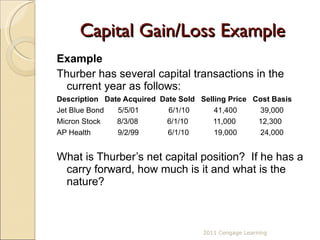
Capital Gain/Loss Example Example Thurber has several capital transactions in the current year as follows: Description  Date Acquired  Date Sold  Selling Price  Cost Basis Jet Blue Bond 5/5/01   6/1/10 41,400   39,000 Micron Stock  8/3/08  6/1/10  11,000  12,300 AP Health  9/2/99  6/1/10 19,000   24,000 What is Thurber’s net capital position?  If he has a carry forward, how much is it and what is the nature? 2011 Cengage Learning
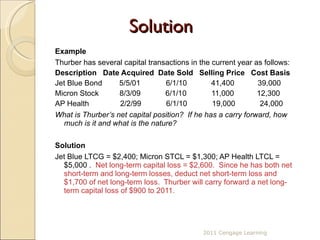
Solution Example Thurber has several capital transactions in the current year as follows: Description  Date Acquired  Date Sold  Selling Price  Cost Basis Jet Blue Bond   5/5/01   6/1/10 41,400   39,000 Micron Stock  8/3/09  6/1/10  11,000  12,300 AP Health  2/2/99  6/1/10  19,000   24,000 What is Thurber’s net capital position?  If he has a carry forward, how much is it and what is the nature?  Solution Jet Blue LTCG = $2,400; Micron STCL = $1,300; AP Health LTCL = $5,000 .  Net long-term capital loss = $2,600.  Since he has both net short-term and long-term losses, deduct net short-term loss and $1,700 of net long-term loss.  Thurber will carry forward a net long-term capital loss of $900 to 2011.  2011 Cengage Learning
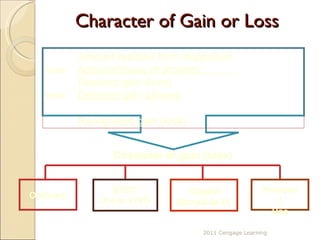
Character of Gain or Loss Amount realized from disposition less: Adjusted basis of property  Realized gain (loss) less: Deferred gain allowed   Recognized gain (loss) Ordinary §1231 (Form 4797) Capital (Schedule D) Personal Use Character of gain (loss) 2011 Cengage Learning
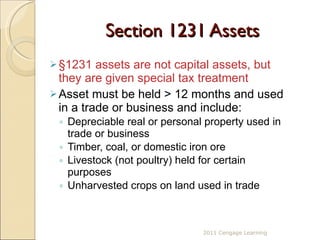
Section 1231 Assets §1231 assets are not capital assets, but they are given special tax treatment Asset must be held > 12 months and used in a trade or business and include:  Depreciable real or personal property used in trade or business Timber, coal, or domestic iron ore Livestock (not poultry) held for certain purposes Unharvested crops on land used in trade 2011 Cengage Learning
§ 1231 Netting Results Net all  § 1231 gains against losses Net  § 1231 gain is classified as LTCG Net  § 1231 loss is classified as ordinary loss This is the best of both worlds! Lower tax rates on gains No limit on losses 2011 Cengage Learning
Depreciation Recapture Prevents taxpayers from receiving the dual benefits of a depreciation deduction  and  capital gain treatment upon sale of the asset Requires gains to be treated as ordinary  to the extent of prior depreciation deductions §1245 recapture §1250 recapture “ Unrecaptured depreciation” previously taken on real estate taxed at 25% 2011 Cengage Learning
§1245  Depreciation Recapture §  1245 applies to property such as Depreciable personal property  Nonresidential real estate placed in service between 1981-1986 with accelerated depreciation  Gains are treated as ordinary income to the extent of any depreciation taken Any gain in excess of depreciation is netted with §1231 gains/losses and given beneficial tax treatment Very complex rules, this is an overview only 2011 Cengage Learning
§1245 Example Example Francesca sells depreciable personal property used in her business on 4/1/10 for the price of $50,000. It was purchased for $60,000 four years ago and she has claimed depreciation on the property of $25,000.  What is her  §1245 recapture?   2011 Cengage Learning
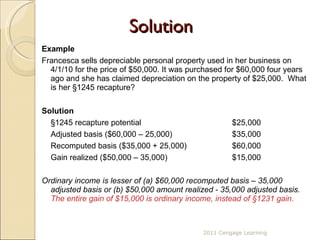
Solution Example Francesca sells depreciable personal property used in her business on 4/1/10 for the price of $50,000. It was purchased for $60,000 four years ago and she has claimed depreciation on the property of $25,000.  What is her  §1245 recapture?   Solution §1245 recapture potential  $25,000 Adjusted basis ($60,000 – 25,000)   $35,000 Recomputed basis ($35,000 + 25,000)    $60,000 Gain realized ($50,000 – 35,000)    $15,000 Ordinary income is lesser of (a) $60,000 recomputed basis – 35,000 adjusted basis or (b) $50,000 amount realized - 35,000 adjusted basis.  The entire gain of $15,000 is ordinary income, instead of  §1231 gain. 2011 Cengage Learning
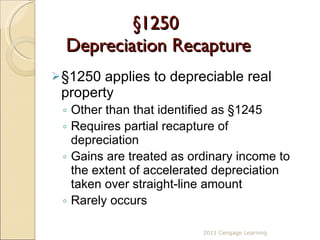
§1250  Depreciation Recapture § 1250 applies to depreciable real property  Other than that identified as  §1245 Requires partial recapture of depreciation Gains are treated as ordinary income to the extent of accelerated depreciation taken over straight-line amount Rarely occurs 2011 Cengage Learning
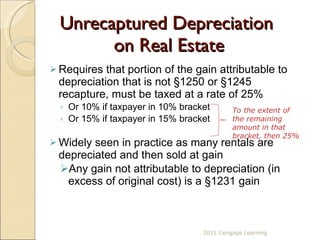
Unrecaptured Depreciation  on Real Estate Requires that portion of the gain attributable to depreciation that is not §1250 or  §1245  recapture, must be taxed at a rate of 25%  Or 10% if taxpayer in 10% bracket Or 15% if taxpayer in 15% bracket Widely seen in practice as many rentals are depreciated and then sold at gain Any gain not attributable to depreciation (in excess of original cost) is a §1231 gain To the extent of the remaining amount in that bracket, then 25% 2011 Cengage Learning
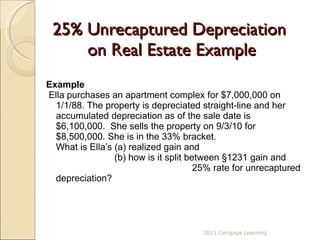
25% Unrecaptured Depreciation  on Real Estate Example Example Ella purchases an apartment complex for $7,000,000 on 1/1/88. The property is depreciated straight-line and her accumulated depreciation as of the sale date is $6,100,000.  She sells the property on 9/3/10 for $8,500,000. She is in the 33% bracket. What is Ella’s (a) realized gain and    (b) how is it split between §1231 gain and      25% rate for unrecaptured depreciation? 2011 Cengage Learning
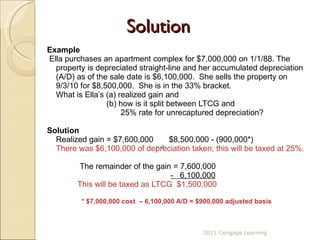
Solution Example Ella purchases an apartment complex for $7,000,000 on 1/1/88. The property is depreciated straight-line and her accumulated depreciation (A/D) as of the sale date is $6,100,000.  She sells the property on 9/3/10 for $8,500,000.  She is in the 33% bracket. What is Ella’s (a) realized gain and    (b) how is it split between LTCG and      25% rate for unrecaptured depreciation? Solution Realized gain = $7,600,000  $8,500,000 - (900,000*) There was $6,100,000 of depreciation taken; this will be taxed at 25%.    The remainder of the gain = 7,600,000   -  6,100,000   This will be taxed as LTCG  $1,500,000 * $7,000,000 cost  – 6,100,000 A/D = $900,000 adjusted basis 2011 Cengage Learning
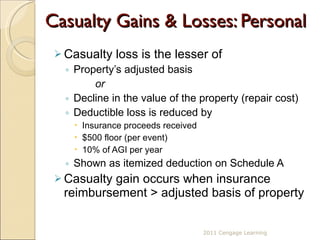
Casualty Gains & Losses: Personal Casualty loss is the lesser of  Property’s adjusted basis  or Decline in the value of the property (repair cost) Deductible loss is reduced by Insurance proceeds received $500 floor (per event) 10% of AGI per year Shown as itemized deduction on Schedule A Casualty gain occurs when insurance reimbursement > adjusted basis of property 2011 Cengage Learning
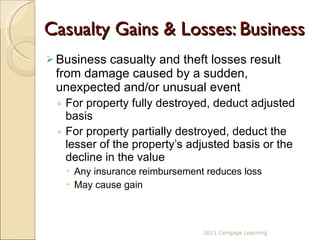
Casualty Gains & Losses: Business Business casualty and theft losses result from damage caused by a sudden, unexpected and/or unusual event For property fully destroyed, deduct adjusted basis For property partially destroyed, deduct the lesser of the property’s adjusted basis or the decline in the value Any insurance reimbursement reduces loss  May cause gain 2011 Cengage Learning
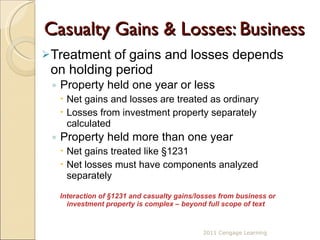
Casualty Gains & Losses: Business Treatment of gains and losses depends on holding period Property held one year or less Net gains and losses are treated as ordinary Losses from investment property separately calculated Property held more than one year  Net gains treated like §1231 Net losses must have components analyzed separately Interaction of §1231 and casualty gains/losses from business or investment property is complex – beyond full scope of text  2011 Cengage Learning
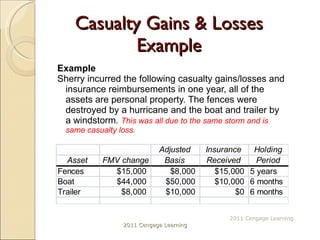
Casualty Gains & Losses Example Example Sherry incurred the following casualty gains/losses and insurance reimbursements in one year, all of the assets are personal property. The fences were destroyed by a hurricane and the boat and trailer by a windstorm .  This was all due to the same storm and is same casualty loss. 2011 Cengage Learning
Solution Example Sherry incurred the following casualty gains/losses and insurance reimbursements in one year, all personal. The fences were destroyed by a hurricane & the boat and trailer by a windstorm .  This was all due to the same storm and is same casualty loss. Solution Hurricane results in a casualty gain =  $  7,000  $8,000 - 15,000.  Windstorm results in a casualty loss =  $41,500   ($44,000 - $10,000) + ($8,000 - $0)] - $500 floor Net casualty loss =  $34,900  The total net casualty loss of $34,900 is further reduced by 10% of AGI. 2011 Cengage Learning
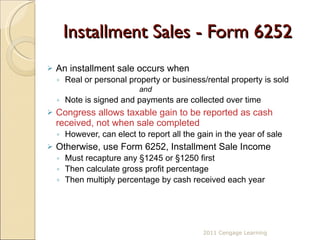
Installment Sales - Form 6252 An installment sale occurs when Real or personal property or business/rental property is sold  and  Note is signed and payments are collected over time Congress allows taxable gain to be reported as cash received, not when sale completed However, can elect to report all the gain in the year of sale Otherwise, use Form 6252, Installment Sale Income Must recapture any §1245 or §1250 first Then calculate gross profit percentage  Then multiply percentage by cash received each year 2011 Cengage Learning
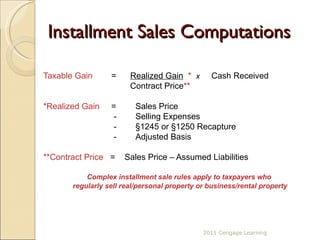
Installment Sales Computations Taxable Gain   =  Realized Gain   *   x   Cash Received   Contract Price ** *Realized Gain   =  Sales Price    -  Selling Expenses   -  §1245 or §1250 Recapture   -  Adjusted Basis  **Contract Price  =  Sales Price – Assumed Liabilities Complex installment sale rules apply to taxpayers who  regularly sell real/personal property or business/rental property 2011 Cengage Learning
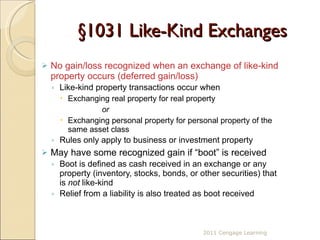
§1031 Like-Kind Exchanges No gain/loss recognized when an exchange of like-kind property occurs (deferred gain/loss) Like-kind property transactions occur when  Exchanging real property for real property  or Exchanging personal property for personal property of the same asset class Rules only apply to business or investment property May have some recognized gain if “boot” is received Boot is defined as cash received in an exchange or any property (inventory, stocks, bonds, or other securities) that is  not  like-kind Relief from a liability is also treated as boot received 2011 Cengage Learning
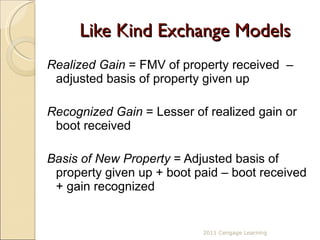
Like Kind Exchange Models Realized Gain  = FMV of property received  – adjusted basis of property given up  Recognized Gain  = Lesser of realized gain or boot received Basis of New Property  = Adjusted basis of property given up + boot paid – boot received + gain recognized  2011 Cengage Learning
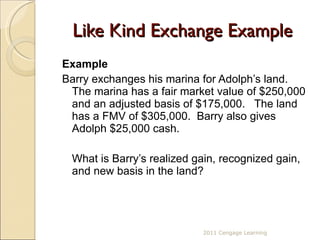
Like Kind Exchange Example Example Barry exchanges his marina for Adolph’s land.  The marina has a fair market value of $250,000 and an adjusted basis of $175,000.  The land has a FMV of $305,000.  Barry also gives Adolph $25,000 cash.  What is Barry’s realized gain, recognized gain, and new basis in the land? 2011 Cengage Learning
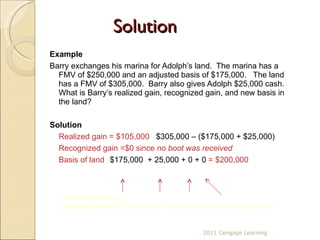
Solution Example Barry exchanges his marina for Adolph’s land.  The marina has a FMV of $250,000 and an adjusted basis of $175,000.  The land has a FMV of $305,000.  Barry also gives Adolph $25,000 cash.  What is Barry’s realized gain, recognized gain, and new basis in the land? Solution Realized gain = $105,000   $305,000 – ($175,000 + $25,000) Recognized gain =$0 since   no boot was received Basis of land  $175,000  + 25,000 + 0 + 0  = $200,000  Adjusted basis of  property given up + boot paid – boot received + gain recognized  2011 Cengage Learning
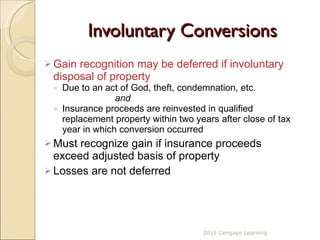
Involuntary Conversions Gain recognition may be deferred if involuntary disposal of property  Due to an act of God, theft, condemnation, etc.   and Insurance proceeds are reinvested in qualified replacement property within two years after close of tax year in which conversion occurred Must recognize gain if insurance proceeds exceed adjusted basis of property Losses are not deferred  2011 Cengage Learning
Sale of Personal Residence  Exclusion on gain of personal home allowed on sale of home  For sales 5/6/97 or later If owned and used as principal residence for two of the last five years Gain exclusion is up to $500,000 (MFJ) or $250,000 (S) 2011 Cengage Learning
Sale of Personal Residence Sales before 5/7/97 were treated very differently Taxpayers didn’t have to recognize gain on sale of house if ‘bought up’ when purchasing new residence Therefore, many taxpayers who had sold one or more principal residences over a period of years have a principal residence with a basis that is far lower than the cost of that residence These taxpayers get ‘fresh basis’ equal to purchase price of newly purchased residence Beginning in 2010, can’t use ‘loophole’ of moving into previously rented properties every two years and exclude gain – if you rent your residence , generally limited to a lesser exclusion 2011 Cengage Learning
Done! 2011 Cengage Learning

Chapter 8

  • 1.
    Chapter 8 CapitalGains and Losses 2011 Cengage Learning Income Tax Fundamentals 2011 Gerald E. Whittenburg Martha Altus-Buller
  • 2.
    Learning Objectives 2011Cengage Learning Define “capital asset” and holding period for long-term and short-term capital gains Calculate gain/loss on asset disposition Compute tax on long-term and short-term capital assets Identify treatment of §1231 assets Identify casualty loss treatment for personal and business purposes Outline gain deferral provisions on various transactions
  • 3.
    Define a CapitalAsset A capital asset is any asset other than inventory, receivables, copyrights, certain U.S. Government publications and depreciable or real property used in a trade or business. Capital assets are defined by exception 2011 Cengage Learning
  • 4.
    Capital Gains andLosses Sale/exchange of capital asset results in a capital gain or loss Although not defined precisely – “sale” is receipt of cash or release of debt and “exchange” requires transfer of ownership Capital gains and losses receive special tax treatment Tax treatment based on length of time property has been owned (called holding period) 2011 Cengage Learning
  • 5.
    Capital Assets -Holding Period Determining holding period is the first step in determining tax treatment The holding period for capital assets is how long the taxpayer owned the asset Long-term assets are held for > 12 months Short-term assets are held for < 12 months 2011 Cengage Learning
  • 6.
    Realized Gains/Losses vs. Recognized Gains/Losses Amount realized * less: Adjusted basis of property * Realized gain (loss) less: Allowed gain deferral * Recognized gain (loss ) *Models for these items are found on the next screens Realization of gain or loss requires the “ sale or exchange” of an asset. 2011 Cengage Learning
  • 7.
    Amount Realized AmountRealized = Gross sales price - Selling expenses Gross sales price is the amount received by the seller from the buyer Cash and fair market value (FMV) of property received plus Seller’s liability assumed by or paid for by the buyer Less selling expenses (costs paid to transfer property) 2011 Cengage Learning
  • 8.
    Example of Calculating Gain/Loss Example On 8/4/10, Juliana sold 326 shares of stock in Nanoplasma LLC that she had purchased 6/18/99. Her cost basis = $10,000; she sold the shares for $19,000 and paid a commission of $1,300. Calculate the “ amount realized” and “ realized gain.” 2011 Cengage Learning
  • 9.
    Solution Example On8/4/10, Juliana sold 326 shares of stock in Nanoplasma LLC that she had purchased 6/18/99. Her cost basis = $10,000; she sold it for $19,000 and paid a commission of $1,300. Calculate “amount realized” and “realized gain.” Solution Amount realized = $17,700 ($19,000 – 1,300) Realized gain = $7,700 ($17,700 - 10,000) 2011 Cengage Learning
  • 10.
    Adjusted Basis Original cost plus: Capital improvements* less: Accumulated depreciation Adjusted basis *Items that significantly result in increase to property value or increased useful life 2011 Cengage Learning
  • 11.
    Cost Basis forStock Oftentimes difficult for taxpayers to track adjusted basis of stock Depends upon whether stock was purchased, inherited or received as a gift Basis depends upon how acquired If inherited, heir’s basis is fair market value at time of death (may not apply to large inheritances after 2010) If acquired as gift, basis depends upon whether donee sells at a gain or loss Due to many errors in reporting basis on individual tax returns, Congress will be requiring brokers to report basis for some sales made as early as 2011 2011 Cengage Learning
  • 12.
    Net Capital GainsThere are complex capital gain rules based on type of capital gain Study the table “Capital Gains & Applicable Tax Rates” in Section 8.4 and note the following: Short-term capital gains - taxed at ordinary income rates Long-term capital gains - taxed at preferred rates, (see next slide) depending on which bracket a taxpayer is normally in Unrecaptured § 1250 gain has differing rates, depending on which bracket a taxpayer is normally in 2011 Cengage Learning
  • 13.
    Tax Treatment for Net Long-term Capital Gains Net long-term capital gain (LTCG) rates depend upon regular tax bracket Taxed at 0% for taxpayers in 10% or 15% brackets Taxed at 15% for taxpayers in all other brackets Collectibles held more than 12 months are taxed at a maximum rate of 28% Unrecaptured depreciation on real estate is taxed at a maximum rate of 25% These preferential rates are about to expire. Congress may pass new laws with different rates, or extend rates, or let preferential rates expire completely. 2011 Cengage Learning
  • 14.
    Tax Treatment for Net Short-term Capital Gains Short-term capital gains result from selling capital assets held less than or equal to one year Net short-term capital gain (STCG) is taxed as ordinary income 2011 Cengage Learning
  • 15.
    Calculating NetCapital Position Long-term gains netted against Long-term losses Net Long-term Gain or Loss Short-term gains netted against Short-term losses Net Short-term Gain or Loss = = Step 1: Classify each item as short-term or long-term and net by groups 2011 Cengage Learning
  • 16.
    Calculating NetCapital Position If net short-term & long-term are opposite signs: Net the short-term gain or loss against Net the long-term gain or loss Net Capital Gain or Loss = Step 2: If short-term & long-term net results are same sign: do not net ! You will have both a STC and LTC gain or loss. 2011 Cengage Learning
  • 17.
    Net Capital LossesNote that net capital losses (short-term and long-term) limited to $3,000/year with an indefinite carry forward Must maintain ‘nature’ of capital loss (i.e. – short-term or long-term) when carrying it forward In subsequent years, must deduct STCL first Note: Must comply with ordering rules (on next screen) 2011 Cengage Learning
  • 18.
    Ordering Rules for Capital Losses When taxpayer has net capital loss position, must offset capital gains using ordering rules Net STCL first reduce 28% gains Then reduce 25% gains Then reduce regular LTCG Net LTCL first reduce 28% gains Then reduce 25% gains Then reduce regular STCG Note: Sale of personal capital assets (like personal residence or automobile) does not generate a tax-deductible loss 2011 Cengage Learning
  • 19.
    Net Capital PositionExample Example Shavril has the following capital gains and losses in the current year: Short-term capital loss ($ 2,000) Long-term capital gain 12,000 Long-term capital loss carryover (7,000) * *Brought forward from prior year What is Shavril’s net capital position? In 2010, what are the tax implications for Shavril’s capital activities, if he’s in the 15% bracket? 2011 Cengage Learning
  • 20.
    Solution Short-term (Step1 – net short-term activities) Short-term capital gains $ 0 Short-term capital loss (2,000) Net ST position $(2,000) Long-term (Step 2 – net long-term activities) Long-term capital gain $ 12,000 Long-term capital loss carryover ( 7,000) Net LT position $ 5,000 (Step 3 –first two steps go in different directions, so net ) Net long-term capital gain [(2,000) + 5,000] $ 3,000 His $3,000 LTCG will be taxed at 0% because he is in the 15% ordinary income tax bracket. 2011 Cengage Learning
  • 21.
    Capital Gain/Loss ExampleExample Thurber has several capital transactions in the current year as follows: Description Date Acquired Date Sold Selling Price Cost Basis Jet Blue Bond 5/5/01 6/1/10 41,400 39,000 Micron Stock 8/3/08 6/1/10 11,000 12,300 AP Health 9/2/99 6/1/10 19,000 24,000 What is Thurber’s net capital position? If he has a carry forward, how much is it and what is the nature? 2011 Cengage Learning
  • 22.
    Solution Example Thurberhas several capital transactions in the current year as follows: Description Date Acquired Date Sold Selling Price Cost Basis Jet Blue Bond 5/5/01 6/1/10 41,400 39,000 Micron Stock 8/3/09 6/1/10 11,000 12,300 AP Health 2/2/99 6/1/10 19,000 24,000 What is Thurber’s net capital position? If he has a carry forward, how much is it and what is the nature? Solution Jet Blue LTCG = $2,400; Micron STCL = $1,300; AP Health LTCL = $5,000 . Net long-term capital loss = $2,600. Since he has both net short-term and long-term losses, deduct net short-term loss and $1,700 of net long-term loss. Thurber will carry forward a net long-term capital loss of $900 to 2011. 2011 Cengage Learning
  • 23.
    Character of Gainor Loss Amount realized from disposition less: Adjusted basis of property Realized gain (loss) less: Deferred gain allowed Recognized gain (loss) Ordinary §1231 (Form 4797) Capital (Schedule D) Personal Use Character of gain (loss) 2011 Cengage Learning
  • 24.
    Section 1231 Assets§1231 assets are not capital assets, but they are given special tax treatment Asset must be held > 12 months and used in a trade or business and include: Depreciable real or personal property used in trade or business Timber, coal, or domestic iron ore Livestock (not poultry) held for certain purposes Unharvested crops on land used in trade 2011 Cengage Learning
  • 25.
    § 1231 NettingResults Net all § 1231 gains against losses Net § 1231 gain is classified as LTCG Net § 1231 loss is classified as ordinary loss This is the best of both worlds! Lower tax rates on gains No limit on losses 2011 Cengage Learning
  • 26.
    Depreciation Recapture Preventstaxpayers from receiving the dual benefits of a depreciation deduction and capital gain treatment upon sale of the asset Requires gains to be treated as ordinary to the extent of prior depreciation deductions §1245 recapture §1250 recapture “ Unrecaptured depreciation” previously taken on real estate taxed at 25% 2011 Cengage Learning
  • 27.
    §1245 DepreciationRecapture § 1245 applies to property such as Depreciable personal property Nonresidential real estate placed in service between 1981-1986 with accelerated depreciation Gains are treated as ordinary income to the extent of any depreciation taken Any gain in excess of depreciation is netted with §1231 gains/losses and given beneficial tax treatment Very complex rules, this is an overview only 2011 Cengage Learning
  • 28.
    §1245 Example ExampleFrancesca sells depreciable personal property used in her business on 4/1/10 for the price of $50,000. It was purchased for $60,000 four years ago and she has claimed depreciation on the property of $25,000. What is her §1245 recapture? 2011 Cengage Learning
  • 29.
    Solution Example Francescasells depreciable personal property used in her business on 4/1/10 for the price of $50,000. It was purchased for $60,000 four years ago and she has claimed depreciation on the property of $25,000. What is her §1245 recapture? Solution §1245 recapture potential $25,000 Adjusted basis ($60,000 – 25,000) $35,000 Recomputed basis ($35,000 + 25,000) $60,000 Gain realized ($50,000 – 35,000) $15,000 Ordinary income is lesser of (a) $60,000 recomputed basis – 35,000 adjusted basis or (b) $50,000 amount realized - 35,000 adjusted basis. The entire gain of $15,000 is ordinary income, instead of §1231 gain. 2011 Cengage Learning
  • 30.
    §1250 DepreciationRecapture § 1250 applies to depreciable real property Other than that identified as §1245 Requires partial recapture of depreciation Gains are treated as ordinary income to the extent of accelerated depreciation taken over straight-line amount Rarely occurs 2011 Cengage Learning
  • 31.
    Unrecaptured Depreciation on Real Estate Requires that portion of the gain attributable to depreciation that is not §1250 or §1245 recapture, must be taxed at a rate of 25% Or 10% if taxpayer in 10% bracket Or 15% if taxpayer in 15% bracket Widely seen in practice as many rentals are depreciated and then sold at gain Any gain not attributable to depreciation (in excess of original cost) is a §1231 gain To the extent of the remaining amount in that bracket, then 25% 2011 Cengage Learning
  • 32.
    25% Unrecaptured Depreciation on Real Estate Example Example Ella purchases an apartment complex for $7,000,000 on 1/1/88. The property is depreciated straight-line and her accumulated depreciation as of the sale date is $6,100,000. She sells the property on 9/3/10 for $8,500,000. She is in the 33% bracket. What is Ella’s (a) realized gain and (b) how is it split between §1231 gain and 25% rate for unrecaptured depreciation? 2011 Cengage Learning
  • 33.
    Solution Example Ellapurchases an apartment complex for $7,000,000 on 1/1/88. The property is depreciated straight-line and her accumulated depreciation (A/D) as of the sale date is $6,100,000. She sells the property on 9/3/10 for $8,500,000. She is in the 33% bracket. What is Ella’s (a) realized gain and (b) how is it split between LTCG and 25% rate for unrecaptured depreciation? Solution Realized gain = $7,600,000 $8,500,000 - (900,000*) There was $6,100,000 of depreciation taken; this will be taxed at 25%. The remainder of the gain = 7,600,000 - 6,100,000 This will be taxed as LTCG $1,500,000 * $7,000,000 cost – 6,100,000 A/D = $900,000 adjusted basis 2011 Cengage Learning
  • 34.
    Casualty Gains &Losses: Personal Casualty loss is the lesser of Property’s adjusted basis or Decline in the value of the property (repair cost) Deductible loss is reduced by Insurance proceeds received $500 floor (per event) 10% of AGI per year Shown as itemized deduction on Schedule A Casualty gain occurs when insurance reimbursement > adjusted basis of property 2011 Cengage Learning
  • 35.
    Casualty Gains &Losses: Business Business casualty and theft losses result from damage caused by a sudden, unexpected and/or unusual event For property fully destroyed, deduct adjusted basis For property partially destroyed, deduct the lesser of the property’s adjusted basis or the decline in the value Any insurance reimbursement reduces loss May cause gain 2011 Cengage Learning
  • 36.
    Casualty Gains &Losses: Business Treatment of gains and losses depends on holding period Property held one year or less Net gains and losses are treated as ordinary Losses from investment property separately calculated Property held more than one year Net gains treated like §1231 Net losses must have components analyzed separately Interaction of §1231 and casualty gains/losses from business or investment property is complex – beyond full scope of text 2011 Cengage Learning
  • 37.
    Casualty Gains &Losses Example Example Sherry incurred the following casualty gains/losses and insurance reimbursements in one year, all of the assets are personal property. The fences were destroyed by a hurricane and the boat and trailer by a windstorm . This was all due to the same storm and is same casualty loss. 2011 Cengage Learning
  • 38.
    Solution Example Sherryincurred the following casualty gains/losses and insurance reimbursements in one year, all personal. The fences were destroyed by a hurricane & the boat and trailer by a windstorm . This was all due to the same storm and is same casualty loss. Solution Hurricane results in a casualty gain = $ 7,000 $8,000 - 15,000. Windstorm results in a casualty loss = $41,500 ($44,000 - $10,000) + ($8,000 - $0)] - $500 floor Net casualty loss = $34,900 The total net casualty loss of $34,900 is further reduced by 10% of AGI. 2011 Cengage Learning
  • 39.
    Installment Sales -Form 6252 An installment sale occurs when Real or personal property or business/rental property is sold and Note is signed and payments are collected over time Congress allows taxable gain to be reported as cash received, not when sale completed However, can elect to report all the gain in the year of sale Otherwise, use Form 6252, Installment Sale Income Must recapture any §1245 or §1250 first Then calculate gross profit percentage Then multiply percentage by cash received each year 2011 Cengage Learning
  • 40.
    Installment Sales ComputationsTaxable Gain = Realized Gain * x Cash Received Contract Price ** *Realized Gain = Sales Price - Selling Expenses - §1245 or §1250 Recapture - Adjusted Basis **Contract Price = Sales Price – Assumed Liabilities Complex installment sale rules apply to taxpayers who regularly sell real/personal property or business/rental property 2011 Cengage Learning
  • 41.
    §1031 Like-Kind ExchangesNo gain/loss recognized when an exchange of like-kind property occurs (deferred gain/loss) Like-kind property transactions occur when Exchanging real property for real property or Exchanging personal property for personal property of the same asset class Rules only apply to business or investment property May have some recognized gain if “boot” is received Boot is defined as cash received in an exchange or any property (inventory, stocks, bonds, or other securities) that is not like-kind Relief from a liability is also treated as boot received 2011 Cengage Learning
  • 42.
    Like Kind ExchangeModels Realized Gain = FMV of property received – adjusted basis of property given up Recognized Gain = Lesser of realized gain or boot received Basis of New Property = Adjusted basis of property given up + boot paid – boot received + gain recognized 2011 Cengage Learning
  • 43.
    Like Kind ExchangeExample Example Barry exchanges his marina for Adolph’s land. The marina has a fair market value of $250,000 and an adjusted basis of $175,000. The land has a FMV of $305,000. Barry also gives Adolph $25,000 cash. What is Barry’s realized gain, recognized gain, and new basis in the land? 2011 Cengage Learning
  • 44.
    Solution Example Barryexchanges his marina for Adolph’s land. The marina has a FMV of $250,000 and an adjusted basis of $175,000. The land has a FMV of $305,000. Barry also gives Adolph $25,000 cash. What is Barry’s realized gain, recognized gain, and new basis in the land? Solution Realized gain = $105,000 $305,000 – ($175,000 + $25,000) Recognized gain =$0 since no boot was received Basis of land $175,000 + 25,000 + 0 + 0 = $200,000 Adjusted basis of property given up + boot paid – boot received + gain recognized 2011 Cengage Learning
  • 45.
    Involuntary Conversions Gainrecognition may be deferred if involuntary disposal of property Due to an act of God, theft, condemnation, etc. and Insurance proceeds are reinvested in qualified replacement property within two years after close of tax year in which conversion occurred Must recognize gain if insurance proceeds exceed adjusted basis of property Losses are not deferred 2011 Cengage Learning
  • 46.
    Sale of PersonalResidence Exclusion on gain of personal home allowed on sale of home For sales 5/6/97 or later If owned and used as principal residence for two of the last five years Gain exclusion is up to $500,000 (MFJ) or $250,000 (S) 2011 Cengage Learning
  • 47.
    Sale of PersonalResidence Sales before 5/7/97 were treated very differently Taxpayers didn’t have to recognize gain on sale of house if ‘bought up’ when purchasing new residence Therefore, many taxpayers who had sold one or more principal residences over a period of years have a principal residence with a basis that is far lower than the cost of that residence These taxpayers get ‘fresh basis’ equal to purchase price of newly purchased residence Beginning in 2010, can’t use ‘loophole’ of moving into previously rented properties every two years and exclude gain – if you rent your residence , generally limited to a lesser exclusion 2011 Cengage Learning
  • 48.