Financial Statement Analysis & Valuation
      Chapter 8 – Microsoft Case
     Analysis of Shareholder Equity
BACKGROUND
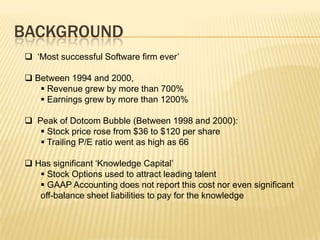
 ‘Most successful Software firm ever’

 Between 1994 and 2000,
    Revenue grew by more than 700%
    Earnings grew by more than 1200%

 Peak of Dotcom Bubble (Between 1998 and 2000):
    Stock price rose from $36 to $120 per share
    Trailing P/E ratio went as high as 66

 Has significant ‘Knowledge Capital’
    Stock Options used to attract leading talent
    GAAP Accounting does not report this cost nor even significant
   off-balance sheet liabilities to pay for the knowledge
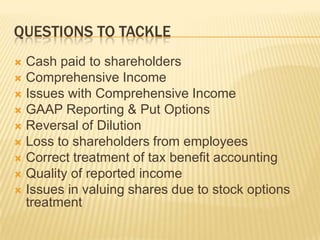
QUESTIONS TO TACKLE
 Cash paid to shareholders
 Comprehensive Income
 Issues with Comprehensive Income
 GAAP Reporting & Put Options
 Reversal of Dilution
 Loss to shareholders from employees
 Correct treatment of tax benefit accounting
 Quality of reported income
 Issues in valuing shares due to stock options
  treatment
1. CASH PAID TO SHAREHOLDERS
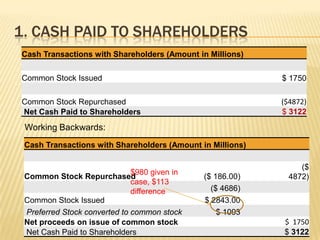
Cash Transactions with Shareholders (Amount in Millions)

Common Stock Issued                                         $ 1750

Common Stock Repurchased                                    ($4872)
Net Cash Paid to Shareholders                               $ 3122
 Working Backwards:
 Cash Transactions with Shareholders (Amount in Millions)

                                                                 ($
                              $980 given in
 Common Stock Repurchased                     ($ 186.00)      4872)
                              case, $113
                              difference        ($ 4686)
 Common Stock Issued                          $ 2843.00
 Preferred Stock converted to common stock        $ 1093
 Net proceeds on issue of common stock                      $ 1750
 Net Cash Paid to Shareholders                              $ 3122
2. COMPREHENSIVE INCOME


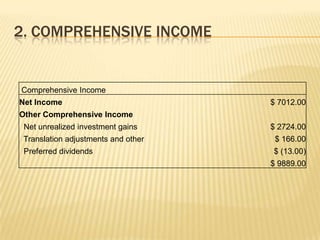
Comprehensive Income
Net Income                           $ 7012.00
Other Comprehensive Income
 Net unrealized investment gains     $ 2724.00
 Translation adjustments and other    $ 166.00
 Preferred dividends                 $ (13.00)
                                     $ 9889.00
2. REFORMULATED STATEMENT

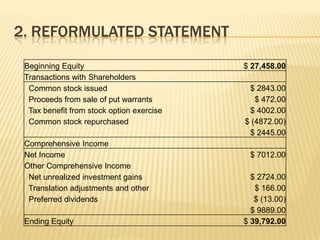
 Beginning Equity                          $ 27,458.00
 Transactions with Shareholders
  Common stock issued                       $ 2843.00
  Proceeds from sale of put warrants          $ 472.00
  Tax benefit from stock option exercise    $ 4002.00
  Common stock repurchased                 $ (4872.00)
                                            $ 2445.00
 Comprehensive Income
 Net Income                                 $ 7012.00
 Other Comprehensive Income
  Net unrealized investment gains            $ 2724.00
  Translation adjustments and other           $ 166.00
  Preferred dividends                         $ (13.00)
                                             $ 9889.00
 Ending Equity                             $ 39,792.00
3. COMPREHENSIVE INCOME - ISSUES
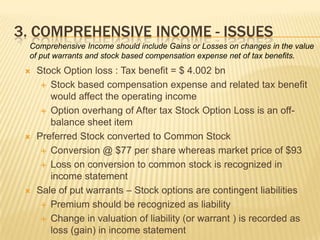
 Comprehensive Income should include Gains or Losses on changes in the value
 of put warrants and stock based compensation expense net of tax benefits.
    Stock Option loss : Tax benefit = $ 4.002 bn
       Stock based compensation expense and related tax benefit
        would affect the operating income
       Option overhang of After tax Stock Option Loss is an off-
        balance sheet item
    Preferred Stock converted to Common Stock
       Conversion @ $77 per share whereas market price of $93

       Loss on conversion to common stock is recognized in
        income statement
    Sale of put warrants – Stock options are contingent liabilities
       Premium should be recognized as liability

       Change in valuation of liability (or warrant ) is recorded as
        loss (gain) in income statement
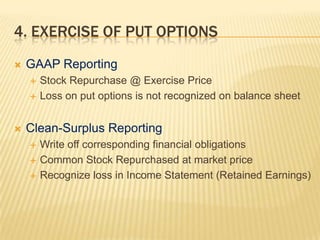
4. EXERCISE OF PUT OPTIONS
   GAAP Reporting
       Stock Repurchase @ Exercise Price
       Loss on put options is not recognized on balance sheet


   Clean-Surplus Reporting
       Write off corresponding financial obligations
       Common Stock Repurchased at market price
       Recognize loss in Income Statement (Retained Earnings)
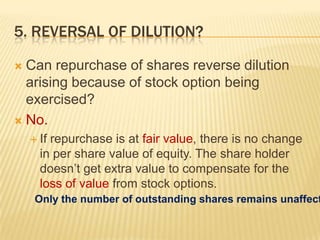
5. REVERSAL OF DILUTION?

 Can repurchase of shares reverse dilution
  arising because of stock option being
  exercised?
 No.
     Ifrepurchase is at fair value, there is no change
      in per share value of equity. The share holder
      doesn’t get extra value to compensate for the
      loss of value from stock options.
     Only the number of outstanding shares remains unaffect
5. REVERSAL OF DILUTION?

 Are repurchases at share prices of 2000
  level, advisable?
 No.
     Duringtech bubble, employees exercised stock
     options at high prices

     Firms had to buy back shares at high prices
     further increasing the dilution
          Double hit for remaining shareholders
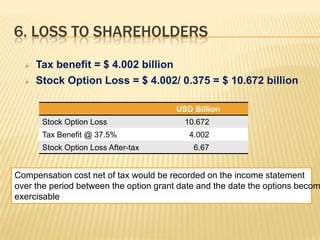
6. LOSS TO SHAREHOLDERS
     Tax benefit = $ 4.002 billion
     Stock Option Loss = $ 4.002/ 0.375 = $ 10.672 billion

                                        USD Billion
       Stock Option Loss                  10.672
       Tax Benefit @ 37.5%                 4.002
       Stock Option Loss After-tax          6.67


Compensation cost net of tax would be recorded on the income statement
over the period between the option grant date and the date the options becom
exercisable
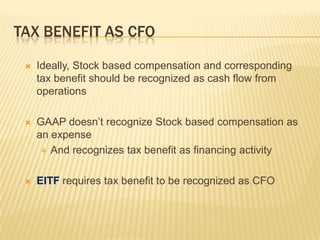
TAX BENEFIT AS CFO

    Ideally, Stock based compensation and corresponding
     tax benefit should be recognized as cash flow from
     operations

    GAAP doesn’t recognize Stock based compensation as
     an expense
       And recognizes tax benefit as financing activity


    EITF requires tax benefit to be recognized as CFO
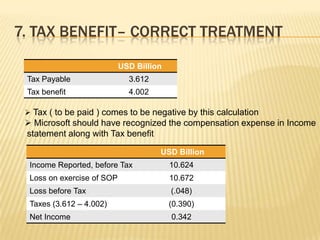
7. TAX BENEFIT– CORRECT TREATMENT

                            USD Billion
 Tax Payable                  3.612
 Tax benefit                  4.002

  Tax ( to be paid ) comes to be negative by this calculation
  Microsoft should have recognized the compensation expense in Income
 statement along with Tax benefit

                                      USD Billion
  Income Reported, before Tax             10.624
  Loss on exercise of SOP                 10.672
  Loss before Tax                         (.048)
  Taxes (3.612 – 4.002)                   (0.390)
  Net Income                              0.342
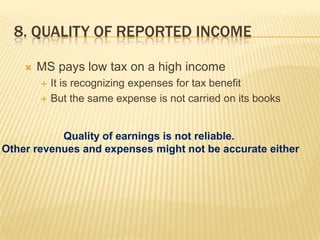
8. QUALITY OF REPORTED INCOME

       MS pays low tax on a high income
           It is recognizing expenses for tax benefit
           But the same expense is not carried on its books


           Quality of earnings is not reliable.
Other revenues and expenses might not be accurate either
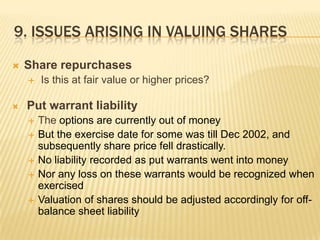
9. ISSUES ARISING IN VALUING SHARES

   Share repurchases
       Is this at fair value or higher prices?

   Put warrant liability
       The options are currently out of money
       But the exercise date for some was till Dec 2002, and
        subsequently share price fell drastically.
       No liability recorded as put warrants went into money
       Nor any loss on these warrants would be recognized when
        exercised
       Valuation of shares should be adjusted accordingly for off-
        balance sheet liability
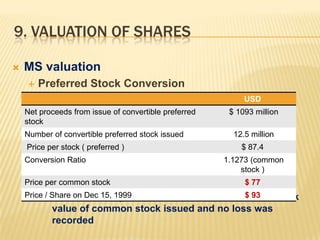
9. VALUATION OF SHARES

   MS valuation
       Preferred Stock Conversion
                                                            USD
    Net proceeds from issue of convertible preferred    $ 1093 million
    stock
    Number of convertible preferred stock issued         12.5 million
    Price per stock ( preferred )                          $ 87.4
    Conversion Ratio                                   1.1273 (common
                                                           stock )
    Price per common stock                                  $ 77
    Price Share on Dec 15, 1999
          / Book value of preferred               $ 93
                                 stock was converted to book
           value of common stock issued and no loss was
           recorded
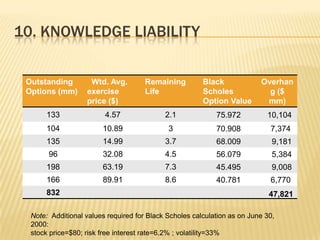
10. KNOWLEDGE LIABILITY

 Outstanding        Wtd. Avg.         Remaining         Black             Overhan
 Options (mm)      exercise           Life              Scholes             g ($
                   price ($)                            Option Value       mm)
       133               4.57               2.1             75.972          10,104
       104              10.89                3              70.908           7,374
       135              14.99               3.7             68.009            9,181
       96               32.08               4.5             56.079            5,384
       198              63.19               7.3             45.495            9,008
       166              89.91               8.6             40.781           6,770
       832                                                                   47,821

  Note: Additional values required for Black Scholes calculation as on June 30,
  2000:
  stock price=$80; risk free interest rate=6.2% ; volatility=33%
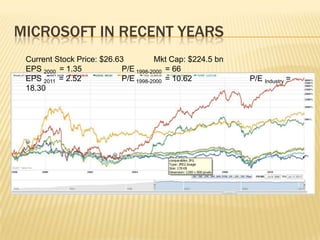
MICROSOFT IN RECENT YEARS
 Current Stock Price: $26.63          Mkt Cap: $224.5 bn
 EPS 2000 = 1.35            P/E 1998-2000 = 66
 EPS 2011 = 2.52            P/E 1998-2000 = 10.62          P/E Industry =
 18.30
QUESTIONS?

Microsoft group 7

  • 1.
    Financial Statement Analysis& Valuation Chapter 8 – Microsoft Case Analysis of Shareholder Equity
  • 2.
    BACKGROUND  ‘Most successfulSoftware firm ever’  Between 1994 and 2000,  Revenue grew by more than 700%  Earnings grew by more than 1200%  Peak of Dotcom Bubble (Between 1998 and 2000):  Stock price rose from $36 to $120 per share  Trailing P/E ratio went as high as 66  Has significant ‘Knowledge Capital’  Stock Options used to attract leading talent  GAAP Accounting does not report this cost nor even significant off-balance sheet liabilities to pay for the knowledge
  • 3.
    QUESTIONS TO TACKLE Cash paid to shareholders  Comprehensive Income  Issues with Comprehensive Income  GAAP Reporting & Put Options  Reversal of Dilution  Loss to shareholders from employees  Correct treatment of tax benefit accounting  Quality of reported income  Issues in valuing shares due to stock options treatment
  • 4.
    1. CASH PAIDTO SHAREHOLDERS Cash Transactions with Shareholders (Amount in Millions) Common Stock Issued $ 1750 Common Stock Repurchased ($4872) Net Cash Paid to Shareholders $ 3122 Working Backwards: Cash Transactions with Shareholders (Amount in Millions) ($ $980 given in Common Stock Repurchased ($ 186.00) 4872) case, $113 difference ($ 4686) Common Stock Issued $ 2843.00 Preferred Stock converted to common stock $ 1093 Net proceeds on issue of common stock $ 1750 Net Cash Paid to Shareholders $ 3122
  • 5.
    2. COMPREHENSIVE INCOME ComprehensiveIncome Net Income $ 7012.00 Other Comprehensive Income Net unrealized investment gains $ 2724.00 Translation adjustments and other $ 166.00 Preferred dividends $ (13.00) $ 9889.00
  • 6.
    2. REFORMULATED STATEMENT Beginning Equity $ 27,458.00 Transactions with Shareholders Common stock issued $ 2843.00 Proceeds from sale of put warrants $ 472.00 Tax benefit from stock option exercise $ 4002.00 Common stock repurchased $ (4872.00) $ 2445.00 Comprehensive Income Net Income $ 7012.00 Other Comprehensive Income Net unrealized investment gains $ 2724.00 Translation adjustments and other $ 166.00 Preferred dividends $ (13.00) $ 9889.00 Ending Equity $ 39,792.00
  • 7.
    3. COMPREHENSIVE INCOME- ISSUES Comprehensive Income should include Gains or Losses on changes in the value of put warrants and stock based compensation expense net of tax benefits.  Stock Option loss : Tax benefit = $ 4.002 bn  Stock based compensation expense and related tax benefit would affect the operating income  Option overhang of After tax Stock Option Loss is an off- balance sheet item  Preferred Stock converted to Common Stock  Conversion @ $77 per share whereas market price of $93  Loss on conversion to common stock is recognized in income statement  Sale of put warrants – Stock options are contingent liabilities  Premium should be recognized as liability  Change in valuation of liability (or warrant ) is recorded as loss (gain) in income statement
  • 8.
    4. EXERCISE OFPUT OPTIONS  GAAP Reporting  Stock Repurchase @ Exercise Price  Loss on put options is not recognized on balance sheet  Clean-Surplus Reporting  Write off corresponding financial obligations  Common Stock Repurchased at market price  Recognize loss in Income Statement (Retained Earnings)
  • 9.
    5. REVERSAL OFDILUTION?  Can repurchase of shares reverse dilution arising because of stock option being exercised?  No.  Ifrepurchase is at fair value, there is no change in per share value of equity. The share holder doesn’t get extra value to compensate for the loss of value from stock options. Only the number of outstanding shares remains unaffect
  • 10.
    5. REVERSAL OFDILUTION?  Are repurchases at share prices of 2000 level, advisable?  No.  Duringtech bubble, employees exercised stock options at high prices  Firms had to buy back shares at high prices further increasing the dilution Double hit for remaining shareholders
  • 11.
    6. LOSS TOSHAREHOLDERS  Tax benefit = $ 4.002 billion  Stock Option Loss = $ 4.002/ 0.375 = $ 10.672 billion USD Billion Stock Option Loss 10.672 Tax Benefit @ 37.5% 4.002 Stock Option Loss After-tax 6.67 Compensation cost net of tax would be recorded on the income statement over the period between the option grant date and the date the options becom exercisable
  • 12.
    TAX BENEFIT ASCFO  Ideally, Stock based compensation and corresponding tax benefit should be recognized as cash flow from operations  GAAP doesn’t recognize Stock based compensation as an expense  And recognizes tax benefit as financing activity  EITF requires tax benefit to be recognized as CFO
  • 13.
    7. TAX BENEFIT–CORRECT TREATMENT USD Billion Tax Payable 3.612 Tax benefit 4.002  Tax ( to be paid ) comes to be negative by this calculation  Microsoft should have recognized the compensation expense in Income statement along with Tax benefit USD Billion Income Reported, before Tax 10.624 Loss on exercise of SOP 10.672 Loss before Tax (.048) Taxes (3.612 – 4.002) (0.390) Net Income 0.342
  • 14.
    8. QUALITY OFREPORTED INCOME  MS pays low tax on a high income  It is recognizing expenses for tax benefit  But the same expense is not carried on its books Quality of earnings is not reliable. Other revenues and expenses might not be accurate either
  • 15.
    9. ISSUES ARISINGIN VALUING SHARES  Share repurchases  Is this at fair value or higher prices?  Put warrant liability  The options are currently out of money  But the exercise date for some was till Dec 2002, and subsequently share price fell drastically.  No liability recorded as put warrants went into money  Nor any loss on these warrants would be recognized when exercised  Valuation of shares should be adjusted accordingly for off- balance sheet liability
  • 16.
    9. VALUATION OFSHARES  MS valuation  Preferred Stock Conversion USD Net proceeds from issue of convertible preferred $ 1093 million stock Number of convertible preferred stock issued 12.5 million Price per stock ( preferred ) $ 87.4 Conversion Ratio 1.1273 (common stock ) Price per common stock $ 77 Price Share on Dec 15, 1999 / Book value of preferred $ 93 stock was converted to book value of common stock issued and no loss was recorded
  • 17.
    10. KNOWLEDGE LIABILITY Outstanding Wtd. Avg. Remaining Black Overhan Options (mm) exercise Life Scholes g ($ price ($) Option Value mm) 133 4.57 2.1 75.972 10,104 104 10.89 3 70.908 7,374 135 14.99 3.7 68.009 9,181 96 32.08 4.5 56.079 5,384 198 63.19 7.3 45.495 9,008 166 89.91 8.6 40.781 6,770 832 47,821 Note: Additional values required for Black Scholes calculation as on June 30, 2000: stock price=$80; risk free interest rate=6.2% ; volatility=33%
  • 18.
    MICROSOFT IN RECENTYEARS Current Stock Price: $26.63 Mkt Cap: $224.5 bn EPS 2000 = 1.35 P/E 1998-2000 = 66 EPS 2011 = 2.52 P/E 1998-2000 = 10.62 P/E Industry = 18.30
  • 19.