Chapter 8: Web Server Hardware and Software   Electronic Commerce, Seventh Annual Edition
Objectives In this chapter, you will learn about: Web server basics Software for Web servers E-mail management and spam control issues Internet and Web site utility programs Web server hardware
Web Server Basics The main job of a Web server computer is to respond to requests from Web client computers Three main elements of a Web server:  Hardware Operating system software Web server software
Types of Web Sites Development sites Used to evaluate different Web designs Intranets Corporate networks that house internal memos, corporate policy handbooks, and a variety of other corporate documents Extranets Intranets that allow authorized parties outside the company to access information stored in the system
Types of Web Sites (continued) Transaction-processing sites Commerce sites that must be available 24 hours a day, seven days a week Content-delivery sites Deliver content such as news, histories, summaries, and other digital information
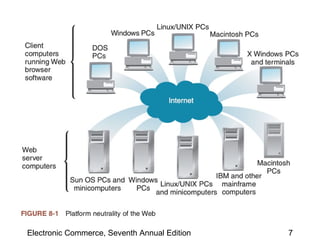
Web Clients and Web Servers Client/server architectures Client computers typically request services  A server processes the clients’ requests Web software Lets different types of computers running different operating systems communicate
 
Dynamic Content Dynamic content is nonstatic information constructed in response to a Web client’s request Dynamic page Web page whose content is shaped by a program in response to user requests Static page   An unchanging page retrieved from disk
Dynamic Content (continued) Server-side scripting  Programs running on a Web server create Web pages before sending them back to the requesting Web clients  Dynamic page-generation technologies include: Active Server Pages (ASP) JavaServer Pages (JSP) PHP: Hypertext Preprocessor (PHP)
Various Meanings of “Server” Server   Computer used to provide files or make programs available to other computers  Server software Used by a server computer to make files and programs available to other computers Database server Server computer on which database management software runs
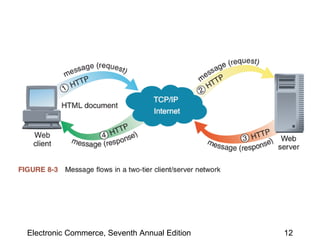
Two-Tier Client/Server Architecture Two-tier client/server architecture has only one client and one server Request message Message that a Web client sends to request a file or files from a Web server Typical request message contains: Request line Optional request headers Optional entity body
 
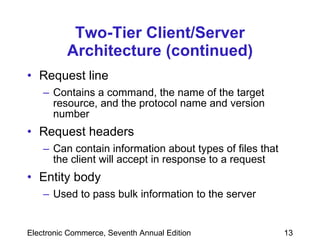
Two-Tier Client/Server Architecture (continued) Request line Contains a command, the name of the target resource, and the protocol name and version number Request headers Can contain information about types of files that the client will accept in response to a request Entity body Used to pass bulk information to the server
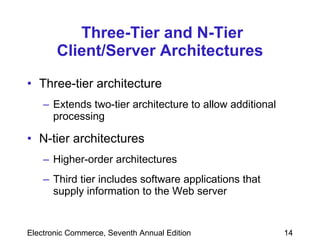
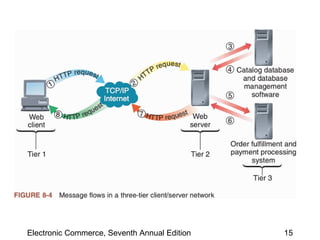
Three-Tier and N-Tier Client/Server Architectures Three-tier architecture Extends two-tier architecture to allow additional processing N-tier architectures Higher-order architectures Third tier includes software applications that supply information to the Web server
 
Software for Web Servers Operating system tasks include running programs and allocating computer resources Linux Open-source operating system that is easy to install, fast, and efficient Open-source software Developed by a community of programmers who make it available for download at no cost
Web Server Software The most popular Web server programs are:  Apache HTTP Server Microsoft Internet Information Server (IIS) Sun Java System Web Server (JSWS)  Netcraft A networking consulting company in Bath, England Accumulates popularity rankings
Apache HTTP Server Apache is an ongoing group software development effort It has dominated the Web since 1996 because it is free and performs efficiently Apache Developed by Rob McCool at the University of Illinois in1994 at the   NCSA   Currently available on the Web at no cost as open-source software
Microsoft Internet Information Server Comes bundled with current versions of Microsoft Windows Server operating systems Used on many corporate intranets Supports the use of: ASP ActiveX Data Objects SQL database queries
Sun Java System Web Server  (Sun ONE, iPlanet, Netscape) Descendant of the original NCSA Web server program Formerly sold under the names: Sun ONE Netscape Enterprise Server iPlanet Enterprise Server Charges between $1400 and $5000 for the licensing fee
Electronic Mail (E-Mail) Being able to attach documents to e-mail is useful Drawbacks include: Time spent by business people responding to e-mail Computer viruses Programs that attach to other programs  Can cause damage when the host program is activated
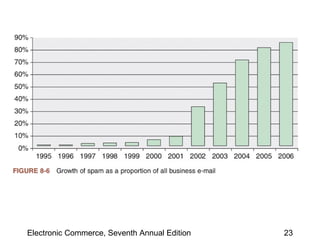
Spam Spam is unsolicited or commercial e-mail During one 24-hour period in 2005 researchers estimated that 106 billion spam e-mail messages were sent Companies now offer software to limit the amount of spam
 
Solutions to the Spam Problem Reduce the likelihood that a spammer can automatically generate e-mail addresses Control exposure of an e-mail address Use multiple e-mail addresses  Content filtering strategy Require software that identifies content elements that indicate if a message is (or is not) spam
Solutions to the Spam Problem (continued) Content-filtering techniques Black list spam filter Looks for known spammer From addresses in incoming messages  White list spam filter   Examines From addresses and compares them to a list of known good sender addresses Challenge-response technique Compares all incoming messages to a white list CAN-SPAM law http://www.ftc.gov/bcp/edu/pubs/business/ecommerce/bus61.shtm
Web Site and Internet Utility Programs Finger  Runs on UNIX operating systems  Allows users to obtain information about other network users Command yields a list of users who are logged on to a network Ping (Packet Internet Groper) Tests connectivity between two computers connected to the Internet
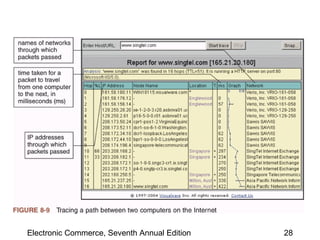
Tracert and Other Route-Tracing Programs Tracert (TRACE RouTe)  Sends data packets to every computer on the path between one computer and another Clocks packets’ roundtrip times Calculates and displays the number of hops between computers Calculates the time it takes to traverse an entire one-way path between machines
 
Telnet and FTP Utilities Telnet  Program that allows users to log on to a computer connected to the Internet Telnet protocol Set of rules used by Telnet programs File Transfer Protocol (FTP) Defines formats used to transfer files between TCP/IP-connected computers
Indexing and Searching Utility Programs Search engines or search tools  Search either a specific site or the entire Web for requested documents Indexing program Can provide full-text indexing that generates an index for all documents stored on a server Can often index documents stored in many different file formats
Data Analysis Software Web servers can capture: Data about who is visiting a Web site  How long the visitor’s Web browser viewed the site Date and time of each visit Which pages a visitor viewed Data captured by Web servers are stored in a log file
Link-Checking Utilities Link checker examines each Web page and reports on URLs that: Are broken Seem broken Are incorrect in some way Orphan file  File on a Web site not linked to any page Dead link When clicked, it displays an error message rather than a Web page
Remote Server Administration Web site administrator can control a Web site from any Internet-connected computer NetMechanic Offers a variety of link-checking, HTML troubleshooting, site-monitoring, and other programs
Web Server Hardware Web server computers More memory, larger hard disk drives, and faster processors than typical PCs Blade servers Placing small server computers on a single computer board, then installing boards into a rack-mounted frame Virtual server (virtual host) Maintains more than one server on one machine
Web Server Performance Evaluation Benchmarking Testing used to compare the performance of hardware and software Throughput  Number of HTTP requests that a hardware and software combination can process in a unit of time  Response time  Time required by a server to process one request
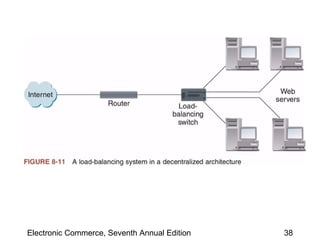
Web Server Hardware Architectures Server farms Large collections of servers Centralized architecture Uses a few very large and fast computers Distributed/decentralized architecture   Uses a large number of less powerful computers Divides the workload among them
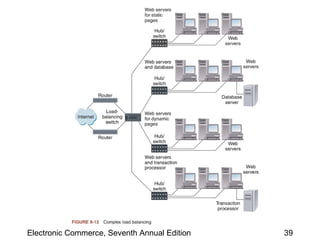
Load-Balancing Systems Load-balancing switch Piece of network hardware that monitors the workloads of servers attached to it  Assigns incoming Web traffic to a server that has the most available capacity at that instant in time
 
 
Summary The Web uses a client/server architecture  For simple HTTP requests a two-tier architecture works well Operating systems commonly used on Web server computers include: Microsoft server operating systems UNIX-based operating systems
Summary (continued) Utility programs running on Web server computers include: Finger, Ping, Tracert, e-mail server software, Telnet, and FTP Unsolicited commercial e-mail (spam) has grown dramatically in recent years Content filters are becoming available to deal with the problem
Summary (continued) Web server hardware Server computer must have enough memory and disk space Factors that affect Web server performance include: Operating system Connection speed User capacity

Chapter 8

  • 1.
    Chapter 8: WebServer Hardware and Software Electronic Commerce, Seventh Annual Edition
  • 2.
    Objectives In thischapter, you will learn about: Web server basics Software for Web servers E-mail management and spam control issues Internet and Web site utility programs Web server hardware
  • 3.
    Web Server BasicsThe main job of a Web server computer is to respond to requests from Web client computers Three main elements of a Web server: Hardware Operating system software Web server software
  • 4.
    Types of WebSites Development sites Used to evaluate different Web designs Intranets Corporate networks that house internal memos, corporate policy handbooks, and a variety of other corporate documents Extranets Intranets that allow authorized parties outside the company to access information stored in the system
  • 5.
    Types of WebSites (continued) Transaction-processing sites Commerce sites that must be available 24 hours a day, seven days a week Content-delivery sites Deliver content such as news, histories, summaries, and other digital information
  • 6.
    Web Clients andWeb Servers Client/server architectures Client computers typically request services A server processes the clients’ requests Web software Lets different types of computers running different operating systems communicate
  • 7.
  • 8.
    Dynamic Content Dynamiccontent is nonstatic information constructed in response to a Web client’s request Dynamic page Web page whose content is shaped by a program in response to user requests Static page An unchanging page retrieved from disk
  • 9.
    Dynamic Content (continued)Server-side scripting Programs running on a Web server create Web pages before sending them back to the requesting Web clients Dynamic page-generation technologies include: Active Server Pages (ASP) JavaServer Pages (JSP) PHP: Hypertext Preprocessor (PHP)
  • 10.
    Various Meanings of“Server” Server Computer used to provide files or make programs available to other computers Server software Used by a server computer to make files and programs available to other computers Database server Server computer on which database management software runs
  • 11.
    Two-Tier Client/Server ArchitectureTwo-tier client/server architecture has only one client and one server Request message Message that a Web client sends to request a file or files from a Web server Typical request message contains: Request line Optional request headers Optional entity body
  • 12.
  • 13.
    Two-Tier Client/Server Architecture(continued) Request line Contains a command, the name of the target resource, and the protocol name and version number Request headers Can contain information about types of files that the client will accept in response to a request Entity body Used to pass bulk information to the server
  • 14.
    Three-Tier and N-TierClient/Server Architectures Three-tier architecture Extends two-tier architecture to allow additional processing N-tier architectures Higher-order architectures Third tier includes software applications that supply information to the Web server
  • 15.
  • 16.
    Software for WebServers Operating system tasks include running programs and allocating computer resources Linux Open-source operating system that is easy to install, fast, and efficient Open-source software Developed by a community of programmers who make it available for download at no cost
  • 17.
    Web Server SoftwareThe most popular Web server programs are: Apache HTTP Server Microsoft Internet Information Server (IIS) Sun Java System Web Server (JSWS) Netcraft A networking consulting company in Bath, England Accumulates popularity rankings
  • 18.
    Apache HTTP ServerApache is an ongoing group software development effort It has dominated the Web since 1996 because it is free and performs efficiently Apache Developed by Rob McCool at the University of Illinois in1994 at the NCSA Currently available on the Web at no cost as open-source software
  • 19.
    Microsoft Internet InformationServer Comes bundled with current versions of Microsoft Windows Server operating systems Used on many corporate intranets Supports the use of: ASP ActiveX Data Objects SQL database queries
  • 20.
    Sun Java SystemWeb Server (Sun ONE, iPlanet, Netscape) Descendant of the original NCSA Web server program Formerly sold under the names: Sun ONE Netscape Enterprise Server iPlanet Enterprise Server Charges between $1400 and $5000 for the licensing fee
  • 21.
    Electronic Mail (E-Mail)Being able to attach documents to e-mail is useful Drawbacks include: Time spent by business people responding to e-mail Computer viruses Programs that attach to other programs Can cause damage when the host program is activated
  • 22.
    Spam Spam isunsolicited or commercial e-mail During one 24-hour period in 2005 researchers estimated that 106 billion spam e-mail messages were sent Companies now offer software to limit the amount of spam
  • 23.
  • 24.
    Solutions to theSpam Problem Reduce the likelihood that a spammer can automatically generate e-mail addresses Control exposure of an e-mail address Use multiple e-mail addresses Content filtering strategy Require software that identifies content elements that indicate if a message is (or is not) spam
  • 25.
    Solutions to theSpam Problem (continued) Content-filtering techniques Black list spam filter Looks for known spammer From addresses in incoming messages White list spam filter Examines From addresses and compares them to a list of known good sender addresses Challenge-response technique Compares all incoming messages to a white list CAN-SPAM law http://www.ftc.gov/bcp/edu/pubs/business/ecommerce/bus61.shtm
  • 26.
    Web Site andInternet Utility Programs Finger Runs on UNIX operating systems Allows users to obtain information about other network users Command yields a list of users who are logged on to a network Ping (Packet Internet Groper) Tests connectivity between two computers connected to the Internet
  • 27.
    Tracert and OtherRoute-Tracing Programs Tracert (TRACE RouTe) Sends data packets to every computer on the path between one computer and another Clocks packets’ roundtrip times Calculates and displays the number of hops between computers Calculates the time it takes to traverse an entire one-way path between machines
  • 28.
  • 29.
    Telnet and FTPUtilities Telnet Program that allows users to log on to a computer connected to the Internet Telnet protocol Set of rules used by Telnet programs File Transfer Protocol (FTP) Defines formats used to transfer files between TCP/IP-connected computers
  • 30.
    Indexing and SearchingUtility Programs Search engines or search tools Search either a specific site or the entire Web for requested documents Indexing program Can provide full-text indexing that generates an index for all documents stored on a server Can often index documents stored in many different file formats
  • 31.
    Data Analysis SoftwareWeb servers can capture: Data about who is visiting a Web site How long the visitor’s Web browser viewed the site Date and time of each visit Which pages a visitor viewed Data captured by Web servers are stored in a log file
  • 32.
    Link-Checking Utilities Linkchecker examines each Web page and reports on URLs that: Are broken Seem broken Are incorrect in some way Orphan file File on a Web site not linked to any page Dead link When clicked, it displays an error message rather than a Web page
  • 33.
    Remote Server AdministrationWeb site administrator can control a Web site from any Internet-connected computer NetMechanic Offers a variety of link-checking, HTML troubleshooting, site-monitoring, and other programs
  • 34.
    Web Server HardwareWeb server computers More memory, larger hard disk drives, and faster processors than typical PCs Blade servers Placing small server computers on a single computer board, then installing boards into a rack-mounted frame Virtual server (virtual host) Maintains more than one server on one machine
  • 35.
    Web Server PerformanceEvaluation Benchmarking Testing used to compare the performance of hardware and software Throughput Number of HTTP requests that a hardware and software combination can process in a unit of time Response time Time required by a server to process one request
  • 36.
    Web Server HardwareArchitectures Server farms Large collections of servers Centralized architecture Uses a few very large and fast computers Distributed/decentralized architecture Uses a large number of less powerful computers Divides the workload among them
  • 37.
    Load-Balancing Systems Load-balancingswitch Piece of network hardware that monitors the workloads of servers attached to it Assigns incoming Web traffic to a server that has the most available capacity at that instant in time
  • 38.
  • 39.
  • 40.
    Summary The Webuses a client/server architecture For simple HTTP requests a two-tier architecture works well Operating systems commonly used on Web server computers include: Microsoft server operating systems UNIX-based operating systems
  • 41.
    Summary (continued) Utilityprograms running on Web server computers include: Finger, Ping, Tracert, e-mail server software, Telnet, and FTP Unsolicited commercial e-mail (spam) has grown dramatically in recent years Content filters are becoming available to deal with the problem
  • 42.
    Summary (continued) Webserver hardware Server computer must have enough memory and disk space Factors that affect Web server performance include: Operating system Connection speed User capacity