

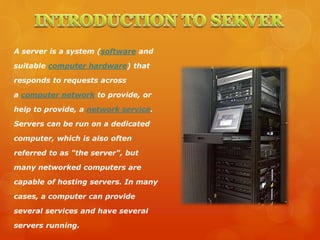

A server is a system (software and
suitable computer hardware) that
responds to requests across
a computer network to provide, or
help to provide, a network service.
Servers can be run on a dedicated
computer, which is also often
referred to as "the server", but
many networked computers are
capable of hosting servers. In many
cases, a computer can provide
several services and have several
servers running.
 The term server is used quite broadly in information
technology. Despite the many server-branded
products available (such as server versions of
hardware, software or operating systems), in theory
any computerized process that shares a resource to
one or more client processes is a server. To illustrate
this, take the common example of file sharing. While
the existence of files on a machine does not classify
it as a server, the mechanism which shares these
files to clients by the operating system is the server.
 Similarly, consider a web server application
(such as the multiplatform "Apache HTTP
Server"). This web server software can
be run on any capable computer. For
example, while a laptop or personal
computer is not typically known as a
server, they can in these situations fulfill
the role of one, and hence be labeled as
one. It is, in this case, the machine's role
that places it in the category of server.
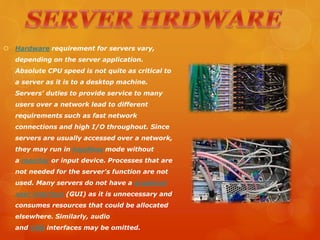
 Hardware requirement for servers vary,
depending on the server application.
Absolute CPU speed is not quite as critical to
a server as it is to a desktop machine.
Servers' duties to provide service to many
users over a network lead to different
requirements such as fast network
connections and high I/O throughout. Since
servers are usually accessed over a network,
they may run in headless mode without
a monitor or input device. Processes that are
not needed for the server's function are not
used. Many servers do not have a graphical
user interface (GUI) as it is unnecessary and
consumes resources that could be allocated
elsewhere. Similarly, audio
and USB interfaces may be omitted.
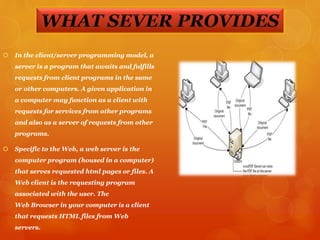
 In the client/server programming model, a
server is a program that awaits and fulfills
requests from client programs in the same
or other computers. A given application in
a computer may function as a client with
requests for services from other programs
and also as a server of requests from other
programs.
 Specific to the Web, a web server is the
computer program (housed in a computer)
that serves requested html pages or files. A
Web client is the requesting program
associated with the user. The
Web Browser in your computer is a client
that requests HTML files from Web
servers.
 Application server a server dedicated to running certain software
applications
 Catalog server a central search point for information across a distributed
network
 Communications server carrier-grade computing platform for
communications networks
 Compute server, a server intended for intensive (esp. scientific)
computations
 Database server provides database services to other computer programs or
computers
 Fax server provides fax services for clients
 File server provides remote access to files
 Game server a server that video game clients connect to in order to play
online together
 Home server a server for the home
 Mail server handles transport of and access to email
 Mobile Server or Server on the Go is an Intel Xeon processor based server
class laptop form factor computer.
 Name server or DNS
 Print server provides printer services
 Proxy server acts as an intermediary for requests from clients seeking
resources from other servers
 Sound server provides multimedia broadcasting, streaming.
 Stand-alone server a server on a Windows network that neither belongs to
nor governs a Windows domain
 Web server a server that HTTP clients connect to in order to send commands
and receive responses along with data contents
Server-oriented operating systems can, in
many cases, interact with hardware sensors
to detect conditions such as overheating,
processor and disk failure, and
consequently alert an operator or take
remedial measures themselves.
Server and Its Types - Presentation

Server and Its Types - Presentation

  • 3.
    A server isa system (software and suitable computer hardware) that responds to requests across a computer network to provide, or help to provide, a network service. Servers can be run on a dedicated computer, which is also often referred to as "the server", but many networked computers are capable of hosting servers. In many cases, a computer can provide several services and have several servers running.
  • 4.
     The termserver is used quite broadly in information technology. Despite the many server-branded products available (such as server versions of hardware, software or operating systems), in theory any computerized process that shares a resource to one or more client processes is a server. To illustrate this, take the common example of file sharing. While the existence of files on a machine does not classify it as a server, the mechanism which shares these files to clients by the operating system is the server.
  • 5.
     Similarly, considera web server application (such as the multiplatform "Apache HTTP Server"). This web server software can be run on any capable computer. For example, while a laptop or personal computer is not typically known as a server, they can in these situations fulfill the role of one, and hence be labeled as one. It is, in this case, the machine's role that places it in the category of server.
  • 6.
     Hardware requirementfor servers vary, depending on the server application. Absolute CPU speed is not quite as critical to a server as it is to a desktop machine. Servers' duties to provide service to many users over a network lead to different requirements such as fast network connections and high I/O throughout. Since servers are usually accessed over a network, they may run in headless mode without a monitor or input device. Processes that are not needed for the server's function are not used. Many servers do not have a graphical user interface (GUI) as it is unnecessary and consumes resources that could be allocated elsewhere. Similarly, audio and USB interfaces may be omitted.
  • 7.
     In theclient/server programming model, a server is a program that awaits and fulfills requests from client programs in the same or other computers. A given application in a computer may function as a client with requests for services from other programs and also as a server of requests from other programs.  Specific to the Web, a web server is the computer program (housed in a computer) that serves requested html pages or files. A Web client is the requesting program associated with the user. The Web Browser in your computer is a client that requests HTML files from Web servers.
  • 8.
     Application servera server dedicated to running certain software applications  Catalog server a central search point for information across a distributed network  Communications server carrier-grade computing platform for communications networks  Compute server, a server intended for intensive (esp. scientific) computations  Database server provides database services to other computer programs or computers  Fax server provides fax services for clients  File server provides remote access to files  Game server a server that video game clients connect to in order to play online together
  • 9.
     Home servera server for the home  Mail server handles transport of and access to email  Mobile Server or Server on the Go is an Intel Xeon processor based server class laptop form factor computer.  Name server or DNS  Print server provides printer services  Proxy server acts as an intermediary for requests from clients seeking resources from other servers  Sound server provides multimedia broadcasting, streaming.  Stand-alone server a server on a Windows network that neither belongs to nor governs a Windows domain  Web server a server that HTTP clients connect to in order to send commands and receive responses along with data contents
  • 10.
    Server-oriented operating systemscan, in many cases, interact with hardware sensors to detect conditions such as overheating, processor and disk failure, and consequently alert an operator or take remedial measures themselves.