CHAPTER 7
CORPORATE
STOCKS
stock financing
 types of stocks

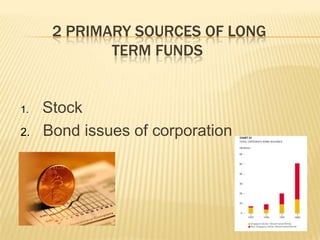
2 PRIMARY SOURCES OF LONG
TERM FUNDS

1.

2.

Stock
Bond issues of corporation
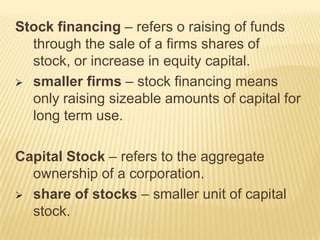
Stock financing – refers o raising of funds
through the sale of a firms shares of
stock, or increase in equity capital.
 smaller firms – stock financing means
only raising sizeable amounts of capital for
long term use.
Capital Stock – refers to the aggregate
ownership of a corporation.
 share of stocks – smaller unit of capital
stock.
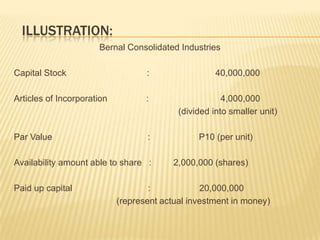
ILLUSTRATION:
Bernal Consolidated Industries
Capital Stock

:

Articles of Incorporation

:

4,000,000
(divided into smaller unit)

Par Value

:

P10 (per unit)

Availability amount able to share :
Paid up capital

40,000,000

2,000,000 (shares)

:
20,000,000
(represent actual investment in money)
SHARES OF STOCKS HAVE
3 BASIC CHARACTERISTICS
1.
2.
3.

they are negotiable
entitled to receive dividends
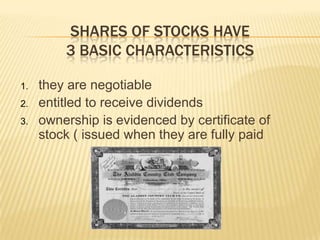
ownership is evidenced by certificate of
stock ( issued when they are fully paid
DIVIDENDS
profit on stock investment are in form of
dividends
 one of the obligation of corporation to
stockholders
 payments is not fixed obligation
 its contingent upon the availability of
accumulated net earnings
 declaration of board of directors if the
dividend should be paid out

consideration before paying dividend
 board allocates net earning
 There may be a need to accumulate
sinking funds for long term debt.
 Funds maybe earmarked for proposed or
on going projects.
 Firm follow a policy of retention of a portion
of net earnings for reinvestment.
 Not all earnings are paid out as dividends
to stockholders.

FORMS OF DIVIDENDS
1.
2.
3.
4.

5.

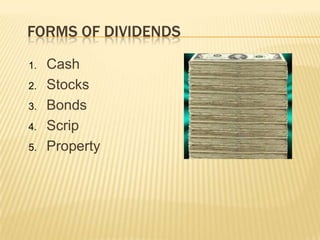
Cash
Stocks
Bonds
Scrip
Property
Cash – management would like to utilize the
funds for other purpose
Shares of stocks or bonds
Scrip – may also be paid as dividends
- this sort of a warrant, option or
certificate entitles the holders to collect either
cash, stocks or bonds from the company at
some future date.

Property – forms of goods, or shares owned by
company but issued by other corporation.
ACQUIRING STOCKS
Investors acquire unissued stocks
by subscription and issued stocks by
purchase


Subscription – a contract entered into by
an investor to buy a certain number of
unissued shares at agreed price.
- buyer become stockholder
- he is entitled of the full value of his
shares even if they are only partially paid.
ILLUSTRATION:
A – 100 shares (10,000 par value) =
1,000,000 value
B – down payment 20 shares (80 shares
left) = certificate upon payment of shares
will given the entitlement of 100% shares
of stock will be issued upon full pay.
CAPITAL STOCK STRUCTURE


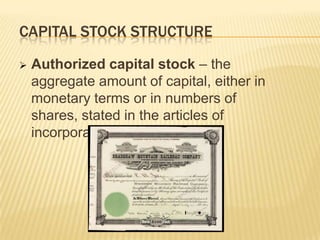
Authorized capital stock – the
aggregate amount of capital, either in
monetary terms or in numbers of
shares, stated in the articles of
incorporation.


Unissued stock – the portion of the
authorized capital stock, or an additional
issue, which has not yet been subscribed
to or purchased and therefore remains
with the corporation.






Issued capital – refers to stocks already
subscribed to or issued, whether partly or fully
paid for, which are in the hands of outsiders or
reacquired by the corporation.
Outstanding Capital Stock – includes all issued
stocks fully or partially paid for which are
currently held by outside stockholders other than
the issuing corporation.
Treasury stocks – shares with have been
issued and fully paid for but are reacquired by
the issuing corporation through repurchase, gifts
or donations.
TYPES OF SHARES OF STOCK
Shares of stocks, just like any
commodity, are bought and sold in a
market, the securities market.
 To promote their marketability, issuing
companies cater to the
whims, preferences, and even
idiosyncracies of the investing public.
 Investors focus their interest on three
primary aspects of their investments
income, risk, and control.

COMMON AND PREFERRED
Shares of stocks are generally classified
into common stocks and preferred
shares.
 Both types are transferable and are
entitled to dividends.
 Stockholders of both enjoy the
fundamental rights of stockholders.

THEIR MAIN DIFFERENCES ARE:
1.

2.

Common stocks represents equity or the
permanent capital of the firm. Preferred
stock is of doubtful investment status.
Modern finance relegates preferred
shares to the category of debt
instruments rather than permanent
investments.
Common stocks have voting rights in the
election and removal of the directors, a
right generally denied preferred shares.
3.

4.

Preferred stocks have special privileges
to compensate for the restrictions on its
voting rights, commonly in priority to the
earnings and assets over common
shares.
Preferred shares have fixed dividend
rates. Dividends to common stocks
depend upon the amount declared
available to common stocks.
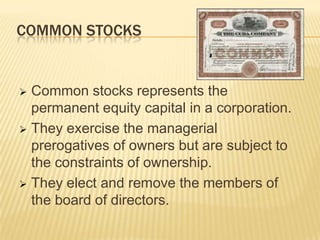
COMMON STOCKS

Common stocks represents the
permanent equity capital in a corporation.
 They exercise the managerial
prerogatives of owners but are subject to
the constraints of ownership.
 They elect and remove the members of
the board of directors.

CLASSIFIED COMMON STOCKS
A number of corporations may differentiate
their common stocks for various purposes.
 The most common reason is to comply
with nationality requirements.
 There are cases when a corporation may
wish to restrict the voting privileges or
dividend rights of some common stocks.
 Limitations imposed on the rights or
transfer of common shares are written on
the certificate of stocks.





Classes “A” and “B” – The Private
Development Corporation of the Philippines
(PDCP) classifies its common stock into
Class “A” and class “B”.
- Both classes of stocks have the same
privilege except for restrictions on the
nationality of the buyers and their voting
rights.
Class “A” – shares may only be purchased
by Filipinos and entities of which 60% of the
capital is owned by Filipino citizens.
- Holders of class “A” stock may elect eight
Filipino directors of the company.
- These directors must also be holders of
Class “A” shares.
- The Philippine National Bank is granted the


Class “B” – stock is open to all
investors, regardless of nationality.
- Holders of class “B” shares are entitled to
elect three of the eleven directors.
- These directors must be holders of class
“B” stocks.
- The Filoil Refinery Corporation
(now Philippine National Oil Company)
issued two classes of common
stock, class “A” and class “B”.
TWO CLASSES OF COMMON STOCK,
CLASS “A” AND CLASS “B”


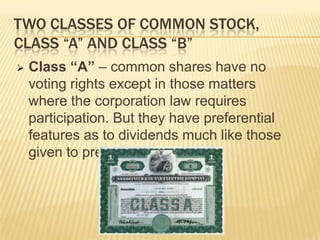
Class “A” – common shares have no
voting rights except in those matters
where the corporation law requires
participation. But they have preferential
features as to dividends much like those
given to preferred shares.
- Class “A” shares are entitled to 4%
dividends before any class “B” shares are
paid at the same rate.
- If there is a remainder, the class “A” share
shall be paid another 4% dividend. Any
balance left goes to class “B” shares


Class “B” – shares are given full voting
rights.
- Class “A” shares are given temporary
voting rights only if the board of directors
fails to declare dividends for three
consecutive years.
- Such power is automatically removed
upon payment of preferred dividends for
one fiscal year.
PREFERRED STOCKS





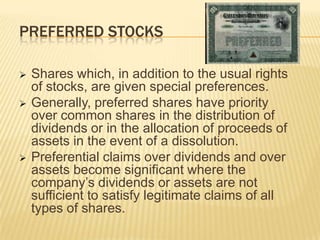
Shares which, in addition to the usual rights
of stocks, are given special preferences.
Generally, preferred shares have priority
over common shares in the distribution of
dividends or in the allocation of proceeds of
assets in the event of a dissolution.
Preferential claims over dividends and over
assets become significant where the
company’s dividends or assets are not
sufficient to satisfy legitimate claims of all
types of shares.
Participating and non-participating
 A share of stock is said to participating
when, in addition to a preferential rate of
dividend it receives, it is allowed to share
with the common stock in the remaining
dividends.
Cumulative and non-cumulative
 Cumulative stocks are entitled to
dividends even for periods where no
dividends have been declared.
- Payment for dividends in arrears, the
unpaid dividends of past periods, are paid
ahead of current dividends.


Non-cumulative stocks, there are
stipulations which modify the limitations to
dividends for non-cumulative shares for
periods where net earnings are nil.
- It may be provided that the noncumulative shares are not entitled to
dividends for periods where there are no
earnings.
Callable or redeemable shares
 These are stocks which are subject to
redemption or recall, or simply repurchase
by the issuing corporation.
 Callable shares of the “optional” variety
are redeemable at the option of the
company, in other words, stockholders
may not force redemption of such shares.
 Redemption prices differ, the price is
usually above the purchase or par value
price of the shares.
Sinking funds for redemption
 Funds used for the repurchase, of redeemable
shares are required to come from the earnings
of the issuing company
 As a matter of good business policy, the
corporation maintains a sinking fund for
redemption purposes.

Convertible stocks
 These are shares which, at the option of the
stockholder, may be exchanged with other
securities of the issuing company.
 The most usual form of conversion is from
preferred to common stocks which once
made, there may be no reconversion.
Diversification and dilution
 The conversion privilege is an opportunity
for the investor to diversify his
investment.
 The stockholder could take advantage of
a favorable climate for the other types of
securities to which they are convertible.
 Dilution a conversion feature is for the
purpose of increasing the sale ability of
the stocks, protection against dilution or
rendering worthless the conversion
privilege may be stipulated.
OTHER STOCK FEATURES
Guarantee
 The dividend payments of guaranteed
stocks are guaranteed by a company
other than the issuing corporation.
 A corporation may not guarantee the
dividend payment of its own stock.
 For example, Filipina Biscuit Corporation
may issue guaranteed preferred shares
the dividend payment of which are
guaranteed by the Republic Cement
Corporation.
Par value
 A share of stock with an assigned nominal
value stated on its face is a par value
stock.
No par value
 Shares are stocks without the nominal
value stated on its certificate.
 “No par value” shares do not have a fixed
value in monetary terms.
 The authorized capital stock of the
company issuing no par value shares is
stated in terms of number of shares.
Deferred stocks
 refer to shares where dividend payments
are subject to the occurrence of a
contingent event or the lapse of a
specified period.
 Stocks receive their dividend whenever
declared by the board of directors.
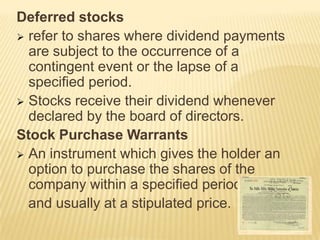
Stock Purchase Warrants
 An instrument which gives the holder an
option to purchase the shares of the
company within a specified period
and usually at a stipulated price.
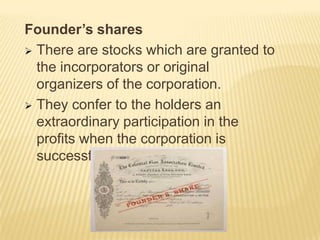
Founder’s shares
 There are stocks which are granted to
the incorporators or original
organizers of the corporation.
 They confer to the holders an
extraordinary participation in the
profits when the corporation is
successful.

Chapter 7 - Corporate Stocks

  • 1.
  • 2.
    2 PRIMARY SOURCESOF LONG TERM FUNDS 1. 2. Stock Bond issues of corporation
  • 3.
    Stock financing –refers o raising of funds through the sale of a firms shares of stock, or increase in equity capital.  smaller firms – stock financing means only raising sizeable amounts of capital for long term use. Capital Stock – refers to the aggregate ownership of a corporation.  share of stocks – smaller unit of capital stock.
  • 4.
    ILLUSTRATION: Bernal Consolidated Industries CapitalStock : Articles of Incorporation : 4,000,000 (divided into smaller unit) Par Value : P10 (per unit) Availability amount able to share : Paid up capital 40,000,000 2,000,000 (shares) : 20,000,000 (represent actual investment in money)
  • 5.
    SHARES OF STOCKSHAVE 3 BASIC CHARACTERISTICS 1. 2. 3. they are negotiable entitled to receive dividends ownership is evidenced by certificate of stock ( issued when they are fully paid
  • 6.
    DIVIDENDS profit on stockinvestment are in form of dividends  one of the obligation of corporation to stockholders  payments is not fixed obligation  its contingent upon the availability of accumulated net earnings  declaration of board of directors if the dividend should be paid out 
  • 7.
    consideration before payingdividend  board allocates net earning  There may be a need to accumulate sinking funds for long term debt.  Funds maybe earmarked for proposed or on going projects.  Firm follow a policy of retention of a portion of net earnings for reinvestment.  Not all earnings are paid out as dividends to stockholders. 
  • 8.
  • 9.
    Cash – managementwould like to utilize the funds for other purpose Shares of stocks or bonds Scrip – may also be paid as dividends - this sort of a warrant, option or certificate entitles the holders to collect either cash, stocks or bonds from the company at some future date. Property – forms of goods, or shares owned by company but issued by other corporation.
  • 10.
    ACQUIRING STOCKS Investors acquireunissued stocks by subscription and issued stocks by purchase  Subscription – a contract entered into by an investor to buy a certain number of unissued shares at agreed price. - buyer become stockholder - he is entitled of the full value of his shares even if they are only partially paid.
  • 11.
    ILLUSTRATION: A – 100shares (10,000 par value) = 1,000,000 value B – down payment 20 shares (80 shares left) = certificate upon payment of shares will given the entitlement of 100% shares of stock will be issued upon full pay.
  • 12.
    CAPITAL STOCK STRUCTURE  Authorizedcapital stock – the aggregate amount of capital, either in monetary terms or in numbers of shares, stated in the articles of incorporation.
  • 13.
     Unissued stock –the portion of the authorized capital stock, or an additional issue, which has not yet been subscribed to or purchased and therefore remains with the corporation.
  • 14.
       Issued capital –refers to stocks already subscribed to or issued, whether partly or fully paid for, which are in the hands of outsiders or reacquired by the corporation. Outstanding Capital Stock – includes all issued stocks fully or partially paid for which are currently held by outside stockholders other than the issuing corporation. Treasury stocks – shares with have been issued and fully paid for but are reacquired by the issuing corporation through repurchase, gifts or donations.
  • 15.
    TYPES OF SHARESOF STOCK Shares of stocks, just like any commodity, are bought and sold in a market, the securities market.  To promote their marketability, issuing companies cater to the whims, preferences, and even idiosyncracies of the investing public.  Investors focus their interest on three primary aspects of their investments income, risk, and control. 
  • 16.
    COMMON AND PREFERRED Sharesof stocks are generally classified into common stocks and preferred shares.  Both types are transferable and are entitled to dividends.  Stockholders of both enjoy the fundamental rights of stockholders. 
  • 17.
    THEIR MAIN DIFFERENCESARE: 1. 2. Common stocks represents equity or the permanent capital of the firm. Preferred stock is of doubtful investment status. Modern finance relegates preferred shares to the category of debt instruments rather than permanent investments. Common stocks have voting rights in the election and removal of the directors, a right generally denied preferred shares.
  • 18.
    3. 4. Preferred stocks havespecial privileges to compensate for the restrictions on its voting rights, commonly in priority to the earnings and assets over common shares. Preferred shares have fixed dividend rates. Dividends to common stocks depend upon the amount declared available to common stocks.
  • 19.
    COMMON STOCKS Common stocksrepresents the permanent equity capital in a corporation.  They exercise the managerial prerogatives of owners but are subject to the constraints of ownership.  They elect and remove the members of the board of directors. 
  • 20.
    CLASSIFIED COMMON STOCKS Anumber of corporations may differentiate their common stocks for various purposes.  The most common reason is to comply with nationality requirements.  There are cases when a corporation may wish to restrict the voting privileges or dividend rights of some common stocks.  Limitations imposed on the rights or transfer of common shares are written on the certificate of stocks. 
  • 21.
      Classes “A” and“B” – The Private Development Corporation of the Philippines (PDCP) classifies its common stock into Class “A” and class “B”. - Both classes of stocks have the same privilege except for restrictions on the nationality of the buyers and their voting rights. Class “A” – shares may only be purchased by Filipinos and entities of which 60% of the capital is owned by Filipino citizens. - Holders of class “A” stock may elect eight Filipino directors of the company. - These directors must also be holders of Class “A” shares. - The Philippine National Bank is granted the
  • 22.
     Class “B” –stock is open to all investors, regardless of nationality. - Holders of class “B” shares are entitled to elect three of the eleven directors. - These directors must be holders of class “B” stocks. - The Filoil Refinery Corporation (now Philippine National Oil Company) issued two classes of common stock, class “A” and class “B”.
  • 23.
    TWO CLASSES OFCOMMON STOCK, CLASS “A” AND CLASS “B”  Class “A” – common shares have no voting rights except in those matters where the corporation law requires participation. But they have preferential features as to dividends much like those given to preferred shares.
  • 24.
    - Class “A”shares are entitled to 4% dividends before any class “B” shares are paid at the same rate. - If there is a remainder, the class “A” share shall be paid another 4% dividend. Any balance left goes to class “B” shares  Class “B” – shares are given full voting rights. - Class “A” shares are given temporary voting rights only if the board of directors fails to declare dividends for three consecutive years. - Such power is automatically removed upon payment of preferred dividends for one fiscal year.
  • 25.
    PREFERRED STOCKS    Shares which,in addition to the usual rights of stocks, are given special preferences. Generally, preferred shares have priority over common shares in the distribution of dividends or in the allocation of proceeds of assets in the event of a dissolution. Preferential claims over dividends and over assets become significant where the company’s dividends or assets are not sufficient to satisfy legitimate claims of all types of shares.
  • 26.
    Participating and non-participating A share of stock is said to participating when, in addition to a preferential rate of dividend it receives, it is allowed to share with the common stock in the remaining dividends. Cumulative and non-cumulative  Cumulative stocks are entitled to dividends even for periods where no dividends have been declared.
  • 27.
    - Payment fordividends in arrears, the unpaid dividends of past periods, are paid ahead of current dividends.  Non-cumulative stocks, there are stipulations which modify the limitations to dividends for non-cumulative shares for periods where net earnings are nil. - It may be provided that the noncumulative shares are not entitled to dividends for periods where there are no earnings.
  • 28.
    Callable or redeemableshares  These are stocks which are subject to redemption or recall, or simply repurchase by the issuing corporation.  Callable shares of the “optional” variety are redeemable at the option of the company, in other words, stockholders may not force redemption of such shares.  Redemption prices differ, the price is usually above the purchase or par value price of the shares.
  • 29.
    Sinking funds forredemption  Funds used for the repurchase, of redeemable shares are required to come from the earnings of the issuing company  As a matter of good business policy, the corporation maintains a sinking fund for redemption purposes. Convertible stocks  These are shares which, at the option of the stockholder, may be exchanged with other securities of the issuing company.  The most usual form of conversion is from preferred to common stocks which once made, there may be no reconversion.
  • 30.
    Diversification and dilution The conversion privilege is an opportunity for the investor to diversify his investment.  The stockholder could take advantage of a favorable climate for the other types of securities to which they are convertible.  Dilution a conversion feature is for the purpose of increasing the sale ability of the stocks, protection against dilution or rendering worthless the conversion privilege may be stipulated.
  • 31.
    OTHER STOCK FEATURES Guarantee The dividend payments of guaranteed stocks are guaranteed by a company other than the issuing corporation.  A corporation may not guarantee the dividend payment of its own stock.  For example, Filipina Biscuit Corporation may issue guaranteed preferred shares the dividend payment of which are guaranteed by the Republic Cement Corporation.
  • 32.
    Par value  Ashare of stock with an assigned nominal value stated on its face is a par value stock. No par value  Shares are stocks without the nominal value stated on its certificate.  “No par value” shares do not have a fixed value in monetary terms.  The authorized capital stock of the company issuing no par value shares is stated in terms of number of shares.
  • 33.
    Deferred stocks  referto shares where dividend payments are subject to the occurrence of a contingent event or the lapse of a specified period.  Stocks receive their dividend whenever declared by the board of directors. Stock Purchase Warrants  An instrument which gives the holder an option to purchase the shares of the company within a specified period and usually at a stipulated price.
  • 34.
    Founder’s shares  Thereare stocks which are granted to the incorporators or original organizers of the corporation.  They confer to the holders an extraordinary participation in the profits when the corporation is successful.