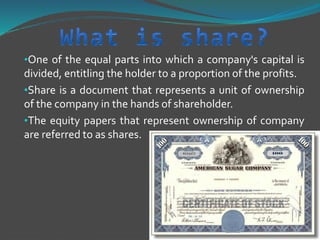
•One of the equal parts into which a company's capital is
divided, entitling the holder to a proportion of the profits.
•Share is a document that represents a unit of ownership
of the company in the hands of shareholder.
•The equity papers that represent ownership of company
are referred to as shares.
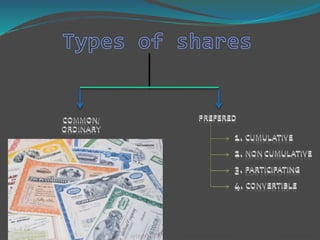
COMMON/ORDINARY SHARES
 Common stock holders have partial ownership
 They enjoy voting rights in the company
 They receive dividend income from the net income of the
company.
 In the event of bankruptcy, common stock shareholders
are entitled to assets left over after creditors,
bondholders and preferred shareholders have been paid
in full.
PREFERED SHARES
 The holders have ownership but no voting rights in
management decisions
 They have preference over the ordinary share holders in
recovery of their money in the event of winding up of
company
 This kind of equity is also called hybrid equity because it
contains the features of both stock & bond.
 The preferred stock holders obtains fixed regular
dividend just like the coupon interest receipt of bond
holder.
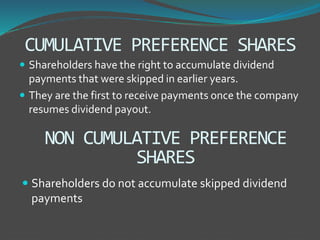
CUMULATIVE PREFERENCE SHARES
 Shareholders have the right to accumulate dividend
payments that were skipped in earlier years.
 They are the first to receive payments once the company
resumes dividend payout.
NON CUMULATIVE PREFERENCE
SHARES
 Shareholders do not accumulate skipped dividend
payments
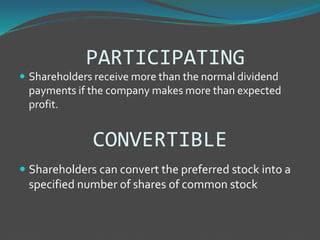
CONVERTIBLE
 Shareholders receive more than the normal dividend
payments if the company makes more than expected
profit.
PARTICIPATING
 Shareholders can convert the preferred stock into a
specified number of shares of common stock
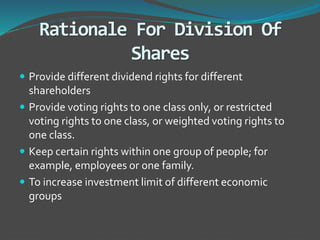
Rationale For Division Of
Shares
 Provide different dividend rights for different
shareholders
 Provide voting rights to one class only, or restricted
voting rights to one class, or weighted voting rights to
one class.
 Keep certain rights within one group of people; for
example, employees or one family.
 To increase investment limit of different economic
groups
Shares and its types

Shares and its types

  • 3.
    •One of theequal parts into which a company's capital is divided, entitling the holder to a proportion of the profits. •Share is a document that represents a unit of ownership of the company in the hands of shareholder. •The equity papers that represent ownership of company are referred to as shares.
  • 5.
    COMMON/ORDINARY SHARES  Commonstock holders have partial ownership  They enjoy voting rights in the company  They receive dividend income from the net income of the company.  In the event of bankruptcy, common stock shareholders are entitled to assets left over after creditors, bondholders and preferred shareholders have been paid in full.
  • 6.
    PREFERED SHARES  Theholders have ownership but no voting rights in management decisions  They have preference over the ordinary share holders in recovery of their money in the event of winding up of company  This kind of equity is also called hybrid equity because it contains the features of both stock & bond.  The preferred stock holders obtains fixed regular dividend just like the coupon interest receipt of bond holder.
  • 7.
    CUMULATIVE PREFERENCE SHARES Shareholders have the right to accumulate dividend payments that were skipped in earlier years.  They are the first to receive payments once the company resumes dividend payout. NON CUMULATIVE PREFERENCE SHARES  Shareholders do not accumulate skipped dividend payments
  • 8.
    CONVERTIBLE  Shareholders receivemore than the normal dividend payments if the company makes more than expected profit. PARTICIPATING  Shareholders can convert the preferred stock into a specified number of shares of common stock
  • 9.
    Rationale For DivisionOf Shares  Provide different dividend rights for different shareholders  Provide voting rights to one class only, or restricted voting rights to one class, or weighted voting rights to one class.  Keep certain rights within one group of people; for example, employees or one family.  To increase investment limit of different economic groups