

APPERCEPTION
TEST (CAT)
MARIVER C.
MANGULABNAN
MAED-Educational Management
August 2019
Projective Techniques
Meaning
A projective test is a
personality test designed to let
a person respond to
ambiguous stimuli,
presumably revealing hidden
emotions and internal conflicts
Meaning
This is sometimes contrasted
with a so-called “objective
test” in which responses are
analyzed according to a
universal standard.
Meaning
The Child Apperception
Test, often abbreviated as
CAT, is an individually
administered projective
personality test appropriate
for children aged 3 to 10
Meaning
The CAT, developed
by psychiatrist and
psychologist Leopold Bellak
and Sonya Sorel Bellak and
first published in 1949
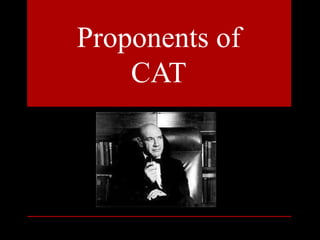
Proponents of
CAT
It is based on the picture-story test called
the Thematic Apperception Test (TAT).
The TAT, created by psychologist Henry
A. Murray for children (ten years old and
older) as well as adults, uses a standard
series of 31 picture cards in assessing
perception of interpersonal relationships.
The cards, which portray humans in a
variety of common situations, are used to
stimulate stories or descriptions (orally or
in writing) about relationships or social
situations and can help identify dominant
drives, emotions, sentiments, conflicts
and complexes. The examiner
In creating the original CAT, animal
figures were used instead of the human
figures depicted in the TAT because it
was assumed that children from three to
ten years of age would identify more
easily with drawings of animals. The
original CAT consisted of ten
cards depicting animal (CAT-A) figures
in human social settings. The Bellaks
later developed the CAT-H, which
included human figures, for use in
children who, for a variety of reasons,
identified more closely with human rather
CAT is a projective personality
test used to assess individual
variations in children's responses
to standardized stimuli presented
in the form of pictures of animals
(CAT-A) or humans (CAT-H) in
Meaning
In a supplement to the CAT—the
CAT-S—the stimuli include
pictures of children in
common family situations such
as prolonged illnesses, births,
deaths, and separations from
Meaning
The CAT is used to assess
personality, level of maturity,
and, often, psychological
health. The theory is that a
child's responses to a series
of drawings of animals or
Purpose
The CAT, which takes 20–45
minutes to administer, is
conducted by a trained
professional—psychiatrist,
psychologist, social worker,
teacher or specially trained
Administration
The test may be used directly in
therapy or as a play technique
in other settings.
Administration
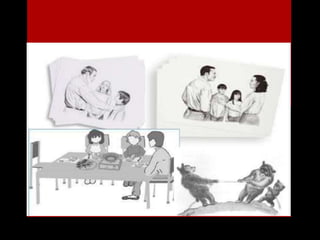
After carefully
establishing rapport with the
child, the examiner shows the
child one card after another in a
particular sequence and
encourages the child to tell a
Administration
The examiner may ask the child
to describe, for example, what
led up to the scene depicted, the
emotions of the characters, and
what might happen in the future.
Administration
A psychologist or other professional person
who is administering the CAT must be trained
in its usage and interpretation, and be
familiar with the psychological theories
underlying the pictures. Because of the
subjective nature of interpreting and analyzing
CAT results, caution should be used in drawing
conclusions from the test results. Most clinical
psychologists recommend using the CAT in
Precautions
Older children between the ages of seven and
10 years may feel that the animal pictures in
the original version of the CAT are too childish
for them. They may respond better to the
pictures of human beings available in the
Children's Apperception Test-Human Figures
(CAT-H), a version of the CAT in which human
beings replace animals in the pictures.
Precautions
In a projective test such as the CAT,
there is no right or wrong answer.
Thus there is no numerical score
or scale for the test. The test
administrator records the essence of
each of the stories told and indicates
the presence or absence of certain
Scoring
The CAT's creators suggest a series
of ten variables to consider when
interpreting the results. These
variables include the story's major
theme, the major character's
needs, drives, anxieties, conflicts,
fears, and the child's conception
Scoring
The CAT, as well as other projective
measures, has been criticized for its lack of
a standardized method of administration as
well as the lack of standard norms for
interpretation. Studies of the interactions
between examiners and test subjects have
found, for example, that the race, gender,
and social class of both participants
Reliability and
Validity
The CAT, which is designed for use in
clinical, educational, and research settings,
provides the examiner with a source of data,
based on the child's perceptions and
imagination, for use in better understanding
the child's current needs, motives,
emotions, and conflicts, both conscious and
unconscious. Its use in clinical assessment
Suggested Uses
http://www.healthofchildren.com/C/Children-s-
Apperception-Test.html#ixzz5sTjfUP00
http://www.minddisorders.com/Br-Del/Children-
s-Apperception-Test.html#ixzz5sTkWj3DM
Reference
Thank you! 

Child Apperception Test by Mariver C. Mangulabnan

  • 1.
    APPERCEPTION TEST (CAT) MARIVER C. MANGULABNAN MAED-EducationalManagement August 2019 Projective Techniques
  • 2.
    Meaning A projective testis a personality test designed to let a person respond to ambiguous stimuli, presumably revealing hidden emotions and internal conflicts
  • 3.
    Meaning This is sometimescontrasted with a so-called “objective test” in which responses are analyzed according to a universal standard.
  • 4.
    Meaning The Child Apperception Test,often abbreviated as CAT, is an individually administered projective personality test appropriate for children aged 3 to 10
  • 5.
    Meaning The CAT, developed bypsychiatrist and psychologist Leopold Bellak and Sonya Sorel Bellak and first published in 1949
  • 6.
  • 7.
    It is basedon the picture-story test called the Thematic Apperception Test (TAT). The TAT, created by psychologist Henry A. Murray for children (ten years old and older) as well as adults, uses a standard series of 31 picture cards in assessing perception of interpersonal relationships. The cards, which portray humans in a variety of common situations, are used to stimulate stories or descriptions (orally or in writing) about relationships or social situations and can help identify dominant drives, emotions, sentiments, conflicts and complexes. The examiner
  • 8.
    In creating theoriginal CAT, animal figures were used instead of the human figures depicted in the TAT because it was assumed that children from three to ten years of age would identify more easily with drawings of animals. The original CAT consisted of ten cards depicting animal (CAT-A) figures in human social settings. The Bellaks later developed the CAT-H, which included human figures, for use in children who, for a variety of reasons, identified more closely with human rather
  • 9.
    CAT is aprojective personality test used to assess individual variations in children's responses to standardized stimuli presented in the form of pictures of animals (CAT-A) or humans (CAT-H) in Meaning
  • 10.
    In a supplementto the CAT—the CAT-S—the stimuli include pictures of children in common family situations such as prolonged illnesses, births, deaths, and separations from Meaning
  • 11.
    The CAT isused to assess personality, level of maturity, and, often, psychological health. The theory is that a child's responses to a series of drawings of animals or Purpose
  • 12.
    The CAT, whichtakes 20–45 minutes to administer, is conducted by a trained professional—psychiatrist, psychologist, social worker, teacher or specially trained Administration
  • 13.
    The test maybe used directly in therapy or as a play technique in other settings. Administration
  • 14.
    After carefully establishing rapportwith the child, the examiner shows the child one card after another in a particular sequence and encourages the child to tell a Administration
  • 15.
    The examiner mayask the child to describe, for example, what led up to the scene depicted, the emotions of the characters, and what might happen in the future. Administration
  • 17.
    A psychologist orother professional person who is administering the CAT must be trained in its usage and interpretation, and be familiar with the psychological theories underlying the pictures. Because of the subjective nature of interpreting and analyzing CAT results, caution should be used in drawing conclusions from the test results. Most clinical psychologists recommend using the CAT in Precautions
  • 18.
    Older children betweenthe ages of seven and 10 years may feel that the animal pictures in the original version of the CAT are too childish for them. They may respond better to the pictures of human beings available in the Children's Apperception Test-Human Figures (CAT-H), a version of the CAT in which human beings replace animals in the pictures. Precautions
  • 19.
    In a projectivetest such as the CAT, there is no right or wrong answer. Thus there is no numerical score or scale for the test. The test administrator records the essence of each of the stories told and indicates the presence or absence of certain Scoring
  • 20.
    The CAT's creatorssuggest a series of ten variables to consider when interpreting the results. These variables include the story's major theme, the major character's needs, drives, anxieties, conflicts, fears, and the child's conception Scoring
  • 21.
    The CAT, aswell as other projective measures, has been criticized for its lack of a standardized method of administration as well as the lack of standard norms for interpretation. Studies of the interactions between examiners and test subjects have found, for example, that the race, gender, and social class of both participants Reliability and Validity
  • 22.
    The CAT, whichis designed for use in clinical, educational, and research settings, provides the examiner with a source of data, based on the child's perceptions and imagination, for use in better understanding the child's current needs, motives, emotions, and conflicts, both conscious and unconscious. Its use in clinical assessment Suggested Uses
  • 23.
  • 24.