F. Scott Fitzgerald’s
 The Great Gatsby
     Narrative Technique
       American Dream
             and
   Gatsby’s American Dream


       Karadeniz Technical University
Department of English Language and Literature
            Ahmet Mesut ATEŞ
• Narrator, Nick, is a minor character merely an
  observer; he doesn’t affect or trigger events.
• Gatsby, the protagonist of the story, is vaguely
  described; leaving reader to construct a character
  with nothing but a few impressions and indirect
  portrayals.
• Protagonist is not succesful but a failed character
• Boundaries between inanimate and animate
  objects seem vague/blury.
It was one of those rare smiles with a quality of eternal
reassurance in it, that you may come across four or five times
in life. (p.32)

With an effoft I managed to restrain my incredulous laughter.
The very phrases were worn so threadbare "that they evoked
no image except that of a turbaned 'character' leaking
sawdust at every pore as he pursued a tiger through the Bois
de Boulogne. (p.42)
The lawn started at the beach and ran towards the front
door for a quarter of a mile, jumping over sundials and brick
walks and burning gardens -finally when it reached the house
drifting up the side in bright vines as though from the
momentum of its run. (p.6)
This is a valley of ashes - a fantastic farm where ashes grow like
wheat into ridges and hills and grotesque gardens; where ashes take
the forms of houses and chimneys and rising smoke and, finally,
with a transcendent effort, of ash-grey men who move dimly and
already crumbling through the powdery air. Occasionally a line of
grey cars crawls along an invisible track, glves out a ghasdy creak,
and comes to rest, and immediately the ash-grey men swaffn up
with leaden spades and stir up an impenetrable cloud, which
screens their obscure operations from your sight. (p.16)
‘American Dream’ can be defined as:
        The prospect of a new country where everybody is emancipatedfrom
        their former economic, religious, social, ethnic and any other
        identities and status; a new frontier for Easterns and a new home for
        those who lack the existence of or the sense of.
Among many we can choose the followings as major catalysts in
the emergence of American Dream:
   –   World War I
   –   The overly-exaggrated and misinterpreted ‘almighty America’ image
   –   Ever-increasing urbanisation
   –   Prohibition of alchololic drinks between 1918-1931
   –   Prospect of easy money
   –   A hopeless/desperate economical and political atmosphere in post-war
       Europe
Gatsby’s American Dream can be analysed in
two part:
• Before he met Daisy
• After his return from World War I
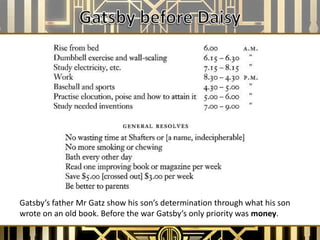
Gatsby’s father Mr Gatz show his son’s determination through what his son
wrote on an old book. Before the war Gatsby’s only priority was money.
He wants her to see his house,' she explained. 'And your house is right
next door.'
'oh!'
'I think he half expected her to wander into one of his parties, some
night,' went on Jordan, 'but she never did. Then he began asking people
casually if they knew her, and I was the first one he found. (p.51)


He wanted nothing less of Daisy than that she should go to Tom and
say: 'I never loved you.‘ …
'And she doesn't understand,' he said. 'She used to be able to
understand. We'd sit for hours - ‘ …
'I wouldn't ask too much of her,' I ventured. 'You can't repeat the past.'
'Can't repeat the past?' he cried incredulously. 'Why of course you can!
(p.70)
Gatsby turned to me rigidly: 'I can't say anything in his house, old spoft.'
'She's got an indiscreet voice,' I remarked. 'It's full of -
' I hesitated.
‘Her voice is full of money,' he said suddenly.
That was it. I'd never understood before. It was full of money – that was
the inexhaustible charm that rose and fell in it, the jingle of it, the
cymbal's song of it ... Fligh in a white palace the king's daughter, the
golden girl… (p.70)


Fitzgerald portrates a failure rather than a success, so we
actually read an American Failed-Dream.
Bibliography
Dimock, Wai Chee. Hemingway, Fitzgerald, Faulkner. Yale
       University, Department of American Studies, Open Yale
       Courses.
National Endowmant of Arts. NEA Big Read Audio Guides, Lec. 16
       The Great Gatsby by F. Scott Fitzgerald.

Narrative Techniques in the Great Gatsby

  • 1.
    F. Scott Fitzgerald’s The Great Gatsby Narrative Technique American Dream and Gatsby’s American Dream Karadeniz Technical University Department of English Language and Literature Ahmet Mesut ATEŞ
  • 2.
    • Narrator, Nick,is a minor character merely an observer; he doesn’t affect or trigger events. • Gatsby, the protagonist of the story, is vaguely described; leaving reader to construct a character with nothing but a few impressions and indirect portrayals. • Protagonist is not succesful but a failed character • Boundaries between inanimate and animate objects seem vague/blury.
  • 3.
    It was oneof those rare smiles with a quality of eternal reassurance in it, that you may come across four or five times in life. (p.32) With an effoft I managed to restrain my incredulous laughter. The very phrases were worn so threadbare "that they evoked no image except that of a turbaned 'character' leaking sawdust at every pore as he pursued a tiger through the Bois de Boulogne. (p.42)
  • 4.
    The lawn startedat the beach and ran towards the front door for a quarter of a mile, jumping over sundials and brick walks and burning gardens -finally when it reached the house drifting up the side in bright vines as though from the momentum of its run. (p.6)
  • 5.
    This is avalley of ashes - a fantastic farm where ashes grow like wheat into ridges and hills and grotesque gardens; where ashes take the forms of houses and chimneys and rising smoke and, finally, with a transcendent effort, of ash-grey men who move dimly and already crumbling through the powdery air. Occasionally a line of grey cars crawls along an invisible track, glves out a ghasdy creak, and comes to rest, and immediately the ash-grey men swaffn up with leaden spades and stir up an impenetrable cloud, which screens their obscure operations from your sight. (p.16)
  • 6.
    ‘American Dream’ canbe defined as: The prospect of a new country where everybody is emancipatedfrom their former economic, religious, social, ethnic and any other identities and status; a new frontier for Easterns and a new home for those who lack the existence of or the sense of. Among many we can choose the followings as major catalysts in the emergence of American Dream: – World War I – The overly-exaggrated and misinterpreted ‘almighty America’ image – Ever-increasing urbanisation – Prohibition of alchololic drinks between 1918-1931 – Prospect of easy money – A hopeless/desperate economical and political atmosphere in post-war Europe
  • 7.
    Gatsby’s American Dreamcan be analysed in two part: • Before he met Daisy • After his return from World War I
  • 8.
    Gatsby’s father MrGatz show his son’s determination through what his son wrote on an old book. Before the war Gatsby’s only priority was money.
  • 9.
    He wants herto see his house,' she explained. 'And your house is right next door.' 'oh!' 'I think he half expected her to wander into one of his parties, some night,' went on Jordan, 'but she never did. Then he began asking people casually if they knew her, and I was the first one he found. (p.51) He wanted nothing less of Daisy than that she should go to Tom and say: 'I never loved you.‘ … 'And she doesn't understand,' he said. 'She used to be able to understand. We'd sit for hours - ‘ … 'I wouldn't ask too much of her,' I ventured. 'You can't repeat the past.' 'Can't repeat the past?' he cried incredulously. 'Why of course you can! (p.70)
  • 10.
    Gatsby turned tome rigidly: 'I can't say anything in his house, old spoft.' 'She's got an indiscreet voice,' I remarked. 'It's full of - ' I hesitated. ‘Her voice is full of money,' he said suddenly. That was it. I'd never understood before. It was full of money – that was the inexhaustible charm that rose and fell in it, the jingle of it, the cymbal's song of it ... Fligh in a white palace the king's daughter, the golden girl… (p.70) Fitzgerald portrates a failure rather than a success, so we actually read an American Failed-Dream.
  • 11.
    Bibliography Dimock, Wai Chee.Hemingway, Fitzgerald, Faulkner. Yale University, Department of American Studies, Open Yale Courses. National Endowmant of Arts. NEA Big Read Audio Guides, Lec. 16 The Great Gatsby by F. Scott Fitzgerald.