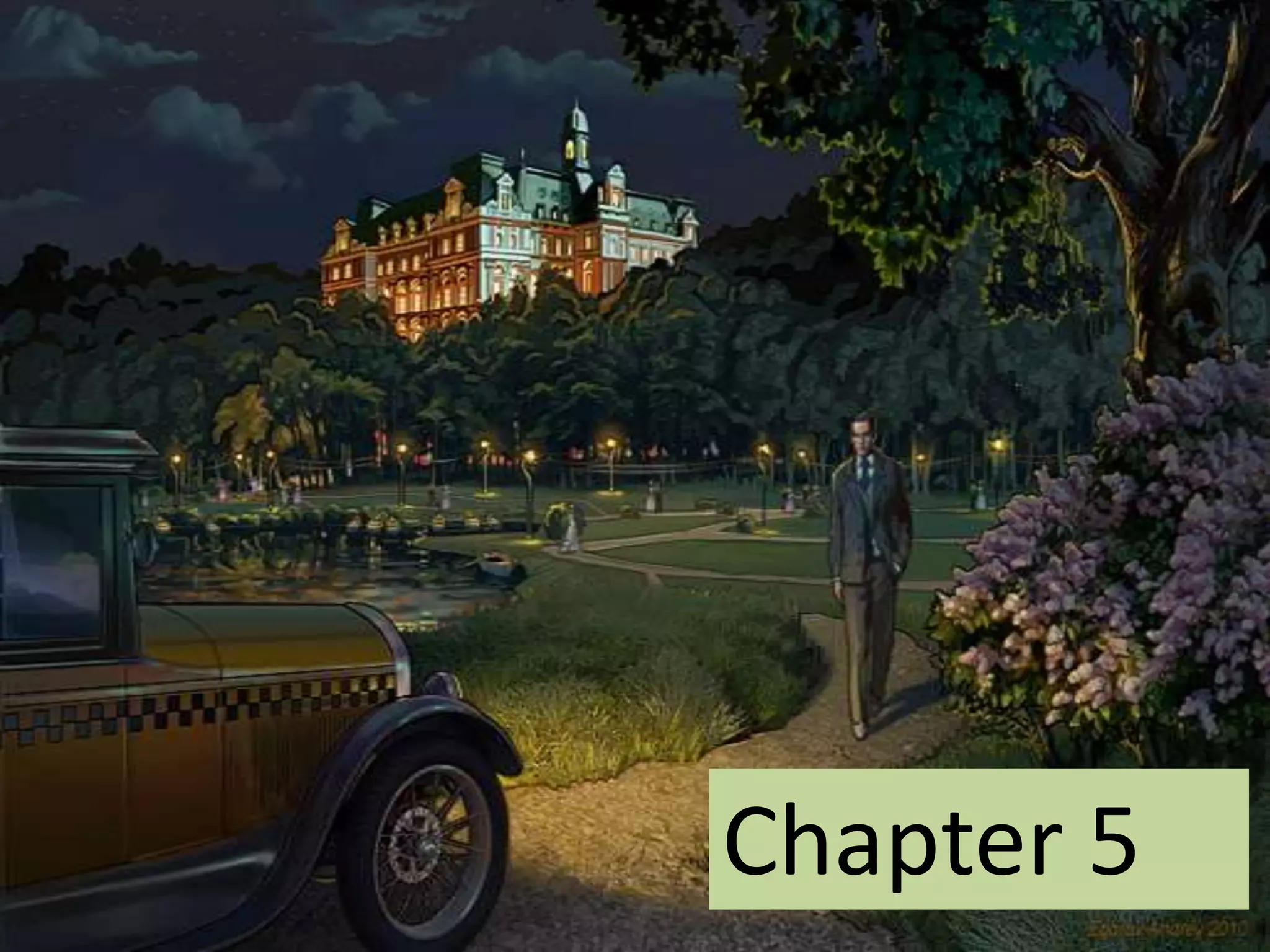
Chapter 5
GATSBY’S HOUSE


           • Restlessness.
 • Gatsby is agitated - exploring his
  house obsessively in the middle of
               the night
• Needs a distraction away from his
               thoughts.
CHARACTERISATION - NICK


“I‟m going to call up Daisy tomorrow and invite her over
       here to tea…What day would suit you?”
Nick is happy to act as a go-between to
  facilitate the relationship between
            Gatsby and Daisy
 Discussion: What does this suggest
about his morals? Is he as honest as he
                professes?
GATSBY’S PREPARATIONS


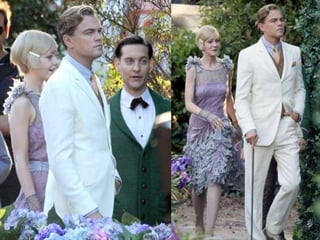
“Gatsby, in a white flannel suit, silver shirt, and gold colored
                             tie”
• reflects the white that Daisy often wears.
• He wants to appear pure, even though he has earned his
   money dishonestly.
 • “He was pale, and there were dark signs of sleeplessness
                       beneath his eyes.”
  • He appeared nervous and worried; he has been obsessing
                about this encounter for years.
GATSBY’S NERVOUSNESS


 • He was “pale as death, with his hands plunged like weights in his
     coat pockets, was standing in a puddle of water glaring tragically
                              into my eyes.”
• He is unsure of himself and uncomfortable – unsure if he
        has sufficiently improved to gain Daisy’s approval.
 • The tragic look in his eyes shows his fear of failure -
   if he fails, he has nothing left to live for, this is all the
                     hope and labor of his life
DAISY – FIRST TIME WE SEE HER
                       SINCERE

  „I‟m glad, Jay.‟ Her throat, full of aching, grieving
      beauty, told only of her unexpected joy.”

 She is trying to control her behavior, but her
voice betrays her at first - she is overcome with
                    emotion.
ROMANCE?


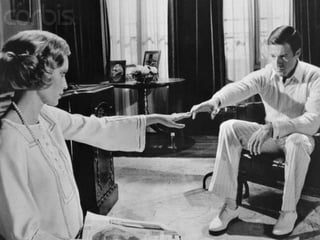
  “Gatsby, his hands still in his pockets, was
    reclining against the mantelpiece in a
 strained counterfeit of perfect ease, even of
  boredom...from this position his distraught
  eyes stared down at Daisy, who was sitting,
frightened but graceful, on the edge of a stiff
                   chair.”
AWKWARD


• Gatsby is nervous and has forgotten etiquette - keeping hands
  in pockets.
• He tries to fake being comfortable and ends up looking
  ridiculous.
• hands are trembling - a visible sign of the emotion; artificial
  pose
• Daisy hides and restrains her emotions.
• Only the fact that she is sitting on the edge of the chair is
  evidence to her emotional state - she is literally on
  edge, perhaps wanting to jump up and express her
  exuberance, but holding herself stiffly back.
CLOCK - SYMBOLISM


          Gatsby, fumbling, lets fall a clock
 “I think we all believed for a moment that it had
        smashed in pieces to the floor.” (87)
  • danger and destruction in Gatsby’s world – reality
              almost shatters the moment
• symbolises the clumsiness of his attempts to stop
              time and retrieve the past
Do you think that Gatsby loves Daisy or is
obsessed with her for some other reason?
WHAT DAISY MEANS TO GATSBY?


• Daisy represents the wealth that Gatsby could never
  aspire to as a young man.
• Rich and beautiful, her rejection and marriage to Tom was
  proof of his poor background.
• Even though he was a better person and loved Daisy,
  money won.
• Gatsby has been obsessed with Daisy because she is
  the unattainable fantasy. Winning her love would
  prove Gatsby’s worth and make his life and hard
  work worthwhile.
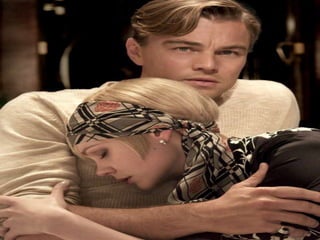
SENSITIVITY


“They were sitting at either end of the couch,
looking at each other as if some question had
     been asked, or was in the air, and every
 vestige of embarrassment gone. Daisy’s face
 was smeared with tears...there was a change
  in Gatsby that was simply confounding. He
   literally glowed; a new well-being radiated
                   from him.”
AWW


• In their privacy Gatsby and Daisy have allowed
                their feelings to show.
 • Daisy becomes human and allows herself to
      cry and show emotion - this is the true
     Daisy, fragile and sad, wanting to be happy.
  • She responds with honesty, not false charm.
    • Gatsby also changes, radiating in Daisy’s
                       company.
• She calls Gatsby by his first name, showing intimacy and a
  close relationship.
• Her voice expresses pain mixed with pleasure.
• She allows herself to express her true self
• Gatsby’s presence reminds her what she has lost
• Daisy’s past was filled with hope and possibility and the
  loving gaze of an infatuated admirer while her present
  features a cheating, unloving husband, violence and
  depression, and Gatsby as a reminder of her materialistic,
  rather than emotional, choices.
GATSBY SHOWS OFF HIS WEALTH


• The world has taught him to appreciate
      appearances and possessions.
• The only way he knows how to impress
           Daisy is with wealth.
“He hadn’t once ceased looking at Daisy...he
revalued everything in his house according to
  the measure of response it drew from her
  well-loved eyes. Sometimes, too, he stared
 around at his possessions in a dazed way, as
though in her actual and astounding presence
        none of it was any longer real.”
DAISY IS HIS MOTIVATION


 • The possessions have no real value for Gatsby.
    He only amassed wealth to win Daisy’s love.
 • Daisy is the measure of value, nothing matters
       to Gatsby if it doesn’t make her happy.
• Daisy offers him things that are not measurable
    or tangible - emotion, connection, a cure for
                     restlessness.
GATSBY’S SHIRTS


 “He took out a pile of shirts and began
 throwing them...many colored disarray”
      • Reckless about his wealth
• Has a personal shopper – doesn’t care to
        pick his clothes out himself
  • They’re a means to impress Daisy
DAISY’S REACTION


• She is impressed with material wealth
   • She is materialistic and shallow
• She shows more emotion towards the
            shirts than Gatsby
      • Overjoyed at his success
GREEN LIGHT


• Gatsby admits to Daisy that he bought his house
  because he can see Daisy’s green light across the
 water. The light is a sign of hope for him, always on
                       and visible.
“the colossal significance of that light has
now vanished forever. Compared to the great
distance that had separated him from Daisy it
had seemed very near to her, almost touching
  her. It had seemed as close as a star to the
  moon. Now it was again a green light on a
  dock. His count of enchanted objects had
            diminished by one.” (93)
GREEN LIGHT


  • Now that he has lured Daisy and bridged the gap between
   them, the light has lost its significance and symbolic value for
                                 Gatsby.
• He has achieved his goal, but lost the magical quality of hope
  - part of the enchantment that made his character so charming
                                 is gone.
    • He has Daisy, he doesn’t need to dream anymore, but a
                   dreamer without a dream is ….
 • He has deflated without his dream. The lack of a dream can
                 have devastating affects on a man.
JOURNEY


Sometimes, the journey, not
   the goal, is the most
        important.
THE PHONE…


               • Reality invades the dream.
• Gatsby’s reality is not as glamorous as he presents it to
                        be, it is shady.
 • He has ruined his innocence and purity in the pursuit
    of an ideal - he is no longer worthy of untainted
                          happiness.
 • He is left with the real Daisy, flaws, past and all – not
             the perfect Daisy he has imagined.
“the expression of bewilderment had come back into
  Gatsby’s face, as though a faint doubt has occurred to
  him as to the quality of his present happiness. There
   must have been moments even that afternoon when
   Daisy tumbled short of his dreams - not through her
   own fault, but because of the colossal vitality of his
illusion. It had gone beyond her, beyond everything. He
    had thrown himself into it with a creative passion,
adding to it all the time, decking it out with every bright
     feather that drifted his way. No amount of fire or
 freshness can challenge what a man will store up in his
                    ghostly heart.” (95-6)
REALITY VS. DREAMS


 • Ideals lead to disappointment; he doesn’t love Daisy
                 the girl, but Daisy the fantasy
• Disappointment: Gatsby realizes that Daisy can never
      live up to the perfect expectations he had of her.
• It isn’t Daisy’s fault that she is flawed, she is human. It
            is Gatsby’s imagination that is to blame
  • Did Gatsby have the wrong dream?
"The Great Gatsby" Chapter 5

"The Great Gatsby" Chapter 5

  • 1.
  • 2.
    GATSBY’S HOUSE • Restlessness. • Gatsby is agitated - exploring his house obsessively in the middle of the night • Needs a distraction away from his thoughts.
  • 3.
    CHARACTERISATION - NICK “I‟mgoing to call up Daisy tomorrow and invite her over here to tea…What day would suit you?” Nick is happy to act as a go-between to facilitate the relationship between Gatsby and Daisy Discussion: What does this suggest about his morals? Is he as honest as he professes?
  • 5.
    GATSBY’S PREPARATIONS “Gatsby, ina white flannel suit, silver shirt, and gold colored tie” • reflects the white that Daisy often wears. • He wants to appear pure, even though he has earned his money dishonestly. • “He was pale, and there were dark signs of sleeplessness beneath his eyes.” • He appeared nervous and worried; he has been obsessing about this encounter for years.
  • 6.
    GATSBY’S NERVOUSNESS •He was “pale as death, with his hands plunged like weights in his coat pockets, was standing in a puddle of water glaring tragically into my eyes.” • He is unsure of himself and uncomfortable – unsure if he has sufficiently improved to gain Daisy’s approval. • The tragic look in his eyes shows his fear of failure - if he fails, he has nothing left to live for, this is all the hope and labor of his life
  • 8.
    DAISY – FIRSTTIME WE SEE HER SINCERE „I‟m glad, Jay.‟ Her throat, full of aching, grieving beauty, told only of her unexpected joy.” She is trying to control her behavior, but her voice betrays her at first - she is overcome with emotion.
  • 10.
    ROMANCE? “Gatsby,his hands still in his pockets, was reclining against the mantelpiece in a strained counterfeit of perfect ease, even of boredom...from this position his distraught eyes stared down at Daisy, who was sitting, frightened but graceful, on the edge of a stiff chair.”
  • 12.
    AWKWARD • Gatsby isnervous and has forgotten etiquette - keeping hands in pockets. • He tries to fake being comfortable and ends up looking ridiculous. • hands are trembling - a visible sign of the emotion; artificial pose • Daisy hides and restrains her emotions. • Only the fact that she is sitting on the edge of the chair is evidence to her emotional state - she is literally on edge, perhaps wanting to jump up and express her exuberance, but holding herself stiffly back.
  • 14.
    CLOCK - SYMBOLISM Gatsby, fumbling, lets fall a clock “I think we all believed for a moment that it had smashed in pieces to the floor.” (87) • danger and destruction in Gatsby’s world – reality almost shatters the moment • symbolises the clumsiness of his attempts to stop time and retrieve the past
  • 15.
    Do you thinkthat Gatsby loves Daisy or is obsessed with her for some other reason?
  • 16.
    WHAT DAISY MEANSTO GATSBY? • Daisy represents the wealth that Gatsby could never aspire to as a young man. • Rich and beautiful, her rejection and marriage to Tom was proof of his poor background. • Even though he was a better person and loved Daisy, money won. • Gatsby has been obsessed with Daisy because she is the unattainable fantasy. Winning her love would prove Gatsby’s worth and make his life and hard work worthwhile.
  • 18.
    SENSITIVITY “They were sittingat either end of the couch, looking at each other as if some question had been asked, or was in the air, and every vestige of embarrassment gone. Daisy’s face was smeared with tears...there was a change in Gatsby that was simply confounding. He literally glowed; a new well-being radiated from him.”
  • 19.
    AWW • In theirprivacy Gatsby and Daisy have allowed their feelings to show. • Daisy becomes human and allows herself to cry and show emotion - this is the true Daisy, fragile and sad, wanting to be happy. • She responds with honesty, not false charm. • Gatsby also changes, radiating in Daisy’s company.
  • 20.
    • She callsGatsby by his first name, showing intimacy and a close relationship. • Her voice expresses pain mixed with pleasure. • She allows herself to express her true self • Gatsby’s presence reminds her what she has lost • Daisy’s past was filled with hope and possibility and the loving gaze of an infatuated admirer while her present features a cheating, unloving husband, violence and depression, and Gatsby as a reminder of her materialistic, rather than emotional, choices.
  • 22.
    GATSBY SHOWS OFFHIS WEALTH • The world has taught him to appreciate appearances and possessions. • The only way he knows how to impress Daisy is with wealth.
  • 23.
    “He hadn’t onceceased looking at Daisy...he revalued everything in his house according to the measure of response it drew from her well-loved eyes. Sometimes, too, he stared around at his possessions in a dazed way, as though in her actual and astounding presence none of it was any longer real.”
  • 24.
    DAISY IS HISMOTIVATION • The possessions have no real value for Gatsby. He only amassed wealth to win Daisy’s love. • Daisy is the measure of value, nothing matters to Gatsby if it doesn’t make her happy. • Daisy offers him things that are not measurable or tangible - emotion, connection, a cure for restlessness.
  • 26.
    GATSBY’S SHIRTS “Hetook out a pile of shirts and began throwing them...many colored disarray” • Reckless about his wealth • Has a personal shopper – doesn’t care to pick his clothes out himself • They’re a means to impress Daisy
  • 27.
    DAISY’S REACTION • Sheis impressed with material wealth • She is materialistic and shallow • She shows more emotion towards the shirts than Gatsby • Overjoyed at his success
  • 29.
    GREEN LIGHT • Gatsbyadmits to Daisy that he bought his house because he can see Daisy’s green light across the water. The light is a sign of hope for him, always on and visible.
  • 30.
    “the colossal significanceof that light has now vanished forever. Compared to the great distance that had separated him from Daisy it had seemed very near to her, almost touching her. It had seemed as close as a star to the moon. Now it was again a green light on a dock. His count of enchanted objects had diminished by one.” (93)
  • 31.
    GREEN LIGHT • Now that he has lured Daisy and bridged the gap between them, the light has lost its significance and symbolic value for Gatsby. • He has achieved his goal, but lost the magical quality of hope - part of the enchantment that made his character so charming is gone. • He has Daisy, he doesn’t need to dream anymore, but a dreamer without a dream is …. • He has deflated without his dream. The lack of a dream can have devastating affects on a man.
  • 32.
    JOURNEY Sometimes, the journey,not the goal, is the most important.
  • 34.
    THE PHONE… • Reality invades the dream. • Gatsby’s reality is not as glamorous as he presents it to be, it is shady. • He has ruined his innocence and purity in the pursuit of an ideal - he is no longer worthy of untainted happiness. • He is left with the real Daisy, flaws, past and all – not the perfect Daisy he has imagined.
  • 35.
    “the expression ofbewilderment had come back into Gatsby’s face, as though a faint doubt has occurred to him as to the quality of his present happiness. There must have been moments even that afternoon when Daisy tumbled short of his dreams - not through her own fault, but because of the colossal vitality of his illusion. It had gone beyond her, beyond everything. He had thrown himself into it with a creative passion, adding to it all the time, decking it out with every bright feather that drifted his way. No amount of fire or freshness can challenge what a man will store up in his ghostly heart.” (95-6)
  • 36.
    REALITY VS. DREAMS • Ideals lead to disappointment; he doesn’t love Daisy the girl, but Daisy the fantasy • Disappointment: Gatsby realizes that Daisy can never live up to the perfect expectations he had of her. • It isn’t Daisy’s fault that she is flawed, she is human. It is Gatsby’s imagination that is to blame • Did Gatsby have the wrong dream?