

Topics to be covered
01
02
03
04
Why is Testing important?
What is Software Testing?
Who does Testing?
Software Testing Life Cycle
Introduction to
Software Testing
What is
Software
Testing?
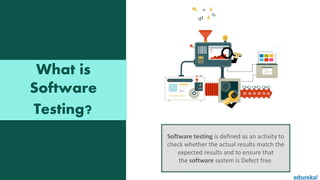
Software testing is defined as an activity to
check whether the actual results match the
expected results and to ensure that
the software system is Defect free.
Why Testing is
important ?
Why Testing is
important ?
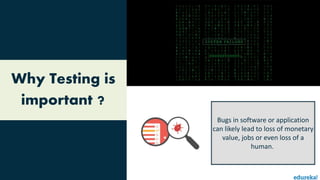
Bugs in software or application
can likely lead to loss of monetary
value, jobs or even loss of a
human.
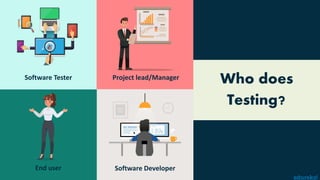
Who does
Testing?
Software Tester
Software Developer
Project lead/Manager
End user
Software testing
life cycle
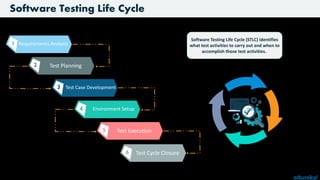
Software Testing Life Cycle
Requirements Analysis1
Test Planning2
Test Case Development3
Environment Setup4
Test Execution5
Test Cycle Closure6
Software Testing Life Cycle (STLC) identifies
what test activities to carry out and when to
accomplish those test activities.
Requirements Analysis01 Requirement Analysis
➢ Quality assurance team
understands the requirements
➢ Test team studies the
requirements from a testing point
of view
➢ The QA team interact with various
stakeholders
➢ Requirements are either
functional or non-functional
Requirements Analysis01 Requirement Analysis
Types of
Requirements
Business Requirements
Architectural Requirements
System & Integration Requirements
Requirements Analysis01 Requirement Analysis
Entry Criteria Activities Deliverable
•Requirements Specification
•Application Architectural
•Prepare list of queries &
questions
•Types of Tests to be
performed
•Define Testing Focus
•List down Test environment
details
•Checkout the Automation
feasibility
•List of questions with
answers
•Automation feasibility report
Requirements Analysis02 Test Planning
04
03
02
01
It helps us determine
the effort needed to validate the
application
Help People outside the team
Test Plan guides our thinking
Important aspects are documented in
Test Plan
Requirements Analysis02 Test Planning
01
0304
05 02
06
Unit Test
API Testing
Integration
Test
System Test
Install/Uninstall
Testing
Agile Testing
Requirements Analysis02 Test Planning
01 Analyze the Product 02 Design Test Strategy 03 Define Test Objective 04 Define Test Criteria
05 Resource Planning06 Plan Test Environment07 Schedule & Estimation08 Determine Test
Deliverables
Requirements Analysis03 Test Case Development
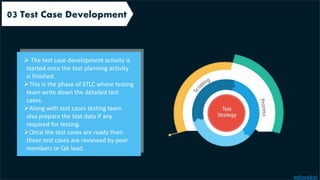
➢ The test case development activity is
started once the test planning activity
is finished.
➢This is the phase of STLC where testing
team write down the detailed test
cases.
➢Along with test cases testing team
also prepare the test data if any
required for testing.
➢Once the test cases are ready then
these test cases are reviewed by peer
members or QA lead.
Requirements Analysis03 Test Case Development
01
02
03
04
05
06
07
08
09
10
Test Cases need to be simple
Create Test Case with End User in mind
Avoid Test Case Repetition
Do not Assume
Ensure 100% Coverage
Test Cases must be identifiable
Implement Testing Techniques
Self Cleaning
Repeatable & self standing
Peer review
Requirements Analysis04 Test Environment Setup
Entry Criteria Activities Deliverable
•Test Plan is available
•Smoke Test cases are
available
•Application Architectural
•Analyze the requirements
and prepare the list of
software & hardware
•Setup the test environment
•Execute the smoke test cases
•Test Environment will be
ready with test data
•Result of test smoke cases
Requirements Analysis04 Test Environment Setup
Setup of Test Server
Network
Test PC Setup
Bug Reporting
Creating Test Data
Requirements Analysis
05 Test Execution
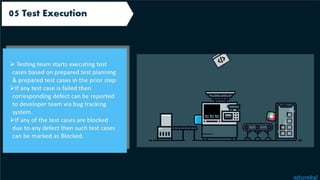
➢ Testing team starts executing test
cases based on prepared test planning
& prepared test cases in the prior step.
➢If any test case is failed then
corresponding defect can be reported
to developer team via bug tracking
system.
➢If any of the test cases are blocked
due to any defect then such test cases
can be marked as Blocked.
Requirements Analysis
05 Test Execution
Entry Criteria Activities Deliverable
•Test Plan or Test Strategy
document
•Test Cases
•Test Data
•Execute the Test Cases
•Mark status of Test Cases
•Assign Bug Id for all Failed
and Blocked test cases.
•Do retesting
•Track the defects to closure
•Test Case execution report
•Defect report
Requirements Analysis
06 Test Cycle Closure
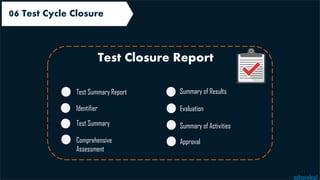
Test Closure Report
Test Summary Report
Identifier
Test Summary
Comprehensive
Assessment
Summary of Results
Evaluation
Summary of Activities
Approval
Requirements Analysis
06 Test Cycle Closure
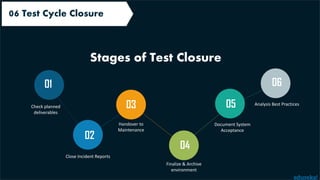
Stages of Test Closure
Close Incident Reports
Handover to
Maintenance
Finalize & Archive
environment
Document System
Acceptance
Analysis Best PracticesCheck planned
deliverables
01
02
03
04
05
06
Software Testing Life Cycle (STLC) | Software Testing Tutorial | Edureka

Software Testing Life Cycle (STLC) | Software Testing Tutorial | Edureka

  • 2.
    Topics to becovered 01 02 03 04 Why is Testing important? What is Software Testing? Who does Testing? Software Testing Life Cycle
  • 3.
  • 4.
    What is Software Testing? Software testingis defined as an activity to check whether the actual results match the expected results and to ensure that the software system is Defect free.
  • 5.
  • 6.
    Why Testing is important? Bugs in software or application can likely lead to loss of monetary value, jobs or even loss of a human.
  • 7.
    Who does Testing? Software Tester SoftwareDeveloper Project lead/Manager End user
  • 8.
  • 9.
    Software Testing LifeCycle Requirements Analysis1 Test Planning2 Test Case Development3 Environment Setup4 Test Execution5 Test Cycle Closure6 Software Testing Life Cycle (STLC) identifies what test activities to carry out and when to accomplish those test activities.
  • 10.
    Requirements Analysis01 RequirementAnalysis ➢ Quality assurance team understands the requirements ➢ Test team studies the requirements from a testing point of view ➢ The QA team interact with various stakeholders ➢ Requirements are either functional or non-functional
  • 11.
    Requirements Analysis01 RequirementAnalysis Types of Requirements Business Requirements Architectural Requirements System & Integration Requirements
  • 12.
    Requirements Analysis01 RequirementAnalysis Entry Criteria Activities Deliverable •Requirements Specification •Application Architectural •Prepare list of queries & questions •Types of Tests to be performed •Define Testing Focus •List down Test environment details •Checkout the Automation feasibility •List of questions with answers •Automation feasibility report
  • 13.
    Requirements Analysis02 TestPlanning 04 03 02 01 It helps us determine the effort needed to validate the application Help People outside the team Test Plan guides our thinking Important aspects are documented in Test Plan
  • 14.
    Requirements Analysis02 TestPlanning 01 0304 05 02 06 Unit Test API Testing Integration Test System Test Install/Uninstall Testing Agile Testing
  • 15.
    Requirements Analysis02 TestPlanning 01 Analyze the Product 02 Design Test Strategy 03 Define Test Objective 04 Define Test Criteria 05 Resource Planning06 Plan Test Environment07 Schedule & Estimation08 Determine Test Deliverables
  • 16.
    Requirements Analysis03 TestCase Development ➢ The test case development activity is started once the test planning activity is finished. ➢This is the phase of STLC where testing team write down the detailed test cases. ➢Along with test cases testing team also prepare the test data if any required for testing. ➢Once the test cases are ready then these test cases are reviewed by peer members or QA lead.
  • 17.
    Requirements Analysis03 TestCase Development 01 02 03 04 05 06 07 08 09 10 Test Cases need to be simple Create Test Case with End User in mind Avoid Test Case Repetition Do not Assume Ensure 100% Coverage Test Cases must be identifiable Implement Testing Techniques Self Cleaning Repeatable & self standing Peer review
  • 18.
    Requirements Analysis04 TestEnvironment Setup Entry Criteria Activities Deliverable •Test Plan is available •Smoke Test cases are available •Application Architectural •Analyze the requirements and prepare the list of software & hardware •Setup the test environment •Execute the smoke test cases •Test Environment will be ready with test data •Result of test smoke cases
  • 19.
    Requirements Analysis04 TestEnvironment Setup Setup of Test Server Network Test PC Setup Bug Reporting Creating Test Data
  • 20.
    Requirements Analysis 05 TestExecution ➢ Testing team starts executing test cases based on prepared test planning & prepared test cases in the prior step. ➢If any test case is failed then corresponding defect can be reported to developer team via bug tracking system. ➢If any of the test cases are blocked due to any defect then such test cases can be marked as Blocked.
  • 21.
    Requirements Analysis 05 TestExecution Entry Criteria Activities Deliverable •Test Plan or Test Strategy document •Test Cases •Test Data •Execute the Test Cases •Mark status of Test Cases •Assign Bug Id for all Failed and Blocked test cases. •Do retesting •Track the defects to closure •Test Case execution report •Defect report
  • 22.
    Requirements Analysis 06 TestCycle Closure Test Closure Report Test Summary Report Identifier Test Summary Comprehensive Assessment Summary of Results Evaluation Summary of Activities Approval
  • 23.
    Requirements Analysis 06 TestCycle Closure Stages of Test Closure Close Incident Reports Handover to Maintenance Finalize & Archive environment Document System Acceptance Analysis Best PracticesCheck planned deliverables 01 02 03 04 05 06