Black Box Testing
Testing Overview and Black-Box 
Testing Techniques 
 Software testing is an important technique for assessing the quality 
of a software product. 
 The basics of software testing, a verification and validation practice, 
throughout the entire software development lifecycle 
 The two basic techniques of software testing, black-box testing and 
white-box testing 
 Six types of testing that involve both black- and white-box 
techniques. 
 Strategies for writing test cases and still finding as many faults as 
possible.
Introduction to Testing 
 Software testing is the process of analyzing a software item to 
detect the differences between existing and required conditions 
(that is, bugs) and to evaluate the features of the software item. 
Verification: Are we building the product right? 
 Through verification, we make sure the product behaves the way 
we want it to. 
Validation: Are we building the right product? 
 Through validation, we check to make sure that somewhere in 
the process a mistake hasn’t been made such that the product 
build is not what the customer asked for; validation always 
involves comparison against requirements.
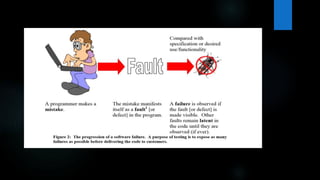
 The following terms with their associated definitions are helpful 
for understanding these concepts: 
• Mistake – a human action that produces an incorrect result. 
• Fault [or Defect] – an incorrect step, process, or data definition in 
a program. 
• Failure – the inability of a system or component to perform its 
required function within the specified performance requirement. 
• Error – the difference between a computed, observed, or 
measured value or condition and the true, specified, or 
theoretically correct value or condition. 
• Specification – a document that specifies in a complete, precise, 
verifiable manner, the requirements, design, behavior, or other 
characteristic of a system or component, and often the 
procedures for determining whether these provisions have been 
satisfied.
The Economics of Software Testing 
 In software development, there are costs associated with testing our 
programs. We need to write out test plan and our test cases, we 
need to set up the proper equipment, we need to systematically 
execute the test cases, we need to follow up on problems that are 
identified, and we need to remove most of the faults we find. 
 To minimize the costs associated with testing and with software 
failures, a goal of testing must be to uncover as many defects as 
possible with as little testing as possible. In other words, we want to 
write test cases that have a high likelihood of uncovering the faults 
that are the most likely to be observed as a failure in normal use.
The Basics of Software Testing 
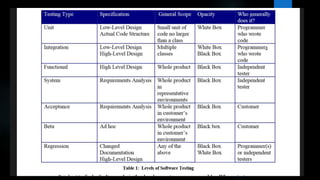
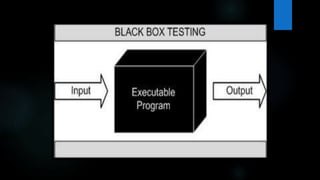
 Black box testing (also called functional testing) is testing that ignores 
the internal mechanism of a system or component and focuses solely 
on the outputs generated in response to selected inputs and 
execution conditions. 
 White box testing (also called structural testing and glass box testing) 
is testing that takes into account the internal mechanism of a system 
or component.
Black Box Testing: 
 Only input & output functionality are visible. 
 Inputs are given and outputs are compared against 
specification. 
Features: 
• Correct outputs from inputs properly. 
• Test cases are designed from user requirements. 
• Test planning can begin early in the software process. 
• Looking at the program from an external point of view.
Black Box Testing 
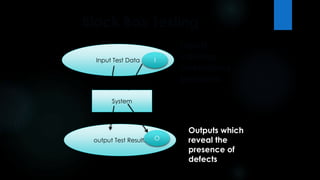
Input Test Data I 
System 
output Test Results O 
Inputs 
causing 
anomalous 
behavior 
Outputs which 
reveal the 
presence of 
defects
Black Box Testing is a “Expert” in 
Finding 
1. Incorrect or missing functions. 
2. Interface errors 
3. Behavior or performance errors. 
4. Initialization and termination errors. 
5. Errors in data structures 
6. External database errors.
Graph Based Testing Methods 
 Each and every application is build up of some objects. All such 
objects are identified and graph is prepared. From this object graph 
each object relationship is identified and test cases written 
accordingly to discover the errors.
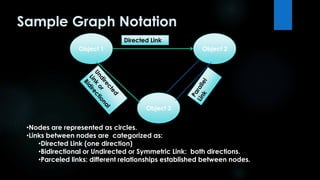
Sample Graph Notation 
Directed Link 
Object 1 Object 2 
Object 3 
•Nodes are represented as circles. 
•Links between nodes are categorized as: 
•Directed Link (one direction) 
•Bidirectional or Undirected or Symmetric Link: both directions. 
•Parceled links: different relationships established between nodes.
Error Guessing Testing Methods 
 This is purely based on previous experience and judgment of tester. 
Error Guessing is the art of guessing where errors can be hidden. For 
this technique there are no specific tools, writing the test cases that 
cover all the application paths.
Methods of Black box Testing
1. Equivalence Partitioning 
 Equivalence Partitioning is a software test design technique that 
involves dividing input values into valid and invalid partitions and 
selecting representative values from each partition as test data.
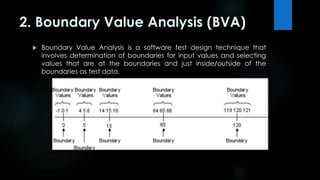
2. Boundary Value Analysis (BVA) 
 Boundary Value Analysis is a software test design technique that 
involves determination of boundaries for input values and selecting 
values that are at the boundaries and just inside/outside of the 
boundaries as test data.
3. Cause Effect Graphing 
 Cause Effect Graphing is a software test design technique that involves 
identifying the cases (input conditions) and effects (output conditions), 
producing a Cause-Effect Graph, and generating test cases accordingly.
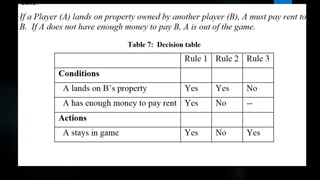
4. Decision Table-Based Testing 
 Decision tables are used to record complex business rules that must 
be implemented in the program, and therefore tested 
 In the table, the conditions represent possible input conditions. The 
actions are the events that should trigger, depending upon the 
makeup of the input conditions. Each column in the table is a 
unique combination of input conditions (and is called a rule) that 
result in triggering the action(s) associated with the rule. Each rule 
(or column) should become a test case.
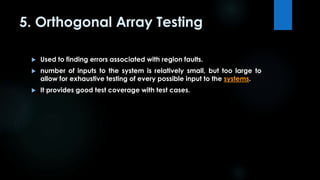
5. Orthogonal Array Testing 
 Used to finding errors associated with region faults. 
 number of inputs to the system is relatively small, but too large to 
allow for exhaustive testing of every possible input to the systems. 
 It provides good test coverage with test cases.
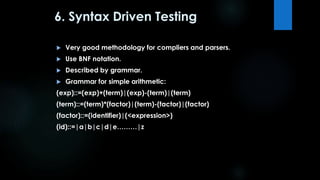
6. Syntax Driven Testing 
 Very good methodology for compliers and parsers. 
 Use BNF notation. 
 Described by grammar. 
 Grammar for simple arithmetic: 
(exp)::=(exp)+(term)|(exp)-(term)|(term) 
(term)::=(term)*(factor)|(term)-(factor)|(factor) 
(factor)::=(identifier)|(<expression>) 
(id)::=|a|b|c|d|e………|z
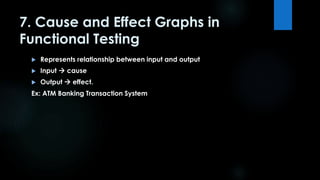
7. Cause and Effect Graphs in 
Functional Testing 
 Represents relationship between input and output 
 Input  cause 
 Output  effect. 
Ex: ATM Banking Transaction System
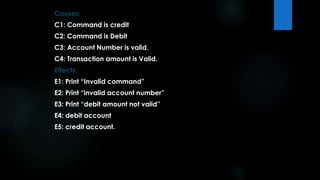
Causes: 
C1: Command is credit 
C2: Command is Debit 
C3: Account Number is valid. 
C4: Transaction amount is Valid. 
Effects: 
E1: Print “Invalid command” 
E2: Print “invalid account number” 
E3: Print “debit amount not valid” 
E4: debit account 
E5: credit account.
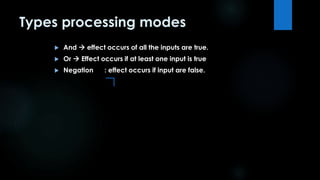
Types processing modes 
 And  effect occurs of all the inputs are true. 
 Or  Effect occurs if at least one input is true 
 Negation : effect occurs if input are false.
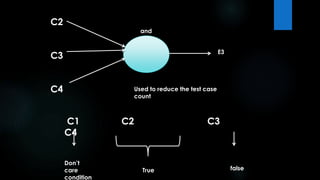
C2 
C3 
C4 
E3 
and 
Used to reduce the test case 
count 
C1 C2 C3 
C4 
Don’t 
care 
condition 
True false

Blackbox

  • 1.
  • 2.
    Testing Overview andBlack-Box Testing Techniques  Software testing is an important technique for assessing the quality of a software product.  The basics of software testing, a verification and validation practice, throughout the entire software development lifecycle  The two basic techniques of software testing, black-box testing and white-box testing  Six types of testing that involve both black- and white-box techniques.  Strategies for writing test cases and still finding as many faults as possible.
  • 3.
    Introduction to Testing  Software testing is the process of analyzing a software item to detect the differences between existing and required conditions (that is, bugs) and to evaluate the features of the software item. Verification: Are we building the product right?  Through verification, we make sure the product behaves the way we want it to. Validation: Are we building the right product?  Through validation, we check to make sure that somewhere in the process a mistake hasn’t been made such that the product build is not what the customer asked for; validation always involves comparison against requirements.
  • 4.
     The followingterms with their associated definitions are helpful for understanding these concepts: • Mistake – a human action that produces an incorrect result. • Fault [or Defect] – an incorrect step, process, or data definition in a program. • Failure – the inability of a system or component to perform its required function within the specified performance requirement. • Error – the difference between a computed, observed, or measured value or condition and the true, specified, or theoretically correct value or condition. • Specification – a document that specifies in a complete, precise, verifiable manner, the requirements, design, behavior, or other characteristic of a system or component, and often the procedures for determining whether these provisions have been satisfied.
  • 6.
    The Economics ofSoftware Testing  In software development, there are costs associated with testing our programs. We need to write out test plan and our test cases, we need to set up the proper equipment, we need to systematically execute the test cases, we need to follow up on problems that are identified, and we need to remove most of the faults we find.  To minimize the costs associated with testing and with software failures, a goal of testing must be to uncover as many defects as possible with as little testing as possible. In other words, we want to write test cases that have a high likelihood of uncovering the faults that are the most likely to be observed as a failure in normal use.
  • 7.
    The Basics ofSoftware Testing  Black box testing (also called functional testing) is testing that ignores the internal mechanism of a system or component and focuses solely on the outputs generated in response to selected inputs and execution conditions.  White box testing (also called structural testing and glass box testing) is testing that takes into account the internal mechanism of a system or component.
  • 9.
    Black Box Testing:  Only input & output functionality are visible.  Inputs are given and outputs are compared against specification. Features: • Correct outputs from inputs properly. • Test cases are designed from user requirements. • Test planning can begin early in the software process. • Looking at the program from an external point of view.
  • 11.
    Black Box Testing Input Test Data I System output Test Results O Inputs causing anomalous behavior Outputs which reveal the presence of defects
  • 12.
    Black Box Testingis a “Expert” in Finding 1. Incorrect or missing functions. 2. Interface errors 3. Behavior or performance errors. 4. Initialization and termination errors. 5. Errors in data structures 6. External database errors.
  • 13.
    Graph Based TestingMethods  Each and every application is build up of some objects. All such objects are identified and graph is prepared. From this object graph each object relationship is identified and test cases written accordingly to discover the errors.
  • 14.
    Sample Graph Notation Directed Link Object 1 Object 2 Object 3 •Nodes are represented as circles. •Links between nodes are categorized as: •Directed Link (one direction) •Bidirectional or Undirected or Symmetric Link: both directions. •Parceled links: different relationships established between nodes.
  • 15.
    Error Guessing TestingMethods  This is purely based on previous experience and judgment of tester. Error Guessing is the art of guessing where errors can be hidden. For this technique there are no specific tools, writing the test cases that cover all the application paths.
  • 16.
    Methods of Blackbox Testing
  • 17.
    1. Equivalence Partitioning  Equivalence Partitioning is a software test design technique that involves dividing input values into valid and invalid partitions and selecting representative values from each partition as test data.
  • 18.
    2. Boundary ValueAnalysis (BVA)  Boundary Value Analysis is a software test design technique that involves determination of boundaries for input values and selecting values that are at the boundaries and just inside/outside of the boundaries as test data.
  • 19.
    3. Cause EffectGraphing  Cause Effect Graphing is a software test design technique that involves identifying the cases (input conditions) and effects (output conditions), producing a Cause-Effect Graph, and generating test cases accordingly.
  • 20.
    4. Decision Table-BasedTesting  Decision tables are used to record complex business rules that must be implemented in the program, and therefore tested  In the table, the conditions represent possible input conditions. The actions are the events that should trigger, depending upon the makeup of the input conditions. Each column in the table is a unique combination of input conditions (and is called a rule) that result in triggering the action(s) associated with the rule. Each rule (or column) should become a test case.
  • 22.
    5. Orthogonal ArrayTesting  Used to finding errors associated with region faults.  number of inputs to the system is relatively small, but too large to allow for exhaustive testing of every possible input to the systems.  It provides good test coverage with test cases.
  • 23.
    6. Syntax DrivenTesting  Very good methodology for compliers and parsers.  Use BNF notation.  Described by grammar.  Grammar for simple arithmetic: (exp)::=(exp)+(term)|(exp)-(term)|(term) (term)::=(term)*(factor)|(term)-(factor)|(factor) (factor)::=(identifier)|(<expression>) (id)::=|a|b|c|d|e………|z
  • 24.
    7. Cause andEffect Graphs in Functional Testing  Represents relationship between input and output  Input  cause  Output  effect. Ex: ATM Banking Transaction System
  • 25.
    Causes: C1: Commandis credit C2: Command is Debit C3: Account Number is valid. C4: Transaction amount is Valid. Effects: E1: Print “Invalid command” E2: Print “invalid account number” E3: Print “debit amount not valid” E4: debit account E5: credit account.
  • 26.
    Types processing modes  And  effect occurs of all the inputs are true.  Or  Effect occurs if at least one input is true  Negation : effect occurs if input are false.
  • 27.
    C2 C3 C4 E3 and Used to reduce the test case count C1 C2 C3 C4 Don’t care condition True false