Static Testing 1 Principles 2 Lifecycle 4 Dynamic test techniques 3 Static testing 5 Management 6 Tools Software Testing
Contents Reviews and the test process Types of review Static analysis Static testing 1 2 4 5 3 6
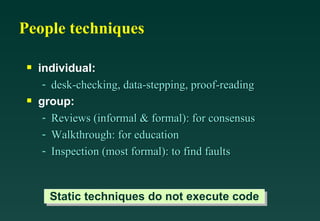
People techniques individual: desk-checking, data-stepping, proof-reading group: Reviews (informal & formal): for consensus Walkthrough: for education Inspection (most formal): to find faults Static techniques do not execute code
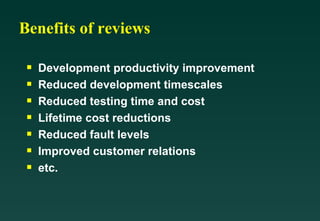
Benefits of reviews Development productivity improvement Reduced development timescales Reduced testing time and cost Lifetime cost reductions Reduced fault levels Improved customer relations etc.
Reviews are cost-effective 10 times reduction in faults reaching test, testing cost reduced by 50% to 80% Freedman & Weinberg, Handbook of Walkthroughs, Inspections & Technical Reviews reduce faults by a factor of 10 Yourdon, Structured Walkthroughs 25% reduction in schedules, remove 80% - 95% of faults at each stage, 28 times reduction in maintenance cost, many others Gilb & Graham, Software Inspection
What can be Inspected? policy, strategy, business plans, marketing or advertising material, contracts system requirements, feasibility studies, acceptance test plans test plans, test designs, test cases, test results system designs, logical & physical software code user manuals, procedures, training material Anything written down can be Inspected
What can be reviewed? anything which could be Inspected i.e. anything written down plans, visions, “big picture”, strategic directions, ideas project progress work completed to schedule, etc. “Should we develop this” marketing options
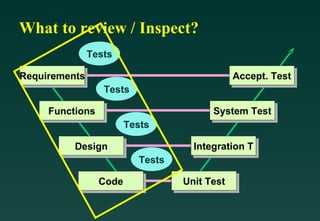
What to review / Inspect? Tests Tests Tests Tests Requirements Design Code Functions Integration T Unit Test Accept. Test System Test
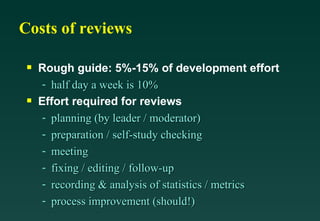
Costs of reviews Rough guide: 5%-15% of development effort half day a week is 10% Effort required for reviews planning (by leader / moderator) preparation / self-study checking meeting fixing / editing / follow-up recording & analysis of statistics / metrics process improvement (should!)
Contents Reviews and the test process Types of review Static analysis Static testing 1 2 4 5 3 6
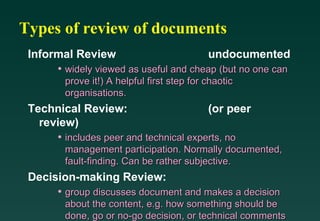
Types of review of documents Informal Review undocumented widely viewed as useful and cheap (but no one can prove it!) A helpful first step for chaotic organisations. Technical Review: (or peer review) includes peer and technical experts, no management participation. Normally documented, fault-finding. Can be rather subjective. Decision-making Review: group discusses document and makes a decision about the content, e.g. how something should be done, go or no-go decision, or technical comments
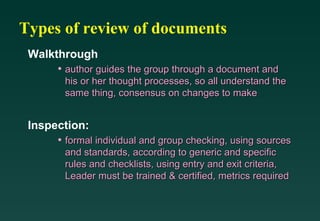
Types of review of documents Walkthrough author guides the group through a document and his or her thought processes, so all understand the same thing, consensus on changes to make Inspection: formal individual and group checking, using sources and standards, according to generic and specific rules and checklists, using entry and exit criteria, Leader must be trained & certified, metrics required
Reviews in general 1 Objectives / goals validation & verification against specifications & standards achieve consensus (excluding Inspection) process improvement (ideal, included in Inspection)
Reviews in general 2 Activities planning overview / kickoff meeting (Inspection) preparation / individual checking review meeting (not always) follow-up (for some types) metrics recording & analysis (Inspections and sometimes reviews)
Reviews in general 3 Roles and responsibilities Leader / moderator - plans the review / Inspection, chooses participants, helps & encourages, conducts the meeting, performs follow-up, manages metrics Author of the document being reviewed / Inspected Reviewers / Inspectors - specialised fault-finding roles for Inspection Managers - excluded from some types of review, need to plan project time for review / Inspection Others: e.g. Inspection/ review Co-ordinator
Reviews in general 4 Deliverables Changes (edits) in review product Change requests for source documents (predecessor documents to product being reviewed / Inspected) Process improvement suggestions to the review / Inspection process to the development process which produced the product just reviewed / Inspected Metrics (Inspection and some types of review)
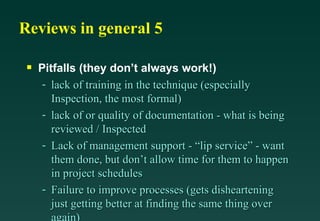
Reviews in general 5 Pitfalls (they don’t always work!) lack of training in the technique (especially Inspection, the most formal) lack of or quality of documentation - what is being reviewed / Inspected Lack of management support - “lip service” - want them done, but don’t allow time for them to happen in project schedules Failure to improve processes (gets disheartening just getting better at finding the same thing over again)
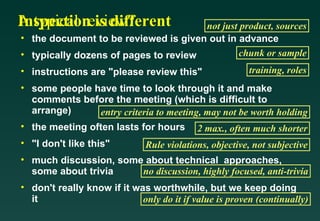
Inspection is different the document to be reviewed is given out in advance typically dozens of pages to review instructions are "please review this" some people have time to look through it and make comments before the meeting (which is difficult to arrange) the meeting often lasts for hours "I don't like this"  much discussion, some about technical  approaches, some about trivia don't really know if it was worthwhile, but we keep doing it Reviews vs. Inspection A typical review? chunk or sample training, roles entry criteria to meeting, may not be worth holding Rule violations, objective, not subjective no discussion, highly focused, anti-trivia only do it if value is proven (continually) not just product, sources 2 max., often much shorter
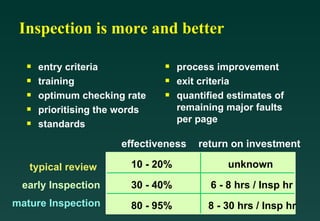
Inspection is more and better entry criteria  training  optimum checking rate prioritising the words  standards  process improvement  exit criteria quantified estimates of remaining major faults per page typical review early Inspection mature Inspection effectiveness return on investment 10 - 20% unknown 30 - 40% 6 - 8 hrs / Insp hr 80 - 95% 8 - 30 hrs / Insp hr
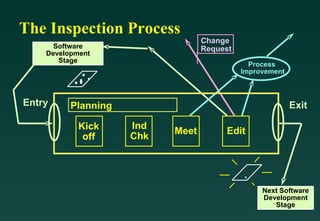
The Inspection Process Software Development Stage . . Planning Kick off Ind Chk Meet Edit Change Request Process  Improvement Entry Next Software Development Stage Exit
At first glance .. Here’s a document: review this (or Inspect it)
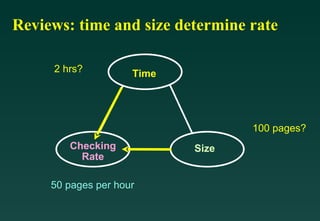
Reviews: time and size determine rate Time Checking Rate Size 2 hrs? 100 pages? 50 pages per hour Checking Rate
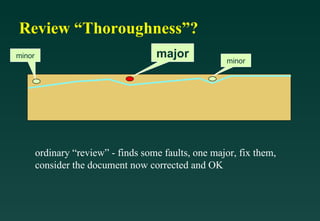
Review “Thoroughness”? ordinary “review” - finds some faults, one major, fix them, consider the document now corrected and OK major minor minor
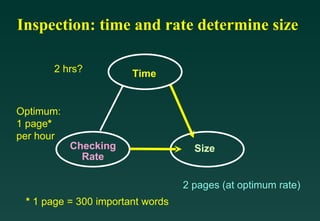
Inspection: time and rate determine size Time Checking Rate Size 2 hrs? Optimum: 1 page *   per hour 2 pages (at optimum rate) Size *  1 page = 300 important words
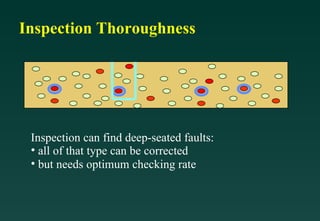
Inspection Thoroughness Inspection can find deep-seated faults:  all of that type can be corrected but needs optimum checking rate
Inspection surprises Fundamental importance of Rules democratically agreed as applying define major issues / faults Slow checking rates Strict entry & exit criteria Fast logging rates Amount of responsibility given to author
Contents Reviews and the test process Types of review Static analysis ISEB Foundation Certificate Course Static testing 1 2 4 5 3 6
What can static analysis do? A form of automated testing check for violations of standards check for things which may be a fault Descended from compiler technology a compiler statically analyses code, and “knows” a lot about it, e.g. variable usage; finds syntax faults static analysis tools extend this knowledge can find unreachable code, undeclared variables, parameter type mis-matches, uncalled functions & procedures, array bound violations, etc. Remember: static techniques do not execute the code
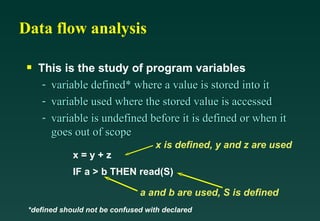
Data flow analysis This is the study of program variables variable defined* where a value is stored into it variable used where the stored value is accessed variable is undefined before it is defined or when it goes out of scope *defined should not be confused with declared x = y + z IF a > b THEN read(S) x is defined, y and z are used a and b are used, S is defined
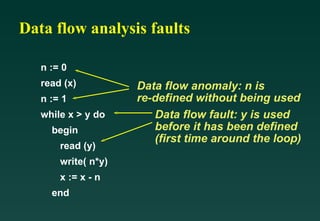
Data flow analysis faults n := 0 read (x) n := 1 while x > y do begin   read (y)   write( n*y)   x := x - n end Data flow anomaly: n is re-defined without being used Data flow fault: y is used before it has been defined (first time around the loop)
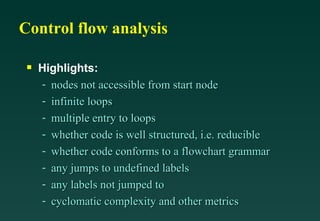
Control flow analysis Highlights: nodes not accessible from start node infinite loops multiple entry to loops whether code is well structured, i.e. reducible whether code conforms to a flowchart grammar any jumps to undefined labels any labels not jumped to cyclomatic complexity and other metrics
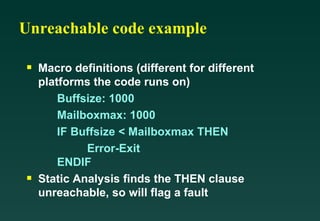
Unreachable code example Macro definitions (different for different platforms the code runs on) Buffsize: 1000  Mailboxmax: 1000 IF Buffsize < Mailboxmax THEN  Error-Exit ENDIF Static Analysis finds the THEN clause unreachable, so will flag a fault
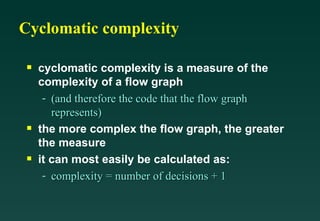
Cyclomatic complexity cyclomatic complexity is a measure of the complexity of a flow graph (and therefore the code that the flow graph represents) the more complex the flow graph, the greater the measure it can most easily be calculated as: complexity = number of decisions + 1
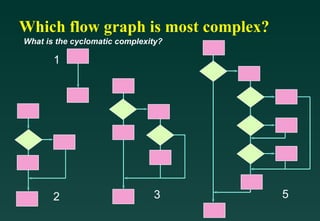
Which flow graph is most complex? 1 2 3 5 What is the cyclomatic complexity?
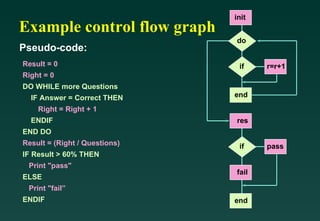
Example control flow graph Result = 0 Right = 0 DO WHILE more Questions IF Answer = Correct THEN     Right = Right + 1 ENDIF END DO Result = (Right / Questions) IF Result > 60% THEN   Print &quot;pass&quot; ELSE Print &quot;fail” ENDIF do if r=r+1 end init if res pass fail end Pseudo-code:
Other static metrics lines of code (LOC) operands & operators (Halstead’s metrics) fan-in & fan-out nesting levels function calls OO metrics: inheritance tree depth, number of methods, coupling & cohesion
Limitations and advantages Limitations: cannot distinguish &quot;fail-safe&quot; code from programming faults or anomalies (often creates overload of spurious error messages) does not execute the code, so not related to operating conditions Advantages: can find faults difficult to &quot;see&quot; gives objective quality assessment of code
Summary: Key Points Reviews help to find faults in development and test documentation, and should be applied early Types of review: informal, walkthrough, technical / peer review, Inspection Static analysis can find faults and give information about code without executing it Static testing 1 2 4 5 3 6

ISTQB Foundation - Chapter 3

  • 1.
    Static Testing 1Principles 2 Lifecycle 4 Dynamic test techniques 3 Static testing 5 Management 6 Tools Software Testing
  • 2.
    Contents Reviews andthe test process Types of review Static analysis Static testing 1 2 4 5 3 6
  • 3.
    People techniques individual:desk-checking, data-stepping, proof-reading group: Reviews (informal & formal): for consensus Walkthrough: for education Inspection (most formal): to find faults Static techniques do not execute code
  • 4.
    Benefits of reviewsDevelopment productivity improvement Reduced development timescales Reduced testing time and cost Lifetime cost reductions Reduced fault levels Improved customer relations etc.
  • 5.
    Reviews are cost-effective10 times reduction in faults reaching test, testing cost reduced by 50% to 80% Freedman & Weinberg, Handbook of Walkthroughs, Inspections & Technical Reviews reduce faults by a factor of 10 Yourdon, Structured Walkthroughs 25% reduction in schedules, remove 80% - 95% of faults at each stage, 28 times reduction in maintenance cost, many others Gilb & Graham, Software Inspection
  • 6.
    What can beInspected? policy, strategy, business plans, marketing or advertising material, contracts system requirements, feasibility studies, acceptance test plans test plans, test designs, test cases, test results system designs, logical & physical software code user manuals, procedures, training material Anything written down can be Inspected
  • 7.
    What can bereviewed? anything which could be Inspected i.e. anything written down plans, visions, “big picture”, strategic directions, ideas project progress work completed to schedule, etc. “Should we develop this” marketing options
  • 8.
    What to review/ Inspect? Tests Tests Tests Tests Requirements Design Code Functions Integration T Unit Test Accept. Test System Test
  • 9.
    Costs of reviewsRough guide: 5%-15% of development effort half day a week is 10% Effort required for reviews planning (by leader / moderator) preparation / self-study checking meeting fixing / editing / follow-up recording & analysis of statistics / metrics process improvement (should!)
  • 10.
    Contents Reviews andthe test process Types of review Static analysis Static testing 1 2 4 5 3 6
  • 11.
    Types of reviewof documents Informal Review undocumented widely viewed as useful and cheap (but no one can prove it!) A helpful first step for chaotic organisations. Technical Review: (or peer review) includes peer and technical experts, no management participation. Normally documented, fault-finding. Can be rather subjective. Decision-making Review: group discusses document and makes a decision about the content, e.g. how something should be done, go or no-go decision, or technical comments
  • 12.
    Types of reviewof documents Walkthrough author guides the group through a document and his or her thought processes, so all understand the same thing, consensus on changes to make Inspection: formal individual and group checking, using sources and standards, according to generic and specific rules and checklists, using entry and exit criteria, Leader must be trained & certified, metrics required
  • 13.
    Reviews in general1 Objectives / goals validation & verification against specifications & standards achieve consensus (excluding Inspection) process improvement (ideal, included in Inspection)
  • 14.
    Reviews in general2 Activities planning overview / kickoff meeting (Inspection) preparation / individual checking review meeting (not always) follow-up (for some types) metrics recording & analysis (Inspections and sometimes reviews)
  • 15.
    Reviews in general3 Roles and responsibilities Leader / moderator - plans the review / Inspection, chooses participants, helps & encourages, conducts the meeting, performs follow-up, manages metrics Author of the document being reviewed / Inspected Reviewers / Inspectors - specialised fault-finding roles for Inspection Managers - excluded from some types of review, need to plan project time for review / Inspection Others: e.g. Inspection/ review Co-ordinator
  • 16.
    Reviews in general4 Deliverables Changes (edits) in review product Change requests for source documents (predecessor documents to product being reviewed / Inspected) Process improvement suggestions to the review / Inspection process to the development process which produced the product just reviewed / Inspected Metrics (Inspection and some types of review)
  • 17.
    Reviews in general5 Pitfalls (they don’t always work!) lack of training in the technique (especially Inspection, the most formal) lack of or quality of documentation - what is being reviewed / Inspected Lack of management support - “lip service” - want them done, but don’t allow time for them to happen in project schedules Failure to improve processes (gets disheartening just getting better at finding the same thing over again)
  • 18.
    Inspection is differentthe document to be reviewed is given out in advance typically dozens of pages to review instructions are &quot;please review this&quot; some people have time to look through it and make comments before the meeting (which is difficult to arrange) the meeting often lasts for hours &quot;I don't like this&quot; much discussion, some about technical approaches, some about trivia don't really know if it was worthwhile, but we keep doing it Reviews vs. Inspection A typical review? chunk or sample training, roles entry criteria to meeting, may not be worth holding Rule violations, objective, not subjective no discussion, highly focused, anti-trivia only do it if value is proven (continually) not just product, sources 2 max., often much shorter
  • 19.
    Inspection is moreand better entry criteria training optimum checking rate prioritising the words standards process improvement exit criteria quantified estimates of remaining major faults per page typical review early Inspection mature Inspection effectiveness return on investment 10 - 20% unknown 30 - 40% 6 - 8 hrs / Insp hr 80 - 95% 8 - 30 hrs / Insp hr
  • 20.
    The Inspection ProcessSoftware Development Stage . . Planning Kick off Ind Chk Meet Edit Change Request Process Improvement Entry Next Software Development Stage Exit
  • 21.
    At first glance.. Here’s a document: review this (or Inspect it)
  • 22.
    Reviews: time andsize determine rate Time Checking Rate Size 2 hrs? 100 pages? 50 pages per hour Checking Rate
  • 23.
    Review “Thoroughness”? ordinary“review” - finds some faults, one major, fix them, consider the document now corrected and OK major minor minor
  • 24.
    Inspection: time andrate determine size Time Checking Rate Size 2 hrs? Optimum: 1 page * per hour 2 pages (at optimum rate) Size * 1 page = 300 important words
  • 25.
    Inspection Thoroughness Inspectioncan find deep-seated faults: all of that type can be corrected but needs optimum checking rate
  • 26.
    Inspection surprises Fundamentalimportance of Rules democratically agreed as applying define major issues / faults Slow checking rates Strict entry & exit criteria Fast logging rates Amount of responsibility given to author
  • 27.
    Contents Reviews andthe test process Types of review Static analysis ISEB Foundation Certificate Course Static testing 1 2 4 5 3 6
  • 28.
    What can staticanalysis do? A form of automated testing check for violations of standards check for things which may be a fault Descended from compiler technology a compiler statically analyses code, and “knows” a lot about it, e.g. variable usage; finds syntax faults static analysis tools extend this knowledge can find unreachable code, undeclared variables, parameter type mis-matches, uncalled functions & procedures, array bound violations, etc. Remember: static techniques do not execute the code
  • 29.
    Data flow analysisThis is the study of program variables variable defined* where a value is stored into it variable used where the stored value is accessed variable is undefined before it is defined or when it goes out of scope *defined should not be confused with declared x = y + z IF a > b THEN read(S) x is defined, y and z are used a and b are used, S is defined
  • 30.
    Data flow analysisfaults n := 0 read (x) n := 1 while x > y do begin read (y) write( n*y) x := x - n end Data flow anomaly: n is re-defined without being used Data flow fault: y is used before it has been defined (first time around the loop)
  • 31.
    Control flow analysisHighlights: nodes not accessible from start node infinite loops multiple entry to loops whether code is well structured, i.e. reducible whether code conforms to a flowchart grammar any jumps to undefined labels any labels not jumped to cyclomatic complexity and other metrics
  • 32.
    Unreachable code exampleMacro definitions (different for different platforms the code runs on) Buffsize: 1000 Mailboxmax: 1000 IF Buffsize < Mailboxmax THEN Error-Exit ENDIF Static Analysis finds the THEN clause unreachable, so will flag a fault
  • 33.
    Cyclomatic complexity cyclomaticcomplexity is a measure of the complexity of a flow graph (and therefore the code that the flow graph represents) the more complex the flow graph, the greater the measure it can most easily be calculated as: complexity = number of decisions + 1
  • 34.
    Which flow graphis most complex? 1 2 3 5 What is the cyclomatic complexity?
  • 35.
    Example control flowgraph Result = 0 Right = 0 DO WHILE more Questions IF Answer = Correct THEN Right = Right + 1 ENDIF END DO Result = (Right / Questions) IF Result > 60% THEN Print &quot;pass&quot; ELSE Print &quot;fail” ENDIF do if r=r+1 end init if res pass fail end Pseudo-code:
  • 36.
    Other static metricslines of code (LOC) operands & operators (Halstead’s metrics) fan-in & fan-out nesting levels function calls OO metrics: inheritance tree depth, number of methods, coupling & cohesion
  • 37.
    Limitations and advantagesLimitations: cannot distinguish &quot;fail-safe&quot; code from programming faults or anomalies (often creates overload of spurious error messages) does not execute the code, so not related to operating conditions Advantages: can find faults difficult to &quot;see&quot; gives objective quality assessment of code
  • 38.
    Summary: Key PointsReviews help to find faults in development and test documentation, and should be applied early Types of review: informal, walkthrough, technical / peer review, Inspection Static analysis can find faults and give information about code without executing it Static testing 1 2 4 5 3 6

Editor's Notes