Chapter - 4
Computer Software
Software
• Software are programs that are used to
operate and manipulate computers and their
peripheral devices
• A set of instruction code that are executed by
the system processor
• Application software and System software
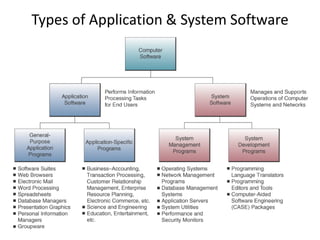
Types of Application & System Software
Application Software
• General Purpose
– Programs that perform common information
processing jobs for end users
– E.g., word processing, spreadsheet
– Also call productivity packages
– Virtual owner owns intellectual property rights
• Custom Software
– Software applications developed within an
organization for use by that organization
– Organization who develops it also uses it
– Changes big or small, occur at any time
– Have full control
– Access to the coding and documentation
Application Software
• Commercial Off-the-Shelf (COTS)
– Many copies sold
– Minimal changes beyond scheduled upgrades
– Purchasers have no control over specifications,
schedule, or evolution, and no access to source
code or internal documentation
– Product vendor retains the intellectual property
rights of the software
Application Software
• Open-source Software
– Developers collaborate on the development of an
application using programming standards which
allow anyone to contribute to the software
– As each developer completes a project, the
application code becomes available and free to
anyone who wants it
Application Software
• Function-Specific Application Software
Business Application software / Application specific programs
– Thousands of these packages support specific
applications of end users, especially in businesses
– Business application software supports the
reengineering and automation of business processes
with strategic e-business applications
– Examples: customer relationship management,
enterprise resource planning, supply chain
management, Web-enabled electronic commerce ,
data mining tools, enterprise information portals, KMS
Application Software
Software Suites, Integrated Packages
• Most widely used productivity packages are
bundled together as software suites
• Advantages
Cost less than buying individual packages
All have similar GUI
Work well together
• Disadvantages
All features not used
Takes a lot of disk space (bloatware)
Application Software
4-10
Presentation Graphics
• Common presentation graphics packages…
– Converts numeric data into graphics displays
– Used to create multimedia presentations of
graphics, photos, animation, and video clips
– E.g., Microsoft PowerPoint, Lotus Freelance, Corel
Presentations
– Top packages can tailor files for transfer in HTML
format to websites
4-11
Personal Information Managers
• Software for end user productivity and
collaboration
– Stores information about clients
– Manages schedules, appointments, tasks
– Most include ability to access the Web and
provide e-mail capabilities
– Some support team collaboration by sharing
information with other PIM users
– E.g., Lotus Organizer, Microsoft Outlook
4-12
Groupware
• Software that helps workgroups collaborate
on group assignments
– E-mail, discussion groups, databases, video
conferencing
– E.g., Lotus Notes, Novell GroupWise, Microsoft
Exchange
– Windows SharePoint Services and WebSphere
both allow teams to create websites for
information sharing and document collaboration
4-13
Software Alternatives
• Outsourcing development and maintenance of
software
• Application service providers (ASPs)
– Companies that own, operate, and maintain
application software and computer system
resources
– Use the application for a fee over the Internet
– Pay-as-you-go
– Use expected to accelerate in the coming years
System Software
• System software are the programs that
manage and support a computer system and
its information processing activities
• 2 Types of system software
– System Management Programs
• The programs that manage the hardware,
software, network and data resources of computer
systems during the execution of various
information processing jobs of users
• Ex. OS, DBMS, Network Mgmt Sys, System Utilities
System Software
• 2 Types of system software
– System Development Programs
• Programs that help user to develop information
processing programs and procedures and prepare user
programs for computer processing.
• Ex. Programing language translators and editors, CASE
System Software
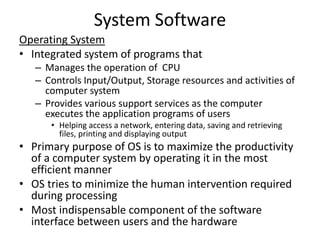
Operating System
• Integrated system of programs that
– Manages the operation of CPU
– Controls Input/Output, Storage resources and activities of
computer system
– Provides various support services as the computer
executes the application programs of users
• Helping access a network, entering data, saving and retrieving
files, printing and displaying output
• Primary purpose of OS is to maximize the productivity
of a computer system by operating it in the most
efficient manner
• OS tries to minimize the human intervention required
during processing
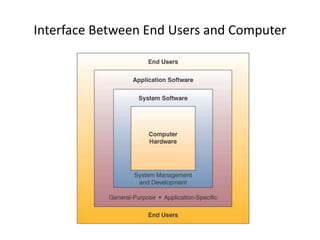
• Most indispensable component of the software
interface between users and the hardware
Interface Between End Users and Computer
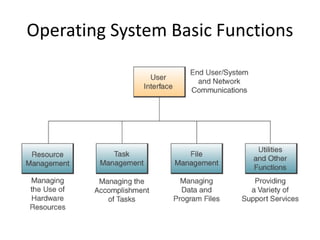
Operating System Basic Functions
1. User Interface
• The part of the operating system that allows you to
communicate with it
• Three main types: Command-driven, Menu-driven, GUI
2. Resource Management
• Part of the operating system that manages the hardware and
networking resources of a computer system
– Includes CPU, memory, secondary storage devices,
telecommunications, and input/output peripherals
– Keeping track of where data and programs are stored
– Subdividing memory; providing virtual memory capability
Operating System Basic Functions
3. File Management
• Part of the operating system that controls the creation,
deletion, and access of files and programs
– Keeps track of physical location on storage devices
– Maintains directories of information about the location and
characteristics of stored files
4. Task Management
• Part of the operating system that manages the
accomplishment of end user computing tasks
– Controls which task gets access to the CPU,
and for how long
– Can interrupt the CPU at any time to substitute
a higher priority task
– Supports preemptive and cooperative multi-tasking and multi-
processing
Operating System Basic Functions
Other system management programs
• Utilities
– Miscellaneous housekeeping functions
– Example: Norton utilities includes data backup,
virus protection, data compression, etc.
• Performance Monitors
– Programs that monitor and adjust computer
system to keep them running efficiently
• Security Monitors
– Monitor and control use of computer systems
to prevent unauthorized use of resources
Middleware
• Application Servers provide an interface
between an operating system and the
application programs of users
• Middleware
– Software that helps diverse software applications
exchange data and work together more efficiently
– Web

Chapter 4 computer software

  • 1.
  • 2.
    Software • Software areprograms that are used to operate and manipulate computers and their peripheral devices • A set of instruction code that are executed by the system processor • Application software and System software
  • 3.
    Types of Application& System Software
  • 4.
    Application Software • GeneralPurpose – Programs that perform common information processing jobs for end users – E.g., word processing, spreadsheet – Also call productivity packages – Virtual owner owns intellectual property rights
  • 5.
    • Custom Software –Software applications developed within an organization for use by that organization – Organization who develops it also uses it – Changes big or small, occur at any time – Have full control – Access to the coding and documentation Application Software
  • 6.
    • Commercial Off-the-Shelf(COTS) – Many copies sold – Minimal changes beyond scheduled upgrades – Purchasers have no control over specifications, schedule, or evolution, and no access to source code or internal documentation – Product vendor retains the intellectual property rights of the software Application Software
  • 7.
    • Open-source Software –Developers collaborate on the development of an application using programming standards which allow anyone to contribute to the software – As each developer completes a project, the application code becomes available and free to anyone who wants it Application Software
  • 8.
    • Function-Specific ApplicationSoftware Business Application software / Application specific programs – Thousands of these packages support specific applications of end users, especially in businesses – Business application software supports the reengineering and automation of business processes with strategic e-business applications – Examples: customer relationship management, enterprise resource planning, supply chain management, Web-enabled electronic commerce , data mining tools, enterprise information portals, KMS Application Software
  • 9.
    Software Suites, IntegratedPackages • Most widely used productivity packages are bundled together as software suites • Advantages Cost less than buying individual packages All have similar GUI Work well together • Disadvantages All features not used Takes a lot of disk space (bloatware) Application Software
  • 10.
    4-10 Presentation Graphics • Commonpresentation graphics packages… – Converts numeric data into graphics displays – Used to create multimedia presentations of graphics, photos, animation, and video clips – E.g., Microsoft PowerPoint, Lotus Freelance, Corel Presentations – Top packages can tailor files for transfer in HTML format to websites
  • 11.
    4-11 Personal Information Managers •Software for end user productivity and collaboration – Stores information about clients – Manages schedules, appointments, tasks – Most include ability to access the Web and provide e-mail capabilities – Some support team collaboration by sharing information with other PIM users – E.g., Lotus Organizer, Microsoft Outlook
  • 12.
    4-12 Groupware • Software thathelps workgroups collaborate on group assignments – E-mail, discussion groups, databases, video conferencing – E.g., Lotus Notes, Novell GroupWise, Microsoft Exchange – Windows SharePoint Services and WebSphere both allow teams to create websites for information sharing and document collaboration
  • 13.
    4-13 Software Alternatives • Outsourcingdevelopment and maintenance of software • Application service providers (ASPs) – Companies that own, operate, and maintain application software and computer system resources – Use the application for a fee over the Internet – Pay-as-you-go – Use expected to accelerate in the coming years
  • 14.
    System Software • Systemsoftware are the programs that manage and support a computer system and its information processing activities • 2 Types of system software – System Management Programs • The programs that manage the hardware, software, network and data resources of computer systems during the execution of various information processing jobs of users • Ex. OS, DBMS, Network Mgmt Sys, System Utilities
  • 15.
    System Software • 2Types of system software – System Development Programs • Programs that help user to develop information processing programs and procedures and prepare user programs for computer processing. • Ex. Programing language translators and editors, CASE
  • 16.
    System Software Operating System •Integrated system of programs that – Manages the operation of CPU – Controls Input/Output, Storage resources and activities of computer system – Provides various support services as the computer executes the application programs of users • Helping access a network, entering data, saving and retrieving files, printing and displaying output • Primary purpose of OS is to maximize the productivity of a computer system by operating it in the most efficient manner • OS tries to minimize the human intervention required during processing • Most indispensable component of the software interface between users and the hardware
  • 17.
    Interface Between EndUsers and Computer
  • 18.
  • 19.
    1. User Interface •The part of the operating system that allows you to communicate with it • Three main types: Command-driven, Menu-driven, GUI 2. Resource Management • Part of the operating system that manages the hardware and networking resources of a computer system – Includes CPU, memory, secondary storage devices, telecommunications, and input/output peripherals – Keeping track of where data and programs are stored – Subdividing memory; providing virtual memory capability Operating System Basic Functions
  • 20.
    3. File Management •Part of the operating system that controls the creation, deletion, and access of files and programs – Keeps track of physical location on storage devices – Maintains directories of information about the location and characteristics of stored files 4. Task Management • Part of the operating system that manages the accomplishment of end user computing tasks – Controls which task gets access to the CPU, and for how long – Can interrupt the CPU at any time to substitute a higher priority task – Supports preemptive and cooperative multi-tasking and multi- processing Operating System Basic Functions
  • 21.
    Other system managementprograms • Utilities – Miscellaneous housekeeping functions – Example: Norton utilities includes data backup, virus protection, data compression, etc. • Performance Monitors – Programs that monitor and adjust computer system to keep them running efficiently • Security Monitors – Monitor and control use of computer systems to prevent unauthorized use of resources
  • 22.
    Middleware • Application Serversprovide an interface between an operating system and the application programs of users • Middleware – Software that helps diverse software applications exchange data and work together more efficiently – Web