Chapter 4
The Relational Model
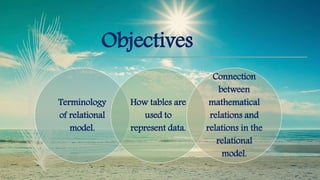
Objectives
Terminology
of relational
model.
How tables are
used to
represent data.
Connection
between
mathematical
relations and
relations in the
relational
model.
Objectives
Properties
of
database
relations.
How to
identify
CK, PK,
and FKs.
Meaning
of entity
integrity
and
referential
integrity.
Purpose
and
advantage
s of views.
Relational Model Terminology
o A Relation is a table with columns and rows.
o Only applies to logical structure of the database, not
the physical structure.
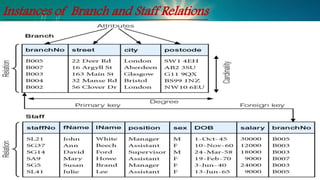
o Attribute is a named column of a relation.
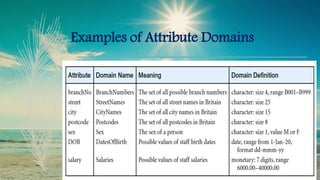
o Domain is the set of allowable values for one or more
attributes.
Relational Model Terminology
o Tuple is a row of a relation.
o Degree is the number of attributes in a relation.
o Cardinality is the number of tuples in a relation.
o Relational Database is a collection of normalized
relations with distinct relation names.
Instances of Branch and Staff Relations
Examples of Attribute Domains
Alternative Terminology for Relational Model
Mathematical Definition of Relation
o Consider two sets, D1 & D2, where D1 = {2, 4} and D2 = {1, 3, 5}.
o Cartesian product, D1 ´ D2, is set of all ordered pairs, where first
element is member of D1 and second element is member of D2.
o Alternative way is to find all combinations of elements with first
from D1 and second from D2.
o D1 ´ D2 = {(2, 1), (2, 3), (2, 5), (4, 1), (4, 3), (4, 5)}
Mathematical Definition of Relation
o Any subset of Cartesian product is a relation e.g.
o R = {(2, 1), (4, 1)}
o May specify which pairs are in relation using some condition
for selection; e.g.
o Second element is 1:
o R = {(x, y) | x ÎD1, y ÎD2, and y = 1}
o First element is always twice the second:
o S = {(x, y) | x ÎD1, y ÎD2, and x = 2y}
Mathematical Definition of Relation
o Consider three sets D1, D2, D3 with Cartesian Product
D1´D2´D3 e.g.
o D1 = {1, 3} D2 = {2, 4} D3 = {5, 6}
o D1´D2´D3 = {(1,2,5), (1,2,6), (1,4,5), (1,4,6), (3,2,5),
(3,2,6), (3,4,5), (3,4,6)}
o Any subset of these ordered triples is a relation.
Mathematical Definition of Relation
o Cartesian product of n sets (D1, D2, . . ., Dn) is:
o D1 ´ D2 ´ . . . ´ Dn = {(d1, d2, . . . , dn) | d1 ÎD1, d2 ÎD2, . . . , dnÎDn}
usually written as:
n
∏ Dii = 1
o Any set of n-tuples from this Cartesian product is a relation on the n sets.
Database Relations
o Relation schema
o Named relation defined by a set of attribute and
domain name pairs.
o Relational database schema
o Set of relation schemas, each with a distinct name.
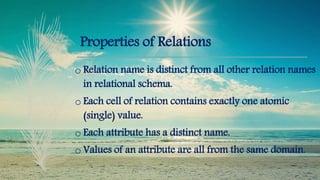
Properties of Relations
o Relation name is distinct from all other relation names
in relational schema.
o Each cell of relation contains exactly one atomic
(single) value.
o Each attribute has a distinct name.
o Values of an attribute are all from the same domain.
Properties of Relations
o Each tuple is distinct, there are no duplicate tuples.
o Order of attributes has no significance.
o Order of tuples has no significance, theoretically.
Relational Keys
o Super key: An attribute, or set of attributes, that uniquely
identifies a tuple within a relation.
o Candidate Key: Super key (K) such that no proper subset is a
super key within the relation.
 Uniqueness: - In each tuple of R, values of K uniquely identify
that tuple.
 Irreducibility: - No proper subset of K has the uniqueness
property.
Relational Keys
– Primary Key: - Candidate key selected to identify tuples
uniquely within relation.
– Alternate Keys: - Candidate keys that are not selected to be
primary key.
– Foreign Key: - Attribute, or set of attributes, within one
relation that matches candidate key of some (possibly same)
relation.
Integrity Constraints
o Null
Represents value for an attribute that is
currently unknown or not applicable for
tuple.
Deals with incomplete or exceptional data.
Represents the absence of a value and is
not the same as zero or spaces, which are
values.
Integrity Constraints
o Entity Integrity
 In a base relation, no attribute of a primary key can be null.
o Referential Integrity
 If foreign key exists in a relation, either foreign key value must
match a candidate key value of some tuple in its home relation or
foreign key value must be wholly null.
Integrity Constraints
oGeneral Constraints
Additional rules specified by users or
database administrators that define or
constrain some aspect of the enterprise.
Views
o Base Relation
Named relation corresponding to an entity in
conceptual schema, whose tuples are physically stored
in database.
o View
Dynamic result of one or more relational operations
operating on base relations to produce another relation.
Views
o A virtual relation that does not necessarily actually exist
in the database but is produced upon request, at time of
request.
o Contents of a view are defined as a query on one or more
base relations.
o Views are dynamic, meaning that changes made to base
relations that affect view attributes are immediately
reflected in the view.
Purpose of Views
o Provides powerful and flexible security mechanism by
hiding parts of database from certain users.
o Permits users to access data in a customized way, so that
same data can be seen by different users in different
ways, at same time.
o Can simplify complex operations on base relations.
Updating Views
oAll updates to a base relation should be
immediately reflected in all views that
reference that base relation.
oIf view is updated, underlying base relation
should reflect change.
Updating Views
– There are restrictions on modifications that can be made through
views:
– Update allowed if query involves single base relation and contains a
candidate key of base relation.
– Update not allowed involving multiple base relations.
– Updates are not allowed involving aggregation or grouping
operations.
Updating Views
oClasses of views are defined as:
oTheoretically not updateable
oTheoretically updateable
oPartially updateable

Chapter 4

  • 1.
  • 2.
    Objectives Terminology of relational model. How tablesare used to represent data. Connection between mathematical relations and relations in the relational model.
  • 3.
    Objectives Properties of database relations. How to identify CK, PK, andFKs. Meaning of entity integrity and referential integrity. Purpose and advantage s of views.
  • 4.
    Relational Model Terminology oA Relation is a table with columns and rows. o Only applies to logical structure of the database, not the physical structure. o Attribute is a named column of a relation. o Domain is the set of allowable values for one or more attributes.
  • 5.
    Relational Model Terminology oTuple is a row of a relation. o Degree is the number of attributes in a relation. o Cardinality is the number of tuples in a relation. o Relational Database is a collection of normalized relations with distinct relation names.
  • 6.
    Instances of Branchand Staff Relations
  • 7.
  • 8.
  • 9.
    Mathematical Definition ofRelation o Consider two sets, D1 & D2, where D1 = {2, 4} and D2 = {1, 3, 5}. o Cartesian product, D1 ´ D2, is set of all ordered pairs, where first element is member of D1 and second element is member of D2. o Alternative way is to find all combinations of elements with first from D1 and second from D2. o D1 ´ D2 = {(2, 1), (2, 3), (2, 5), (4, 1), (4, 3), (4, 5)}
  • 10.
    Mathematical Definition ofRelation o Any subset of Cartesian product is a relation e.g. o R = {(2, 1), (4, 1)} o May specify which pairs are in relation using some condition for selection; e.g. o Second element is 1: o R = {(x, y) | x ÎD1, y ÎD2, and y = 1} o First element is always twice the second: o S = {(x, y) | x ÎD1, y ÎD2, and x = 2y}
  • 11.
    Mathematical Definition ofRelation o Consider three sets D1, D2, D3 with Cartesian Product D1´D2´D3 e.g. o D1 = {1, 3} D2 = {2, 4} D3 = {5, 6} o D1´D2´D3 = {(1,2,5), (1,2,6), (1,4,5), (1,4,6), (3,2,5), (3,2,6), (3,4,5), (3,4,6)} o Any subset of these ordered triples is a relation.
  • 12.
    Mathematical Definition ofRelation o Cartesian product of n sets (D1, D2, . . ., Dn) is: o D1 ´ D2 ´ . . . ´ Dn = {(d1, d2, . . . , dn) | d1 ÎD1, d2 ÎD2, . . . , dnÎDn} usually written as: n ∏ Dii = 1 o Any set of n-tuples from this Cartesian product is a relation on the n sets.
  • 13.
    Database Relations o Relationschema o Named relation defined by a set of attribute and domain name pairs. o Relational database schema o Set of relation schemas, each with a distinct name.
  • 14.
    Properties of Relations oRelation name is distinct from all other relation names in relational schema. o Each cell of relation contains exactly one atomic (single) value. o Each attribute has a distinct name. o Values of an attribute are all from the same domain.
  • 15.
    Properties of Relations oEach tuple is distinct, there are no duplicate tuples. o Order of attributes has no significance. o Order of tuples has no significance, theoretically.
  • 16.
    Relational Keys o Superkey: An attribute, or set of attributes, that uniquely identifies a tuple within a relation. o Candidate Key: Super key (K) such that no proper subset is a super key within the relation.  Uniqueness: - In each tuple of R, values of K uniquely identify that tuple.  Irreducibility: - No proper subset of K has the uniqueness property.
  • 17.
    Relational Keys – PrimaryKey: - Candidate key selected to identify tuples uniquely within relation. – Alternate Keys: - Candidate keys that are not selected to be primary key. – Foreign Key: - Attribute, or set of attributes, within one relation that matches candidate key of some (possibly same) relation.
  • 18.
    Integrity Constraints o Null Representsvalue for an attribute that is currently unknown or not applicable for tuple. Deals with incomplete or exceptional data. Represents the absence of a value and is not the same as zero or spaces, which are values.
  • 19.
    Integrity Constraints o EntityIntegrity  In a base relation, no attribute of a primary key can be null. o Referential Integrity  If foreign key exists in a relation, either foreign key value must match a candidate key value of some tuple in its home relation or foreign key value must be wholly null.
  • 20.
    Integrity Constraints oGeneral Constraints Additionalrules specified by users or database administrators that define or constrain some aspect of the enterprise.
  • 21.
    Views o Base Relation Namedrelation corresponding to an entity in conceptual schema, whose tuples are physically stored in database. o View Dynamic result of one or more relational operations operating on base relations to produce another relation.
  • 22.
    Views o A virtualrelation that does not necessarily actually exist in the database but is produced upon request, at time of request. o Contents of a view are defined as a query on one or more base relations. o Views are dynamic, meaning that changes made to base relations that affect view attributes are immediately reflected in the view.
  • 23.
    Purpose of Views oProvides powerful and flexible security mechanism by hiding parts of database from certain users. o Permits users to access data in a customized way, so that same data can be seen by different users in different ways, at same time. o Can simplify complex operations on base relations.
  • 24.
    Updating Views oAll updatesto a base relation should be immediately reflected in all views that reference that base relation. oIf view is updated, underlying base relation should reflect change.
  • 25.
    Updating Views – Thereare restrictions on modifications that can be made through views: – Update allowed if query involves single base relation and contains a candidate key of base relation. – Update not allowed involving multiple base relations. – Updates are not allowed involving aggregation or grouping operations.
  • 26.
    Updating Views oClasses ofviews are defined as: oTheoretically not updateable oTheoretically updateable oPartially updateable