Recommended
PPTX
PPTX
PPTX
PPT
Joint Arrengement and public sector teaching
PDF
Chapter 1. accounting in action student
PPTX
PPT
Advanced I Ch V ppt..ppt best presentation
PPTX
ch02 The Recording Process.pptx
PPT
fraud, internal control.ppt
PPT
RTF
PPTX
PPTX
Auditing the expenditure cycle
PDF
Principle Accounting Warren Reeve Fees 22 edition
PPT
Chapter 1(accounting) kimmel kieso
PPTX
Accounting Information Systems - Chapt 7
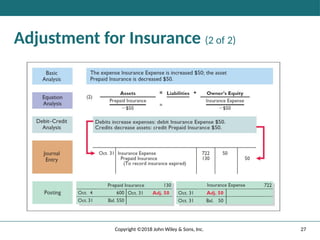
PPTX
Fraud, Internal Control and Cash - Accounting Principles
PPTX
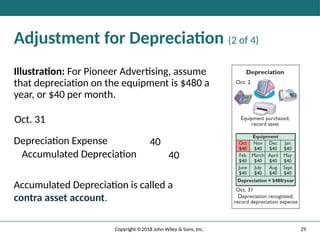
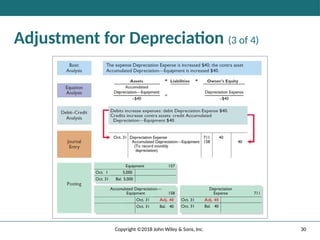
Accounting Information System - Accounting Principles
PPT
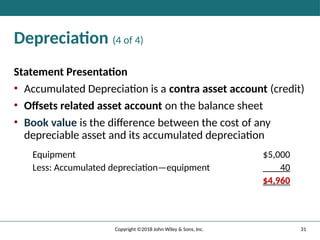
BAB 18-1 modul untuk mata kuliah akuntansi keuangan 2
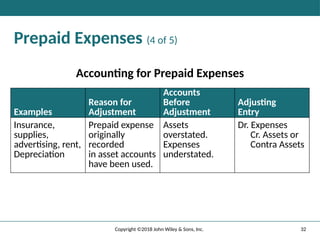
PPTX
Chapter 13 Fundamental of Accounting Financial
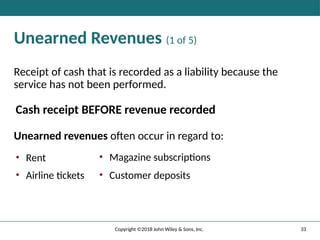
PPTX
ch21 process costing managerial accounting
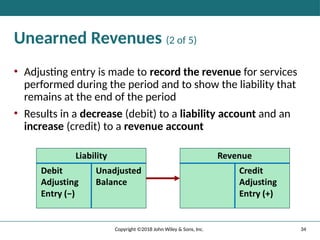
PDF
PPT
Ch 8 - Accounting for Receivables.ppt
PPTX
ch13_Current Liability.pptx
PPS
Bab 4 Income Statement and Related Information
PPT
Ch03 the matching concept and the adjusting process, intro accounting, 21st...
PPTX
Revenue Recognition - Intermediate Accounting
PPTX
Chapter two: The Recording Process (Financial Accounting)
PPTX
Wey_FinIFRS_5e_PPT_Ch03.pptxilhkljkjbjbbh
PPT
أبسط المعلومات المالية باللغة الانجليزية عرض محاسبية2.ppt
More Related Content
PPTX
PPTX
PPTX
PPT
Joint Arrengement and public sector teaching
PDF
Chapter 1. accounting in action student
PPTX
PPT
Advanced I Ch V ppt..ppt best presentation
PPTX
ch02 The Recording Process.pptx
What's hot
PPT
fraud, internal control.ppt
PPT
RTF
PPTX
PPTX
Auditing the expenditure cycle
PDF
Principle Accounting Warren Reeve Fees 22 edition
PPT
Chapter 1(accounting) kimmel kieso
PPTX
Accounting Information Systems - Chapt 7
PPTX
Fraud, Internal Control and Cash - Accounting Principles
PPTX
Accounting Information System - Accounting Principles
PPT
BAB 18-1 modul untuk mata kuliah akuntansi keuangan 2
PPTX
Chapter 13 Fundamental of Accounting Financial
PPTX
ch21 process costing managerial accounting
PDF
PPT
Ch 8 - Accounting for Receivables.ppt
PPTX
ch13_Current Liability.pptx
PPS
Bab 4 Income Statement and Related Information
PPT
Ch03 the matching concept and the adjusting process, intro accounting, 21st...
PPTX
Revenue Recognition - Intermediate Accounting
PPTX
Chapter two: The Recording Process (Financial Accounting)
Similar to Chapter 3 Slides - Part I-accountibg.pptx
PPTX
Wey_FinIFRS_5e_PPT_Ch03.pptxilhkljkjbjbbh
PPT
أبسط المعلومات المالية باللغة الانجليزية عرض محاسبية2.ppt
PPT
ch03 Introduction to accounting Conepts.ppt
PPTX
https://www.slideshare.net/upload?download_id=50789038&_gl=1*1psauer*_gcl_au*...
PPTX
very important notetaking presentation useful much.pptx
PPT
NSU EMB 501 Accounting Ch03
PPT
Financial_Accounting_chapter_03.ppt
PPT
Accounting 201 intro to accounting ch03.ppt
PPTX
accounting principles ch03- adjusting entries-1.pptx
PPT
PPTX
Lecture slides_Chapter 3 _ 4.pptx
PPT
rtrtrtrtrtrtrtrtrtrtrtrtrtrtrtrtrtrtr.ppt
PPTX
Adjusting the Accounts Adjusting Entries
PDF
PPTX
principles of accounting adjusting entries.pptx
PPTX
principles of accounting adjusting entriew.pptx
PPTX
This is the Week 3 Live Session.pptx without audio
PPT
Chapter three of drugs supply management
PPT
accounting adjusting entries chapter 3.ppt
DOCX
Accrual Accounting ConceptsKimmel ● Weygandt ● KiesoAccounti.docx
Recently uploaded
PDF
Chemical Hazards at Workplace – Types, Properties & Exposure Routes, CORE-EHS
PDF
(en/zhTW) Heterogeneous System Architecture: Design & Performance
PPTX
1.Module 4-Clamping of jigs and fixtures for manufacturing.pptx
PPTX
Theory to Practice of Unsaturated Soil Mechanics-1.pptx
PDF
Chad Ayach - An Accomplished Mechanical Engineer
PPT
Integer , Goal and Non linear Programming Model
PDF
Soil Compressibility (Elastic Settlement).pdf
PDF
NS unit wise unit wise 1 -5 so prepare,.
PPTX
operating_systems.pptx m,nm,nm,n,nm,n,nm,nikl
PDF
Infinite Sequence and Series: It Includes basic Sequence and Series
PPTX
A professional presentation on Cosmos Bank Heist
PDF
engineering management chapter 5 ppt presentation
PDF
Model QP 2025 scheme Q &A- Module 1 and 2.pdf
PPTX
ISO 13485.2016 Awareness's Training material
PPTX
Why TPM Succeeds in Some Plants and Struggles in Others | MaintWiz
PPTX
Unit 1_Importance of modelling(Object oriented concepts).pptx
PPTX
Presentation-WPS Office.pptx afgouvhyhgfccf
PPTX
ME3592 - Metrology and Measurements - Unit - 1 - Lecture Notes
PPT
Ceramic Matrix Composites Slide from Composite Materials
PPT
Cloud computing-1.ppt presentation preview
Chapter 3 Slides - Part I-accountibg.pptx 1. 2. Chapter Outline
Learning Objectives
LO 1 Explain the accrual basis of accounting and the reasons
for adjusting entries.
LO 2 Prepare adjusting entries for deferrals.
LO 3 Prepare adjusting entries for accruals.
LO 4 Describe the nature and purpose of an adjusted trial
balance.
2
Copyright ©2018 John Wiley & Sons, Inc.
3. 3
Copyright ©2018 John Wiley & Sons, Inc.
Accrual-Basis and Adjusting Entries
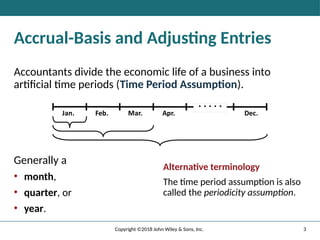
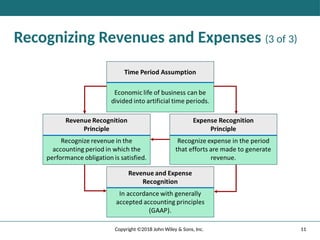
Accountants divide the economic life of a business into
artificial time periods (Time Period Assumption).
Generally a
• month,
• quarter, or
• year.
Alternative terminology
The time period assumption is also
called the periodicity assumption.
4. Fiscal and Calendar Years (1 of 5)
• Monthly and quarterly time periods are called interim
periods
• Most large companies must prepare both quarterly
and annual financial statements
• Fiscal Year = Accounting time period that is one year
in length
• Calendar Year = January 1 to December 31
4
Copyright ©2018 John Wiley & Sons, Inc.
5. 5
Copyright ©2018 John Wiley & Sons, Inc.
Fiscal and Calendar Years (2 of 5)
The time period assumption states that:
a. companies must wait until the calendar year is
completed to prepare financial statements.
b. companies use the fiscal year to report financial
information.
c. the economic life of a business can be divided into
artificial time periods.
d. companies record information in the time period in
which the events occur.
6. 6
Copyright ©2018 John Wiley & Sons, Inc.
Fiscal and Calendar Years (3 of 5)
The time period assumption states that:
a. companies must wait until the calendar year is
completed to prepare financial statements.
b. companies use the fiscal year to report financial
information.
c. Answer: the economic life of a business can be divided
into artificial time periods.
d. companies record information in the time period in
which the events occur.
7. 7
Copyright ©2018 John Wiley & Sons, Inc.
Accrual- versus Cash-Basis Accounting (1
of 2)
Accrual-Basis Accounting
• Transactions recorded in the periods in which the events
occur
• Companies recognize revenues when they perform
services (rather than when they receive cash)
• Expenses are recognized when incurred (rather than when
paid)
• In accordance with generally accepted accounting
principles (GAAP)
8. 8
Copyright ©2018 John Wiley & Sons, Inc.
Accrual- versus Cash-Basis Accounting (2
of 2)
Cash-Basis Accounting
• Revenues recognized when cash is received
• Expenses recognized when cash is paid
• Cash-basis accounting is not in accordance with generally
accepted accounting principles (GAAP)
9. 9
Copyright ©2018 John Wiley & Sons, Inc.
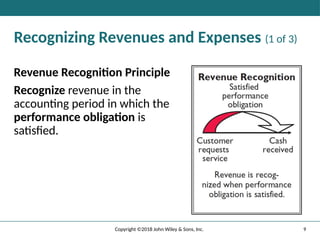
Recognizing Revenues and Expenses (1 of 3)
Revenue Recognition Principle
Recognize revenue in the
accounting period in which the
performance obligation is
satisfied.
10. 10
Copyright ©2018 John Wiley & Sons, Inc.
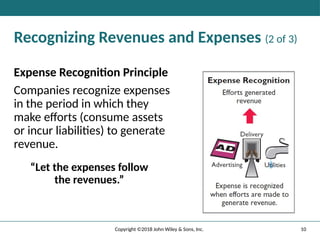
Recognizing Revenues and Expenses (2 of 3)
Expense Recognition Principle
Companies recognize expenses
in the period in which they
make efforts (consume assets
or incur liabilities) to generate
revenue.
“Let the expenses follow
the revenues.”
11. 12. 12
Copyright ©2018 John Wiley & Sons, Inc.
Fiscal and Calendar Years (4 of 5)
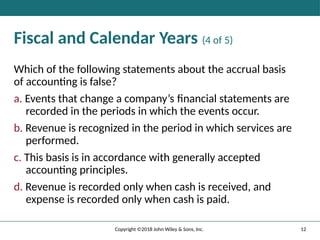
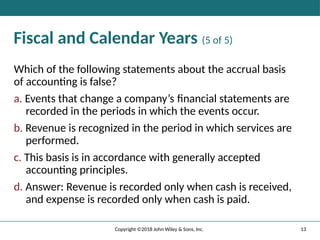
Which of the following statements about the accrual basis
of accounting is false?
a. Events that change a company’s financial statements are
recorded in the periods in which the events occur.
b. Revenue is recognized in the period in which services are
performed.
c. This basis is in accordance with generally accepted
accounting principles.
d. Revenue is recorded only when cash is received, and
expense is recorded only when cash is paid.
13. 13
Copyright ©2018 John Wiley & Sons, Inc.
Fiscal and Calendar Years (5 of 5)
Which of the following statements about the accrual basis
of accounting is false?
a. Events that change a company’s financial statements are
recorded in the periods in which the events occur.
b. Revenue is recognized in the period in which services are
performed.
c. This basis is in accordance with generally accepted
accounting principles.
d. Answer: Revenue is recorded only when cash is received,
and expense is recorded only when cash is paid.
14. The Need for Adjusting Entries (1 of 3)
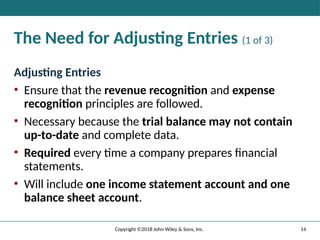
Adjusting Entries
• Ensure that the revenue recognition and expense
recognition principles are followed.
• Necessary because the trial balance may not contain
up-to-date and complete data.
• Required every time a company prepares financial
statements.
• Will include one income statement account and one
balance sheet account.
14
Copyright ©2018 John Wiley & Sons, Inc.
15. 15
Copyright ©2018 John Wiley & Sons, Inc.
The Need for Adjusting Entries (2 of 3)
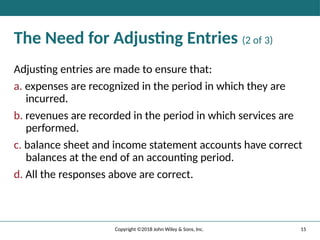
Adjusting entries are made to ensure that:
a. expenses are recognized in the period in which they are
incurred.
b. revenues are recorded in the period in which services are
performed.
c. balance sheet and income statement accounts have correct
balances at the end of an accounting period.
d. All the responses above are correct.
16. 16
Copyright ©2018 John Wiley & Sons, Inc.
The Need for Adjusting Entries (3 of 3)
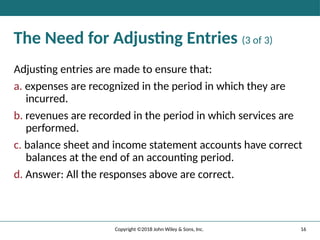
Adjusting entries are made to ensure that:
a. expenses are recognized in the period in which they are
incurred.
b. revenues are recorded in the period in which services are
performed.
c. balance sheet and income statement accounts have correct
balances at the end of an accounting period.
d. Answer: All the responses above are correct.
17. 17
Copyright ©2018 John Wiley & Sons, Inc.
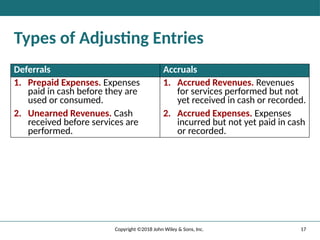
Types of Adjusting Entries
Deferrals Accruals
1. Prepaid Expenses. Expenses
paid in cash before they are
used or consumed.
2. Unearned Revenues. Cash
received before services are
performed.
1. Accrued Revenues. Revenues
for services performed but not
yet received in cash or recorded.
2. Accrued Expenses. Expenses
incurred but not yet paid in cash
or recorded.
18. 18
Copyright ©2018 John Wiley & Sons, Inc.
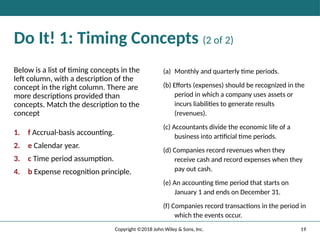
Do It! 1: Timing Concepts (1 of 2)
Below is a list of timing concepts in the
left column, with a description of the
concept in the right column. There are
more descriptions provided than
concepts. Match the description to the
concept
1. [blank] Accrual-basis accounting.
2. [blank] Calendar year.
3. [blank] Time period assumption.
4. [blank] Expense recognition principle.
(a) Monthly and quarterly time periods.
(b) Efforts (expenses) should be recognized in the
period in which a company uses assets or
incurs liabilities to generate results
(revenues).
(c) Accountants divide the economic life of a
business into artificial time periods.
(d) Companies record revenues when they
receive cash and record expenses when they
pay out cash.
(e) An accounting time period that starts on
January 1 and ends on December 31.
(f) Companies record transactions in the period in
which the events occur.
19. 19
Copyright ©2018 John Wiley & Sons, Inc.
Do It! 1: Timing Concepts (2 of 2)
Below is a list of timing concepts in the
left column, with a description of the
concept in the right column. There are
more descriptions provided than
concepts. Match the description to the
concept
1. f Accrual-basis accounting.
2. e Calendar year.
3. c Time period assumption.
4. b Expense recognition principle.
(a) Monthly and quarterly time periods.
(b) Efforts (expenses) should be recognized in the
period in which a company uses assets or
incurs liabilities to generate results
(revenues).
(c) Accountants divide the economic life of a
business into artificial time periods.
(d) Companies record revenues when they
receive cash and record expenses when they
pay out cash.
(e) An accounting time period that starts on
January 1 and ends on December 31.
(f) Companies record transactions in the period in
which the events occur.
20. 20
Copyright ©2018 John Wiley & Sons, Inc.
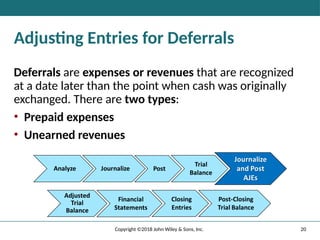
Adjusting Entries for Deferrals
Deferrals are expenses or revenues that are recognized
at a date later than the point when cash was originally
exchanged. There are two types:
• Prepaid expenses
• Unearned revenues
21. 21
Copyright ©2018 John Wiley & Sons, Inc.
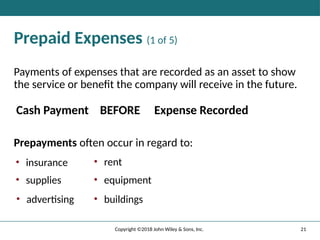
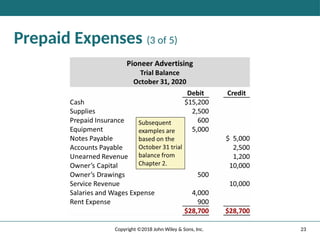
Prepaid Expenses (1 of 5)
Payments of expenses that are recorded as an asset to show
the service or benefit the company will receive in the future.
Cash Payment BEFORE Expense Recorded
Prepayments often occur in regard to:
• insurance
• supplies
• advertising
• rent
• equipment
• buildings
22. 22
Copyright ©2018 John Wiley & Sons, Inc.
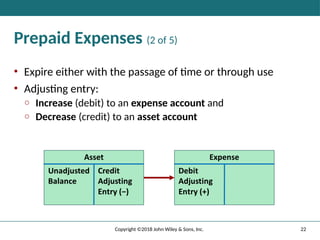
Prepaid Expenses (2 of 5)
• Expire either with the passage of time or through use
• Adjusting entry:
o Increase (debit) to an expense account and
o Decrease (credit) to an asset account
23. 24. 24
Copyright ©2018 John Wiley & Sons, Inc.
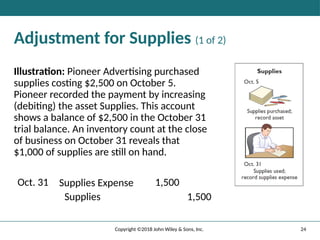
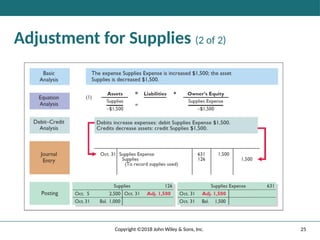
Adjustment for Supplies (1 of 2)
Illustration: Pioneer Advertising purchased
supplies costing $2,500 on October 5.
Pioneer recorded the payment by increasing
(debiting) the asset Supplies. This account
shows a balance of $2,500 in the October 31
trial balance. An inventory count at the close
of business on October 31 reveals that
$1,000 of supplies are still on hand.
Oct. 31 Supplies Expense 1,500
Supplies 1,500
25. 26. 26
Copyright ©2018 John Wiley & Sons, Inc.
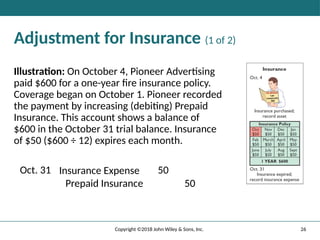
Adjustment for Insurance (1 of 2)
Illustration: On October 4, Pioneer Advertising
paid $600 for a one-year fire insurance policy.
Coverage began on October 1. Pioneer recorded
the payment by increasing (debiting) Prepaid
Insurance. This account shows a balance of
$600 in the October 31 trial balance. Insurance
of $50 ($600 ÷ 12) expires each month.
Oct. 31 Insurance Expense 50
Prepaid Insurance 50
27. 28. 28
Copyright ©2018 John Wiley & Sons, Inc.
Depreciation (1 of 4)
• Buildings, equipment, and motor vehicles (assets that
provide service for many years) are recorded as assets,
rather than an expense, on the date acquired
• Depreciation is the process of allocating the cost of an
asset to expense over its useful life
• Depreciation does not attempt to report the actual
change in the value of the asset
o Allocation concept, not a valuation concept
29. 29
Copyright ©2018 John Wiley & Sons, Inc.
Adjustment for Depreciation (2 of 4)
Illustration: For Pioneer Advertising, assume
that depreciation on the equipment is $480 a
year, or $40 per month.
Oct. 31
Depreciation Expense 40
Accumulated Depreciation 40
Accumulated Depreciation is called a
contra asset account.
30. 31. 31
Copyright ©2018 John Wiley & Sons, Inc.
Depreciation (4 of 4)
Statement Presentation
• Accumulated Depreciation is a contra asset account (credit)
• Offsets related asset account on the balance sheet
• Book value is the difference between the cost of any
depreciable asset and its accumulated depreciation
Equipment $5,000
Less: Accumulated depreciation—equipment 40
$4,960
32. 32
Copyright ©2018 John Wiley & Sons, Inc.
Prepaid Expenses (4 of 5)
Accounting for Prepaid Expenses
Examples
Reason for
Adjustment
Accounts
Before
Adjustment
Adjusting
Entry
Insurance,
supplies,
advertising, rent,
Depreciation
Prepaid expense
originally
recorded
in asset accounts
have been used.
Assets
overstated.
Expenses
understated.
Dr. Expenses
Cr. Assets or
Contra Assets
33. 33
Copyright ©2018 John Wiley & Sons, Inc.
Unearned Revenues (1 of 5)
Receipt of cash that is recorded as a liability because the
service has not been performed.
Cash receipt BEFORE revenue recorded
Unearned revenues often occur in regard to:
• Rent
• Airline tickets
• Magazine subscriptions
• Customer deposits
34. 34
Copyright ©2018 John Wiley & Sons, Inc.
Unearned Revenues (2 of 5)
• Adjusting entry is made to record the revenue for services
performed during the period and to show the liability that
remains at the end of the period
• Results in a decrease (debit) to a liability account and an
increase (credit) to a revenue account
35. 35
Copyright ©2018 John Wiley & Sons, Inc.
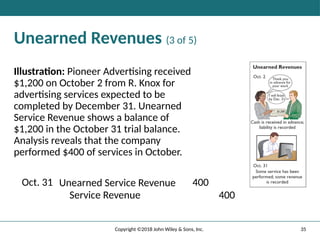
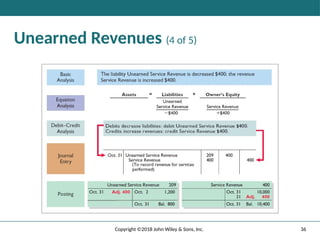
Unearned Revenues (3 of 5)
Illustration: Pioneer Advertising received
$1,200 on October 2 from R. Knox for
advertising services expected to be
completed by December 31. Unearned
Service Revenue shows a balance of
$1,200 in the October 31 trial balance.
Analysis reveals that the company
performed $400 of services in October.
Oct. 31 Unearned Service Revenue 400
Service Revenue 400
36. 37. 37
Copyright ©2018 John Wiley & Sons, Inc.
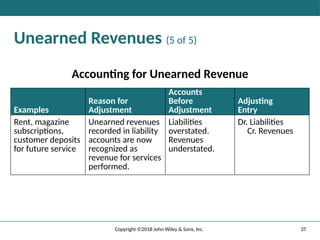
Unearned Revenues (5 of 5)
Accounting for Unearned Revenue
Examples
Reason for
Adjustment
Accounts
Before
Adjustment
Adjusting
Entry
Rent, magazine
subscriptions,
customer deposits
for future service
Unearned revenues
recorded in liability
accounts are now
recognized as
revenue for services
performed.
Liabilities
overstated.
Revenues
understated.
Dr. Liabilities
Cr. Revenues
38. 38
Copyright ©2018 John Wiley & Sons, Inc.
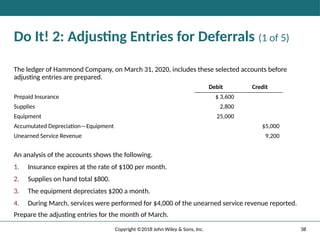
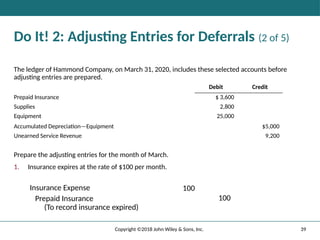
Do It! 2: Adjusting Entries for Deferrals (1 of 5)
The ledger of Hammond Company, on March 31, 2020, includes these selected accounts before
adjusting entries are prepared.
Debit Credit
Prepaid Insurance $ 3,600
Supplies 2,800
Equipment 25,000
Accumulated Depreciation—Equipment $5,000
Unearned Service Revenue 9,200
An analysis of the accounts shows the following.
1. Insurance expires at the rate of $100 per month.
2. Supplies on hand total $800.
3. The equipment depreciates $200 a month.
4. During March, services were performed for $4,000 of the unearned service revenue reported.
Prepare the adjusting entries for the month of March.
39. 39
Copyright ©2018 John Wiley & Sons, Inc.
Do It! 2: Adjusting Entries for Deferrals (2 of 5)
The ledger of Hammond Company, on March 31, 2020, includes these selected accounts before
adjusting entries are prepared.
Debit Credit
Prepaid Insurance $ 3,600
Supplies 2,800
Equipment 25,000
Accumulated Depreciation—Equipment $5,000
Unearned Service Revenue 9,200
Prepare the adjusting entries for the month of March.
1. Insurance expires at the rate of $100 per month.
Insurance Expense 100
Prepaid Insurance
(To record insurance expired)
100
40. 40
Copyright ©2018 John Wiley & Sons, Inc.
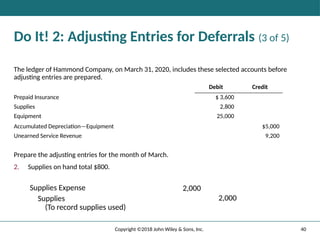
Do It! 2: Adjusting Entries for Deferrals (3 of 5)
The ledger of Hammond Company, on March 31, 2020, includes these selected accounts before
adjusting entries are prepared.
Debit Credit
Prepaid Insurance $ 3,600
Supplies 2,800
Equipment 25,000
Accumulated Depreciation—Equipment $5,000
Unearned Service Revenue 9,200
Prepare the adjusting entries for the month of March.
2. Supplies on hand total $800.
Supplies Expense 2,000
Supplies
(To record supplies used)
2,000
41. 41
Copyright ©2018 John Wiley & Sons, Inc.
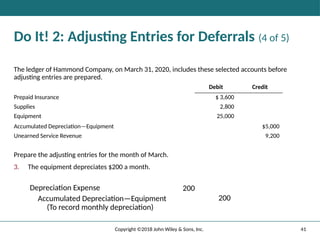
Do It! 2: Adjusting Entries for Deferrals (4 of 5)
The ledger of Hammond Company, on March 31, 2020, includes these selected accounts before
adjusting entries are prepared.
Debit Credit
Prepaid Insurance $ 3,600
Supplies 2,800
Equipment 25,000
Accumulated Depreciation—Equipment $5,000
Unearned Service Revenue 9,200
Prepare the adjusting entries for the month of March.
3. The equipment depreciates $200 a month.
Depreciation Expense 200
Accumulated Depreciation—Equipment
(To record monthly depreciation)
200
42. 42
Copyright ©2018 John Wiley & Sons, Inc.
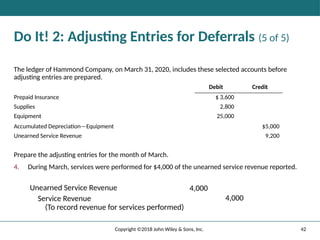
Do It! 2: Adjusting Entries for Deferrals (5 of 5)
The ledger of Hammond Company, on March 31, 2020, includes these selected accounts before
adjusting entries are prepared.
Debit Credit
Prepaid Insurance $ 3,600
Supplies 2,800
Equipment 25,000
Accumulated Depreciation—Equipment $5,000
Unearned Service Revenue 9,200
Prepare the adjusting entries for the month of March.
4. During March, services were performed for $4,000 of the unearned service revenue reported.
Unearned Service Revenue 4,000
Service Revenue
(To record revenue for services performed)
4,000
43. 43
Copyright ©2018 John Wiley & Sons, Inc.
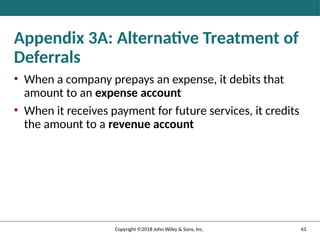
Appendix 3A: Alternative Treatment of
Deferrals
• When a company prepays an expense, it debits that
amount to an expense account
• When it receives payment for future services, it credits
the amount to a revenue account
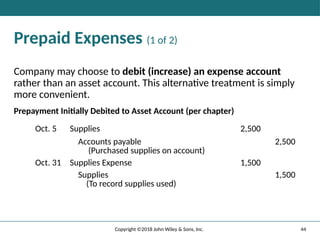
44. 44
Copyright ©2018 John Wiley & Sons, Inc.
Prepaid Expenses (1 of 2)
Company may choose to debit (increase) an expense account
rather than an asset account. This alternative treatment is simply
more convenient.
Prepayment Initially Debited to Asset Account (per chapter)
Oct. 5 Supplies 2,500
Accounts payable
(Purchased supplies on account)
2,500
Oct. 31 Supplies Expense 1,500
Supplies
(To record supplies used)
1,500
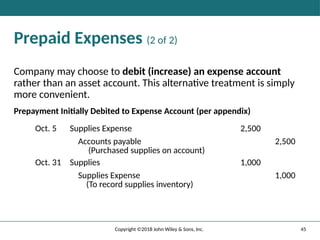
45. 45
Copyright ©2018 John Wiley & Sons, Inc.
Prepaid Expenses (2 of 2)
Company may choose to debit (increase) an expense account
rather than an asset account. This alternative treatment is simply
more convenient.
Prepayment Initially Debited to Expense Account (per appendix)
Oct. 5 Supplies Expense 2,500
Accounts payable
(Purchased supplies on account)
2,500
Oct. 31 Supplies 1,000
Supplies Expense
(To record supplies inventory)
1,000
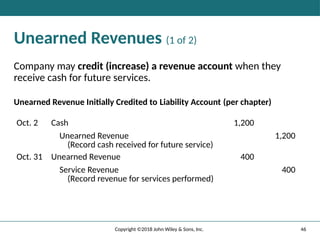
46. 46
Copyright ©2018 John Wiley & Sons, Inc.
Unearned Revenues (1 of 2)
Company may credit (increase) a revenue account when they
receive cash for future services.
Unearned Revenue Initially Credited to Liability Account (per chapter)
Oct. 2 Cash 1,200
Unearned Revenue
(Record cash received for future service)
1,200
Oct. 31 Unearned Revenue 400
Service Revenue
(Record revenue for services performed)
400
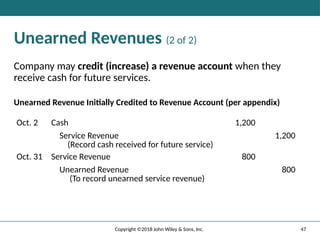
47. 47
Copyright ©2018 John Wiley & Sons, Inc.
Unearned Revenues (2 of 2)
Company may credit (increase) a revenue account when they
receive cash for future services.
Unearned Revenue Initially Credited to Revenue Account (per appendix)
Oct. 2 Cash 1,200
Service Revenue
(Record cash received for future service)
1,200
Oct. 31 Service Revenue 800
Unearned Revenue
(To record unearned service revenue)
800
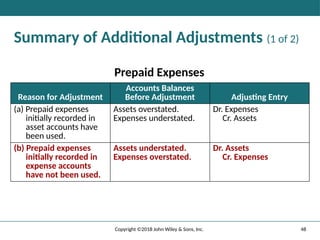
48. 48
Copyright ©2018 John Wiley & Sons, Inc.
Summary of Additional Adjustments (1 of 2)
Prepaid Expenses
Reason for Adjustment
Accounts Balances
Before Adjustment Adjusting Entry
(a) Prepaid expenses
initially recorded in
asset accounts have
been used.
Assets overstated.
Expenses understated.
Dr. Expenses
Cr. Assets
(b) Prepaid expenses
initially recorded in
expense accounts
have not been used.
Assets understated.
Expenses overstated.
Dr. Assets
Cr. Expenses
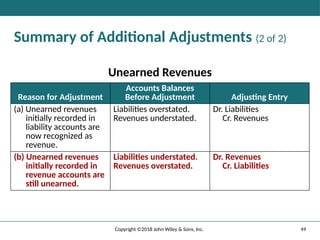
49. 49
Copyright ©2018 John Wiley & Sons, Inc.
Summary of Additional Adjustments (2 of 2)
Unearned Revenues
Reason for Adjustment
Accounts Balances
Before Adjustment Adjusting Entry
(a) Unearned revenues
initially recorded in
liability accounts are
now recognized as
revenue.
Liabilities overstated.
Revenues understated.
Dr. Liabilities
Cr. Revenues
(b) Unearned revenues
initially recorded in
revenue accounts are
still unearned.
Liabilities understated.
Revenues overstated.
Dr. Revenues
Cr. Liabilities
50. 50
Copyright ©2018 John Wiley & Sons, Inc.
Copyright
Copyright © 2018 John Wiley & Sons, Inc.
All rights reserved. Reproduction or translation of this work beyond that permitted in
Section 117 of the 1976 United States Act without the express written permission of the
copyright owner is unlawful. Request for further information should be addressed to the
Permissions Department, John Wiley & Sons, Inc. The purchaser may make back-up copies
for his/her own use only and not for distribution or resale. The Publisher assumes no
responsibility for errors, omissions, or damages, caused by the use of these programs or
from the use of the information contained herein.

![18
Copyright ©2018 John Wiley & Sons, Inc.
Do It! 1: Timing Concepts (1 of 2)
Below is a list of timing concepts in the
left column, with a description of the
concept in the right column. There are
more descriptions provided than
concepts. Match the description to the
concept
1. [blank] Accrual-basis accounting.
2. [blank] Calendar year.
3. [blank] Time period assumption.
4. [blank] Expense recognition principle.
(a) Monthly and quarterly time periods.
(b) Efforts (expenses) should be recognized in the
period in which a company uses assets or
incurs liabilities to generate results
(revenues).
(c) Accountants divide the economic life of a
business into artificial time periods.
(d) Companies record revenues when they
receive cash and record expenses when they
pay out cash.
(e) An accounting time period that starts on
January 1 and ends on December 31.
(f) Companies record transactions in the period in
which the events occur.](https://image.slidesharecdn.com/chapter3slides-parti-250712161815-b85bfd48/85/Chapter-3-Slides-Part-I-accountibg-pptx-18-320.jpg)