18-1
Prepared by
Coby Harmon
University of California, Santa Barbara
Westmont College
18-2
1. Understand the fundamental
concepts related to revenue
recognition and measurement.
2. Understand and apply the five-
step revenue recognition
process.
LEARNING OBJECTIVES
3. Apply the five-step process to
major revenue recognition
issues.
4. Describe presentation and
disclosure regarding revenue.
After studying this chapter, you should be able to:
Revenue Recognition
CHAPTER 18
18-3
PREVIEW OF CHAPTER 18
Intermediate Accounting
IFRS 3rd Edition
Kieso ● Weygandt ● Warfield
18-4
Fundamentals of
Revenue Recognition
Both the IASB and the FASB have indicated that the state
of reporting for revenue was unsatisfactory.
Recently, the IASB issued a converged standard on
revenue recognition entitled Revenue from Contracts
with Customers.
LO 1
Background
LEARNING OBJECTIVE 1
Understand the fundamental
concepts related to revenue
recognition and measurement.
18-5
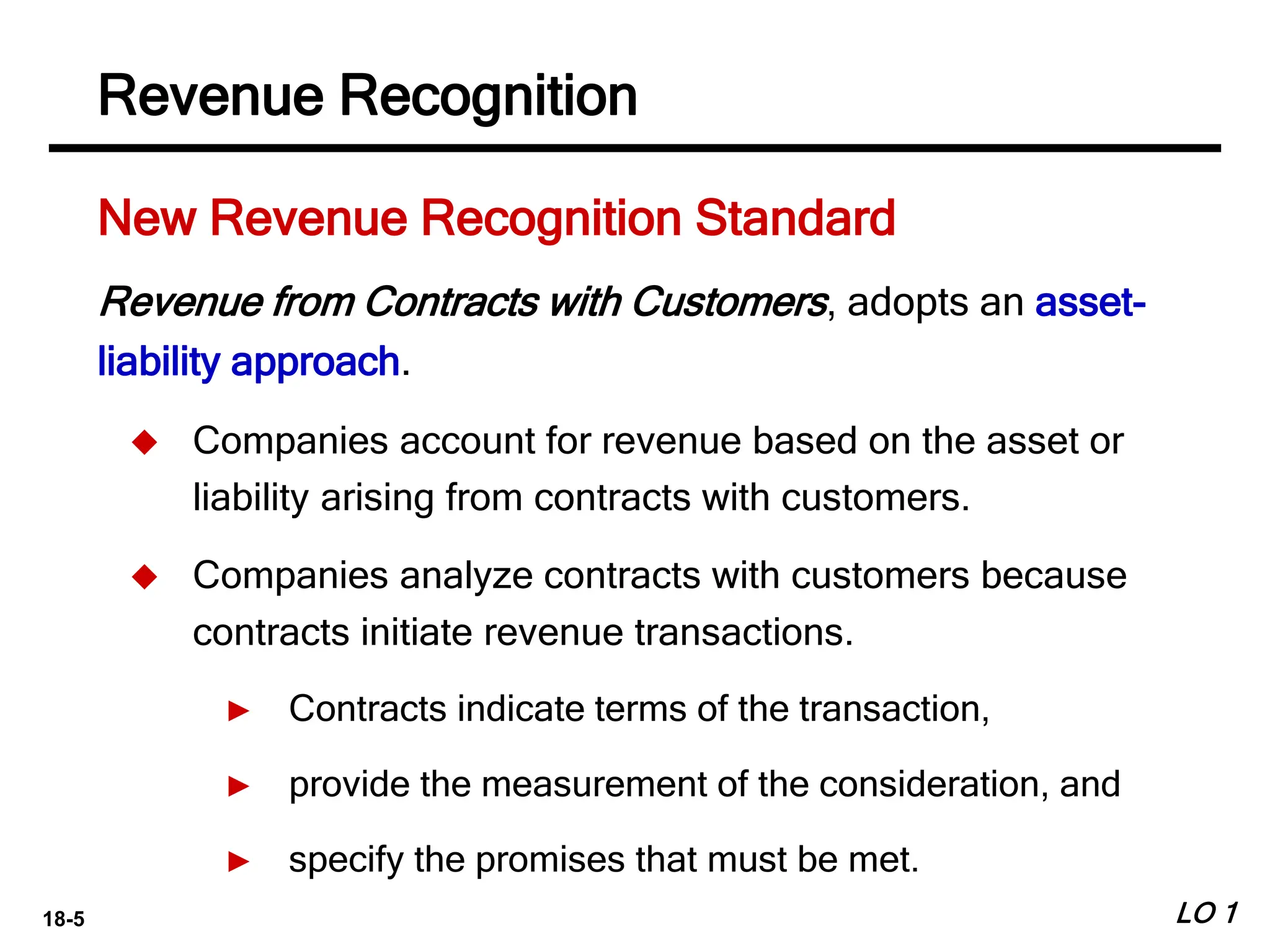
New Revenue Recognition Standard
LO 1
Revenue from Contracts with Customers, adopts an asset-
liability approach.
 Companies account for revenue based on the asset or
liability arising from contracts with customers.
 Companies analyze contracts with customers because
contracts initiate revenue transactions.
► Contracts indicate terms of the transaction,
► provide the measurement of the consideration, and
► specify the promises that must be met.
Revenue Recognition
18-6 LO 1
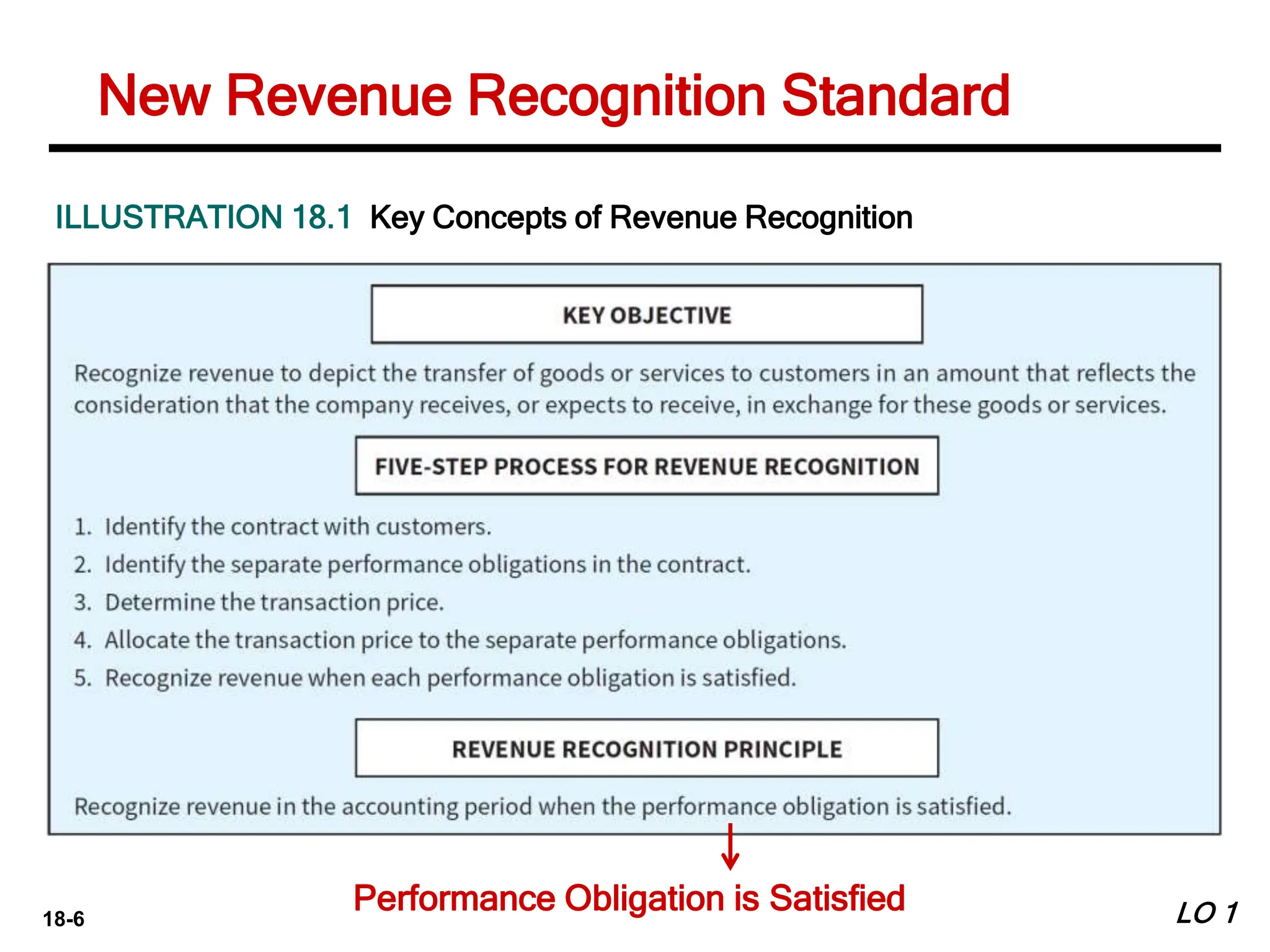
New Revenue Recognition Standard
ILLUSTRATION 18.1 Key Concepts of Revenue Recognition
Performance Obligation is Satisfied
18-7 LO 1
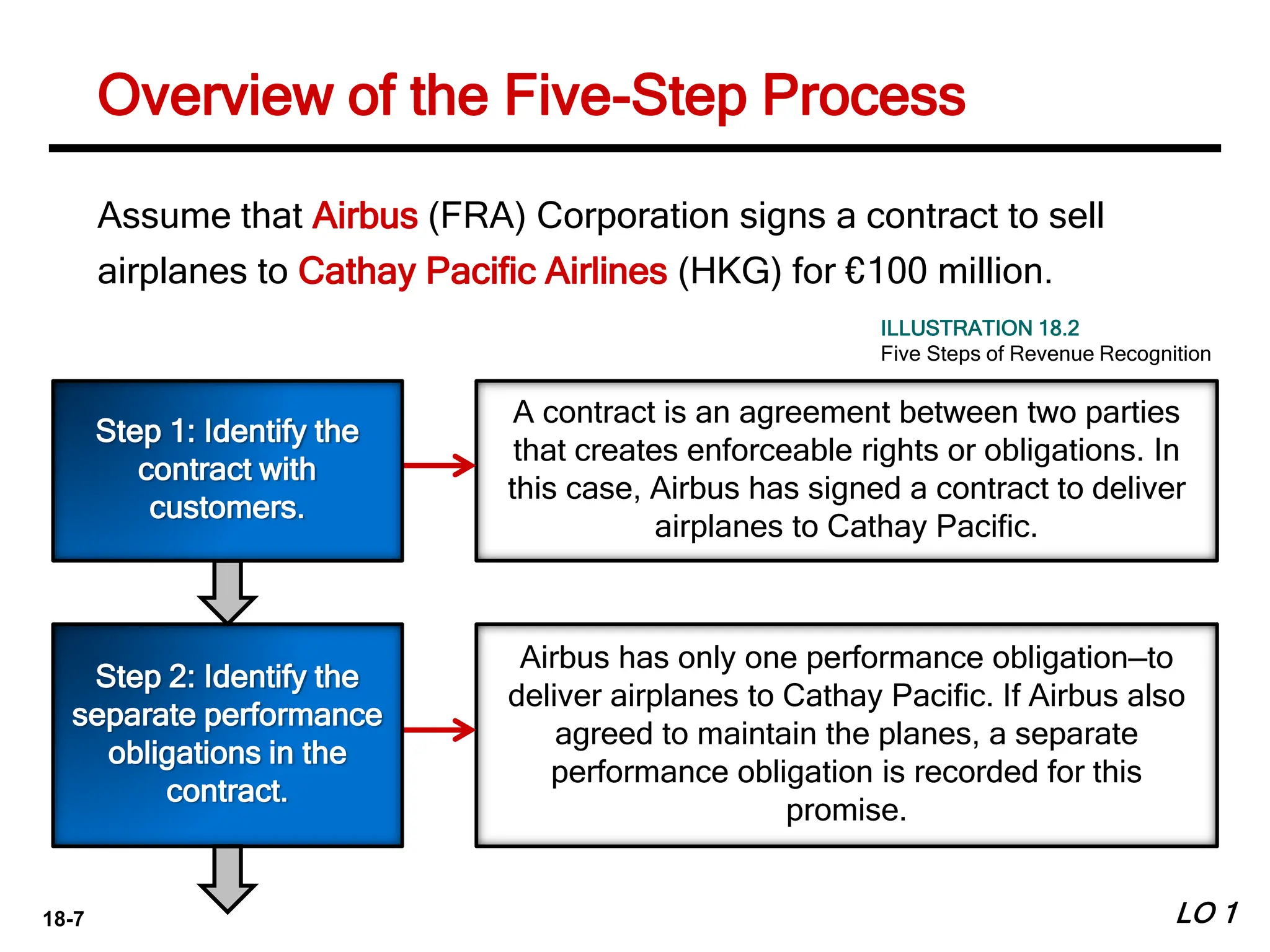
Overview of the Five-Step Process
A contract is an agreement between two parties
that creates enforceable rights or obligations. In
this case, Airbus has signed a contract to deliver
airplanes to Cathay Pacific.
Assume that Airbus (FRA) Corporation signs a contract to sell
airplanes to Cathay Pacific Airlines (HKG) for €100 million.
Airbus has only one performance obligation—to
deliver airplanes to Cathay Pacific. If Airbus also
agreed to maintain the planes, a separate
performance obligation is recorded for this
promise.
Step 2: Identify the
separate performance
obligations in the
contract.
ILLUSTRATION 18.2
Five Steps of Revenue Recognition
Step 1: Identify the
contract with
customers.
18-8 LO 1
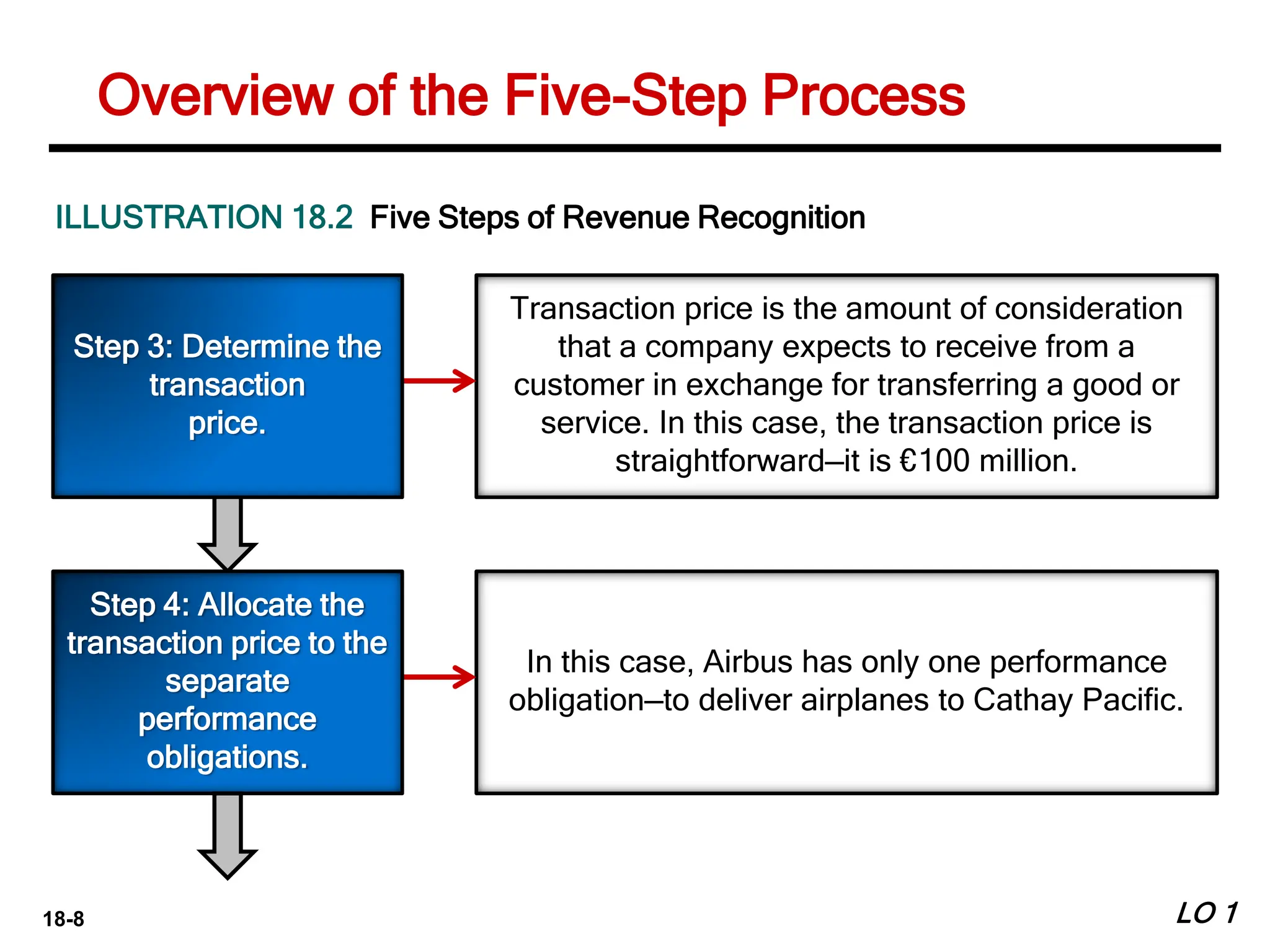
Transaction price is the amount of consideration
that a company expects to receive from a
customer in exchange for transferring a good or
service. In this case, the transaction price is
straightforward—it is €100 million.
ILLUSTRATION 18.2 Five Steps of Revenue Recognition
Step 3: Determine the
transaction
price.
In this case, Airbus has only one performance
obligation—to deliver airplanes to Cathay Pacific.
Step 4: Allocate the
transaction price to the
separate
performance
obligations.
Overview of the Five-Step Process
18-9 LO 1
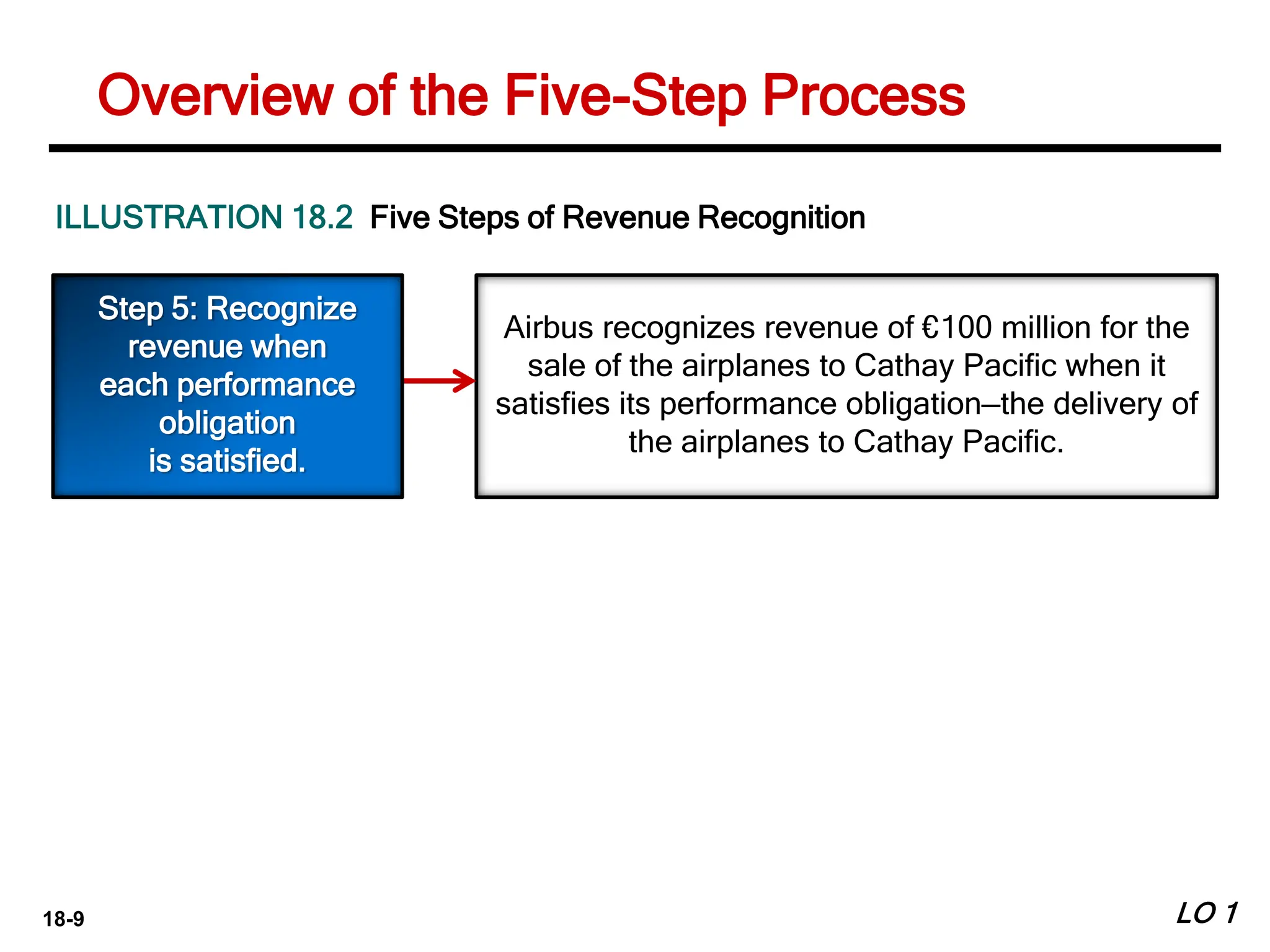
Airbus recognizes revenue of €100 million for the
sale of the airplanes to Cathay Pacific when it
satisfies its performance obligation—the delivery of
the airplanes to Cathay Pacific.
ILLUSTRATION 18.2 Five Steps of Revenue Recognition
Step 5: Recognize
revenue when
each performance
obligation
is satisfied.
Overview of the Five-Step Process
18-10 LO 1
Extended Example of Five-Step Process
Identifying the Contract with Customers—Step 1
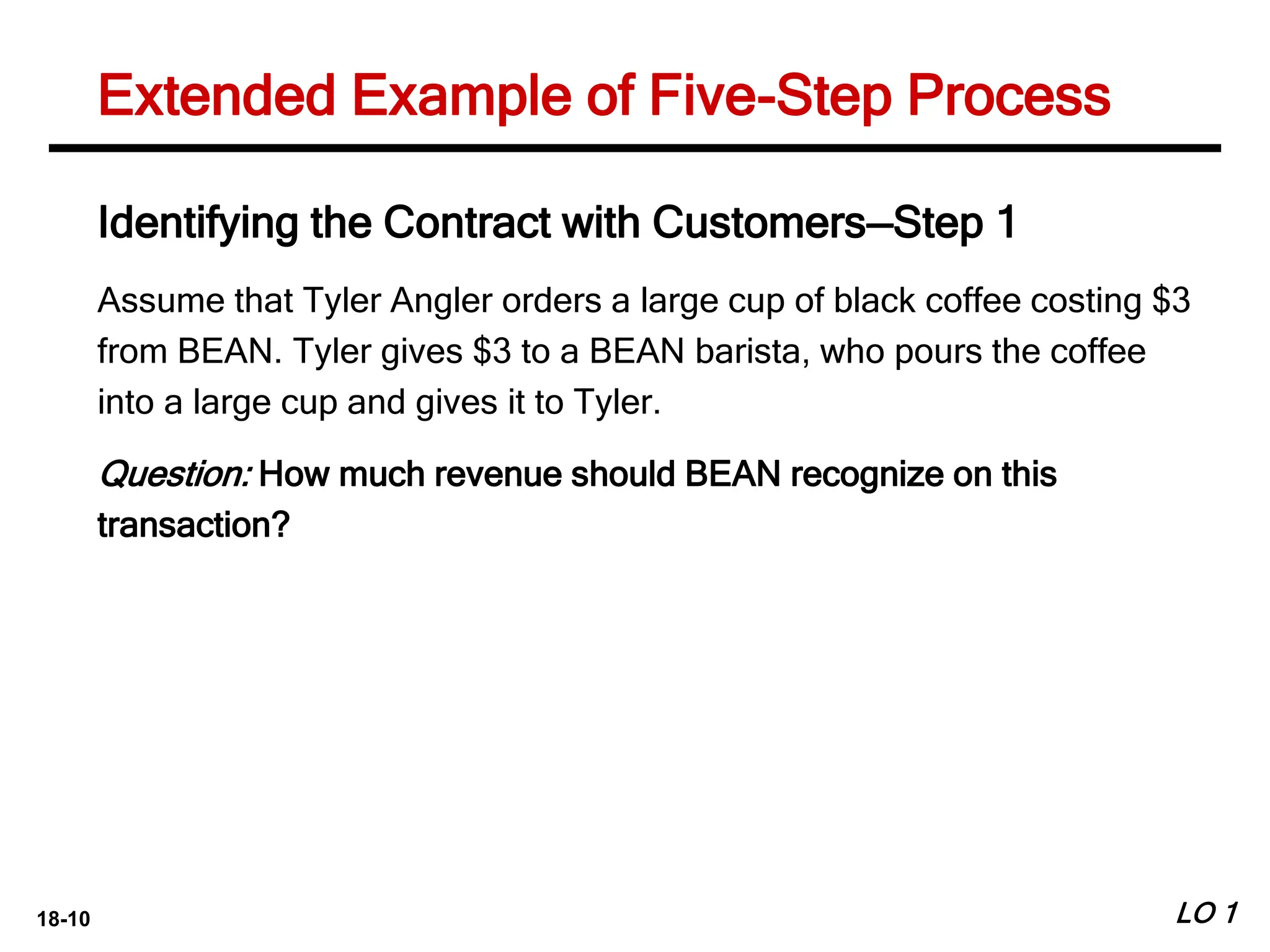
Assume that Tyler Angler orders a large cup of black coffee costing $3
from BEAN. Tyler gives $3 to a BEAN barista, who pours the coffee
into a large cup and gives it to Tyler.
Question: How much revenue should BEAN recognize on this
transaction?
18-11 LO 1
Extended Example of Five-Step Process
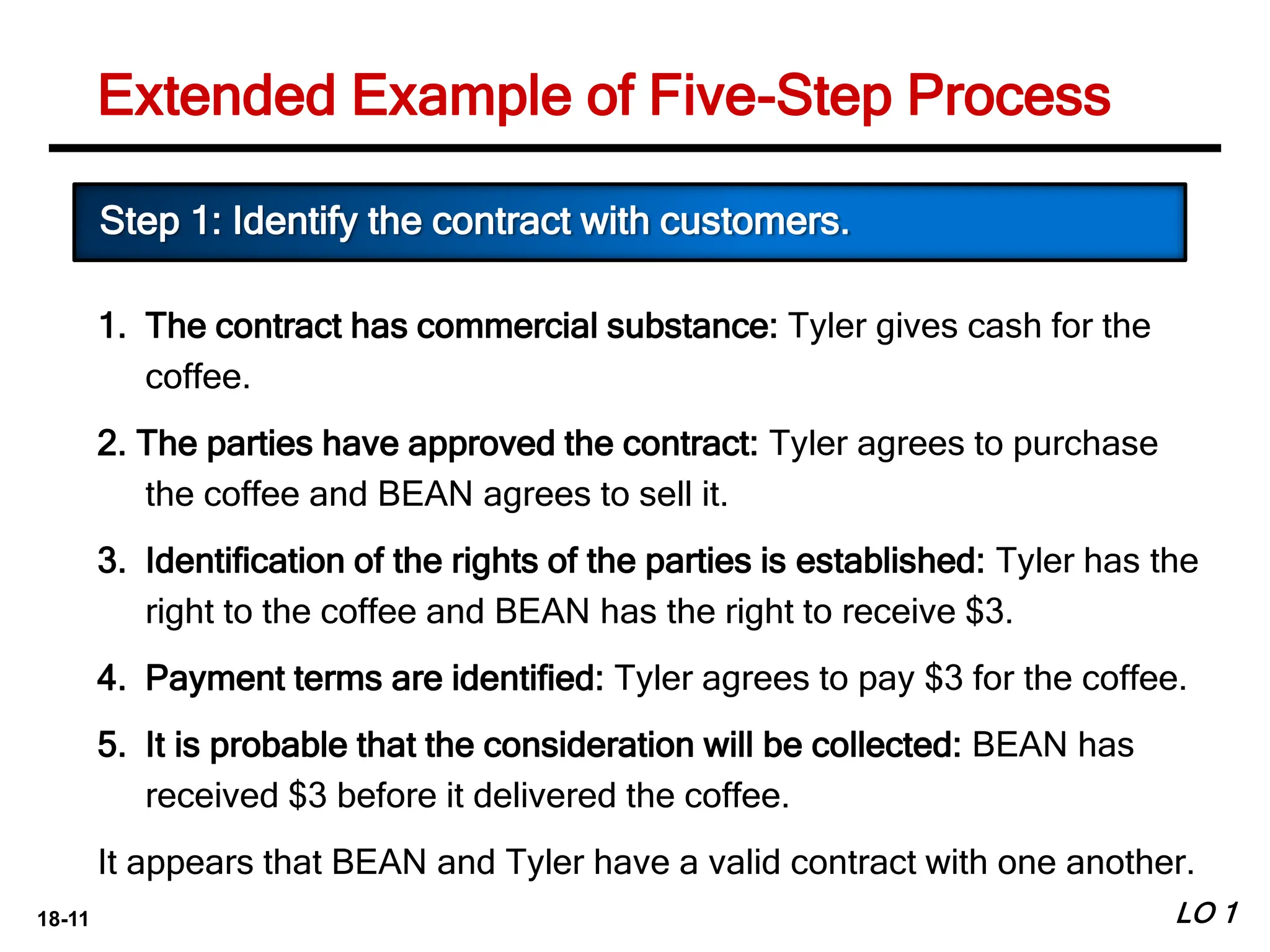
1. The contract has commercial substance: Tyler gives cash for the
coffee.
2. The parties have approved the contract: Tyler agrees to purchase
the coffee and BEAN agrees to sell it.
3. Identification of the rights of the parties is established: Tyler has the
right to the coffee and BEAN has the right to receive $3.
4. Payment terms are identified: Tyler agrees to pay $3 for the coffee.
5. It is probable that the consideration will be collected: BEAN has
received $3 before it delivered the coffee.
It appears that BEAN and Tyler have a valid contract with one another.
Step 1: Identify the contract with customers.
18-12 LO 1
Extended Example of Five-Step Process
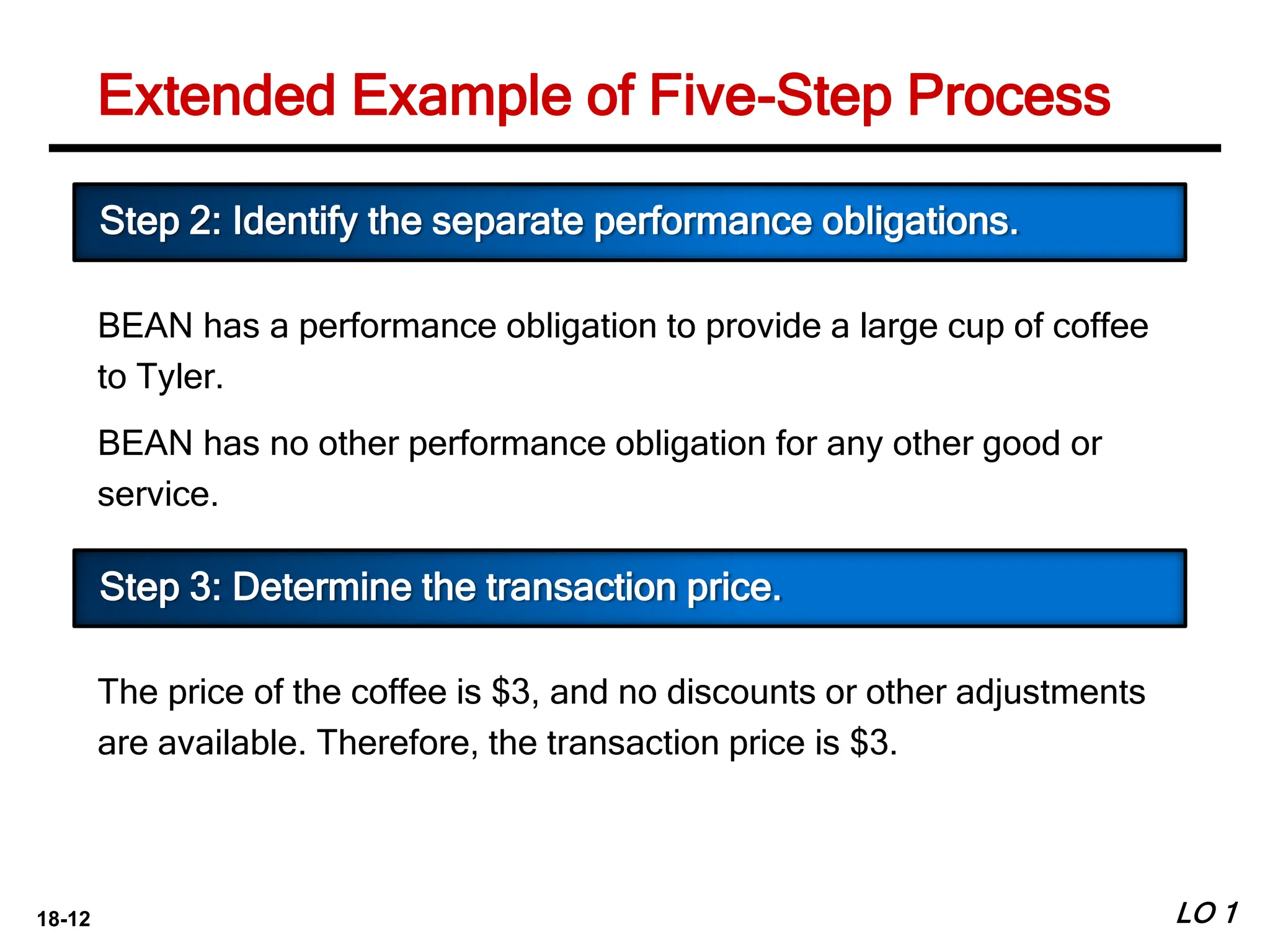
BEAN has a performance obligation to provide a large cup of coffee
to Tyler.
BEAN has no other performance obligation for any other good or
service.
Step 2: Identify the separate performance obligations.
The price of the coffee is $3, and no discounts or other adjustments
are available. Therefore, the transaction price is $3.
Step 3: Determine the transaction price.
18-13 LO 1
Extended Example of Five-Step Process
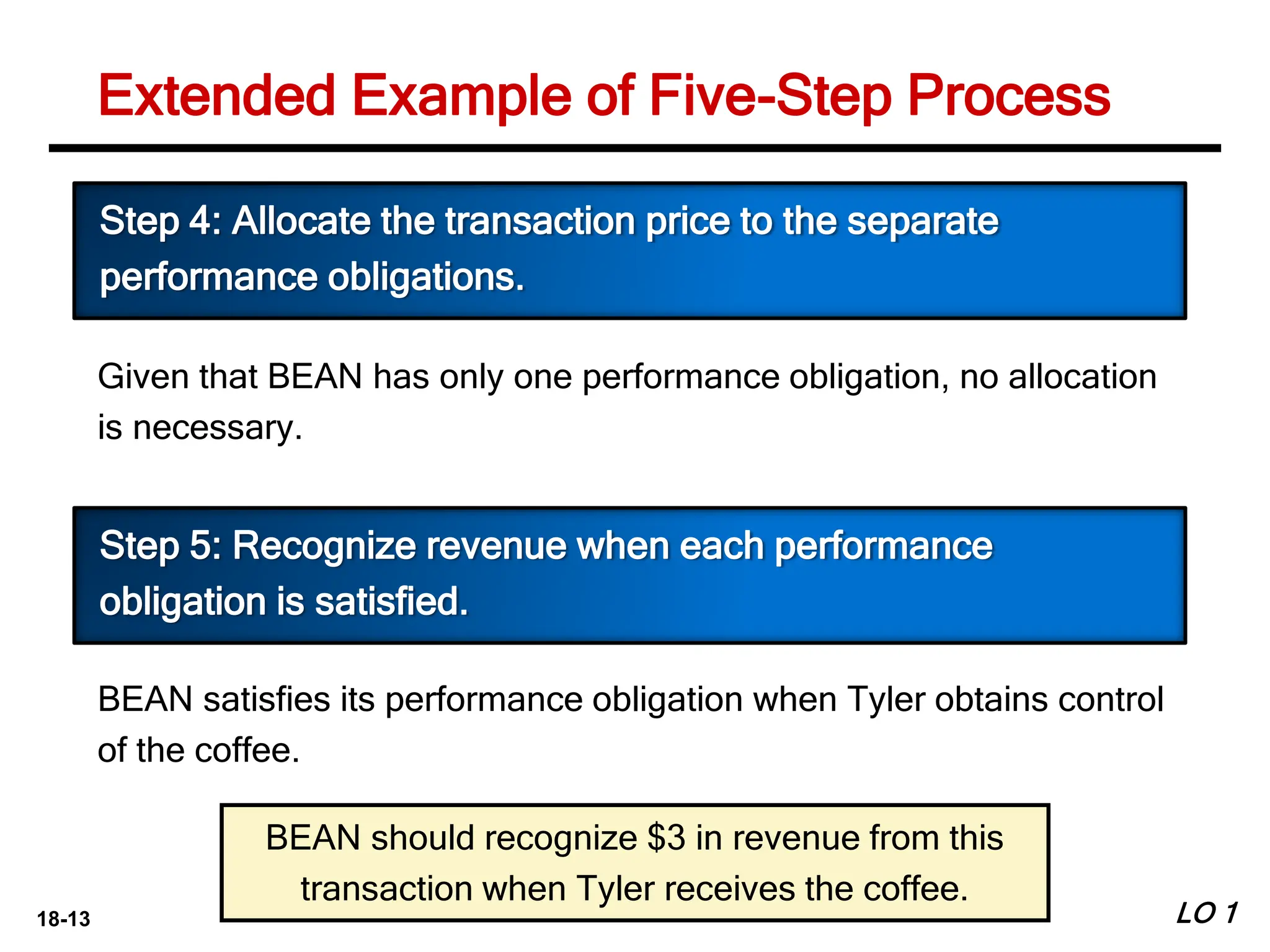
Given that BEAN has only one performance obligation, no allocation
is necessary.
Step 4: Allocate the transaction price to the separate
performance obligations.
BEAN satisfies its performance obligation when Tyler obtains control
of the coffee.
Step 5: Recognize revenue when each performance
obligation is satisfied.
BEAN should recognize $3 in revenue from this
transaction when Tyler receives the coffee.
18-14 LO 1
Extended Example of Five-Step Process
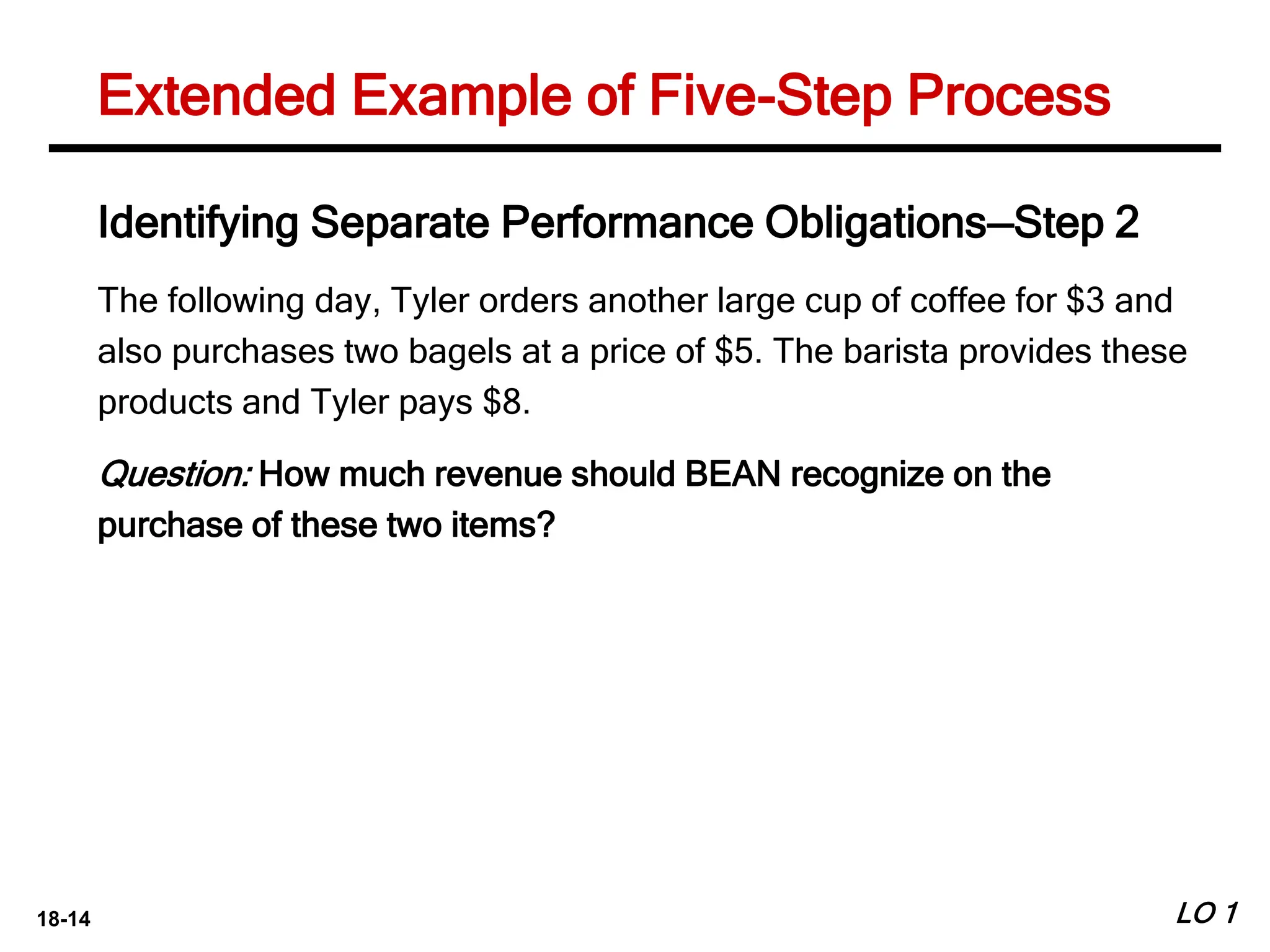
Identifying Separate Performance Obligations—Step 2
The following day, Tyler orders another large cup of coffee for $3 and
also purchases two bagels at a price of $5. The barista provides these
products and Tyler pays $8.
Question: How much revenue should BEAN recognize on the
purchase of these two items?
18-15 LO 1
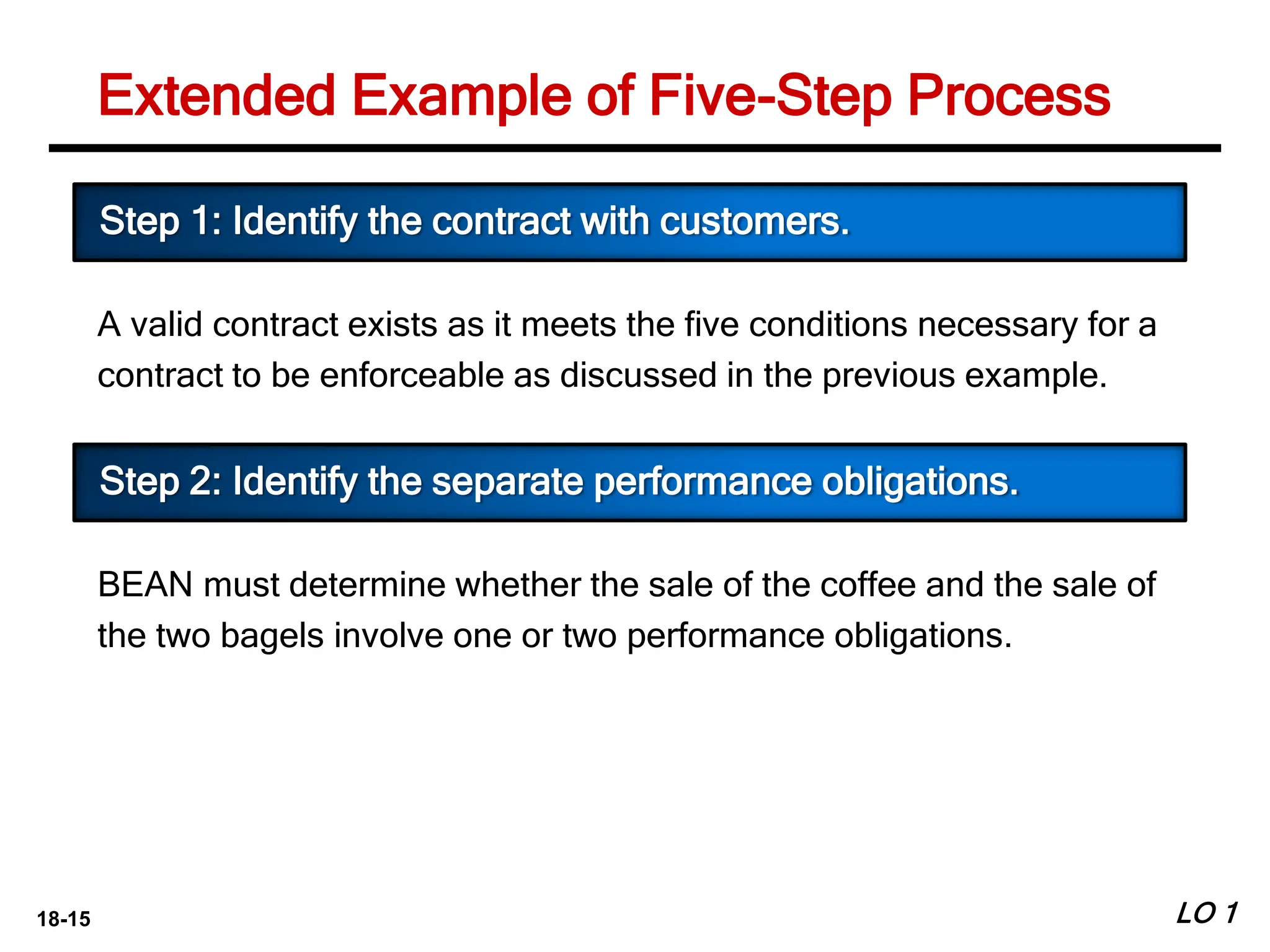
Extended Example of Five-Step Process
A valid contract exists as it meets the five conditions necessary for a
contract to be enforceable as discussed in the previous example.
Step 1: Identify the contract with customers.
BEAN must determine whether the sale of the coffee and the sale of
the two bagels involve one or two performance obligations.
Step 2: Identify the separate performance obligations.
18-16 LO 1
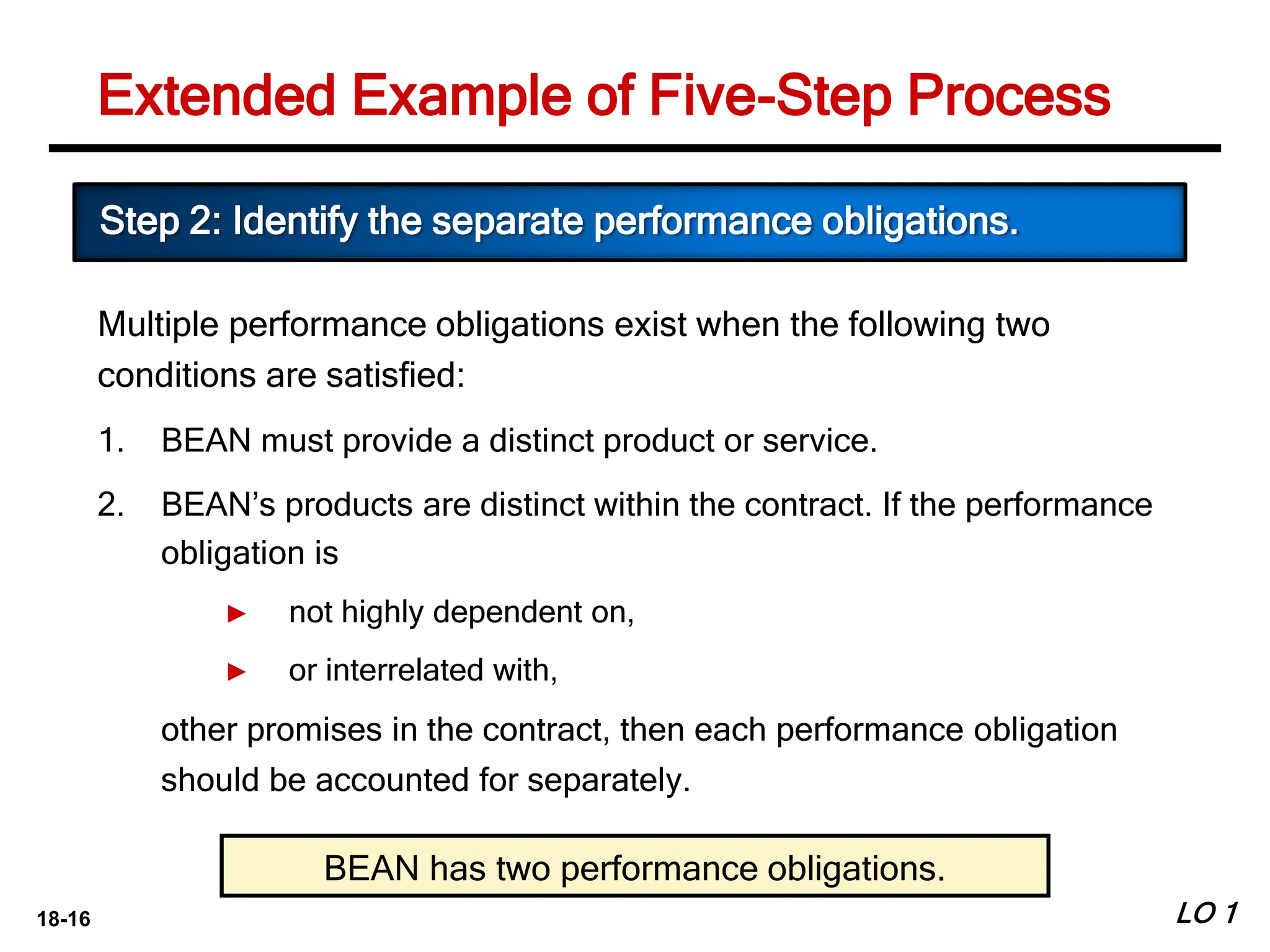
Extended Example of Five-Step Process
Multiple performance obligations exist when the following two
conditions are satisfied:
1. BEAN must provide a distinct product or service.
2. BEAN’s products are distinct within the contract. If the performance
obligation is
► not highly dependent on,
► or interrelated with,
other promises in the contract, then each performance obligation
should be accounted for separately.
Step 2: Identify the separate performance obligations.
BEAN has two performance obligations.
18-17 LO 1
Extended Example of Five-Step Process
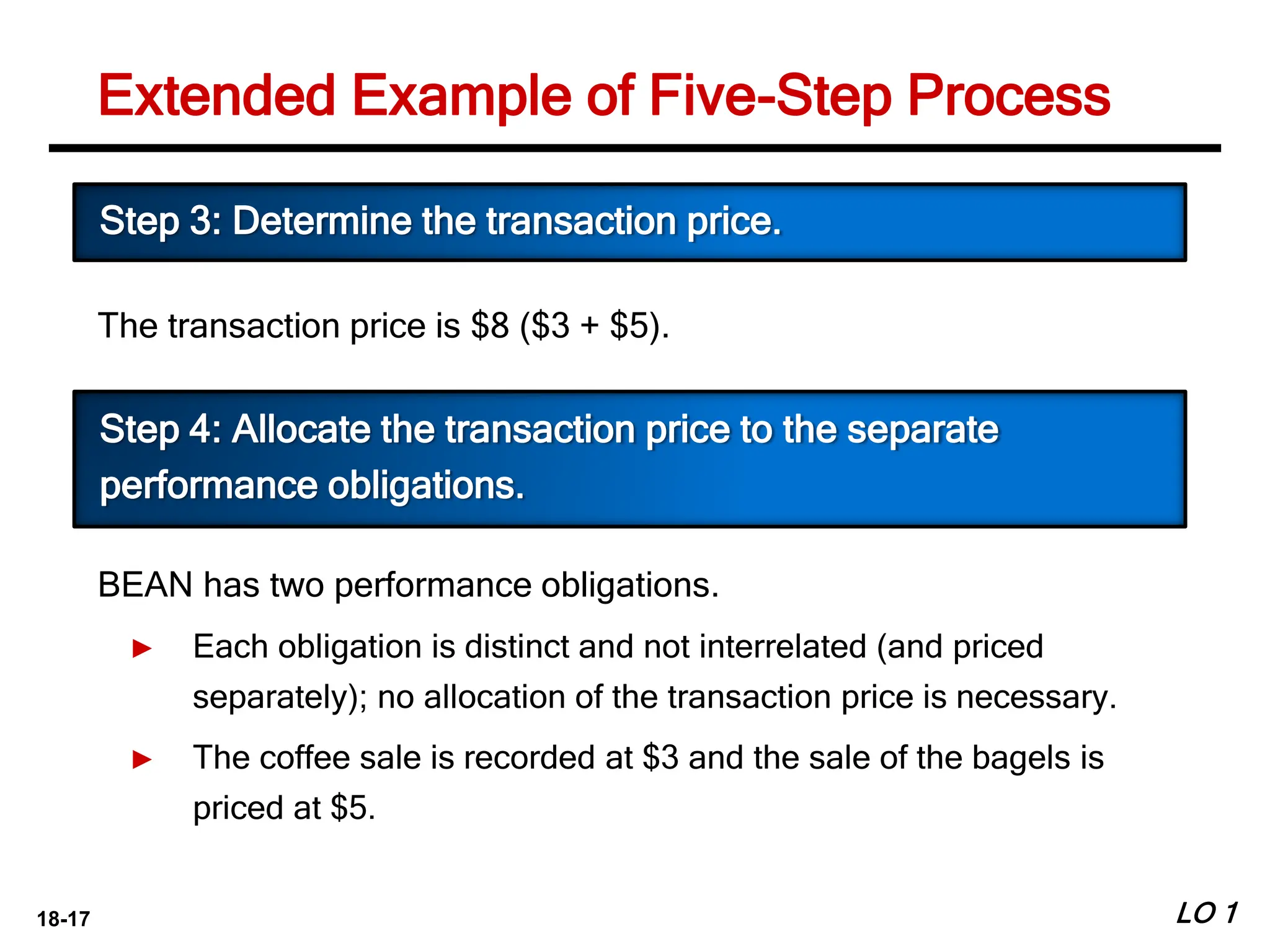
The transaction price is $8 ($3 + $5).
Step 3: Determine the transaction price.
BEAN has two performance obligations.
► Each obligation is distinct and not interrelated (and priced
separately); no allocation of the transaction price is necessary.
► The coffee sale is recorded at $3 and the sale of the bagels is
priced at $5.
Step 4: Allocate the transaction price to the separate
performance obligations.
18-18 LO 1
Extended Example of Five-Step Process
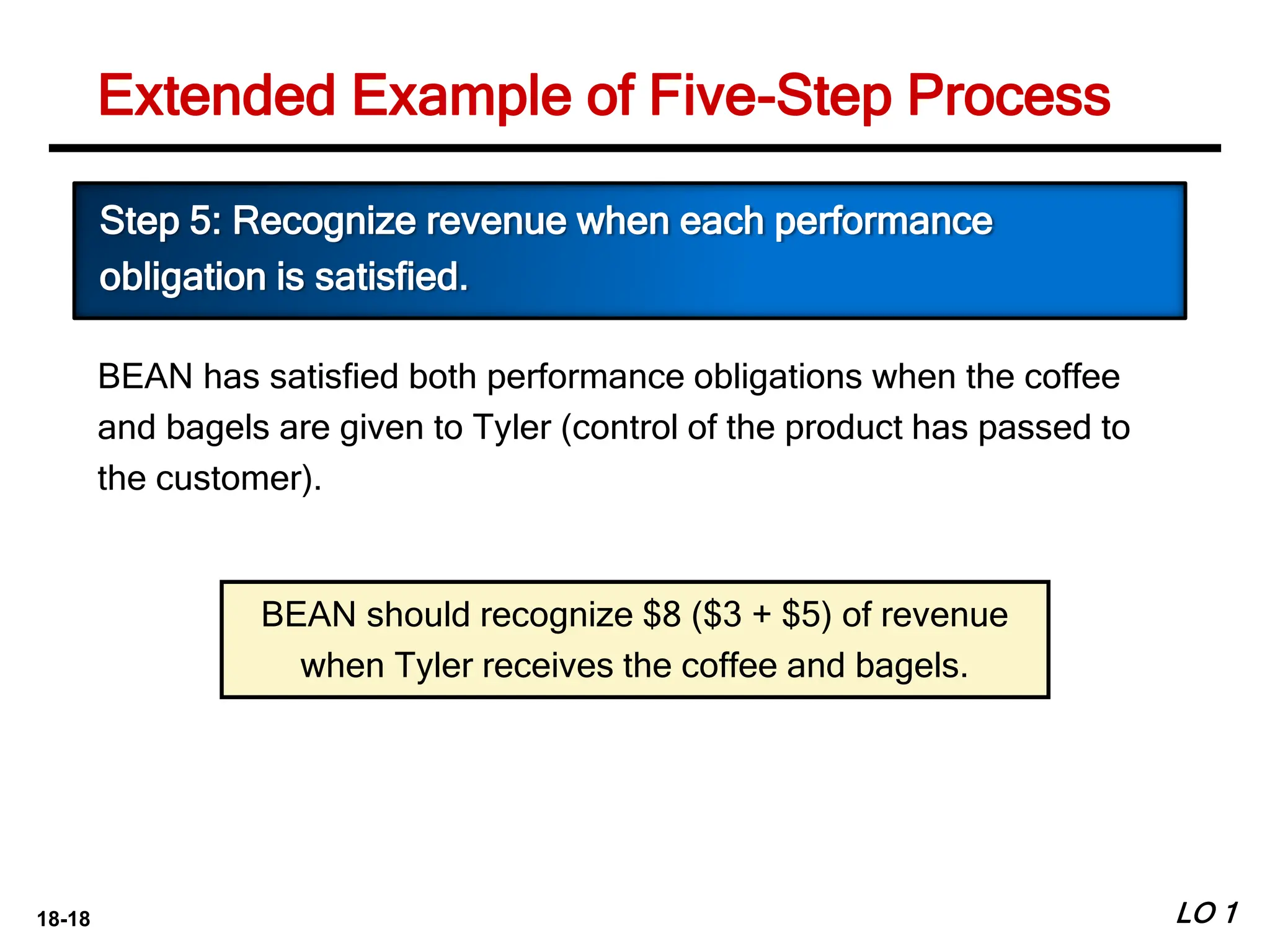
BEAN has satisfied both performance obligations when the coffee
and bagels are given to Tyler (control of the product has passed to
the customer).
Step 5: Recognize revenue when each performance
obligation is satisfied.
BEAN should recognize $8 ($3 + $5) of revenue
when Tyler receives the coffee and bagels.
18-19 LO 1
Extended Example of Five-Step Process
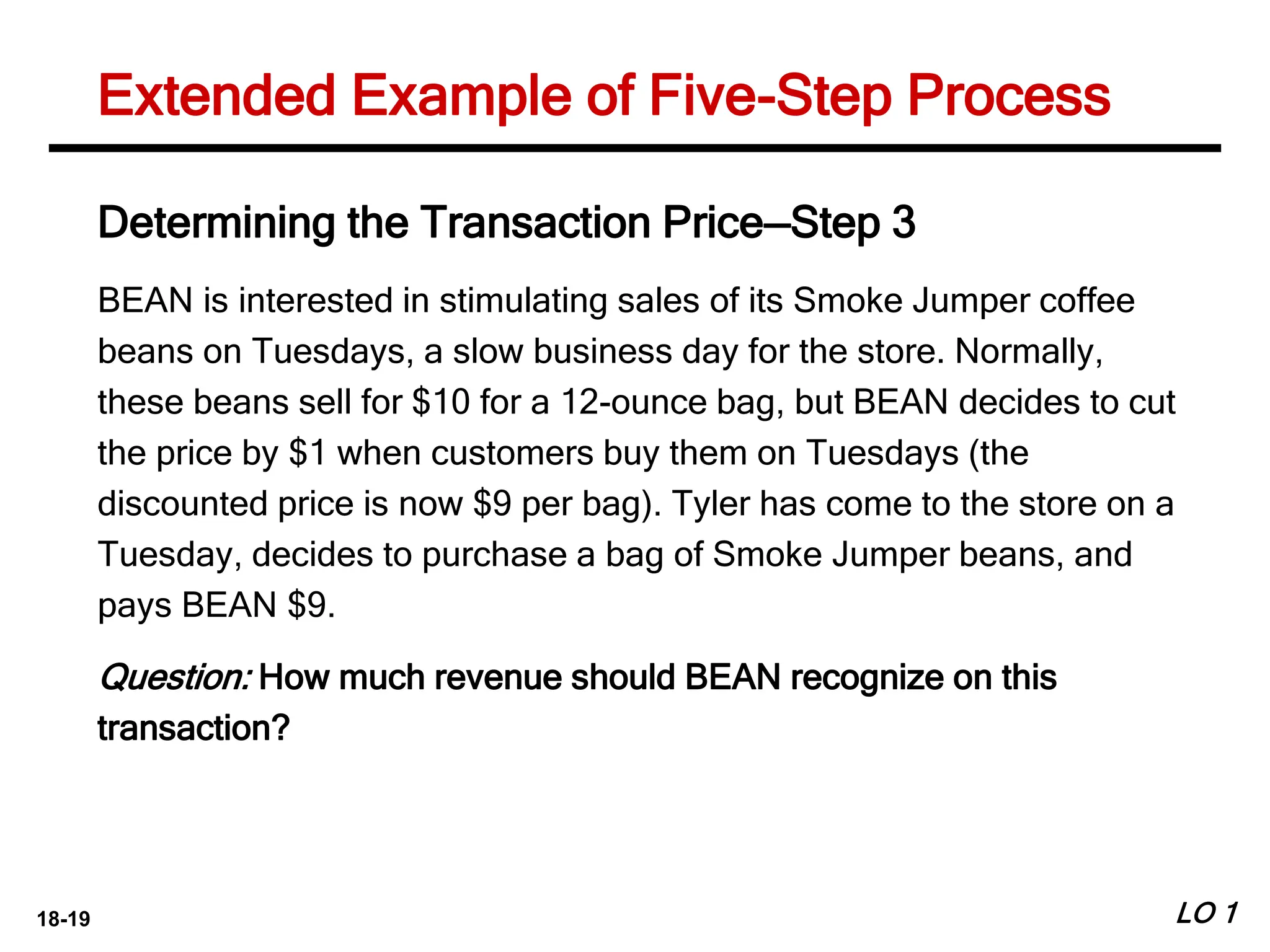
Determining the Transaction Price—Step 3
BEAN is interested in stimulating sales of its Smoke Jumper coffee
beans on Tuesdays, a slow business day for the store. Normally,
these beans sell for $10 for a 12-ounce bag, but BEAN decides to cut
the price by $1 when customers buy them on Tuesdays (the
discounted price is now $9 per bag). Tyler has come to the store on a
Tuesday, decides to purchase a bag of Smoke Jumper beans, and
pays BEAN $9.
Question: How much revenue should BEAN recognize on this
transaction?
18-20
18-21 LO 1
Extended Example of Five-Step Process
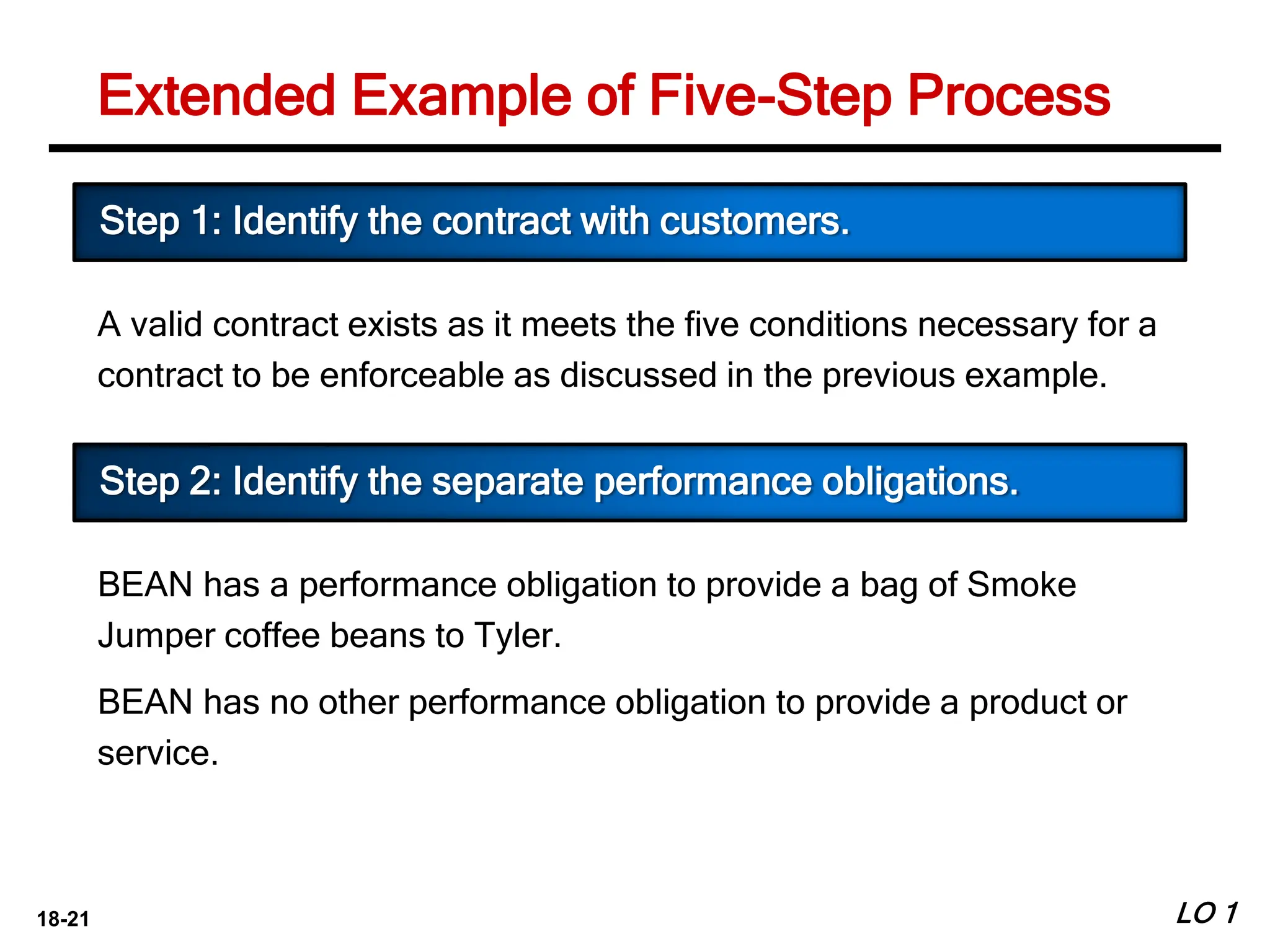
A valid contract exists as it meets the five conditions necessary for a
contract to be enforceable as discussed in the previous example.
Step 1: Identify the contract with customers.
BEAN has a performance obligation to provide a bag of Smoke
Jumper coffee beans to Tyler.
BEAN has no other performance obligation to provide a product or
service.
Step 2: Identify the separate performance obligations.
18-22 LO 1
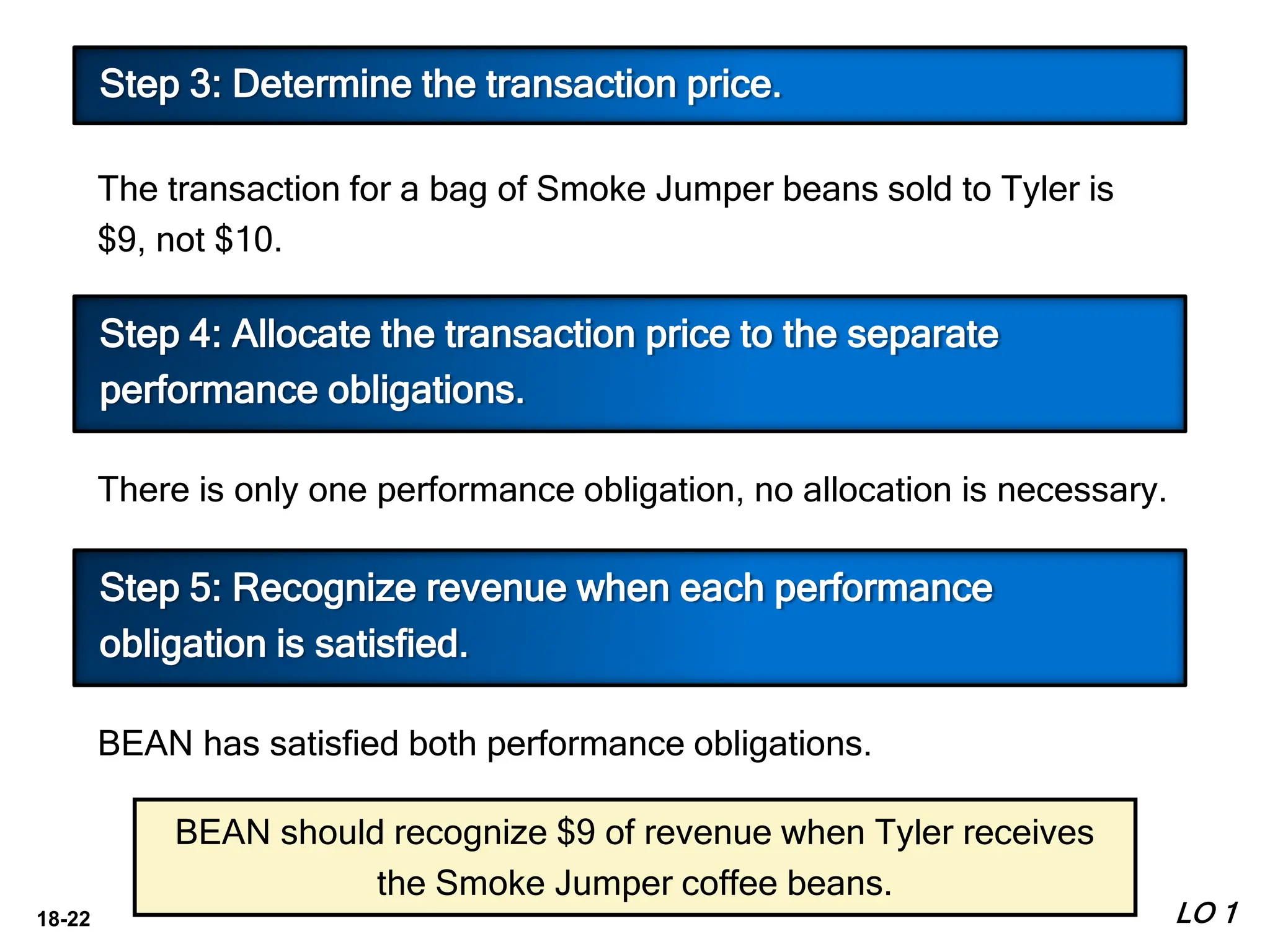
The transaction for a bag of Smoke Jumper beans sold to Tyler is
$9, not $10.
Step 3: Determine the transaction price.
There is only one performance obligation, no allocation is necessary.
Step 4: Allocate the transaction price to the separate
performance obligations.
BEAN has satisfied both performance obligations.
Step 5: Recognize revenue when each performance
obligation is satisfied.
BEAN should recognize $9 of revenue when Tyler receives
the Smoke Jumper coffee beans.
18-23 LO 1
Extended Example of Five-Step Process
Allocating the Transaction Price to Separate
Performance Obligations—Step 4
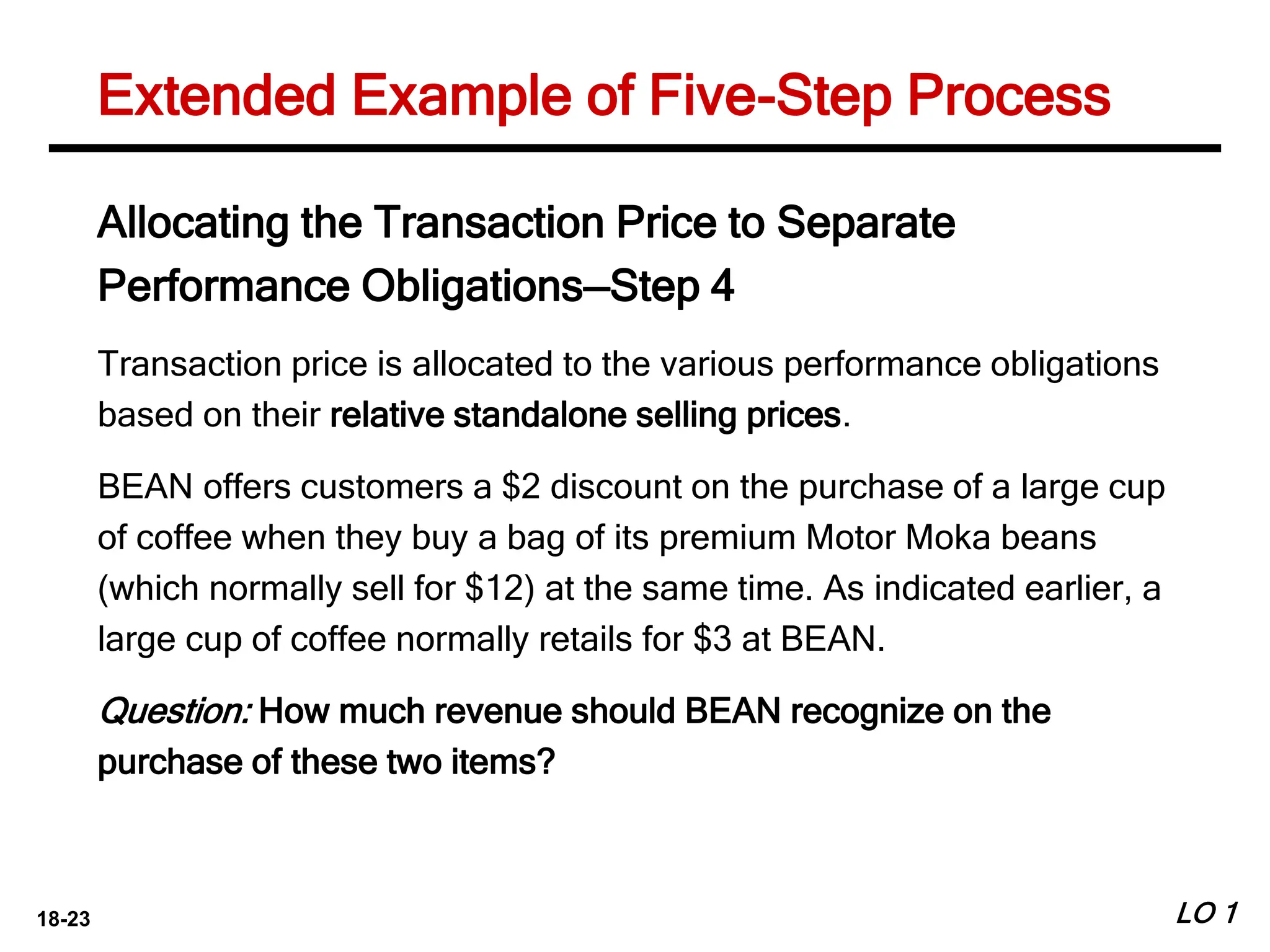
Transaction price is allocated to the various performance obligations
based on their relative standalone selling prices.
BEAN offers customers a $2 discount on the purchase of a large cup
of coffee when they buy a bag of its premium Motor Moka beans
(which normally sell for $12) at the same time. As indicated earlier, a
large cup of coffee normally retails for $3 at BEAN.
Question: How much revenue should BEAN recognize on the
purchase of these two items?
18-24 LO 1
Extended Example of Five-Step Process
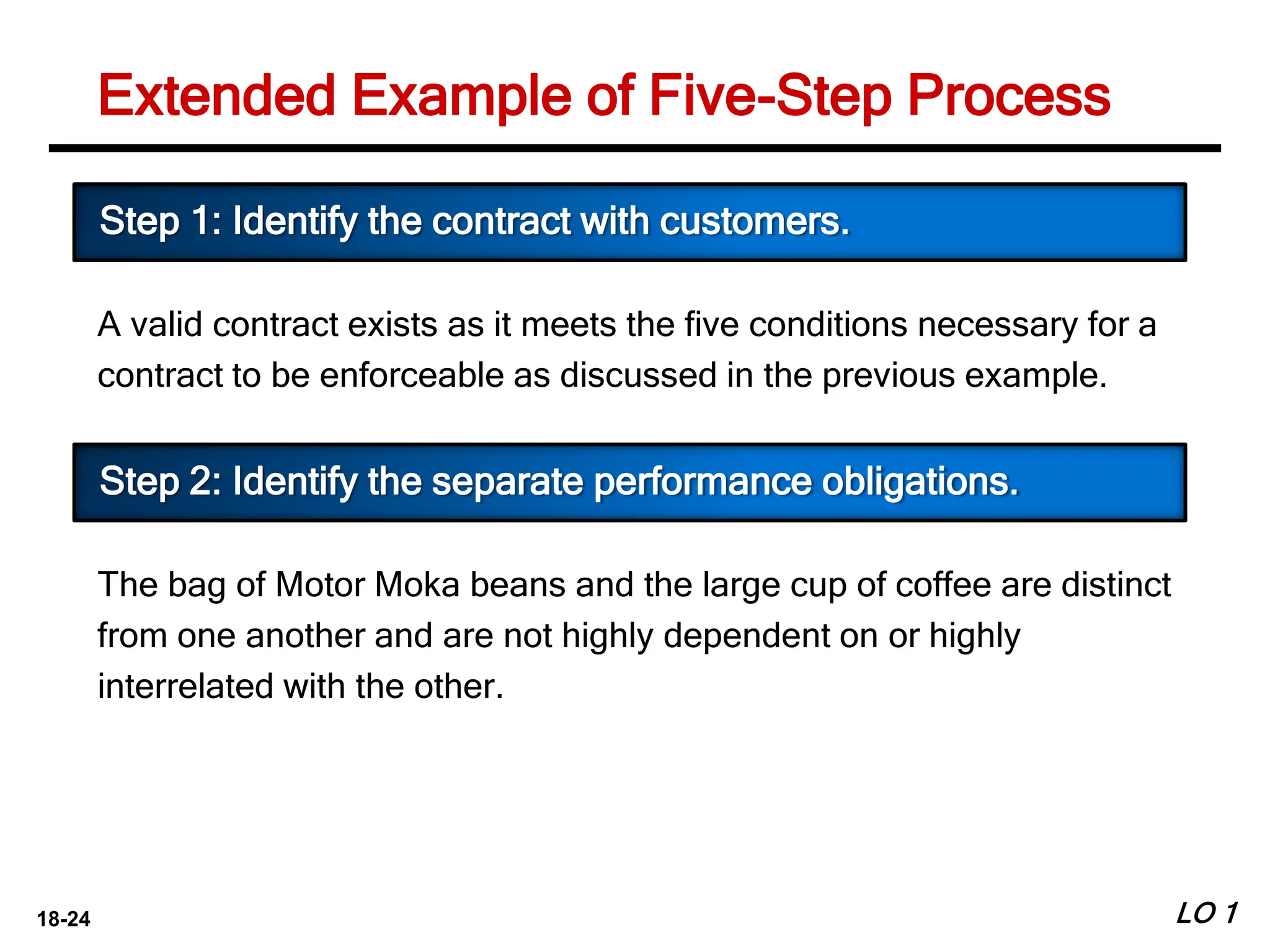
A valid contract exists as it meets the five conditions necessary for a
contract to be enforceable as discussed in the previous example.
Step 1: Identify the contract with customers.
The bag of Motor Moka beans and the large cup of coffee are distinct
from one another and are not highly dependent on or highly
interrelated with the other.
Step 2: Identify the separate performance obligations.
18-25 LO 1
Extended Example of Five-Step Process
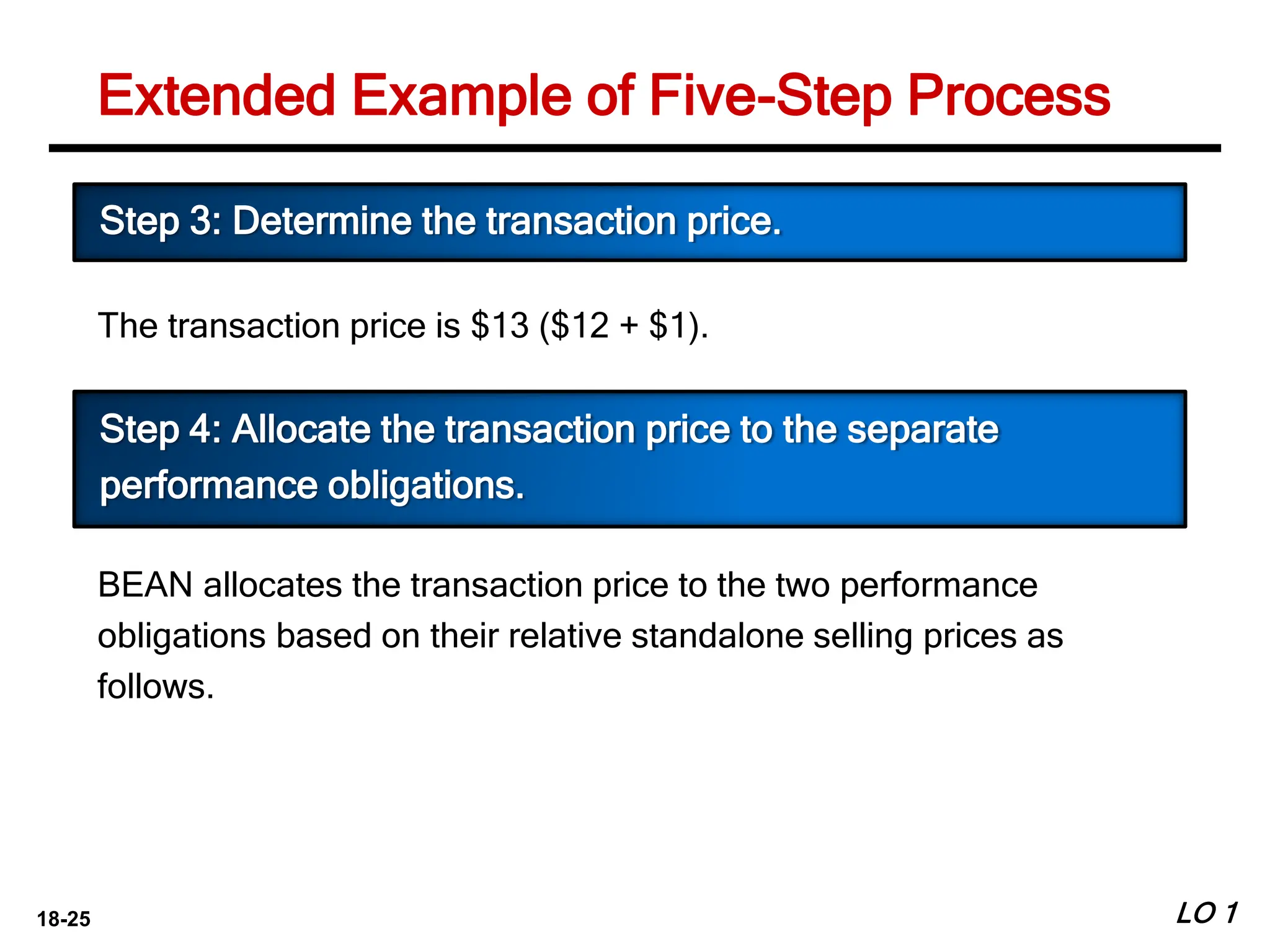
The transaction price is $13 ($12 + $1).
Step 3: Determine the transaction price.
BEAN allocates the transaction price to the two performance
obligations based on their relative standalone selling prices as
follows.
Step 4: Allocate the transaction price to the separate
performance obligations.
18-26 LO 1
Extended Example of Five-Step Process
BEAN allocates the transaction price to the two performance
obligations based on their relative standalone selling prices as
follows.
Step 4: Allocate the transaction price to the separate
performance obligations.
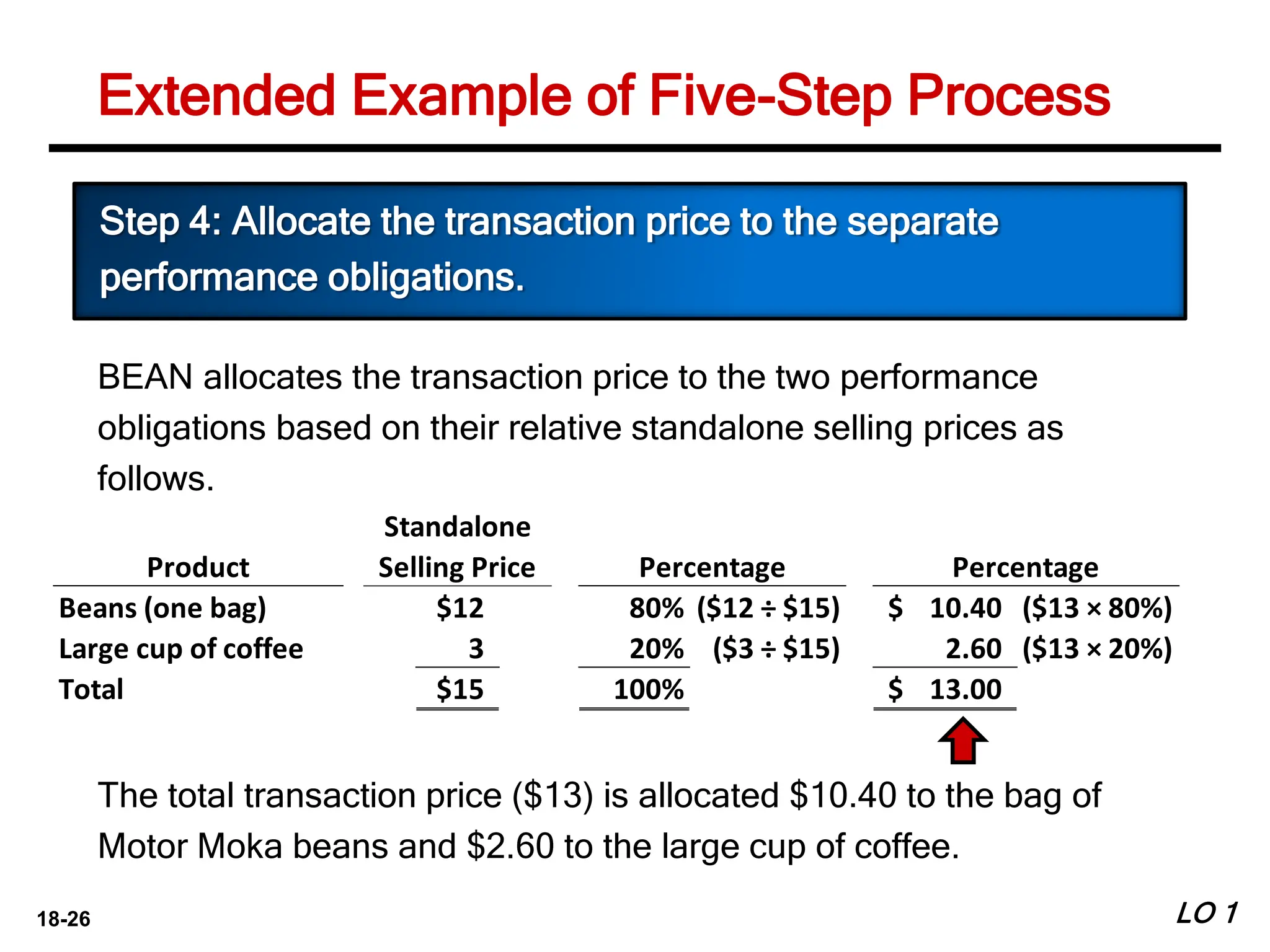
Standalone
Product Selling Price
Beans (one bag) $12 80% ($12 ÷ $15) 10.40
$ ($13 × 80%)
Large cup of coffee 3 20% ($3 ÷ $15) 2.60 ($13 × 20%)
Total $15 100% 13.00
$
Percentage Percentage
The total transaction price ($13) is allocated $10.40 to the bag of
Motor Moka beans and $2.60 to the large cup of coffee.
18-27 LO 1
Extended Example of Five-Step Process
BEAN has satisfied both performance obligations as control of the
bag of Motor Moka beans and the large cup of coffee has passed to
Tyler.
Step 5: Recognize revenue when each performance
obligation is satisfied.
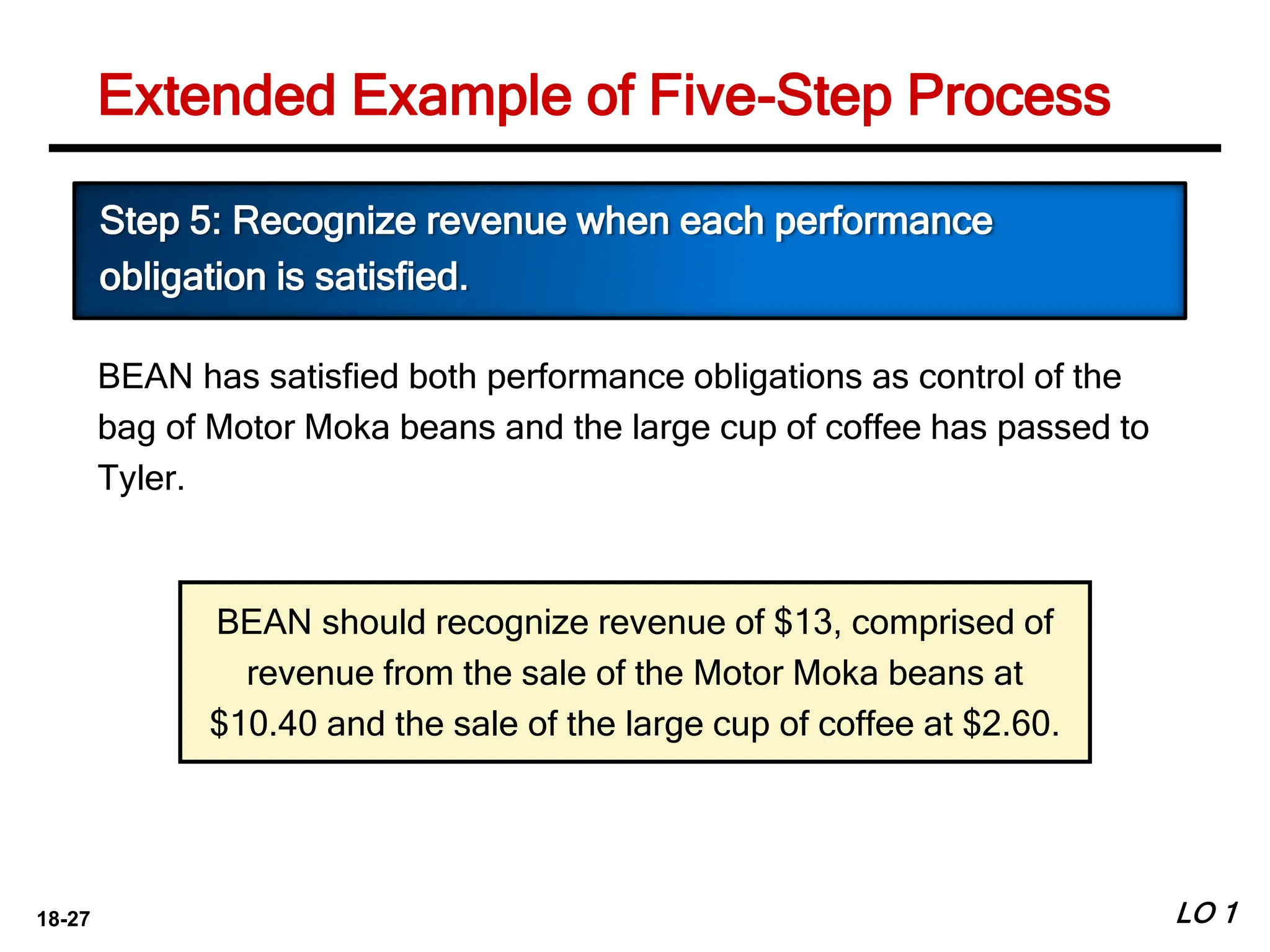
BEAN should recognize revenue of $13, comprised of
revenue from the sale of the Motor Moka beans at
$10.40 and the sale of the large cup of coffee at $2.60.
18-28 LO 1
Extended Example of Five-Step Process
BEAN satisfied its performance obligation(s) when Tyler obtained
control of the product(s).
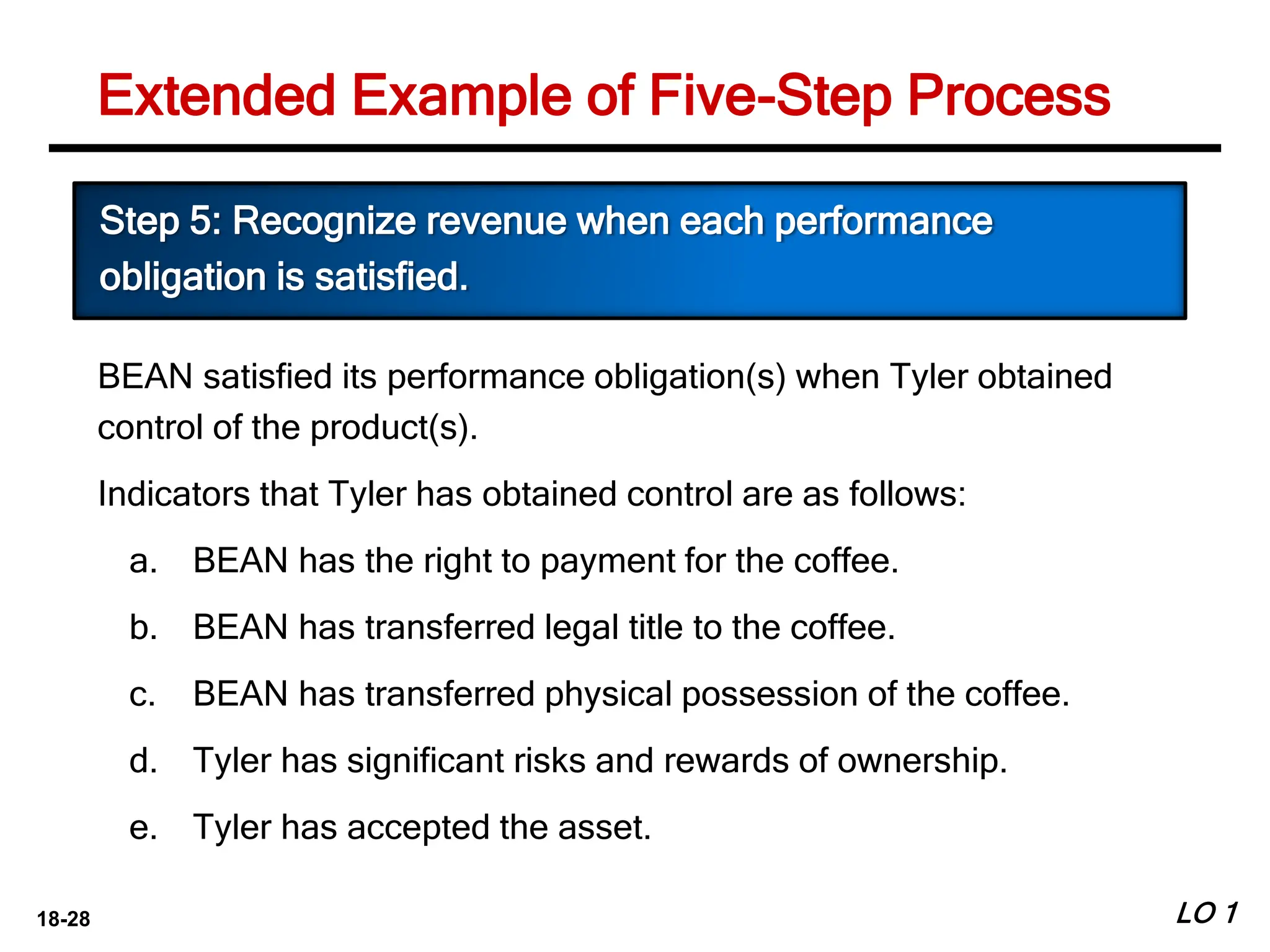
Indicators that Tyler has obtained control are as follows:
a. BEAN has the right to payment for the coffee.
b. BEAN has transferred legal title to the coffee.
c. BEAN has transferred physical possession of the coffee.
d. Tyler has significant risks and rewards of ownership.
e. Tyler has accepted the asset.
Step 5: Recognize revenue when each performance
obligation is satisfied.
18-29
Contract:
 Agreement between two or more parties that creates
enforceable rights or obligations.
 Can be
► written,
► oral, or
► implied from customary business practice.
LO 2
The Five-Step
Process Revisited
Identifying the Contract with Customers—Step 1
LEARNING OBJECTIVE 2
Understand and apply the five-
step revenue recognition
process.
18-30
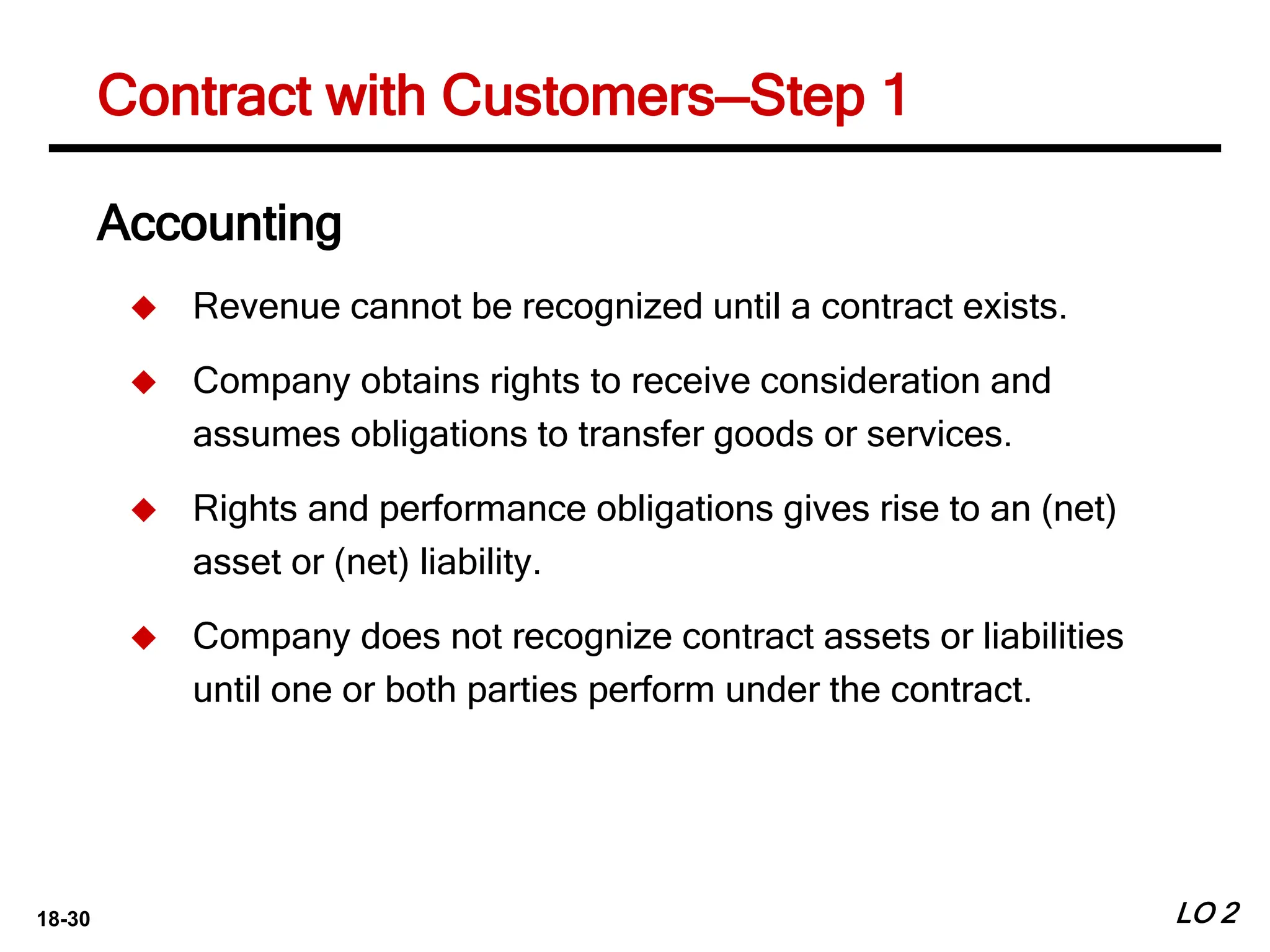
Accounting
 Revenue cannot be recognized until a contract exists.
 Company obtains rights to receive consideration and
assumes obligations to transfer goods or services.
 Rights and performance obligations gives rise to an (net)
asset or (net) liability.
 Company does not recognize contract assets or liabilities
until one or both parties perform under the contract.
LO 2
Contract with Customers—Step 1
18-31
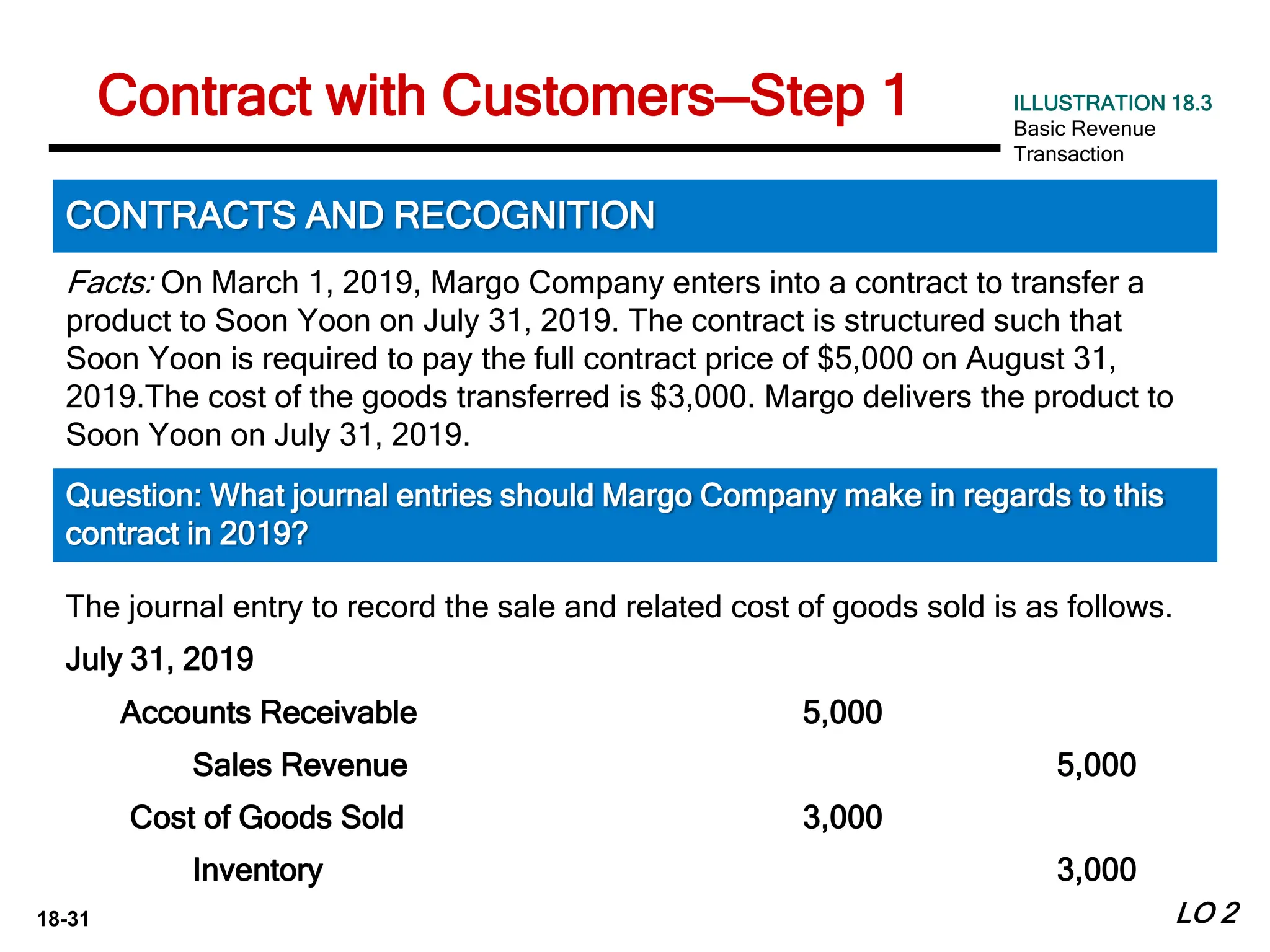
Facts: On March 1, 2019, Margo Company enters into a contract to transfer a
product to Soon Yoon on July 31, 2019. The contract is structured such that
Soon Yoon is required to pay the full contract price of $5,000 on August 31,
2019.The cost of the goods transferred is $3,000. Margo delivers the product to
Soon Yoon on July 31, 2019.
LO 2
CONTRACTS AND RECOGNITION
Question: What journal entries should Margo Company make in regards to this
contract in 2019?
The journal entry to record the sale and related cost of goods sold is as follows.
July 31, 2019
Accounts Receivable 5,000
Sales Revenue 5,000
Cost of Goods Sold 3,000
Inventory 3,000
Contract with Customers—Step 1 ILLUSTRATION 18.3
Basic Revenue
Transaction
18-32 LO 2
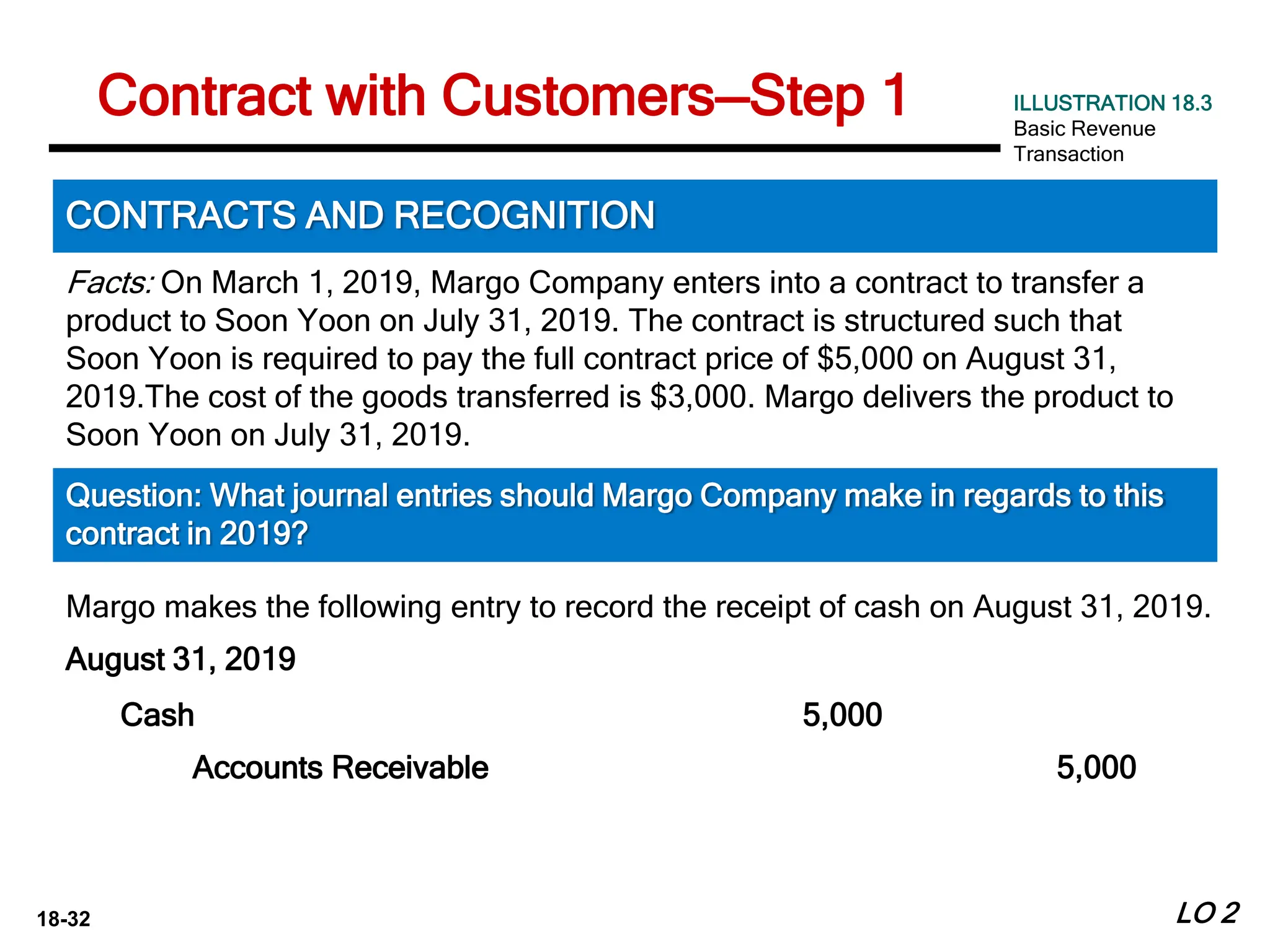
CONTRACTS AND RECOGNITION
Cash 5,000
Accounts Receivable 5,000
Facts: On March 1, 2019, Margo Company enters into a contract to transfer a
product to Soon Yoon on July 31, 2019. The contract is structured such that
Soon Yoon is required to pay the full contract price of $5,000 on August 31,
2019.The cost of the goods transferred is $3,000. Margo delivers the product to
Soon Yoon on July 31, 2019.
Question: What journal entries should Margo Company make in regards to this
contract in 2019?
Margo makes the following entry to record the receipt of cash on August 31, 2019.
August 31, 2019
Contract with Customers—Step 1 ILLUSTRATION 18.3
Basic Revenue
Transaction
18-33 LO 2
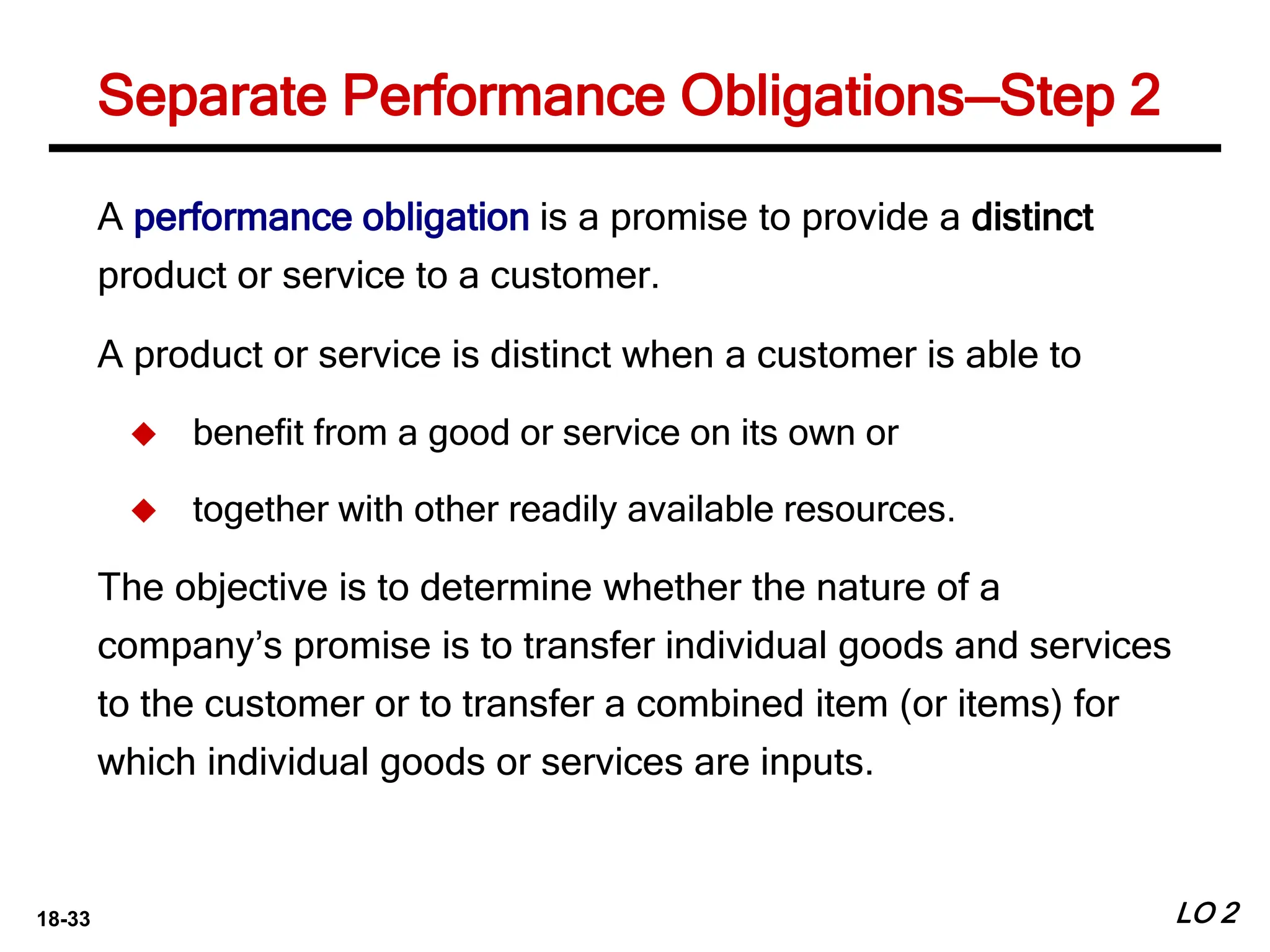
A performance obligation is a promise to provide a distinct
product or service to a customer.
A product or service is distinct when a customer is able to
 benefit from a good or service on its own or
 together with other readily available resources.
The objective is to determine whether the nature of a
company’s promise is to transfer individual goods and services
to the customer or to transfer a combined item (or items) for
which individual goods or services are inputs.
Separate Performance Obligations—Step 2
18-34
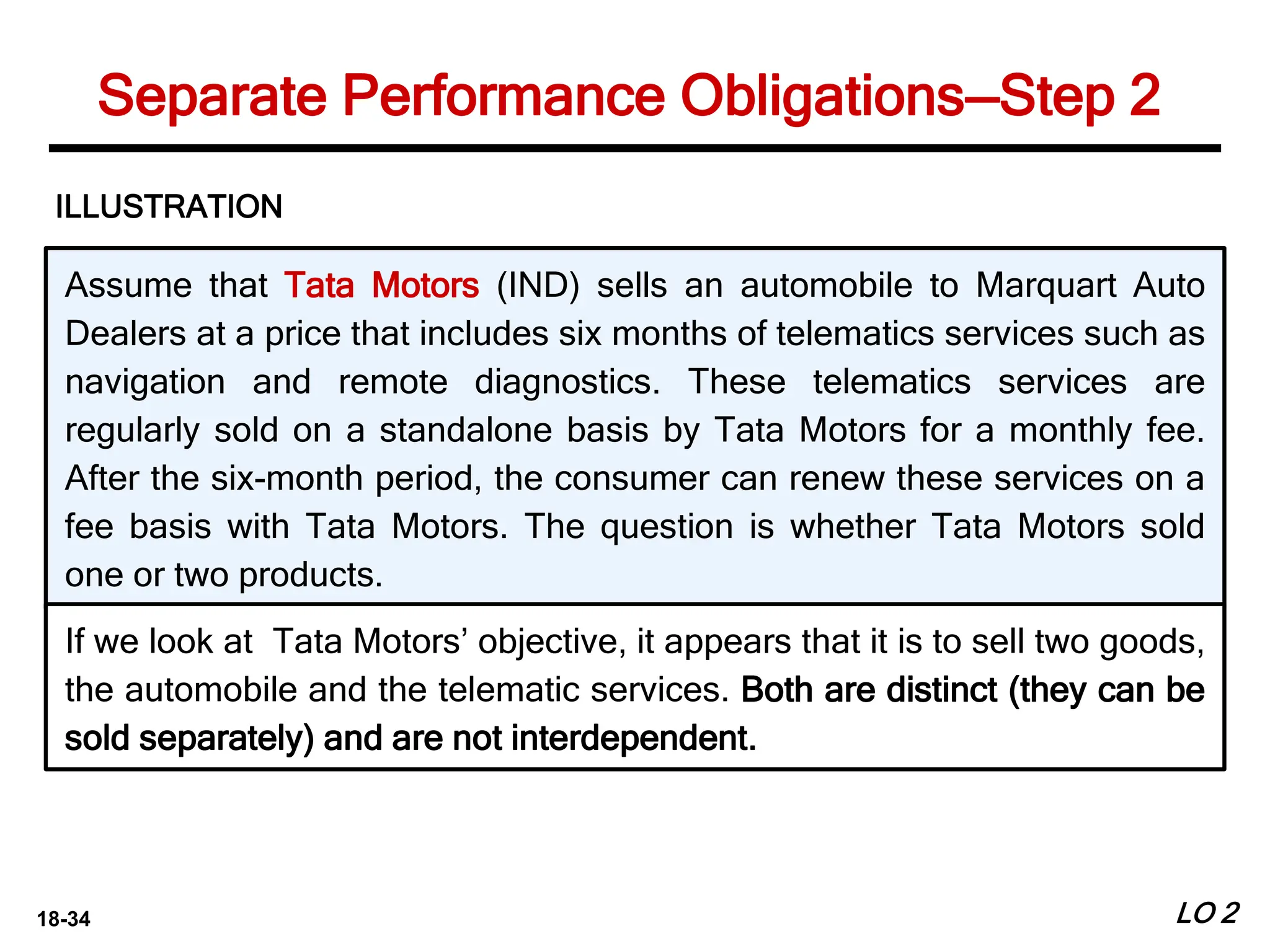
Assume that Tata Motors (IND) sells an automobile to Marquart Auto
Dealers at a price that includes six months of telematics services such as
navigation and remote diagnostics. These telematics services are
regularly sold on a standalone basis by Tata Motors for a monthly fee.
After the six-month period, the consumer can renew these services on a
fee basis with Tata Motors. The question is whether Tata Motors sold
one or two products.
ILLUSTRATION
If we look at Tata Motors’ objective, it appears that it is to sell two goods,
the automobile and the telematic services. Both are distinct (they can be
sold separately) and are not interdependent.
LO 2
Separate Performance Obligations—Step 2
18-35
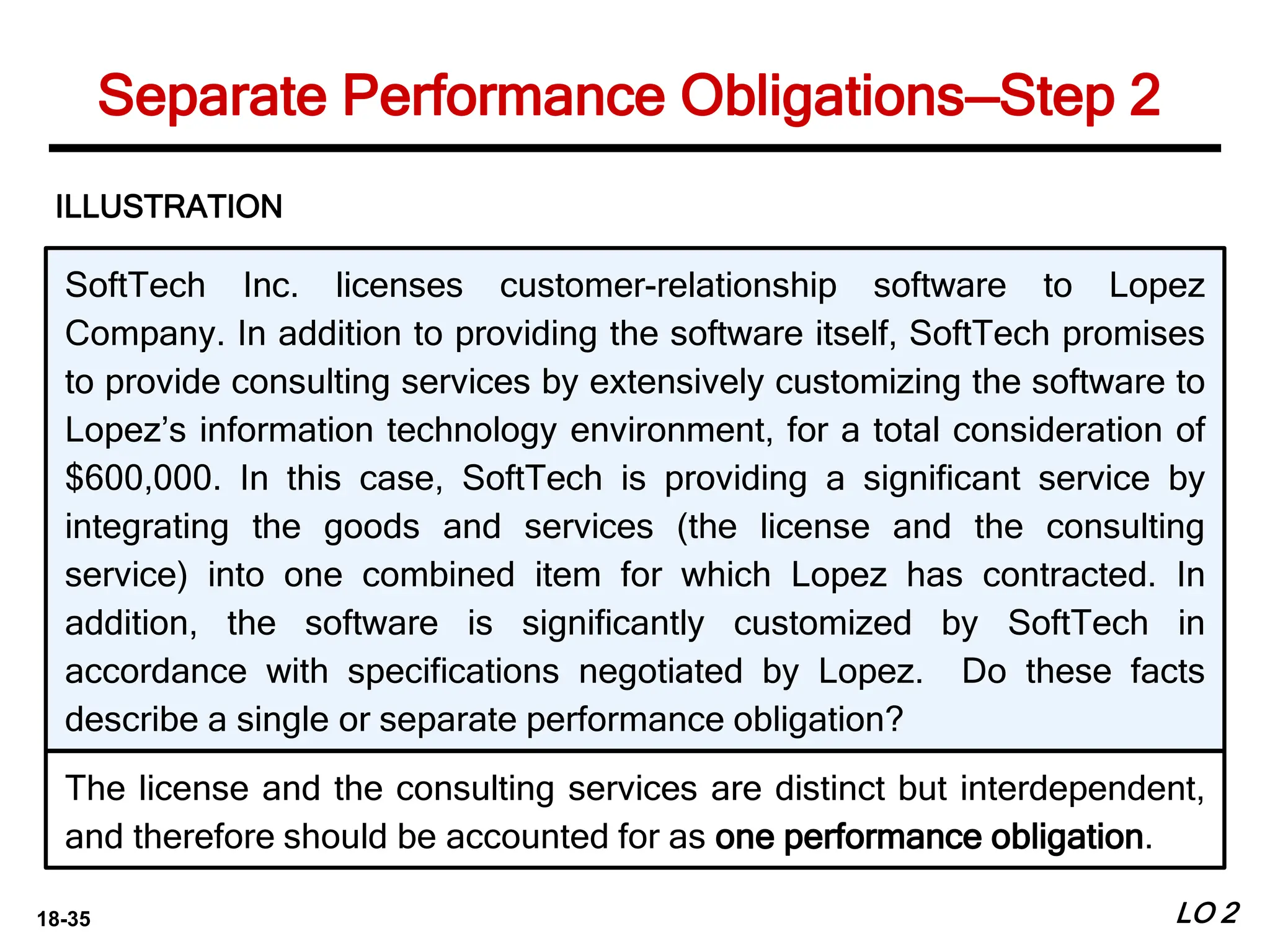
SoftTech Inc. licenses customer-relationship software to Lopez
Company. In addition to providing the software itself, SoftTech promises
to provide consulting services by extensively customizing the software to
Lopez’s information technology environment, for a total consideration of
$600,000. In this case, SoftTech is providing a significant service by
integrating the goods and services (the license and the consulting
service) into one combined item for which Lopez has contracted. In
addition, the software is significantly customized by SoftTech in
accordance with specifications negotiated by Lopez. Do these facts
describe a single or separate performance obligation?
ILLUSTRATION
The license and the consulting services are distinct but interdependent,
and therefore should be accounted for as one performance obligation.
LO 2
Separate Performance Obligations—Step 2
18-36 LO 2
Determining Transaction Price—Step 3
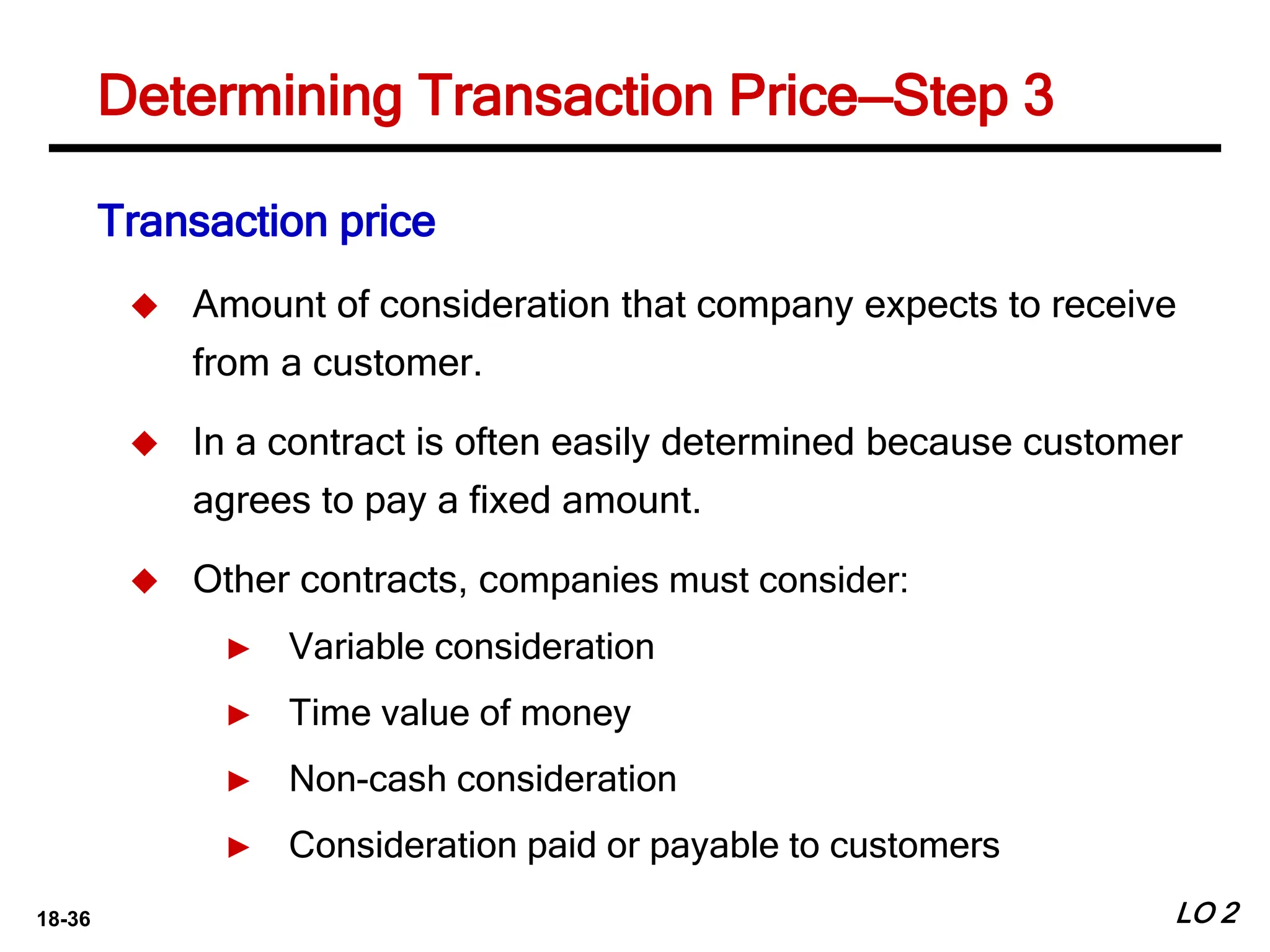
Transaction price
 Amount of consideration that company expects to receive
from a customer.
 In a contract is often easily determined because customer
agrees to pay a fixed amount.
 Other contracts, companies must consider:
► Variable consideration
► Time value of money
► Non-cash consideration
► Consideration paid or payable to customers
18-37 LO 2
Determining Transaction Price—Step 3
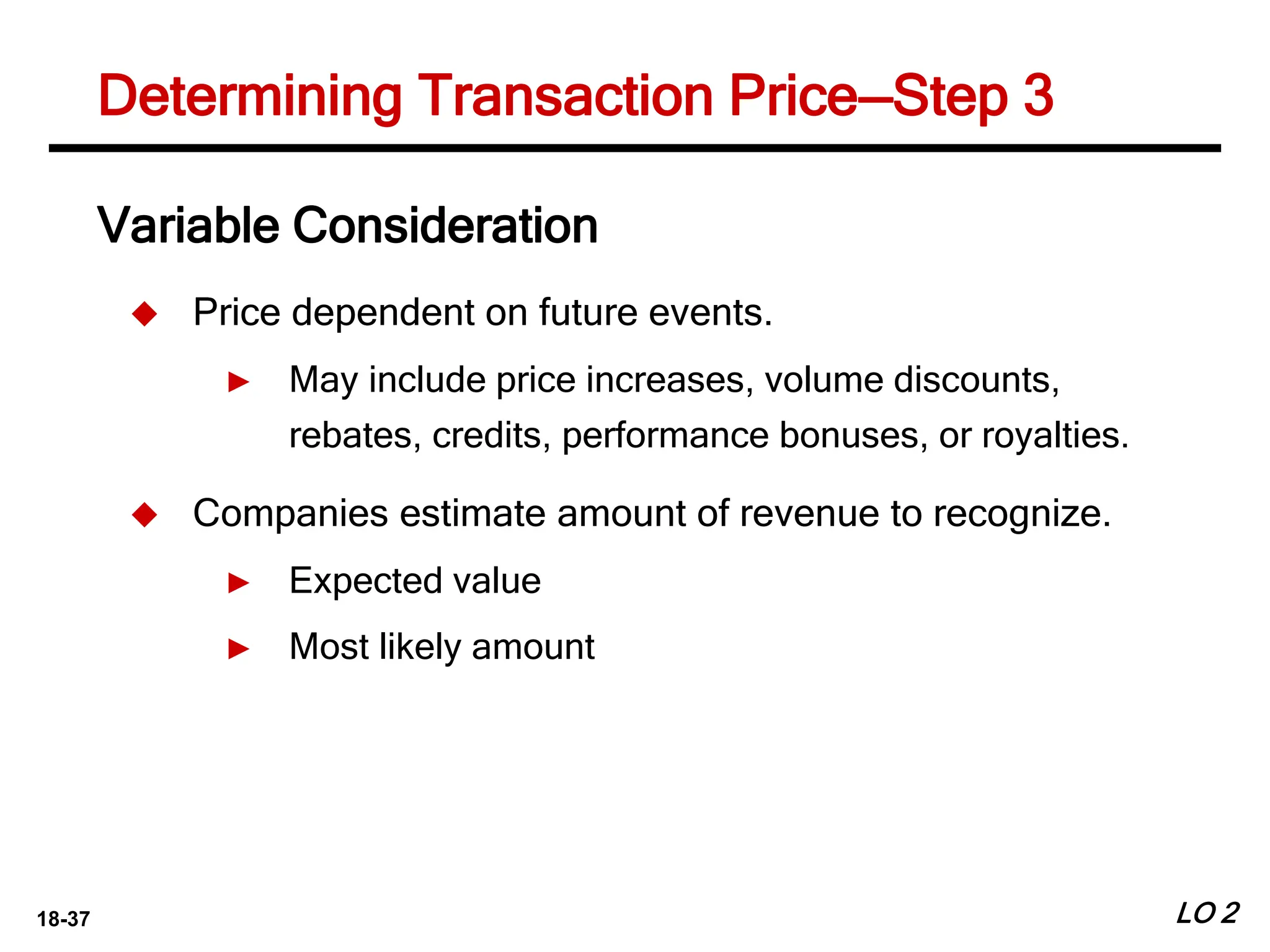
Variable Consideration
 Price dependent on future events.
► May include price increases, volume discounts,
rebates, credits, performance bonuses, or royalties.
 Companies estimate amount of revenue to recognize.
► Expected value
► Most likely amount
18-38
ILLUSTRATION 18.4 Estimating Variable Consideration
Expected Value: Probability-weighted amount in a range of possible
consideration amounts.
Most Likely Amount: The single most likely amount in a range of possible
consideration outcomes.
 May be appropriate if a company has a large number of contracts with
similar characteristics.
 Can be based on a limited number of discrete outcomes and probabilities.
 May be appropriate if the contract has only two possible outcomes.
Determining Transaction Price—Step 3
LO 2
18-39
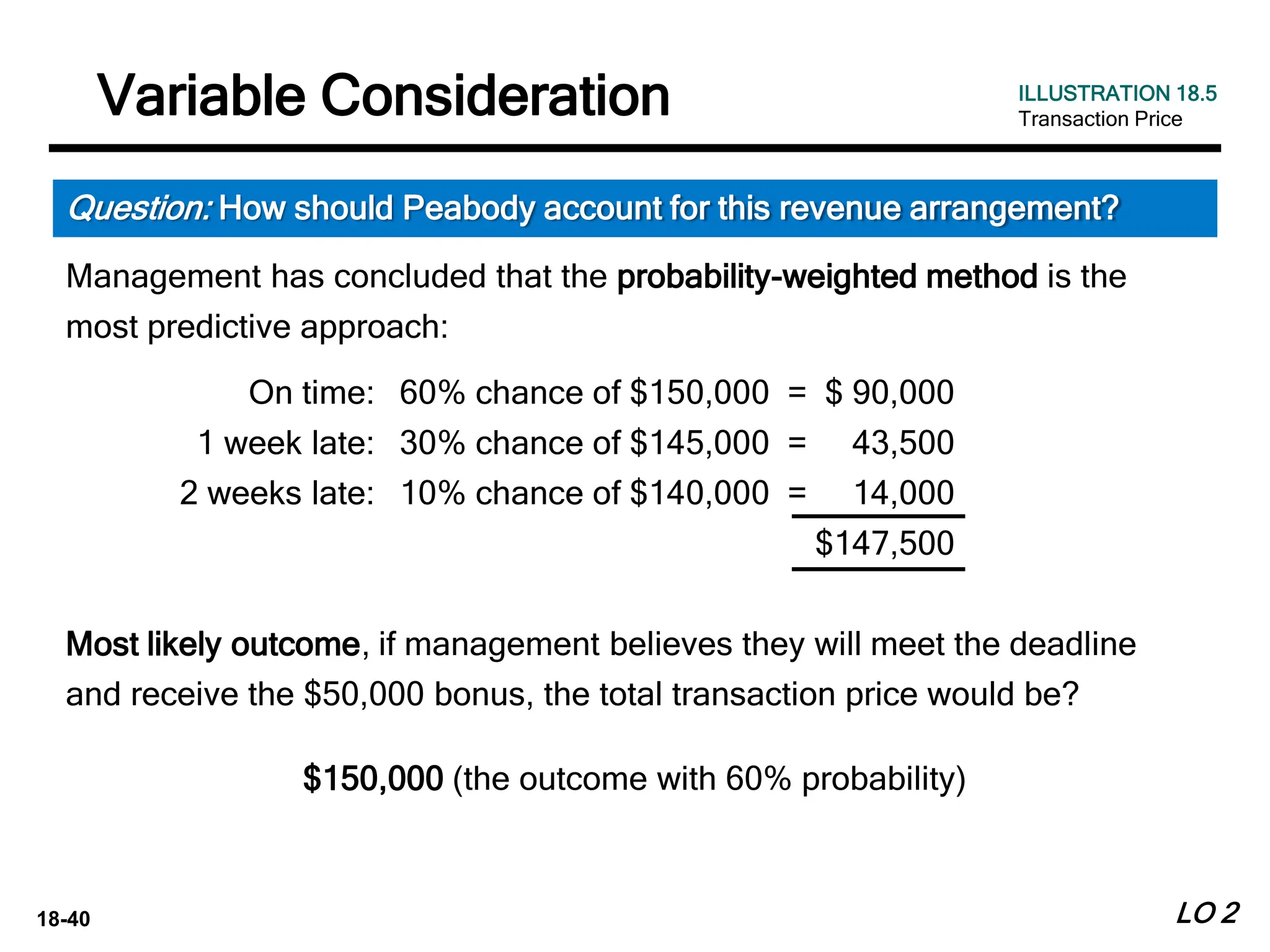
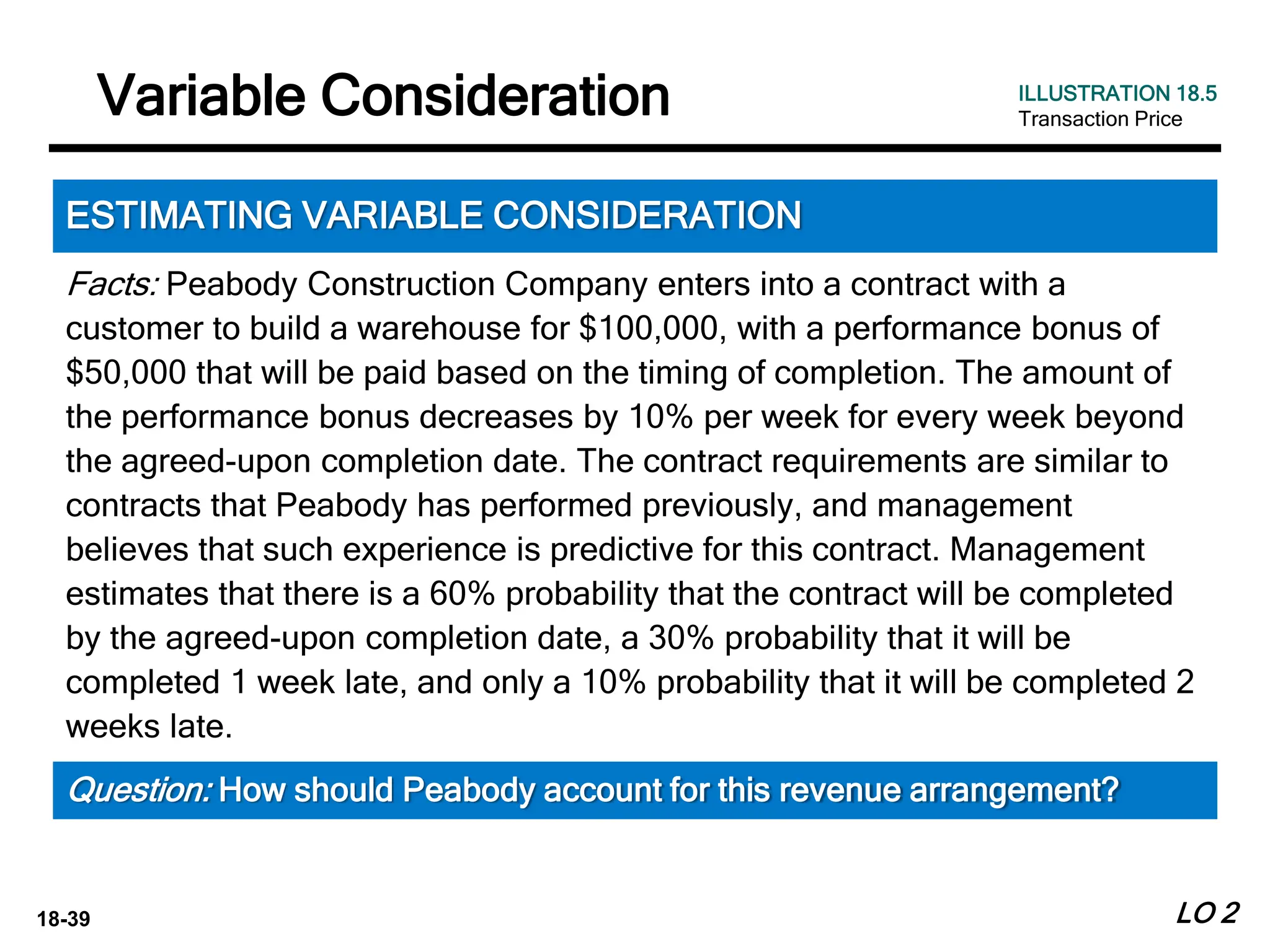
Facts: Peabody Construction Company enters into a contract with a
customer to build a warehouse for $100,000, with a performance bonus of
$50,000 that will be paid based on the timing of completion. The amount of
the performance bonus decreases by 10% per week for every week beyond
the agreed-upon completion date. The contract requirements are similar to
contracts that Peabody has performed previously, and management
believes that such experience is predictive for this contract. Management
estimates that there is a 60% probability that the contract will be completed
by the agreed-upon completion date, a 30% probability that it will be
completed 1 week late, and only a 10% probability that it will be completed 2
weeks late.
LO 2
Variable Consideration
ESTIMATING VARIABLE CONSIDERATION
Question: How should Peabody account for this revenue arrangement?
ILLUSTRATION 18.5
Transaction Price
18-40
Management has concluded that the probability-weighted method is the
most predictive approach:
LO 2
Variable Consideration
Question: How should Peabody account for this revenue arrangement?
On time: 60% chance of $150,000 = $ 90,000
1 week late: 30% chance of $145,000 = 43,500
2 weeks late: 10% chance of $140,000 = 14,000
$147,500
Most likely outcome, if management believes they will meet the deadline
and receive the $50,000 bonus, the total transaction price would be?
$150,000 (the outcome with 60% probability)
ILLUSTRATION 18.5
Transaction Price
18-41 LO 2
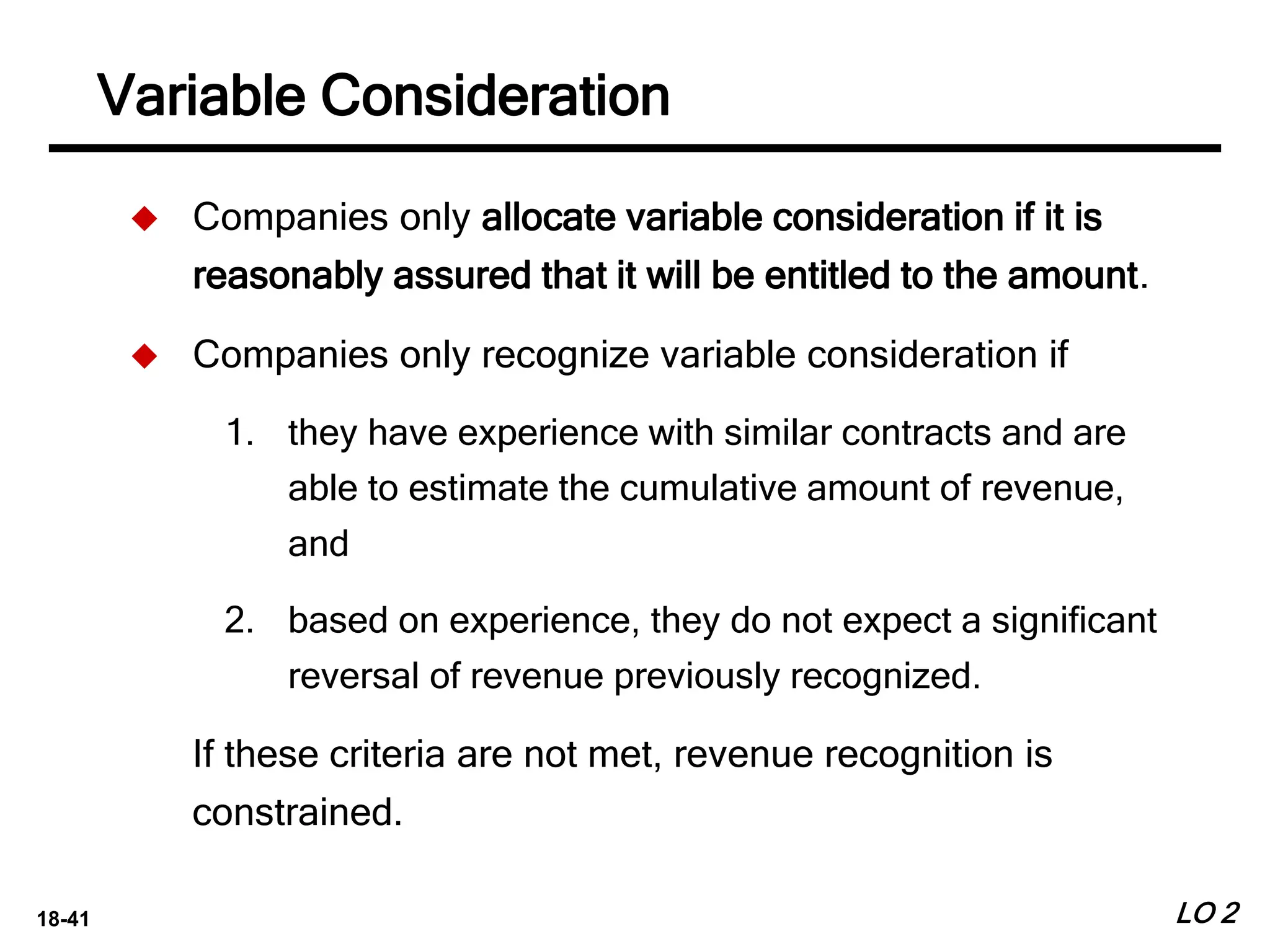
 Companies only allocate variable consideration if it is
reasonably assured that it will be entitled to the amount.
 Companies only recognize variable consideration if
1. they have experience with similar contracts and are
able to estimate the cumulative amount of revenue,
and
2. based on experience, they do not expect a significant
reversal of revenue previously recognized.
If these criteria are not met, revenue recognition is
constrained.
Variable Consideration
18-42 LO 2
Determining Transaction Price—Step 3
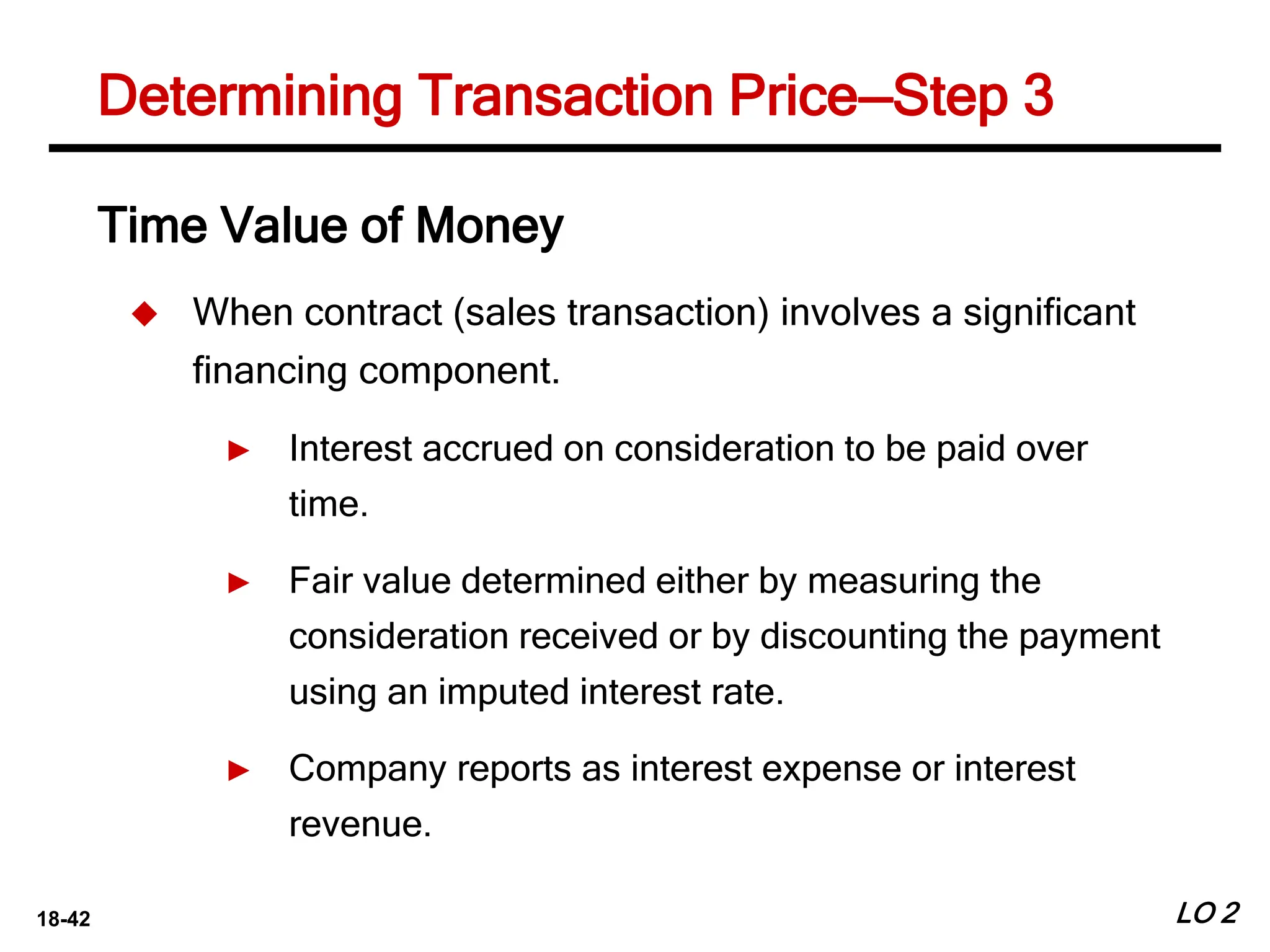
Time Value of Money
 When contract (sales transaction) involves a significant
financing component.
► Interest accrued on consideration to be paid over
time.
► Fair value determined either by measuring the
consideration received or by discounting the payment
using an imputed interest rate.
► Company reports as interest expense or interest
revenue.
18-43
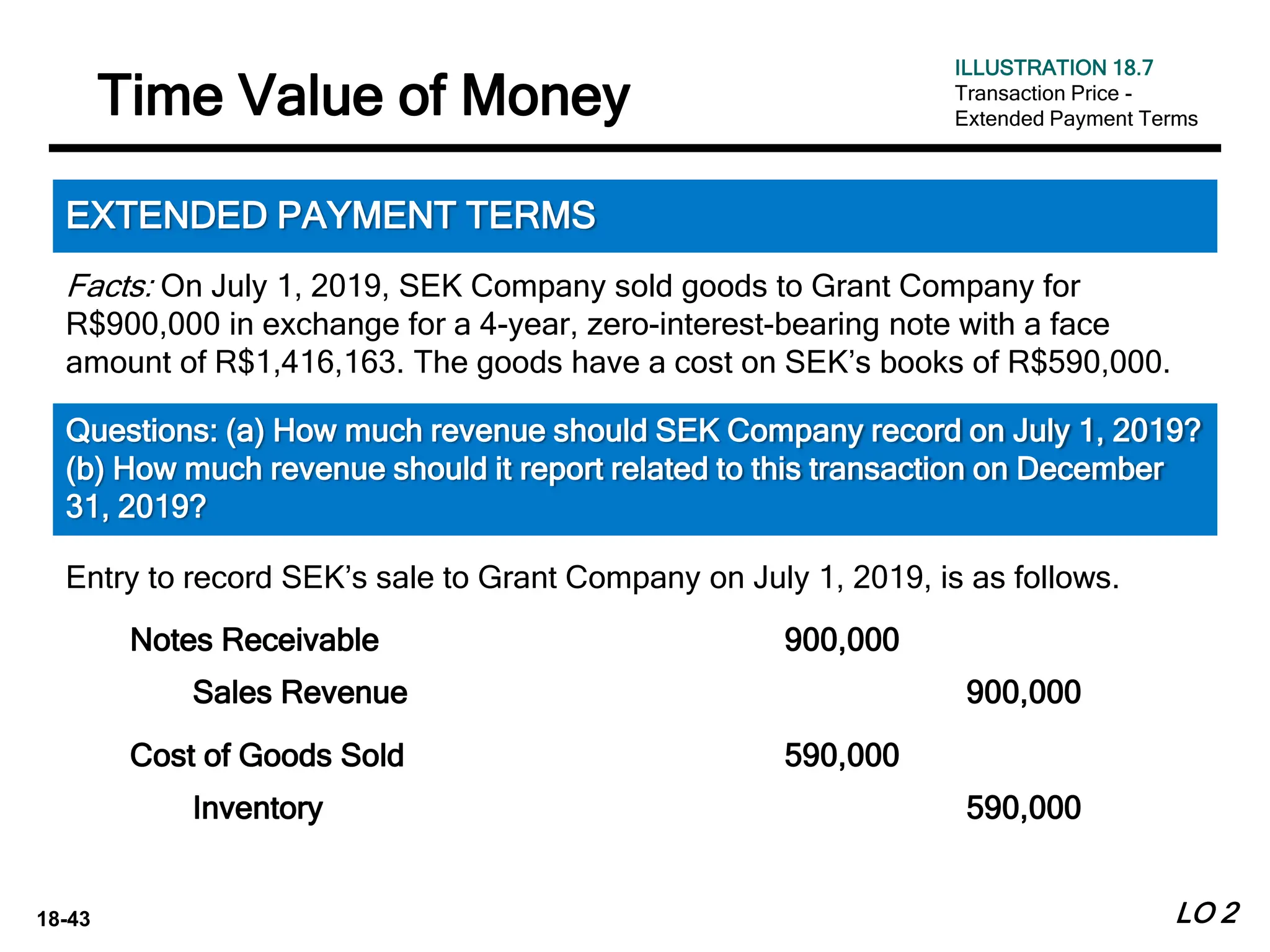
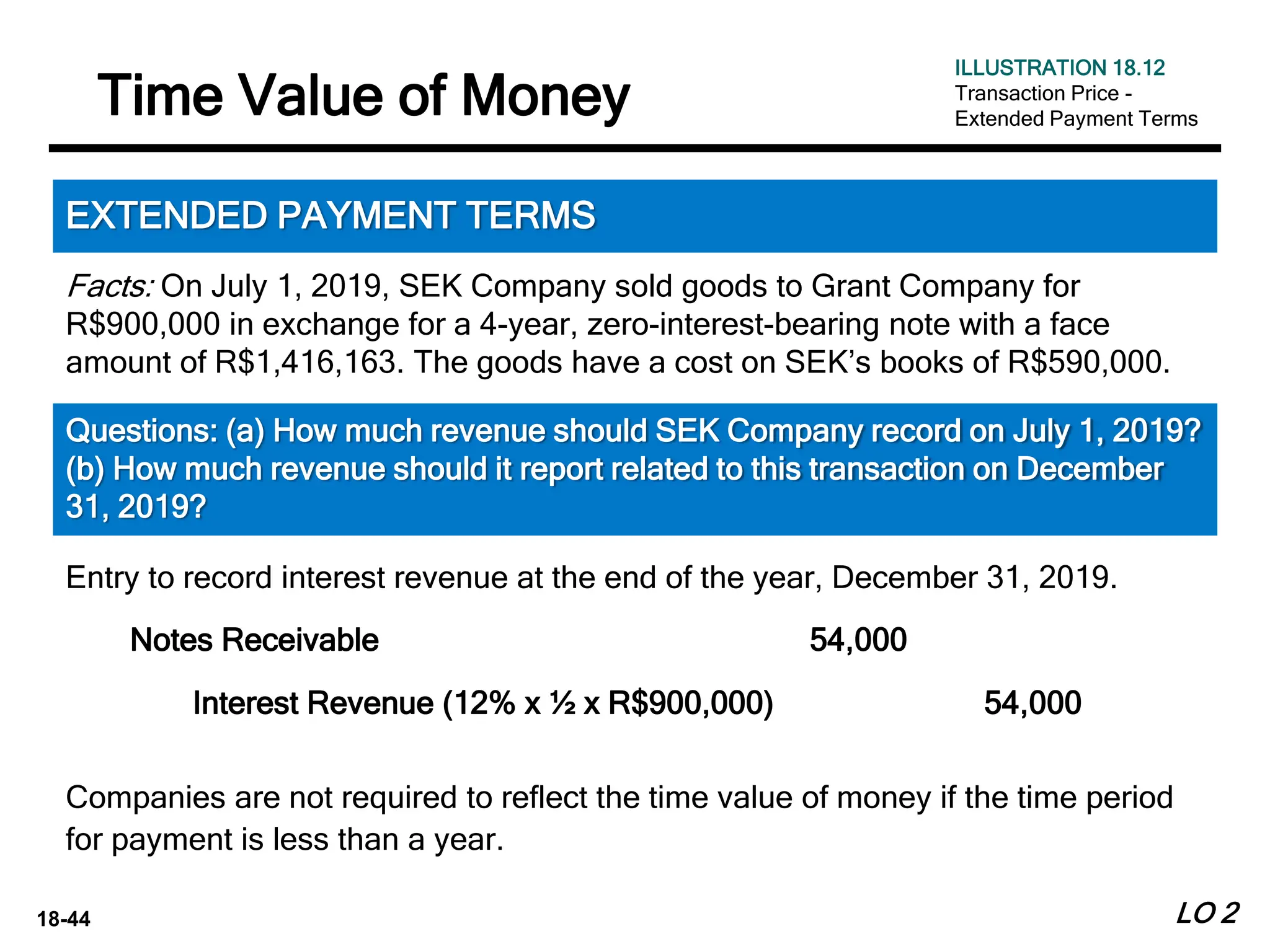
Facts: On July 1, 2019, SEK Company sold goods to Grant Company for
R$900,000 in exchange for a 4-year, zero-interest-bearing note with a face
amount of R$1,416,163. The goods have a cost on SEK’s books of R$590,000.
LO 2
Time Value of Money
EXTENDED PAYMENT TERMS
Questions: (a) How much revenue should SEK Company record on July 1, 2019?
(b) How much revenue should it report related to this transaction on December
31, 2019?
Entry to record SEK’s sale to Grant Company on July 1, 2019, is as follows.
Notes Receivable 900,000
Sales Revenue 900,000
Cost of Goods Sold 590,000
Inventory 590,000
ILLUSTRATION 18.7
Transaction Price -
Extended Payment Terms
18-44 LO 2
Time Value of Money
EXTENDED PAYMENT TERMS
Questions: (a) How much revenue should SEK Company record on July 1, 2019?
(b) How much revenue should it report related to this transaction on December
31, 2019?
Entry to record interest revenue at the end of the year, December 31, 2019.
Notes Receivable 54,000
Interest Revenue (12% x ½ x R$900,000) 54,000
Companies are not required to reflect the time value of money if the time period
for payment is less than a year.
ILLUSTRATION 18.12
Transaction Price -
Extended Payment Terms
Facts: On July 1, 2019, SEK Company sold goods to Grant Company for
R$900,000 in exchange for a 4-year, zero-interest-bearing note with a face
amount of R$1,416,163. The goods have a cost on SEK’s books of R$590,000.
18-45 LO 2
Determining Transaction Price—Step 3
Non-Cash Consideration
Goods, services, or other non-cash consideration.
 Companies sometimes receive contributions (e.g.,
donations and gifts).
 Customers sometimes contribute goods or services, such
as equipment or labor, as consideration for goods
provided or services performed.
 Companies generally recognize revenue on the basis of
the fair value of what is received.
18-46 LO 2
Determining Transaction Price—Step 3
Consideration Paid or Payable to Customers
 May include discounts, volume rebates, coupons, free
products, or services.
 In general, these elements reduce the consideration
received and the revenue to be recognized.
18-47
Facts: Sansung Company offers its customers a 3% volume discount if they
purchase at least ¥2 million of its product during the calendar year. On March 31,
2019, Sansung has made sales of ¥700,000 to Artic Co. In the previous 2 years,
Sansung sold over ¥3,000,000 to Artic in the period April 1 to December 31.
LO 2
Consideration Paid or Payable
VOLUME DISCOUNT
Questions: How much revenue should Sansung recognize for the first 3 months
of 2019?
Sansung makes the following entry on March 31, 2019.
Accounts Receivable 679,000
Sales Revenue 679,000
Sansung should reduce its revenue by ¥21,000 (¥700,000 x 3%) because it is
probable that it will provide this rebate.
ILLUSTRATION 18.8
Transaction Price –
Volume Discount
18-48 LO 2
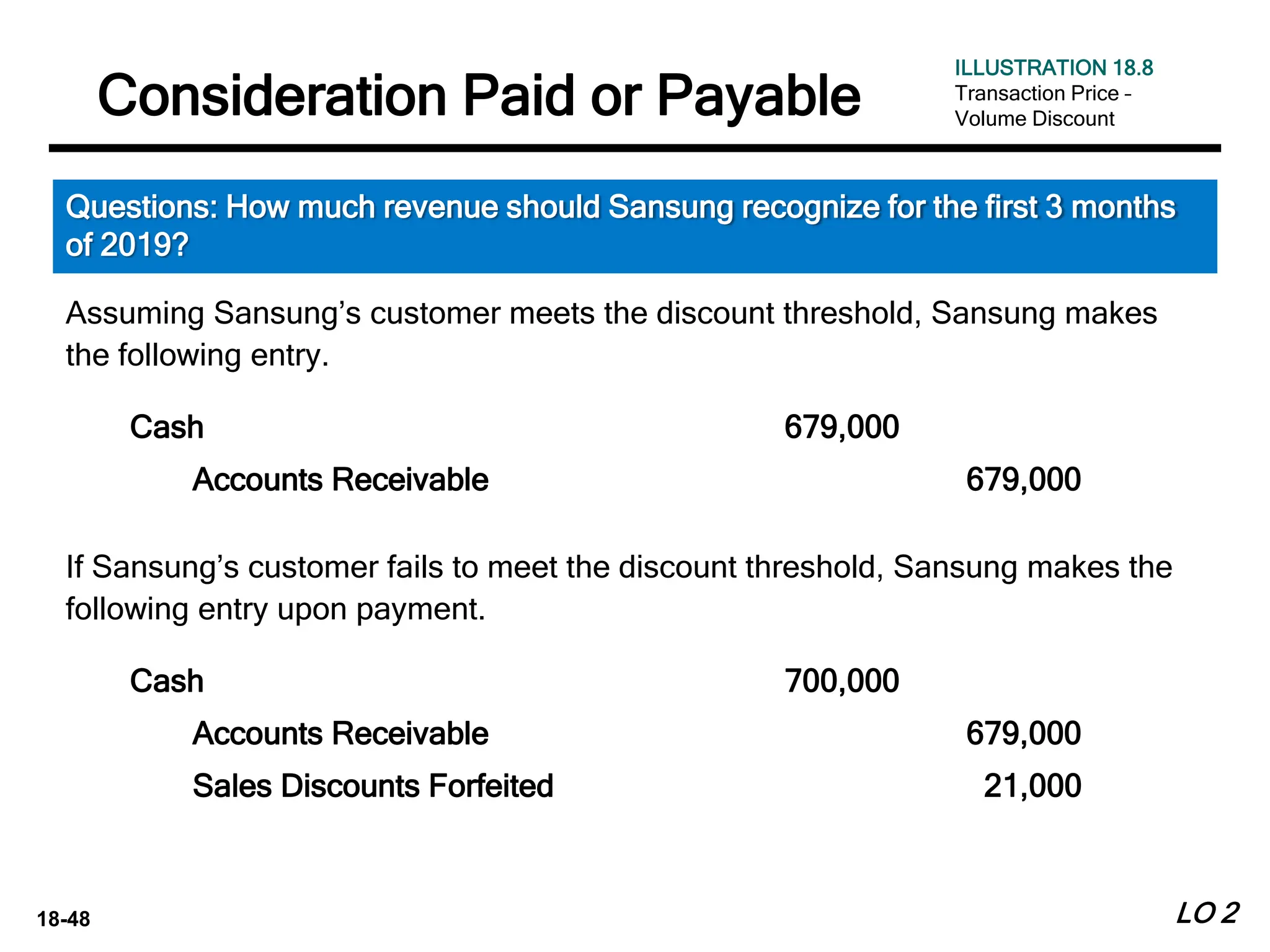
Questions: How much revenue should Sansung recognize for the first 3 months
of 2019?
Assuming Sansung’s customer meets the discount threshold, Sansung makes
the following entry.
Cash 679,000
Accounts Receivable 679,000
If Sansung’s customer fails to meet the discount threshold, Sansung makes the
following entry upon payment.
Cash 700,000
Accounts Receivable 679,000
Sales Discounts Forfeited 21,000
Consideration Paid or Payable
ILLUSTRATION 18.8
Transaction Price –
Volume Discount
18-49
Allocating Transaction Price to Separate
Performance Obligations—Step 4
LO 2
 Based on their relative fair values.
 Best measure of fair value is what the company could
sell the good or service for on a standalone basis.
 If not available, companies should use their best estimate
of what the good or service might sell for as a standalone
unit.
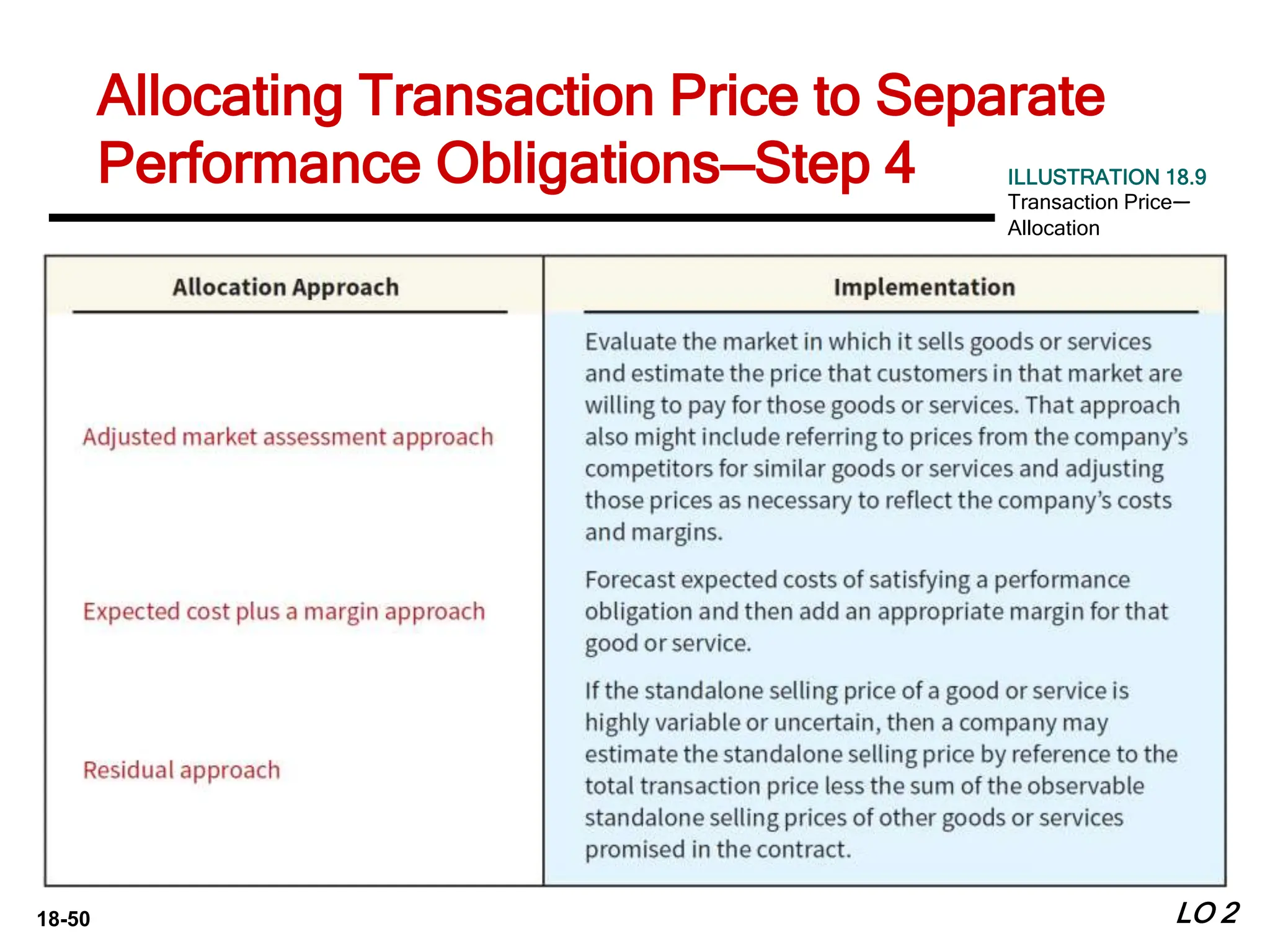
18-50 LO 2
Allocating Transaction Price to Separate
Performance Obligations—Step 4 ILLUSTRATION 18.9
Transaction Price—
Allocation
18-51
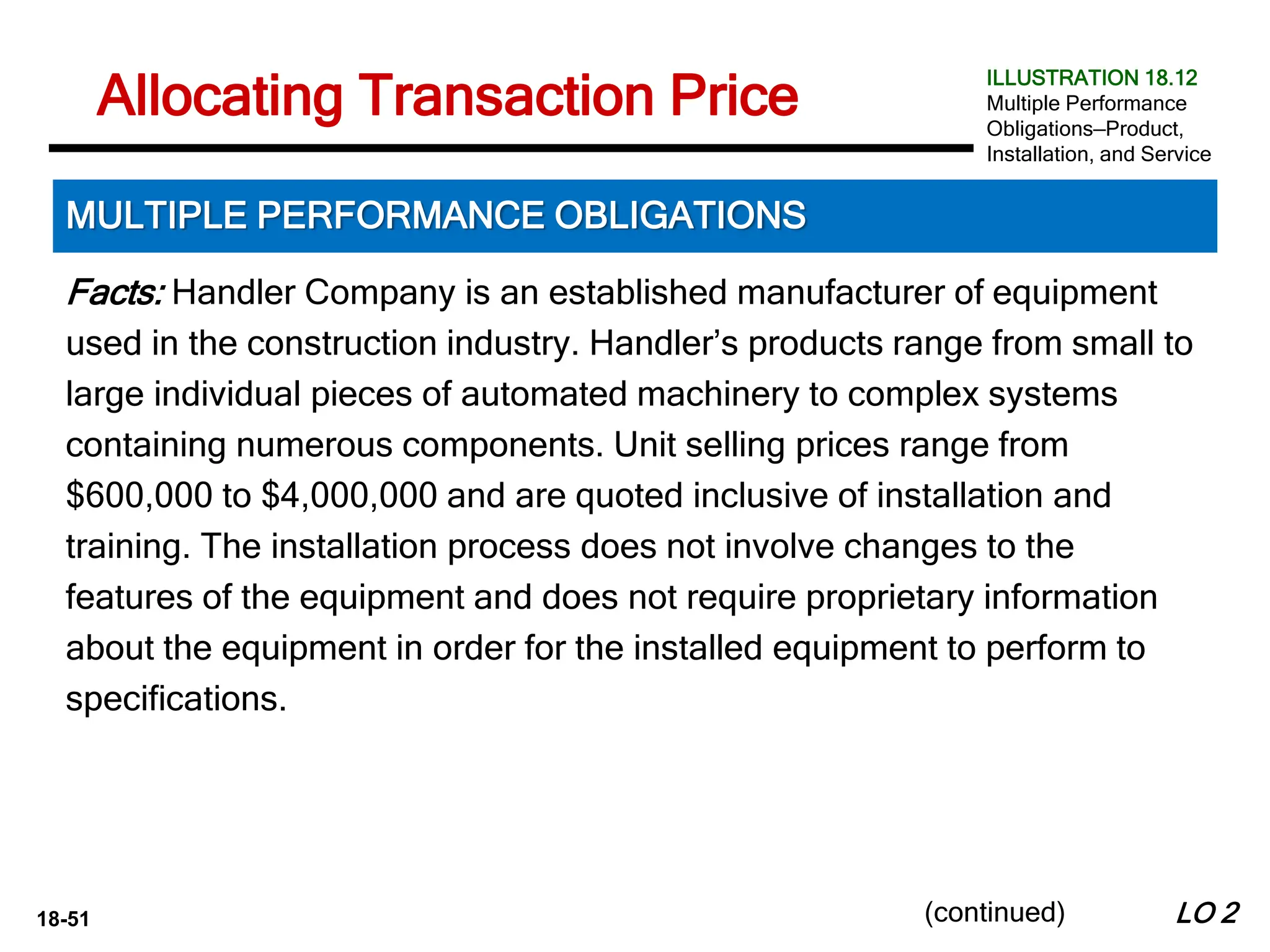
Facts: Handler Company is an established manufacturer of equipment
used in the construction industry. Handler’s products range from small to
large individual pieces of automated machinery to complex systems
containing numerous components. Unit selling prices range from
$600,000 to $4,000,000 and are quoted inclusive of installation and
training. The installation process does not involve changes to the
features of the equipment and does not require proprietary information
about the equipment in order for the installed equipment to perform to
specifications.
LO 2
Allocating Transaction Price
MULTIPLE PERFORMANCE OBLIGATIONS
ILLUSTRATION 18.12
Multiple Performance
Obligations—Product,
Installation, and Service
(continued)
18-52
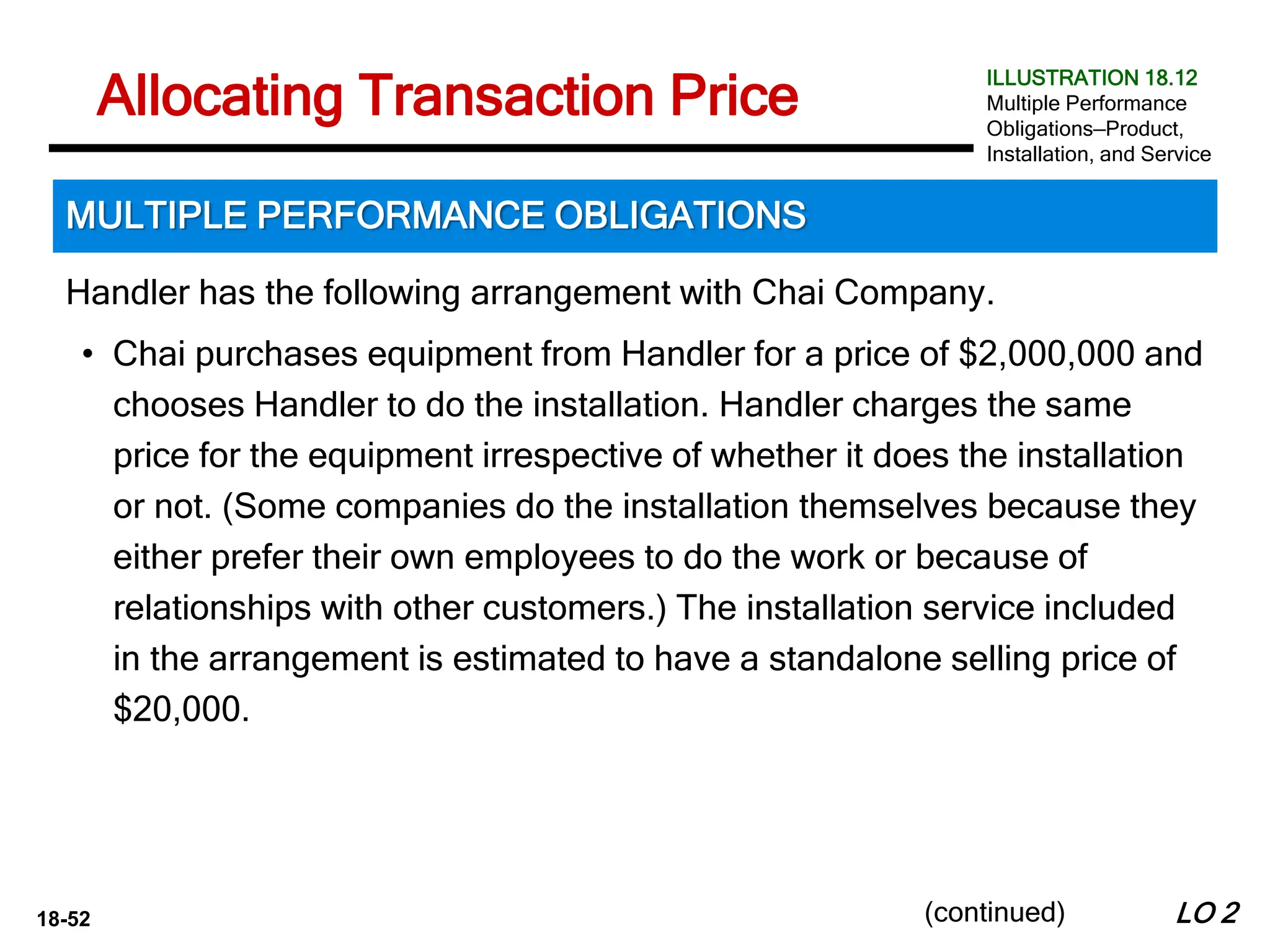
Handler has the following arrangement with Chai Company.
• Chai purchases equipment from Handler for a price of $2,000,000 and
chooses Handler to do the installation. Handler charges the same
price for the equipment irrespective of whether it does the installation
or not. (Some companies do the installation themselves because they
either prefer their own employees to do the work or because of
relationships with other customers.) The installation service included
in the arrangement is estimated to have a standalone selling price of
$20,000.
LO 2
Allocating Transaction Price
MULTIPLE PERFORMANCE OBLIGATIONS
ILLUSTRATION 18.12
Multiple Performance
Obligations—Product,
Installation, and Service
(continued)
18-53
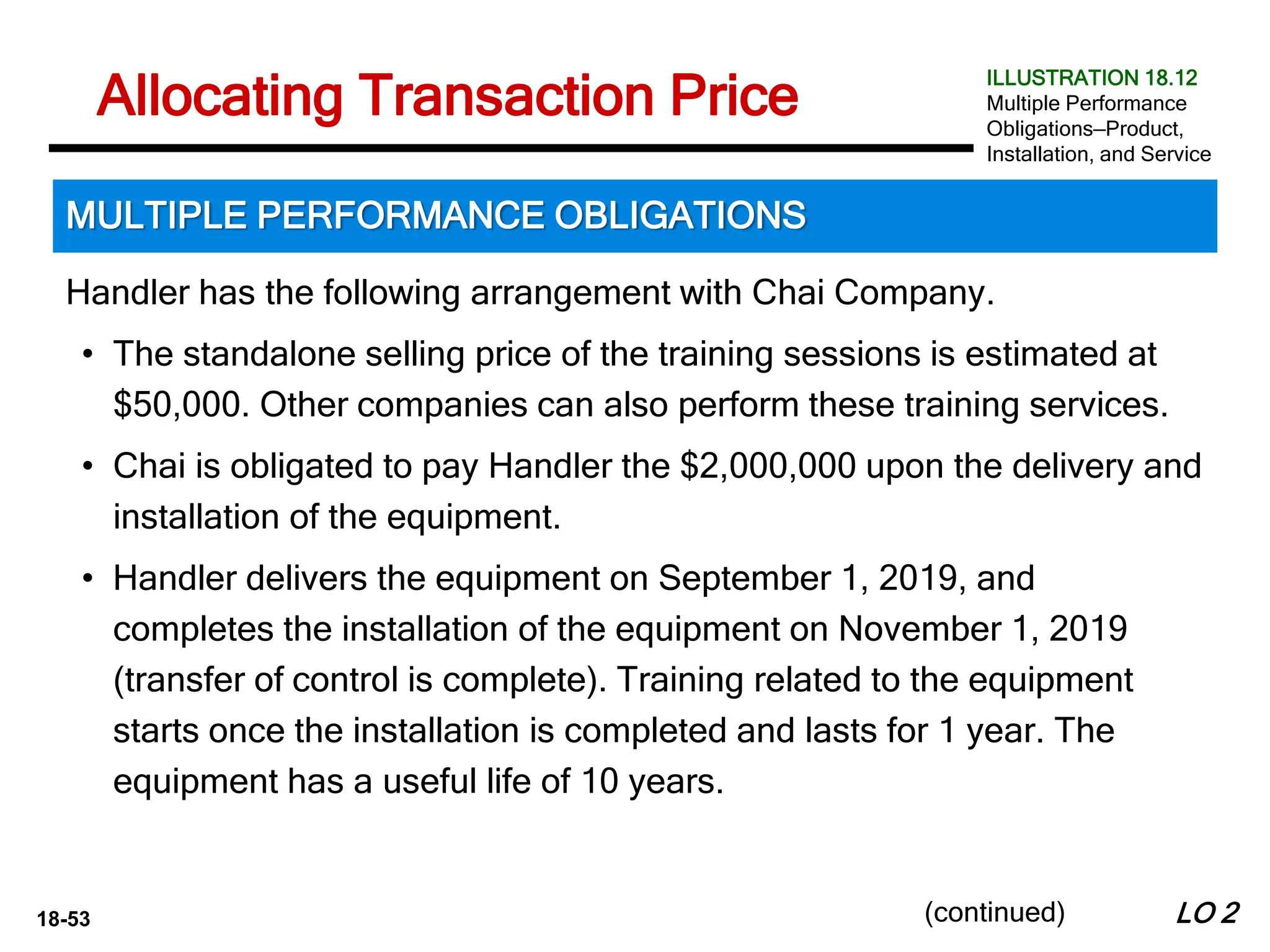
Handler has the following arrangement with Chai Company.
• The standalone selling price of the training sessions is estimated at
$50,000. Other companies can also perform these training services.
• Chai is obligated to pay Handler the $2,000,000 upon the delivery and
installation of the equipment.
• Handler delivers the equipment on September 1, 2019, and
completes the installation of the equipment on November 1, 2019
(transfer of control is complete). Training related to the equipment
starts once the installation is completed and lasts for 1 year. The
equipment has a useful life of 10 years.
LO 2
Allocating Transaction Price
MULTIPLE PERFORMANCE OBLIGATIONS
ILLUSTRATION 18.12
Multiple Performance
Obligations—Product,
Installation, and Service
(continued)
18-54
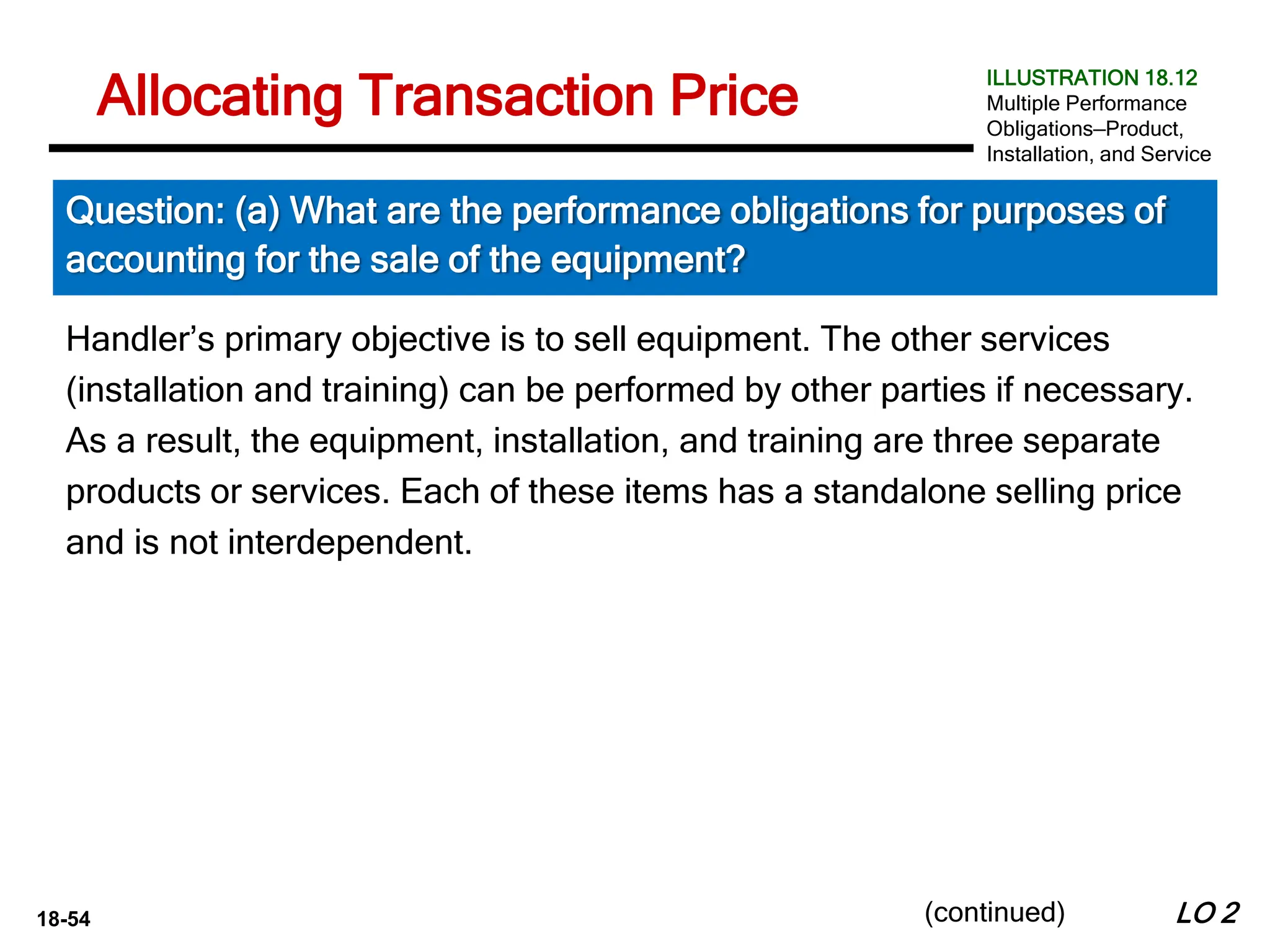
Handler’s primary objective is to sell equipment. The other services
(installation and training) can be performed by other parties if necessary.
As a result, the equipment, installation, and training are three separate
products or services. Each of these items has a standalone selling price
and is not interdependent.
LO 2
Allocating Transaction Price
Question: (a) What are the performance obligations for purposes of
accounting for the sale of the equipment?
ILLUSTRATION 18.12
Multiple Performance
Obligations—Product,
Installation, and Service
(continued)
18-55
The total revenue of $2,000,000 should be allocated to the three
components based on their relative standalone selling prices. In this
case, the standalone selling price of the equipment is $2,000,000, the
installation fee is $20,000, and the training is $50,000. The total
standalone selling price therefore is $2,070,000 ($2,000,000 + $20,000 +
$50,000). The allocation is as follows.
Equipment $1,932,367 [($2,000,000 ÷ $2,070,000) × $2,000,000]
Installation $19,324 [($20,000 ÷ $2,070,000) × $2,000,000]
Training $48,309 [($50,000 ÷ $2,070,000) × $2,000,000]
LO 2
Allocating Transaction Price
Question: (b) If there is more than one performance obligation, how
should the payment of $2,000,000 be allocated to various
components?
ILLUSTRATION 18.12
Multiple Performance
Obligations—Product,
Installation, and Service
(continued)
18-56
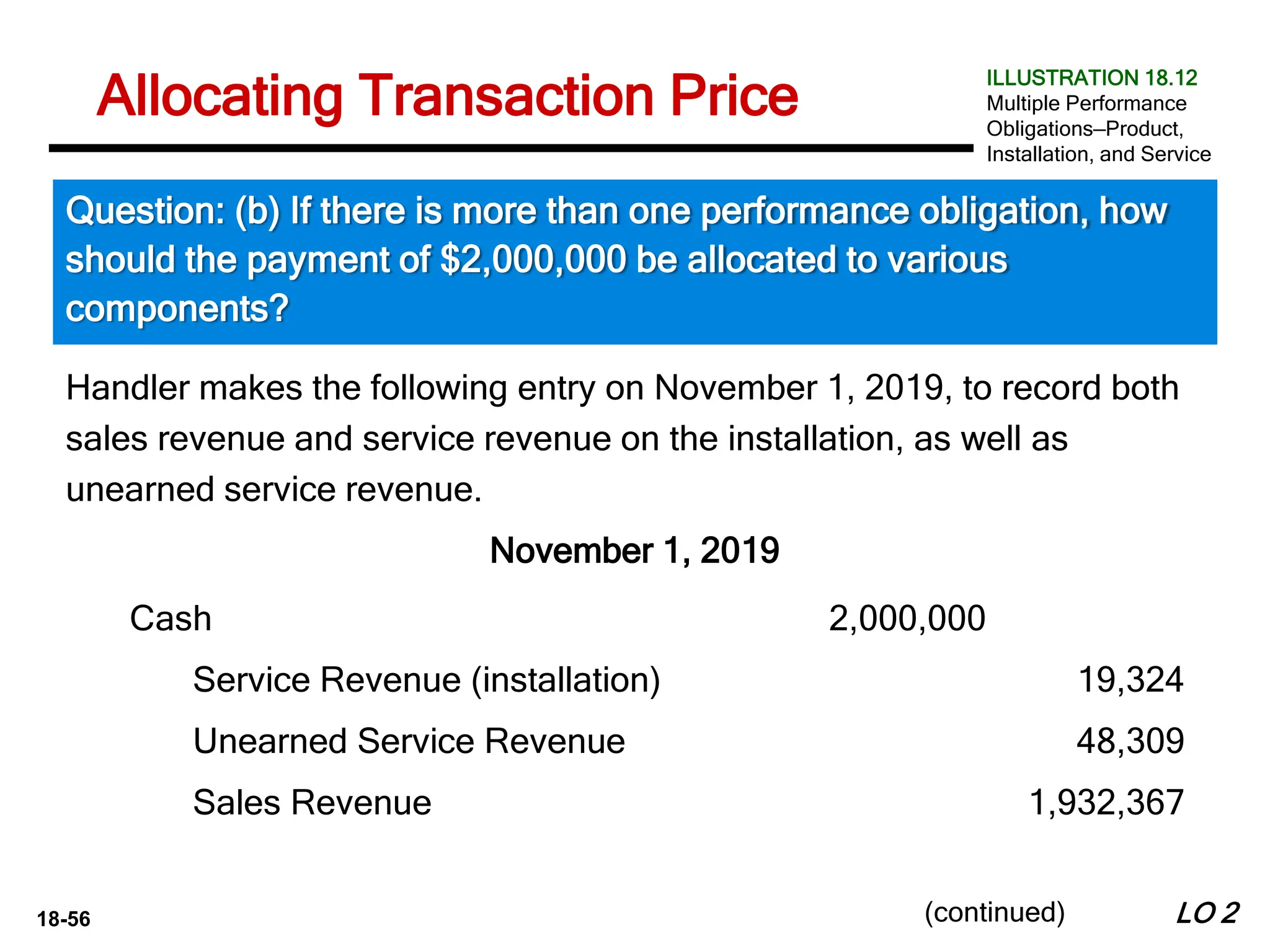
Handler makes the following entry on November 1, 2019, to record both
sales revenue and service revenue on the installation, as well as
unearned service revenue.
November 1, 2019
LO 2
Allocating Transaction Price
Question: (b) If there is more than one performance obligation, how
should the payment of $2,000,000 be allocated to various
components?
ILLUSTRATION 18.12
Multiple Performance
Obligations—Product,
Installation, and Service
(continued)
Cash 2,000,000
Service Revenue (installation) 19,324
Unearned Service Revenue 48,309
Sales Revenue 1,932,367
18-57
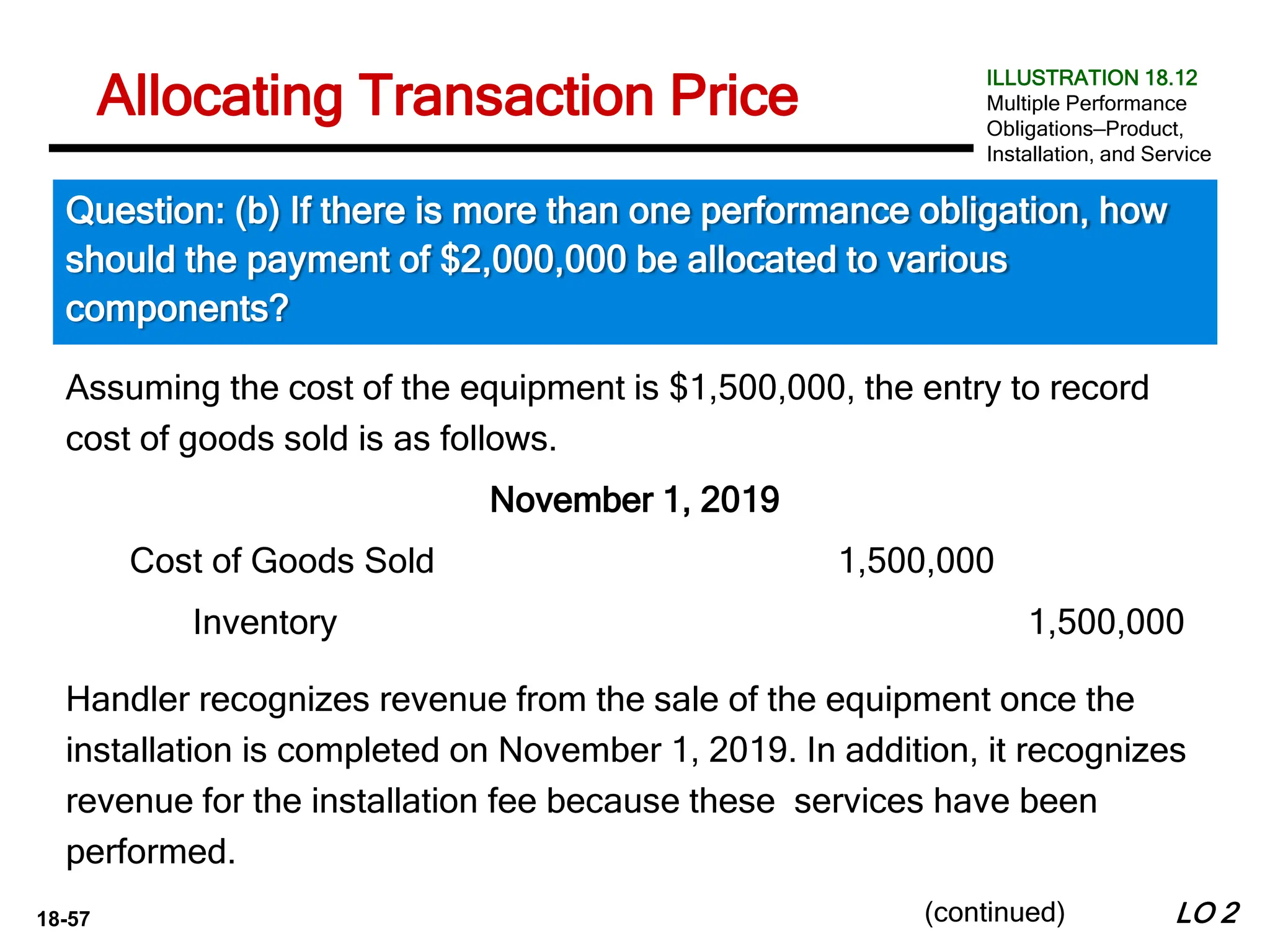
Assuming the cost of the equipment is $1,500,000, the entry to record
cost of goods sold is as follows.
November 1, 2019
LO 2
Allocating Transaction Price
Question: (b) If there is more than one performance obligation, how
should the payment of $2,000,000 be allocated to various
components?
ILLUSTRATION 18.12
Multiple Performance
Obligations—Product,
Installation, and Service
(continued)
Handler recognizes revenue from the sale of the equipment once the
installation is completed on November 1, 2019. In addition, it recognizes
revenue for the installation fee because these services have been
performed.
Cost of Goods Sold 1,500,000
Inventory 1,500,000
18-58
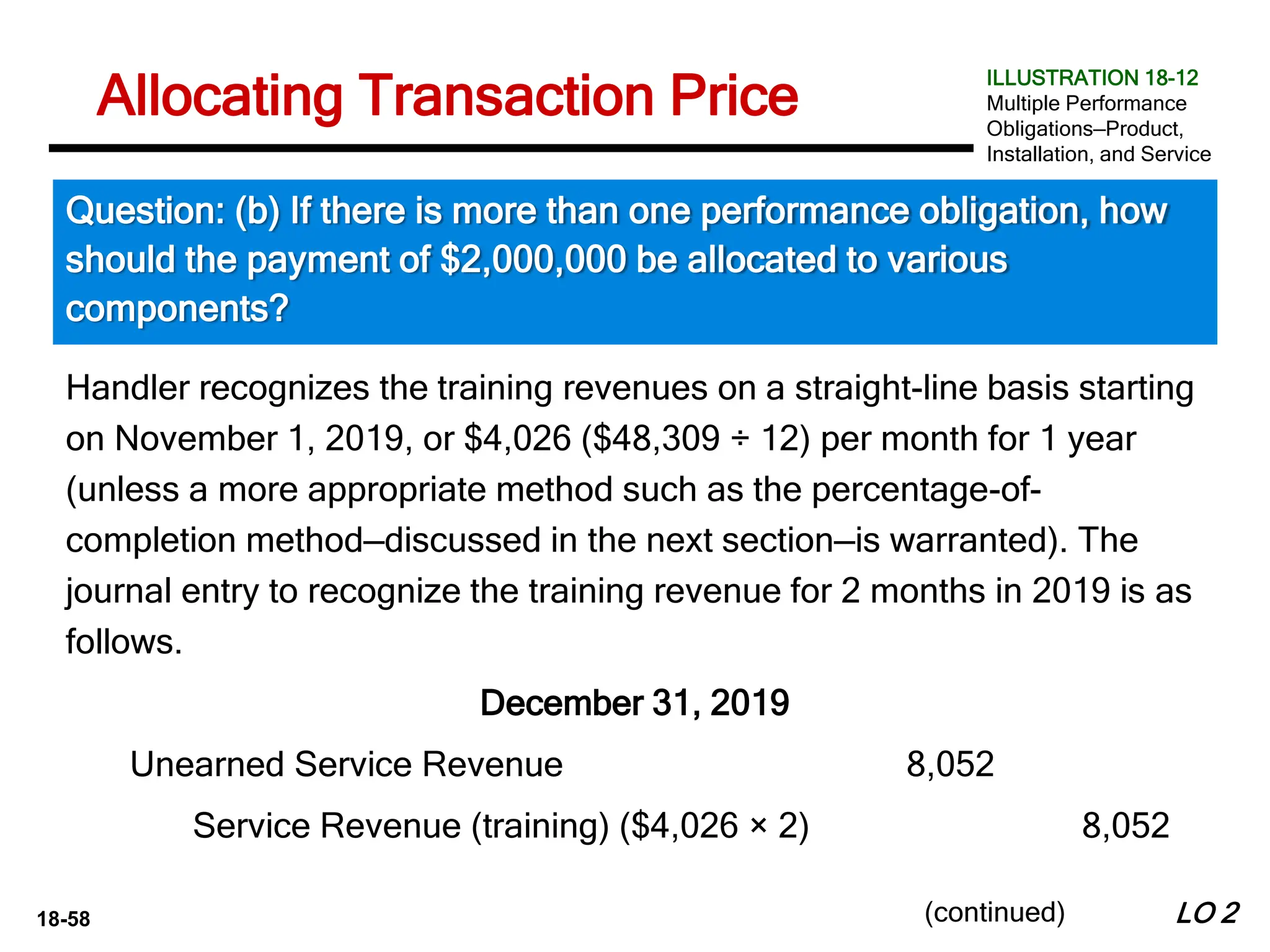
Handler recognizes the training revenues on a straight-line basis starting
on November 1, 2019, or $4,026 ($48,309 ÷ 12) per month for 1 year
(unless a more appropriate method such as the percentage-of-
completion method—discussed in the next section—is warranted). The
journal entry to recognize the training revenue for 2 months in 2019 is as
follows.
December 31, 2019
LO 2
Allocating Transaction Price
Question: (b) If there is more than one performance obligation, how
should the payment of $2,000,000 be allocated to various
components?
ILLUSTRATION 18-12
Multiple Performance
Obligations—Product,
Installation, and Service
(continued)
Unearned Service Revenue 8,052
Service Revenue (training) ($4,026 × 2) 8,052
18-59
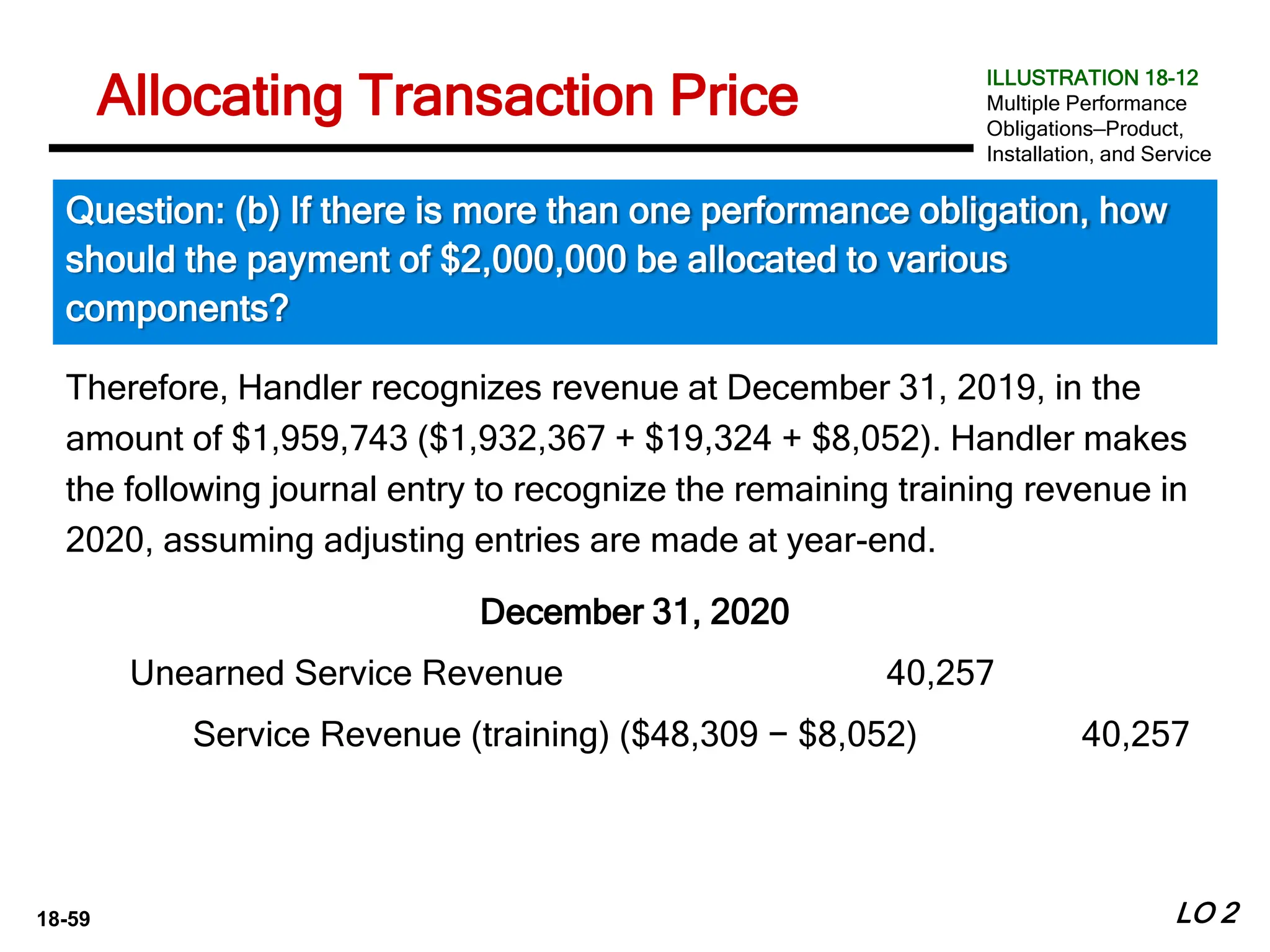
Therefore, Handler recognizes revenue at December 31, 2019, in the
amount of $1,959,743 ($1,932,367 + $19,324 + $8,052). Handler makes
the following journal entry to recognize the remaining training revenue in
2020, assuming adjusting entries are made at year-end.
December 31, 2020
LO 2
Allocating Transaction Price
Question: (b) If there is more than one performance obligation, how
should the payment of $2,000,000 be allocated to various
components?
ILLUSTRATION 18-12
Multiple Performance
Obligations—Product,
Installation, and Service
Unearned Service Revenue 40,257
Service Revenue (training) ($48,309 − $8,052) 40,257
18-60 LO 2
Recognizing Revenue When (or as) Each
Performance Obligation Is Satisfied—Step 5
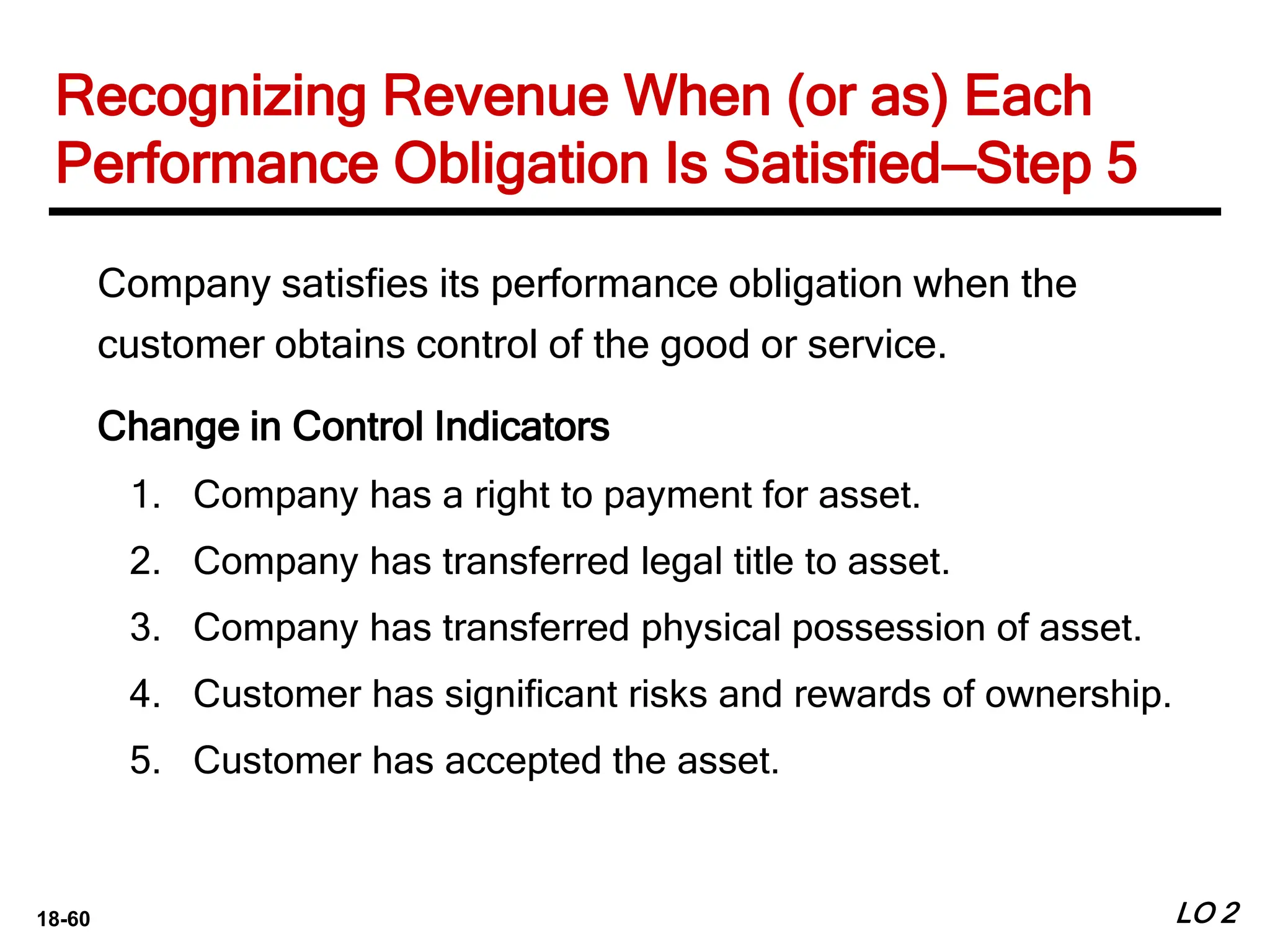
Company satisfies its performance obligation when the
customer obtains control of the good or service.
Change in Control Indicators
1. Company has a right to payment for asset.
2. Company has transferred legal title to asset.
3. Company has transferred physical possession of asset.
4. Customer has significant risks and rewards of ownership.
5. Customer has accepted the asset.
18-61 LO 2
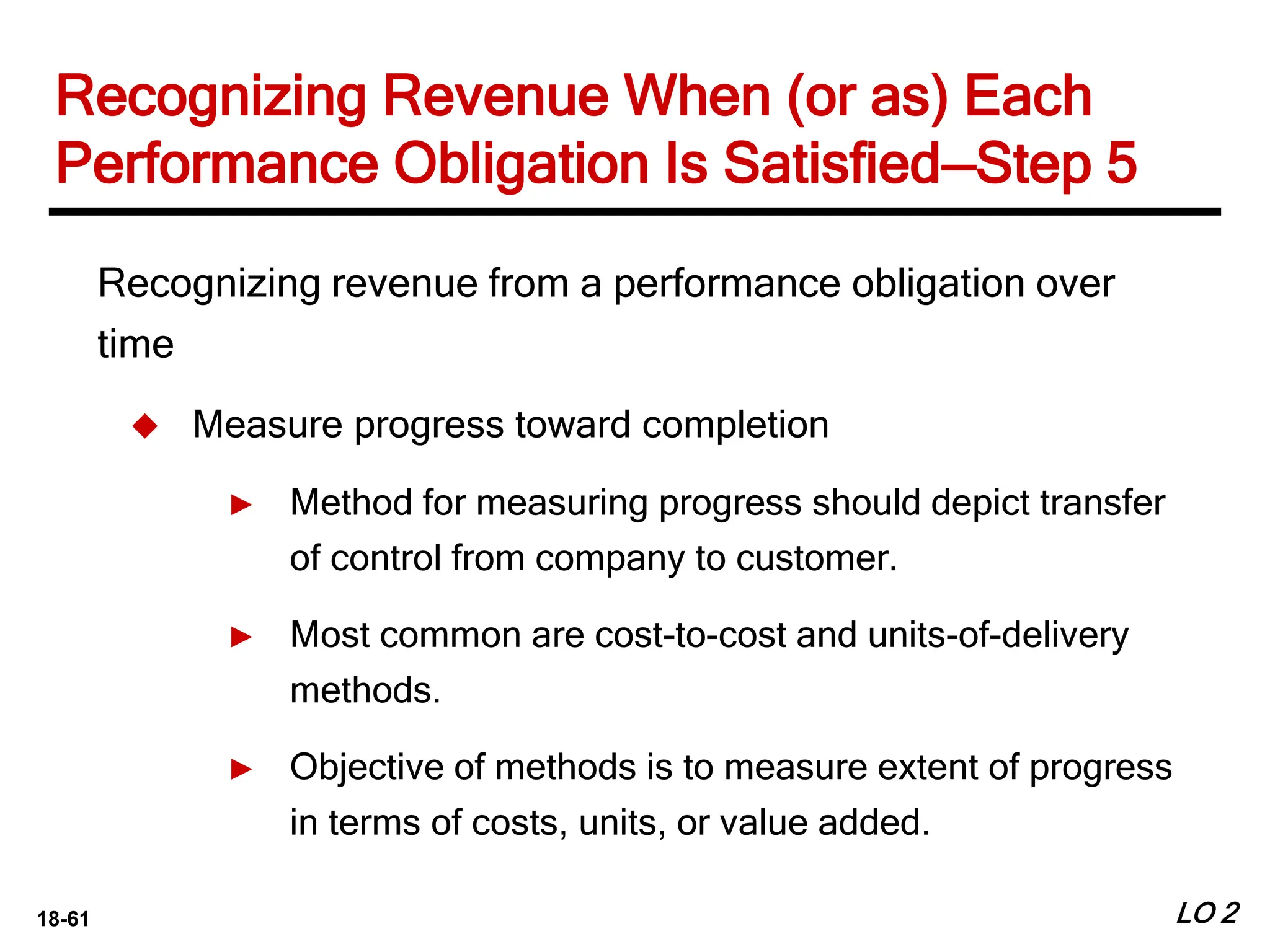
Recognizing revenue from a performance obligation over
time
 Measure progress toward completion
► Method for measuring progress should depict transfer
of control from company to customer.
► Most common are cost-to-cost and units-of-delivery
methods.
► Objective of methods is to measure extent of progress
in terms of costs, units, or value added.
Recognizing Revenue When (or as) Each
Performance Obligation Is Satisfied—Step 5
18-62 LO 2
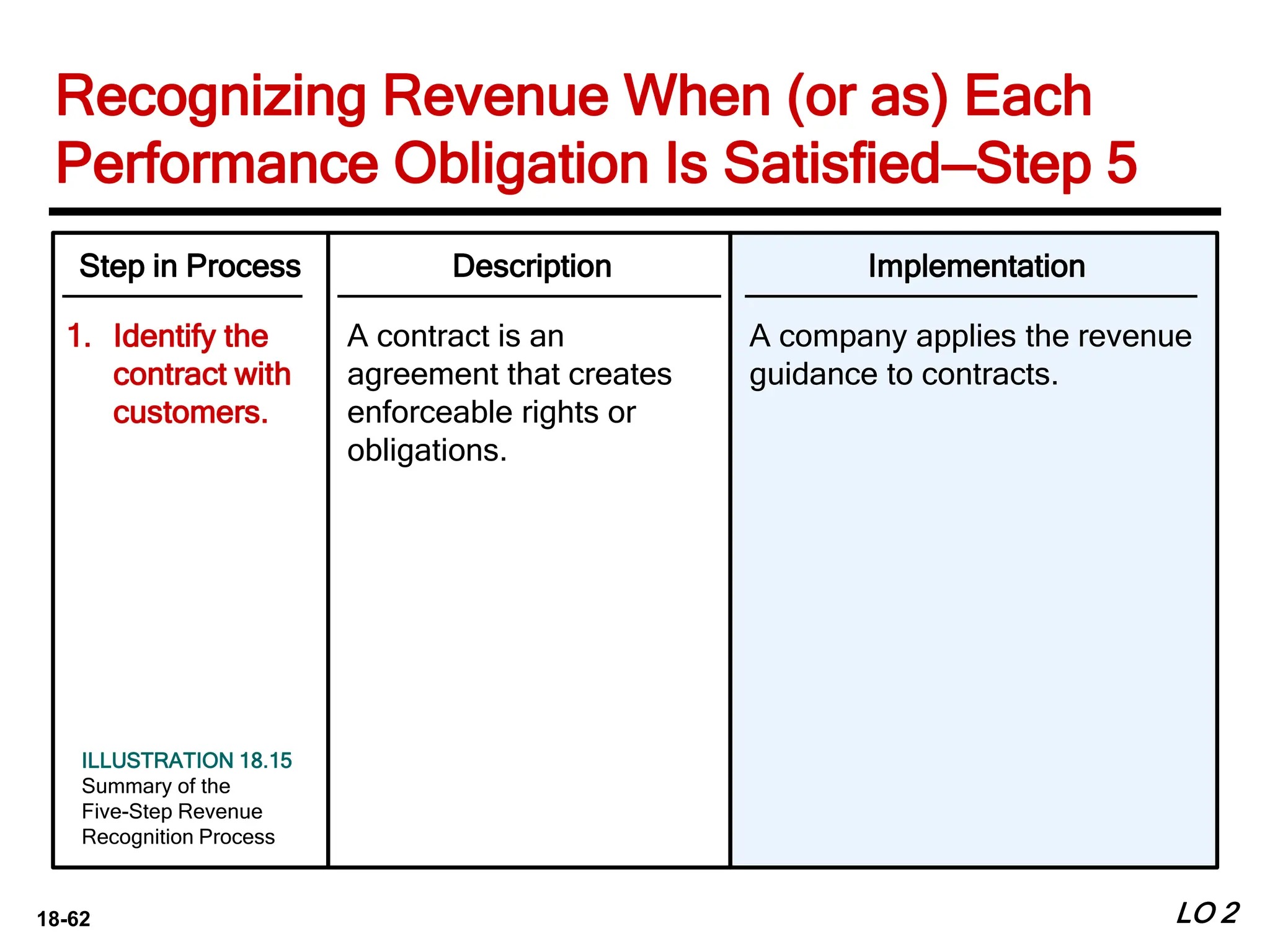
Step in Process
1. Identify the
contract with
customers.
Description
A contract is an
agreement that creates
enforceable rights or
obligations.
Implementation
A company applies the revenue
guidance to contracts.
ILLUSTRATION 18.15
Summary of the
Five-Step Revenue
Recognition Process
Recognizing Revenue When (or as) Each
Performance Obligation Is Satisfied—Step 5
18-63 LO 2
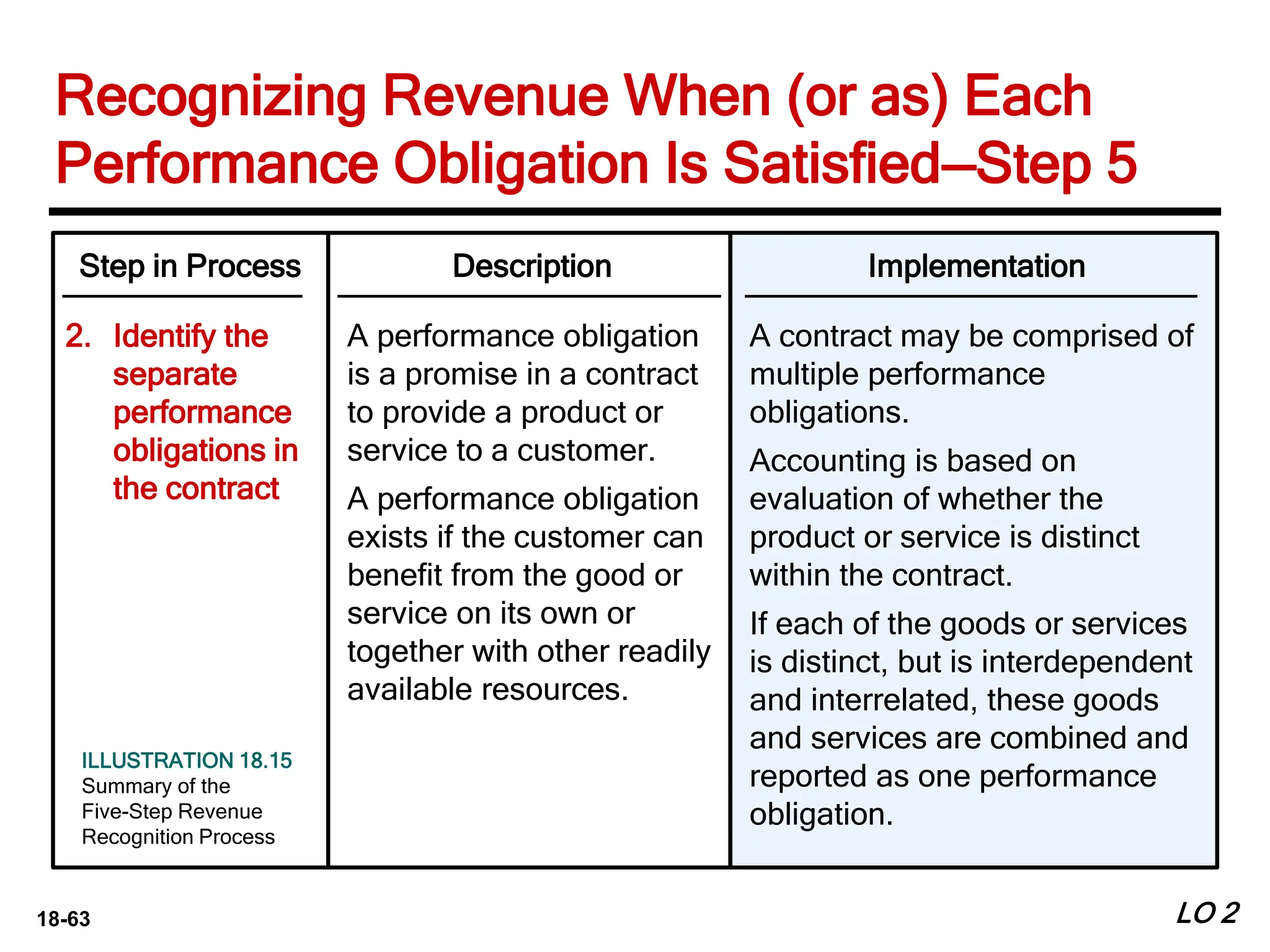
Step in Process
2. Identify the
separate
performance
obligations in
the contract
Description
A performance obligation
is a promise in a contract
to provide a product or
service to a customer.
A performance obligation
exists if the customer can
benefit from the good or
service on its own or
together with other readily
available resources.
Implementation
A contract may be comprised of
multiple performance
obligations.
Accounting is based on
evaluation of whether the
product or service is distinct
within the contract.
If each of the goods or services
is distinct, but is interdependent
and interrelated, these goods
and services are combined and
reported as one performance
obligation.
ILLUSTRATION 18.15
Summary of the
Five-Step Revenue
Recognition Process
Recognizing Revenue When (or as) Each
Performance Obligation Is Satisfied—Step 5
18-64 LO 2
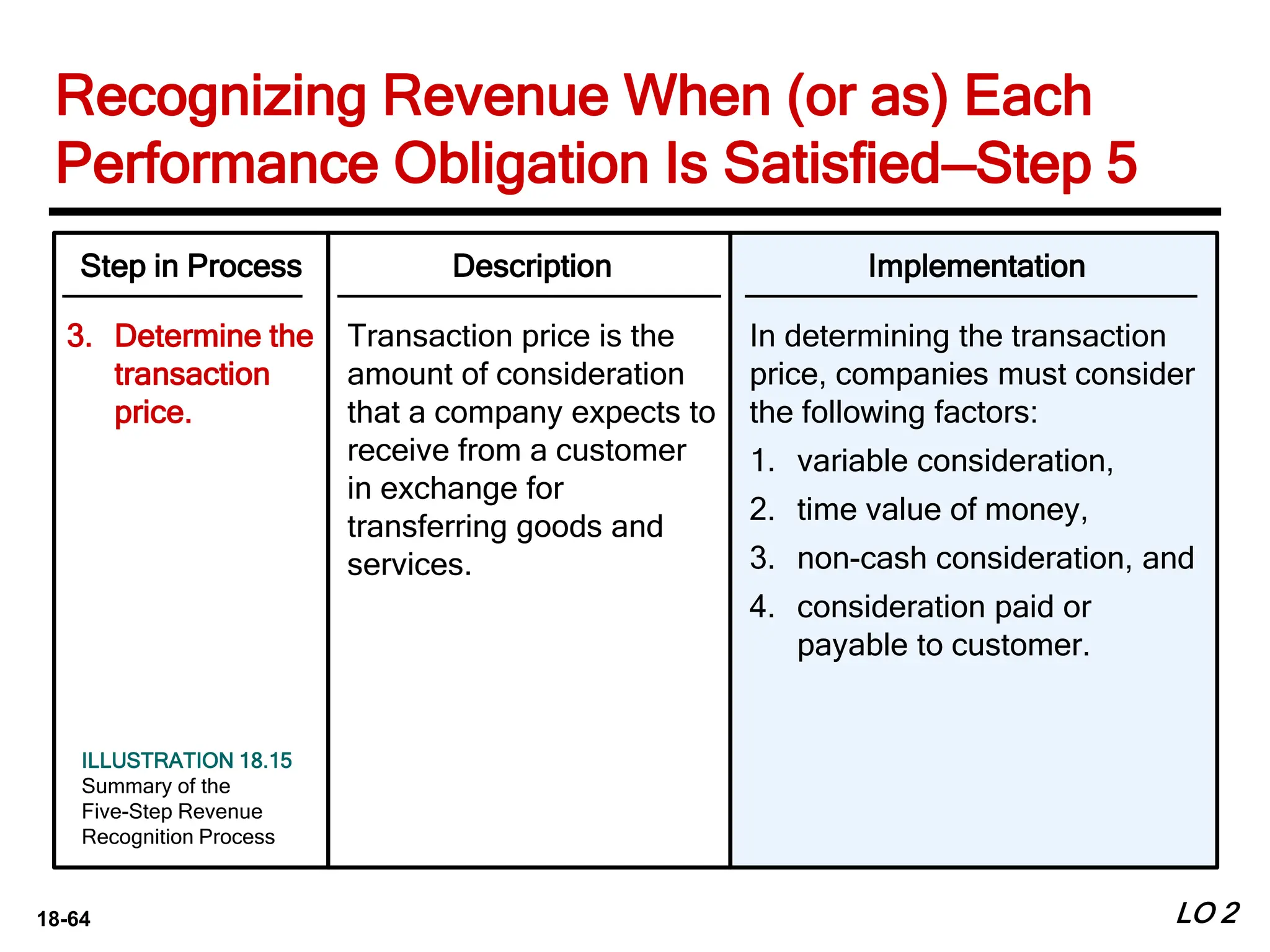
Step in Process
3. Determine the
transaction
price.
Description
Transaction price is the
amount of consideration
that a company expects to
receive from a customer
in exchange for
transferring goods and
services.
Implementation
In determining the transaction
price, companies must consider
the following factors:
1. variable consideration,
2. time value of money,
3. non-cash consideration, and
4. consideration paid or
payable to customer.
ILLUSTRATION 18.15
Summary of the
Five-Step Revenue
Recognition Process
Recognizing Revenue When (or as) Each
Performance Obligation Is Satisfied—Step 5
18-65 LO 2
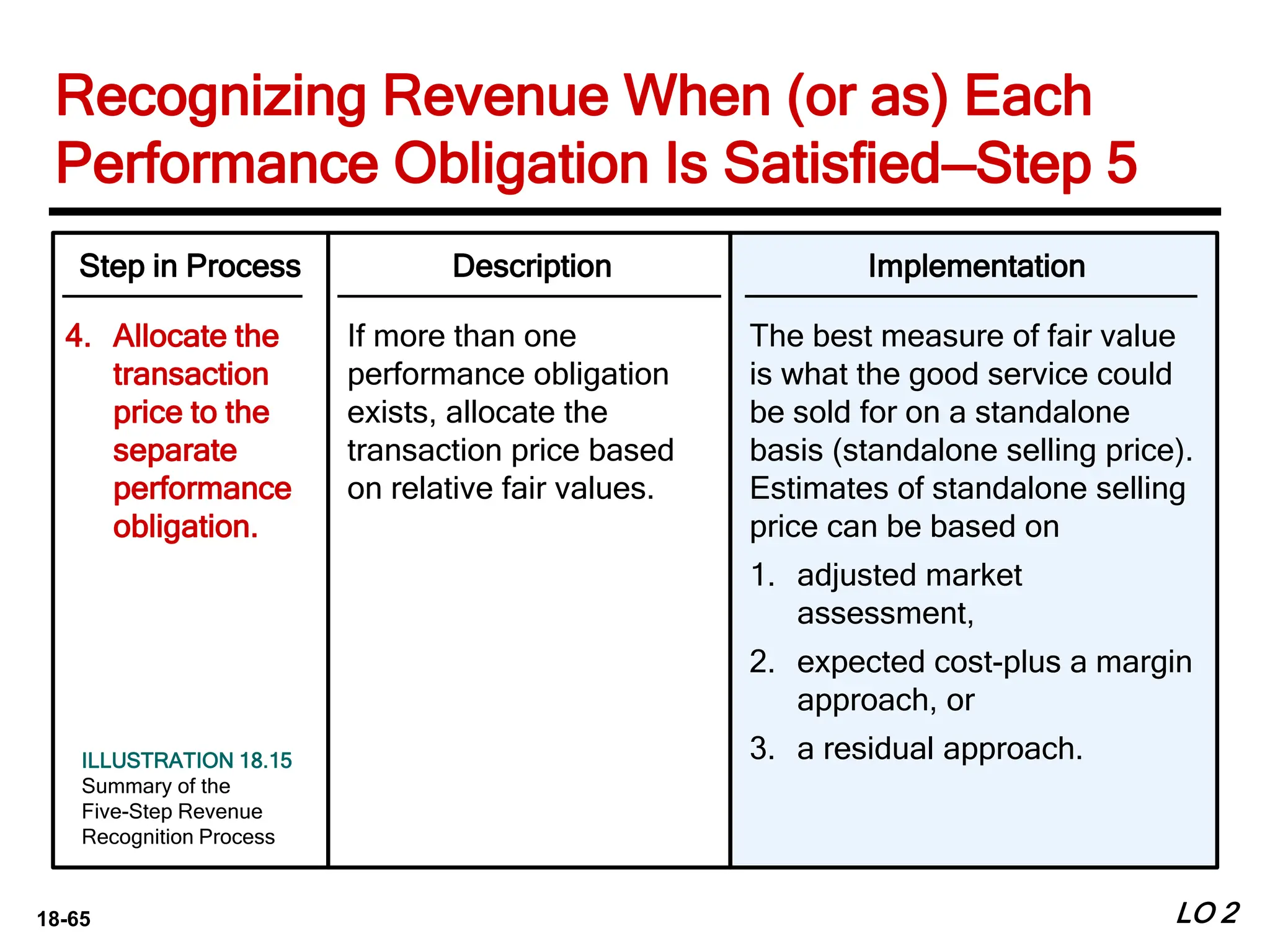
Step in Process
4. Allocate the
transaction
price to the
separate
performance
obligation.
Description
If more than one
performance obligation
exists, allocate the
transaction price based
on relative fair values.
Implementation
The best measure of fair value
is what the good service could
be sold for on a standalone
basis (standalone selling price).
Estimates of standalone selling
price can be based on
1. adjusted market
assessment,
2. expected cost-plus a margin
approach, or
3. a residual approach.
ILLUSTRATION 18.15
Summary of the
Five-Step Revenue
Recognition Process
Recognizing Revenue When (or as) Each
Performance Obligation Is Satisfied—Step 5
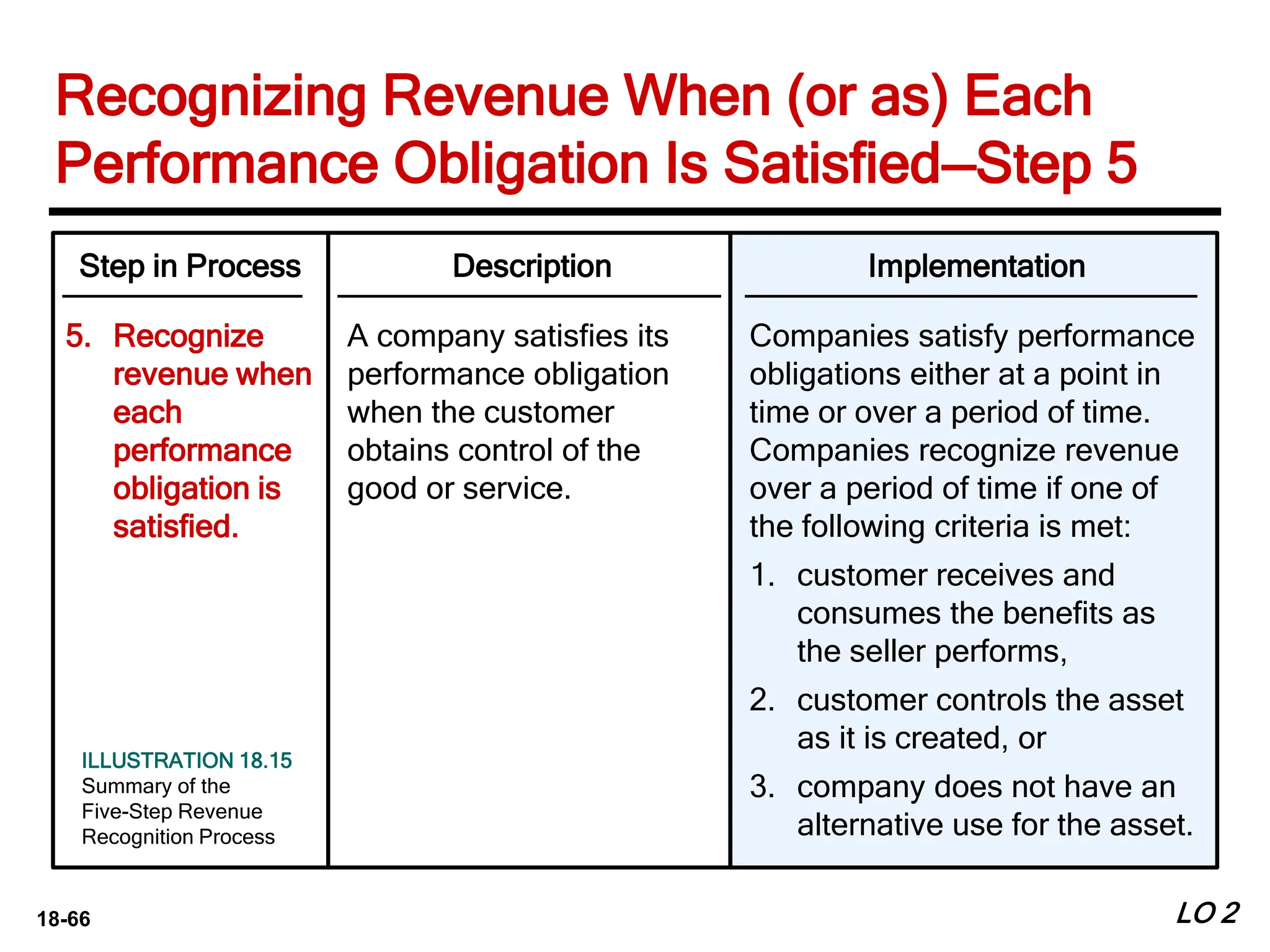
18-66 LO 2
Step in Process
5. Recognize
revenue when
each
performance
obligation is
satisfied.
Description
A company satisfies its
performance obligation
when the customer
obtains control of the
good or service.
Implementation
Companies satisfy performance
obligations either at a point in
time or over a period of time.
Companies recognize revenue
over a period of time if one of
the following criteria is met:
1. customer receives and
consumes the benefits as
the seller performs,
2. customer controls the asset
as it is created, or
3. company does not have an
alternative use for the asset.
ILLUSTRATION 18.15
Summary of the
Five-Step Revenue
Recognition Process
Recognizing Revenue When (or as) Each
Performance Obligation Is Satisfied—Step 5
18-67
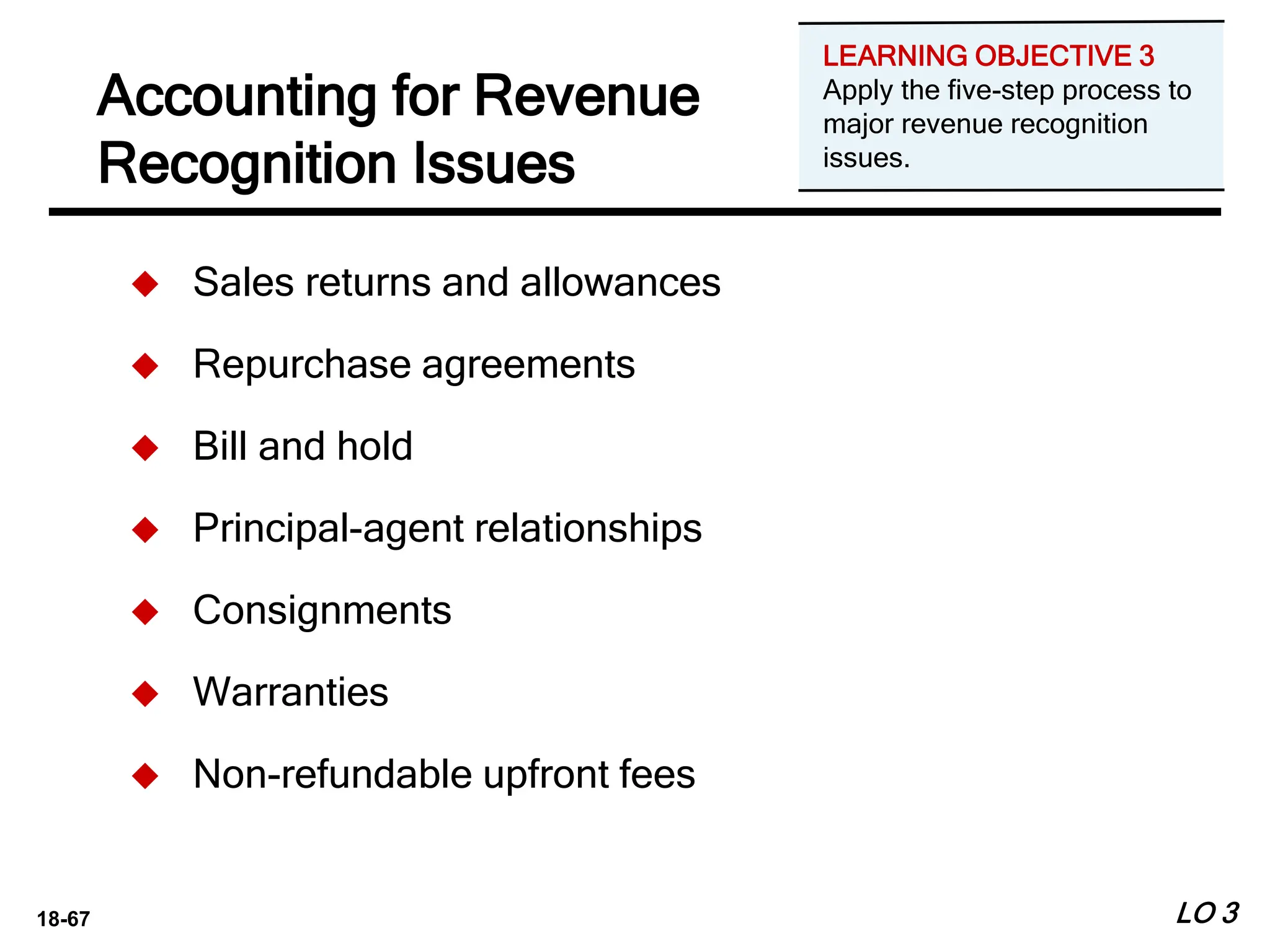
Accounting for Revenue
Recognition Issues
LO 3
 Sales returns and allowances
 Repurchase agreements
 Bill and hold
 Principal-agent relationships
 Consignments
 Warranties
 Non-refundable upfront fees
LEARNING OBJECTIVE 3
Apply the five-step process to
major revenue recognition
issues.
18-68
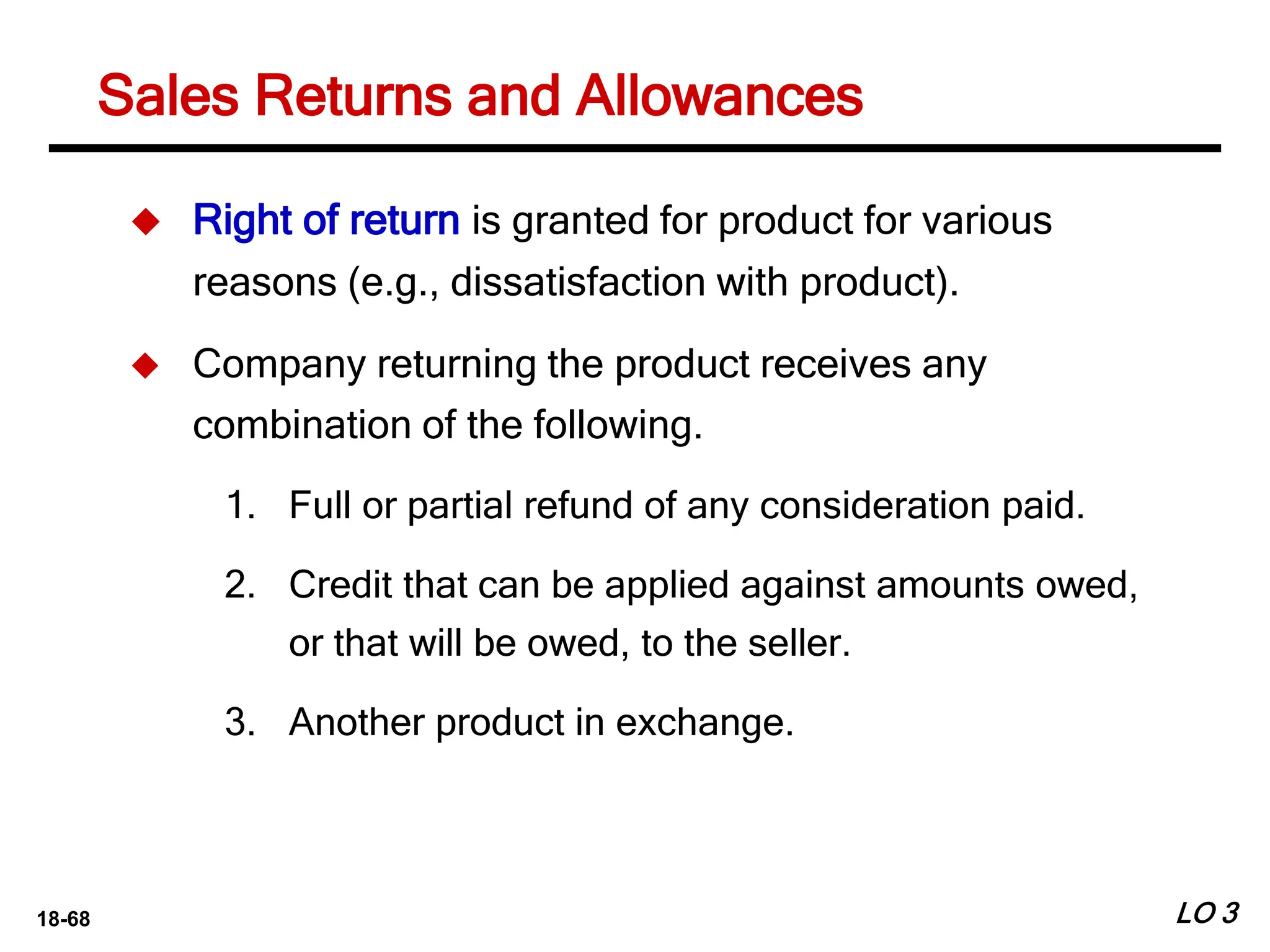
Sales Returns and Allowances
LO 3
 Right of return is granted for product for various
reasons (e.g., dissatisfaction with product).
 Company returning the product receives any
combination of the following.
1. Full or partial refund of any consideration paid.
2. Credit that can be applied against amounts owed,
or that will be owed, to the seller.
3. Another product in exchange.
18-69
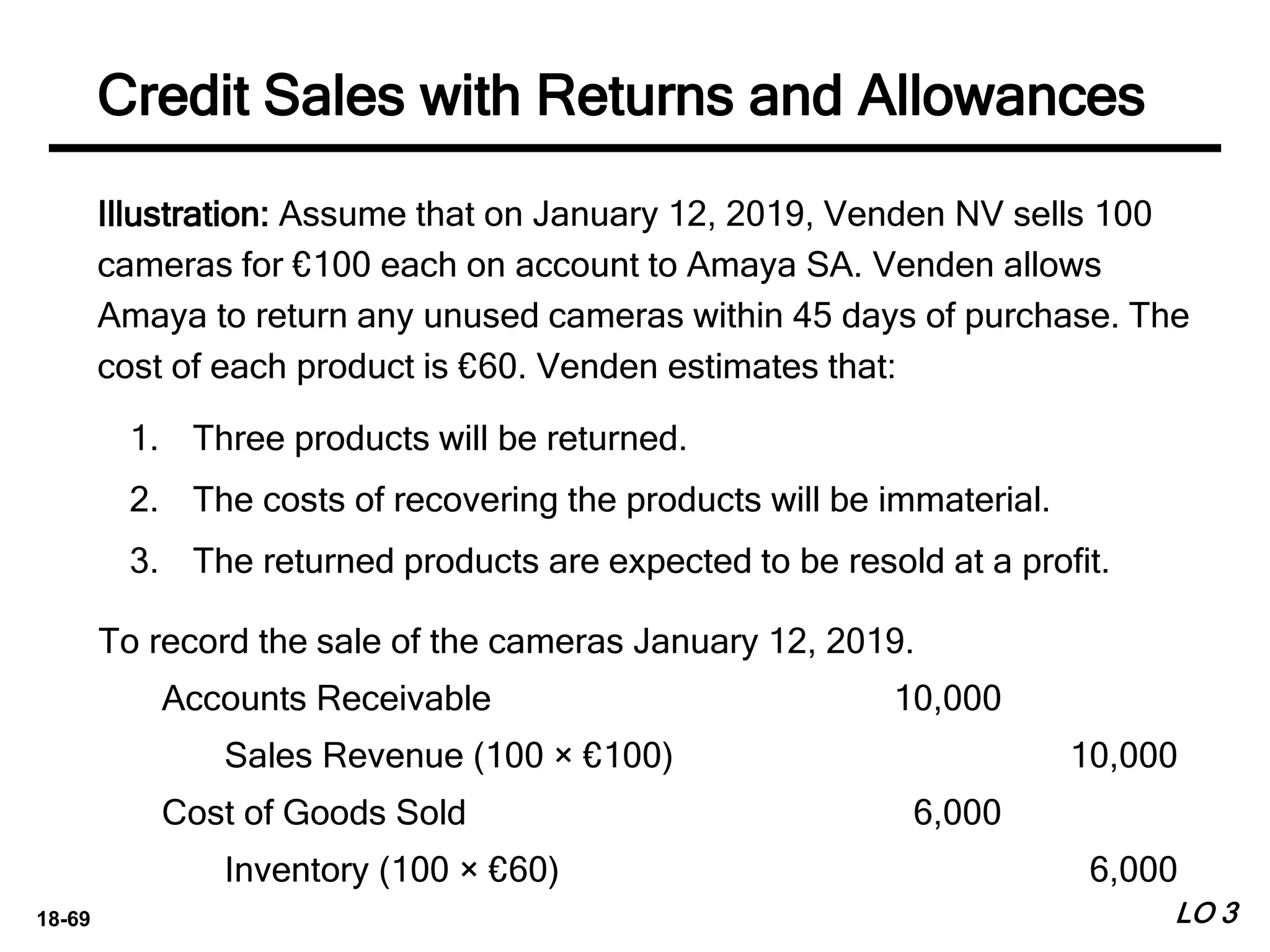
Illustration: Assume that on January 12, 2019, Venden NV sells 100
cameras for €100 each on account to Amaya SA. Venden allows
Amaya to return any unused cameras within 45 days of purchase. The
cost of each product is €60. Venden estimates that:
1. Three products will be returned.
2. The costs of recovering the products will be immaterial.
3. The returned products are expected to be resold at a profit.
LO 3
Credit Sales with Returns and Allowances
To record the sale of the cameras January 12, 2019.
Accounts Receivable 10,000
Sales Revenue (100 × €100) 10,000
Cost of Goods Sold 6,000
Inventory (100 × €60) 6,000
18-70
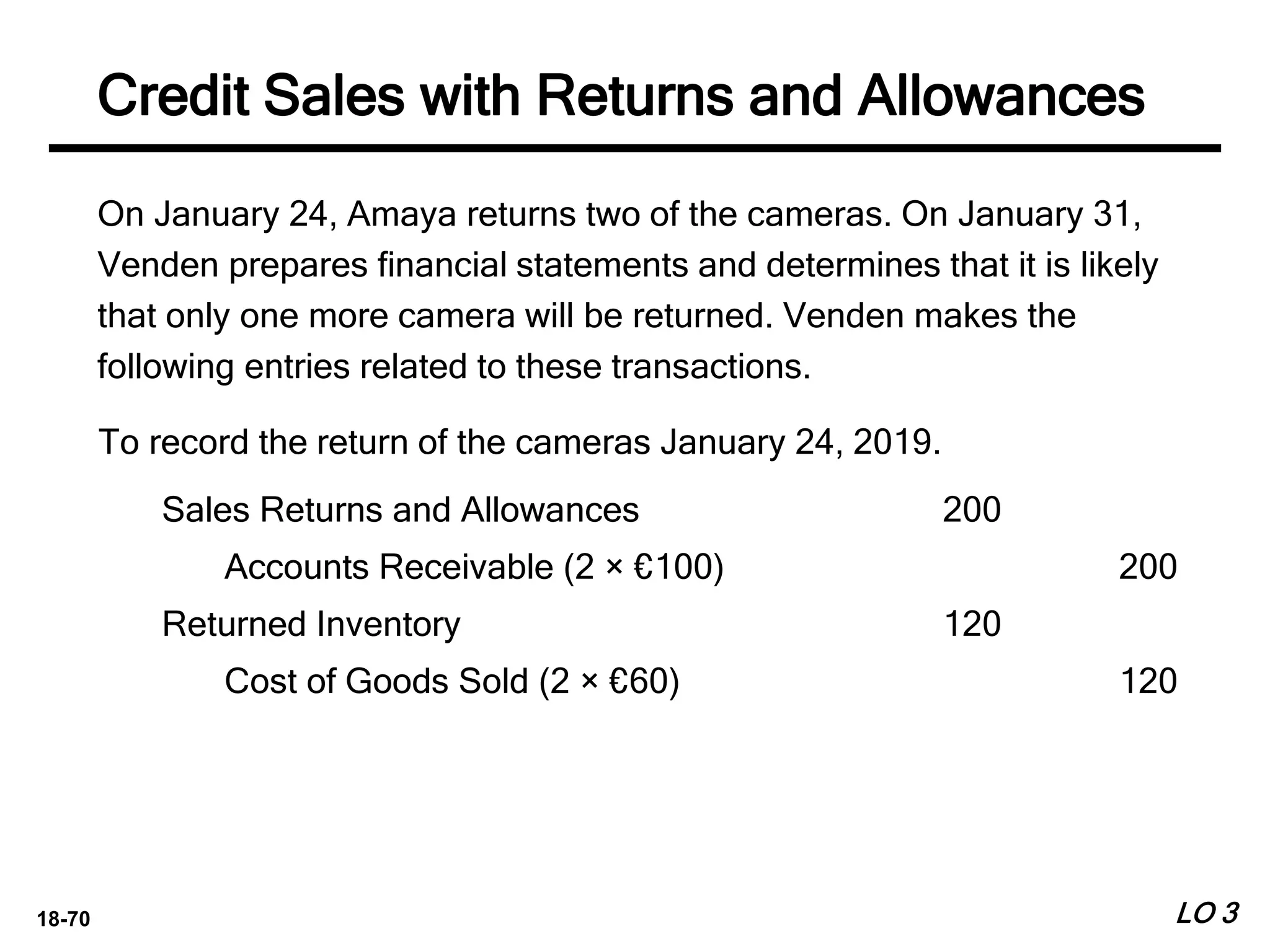
On January 24, Amaya returns two of the cameras. On January 31,
Venden prepares financial statements and determines that it is likely
that only one more camera will be returned. Venden makes the
following entries related to these transactions.
LO 3
To record the return of the cameras January 24, 2019.
Sales Returns and Allowances 200
Accounts Receivable (2 × €100) 200
Returned Inventory 120
Cost of Goods Sold (2 × €60) 120
Credit Sales with Returns and Allowances
18-71
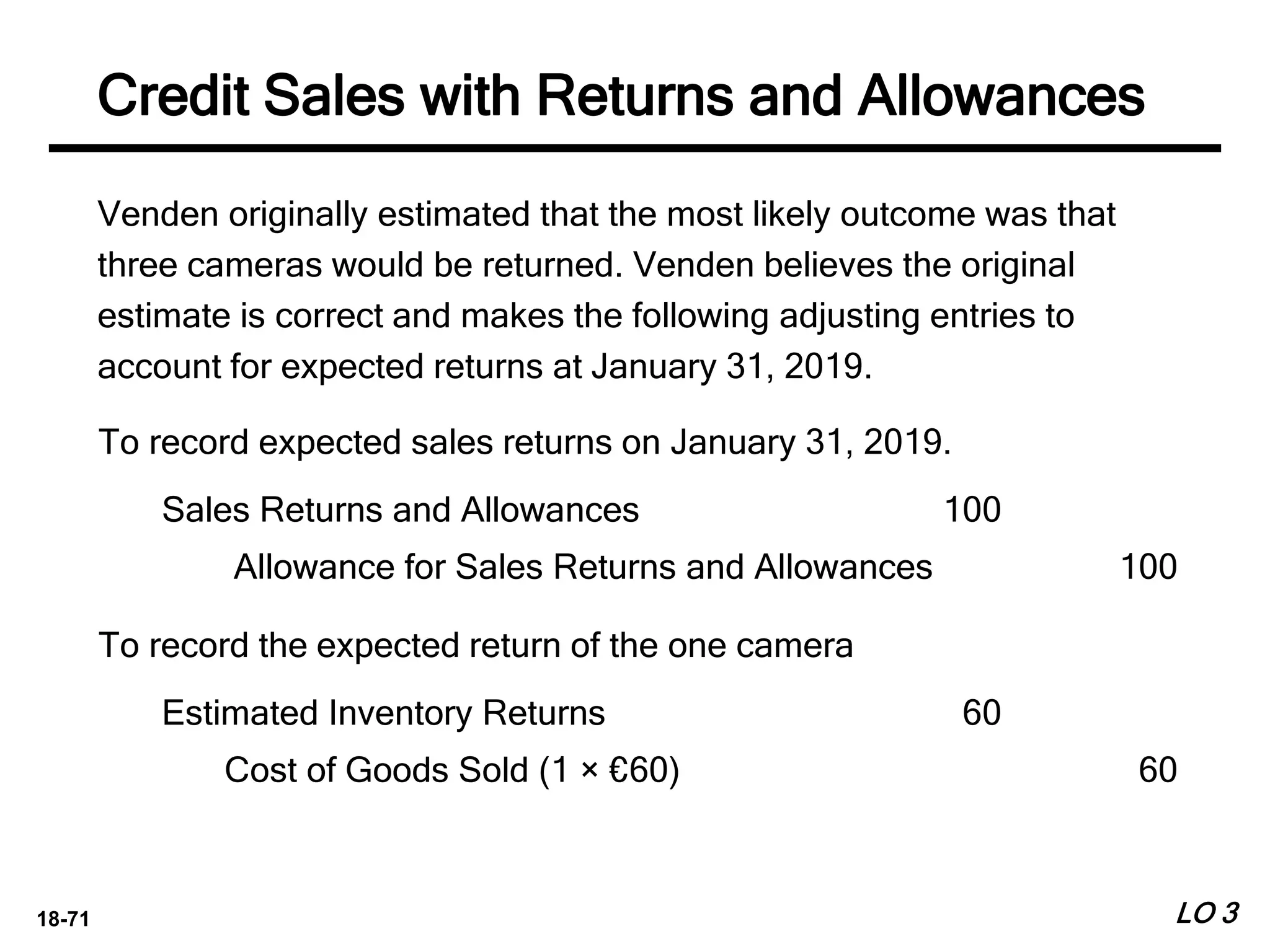
Venden originally estimated that the most likely outcome was that
three cameras would be returned. Venden believes the original
estimate is correct and makes the following adjusting entries to
account for expected returns at January 31, 2019.
LO 3
To record expected sales returns on January 31, 2019.
Sales Returns and Allowances 100
Allowance for Sales Returns and Allowances 100
To record the expected return of the one camera
Estimated Inventory Returns 60
Cost of Goods Sold (1 × €60) 60
Credit Sales with Returns and Allowances
18-72
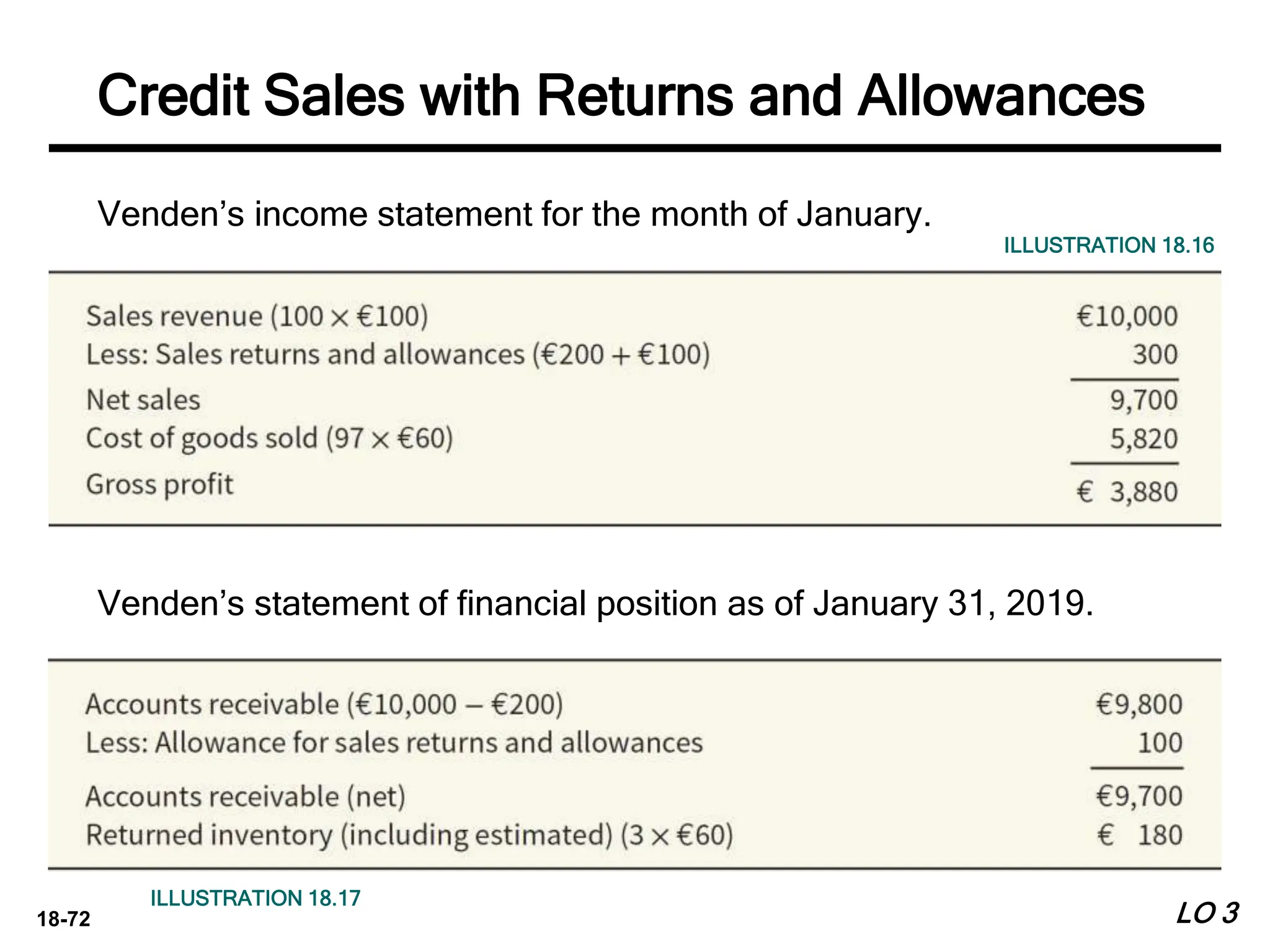
Venden’s income statement for the month of January.
LO 3
Credit Sales with Returns and Allowances
Venden’s statement of financial position as of January 31, 2019.
ILLUSTRATION 18.16
ILLUSTRATION 18.17
18-73
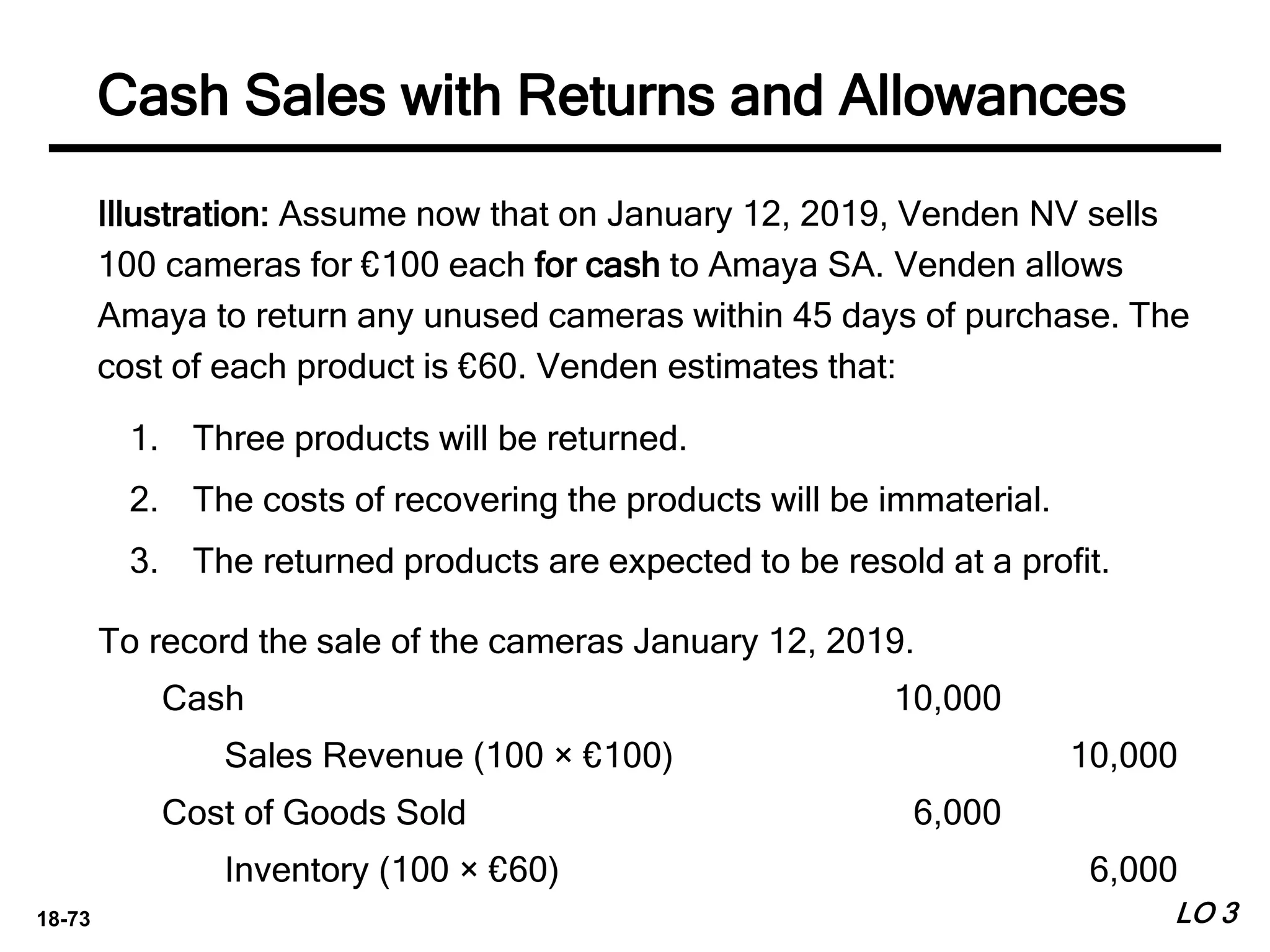
Illustration: Assume now that on January 12, 2019, Venden NV sells
100 cameras for €100 each for cash to Amaya SA. Venden allows
Amaya to return any unused cameras within 45 days of purchase. The
cost of each product is €60. Venden estimates that:
1. Three products will be returned.
2. The costs of recovering the products will be immaterial.
3. The returned products are expected to be resold at a profit.
LO 3
Cash Sales with Returns and Allowances
To record the sale of the cameras January 12, 2019.
Cash 10,000
Sales Revenue (100 × €100) 10,000
Cost of Goods Sold 6,000
Inventory (100 × €60) 6,000
18-74
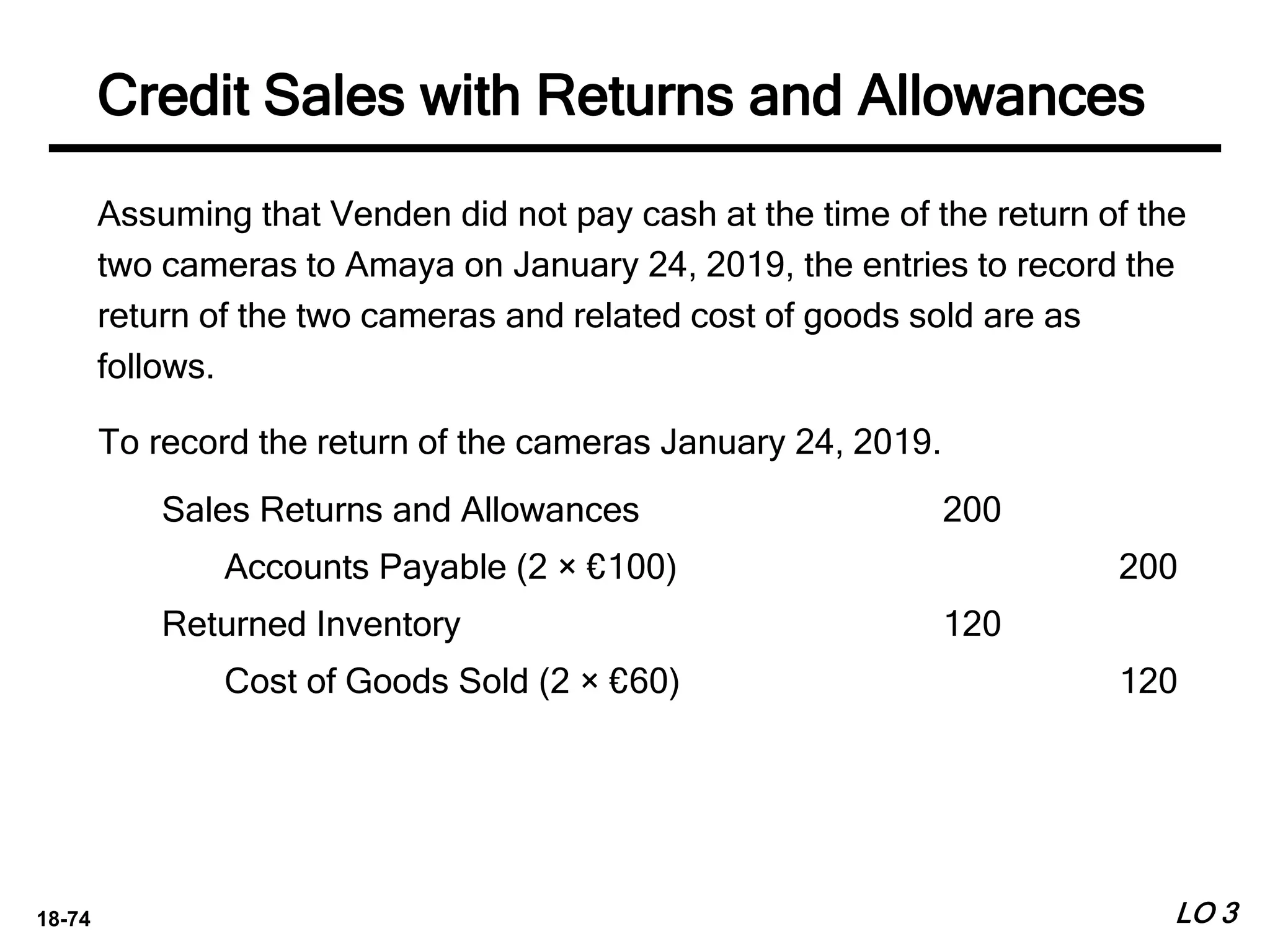
Assuming that Venden did not pay cash at the time of the return of the
two cameras to Amaya on January 24, 2019, the entries to record the
return of the two cameras and related cost of goods sold are as
follows.
LO 3
To record the return of the cameras January 24, 2019.
Sales Returns and Allowances 200
Accounts Payable (2 × €100) 200
Returned Inventory 120
Cost of Goods Sold (2 × €60) 120
Credit Sales with Returns and Allowances
18-75
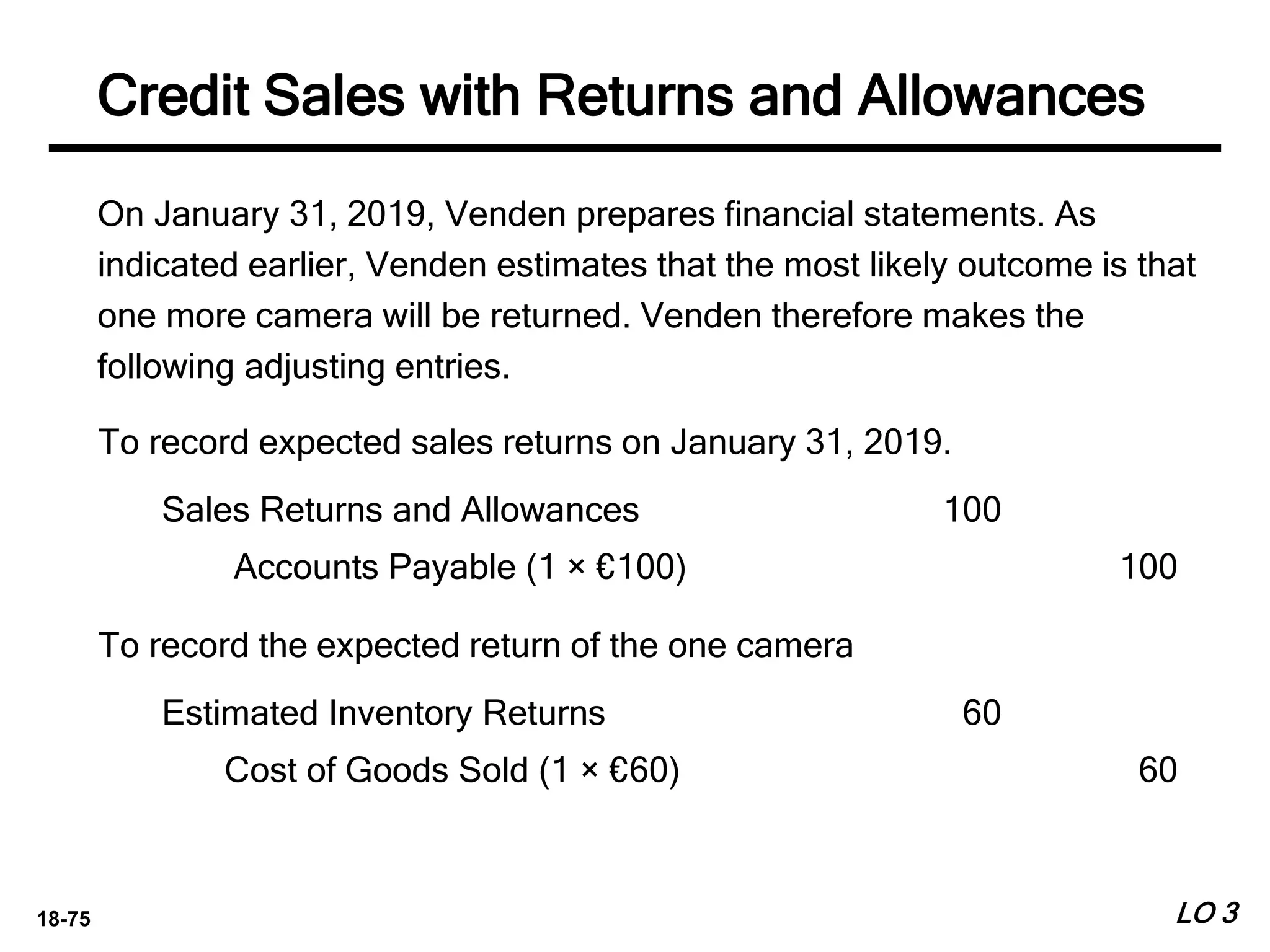
On January 31, 2019, Venden prepares financial statements. As
indicated earlier, Venden estimates that the most likely outcome is that
one more camera will be returned. Venden therefore makes the
following adjusting entries.
LO 3
To record expected sales returns on January 31, 2019.
Sales Returns and Allowances 100
Accounts Payable (1 × €100) 100
To record the expected return of the one camera
Estimated Inventory Returns 60
Cost of Goods Sold (1 × €60) 60
Credit Sales with Returns and Allowances
18-76
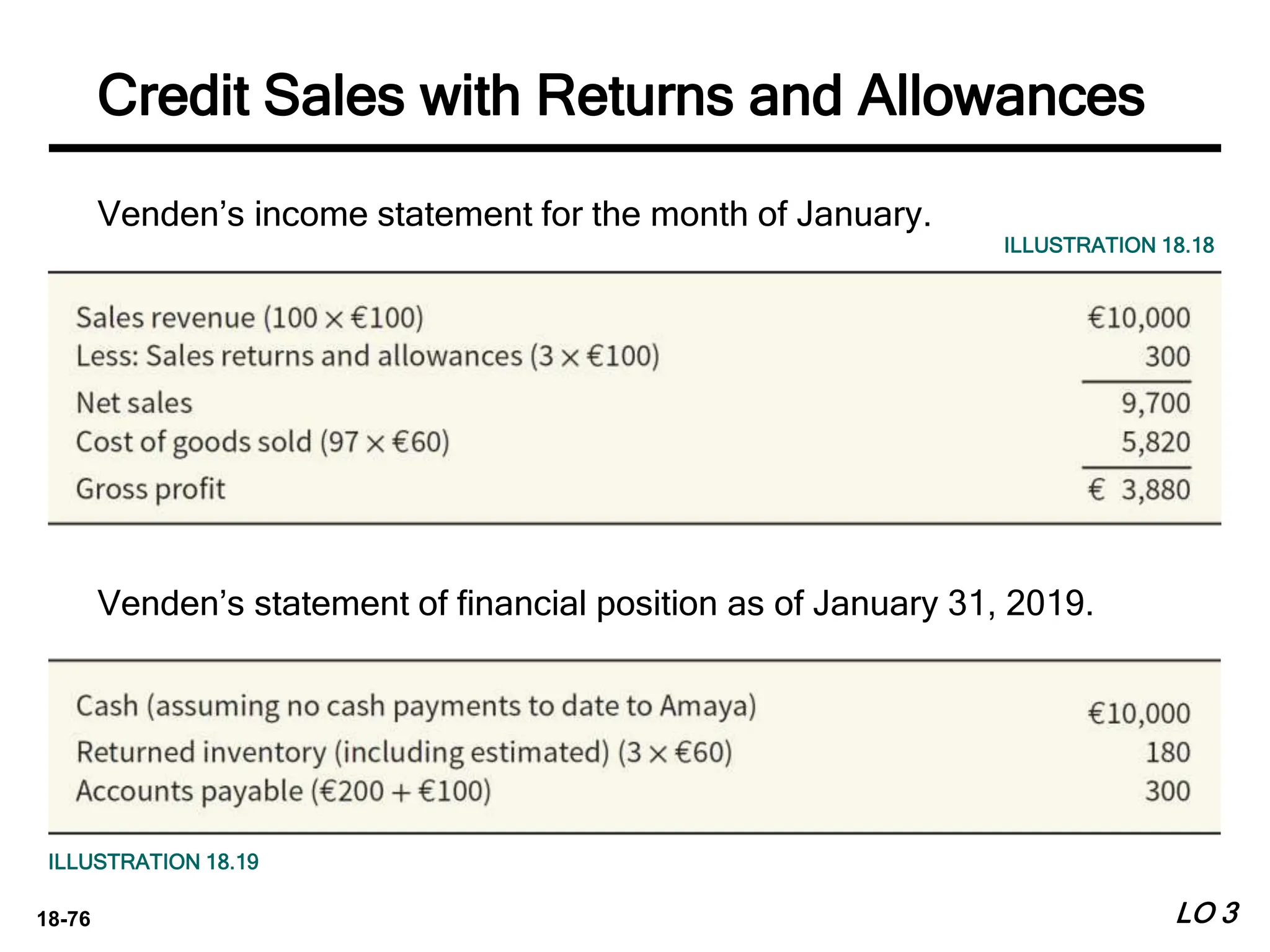
Venden’s income statement for the month of January.
LO 3
Credit Sales with Returns and Allowances
Venden’s statement of financial position as of January 31, 2019.
ILLUSTRATION 18.18
ILLUSTRATION 18.19
18-77
Repurchase Agreements
LO 3
 Allows company to transfer an asset to a customer but
have an unconditional (forward) obligation or
unconditional right (call option) to repurchase the asset
at a later date.
 If the obligation or right to repurchase is for an amount
greater than or equal to selling price, then transaction
is a financing transaction.
18-78
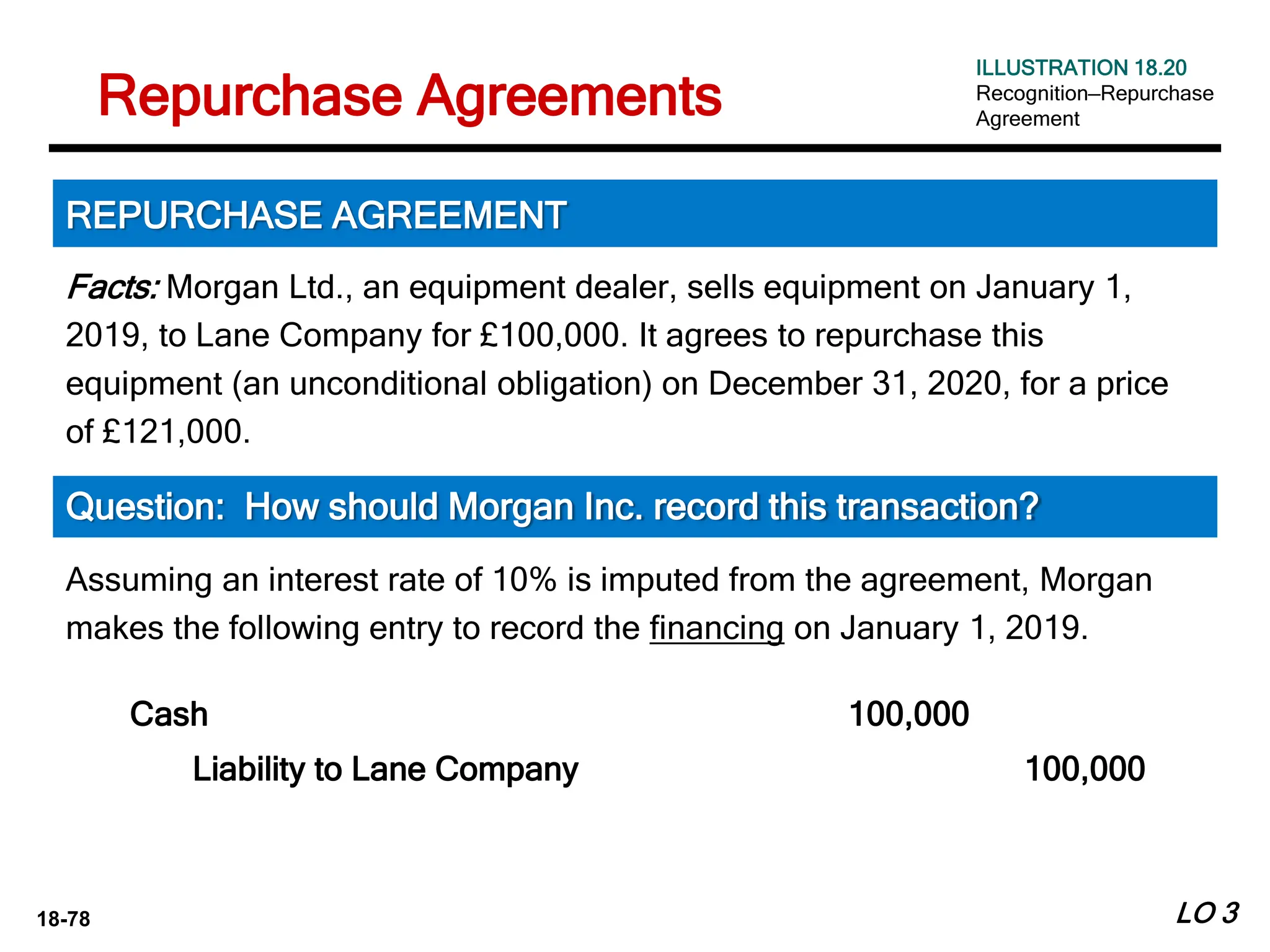
Facts: Morgan Ltd., an equipment dealer, sells equipment on January 1,
2019, to Lane Company for £100,000. It agrees to repurchase this
equipment (an unconditional obligation) on December 31, 2020, for a price
of £121,000.
LO 3
REPURCHASE AGREEMENT
Question: How should Morgan Inc. record this transaction?
ILLUSTRATION 18.20
Recognition—Repurchase
Agreement
Repurchase Agreements
Assuming an interest rate of 10% is imputed from the agreement, Morgan
makes the following entry to record the financing on January 1, 2019.
Cash 100,000
Liability to Lane Company 100,000
18-79 LO 3
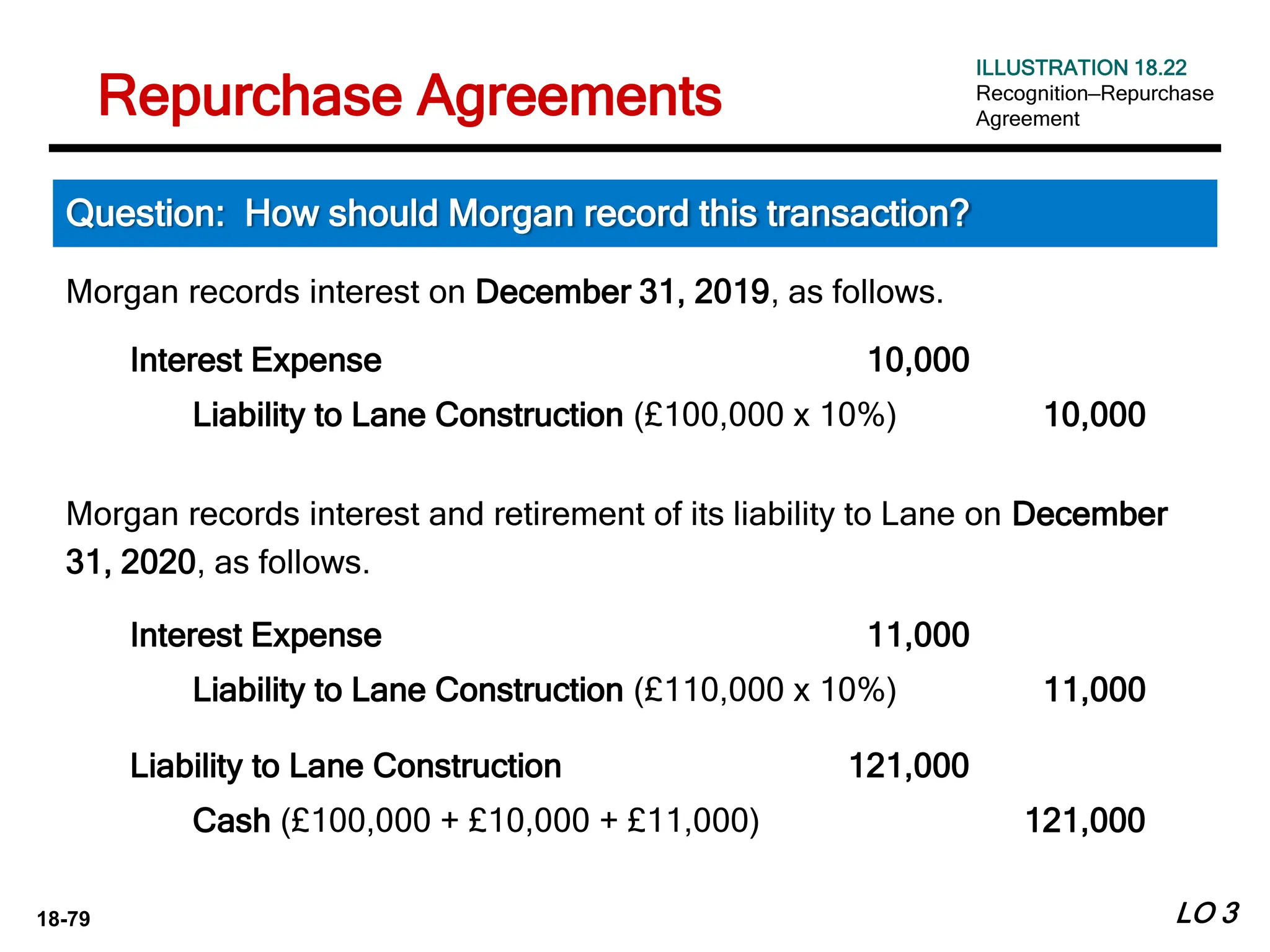
ILLUSTRATION 18.22
Recognition—Repurchase
Agreement
Repurchase Agreements
Morgan records interest on December 31, 2019, as follows.
Interest Expense 10,000
Liability to Lane Construction (£100,000 x 10%) 10,000
Question: How should Morgan record this transaction?
Morgan records interest and retirement of its liability to Lane on December
31, 2020, as follows.
Interest Expense 11,000
Liability to Lane Construction (£110,000 x 10%) 11,000
Liability to Lane Construction 121,000
Cash (£100,000 + £10,000 + £11,000) 121,000
18-80
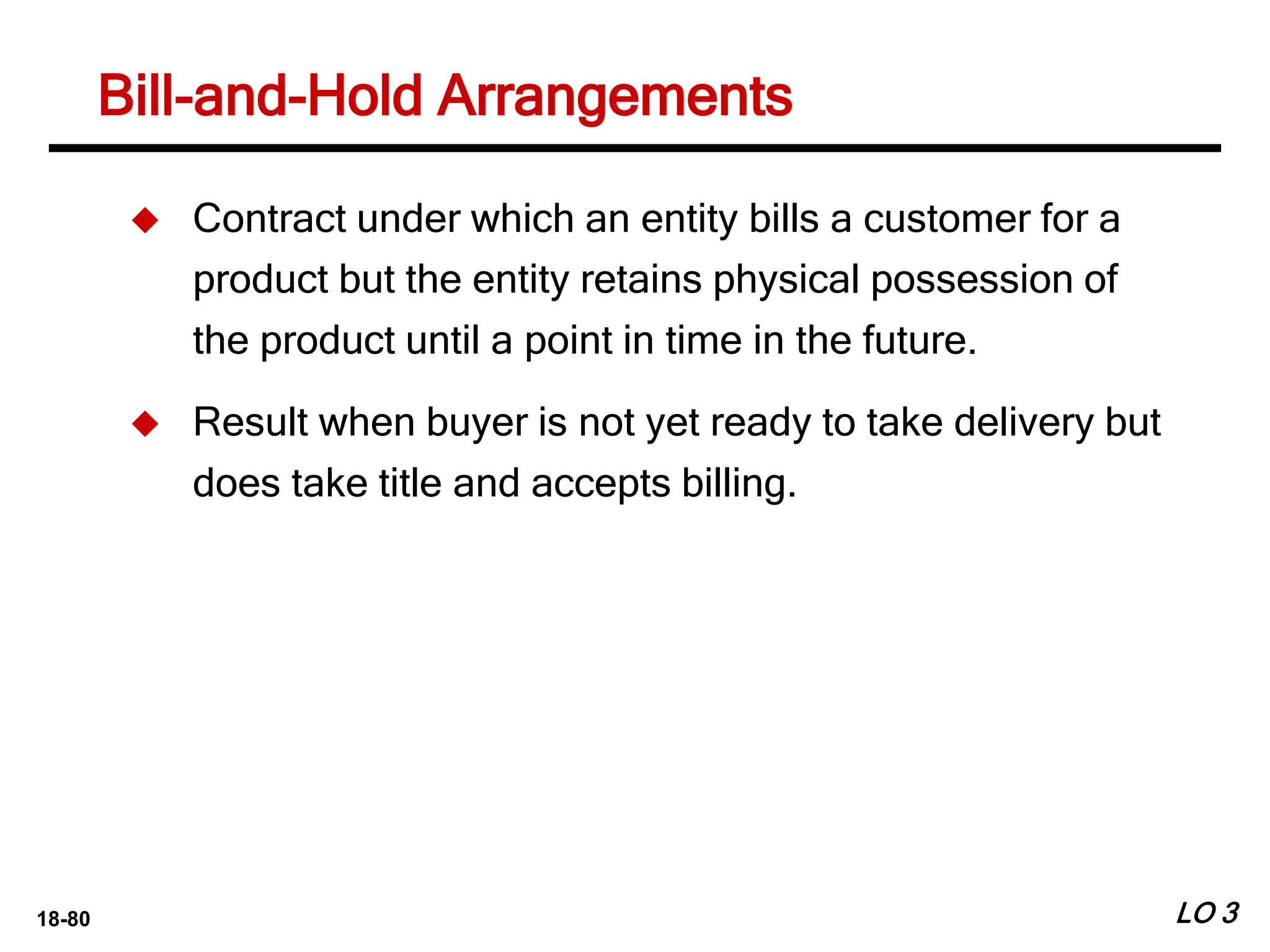
Bill-and-Hold Arrangements
LO 3
 Contract under which an entity bills a customer for a
product but the entity retains physical possession of
the product until a point in time in the future.
 Result when buyer is not yet ready to take delivery but
does take title and accepts billing.
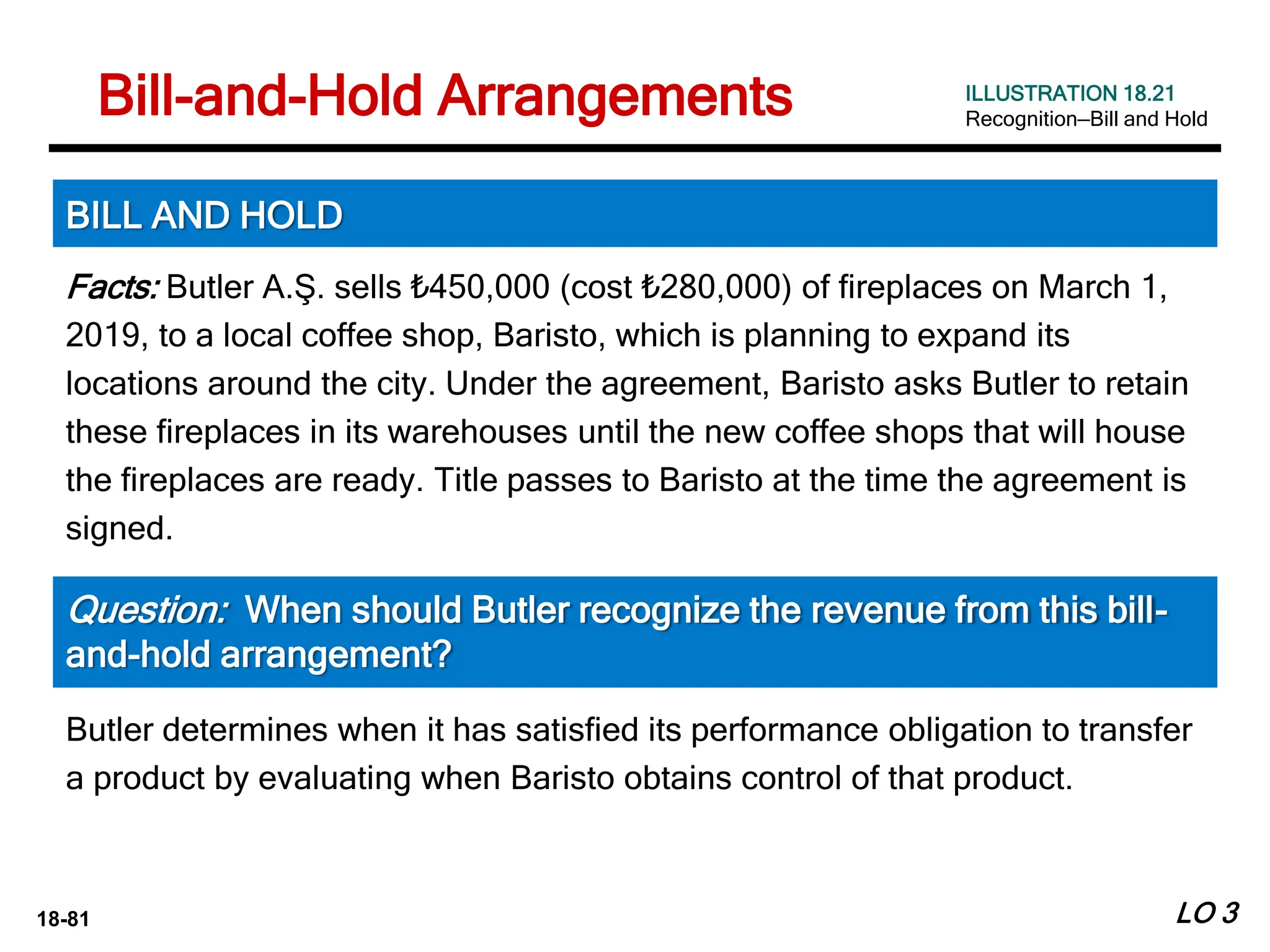
18-81
Facts: Butler A.Ş. sells ₺450,000 (cost ₺280,000) of fireplaces on March 1,
2019, to a local coffee shop, Baristo, which is planning to expand its
locations around the city. Under the agreement, Baristo asks Butler to retain
these fireplaces in its warehouses until the new coffee shops that will house
the fireplaces are ready. Title passes to Baristo at the time the agreement is
signed.
LO 3
BILL AND HOLD
Question: When should Butler recognize the revenue from this bill-
and-hold arrangement?
ILLUSTRATION 18.21
Recognition—Bill and Hold
Butler determines when it has satisfied its performance obligation to transfer
a product by evaluating when Baristo obtains control of that product.
Bill-and-Hold Arrangements
18-82 LO 3
Question: When should Butler recognize the revenue from this bill-
and-hold arrangement?
ILLUSTRATION 18.23
Recognition—Bill and Hold
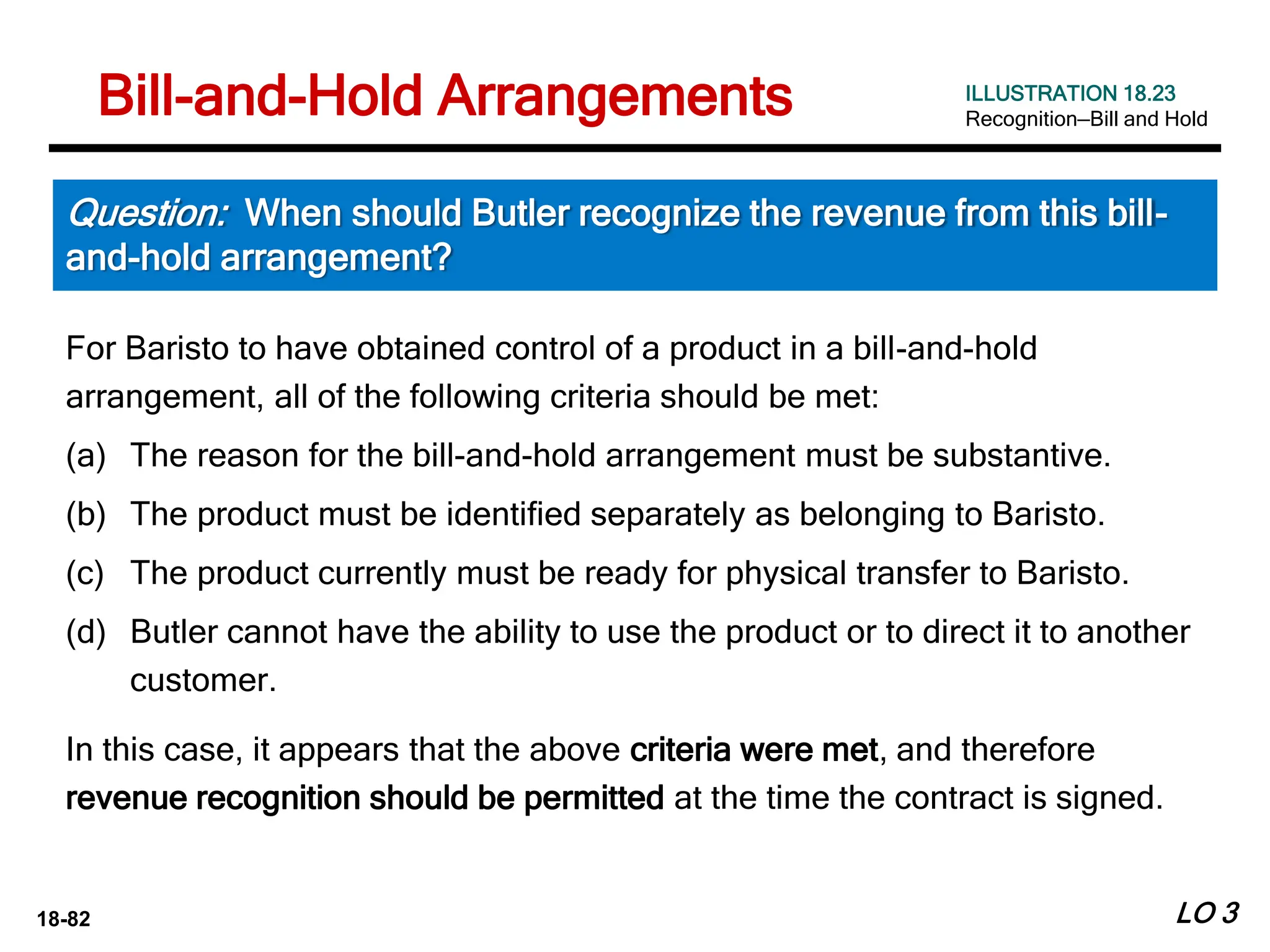
For Baristo to have obtained control of a product in a bill-and-hold
arrangement, all of the following criteria should be met:
(a) The reason for the bill-and-hold arrangement must be substantive.
(b) The product must be identified separately as belonging to Baristo.
(c) The product currently must be ready for physical transfer to Baristo.
(d) Butler cannot have the ability to use the product or to direct it to another
customer.
In this case, it appears that the above criteria were met, and therefore
revenue recognition should be permitted at the time the contract is signed.
Bill-and-Hold Arrangements
18-83 LO 3
Question: When should Butler recognize the revenue from this bill-
and-hold arrangement?
ILLUSTRATION 18.23
Recognition—Bill and Hold
Bill-and-Hold Arrangements
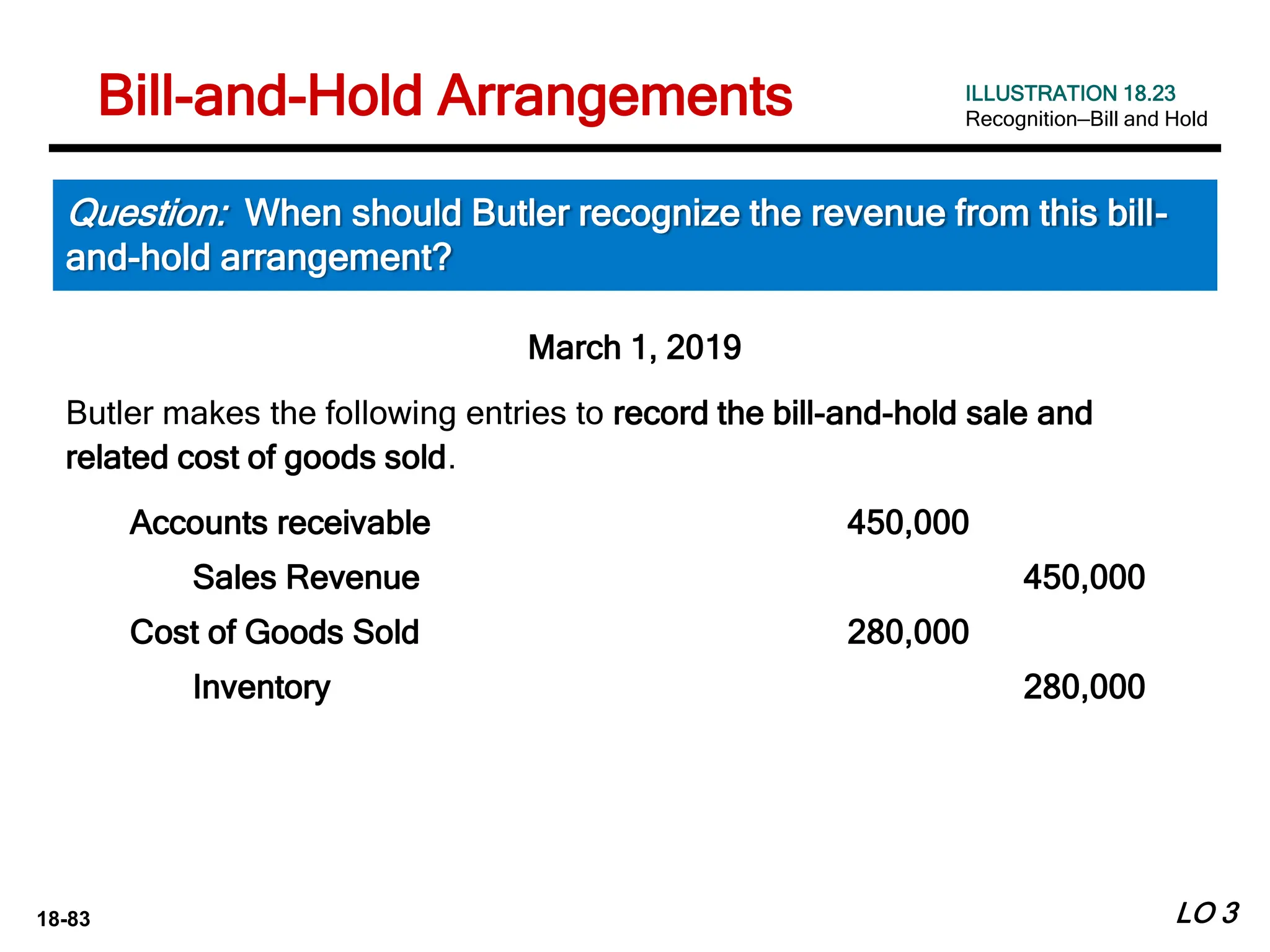
March 1, 2019
Butler makes the following entries to record the bill-and-hold sale and
related cost of goods sold.
Accounts receivable 450,000
Sales Revenue 450,000
Cost of Goods Sold 280,000
Inventory 280,000
18-84
Principal-Agent Relationships
LO 3
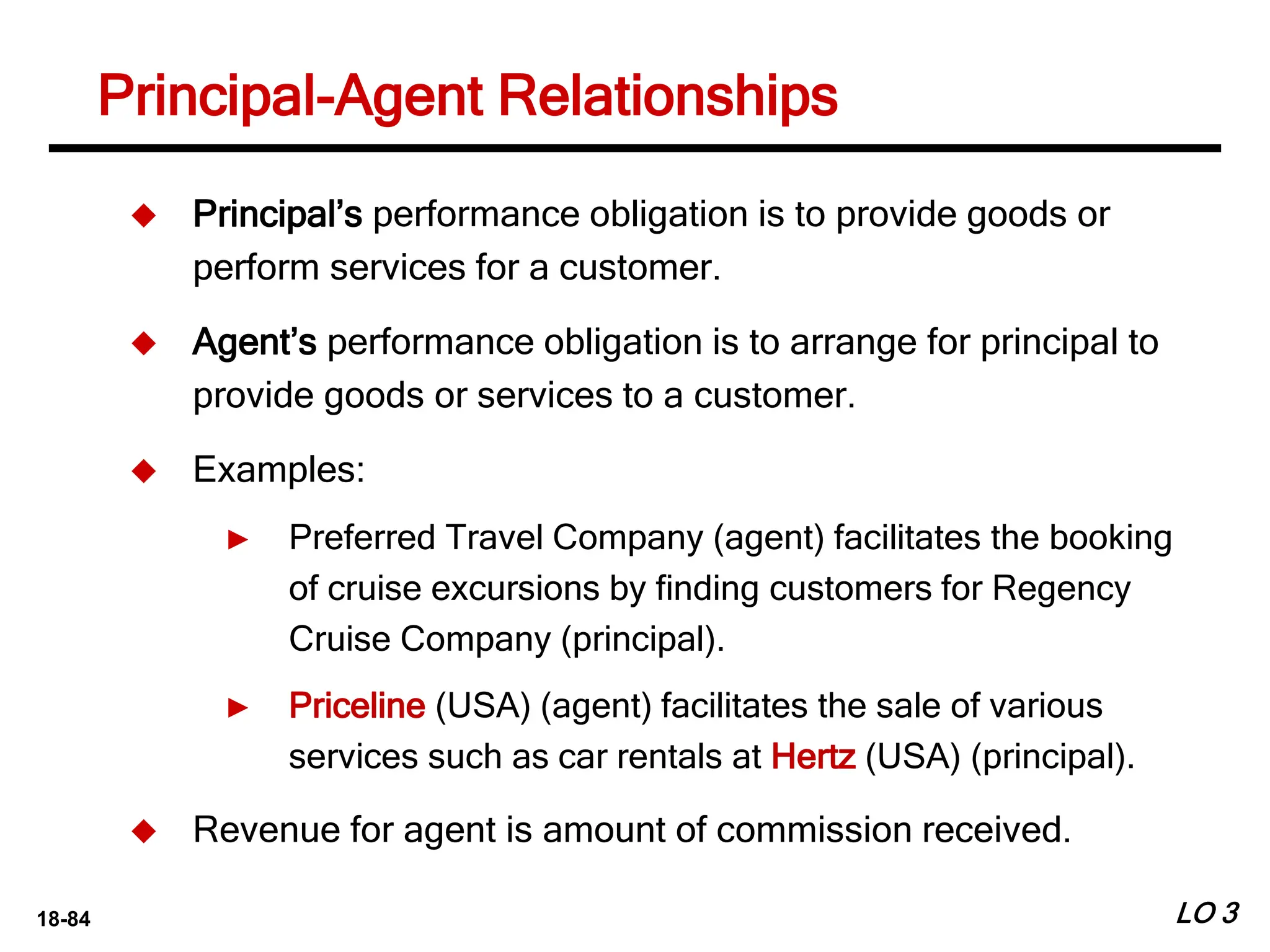
 Principal’s performance obligation is to provide goods or
perform services for a customer.
 Agent’s performance obligation is to arrange for principal to
provide goods or services to a customer.
 Examples:
► Preferred Travel Company (agent) facilitates the booking
of cruise excursions by finding customers for Regency
Cruise Company (principal).
► Priceline (USA) (agent) facilitates the sale of various
services such as car rentals at Hertz (USA) (principal).
 Revenue for agent is amount of commission received.
18-85
Consignments
LO 3
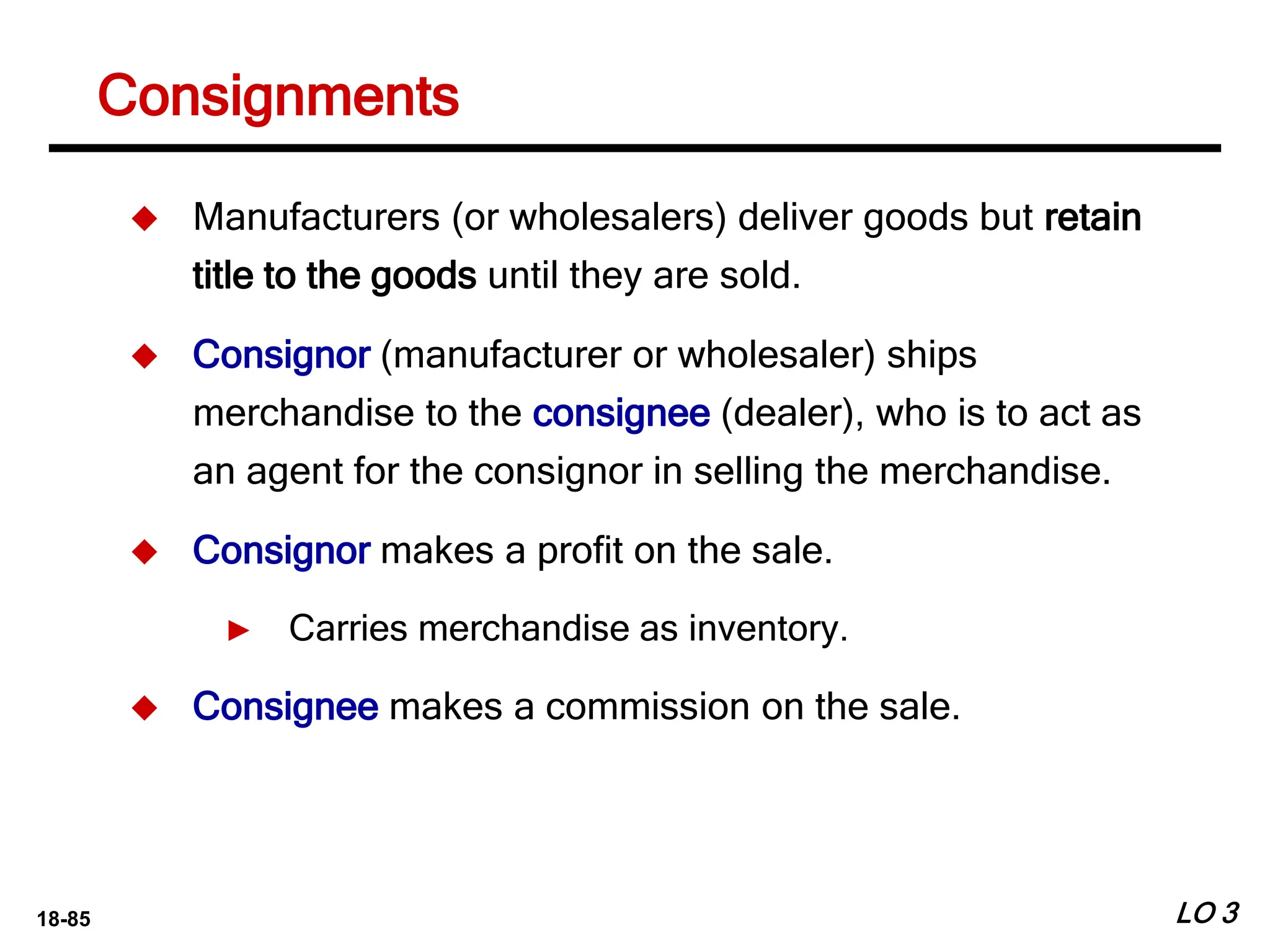
 Manufacturers (or wholesalers) deliver goods but retain
title to the goods until they are sold.
 Consignor (manufacturer or wholesaler) ships
merchandise to the consignee (dealer), who is to act as
an agent for the consignor in selling the merchandise.
 Consignor makes a profit on the sale.
► Carries merchandise as inventory.
 Consignee makes a commission on the sale.
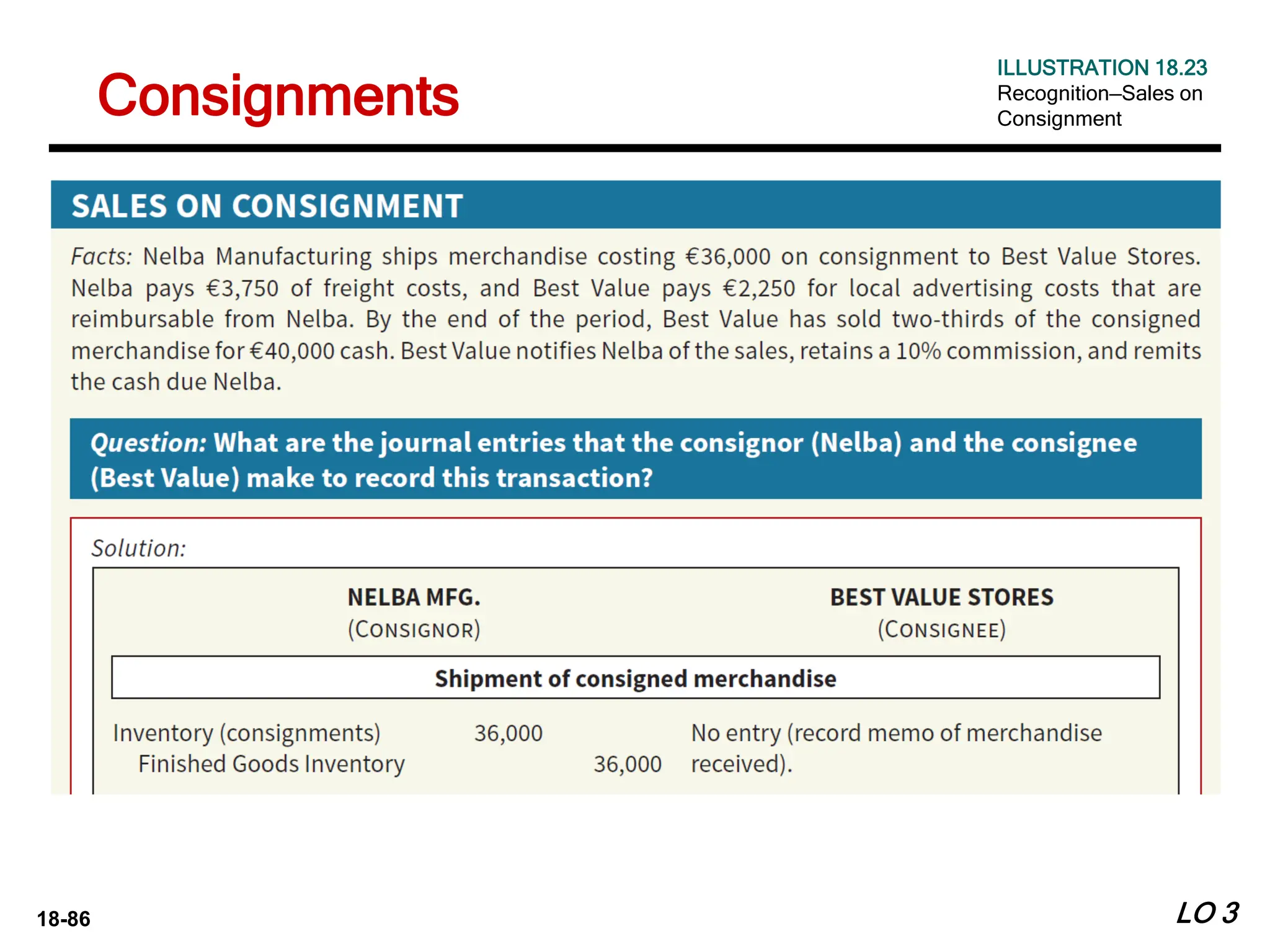
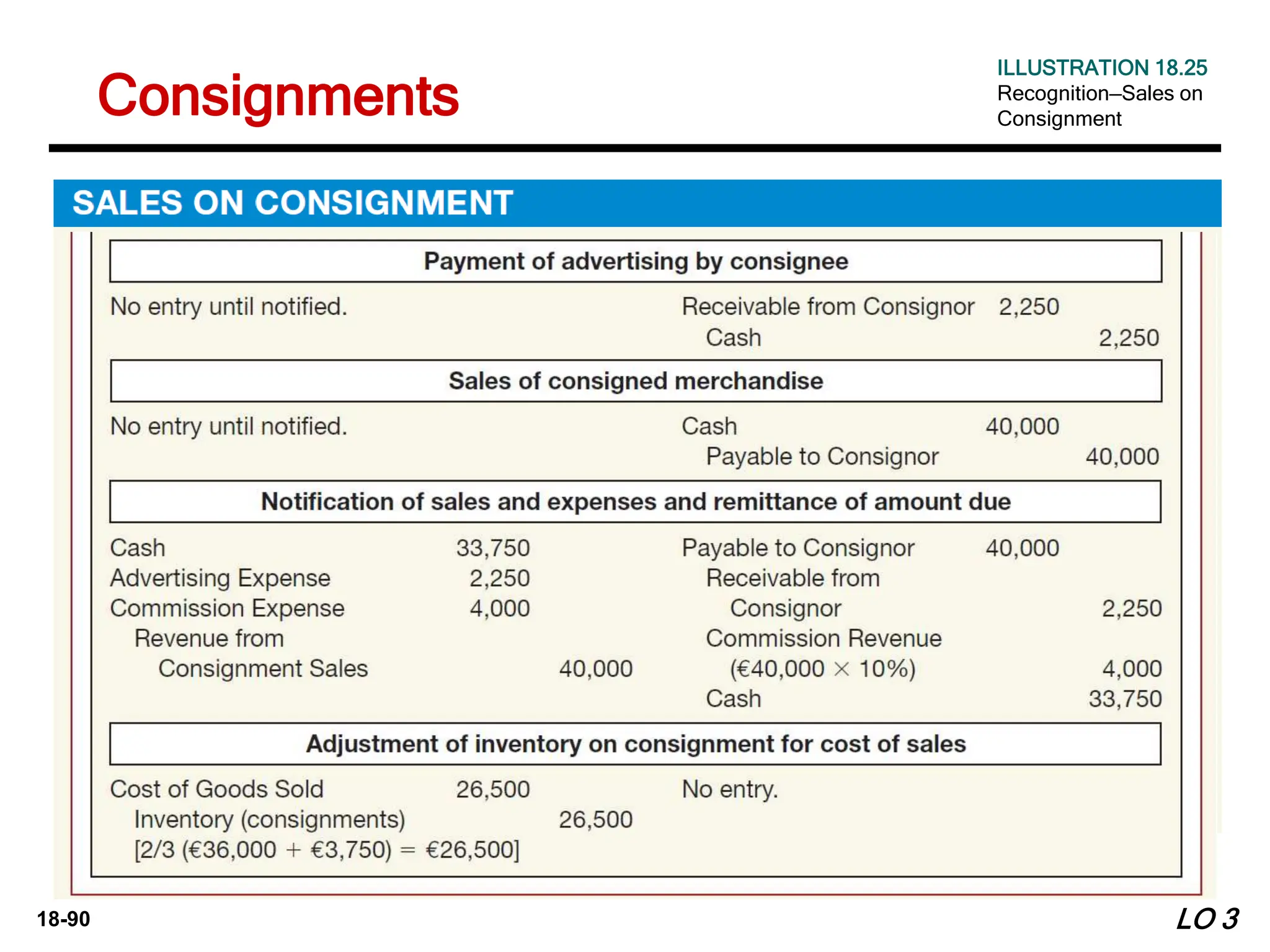
18-86 LO 3
ILLUSTRATION 18.23
Recognition—Sales on
Consignment
Consignments
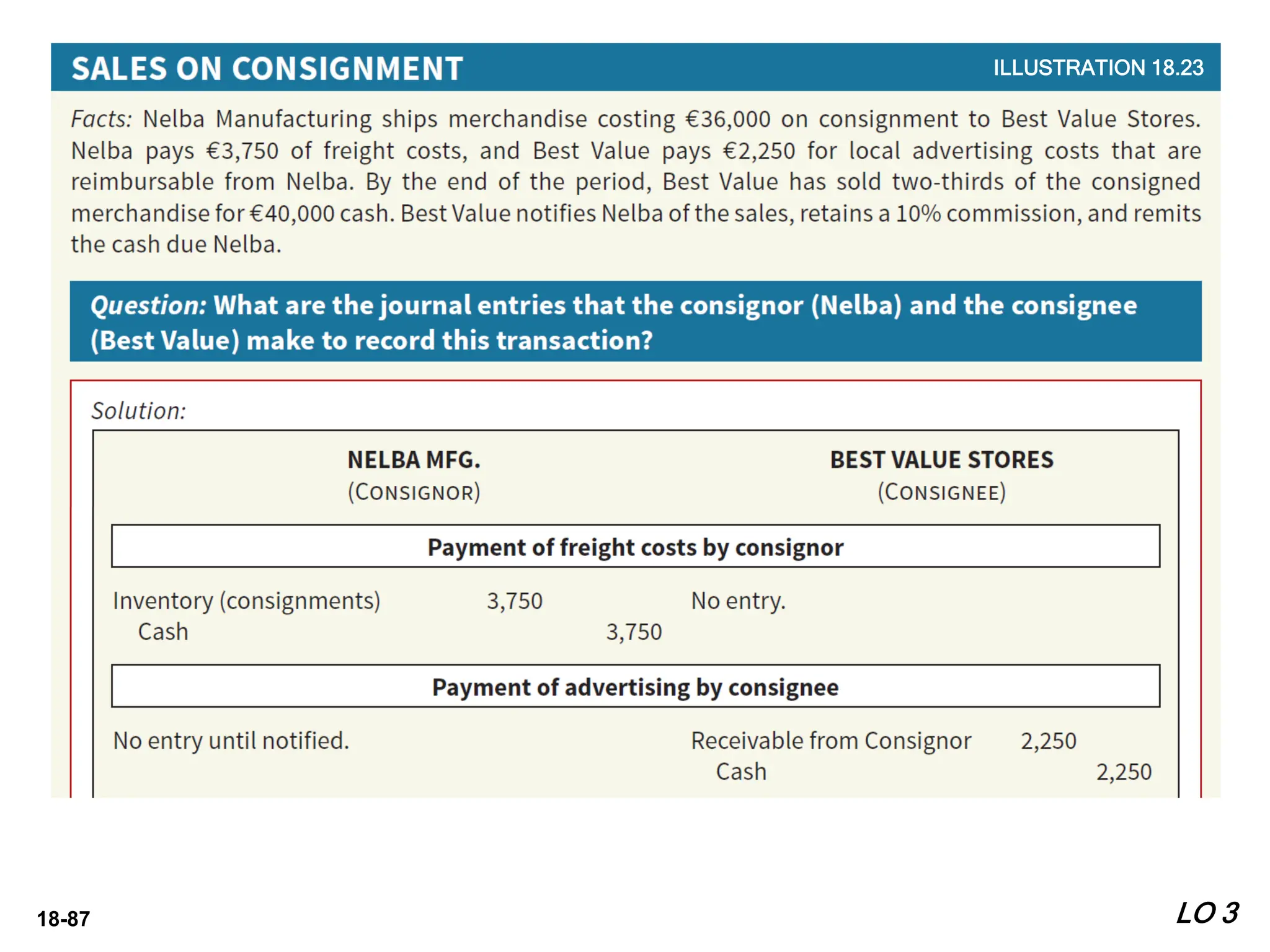
18-87 LO 3
ILLUSTRATION 18.23
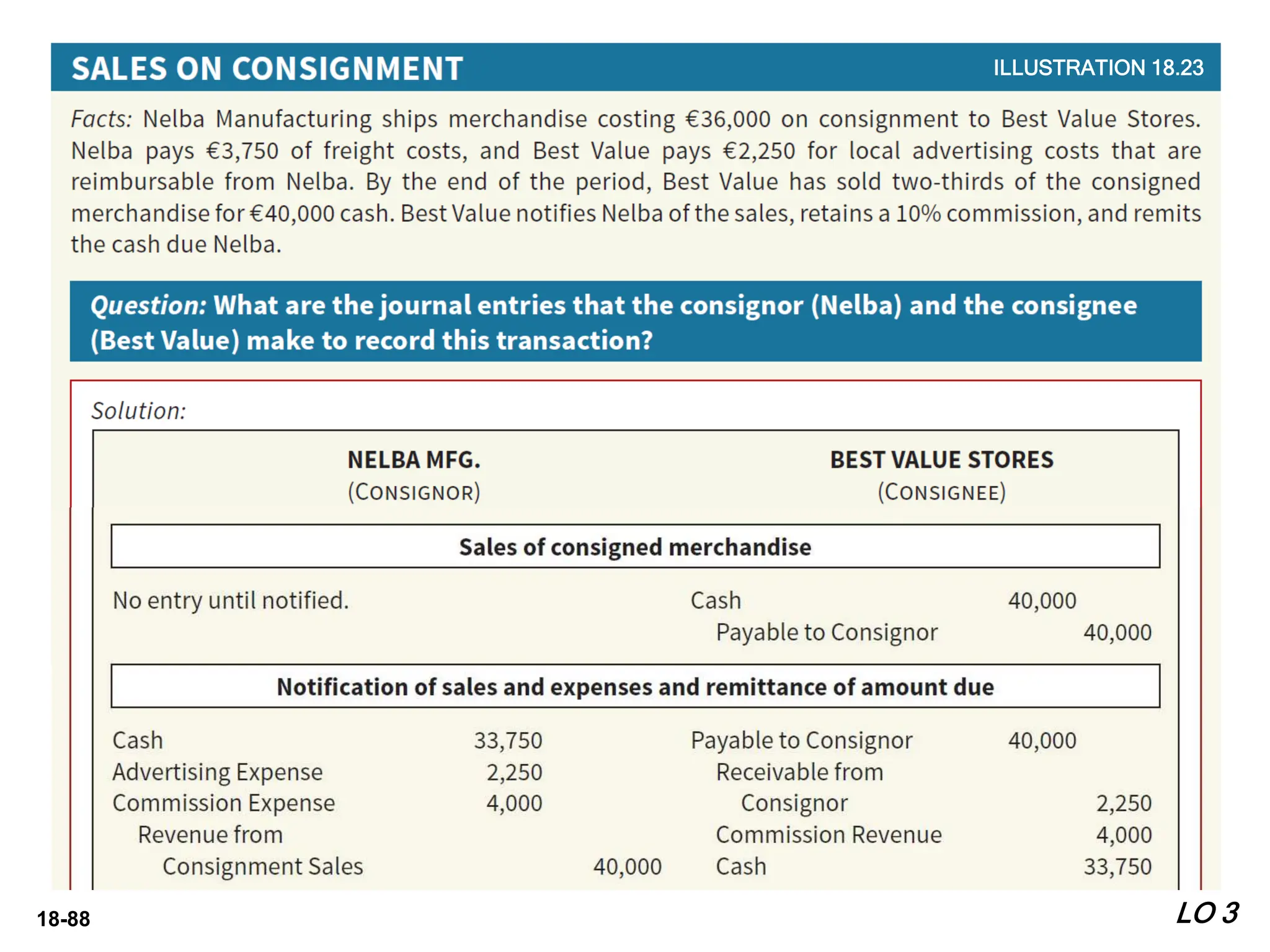
18-88 LO 3
ILLUSTRATION 18.23
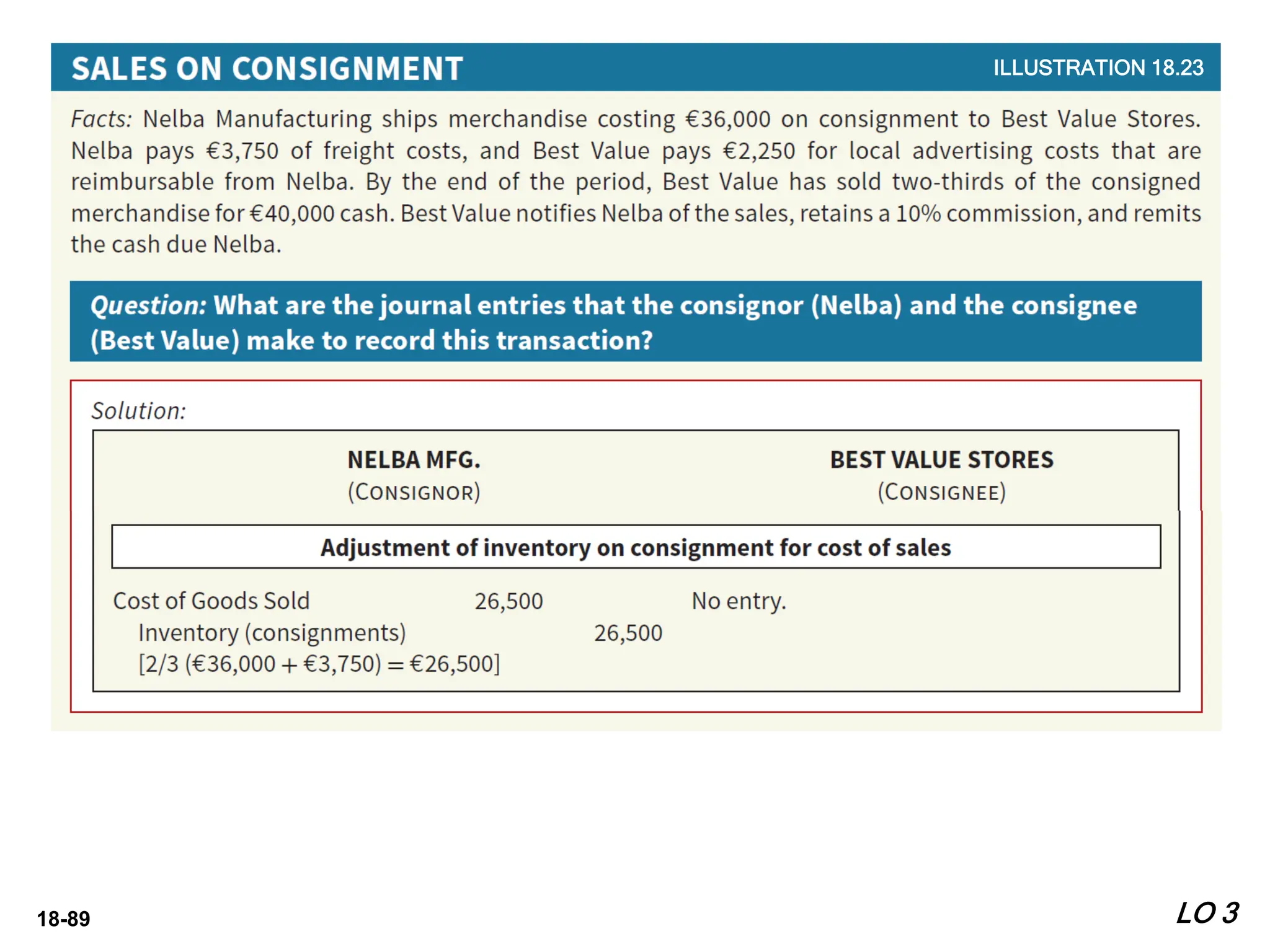
18-89 LO 3
ILLUSTRATION 18.23
18-90 LO 3
ILLUSTRATION 18.25
Recognition—Sales on
Consignment
Consignments
18-91
Warranties
LO 3
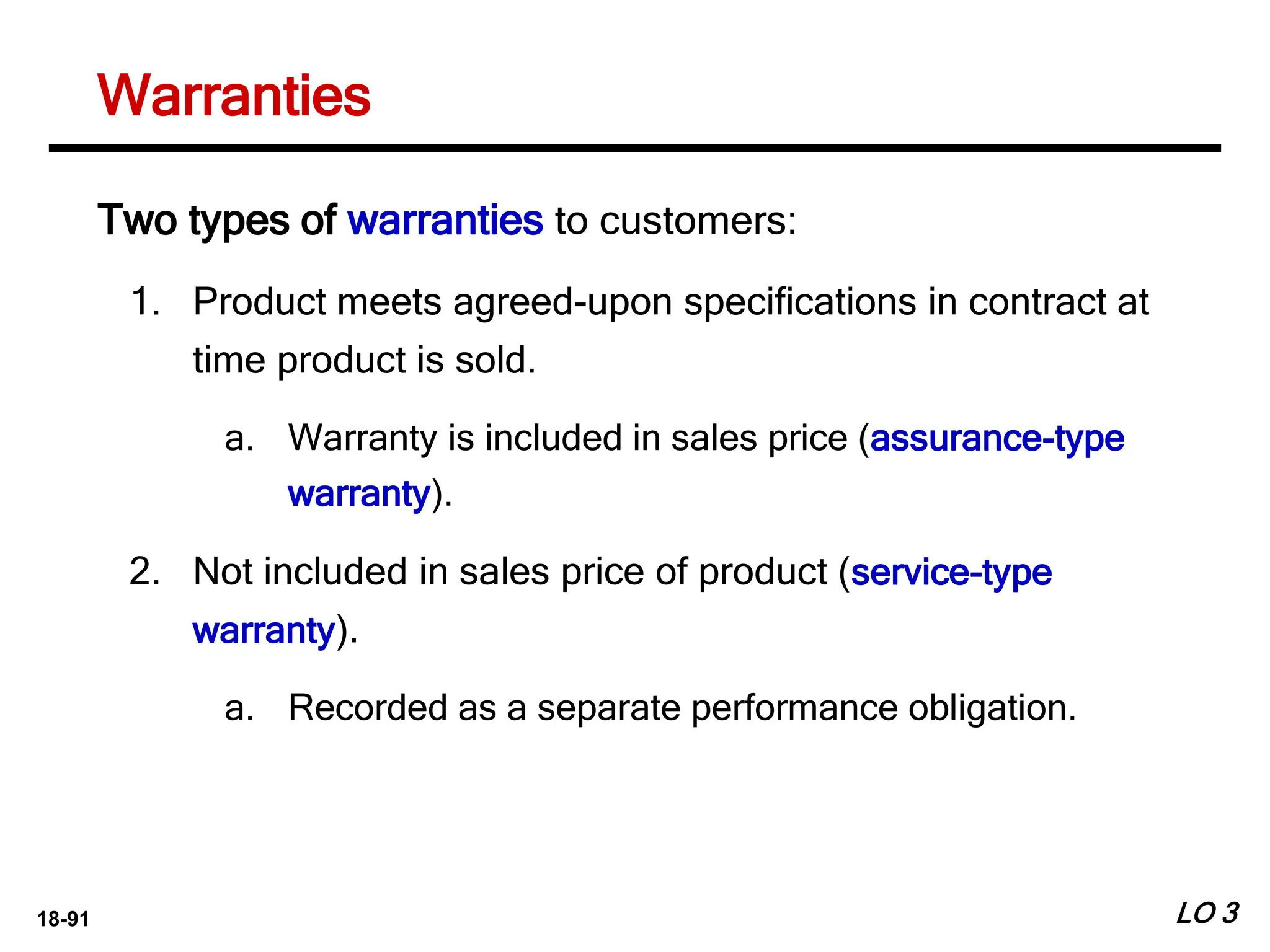
Two types of warranties to customers:
1. Product meets agreed-upon specifications in contract at
time product is sold.
a. Warranty is included in sales price (assurance-type
warranty).
2. Not included in sales price of product (service-type
warranty).
a. Recorded as a separate performance obligation.
18-92
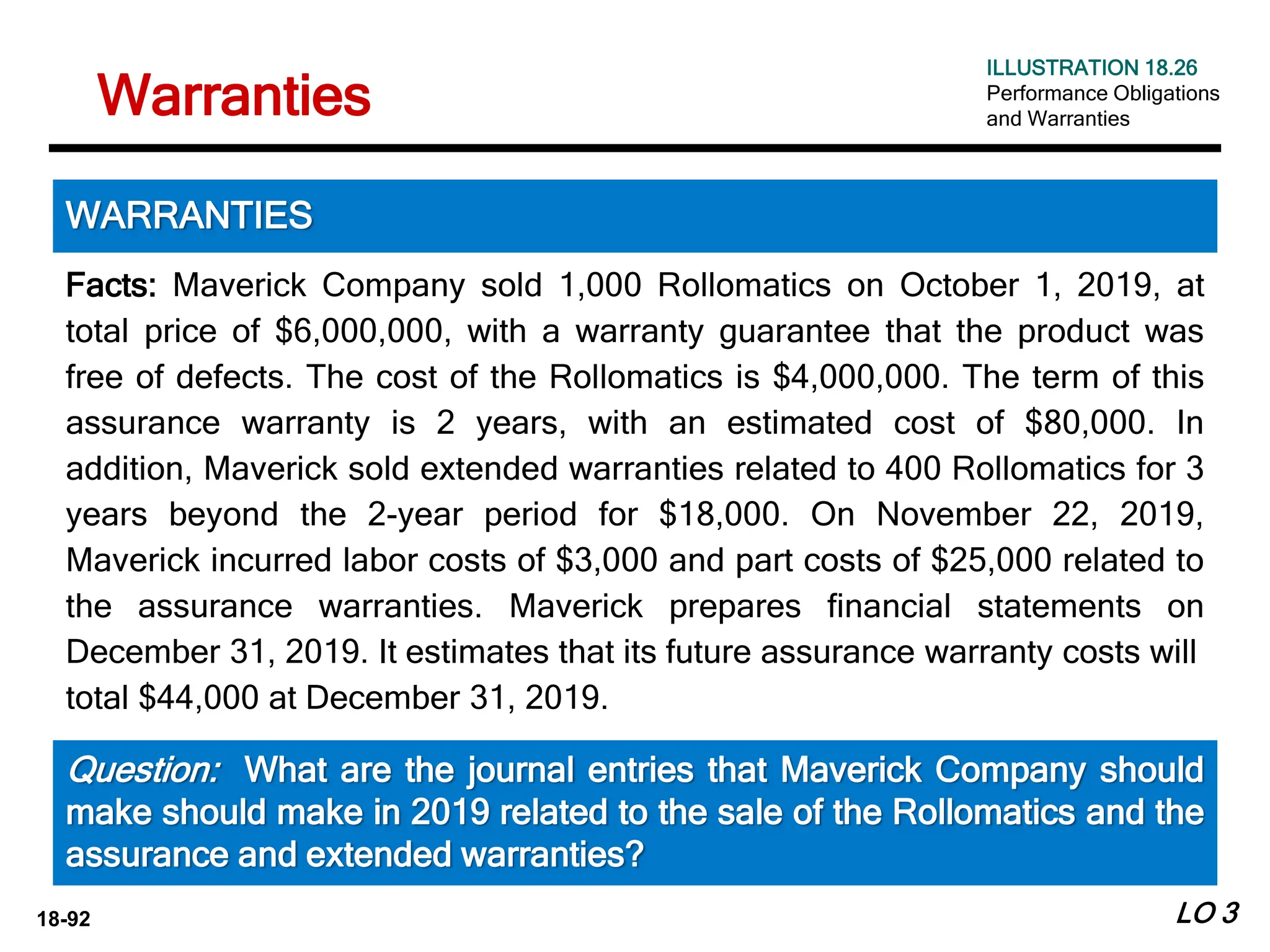
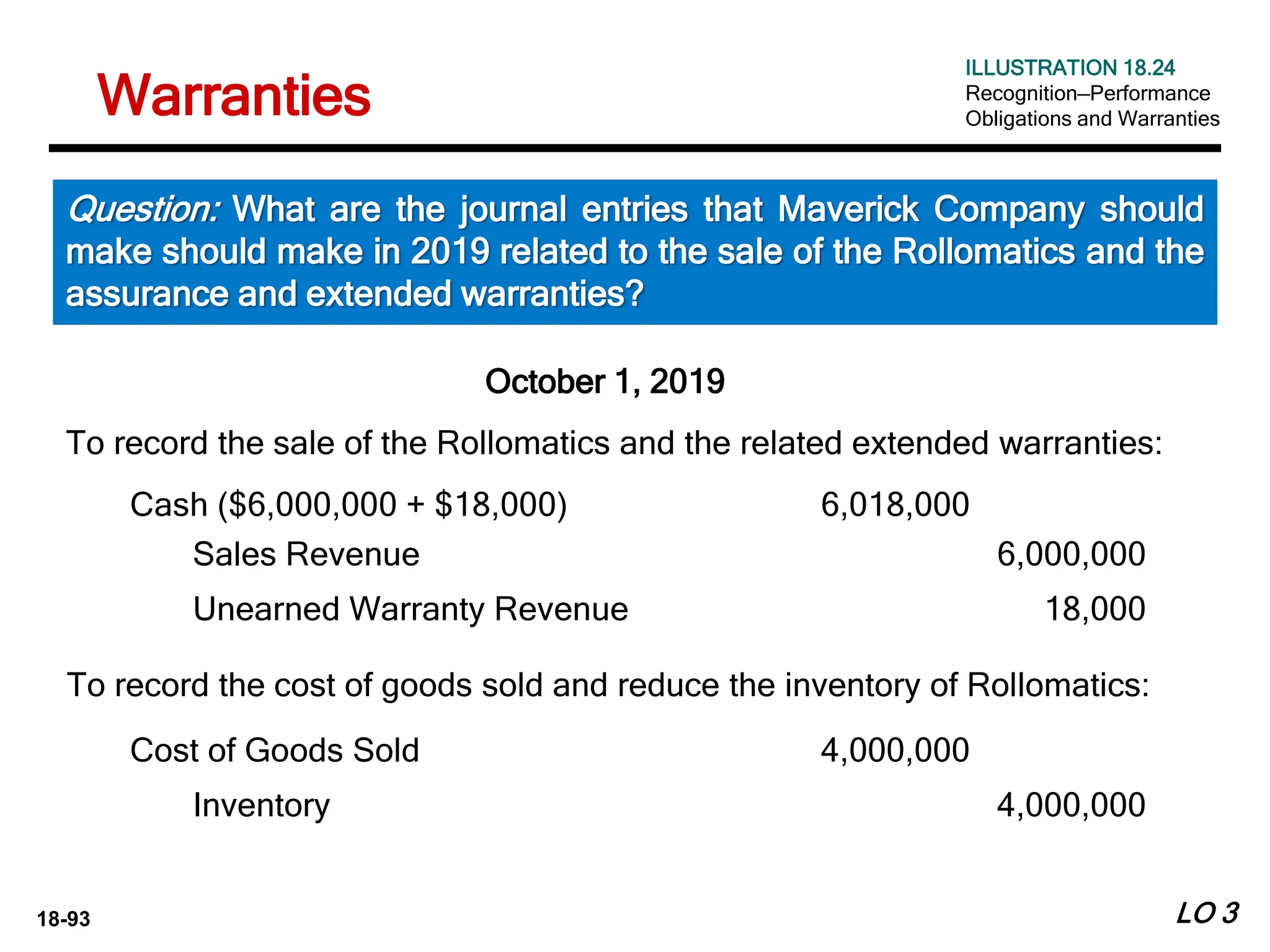
Facts: Maverick Company sold 1,000 Rollomatics on October 1, 2019, at
total price of $6,000,000, with a warranty guarantee that the product was
free of defects. The cost of the Rollomatics is $4,000,000. The term of this
assurance warranty is 2 years, with an estimated cost of $80,000. In
addition, Maverick sold extended warranties related to 400 Rollomatics for 3
years beyond the 2-year period for $18,000. On November 22, 2019,
Maverick incurred labor costs of $3,000 and part costs of $25,000 related to
the assurance warranties. Maverick prepares financial statements on
December 31, 2019. It estimates that its future assurance warranty costs will
total $44,000 at December 31, 2019.
WARRANTIES
Question: What are the journal entries that Maverick Company should
make should make in 2019 related to the sale of the Rollomatics and the
assurance and extended warranties?
ILLUSTRATION 18.26
Performance Obligations
and Warranties
Warranties
LO 3
18-93
October 1, 2019
To record the sale of the Rollomatics and the related extended warranties:
Cash ($6,000,000 + $18,000) 6,018,000
Sales Revenue 6,000,000
Unearned Warranty Revenue 18,000
To record the cost of goods sold and reduce the inventory of Rollomatics:
Cost of Goods Sold 4,000,000
Inventory 4,000,000
Warranties
LO 3
Question: What are the journal entries that Maverick Company should
make should make in 2019 related to the sale of the Rollomatics and the
assurance and extended warranties?
ILLUSTRATION 18.24
Recognition—Performance
Obligations and Warranties
18-94
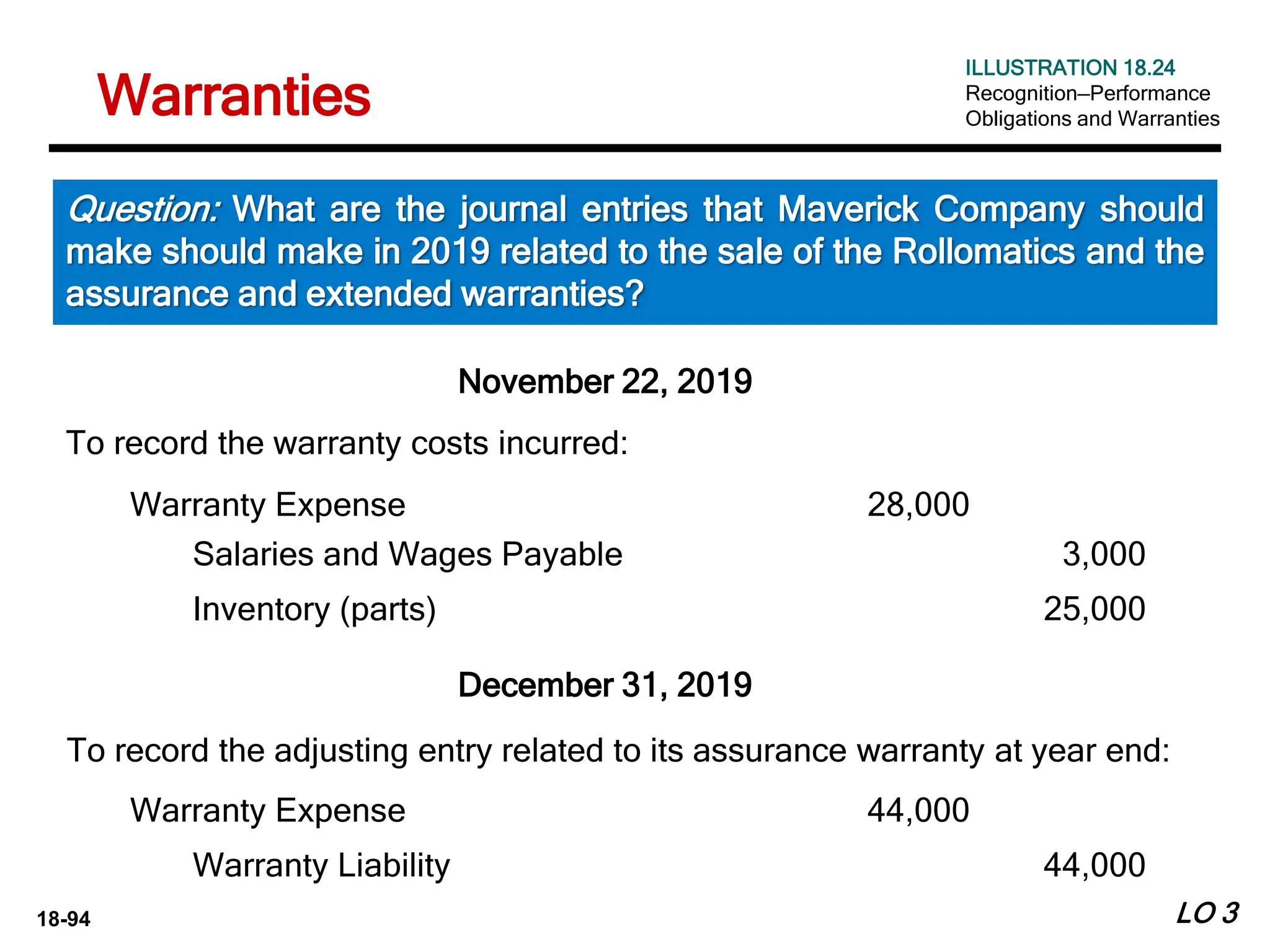
November 22, 2019
To record the warranty costs incurred:
Warranty Expense 28,000
Salaries and Wages Payable 3,000
Inventory (parts) 25,000
December 31, 2019
To record the adjusting entry related to its assurance warranty at year end:
Warranty Expense 44,000
Warranty Liability 44,000
ILLUSTRATION 18.24
Recognition—Performance
Obligations and Warranties
Warranties
LO 3
Question: What are the journal entries that Maverick Company should
make should make in 2019 related to the sale of the Rollomatics and the
assurance and extended warranties?
18-95
Non-Refundable Upfront Fees
LO 3
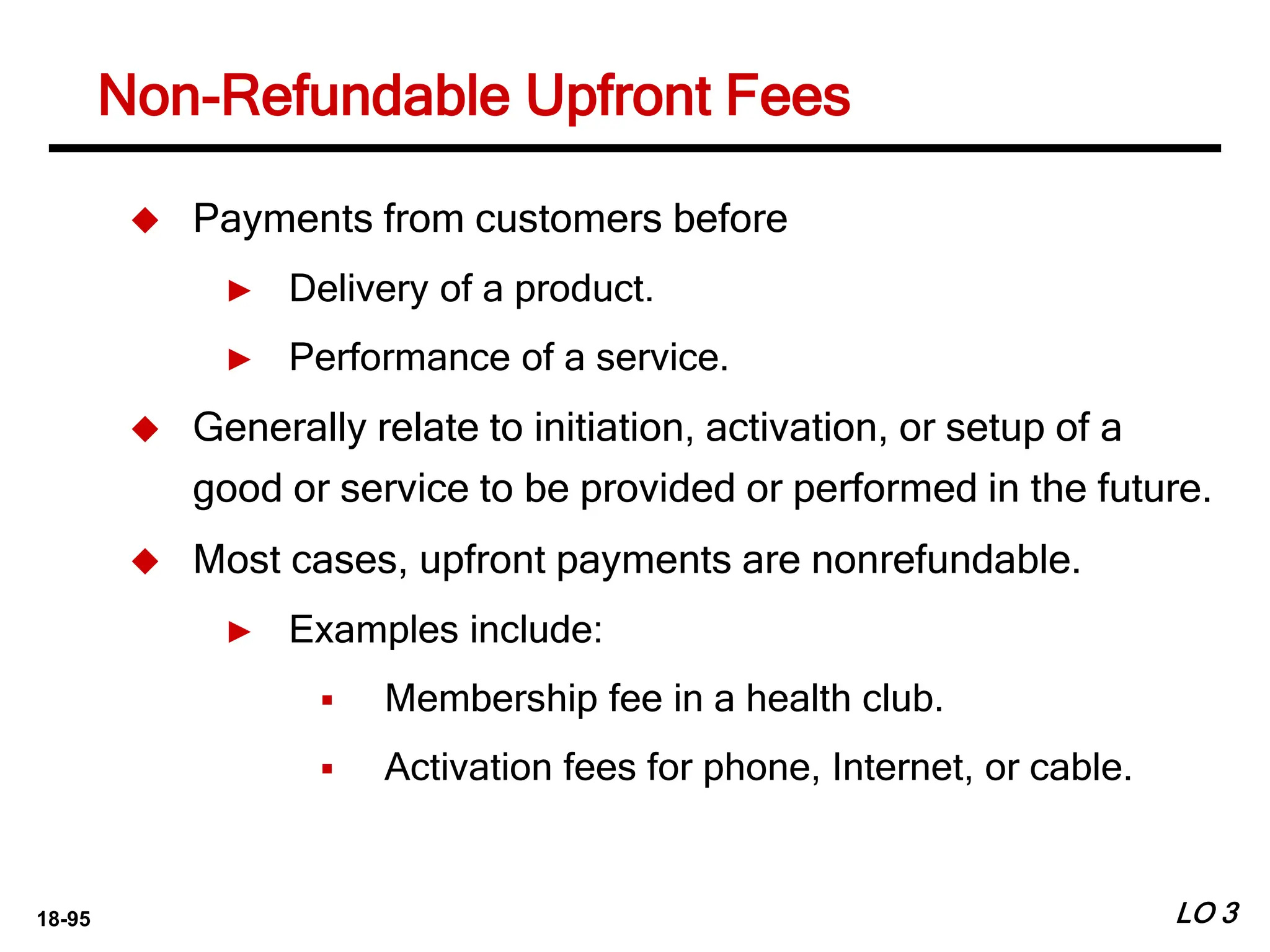
 Payments from customers before
► Delivery of a product.
► Performance of a service.
 Generally relate to initiation, activation, or setup of a
good or service to be provided or performed in the future.
 Most cases, upfront payments are nonrefundable.
► Examples include:
 Membership fee in a health club.
 Activation fees for phone, Internet, or cable.
18-96
Presentation
Presentation and Disclosure
LO 4
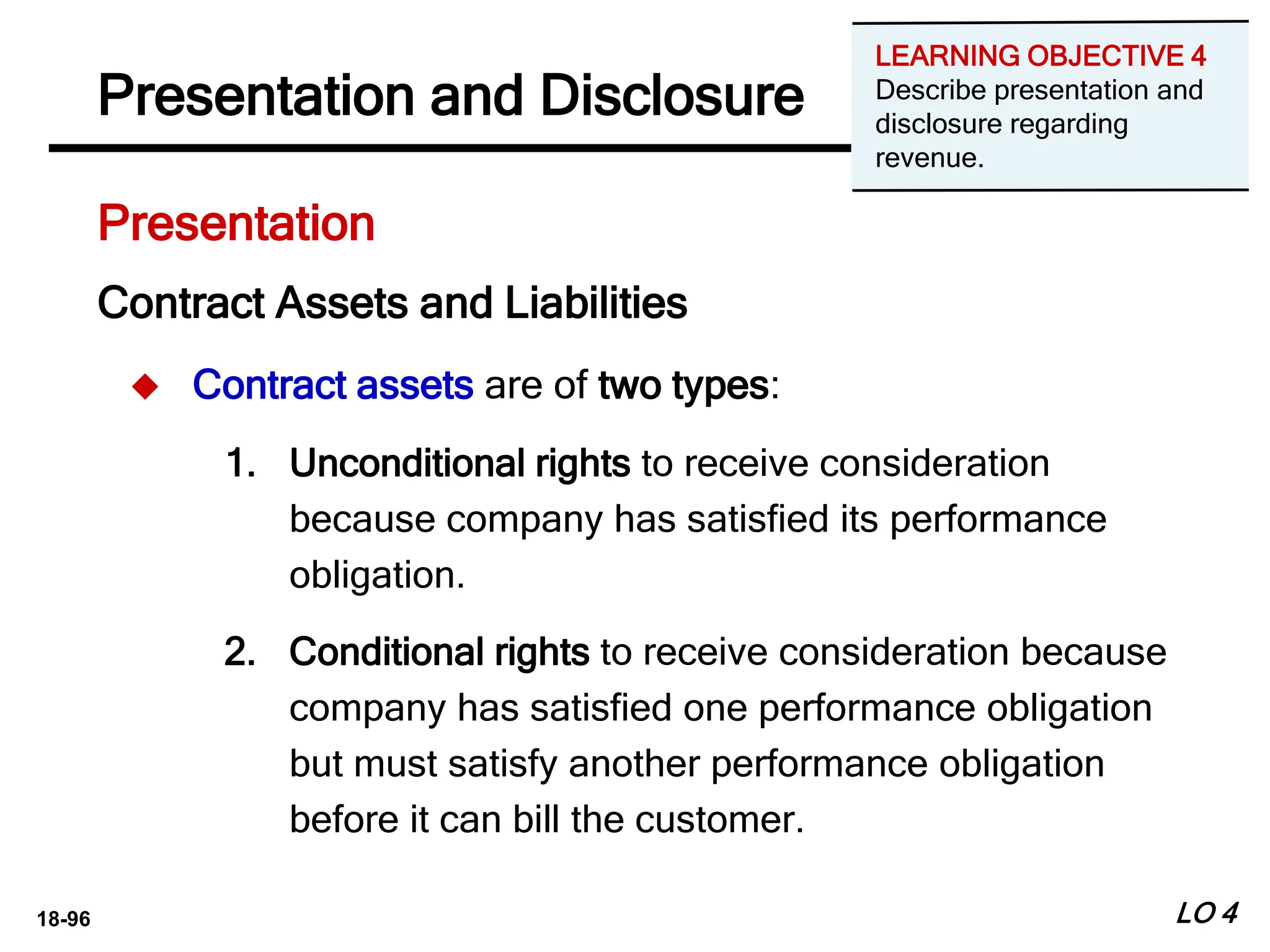
Contract Assets and Liabilities
 Contract assets are of two types:
1. Unconditional rights to receive consideration
because company has satisfied its performance
obligation.
2. Conditional rights to receive consideration because
company has satisfied one performance obligation
but must satisfy another performance obligation
before it can bill the customer.
LEARNING OBJECTIVE 4
Describe presentation and
disclosure regarding
revenue.
18-97
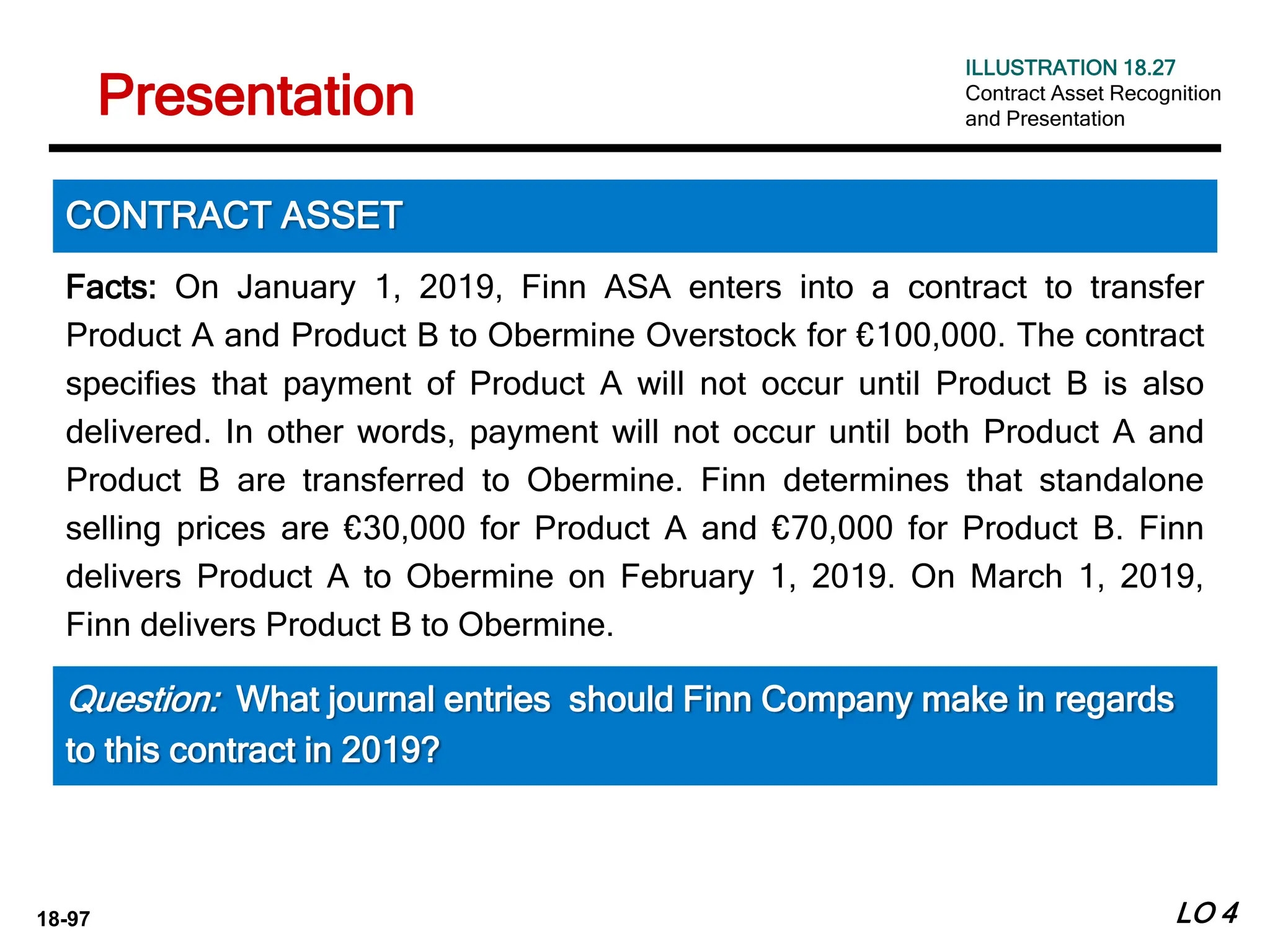
Facts: On January 1, 2019, Finn ASA enters into a contract to transfer
Product A and Product B to Obermine Overstock for €100,000. The contract
specifies that payment of Product A will not occur until Product B is also
delivered. In other words, payment will not occur until both Product A and
Product B are transferred to Obermine. Finn determines that standalone
selling prices are €30,000 for Product A and €70,000 for Product B. Finn
delivers Product A to Obermine on February 1, 2019. On March 1, 2019,
Finn delivers Product B to Obermine.
LO 4
CONTRACT ASSET
Question: What journal entries should Finn Company make in regards
to this contract in 2019?
ILLUSTRATION 18.27
Contract Asset Recognition
and Presentation
Presentation
18-98
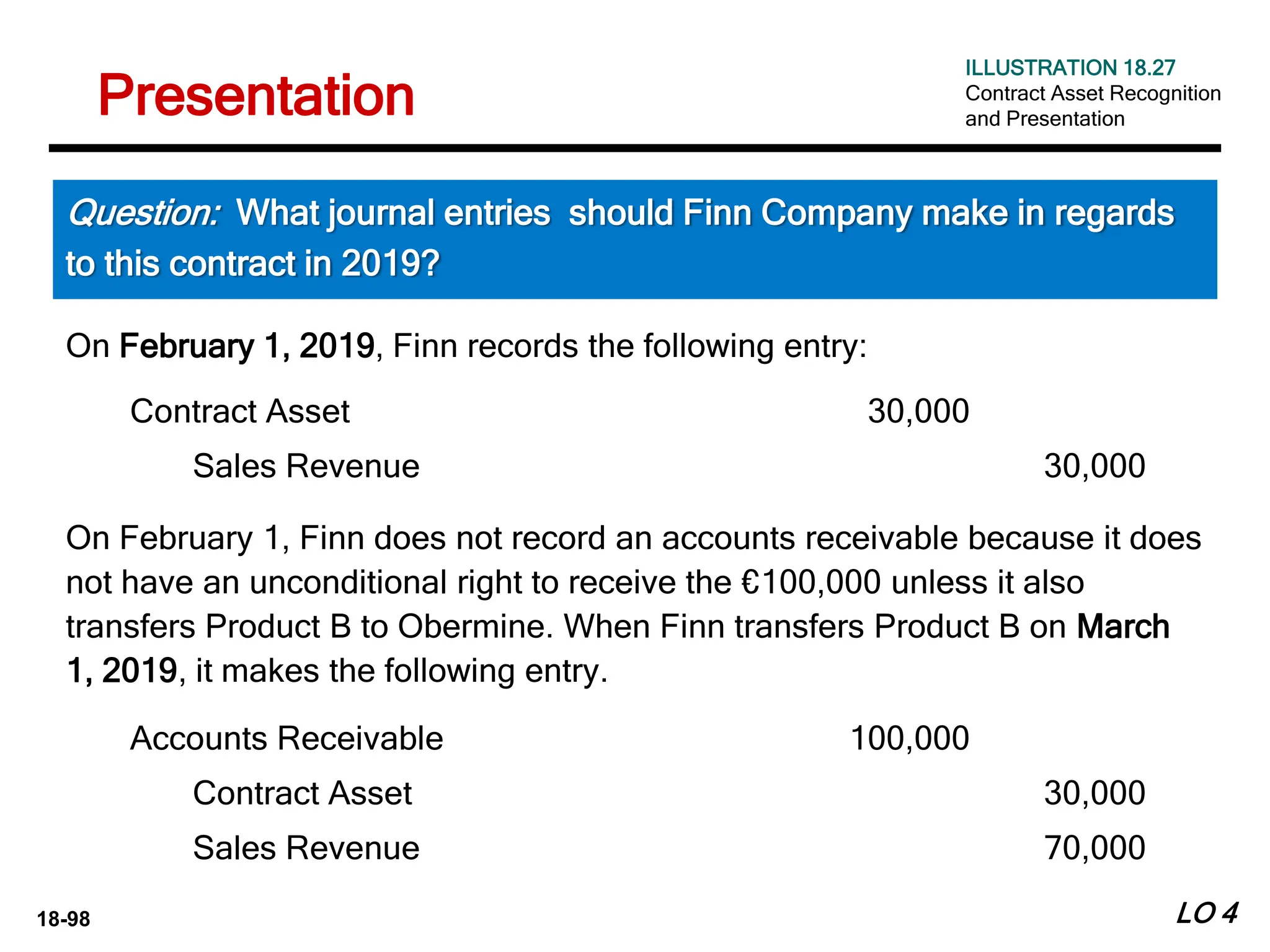
Contract Asset 30,000
Sales Revenue 30,000
Question: What journal entries should Finn Company make in regards
to this contract in 2019?
On February 1, 2019, Finn records the following entry:
On February 1, Finn does not record an accounts receivable because it does
not have an unconditional right to receive the €100,000 unless it also
transfers Product B to Obermine. When Finn transfers Product B on March
1, 2019, it makes the following entry.
LO 4
ILLUSTRATION 18.27
Contract Asset Recognition
and Presentation
Accounts Receivable 100,000
Contract Asset 30,000
Sales Revenue 70,000
Presentation
18-99
Facts: On March 1, 2019, Henly Company enters into a contract to transfer a
product to Propel Inc. on July 31, 2019. It is agreed that Propel will pay the
full price of $10,000 in advance on April 1, 2019. The contract is non-
cancelable. Propel, however, does not pay until April 15, 2019, and Henly
delivers the product on July 31, 2019. The cost of the product is $7,500.
LO 4
CONTRACT LIABILITY
Question: What journal entries are required in 2019?
ILLUSTRATION 18.28
Contract Liability Recognition
and Presentation
No entry is required on March 1, 2019:
► Neither party has performed on the contract.
► Neither party has an unconditional right as of March 1, 2019.
Presentation
18-100 LO 4
Question: What journal entries are required in 2019?
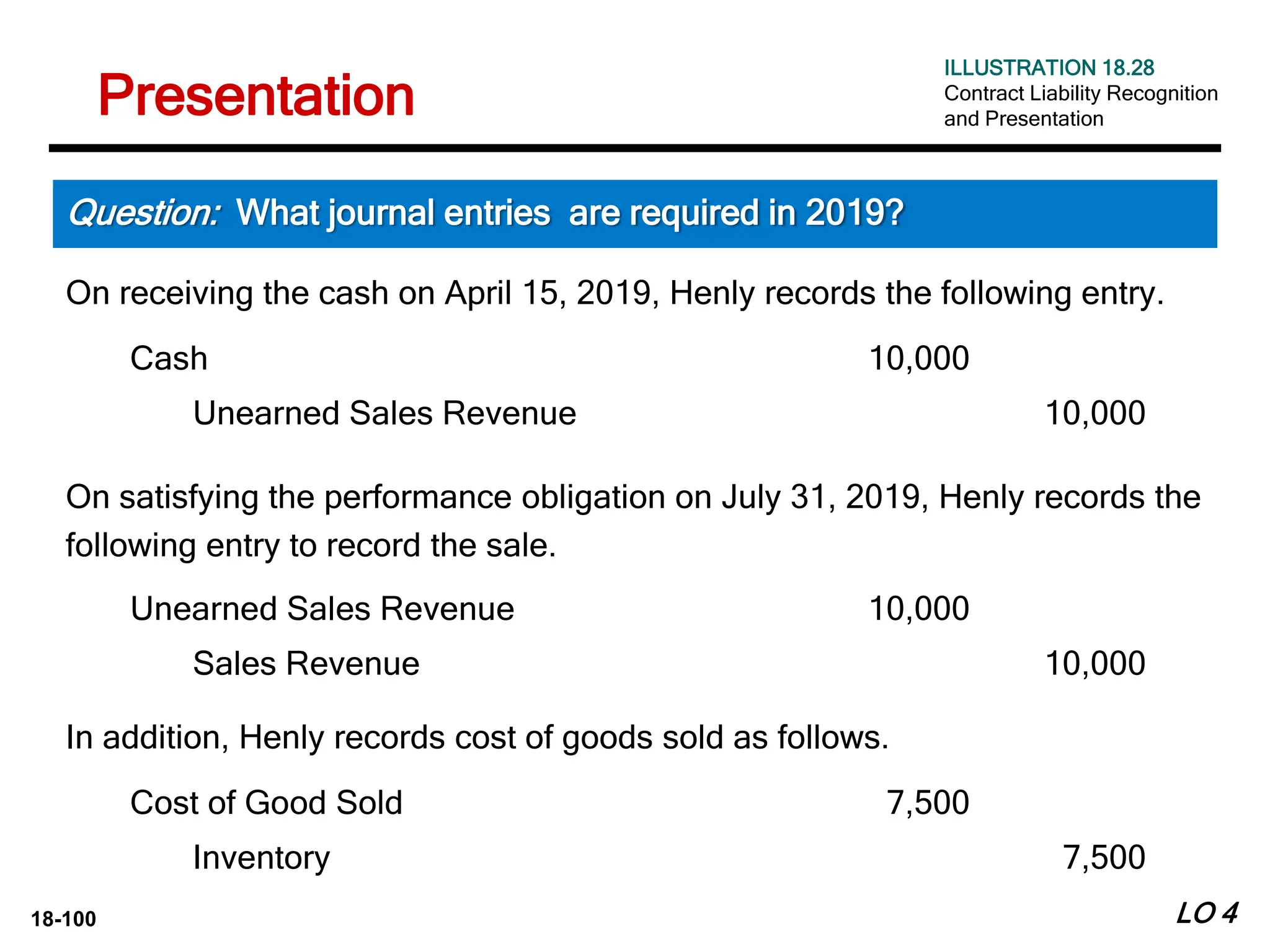
Cash 10,000
Unearned Sales Revenue 10,000
On receiving the cash on April 15, 2019, Henly records the following entry.
Unearned Sales Revenue 10,000
Sales Revenue 10,000
On satisfying the performance obligation on July 31, 2019, Henly records the
following entry to record the sale.
ILLUSTRATION 18.28
Contract Liability Recognition
and Presentation
Cost of Good Sold 7,500
Inventory 7,500
In addition, Henly records cost of goods sold as follows.
Presentation
18-101
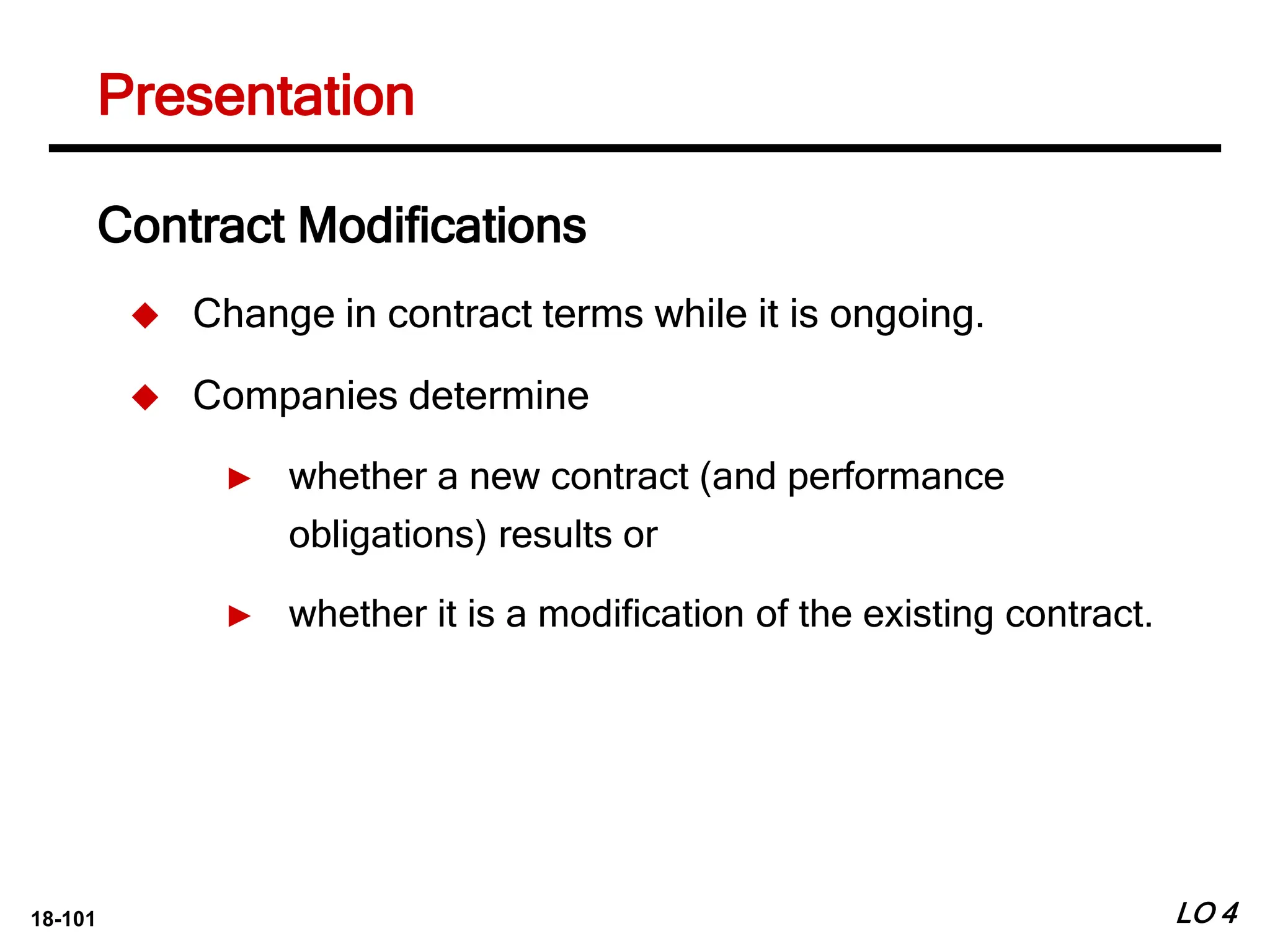
Contract Modifications
 Change in contract terms while it is ongoing.
 Companies determine
► whether a new contract (and performance
obligations) results or
► whether it is a modification of the existing contract.
LO 4
Presentation
18-102
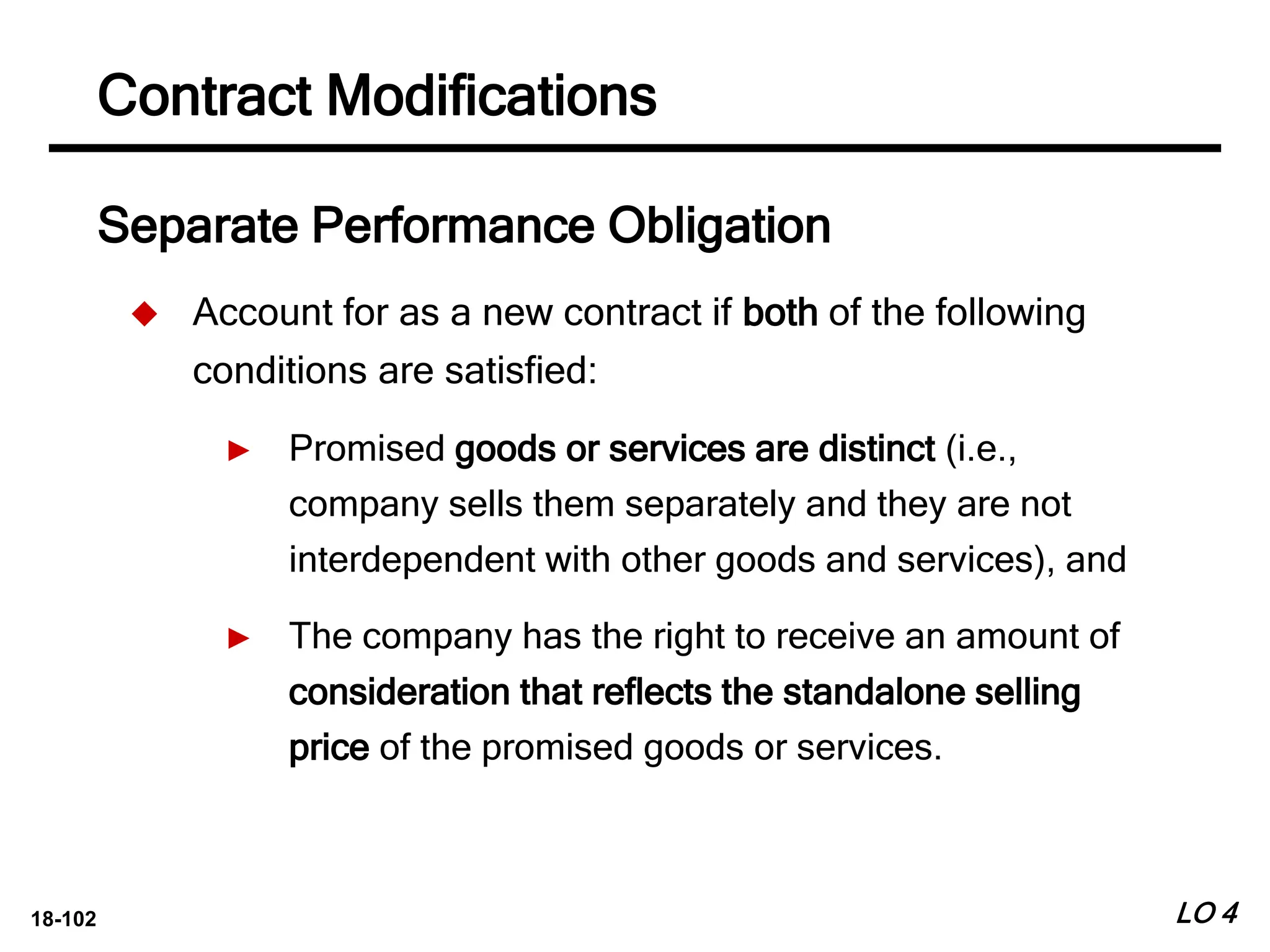
Separate Performance Obligation
 Account for as a new contract if both of the following
conditions are satisfied:
► Promised goods or services are distinct (i.e.,
company sells them separately and they are not
interdependent with other goods and services), and
► The company has the right to receive an amount of
consideration that reflects the standalone selling
price of the promised goods or services.
LO 4
Contract Modifications
18-103
For example, Crandall Co. has a contract to sell 100 products to a
customer for $10,000 ($100 per product) at various points in time
over a six-month period. After 60 products have been delivered,
Crandall modifies the contract by promising to deliver 20 more
products for an additional $1,900, or $95 per product (which is the
standalone selling price of the products at the time of the contract
modification). Crandall regularly sells the products separately.
Given a new contract, Crandall recognizes an additional:
LO 4
Separate Performance Obligation
Original contract [(100 units - 60 units) x $100] = $4,000
New product (20 units x $95) = 1,900
Total revenue $5,900
18-104
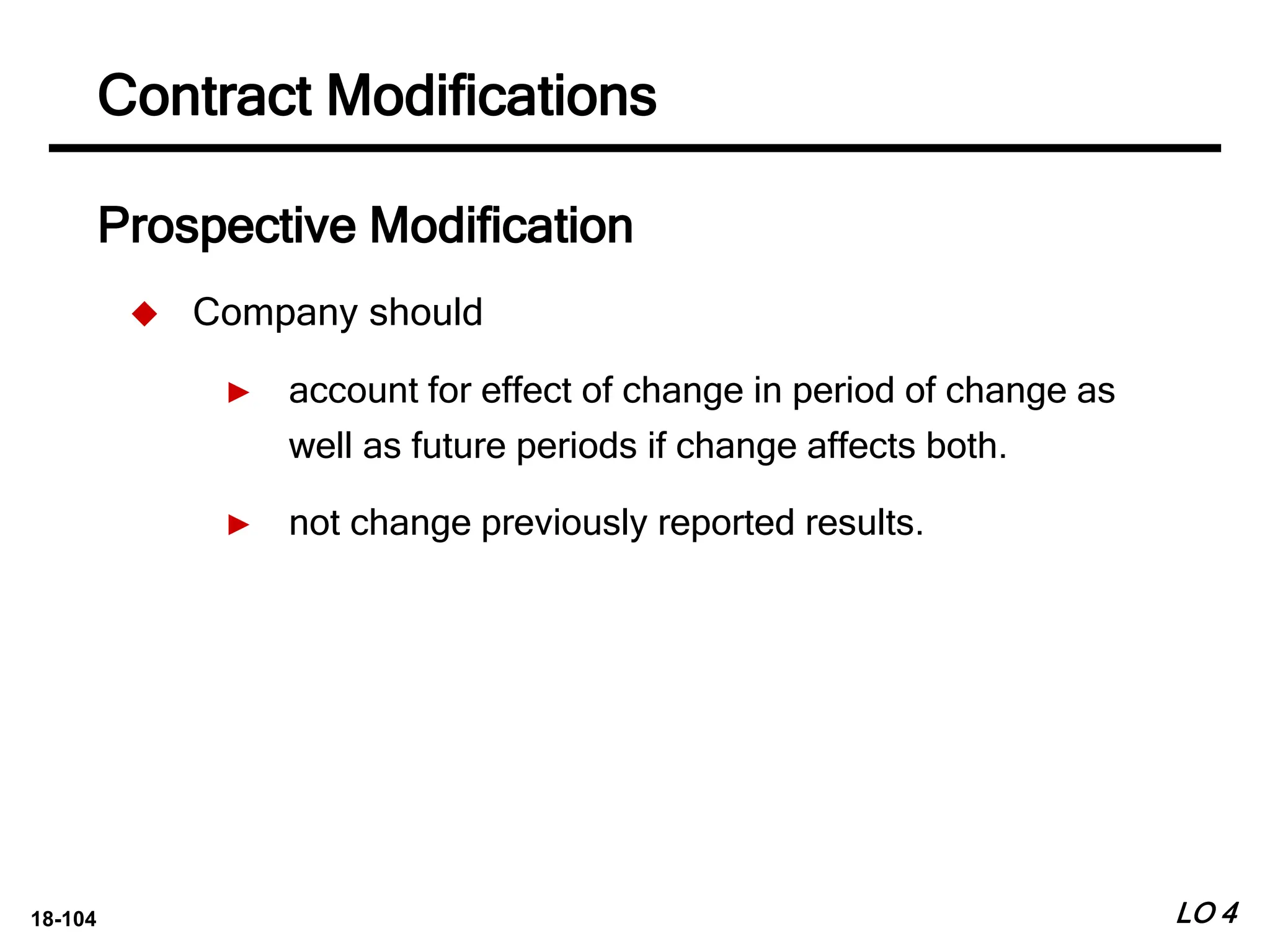
Prospective Modification
 Company should
► account for effect of change in period of change as
well as future periods if change affects both.
► not change previously reported results.
LO 4
Contract Modifications
18-105
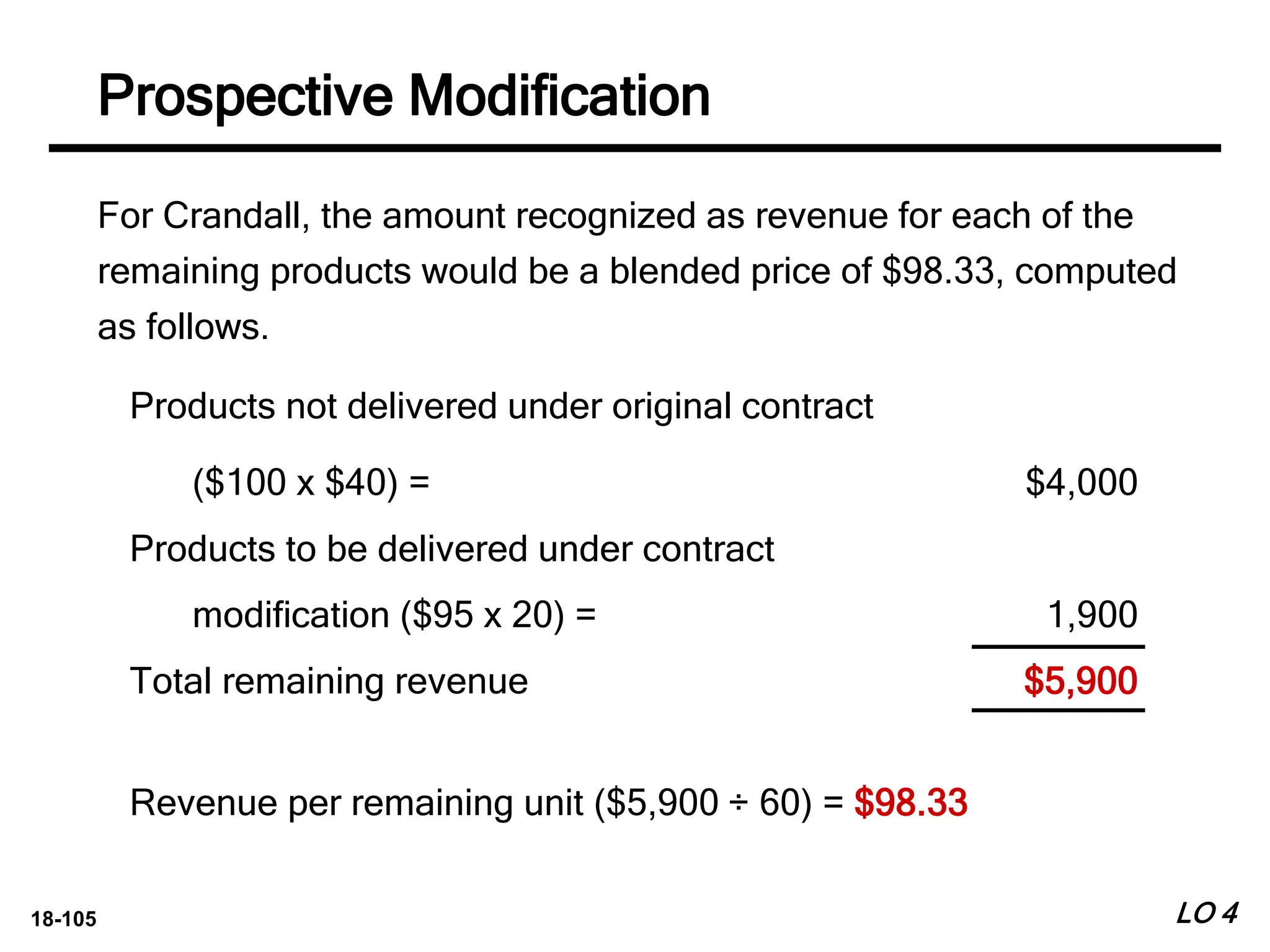
Products not delivered under original contract
($100 x $40) = $4,000
Products to be delivered under contract
modification ($95 x 20) = 1,900
Total remaining revenue $5,900
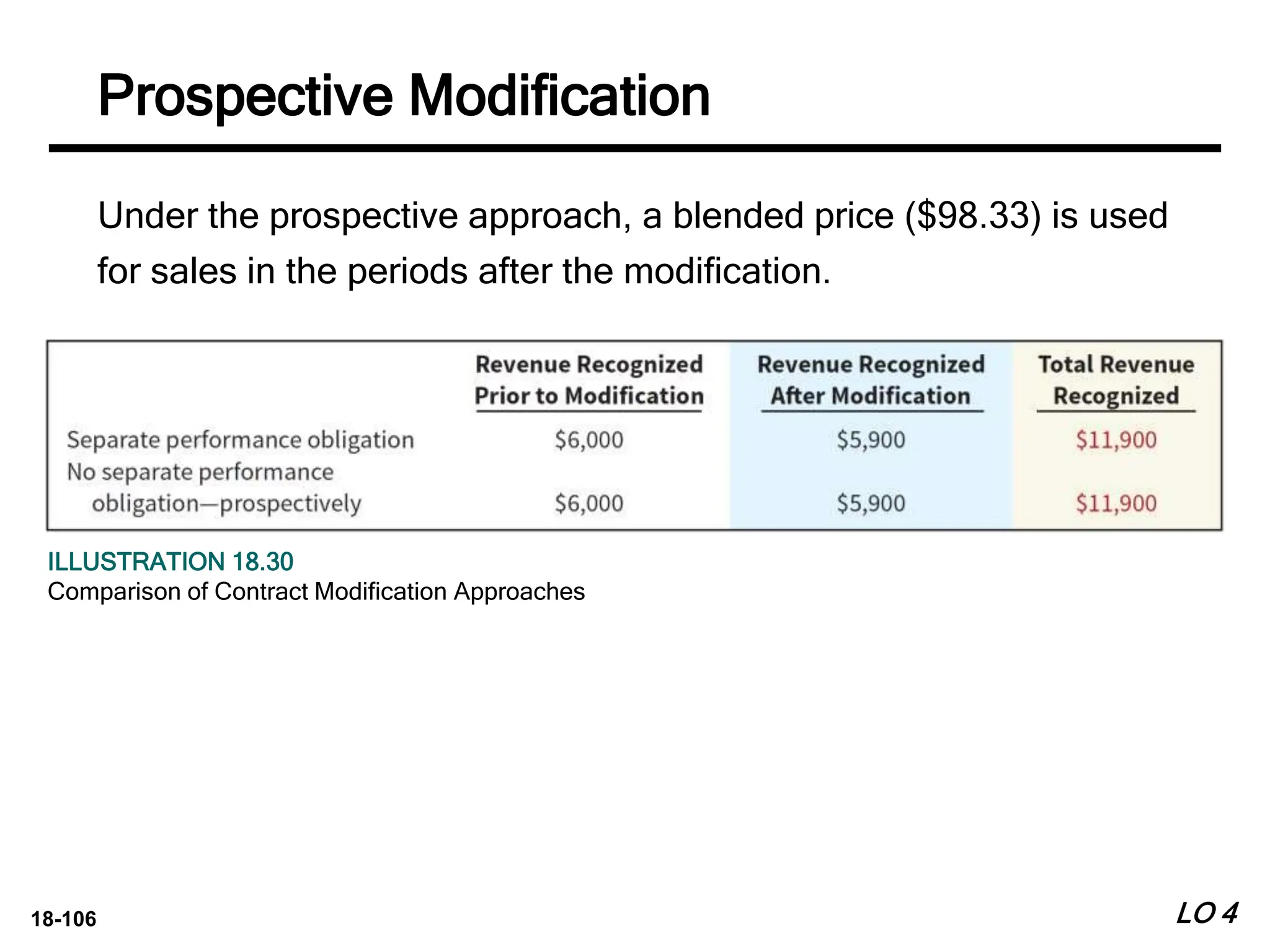
Revenue per remaining unit ($5,900 ÷ 60) = $98.33
For Crandall, the amount recognized as revenue for each of the
remaining products would be a blended price of $98.33, computed
as follows.
LO 4
Prospective Modification
18-106
Under the prospective approach, a blended price ($98.33) is used
for sales in the periods after the modification.
LO 4
Prospective Modification
ILLUSTRATION 18.30
Comparison of Contract Modification Approaches
18-107 LO 4
Costs to Fulfill a Contract
 Companies divide fulfillment costs (contract acquisition
costs) into two categories:
1. Those that give rise to an asset.
2. Those that are expensed as incurred.
Presentation
18-108 LO 4
Collectibility
 Credit risk that a customer will be unable to pay in
accordance with the contract.
► Whether a company will get paid is not a consideration
in determining revenue recognition.
► Amount recognized as revenue is not adjusted for
customer credit risk.
Presentation
18-109
Disclosure
LO 4
Companies disclose qualitative and quantitative information
about the following:
 Contracts with customers.
 Significant judgments.
 Assets recognized from costs incurred to fulfill a contract.
18-110
Disclosure
LO 4
Companies provide a range of disclosures:
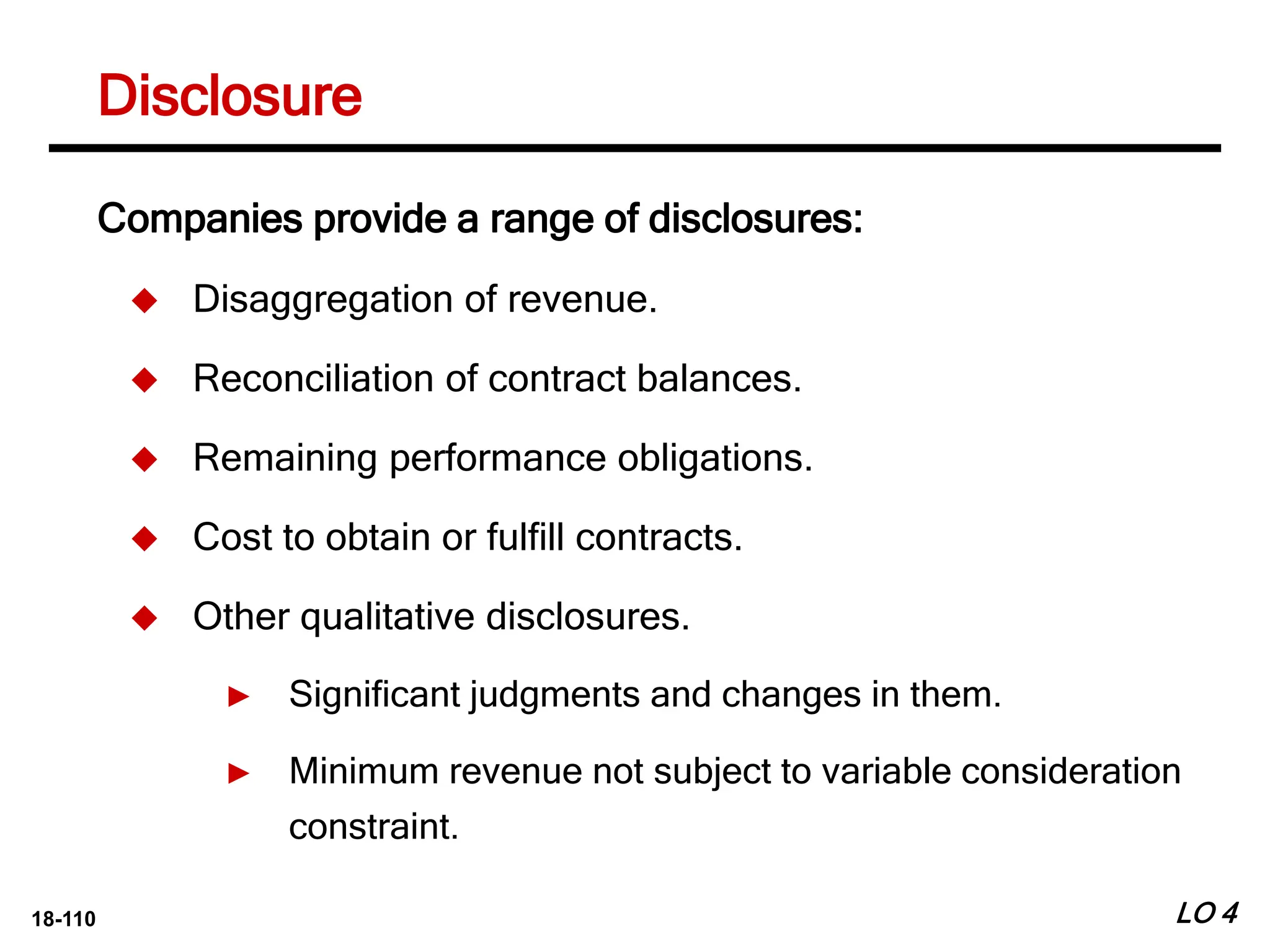
 Disaggregation of revenue.
 Reconciliation of contract balances.
 Remaining performance obligations.
 Cost to obtain or fulfill contracts.
 Other qualitative disclosures.
► Significant judgments and changes in them.
► Minimum revenue not subject to variable consideration
constraint.
18-111
Revenue Recognition Over Time
Under certain circumstances companies recognize revenue
over time.
The most notable context in which revenue may be
recognized over time is long-term construction contract
accounting.
APPENDIX 18A Long-Term Construction Contracts
LEARNING OBJECTIVE 5
Apply the percentage-of-completion method for long-term contracts.
LO 5
18-112
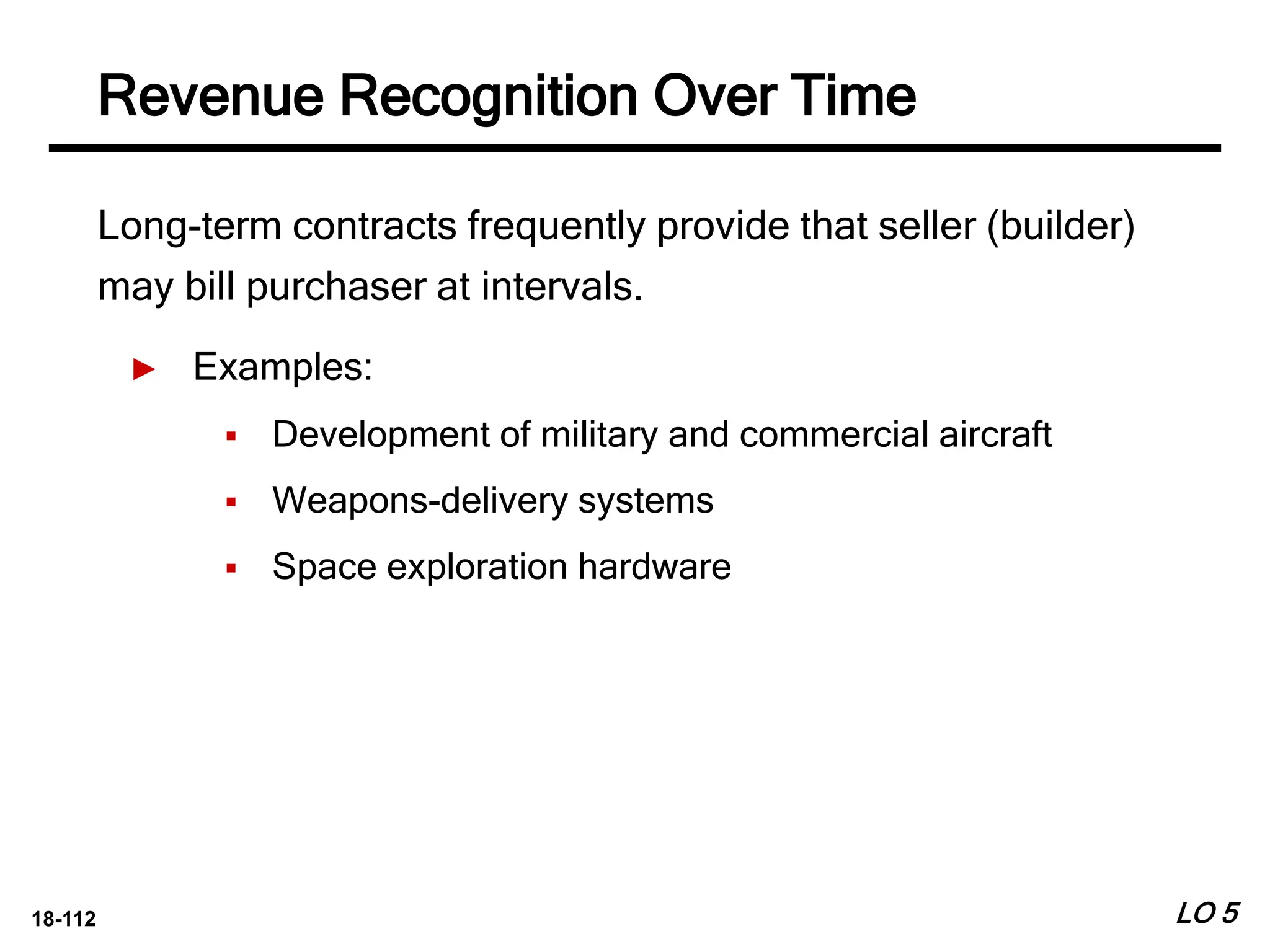
Long-term contracts frequently provide that seller (builder)
may bill purchaser at intervals.
► Examples:
 Development of military and commercial aircraft
 Weapons-delivery systems
 Space exploration hardware
LO 5
Revenue Recognition Over Time
18-113
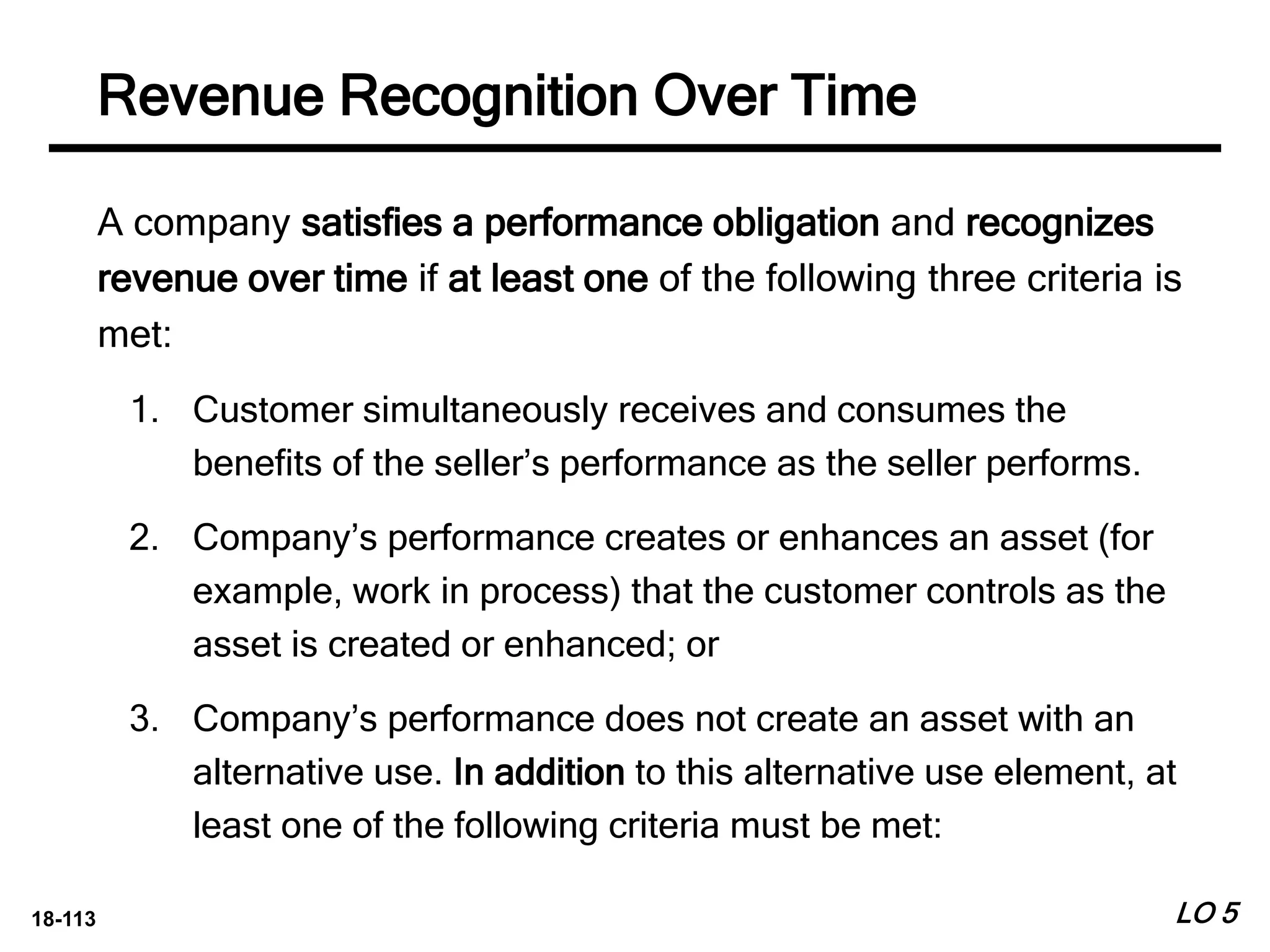
A company satisfies a performance obligation and recognizes
revenue over time if at least one of the following three criteria is
met:
1. Customer simultaneously receives and consumes the
benefits of the seller’s performance as the seller performs.
2. Company’s performance creates or enhances an asset (for
example, work in process) that the customer controls as the
asset is created or enhanced; or
3. Company’s performance does not create an asset with an
alternative use. In addition to this alternative use element, at
least one of the following criteria must be met:
LO 5
Revenue Recognition Over Time
18-114
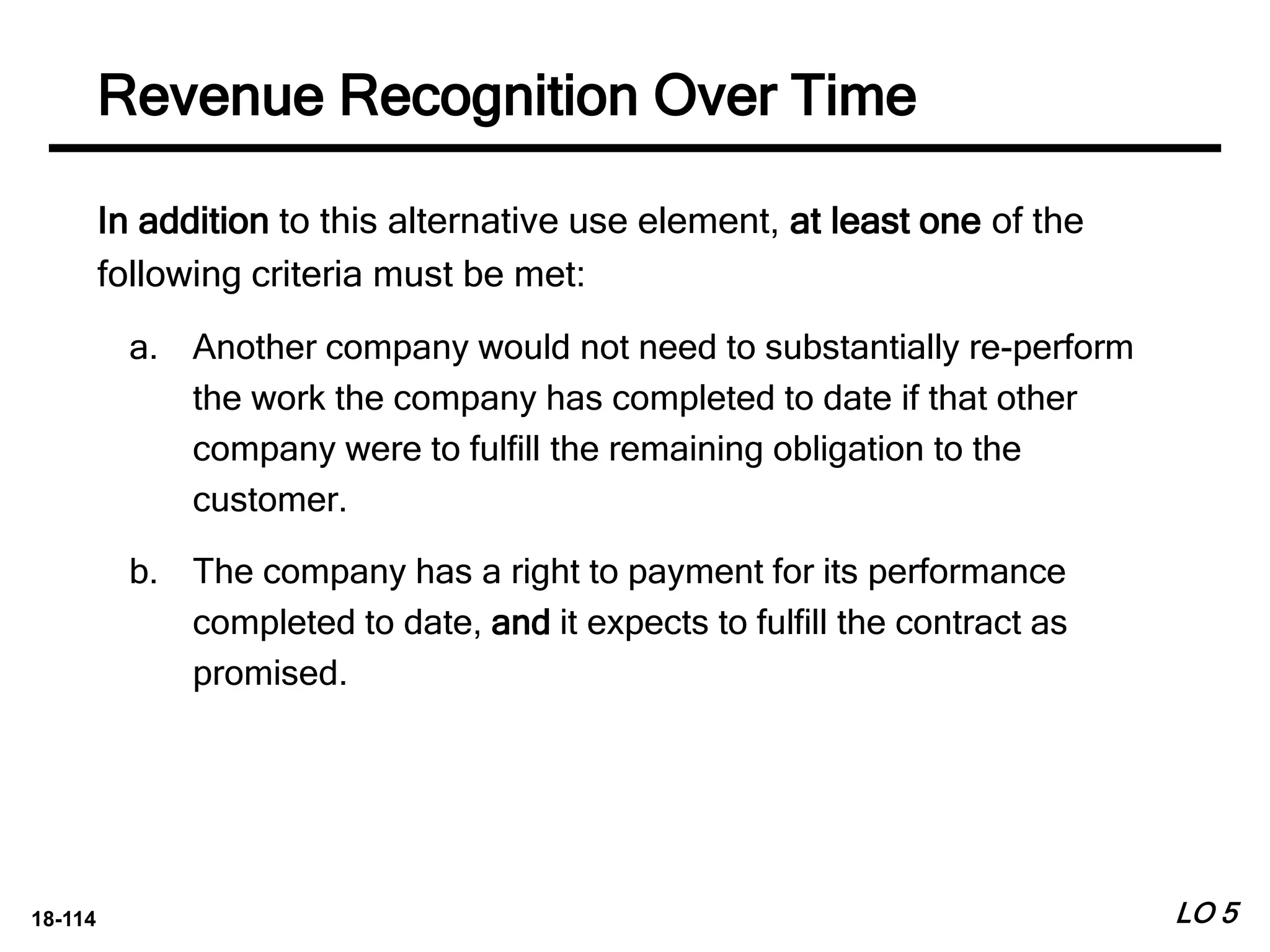
In addition to this alternative use element, at least one of the
following criteria must be met:
a. Another company would not need to substantially re-perform
the work the company has completed to date if that other
company were to fulfill the remaining obligation to the
customer.
b. The company has a right to payment for its performance
completed to date, and it expects to fulfill the contract as
promised.
LO 5
Revenue Recognition Over Time
18-115
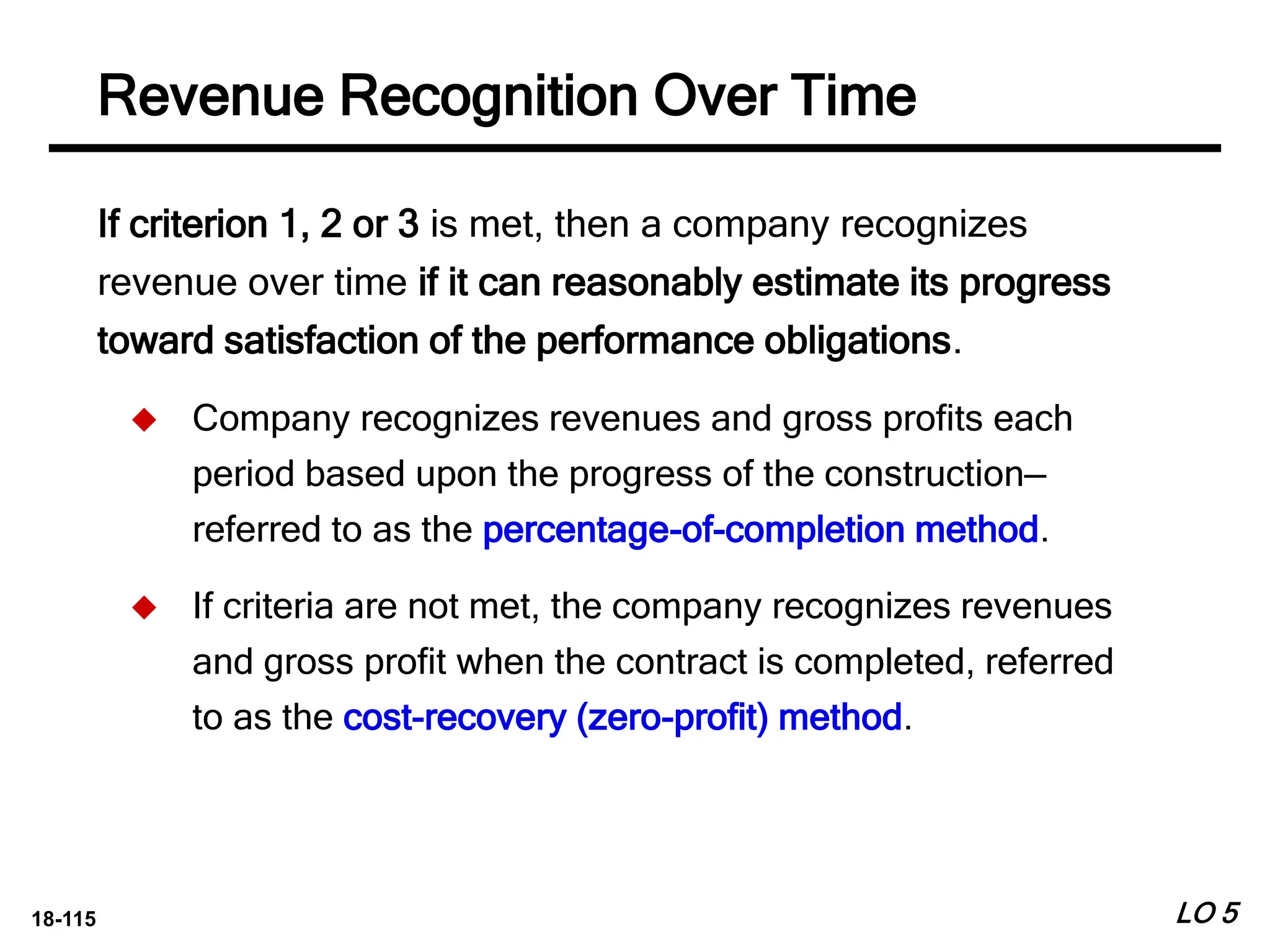
If criterion 1, 2 or 3 is met, then a company recognizes
revenue over time if it can reasonably estimate its progress
toward satisfaction of the performance obligations.
 Company recognizes revenues and gross profits each
period based upon the progress of the construction—
referred to as the percentage-of-completion method.
 If criteria are not met, the company recognizes revenues
and gross profit when the contract is completed, referred
to as the cost-recovery (zero-profit) method.
LO 5
Revenue Recognition Over Time
18-116
Measuring the Progress Toward Completion
Most popular input measure used to determine the progress
toward completion is the cost-to-cost basis.
LO 5
Percentage-of-Completion Method
Revenue Recognition Over Time
18-117 LO 5
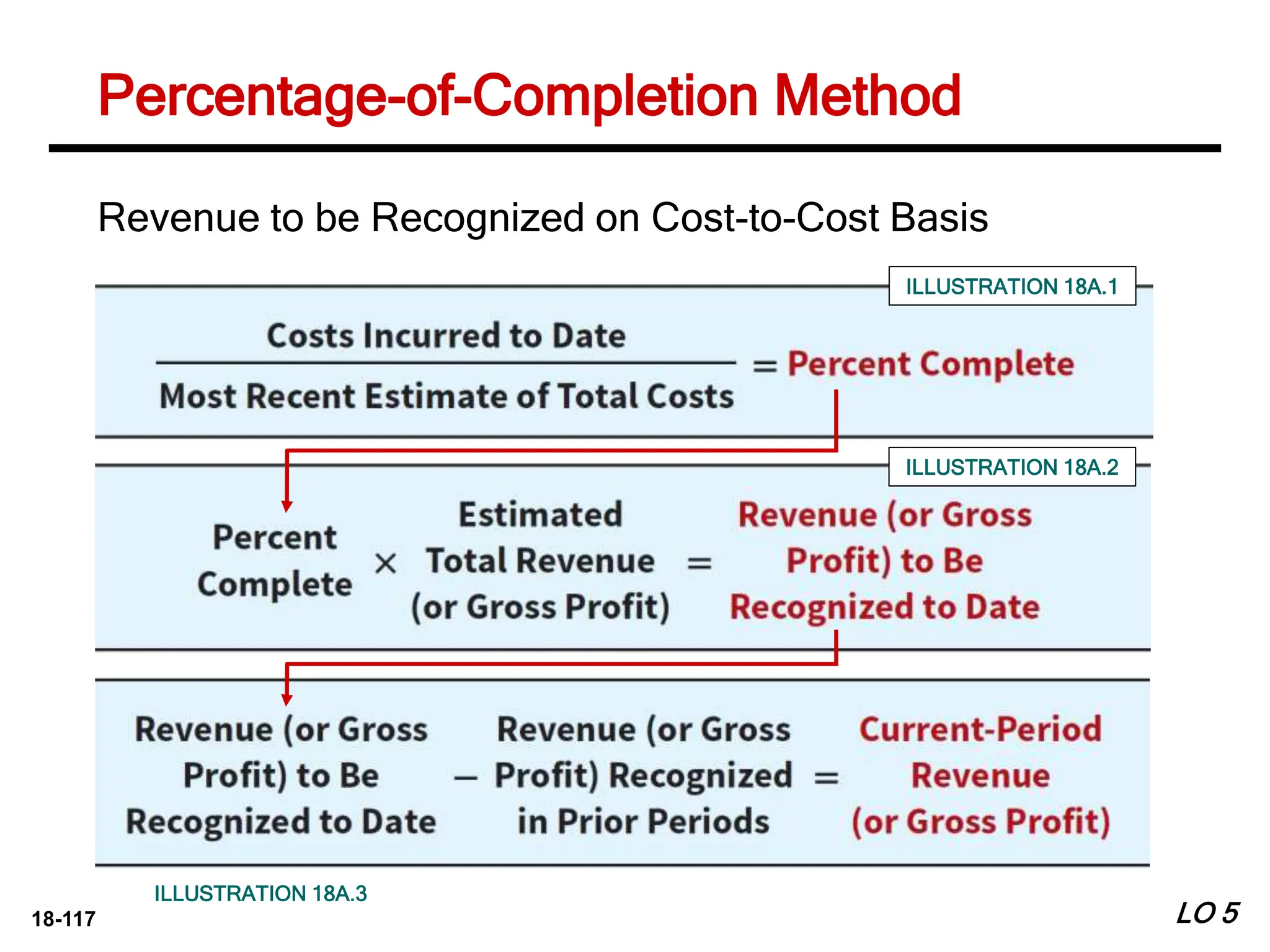
Revenue to be Recognized on Cost-to-Cost Basis
ILLUSTRATION 18A.1
ILLUSTRATION 18A.2
ILLUSTRATION 18A.3
Percentage-of-Completion Method
18-118
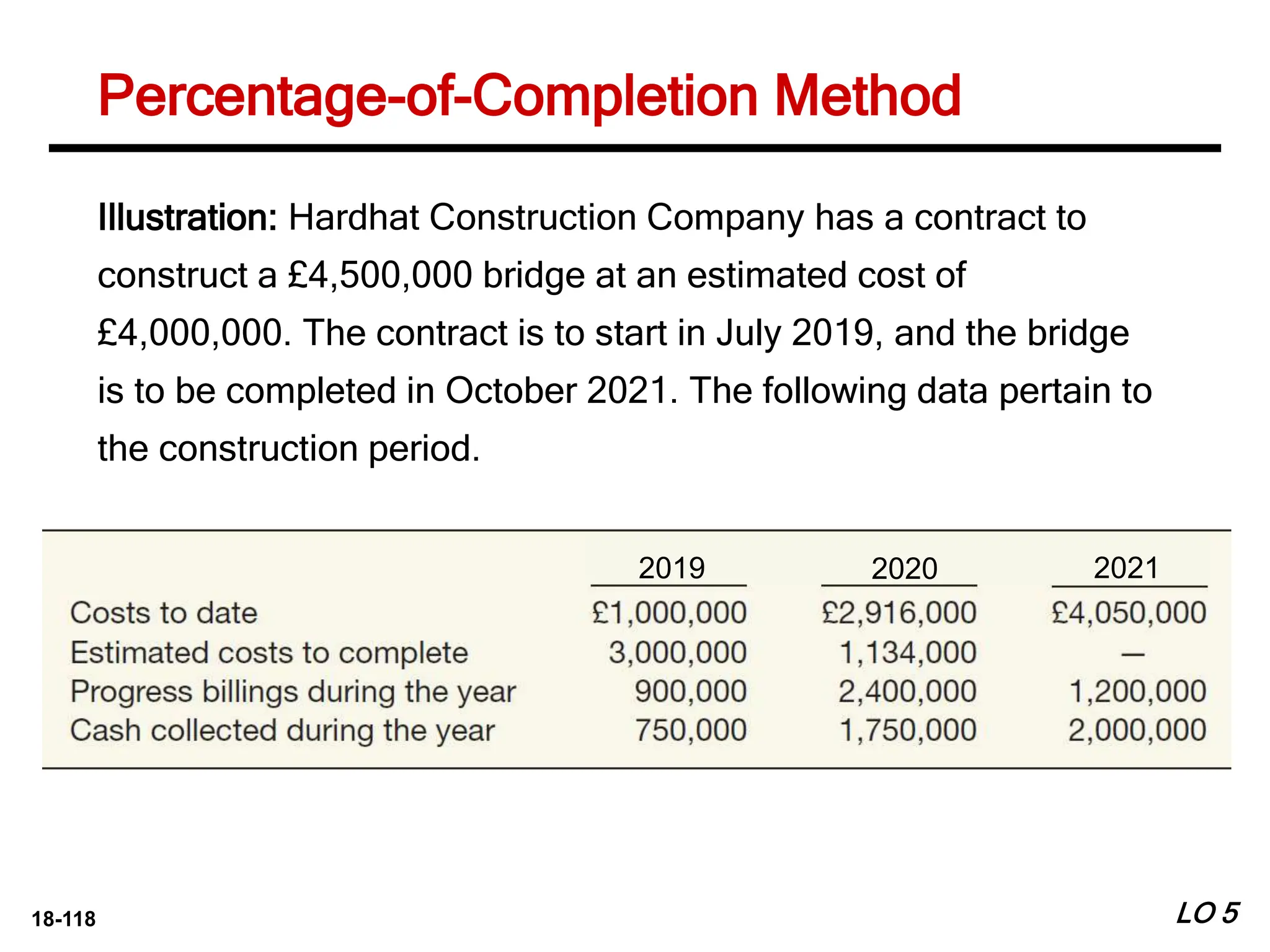
Illustration: Hardhat Construction Company has a contract to
construct a £4,500,000 bridge at an estimated cost of
£4,000,000. The contract is to start in July 2019, and the bridge
is to be completed in October 2021. The following data pertain to
the construction period.
LO 5
Percentage-of-Completion Method
2019 2020 2021
18-119
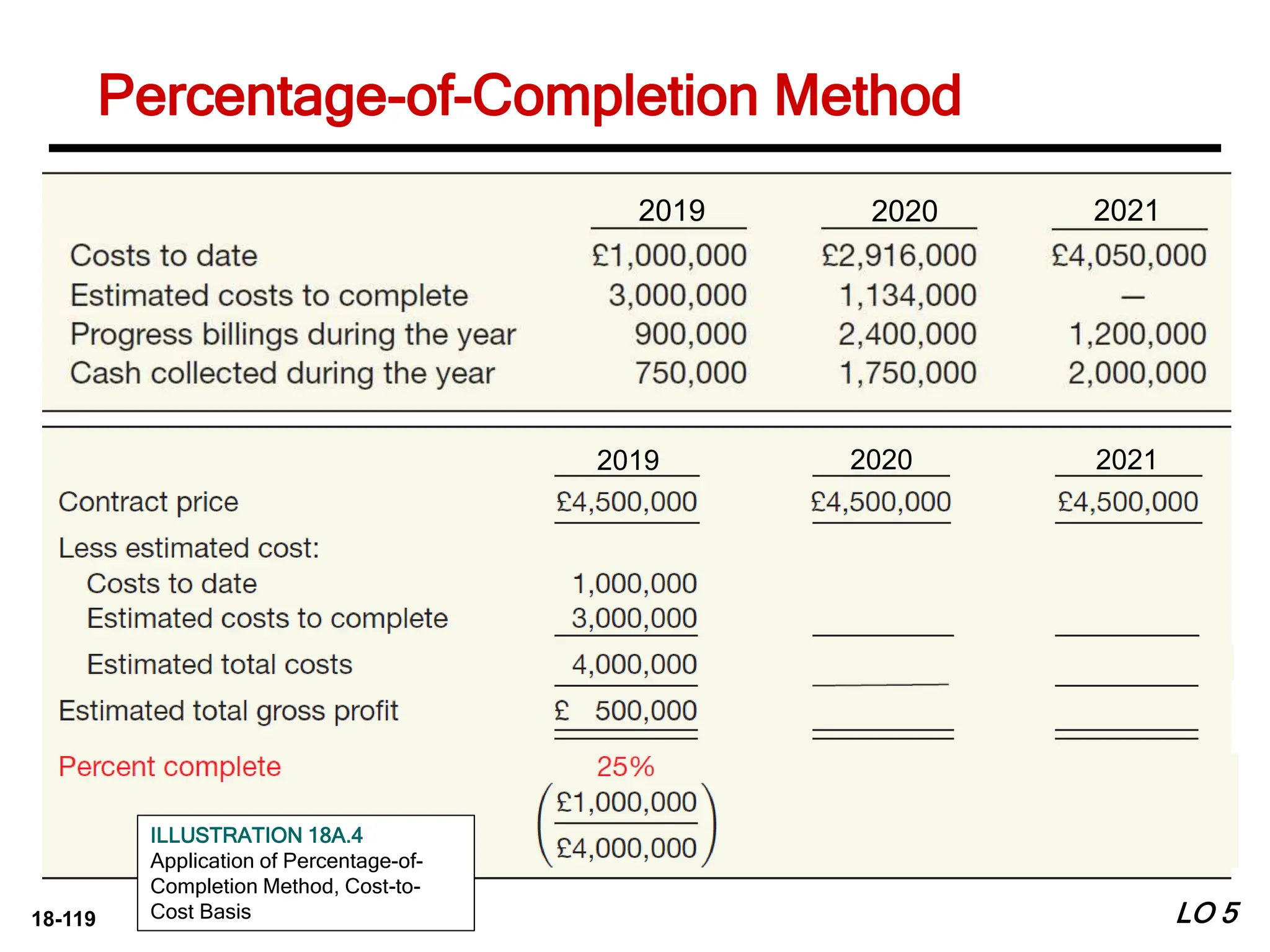
ILLUSTRATION 18A.4
Application of Percentage-of-
Completion Method, Cost-to-
Cost Basis LO 5
Percentage-of-Completion Method
2019 2020 2021
2019 2020 2021
18-120
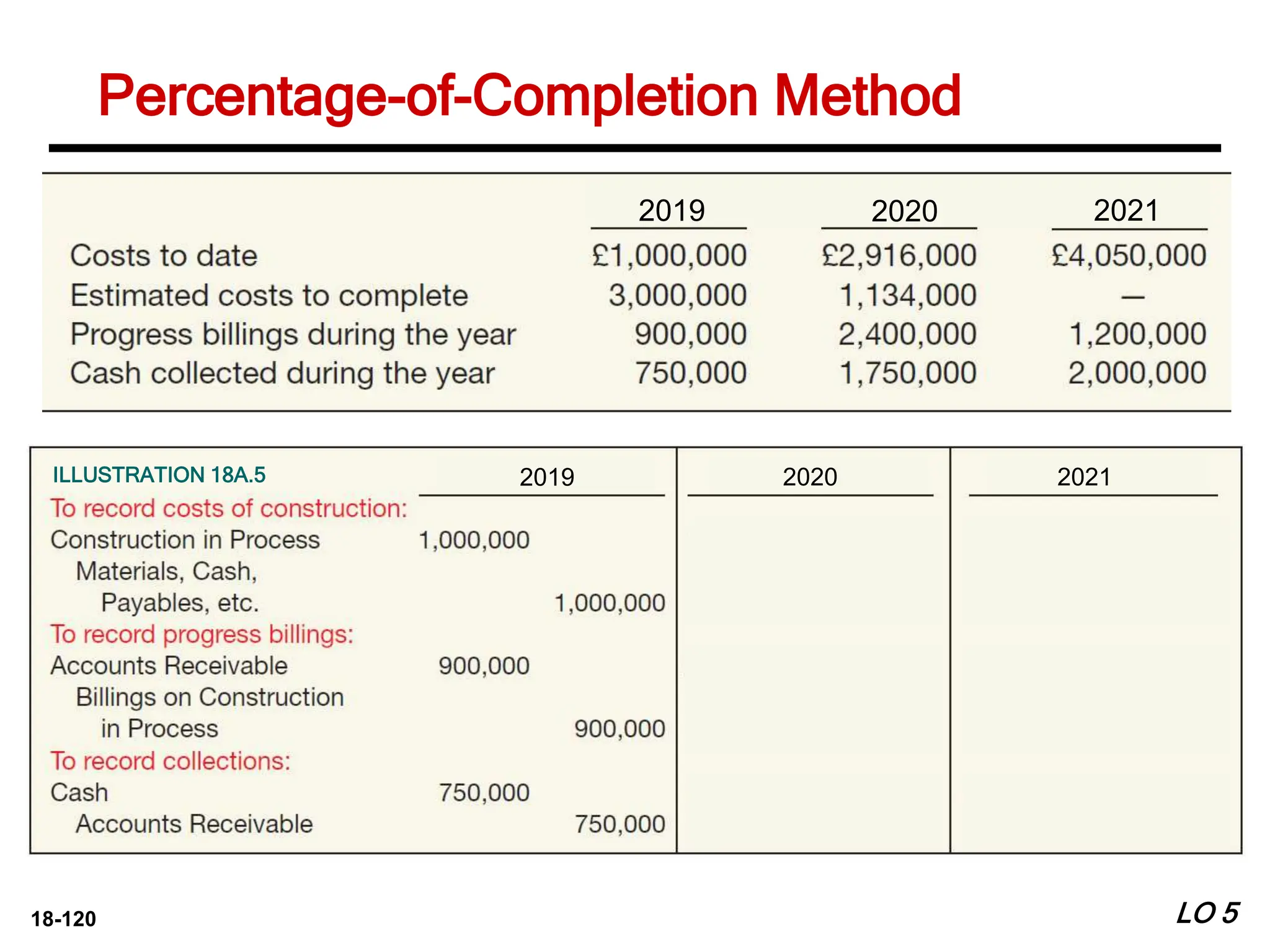
ILLUSTRATION 18A.5
LO 5
2019 2020 2021
Percentage-of-Completion Method
2019 2020 2021
18-121
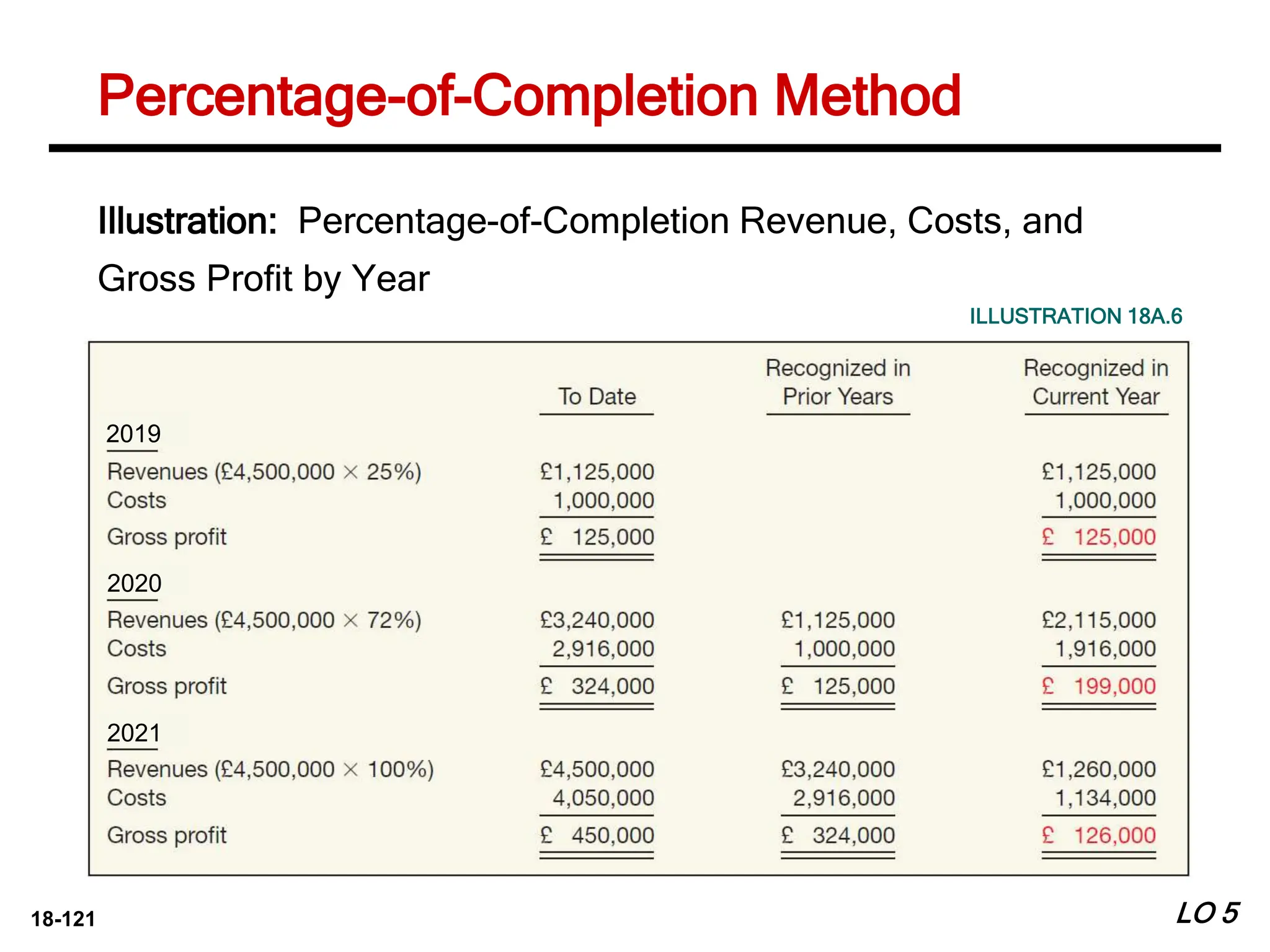
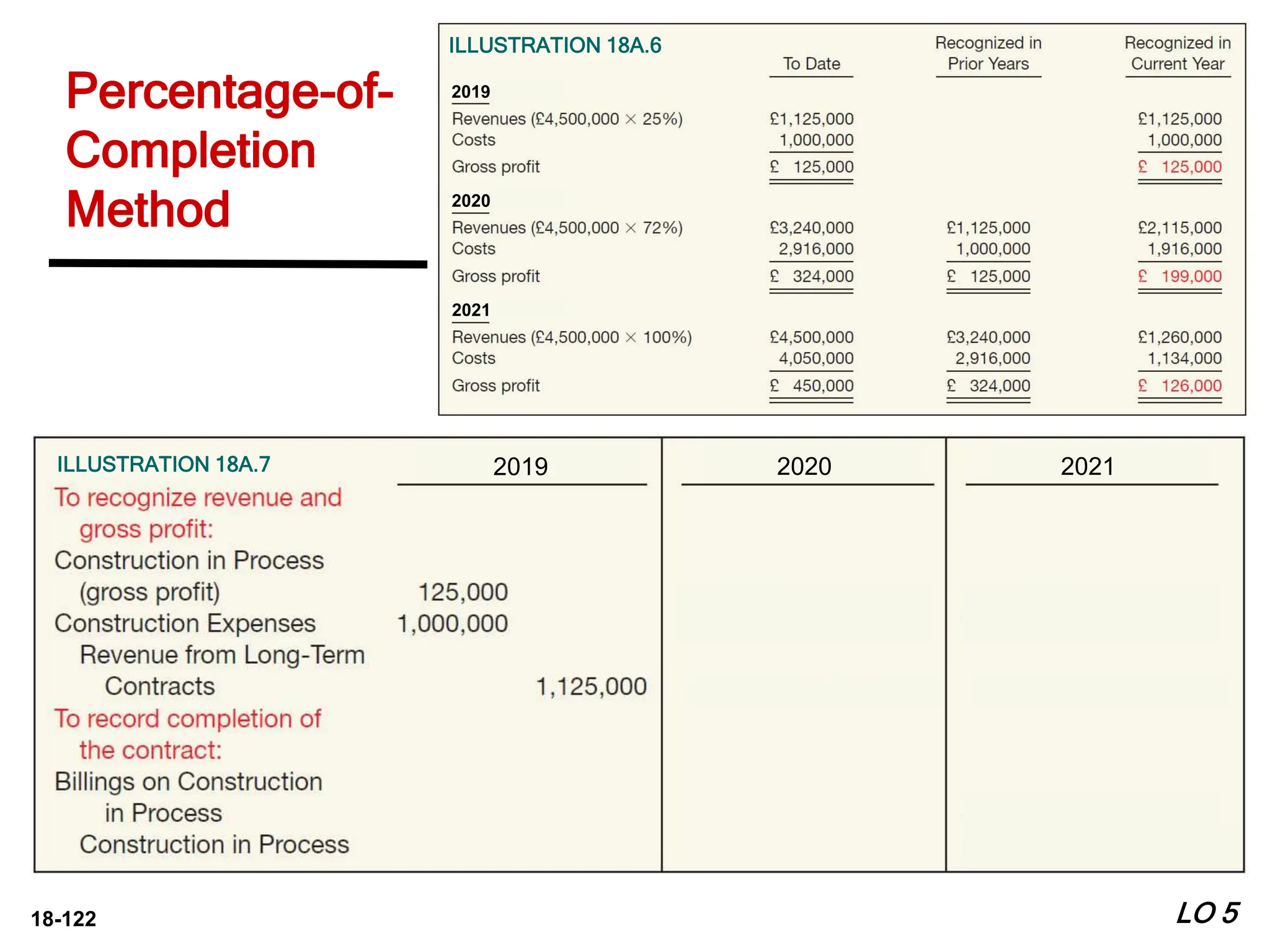
Illustration: Percentage-of-Completion Revenue, Costs, and
Gross Profit by Year
ILLUSTRATION 18A.6
LO 5
2019
2020
2021
Percentage-of-Completion Method
18-122
ILLUSTRATION 18A.7
ILLUSTRATION 18A.6
LO 5
Percentage-of-
Completion
Method
2019
2020
2021
2019 2020 2021
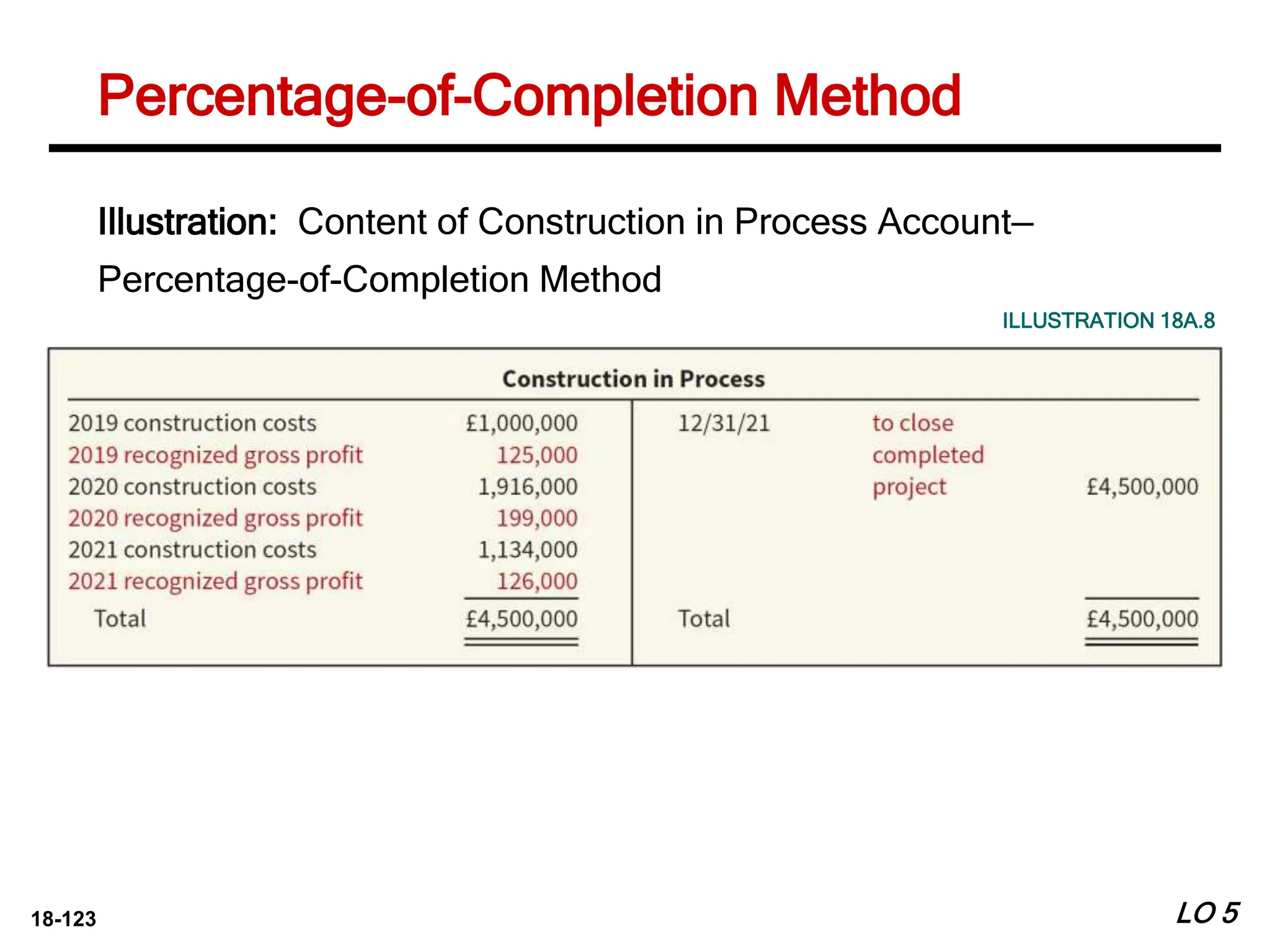
18-123
Illustration: Content of Construction in Process Account—
Percentage-of-Completion Method
ILLUSTRATION 18A.8
LO 5
Percentage-of-Completion Method
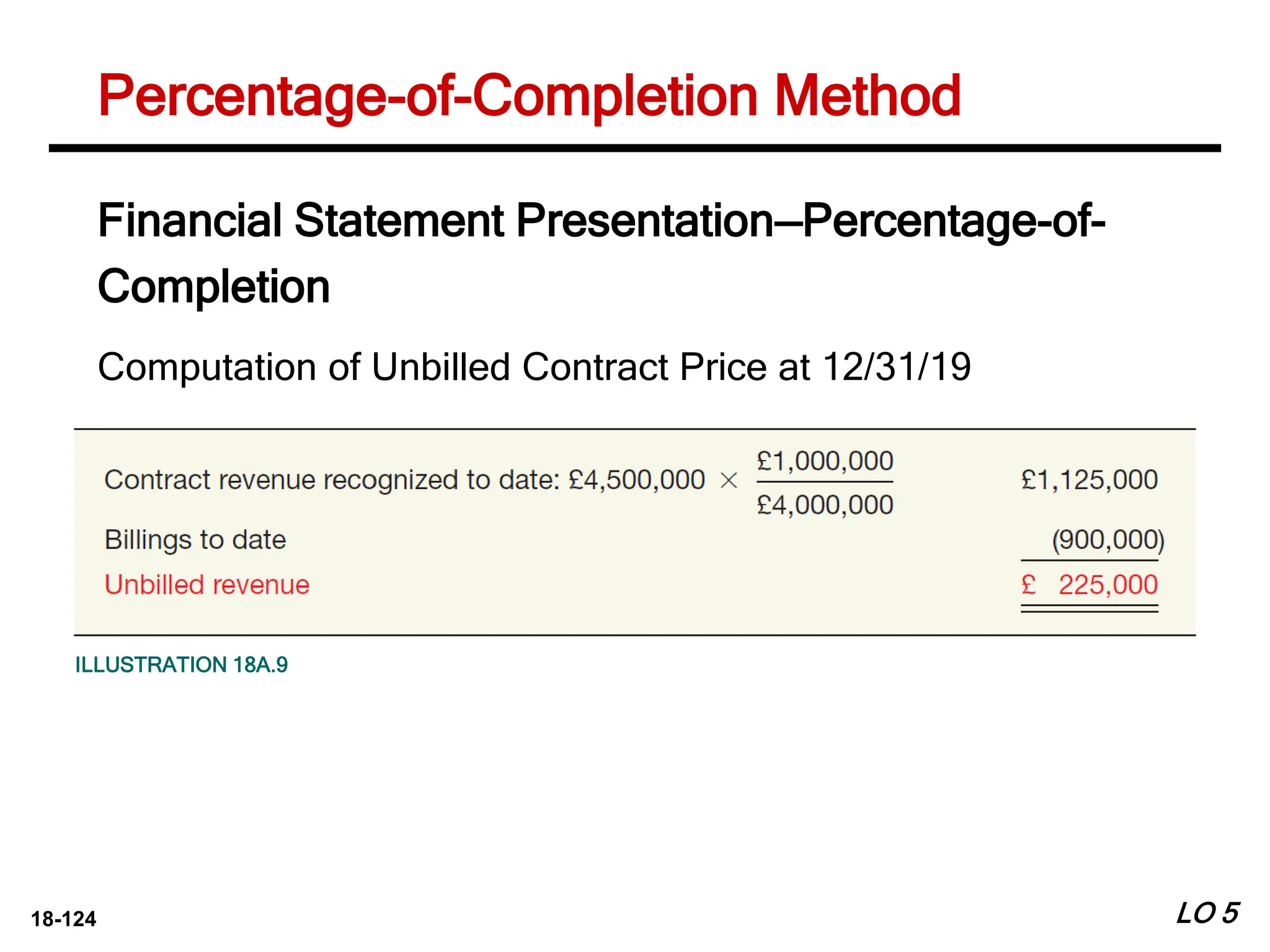
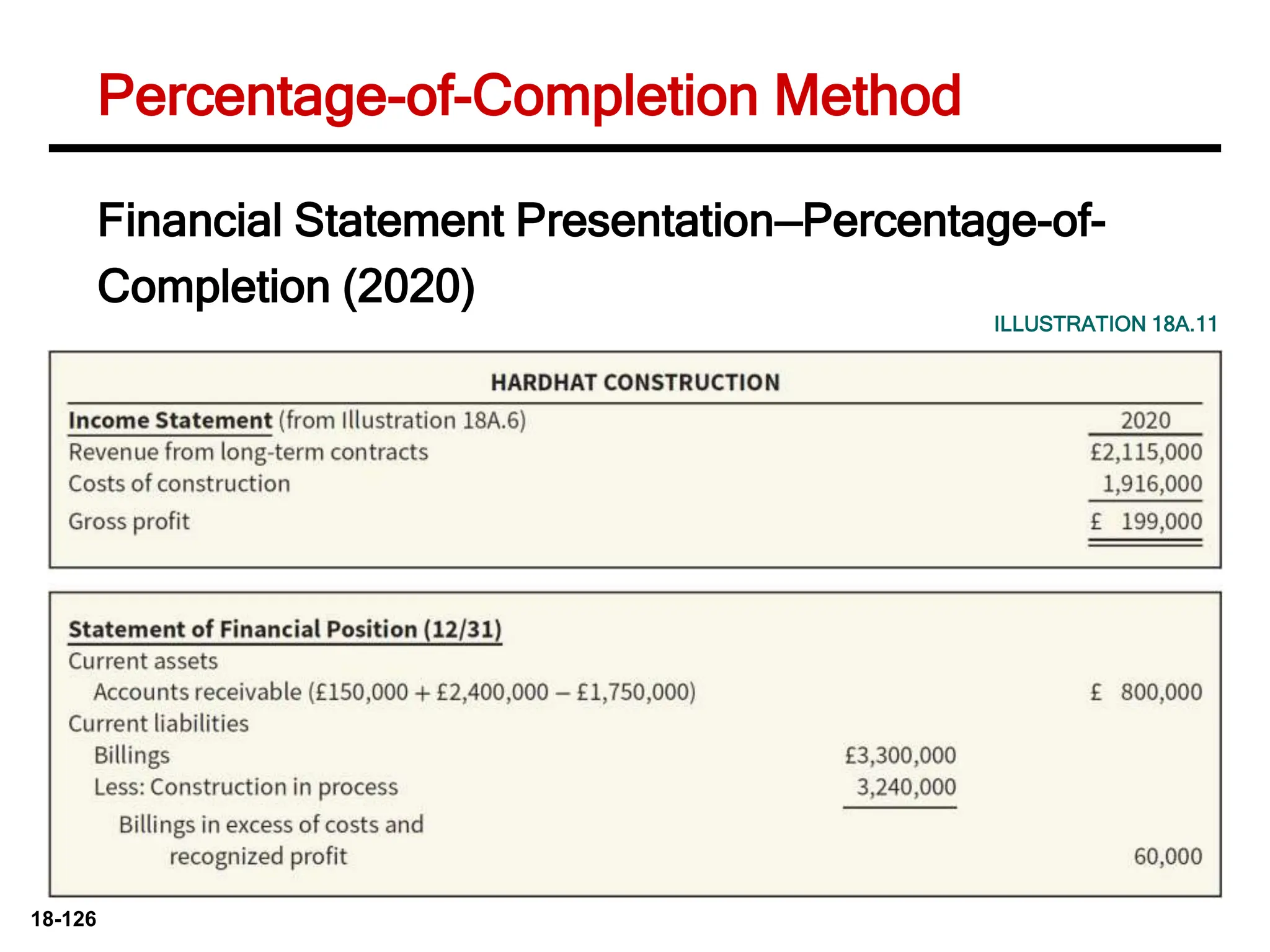
18-124
Financial Statement Presentation—Percentage-of-
Completion
ILLUSTRATION 18A.9
Computation of Unbilled Contract Price at 12/31/19
LO 5
Percentage-of-Completion Method
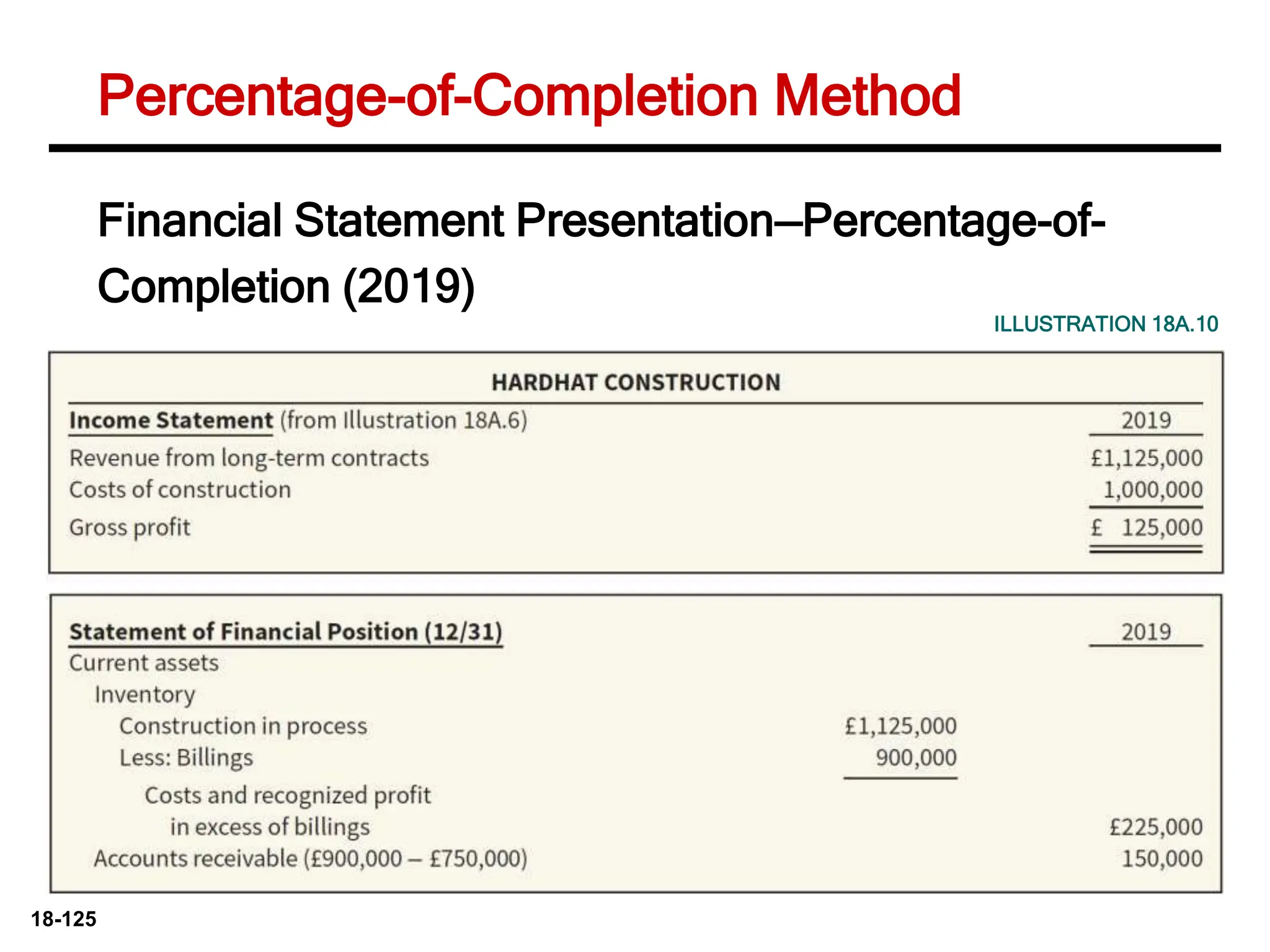
18-125
Financial Statement Presentation—Percentage-of-
Completion (2019)
ILLUSTRATION 18A.10
Percentage-of-Completion Method
18-126
Financial Statement Presentation—Percentage-of-
Completion (2020)
ILLUSTRATION 18A.11
Percentage-of-Completion Method
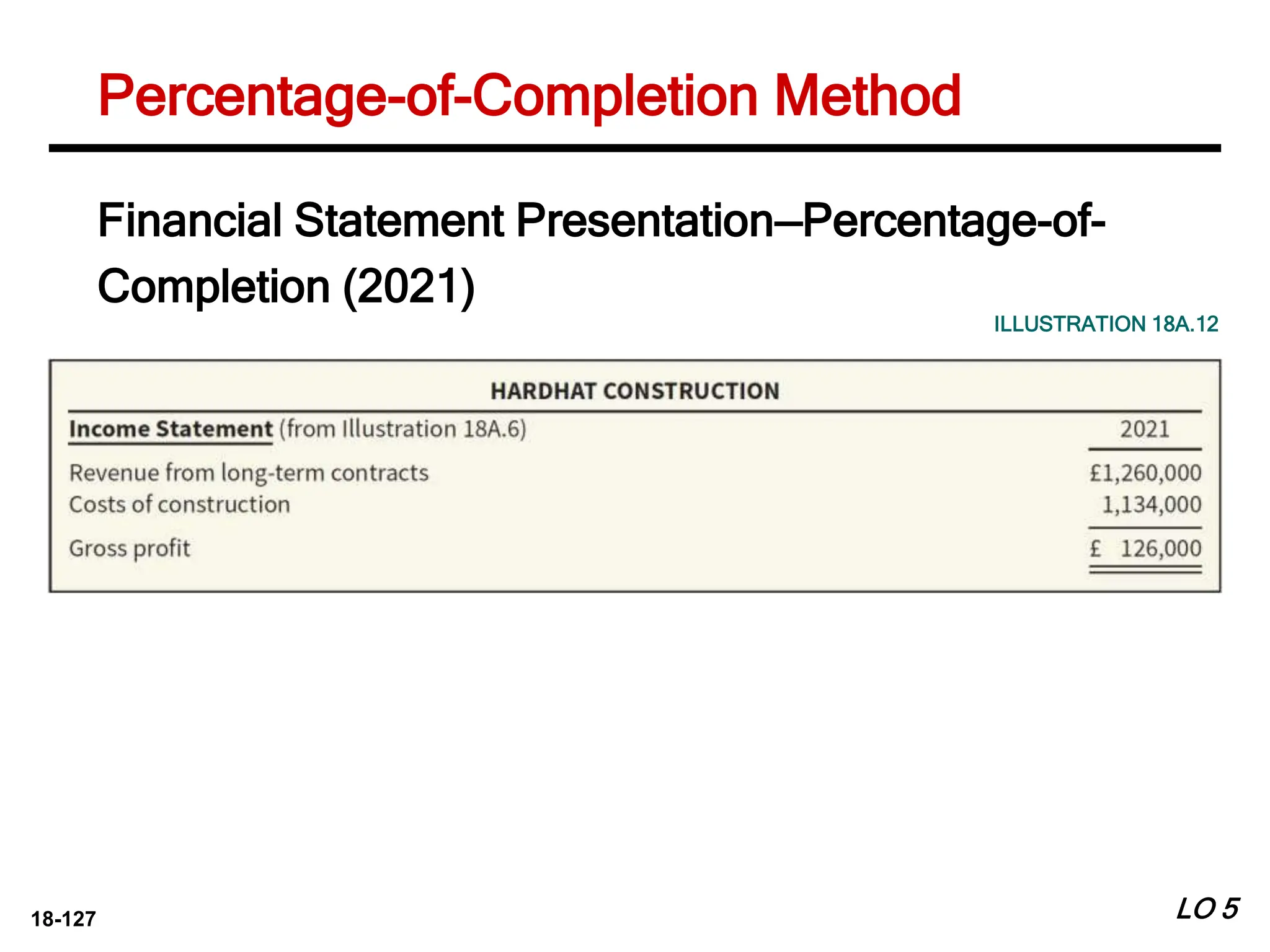
18-127
Financial Statement Presentation—Percentage-of-
Completion (2021)
ILLUSTRATION 18A.12
Percentage-of-Completion Method
LO 5
18-128
This method recognizes revenue only to the extent of costs
incurred that are expected to be recoverable.
Only after all costs are incurred is gross profit recognized.
Cost-Recovery (Zero-Profit) Method
APPENDIX 18A Long-Term Construction Contracts
LEARNING OBJECTIVE 6
Apply the cost-recovery method for long-term contracts.
LO 6
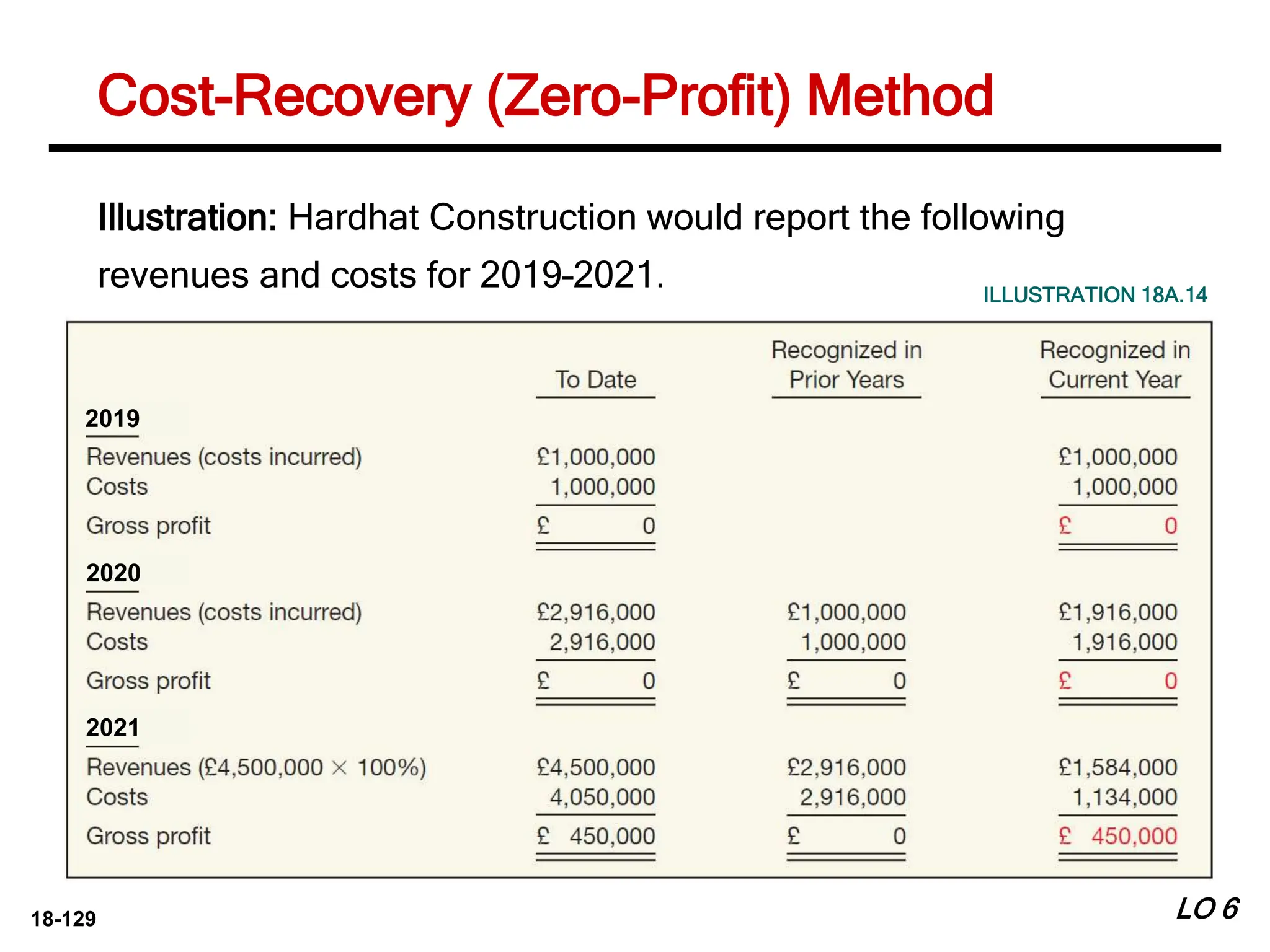
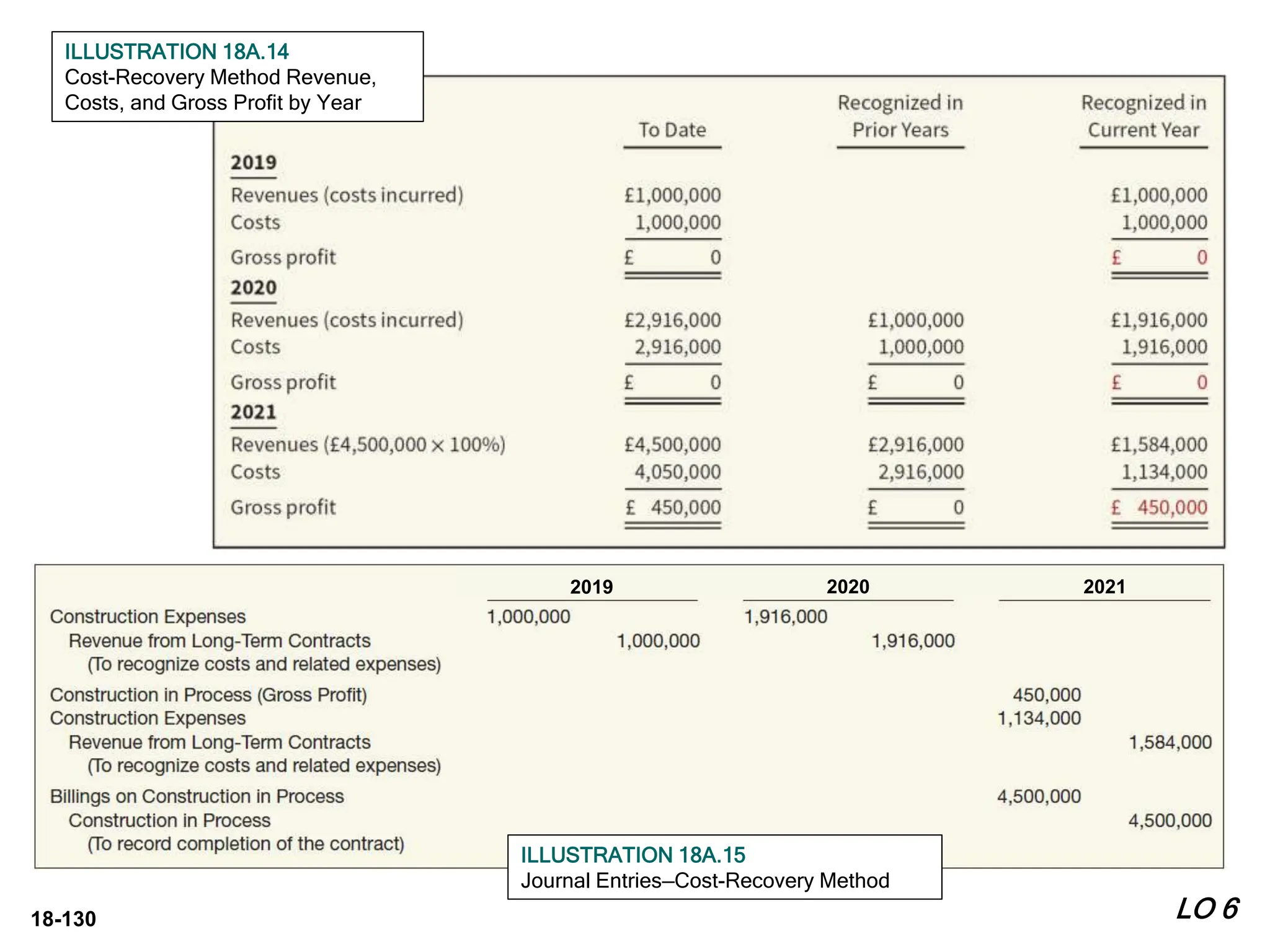
18-129 LO 6
Illustration: Hardhat Construction would report the following
revenues and costs for 2019–2021. ILLUSTRATION 18A.14
Cost-Recovery (Zero-Profit) Method
2019
2020
2021
18-130 LO 6
ILLUSTRATION 18A.14
Cost-Recovery Method Revenue,
Costs, and Gross Profit by Year
ILLUSTRATION 18A.15
Journal Entries—Cost-Recovery Method
2019 2020 2021
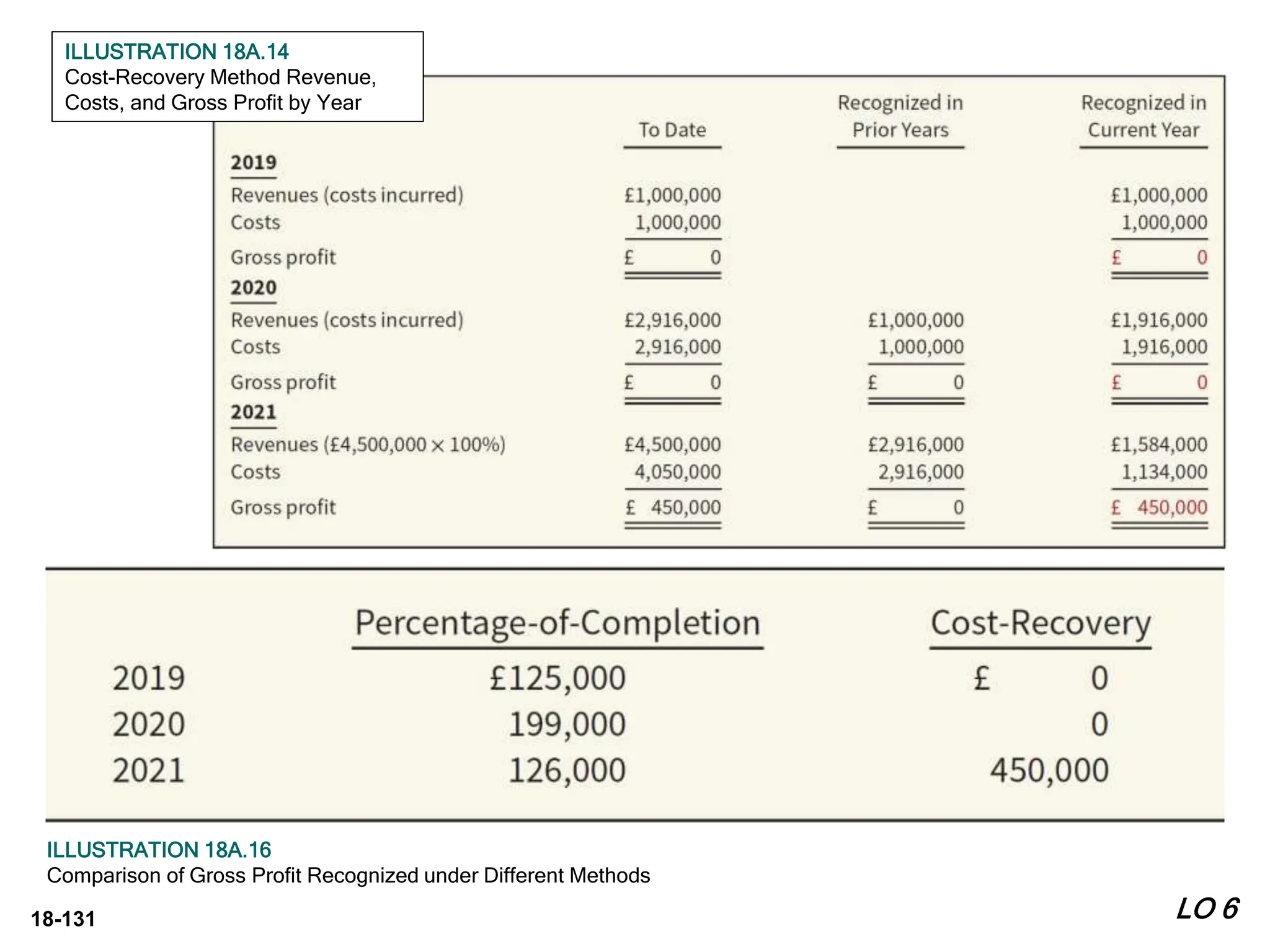
18-131 LO 6
ILLUSTRATION 18A.16
Comparison of Gross Profit Recognized under Different Methods
ILLUSTRATION 18A.14
Cost-Recovery Method Revenue,
Costs, and Gross Profit by Year
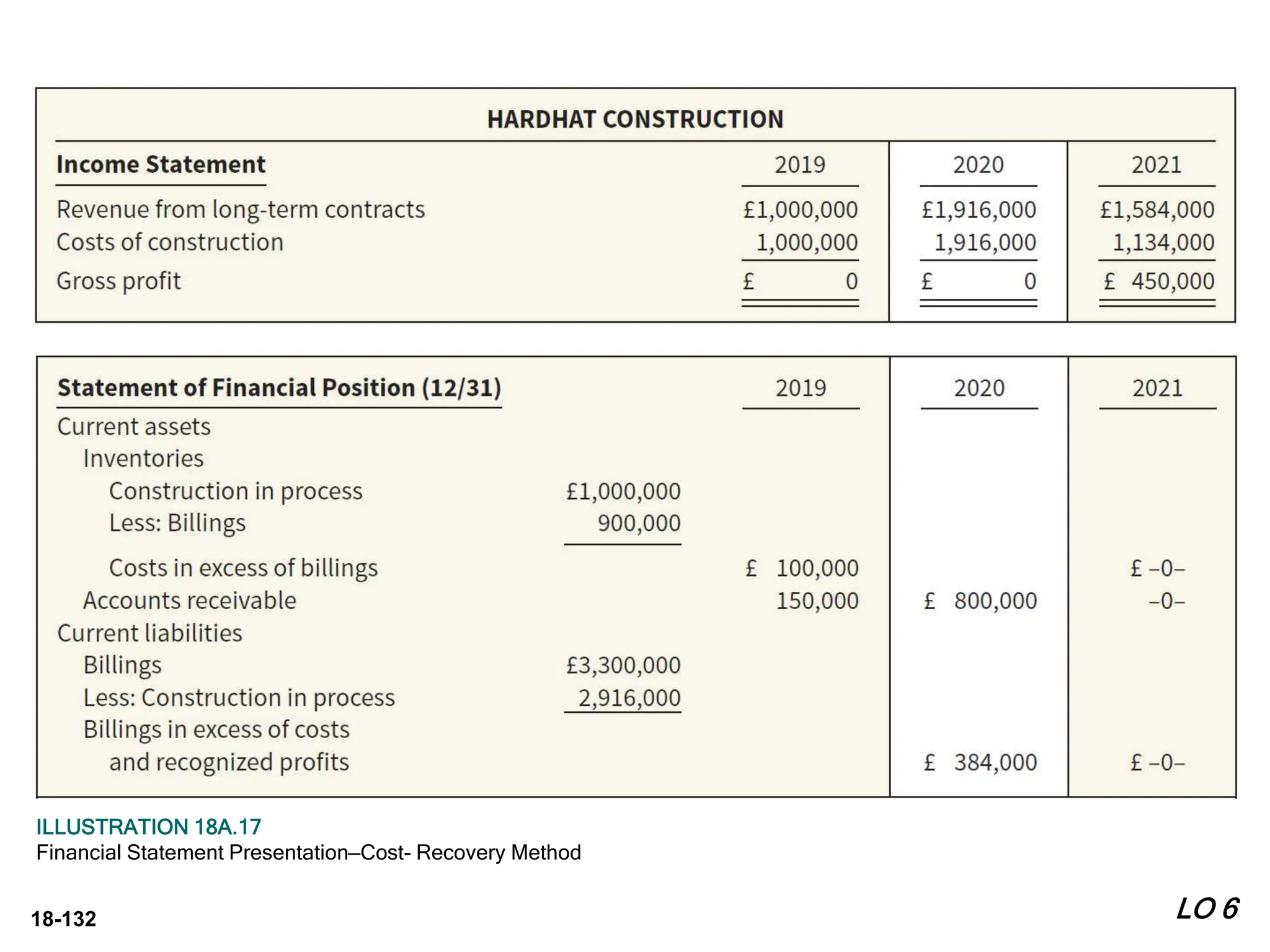
18-132 LO 6
ILLUSTRATION 18A.17
Financial Statement Presentation—Cost- Recovery Method
18-133
1. Loss in Current Period on a Profitable Contract
► Percentage-of-completion method only, the estimated
cost increase requires a current-period adjustment of
excess gross profit recognized in prior periods.
2. Loss on an Unprofitable Contract
► Under both percentage-of-completion and cost-recovery
methods, the company must recognize in the current
period the entire expected contract loss.
Long-Term Contract Losses
APPENDIX 18A Long-Term Construction Contracts
LEARNING OBJECTIVE 7
Identify the proper accounting for losses on long-term contracts.
LO 7
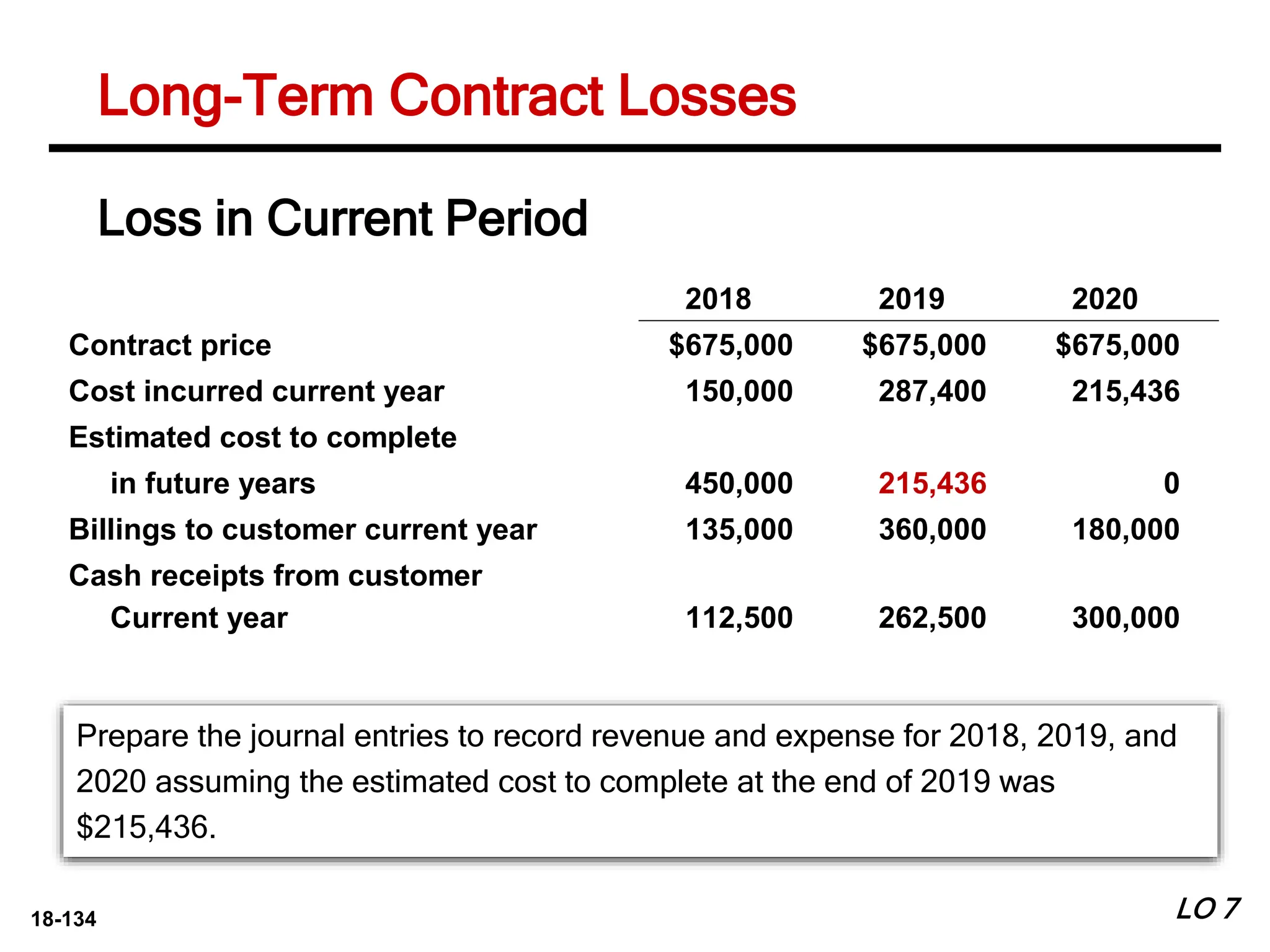
18-134
Prepare the journal entries to record revenue and expense for 2018, 2019, and
2020 assuming the estimated cost to complete at the end of 2019 was
$215,436.
2018 2019 2020
Contract price $675,000 $675,000 $675,000
Cost incurred current year 150,000 287,400 215,436
Estimated cost to complete
in future years 450,000 215,436 0
Billings to customer current year 135,000 360,000 180,000
Cash receipts from customer
Current year 112,500 262,500 300,000
Loss in Current Period
LO 7
Long-Term Contract Losses
18-135
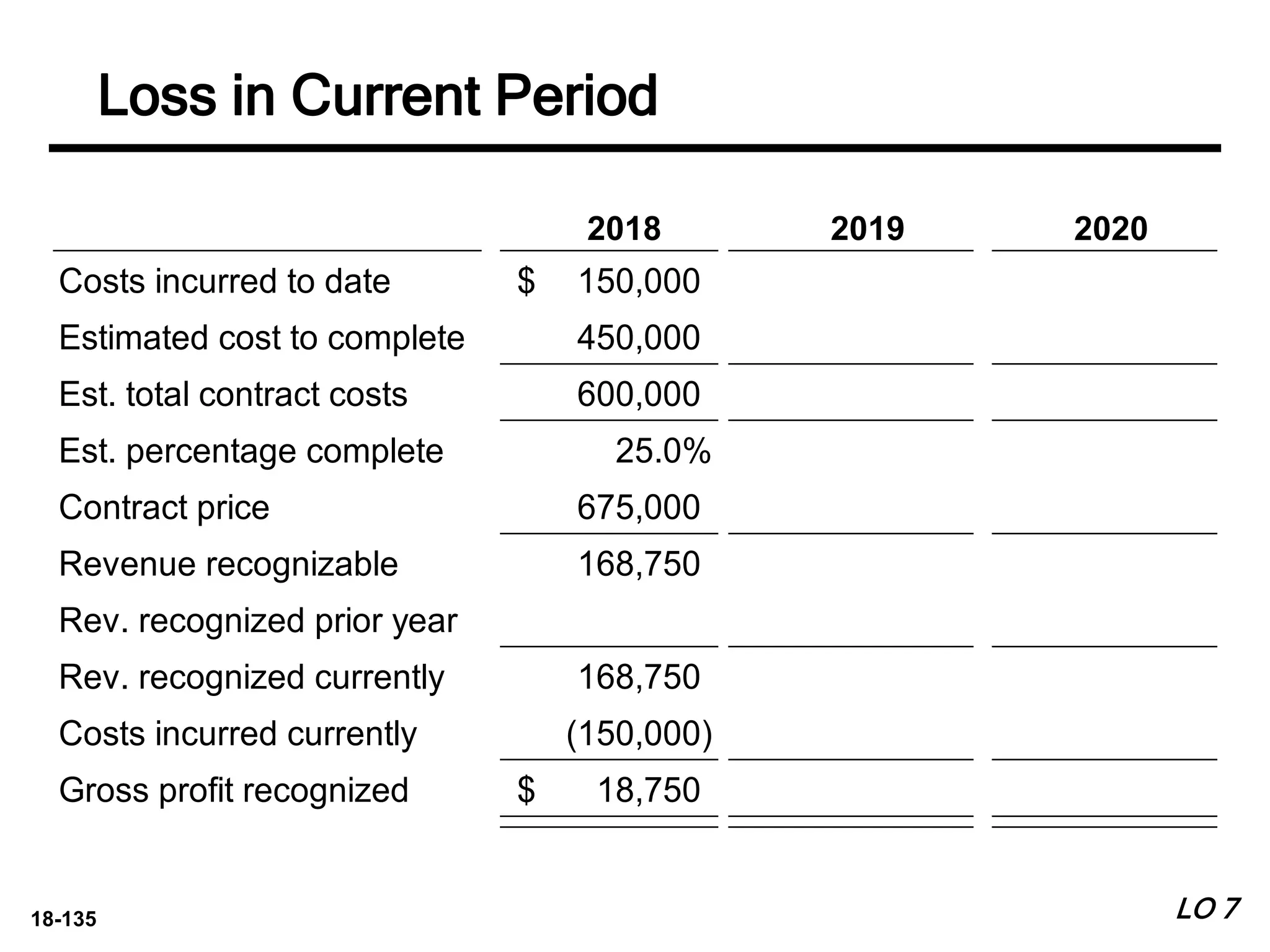
2014 2015 2016
Costs incurred to date 150,000
$ 437,400
$ 652,836
$
Estimated cost to complete 450,000 215,436
Est. total contract costs 600,000 652,836 652,836
Est. percentage complete 25.0% 67.0% 100.0%
Contract price 675,000 675,000 675,000
Revenue recognizable 168,750 452,250 675,000
Rev. recognized prior year (168,750) (452,250)
Rev. recognized currently 168,750 283,500 222,750
Costs incurred currently (150,000) (287,400) (215,436)
Gross profit recognized 18,750
$ (3,900)
$ 7,314
$
LO 7
2018 2019 2020
Loss in Current Period
18-136
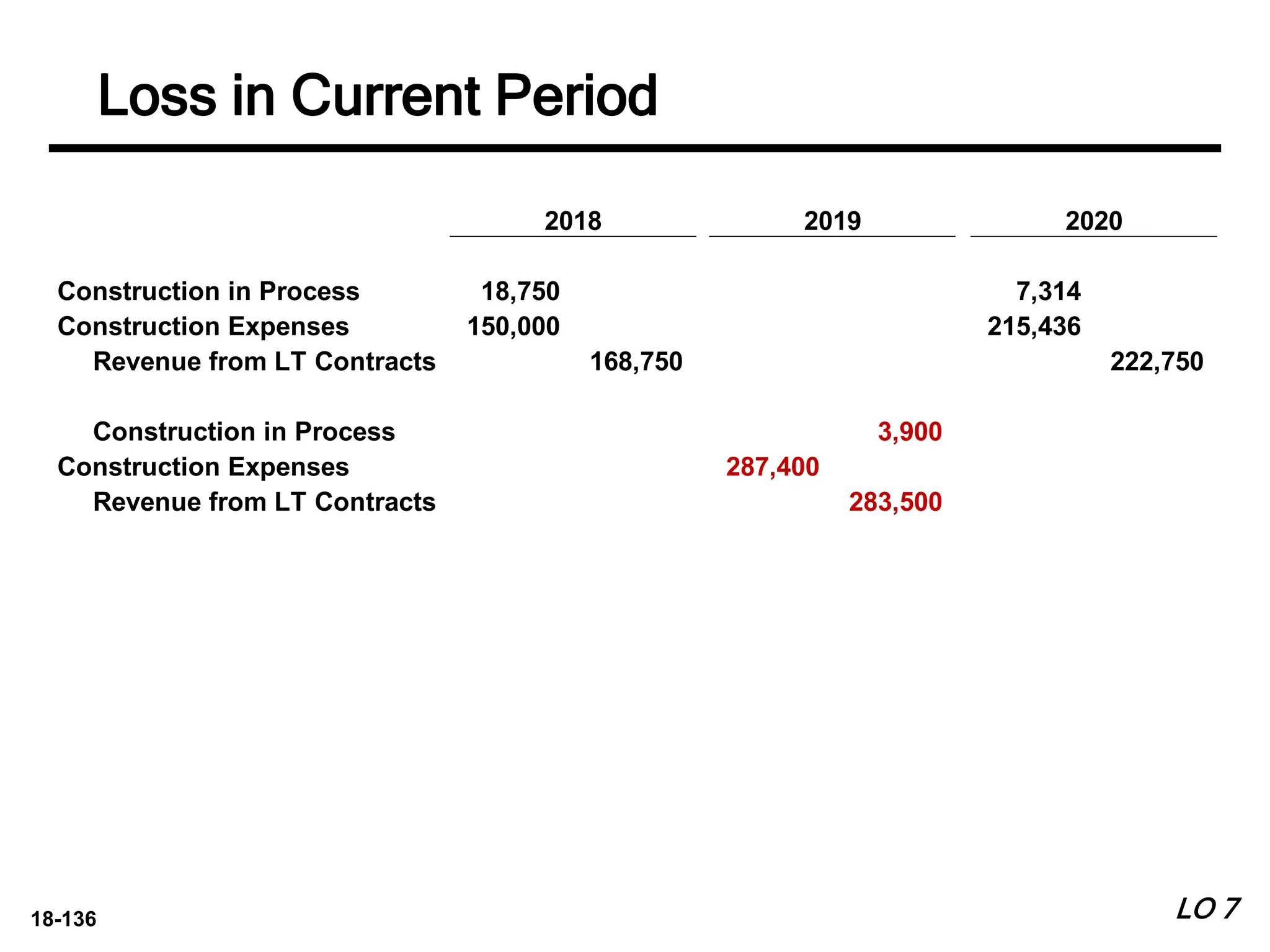
Construction in Process 18,750 7,314
Construction Expenses 150,000 215,436
Revenue from LT Contracts 168,750 222,750
Construction in Process 3,900
Construction Expenses 287,400
Revenue from LT Contracts 283,500
2020
2018 2019
LO 7
Loss in Current Period
18-137
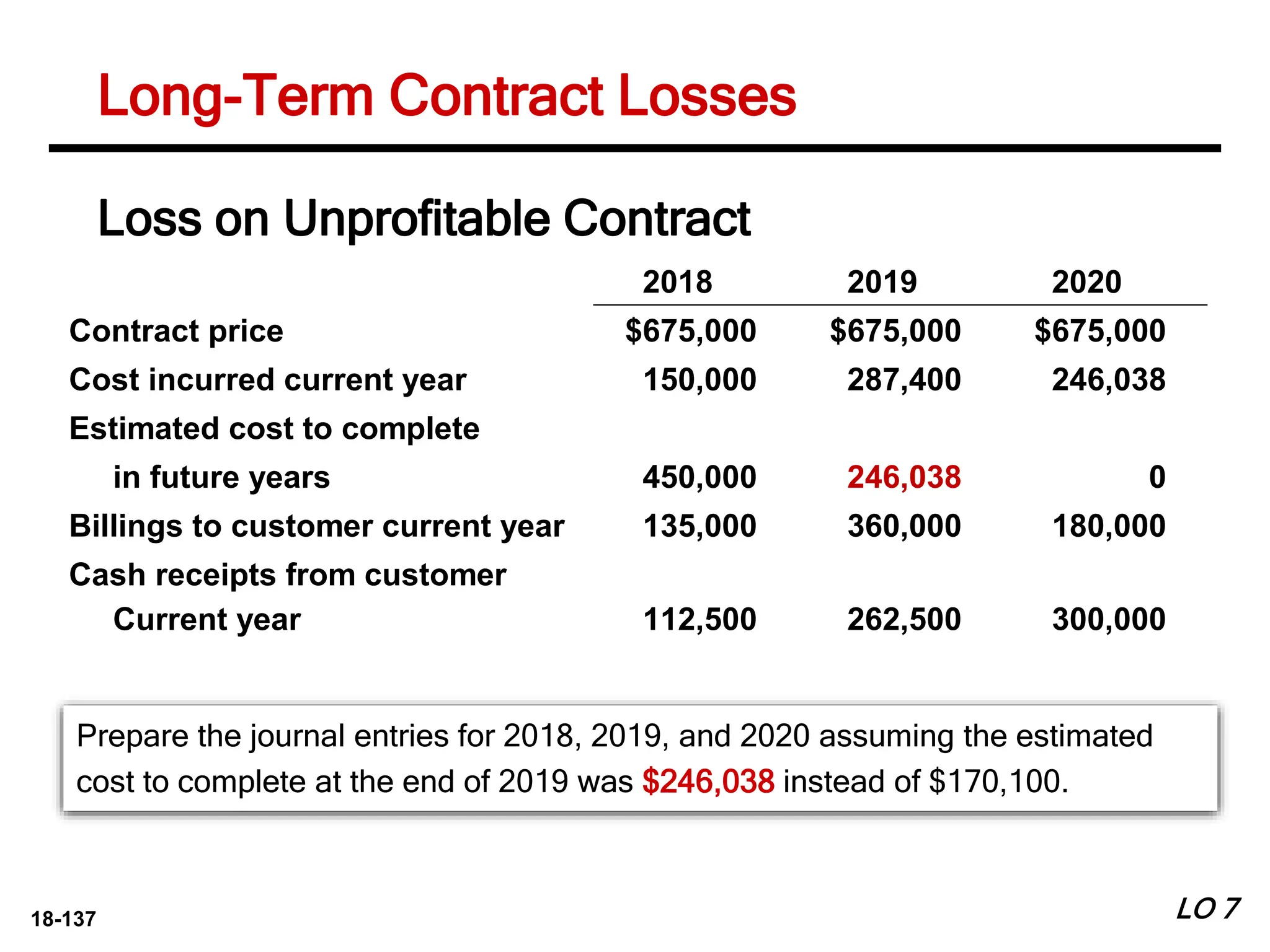
Prepare the journal entries for 2018, 2019, and 2020 assuming the estimated
cost to complete at the end of 2019 was $246,038 instead of $170,100.
Casper Construction Co.
2018 2019 2020
Contract price $675,000 $675,000 $675,000
Cost incurred current year 150,000 287,400 246,038
Estimated cost to complete
in future years 450,000 246,038 0
Billings to customer current year 135,000 360,000 180,000
Cash receipts from customer
Current year 112,500 262,500 300,000
LO 7
Loss on Unprofitable Contract
Long-Term Contract Losses
18-138
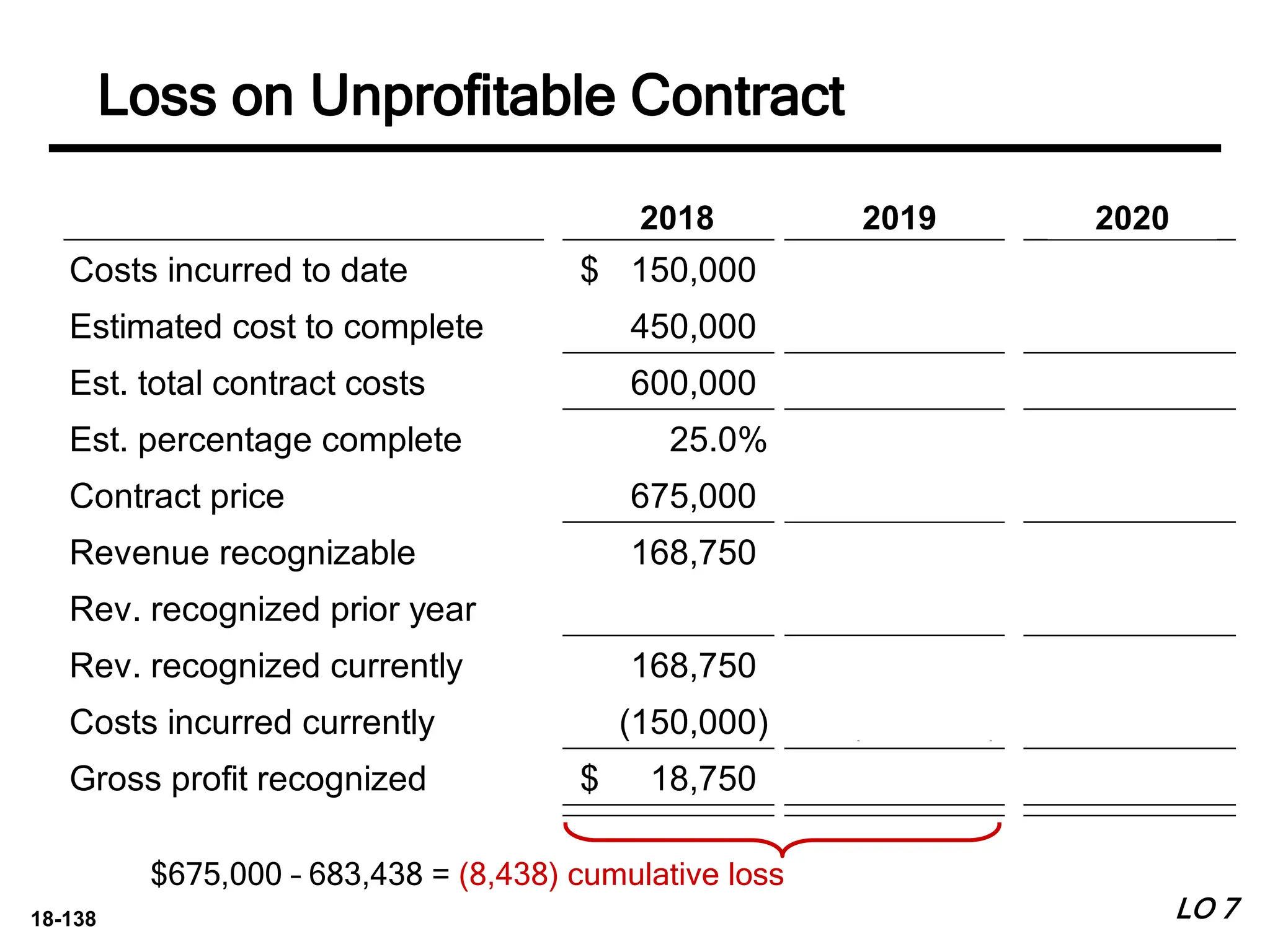
2014 2015 2016
Costs incurred to date 150,000
$ 437,400
$ 683,438
$
Estimated cost to complete 450,000 246,038
Est. total contract costs 600,000 683,438 683,438
Est. percentage complete 25.0% 64.0% 100.0%
Contract price 675,000 675,000 675,000
Revenue recognizable 168,750 432,000 675,000
Rev. recognized prior year (168,750) (432,000)
Rev. recognized currently 168,750 263,250 243,000
Costs incurred currently (150,000) (290,438) (243,000)
Gross profit recognized 18,750
$ (27,188)
$ -
$
$675,000 – 683,438 = (8,438) cumulative loss
LO 7
Loss on Unprofitable Contract
2018 2019 2020
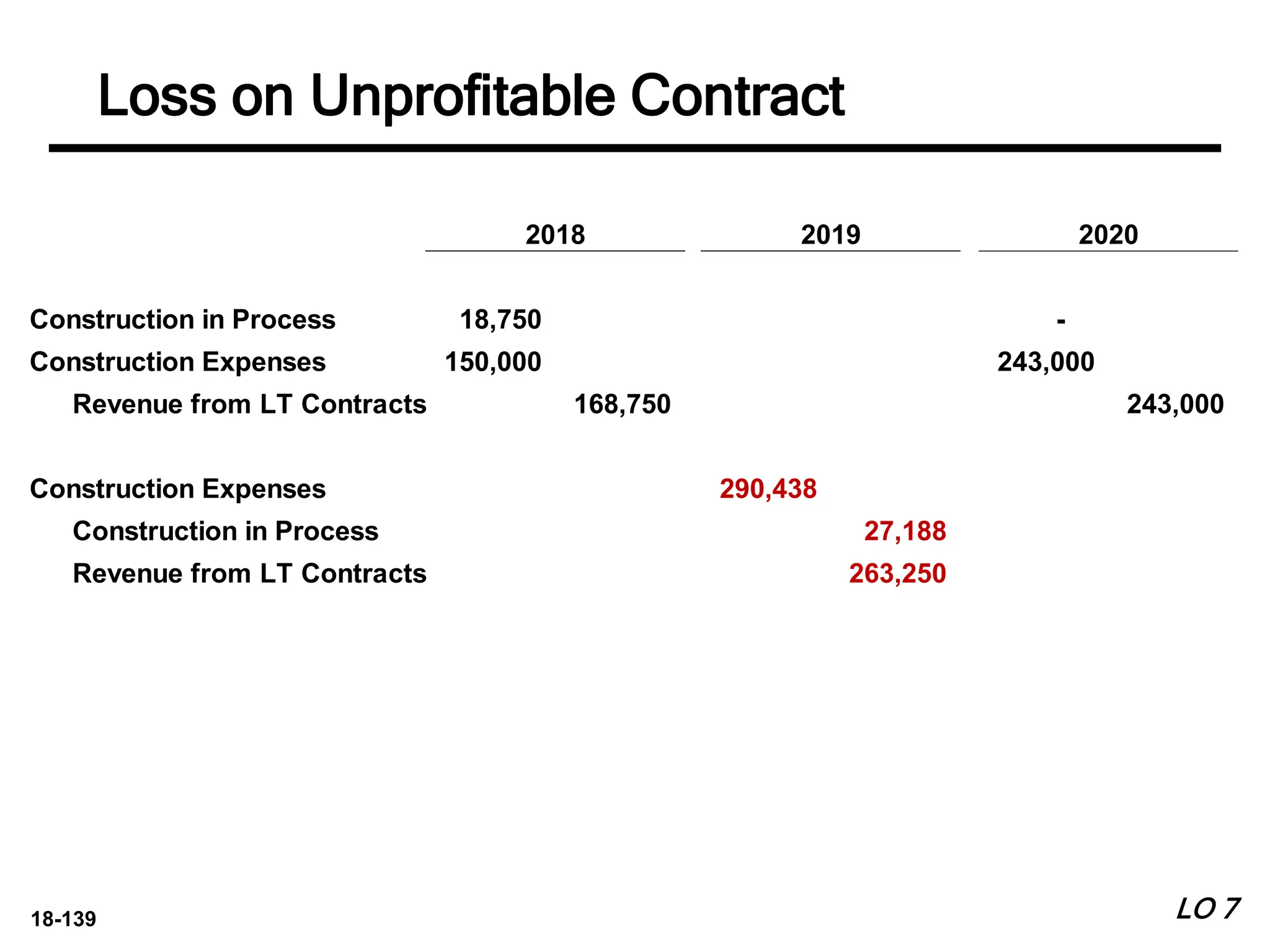
18-139
Construction in Process 18,750 -
Construction Expenses 150,000 243,000
Revenue from LT Contracts 168,750 243,000
Construction Expenses 290,438
Construction in Process 27,188
Revenue from LT Contracts 263,250
2020
2018 2019
LO 7
Loss on Unprofitable Contract
18-140
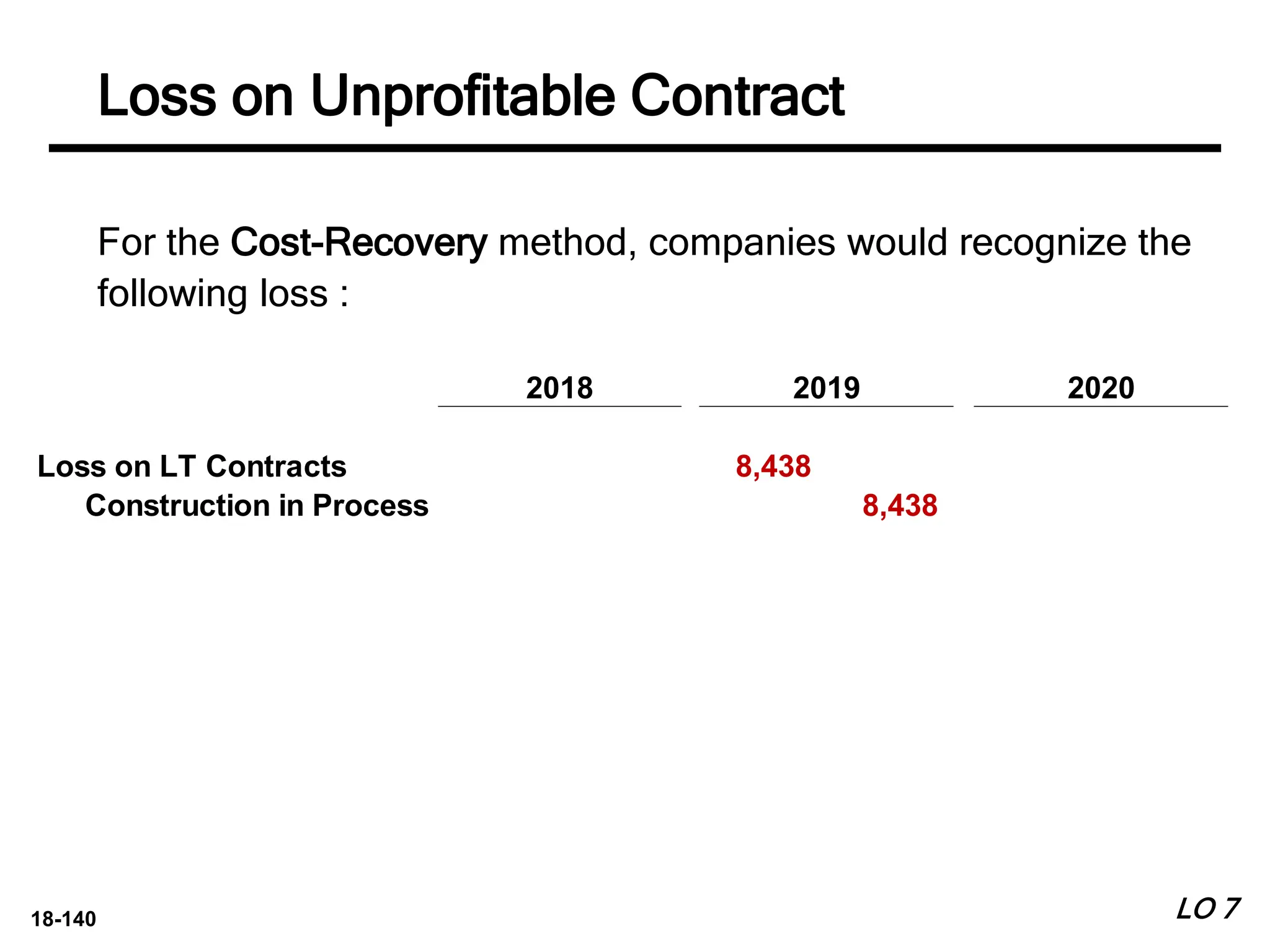
Loss on LT Contracts 8,438
Construction in Process 8,438
2020
2018 2019
For the Cost-Recovery method, companies would recognize the
following loss :
LO 7
Loss on Unprofitable Contract
18-141
Four types of franchising arrangements have evolved:
1. Manufacturer-retailer
2. Manufacturer-wholesaler
3. Service sponsor-retailer
4. Wholesaler-retailer
APPENDIX 18B Revenue Recognition for Franchises
LO 8
LEARNING OBJECTIVE 8
Explain revenue recognition for franchises.
18-142
Franchise companies derive their revenue from one or
both of two sources:
1. Sale of initial franchises and related assets or services,
and
2. Continuing fees based on the operations of franchises.
LO 8
APPENDIX 18B Revenue Recognition for Franchises
18-143
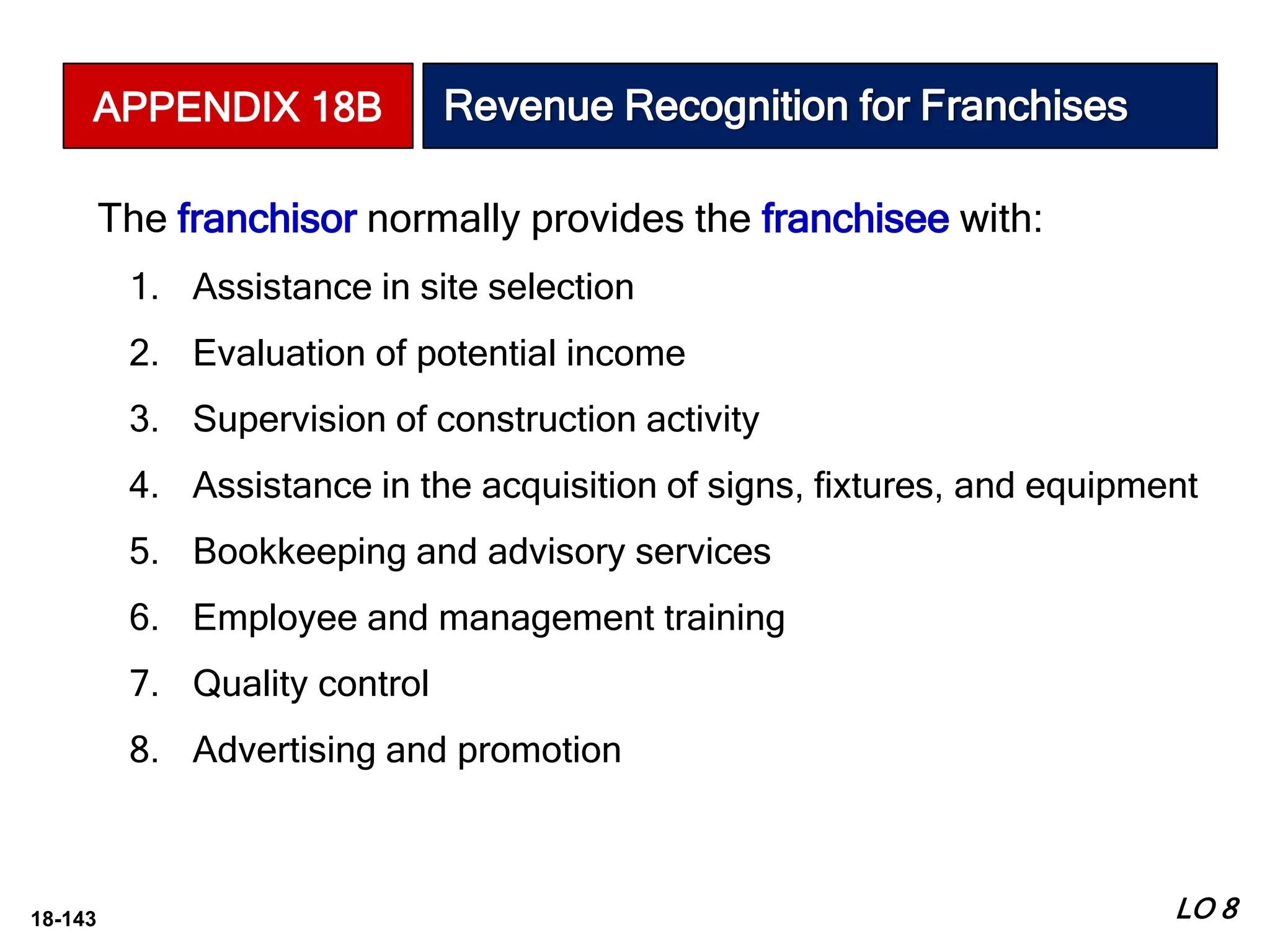
The franchisor normally provides the franchisee with:
1. Assistance in site selection
2. Evaluation of potential income
3. Supervision of construction activity
4. Assistance in the acquisition of signs, fixtures, and equipment
5. Bookkeeping and advisory services
6. Employee and management training
7. Quality control
8. Advertising and promotion
LO 8
APPENDIX 18B Revenue Recognition for Franchises
18-144
Performance obligations relate to:
 Right to open a business.
 Use of trade name or other intellectual property of the
franchisor.
 Continuing services, such as marketing help, training, and
in some cases supplying inventory and inventory
management.
Franchise Accounting
LO 8
APPENDIX 18B Revenue Recognition for Franchises
18-145
Franchisors commonly charge an initial franchise fee and
continuing franchise fees:
► Initial franchise fee (payment for establishing the relationship
and providing some initial services).
► Continuing franchise fees received
 In return for continuing rights granted by the agreement.
 For providing management training, advertising and
promotion, legal assistance, and other support.
LO 8
Franchise Accounting
18-146
Facts: Tum’s Pizza Inc. enters into a franchise agreement on November 1,
2019, giving Food Fight Corp. the right to operate as a franchisee of Tum’s
Pizza for 5 years. Tum’s charges Food Fight an initial franchise fee of
$50,000 for the right to operate as a franchisee. Of this amount, $20,000 is
payable when Food Fight signs the agreement, and the balance is payable
in five annual payments of $6,000 each on December 31. Food Fight also
promises to pay ongoing royalty payments of 1% of its annual sales
(payable each January 31 of the following year) and is obliged to purchase
products from Tum’s at its current standalone selling prices at the time of
purchase. The credit rating of Food Fight indicates that money can be
borrowed at 8%. The present value of an ordinary annuity of five annual
receipts of $6,000 each discounted at 8% is $23,957. The discount of
$6,043 represents the interest revenue to be accrued by Tum’s over the
payment period.
LO 8
FRANCHISE
18-147
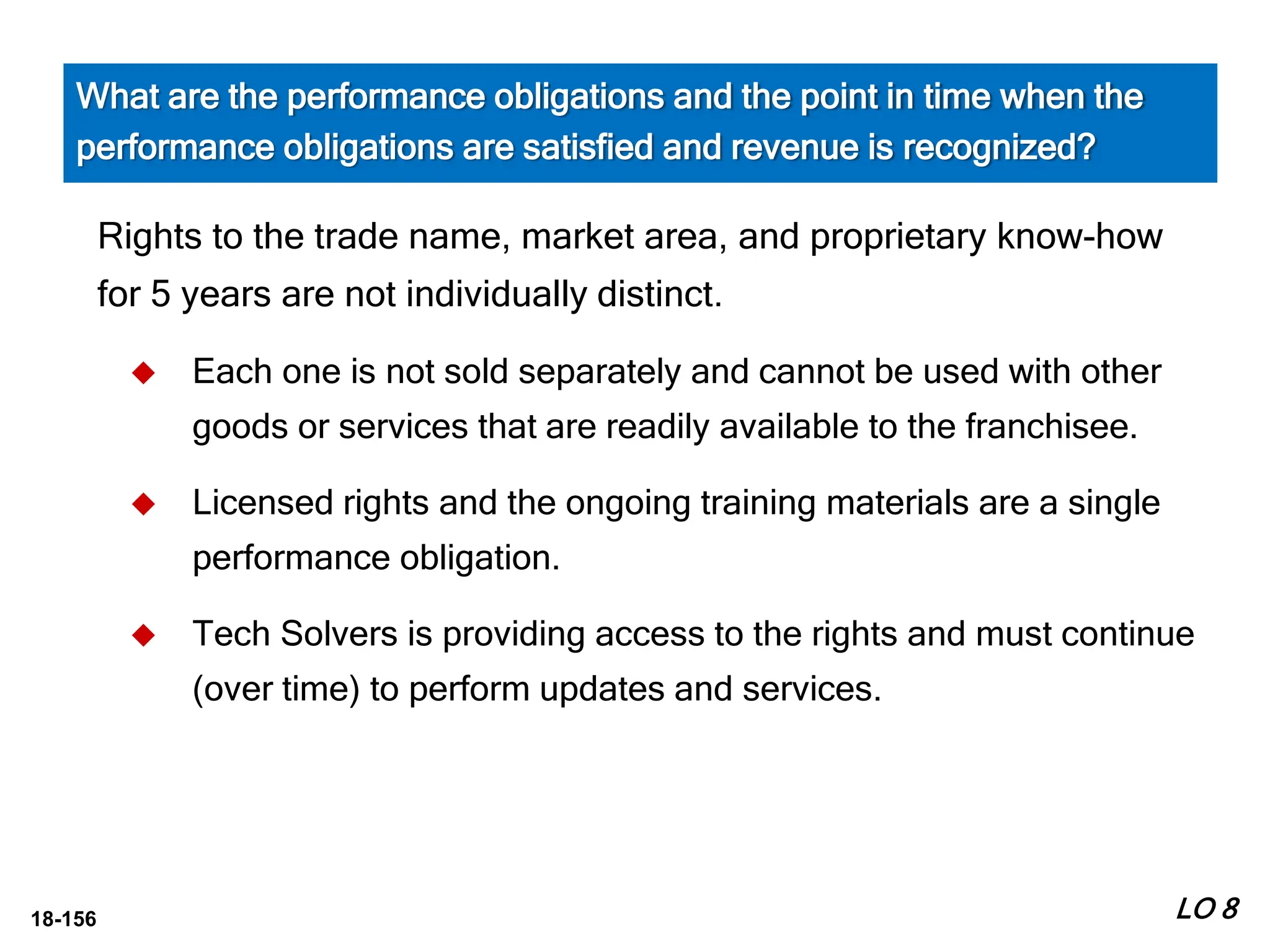
Rights to the trade name, market area, and proprietary know-
how for 5 years are not individually distinct.
 Each one is not sold separately and cannot be used with other
goods or services that are readily available to the franchisee.
 Combined rights give rise to a single performance obligation.
 Tum’s satisfies performance obligation at point in time when
Food Fight obtains control of the rights.
LO 8
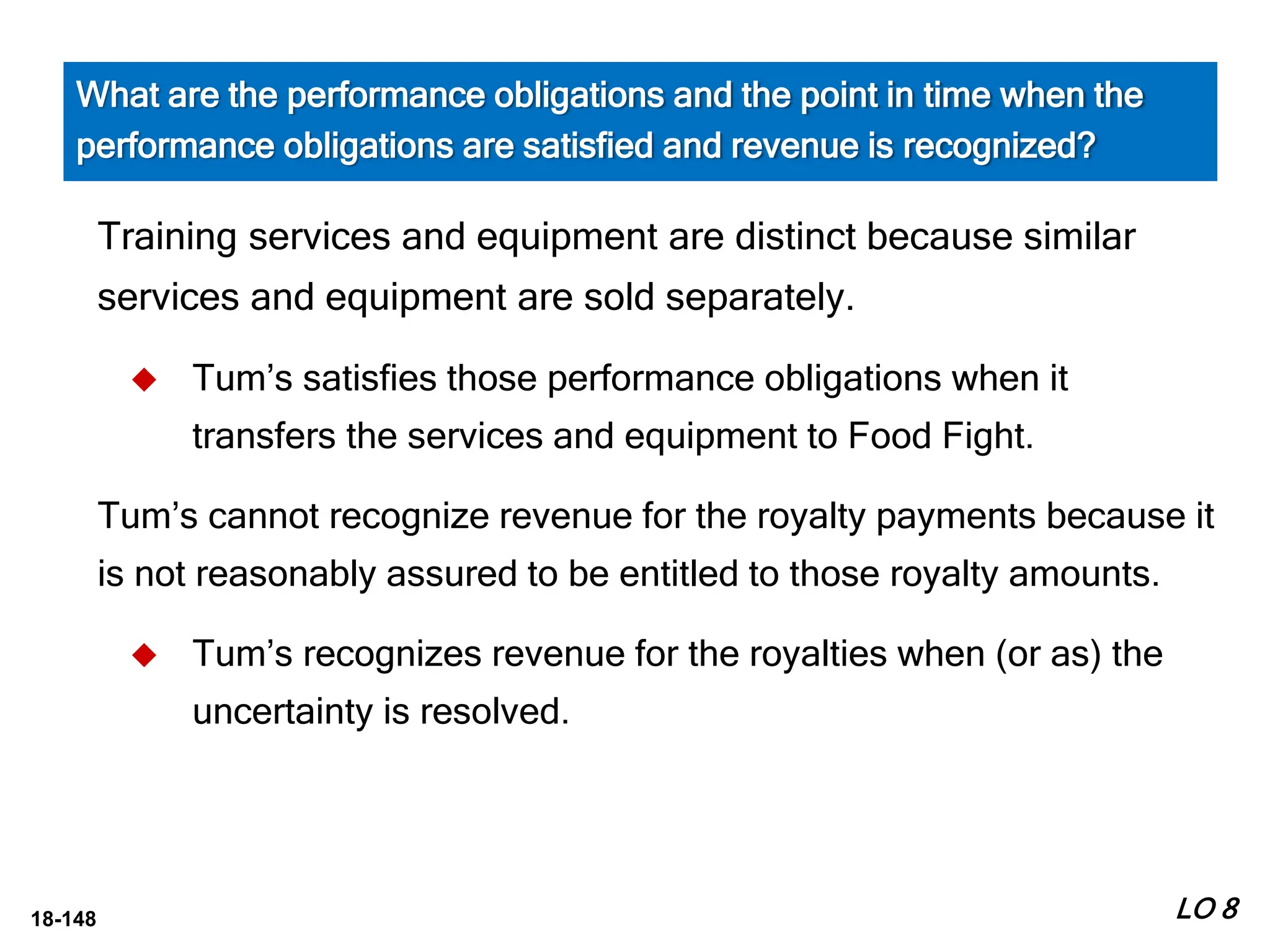
What are the performance obligations and the point in time when the
performance obligations are satisfied and revenue is recognized?
18-148
Training services and equipment are distinct because similar
services and equipment are sold separately.
 Tum’s satisfies those performance obligations when it
transfers the services and equipment to Food Fight.
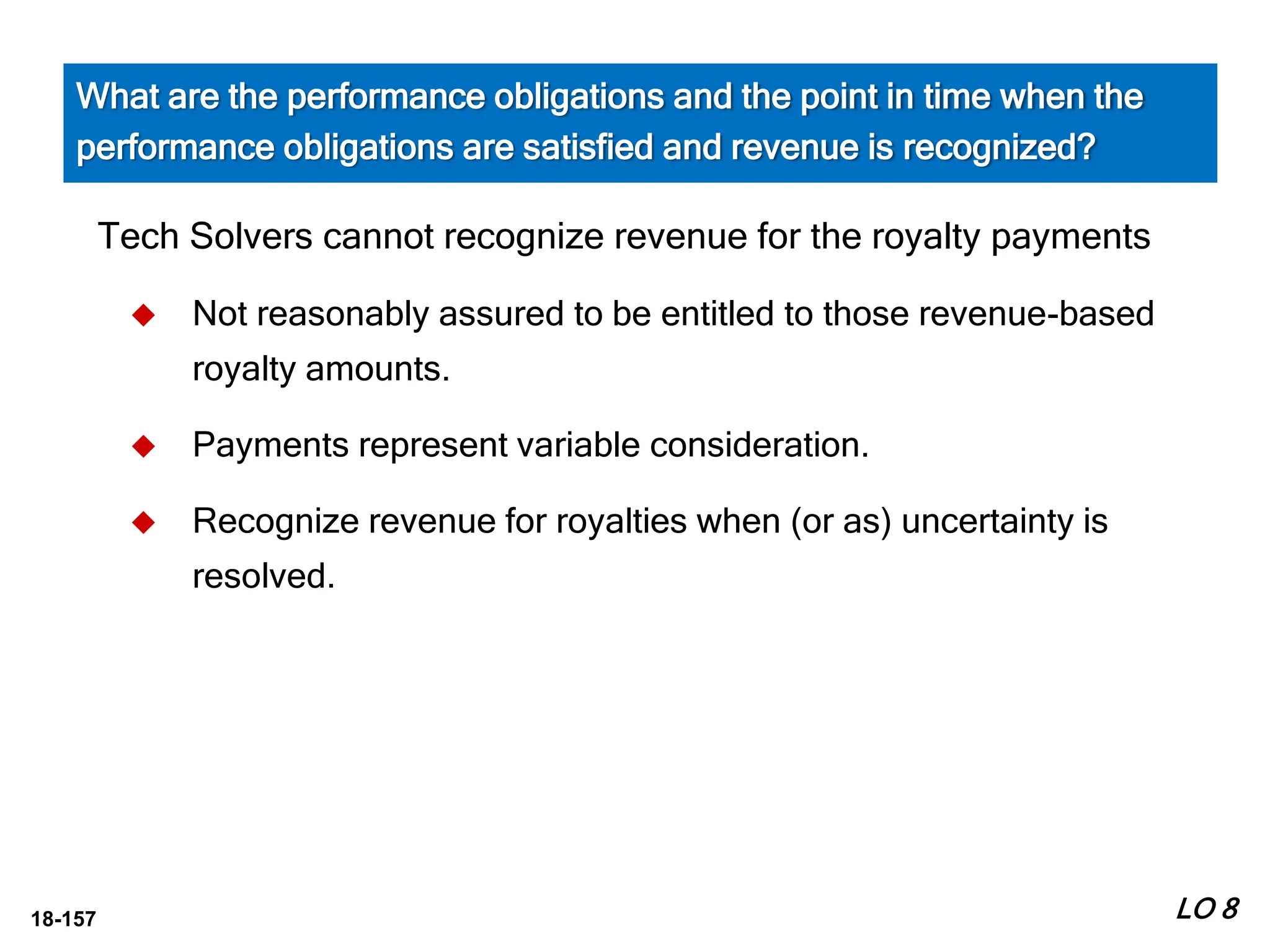
Tum’s cannot recognize revenue for the royalty payments because it
is not reasonably assured to be entitled to those royalty amounts.
 Tum’s recognizes revenue for the royalties when (or as) the
uncertainty is resolved.
LO 8
What are the performance obligations and the point in time when the
performance obligations are satisfied and revenue is recognized?
18-149
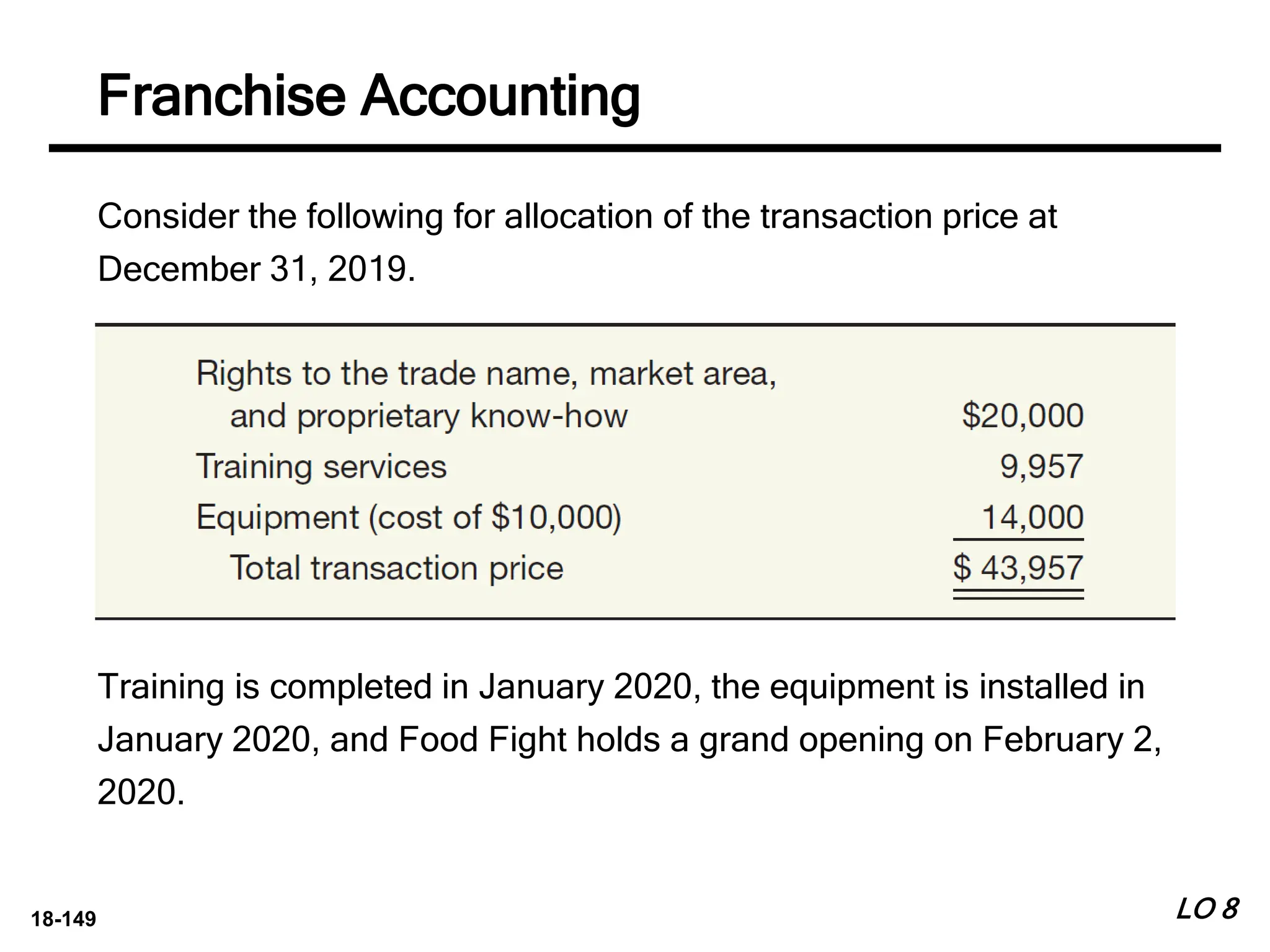
Consider the following for allocation of the transaction price at
December 31, 2019.
LO 8
Training is completed in January 2020, the equipment is installed in
January 2020, and Food Fight holds a grand opening on February 2,
2020.
Franchise Accounting
18-150
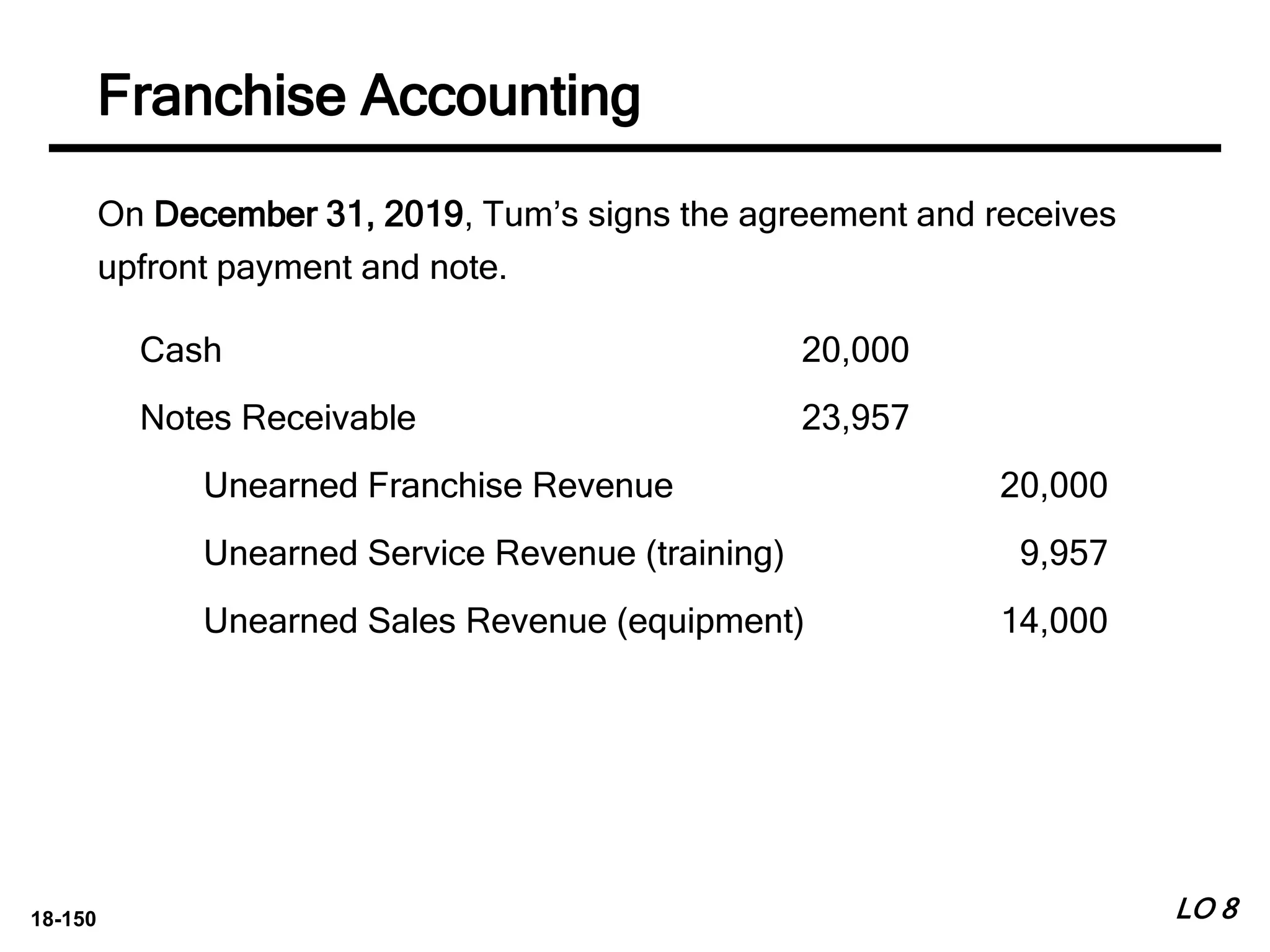
On December 31, 2019, Tum’s signs the agreement and receives
upfront payment and note.
Cash 20,000
Notes Receivable 23,957
Unearned Franchise Revenue 20,000
Unearned Service Revenue (training) 9,957
Unearned Sales Revenue (equipment) 14,000
LO 8
Franchise Accounting
18-151
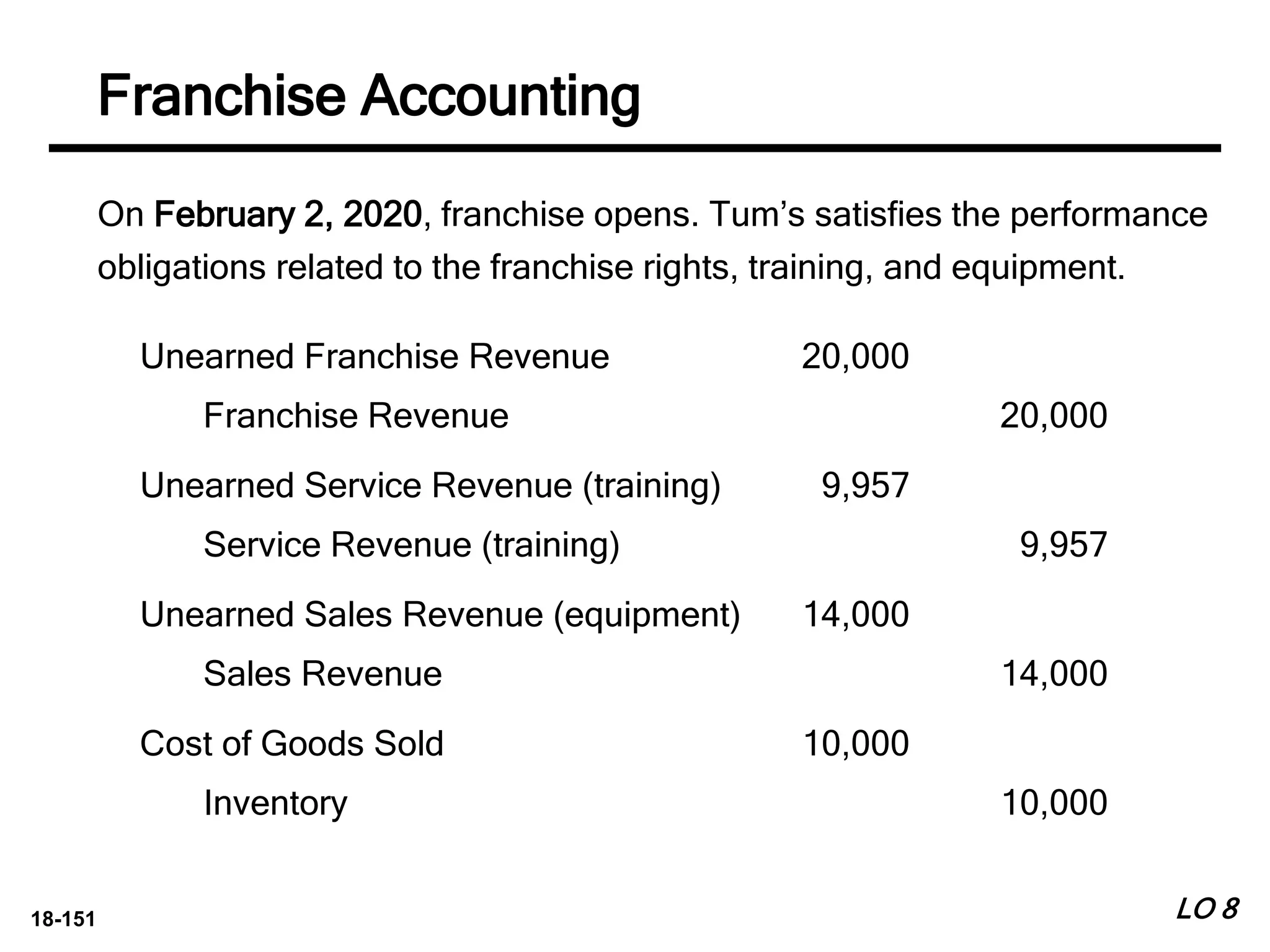
On February 2, 2020, franchise opens. Tum’s satisfies the performance
obligations related to the franchise rights, training, and equipment.
Unearned Franchise Revenue 20,000
Franchise Revenue 20,000
Unearned Service Revenue (training) 9,957
Service Revenue (training) 9,957
Unearned Sales Revenue (equipment) 14,000
Sales Revenue 14,000
Cost of Goods Sold 10,000
Inventory 10,000
LO 8
Franchise Accounting
18-152
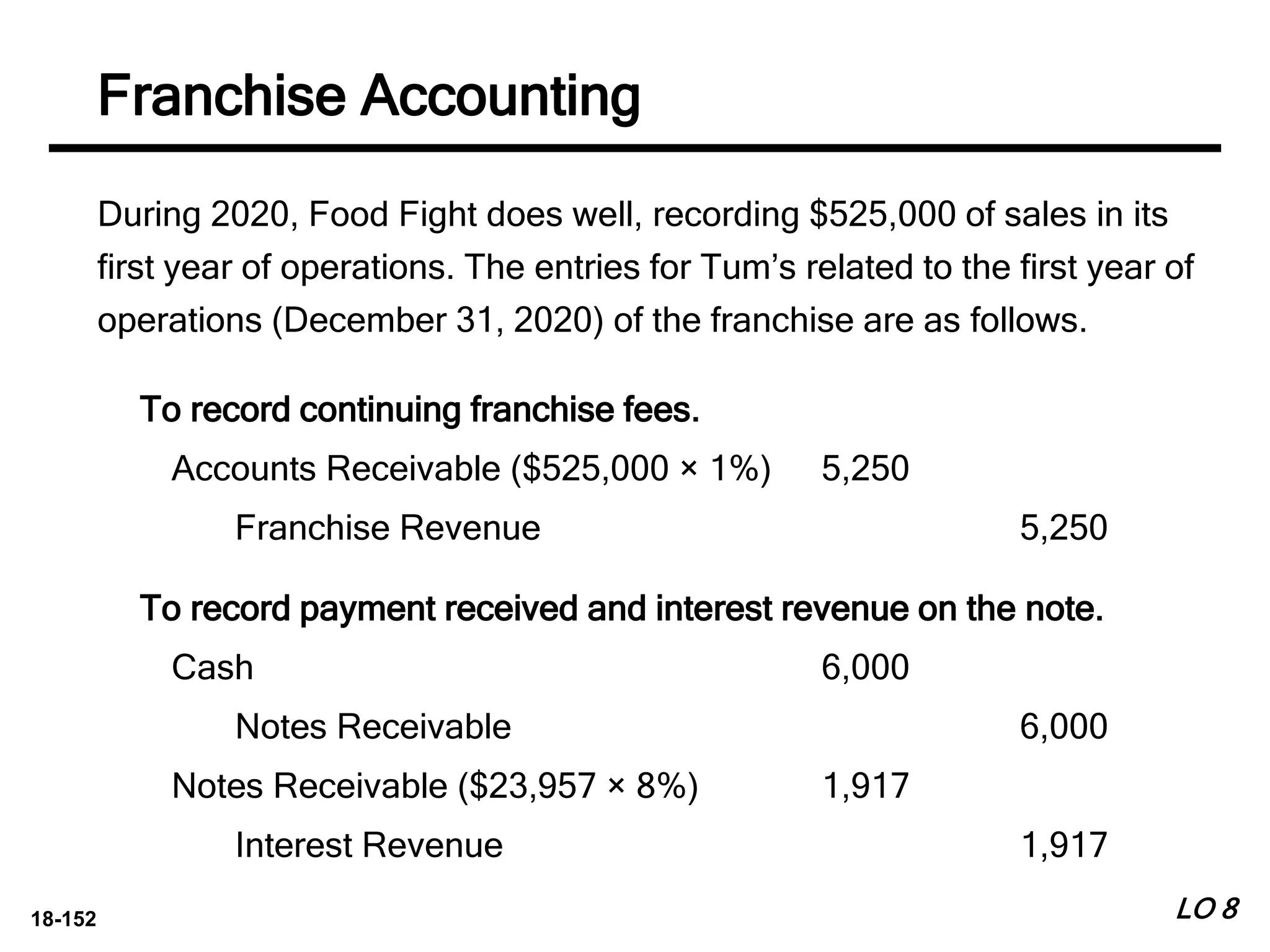
During 2020, Food Fight does well, recording $525,000 of sales in its
first year of operations. The entries for Tum’s related to the first year of
operations (December 31, 2020) of the franchise are as follows.
To record continuing franchise fees.
Accounts Receivable ($525,000 × 1%) 5,250
Franchise Revenue 5,250
To record payment received and interest revenue on the note.
Cash 6,000
Notes Receivable 6,000
Notes Receivable ($23,957 × 8%) 1,917
Interest Revenue 1,917
LO 8
Franchise Accounting
18-153
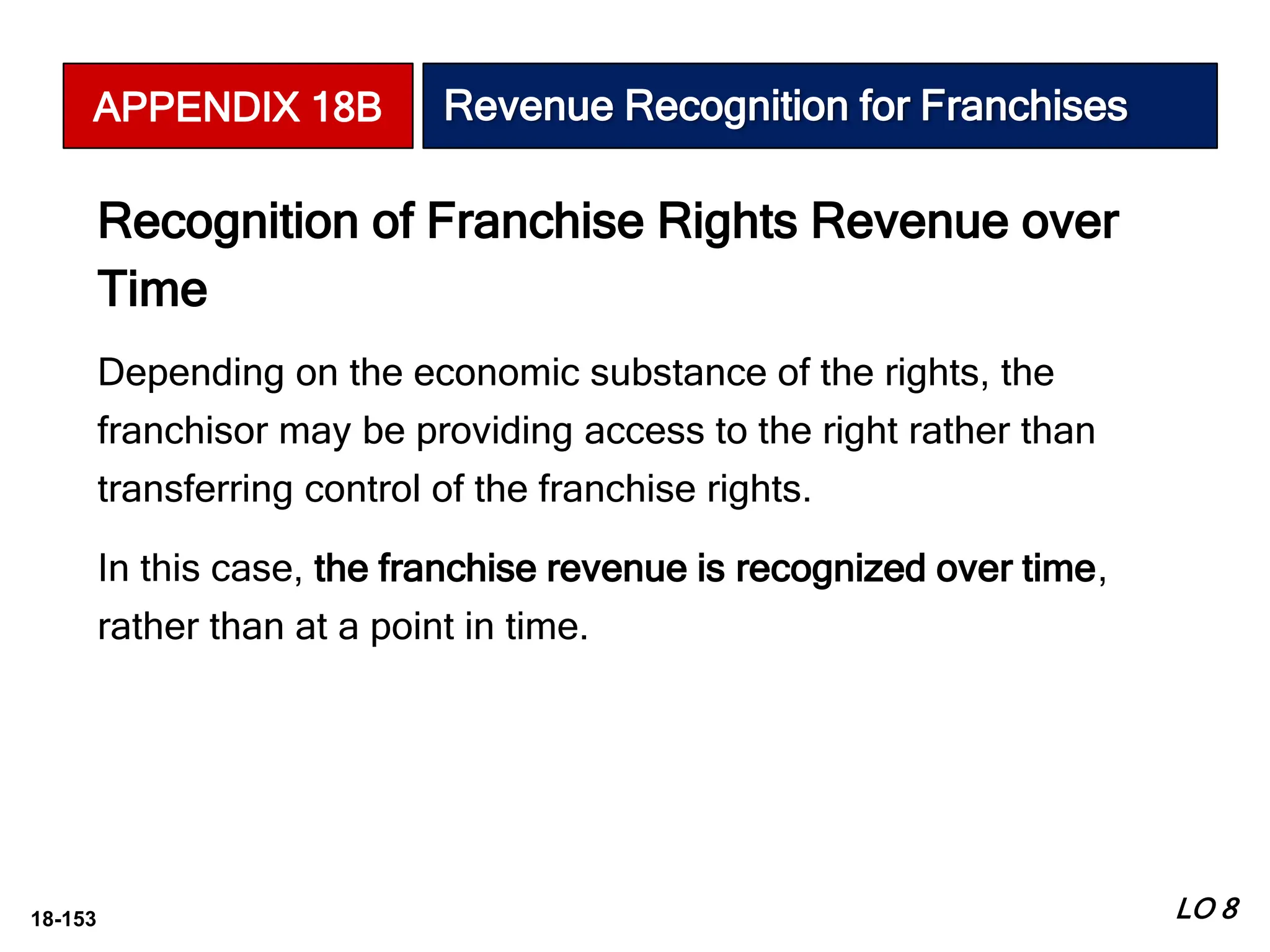
Recognition of Franchise Rights Revenue over
Time
Depending on the economic substance of the rights, the
franchisor may be providing access to the right rather than
transferring control of the franchise rights.
In this case, the franchise revenue is recognized over time,
rather than at a point in time.
LO 8
APPENDIX 18B Revenue Recognition for Franchises
18-154
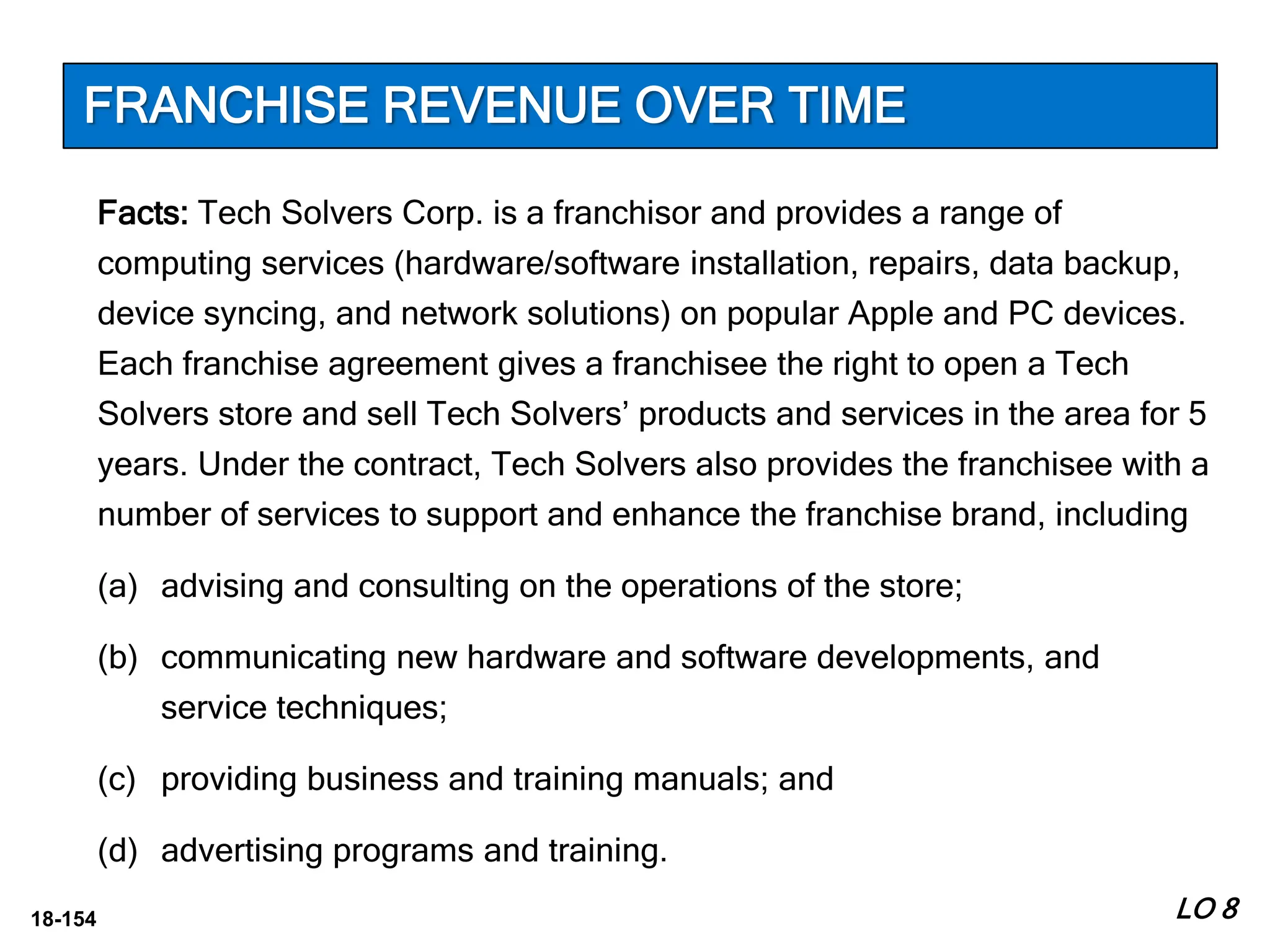
Facts: Tech Solvers Corp. is a franchisor and provides a range of
computing services (hardware/software installation, repairs, data backup,
device syncing, and network solutions) on popular Apple and PC devices.
Each franchise agreement gives a franchisee the right to open a Tech
Solvers store and sell Tech Solvers’ products and services in the area for 5
years. Under the contract, Tech Solvers also provides the franchisee with a
number of services to support and enhance the franchise brand, including
(a) advising and consulting on the operations of the store;
(b) communicating new hardware and software developments, and
service techniques;
(c) providing business and training manuals; and
(d) advertising programs and training.
LO 8
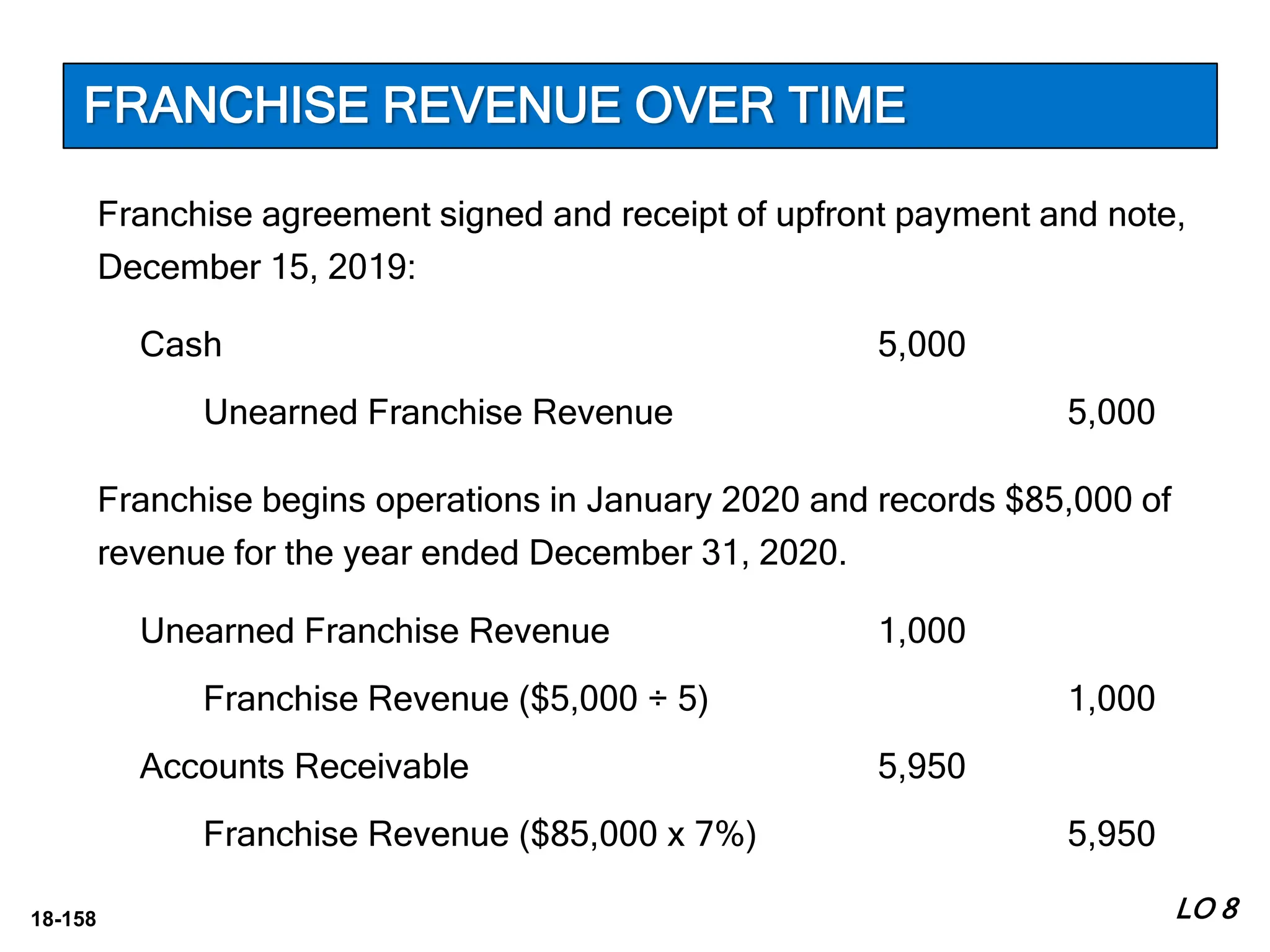
FRANCHISE REVENUE OVER TIME
18-155
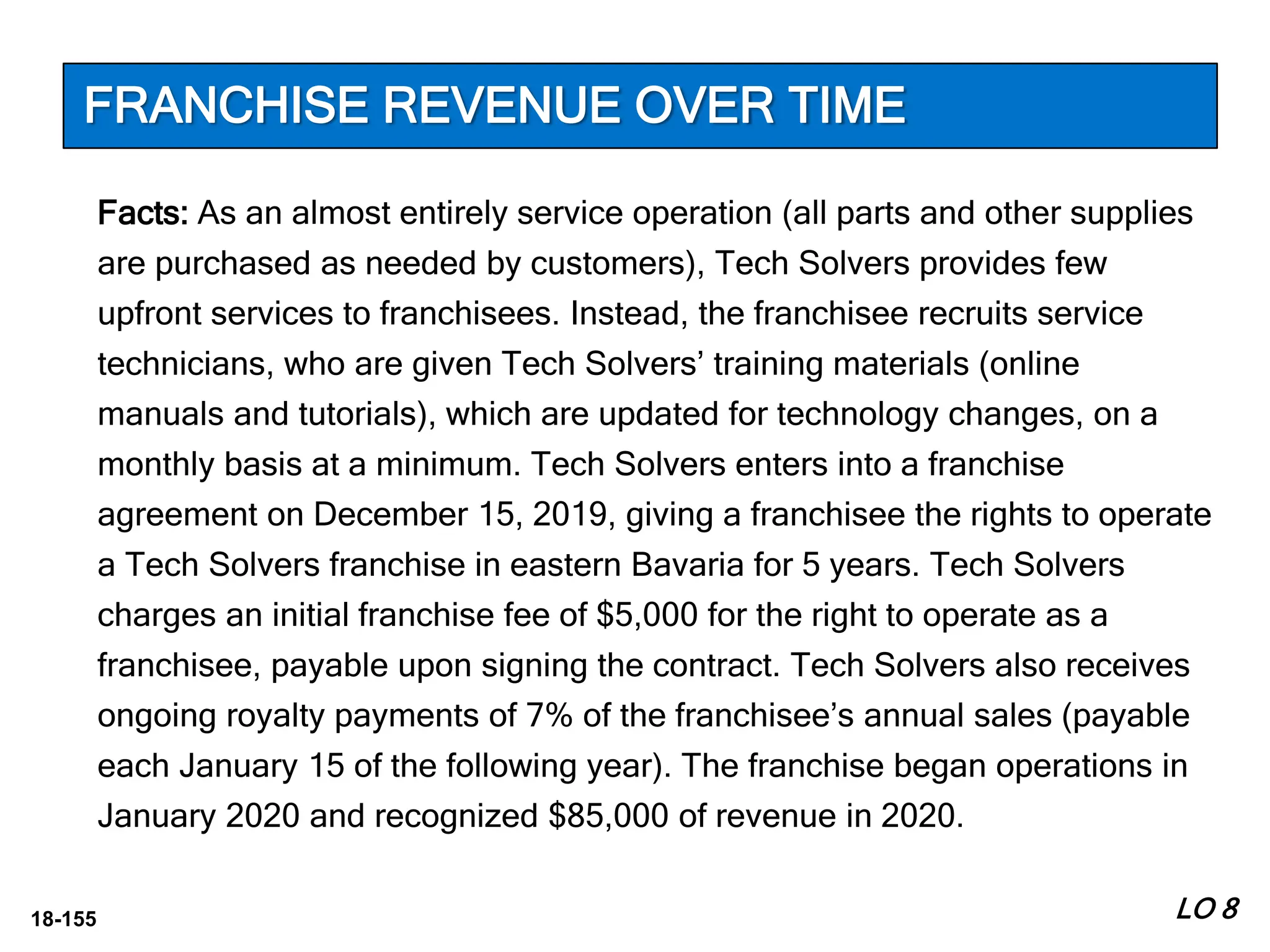
Facts: As an almost entirely service operation (all parts and other supplies
are purchased as needed by customers), Tech Solvers provides few
upfront services to franchisees. Instead, the franchisee recruits service
technicians, who are given Tech Solvers’ training materials (online
manuals and tutorials), which are updated for technology changes, on a
monthly basis at a minimum. Tech Solvers enters into a franchise
agreement on December 15, 2019, giving a franchisee the rights to operate
a Tech Solvers franchise in eastern Bavaria for 5 years. Tech Solvers
charges an initial franchise fee of $5,000 for the right to operate as a
franchisee, payable upon signing the contract. Tech Solvers also receives
ongoing royalty payments of 7% of the franchisee’s annual sales (payable
each January 15 of the following year). The franchise began operations in
January 2020 and recognized $85,000 of revenue in 2020.
LO 8
FRANCHISE REVENUE OVER TIME
18-156
Rights to the trade name, market area, and proprietary know-how
for 5 years are not individually distinct.
 Each one is not sold separately and cannot be used with other
goods or services that are readily available to the franchisee.
 Licensed rights and the ongoing training materials are a single
performance obligation.
 Tech Solvers is providing access to the rights and must continue
(over time) to perform updates and services.
LO 8
What are the performance obligations and the point in time when the
performance obligations are satisfied and revenue is recognized?
18-157
Tech Solvers cannot recognize revenue for the royalty payments
 Not reasonably assured to be entitled to those revenue-based
royalty amounts.
 Payments represent variable consideration.
 Recognize revenue for royalties when (or as) uncertainty is
resolved.
LO 8
What are the performance obligations and the point in time when the
performance obligations are satisfied and revenue is recognized?
18-158
Franchise agreement signed and receipt of upfront payment and note,
December 15, 2019:
Cash 5,000
Unearned Franchise Revenue 5,000
LO 8
Unearned Franchise Revenue 1,000
Franchise Revenue ($5,000 ÷ 5) 1,000
Accounts Receivable 5,950
Franchise Revenue ($85,000 x 7%) 5,950
Franchise begins operations in January 2020 and records $85,000 of
revenue for the year ended December 31, 2020.
FRANCHISE REVENUE OVER TIME
18-159
Copyright © 2019 John Wiley & Sons, Inc. All rights reserved.
Reproduction or translation of this work beyond that permitted in
Section 117 of the 1976 United States Copyright Act without the
express written permission of the copyright owner is unlawful.
Request for further information should be addressed to the
Permissions Department, John Wiley & Sons, Inc. The purchaser
may make back-up copies for his/her own use only and not for
distribution or resale. The Publisher assumes no responsibility for
errors, omissions, or damages, caused by the use of these programs
or from the use of the information contained herein.
Copyright

Revenue Recognition - Intermediate Accounting

  • 1.
    18-1 Prepared by Coby Harmon Universityof California, Santa Barbara Westmont College
  • 2.
    18-2 1. Understand thefundamental concepts related to revenue recognition and measurement. 2. Understand and apply the five- step revenue recognition process. LEARNING OBJECTIVES 3. Apply the five-step process to major revenue recognition issues. 4. Describe presentation and disclosure regarding revenue. After studying this chapter, you should be able to: Revenue Recognition CHAPTER 18
  • 3.
    18-3 PREVIEW OF CHAPTER18 Intermediate Accounting IFRS 3rd Edition Kieso ● Weygandt ● Warfield
  • 4.
    18-4 Fundamentals of Revenue Recognition Boththe IASB and the FASB have indicated that the state of reporting for revenue was unsatisfactory. Recently, the IASB issued a converged standard on revenue recognition entitled Revenue from Contracts with Customers. LO 1 Background LEARNING OBJECTIVE 1 Understand the fundamental concepts related to revenue recognition and measurement.
  • 5.
    18-5 New Revenue RecognitionStandard LO 1 Revenue from Contracts with Customers, adopts an asset- liability approach.  Companies account for revenue based on the asset or liability arising from contracts with customers.  Companies analyze contracts with customers because contracts initiate revenue transactions. ► Contracts indicate terms of the transaction, ► provide the measurement of the consideration, and ► specify the promises that must be met. Revenue Recognition
  • 6.
    18-6 LO 1 NewRevenue Recognition Standard ILLUSTRATION 18.1 Key Concepts of Revenue Recognition Performance Obligation is Satisfied
  • 7.
    18-7 LO 1 Overviewof the Five-Step Process A contract is an agreement between two parties that creates enforceable rights or obligations. In this case, Airbus has signed a contract to deliver airplanes to Cathay Pacific. Assume that Airbus (FRA) Corporation signs a contract to sell airplanes to Cathay Pacific Airlines (HKG) for €100 million. Airbus has only one performance obligation—to deliver airplanes to Cathay Pacific. If Airbus also agreed to maintain the planes, a separate performance obligation is recorded for this promise. Step 2: Identify the separate performance obligations in the contract. ILLUSTRATION 18.2 Five Steps of Revenue Recognition Step 1: Identify the contract with customers.
  • 8.
    18-8 LO 1 Transactionprice is the amount of consideration that a company expects to receive from a customer in exchange for transferring a good or service. In this case, the transaction price is straightforward—it is €100 million. ILLUSTRATION 18.2 Five Steps of Revenue Recognition Step 3: Determine the transaction price. In this case, Airbus has only one performance obligation—to deliver airplanes to Cathay Pacific. Step 4: Allocate the transaction price to the separate performance obligations. Overview of the Five-Step Process
  • 9.
    18-9 LO 1 Airbusrecognizes revenue of €100 million for the sale of the airplanes to Cathay Pacific when it satisfies its performance obligation—the delivery of the airplanes to Cathay Pacific. ILLUSTRATION 18.2 Five Steps of Revenue Recognition Step 5: Recognize revenue when each performance obligation is satisfied. Overview of the Five-Step Process
  • 10.
    18-10 LO 1 ExtendedExample of Five-Step Process Identifying the Contract with Customers—Step 1 Assume that Tyler Angler orders a large cup of black coffee costing $3 from BEAN. Tyler gives $3 to a BEAN barista, who pours the coffee into a large cup and gives it to Tyler. Question: How much revenue should BEAN recognize on this transaction?
  • 11.
    18-11 LO 1 ExtendedExample of Five-Step Process 1. The contract has commercial substance: Tyler gives cash for the coffee. 2. The parties have approved the contract: Tyler agrees to purchase the coffee and BEAN agrees to sell it. 3. Identification of the rights of the parties is established: Tyler has the right to the coffee and BEAN has the right to receive $3. 4. Payment terms are identified: Tyler agrees to pay $3 for the coffee. 5. It is probable that the consideration will be collected: BEAN has received $3 before it delivered the coffee. It appears that BEAN and Tyler have a valid contract with one another. Step 1: Identify the contract with customers.
  • 12.
    18-12 LO 1 ExtendedExample of Five-Step Process BEAN has a performance obligation to provide a large cup of coffee to Tyler. BEAN has no other performance obligation for any other good or service. Step 2: Identify the separate performance obligations. The price of the coffee is $3, and no discounts or other adjustments are available. Therefore, the transaction price is $3. Step 3: Determine the transaction price.
  • 13.
    18-13 LO 1 ExtendedExample of Five-Step Process Given that BEAN has only one performance obligation, no allocation is necessary. Step 4: Allocate the transaction price to the separate performance obligations. BEAN satisfies its performance obligation when Tyler obtains control of the coffee. Step 5: Recognize revenue when each performance obligation is satisfied. BEAN should recognize $3 in revenue from this transaction when Tyler receives the coffee.
  • 14.
    18-14 LO 1 ExtendedExample of Five-Step Process Identifying Separate Performance Obligations—Step 2 The following day, Tyler orders another large cup of coffee for $3 and also purchases two bagels at a price of $5. The barista provides these products and Tyler pays $8. Question: How much revenue should BEAN recognize on the purchase of these two items?
  • 15.
    18-15 LO 1 ExtendedExample of Five-Step Process A valid contract exists as it meets the five conditions necessary for a contract to be enforceable as discussed in the previous example. Step 1: Identify the contract with customers. BEAN must determine whether the sale of the coffee and the sale of the two bagels involve one or two performance obligations. Step 2: Identify the separate performance obligations.
  • 16.
    18-16 LO 1 ExtendedExample of Five-Step Process Multiple performance obligations exist when the following two conditions are satisfied: 1. BEAN must provide a distinct product or service. 2. BEAN’s products are distinct within the contract. If the performance obligation is ► not highly dependent on, ► or interrelated with, other promises in the contract, then each performance obligation should be accounted for separately. Step 2: Identify the separate performance obligations. BEAN has two performance obligations.
  • 17.
    18-17 LO 1 ExtendedExample of Five-Step Process The transaction price is $8 ($3 + $5). Step 3: Determine the transaction price. BEAN has two performance obligations. ► Each obligation is distinct and not interrelated (and priced separately); no allocation of the transaction price is necessary. ► The coffee sale is recorded at $3 and the sale of the bagels is priced at $5. Step 4: Allocate the transaction price to the separate performance obligations.
  • 18.
    18-18 LO 1 ExtendedExample of Five-Step Process BEAN has satisfied both performance obligations when the coffee and bagels are given to Tyler (control of the product has passed to the customer). Step 5: Recognize revenue when each performance obligation is satisfied. BEAN should recognize $8 ($3 + $5) of revenue when Tyler receives the coffee and bagels.
  • 19.
    18-19 LO 1 ExtendedExample of Five-Step Process Determining the Transaction Price—Step 3 BEAN is interested in stimulating sales of its Smoke Jumper coffee beans on Tuesdays, a slow business day for the store. Normally, these beans sell for $10 for a 12-ounce bag, but BEAN decides to cut the price by $1 when customers buy them on Tuesdays (the discounted price is now $9 per bag). Tyler has come to the store on a Tuesday, decides to purchase a bag of Smoke Jumper beans, and pays BEAN $9. Question: How much revenue should BEAN recognize on this transaction?
  • 20.
  • 21.
    18-21 LO 1 ExtendedExample of Five-Step Process A valid contract exists as it meets the five conditions necessary for a contract to be enforceable as discussed in the previous example. Step 1: Identify the contract with customers. BEAN has a performance obligation to provide a bag of Smoke Jumper coffee beans to Tyler. BEAN has no other performance obligation to provide a product or service. Step 2: Identify the separate performance obligations.
  • 22.
    18-22 LO 1 Thetransaction for a bag of Smoke Jumper beans sold to Tyler is $9, not $10. Step 3: Determine the transaction price. There is only one performance obligation, no allocation is necessary. Step 4: Allocate the transaction price to the separate performance obligations. BEAN has satisfied both performance obligations. Step 5: Recognize revenue when each performance obligation is satisfied. BEAN should recognize $9 of revenue when Tyler receives the Smoke Jumper coffee beans.
  • 23.
    18-23 LO 1 ExtendedExample of Five-Step Process Allocating the Transaction Price to Separate Performance Obligations—Step 4 Transaction price is allocated to the various performance obligations based on their relative standalone selling prices. BEAN offers customers a $2 discount on the purchase of a large cup of coffee when they buy a bag of its premium Motor Moka beans (which normally sell for $12) at the same time. As indicated earlier, a large cup of coffee normally retails for $3 at BEAN. Question: How much revenue should BEAN recognize on the purchase of these two items?
  • 24.
    18-24 LO 1 ExtendedExample of Five-Step Process A valid contract exists as it meets the five conditions necessary for a contract to be enforceable as discussed in the previous example. Step 1: Identify the contract with customers. The bag of Motor Moka beans and the large cup of coffee are distinct from one another and are not highly dependent on or highly interrelated with the other. Step 2: Identify the separate performance obligations.
  • 25.
    18-25 LO 1 ExtendedExample of Five-Step Process The transaction price is $13 ($12 + $1). Step 3: Determine the transaction price. BEAN allocates the transaction price to the two performance obligations based on their relative standalone selling prices as follows. Step 4: Allocate the transaction price to the separate performance obligations.
  • 26.
    18-26 LO 1 ExtendedExample of Five-Step Process BEAN allocates the transaction price to the two performance obligations based on their relative standalone selling prices as follows. Step 4: Allocate the transaction price to the separate performance obligations. Standalone Product Selling Price Beans (one bag) $12 80% ($12 ÷ $15) 10.40 $ ($13 × 80%) Large cup of coffee 3 20% ($3 ÷ $15) 2.60 ($13 × 20%) Total $15 100% 13.00 $ Percentage Percentage The total transaction price ($13) is allocated $10.40 to the bag of Motor Moka beans and $2.60 to the large cup of coffee.
  • 27.
    18-27 LO 1 ExtendedExample of Five-Step Process BEAN has satisfied both performance obligations as control of the bag of Motor Moka beans and the large cup of coffee has passed to Tyler. Step 5: Recognize revenue when each performance obligation is satisfied. BEAN should recognize revenue of $13, comprised of revenue from the sale of the Motor Moka beans at $10.40 and the sale of the large cup of coffee at $2.60.
  • 28.
    18-28 LO 1 ExtendedExample of Five-Step Process BEAN satisfied its performance obligation(s) when Tyler obtained control of the product(s). Indicators that Tyler has obtained control are as follows: a. BEAN has the right to payment for the coffee. b. BEAN has transferred legal title to the coffee. c. BEAN has transferred physical possession of the coffee. d. Tyler has significant risks and rewards of ownership. e. Tyler has accepted the asset. Step 5: Recognize revenue when each performance obligation is satisfied.
  • 29.
    18-29 Contract:  Agreement betweentwo or more parties that creates enforceable rights or obligations.  Can be ► written, ► oral, or ► implied from customary business practice. LO 2 The Five-Step Process Revisited Identifying the Contract with Customers—Step 1 LEARNING OBJECTIVE 2 Understand and apply the five- step revenue recognition process.
  • 30.
    18-30 Accounting  Revenue cannotbe recognized until a contract exists.  Company obtains rights to receive consideration and assumes obligations to transfer goods or services.  Rights and performance obligations gives rise to an (net) asset or (net) liability.  Company does not recognize contract assets or liabilities until one or both parties perform under the contract. LO 2 Contract with Customers—Step 1
  • 31.
    18-31 Facts: On March1, 2019, Margo Company enters into a contract to transfer a product to Soon Yoon on July 31, 2019. The contract is structured such that Soon Yoon is required to pay the full contract price of $5,000 on August 31, 2019.The cost of the goods transferred is $3,000. Margo delivers the product to Soon Yoon on July 31, 2019. LO 2 CONTRACTS AND RECOGNITION Question: What journal entries should Margo Company make in regards to this contract in 2019? The journal entry to record the sale and related cost of goods sold is as follows. July 31, 2019 Accounts Receivable 5,000 Sales Revenue 5,000 Cost of Goods Sold 3,000 Inventory 3,000 Contract with Customers—Step 1 ILLUSTRATION 18.3 Basic Revenue Transaction
  • 32.
    18-32 LO 2 CONTRACTSAND RECOGNITION Cash 5,000 Accounts Receivable 5,000 Facts: On March 1, 2019, Margo Company enters into a contract to transfer a product to Soon Yoon on July 31, 2019. The contract is structured such that Soon Yoon is required to pay the full contract price of $5,000 on August 31, 2019.The cost of the goods transferred is $3,000. Margo delivers the product to Soon Yoon on July 31, 2019. Question: What journal entries should Margo Company make in regards to this contract in 2019? Margo makes the following entry to record the receipt of cash on August 31, 2019. August 31, 2019 Contract with Customers—Step 1 ILLUSTRATION 18.3 Basic Revenue Transaction
  • 33.
    18-33 LO 2 Aperformance obligation is a promise to provide a distinct product or service to a customer. A product or service is distinct when a customer is able to  benefit from a good or service on its own or  together with other readily available resources. The objective is to determine whether the nature of a company’s promise is to transfer individual goods and services to the customer or to transfer a combined item (or items) for which individual goods or services are inputs. Separate Performance Obligations—Step 2
  • 34.
    18-34 Assume that TataMotors (IND) sells an automobile to Marquart Auto Dealers at a price that includes six months of telematics services such as navigation and remote diagnostics. These telematics services are regularly sold on a standalone basis by Tata Motors for a monthly fee. After the six-month period, the consumer can renew these services on a fee basis with Tata Motors. The question is whether Tata Motors sold one or two products. ILLUSTRATION If we look at Tata Motors’ objective, it appears that it is to sell two goods, the automobile and the telematic services. Both are distinct (they can be sold separately) and are not interdependent. LO 2 Separate Performance Obligations—Step 2
  • 35.
    18-35 SoftTech Inc. licensescustomer-relationship software to Lopez Company. In addition to providing the software itself, SoftTech promises to provide consulting services by extensively customizing the software to Lopez’s information technology environment, for a total consideration of $600,000. In this case, SoftTech is providing a significant service by integrating the goods and services (the license and the consulting service) into one combined item for which Lopez has contracted. In addition, the software is significantly customized by SoftTech in accordance with specifications negotiated by Lopez. Do these facts describe a single or separate performance obligation? ILLUSTRATION The license and the consulting services are distinct but interdependent, and therefore should be accounted for as one performance obligation. LO 2 Separate Performance Obligations—Step 2
  • 36.
    18-36 LO 2 DeterminingTransaction Price—Step 3 Transaction price  Amount of consideration that company expects to receive from a customer.  In a contract is often easily determined because customer agrees to pay a fixed amount.  Other contracts, companies must consider: ► Variable consideration ► Time value of money ► Non-cash consideration ► Consideration paid or payable to customers
  • 37.
    18-37 LO 2 DeterminingTransaction Price—Step 3 Variable Consideration  Price dependent on future events. ► May include price increases, volume discounts, rebates, credits, performance bonuses, or royalties.  Companies estimate amount of revenue to recognize. ► Expected value ► Most likely amount
  • 38.
    18-38 ILLUSTRATION 18.4 EstimatingVariable Consideration Expected Value: Probability-weighted amount in a range of possible consideration amounts. Most Likely Amount: The single most likely amount in a range of possible consideration outcomes.  May be appropriate if a company has a large number of contracts with similar characteristics.  Can be based on a limited number of discrete outcomes and probabilities.  May be appropriate if the contract has only two possible outcomes. Determining Transaction Price—Step 3 LO 2
  • 39.
    18-39 Facts: Peabody ConstructionCompany enters into a contract with a customer to build a warehouse for $100,000, with a performance bonus of $50,000 that will be paid based on the timing of completion. The amount of the performance bonus decreases by 10% per week for every week beyond the agreed-upon completion date. The contract requirements are similar to contracts that Peabody has performed previously, and management believes that such experience is predictive for this contract. Management estimates that there is a 60% probability that the contract will be completed by the agreed-upon completion date, a 30% probability that it will be completed 1 week late, and only a 10% probability that it will be completed 2 weeks late. LO 2 Variable Consideration ESTIMATING VARIABLE CONSIDERATION Question: How should Peabody account for this revenue arrangement? ILLUSTRATION 18.5 Transaction Price
  • 40.
    18-40 Management has concludedthat the probability-weighted method is the most predictive approach: LO 2 Variable Consideration Question: How should Peabody account for this revenue arrangement? On time: 60% chance of $150,000 = $ 90,000 1 week late: 30% chance of $145,000 = 43,500 2 weeks late: 10% chance of $140,000 = 14,000 $147,500 Most likely outcome, if management believes they will meet the deadline and receive the $50,000 bonus, the total transaction price would be? $150,000 (the outcome with 60% probability) ILLUSTRATION 18.5 Transaction Price
  • 41.
    18-41 LO 2 Companies only allocate variable consideration if it is reasonably assured that it will be entitled to the amount.  Companies only recognize variable consideration if 1. they have experience with similar contracts and are able to estimate the cumulative amount of revenue, and 2. based on experience, they do not expect a significant reversal of revenue previously recognized. If these criteria are not met, revenue recognition is constrained. Variable Consideration
  • 42.
    18-42 LO 2 DeterminingTransaction Price—Step 3 Time Value of Money  When contract (sales transaction) involves a significant financing component. ► Interest accrued on consideration to be paid over time. ► Fair value determined either by measuring the consideration received or by discounting the payment using an imputed interest rate. ► Company reports as interest expense or interest revenue.
  • 43.
    18-43 Facts: On July1, 2019, SEK Company sold goods to Grant Company for R$900,000 in exchange for a 4-year, zero-interest-bearing note with a face amount of R$1,416,163. The goods have a cost on SEK’s books of R$590,000. LO 2 Time Value of Money EXTENDED PAYMENT TERMS Questions: (a) How much revenue should SEK Company record on July 1, 2019? (b) How much revenue should it report related to this transaction on December 31, 2019? Entry to record SEK’s sale to Grant Company on July 1, 2019, is as follows. Notes Receivable 900,000 Sales Revenue 900,000 Cost of Goods Sold 590,000 Inventory 590,000 ILLUSTRATION 18.7 Transaction Price - Extended Payment Terms
  • 44.
    18-44 LO 2 TimeValue of Money EXTENDED PAYMENT TERMS Questions: (a) How much revenue should SEK Company record on July 1, 2019? (b) How much revenue should it report related to this transaction on December 31, 2019? Entry to record interest revenue at the end of the year, December 31, 2019. Notes Receivable 54,000 Interest Revenue (12% x ½ x R$900,000) 54,000 Companies are not required to reflect the time value of money if the time period for payment is less than a year. ILLUSTRATION 18.12 Transaction Price - Extended Payment Terms Facts: On July 1, 2019, SEK Company sold goods to Grant Company for R$900,000 in exchange for a 4-year, zero-interest-bearing note with a face amount of R$1,416,163. The goods have a cost on SEK’s books of R$590,000.
  • 45.
    18-45 LO 2 DeterminingTransaction Price—Step 3 Non-Cash Consideration Goods, services, or other non-cash consideration.  Companies sometimes receive contributions (e.g., donations and gifts).  Customers sometimes contribute goods or services, such as equipment or labor, as consideration for goods provided or services performed.  Companies generally recognize revenue on the basis of the fair value of what is received.
  • 46.
    18-46 LO 2 DeterminingTransaction Price—Step 3 Consideration Paid or Payable to Customers  May include discounts, volume rebates, coupons, free products, or services.  In general, these elements reduce the consideration received and the revenue to be recognized.
  • 47.
    18-47 Facts: Sansung Companyoffers its customers a 3% volume discount if they purchase at least ¥2 million of its product during the calendar year. On March 31, 2019, Sansung has made sales of ¥700,000 to Artic Co. In the previous 2 years, Sansung sold over ¥3,000,000 to Artic in the period April 1 to December 31. LO 2 Consideration Paid or Payable VOLUME DISCOUNT Questions: How much revenue should Sansung recognize for the first 3 months of 2019? Sansung makes the following entry on March 31, 2019. Accounts Receivable 679,000 Sales Revenue 679,000 Sansung should reduce its revenue by ¥21,000 (¥700,000 x 3%) because it is probable that it will provide this rebate. ILLUSTRATION 18.8 Transaction Price – Volume Discount
  • 48.
    18-48 LO 2 Questions:How much revenue should Sansung recognize for the first 3 months of 2019? Assuming Sansung’s customer meets the discount threshold, Sansung makes the following entry. Cash 679,000 Accounts Receivable 679,000 If Sansung’s customer fails to meet the discount threshold, Sansung makes the following entry upon payment. Cash 700,000 Accounts Receivable 679,000 Sales Discounts Forfeited 21,000 Consideration Paid or Payable ILLUSTRATION 18.8 Transaction Price – Volume Discount
  • 49.
    18-49 Allocating Transaction Priceto Separate Performance Obligations—Step 4 LO 2  Based on their relative fair values.  Best measure of fair value is what the company could sell the good or service for on a standalone basis.  If not available, companies should use their best estimate of what the good or service might sell for as a standalone unit.
  • 50.
    18-50 LO 2 AllocatingTransaction Price to Separate Performance Obligations—Step 4 ILLUSTRATION 18.9 Transaction Price— Allocation
  • 51.
    18-51 Facts: Handler Companyis an established manufacturer of equipment used in the construction industry. Handler’s products range from small to large individual pieces of automated machinery to complex systems containing numerous components. Unit selling prices range from $600,000 to $4,000,000 and are quoted inclusive of installation and training. The installation process does not involve changes to the features of the equipment and does not require proprietary information about the equipment in order for the installed equipment to perform to specifications. LO 2 Allocating Transaction Price MULTIPLE PERFORMANCE OBLIGATIONS ILLUSTRATION 18.12 Multiple Performance Obligations—Product, Installation, and Service (continued)
  • 52.
    18-52 Handler has thefollowing arrangement with Chai Company. • Chai purchases equipment from Handler for a price of $2,000,000 and chooses Handler to do the installation. Handler charges the same price for the equipment irrespective of whether it does the installation or not. (Some companies do the installation themselves because they either prefer their own employees to do the work or because of relationships with other customers.) The installation service included in the arrangement is estimated to have a standalone selling price of $20,000. LO 2 Allocating Transaction Price MULTIPLE PERFORMANCE OBLIGATIONS ILLUSTRATION 18.12 Multiple Performance Obligations—Product, Installation, and Service (continued)
  • 53.
    18-53 Handler has thefollowing arrangement with Chai Company. • The standalone selling price of the training sessions is estimated at $50,000. Other companies can also perform these training services. • Chai is obligated to pay Handler the $2,000,000 upon the delivery and installation of the equipment. • Handler delivers the equipment on September 1, 2019, and completes the installation of the equipment on November 1, 2019 (transfer of control is complete). Training related to the equipment starts once the installation is completed and lasts for 1 year. The equipment has a useful life of 10 years. LO 2 Allocating Transaction Price MULTIPLE PERFORMANCE OBLIGATIONS ILLUSTRATION 18.12 Multiple Performance Obligations—Product, Installation, and Service (continued)
  • 54.
    18-54 Handler’s primary objectiveis to sell equipment. The other services (installation and training) can be performed by other parties if necessary. As a result, the equipment, installation, and training are three separate products or services. Each of these items has a standalone selling price and is not interdependent. LO 2 Allocating Transaction Price Question: (a) What are the performance obligations for purposes of accounting for the sale of the equipment? ILLUSTRATION 18.12 Multiple Performance Obligations—Product, Installation, and Service (continued)
  • 55.
    18-55 The total revenueof $2,000,000 should be allocated to the three components based on their relative standalone selling prices. In this case, the standalone selling price of the equipment is $2,000,000, the installation fee is $20,000, and the training is $50,000. The total standalone selling price therefore is $2,070,000 ($2,000,000 + $20,000 + $50,000). The allocation is as follows. Equipment $1,932,367 [($2,000,000 ÷ $2,070,000) × $2,000,000] Installation $19,324 [($20,000 ÷ $2,070,000) × $2,000,000] Training $48,309 [($50,000 ÷ $2,070,000) × $2,000,000] LO 2 Allocating Transaction Price Question: (b) If there is more than one performance obligation, how should the payment of $2,000,000 be allocated to various components? ILLUSTRATION 18.12 Multiple Performance Obligations—Product, Installation, and Service (continued)
  • 56.
    18-56 Handler makes thefollowing entry on November 1, 2019, to record both sales revenue and service revenue on the installation, as well as unearned service revenue. November 1, 2019 LO 2 Allocating Transaction Price Question: (b) If there is more than one performance obligation, how should the payment of $2,000,000 be allocated to various components? ILLUSTRATION 18.12 Multiple Performance Obligations—Product, Installation, and Service (continued) Cash 2,000,000 Service Revenue (installation) 19,324 Unearned Service Revenue 48,309 Sales Revenue 1,932,367
  • 57.
    18-57 Assuming the costof the equipment is $1,500,000, the entry to record cost of goods sold is as follows. November 1, 2019 LO 2 Allocating Transaction Price Question: (b) If there is more than one performance obligation, how should the payment of $2,000,000 be allocated to various components? ILLUSTRATION 18.12 Multiple Performance Obligations—Product, Installation, and Service (continued) Handler recognizes revenue from the sale of the equipment once the installation is completed on November 1, 2019. In addition, it recognizes revenue for the installation fee because these services have been performed. Cost of Goods Sold 1,500,000 Inventory 1,500,000
  • 58.
    18-58 Handler recognizes thetraining revenues on a straight-line basis starting on November 1, 2019, or $4,026 ($48,309 ÷ 12) per month for 1 year (unless a more appropriate method such as the percentage-of- completion method—discussed in the next section—is warranted). The journal entry to recognize the training revenue for 2 months in 2019 is as follows. December 31, 2019 LO 2 Allocating Transaction Price Question: (b) If there is more than one performance obligation, how should the payment of $2,000,000 be allocated to various components? ILLUSTRATION 18-12 Multiple Performance Obligations—Product, Installation, and Service (continued) Unearned Service Revenue 8,052 Service Revenue (training) ($4,026 × 2) 8,052
  • 59.
    18-59 Therefore, Handler recognizesrevenue at December 31, 2019, in the amount of $1,959,743 ($1,932,367 + $19,324 + $8,052). Handler makes the following journal entry to recognize the remaining training revenue in 2020, assuming adjusting entries are made at year-end. December 31, 2020 LO 2 Allocating Transaction Price Question: (b) If there is more than one performance obligation, how should the payment of $2,000,000 be allocated to various components? ILLUSTRATION 18-12 Multiple Performance Obligations—Product, Installation, and Service Unearned Service Revenue 40,257 Service Revenue (training) ($48,309 − $8,052) 40,257
  • 60.
    18-60 LO 2 RecognizingRevenue When (or as) Each Performance Obligation Is Satisfied—Step 5 Company satisfies its performance obligation when the customer obtains control of the good or service. Change in Control Indicators 1. Company has a right to payment for asset. 2. Company has transferred legal title to asset. 3. Company has transferred physical possession of asset. 4. Customer has significant risks and rewards of ownership. 5. Customer has accepted the asset.
  • 61.
    18-61 LO 2 Recognizingrevenue from a performance obligation over time  Measure progress toward completion ► Method for measuring progress should depict transfer of control from company to customer. ► Most common are cost-to-cost and units-of-delivery methods. ► Objective of methods is to measure extent of progress in terms of costs, units, or value added. Recognizing Revenue When (or as) Each Performance Obligation Is Satisfied—Step 5
  • 62.
    18-62 LO 2 Stepin Process 1. Identify the contract with customers. Description A contract is an agreement that creates enforceable rights or obligations. Implementation A company applies the revenue guidance to contracts. ILLUSTRATION 18.15 Summary of the Five-Step Revenue Recognition Process Recognizing Revenue When (or as) Each Performance Obligation Is Satisfied—Step 5
  • 63.
    18-63 LO 2 Stepin Process 2. Identify the separate performance obligations in the contract Description A performance obligation is a promise in a contract to provide a product or service to a customer. A performance obligation exists if the customer can benefit from the good or service on its own or together with other readily available resources. Implementation A contract may be comprised of multiple performance obligations. Accounting is based on evaluation of whether the product or service is distinct within the contract. If each of the goods or services is distinct, but is interdependent and interrelated, these goods and services are combined and reported as one performance obligation. ILLUSTRATION 18.15 Summary of the Five-Step Revenue Recognition Process Recognizing Revenue When (or as) Each Performance Obligation Is Satisfied—Step 5
  • 64.
    18-64 LO 2 Stepin Process 3. Determine the transaction price. Description Transaction price is the amount of consideration that a company expects to receive from a customer in exchange for transferring goods and services. Implementation In determining the transaction price, companies must consider the following factors: 1. variable consideration, 2. time value of money, 3. non-cash consideration, and 4. consideration paid or payable to customer. ILLUSTRATION 18.15 Summary of the Five-Step Revenue Recognition Process Recognizing Revenue When (or as) Each Performance Obligation Is Satisfied—Step 5
  • 65.
    18-65 LO 2 Stepin Process 4. Allocate the transaction price to the separate performance obligation. Description If more than one performance obligation exists, allocate the transaction price based on relative fair values. Implementation The best measure of fair value is what the good service could be sold for on a standalone basis (standalone selling price). Estimates of standalone selling price can be based on 1. adjusted market assessment, 2. expected cost-plus a margin approach, or 3. a residual approach. ILLUSTRATION 18.15 Summary of the Five-Step Revenue Recognition Process Recognizing Revenue When (or as) Each Performance Obligation Is Satisfied—Step 5
  • 66.
    18-66 LO 2 Stepin Process 5. Recognize revenue when each performance obligation is satisfied. Description A company satisfies its performance obligation when the customer obtains control of the good or service. Implementation Companies satisfy performance obligations either at a point in time or over a period of time. Companies recognize revenue over a period of time if one of the following criteria is met: 1. customer receives and consumes the benefits as the seller performs, 2. customer controls the asset as it is created, or 3. company does not have an alternative use for the asset. ILLUSTRATION 18.15 Summary of the Five-Step Revenue Recognition Process Recognizing Revenue When (or as) Each Performance Obligation Is Satisfied—Step 5
  • 67.
    18-67 Accounting for Revenue RecognitionIssues LO 3  Sales returns and allowances  Repurchase agreements  Bill and hold  Principal-agent relationships  Consignments  Warranties  Non-refundable upfront fees LEARNING OBJECTIVE 3 Apply the five-step process to major revenue recognition issues.
  • 68.
    18-68 Sales Returns andAllowances LO 3  Right of return is granted for product for various reasons (e.g., dissatisfaction with product).  Company returning the product receives any combination of the following. 1. Full or partial refund of any consideration paid. 2. Credit that can be applied against amounts owed, or that will be owed, to the seller. 3. Another product in exchange.
  • 69.
    18-69 Illustration: Assume thaton January 12, 2019, Venden NV sells 100 cameras for €100 each on account to Amaya SA. Venden allows Amaya to return any unused cameras within 45 days of purchase. The cost of each product is €60. Venden estimates that: 1. Three products will be returned. 2. The costs of recovering the products will be immaterial. 3. The returned products are expected to be resold at a profit. LO 3 Credit Sales with Returns and Allowances To record the sale of the cameras January 12, 2019. Accounts Receivable 10,000 Sales Revenue (100 × €100) 10,000 Cost of Goods Sold 6,000 Inventory (100 × €60) 6,000
  • 70.
    18-70 On January 24,Amaya returns two of the cameras. On January 31, Venden prepares financial statements and determines that it is likely that only one more camera will be returned. Venden makes the following entries related to these transactions. LO 3 To record the return of the cameras January 24, 2019. Sales Returns and Allowances 200 Accounts Receivable (2 × €100) 200 Returned Inventory 120 Cost of Goods Sold (2 × €60) 120 Credit Sales with Returns and Allowances
  • 71.
    18-71 Venden originally estimatedthat the most likely outcome was that three cameras would be returned. Venden believes the original estimate is correct and makes the following adjusting entries to account for expected returns at January 31, 2019. LO 3 To record expected sales returns on January 31, 2019. Sales Returns and Allowances 100 Allowance for Sales Returns and Allowances 100 To record the expected return of the one camera Estimated Inventory Returns 60 Cost of Goods Sold (1 × €60) 60 Credit Sales with Returns and Allowances
  • 72.
    18-72 Venden’s income statementfor the month of January. LO 3 Credit Sales with Returns and Allowances Venden’s statement of financial position as of January 31, 2019. ILLUSTRATION 18.16 ILLUSTRATION 18.17
  • 73.
    18-73 Illustration: Assume nowthat on January 12, 2019, Venden NV sells 100 cameras for €100 each for cash to Amaya SA. Venden allows Amaya to return any unused cameras within 45 days of purchase. The cost of each product is €60. Venden estimates that: 1. Three products will be returned. 2. The costs of recovering the products will be immaterial. 3. The returned products are expected to be resold at a profit. LO 3 Cash Sales with Returns and Allowances To record the sale of the cameras January 12, 2019. Cash 10,000 Sales Revenue (100 × €100) 10,000 Cost of Goods Sold 6,000 Inventory (100 × €60) 6,000
  • 74.
    18-74 Assuming that Vendendid not pay cash at the time of the return of the two cameras to Amaya on January 24, 2019, the entries to record the return of the two cameras and related cost of goods sold are as follows. LO 3 To record the return of the cameras January 24, 2019. Sales Returns and Allowances 200 Accounts Payable (2 × €100) 200 Returned Inventory 120 Cost of Goods Sold (2 × €60) 120 Credit Sales with Returns and Allowances
  • 75.
    18-75 On January 31,2019, Venden prepares financial statements. As indicated earlier, Venden estimates that the most likely outcome is that one more camera will be returned. Venden therefore makes the following adjusting entries. LO 3 To record expected sales returns on January 31, 2019. Sales Returns and Allowances 100 Accounts Payable (1 × €100) 100 To record the expected return of the one camera Estimated Inventory Returns 60 Cost of Goods Sold (1 × €60) 60 Credit Sales with Returns and Allowances
  • 76.
    18-76 Venden’s income statementfor the month of January. LO 3 Credit Sales with Returns and Allowances Venden’s statement of financial position as of January 31, 2019. ILLUSTRATION 18.18 ILLUSTRATION 18.19
  • 77.
    18-77 Repurchase Agreements LO 3 Allows company to transfer an asset to a customer but have an unconditional (forward) obligation or unconditional right (call option) to repurchase the asset at a later date.  If the obligation or right to repurchase is for an amount greater than or equal to selling price, then transaction is a financing transaction.
  • 78.
    18-78 Facts: Morgan Ltd.,an equipment dealer, sells equipment on January 1, 2019, to Lane Company for £100,000. It agrees to repurchase this equipment (an unconditional obligation) on December 31, 2020, for a price of £121,000. LO 3 REPURCHASE AGREEMENT Question: How should Morgan Inc. record this transaction? ILLUSTRATION 18.20 Recognition—Repurchase Agreement Repurchase Agreements Assuming an interest rate of 10% is imputed from the agreement, Morgan makes the following entry to record the financing on January 1, 2019. Cash 100,000 Liability to Lane Company 100,000
  • 79.
    18-79 LO 3 ILLUSTRATION18.22 Recognition—Repurchase Agreement Repurchase Agreements Morgan records interest on December 31, 2019, as follows. Interest Expense 10,000 Liability to Lane Construction (£100,000 x 10%) 10,000 Question: How should Morgan record this transaction? Morgan records interest and retirement of its liability to Lane on December 31, 2020, as follows. Interest Expense 11,000 Liability to Lane Construction (£110,000 x 10%) 11,000 Liability to Lane Construction 121,000 Cash (£100,000 + £10,000 + £11,000) 121,000
  • 80.
    18-80 Bill-and-Hold Arrangements LO 3 Contract under which an entity bills a customer for a product but the entity retains physical possession of the product until a point in time in the future.  Result when buyer is not yet ready to take delivery but does take title and accepts billing.
  • 81.
    18-81 Facts: Butler A.Ş.sells ₺450,000 (cost ₺280,000) of fireplaces on March 1, 2019, to a local coffee shop, Baristo, which is planning to expand its locations around the city. Under the agreement, Baristo asks Butler to retain these fireplaces in its warehouses until the new coffee shops that will house the fireplaces are ready. Title passes to Baristo at the time the agreement is signed. LO 3 BILL AND HOLD Question: When should Butler recognize the revenue from this bill- and-hold arrangement? ILLUSTRATION 18.21 Recognition—Bill and Hold Butler determines when it has satisfied its performance obligation to transfer a product by evaluating when Baristo obtains control of that product. Bill-and-Hold Arrangements
  • 82.
    18-82 LO 3 Question:When should Butler recognize the revenue from this bill- and-hold arrangement? ILLUSTRATION 18.23 Recognition—Bill and Hold For Baristo to have obtained control of a product in a bill-and-hold arrangement, all of the following criteria should be met: (a) The reason for the bill-and-hold arrangement must be substantive. (b) The product must be identified separately as belonging to Baristo. (c) The product currently must be ready for physical transfer to Baristo. (d) Butler cannot have the ability to use the product or to direct it to another customer. In this case, it appears that the above criteria were met, and therefore revenue recognition should be permitted at the time the contract is signed. Bill-and-Hold Arrangements
  • 83.
    18-83 LO 3 Question:When should Butler recognize the revenue from this bill- and-hold arrangement? ILLUSTRATION 18.23 Recognition—Bill and Hold Bill-and-Hold Arrangements March 1, 2019 Butler makes the following entries to record the bill-and-hold sale and related cost of goods sold. Accounts receivable 450,000 Sales Revenue 450,000 Cost of Goods Sold 280,000 Inventory 280,000
  • 84.
    18-84 Principal-Agent Relationships LO 3 Principal’s performance obligation is to provide goods or perform services for a customer.  Agent’s performance obligation is to arrange for principal to provide goods or services to a customer.  Examples: ► Preferred Travel Company (agent) facilitates the booking of cruise excursions by finding customers for Regency Cruise Company (principal). ► Priceline (USA) (agent) facilitates the sale of various services such as car rentals at Hertz (USA) (principal).  Revenue for agent is amount of commission received.
  • 85.
    18-85 Consignments LO 3  Manufacturers(or wholesalers) deliver goods but retain title to the goods until they are sold.  Consignor (manufacturer or wholesaler) ships merchandise to the consignee (dealer), who is to act as an agent for the consignor in selling the merchandise.  Consignor makes a profit on the sale. ► Carries merchandise as inventory.  Consignee makes a commission on the sale.
  • 86.
    18-86 LO 3 ILLUSTRATION18.23 Recognition—Sales on Consignment Consignments
  • 87.
  • 88.
  • 89.
  • 90.
    18-90 LO 3 ILLUSTRATION18.25 Recognition—Sales on Consignment Consignments
  • 91.
    18-91 Warranties LO 3 Two typesof warranties to customers: 1. Product meets agreed-upon specifications in contract at time product is sold. a. Warranty is included in sales price (assurance-type warranty). 2. Not included in sales price of product (service-type warranty). a. Recorded as a separate performance obligation.
  • 92.
    18-92 Facts: Maverick Companysold 1,000 Rollomatics on October 1, 2019, at total price of $6,000,000, with a warranty guarantee that the product was free of defects. The cost of the Rollomatics is $4,000,000. The term of this assurance warranty is 2 years, with an estimated cost of $80,000. In addition, Maverick sold extended warranties related to 400 Rollomatics for 3 years beyond the 2-year period for $18,000. On November 22, 2019, Maverick incurred labor costs of $3,000 and part costs of $25,000 related to the assurance warranties. Maverick prepares financial statements on December 31, 2019. It estimates that its future assurance warranty costs will total $44,000 at December 31, 2019. WARRANTIES Question: What are the journal entries that Maverick Company should make should make in 2019 related to the sale of the Rollomatics and the assurance and extended warranties? ILLUSTRATION 18.26 Performance Obligations and Warranties Warranties LO 3
  • 93.
    18-93 October 1, 2019 Torecord the sale of the Rollomatics and the related extended warranties: Cash ($6,000,000 + $18,000) 6,018,000 Sales Revenue 6,000,000 Unearned Warranty Revenue 18,000 To record the cost of goods sold and reduce the inventory of Rollomatics: Cost of Goods Sold 4,000,000 Inventory 4,000,000 Warranties LO 3 Question: What are the journal entries that Maverick Company should make should make in 2019 related to the sale of the Rollomatics and the assurance and extended warranties? ILLUSTRATION 18.24 Recognition—Performance Obligations and Warranties
  • 94.
    18-94 November 22, 2019 Torecord the warranty costs incurred: Warranty Expense 28,000 Salaries and Wages Payable 3,000 Inventory (parts) 25,000 December 31, 2019 To record the adjusting entry related to its assurance warranty at year end: Warranty Expense 44,000 Warranty Liability 44,000 ILLUSTRATION 18.24 Recognition—Performance Obligations and Warranties Warranties LO 3 Question: What are the journal entries that Maverick Company should make should make in 2019 related to the sale of the Rollomatics and the assurance and extended warranties?
  • 95.
    18-95 Non-Refundable Upfront Fees LO3  Payments from customers before ► Delivery of a product. ► Performance of a service.  Generally relate to initiation, activation, or setup of a good or service to be provided or performed in the future.  Most cases, upfront payments are nonrefundable. ► Examples include:  Membership fee in a health club.  Activation fees for phone, Internet, or cable.
  • 96.
    18-96 Presentation Presentation and Disclosure LO4 Contract Assets and Liabilities  Contract assets are of two types: 1. Unconditional rights to receive consideration because company has satisfied its performance obligation. 2. Conditional rights to receive consideration because company has satisfied one performance obligation but must satisfy another performance obligation before it can bill the customer. LEARNING OBJECTIVE 4 Describe presentation and disclosure regarding revenue.
  • 97.
    18-97 Facts: On January1, 2019, Finn ASA enters into a contract to transfer Product A and Product B to Obermine Overstock for €100,000. The contract specifies that payment of Product A will not occur until Product B is also delivered. In other words, payment will not occur until both Product A and Product B are transferred to Obermine. Finn determines that standalone selling prices are €30,000 for Product A and €70,000 for Product B. Finn delivers Product A to Obermine on February 1, 2019. On March 1, 2019, Finn delivers Product B to Obermine. LO 4 CONTRACT ASSET Question: What journal entries should Finn Company make in regards to this contract in 2019? ILLUSTRATION 18.27 Contract Asset Recognition and Presentation Presentation
  • 98.
    18-98 Contract Asset 30,000 SalesRevenue 30,000 Question: What journal entries should Finn Company make in regards to this contract in 2019? On February 1, 2019, Finn records the following entry: On February 1, Finn does not record an accounts receivable because it does not have an unconditional right to receive the €100,000 unless it also transfers Product B to Obermine. When Finn transfers Product B on March 1, 2019, it makes the following entry. LO 4 ILLUSTRATION 18.27 Contract Asset Recognition and Presentation Accounts Receivable 100,000 Contract Asset 30,000 Sales Revenue 70,000 Presentation
  • 99.
    18-99 Facts: On March1, 2019, Henly Company enters into a contract to transfer a product to Propel Inc. on July 31, 2019. It is agreed that Propel will pay the full price of $10,000 in advance on April 1, 2019. The contract is non- cancelable. Propel, however, does not pay until April 15, 2019, and Henly delivers the product on July 31, 2019. The cost of the product is $7,500. LO 4 CONTRACT LIABILITY Question: What journal entries are required in 2019? ILLUSTRATION 18.28 Contract Liability Recognition and Presentation No entry is required on March 1, 2019: ► Neither party has performed on the contract. ► Neither party has an unconditional right as of March 1, 2019. Presentation
  • 100.
    18-100 LO 4 Question:What journal entries are required in 2019? Cash 10,000 Unearned Sales Revenue 10,000 On receiving the cash on April 15, 2019, Henly records the following entry. Unearned Sales Revenue 10,000 Sales Revenue 10,000 On satisfying the performance obligation on July 31, 2019, Henly records the following entry to record the sale. ILLUSTRATION 18.28 Contract Liability Recognition and Presentation Cost of Good Sold 7,500 Inventory 7,500 In addition, Henly records cost of goods sold as follows. Presentation
  • 101.
    18-101 Contract Modifications  Changein contract terms while it is ongoing.  Companies determine ► whether a new contract (and performance obligations) results or ► whether it is a modification of the existing contract. LO 4 Presentation
  • 102.
    18-102 Separate Performance Obligation Account for as a new contract if both of the following conditions are satisfied: ► Promised goods or services are distinct (i.e., company sells them separately and they are not interdependent with other goods and services), and ► The company has the right to receive an amount of consideration that reflects the standalone selling price of the promised goods or services. LO 4 Contract Modifications
  • 103.
    18-103 For example, CrandallCo. has a contract to sell 100 products to a customer for $10,000 ($100 per product) at various points in time over a six-month period. After 60 products have been delivered, Crandall modifies the contract by promising to deliver 20 more products for an additional $1,900, or $95 per product (which is the standalone selling price of the products at the time of the contract modification). Crandall regularly sells the products separately. Given a new contract, Crandall recognizes an additional: LO 4 Separate Performance Obligation Original contract [(100 units - 60 units) x $100] = $4,000 New product (20 units x $95) = 1,900 Total revenue $5,900
  • 104.
    18-104 Prospective Modification  Companyshould ► account for effect of change in period of change as well as future periods if change affects both. ► not change previously reported results. LO 4 Contract Modifications
  • 105.
    18-105 Products not deliveredunder original contract ($100 x $40) = $4,000 Products to be delivered under contract modification ($95 x 20) = 1,900 Total remaining revenue $5,900 Revenue per remaining unit ($5,900 ÷ 60) = $98.33 For Crandall, the amount recognized as revenue for each of the remaining products would be a blended price of $98.33, computed as follows. LO 4 Prospective Modification
  • 106.
    18-106 Under the prospectiveapproach, a blended price ($98.33) is used for sales in the periods after the modification. LO 4 Prospective Modification ILLUSTRATION 18.30 Comparison of Contract Modification Approaches
  • 107.
    18-107 LO 4 Coststo Fulfill a Contract  Companies divide fulfillment costs (contract acquisition costs) into two categories: 1. Those that give rise to an asset. 2. Those that are expensed as incurred. Presentation
  • 108.
    18-108 LO 4 Collectibility Credit risk that a customer will be unable to pay in accordance with the contract. ► Whether a company will get paid is not a consideration in determining revenue recognition. ► Amount recognized as revenue is not adjusted for customer credit risk. Presentation
  • 109.
    18-109 Disclosure LO 4 Companies disclosequalitative and quantitative information about the following:  Contracts with customers.  Significant judgments.  Assets recognized from costs incurred to fulfill a contract.
  • 110.
    18-110 Disclosure LO 4 Companies providea range of disclosures:  Disaggregation of revenue.  Reconciliation of contract balances.  Remaining performance obligations.  Cost to obtain or fulfill contracts.  Other qualitative disclosures. ► Significant judgments and changes in them. ► Minimum revenue not subject to variable consideration constraint.
  • 111.
    18-111 Revenue Recognition OverTime Under certain circumstances companies recognize revenue over time. The most notable context in which revenue may be recognized over time is long-term construction contract accounting. APPENDIX 18A Long-Term Construction Contracts LEARNING OBJECTIVE 5 Apply the percentage-of-completion method for long-term contracts. LO 5
  • 112.
    18-112 Long-term contracts frequentlyprovide that seller (builder) may bill purchaser at intervals. ► Examples:  Development of military and commercial aircraft  Weapons-delivery systems  Space exploration hardware LO 5 Revenue Recognition Over Time
  • 113.
    18-113 A company satisfiesa performance obligation and recognizes revenue over time if at least one of the following three criteria is met: 1. Customer simultaneously receives and consumes the benefits of the seller’s performance as the seller performs. 2. Company’s performance creates or enhances an asset (for example, work in process) that the customer controls as the asset is created or enhanced; or 3. Company’s performance does not create an asset with an alternative use. In addition to this alternative use element, at least one of the following criteria must be met: LO 5 Revenue Recognition Over Time
  • 114.
    18-114 In addition tothis alternative use element, at least one of the following criteria must be met: a. Another company would not need to substantially re-perform the work the company has completed to date if that other company were to fulfill the remaining obligation to the customer. b. The company has a right to payment for its performance completed to date, and it expects to fulfill the contract as promised. LO 5 Revenue Recognition Over Time
  • 115.
    18-115 If criterion 1,2 or 3 is met, then a company recognizes revenue over time if it can reasonably estimate its progress toward satisfaction of the performance obligations.  Company recognizes revenues and gross profits each period based upon the progress of the construction— referred to as the percentage-of-completion method.  If criteria are not met, the company recognizes revenues and gross profit when the contract is completed, referred to as the cost-recovery (zero-profit) method. LO 5 Revenue Recognition Over Time
  • 116.
    18-116 Measuring the ProgressToward Completion Most popular input measure used to determine the progress toward completion is the cost-to-cost basis. LO 5 Percentage-of-Completion Method Revenue Recognition Over Time
  • 117.
    18-117 LO 5 Revenueto be Recognized on Cost-to-Cost Basis ILLUSTRATION 18A.1 ILLUSTRATION 18A.2 ILLUSTRATION 18A.3 Percentage-of-Completion Method
  • 118.
    18-118 Illustration: Hardhat ConstructionCompany has a contract to construct a £4,500,000 bridge at an estimated cost of £4,000,000. The contract is to start in July 2019, and the bridge is to be completed in October 2021. The following data pertain to the construction period. LO 5 Percentage-of-Completion Method 2019 2020 2021
  • 119.
    18-119 ILLUSTRATION 18A.4 Application ofPercentage-of- Completion Method, Cost-to- Cost Basis LO 5 Percentage-of-Completion Method 2019 2020 2021 2019 2020 2021
  • 120.
    18-120 ILLUSTRATION 18A.5 LO 5 20192020 2021 Percentage-of-Completion Method 2019 2020 2021
  • 121.
    18-121 Illustration: Percentage-of-Completion Revenue,Costs, and Gross Profit by Year ILLUSTRATION 18A.6 LO 5 2019 2020 2021 Percentage-of-Completion Method
  • 122.
    18-122 ILLUSTRATION 18A.7 ILLUSTRATION 18A.6 LO5 Percentage-of- Completion Method 2019 2020 2021 2019 2020 2021
  • 123.
    18-123 Illustration: Content ofConstruction in Process Account— Percentage-of-Completion Method ILLUSTRATION 18A.8 LO 5 Percentage-of-Completion Method
  • 124.
    18-124 Financial Statement Presentation—Percentage-of- Completion ILLUSTRATION18A.9 Computation of Unbilled Contract Price at 12/31/19 LO 5 Percentage-of-Completion Method
  • 125.
    18-125 Financial Statement Presentation—Percentage-of- Completion(2019) ILLUSTRATION 18A.10 Percentage-of-Completion Method
  • 126.
    18-126 Financial Statement Presentation—Percentage-of- Completion(2020) ILLUSTRATION 18A.11 Percentage-of-Completion Method
  • 127.
    18-127 Financial Statement Presentation—Percentage-of- Completion(2021) ILLUSTRATION 18A.12 Percentage-of-Completion Method LO 5
  • 128.
    18-128 This method recognizesrevenue only to the extent of costs incurred that are expected to be recoverable. Only after all costs are incurred is gross profit recognized. Cost-Recovery (Zero-Profit) Method APPENDIX 18A Long-Term Construction Contracts LEARNING OBJECTIVE 6 Apply the cost-recovery method for long-term contracts. LO 6
  • 129.
    18-129 LO 6 Illustration:Hardhat Construction would report the following revenues and costs for 2019–2021. ILLUSTRATION 18A.14 Cost-Recovery (Zero-Profit) Method 2019 2020 2021
  • 130.
    18-130 LO 6 ILLUSTRATION18A.14 Cost-Recovery Method Revenue, Costs, and Gross Profit by Year ILLUSTRATION 18A.15 Journal Entries—Cost-Recovery Method 2019 2020 2021
  • 131.
    18-131 LO 6 ILLUSTRATION18A.16 Comparison of Gross Profit Recognized under Different Methods ILLUSTRATION 18A.14 Cost-Recovery Method Revenue, Costs, and Gross Profit by Year
  • 132.
    18-132 LO 6 ILLUSTRATION18A.17 Financial Statement Presentation—Cost- Recovery Method
  • 133.
    18-133 1. Loss inCurrent Period on a Profitable Contract ► Percentage-of-completion method only, the estimated cost increase requires a current-period adjustment of excess gross profit recognized in prior periods. 2. Loss on an Unprofitable Contract ► Under both percentage-of-completion and cost-recovery methods, the company must recognize in the current period the entire expected contract loss. Long-Term Contract Losses APPENDIX 18A Long-Term Construction Contracts LEARNING OBJECTIVE 7 Identify the proper accounting for losses on long-term contracts. LO 7
  • 134.
    18-134 Prepare the journalentries to record revenue and expense for 2018, 2019, and 2020 assuming the estimated cost to complete at the end of 2019 was $215,436. 2018 2019 2020 Contract price $675,000 $675,000 $675,000 Cost incurred current year 150,000 287,400 215,436 Estimated cost to complete in future years 450,000 215,436 0 Billings to customer current year 135,000 360,000 180,000 Cash receipts from customer Current year 112,500 262,500 300,000 Loss in Current Period LO 7 Long-Term Contract Losses
  • 135.
    18-135 2014 2015 2016 Costsincurred to date 150,000 $ 437,400 $ 652,836 $ Estimated cost to complete 450,000 215,436 Est. total contract costs 600,000 652,836 652,836 Est. percentage complete 25.0% 67.0% 100.0% Contract price 675,000 675,000 675,000 Revenue recognizable 168,750 452,250 675,000 Rev. recognized prior year (168,750) (452,250) Rev. recognized currently 168,750 283,500 222,750 Costs incurred currently (150,000) (287,400) (215,436) Gross profit recognized 18,750 $ (3,900) $ 7,314 $ LO 7 2018 2019 2020 Loss in Current Period
  • 136.
    18-136 Construction in Process18,750 7,314 Construction Expenses 150,000 215,436 Revenue from LT Contracts 168,750 222,750 Construction in Process 3,900 Construction Expenses 287,400 Revenue from LT Contracts 283,500 2020 2018 2019 LO 7 Loss in Current Period
  • 137.
    18-137 Prepare the journalentries for 2018, 2019, and 2020 assuming the estimated cost to complete at the end of 2019 was $246,038 instead of $170,100. Casper Construction Co. 2018 2019 2020 Contract price $675,000 $675,000 $675,000 Cost incurred current year 150,000 287,400 246,038 Estimated cost to complete in future years 450,000 246,038 0 Billings to customer current year 135,000 360,000 180,000 Cash receipts from customer Current year 112,500 262,500 300,000 LO 7 Loss on Unprofitable Contract Long-Term Contract Losses
  • 138.
    18-138 2014 2015 2016 Costsincurred to date 150,000 $ 437,400 $ 683,438 $ Estimated cost to complete 450,000 246,038 Est. total contract costs 600,000 683,438 683,438 Est. percentage complete 25.0% 64.0% 100.0% Contract price 675,000 675,000 675,000 Revenue recognizable 168,750 432,000 675,000 Rev. recognized prior year (168,750) (432,000) Rev. recognized currently 168,750 263,250 243,000 Costs incurred currently (150,000) (290,438) (243,000) Gross profit recognized 18,750 $ (27,188) $ - $ $675,000 – 683,438 = (8,438) cumulative loss LO 7 Loss on Unprofitable Contract 2018 2019 2020
  • 139.
    18-139 Construction in Process18,750 - Construction Expenses 150,000 243,000 Revenue from LT Contracts 168,750 243,000 Construction Expenses 290,438 Construction in Process 27,188 Revenue from LT Contracts 263,250 2020 2018 2019 LO 7 Loss on Unprofitable Contract
  • 140.
    18-140 Loss on LTContracts 8,438 Construction in Process 8,438 2020 2018 2019 For the Cost-Recovery method, companies would recognize the following loss : LO 7 Loss on Unprofitable Contract
  • 141.
    18-141 Four types offranchising arrangements have evolved: 1. Manufacturer-retailer 2. Manufacturer-wholesaler 3. Service sponsor-retailer 4. Wholesaler-retailer APPENDIX 18B Revenue Recognition for Franchises LO 8 LEARNING OBJECTIVE 8 Explain revenue recognition for franchises.
  • 142.
    18-142 Franchise companies derivetheir revenue from one or both of two sources: 1. Sale of initial franchises and related assets or services, and 2. Continuing fees based on the operations of franchises. LO 8 APPENDIX 18B Revenue Recognition for Franchises
  • 143.
    18-143 The franchisor normallyprovides the franchisee with: 1. Assistance in site selection 2. Evaluation of potential income 3. Supervision of construction activity 4. Assistance in the acquisition of signs, fixtures, and equipment 5. Bookkeeping and advisory services 6. Employee and management training 7. Quality control 8. Advertising and promotion LO 8 APPENDIX 18B Revenue Recognition for Franchises
  • 144.
    18-144 Performance obligations relateto:  Right to open a business.  Use of trade name or other intellectual property of the franchisor.  Continuing services, such as marketing help, training, and in some cases supplying inventory and inventory management. Franchise Accounting LO 8 APPENDIX 18B Revenue Recognition for Franchises
  • 145.
    18-145 Franchisors commonly chargean initial franchise fee and continuing franchise fees: ► Initial franchise fee (payment for establishing the relationship and providing some initial services). ► Continuing franchise fees received  In return for continuing rights granted by the agreement.  For providing management training, advertising and promotion, legal assistance, and other support. LO 8 Franchise Accounting
  • 146.
    18-146 Facts: Tum’s PizzaInc. enters into a franchise agreement on November 1, 2019, giving Food Fight Corp. the right to operate as a franchisee of Tum’s Pizza for 5 years. Tum’s charges Food Fight an initial franchise fee of $50,000 for the right to operate as a franchisee. Of this amount, $20,000 is payable when Food Fight signs the agreement, and the balance is payable in five annual payments of $6,000 each on December 31. Food Fight also promises to pay ongoing royalty payments of 1% of its annual sales (payable each January 31 of the following year) and is obliged to purchase products from Tum’s at its current standalone selling prices at the time of purchase. The credit rating of Food Fight indicates that money can be borrowed at 8%. The present value of an ordinary annuity of five annual receipts of $6,000 each discounted at 8% is $23,957. The discount of $6,043 represents the interest revenue to be accrued by Tum’s over the payment period. LO 8 FRANCHISE
  • 147.
    18-147 Rights to thetrade name, market area, and proprietary know- how for 5 years are not individually distinct.  Each one is not sold separately and cannot be used with other goods or services that are readily available to the franchisee.  Combined rights give rise to a single performance obligation.  Tum’s satisfies performance obligation at point in time when Food Fight obtains control of the rights. LO 8 What are the performance obligations and the point in time when the performance obligations are satisfied and revenue is recognized?
  • 148.
    18-148 Training services andequipment are distinct because similar services and equipment are sold separately.  Tum’s satisfies those performance obligations when it transfers the services and equipment to Food Fight. Tum’s cannot recognize revenue for the royalty payments because it is not reasonably assured to be entitled to those royalty amounts.  Tum’s recognizes revenue for the royalties when (or as) the uncertainty is resolved. LO 8 What are the performance obligations and the point in time when the performance obligations are satisfied and revenue is recognized?
  • 149.
    18-149 Consider the followingfor allocation of the transaction price at December 31, 2019. LO 8 Training is completed in January 2020, the equipment is installed in January 2020, and Food Fight holds a grand opening on February 2, 2020. Franchise Accounting
  • 150.
    18-150 On December 31,2019, Tum’s signs the agreement and receives upfront payment and note. Cash 20,000 Notes Receivable 23,957 Unearned Franchise Revenue 20,000 Unearned Service Revenue (training) 9,957 Unearned Sales Revenue (equipment) 14,000 LO 8 Franchise Accounting
  • 151.
    18-151 On February 2,2020, franchise opens. Tum’s satisfies the performance obligations related to the franchise rights, training, and equipment. Unearned Franchise Revenue 20,000 Franchise Revenue 20,000 Unearned Service Revenue (training) 9,957 Service Revenue (training) 9,957 Unearned Sales Revenue (equipment) 14,000 Sales Revenue 14,000 Cost of Goods Sold 10,000 Inventory 10,000 LO 8 Franchise Accounting
  • 152.
    18-152 During 2020, FoodFight does well, recording $525,000 of sales in its first year of operations. The entries for Tum’s related to the first year of operations (December 31, 2020) of the franchise are as follows. To record continuing franchise fees. Accounts Receivable ($525,000 × 1%) 5,250 Franchise Revenue 5,250 To record payment received and interest revenue on the note. Cash 6,000 Notes Receivable 6,000 Notes Receivable ($23,957 × 8%) 1,917 Interest Revenue 1,917 LO 8 Franchise Accounting
  • 153.
    18-153 Recognition of FranchiseRights Revenue over Time Depending on the economic substance of the rights, the franchisor may be providing access to the right rather than transferring control of the franchise rights. In this case, the franchise revenue is recognized over time, rather than at a point in time. LO 8 APPENDIX 18B Revenue Recognition for Franchises
  • 154.
    18-154 Facts: Tech SolversCorp. is a franchisor and provides a range of computing services (hardware/software installation, repairs, data backup, device syncing, and network solutions) on popular Apple and PC devices. Each franchise agreement gives a franchisee the right to open a Tech Solvers store and sell Tech Solvers’ products and services in the area for 5 years. Under the contract, Tech Solvers also provides the franchisee with a number of services to support and enhance the franchise brand, including (a) advising and consulting on the operations of the store; (b) communicating new hardware and software developments, and service techniques; (c) providing business and training manuals; and (d) advertising programs and training. LO 8 FRANCHISE REVENUE OVER TIME
  • 155.
    18-155 Facts: As analmost entirely service operation (all parts and other supplies are purchased as needed by customers), Tech Solvers provides few upfront services to franchisees. Instead, the franchisee recruits service technicians, who are given Tech Solvers’ training materials (online manuals and tutorials), which are updated for technology changes, on a monthly basis at a minimum. Tech Solvers enters into a franchise agreement on December 15, 2019, giving a franchisee the rights to operate a Tech Solvers franchise in eastern Bavaria for 5 years. Tech Solvers charges an initial franchise fee of $5,000 for the right to operate as a franchisee, payable upon signing the contract. Tech Solvers also receives ongoing royalty payments of 7% of the franchisee’s annual sales (payable each January 15 of the following year). The franchise began operations in January 2020 and recognized $85,000 of revenue in 2020. LO 8 FRANCHISE REVENUE OVER TIME
  • 156.
    18-156 Rights to thetrade name, market area, and proprietary know-how for 5 years are not individually distinct.  Each one is not sold separately and cannot be used with other goods or services that are readily available to the franchisee.  Licensed rights and the ongoing training materials are a single performance obligation.  Tech Solvers is providing access to the rights and must continue (over time) to perform updates and services. LO 8 What are the performance obligations and the point in time when the performance obligations are satisfied and revenue is recognized?
  • 157.
    18-157 Tech Solvers cannotrecognize revenue for the royalty payments  Not reasonably assured to be entitled to those revenue-based royalty amounts.  Payments represent variable consideration.  Recognize revenue for royalties when (or as) uncertainty is resolved. LO 8 What are the performance obligations and the point in time when the performance obligations are satisfied and revenue is recognized?
  • 158.
    18-158 Franchise agreement signedand receipt of upfront payment and note, December 15, 2019: Cash 5,000 Unearned Franchise Revenue 5,000 LO 8 Unearned Franchise Revenue 1,000 Franchise Revenue ($5,000 ÷ 5) 1,000 Accounts Receivable 5,950 Franchise Revenue ($85,000 x 7%) 5,950 Franchise begins operations in January 2020 and records $85,000 of revenue for the year ended December 31, 2020. FRANCHISE REVENUE OVER TIME
  • 159.
    18-159 Copyright © 2019John Wiley & Sons, Inc. All rights reserved. Reproduction or translation of this work beyond that permitted in Section 117 of the 1976 United States Copyright Act without the express written permission of the copyright owner is unlawful. Request for further information should be addressed to the Permissions Department, John Wiley & Sons, Inc. The purchaser may make back-up copies for his/her own use only and not for distribution or resale. The Publisher assumes no responsibility for errors, omissions, or damages, caused by the use of these programs or from the use of the information contained herein. Copyright