Accounting Principles
Thirteenth Edition
Weygandt ● Kimmel ● Kieso
Chapter 7
Accounting Information Systems
This slide deck contains animations. Please disable animations if they cause issues with your device.
2
Copyright ©2018 John Wiley & Sons, Inc.
Chapter Outline
Learning Objectives
LO 1 Explain the basic concepts of an accounting
information system.
LO 2 Describe the nature and purpose of a subsidiary
ledger.
LO 3 Record transactions in special journals.
Accounting Information Systems
LEARNING OBJECTIVE 1
Explain the basic concepts of an accounting information
system.
Collects and processes transaction data and
communicates financial information to decision makers.
Includes:
• All steps in the accounting cycle
• Documents that provide evidence of transactions and
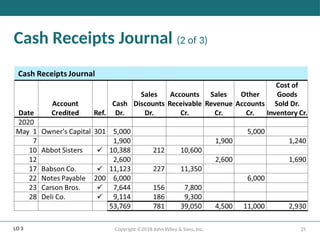
records, trial balances, worksheets, and financial
statements that result
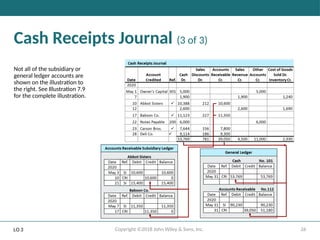
• Manual or computerized accounting system
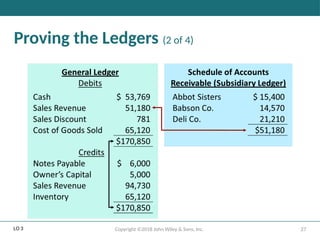
LO 1 3
Copyright ©2018 John Wiley & Sons, Inc.
4
Copyright ©2018 John Wiley & Sons, Inc.
Accounting Information Systems
Cost-Effectiveness
• Benefits of information must outweigh costs of providing it
Useful Output
• Information must be understandable, relevant, reliable,
timely, and accurate
• Must consider needs and knowledge of various users
Flexibility
• Should accommodate changing information needs
LO 1
5
Copyright ©2018 John Wiley & Sons, Inc.
Computerized Accounting Systems (1 of 2)
• Software programs (functions include sales, purchases,
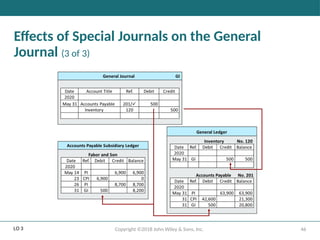
receivables, payables, cash receipts and disbursements, and
payroll)
• Generate financial statements
• Advantages:
o Typically enter data only once
o Many human errors are eliminated
o More timely information
LO 1
6
Copyright ©2018 John Wiley & Sons, Inc.
Computerized Accounting Systems (2 of 2)
Choosing a Software Package
Entry-Level Software
• Easy data access and report preparation
• Audit trail
• Internal control
• Customization
• Network-Compatibility
Enterprise Resource Planning Systems
LO 1
7
Copyright ©2018 John Wiley & Sons, Inc.
Manual Accounting Systems
• Perform each step in accounting cycle by hand
• Satisfactory with a low volume of transactions
• Must understand manual accounting systems to
understand computerized accounting systems
LO 1
8
Copyright ©2018 John Wiley & Sons, Inc.
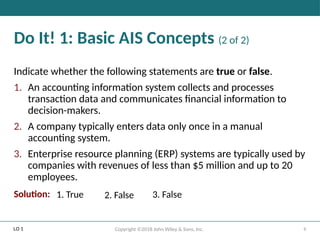
Do It! 1: Basic AIS Concepts (1 of 2)
Indicate whether the following statements are true or false.
1. An accounting information system collects and processes
transaction data and communicates financial information to
decision-makers.
2. A company typically enters data only once in a manual
accounting system.
3. Enterprise resource planning (ERP) systems are typically used by
companies with revenues of less than $5 million and up to 20
employees.
Solution: 1. 2. 3.
LO 1
9
Copyright ©2018 John Wiley & Sons, Inc.
Do It! 1: Basic AIS Concepts (2 of 2)
Indicate whether the following statements are true or false.
1. An accounting information system collects and processes
transaction data and communicates financial information to
decision-makers.
2. A company typically enters data only once in a manual
accounting system.
3. Enterprise resource planning (ERP) systems are typically used by
companies with revenues of less than $5 million and up to 20
employees.
Solution: 1. True 2. False 3. False
LO 1
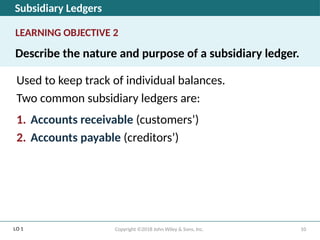
Subsidiary Ledgers
LEARNING OBJECTIVE 2
Describe the nature and purpose of a subsidiary ledger.
Used to keep track of individual balances.
Two common subsidiary ledgers are:
1. Accounts receivable (customers’)
2. Accounts payable (creditors’)
LO 1 10
Copyright ©2018 John Wiley & Sons, Inc.
11
Copyright ©2018 John Wiley & Sons, Inc.
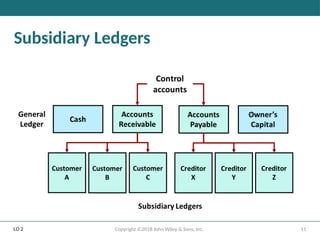
Subsidiary Ledgers
LO 2
12
Copyright ©2018 John Wiley & Sons, Inc.
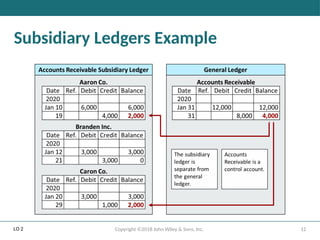
Subsidiary Ledgers Example
LO 2
13
Copyright ©2018 John Wiley & Sons, Inc.
Advantages of Subsidiary Ledgers
1. Show in a single account transactions affecting one
customer or one creditor.
2. Free the general ledger of excessive details.
3. Help locate errors in individual accounts.
4. Make possible a division of labor.
LO 2
14
Copyright ©2018 John Wiley & Sons, Inc.
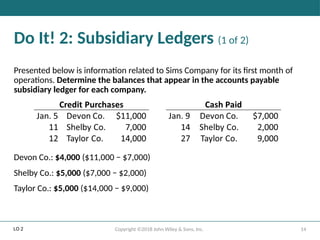
Do It! 2: Subsidiary Ledgers (1 of 2)
Presented below is information related to Sims Company for its first month of
operations. Determine the balances that appear in the accounts payable
subsidiary ledger for each company.
Devon Co.: $4,000 ($11,000 − $7,000)
Shelby Co.: $5,000 ($7,000 − $2,000)
Taylor Co.: $5,000 ($14,000 − $9,000)
LO 2
15
Copyright ©2018 John Wiley & Sons, Inc.
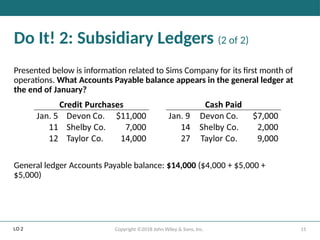
Do It! 2: Subsidiary Ledgers (2 of 2)
Presented below is information related to Sims Company for its first month of
operations. What Accounts Payable balance appears in the general ledger at
the end of January?
General ledger Accounts Payable balance: $14,000 ($4,000 + $5,000 +
$5,000)
LO 2
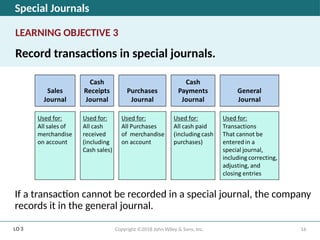
Special Journals
LEARNING OBJECTIVE 3
Record transactions in special journals.
If a transaction cannot be recorded in a special journal, the company
records it in the general journal.
LO 3 16
Copyright ©2018 John Wiley & Sons, Inc.
17
Copyright ©2018 John Wiley & Sons, Inc.
Special Journals (1 of 13)
Each of the following is a subsidiary edger except the:
a. Accounts receivable ledger.
b. Accounts payable ledger.
c. Customer’s ledger.
d. General ledger.
LO 3
18
Copyright ©2018 John Wiley & Sons, Inc.
Special Journals (2 of 13)
Each of the following is a subsidiary edger except the:
a. Accounts receivable ledger.
b. Accounts payable ledger.
c. Customer’s ledger.
d. Answer: General ledger.
LO 3
19
Copyright ©2018 John Wiley & Sons, Inc.
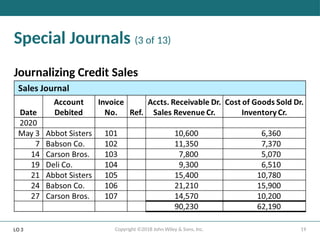
Special Journals (3 of 13)
Journalizing Credit Sales
LO 3
20
Copyright ©2018 John Wiley & Sons, Inc.
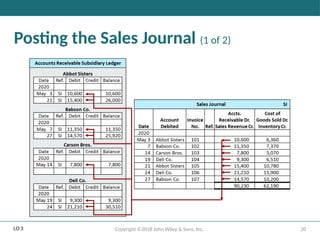
Posting the Sales Journal (1 of 2)
LO 3
21
Copyright ©2018 John Wiley & Sons, Inc.
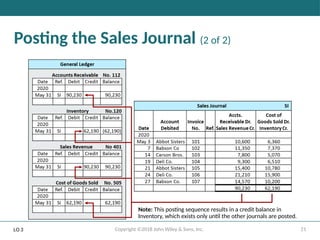
Posting the Sales Journal (2 of 2)
Note: This posting sequence results in a credit balance in
Inventory, which exists only until the other journals are posted.
LO 3
22
Copyright ©2018 John Wiley & Sons, Inc.
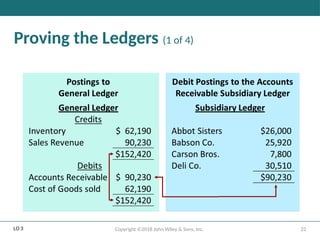
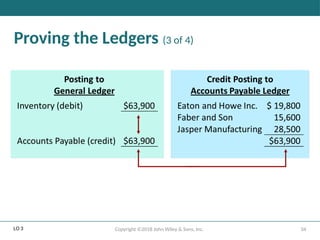
Proving the Ledgers (1 of 4)
LO 3
23
Copyright ©2018 John Wiley & Sons, Inc.
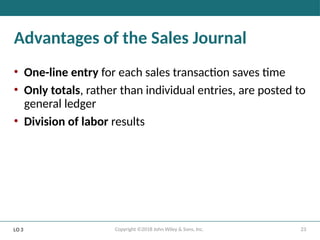
Advantages of the Sales Journal
• One-line entry for each sales transaction saves time
• Only totals, rather than individual entries, are posted to
general ledger
• Division of labor results
LO 3
24
Copyright ©2018 John Wiley & Sons, Inc.
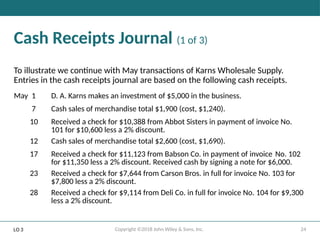
Cash Receipts Journal (1 of 3)
To illustrate we continue with May transactions of Karns Wholesale Supply.
Entries in the cash receipts journal are based on the following cash receipts.
May 1 D. A. Karns makes an investment of $5,000 in the business.
7 Cash sales of merchandise total $1,900 (cost, $1,240).
10 Received a check for $10,388 from Abbot Sisters in payment of invoice No.
101 for $10,600 less a 2% discount.
12 Cash sales of merchandise total $2,600 (cost, $1,690).
17 Received a check for $11,123 from Babson Co. in payment of invoice No. 102
for $11,350 less a 2% discount. Received cash by signing a note for $6,000.
23 Received a check for $7,644 from Carson Bros. in full for invoice No. 103 for
$7,800 less a 2% discount.
28 Received a check for $9,114 from Deli Co. in full for invoice No. 104 for $9,300
less a 2% discount.
LO 3
25
Copyright ©2018 John Wiley & Sons, Inc.
Cash Receipts Journal (2 of 3)
LO 3
26
Copyright ©2018 John Wiley & Sons, Inc.
Cash Receipts Journal (3 of 3)
Not all of the subsidiary or
general ledger accounts are
shown on the illustration to
the right. See Illustration 7.9
for the complete illustration.
LO 3
27
Copyright ©2018 John Wiley & Sons, Inc.
Proving the Ledgers (2 of 4)
LO 3
28
Copyright ©2018 John Wiley & Sons, Inc.
Special Journals (4 of 13)
Cash sales of merchandise are recorded in the
a. Cash payments journal.
b. Cash receipts journal.
c. General journal.
d. Sales journal.
LO 3
29
Copyright ©2018 John Wiley & Sons, Inc.
Special Journals (5 of 13)
Cash sales of merchandise are recorded in the
a. Cash payments journal.
b. Answer: Cash receipts journal.
c. General journal.
d. Sales journal.
LO 3
30
Copyright ©2018 John Wiley & Sons, Inc.
Special Journals (6 of 13)
Which of the following is not one of the credit columns in
the cash receipts journal?
a. Other accounts
b. Accounts payable
c. Accounts receivable
d. Sales
LO 3
31
Copyright ©2018 John Wiley & Sons, Inc.
Special Journals (7 of 13)
Which of the following is not one of the credit columns in
the cash receipts journal?
a. Other accounts
b. Answer: Accounts payable
c. Accounts receivable
d. Sales
LO 3
32
Copyright ©2018 John Wiley & Sons, Inc.
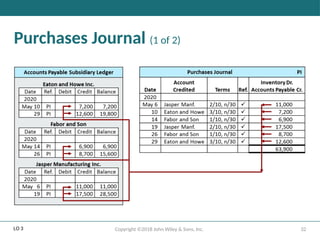
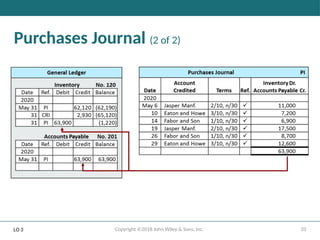
Purchases Journal (1 of 2)
LO 3
33
Copyright ©2018 John Wiley & Sons, Inc.
Purchases Journal (2 of 2)
LO 3
34
Copyright ©2018 John Wiley & Sons, Inc.
Proving the Ledgers (3 of 4)
LO 3
35
Copyright ©2018 John Wiley & Sons, Inc.
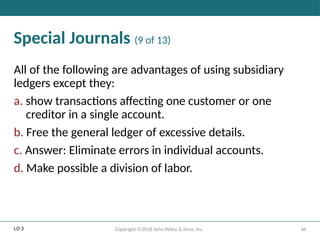
Special Journals (8 of 13)
All of the following are advantages of using subsidiary
ledgers except they:
a. show transactions affecting one customer or one
creditor in a single account.
b. Free the general ledger of excessive details.
c. Eliminate errors in individual accounts.
d. Make possible a division of labor.
LO 3
36
Copyright ©2018 John Wiley & Sons, Inc.
Special Journals (9 of 13)
All of the following are advantages of using subsidiary
ledgers except they:
a. show transactions affecting one customer or one
creditor in a single account.
b. Free the general ledger of excessive details.
c. Answer: Eliminate errors in individual accounts.
d. Make possible a division of labor.
LO 3
37
Copyright ©2018 John Wiley & Sons, Inc.
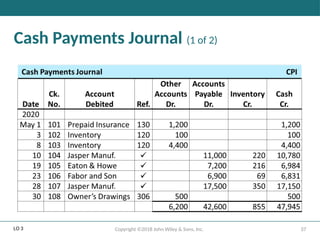
Cash Payments Journal (1 of 2)
LO 3
38
Copyright ©2018 John Wiley & Sons, Inc.
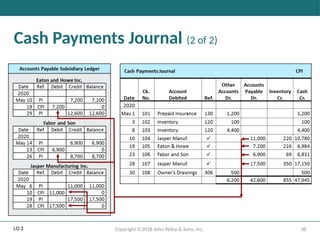
Cash Payments Journal (2 of 2)
LO 3
39
Copyright ©2018 John Wiley & Sons, Inc.
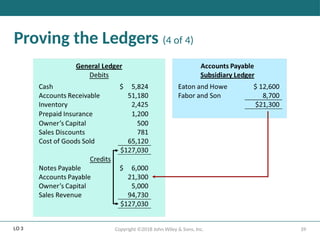
Proving the Ledgers (4 of 4)
LO 3
40
Copyright ©2018 John Wiley & Sons, Inc.
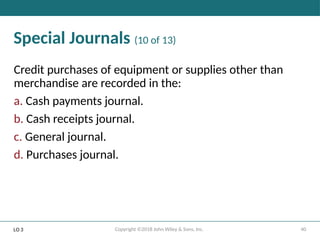
Special Journals (10 of 13)
Credit purchases of equipment or supplies other than
merchandise are recorded in the:
a. Cash payments journal.
b. Cash receipts journal.
c. General journal.
d. Purchases journal.
LO 3
41
Copyright ©2018 John Wiley & Sons, Inc.
Special Journals (11 of 13)
Credit purchases of equipment or supplies other than
merchandise are recorded in the:
a. Cash payments journal.
b. Cash receipts journal.
c. Answer: General journal.
d. Purchases journal.
LO 3
42
Copyright ©2018 John Wiley & Sons, Inc.
Special Journals (12 of 13)
Cash payment of merchandise are recorded in the:
a. Cash payments journal.
b. Cash receipts journal.
c. General journal.
d. Purchases journal.
LO 3
43
Copyright ©2018 John Wiley & Sons, Inc.
Special Journals (13 of 13)
Cash payment of merchandise are recorded in the:
a. Answer: Cash payments journal.
b. Cash receipts journal.
c. General journal.
d. Purchases journal.
LO 3
44
Copyright ©2018 John Wiley & Sons, Inc.
Effects of Special Journals on the General
Journal (1 of 3)
• Special journals substantially reduce the number of
entries that companies make in the general journal.
• Only transactions that cannot be entered in a special
journal are recorded in the general journal.
• Correcting, adjusting, and closing entries are made in
the general journal.
LO 3
45
Copyright ©2018 John Wiley & Sons, Inc.
Effects of Special Journals on the General
Journal (2 of 3)
To illustrate, assume that on May 31, Karns Wholesale
Supply returns $500 of merchandise for credit to Fabor
and Son. Illustration 7.18 shows the entry in the general
journal and the posting of the entry.
LO 3
46
Copyright ©2018 John Wiley & Sons, Inc.
Effects of Special Journals on the General
Journal (3 of 3)
LO 3
47
Copyright ©2018 John Wiley & Sons, Inc.
Do It! 3: Sales Transactions
Swisher Company had the following transactions during March.
1. Collected cash on account from Oakland Company.
2. Purchased equipment by signing a note payable.
3. Sold merchandise on account.
4. Purchased merchandise on account.
5. Paid $2,400 for a 2-year insurance policy.
Identify the journal in which each transactions is recorded.
Solution:
1. Cash receipts journal
2. General journal
3. Sales journal
4. Purchases journal
5. Cash payments journal
LO 3
48
Copyright ©2018 John Wiley & Sons, Inc.
A Look at IFRS (1 of 3)
Key Points
Similarities
• The basic concepts related to an accounting
information system are the same under GAAP and IFRS.
• The use of subsidiary ledgers and control accounts, as
well as the system used for recording transactions, are
the same under GAAP and IFRS.
LO 4
49
Copyright ©2018 John Wiley & Sons, Inc.
A Look at IFRS (2 of 3)
Key Points
Differences
• Many companies will be going through a substantial
conversion process to switch from their current
reporting standards to IFRS.
• Upon first-time adoption of IFRS, a company must
present at least one year of comparative information
under IFRS.
LO 4
50
Copyright ©2018 John Wiley & Sons, Inc.
A Look at IFRS (3 of 3)
Looking to the Future
The basic recording process shown in this textbook is followed
by companies around the globe. It is unlikely to change in the
future. The definitional structure of assets, liabilities, equity,
revenues, and expenses may change over time as the IASB
and FASB evaluate their overall conceptual framework for
establishing accounting standards. In addition, high-quality
international accounting requires both high-quality
accounting standards and high-quality auditing. Similar to the
convergence of GAAP and IFRS, there is a movement to
improve international auditing standards.
LO 4
51
Copyright ©2018 John Wiley & Sons, Inc.
Copyright
Copyright © 2018 John Wiley & Sons, Inc.
All rights reserved. Reproduction or translation of this work beyond that permitted in
Section 117 of the 1976 United States Act without the express written permission of the
copyright owner is unlawful. Request for further information should be addressed to the
Permissions Department, John Wiley & Sons, Inc. The purchaser may make back-up copies
for his/her own use only and not for distribution or resale. The Publisher assumes no
responsibility for errors, omissions, or damages, caused by the use of these programs or
from the use of the information contained herein.

Accounting Information System - Accounting Principles

  • 1.
    Accounting Principles Thirteenth Edition Weygandt● Kimmel ● Kieso Chapter 7 Accounting Information Systems This slide deck contains animations. Please disable animations if they cause issues with your device.
  • 2.
    2 Copyright ©2018 JohnWiley & Sons, Inc. Chapter Outline Learning Objectives LO 1 Explain the basic concepts of an accounting information system. LO 2 Describe the nature and purpose of a subsidiary ledger. LO 3 Record transactions in special journals.
  • 3.
    Accounting Information Systems LEARNINGOBJECTIVE 1 Explain the basic concepts of an accounting information system. Collects and processes transaction data and communicates financial information to decision makers. Includes: • All steps in the accounting cycle • Documents that provide evidence of transactions and records, trial balances, worksheets, and financial statements that result • Manual or computerized accounting system LO 1 3 Copyright ©2018 John Wiley & Sons, Inc.
  • 4.
    4 Copyright ©2018 JohnWiley & Sons, Inc. Accounting Information Systems Cost-Effectiveness • Benefits of information must outweigh costs of providing it Useful Output • Information must be understandable, relevant, reliable, timely, and accurate • Must consider needs and knowledge of various users Flexibility • Should accommodate changing information needs LO 1
  • 5.
    5 Copyright ©2018 JohnWiley & Sons, Inc. Computerized Accounting Systems (1 of 2) • Software programs (functions include sales, purchases, receivables, payables, cash receipts and disbursements, and payroll) • Generate financial statements • Advantages: o Typically enter data only once o Many human errors are eliminated o More timely information LO 1
  • 6.
    6 Copyright ©2018 JohnWiley & Sons, Inc. Computerized Accounting Systems (2 of 2) Choosing a Software Package Entry-Level Software • Easy data access and report preparation • Audit trail • Internal control • Customization • Network-Compatibility Enterprise Resource Planning Systems LO 1
  • 7.
    7 Copyright ©2018 JohnWiley & Sons, Inc. Manual Accounting Systems • Perform each step in accounting cycle by hand • Satisfactory with a low volume of transactions • Must understand manual accounting systems to understand computerized accounting systems LO 1
  • 8.
    8 Copyright ©2018 JohnWiley & Sons, Inc. Do It! 1: Basic AIS Concepts (1 of 2) Indicate whether the following statements are true or false. 1. An accounting information system collects and processes transaction data and communicates financial information to decision-makers. 2. A company typically enters data only once in a manual accounting system. 3. Enterprise resource planning (ERP) systems are typically used by companies with revenues of less than $5 million and up to 20 employees. Solution: 1. 2. 3. LO 1
  • 9.
    9 Copyright ©2018 JohnWiley & Sons, Inc. Do It! 1: Basic AIS Concepts (2 of 2) Indicate whether the following statements are true or false. 1. An accounting information system collects and processes transaction data and communicates financial information to decision-makers. 2. A company typically enters data only once in a manual accounting system. 3. Enterprise resource planning (ERP) systems are typically used by companies with revenues of less than $5 million and up to 20 employees. Solution: 1. True 2. False 3. False LO 1
  • 10.
    Subsidiary Ledgers LEARNING OBJECTIVE2 Describe the nature and purpose of a subsidiary ledger. Used to keep track of individual balances. Two common subsidiary ledgers are: 1. Accounts receivable (customers’) 2. Accounts payable (creditors’) LO 1 10 Copyright ©2018 John Wiley & Sons, Inc.
  • 11.
    11 Copyright ©2018 JohnWiley & Sons, Inc. Subsidiary Ledgers LO 2
  • 12.
    12 Copyright ©2018 JohnWiley & Sons, Inc. Subsidiary Ledgers Example LO 2
  • 13.
    13 Copyright ©2018 JohnWiley & Sons, Inc. Advantages of Subsidiary Ledgers 1. Show in a single account transactions affecting one customer or one creditor. 2. Free the general ledger of excessive details. 3. Help locate errors in individual accounts. 4. Make possible a division of labor. LO 2
  • 14.
    14 Copyright ©2018 JohnWiley & Sons, Inc. Do It! 2: Subsidiary Ledgers (1 of 2) Presented below is information related to Sims Company for its first month of operations. Determine the balances that appear in the accounts payable subsidiary ledger for each company. Devon Co.: $4,000 ($11,000 − $7,000) Shelby Co.: $5,000 ($7,000 − $2,000) Taylor Co.: $5,000 ($14,000 − $9,000) LO 2
  • 15.
    15 Copyright ©2018 JohnWiley & Sons, Inc. Do It! 2: Subsidiary Ledgers (2 of 2) Presented below is information related to Sims Company for its first month of operations. What Accounts Payable balance appears in the general ledger at the end of January? General ledger Accounts Payable balance: $14,000 ($4,000 + $5,000 + $5,000) LO 2
  • 16.
    Special Journals LEARNING OBJECTIVE3 Record transactions in special journals. If a transaction cannot be recorded in a special journal, the company records it in the general journal. LO 3 16 Copyright ©2018 John Wiley & Sons, Inc.
  • 17.
    17 Copyright ©2018 JohnWiley & Sons, Inc. Special Journals (1 of 13) Each of the following is a subsidiary edger except the: a. Accounts receivable ledger. b. Accounts payable ledger. c. Customer’s ledger. d. General ledger. LO 3
  • 18.
    18 Copyright ©2018 JohnWiley & Sons, Inc. Special Journals (2 of 13) Each of the following is a subsidiary edger except the: a. Accounts receivable ledger. b. Accounts payable ledger. c. Customer’s ledger. d. Answer: General ledger. LO 3
  • 19.
    19 Copyright ©2018 JohnWiley & Sons, Inc. Special Journals (3 of 13) Journalizing Credit Sales LO 3
  • 20.
    20 Copyright ©2018 JohnWiley & Sons, Inc. Posting the Sales Journal (1 of 2) LO 3
  • 21.
    21 Copyright ©2018 JohnWiley & Sons, Inc. Posting the Sales Journal (2 of 2) Note: This posting sequence results in a credit balance in Inventory, which exists only until the other journals are posted. LO 3
  • 22.
    22 Copyright ©2018 JohnWiley & Sons, Inc. Proving the Ledgers (1 of 4) LO 3
  • 23.
    23 Copyright ©2018 JohnWiley & Sons, Inc. Advantages of the Sales Journal • One-line entry for each sales transaction saves time • Only totals, rather than individual entries, are posted to general ledger • Division of labor results LO 3
  • 24.
    24 Copyright ©2018 JohnWiley & Sons, Inc. Cash Receipts Journal (1 of 3) To illustrate we continue with May transactions of Karns Wholesale Supply. Entries in the cash receipts journal are based on the following cash receipts. May 1 D. A. Karns makes an investment of $5,000 in the business. 7 Cash sales of merchandise total $1,900 (cost, $1,240). 10 Received a check for $10,388 from Abbot Sisters in payment of invoice No. 101 for $10,600 less a 2% discount. 12 Cash sales of merchandise total $2,600 (cost, $1,690). 17 Received a check for $11,123 from Babson Co. in payment of invoice No. 102 for $11,350 less a 2% discount. Received cash by signing a note for $6,000. 23 Received a check for $7,644 from Carson Bros. in full for invoice No. 103 for $7,800 less a 2% discount. 28 Received a check for $9,114 from Deli Co. in full for invoice No. 104 for $9,300 less a 2% discount. LO 3
  • 25.
    25 Copyright ©2018 JohnWiley & Sons, Inc. Cash Receipts Journal (2 of 3) LO 3
  • 26.
    26 Copyright ©2018 JohnWiley & Sons, Inc. Cash Receipts Journal (3 of 3) Not all of the subsidiary or general ledger accounts are shown on the illustration to the right. See Illustration 7.9 for the complete illustration. LO 3
  • 27.
    27 Copyright ©2018 JohnWiley & Sons, Inc. Proving the Ledgers (2 of 4) LO 3
  • 28.
    28 Copyright ©2018 JohnWiley & Sons, Inc. Special Journals (4 of 13) Cash sales of merchandise are recorded in the a. Cash payments journal. b. Cash receipts journal. c. General journal. d. Sales journal. LO 3
  • 29.
    29 Copyright ©2018 JohnWiley & Sons, Inc. Special Journals (5 of 13) Cash sales of merchandise are recorded in the a. Cash payments journal. b. Answer: Cash receipts journal. c. General journal. d. Sales journal. LO 3
  • 30.
    30 Copyright ©2018 JohnWiley & Sons, Inc. Special Journals (6 of 13) Which of the following is not one of the credit columns in the cash receipts journal? a. Other accounts b. Accounts payable c. Accounts receivable d. Sales LO 3
  • 31.
    31 Copyright ©2018 JohnWiley & Sons, Inc. Special Journals (7 of 13) Which of the following is not one of the credit columns in the cash receipts journal? a. Other accounts b. Answer: Accounts payable c. Accounts receivable d. Sales LO 3
  • 32.
    32 Copyright ©2018 JohnWiley & Sons, Inc. Purchases Journal (1 of 2) LO 3
  • 33.
    33 Copyright ©2018 JohnWiley & Sons, Inc. Purchases Journal (2 of 2) LO 3
  • 34.
    34 Copyright ©2018 JohnWiley & Sons, Inc. Proving the Ledgers (3 of 4) LO 3
  • 35.
    35 Copyright ©2018 JohnWiley & Sons, Inc. Special Journals (8 of 13) All of the following are advantages of using subsidiary ledgers except they: a. show transactions affecting one customer or one creditor in a single account. b. Free the general ledger of excessive details. c. Eliminate errors in individual accounts. d. Make possible a division of labor. LO 3
  • 36.
    36 Copyright ©2018 JohnWiley & Sons, Inc. Special Journals (9 of 13) All of the following are advantages of using subsidiary ledgers except they: a. show transactions affecting one customer or one creditor in a single account. b. Free the general ledger of excessive details. c. Answer: Eliminate errors in individual accounts. d. Make possible a division of labor. LO 3
  • 37.
    37 Copyright ©2018 JohnWiley & Sons, Inc. Cash Payments Journal (1 of 2) LO 3
  • 38.
    38 Copyright ©2018 JohnWiley & Sons, Inc. Cash Payments Journal (2 of 2) LO 3
  • 39.
    39 Copyright ©2018 JohnWiley & Sons, Inc. Proving the Ledgers (4 of 4) LO 3
  • 40.
    40 Copyright ©2018 JohnWiley & Sons, Inc. Special Journals (10 of 13) Credit purchases of equipment or supplies other than merchandise are recorded in the: a. Cash payments journal. b. Cash receipts journal. c. General journal. d. Purchases journal. LO 3
  • 41.
    41 Copyright ©2018 JohnWiley & Sons, Inc. Special Journals (11 of 13) Credit purchases of equipment or supplies other than merchandise are recorded in the: a. Cash payments journal. b. Cash receipts journal. c. Answer: General journal. d. Purchases journal. LO 3
  • 42.
    42 Copyright ©2018 JohnWiley & Sons, Inc. Special Journals (12 of 13) Cash payment of merchandise are recorded in the: a. Cash payments journal. b. Cash receipts journal. c. General journal. d. Purchases journal. LO 3
  • 43.
    43 Copyright ©2018 JohnWiley & Sons, Inc. Special Journals (13 of 13) Cash payment of merchandise are recorded in the: a. Answer: Cash payments journal. b. Cash receipts journal. c. General journal. d. Purchases journal. LO 3
  • 44.
    44 Copyright ©2018 JohnWiley & Sons, Inc. Effects of Special Journals on the General Journal (1 of 3) • Special journals substantially reduce the number of entries that companies make in the general journal. • Only transactions that cannot be entered in a special journal are recorded in the general journal. • Correcting, adjusting, and closing entries are made in the general journal. LO 3
  • 45.
    45 Copyright ©2018 JohnWiley & Sons, Inc. Effects of Special Journals on the General Journal (2 of 3) To illustrate, assume that on May 31, Karns Wholesale Supply returns $500 of merchandise for credit to Fabor and Son. Illustration 7.18 shows the entry in the general journal and the posting of the entry. LO 3
  • 46.
    46 Copyright ©2018 JohnWiley & Sons, Inc. Effects of Special Journals on the General Journal (3 of 3) LO 3
  • 47.
    47 Copyright ©2018 JohnWiley & Sons, Inc. Do It! 3: Sales Transactions Swisher Company had the following transactions during March. 1. Collected cash on account from Oakland Company. 2. Purchased equipment by signing a note payable. 3. Sold merchandise on account. 4. Purchased merchandise on account. 5. Paid $2,400 for a 2-year insurance policy. Identify the journal in which each transactions is recorded. Solution: 1. Cash receipts journal 2. General journal 3. Sales journal 4. Purchases journal 5. Cash payments journal LO 3
  • 48.
    48 Copyright ©2018 JohnWiley & Sons, Inc. A Look at IFRS (1 of 3) Key Points Similarities • The basic concepts related to an accounting information system are the same under GAAP and IFRS. • The use of subsidiary ledgers and control accounts, as well as the system used for recording transactions, are the same under GAAP and IFRS. LO 4
  • 49.
    49 Copyright ©2018 JohnWiley & Sons, Inc. A Look at IFRS (2 of 3) Key Points Differences • Many companies will be going through a substantial conversion process to switch from their current reporting standards to IFRS. • Upon first-time adoption of IFRS, a company must present at least one year of comparative information under IFRS. LO 4
  • 50.
    50 Copyright ©2018 JohnWiley & Sons, Inc. A Look at IFRS (3 of 3) Looking to the Future The basic recording process shown in this textbook is followed by companies around the globe. It is unlikely to change in the future. The definitional structure of assets, liabilities, equity, revenues, and expenses may change over time as the IASB and FASB evaluate their overall conceptual framework for establishing accounting standards. In addition, high-quality international accounting requires both high-quality accounting standards and high-quality auditing. Similar to the convergence of GAAP and IFRS, there is a movement to improve international auditing standards. LO 4
  • 51.
    51 Copyright ©2018 JohnWiley & Sons, Inc. Copyright Copyright © 2018 John Wiley & Sons, Inc. All rights reserved. Reproduction or translation of this work beyond that permitted in Section 117 of the 1976 United States Act without the express written permission of the copyright owner is unlawful. Request for further information should be addressed to the Permissions Department, John Wiley & Sons, Inc. The purchaser may make back-up copies for his/her own use only and not for distribution or resale. The Publisher assumes no responsibility for errors, omissions, or damages, caused by the use of these programs or from the use of the information contained herein.