7-1
7-2
Chapter 7
Fraud, Internal
Control, and Cash
Learning Objectives
After studying this chapter, you should be able to:
1. Define fraud and internal control.
2. Identify the principles of internal control activities.
3. Explain the applications of internal control principles to cash receipts.
4. Explain the applications of internal control principles to cash
disbursements.
5. Describe the operation of a petty cash fund.
6. Indicate the control features of a bank account.
7. Prepare a bank reconciliation.
8. Explain the reporting of cash.
7-3
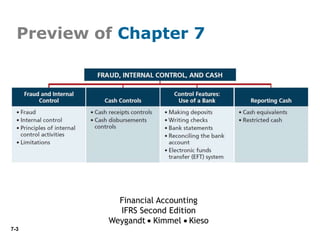
Preview of Chapter 7
Financial Accounting
IFRS Second Edition
Weygandt Kimmel Kieso
7-4
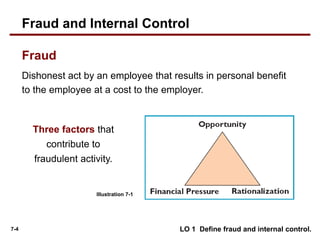
Dishonest act by an employee that results in personal benefit
to the employee at a cost to the employer.
LO 1 Define fraud and internal control.
Three factors that
contribute to
fraudulent activity.
Illustration 7-1
Fraud
Fraud and Internal Control
7-5
Methods and measures adopted to:
1. Safeguard assets.
2. Enhance accuracy and reliability of accounting records.
3. Increase efficiency of operations.
4. Ensure compliance with laws and regulations.
LO 1 Define fraud and internal control.
Internal Control
Fraud and Internal Control
7-6
Five Primary Components:
1. Control environment.
2. Risk assessment.
3. Control activities.
4. Information and communication.
5. Monitoring.
LO 1 Define fraud and internal control.
Internal Control
Fraud and Internal Control
7-7
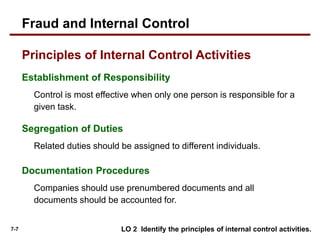
Establishment of Responsibility
Control is most effective when only one person is responsible for a
given task.
Segregation of Duties
Related duties should be assigned to different individuals.
Documentation Procedures
Companies should use prenumbered documents and all
documents should be accounted for.
Principles of Internal Control Activities
LO 2 Identify the principles of internal control activities.
Fraud and Internal Control
7-8
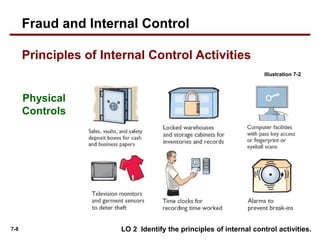
Physical
Controls
Illustration 7-2
LO 2 Identify the principles of internal control activities.
Principles of Internal Control Activities
Fraud and Internal Control
7-9
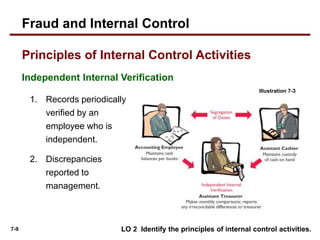
Independent Internal Verification
LO 2 Identify the principles of internal control activities.
Principles of Internal Control Activities
Fraud and Internal Control
1. Records periodically
verified by an
employee who is
independent.
2. Discrepancies
reported to
management.
Illustration 7-3
7-10
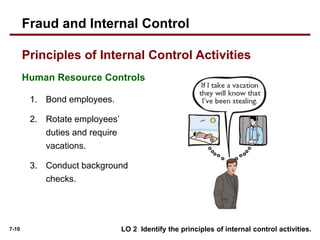
Human Resource Controls
LO 2 Identify the principles of internal control activities.
Principles of Internal Control Activities
Fraud and Internal Control
1. Bond employees.
2. Rotate employees’
duties and require
vacations.
3. Conduct background
checks.
7-11
The Missing Control
Establishment of responsibility. The healthcare company did not adequately
restrict the responsibility for authoring and approving claims transactions. The
training supervisor should not have been authorized to create claims in the
company’s “live” system.
Total take: $11 million
ANATOMY OF A FRAUD
Maureen Frugali was a training supervisor for claims processing at Colossal
Healthcare. As a standard part of the claims processing training program,
Maureen created fictitious claims for use by trainees. These fictitious claims
were then sent to the accounts payable department. After the training claims
had been processed, she was to notify Accounts Payable of all fictitious claims,
so that they would not be paid. However, she did not inform Accounts Payable
about every fictitious claim. She created some fictitious claims for entities that
she controlled (that is, she would receive the payment), and she let Accounts
Payable pay her.
7-12
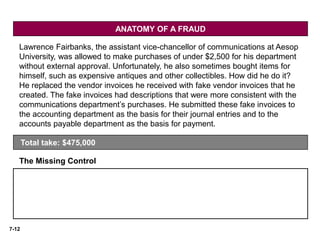
The Missing Control
Segregation of duties. The university had not properly segregated related
purchasing activities. Lawrence was ordering items, receiving the items, and
receiving the invoice. By receiving the invoice, he had control over the
documents that were used to account for the purchase and thus was able to
substitute a fake invoice.
Total take: $475,000
ANATOMY OF A FRAUD
Lawrence Fairbanks, the assistant vice-chancellor of communications at Aesop
University, was allowed to make purchases of under $2,500 for his department
without external approval. Unfortunately, he also sometimes bought items for
himself, such as expensive antiques and other collectibles. How did he do it?
He replaced the vendor invoices he received with fake vendor invoices that he
created. The fake invoices had descriptions that were more consistent with the
communications department’s purchases. He submitted these fake invoices to
the accounting department as the basis for their journal entries and to the
accounts payable department as the basis for payment.
7-13
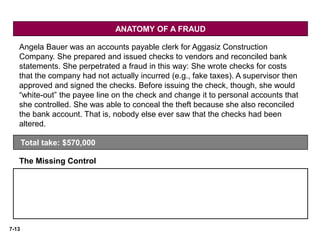
The Missing Control
Segregation of duties. Aggasiz Construction Company did not properly
segregate record-keeping from physical custody. Angela had physical custody
of the checks, which essentially was control of the cash. She also had record-
keeping responsibility because she prepared the bank reconciliation.
Total take: $570,000
ANATOMY OF A FRAUD
Angela Bauer was an accounts payable clerk for Aggasiz Construction
Company. She prepared and issued checks to vendors and reconciled bank
statements. She perpetrated a fraud in this way: She wrote checks for costs
that the company had not actually incurred (e.g., fake taxes). A supervisor then
approved and signed the checks. Before issuing the check, though, she would
“white-out” the payee line on the check and change it to personal accounts that
she controlled. She was able to conceal the theft because she also reconciled
the bank account. That is, nobody else ever saw that the checks had been
altered.
7-14
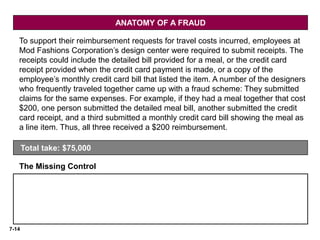
The Missing Control
Documentation procedures. Mod Fashions should require the original,
detailed receipt. It should not accept photocopies, and it should not accept
credit card statements. In addition, documentation procedures could be further
improved by requiring the use of a corporate credit card (rather than a personal
credit card) for all business expenses.
Total take: $75,000
ANATOMY OF A FRAUD
To support their reimbursement requests for travel costs incurred, employees at
Mod Fashions Corporation’s design center were required to submit receipts. The
receipts could include the detailed bill provided for a meal, or the credit card
receipt provided when the credit card payment is made, or a copy of the
employee’s monthly credit card bill that listed the item. A number of the designers
who frequently traveled together came up with a fraud scheme: They submitted
claims for the same expenses. For example, if they had a meal together that cost
$200, one person submitted the detailed meal bill, another submitted the credit
card receipt, and a third submitted a monthly credit card bill showing the meal as
a line item. Thus, all three received a $200 reimbursement.
7-15
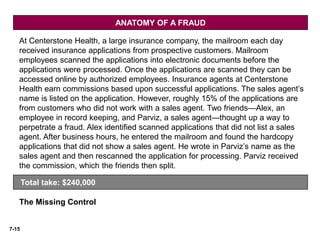
The Missing Control
Total take: $240,000
ANATOMY OF A FRAUD
At Centerstone Health, a large insurance company, the mailroom each day
received insurance applications from prospective customers. Mailroom
employees scanned the applications into electronic documents before the
applications were processed. Once the applications are scanned they can be
accessed online by authorized employees. Insurance agents at Centerstone
Health earn commissions based upon successful applications. The sales agent’s
name is listed on the application. However, roughly 15% of the applications are
from customers who did not work with a sales agent. Two friends—Alex, an
employee in record keeping, and Parviz, a sales agent—thought up a way to
perpetrate a fraud. Alex identified scanned applications that did not list a sales
agent. After business hours, he entered the mailroom and found the hardcopy
applications that did not show a sales agent. He wrote in Parviz’s name as the
sales agent and then rescanned the application for processing. Parviz received
the commission, which the friends then split.
7-16
The Missing Control
Physical controls. Centerstone Health lacked two basic physical controls that
could have prevented this fraud. First, the mailroom should have been locked
during nonbusiness hours, and access during business hours should have
been tightly controlled. Second, the scanned applications supposedly could be
accessed only by authorized employees using their passwords. However, the
password for each employee was the same as the employee’s user ID. Since
employee user-ID numbers were available to all other employees, all
employees knew all other employees’ passwords. Unauthorized employees
could access the scanned applications. Thus, Alex could enter the system
using another employee’s password and access the scanned applications.
Total take: $240,000
7-17
The Missing Control
Independent internal verification. Bobbi Jean’s boss should have verified her
expense reports. When asked what he thought her expenses were, the boss
said about $10,000. At $115,000 per year, her actual expenses were more than
ten times what would have been expected. However, because he was “too
busy” to verify her expense reports or to review the budget, he never noticed.
Total take: $275,000
ANATOMY OF A FRAUD
Bobbi Jean Donnelly, the office manager for Mod Fashions Corporations design
center, was responsible for preparing the design center budget and reviewing
expense reports submitted by design center employees. Her desire to upgrade
her wardrobe got the better of her, and she enacted a fraud that involved filing
expense-reimbursement requests for her own personal clothing purchases. She
was able to conceal the fraud because she was responsible for reviewing all
expense reports, including her own. In addition, she sometimes was given
ultimate responsibility for signing off on the expense reports when her boss was
“too busy.” Also, because she controlled the budget, when she submitted her
expenses, she coded them to budget items that she knew were running under
budget, so that they would not catch anyone’s attention.
7-18
The Missing Control
Human resource controls. Ellen, the desk manager, had been fired by a
previous employer. If the Excelsior Inn had conducted a background check, it
would not have hired her. The fraud was detected when Ellen missed work due
to illness. A system of mandatory vacations and rotating days off would have
increased the chances of detecting the fraud before it became so large.
Total take: $95,000
ANATOMY OF A FRAUD
Ellen Lowry was the desk manager and Josephine Rodriquez was the head of
housekeeping at the Excelsior Inn, a luxury hotel. The two best friends were so
dedicated to their jobs that they never took vacations, and they frequently filled in
for other employees. In fact, Ms. Rodriquez, whose job as head of housekeeping
did not include cleaning rooms, often cleaned rooms herself, “just to help the
staff keep up.” Ellen, the desk manager, provided significant discounts to guests
who paid with cash. She kept the cash and did not register the guest in the
hotel’s computerized system. Instead, she took the room out of circulation “due
to routine maintenance.” Because the room did not show up as being used, it did
not receive a normal housekeeping assignment. Instead, Josephine, the head of
housekeeping, cleaned the rooms during the guests’ stay.
7-19
7-20
Limitations of Internal Control
 Costs should not exceed benefit.
 Human element.
 Size of the business.
LO 2 Identify the principles of internal control activities.
Fraud and Internal Control
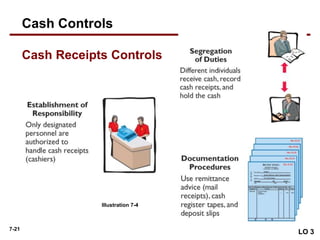
7-21
Illustration 7-4
Cash Receipts Controls
LO 3
Cash Controls
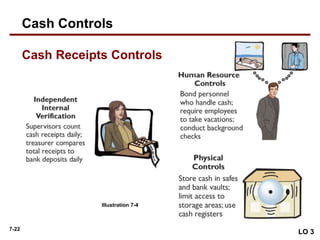
7-22
Cash Receipts Controls
LO 3
Cash Controls
Illustration 7-4
7-23
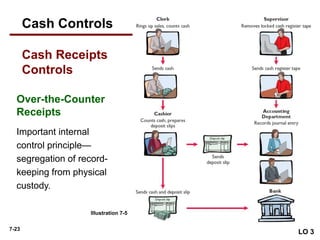
Illustration 7-5
Important internal
control principle—
segregation of record-
keeping from physical
custody.
Cash Receipts
Controls
Over-the-Counter
Receipts
LO 3
Cash Controls
7-24
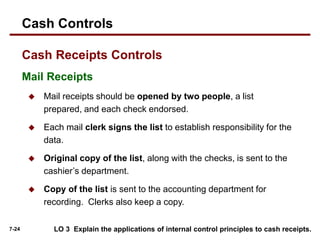
Mail Receipts
 Mail receipts should be opened by two people, a list
prepared, and each check endorsed.
 Each mail clerk signs the list to establish responsibility for the
data.
 Original copy of the list, along with the checks, is sent to the
cashier’s department.
 Copy of the list is sent to the accounting department for
recording. Clerks also keep a copy.
LO 3 Explain the applications of internal control principles to cash receipts.
Cash Controls
Cash Receipts Controls
7-25
Permitting only designated personnel to handle cash receipts
is an application of the principle of:
a. segregation of duties.
b. establishment of responsibility.
c. independent check.
d. other controls.
Review Question
LO 3 Explain the applications of internal control principles to cash receipts.
Cash Controls
7-26
Generally, internal control over cash disbursements is more
effective when companies pay by check, rather than by
cash.
Applications:
 Voucher system
 Petty cash fund
LO 4 Explain the applications of internal control
principles to cash disbursements.
Cash Disbursements Controls
Cash Controls
7-27
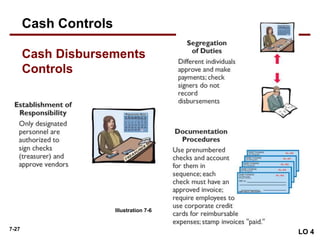
Cash Disbursements
Controls
Illustration 7-6
LO 4
Cash Controls
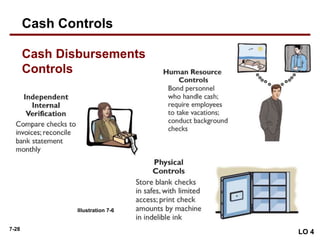
7-28
Cash Disbursements
Controls
Illustration 7-6
LO 4
Cash Controls
7-29
The use of prenumbered checks in disbursing cash is an
application of the principle of:
a. establishment of responsibility.
b. segregation of duties.
c. physical, mechanical, and electronic controls.
d. documentation procedures.
Review Question
LO 4 Explain the applications of internal control
principles to cash disbursements.
Cash Controls
7-30
Voucher System
 Network of approvals, by authorized individuals, to
ensure all disbursements by check are proper.
 A voucher is an authorization form prepared for each
expenditure.
LO 4 Explain the applications of internal control
principles to cash disbursements.
Cash Disbursements Controls
Cash Controls
7-31
Petty Cash Fund - Used to pay small amounts.
Involves:
1. establishing the fund,
2. making payments from the fund, and
3. replenishing the fund.
Cash Disbursements Controls
Cash Controls
LO 5 Describe the operation of a petty cash fund.
7-32
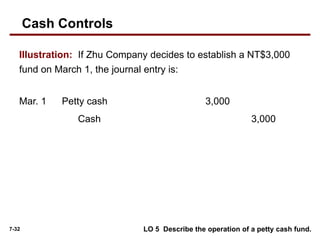
Illustration: If Zhu Company decides to establish a NT$3,000
fund on March 1, the journal entry is:
LO 5 Describe the operation of a petty cash fund.
Petty cash 3,000
Mar. 1
Cash 3,000
Cash Controls
7-33
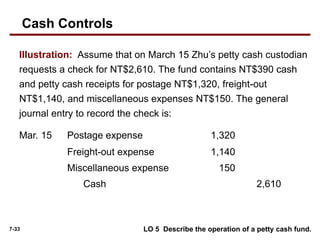
Illustration: Assume that on March 15 Zhu’s petty cash custodian
requests a check for NT$2,610. The fund contains NT$390 cash
and petty cash receipts for postage NT$1,320, freight-out
NT$1,140, and miscellaneous expenses NT$150. The general
journal entry to record the check is:
LO 5 Describe the operation of a petty cash fund.
Postage expense 1,320
Mar. 15
Cash 2,610
Freight-out expense 1,140
Miscellaneous expense 150
Cash Controls
7-34
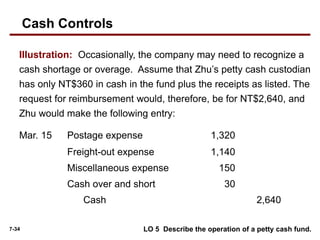
Illustration: Occasionally, the company may need to recognize a
cash shortage or overage. Assume that Zhu’s petty cash custodian
has only NT$360 in cash in the fund plus the receipts as listed. The
request for reimbursement would, therefore, be for NT$2,640, and
Zhu would make the following entry:
LO 5 Describe the operation of a petty cash fund.
Postage expense 1,320
Mar. 15
Cash 2,640
Freight-out expense 1,140
Miscellaneous expense 150
Cash over and short 30
Cash Controls
7-35
Contributes to good internal control over cash.
 Minimizes the amount of currency on hand.
 Creates a double record of bank transactions.
 Bank reconciliation.
LO 6 Indicate the control features of a bank account.
Control Features: Use of a Bank
7-36
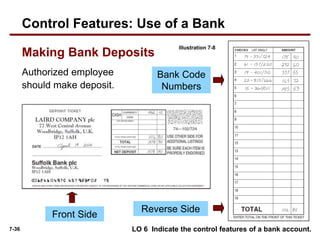
Authorized employee
should make deposit.
LO 6 Indicate the control features of a bank account.
Bank Code
Numbers
Front Side
Reverse Side
Illustration 7-8
Control Features: Use of a Bank
Making Bank Deposits
7-37
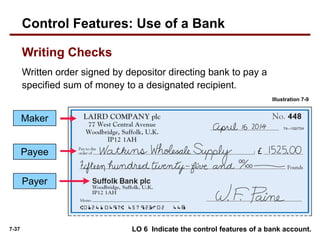
Written order signed by depositor directing bank to pay a
specified sum of money to a designated recipient.
LO 6 Indicate the control features of a bank account.
Maker
Payee
Illustration 7-9
Payer
Control Features: Use of a Bank
Writing Checks
7-38
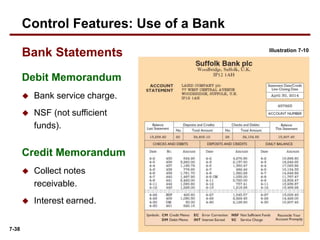
Debit Memorandum
 Bank service charge.
 NSF (not sufficient
funds).
Illustration 7-10
Credit Memorandum
 Collect notes
receivable.
 Interest earned.
Bank Statements
Control Features: Use of a Bank
7-39
The control features of a bank account do not include:
a. having bank auditors verify the correctness of the bank
balance per books.
b. minimizing the amount of cash that must be kept on
hand.
c. providing a double record of all bank transactions.
d. safeguarding cash by using a bank as a depository.
Review Question
LO 6 Indicate the control features of a bank account.
Control Features: Use of a Bank
7-40
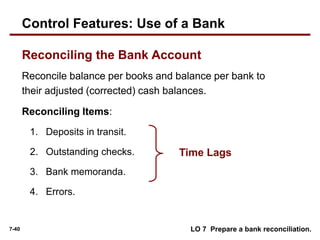
Reconcile balance per books and balance per bank to
their adjusted (corrected) cash balances.
Reconciling Items:
1. Deposits in transit.
2. Outstanding checks.
3. Bank memoranda.
4. Errors.
LO 7 Prepare a bank reconciliation.
Time Lags
Control Features: Use of a Bank
Reconciling the Bank Account
7-41
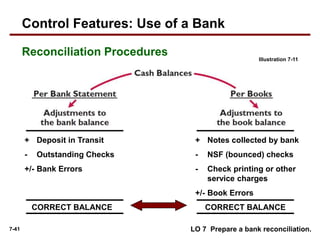
Reconciliation Procedures
LO 7 Prepare a bank reconciliation.
+ Deposit in Transit
- Outstanding Checks
+/- Bank Errors
+ Notes collected by bank
- NSF (bounced) checks
- Check printing or other
service charges
+/- Book Errors
CORRECT BALANCE CORRECT BALANCE
Illustration 7-11
Control Features: Use of a Bank
7-42 LO 7 Prepare a bank reconciliation.
Control Features: Use of a Bank
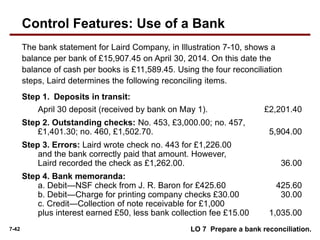
The bank statement for Laird Company, in Illustration 7-10, shows a
balance per bank of £15,907.45 on April 30, 2014. On this date the
balance of cash per books is £11,589.45. Using the four reconciliation
steps, Laird determines the following reconciling items.
Step 1. Deposits in transit:
April 30 deposit (received by bank on May 1). £2,201.40
Step 2. Outstanding checks: No. 453, £3,000.00; no. 457,
£1,401.30; no. 460, £1,502.70. 5,904.00
Step 3. Errors: Laird wrote check no. 443 for £1,226.00
and the bank correctly paid that amount. However,
Laird recorded the check as £1,262.00. 36.00
Step 4. Bank memoranda:
a. Debit—NSF check from J. R. Baron for £425.60 425.60
b. Debit—Charge for printing company checks £30.00 30.00
c. Credit—Collection of note receivable for £1,000
plus interest earned £50, less bank collection fee £15.00 1,035.00
7-43
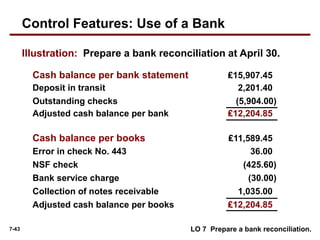
Illustration: Prepare a bank reconciliation at April 30.
LO 7 Prepare a bank reconciliation.
Cash balance per bank statement ₤15,907.45
Deposit in transit 2,201.40
Outstanding checks (5,904.00)
Adjusted cash balance per bank ₤12,204.85
Cash balance per books ₤11,589.45
Collection of notes receivable 1,035.00
Error in check No. 443 36.00
NSF check (425.60)
Bank service charge (30.00)
Adjusted cash balance per books ₤12,204.85
Control Features: Use of a Bank
7-44
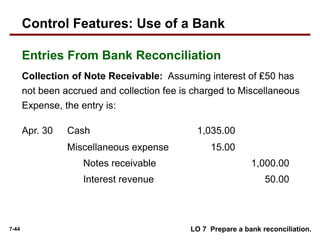
Collection of Note Receivable: Assuming interest of ₤50 has
not been accrued and collection fee is charged to Miscellaneous
Expense, the entry is:
Cash 1,035.00
Apr. 30
Miscellaneous expense 15.00
Notes receivable 1,000.00
Interest revenue 50.00
LO 7 Prepare a bank reconciliation.
Control Features: Use of a Bank
Entries From Bank Reconciliation
7-45
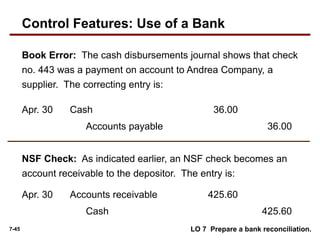
Book Error: The cash disbursements journal shows that check
no. 443 was a payment on account to Andrea Company, a
supplier. The correcting entry is:
Cash 36.00
Apr. 30
Accounts payable 36.00
LO 7 Prepare a bank reconciliation.
Control Features: Use of a Bank
NSF Check: As indicated earlier, an NSF check becomes an
account receivable to the depositor. The entry is:
Accounts receivable 425.60
Apr. 30
Cash 425.60
7-46
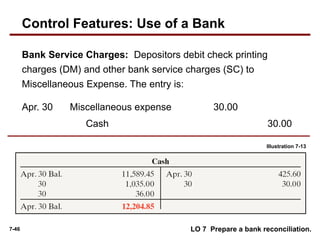
Bank Service Charges: Depositors debit check printing
charges (DM) and other bank service charges (SC) to
Miscellaneous Expense. The entry is:
Miscellaneous expense 30.00
Apr. 30
Cash 30.00
LO 7 Prepare a bank reconciliation.
Control Features: Use of a Bank
Illustration 7-13
7-47
The reconciling item in a bank reconciliation that will result in
an adjusting entry by the depositor is:
a. outstanding checks.
b. deposit in transit.
c. a bank error.
d. bank service charges.
Review Question
LO 7 Prepare a bank reconciliation.
Control Features: Use of a Bank
7-48
 Disbursement systems that uses wire, telephone, or
computers to transfer cash balances between locations.
 EFT transfers normally result in better internal control
since no cash or checks are handled by company
employees.
LO 7 Prepare a bank reconciliation.
Control Features: Use of a Bank
Electronic Funds Transfer (EFT) System
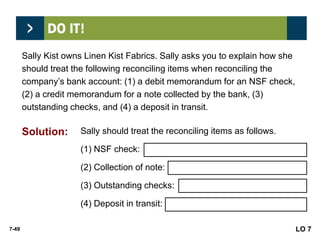
7-49
Sally Kist owns Linen Kist Fabrics. Sally asks you to explain how she
should treat the following reconciling items when reconciling the
company’s bank account: (1) a debit memorandum for an NSF check,
(2) a credit memorandum for a note collected by the bank, (3)
outstanding checks, and (4) a deposit in transit.
Sally should treat the reconciling items as follows.
(1) NSF check: Deduct from balance per books.
(2) Collection of note: Add to balance per books.
(3) Outstanding checks: Deduct from balance per bank.
(4) Deposit in transit: Add to balance per bank.
LO 7
Solution:
7-50
Cash equivalents are short-term, highly liquid investments
that are both:
1. Readily convertible to cash, and
2. So near their maturity that their market value is relatively
insensitive to changes in interest rates.
Reporting Cash
Cash Equivalents
Should be reported separately on the balance sheet as
restricted cash.
Restricted Cash
LO 8 Explain the reporting of cash.
7-51
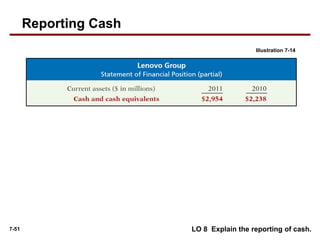
Illustration 7-14
Reporting Cash
LO 8 Explain the reporting of cash.

fraud, internal control.ppt

  • 1.
  • 2.
    7-2 Chapter 7 Fraud, Internal Control,and Cash Learning Objectives After studying this chapter, you should be able to: 1. Define fraud and internal control. 2. Identify the principles of internal control activities. 3. Explain the applications of internal control principles to cash receipts. 4. Explain the applications of internal control principles to cash disbursements. 5. Describe the operation of a petty cash fund. 6. Indicate the control features of a bank account. 7. Prepare a bank reconciliation. 8. Explain the reporting of cash.
  • 3.
    7-3 Preview of Chapter7 Financial Accounting IFRS Second Edition Weygandt Kimmel Kieso
  • 4.
    7-4 Dishonest act byan employee that results in personal benefit to the employee at a cost to the employer. LO 1 Define fraud and internal control. Three factors that contribute to fraudulent activity. Illustration 7-1 Fraud Fraud and Internal Control
  • 5.
    7-5 Methods and measuresadopted to: 1. Safeguard assets. 2. Enhance accuracy and reliability of accounting records. 3. Increase efficiency of operations. 4. Ensure compliance with laws and regulations. LO 1 Define fraud and internal control. Internal Control Fraud and Internal Control
  • 6.
    7-6 Five Primary Components: 1.Control environment. 2. Risk assessment. 3. Control activities. 4. Information and communication. 5. Monitoring. LO 1 Define fraud and internal control. Internal Control Fraud and Internal Control
  • 7.
    7-7 Establishment of Responsibility Controlis most effective when only one person is responsible for a given task. Segregation of Duties Related duties should be assigned to different individuals. Documentation Procedures Companies should use prenumbered documents and all documents should be accounted for. Principles of Internal Control Activities LO 2 Identify the principles of internal control activities. Fraud and Internal Control
  • 8.
    7-8 Physical Controls Illustration 7-2 LO 2Identify the principles of internal control activities. Principles of Internal Control Activities Fraud and Internal Control
  • 9.
    7-9 Independent Internal Verification LO2 Identify the principles of internal control activities. Principles of Internal Control Activities Fraud and Internal Control 1. Records periodically verified by an employee who is independent. 2. Discrepancies reported to management. Illustration 7-3
  • 10.
    7-10 Human Resource Controls LO2 Identify the principles of internal control activities. Principles of Internal Control Activities Fraud and Internal Control 1. Bond employees. 2. Rotate employees’ duties and require vacations. 3. Conduct background checks.
  • 11.
    7-11 The Missing Control Establishmentof responsibility. The healthcare company did not adequately restrict the responsibility for authoring and approving claims transactions. The training supervisor should not have been authorized to create claims in the company’s “live” system. Total take: $11 million ANATOMY OF A FRAUD Maureen Frugali was a training supervisor for claims processing at Colossal Healthcare. As a standard part of the claims processing training program, Maureen created fictitious claims for use by trainees. These fictitious claims were then sent to the accounts payable department. After the training claims had been processed, she was to notify Accounts Payable of all fictitious claims, so that they would not be paid. However, she did not inform Accounts Payable about every fictitious claim. She created some fictitious claims for entities that she controlled (that is, she would receive the payment), and she let Accounts Payable pay her.
  • 12.
    7-12 The Missing Control Segregationof duties. The university had not properly segregated related purchasing activities. Lawrence was ordering items, receiving the items, and receiving the invoice. By receiving the invoice, he had control over the documents that were used to account for the purchase and thus was able to substitute a fake invoice. Total take: $475,000 ANATOMY OF A FRAUD Lawrence Fairbanks, the assistant vice-chancellor of communications at Aesop University, was allowed to make purchases of under $2,500 for his department without external approval. Unfortunately, he also sometimes bought items for himself, such as expensive antiques and other collectibles. How did he do it? He replaced the vendor invoices he received with fake vendor invoices that he created. The fake invoices had descriptions that were more consistent with the communications department’s purchases. He submitted these fake invoices to the accounting department as the basis for their journal entries and to the accounts payable department as the basis for payment.
  • 13.
    7-13 The Missing Control Segregationof duties. Aggasiz Construction Company did not properly segregate record-keeping from physical custody. Angela had physical custody of the checks, which essentially was control of the cash. She also had record- keeping responsibility because she prepared the bank reconciliation. Total take: $570,000 ANATOMY OF A FRAUD Angela Bauer was an accounts payable clerk for Aggasiz Construction Company. She prepared and issued checks to vendors and reconciled bank statements. She perpetrated a fraud in this way: She wrote checks for costs that the company had not actually incurred (e.g., fake taxes). A supervisor then approved and signed the checks. Before issuing the check, though, she would “white-out” the payee line on the check and change it to personal accounts that she controlled. She was able to conceal the theft because she also reconciled the bank account. That is, nobody else ever saw that the checks had been altered.
  • 14.
    7-14 The Missing Control Documentationprocedures. Mod Fashions should require the original, detailed receipt. It should not accept photocopies, and it should not accept credit card statements. In addition, documentation procedures could be further improved by requiring the use of a corporate credit card (rather than a personal credit card) for all business expenses. Total take: $75,000 ANATOMY OF A FRAUD To support their reimbursement requests for travel costs incurred, employees at Mod Fashions Corporation’s design center were required to submit receipts. The receipts could include the detailed bill provided for a meal, or the credit card receipt provided when the credit card payment is made, or a copy of the employee’s monthly credit card bill that listed the item. A number of the designers who frequently traveled together came up with a fraud scheme: They submitted claims for the same expenses. For example, if they had a meal together that cost $200, one person submitted the detailed meal bill, another submitted the credit card receipt, and a third submitted a monthly credit card bill showing the meal as a line item. Thus, all three received a $200 reimbursement.
  • 15.
    7-15 The Missing Control Totaltake: $240,000 ANATOMY OF A FRAUD At Centerstone Health, a large insurance company, the mailroom each day received insurance applications from prospective customers. Mailroom employees scanned the applications into electronic documents before the applications were processed. Once the applications are scanned they can be accessed online by authorized employees. Insurance agents at Centerstone Health earn commissions based upon successful applications. The sales agent’s name is listed on the application. However, roughly 15% of the applications are from customers who did not work with a sales agent. Two friends—Alex, an employee in record keeping, and Parviz, a sales agent—thought up a way to perpetrate a fraud. Alex identified scanned applications that did not list a sales agent. After business hours, he entered the mailroom and found the hardcopy applications that did not show a sales agent. He wrote in Parviz’s name as the sales agent and then rescanned the application for processing. Parviz received the commission, which the friends then split.
  • 16.
    7-16 The Missing Control Physicalcontrols. Centerstone Health lacked two basic physical controls that could have prevented this fraud. First, the mailroom should have been locked during nonbusiness hours, and access during business hours should have been tightly controlled. Second, the scanned applications supposedly could be accessed only by authorized employees using their passwords. However, the password for each employee was the same as the employee’s user ID. Since employee user-ID numbers were available to all other employees, all employees knew all other employees’ passwords. Unauthorized employees could access the scanned applications. Thus, Alex could enter the system using another employee’s password and access the scanned applications. Total take: $240,000
  • 17.
    7-17 The Missing Control Independentinternal verification. Bobbi Jean’s boss should have verified her expense reports. When asked what he thought her expenses were, the boss said about $10,000. At $115,000 per year, her actual expenses were more than ten times what would have been expected. However, because he was “too busy” to verify her expense reports or to review the budget, he never noticed. Total take: $275,000 ANATOMY OF A FRAUD Bobbi Jean Donnelly, the office manager for Mod Fashions Corporations design center, was responsible for preparing the design center budget and reviewing expense reports submitted by design center employees. Her desire to upgrade her wardrobe got the better of her, and she enacted a fraud that involved filing expense-reimbursement requests for her own personal clothing purchases. She was able to conceal the fraud because she was responsible for reviewing all expense reports, including her own. In addition, she sometimes was given ultimate responsibility for signing off on the expense reports when her boss was “too busy.” Also, because she controlled the budget, when she submitted her expenses, she coded them to budget items that she knew were running under budget, so that they would not catch anyone’s attention.
  • 18.
    7-18 The Missing Control Humanresource controls. Ellen, the desk manager, had been fired by a previous employer. If the Excelsior Inn had conducted a background check, it would not have hired her. The fraud was detected when Ellen missed work due to illness. A system of mandatory vacations and rotating days off would have increased the chances of detecting the fraud before it became so large. Total take: $95,000 ANATOMY OF A FRAUD Ellen Lowry was the desk manager and Josephine Rodriquez was the head of housekeeping at the Excelsior Inn, a luxury hotel. The two best friends were so dedicated to their jobs that they never took vacations, and they frequently filled in for other employees. In fact, Ms. Rodriquez, whose job as head of housekeeping did not include cleaning rooms, often cleaned rooms herself, “just to help the staff keep up.” Ellen, the desk manager, provided significant discounts to guests who paid with cash. She kept the cash and did not register the guest in the hotel’s computerized system. Instead, she took the room out of circulation “due to routine maintenance.” Because the room did not show up as being used, it did not receive a normal housekeeping assignment. Instead, Josephine, the head of housekeeping, cleaned the rooms during the guests’ stay.
  • 19.
  • 20.
    7-20 Limitations of InternalControl  Costs should not exceed benefit.  Human element.  Size of the business. LO 2 Identify the principles of internal control activities. Fraud and Internal Control
  • 21.
    7-21 Illustration 7-4 Cash ReceiptsControls LO 3 Cash Controls
  • 22.
    7-22 Cash Receipts Controls LO3 Cash Controls Illustration 7-4
  • 23.
    7-23 Illustration 7-5 Important internal controlprinciple— segregation of record- keeping from physical custody. Cash Receipts Controls Over-the-Counter Receipts LO 3 Cash Controls
  • 24.
    7-24 Mail Receipts  Mailreceipts should be opened by two people, a list prepared, and each check endorsed.  Each mail clerk signs the list to establish responsibility for the data.  Original copy of the list, along with the checks, is sent to the cashier’s department.  Copy of the list is sent to the accounting department for recording. Clerks also keep a copy. LO 3 Explain the applications of internal control principles to cash receipts. Cash Controls Cash Receipts Controls
  • 25.
    7-25 Permitting only designatedpersonnel to handle cash receipts is an application of the principle of: a. segregation of duties. b. establishment of responsibility. c. independent check. d. other controls. Review Question LO 3 Explain the applications of internal control principles to cash receipts. Cash Controls
  • 26.
    7-26 Generally, internal controlover cash disbursements is more effective when companies pay by check, rather than by cash. Applications:  Voucher system  Petty cash fund LO 4 Explain the applications of internal control principles to cash disbursements. Cash Disbursements Controls Cash Controls
  • 27.
  • 28.
  • 29.
    7-29 The use ofprenumbered checks in disbursing cash is an application of the principle of: a. establishment of responsibility. b. segregation of duties. c. physical, mechanical, and electronic controls. d. documentation procedures. Review Question LO 4 Explain the applications of internal control principles to cash disbursements. Cash Controls
  • 30.
    7-30 Voucher System  Networkof approvals, by authorized individuals, to ensure all disbursements by check are proper.  A voucher is an authorization form prepared for each expenditure. LO 4 Explain the applications of internal control principles to cash disbursements. Cash Disbursements Controls Cash Controls
  • 31.
    7-31 Petty Cash Fund- Used to pay small amounts. Involves: 1. establishing the fund, 2. making payments from the fund, and 3. replenishing the fund. Cash Disbursements Controls Cash Controls LO 5 Describe the operation of a petty cash fund.
  • 32.
    7-32 Illustration: If ZhuCompany decides to establish a NT$3,000 fund on March 1, the journal entry is: LO 5 Describe the operation of a petty cash fund. Petty cash 3,000 Mar. 1 Cash 3,000 Cash Controls
  • 33.
    7-33 Illustration: Assume thaton March 15 Zhu’s petty cash custodian requests a check for NT$2,610. The fund contains NT$390 cash and petty cash receipts for postage NT$1,320, freight-out NT$1,140, and miscellaneous expenses NT$150. The general journal entry to record the check is: LO 5 Describe the operation of a petty cash fund. Postage expense 1,320 Mar. 15 Cash 2,610 Freight-out expense 1,140 Miscellaneous expense 150 Cash Controls
  • 34.
    7-34 Illustration: Occasionally, thecompany may need to recognize a cash shortage or overage. Assume that Zhu’s petty cash custodian has only NT$360 in cash in the fund plus the receipts as listed. The request for reimbursement would, therefore, be for NT$2,640, and Zhu would make the following entry: LO 5 Describe the operation of a petty cash fund. Postage expense 1,320 Mar. 15 Cash 2,640 Freight-out expense 1,140 Miscellaneous expense 150 Cash over and short 30 Cash Controls
  • 35.
    7-35 Contributes to goodinternal control over cash.  Minimizes the amount of currency on hand.  Creates a double record of bank transactions.  Bank reconciliation. LO 6 Indicate the control features of a bank account. Control Features: Use of a Bank
  • 36.
    7-36 Authorized employee should makedeposit. LO 6 Indicate the control features of a bank account. Bank Code Numbers Front Side Reverse Side Illustration 7-8 Control Features: Use of a Bank Making Bank Deposits
  • 37.
    7-37 Written order signedby depositor directing bank to pay a specified sum of money to a designated recipient. LO 6 Indicate the control features of a bank account. Maker Payee Illustration 7-9 Payer Control Features: Use of a Bank Writing Checks
  • 38.
    7-38 Debit Memorandum  Bankservice charge.  NSF (not sufficient funds). Illustration 7-10 Credit Memorandum  Collect notes receivable.  Interest earned. Bank Statements Control Features: Use of a Bank
  • 39.
    7-39 The control featuresof a bank account do not include: a. having bank auditors verify the correctness of the bank balance per books. b. minimizing the amount of cash that must be kept on hand. c. providing a double record of all bank transactions. d. safeguarding cash by using a bank as a depository. Review Question LO 6 Indicate the control features of a bank account. Control Features: Use of a Bank
  • 40.
    7-40 Reconcile balance perbooks and balance per bank to their adjusted (corrected) cash balances. Reconciling Items: 1. Deposits in transit. 2. Outstanding checks. 3. Bank memoranda. 4. Errors. LO 7 Prepare a bank reconciliation. Time Lags Control Features: Use of a Bank Reconciling the Bank Account
  • 41.
    7-41 Reconciliation Procedures LO 7Prepare a bank reconciliation. + Deposit in Transit - Outstanding Checks +/- Bank Errors + Notes collected by bank - NSF (bounced) checks - Check printing or other service charges +/- Book Errors CORRECT BALANCE CORRECT BALANCE Illustration 7-11 Control Features: Use of a Bank
  • 42.
    7-42 LO 7Prepare a bank reconciliation. Control Features: Use of a Bank The bank statement for Laird Company, in Illustration 7-10, shows a balance per bank of £15,907.45 on April 30, 2014. On this date the balance of cash per books is £11,589.45. Using the four reconciliation steps, Laird determines the following reconciling items. Step 1. Deposits in transit: April 30 deposit (received by bank on May 1). £2,201.40 Step 2. Outstanding checks: No. 453, £3,000.00; no. 457, £1,401.30; no. 460, £1,502.70. 5,904.00 Step 3. Errors: Laird wrote check no. 443 for £1,226.00 and the bank correctly paid that amount. However, Laird recorded the check as £1,262.00. 36.00 Step 4. Bank memoranda: a. Debit—NSF check from J. R. Baron for £425.60 425.60 b. Debit—Charge for printing company checks £30.00 30.00 c. Credit—Collection of note receivable for £1,000 plus interest earned £50, less bank collection fee £15.00 1,035.00
  • 43.
    7-43 Illustration: Prepare abank reconciliation at April 30. LO 7 Prepare a bank reconciliation. Cash balance per bank statement ₤15,907.45 Deposit in transit 2,201.40 Outstanding checks (5,904.00) Adjusted cash balance per bank ₤12,204.85 Cash balance per books ₤11,589.45 Collection of notes receivable 1,035.00 Error in check No. 443 36.00 NSF check (425.60) Bank service charge (30.00) Adjusted cash balance per books ₤12,204.85 Control Features: Use of a Bank
  • 44.
    7-44 Collection of NoteReceivable: Assuming interest of ₤50 has not been accrued and collection fee is charged to Miscellaneous Expense, the entry is: Cash 1,035.00 Apr. 30 Miscellaneous expense 15.00 Notes receivable 1,000.00 Interest revenue 50.00 LO 7 Prepare a bank reconciliation. Control Features: Use of a Bank Entries From Bank Reconciliation
  • 45.
    7-45 Book Error: Thecash disbursements journal shows that check no. 443 was a payment on account to Andrea Company, a supplier. The correcting entry is: Cash 36.00 Apr. 30 Accounts payable 36.00 LO 7 Prepare a bank reconciliation. Control Features: Use of a Bank NSF Check: As indicated earlier, an NSF check becomes an account receivable to the depositor. The entry is: Accounts receivable 425.60 Apr. 30 Cash 425.60
  • 46.
    7-46 Bank Service Charges:Depositors debit check printing charges (DM) and other bank service charges (SC) to Miscellaneous Expense. The entry is: Miscellaneous expense 30.00 Apr. 30 Cash 30.00 LO 7 Prepare a bank reconciliation. Control Features: Use of a Bank Illustration 7-13
  • 47.
    7-47 The reconciling itemin a bank reconciliation that will result in an adjusting entry by the depositor is: a. outstanding checks. b. deposit in transit. c. a bank error. d. bank service charges. Review Question LO 7 Prepare a bank reconciliation. Control Features: Use of a Bank
  • 48.
    7-48  Disbursement systemsthat uses wire, telephone, or computers to transfer cash balances between locations.  EFT transfers normally result in better internal control since no cash or checks are handled by company employees. LO 7 Prepare a bank reconciliation. Control Features: Use of a Bank Electronic Funds Transfer (EFT) System
  • 49.
    7-49 Sally Kist ownsLinen Kist Fabrics. Sally asks you to explain how she should treat the following reconciling items when reconciling the company’s bank account: (1) a debit memorandum for an NSF check, (2) a credit memorandum for a note collected by the bank, (3) outstanding checks, and (4) a deposit in transit. Sally should treat the reconciling items as follows. (1) NSF check: Deduct from balance per books. (2) Collection of note: Add to balance per books. (3) Outstanding checks: Deduct from balance per bank. (4) Deposit in transit: Add to balance per bank. LO 7 Solution:
  • 50.
    7-50 Cash equivalents areshort-term, highly liquid investments that are both: 1. Readily convertible to cash, and 2. So near their maturity that their market value is relatively insensitive to changes in interest rates. Reporting Cash Cash Equivalents Should be reported separately on the balance sheet as restricted cash. Restricted Cash LO 8 Explain the reporting of cash.
  • 51.
    7-51 Illustration 7-14 Reporting Cash LO8 Explain the reporting of cash.