Accounting Principles
Thirteenth Edition
Weygandt Kimmel Kieso
Chapter 6
Inventories
Prepared by
Coby Harmon
University of California, Santa Barbara
Westmont College
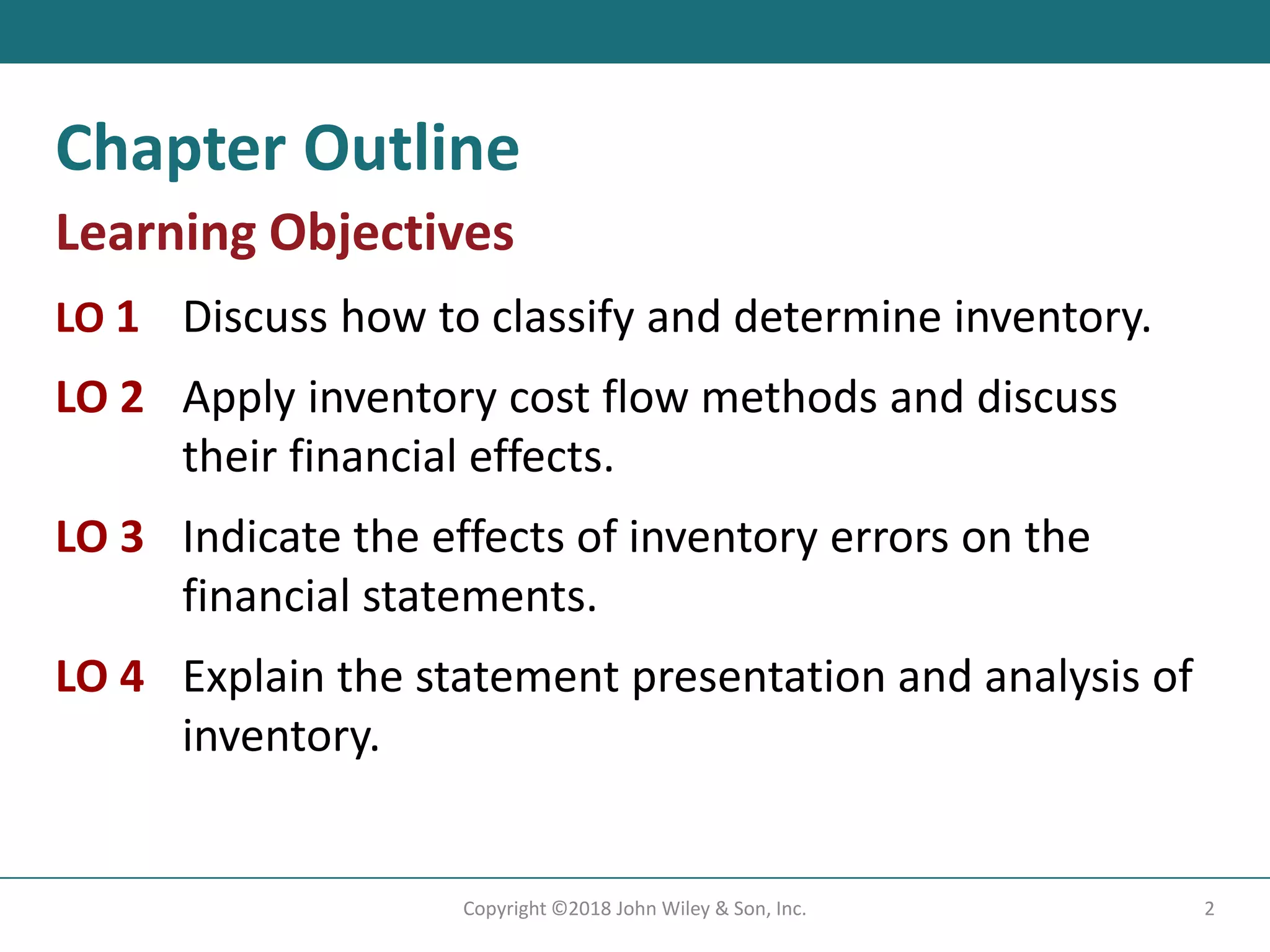
Chapter Outline
Learning Objectives
LO 1 Discuss how to classify and determine inventory.
LO 2 Apply inventory cost flow methods and discuss
their financial effects.
LO 3 Indicate the effects of inventory errors on the
financial statements.
LO 4 Explain the statement presentation and analysis of
inventory.
2
Copyright ©2018 John Wiley & Son, Inc.
Classifying and Determining Inventory
3
Copyright ©2018 John Wiley & Son, Inc.
LO 1
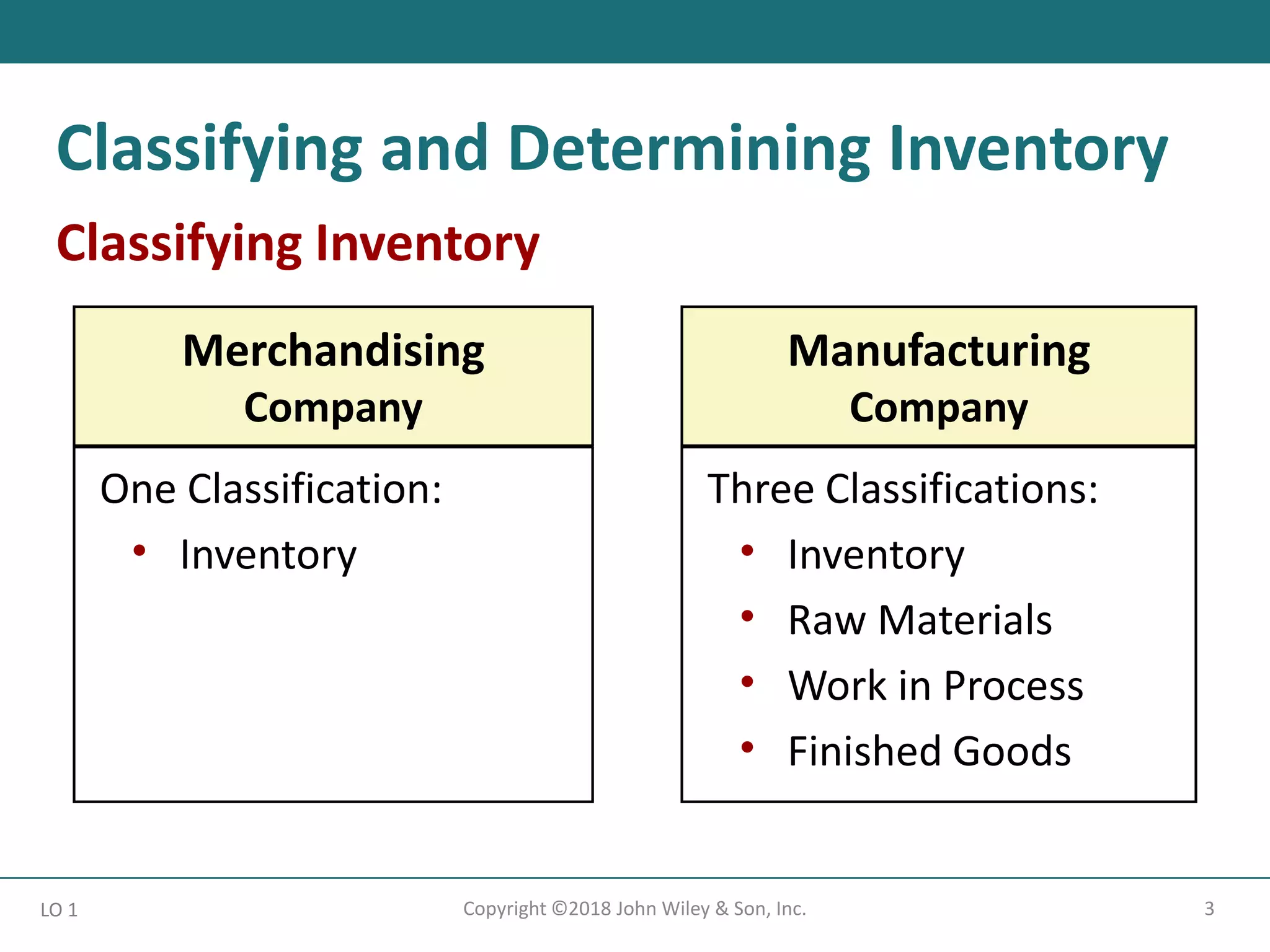
Classifying Inventory
Merchandising
Company
Manufacturing
Company
One Classification:
• Inventory
Three Classifications:
• Inventory
• Raw Materials
• Work in Process
• Finished Goods
4
Copyright ©2018 John Wiley & Son, Inc.
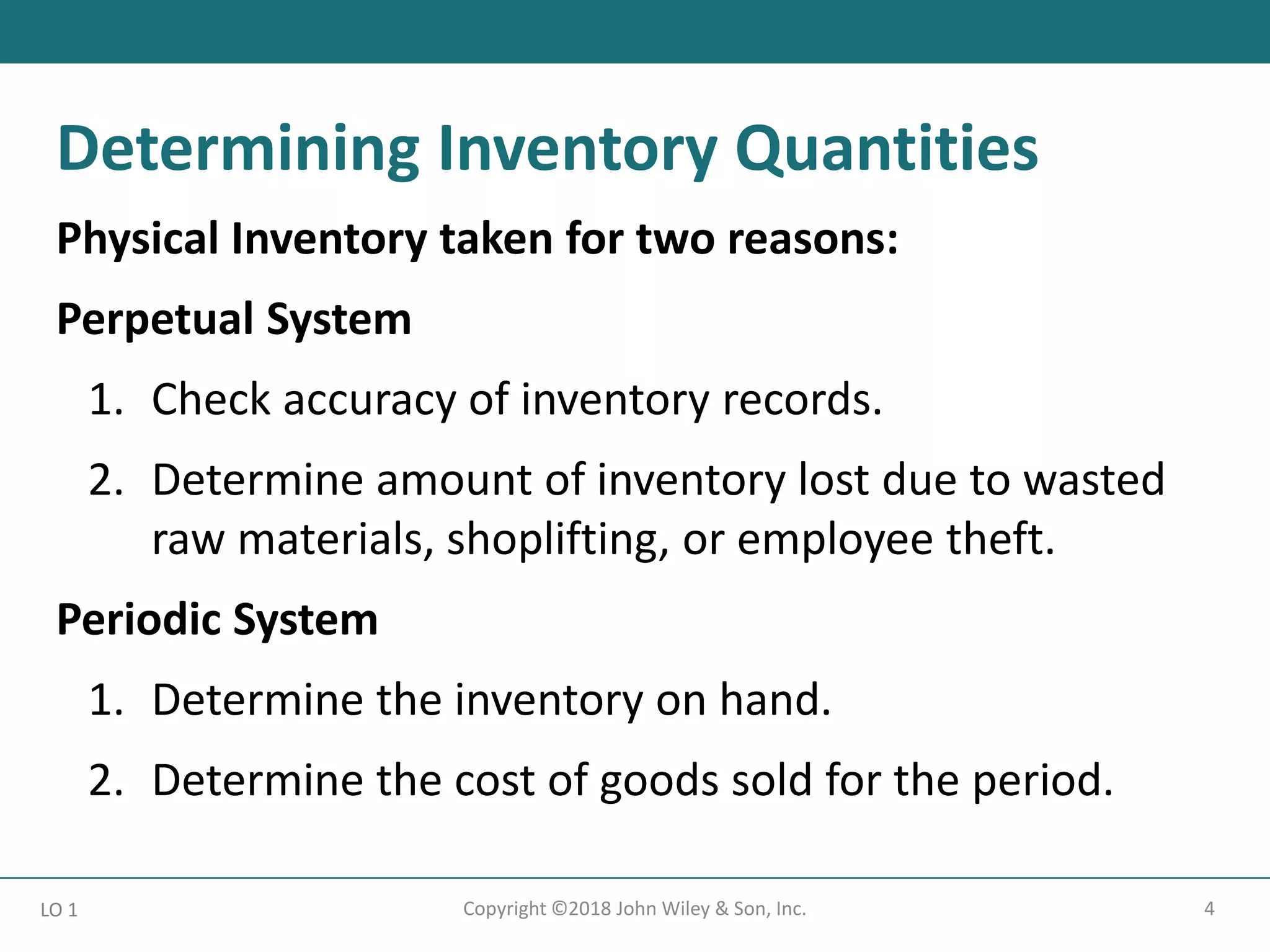
Physical Inventory taken for two reasons:
Perpetual System
1. Check accuracy of inventory records.
2. Determine amount of inventory lost due to wasted
raw materials, shoplifting, or employee theft.
Periodic System
1. Determine the inventory on hand.
2. Determine the cost of goods sold for the period.
LO 1
Determining Inventory Quantities
5
Copyright ©2018 John Wiley & Son, Inc.
Taking a Physical Inventory
Involves counting, weighing, or measuring each kind of
inventory on hand.
Companies often “take inventory”
• when business is closed or business is slow
• at the end of accounting period
LO 1
Determining Inventory Quantities
6
Copyright ©2018 John Wiley & Son, Inc.
Determining Ownership of Goods
Goods in Transit
• Purchased goods not yet received
• Sold goods not yet delivered
• Included in inventory of company that has legal title
to goods
LO 1
Determining Inventory Quantities
7
Copyright ©2018 John Wiley & Son, Inc.
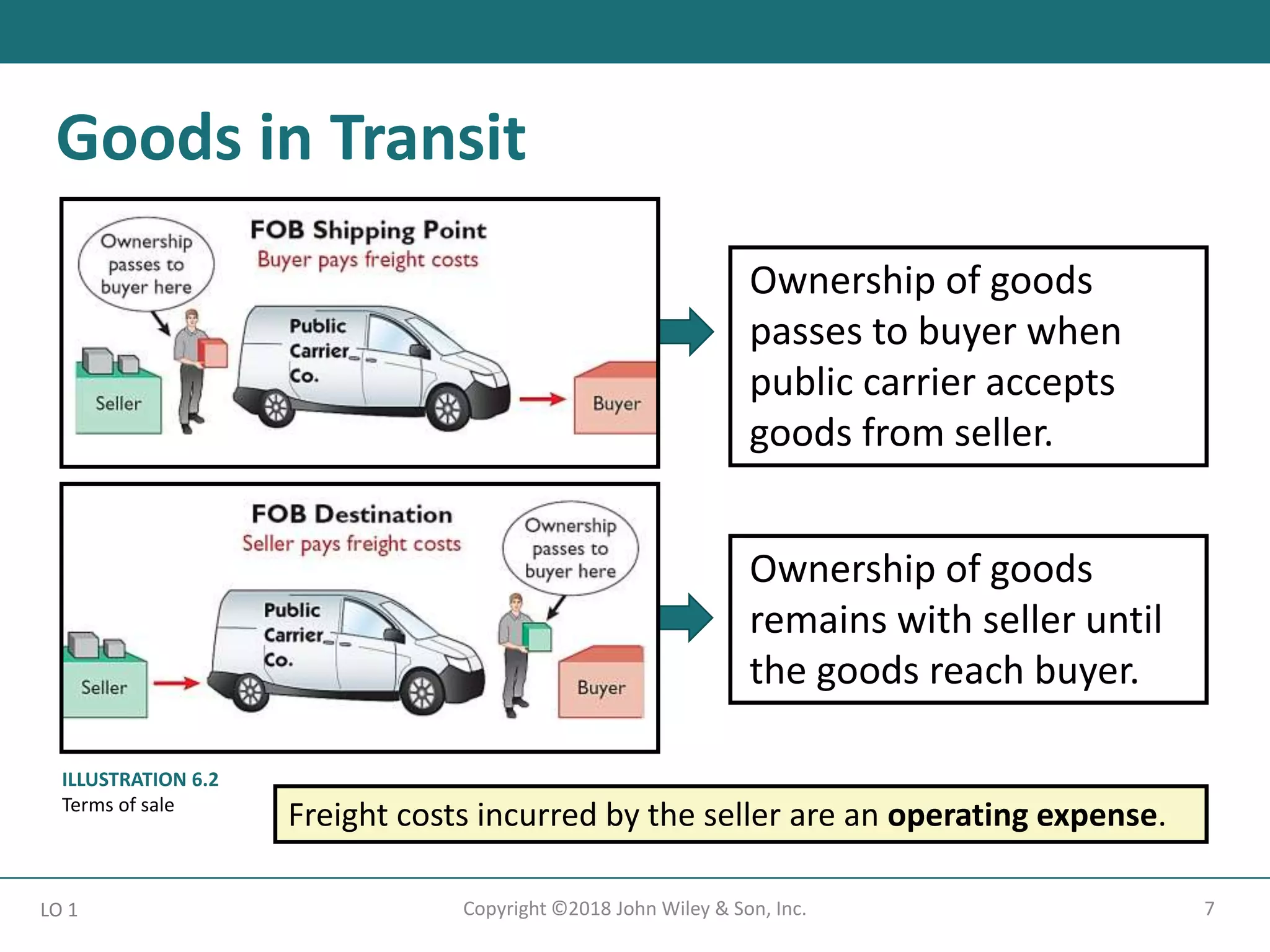
LO 1
Goods in Transit
ILLUSTRATION 6.2
Terms of sale
Ownership of goods
passes to buyer when
public carrier accepts
goods from seller.
Ownership of goods
remains with seller until
the goods reach buyer.
Freight costs incurred by the seller are an operating expense.
8
Copyright ©2018 John Wiley & Son, Inc.
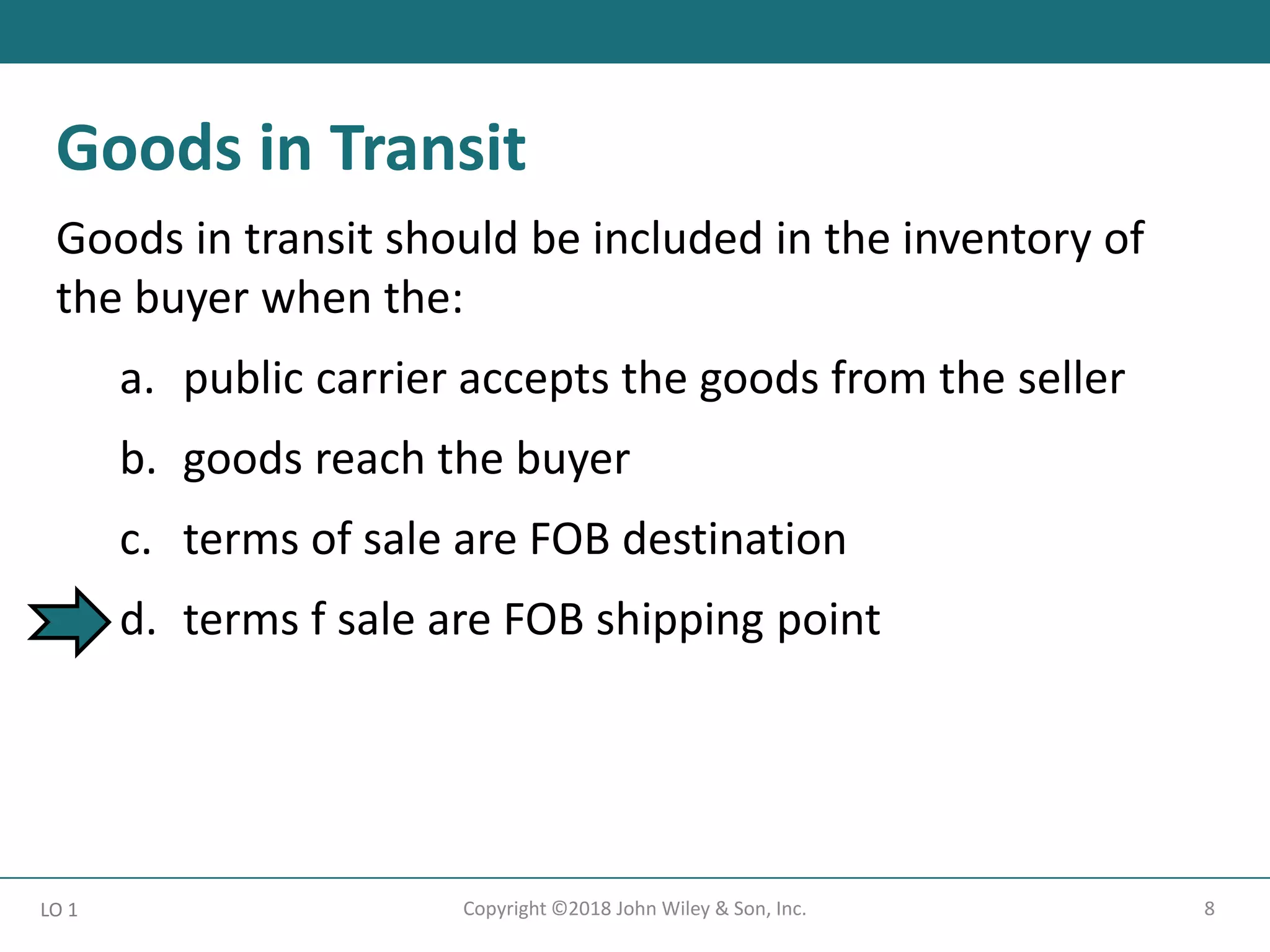
Goods in transit should be included in the inventory of
the buyer when the:
a. public carrier accepts the goods from the seller
b. goods reach the buyer
c. terms of sale are FOB destination
d. terms f sale are FOB shipping point
LO 1
Goods in Transit
9
Copyright ©2018 John Wiley & Son, Inc.
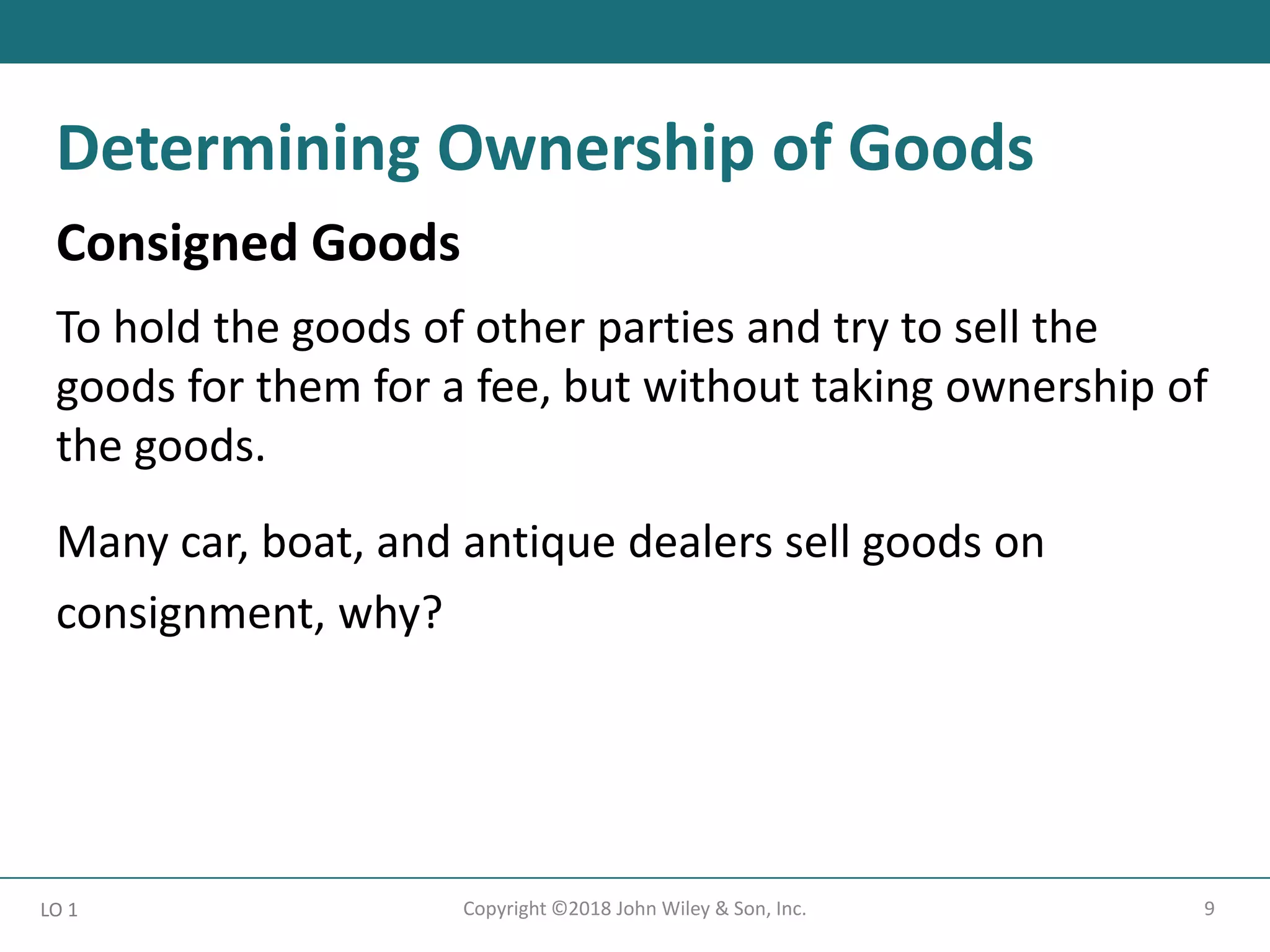
Consigned Goods
To hold the goods of other parties and try to sell the
goods for them for a fee, but without taking ownership of
the goods.
Many car, boat, and antique dealers sell goods on
consignment, why?
LO 1
Determining Ownership of Goods
10
Copyright ©2018 John Wiley & Son, Inc.
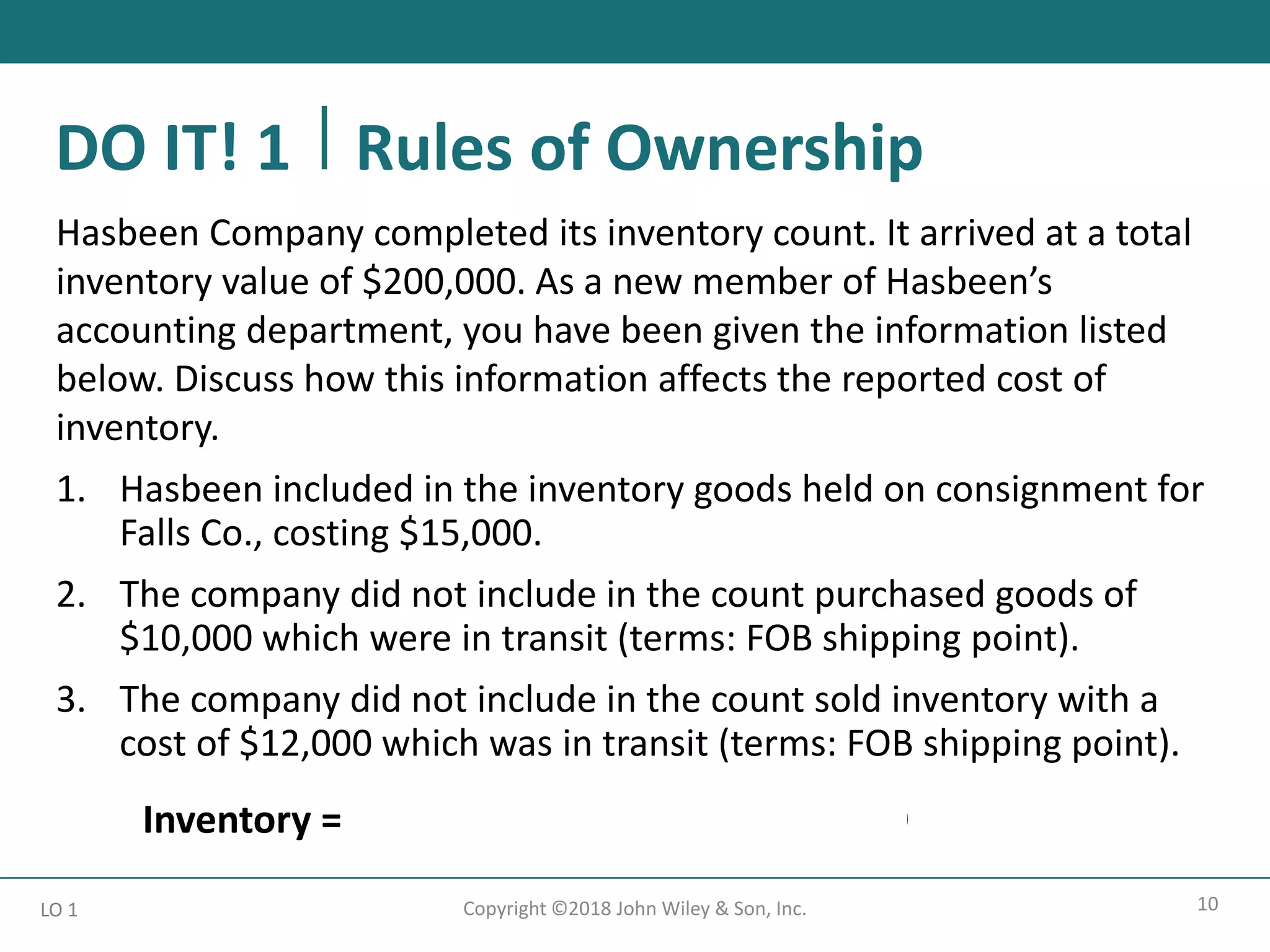
Hasbeen Company completed its inventory count. It arrived at a total
inventory value of $200,000. As a new member of Hasbeen’s
accounting department, you have been given the information listed
below. Discuss how this information affects the reported cost of
inventory.
1. Hasbeen included in the inventory goods held on consignment for
Falls Co., costing $15,000.
2. The company did not include in the count purchased goods of
$10,000 which were in transit (terms: FOB shipping point).
3. The company did not include in the count sold inventory with a
cost of $12,000 which was in transit (terms: FOB shipping point).
Inventory = $200,000 - $15,000 + $10,000 = $195,000
LO 1
DO IT! 1 Rules of Ownership
11
Copyright ©2018 John Wiley & Son, Inc.
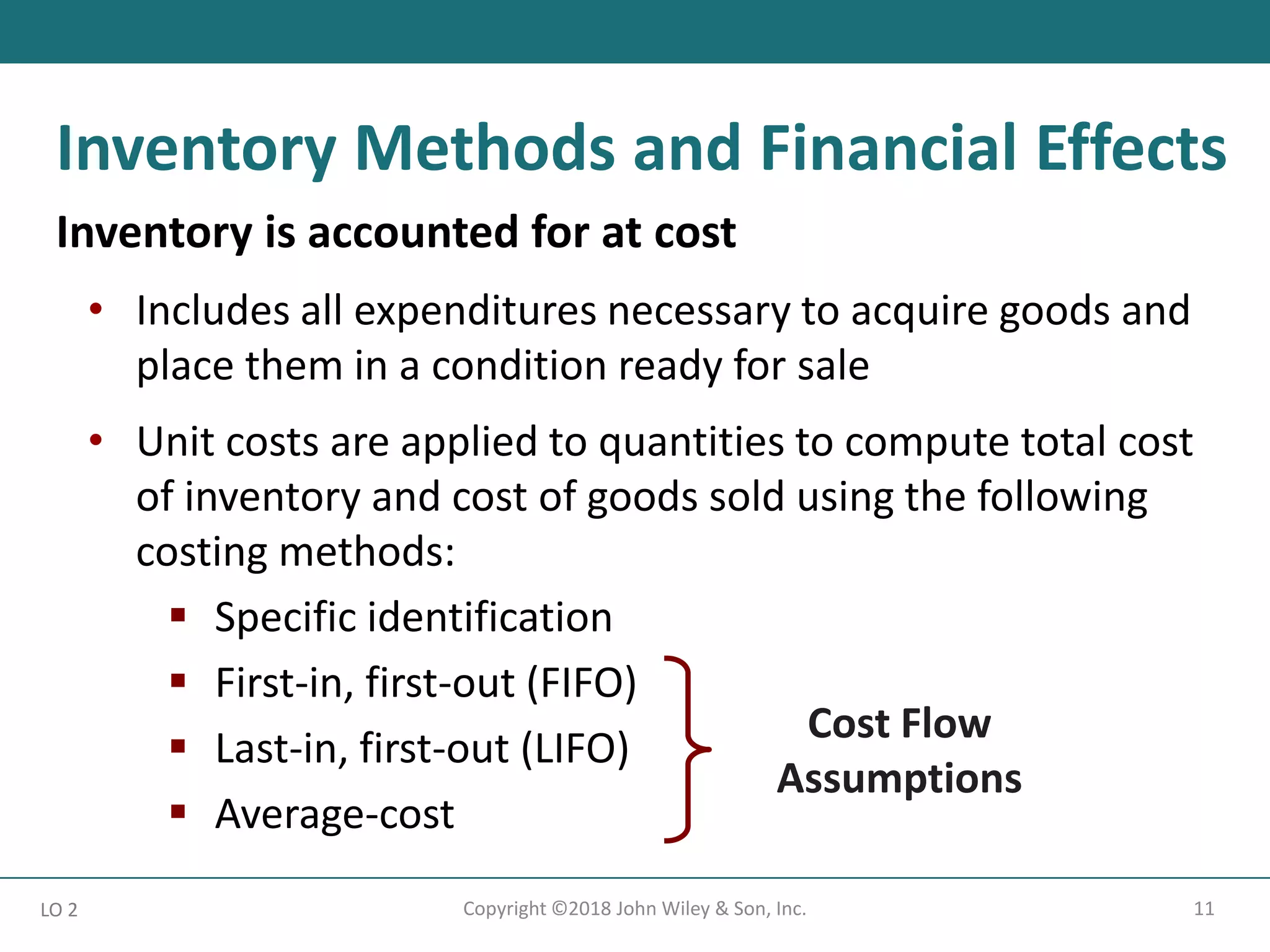
Inventory is accounted for at cost
• Includes all expenditures necessary to acquire goods and
place them in a condition ready for sale
• Unit costs are applied to quantities to compute total cost
of inventory and cost of goods sold using the following
costing methods:
 Specific identification
 First-in, first-out (FIFO)
 Last-in, first-out (LIFO)
 Average-cost
LO 2
Inventory Methods and Financial Effects
Cost Flow
Assumptions
12
Copyright ©2018 John Wiley & Son, Inc.
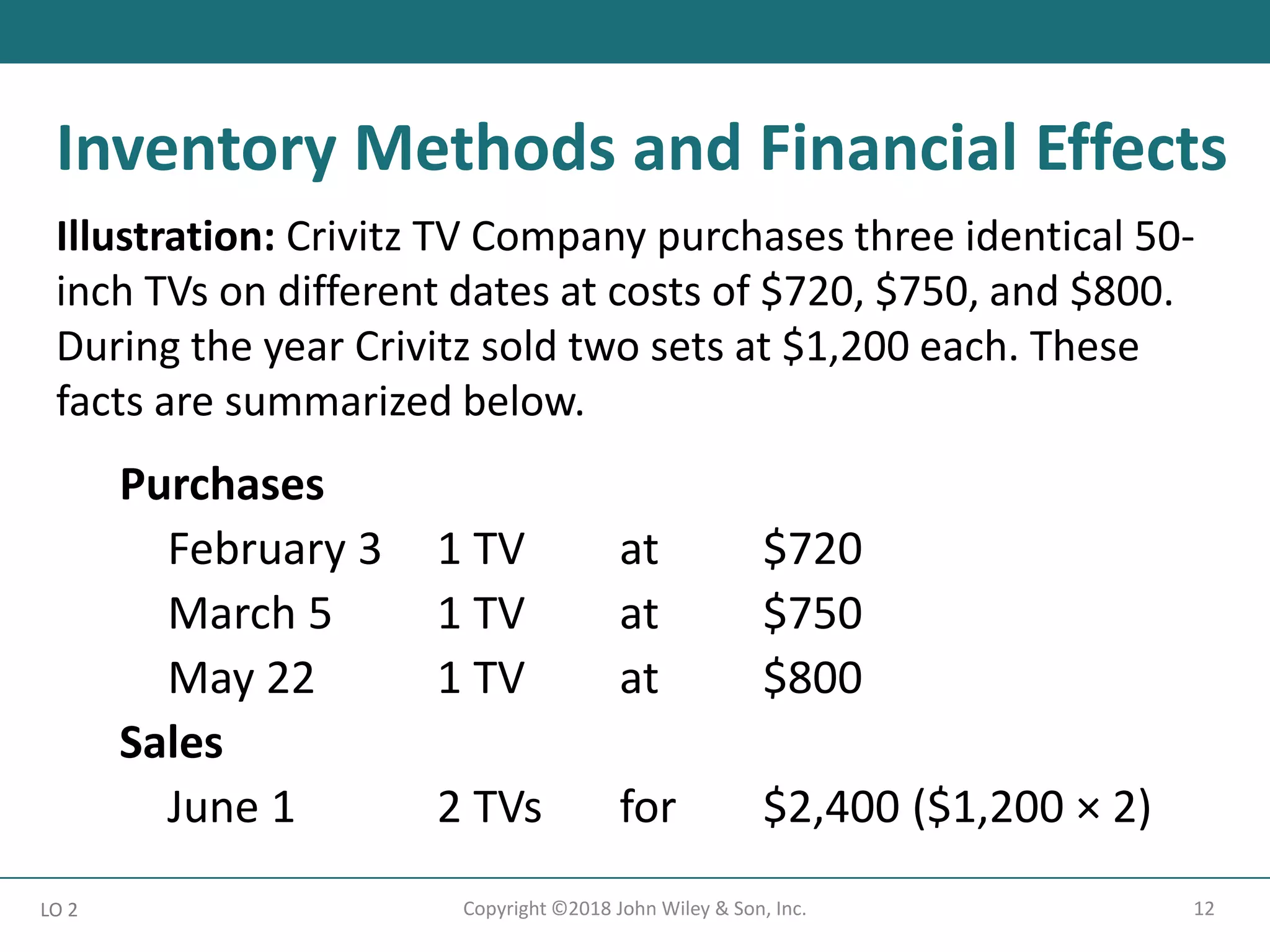
Illustration: Crivitz TV Company purchases three identical 50-
inch TVs on different dates at costs of $720, $750, and $800.
During the year Crivitz sold two sets at $1,200 each. These
facts are summarized below.
Purchases
February 3 1 TV at $720
March 5 1 TV at $750
May 22 1 TV at $800
Sales
June 1 2 TVs for $2,400 ($1,200 × 2)
LO 2
Inventory Methods and Financial Effects
13
Copyright ©2018 John Wiley & Son, Inc.
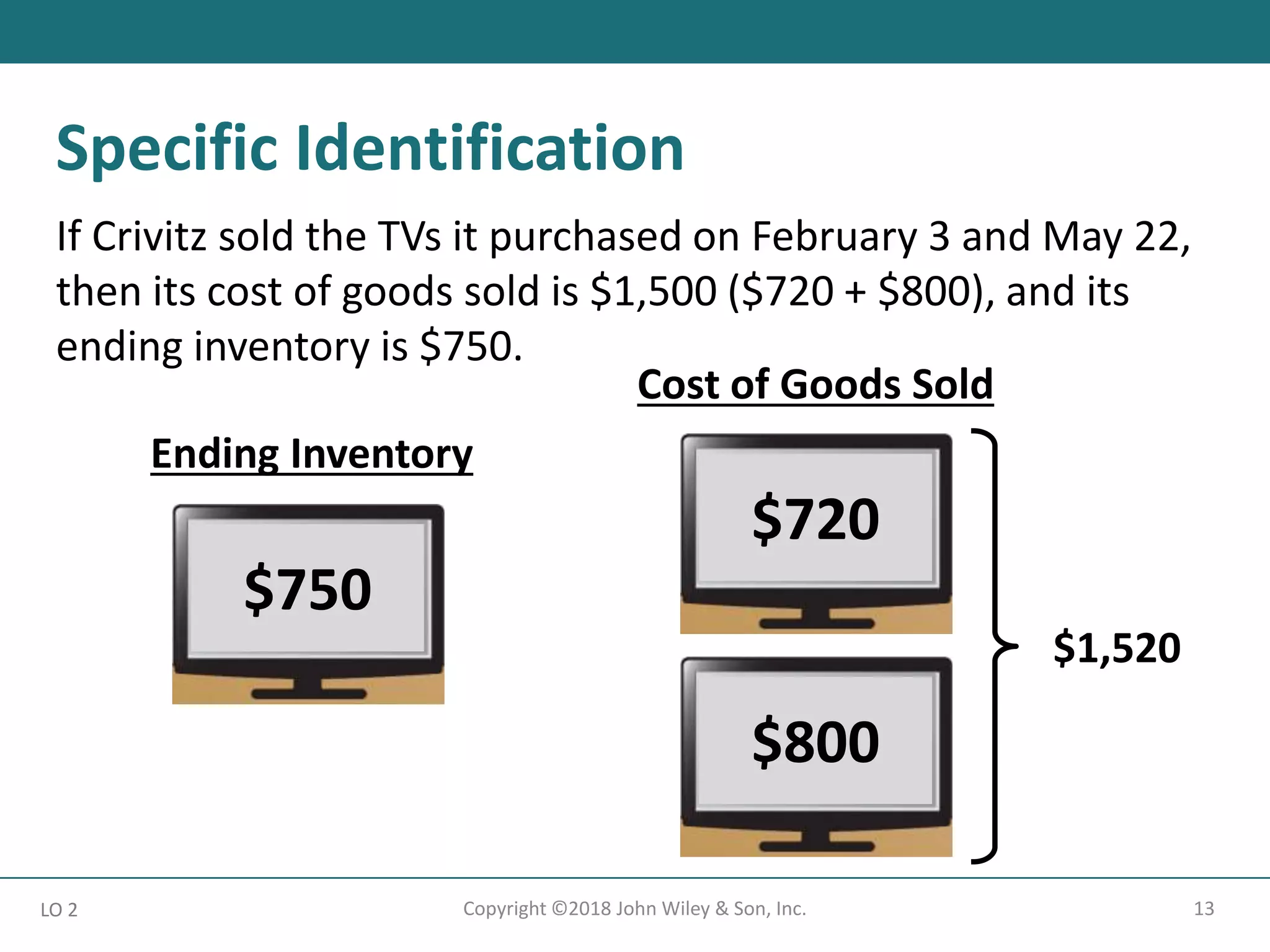
If Crivitz sold the TVs it purchased on February 3 and May 22,
then its cost of goods sold is $1,500 ($720 + $800), and its
ending inventory is $750.
LO 2
Specific Identification
$750
$720
$800
Cost of Goods Sold
Ending Inventory
$1,520
14
Copyright ©2018 John Wiley & Son, Inc.
Costing method in which items still in inventory are
specifically costed to arrive at the total cost of the ending
inventory.
• Practice is relatively rare
• Most companies make assumptions (cost flow
assumptions) about which units were sold
LO 2
Specific Identification
15
Copyright ©2018 John Wiley & Son, Inc.
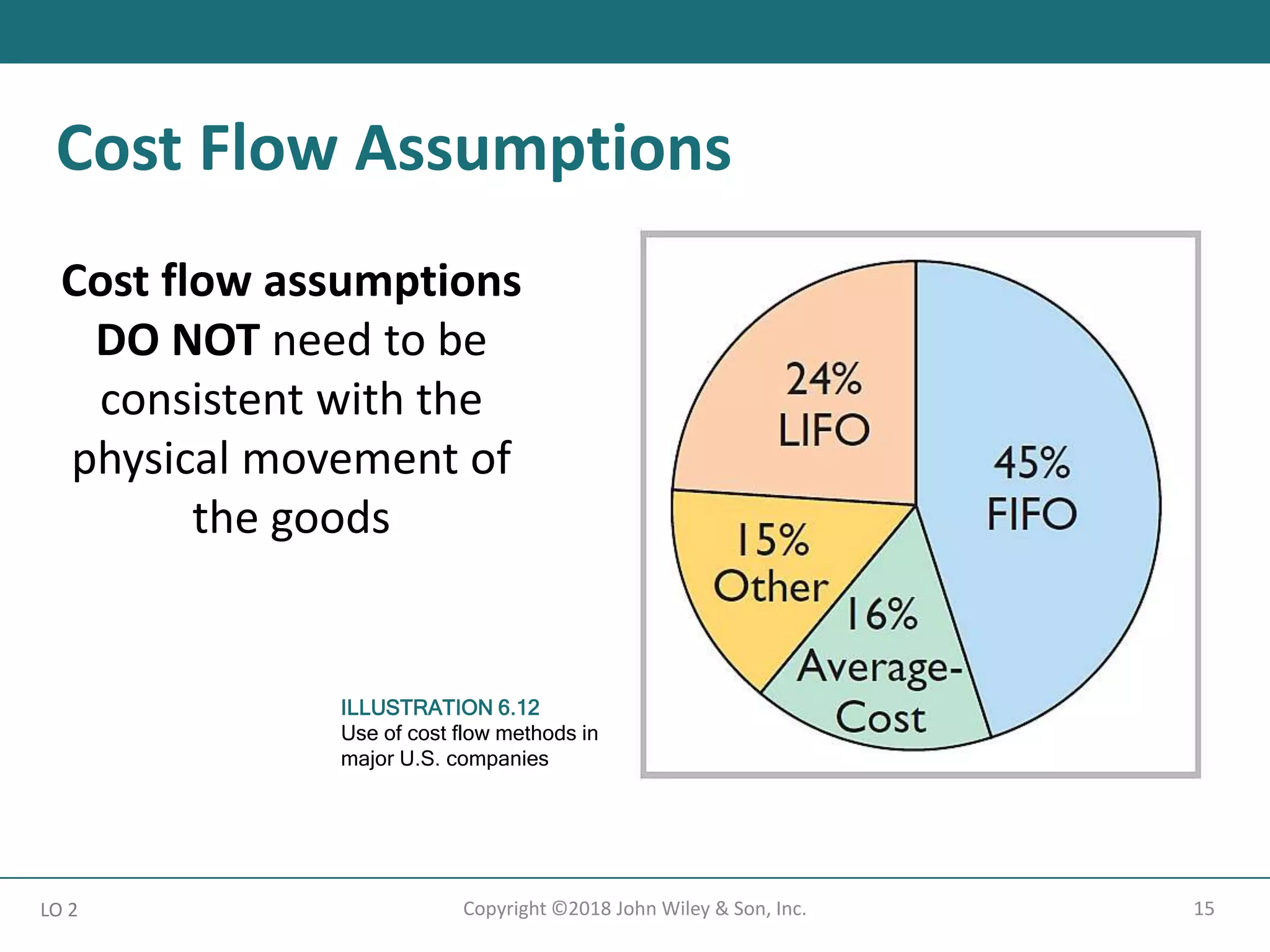
Cost flow assumptions
DO NOT need to be
consistent with the
physical movement of
the goods
LO 2
Cost Flow Assumptions
ILLUSTRATION 6.12
Use of cost flow methods in
major U.S. companies
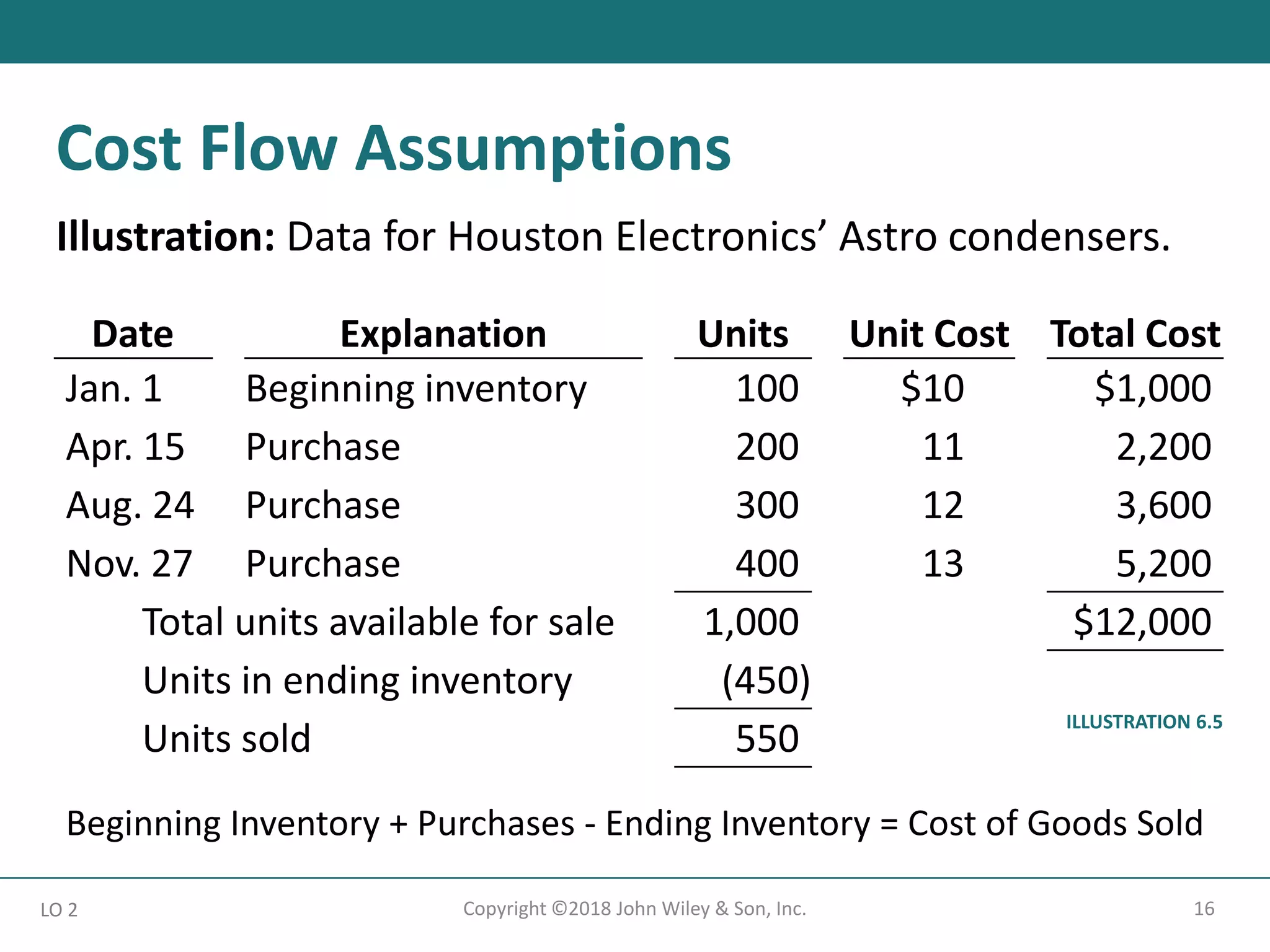
Date Explanation Units Unit Cost Total Cost
Jan. 1 Beginning inventory 100 $10 $1,000
Apr. 15 Purchase 200 11 2,200
Aug. 24 Purchase 300 12 3,600
Nov. 27 Purchase 400 13 5,200
Total units available for sale 1,000 $12,000
Units in ending inventory (450)
Units sold 550
Beginning Inventory + Purchases - Ending Inventory = Cost of Goods Sold
16
Copyright ©2018 John Wiley & Son, Inc.
Illustration: Data for Houston Electronics’ Astro condensers.
LO 2
Cost Flow Assumptions
ILLUSTRATION 6.5
17
Copyright ©2018 John Wiley & Son, Inc.
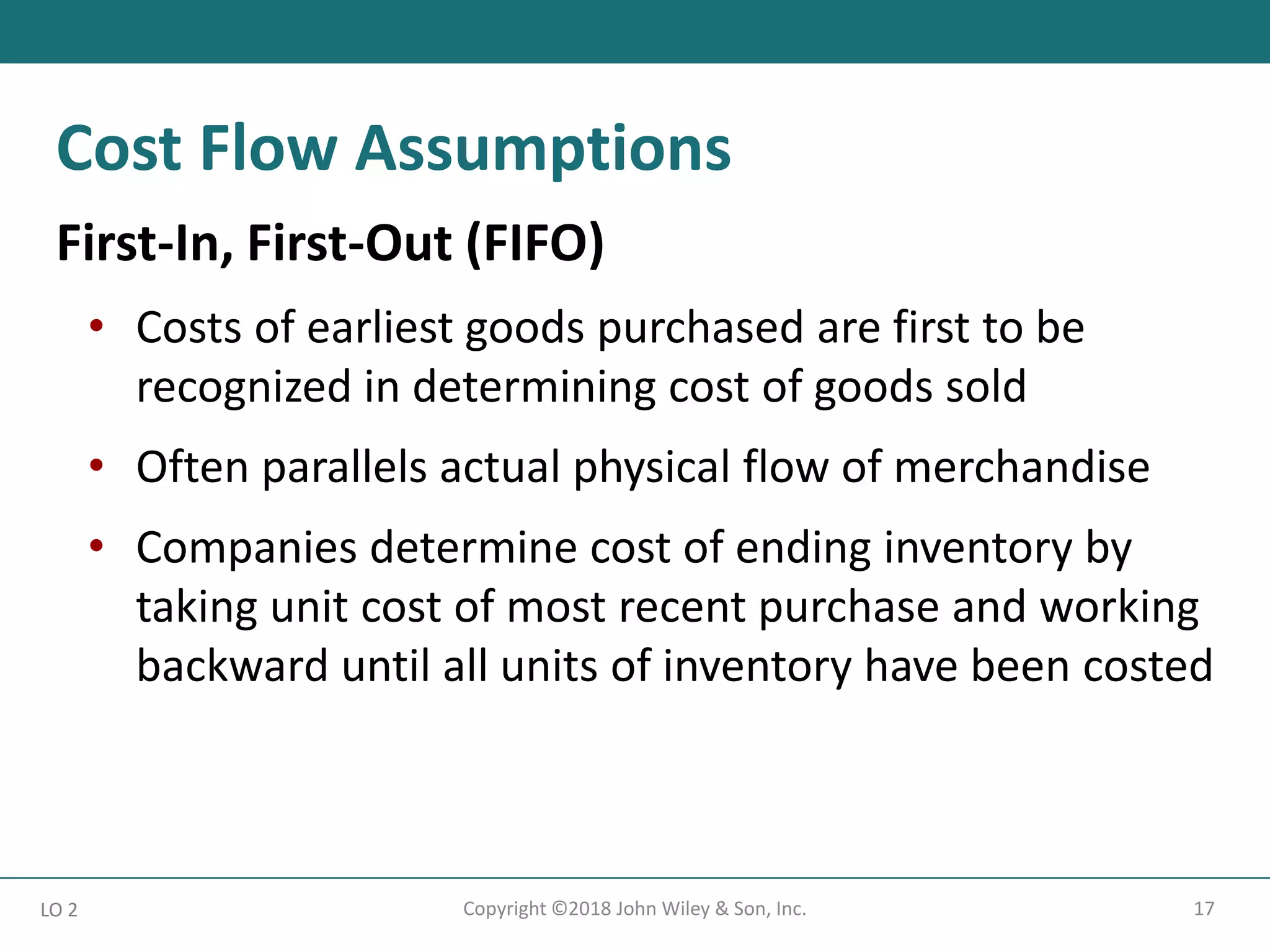
First-In, First-Out (FIFO)
• Costs of earliest goods purchased are first to be
recognized in determining cost of goods sold
• Often parallels actual physical flow of merchandise
• Companies determine cost of ending inventory by
taking unit cost of most recent purchase and working
backward until all units of inventory have been costed
LO 2
Cost Flow Assumptions
18
Copyright ©2018 John Wiley & Son, Inc.
LO 2
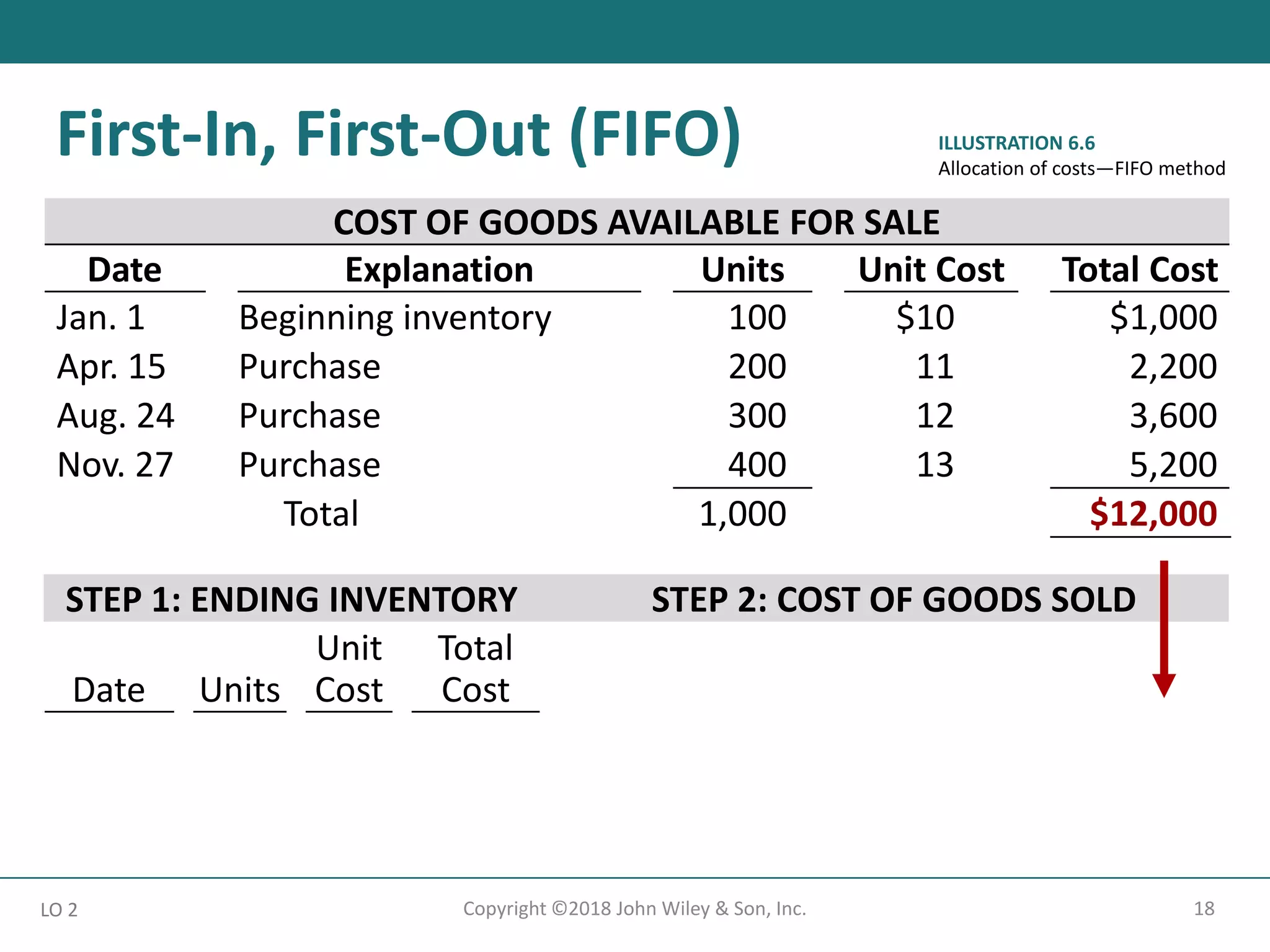
ILLUSTRATION 6.6
Allocation of costs—FIFO method
First-In, First-Out (FIFO)
COST OF GOODS AVAILABLE FOR SALE
Date Explanation Units Unit Cost Total Cost
Jan. 1 Beginning inventory 100 $10 $1,000
Apr. 15 Purchase 200 11 2,200
Aug. 24 Purchase 300 12 3,600
Nov. 27 Purchase 400 13 5,200
Total 1,000 $12,000
STEP 1: ENDING INVENTORY STEP 2: COST OF GOODS SOLD
Date Units
Unit
Cost
Total
Cost
Nov. 27 400 $13 $5,200 Cost of goods available for sale $12,000
Aug. 24 50 12 600 Less : Ending inventory 5,800
Total 450 $5,800 Cost of goods sold $ 6,200
19
Copyright ©2018 John Wiley & Son, Inc.
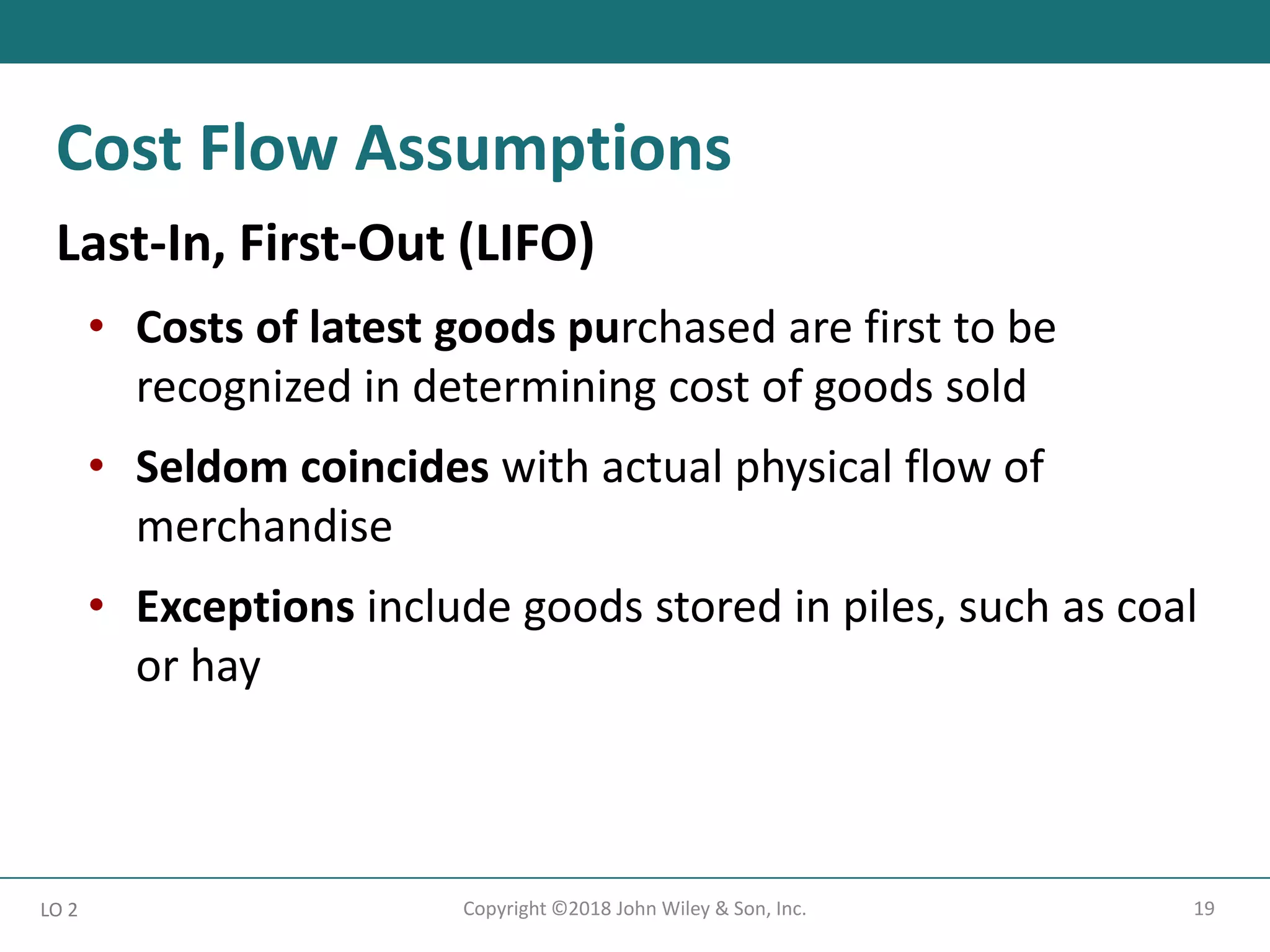
Last-In, First-Out (LIFO)
• Costs of latest goods purchased are first to be
recognized in determining cost of goods sold
• Seldom coincides with actual physical flow of
merchandise
• Exceptions include goods stored in piles, such as coal
or hay
LO 2
Cost Flow Assumptions
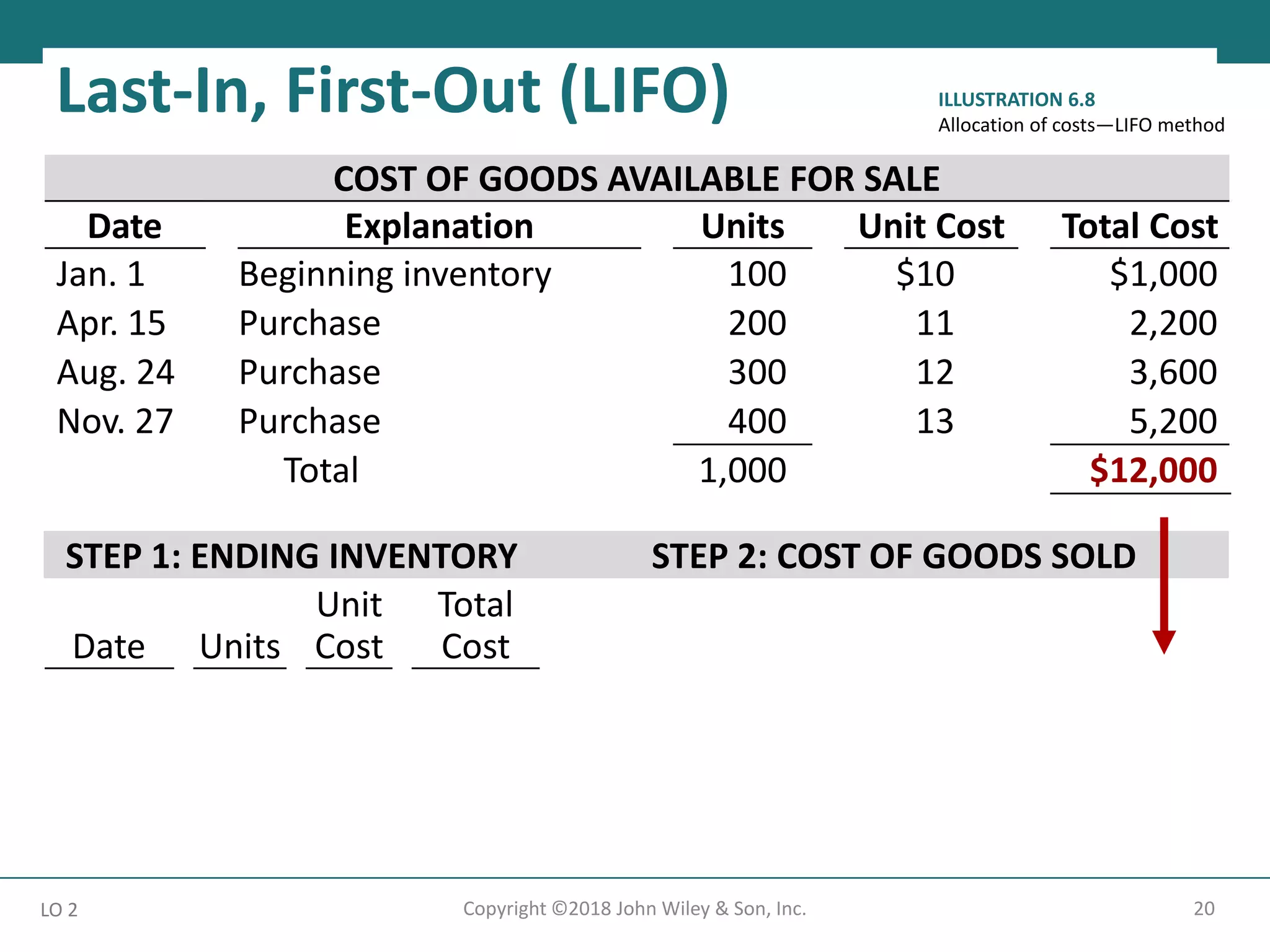
STEP 1: ENDING INVENTORY STEP 2: COST OF GOODS SOLD
Date Units
Unit
Cost
Total
Cost
Jan. 1 100 $10 $1,000 Cost of goods available for sale $12,000
Apr. 15 200 11 2,200 Less : Ending inventory 5,000
Aug. 24 150 12 1,800 Cost of goods sold $ 7,000
Total 450 $5,000
Last-In, First-Out (LIFO)
20
Copyright ©2018 John Wiley & Son, Inc.
LO 2
ILLUSTRATION 6.8
Allocation of costs—LIFO method
COST OF GOODS AVAILABLE FOR SALE
Date Explanation Units Unit Cost Total Cost
Jan. 1 Beginning inventory 100 $10 $1,000
Apr. 15 Purchase 200 11 2,200
Aug. 24 Purchase 300 12 3,600
Nov. 27 Purchase 400 13 5,200
Total 1,000 $12,000
21
Copyright ©2018 John Wiley & Son, Inc.
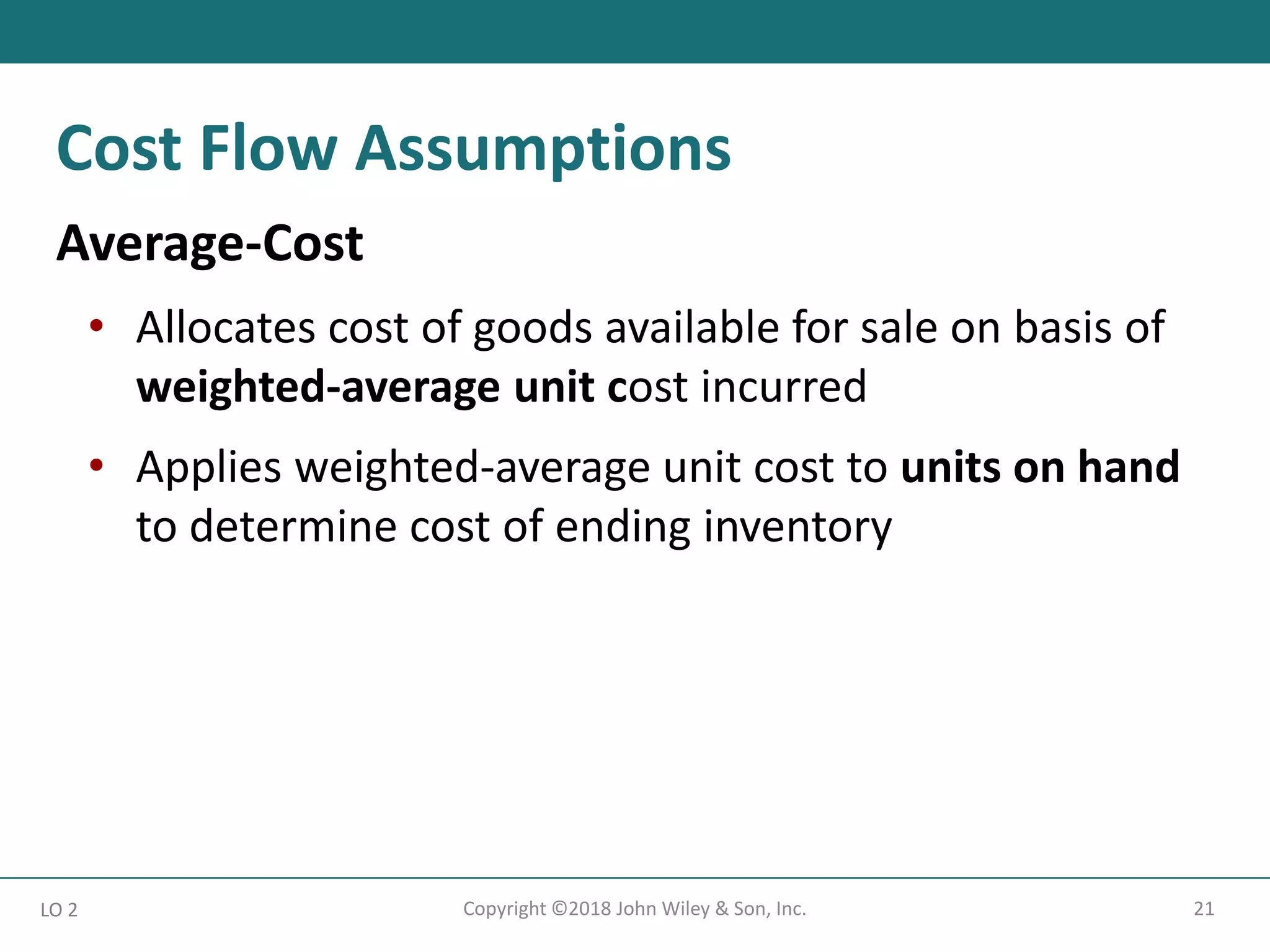
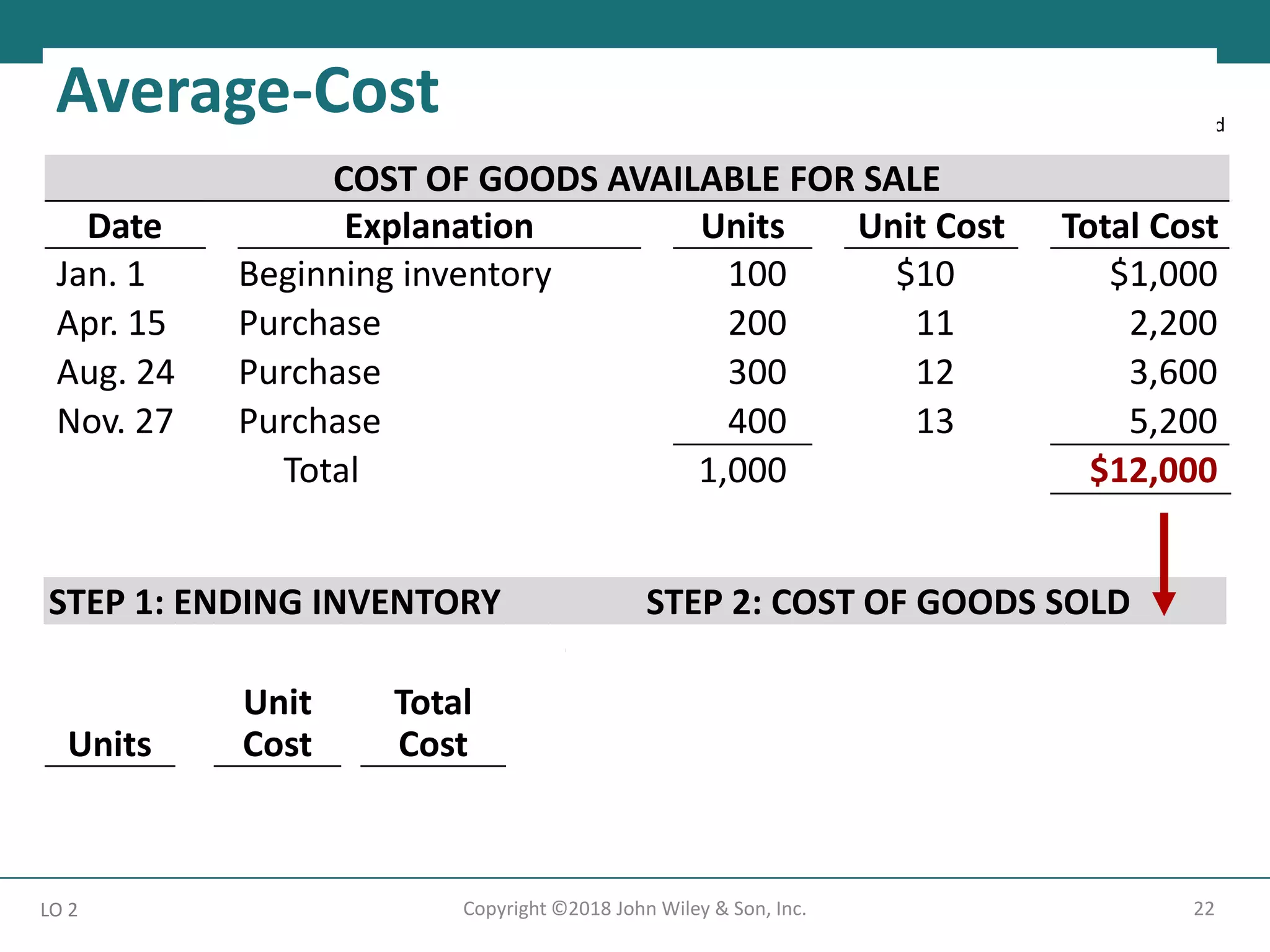
Average-Cost
• Allocates cost of goods available for sale on basis of
weighted-average unit cost incurred
• Applies weighted-average unit cost to units on hand
to determine cost of ending inventory
LO 2
Cost Flow Assumptions
STEP 1: ENDING INVENTORY STEP 2: COST OF GOODS SOLD
$12,000 ÷ 1,000 = $12 Cost of goods available for sale $12,000
Units
Unit
Cost
Total
Cost
Less : Ending inventory
Cost of goods sold
5,400
$ 6,600
450 $12 $5,400
22
Copyright ©2018 John Wiley & Son, Inc.
LO 2
ILLUSTRATION 6.8
Allocation of costs—LIFO method
COST OF GOODS AVAILABLE FOR SALE
Date Explanation Units Unit Cost Total Cost
Jan. 1 Beginning inventory 100 $10 $1,000
Apr. 15 Purchase 200 11 2,200
Aug. 24 Purchase 300 12 3,600
Nov. 27 Purchase 400 13 5,200
Total 1,000 $12,000
Average-Cost
23
Copyright ©2018 John Wiley & Son, Inc.
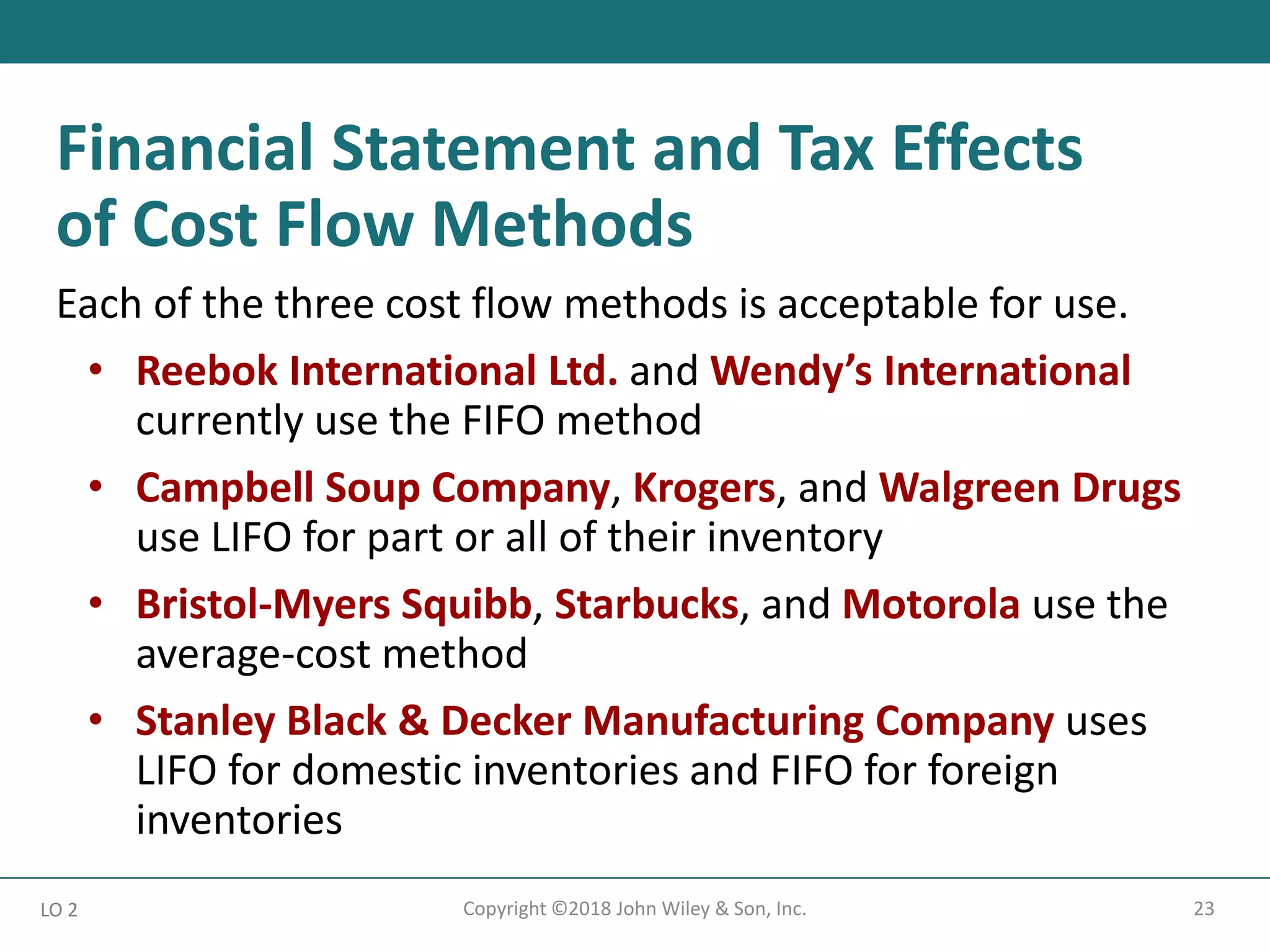
Each of the three cost flow methods is acceptable for use.
• Reebok International Ltd. and Wendy’s International
currently use the FIFO method
• Campbell Soup Company, Krogers, and Walgreen Drugs
use LIFO for part or all of their inventory
• Bristol-Myers Squibb, Starbucks, and Motorola use the
average-cost method
• Stanley Black & Decker Manufacturing Company uses
LIFO for domestic inventories and FIFO for foreign
inventories
LO 2
Financial Statement and Tax Effects
of Cost Flow Methods
24
Copyright ©2018 John Wiley & Son, Inc.
LO 2
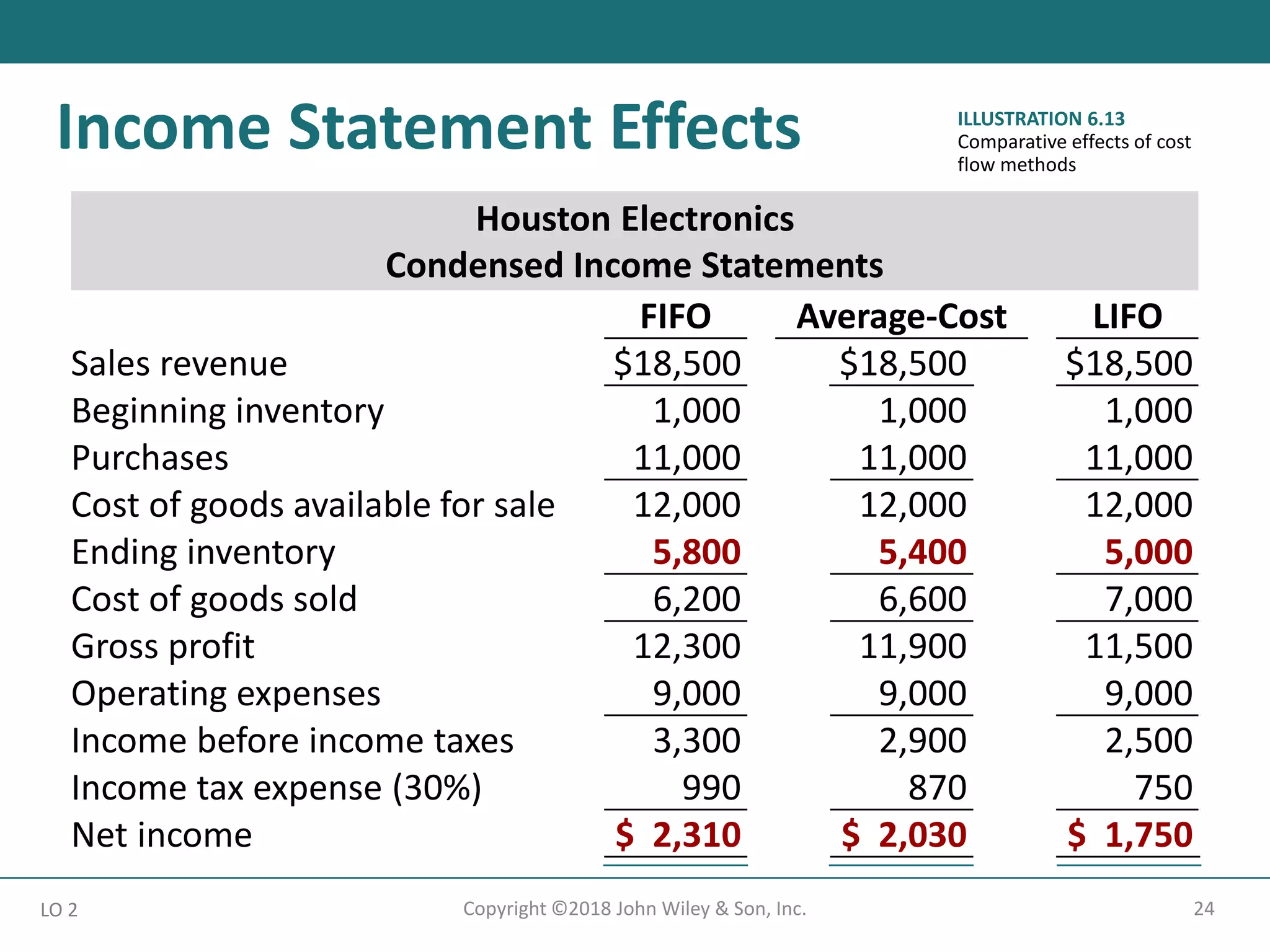
Income Statement Effects
Houston Electronics
Condensed Income Statements
FIFO Average-Cost LIFO
Sales revenue $18,500 $18,500 $18,500
Beginning inventory 1,000 1,000 1,000
Purchases 11,000 11,000 11,000
Cost of goods available for sale 12,000 12,000 12,000
Ending inventory 5,800 5,400 5,000
Cost of goods sold 6,200 6,600 7,000
Gross profit 12,300 11,900 11,500
Operating expenses 9,000 9,000 9,000
Income before income taxes 3,300 2,900 2,500
Income tax expense (30%) 990 870 750
Net income $ 2,310 $ 2,030 $ 1,750
ILLUSTRATION 6.13
Comparative effects of cost
flow methods
25
Copyright ©2018 John Wiley & Son, Inc.
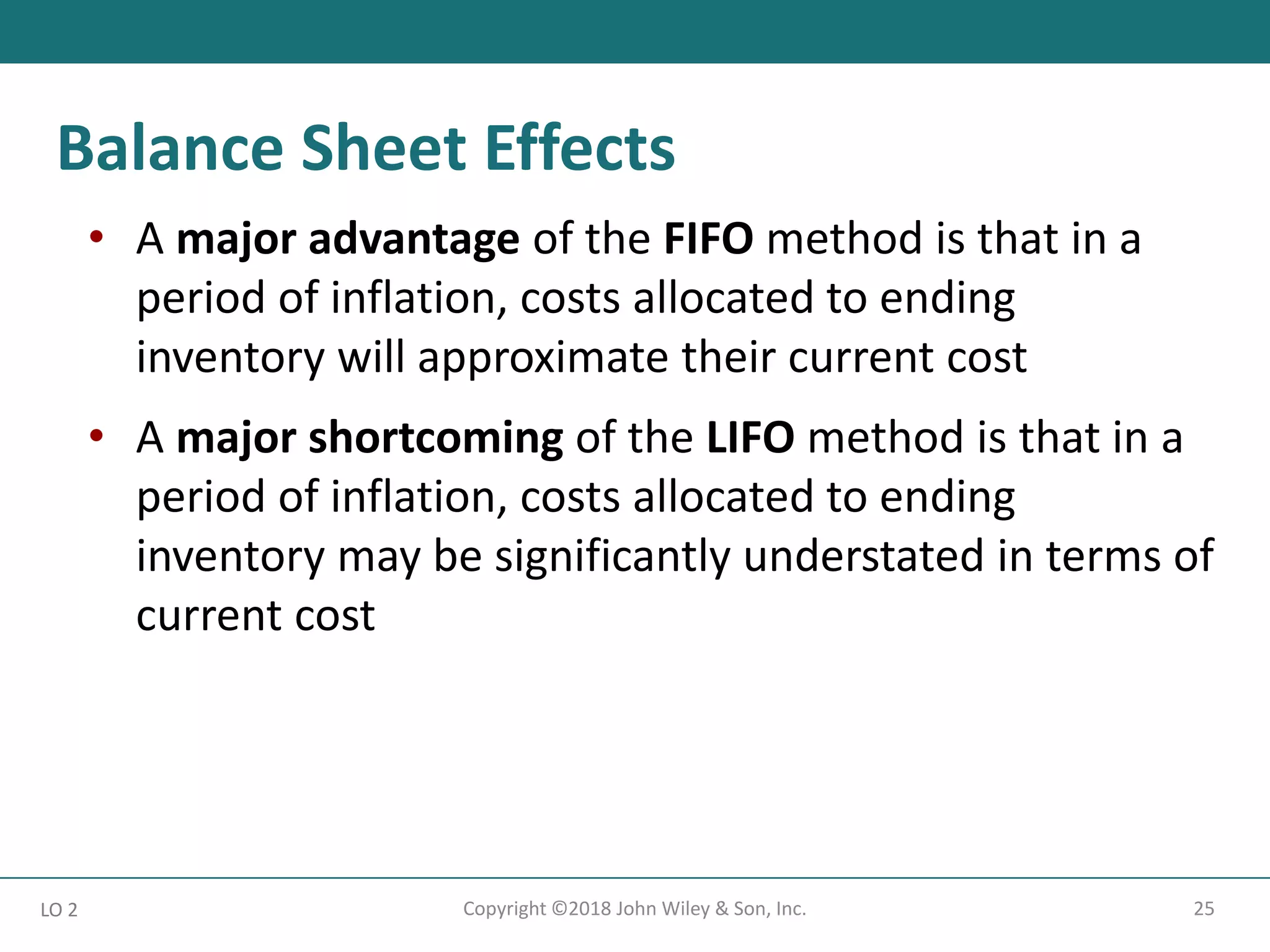
• A major advantage of the FIFO method is that in a
period of inflation, costs allocated to ending
inventory will approximate their current cost
• A major shortcoming of the LIFO method is that in a
period of inflation, costs allocated to ending
inventory may be significantly understated in terms of
current cost
LO 2
Balance Sheet Effects
26
Copyright ©2018 John Wiley & Son, Inc.
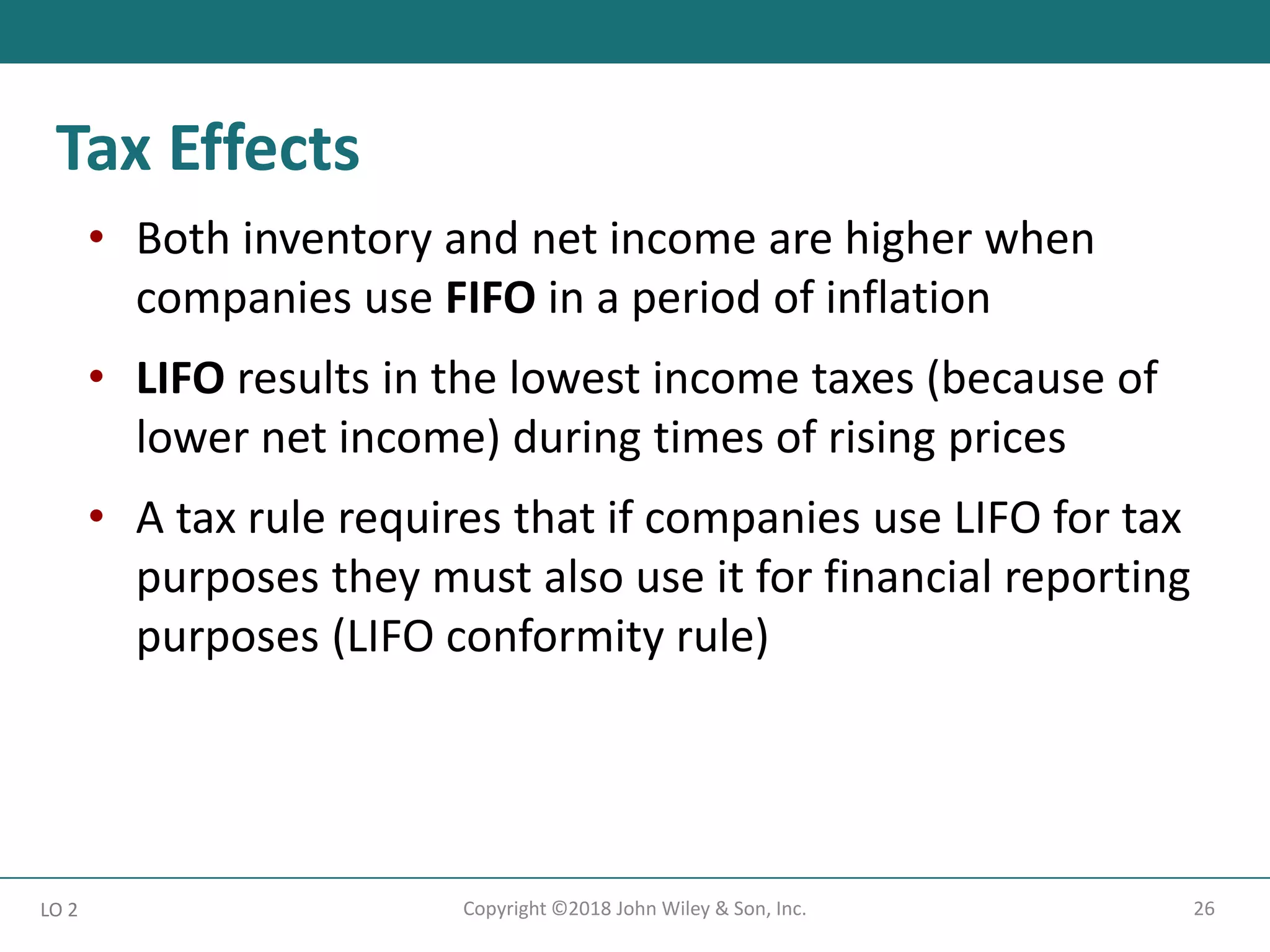
• Both inventory and net income are higher when
companies use FIFO in a period of inflation
• LIFO results in the lowest income taxes (because of
lower net income) during times of rising prices
• A tax rule requires that if companies use LIFO for tax
purposes they must also use it for financial reporting
purposes (LIFO conformity rule)
LO 2
Tax Effects
27
Copyright ©2018 John Wiley & Son, Inc.
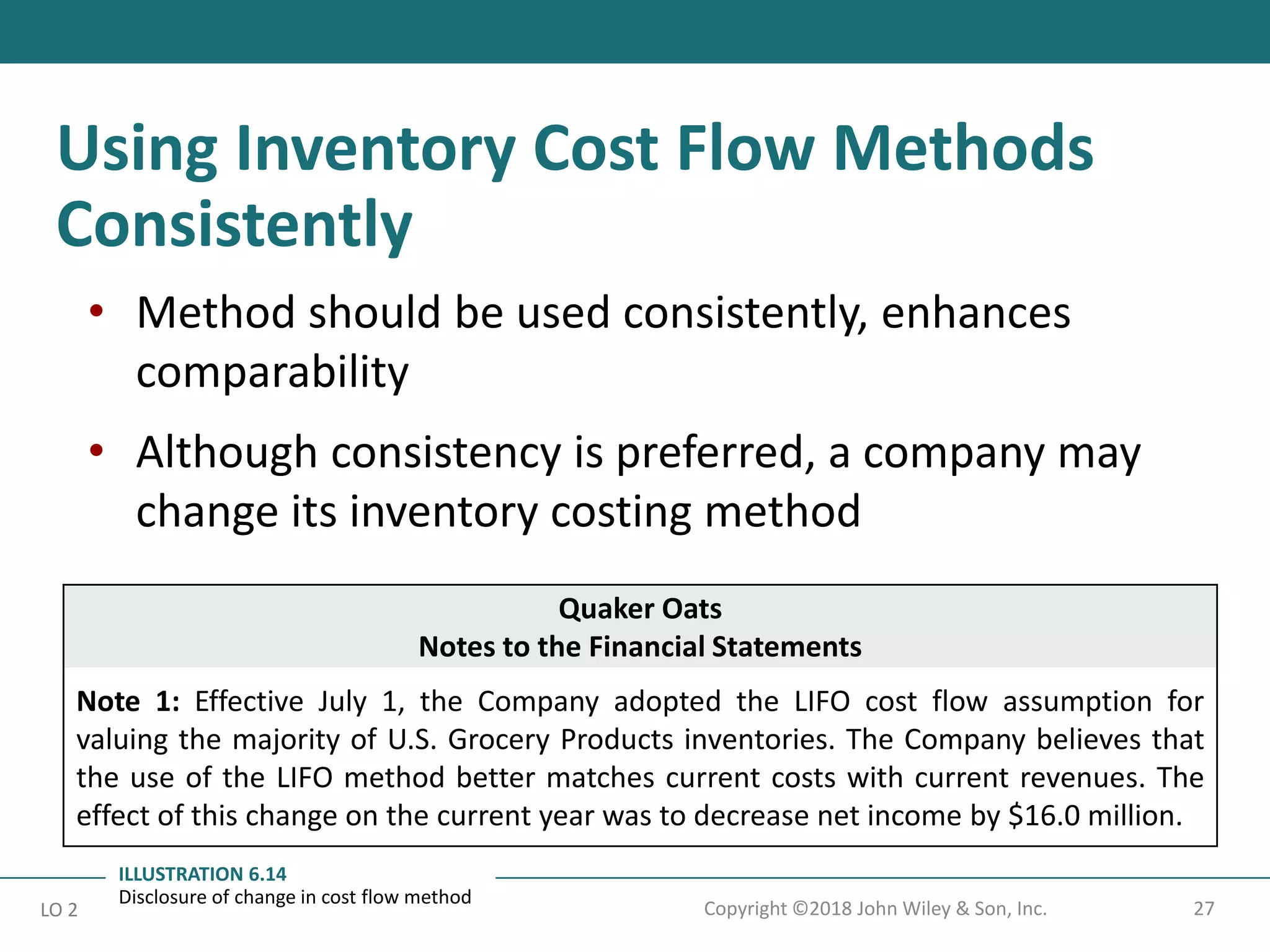
• Method should be used consistently, enhances
comparability
• Although consistency is preferred, a company may
change its inventory costing method
LO 2
Using Inventory Cost Flow Methods
Consistently
Quaker Oats
Notes to the Financial Statements
Note 1: Effective July 1, the Company adopted the LIFO cost flow assumption for
valuing the majority of U.S. Grocery Products inventories. The Company believes that
the use of the LIFO method better matches current costs with current revenues. The
effect of this change on the current year was to decrease net income by $16.0 million.
ILLUSTRATION 6.14
Disclosure of change in cost flow method
28
Copyright ©2018 John Wiley & Son, Inc.
The cost flow method that often parallels the actual
physical flow of merchandise is the:
a. FIFO method
b. LIFO method
c. average cost method
d. gross profit method
LO 2
Cost Flow Assumptions
29
Copyright ©2018 John Wiley & Son, Inc.
In a period of inflation, the cost flow method that
results in the lowest income taxes is the:
a. FIFO method
b. LIFO method
c. average cost method
d. gross profit method
LO 2
Cost Flow Assumptions
30
Copyright ©2018 John Wiley & Son, Inc.
LO 2
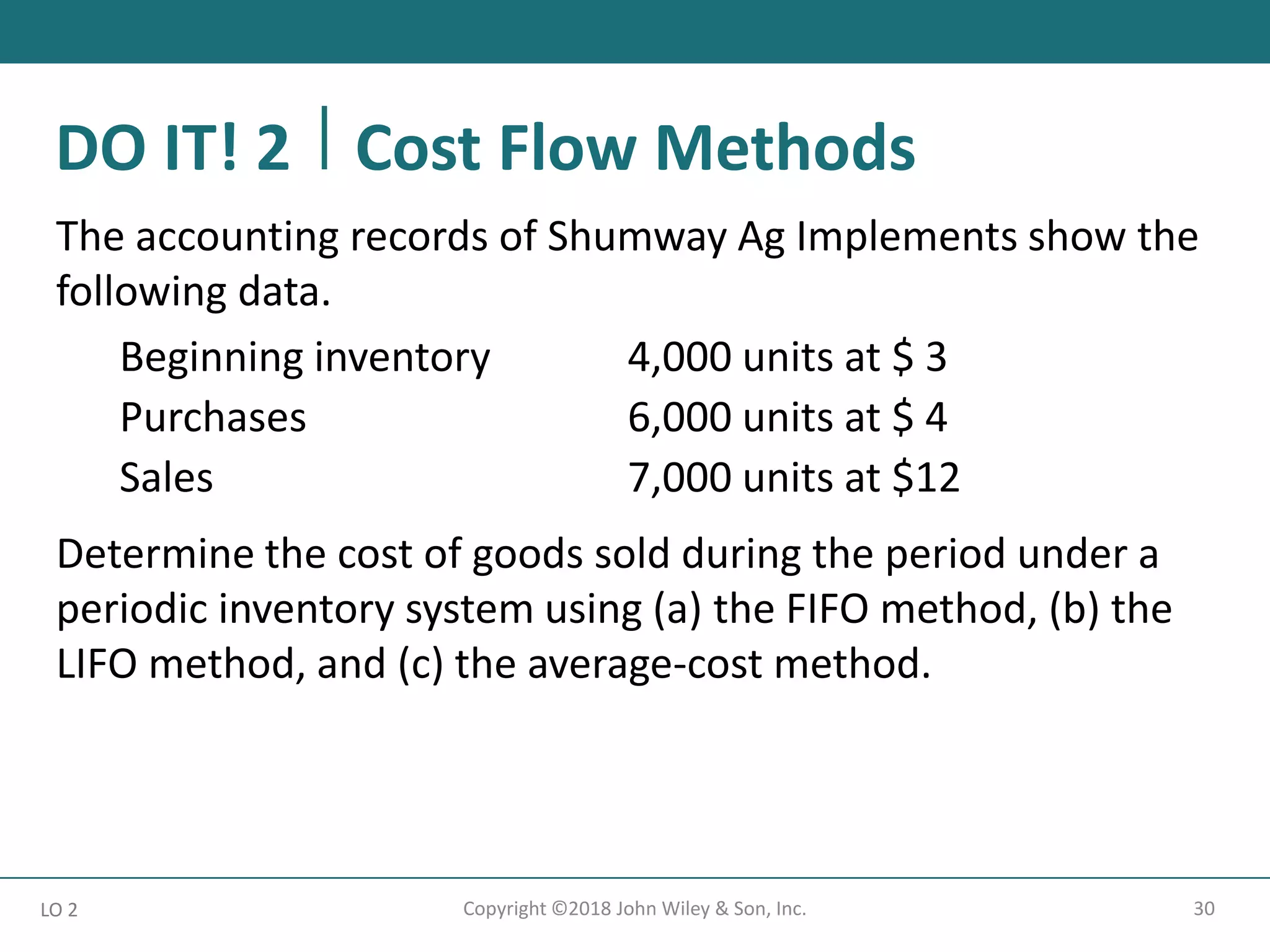
DO IT! 2 Cost Flow Methods
The accounting records of Shumway Ag Implements show the
following data.
Beginning inventory 4,000 units at $ 3
Purchases 6,000 units at $ 4
Sales 7,000 units at $12
Determine the cost of goods sold during the period under a
periodic inventory system using (a) the FIFO method, (b) the
LIFO method, and (c) the average-cost method.
STEP 1: ENDING INVENTORY STEP 2: COST OF GOODS SOLD
Units
Unit
Cost
Total
Cost
Cost of goods available for sale $36,000
Less : Ending inventory 12,000
3,000 $4 $12,000 Cost of goods sold $ 24,000
31
Copyright ©2018 John Wiley & Son, Inc.
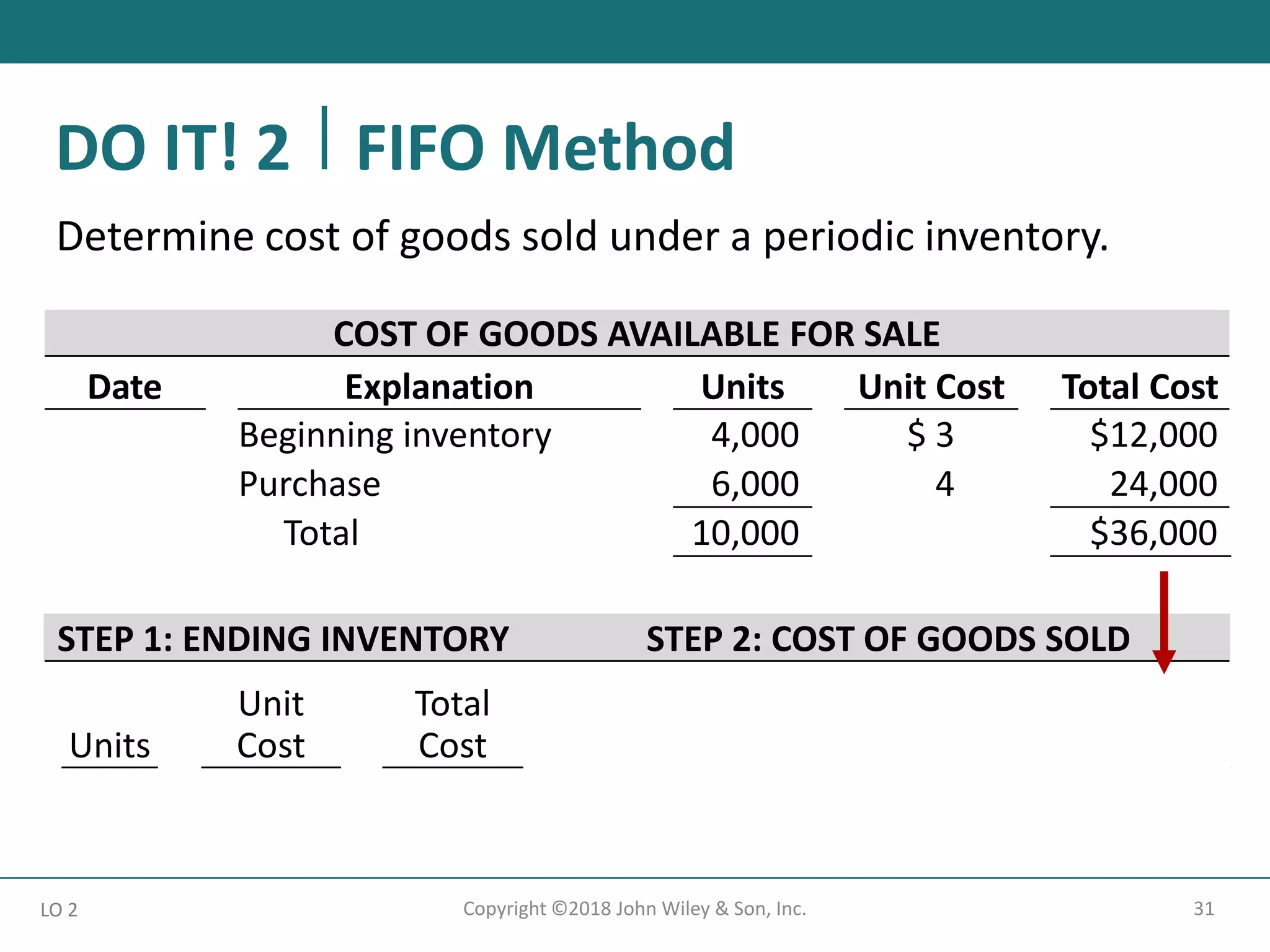
LO 2
COST OF GOODS AVAILABLE FOR SALE
Date Explanation Units Unit Cost Total Cost
Beginning inventory 4,000 $ 3 $12,000
Purchase 6,000 4 24,000
Total 10,000 $36,000
DO IT! 2 FIFO Method
Determine cost of goods sold under a periodic inventory.
STEP 1: ENDING INVENTORY STEP 2: COST OF GOODS SOLD
Units
Unit
Cost
Total
Cost
Cost of goods available for sale $36,000
Less : Ending inventory 9,000
3,000 $3 $9,000 Cost of goods sold $ 27,000
32
Copyright ©2018 John Wiley & Son, Inc.
LO 2
COST OF GOODS AVAILABLE FOR SALE
Date Explanation Units Unit Cost Total Cost
Beginning inventory 4,000 $ 3 $12,000
Purchase 6,000 4 24,000
Total 10,000 $36,000
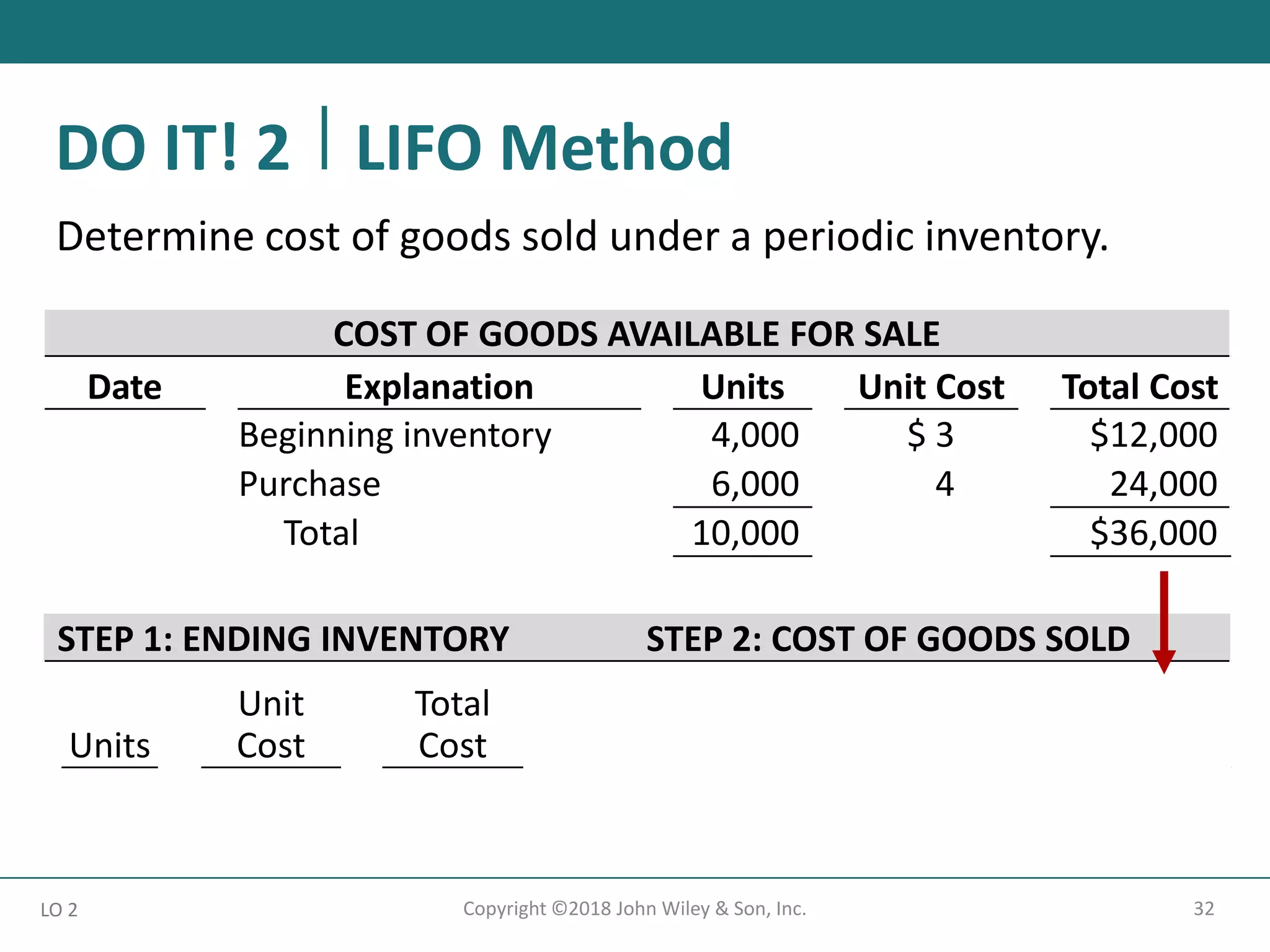
DO IT! 2 LIFO Method
Determine cost of goods sold under a periodic inventory.
STEP 1: ENDING INVENTORY STEP 2: COST OF GOODS SOLD
Units
Unit
Cost
Total
Cost
Cost of goods available for sale $36,000
Less : Ending inventory 10,800
3,000 $3.60 $10,800 Cost of goods sold $ 25,200
33
Copyright ©2018 John Wiley & Son, Inc.
LO 2
COST OF GOODS AVAILABLE FOR SALE
Date Explanation Units Unit Cost Total Cost
Beginning inventory 4,000 $3.00 $12,000
Purchase 6,000 4.00 24,000
Total 10,000 $3.60 $36,000
DO IT! 2 Average-Cost Method
Determine cost of goods sold under a periodic inventory.
Average Cost Per Unit
34
Copyright ©2018 John Wiley & Son, Inc.
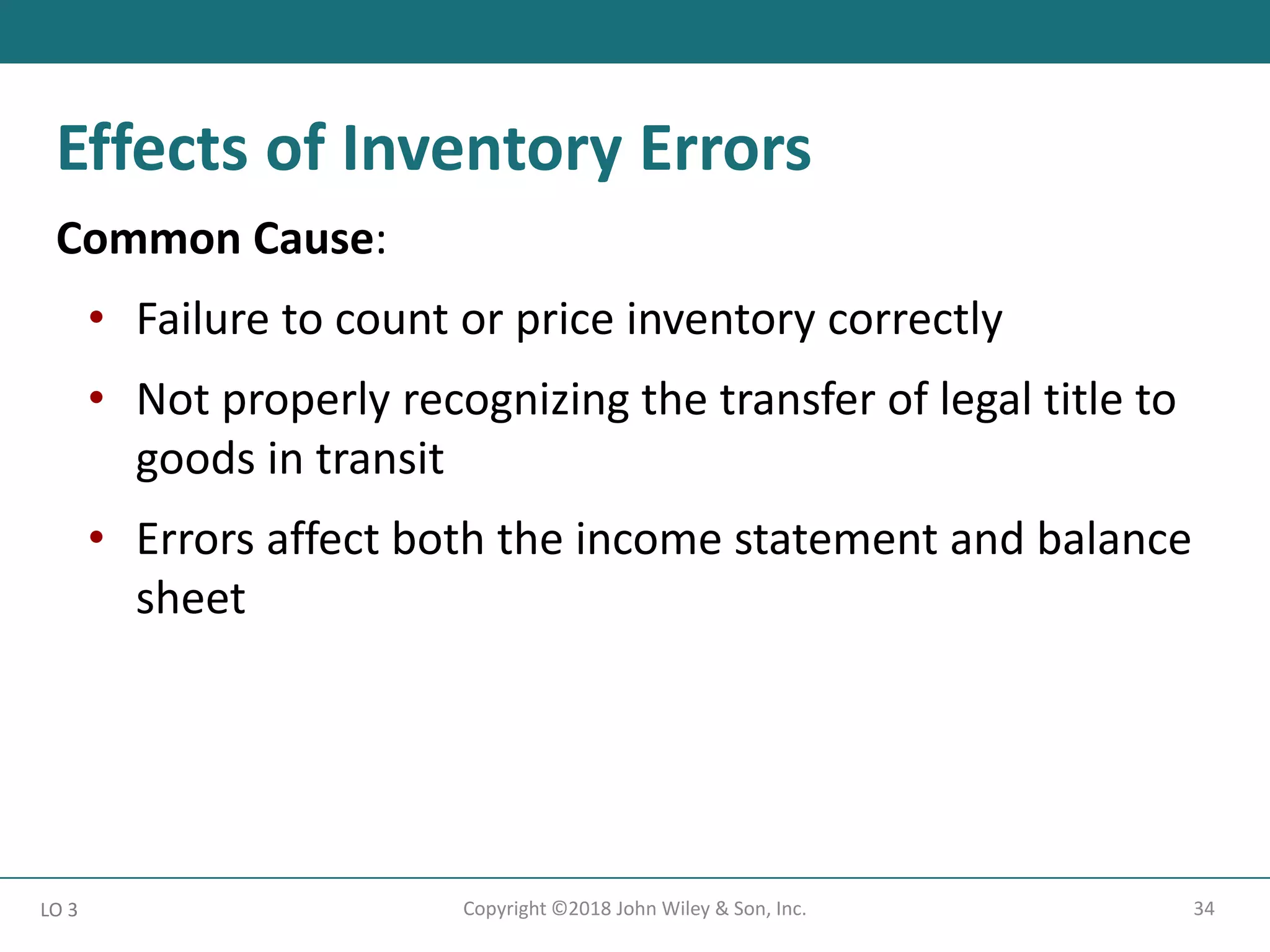
Common Cause:
• Failure to count or price inventory correctly
• Not properly recognizing the transfer of legal title to
goods in transit
• Errors affect both the income statement and balance
sheet
LO 3
Effects of Inventory Errors
35
Copyright ©2018 John Wiley & Son, Inc.
Inventory errors affect the computation of cost of goods
sold and net income in two periods.
LO 3
Effects of Inventory Errors
Beginning
Inventory
+
Cost of
Goods
Purchased
-
Ending
Inventory
=
Cost of
Goods
Sold
When Inventory Error:
Cost of
Goods Sold Is: Net Income Is:
Understates beginning inventory Understated Overstated
Overstates beginning inventory Overstated Understated
Understates ending inventory Overstated Understated
Overstated ending inventory Understated Overstated
ILLUSTRATION 6.16
Effects of inventory errors on current year’s income statement
ILLUSTRATION 6.15
Formula for cost of goods sold
36
Copyright ©2018 John Wiley & Son, Inc.
Inventory errors affect the computation of cost of goods
sold and net income in two periods.
• An error in ending inventory of current period will
have a reverse effect on net income of next
accounting period
• Over two years, total net income is correct because
errors offset each other
• Ending inventory depends entirely on accuracy of
taking and costing inventory
LO 3
Income Statement Effects
37
Copyright ©2018 John Wiley & Son, Inc.
LO 3
Income Statement Effects
($3,000)
Understated
$3,000
Overstated
Combined income
for 2-year period is
correct.
ILLUSTRATION 6.17
Effects of inventory errors on
two years’ income statements
2019 2020
Incorrect Correct Incorrect Correct
Sales $ 80,000 $ 80,000 $ 90,000 $ 90,000
Beginning inventory 20,000 20,000 12,000 15,000
Cost of goods purchased 40,000 40,000 68,000 68,000
Cost of goods available 60,000 60,000 80,000 83,000
Ending inventory 12,000 15,000 23,000 23,000
Cost of good sold 48,000 45,000 57,000 60,000
Gross profit 32,000 35,000 33,000 30,000
Operating expenses 10,000 10,000 20,000 20,000
Net income $ 22,000 $ 25,000 $ 13,000 $ 10,000
38
Copyright ©2018 John Wiley & Son, Inc.
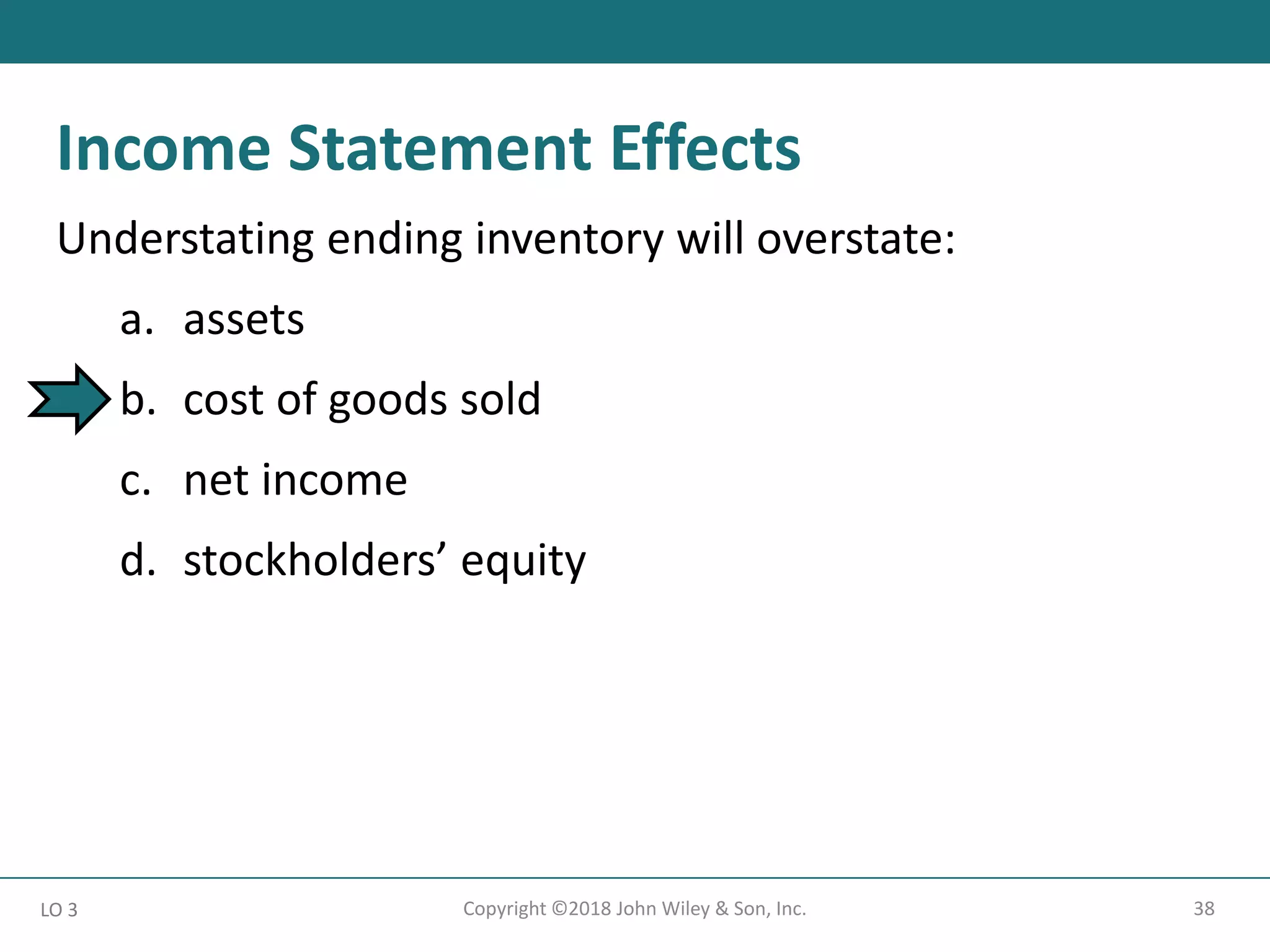
Understating ending inventory will overstate:
a. assets
b. cost of goods sold
c. net income
d. stockholders’ equity
LO 3
Income Statement Effects
39
Copyright ©2018 John Wiley & Son, Inc.
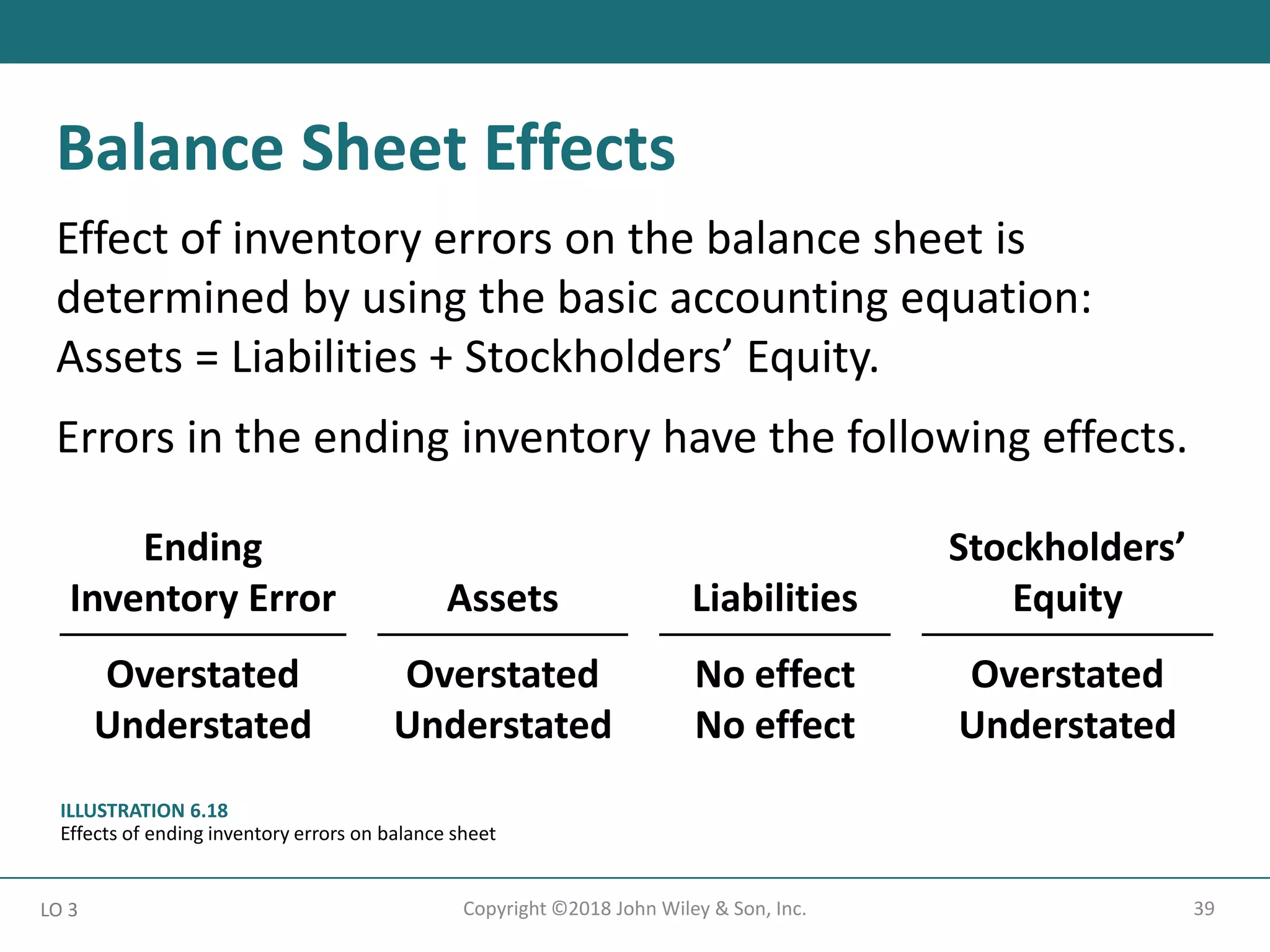
Effect of inventory errors on the balance sheet is
determined by using the basic accounting equation:
Assets = Liabilities + Stockholders’ Equity.
Errors in the ending inventory have the following effects.
LO 3
Balance Sheet Effects
Ending
Inventory Error Assets Liabilities
Stockholders’
Equity
Overstated
Understated
Overstated
Understated
No effect
No effect
Overstated
Understated
ILLUSTRATION 6.18
Effects of ending inventory errors on balance sheet
2019 2020
Ending inventory $22,000 overstated No effect
Cost of goods sold $22,000 understated $22,000 overstated
Owner’s equity $22,000 overstated No effect
40
Copyright ©2018 John Wiley & Son, Inc.
Visual Company overstated its 2019 ending inventory by
$22,000. Determine the impact this error has on ending
inventory, cost of goods sold, and owner’s equity in 2019 and
2020.
Solution
LO 3
DO IT! 3 Inventory Errors
41
Copyright ©2018 John Wiley & Son, Inc.
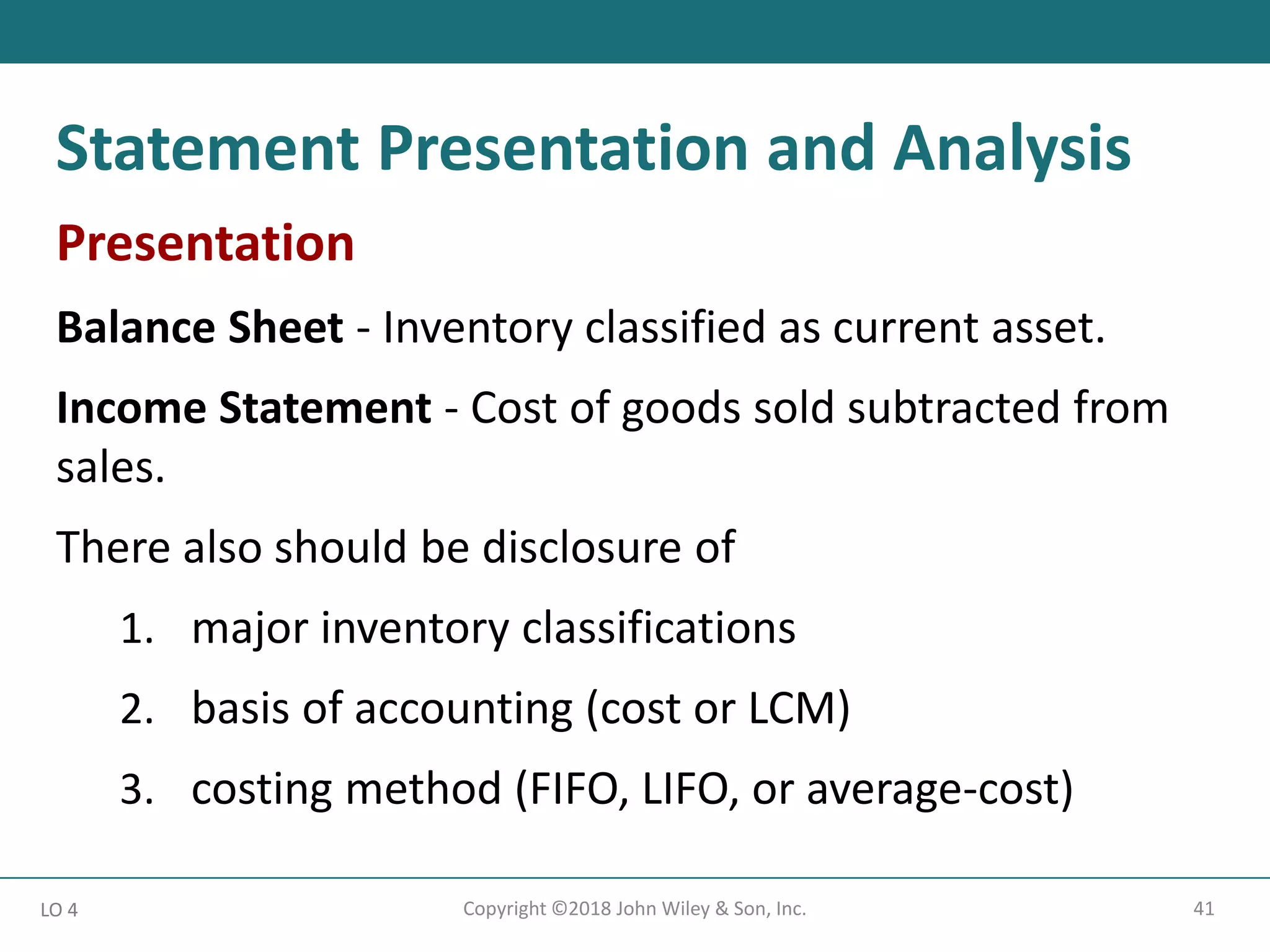
Presentation
Balance Sheet - Inventory classified as current asset.
Income Statement - Cost of goods sold subtracted from
sales.
There also should be disclosure of
1. major inventory classifications
2. basis of accounting (cost or LCM)
3. costing method (FIFO, LIFO, or average-cost)
LO 4
Statement Presentation and Analysis
42
Copyright ©2018 John Wiley & Son, Inc.
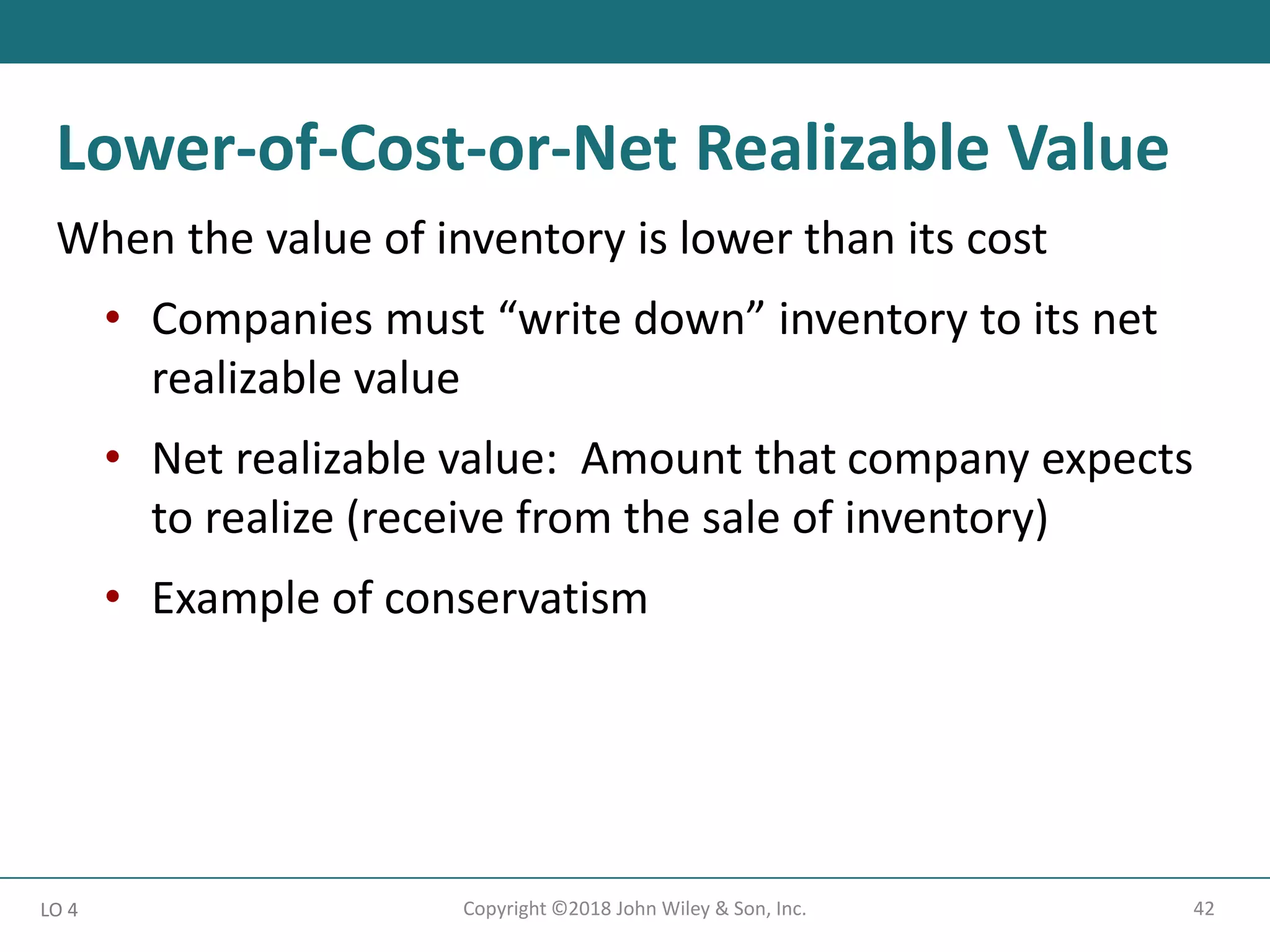
When the value of inventory is lower than its cost
• Companies must “write down” inventory to its net
realizable value
• Net realizable value: Amount that company expects
to realize (receive from the sale of inventory)
• Example of conservatism
LO 4
Lower-of-Cost-or-Net Realizable Value
43
Copyright ©2018 John Wiley & Son, Inc.
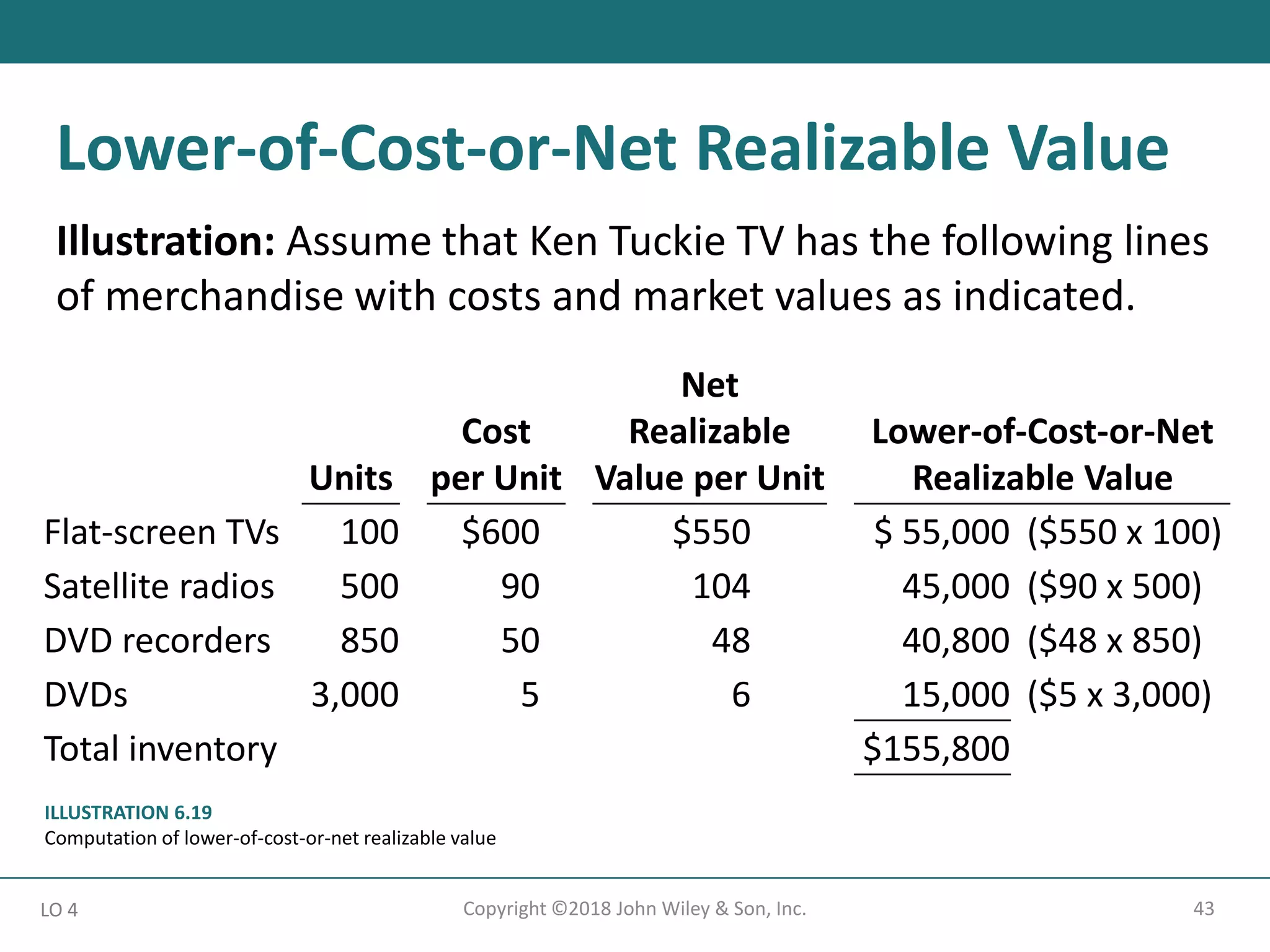
Illustration: Assume that Ken Tuckie TV has the following lines
of merchandise with costs and market values as indicated.
LO 4
Lower-of-Cost-or-Net Realizable Value
Units
Cost
per Unit
Net
Realizable
Value per Unit
Lower-of-Cost-or-Net
Realizable Value
Flat-screen TVs 100 $600 $550 $ 55,000 ($550 x 100)
Satellite radios 500 90 104 45,000 ($90 x 500)
DVD recorders 850 50 48 40,800 ($48 x 850)
DVDs 3,000 5 6 15,000 ($5 x 3,000)
Total inventory $155,800
ILLUSTRATION 6.19
Computation of lower-of-cost-or-net realizable value
44
Copyright ©2018 John Wiley & Son, Inc.
Analysis
Inventory management is a double-edged sword
1. High Inventory Levels - may incur high carrying
costs (e.g., investment, storage, insurance,
obsolescence, and damage).
2. Low Inventory Levels – may lead to stock-outs and
lost sales.
LO 4
Statement Presentation and Analysis
45
Copyright ©2018 John Wiley & Son, Inc.
LO 4
Analysis
Inventory turnover measures the number of times on
average the inventory is sold during the period.
Cost of Goods Sold
Average Inventory
Inventory
Turnover
=
Days in inventory measures the average number of
days inventory is held.
Days in Year (365)
Inventory Turnover
Days in
Inventory
=
46
Copyright ©2018 John Wiley & Son, Inc.
LO 4
Analysis
Illustration: Wal-Mart reported in its 2016 annual report a
beginning inventory of $45,141 million, an ending inventory of
$44,469 million, and cost of goods sold for the year ended
January 31, 2016, of $360,984 million. The inventory turnover
formula and computation for Wal-Mart are shown below.
Cost of
Goods Sold
÷ Average Inventory = Inventory Turnover
$360,984 ÷
$44,469 + $45,141
= 8.1 Times
2
ILLUSTRATION 6.20
Inventory turnover formula and computation for Wal-Mart 365 ÷ 8.1 = 45.1 Days
47
Copyright ©2018 John Wiley & Son, Inc.
LO 4
DO IT! 4 LCNRV
Tracy company sells three different types of home heating stoves
(gas, wood, and pellet). The cost and net realizable value of its
inventory of stoves are as follows.
Cost Net Realizable Value
Gas $ 84,000 $ 79,000
Wood 250,000 280,000
Pellet 112,000 101,000
Determine the value of the company’s inventory under the lower-
of-cost-or-net realizable value approach.
Solution: The lowest value for each inventory type is gas $79,000,
wood $250,000, and pellet $101,000. The total inventory value is
the sum of these amounts, $430,000.
48
Copyright ©2018 John Wiley & Son, Inc.
LO 4
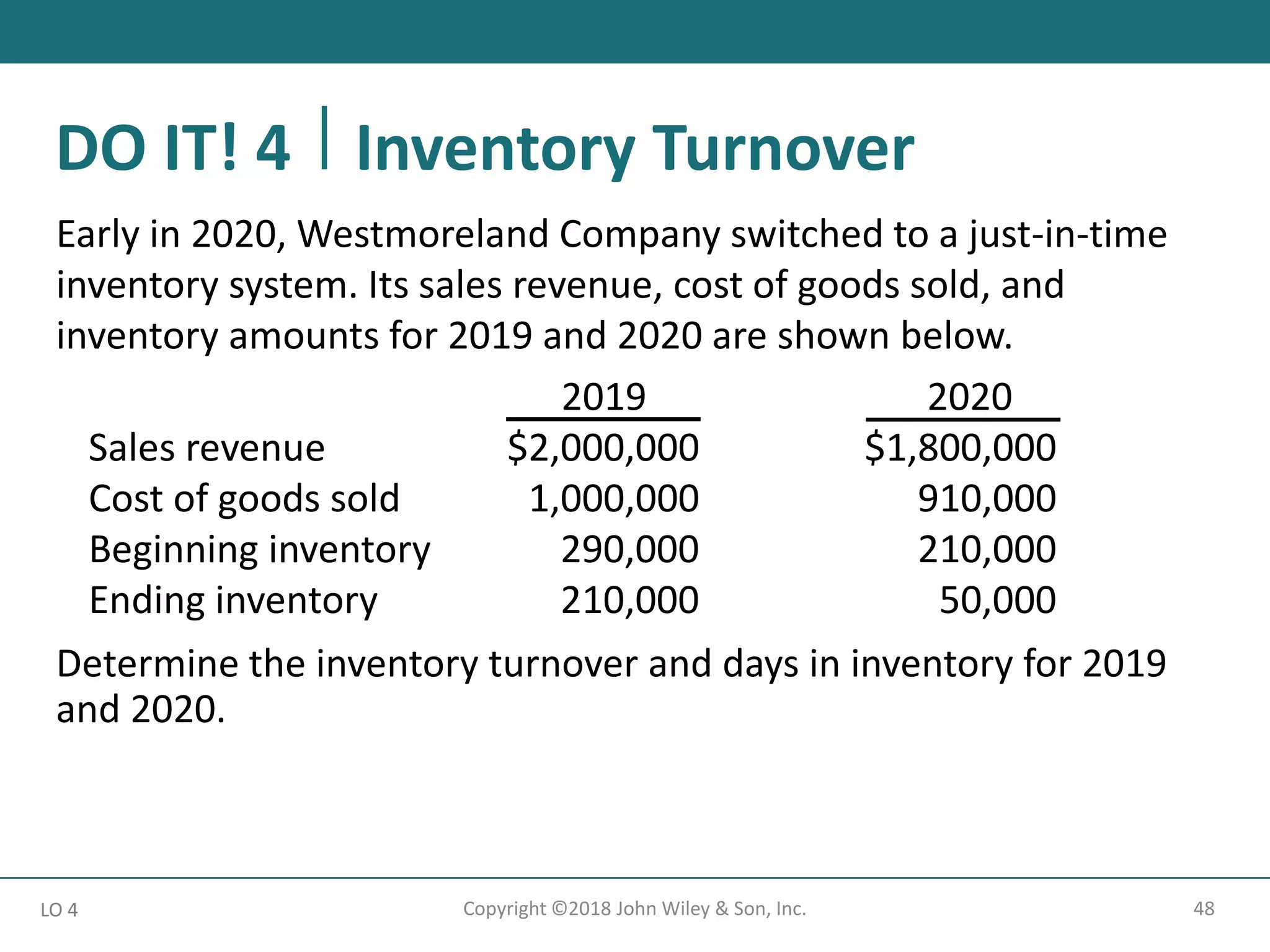
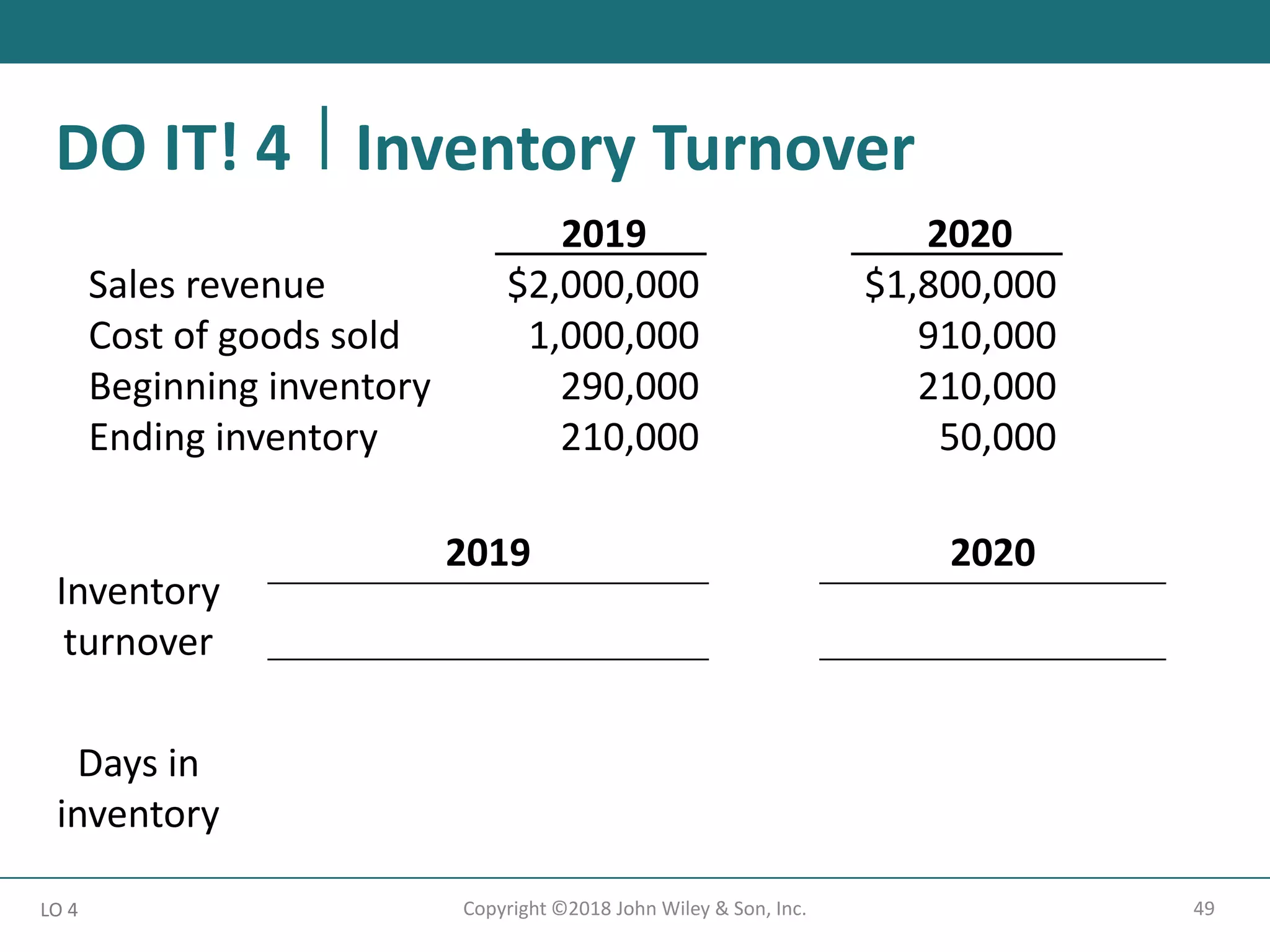
DO IT! 4 Inventory Turnover
Early in 2020, Westmoreland Company switched to a just-in-time
inventory system. Its sales revenue, cost of goods sold, and
inventory amounts for 2019 and 2020 are shown below.
2019 2020
Sales revenue $2,000,000 $1,800,000
Cost of goods sold 1,000,000 910,000
Beginning inventory 290,000 210,000
Ending inventory 210,000 50,000
Determine the inventory turnover and days in inventory for 2019
and 2020.
2019 2020
Sales revenue $2,000,000 $1,800,000
Cost of goods sold 1,000,000 910,000
Beginning inventory 290,000 210,000
Ending inventory 210,000 50,000
49
Copyright ©2018 John Wiley & Son, Inc.
LO 4
Inventory
turnover
2019 2020
$1,000,000
= 4
$44,469 + $45,141 =7
($290,000 + $210,000)/2 2
Days in
inventory
365 ÷ 4 = 91.3 Days 365 ÷ 7 = 52.1 Days
DO IT! 4 Inventory Turnover
50
Copyright ©2018 John Wiley & Son, Inc.
LO 5
Appendix 6A Inventory Methods and the
Perpetual System
Illustration: Compute Cost of Goods Sold and Ending Inventory under
FIFO, LIFO, and average-cost.
ILLUSTRATION 6A.1
Inventoriable units and costs
HOUSTON ELECTRONICS
Date Explanation Units Unit Cost Total Cost
Balance
in Units
1/1 Beginning inventory 100 $10 $ 1,000 100
4/15 Purchase 200 11 2,200 300
8/24 Purchase 300 12 3,600 600
9/10 Sale 550 50
11/27 Purchase 400 13 5,200 450
$12,000
Date Purchases
Cost of
Goods Sold Inventory Balance
1/1 (100 @ $10) $1,000
4/15 (200 @ $11) $2,200 (100 @ $10)
$3,200
(200 @ $11)
8/ 24 (300 @ $12) $3,600 (100 @ $10)
(200 @ $11) $6,800
(300 @ $12)
9/10 (100 @ $10)
(200 @ $11)
(250 @ $12) ( 50 @ $12) $600
$6,200
11/27 (400 @ $13) $5,200 ( 50 @ $12)
$5,800
(400 @ $13)
First-In, First-Out (FIFO)
51
Copyright ©2018 John Wiley & Son, Inc.
LO 5
ILLUSTRATION 6A.2
Perpetual system—FIFO
Date Purchases
Cost of
Goods Sold Inventory Balance
1/1 (100 @ $10) $1,000
4/15 (200 @ $11) $2,200 (100 @ $10)
$3,200
(200 @ $11)
8/ 24 (300 @ $12) $3,600 (100 @ $10)
(200 @ $11) $6,800
(300 @ $12)
9/10 (300 @ $12)
(200 @ $11)
( 50 @ $10) ( 50 @ $10) $500
$6,300
11/27 (400 @ $13) $5,200 ( 50 @ $10)
$5,700
(400 @ $13)
Last-In, First-Out (FIFO)
52
Copyright ©2018 John Wiley & Son, Inc.
LO 5
ILLUSTRATION 6A.3
Perpetual system—LIFO
Moving Average
53
Copyright ©2018 John Wiley & Son, Inc.
LO 5
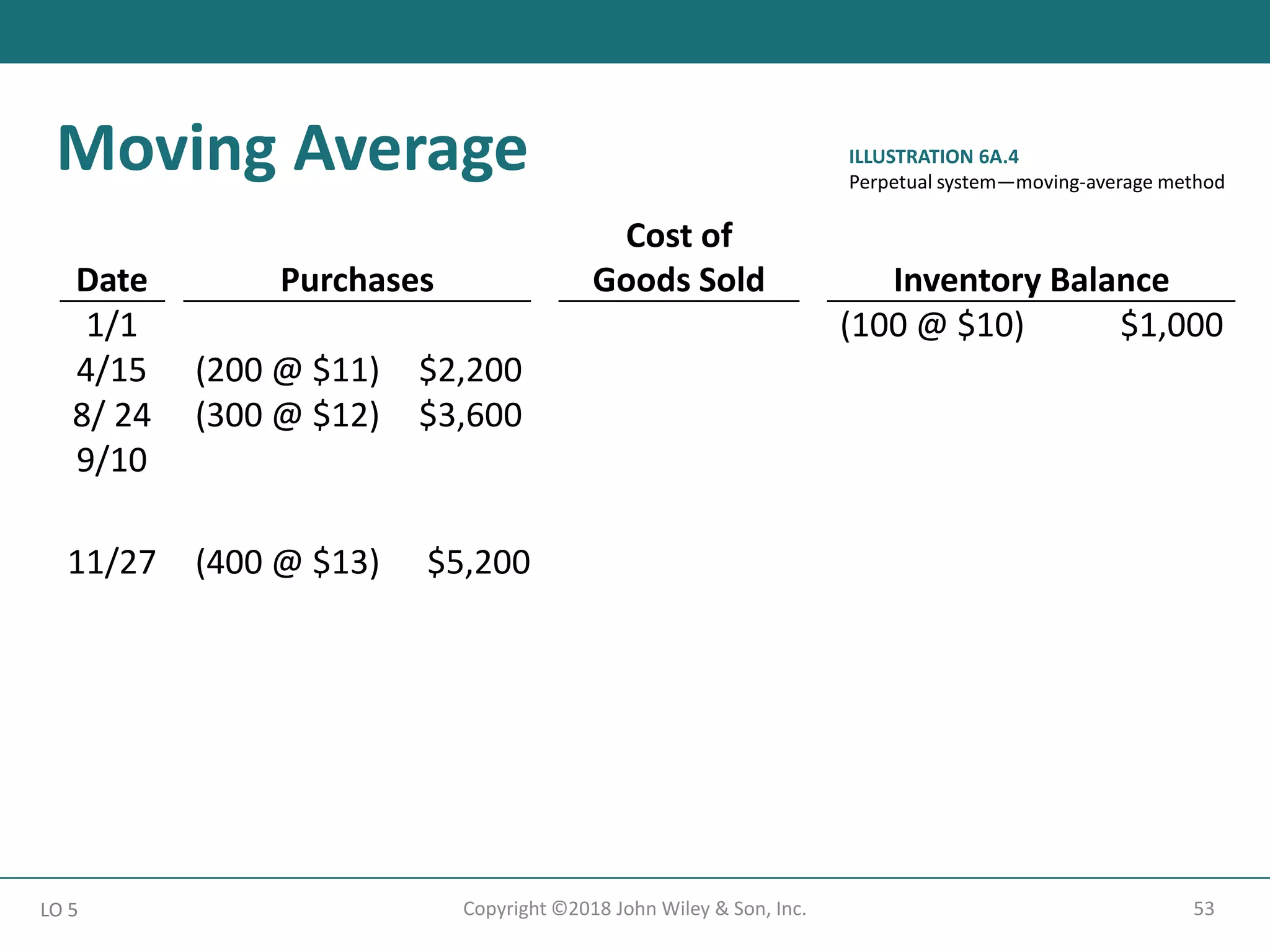
ILLUSTRATION 6A.4
Perpetual system—moving-average method
Date Purchases
Cost of
Goods Sold Inventory Balance
1/1 (100 @ $10) $1,000
4/15 (200 @ $11) $2,200 (300 @ $10.67) $3,200
8/ 24 (300 @ $12) $3,600 (600 @ $11.33) $6,800
9/10 (550 @ $11.33) (50 @ $11.33) $567
$6,233
11/27 (400 @ $13) $5,200 (450 @ $12.82) $5,767
54
Copyright ©2018 John Wiley & Son, Inc.
LO 6
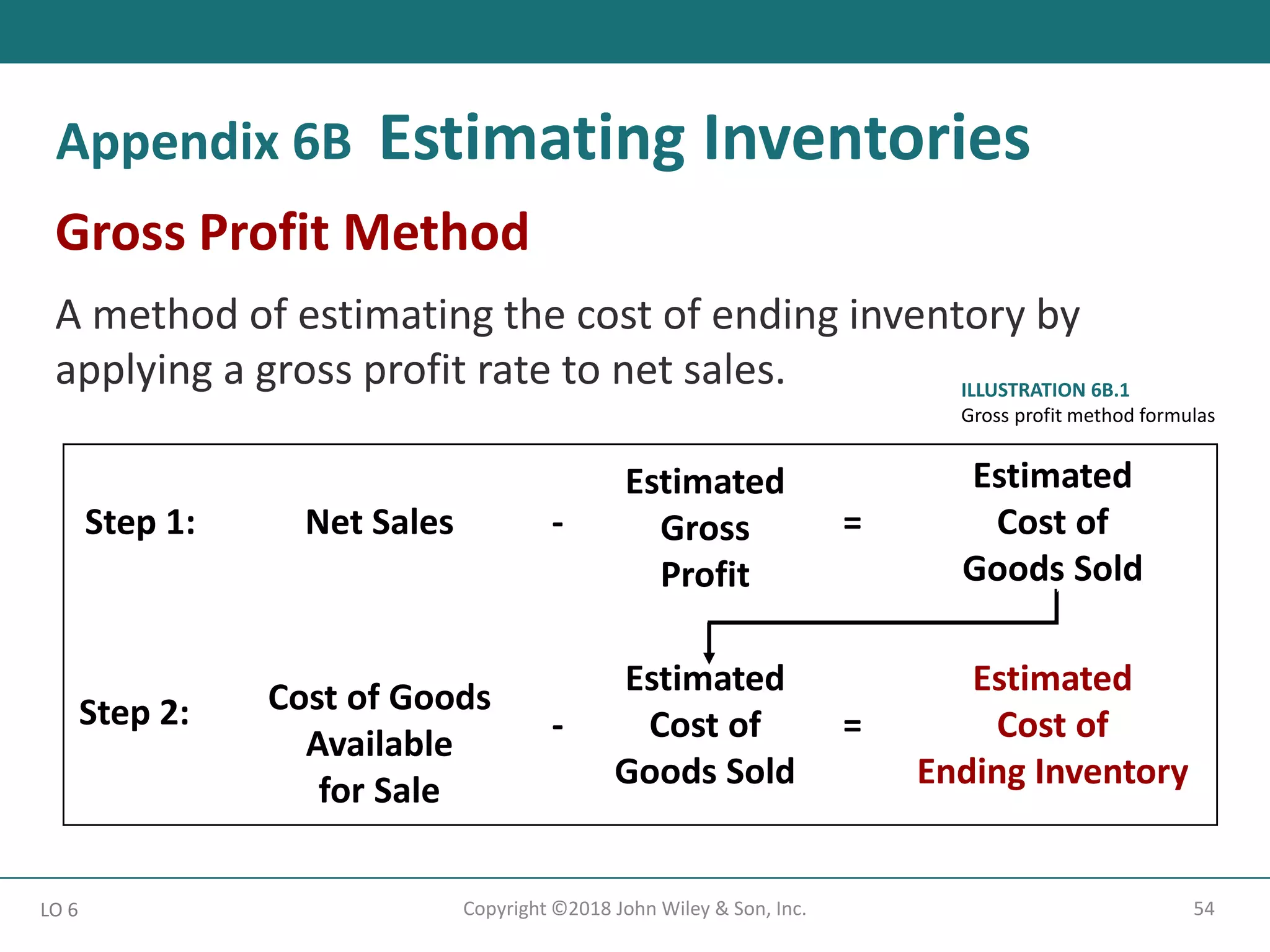
Appendix 6B Estimating Inventories
Gross Profit Method
A method of estimating the cost of ending inventory by
applying a gross profit rate to net sales. ILLUSTRATION 6B.1
Gross profit method formulas
Step 1: Net Sales -
Estimated
Gross
Profit
=
Estimated
Cost of
Goods Sold
Step 2: Cost of Goods
Available
for Sale
-
Estimated
Cost of
Goods Sold
=
Estimated
Cost of
Ending Inventory
55
Copyright ©2018 John Wiley & Son, Inc.
LO 6
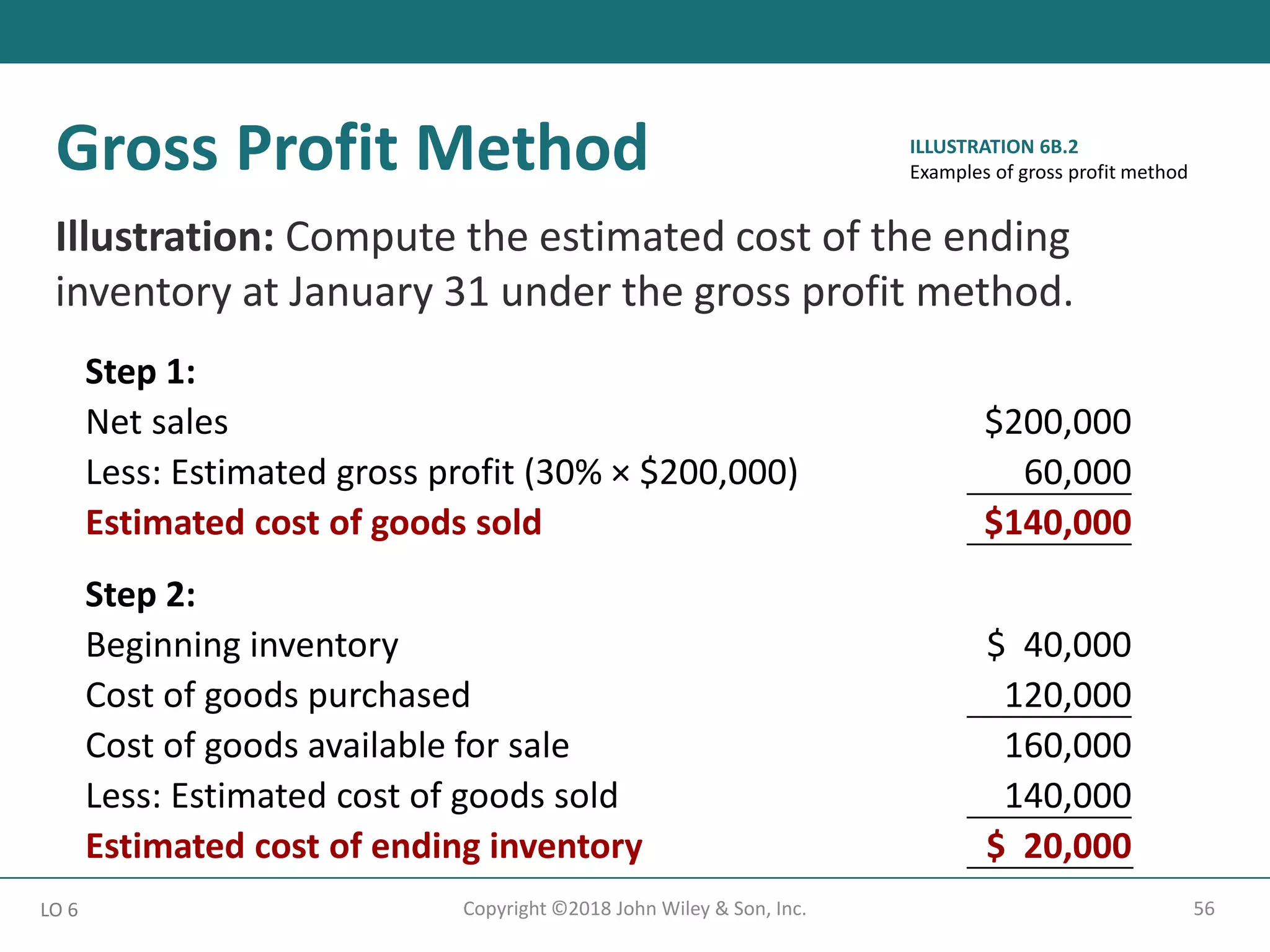
Illustration: Kishwaukee Company records show net sales of
$200,000, beginning inventory $40,000, and cost of goods
purchased $120,000. In the preceding year, the company
realized a 30% gross profit rate. It expects to earn the same
rate this year. Compute the estimated cost of the ending
inventory at January 31 under the gross profit method.
Gross Profit Method
56
Copyright ©2018 John Wiley & Son, Inc.
LO 6
Illustration: Compute the estimated cost of the ending
inventory at January 31 under the gross profit method.
Gross Profit Method
Step 1:
Net sales $200,000
Less: Estimated gross profit (30% × $200,000) 60,000
Estimated cost of goods sold $140,000
Step 2:
Beginning inventory $ 40,000
Cost of goods purchased 120,000
Cost of goods available for sale 160,000
Less: Estimated cost of goods sold 140,000
Estimated cost of ending inventory $ 20,000
ILLUSTRATION 6B.2
Examples of gross profit method
57
Copyright ©2018 John Wiley & Son, Inc.
LO 6
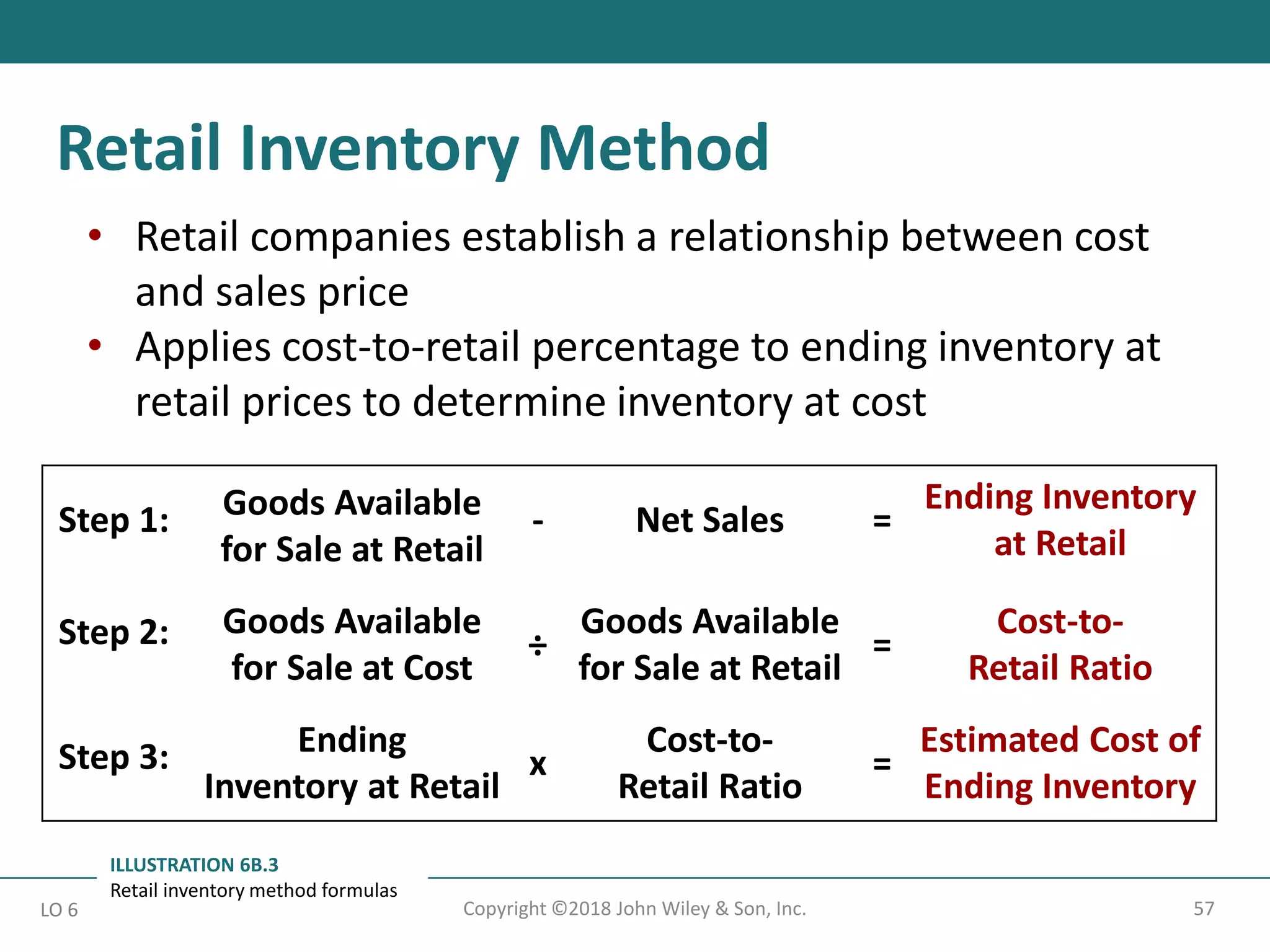
• Retail companies establish a relationship between cost
and sales price
• Applies cost-to-retail percentage to ending inventory at
retail prices to determine inventory at cost
Retail Inventory Method
Step 1: Goods Available
for Sale at Retail
- Net Sales =
Ending Inventory
at Retail
Step 2: Goods Available
for Sale at Cost
÷
Goods Available
for Sale at Retail
=
Cost-to-
Retail Ratio
Step 3: Ending
Inventory at Retail
x
Cost-to-
Retail Ratio
=
Estimated Cost of
Ending Inventory
ILLUSTRATION 6B.3
Retail inventory method formulas
58
Copyright ©2018 John Wiley & Son, Inc.
LO 6
Illustration: It is not necessary to take a physical inventory to
determine the estimated cost of goods on hand.
Retail Inventory Method
ILLUSTRATION 6B.4
Application of retail inventory
At Cost At Retail
Beginning inventory $14,000 $ 21,500
Goods purchased 61,000 78,500
Goods available for sale $75,000 100,000
Less: Net sales 70,000
Step (1) Ending inventory at retail = $ 30,000
Step (2) Cost-to-retail ratio = $75,000 ÷ $100,000 = 75%
Step (3) Estimated cost of ending inventory = $30,000 x 75% = $22,500
59
Copyright ©2018 John Wiley & Son, Inc.
Key Points
Similarities
• IFRS and GAAP account for inventory acquisitions at historical cost
and value inventory at the lower-of-cost-or-net-realizable value
subsequent to acquisition.
• Who owns the goods—goods in transit or consigned goods—as well
as the costs to include in inventory are essentially accounted for the
same under IFRS and GAAP.
LO 7
A Look at IFRS
60
Copyright ©2018 John Wiley & Son, Inc.
Key Points
Differences
• The requirements for accounting for and reporting inventories are
more principles-based under IFRS. That is, GAAP provides more
detailed guidelines in inventory accounting.
• A major difference between IFRS and GAAP relates to the LIFO cost
flow assumption. GAAP permits the use of LIFO for inventory
valuation. IFRS prohibits its use. FIFO and average-cost are the only
two acceptable cost flow assumptions permitted under IFRS. Both
sets of standards permit specific identification where appropriate.
LO 7
A Look at IFRS
61
Copyright ©2018 John Wiley & Son, Inc.
Looking to the Future
One convergence issue that will be difficult to resolve relates to the use
of the LIFO cost flow assumption. As indicated, IFRS specifically prohibits
its use. Conversely, the LIFO cost flow assumption is widely used in the
United States because of its favorable tax advantages. In addition, many
argue that LIFO from a financial reporting point of view provides a better
matching of current costs against revenue and, therefore, enables
companies to compute a more realistic income.
LO 7
A Look at IFRS
Copyright
Copyright © 2018 John Wiley & Sons, Inc.
All rights reserved. Reproduction or translation of this work beyond that permitted in
Section 117 of the 1976 United States Act without the express written permission of the
copyright owner is unlawful. Request for further information should be addressed to the
Permissions Department, John Wiley & Sons, Inc. The purchaser may make back-up
copies for his/her own use only and not for distribution or resale. The Publisher assumes
no responsibility for errors, omissions, or damages, caused by the use of these programs
or from the use of the information contained herein.
62
Copyright ©2018 John Wiley & Son, Inc.

ch06.pptx

  • 1.
    Accounting Principles Thirteenth Edition WeygandtKimmel Kieso Chapter 6 Inventories Prepared by Coby Harmon University of California, Santa Barbara Westmont College
  • 2.
    Chapter Outline Learning Objectives LO1 Discuss how to classify and determine inventory. LO 2 Apply inventory cost flow methods and discuss their financial effects. LO 3 Indicate the effects of inventory errors on the financial statements. LO 4 Explain the statement presentation and analysis of inventory. 2 Copyright ©2018 John Wiley & Son, Inc.
  • 3.
    Classifying and DeterminingInventory 3 Copyright ©2018 John Wiley & Son, Inc. LO 1 Classifying Inventory Merchandising Company Manufacturing Company One Classification: • Inventory Three Classifications: • Inventory • Raw Materials • Work in Process • Finished Goods
  • 4.
    4 Copyright ©2018 JohnWiley & Son, Inc. Physical Inventory taken for two reasons: Perpetual System 1. Check accuracy of inventory records. 2. Determine amount of inventory lost due to wasted raw materials, shoplifting, or employee theft. Periodic System 1. Determine the inventory on hand. 2. Determine the cost of goods sold for the period. LO 1 Determining Inventory Quantities
  • 5.
    5 Copyright ©2018 JohnWiley & Son, Inc. Taking a Physical Inventory Involves counting, weighing, or measuring each kind of inventory on hand. Companies often “take inventory” • when business is closed or business is slow • at the end of accounting period LO 1 Determining Inventory Quantities
  • 6.
    6 Copyright ©2018 JohnWiley & Son, Inc. Determining Ownership of Goods Goods in Transit • Purchased goods not yet received • Sold goods not yet delivered • Included in inventory of company that has legal title to goods LO 1 Determining Inventory Quantities
  • 7.
    7 Copyright ©2018 JohnWiley & Son, Inc. LO 1 Goods in Transit ILLUSTRATION 6.2 Terms of sale Ownership of goods passes to buyer when public carrier accepts goods from seller. Ownership of goods remains with seller until the goods reach buyer. Freight costs incurred by the seller are an operating expense.
  • 8.
    8 Copyright ©2018 JohnWiley & Son, Inc. Goods in transit should be included in the inventory of the buyer when the: a. public carrier accepts the goods from the seller b. goods reach the buyer c. terms of sale are FOB destination d. terms f sale are FOB shipping point LO 1 Goods in Transit
  • 9.
    9 Copyright ©2018 JohnWiley & Son, Inc. Consigned Goods To hold the goods of other parties and try to sell the goods for them for a fee, but without taking ownership of the goods. Many car, boat, and antique dealers sell goods on consignment, why? LO 1 Determining Ownership of Goods
  • 10.
    10 Copyright ©2018 JohnWiley & Son, Inc. Hasbeen Company completed its inventory count. It arrived at a total inventory value of $200,000. As a new member of Hasbeen’s accounting department, you have been given the information listed below. Discuss how this information affects the reported cost of inventory. 1. Hasbeen included in the inventory goods held on consignment for Falls Co., costing $15,000. 2. The company did not include in the count purchased goods of $10,000 which were in transit (terms: FOB shipping point). 3. The company did not include in the count sold inventory with a cost of $12,000 which was in transit (terms: FOB shipping point). Inventory = $200,000 - $15,000 + $10,000 = $195,000 LO 1 DO IT! 1 Rules of Ownership
  • 11.
    11 Copyright ©2018 JohnWiley & Son, Inc. Inventory is accounted for at cost • Includes all expenditures necessary to acquire goods and place them in a condition ready for sale • Unit costs are applied to quantities to compute total cost of inventory and cost of goods sold using the following costing methods:  Specific identification  First-in, first-out (FIFO)  Last-in, first-out (LIFO)  Average-cost LO 2 Inventory Methods and Financial Effects Cost Flow Assumptions
  • 12.
    12 Copyright ©2018 JohnWiley & Son, Inc. Illustration: Crivitz TV Company purchases three identical 50- inch TVs on different dates at costs of $720, $750, and $800. During the year Crivitz sold two sets at $1,200 each. These facts are summarized below. Purchases February 3 1 TV at $720 March 5 1 TV at $750 May 22 1 TV at $800 Sales June 1 2 TVs for $2,400 ($1,200 × 2) LO 2 Inventory Methods and Financial Effects
  • 13.
    13 Copyright ©2018 JohnWiley & Son, Inc. If Crivitz sold the TVs it purchased on February 3 and May 22, then its cost of goods sold is $1,500 ($720 + $800), and its ending inventory is $750. LO 2 Specific Identification $750 $720 $800 Cost of Goods Sold Ending Inventory $1,520
  • 14.
    14 Copyright ©2018 JohnWiley & Son, Inc. Costing method in which items still in inventory are specifically costed to arrive at the total cost of the ending inventory. • Practice is relatively rare • Most companies make assumptions (cost flow assumptions) about which units were sold LO 2 Specific Identification
  • 15.
    15 Copyright ©2018 JohnWiley & Son, Inc. Cost flow assumptions DO NOT need to be consistent with the physical movement of the goods LO 2 Cost Flow Assumptions ILLUSTRATION 6.12 Use of cost flow methods in major U.S. companies
  • 16.
    Date Explanation UnitsUnit Cost Total Cost Jan. 1 Beginning inventory 100 $10 $1,000 Apr. 15 Purchase 200 11 2,200 Aug. 24 Purchase 300 12 3,600 Nov. 27 Purchase 400 13 5,200 Total units available for sale 1,000 $12,000 Units in ending inventory (450) Units sold 550 Beginning Inventory + Purchases - Ending Inventory = Cost of Goods Sold 16 Copyright ©2018 John Wiley & Son, Inc. Illustration: Data for Houston Electronics’ Astro condensers. LO 2 Cost Flow Assumptions ILLUSTRATION 6.5
  • 17.
    17 Copyright ©2018 JohnWiley & Son, Inc. First-In, First-Out (FIFO) • Costs of earliest goods purchased are first to be recognized in determining cost of goods sold • Often parallels actual physical flow of merchandise • Companies determine cost of ending inventory by taking unit cost of most recent purchase and working backward until all units of inventory have been costed LO 2 Cost Flow Assumptions
  • 18.
    18 Copyright ©2018 JohnWiley & Son, Inc. LO 2 ILLUSTRATION 6.6 Allocation of costs—FIFO method First-In, First-Out (FIFO) COST OF GOODS AVAILABLE FOR SALE Date Explanation Units Unit Cost Total Cost Jan. 1 Beginning inventory 100 $10 $1,000 Apr. 15 Purchase 200 11 2,200 Aug. 24 Purchase 300 12 3,600 Nov. 27 Purchase 400 13 5,200 Total 1,000 $12,000 STEP 1: ENDING INVENTORY STEP 2: COST OF GOODS SOLD Date Units Unit Cost Total Cost Nov. 27 400 $13 $5,200 Cost of goods available for sale $12,000 Aug. 24 50 12 600 Less : Ending inventory 5,800 Total 450 $5,800 Cost of goods sold $ 6,200
  • 19.
    19 Copyright ©2018 JohnWiley & Son, Inc. Last-In, First-Out (LIFO) • Costs of latest goods purchased are first to be recognized in determining cost of goods sold • Seldom coincides with actual physical flow of merchandise • Exceptions include goods stored in piles, such as coal or hay LO 2 Cost Flow Assumptions
  • 20.
    STEP 1: ENDINGINVENTORY STEP 2: COST OF GOODS SOLD Date Units Unit Cost Total Cost Jan. 1 100 $10 $1,000 Cost of goods available for sale $12,000 Apr. 15 200 11 2,200 Less : Ending inventory 5,000 Aug. 24 150 12 1,800 Cost of goods sold $ 7,000 Total 450 $5,000 Last-In, First-Out (LIFO) 20 Copyright ©2018 John Wiley & Son, Inc. LO 2 ILLUSTRATION 6.8 Allocation of costs—LIFO method COST OF GOODS AVAILABLE FOR SALE Date Explanation Units Unit Cost Total Cost Jan. 1 Beginning inventory 100 $10 $1,000 Apr. 15 Purchase 200 11 2,200 Aug. 24 Purchase 300 12 3,600 Nov. 27 Purchase 400 13 5,200 Total 1,000 $12,000
  • 21.
    21 Copyright ©2018 JohnWiley & Son, Inc. Average-Cost • Allocates cost of goods available for sale on basis of weighted-average unit cost incurred • Applies weighted-average unit cost to units on hand to determine cost of ending inventory LO 2 Cost Flow Assumptions
  • 22.
    STEP 1: ENDINGINVENTORY STEP 2: COST OF GOODS SOLD $12,000 ÷ 1,000 = $12 Cost of goods available for sale $12,000 Units Unit Cost Total Cost Less : Ending inventory Cost of goods sold 5,400 $ 6,600 450 $12 $5,400 22 Copyright ©2018 John Wiley & Son, Inc. LO 2 ILLUSTRATION 6.8 Allocation of costs—LIFO method COST OF GOODS AVAILABLE FOR SALE Date Explanation Units Unit Cost Total Cost Jan. 1 Beginning inventory 100 $10 $1,000 Apr. 15 Purchase 200 11 2,200 Aug. 24 Purchase 300 12 3,600 Nov. 27 Purchase 400 13 5,200 Total 1,000 $12,000 Average-Cost
  • 23.
    23 Copyright ©2018 JohnWiley & Son, Inc. Each of the three cost flow methods is acceptable for use. • Reebok International Ltd. and Wendy’s International currently use the FIFO method • Campbell Soup Company, Krogers, and Walgreen Drugs use LIFO for part or all of their inventory • Bristol-Myers Squibb, Starbucks, and Motorola use the average-cost method • Stanley Black & Decker Manufacturing Company uses LIFO for domestic inventories and FIFO for foreign inventories LO 2 Financial Statement and Tax Effects of Cost Flow Methods
  • 24.
    24 Copyright ©2018 JohnWiley & Son, Inc. LO 2 Income Statement Effects Houston Electronics Condensed Income Statements FIFO Average-Cost LIFO Sales revenue $18,500 $18,500 $18,500 Beginning inventory 1,000 1,000 1,000 Purchases 11,000 11,000 11,000 Cost of goods available for sale 12,000 12,000 12,000 Ending inventory 5,800 5,400 5,000 Cost of goods sold 6,200 6,600 7,000 Gross profit 12,300 11,900 11,500 Operating expenses 9,000 9,000 9,000 Income before income taxes 3,300 2,900 2,500 Income tax expense (30%) 990 870 750 Net income $ 2,310 $ 2,030 $ 1,750 ILLUSTRATION 6.13 Comparative effects of cost flow methods
  • 25.
    25 Copyright ©2018 JohnWiley & Son, Inc. • A major advantage of the FIFO method is that in a period of inflation, costs allocated to ending inventory will approximate their current cost • A major shortcoming of the LIFO method is that in a period of inflation, costs allocated to ending inventory may be significantly understated in terms of current cost LO 2 Balance Sheet Effects
  • 26.
    26 Copyright ©2018 JohnWiley & Son, Inc. • Both inventory and net income are higher when companies use FIFO in a period of inflation • LIFO results in the lowest income taxes (because of lower net income) during times of rising prices • A tax rule requires that if companies use LIFO for tax purposes they must also use it for financial reporting purposes (LIFO conformity rule) LO 2 Tax Effects
  • 27.
    27 Copyright ©2018 JohnWiley & Son, Inc. • Method should be used consistently, enhances comparability • Although consistency is preferred, a company may change its inventory costing method LO 2 Using Inventory Cost Flow Methods Consistently Quaker Oats Notes to the Financial Statements Note 1: Effective July 1, the Company adopted the LIFO cost flow assumption for valuing the majority of U.S. Grocery Products inventories. The Company believes that the use of the LIFO method better matches current costs with current revenues. The effect of this change on the current year was to decrease net income by $16.0 million. ILLUSTRATION 6.14 Disclosure of change in cost flow method
  • 28.
    28 Copyright ©2018 JohnWiley & Son, Inc. The cost flow method that often parallels the actual physical flow of merchandise is the: a. FIFO method b. LIFO method c. average cost method d. gross profit method LO 2 Cost Flow Assumptions
  • 29.
    29 Copyright ©2018 JohnWiley & Son, Inc. In a period of inflation, the cost flow method that results in the lowest income taxes is the: a. FIFO method b. LIFO method c. average cost method d. gross profit method LO 2 Cost Flow Assumptions
  • 30.
    30 Copyright ©2018 JohnWiley & Son, Inc. LO 2 DO IT! 2 Cost Flow Methods The accounting records of Shumway Ag Implements show the following data. Beginning inventory 4,000 units at $ 3 Purchases 6,000 units at $ 4 Sales 7,000 units at $12 Determine the cost of goods sold during the period under a periodic inventory system using (a) the FIFO method, (b) the LIFO method, and (c) the average-cost method.
  • 31.
    STEP 1: ENDINGINVENTORY STEP 2: COST OF GOODS SOLD Units Unit Cost Total Cost Cost of goods available for sale $36,000 Less : Ending inventory 12,000 3,000 $4 $12,000 Cost of goods sold $ 24,000 31 Copyright ©2018 John Wiley & Son, Inc. LO 2 COST OF GOODS AVAILABLE FOR SALE Date Explanation Units Unit Cost Total Cost Beginning inventory 4,000 $ 3 $12,000 Purchase 6,000 4 24,000 Total 10,000 $36,000 DO IT! 2 FIFO Method Determine cost of goods sold under a periodic inventory.
  • 32.
    STEP 1: ENDINGINVENTORY STEP 2: COST OF GOODS SOLD Units Unit Cost Total Cost Cost of goods available for sale $36,000 Less : Ending inventory 9,000 3,000 $3 $9,000 Cost of goods sold $ 27,000 32 Copyright ©2018 John Wiley & Son, Inc. LO 2 COST OF GOODS AVAILABLE FOR SALE Date Explanation Units Unit Cost Total Cost Beginning inventory 4,000 $ 3 $12,000 Purchase 6,000 4 24,000 Total 10,000 $36,000 DO IT! 2 LIFO Method Determine cost of goods sold under a periodic inventory.
  • 33.
    STEP 1: ENDINGINVENTORY STEP 2: COST OF GOODS SOLD Units Unit Cost Total Cost Cost of goods available for sale $36,000 Less : Ending inventory 10,800 3,000 $3.60 $10,800 Cost of goods sold $ 25,200 33 Copyright ©2018 John Wiley & Son, Inc. LO 2 COST OF GOODS AVAILABLE FOR SALE Date Explanation Units Unit Cost Total Cost Beginning inventory 4,000 $3.00 $12,000 Purchase 6,000 4.00 24,000 Total 10,000 $3.60 $36,000 DO IT! 2 Average-Cost Method Determine cost of goods sold under a periodic inventory. Average Cost Per Unit
  • 34.
    34 Copyright ©2018 JohnWiley & Son, Inc. Common Cause: • Failure to count or price inventory correctly • Not properly recognizing the transfer of legal title to goods in transit • Errors affect both the income statement and balance sheet LO 3 Effects of Inventory Errors
  • 35.
    35 Copyright ©2018 JohnWiley & Son, Inc. Inventory errors affect the computation of cost of goods sold and net income in two periods. LO 3 Effects of Inventory Errors Beginning Inventory + Cost of Goods Purchased - Ending Inventory = Cost of Goods Sold When Inventory Error: Cost of Goods Sold Is: Net Income Is: Understates beginning inventory Understated Overstated Overstates beginning inventory Overstated Understated Understates ending inventory Overstated Understated Overstated ending inventory Understated Overstated ILLUSTRATION 6.16 Effects of inventory errors on current year’s income statement ILLUSTRATION 6.15 Formula for cost of goods sold
  • 36.
    36 Copyright ©2018 JohnWiley & Son, Inc. Inventory errors affect the computation of cost of goods sold and net income in two periods. • An error in ending inventory of current period will have a reverse effect on net income of next accounting period • Over two years, total net income is correct because errors offset each other • Ending inventory depends entirely on accuracy of taking and costing inventory LO 3 Income Statement Effects
  • 37.
    37 Copyright ©2018 JohnWiley & Son, Inc. LO 3 Income Statement Effects ($3,000) Understated $3,000 Overstated Combined income for 2-year period is correct. ILLUSTRATION 6.17 Effects of inventory errors on two years’ income statements 2019 2020 Incorrect Correct Incorrect Correct Sales $ 80,000 $ 80,000 $ 90,000 $ 90,000 Beginning inventory 20,000 20,000 12,000 15,000 Cost of goods purchased 40,000 40,000 68,000 68,000 Cost of goods available 60,000 60,000 80,000 83,000 Ending inventory 12,000 15,000 23,000 23,000 Cost of good sold 48,000 45,000 57,000 60,000 Gross profit 32,000 35,000 33,000 30,000 Operating expenses 10,000 10,000 20,000 20,000 Net income $ 22,000 $ 25,000 $ 13,000 $ 10,000
  • 38.
    38 Copyright ©2018 JohnWiley & Son, Inc. Understating ending inventory will overstate: a. assets b. cost of goods sold c. net income d. stockholders’ equity LO 3 Income Statement Effects
  • 39.
    39 Copyright ©2018 JohnWiley & Son, Inc. Effect of inventory errors on the balance sheet is determined by using the basic accounting equation: Assets = Liabilities + Stockholders’ Equity. Errors in the ending inventory have the following effects. LO 3 Balance Sheet Effects Ending Inventory Error Assets Liabilities Stockholders’ Equity Overstated Understated Overstated Understated No effect No effect Overstated Understated ILLUSTRATION 6.18 Effects of ending inventory errors on balance sheet
  • 40.
    2019 2020 Ending inventory$22,000 overstated No effect Cost of goods sold $22,000 understated $22,000 overstated Owner’s equity $22,000 overstated No effect 40 Copyright ©2018 John Wiley & Son, Inc. Visual Company overstated its 2019 ending inventory by $22,000. Determine the impact this error has on ending inventory, cost of goods sold, and owner’s equity in 2019 and 2020. Solution LO 3 DO IT! 3 Inventory Errors
  • 41.
    41 Copyright ©2018 JohnWiley & Son, Inc. Presentation Balance Sheet - Inventory classified as current asset. Income Statement - Cost of goods sold subtracted from sales. There also should be disclosure of 1. major inventory classifications 2. basis of accounting (cost or LCM) 3. costing method (FIFO, LIFO, or average-cost) LO 4 Statement Presentation and Analysis
  • 42.
    42 Copyright ©2018 JohnWiley & Son, Inc. When the value of inventory is lower than its cost • Companies must “write down” inventory to its net realizable value • Net realizable value: Amount that company expects to realize (receive from the sale of inventory) • Example of conservatism LO 4 Lower-of-Cost-or-Net Realizable Value
  • 43.
    43 Copyright ©2018 JohnWiley & Son, Inc. Illustration: Assume that Ken Tuckie TV has the following lines of merchandise with costs and market values as indicated. LO 4 Lower-of-Cost-or-Net Realizable Value Units Cost per Unit Net Realizable Value per Unit Lower-of-Cost-or-Net Realizable Value Flat-screen TVs 100 $600 $550 $ 55,000 ($550 x 100) Satellite radios 500 90 104 45,000 ($90 x 500) DVD recorders 850 50 48 40,800 ($48 x 850) DVDs 3,000 5 6 15,000 ($5 x 3,000) Total inventory $155,800 ILLUSTRATION 6.19 Computation of lower-of-cost-or-net realizable value
  • 44.
    44 Copyright ©2018 JohnWiley & Son, Inc. Analysis Inventory management is a double-edged sword 1. High Inventory Levels - may incur high carrying costs (e.g., investment, storage, insurance, obsolescence, and damage). 2. Low Inventory Levels – may lead to stock-outs and lost sales. LO 4 Statement Presentation and Analysis
  • 45.
    45 Copyright ©2018 JohnWiley & Son, Inc. LO 4 Analysis Inventory turnover measures the number of times on average the inventory is sold during the period. Cost of Goods Sold Average Inventory Inventory Turnover = Days in inventory measures the average number of days inventory is held. Days in Year (365) Inventory Turnover Days in Inventory =
  • 46.
    46 Copyright ©2018 JohnWiley & Son, Inc. LO 4 Analysis Illustration: Wal-Mart reported in its 2016 annual report a beginning inventory of $45,141 million, an ending inventory of $44,469 million, and cost of goods sold for the year ended January 31, 2016, of $360,984 million. The inventory turnover formula and computation for Wal-Mart are shown below. Cost of Goods Sold ÷ Average Inventory = Inventory Turnover $360,984 ÷ $44,469 + $45,141 = 8.1 Times 2 ILLUSTRATION 6.20 Inventory turnover formula and computation for Wal-Mart 365 ÷ 8.1 = 45.1 Days
  • 47.
    47 Copyright ©2018 JohnWiley & Son, Inc. LO 4 DO IT! 4 LCNRV Tracy company sells three different types of home heating stoves (gas, wood, and pellet). The cost and net realizable value of its inventory of stoves are as follows. Cost Net Realizable Value Gas $ 84,000 $ 79,000 Wood 250,000 280,000 Pellet 112,000 101,000 Determine the value of the company’s inventory under the lower- of-cost-or-net realizable value approach. Solution: The lowest value for each inventory type is gas $79,000, wood $250,000, and pellet $101,000. The total inventory value is the sum of these amounts, $430,000.
  • 48.
    48 Copyright ©2018 JohnWiley & Son, Inc. LO 4 DO IT! 4 Inventory Turnover Early in 2020, Westmoreland Company switched to a just-in-time inventory system. Its sales revenue, cost of goods sold, and inventory amounts for 2019 and 2020 are shown below. 2019 2020 Sales revenue $2,000,000 $1,800,000 Cost of goods sold 1,000,000 910,000 Beginning inventory 290,000 210,000 Ending inventory 210,000 50,000 Determine the inventory turnover and days in inventory for 2019 and 2020.
  • 49.
    2019 2020 Sales revenue$2,000,000 $1,800,000 Cost of goods sold 1,000,000 910,000 Beginning inventory 290,000 210,000 Ending inventory 210,000 50,000 49 Copyright ©2018 John Wiley & Son, Inc. LO 4 Inventory turnover 2019 2020 $1,000,000 = 4 $44,469 + $45,141 =7 ($290,000 + $210,000)/2 2 Days in inventory 365 ÷ 4 = 91.3 Days 365 ÷ 7 = 52.1 Days DO IT! 4 Inventory Turnover
  • 50.
    50 Copyright ©2018 JohnWiley & Son, Inc. LO 5 Appendix 6A Inventory Methods and the Perpetual System Illustration: Compute Cost of Goods Sold and Ending Inventory under FIFO, LIFO, and average-cost. ILLUSTRATION 6A.1 Inventoriable units and costs HOUSTON ELECTRONICS Date Explanation Units Unit Cost Total Cost Balance in Units 1/1 Beginning inventory 100 $10 $ 1,000 100 4/15 Purchase 200 11 2,200 300 8/24 Purchase 300 12 3,600 600 9/10 Sale 550 50 11/27 Purchase 400 13 5,200 450 $12,000
  • 51.
    Date Purchases Cost of GoodsSold Inventory Balance 1/1 (100 @ $10) $1,000 4/15 (200 @ $11) $2,200 (100 @ $10) $3,200 (200 @ $11) 8/ 24 (300 @ $12) $3,600 (100 @ $10) (200 @ $11) $6,800 (300 @ $12) 9/10 (100 @ $10) (200 @ $11) (250 @ $12) ( 50 @ $12) $600 $6,200 11/27 (400 @ $13) $5,200 ( 50 @ $12) $5,800 (400 @ $13) First-In, First-Out (FIFO) 51 Copyright ©2018 John Wiley & Son, Inc. LO 5 ILLUSTRATION 6A.2 Perpetual system—FIFO
  • 52.
    Date Purchases Cost of GoodsSold Inventory Balance 1/1 (100 @ $10) $1,000 4/15 (200 @ $11) $2,200 (100 @ $10) $3,200 (200 @ $11) 8/ 24 (300 @ $12) $3,600 (100 @ $10) (200 @ $11) $6,800 (300 @ $12) 9/10 (300 @ $12) (200 @ $11) ( 50 @ $10) ( 50 @ $10) $500 $6,300 11/27 (400 @ $13) $5,200 ( 50 @ $10) $5,700 (400 @ $13) Last-In, First-Out (FIFO) 52 Copyright ©2018 John Wiley & Son, Inc. LO 5 ILLUSTRATION 6A.3 Perpetual system—LIFO
  • 53.
    Moving Average 53 Copyright ©2018John Wiley & Son, Inc. LO 5 ILLUSTRATION 6A.4 Perpetual system—moving-average method Date Purchases Cost of Goods Sold Inventory Balance 1/1 (100 @ $10) $1,000 4/15 (200 @ $11) $2,200 (300 @ $10.67) $3,200 8/ 24 (300 @ $12) $3,600 (600 @ $11.33) $6,800 9/10 (550 @ $11.33) (50 @ $11.33) $567 $6,233 11/27 (400 @ $13) $5,200 (450 @ $12.82) $5,767
  • 54.
    54 Copyright ©2018 JohnWiley & Son, Inc. LO 6 Appendix 6B Estimating Inventories Gross Profit Method A method of estimating the cost of ending inventory by applying a gross profit rate to net sales. ILLUSTRATION 6B.1 Gross profit method formulas Step 1: Net Sales - Estimated Gross Profit = Estimated Cost of Goods Sold Step 2: Cost of Goods Available for Sale - Estimated Cost of Goods Sold = Estimated Cost of Ending Inventory
  • 55.
    55 Copyright ©2018 JohnWiley & Son, Inc. LO 6 Illustration: Kishwaukee Company records show net sales of $200,000, beginning inventory $40,000, and cost of goods purchased $120,000. In the preceding year, the company realized a 30% gross profit rate. It expects to earn the same rate this year. Compute the estimated cost of the ending inventory at January 31 under the gross profit method. Gross Profit Method
  • 56.
    56 Copyright ©2018 JohnWiley & Son, Inc. LO 6 Illustration: Compute the estimated cost of the ending inventory at January 31 under the gross profit method. Gross Profit Method Step 1: Net sales $200,000 Less: Estimated gross profit (30% × $200,000) 60,000 Estimated cost of goods sold $140,000 Step 2: Beginning inventory $ 40,000 Cost of goods purchased 120,000 Cost of goods available for sale 160,000 Less: Estimated cost of goods sold 140,000 Estimated cost of ending inventory $ 20,000 ILLUSTRATION 6B.2 Examples of gross profit method
  • 57.
    57 Copyright ©2018 JohnWiley & Son, Inc. LO 6 • Retail companies establish a relationship between cost and sales price • Applies cost-to-retail percentage to ending inventory at retail prices to determine inventory at cost Retail Inventory Method Step 1: Goods Available for Sale at Retail - Net Sales = Ending Inventory at Retail Step 2: Goods Available for Sale at Cost ÷ Goods Available for Sale at Retail = Cost-to- Retail Ratio Step 3: Ending Inventory at Retail x Cost-to- Retail Ratio = Estimated Cost of Ending Inventory ILLUSTRATION 6B.3 Retail inventory method formulas
  • 58.
    58 Copyright ©2018 JohnWiley & Son, Inc. LO 6 Illustration: It is not necessary to take a physical inventory to determine the estimated cost of goods on hand. Retail Inventory Method ILLUSTRATION 6B.4 Application of retail inventory At Cost At Retail Beginning inventory $14,000 $ 21,500 Goods purchased 61,000 78,500 Goods available for sale $75,000 100,000 Less: Net sales 70,000 Step (1) Ending inventory at retail = $ 30,000 Step (2) Cost-to-retail ratio = $75,000 ÷ $100,000 = 75% Step (3) Estimated cost of ending inventory = $30,000 x 75% = $22,500
  • 59.
    59 Copyright ©2018 JohnWiley & Son, Inc. Key Points Similarities • IFRS and GAAP account for inventory acquisitions at historical cost and value inventory at the lower-of-cost-or-net-realizable value subsequent to acquisition. • Who owns the goods—goods in transit or consigned goods—as well as the costs to include in inventory are essentially accounted for the same under IFRS and GAAP. LO 7 A Look at IFRS
  • 60.
    60 Copyright ©2018 JohnWiley & Son, Inc. Key Points Differences • The requirements for accounting for and reporting inventories are more principles-based under IFRS. That is, GAAP provides more detailed guidelines in inventory accounting. • A major difference between IFRS and GAAP relates to the LIFO cost flow assumption. GAAP permits the use of LIFO for inventory valuation. IFRS prohibits its use. FIFO and average-cost are the only two acceptable cost flow assumptions permitted under IFRS. Both sets of standards permit specific identification where appropriate. LO 7 A Look at IFRS
  • 61.
    61 Copyright ©2018 JohnWiley & Son, Inc. Looking to the Future One convergence issue that will be difficult to resolve relates to the use of the LIFO cost flow assumption. As indicated, IFRS specifically prohibits its use. Conversely, the LIFO cost flow assumption is widely used in the United States because of its favorable tax advantages. In addition, many argue that LIFO from a financial reporting point of view provides a better matching of current costs against revenue and, therefore, enables companies to compute a more realistic income. LO 7 A Look at IFRS
  • 62.
    Copyright Copyright © 2018John Wiley & Sons, Inc. All rights reserved. Reproduction or translation of this work beyond that permitted in Section 117 of the 1976 United States Act without the express written permission of the copyright owner is unlawful. Request for further information should be addressed to the Permissions Department, John Wiley & Sons, Inc. The purchaser may make back-up copies for his/her own use only and not for distribution or resale. The Publisher assumes no responsibility for errors, omissions, or damages, caused by the use of these programs or from the use of the information contained herein. 62 Copyright ©2018 John Wiley & Son, Inc.