Project Delivery Methods
College of Engineering,
Construction Technology and Management Department
Lecture by: Andualem Endris (M.Sc)
@yahoo.com0117andu
Madawalabu
University
Procurement Management and Contract Administration
CoTM 4242
Chapter Three
COTM 4242
Construction Project Characteristics
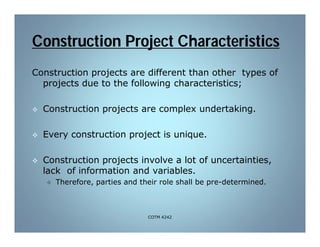
Construction projects are different than other types of
projects due to the following characteristics;
 Construction projects are complex undertaking.
 Every construction project is unique.
 Construction projects involve a lot of uncertainties,
lack of information and variables.
 Therefore, parties and their role shall be pre-determined.
COTM 4242
Traditional Vs Alternative Project
Delivery Methods
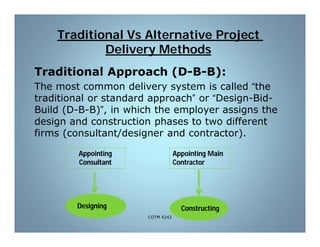
Traditional Approach (D-B-B):
The most common delivery system is called “the
traditional or standard approach” or “Design-Bid-
Build (D-B-B)”, in which the employer assigns the
design and construction phases to two different
firms (consultant/designer and contractor).
ConstructingDesigning
Appointing
Consultant
Appointing Main
Contractor
COTM 4242
Traditional Approach (D-B-B):
 For many years, DBB has been the most common method of
project delivery for public projects, and for many private projects
as well.
 Design-Bid-Build is effective on projects
 where the owner needs both professional design services and
construction services
 where the designer does not require detailed knowledge of the
means and methods of construction.
 DBB provides the owner with a high degree of control.
COTM 4242
B):-B-Traditional Approach (D
 The owner defines project goals and objectives, secures the financing,
and specifies the standards and contract terms.
 The owner may perform planning, conceptual design and full design,
or may engage an outside design professional (designer) for some or
all of these tasks.
 During this planning and preliminary stage, owner and designer work
as a team to obtain required permits and conduct necessary site
investigations.
 The designer prepares the construction bid documents to reflect the
owner’s project goals and objectives.
 Prospective contractors prepare their bids from these complete and
specific bid documents.
 The bidders submit their proposals to the owner, who determines the
most responsive (typically the lowest) bid meeting project
requirements.
 In certain circumstances, owner may be justified in selecting a
contractor outright and negotiating contract terms directly.
COTM 4242
Advantages of D-B-B Approach
 Applicable to a wide range of projects.
 Well established and easily understood.
 Clearly defined roles for all parties.
 Provides the lowest initial price that competitive
bidders can offer.
 Extensive litigation has resulted in well established
legal precedents.
 Insurance and bonding are well defined.
COTM 4242
B Approach-B-Disadvantages of D
 Least-cost approach requires higher level of inspection.
 Initial low bid might not result in ultimate lowest cost or
final best value.
 Designers may have limited knowledge of the true cost
and scheduling implication of design decisions.
COTM 4242
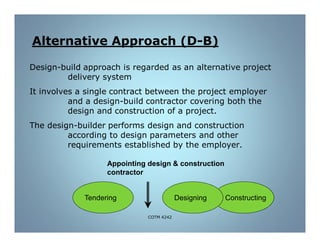
B)-Alternative Approach (D
Design-build approach is regarded as an alternative project
delivery system
It involves a single contract between the project employer
and a design-build contractor covering both the
design and construction of a project.
The design-builder performs design and construction
according to design parameters and other
requirements established by the employer.
ConstructingDesigning
Appointing design & construction
contractor
Tendering
COTM 4242
Design-Build Approach
 The owner contracts with a single entity to provide the design
and to construct the project.
 The contract might be negotiated with a single design-builder
or result from competitive proposals.
 The selection can be based on low price or on a set of value
criteria (experience, staff, bonding capacity, etc.).
 With the contractor playing a major role in design, costs are
typically defined and maintained to a greater degree, and the
coordination of fast-track management to achieve early
completion is greatly simplified.
 The design-builder makes many decisions that owner would
make under DBB, due to delegation of greatly increased
authority.
COTM 4242
Design-Build Approach
 For many owners, delegation of responsibilities leads to
satisfactory projects. However, if the parties are
inexperienced and do not cooperate, the transfer of control
and risk can be disappointing.
 The owner may need to restructure his/her internal
procedures to accommodate design-build approach.
 Compared to DBB, this involves a significantly different set
of requirements and expectations for process, timelines and
communications.
 A clear understanding and documentation of design-build
processes enhances the quality of design-build projects
COTM 4242
Advantage of Design-Build Approach
Innovation and quality improvements through:
- Alternative designs and construction methods
suited to the contractor’s capabilities
- Flexibility in the selection of design, materials, and
construction methods.
• Earlier schedule and cost certainty
COTM 4242
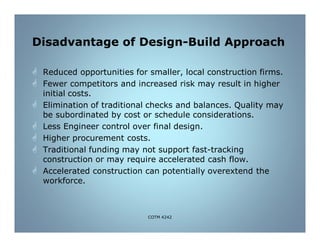
Disadvantage of Design-Build Approach
 Reduced opportunities for smaller, local construction firms.
 Fewer competitors and increased risk may result in higher
initial costs.
 Elimination of traditional checks and balances. Quality may
be subordinated by cost or schedule considerations.
 Less Engineer control over final design.
 Higher procurement costs.
 Traditional funding may not support fast-tracking
construction or may require accelerated cash flow.
 Accelerated construction can potentially overextend the
workforce.
COTM 4242
Others
 Turnkey
 Turnkey Variations
 Direct Labor Approach.
 Construction management
COTM 4242
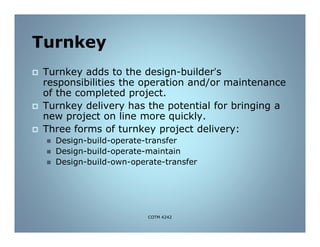
Turnkey
 Turnkey adds to the design-builder’s
responsibilities the operation and/or maintenance
of the completed project.
 Turnkey delivery has the potential for bringing a
new project on line more quickly.
 Three forms of turnkey project delivery:
 Design-build-operate-transfer
 Design-build-operate-maintain
 Design-build-own-operate-transfer
COTM 4242
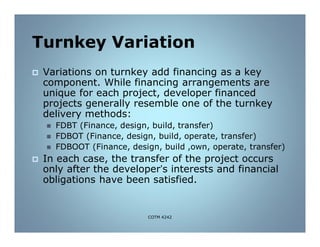
Turnkey Variation
 Variations on turnkey add financing as a key
component. While financing arrangements are
unique for each project, developer financed
projects generally resemble one of the turnkey
delivery methods:
 FDBT (Finance, design, build, transfer)
 FDBOT (Finance, design, build, operate, transfer)
 FDBOOT (Finance, design, build ,own, operate, transfer)
 In each case, the transfer of the project occurs
only after the developer’s interests and financial
obligations have been satisfied.
COTM 4242
Types of
Construction
Contracts
COTM 4242
Purpose of the contract
o Identify the parties
o Promises and responsibilities
o Scope of work
o Price and payment terms
o Commercial terms and conditions
o Project execution plan.
COTM 4242
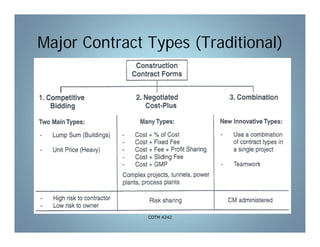
Major Contract Types (Traditional)
COTM 4242
Lump Sum Contract
 One price for the whole contract
 Lump sum includes costs plus overheads and profits
 Higher risk to contractor
 Price quoted is a guaranteed price as per contract
documents.
 Payment based on a scheduled percentage scheme
(monthly progress claims)
 The contractor is free to use means and methods to
complete the work and responsible for proper performance
 Work must be well defined at bid time.
 Fully developed plans and specifications
COTM 4242
Lump Sum Contract/ advantage
 Low risk on the owner, Higher risk to
the contractor
 Cost known at outset
 Contractor will assign best personnel
 Contractor selection is easy.
COTM 4242
Lump Sum Contract/disadvantage
 Changes is difficult and costly.
 Contractor is free to use the lowest cost of
material, equipment, and methods.
COTM 4242
Admeasurements/Unit Price Contracts
 Quote Rates / Prices by units
 No total final price
 Re-negotiate for rates if the quantity or work
considerably exceeds the initial target
 Payment to contractor is based on the measure.
 Unbalanced bids
 Higher risk to owner
 Ideal for work where quantities can not be
accurately established before construction starts.
COTM 4242
Admeasurements/Unit Price contract
 Require sufficient design definition to estimate
quantities of units
 Contractors bid based on units of works
 Time & cost risk (shared)
 Owner : at risk for total quantities
 Contractor : at risk for fixed unit price.
 Large quantity changes (>15-25%) can lead to
increase or decrease of price.
COTM 4242
Unit Price / Requirement
 Adequate breakdown and definition of work units
 Good quantity surveying and reporting system.
 Adequate drawings.
 Experience in developing BOQ
 Payment based on the measurement of the finished
works.
 Quantity sensitive analysis of unit prices to evaluate
total bid price for potential quantity variation.
COTM 4242
Unit Price / advantages
 Suitable for competitive bid
 Easy for contractor selection
 Flexibility : quantities and scope can be easily
adjusted
COTM 4242
Unit Price / disadvantages
Final cost not known from the beginning (BoQ
only is estimated)
Staff needed to measure the finished quantities
and report on the units not completed.
Unit price sometime tend to draw unbalanced bid.
(For Unit-Price Contracts, a balanced bid is one in which each bid
is priced to carry its share of the cost of the work and also its
share of the contractor’s profit.
Contractors raise prices on certain items and make corresponding
reductions of the prices on other items ,without changing the total
amount of the bid)
COTM 4242
Cost Plus
1. Actual cost plus a negotiated reimbursement to
cover overheads and profit.
2. different methods of reimbursement :
Cost + percentage
Cost + fixed fee
Cost + fixed fee + profit-sharing clause.
3. Higher risk to owner
4. Compromise: guaranteed maximum price (GMP)
reduces risk to owner while maintain advantage
of cost plus contract.
5. By using this type of contract the contractor can start
work without a clearly defined project scope, since all
costs will be reimbursed and a profit guaranteed.
COTM 4242
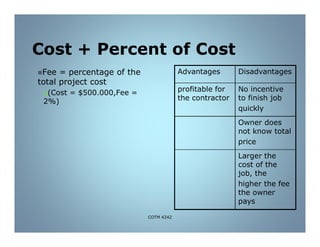
Cost + Percent of Cost
Fee = percentage of the
total project cost
(Cost = $500.000,Fee =
2%)
Advantages Disadvantages
profitable for
the contractor
No incentive
to finish job
quickly
Owner does
not know total
price
Larger the
cost of the
job, the
higher the fee
the owner
pays
COTM 4242
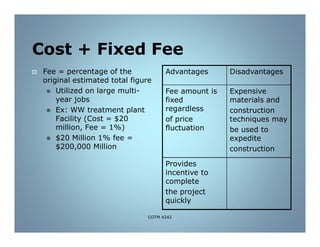
Cost + Fixed Fee
 Fee = percentage of the
original estimated total figure
 Utilized on large multi-
year jobs
 Ex: WW treatment plant
Facility (Cost = $20
million, Fee = 1%)
 $20 Million 1% fee =
$200,000 Million
Advantages Disadvantages
Fee amount is
fixed
regardless
of price
fluctuation
Expensive
materials and
construction
techniques may
be used to
expedite
construction
Provides
incentive to
complete
the project
quickly
COTM 4242
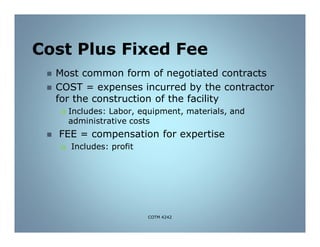
Cost Plus Fixed Fee
 Most common form of negotiated contracts
 COST = expenses incurred by the contractor
for the construction of the facility
 Includes: Labor, equipment, materials, and
administrative costs
 FEE = compensation for expertise
 Includes: profit
COTM 4242
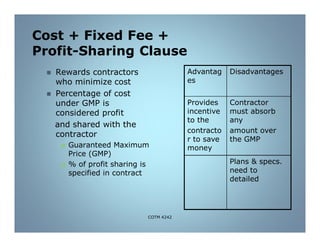
Cost + Fixed Fee +
Profit-Sharing Clause
 Rewards contractors
who minimize cost
 Percentage of cost
under GMP is
considered profit
and shared with the
contractor
 Guaranteed Maximum
Price (GMP)
 % of profit sharing is
specified in contract
Advantag
es
Disadvantages
Provides
incentive
to the
contracto
r to save
money
Contractor
must absorb
any
amount over
the GMP
Plans & specs.
need to
detailed
COTM 4242
Cost + Fixed Fee +
Profit-Sharing Clause
variation of this type of contract is called a guaranteed
maximum price (GMP).
 In this type of contract the contractor is reimbursed at cost
with an agreed-upon fee up to the GMP, which is essentially
a cap; beyond this point the contractor is responsible for
covering any additional costs within the original project
scope
 An incentive clause, which specifies that the contractor
will receive additional profit for bringing the project in
under the GMP.
COTM 4242
Content of a Contract Document
 Contract Documents
 Contract Forms
 Conditions of the Contract
 Specifications
 Drawings
 Addenda
 Change Orders
 Agreement.
COTM 4242
Construction Documents
 Construction Contract Documents are defined as the
written and graphic documents prepared or assembled by
the A/E for communicating the design of the project and
administering the contract for its construction.
 Contract Documents:
Legally enforceable requirements that become part
of the contract
Include all construction documents except bidding
forms
COTM 4242
Assignment (2)
 Describe the turnkey methods and
turnkey variation methods highlighting on
advantage and disadvantage of each one.
 Differentiate between Lump sum,
Admeasurements, and Cost Plus
contracts. Discuss in terms of advantage
and disadvantage of each contract.
Submission date: 21st April 2017
COTM 4242
Thank You
COTM 4242

Chapter 3 [compatibility mode]

  • 1.
    Project Delivery Methods Collegeof Engineering, Construction Technology and Management Department Lecture by: Andualem Endris (M.Sc) @yahoo.com0117andu Madawalabu University Procurement Management and Contract Administration CoTM 4242 Chapter Three COTM 4242
  • 2.
    Construction Project Characteristics Constructionprojects are different than other types of projects due to the following characteristics;  Construction projects are complex undertaking.  Every construction project is unique.  Construction projects involve a lot of uncertainties, lack of information and variables.  Therefore, parties and their role shall be pre-determined. COTM 4242
  • 3.
    Traditional Vs AlternativeProject Delivery Methods Traditional Approach (D-B-B): The most common delivery system is called “the traditional or standard approach” or “Design-Bid- Build (D-B-B)”, in which the employer assigns the design and construction phases to two different firms (consultant/designer and contractor). ConstructingDesigning Appointing Consultant Appointing Main Contractor COTM 4242
  • 4.
    Traditional Approach (D-B-B): For many years, DBB has been the most common method of project delivery for public projects, and for many private projects as well.  Design-Bid-Build is effective on projects  where the owner needs both professional design services and construction services  where the designer does not require detailed knowledge of the means and methods of construction.  DBB provides the owner with a high degree of control. COTM 4242
  • 5.
    B):-B-Traditional Approach (D The owner defines project goals and objectives, secures the financing, and specifies the standards and contract terms.  The owner may perform planning, conceptual design and full design, or may engage an outside design professional (designer) for some or all of these tasks.  During this planning and preliminary stage, owner and designer work as a team to obtain required permits and conduct necessary site investigations.  The designer prepares the construction bid documents to reflect the owner’s project goals and objectives.  Prospective contractors prepare their bids from these complete and specific bid documents.  The bidders submit their proposals to the owner, who determines the most responsive (typically the lowest) bid meeting project requirements.  In certain circumstances, owner may be justified in selecting a contractor outright and negotiating contract terms directly. COTM 4242
  • 6.
    Advantages of D-B-BApproach  Applicable to a wide range of projects.  Well established and easily understood.  Clearly defined roles for all parties.  Provides the lowest initial price that competitive bidders can offer.  Extensive litigation has resulted in well established legal precedents.  Insurance and bonding are well defined. COTM 4242
  • 7.
    B Approach-B-Disadvantages ofD  Least-cost approach requires higher level of inspection.  Initial low bid might not result in ultimate lowest cost or final best value.  Designers may have limited knowledge of the true cost and scheduling implication of design decisions. COTM 4242
  • 8.
    B)-Alternative Approach (D Design-buildapproach is regarded as an alternative project delivery system It involves a single contract between the project employer and a design-build contractor covering both the design and construction of a project. The design-builder performs design and construction according to design parameters and other requirements established by the employer. ConstructingDesigning Appointing design & construction contractor Tendering COTM 4242
  • 9.
    Design-Build Approach  Theowner contracts with a single entity to provide the design and to construct the project.  The contract might be negotiated with a single design-builder or result from competitive proposals.  The selection can be based on low price or on a set of value criteria (experience, staff, bonding capacity, etc.).  With the contractor playing a major role in design, costs are typically defined and maintained to a greater degree, and the coordination of fast-track management to achieve early completion is greatly simplified.  The design-builder makes many decisions that owner would make under DBB, due to delegation of greatly increased authority. COTM 4242
  • 10.
    Design-Build Approach  Formany owners, delegation of responsibilities leads to satisfactory projects. However, if the parties are inexperienced and do not cooperate, the transfer of control and risk can be disappointing.  The owner may need to restructure his/her internal procedures to accommodate design-build approach.  Compared to DBB, this involves a significantly different set of requirements and expectations for process, timelines and communications.  A clear understanding and documentation of design-build processes enhances the quality of design-build projects COTM 4242
  • 11.
    Advantage of Design-BuildApproach Innovation and quality improvements through: - Alternative designs and construction methods suited to the contractor’s capabilities - Flexibility in the selection of design, materials, and construction methods. • Earlier schedule and cost certainty COTM 4242
  • 12.
    Disadvantage of Design-BuildApproach  Reduced opportunities for smaller, local construction firms.  Fewer competitors and increased risk may result in higher initial costs.  Elimination of traditional checks and balances. Quality may be subordinated by cost or schedule considerations.  Less Engineer control over final design.  Higher procurement costs.  Traditional funding may not support fast-tracking construction or may require accelerated cash flow.  Accelerated construction can potentially overextend the workforce. COTM 4242
  • 13.
    Others  Turnkey  TurnkeyVariations  Direct Labor Approach.  Construction management COTM 4242
  • 14.
    Turnkey  Turnkey addsto the design-builder’s responsibilities the operation and/or maintenance of the completed project.  Turnkey delivery has the potential for bringing a new project on line more quickly.  Three forms of turnkey project delivery:  Design-build-operate-transfer  Design-build-operate-maintain  Design-build-own-operate-transfer COTM 4242
  • 15.
    Turnkey Variation  Variationson turnkey add financing as a key component. While financing arrangements are unique for each project, developer financed projects generally resemble one of the turnkey delivery methods:  FDBT (Finance, design, build, transfer)  FDBOT (Finance, design, build, operate, transfer)  FDBOOT (Finance, design, build ,own, operate, transfer)  In each case, the transfer of the project occurs only after the developer’s interests and financial obligations have been satisfied. COTM 4242
  • 16.
  • 17.
    Purpose of thecontract o Identify the parties o Promises and responsibilities o Scope of work o Price and payment terms o Commercial terms and conditions o Project execution plan. COTM 4242
  • 18.
    Major Contract Types(Traditional) COTM 4242
  • 19.
    Lump Sum Contract One price for the whole contract  Lump sum includes costs plus overheads and profits  Higher risk to contractor  Price quoted is a guaranteed price as per contract documents.  Payment based on a scheduled percentage scheme (monthly progress claims)  The contractor is free to use means and methods to complete the work and responsible for proper performance  Work must be well defined at bid time.  Fully developed plans and specifications COTM 4242
  • 20.
    Lump Sum Contract/advantage  Low risk on the owner, Higher risk to the contractor  Cost known at outset  Contractor will assign best personnel  Contractor selection is easy. COTM 4242
  • 21.
    Lump Sum Contract/disadvantage Changes is difficult and costly.  Contractor is free to use the lowest cost of material, equipment, and methods. COTM 4242
  • 22.
    Admeasurements/Unit Price Contracts Quote Rates / Prices by units  No total final price  Re-negotiate for rates if the quantity or work considerably exceeds the initial target  Payment to contractor is based on the measure.  Unbalanced bids  Higher risk to owner  Ideal for work where quantities can not be accurately established before construction starts. COTM 4242
  • 23.
    Admeasurements/Unit Price contract Require sufficient design definition to estimate quantities of units  Contractors bid based on units of works  Time & cost risk (shared)  Owner : at risk for total quantities  Contractor : at risk for fixed unit price.  Large quantity changes (>15-25%) can lead to increase or decrease of price. COTM 4242
  • 24.
    Unit Price /Requirement  Adequate breakdown and definition of work units  Good quantity surveying and reporting system.  Adequate drawings.  Experience in developing BOQ  Payment based on the measurement of the finished works.  Quantity sensitive analysis of unit prices to evaluate total bid price for potential quantity variation. COTM 4242
  • 25.
    Unit Price /advantages  Suitable for competitive bid  Easy for contractor selection  Flexibility : quantities and scope can be easily adjusted COTM 4242
  • 26.
    Unit Price /disadvantages Final cost not known from the beginning (BoQ only is estimated) Staff needed to measure the finished quantities and report on the units not completed. Unit price sometime tend to draw unbalanced bid. (For Unit-Price Contracts, a balanced bid is one in which each bid is priced to carry its share of the cost of the work and also its share of the contractor’s profit. Contractors raise prices on certain items and make corresponding reductions of the prices on other items ,without changing the total amount of the bid) COTM 4242
  • 27.
    Cost Plus 1. Actualcost plus a negotiated reimbursement to cover overheads and profit. 2. different methods of reimbursement : Cost + percentage Cost + fixed fee Cost + fixed fee + profit-sharing clause. 3. Higher risk to owner 4. Compromise: guaranteed maximum price (GMP) reduces risk to owner while maintain advantage of cost plus contract. 5. By using this type of contract the contractor can start work without a clearly defined project scope, since all costs will be reimbursed and a profit guaranteed. COTM 4242
  • 28.
    Cost + Percentof Cost Fee = percentage of the total project cost (Cost = $500.000,Fee = 2%) Advantages Disadvantages profitable for the contractor No incentive to finish job quickly Owner does not know total price Larger the cost of the job, the higher the fee the owner pays COTM 4242
  • 29.
    Cost + FixedFee  Fee = percentage of the original estimated total figure  Utilized on large multi- year jobs  Ex: WW treatment plant Facility (Cost = $20 million, Fee = 1%)  $20 Million 1% fee = $200,000 Million Advantages Disadvantages Fee amount is fixed regardless of price fluctuation Expensive materials and construction techniques may be used to expedite construction Provides incentive to complete the project quickly COTM 4242
  • 30.
    Cost Plus FixedFee  Most common form of negotiated contracts  COST = expenses incurred by the contractor for the construction of the facility  Includes: Labor, equipment, materials, and administrative costs  FEE = compensation for expertise  Includes: profit COTM 4242
  • 31.
    Cost + FixedFee + Profit-Sharing Clause  Rewards contractors who minimize cost  Percentage of cost under GMP is considered profit and shared with the contractor  Guaranteed Maximum Price (GMP)  % of profit sharing is specified in contract Advantag es Disadvantages Provides incentive to the contracto r to save money Contractor must absorb any amount over the GMP Plans & specs. need to detailed COTM 4242
  • 32.
    Cost + FixedFee + Profit-Sharing Clause variation of this type of contract is called a guaranteed maximum price (GMP).  In this type of contract the contractor is reimbursed at cost with an agreed-upon fee up to the GMP, which is essentially a cap; beyond this point the contractor is responsible for covering any additional costs within the original project scope  An incentive clause, which specifies that the contractor will receive additional profit for bringing the project in under the GMP. COTM 4242
  • 33.
    Content of aContract Document  Contract Documents  Contract Forms  Conditions of the Contract  Specifications  Drawings  Addenda  Change Orders  Agreement. COTM 4242
  • 34.
    Construction Documents  ConstructionContract Documents are defined as the written and graphic documents prepared or assembled by the A/E for communicating the design of the project and administering the contract for its construction.  Contract Documents: Legally enforceable requirements that become part of the contract Include all construction documents except bidding forms COTM 4242
  • 35.
    Assignment (2)  Describethe turnkey methods and turnkey variation methods highlighting on advantage and disadvantage of each one.  Differentiate between Lump sum, Admeasurements, and Cost Plus contracts. Discuss in terms of advantage and disadvantage of each contract. Submission date: 21st April 2017 COTM 4242
  • 36.