Consulting Engineering Industry and
Application of FIDIC Forms of Contract :
The Ukrainian Dimension at a Glance
Svitlana Teush, PhD
Senior Associate
Arzinger Law Office, Kyiv , Ukraine
FIDIC-ARIC-EFCA Regional Infrastructure Conference, Bucharest, March, 2015
Consulting Engineering Industry:
Current Reality and Trends
2
 A handful of full-fledged consulting engineers capable of
meeting FIDIC standards
 Trust, qualification, expertise and awareness issues
 Nascent institutionalization and self-governance of the
engineering industry
 Targeted alignment with the international standards and
practices
 Reforms in transition - extreme agility of performers in
demand: New design and construction standards, energy
efficiency and sustainability agenda, modifications in service
provision and cooperation patterns, etc.
 Peculiarities of the local association of consulting engineers
FIDIC-ARIC-EFCA Regional Infrastructure Conference, Bucharest, March, 2015
Use of FIDIC forms of contract in Ukraine
3
 Limited and cautious use of FIDIC forms of contract, primarily,
in infrastructural projects
 International institutional lenders (MDB) act as the main
driver
 Red Book and Yellow Book are most commonly used
 Lack of clear guidance, explanatory notes, case law/
established court precedents
 Lack of established and demanding operational environment
(a handuful of infrastructural projects, PPPs underused)
 Practical difficulties at the implementation stage and during
audits by controlling authorities, in courts: literacy campaign
in need
 Engineer’s role and functions are not properly understood
FIDIC-ARIC-EFCA Regional Infrastructure Conference, Bucharest, March, 2015
Use of FIDIC forms of contract in Ukraine. – Cntd.
4
 Mandatory rules vs. FIDIC conditions of contract (where
divergent). Civil law issues
 Special legislative limitations re projects with public
authorities/public finance involved: e.g., standards of supporting
documents, special approval procedures, restrictions on contract amendments, etc.
 Lack of the ready and tested adjustment techniques and of
assessment of the affordable degree of adjustments
 Language barrier
 Comprehension and terminology issues
 Mentality and custom
 Contract administration
FIDIC-ARIC-EFCA Regional Infrastructure Conference, Bucharest, March, 2015
Risks Allocation and Management
5
 No ramified risk allocation patterns established in legal
concept
 “Dressing” solutions suggested or even imposed for certain
generalized categories of claims / under categories of cases,
which may be invoked where a contract is silent (e.g., a material
change in circumstances, force majeure, etc.)
 Case-by-case approach to pre-assess a claim or procedure in
light of how applicable rules and conditions of contract
compare
 Intermittent “Suspend-terminate” solutions suggested by law:
how does it compare with contract procedures?
FIDIC-ARIC-EFCA Regional Infrastructure Conference, Bucharest, March, 2015
Risks Allocation and Management. – Cntd.
6
EXAMPLES:
Claims regarding the time of works’ performance
§ If the Contractor fails to commence works in a timely manner or performs it so
slowly that it becomes clear that it cannot be performed in a timely manner, the
Employer has the right to terminate the contract and to claim damages.
If, during performance of work, it becomes obvious that the work will not be
properly performed, the Employer has the right to appoint the defects remedial term
and, in case of non-compliance by the Contractor, to terminate the contract and
claim damages or appoint a third party to perform works at the Contractor’s costs.
(Art. 849 of Civil Code of Ukraine)
FIDIC-ARIC-EFCA Regional Infrastructure Conference, Bucharest, March, 2015
Risks Allocation and Management. – Cntd.
7
Claims regarding the Employer’s instructions or supply of
materials by the Employer
§ If the use of improper or faulty materials, or compliance with the Employer’s
instructions presents danger to life or health, or entails a breach of ecological,
sanitary rules, security or other requirements , the Contractor shall be obliged to
terminate the contract, while retaining the entitlement to claim damages.
(Art. 848 of the Civil Code of Ukraine)
FIDIC-ARIC-EFCA Regional Infrastructure Conference, Bucharest, March, 2015
Risks Allocation and Management. – Cntd.
8
Claims regarding payment of additional works caused by design
amendment
§ The Employer has the right to amend design documentation before
commencement or during performance of works, provided that additional works
caused by such amendments will not exceed 10% of the cost estimate and will not
change the nature of works. Should the cost of such additional works exceed 10%
of the cost estimate, such amendments are subject to agreement with the Contractor.
The Contractor shall have the right to terminate the contract and claim damages.
(Art. 878 of the Civil Code of Ukraine)
FIDIC-ARIC-EFCA Regional Infrastructure Conference, Bucharest, March, 2015
Construction Disputes Resolution:
Current Approaches and Trends
9
 Litigation in national courts prevails over international arbitration. Yet:
growing preference for arbitration in international commercial disputes (ICC,
LCIA, VIAC etc.)
• Institutional arbitration in Ukraine:
– International Commercial Arbitration Court at the Ukrainian Chamber of Commerce and
Industry
– Maritime Arbitration Commission at the Ukrainian Chamber of Commerce and Industry
 Complex and protracted proceedings
 Judges/arbitrators lack expert knowledge and relevant practice
 No institutions specialized in handling construction disputes
 Technical expert examination is often an issue
 Lack of relevant “case-law” / well-established precedents
FIDIC-ARIC-EFCA Regional Infrastructure Conference, Bucharest, March, 2015
Construction Disputes Resolution:
Current Approaches and Trends. – Cntd.
10
 Mediation:
 Rudimentary stage of development
 Not prohibited, yet not commonly used
 No special legislation on mediation
 Enforceability issue
 Draft bills on mediation registered in Parliament in 2013
 Mediation promotion and advocacy (Ukrainian Mediation Center)
 Investment treaty arbitration (ICSID, BIT ) can be invoked in a
dispute against the State /state authorities:
e.g., on grounds of expropriation or violation of FIT (fair and equitable
treatment standards)
FIDIC-ARIC-EFCA Regional Infrastructure Conference, Bucharest, March, 2015
CASE STUDY: Transport Infrastructure project
 Based on „Yellow Book“ (Design-Build delivery method), MBR-
funded
 Engineer‘s liability and warranties
 Coherence and correlation between different instruments is an
issue
 Delay damages:
Substantiation and enforceability issues
 Security instruments:
Efficiency and enforceability issues
 Engineer‘s determination preserved subject to efficiency and
enforceability issues. DAB deleted. Disputes to be resolved by local
commercial courts.
11FIDIC-ARIC-EFCA Regional Infrastructure Conference, Bucharest, March, 2015
CASE STUDY: Transport Infrastructure project. - Cntd.
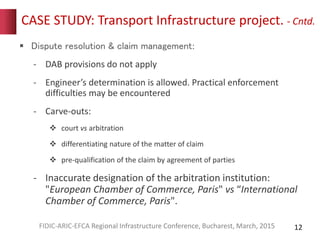
 Dispute resolution & claim management:
- DAB provisions do not apply
- Engineer’s determination is allowed. Practical enforcement
difficulties may be encountered
- Carve-outs:
 court vs arbitration
 differentiating nature of the matter of claim
 pre-qualification of the claim by agreement of parties
- Inaccurate designation of the arbitration institution:
"European Chamber of Commerce, Paris" vs “International
Chamber of Commerce, Paris".
12FIDIC-ARIC-EFCA Regional Infrastructure Conference, Bucharest, March, 2015
CASE STUDY: Transport Infrastructure project. - Cntd.
13
FIDIC-ARIC-EFCA Regional Infrastructure Conference, Bucharest, March, 2015
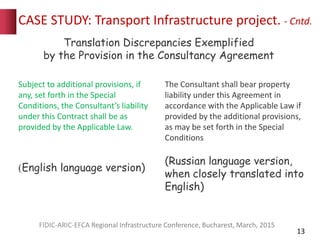
Subject to additional provisions, if
any, set forth in the Special
Conditions, the Consultant’s liability
under this Contract shall be as
provided by the Applicable Law.
(English language version)
The Consultant shall bear property
liability under this Agreement in
accordance with the Applicable Law if
provided by the additional provisions,
as may be set forth in the Special
Conditions
(Russian language version,
when closely translated into
English)
Translation Discrepancies Exemplified
by the Provision in the Consultancy Agreement
Challenges and Tasks Faced
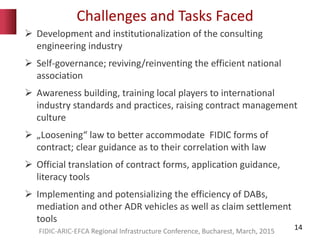
 Development and institutionalization of the consulting
engineering industry
 Self-governance; reviving/reinventing the efficient national
association
 Awareness building, training local players to international
industry standards and practices, raising contract management
culture
 „Loosening“ law to better accommodate FIDIC forms of
contract; clear guidance as to their correlation with law
 Official translation of contract forms, application guidance,
literacy tools
 Implementing and potensializing the efficiency of DABs,
mediation and other ADR vehicles as well as claim settlement
tools
14FIDIC-ARIC-EFCA Regional Infrastructure Conference, Bucharest, March, 2015
Thank you for your attention!
15

Presentation Teush

  • 1.
    Consulting Engineering Industryand Application of FIDIC Forms of Contract : The Ukrainian Dimension at a Glance Svitlana Teush, PhD Senior Associate Arzinger Law Office, Kyiv , Ukraine FIDIC-ARIC-EFCA Regional Infrastructure Conference, Bucharest, March, 2015
  • 2.
    Consulting Engineering Industry: CurrentReality and Trends 2  A handful of full-fledged consulting engineers capable of meeting FIDIC standards  Trust, qualification, expertise and awareness issues  Nascent institutionalization and self-governance of the engineering industry  Targeted alignment with the international standards and practices  Reforms in transition - extreme agility of performers in demand: New design and construction standards, energy efficiency and sustainability agenda, modifications in service provision and cooperation patterns, etc.  Peculiarities of the local association of consulting engineers FIDIC-ARIC-EFCA Regional Infrastructure Conference, Bucharest, March, 2015
  • 3.
    Use of FIDICforms of contract in Ukraine 3  Limited and cautious use of FIDIC forms of contract, primarily, in infrastructural projects  International institutional lenders (MDB) act as the main driver  Red Book and Yellow Book are most commonly used  Lack of clear guidance, explanatory notes, case law/ established court precedents  Lack of established and demanding operational environment (a handuful of infrastructural projects, PPPs underused)  Practical difficulties at the implementation stage and during audits by controlling authorities, in courts: literacy campaign in need  Engineer’s role and functions are not properly understood FIDIC-ARIC-EFCA Regional Infrastructure Conference, Bucharest, March, 2015
  • 4.
    Use of FIDICforms of contract in Ukraine. – Cntd. 4  Mandatory rules vs. FIDIC conditions of contract (where divergent). Civil law issues  Special legislative limitations re projects with public authorities/public finance involved: e.g., standards of supporting documents, special approval procedures, restrictions on contract amendments, etc.  Lack of the ready and tested adjustment techniques and of assessment of the affordable degree of adjustments  Language barrier  Comprehension and terminology issues  Mentality and custom  Contract administration FIDIC-ARIC-EFCA Regional Infrastructure Conference, Bucharest, March, 2015
  • 5.
    Risks Allocation andManagement 5  No ramified risk allocation patterns established in legal concept  “Dressing” solutions suggested or even imposed for certain generalized categories of claims / under categories of cases, which may be invoked where a contract is silent (e.g., a material change in circumstances, force majeure, etc.)  Case-by-case approach to pre-assess a claim or procedure in light of how applicable rules and conditions of contract compare  Intermittent “Suspend-terminate” solutions suggested by law: how does it compare with contract procedures? FIDIC-ARIC-EFCA Regional Infrastructure Conference, Bucharest, March, 2015
  • 6.
    Risks Allocation andManagement. – Cntd. 6 EXAMPLES: Claims regarding the time of works’ performance § If the Contractor fails to commence works in a timely manner or performs it so slowly that it becomes clear that it cannot be performed in a timely manner, the Employer has the right to terminate the contract and to claim damages. If, during performance of work, it becomes obvious that the work will not be properly performed, the Employer has the right to appoint the defects remedial term and, in case of non-compliance by the Contractor, to terminate the contract and claim damages or appoint a third party to perform works at the Contractor’s costs. (Art. 849 of Civil Code of Ukraine) FIDIC-ARIC-EFCA Regional Infrastructure Conference, Bucharest, March, 2015
  • 7.
    Risks Allocation andManagement. – Cntd. 7 Claims regarding the Employer’s instructions or supply of materials by the Employer § If the use of improper or faulty materials, or compliance with the Employer’s instructions presents danger to life or health, or entails a breach of ecological, sanitary rules, security or other requirements , the Contractor shall be obliged to terminate the contract, while retaining the entitlement to claim damages. (Art. 848 of the Civil Code of Ukraine) FIDIC-ARIC-EFCA Regional Infrastructure Conference, Bucharest, March, 2015
  • 8.
    Risks Allocation andManagement. – Cntd. 8 Claims regarding payment of additional works caused by design amendment § The Employer has the right to amend design documentation before commencement or during performance of works, provided that additional works caused by such amendments will not exceed 10% of the cost estimate and will not change the nature of works. Should the cost of such additional works exceed 10% of the cost estimate, such amendments are subject to agreement with the Contractor. The Contractor shall have the right to terminate the contract and claim damages. (Art. 878 of the Civil Code of Ukraine) FIDIC-ARIC-EFCA Regional Infrastructure Conference, Bucharest, March, 2015
  • 9.
    Construction Disputes Resolution: CurrentApproaches and Trends 9  Litigation in national courts prevails over international arbitration. Yet: growing preference for arbitration in international commercial disputes (ICC, LCIA, VIAC etc.) • Institutional arbitration in Ukraine: – International Commercial Arbitration Court at the Ukrainian Chamber of Commerce and Industry – Maritime Arbitration Commission at the Ukrainian Chamber of Commerce and Industry  Complex and protracted proceedings  Judges/arbitrators lack expert knowledge and relevant practice  No institutions specialized in handling construction disputes  Technical expert examination is often an issue  Lack of relevant “case-law” / well-established precedents FIDIC-ARIC-EFCA Regional Infrastructure Conference, Bucharest, March, 2015
  • 10.
    Construction Disputes Resolution: CurrentApproaches and Trends. – Cntd. 10  Mediation:  Rudimentary stage of development  Not prohibited, yet not commonly used  No special legislation on mediation  Enforceability issue  Draft bills on mediation registered in Parliament in 2013  Mediation promotion and advocacy (Ukrainian Mediation Center)  Investment treaty arbitration (ICSID, BIT ) can be invoked in a dispute against the State /state authorities: e.g., on grounds of expropriation or violation of FIT (fair and equitable treatment standards) FIDIC-ARIC-EFCA Regional Infrastructure Conference, Bucharest, March, 2015
  • 11.
    CASE STUDY: TransportInfrastructure project  Based on „Yellow Book“ (Design-Build delivery method), MBR- funded  Engineer‘s liability and warranties  Coherence and correlation between different instruments is an issue  Delay damages: Substantiation and enforceability issues  Security instruments: Efficiency and enforceability issues  Engineer‘s determination preserved subject to efficiency and enforceability issues. DAB deleted. Disputes to be resolved by local commercial courts. 11FIDIC-ARIC-EFCA Regional Infrastructure Conference, Bucharest, March, 2015
  • 12.
    CASE STUDY: TransportInfrastructure project. - Cntd.  Dispute resolution & claim management: - DAB provisions do not apply - Engineer’s determination is allowed. Practical enforcement difficulties may be encountered - Carve-outs:  court vs arbitration  differentiating nature of the matter of claim  pre-qualification of the claim by agreement of parties - Inaccurate designation of the arbitration institution: "European Chamber of Commerce, Paris" vs “International Chamber of Commerce, Paris". 12FIDIC-ARIC-EFCA Regional Infrastructure Conference, Bucharest, March, 2015
  • 13.
    CASE STUDY: TransportInfrastructure project. - Cntd. 13 FIDIC-ARIC-EFCA Regional Infrastructure Conference, Bucharest, March, 2015 Subject to additional provisions, if any, set forth in the Special Conditions, the Consultant’s liability under this Contract shall be as provided by the Applicable Law. (English language version) The Consultant shall bear property liability under this Agreement in accordance with the Applicable Law if provided by the additional provisions, as may be set forth in the Special Conditions (Russian language version, when closely translated into English) Translation Discrepancies Exemplified by the Provision in the Consultancy Agreement
  • 14.
    Challenges and TasksFaced  Development and institutionalization of the consulting engineering industry  Self-governance; reviving/reinventing the efficient national association  Awareness building, training local players to international industry standards and practices, raising contract management culture  „Loosening“ law to better accommodate FIDIC forms of contract; clear guidance as to their correlation with law  Official translation of contract forms, application guidance, literacy tools  Implementing and potensializing the efficiency of DABs, mediation and other ADR vehicles as well as claim settlement tools 14FIDIC-ARIC-EFCA Regional Infrastructure Conference, Bucharest, March, 2015
  • 15.
    Thank you foryour attention! 15