Madawalabu
Madawalabu
University
University
Construction Equipment and Plant Management
COTM 4202
General
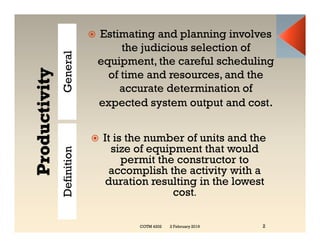
 Estimating and planning involves
the judicious selection of
equipment, the careful scheduling
of time and resources, and the
accurate determination of
expected system output and cost.
Definition
 It is the number of units and the
size of equipment that would
permit the constructor to
accomplish the activity with a
duration resulting in the lowest
cost.
2 February 2019 2
COTM 4202
 Haul unit horsepower
 Haul road rolling resistance
 Haul road grades
 Haul unit loaded and empty weight
 Haul unit transmission characteristics
 Haul unit loading time
 Haul unit travel time
 Haul unit delay time
 Altitude of the project site
 Haul unit horsepower
 Haul road rolling resistance
 Haul road grades
 Haul unit loaded and empty weight
 Haul unit transmission characteristics
 Haul unit loading time
 Haul unit travel time
 Haul unit delay time
 Altitude of the project site
2 February 2019
COTM 4202 3
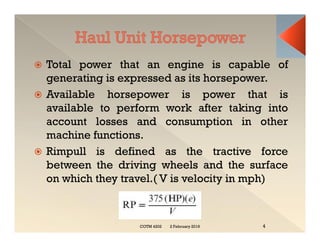
 Total power that an engine is capable of
generating is expressed as its horsepower.
 Available horsepower is power that is
available to perform work after taking into
account losses and consumption in other
machine functions.
 Rimpull is defined as the tractive force
between the driving wheels and the surface
on which they travel.( V is velocity in mph)
 Total power that an engine is capable of
generating is expressed as its horsepower.
 Available horsepower is power that is
available to perform work after taking into
account losses and consumption in other
machine functions.
 Rimpull is defined as the tractive force
between the driving wheels and the surface
on which they travel.( V is velocity in mph)
2 February 2019
COTM 4202 4
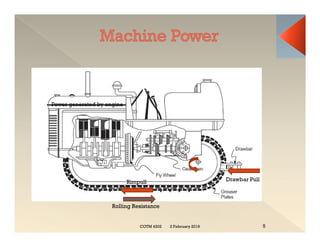
Power generated by engine
2 February 2019
COTM 4202 5
Drawbar Pull
Rolling Resistance
Rimpull
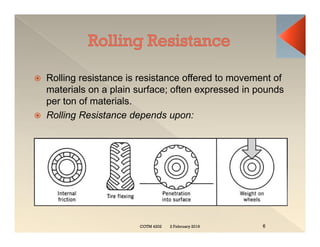
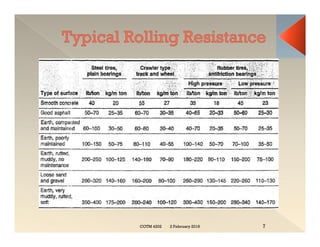
 Rolling resistance is resistance offered to movement of
materials on a plain surface; often expressed in pounds
per ton of materials.
 Rolling Resistance depends upon:
2 February 2019
COTM 4202 6
2 February 2019
COTM 4202 7
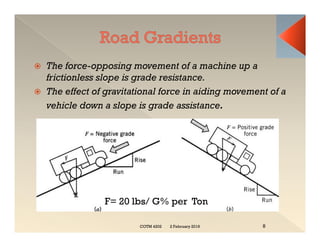
 The force-opposing movement of a machine up a
frictionless slope is grade resistance.
 The effect of gravitational force in aiding movement of a
vehicle down a slope is grade assistance.
2 February 2019
COTM 4202 8
F= 20 lbs/ G% per Ton
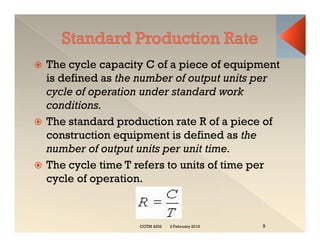
 The cycle capacity C of a piece of equipment
is defined as the number of output units per
cycle of operation under standard work
conditions.
 The standard production rate R of a piece of
construction equipment is defined as the
number of output units per unit time.
 The cycle time T refers to units of time per
cycle of operation.
 The cycle capacity C of a piece of equipment
is defined as the number of output units per
cycle of operation under standard work
conditions.
 The standard production rate R of a piece of
construction equipment is defined as the
number of output units per unit time.
 The cycle time T refers to units of time per
cycle of operation.
2 February 2019
COTM 4202 9
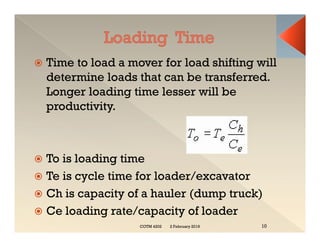
 Time to load a mover for load shifting will
determine loads that can be transferred.
Longer loading time lesser will be
productivity.
 To is loading time
 Te is cycle time for loader/excavator
 Ch is capacity of a hauler (dump truck)
 Ce loading rate/capacity of loader
 Time to load a mover for load shifting will
determine loads that can be transferred.
Longer loading time lesser will be
productivity.
 To is loading time
 Te is cycle time for loader/excavator
 Ch is capacity of a hauler (dump truck)
 Ce loading rate/capacity of loader
2 February 2019
COTM 4202 10
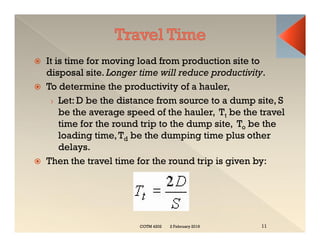
 It is time for moving load from production site to
disposal site. Longer time will reduce productivity.
 To determine the productivity of a hauler,
› Let: D be the distance from source to a dump site, S
be the average speed of the hauler, Tt be the travel
time for the round trip to the dump site, To be the
loading time,Td be the dumping time plus other
delays.
 Then the travel time for the round trip is given by:
 It is time for moving load from production site to
disposal site. Longer time will reduce productivity.
 To determine the productivity of a hauler,
› Let: D be the distance from source to a dump site, S
be the average speed of the hauler, Tt be the travel
time for the round trip to the dump site, To be the
loading time,Td be the dumping time plus other
delays.
 Then the travel time for the round trip is given by:
2 February 2019
COTM 4202 11
 Human and machine system suffer from
inherent delays due to reaction time and
capacity, say Td.
2 February 2019
COTM 4202 12
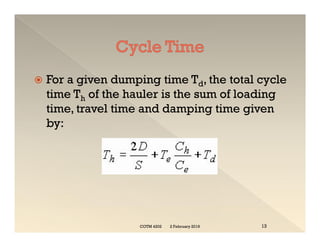
 For a given dumping time Td, the total cycle
time Th of the hauler is the sum of loading
time, travel time and damping time given
by:
 For a given dumping time Td, the total cycle
time Th of the hauler is the sum of loading
time, travel time and damping time given
by:
2 February 2019
COTM 4202 13
 Optimum number of haul units (N) is
determined by:
 NB: Rounding down will maximize haul unit
productivity.
 Optimum number of haul units (N) is
determined by:
 NB: Rounding down will maximize haul unit
productivity.
2 February 2019
COTM 4202 14
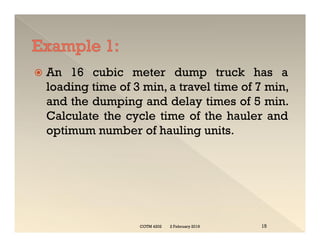
 An 16 cubic meter dump truck has a
loading time of 3 min, a travel time of 7 min,
and the dumping and delay times of 5 min.
Calculate the cycle time of the hauler and
optimum number of hauling units.
 An 16 cubic meter dump truck has a
loading time of 3 min, a travel time of 7 min,
and the dumping and delay times of 5 min.
Calculate the cycle time of the hauler and
optimum number of hauling units.
2 February 2019
COTM 4202 15
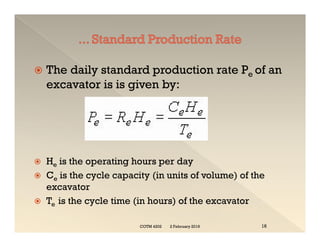
 The daily standard production rate Pe of an
excavator is is given by:
 He is the operating hours per day
 Ce is the cycle capacity (in units of volume) of the
excavator
 Te is the cycle time (in hours) of the excavator
 The daily standard production rate Pe of an
excavator is is given by:
 He is the operating hours per day
 Ce is the cycle capacity (in units of volume) of the
excavator
 Te is the cycle time (in hours) of the excavator
2 February 2019
COTM 4202 16
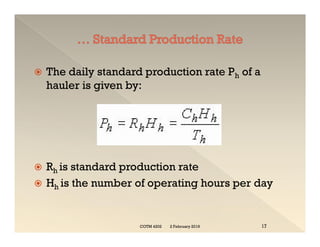
 The daily standard production rate Ph of a
hauler is given by:
 Rh is standard production rate
 Hh is the number of operating hours per day
 The daily standard production rate Ph of a
hauler is given by:
 Rh is standard production rate
 Hh is the number of operating hours per day
2 February 2019
COTM 4202 17
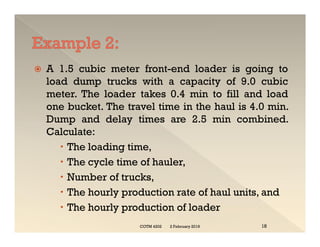
 A 1.5 cubic meter front-end loader is going to
load dump trucks with a capacity of 9.0 cubic
meter. The loader takes 0.4 min to fill and load
one bucket. The travel time in the haul is 4.0 min.
Dump and delay times are 2.5 min combined.
Calculate:
 The loading time,
 The cycle time of hauler,
 Number of trucks,
 The hourly production rate of haul units, and
 The hourly production of loader
 A 1.5 cubic meter front-end loader is going to
load dump trucks with a capacity of 9.0 cubic
meter. The loader takes 0.4 min to fill and load
one bucket. The travel time in the haul is 4.0 min.
Dump and delay times are 2.5 min combined.
Calculate:
 The loading time,
 The cycle time of hauler,
 Number of trucks,
 The hourly production rate of haul units, and
 The hourly production of loader
2 February 2019
COTM 4202 18
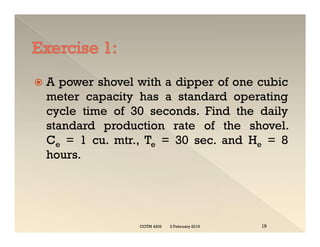
 A power shovel with a dipper of one cubic
meter capacity has a standard operating
cycle time of 30 seconds. Find the daily
standard production rate of the shovel.
Ce = 1 cu. mtr., Te = 30 sec. and He = 8
hours.
 A power shovel with a dipper of one cubic
meter capacity has a standard operating
cycle time of 30 seconds. Find the daily
standard production rate of the shovel.
Ce = 1 cu. mtr., Te = 30 sec. and He = 8
hours.
2 February 2019
COTM 4202 19
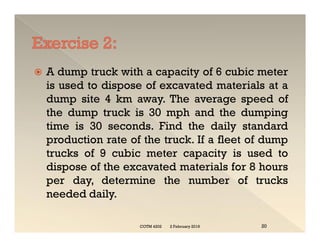
 A dump truck with a capacity of 6 cubic meter
is used to dispose of excavated materials at a
dump site 4 km away. The average speed of
the dump truck is 30 mph and the dumping
time is 30 seconds. Find the daily standard
production rate of the truck. If a fleet of dump
trucks of 9 cubic meter capacity is used to
dispose of the excavated materials for 8 hours
per day, determine the number of trucks
needed daily.
 A dump truck with a capacity of 6 cubic meter
is used to dispose of excavated materials at a
dump site 4 km away. The average speed of
the dump truck is 30 mph and the dumping
time is 30 seconds. Find the daily standard
production rate of the truck. If a fleet of dump
trucks of 9 cubic meter capacity is used to
dispose of the excavated materials for 8 hours
per day, determine the number of trucks
needed daily.
2 February 2019
COTM 4202 20
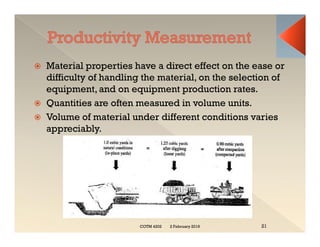
 Material properties have a direct effect on the ease or
difficulty of handling the material, on the selection of
equipment, and on equipment production rates.
 Quantities are often measured in volume units.
 Volume of material under different conditions varies
appreciably.
 Material properties have a direct effect on the ease or
difficulty of handling the material, on the selection of
equipment, and on equipment production rates.
 Quantities are often measured in volume units.
 Volume of material under different conditions varies
appreciably.
2 February 2019
COTM 4202 21
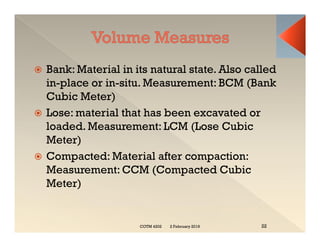
 Bank: Material in its natural state. Also called
in-place or in-situ. Measurement: BCM (Bank
Cubic Meter)
 Lose: material that has been excavated or
loaded. Measurement: LCM (Lose Cubic
Meter)
 Compacted: Material after compaction:
Measurement: CCM (Compacted Cubic
Meter)
2 February 2019
COTM 4202 22
 Bank: Material in its natural state. Also called
in-place or in-situ. Measurement: BCM (Bank
Cubic Meter)
 Lose: material that has been excavated or
loaded. Measurement: LCM (Lose Cubic
Meter)
 Compacted: Material after compaction:
Measurement: CCM (Compacted Cubic
Meter)
Swell
Factor
Shrinkage
Factor
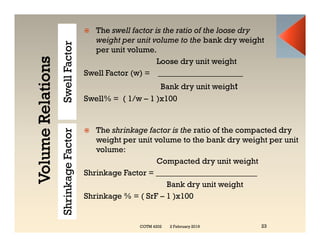
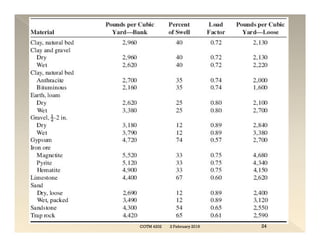
 The swell factor is the ratio of the loose dry
weight per unit volume to the bank dry weight
per unit volume.
Loose dry unit weight
Swell Factor (w) = _____________________
Bank dry unit weight
Swell% = ( 1/w – 1 )x100
 The shrinkage factor is the ratio of the compacted dry
weight per unit volume to the bank dry weight per unit
volume:
Compacted dry unit weight
Shrinkage Factor = _________________________
Bank dry unit weight
Shrinkage % = ( SrF – 1 )x100
Shrinkage
Factor
 The shrinkage factor is the ratio of the compacted dry
weight per unit volume to the bank dry weight per unit
volume:
Compacted dry unit weight
Shrinkage Factor = _________________________
Bank dry unit weight
Shrinkage % = ( SrF – 1 )x100
2 February 2019
COTM 4202 23
2 February 2019
COTM 4202 24
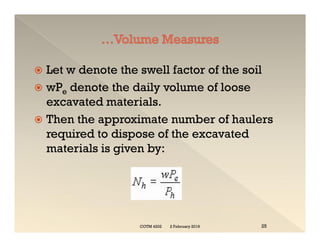
 Let w denote the swell factor of the soil
 wPe denote the daily volume of loose
excavated materials.
 Then the approximate number of haulers
required to dispose of the excavated
materials is given by:
 Let w denote the swell factor of the soil
 wPe denote the daily volume of loose
excavated materials.
 Then the approximate number of haulers
required to dispose of the excavated
materials is given by:
2 February 2019
COTM 4202 25
 Equipment productivities at job sites are
influenced by actual work conditions and a
variety of inefficiencies and work stoppages.
 Let F1, F2, ..., Fn, denote factors that lower
productivity, each of which is smaller than 1,
 Then the actual equipment productivity R' at the
job site can be related to the standard
production rate R as follows:
 Equipment productivities at job sites are
influenced by actual work conditions and a
variety of inefficiencies and work stoppages.
 Let F1, F2, ..., Fn, denote factors that lower
productivity, each of which is smaller than 1,
 Then the actual equipment productivity R' at the
job site can be related to the standard
production rate R as follows:
2 February 2019
COTM 4202 26
 The actual cycle time T' at the job site is
related to the standard cycle time T as:
2 February 2019
COTM 4202 27
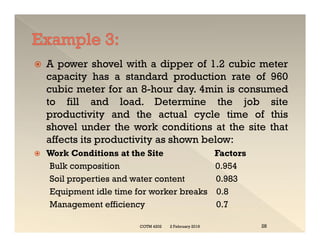
 A power shovel with a dipper of 1.2 cubic meter
capacity has a standard production rate of 960
cubic meter for an 8-hour day. 4min is consumed
to fill and load. Determine the job site
productivity and the actual cycle time of this
shovel under the work conditions at the site that
affects its productivity as shown below:
 Work Conditions at the Site Factors
Bulk composition 0.954
Soil properties and water content 0.983
Equipment idle time for worker breaks 0.8
Management efficiency 0.7
 A power shovel with a dipper of 1.2 cubic meter
capacity has a standard production rate of 960
cubic meter for an 8-hour day. 4min is consumed
to fill and load. Determine the job site
productivity and the actual cycle time of this
shovel under the work conditions at the site that
affects its productivity as shown below:
 Work Conditions at the Site Factors
Bulk composition 0.954
Soil properties and water content 0.983
Equipment idle time for worker breaks 0.8
Management efficiency 0.7
2 February 2019
COTM 4202 28
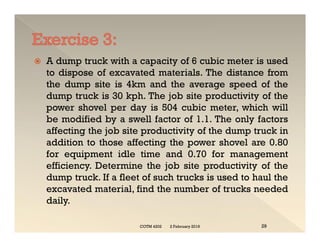
 A dump truck with a capacity of 6 cubic meter is used
to dispose of excavated materials. The distance from
the dump site is 4km and the average speed of the
dump truck is 30 kph. The job site productivity of the
power shovel per day is 504 cubic meter, which will
be modified by a swell factor of 1.1. The only factors
affecting the job site productivity of the dump truck in
addition to those affecting the power shovel are 0.80
for equipment idle time and 0.70 for management
efficiency. Determine the job site productivity of the
dump truck. If a fleet of such trucks is used to haul the
excavated material, find the number of trucks needed
daily.
 A dump truck with a capacity of 6 cubic meter is used
to dispose of excavated materials. The distance from
the dump site is 4km and the average speed of the
dump truck is 30 kph. The job site productivity of the
power shovel per day is 504 cubic meter, which will
be modified by a swell factor of 1.1. The only factors
affecting the job site productivity of the dump truck in
addition to those affecting the power shovel are 0.80
for equipment idle time and 0.70 for management
efficiency. Determine the job site productivity of the
dump truck. If a fleet of such trucks is used to haul the
excavated material, find the number of trucks needed
daily.
2 February 2019
COTM 4202 29
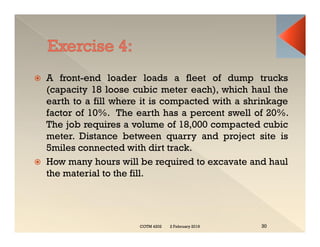
 A front-end loader loads a fleet of dump trucks
(capacity 18 loose cubic meter each), which haul the
earth to a fill where it is compacted with a shrinkage
factor of 10%. The earth has a percent swell of 20%.
The job requires a volume of 18,000 compacted cubic
meter. Distance between quarry and project site is
5miles connected with dirt track.
 How many hours will be required to excavate and haul
the material to the fill.
 A front-end loader loads a fleet of dump trucks
(capacity 18 loose cubic meter each), which haul the
earth to a fill where it is compacted with a shrinkage
factor of 10%. The earth has a percent swell of 20%.
The job requires a volume of 18,000 compacted cubic
meter. Distance between quarry and project site is
5miles connected with dirt track.
 How many hours will be required to excavate and haul
the material to the fill.
2 February 2019
COTM 4202 30
THANK YOU!
THANK YOU!
31
THANK YOU!
THANK YOU!
2 February 2019
COTM 4202

Construction equipment management chapter 3

  • 1.
  • 2.
    General  Estimating andplanning involves the judicious selection of equipment, the careful scheduling of time and resources, and the accurate determination of expected system output and cost. Definition  It is the number of units and the size of equipment that would permit the constructor to accomplish the activity with a duration resulting in the lowest cost. 2 February 2019 2 COTM 4202
  • 3.
     Haul unithorsepower  Haul road rolling resistance  Haul road grades  Haul unit loaded and empty weight  Haul unit transmission characteristics  Haul unit loading time  Haul unit travel time  Haul unit delay time  Altitude of the project site  Haul unit horsepower  Haul road rolling resistance  Haul road grades  Haul unit loaded and empty weight  Haul unit transmission characteristics  Haul unit loading time  Haul unit travel time  Haul unit delay time  Altitude of the project site 2 February 2019 COTM 4202 3
  • 4.
     Total powerthat an engine is capable of generating is expressed as its horsepower.  Available horsepower is power that is available to perform work after taking into account losses and consumption in other machine functions.  Rimpull is defined as the tractive force between the driving wheels and the surface on which they travel.( V is velocity in mph)  Total power that an engine is capable of generating is expressed as its horsepower.  Available horsepower is power that is available to perform work after taking into account losses and consumption in other machine functions.  Rimpull is defined as the tractive force between the driving wheels and the surface on which they travel.( V is velocity in mph) 2 February 2019 COTM 4202 4
  • 5.
    Power generated byengine 2 February 2019 COTM 4202 5 Drawbar Pull Rolling Resistance Rimpull
  • 6.
     Rolling resistanceis resistance offered to movement of materials on a plain surface; often expressed in pounds per ton of materials.  Rolling Resistance depends upon: 2 February 2019 COTM 4202 6
  • 7.
  • 8.
     The force-opposingmovement of a machine up a frictionless slope is grade resistance.  The effect of gravitational force in aiding movement of a vehicle down a slope is grade assistance. 2 February 2019 COTM 4202 8 F= 20 lbs/ G% per Ton
  • 9.
     The cyclecapacity C of a piece of equipment is defined as the number of output units per cycle of operation under standard work conditions.  The standard production rate R of a piece of construction equipment is defined as the number of output units per unit time.  The cycle time T refers to units of time per cycle of operation.  The cycle capacity C of a piece of equipment is defined as the number of output units per cycle of operation under standard work conditions.  The standard production rate R of a piece of construction equipment is defined as the number of output units per unit time.  The cycle time T refers to units of time per cycle of operation. 2 February 2019 COTM 4202 9
  • 10.
     Time toload a mover for load shifting will determine loads that can be transferred. Longer loading time lesser will be productivity.  To is loading time  Te is cycle time for loader/excavator  Ch is capacity of a hauler (dump truck)  Ce loading rate/capacity of loader  Time to load a mover for load shifting will determine loads that can be transferred. Longer loading time lesser will be productivity.  To is loading time  Te is cycle time for loader/excavator  Ch is capacity of a hauler (dump truck)  Ce loading rate/capacity of loader 2 February 2019 COTM 4202 10
  • 11.
     It istime for moving load from production site to disposal site. Longer time will reduce productivity.  To determine the productivity of a hauler, › Let: D be the distance from source to a dump site, S be the average speed of the hauler, Tt be the travel time for the round trip to the dump site, To be the loading time,Td be the dumping time plus other delays.  Then the travel time for the round trip is given by:  It is time for moving load from production site to disposal site. Longer time will reduce productivity.  To determine the productivity of a hauler, › Let: D be the distance from source to a dump site, S be the average speed of the hauler, Tt be the travel time for the round trip to the dump site, To be the loading time,Td be the dumping time plus other delays.  Then the travel time for the round trip is given by: 2 February 2019 COTM 4202 11
  • 12.
     Human andmachine system suffer from inherent delays due to reaction time and capacity, say Td. 2 February 2019 COTM 4202 12
  • 13.
     For agiven dumping time Td, the total cycle time Th of the hauler is the sum of loading time, travel time and damping time given by:  For a given dumping time Td, the total cycle time Th of the hauler is the sum of loading time, travel time and damping time given by: 2 February 2019 COTM 4202 13
  • 14.
     Optimum numberof haul units (N) is determined by:  NB: Rounding down will maximize haul unit productivity.  Optimum number of haul units (N) is determined by:  NB: Rounding down will maximize haul unit productivity. 2 February 2019 COTM 4202 14
  • 15.
     An 16cubic meter dump truck has a loading time of 3 min, a travel time of 7 min, and the dumping and delay times of 5 min. Calculate the cycle time of the hauler and optimum number of hauling units.  An 16 cubic meter dump truck has a loading time of 3 min, a travel time of 7 min, and the dumping and delay times of 5 min. Calculate the cycle time of the hauler and optimum number of hauling units. 2 February 2019 COTM 4202 15
  • 16.
     The dailystandard production rate Pe of an excavator is is given by:  He is the operating hours per day  Ce is the cycle capacity (in units of volume) of the excavator  Te is the cycle time (in hours) of the excavator  The daily standard production rate Pe of an excavator is is given by:  He is the operating hours per day  Ce is the cycle capacity (in units of volume) of the excavator  Te is the cycle time (in hours) of the excavator 2 February 2019 COTM 4202 16
  • 17.
     The dailystandard production rate Ph of a hauler is given by:  Rh is standard production rate  Hh is the number of operating hours per day  The daily standard production rate Ph of a hauler is given by:  Rh is standard production rate  Hh is the number of operating hours per day 2 February 2019 COTM 4202 17
  • 18.
     A 1.5cubic meter front-end loader is going to load dump trucks with a capacity of 9.0 cubic meter. The loader takes 0.4 min to fill and load one bucket. The travel time in the haul is 4.0 min. Dump and delay times are 2.5 min combined. Calculate:  The loading time,  The cycle time of hauler,  Number of trucks,  The hourly production rate of haul units, and  The hourly production of loader  A 1.5 cubic meter front-end loader is going to load dump trucks with a capacity of 9.0 cubic meter. The loader takes 0.4 min to fill and load one bucket. The travel time in the haul is 4.0 min. Dump and delay times are 2.5 min combined. Calculate:  The loading time,  The cycle time of hauler,  Number of trucks,  The hourly production rate of haul units, and  The hourly production of loader 2 February 2019 COTM 4202 18
  • 19.
     A powershovel with a dipper of one cubic meter capacity has a standard operating cycle time of 30 seconds. Find the daily standard production rate of the shovel. Ce = 1 cu. mtr., Te = 30 sec. and He = 8 hours.  A power shovel with a dipper of one cubic meter capacity has a standard operating cycle time of 30 seconds. Find the daily standard production rate of the shovel. Ce = 1 cu. mtr., Te = 30 sec. and He = 8 hours. 2 February 2019 COTM 4202 19
  • 20.
     A dumptruck with a capacity of 6 cubic meter is used to dispose of excavated materials at a dump site 4 km away. The average speed of the dump truck is 30 mph and the dumping time is 30 seconds. Find the daily standard production rate of the truck. If a fleet of dump trucks of 9 cubic meter capacity is used to dispose of the excavated materials for 8 hours per day, determine the number of trucks needed daily.  A dump truck with a capacity of 6 cubic meter is used to dispose of excavated materials at a dump site 4 km away. The average speed of the dump truck is 30 mph and the dumping time is 30 seconds. Find the daily standard production rate of the truck. If a fleet of dump trucks of 9 cubic meter capacity is used to dispose of the excavated materials for 8 hours per day, determine the number of trucks needed daily. 2 February 2019 COTM 4202 20
  • 21.
     Material propertieshave a direct effect on the ease or difficulty of handling the material, on the selection of equipment, and on equipment production rates.  Quantities are often measured in volume units.  Volume of material under different conditions varies appreciably.  Material properties have a direct effect on the ease or difficulty of handling the material, on the selection of equipment, and on equipment production rates.  Quantities are often measured in volume units.  Volume of material under different conditions varies appreciably. 2 February 2019 COTM 4202 21
  • 22.
     Bank: Materialin its natural state. Also called in-place or in-situ. Measurement: BCM (Bank Cubic Meter)  Lose: material that has been excavated or loaded. Measurement: LCM (Lose Cubic Meter)  Compacted: Material after compaction: Measurement: CCM (Compacted Cubic Meter) 2 February 2019 COTM 4202 22  Bank: Material in its natural state. Also called in-place or in-situ. Measurement: BCM (Bank Cubic Meter)  Lose: material that has been excavated or loaded. Measurement: LCM (Lose Cubic Meter)  Compacted: Material after compaction: Measurement: CCM (Compacted Cubic Meter)
  • 23.
    Swell Factor Shrinkage Factor  The swellfactor is the ratio of the loose dry weight per unit volume to the bank dry weight per unit volume. Loose dry unit weight Swell Factor (w) = _____________________ Bank dry unit weight Swell% = ( 1/w – 1 )x100  The shrinkage factor is the ratio of the compacted dry weight per unit volume to the bank dry weight per unit volume: Compacted dry unit weight Shrinkage Factor = _________________________ Bank dry unit weight Shrinkage % = ( SrF – 1 )x100 Shrinkage Factor  The shrinkage factor is the ratio of the compacted dry weight per unit volume to the bank dry weight per unit volume: Compacted dry unit weight Shrinkage Factor = _________________________ Bank dry unit weight Shrinkage % = ( SrF – 1 )x100 2 February 2019 COTM 4202 23
  • 24.
  • 25.
     Let wdenote the swell factor of the soil  wPe denote the daily volume of loose excavated materials.  Then the approximate number of haulers required to dispose of the excavated materials is given by:  Let w denote the swell factor of the soil  wPe denote the daily volume of loose excavated materials.  Then the approximate number of haulers required to dispose of the excavated materials is given by: 2 February 2019 COTM 4202 25
  • 26.
     Equipment productivitiesat job sites are influenced by actual work conditions and a variety of inefficiencies and work stoppages.  Let F1, F2, ..., Fn, denote factors that lower productivity, each of which is smaller than 1,  Then the actual equipment productivity R' at the job site can be related to the standard production rate R as follows:  Equipment productivities at job sites are influenced by actual work conditions and a variety of inefficiencies and work stoppages.  Let F1, F2, ..., Fn, denote factors that lower productivity, each of which is smaller than 1,  Then the actual equipment productivity R' at the job site can be related to the standard production rate R as follows: 2 February 2019 COTM 4202 26
  • 27.
     The actualcycle time T' at the job site is related to the standard cycle time T as: 2 February 2019 COTM 4202 27
  • 28.
     A powershovel with a dipper of 1.2 cubic meter capacity has a standard production rate of 960 cubic meter for an 8-hour day. 4min is consumed to fill and load. Determine the job site productivity and the actual cycle time of this shovel under the work conditions at the site that affects its productivity as shown below:  Work Conditions at the Site Factors Bulk composition 0.954 Soil properties and water content 0.983 Equipment idle time for worker breaks 0.8 Management efficiency 0.7  A power shovel with a dipper of 1.2 cubic meter capacity has a standard production rate of 960 cubic meter for an 8-hour day. 4min is consumed to fill and load. Determine the job site productivity and the actual cycle time of this shovel under the work conditions at the site that affects its productivity as shown below:  Work Conditions at the Site Factors Bulk composition 0.954 Soil properties and water content 0.983 Equipment idle time for worker breaks 0.8 Management efficiency 0.7 2 February 2019 COTM 4202 28
  • 29.
     A dumptruck with a capacity of 6 cubic meter is used to dispose of excavated materials. The distance from the dump site is 4km and the average speed of the dump truck is 30 kph. The job site productivity of the power shovel per day is 504 cubic meter, which will be modified by a swell factor of 1.1. The only factors affecting the job site productivity of the dump truck in addition to those affecting the power shovel are 0.80 for equipment idle time and 0.70 for management efficiency. Determine the job site productivity of the dump truck. If a fleet of such trucks is used to haul the excavated material, find the number of trucks needed daily.  A dump truck with a capacity of 6 cubic meter is used to dispose of excavated materials. The distance from the dump site is 4km and the average speed of the dump truck is 30 kph. The job site productivity of the power shovel per day is 504 cubic meter, which will be modified by a swell factor of 1.1. The only factors affecting the job site productivity of the dump truck in addition to those affecting the power shovel are 0.80 for equipment idle time and 0.70 for management efficiency. Determine the job site productivity of the dump truck. If a fleet of such trucks is used to haul the excavated material, find the number of trucks needed daily. 2 February 2019 COTM 4202 29
  • 30.
     A front-endloader loads a fleet of dump trucks (capacity 18 loose cubic meter each), which haul the earth to a fill where it is compacted with a shrinkage factor of 10%. The earth has a percent swell of 20%. The job requires a volume of 18,000 compacted cubic meter. Distance between quarry and project site is 5miles connected with dirt track.  How many hours will be required to excavate and haul the material to the fill.  A front-end loader loads a fleet of dump trucks (capacity 18 loose cubic meter each), which haul the earth to a fill where it is compacted with a shrinkage factor of 10%. The earth has a percent swell of 20%. The job requires a volume of 18,000 compacted cubic meter. Distance between quarry and project site is 5miles connected with dirt track.  How many hours will be required to excavate and haul the material to the fill. 2 February 2019 COTM 4202 30
  • 31.
    THANK YOU! THANK YOU! 31 THANKYOU! THANK YOU! 2 February 2019 COTM 4202