
Project Delivery Methods
College of Engineering
Construction Technology and Management Department
Mada Walabu
University
Procurement Management and Contract Administration
CoTM 4242
Chapter Three
Instructor
Andualem Endris (M.Sc)
andu0117@yahoo.com
www.facebook.com/aendris1
www.linkedin.com/in/andualem-yadeta
www.twitter.com/andualemyadeta
Definition
Project Delivery Method: Is a system
used by an agency or owner for organizing
and financing design, construction,
operations, and maintenance services for a
project.
31 July 2021 COTM 4242 2
Construction Project Characteristics
Construction projects are different than other types of
projects due to the following characteristics;
 Construction projects are complex undertaking.
 Every construction project is unique.
 Construction projects involve a lot of uncertainties,
lack of information and variables.
 Therefore, parties and their role shall be pre-determined.
31 July 2021 3
COTM 4242
Traditional Vs Alternative Project
Delivery Methods
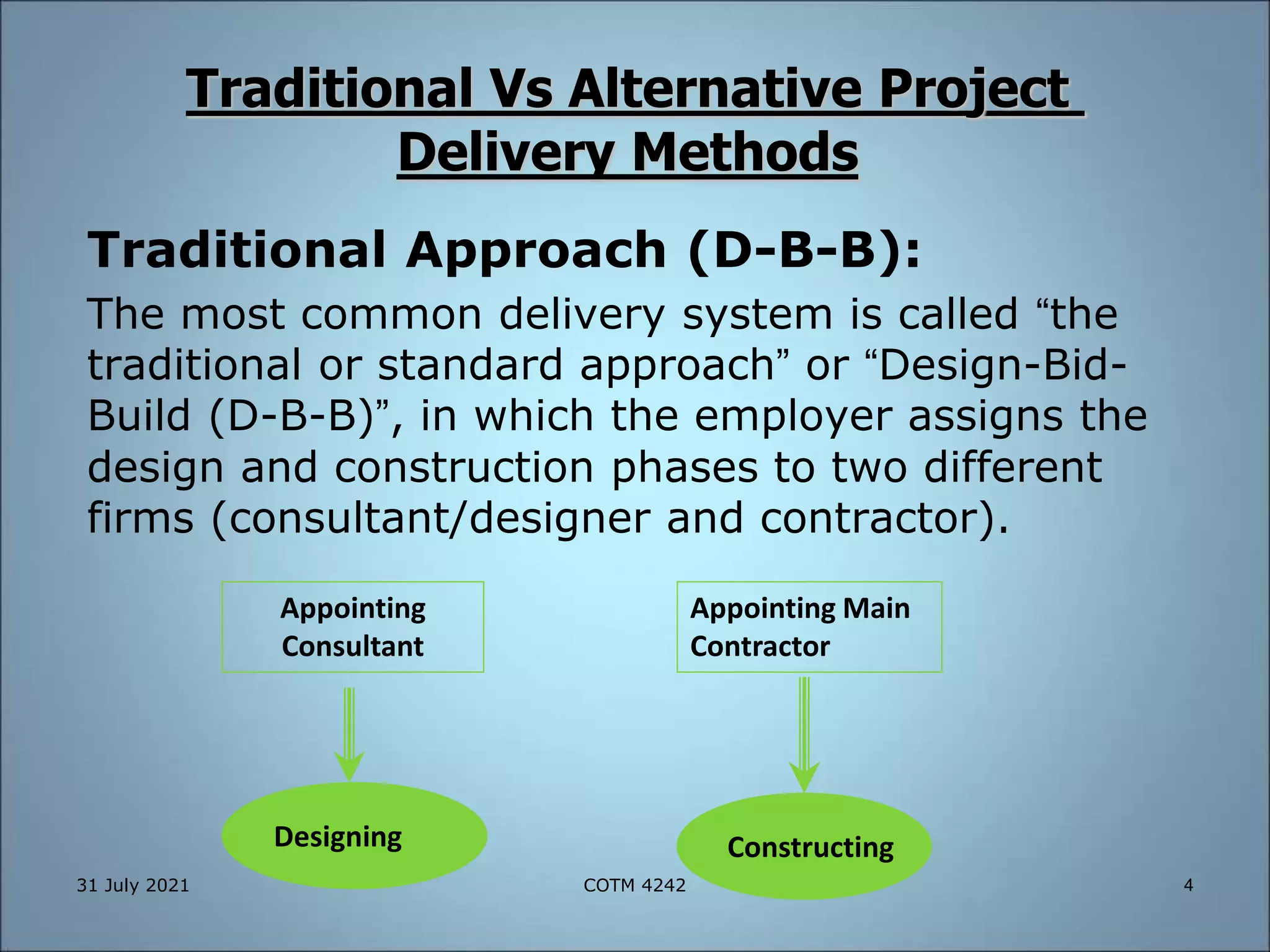
Traditional Approach (D-B-B):
The most common delivery system is called “the
traditional or standard approach” or “Design-Bid-
Build (D-B-B)”, in which the employer assigns the
design and construction phases to two different
firms (consultant/designer and contractor).
Constructing
Designing
Appointing
Consultant
Appointing Main
Contractor
31 July 2021 4
COTM 4242
Traditional Approach (D-B-B):
 For many years, DBB has been the most common
method of project delivery for public projects,
and for many private projects as well.
 Design-Bid-Build is effective on projects
 where the owner needs both professional
design services and construction services
 where the designer does not require detailed
knowledge of the means and methods of
construction.
 DBB provides the owner with a high degree of
control.
31 July 2021 5
COTM 4242
Traditional Approach (D-B-B) … Cont’d
 The owner defines project goals and objectives, secures the financing,
and specifies the standards and contract terms.
 The owner may perform planning, conceptual design and full design,
or may engage an outside design professional (designer) for some or
all of these tasks.
 During this planning and preliminary stage, owner and designer work
as a team to obtain required permits and conduct necessary site
investigations.
 The designer prepares the construction bid documents to reflect the
owner’s project goals and objectives.
 Prospective contractors prepare their bids from these complete and
specific bid documents.
 The bidders submit their proposals to the owner, who determines the
most responsive (typically the lowest) bid meeting project
requirements.
 In certain circumstances, owner may be justified in selecting a
contractor outright and negotiating contract terms directly.
31 July 2021 6
COTM 4242
Advantages of D-B-B Approach
 Applicable to a wide range of projects.
 Well established and easily understood.
 Clearly defined roles for all parties.
 Provides the lowest initial price that competitive
bidders can offer.
 Extensive litigation has resulted in well
established legal precedents.
 Insurance and bonding are well defined.
31 July 2021 7
COTM 4242
Disadvantages of D-B-B Approach
 Least-cost approach requires higher level of
inspection.
 Initial low bid might not result in ultimate lowest
cost or final best value.
 Designers may have limited knowledge of the
true cost and scheduling implication of design
decisions.
31 July 2021 8
COTM 4242
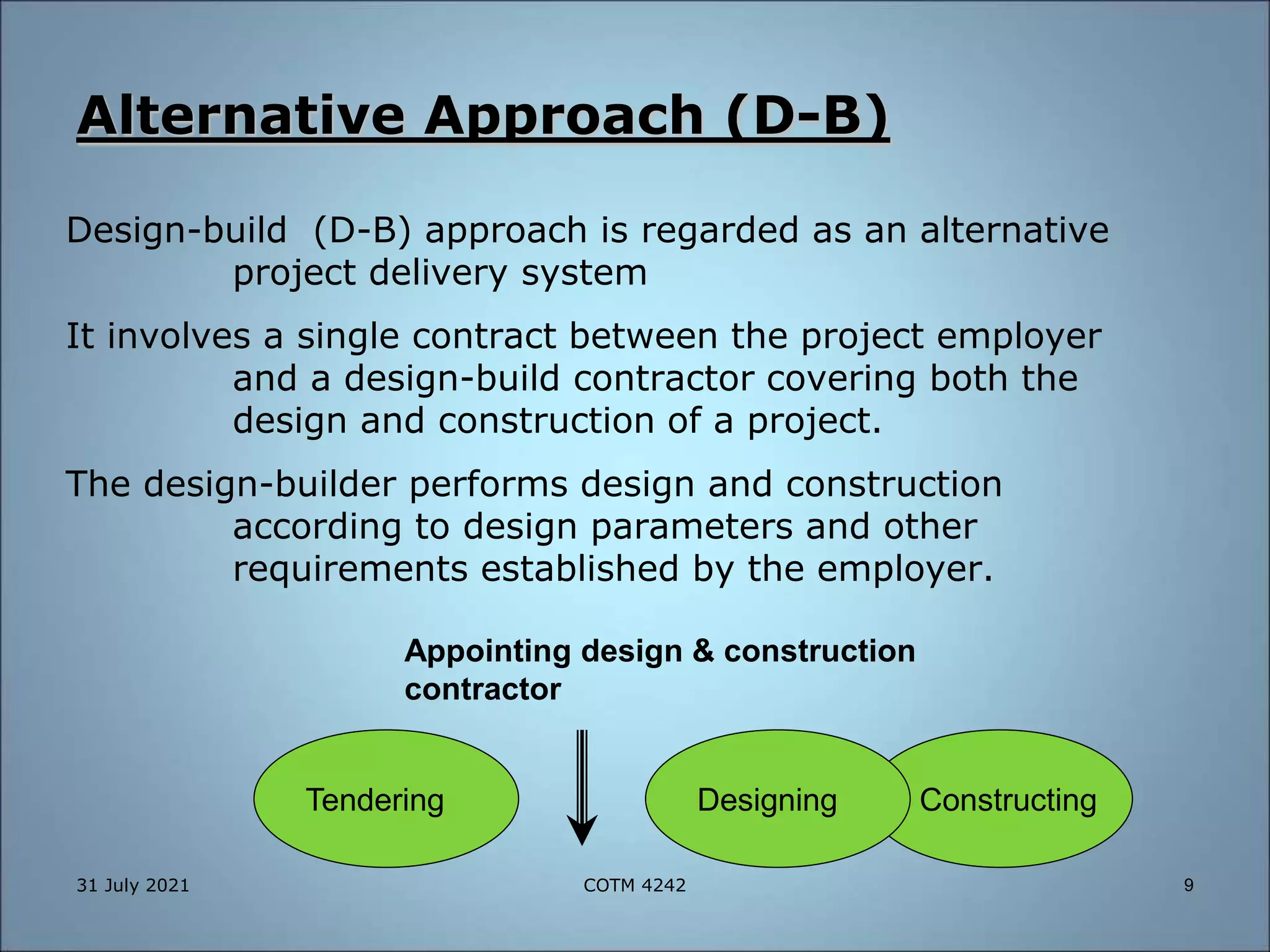
Alternative Approach (D-B)
Design-build (D-B) approach is regarded as an alternative
project delivery system
It involves a single contract between the project employer
and a design-build contractor covering both the
design and construction of a project.
The design-builder performs design and construction
according to design parameters and other
requirements established by the employer.
Constructing
Designing
Appointing design & construction
contractor
Tendering
31 July 2021 9
COTM 4242
Design-Build Approach
 The owner contracts with a single entity to provide the
design and to construct the project.
 The contract might be negotiated with a single design-
builder or result from competitive proposals.
 The selection can be based on low price or on a set of
value criteria (experience, staff, bonding capacity, etc).
 With the contractor playing a major role in design,
costs are typically defined and maintained to a greater
degree, and the coordination of fast-track management
to achieve early completion is greatly simplified.
 The design-builder makes many decisions that owner
would make under DBB, due to delegation of greatly
increased authority.
31 July 2021 10
COTM 4242
Design-Build Approach
 For many owners, delegation of responsibilities
leads to satisfactory projects. However, if the
parties are inexperienced and do not cooperate,
the transfer of control and risk can be
disappointing.
 The owner may need to restructure his/her
internal procedures to accommodate design-build
approach.
 Compared to DBB, this involves a significantly
different set of requirements and expectations for
process, timelines and communications.
 A clear understanding and documentation of
design-build processes enhances the quality of
design-build projects
31 July 2021 11
COTM 4242
Advantage of Design-Build Approach
Innovation and quality improvements through:
- Alternative designs and construction
methods
suited to the contractor’s capabilities
- Flexibility in the selection of design,
materials, and
construction methods.
• Earlier schedule and cost certainty
31 July 2021 12
COTM 4242
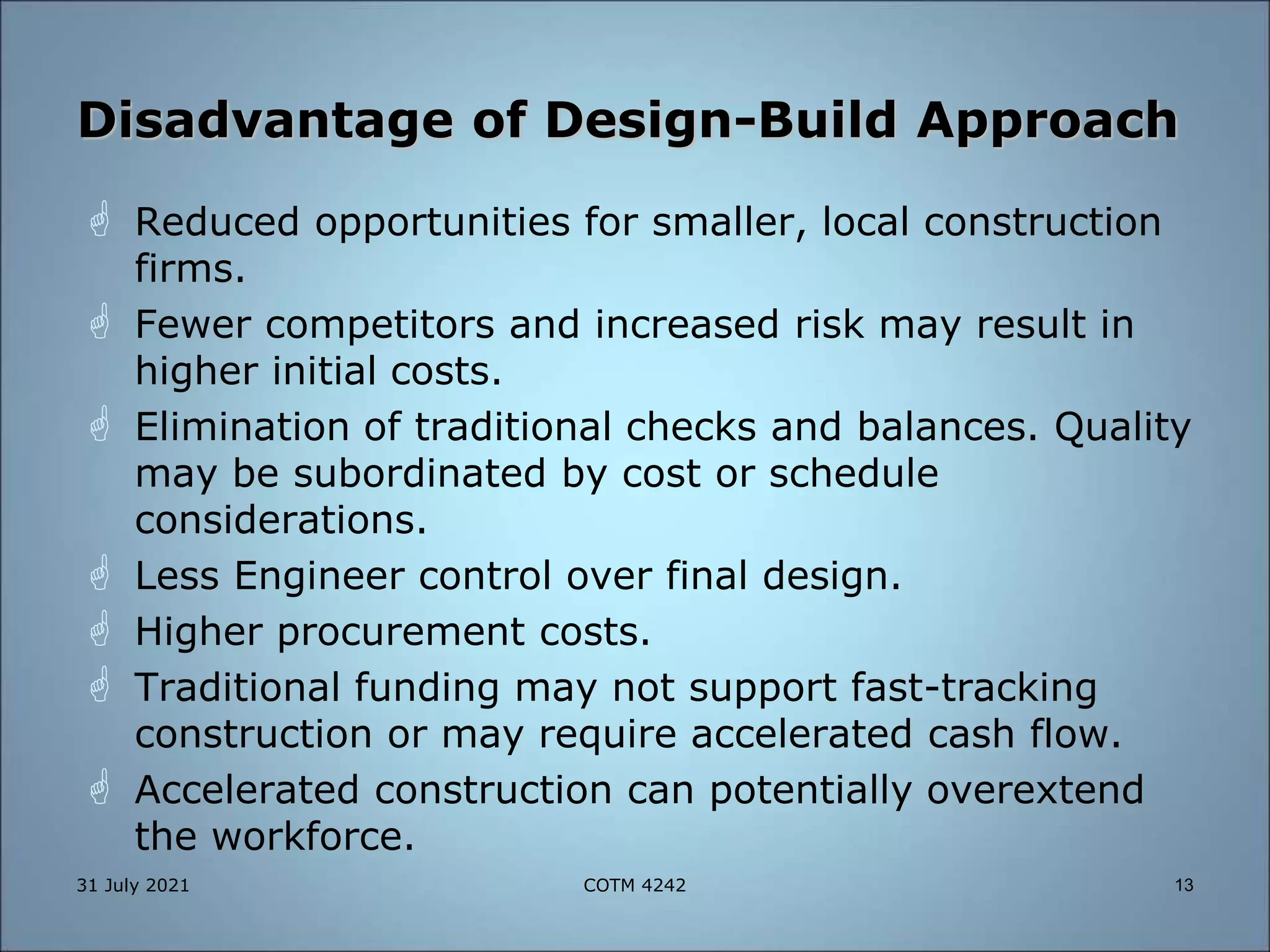
Disadvantage of Design-Build Approach
 Reduced opportunities for smaller, local construction
firms.
 Fewer competitors and increased risk may result in
higher initial costs.
 Elimination of traditional checks and balances. Quality
may be subordinated by cost or schedule
considerations.
 Less Engineer control over final design.
 Higher procurement costs.
 Traditional funding may not support fast-tracking
construction or may require accelerated cash flow.
 Accelerated construction can potentially overextend
the workforce.
31 July 2021 13
COTM 4242
Others
 Turnkey
 Turnkey Variations
 Direct Labor Approach
 Construction management.
31 July 2021 14
COTM 4242
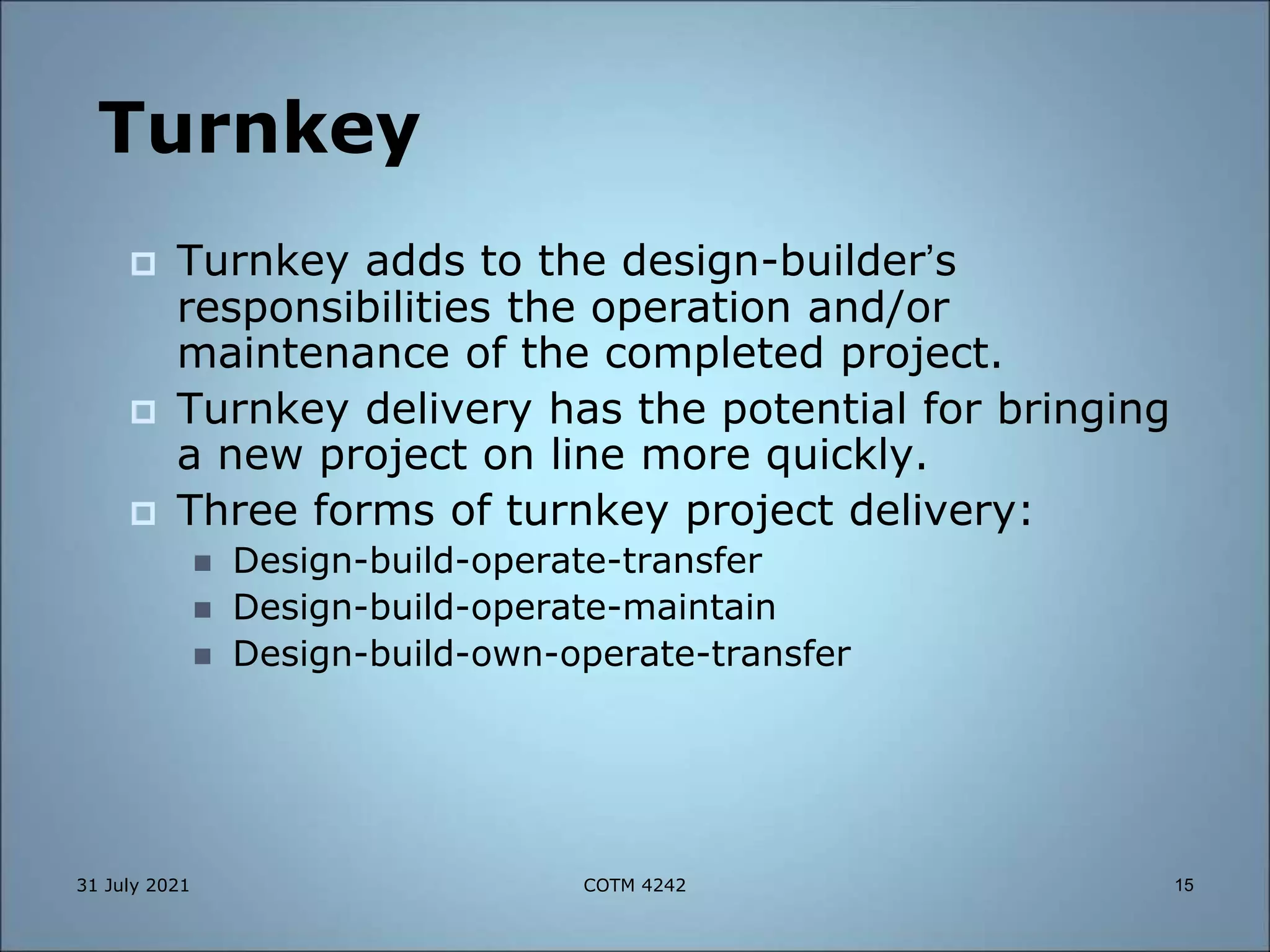
Turnkey
 Turnkey adds to the design-builder’s
responsibilities the operation and/or
maintenance of the completed project.
 Turnkey delivery has the potential for bringing
a new project on line more quickly.
 Three forms of turnkey project delivery:
 Design-build-operate-transfer
 Design-build-operate-maintain
 Design-build-own-operate-transfer
31 July 2021 15
COTM 4242
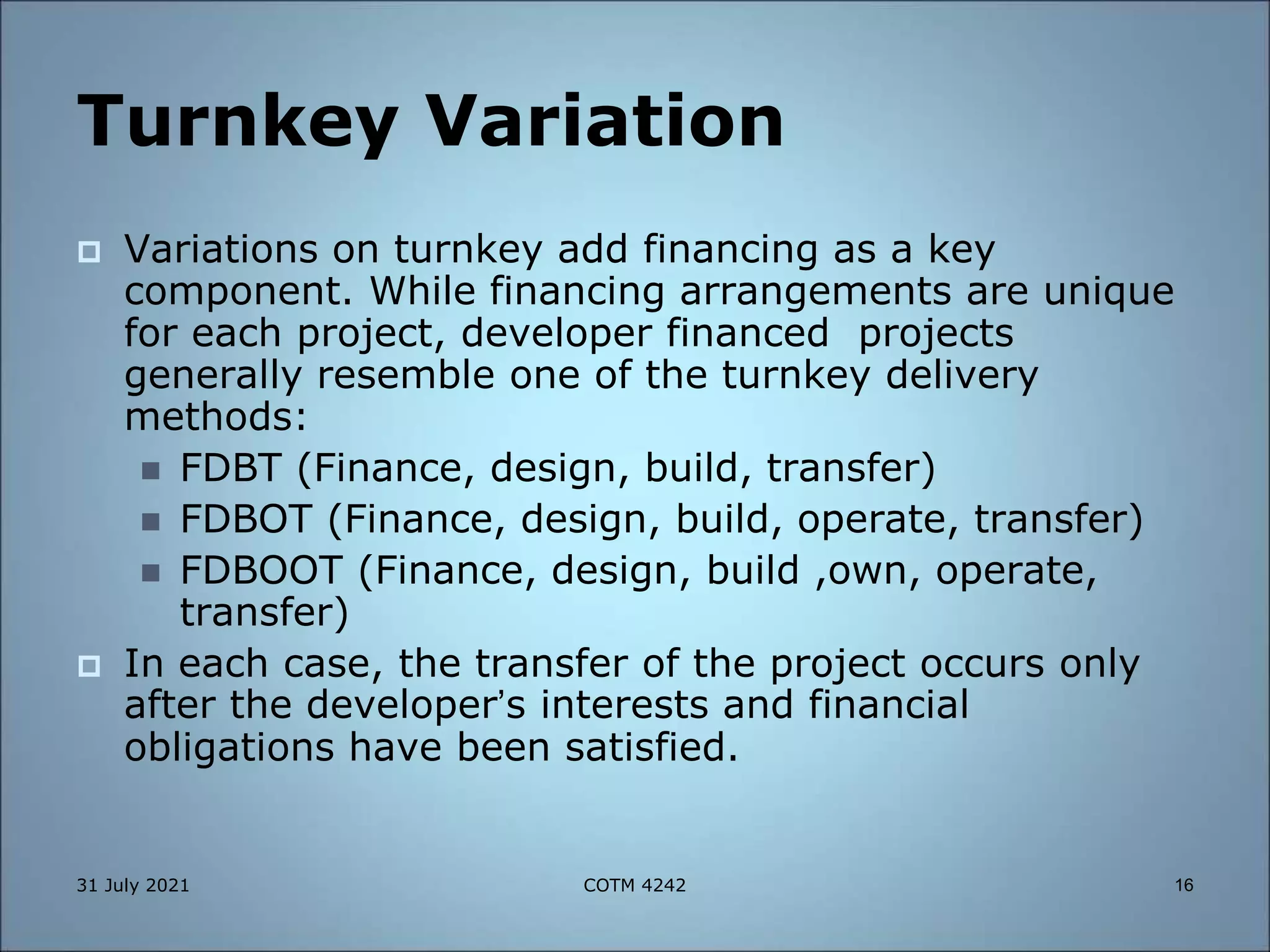
Turnkey Variation
 Variations on turnkey add financing as a key
component. While financing arrangements are unique
for each project, developer financed projects
generally resemble one of the turnkey delivery
methods:
 FDBT (Finance, design, build, transfer)
 FDBOT (Finance, design, build, operate, transfer)
 FDBOOT (Finance, design, build ,own, operate,
transfer)
 In each case, the transfer of the project occurs only
after the developer’s interests and financial
obligations have been satisfied.
31 July 2021 16
COTM 4242
Thank You

Chapter 3- Contract Management

  • 1.
    Project Delivery Methods Collegeof Engineering Construction Technology and Management Department Mada Walabu University Procurement Management and Contract Administration CoTM 4242 Chapter Three Instructor Andualem Endris (M.Sc) andu0117@yahoo.com www.facebook.com/aendris1 www.linkedin.com/in/andualem-yadeta www.twitter.com/andualemyadeta
  • 2.
    Definition Project Delivery Method:Is a system used by an agency or owner for organizing and financing design, construction, operations, and maintenance services for a project. 31 July 2021 COTM 4242 2
  • 3.
    Construction Project Characteristics Constructionprojects are different than other types of projects due to the following characteristics;  Construction projects are complex undertaking.  Every construction project is unique.  Construction projects involve a lot of uncertainties, lack of information and variables.  Therefore, parties and their role shall be pre-determined. 31 July 2021 3 COTM 4242
  • 4.
    Traditional Vs AlternativeProject Delivery Methods Traditional Approach (D-B-B): The most common delivery system is called “the traditional or standard approach” or “Design-Bid- Build (D-B-B)”, in which the employer assigns the design and construction phases to two different firms (consultant/designer and contractor). Constructing Designing Appointing Consultant Appointing Main Contractor 31 July 2021 4 COTM 4242
  • 5.
    Traditional Approach (D-B-B): For many years, DBB has been the most common method of project delivery for public projects, and for many private projects as well.  Design-Bid-Build is effective on projects  where the owner needs both professional design services and construction services  where the designer does not require detailed knowledge of the means and methods of construction.  DBB provides the owner with a high degree of control. 31 July 2021 5 COTM 4242
  • 6.
    Traditional Approach (D-B-B)… Cont’d  The owner defines project goals and objectives, secures the financing, and specifies the standards and contract terms.  The owner may perform planning, conceptual design and full design, or may engage an outside design professional (designer) for some or all of these tasks.  During this planning and preliminary stage, owner and designer work as a team to obtain required permits and conduct necessary site investigations.  The designer prepares the construction bid documents to reflect the owner’s project goals and objectives.  Prospective contractors prepare their bids from these complete and specific bid documents.  The bidders submit their proposals to the owner, who determines the most responsive (typically the lowest) bid meeting project requirements.  In certain circumstances, owner may be justified in selecting a contractor outright and negotiating contract terms directly. 31 July 2021 6 COTM 4242
  • 7.
    Advantages of D-B-BApproach  Applicable to a wide range of projects.  Well established and easily understood.  Clearly defined roles for all parties.  Provides the lowest initial price that competitive bidders can offer.  Extensive litigation has resulted in well established legal precedents.  Insurance and bonding are well defined. 31 July 2021 7 COTM 4242
  • 8.
    Disadvantages of D-B-BApproach  Least-cost approach requires higher level of inspection.  Initial low bid might not result in ultimate lowest cost or final best value.  Designers may have limited knowledge of the true cost and scheduling implication of design decisions. 31 July 2021 8 COTM 4242
  • 9.
    Alternative Approach (D-B) Design-build(D-B) approach is regarded as an alternative project delivery system It involves a single contract between the project employer and a design-build contractor covering both the design and construction of a project. The design-builder performs design and construction according to design parameters and other requirements established by the employer. Constructing Designing Appointing design & construction contractor Tendering 31 July 2021 9 COTM 4242
  • 10.
    Design-Build Approach  Theowner contracts with a single entity to provide the design and to construct the project.  The contract might be negotiated with a single design- builder or result from competitive proposals.  The selection can be based on low price or on a set of value criteria (experience, staff, bonding capacity, etc).  With the contractor playing a major role in design, costs are typically defined and maintained to a greater degree, and the coordination of fast-track management to achieve early completion is greatly simplified.  The design-builder makes many decisions that owner would make under DBB, due to delegation of greatly increased authority. 31 July 2021 10 COTM 4242
  • 11.
    Design-Build Approach  Formany owners, delegation of responsibilities leads to satisfactory projects. However, if the parties are inexperienced and do not cooperate, the transfer of control and risk can be disappointing.  The owner may need to restructure his/her internal procedures to accommodate design-build approach.  Compared to DBB, this involves a significantly different set of requirements and expectations for process, timelines and communications.  A clear understanding and documentation of design-build processes enhances the quality of design-build projects 31 July 2021 11 COTM 4242
  • 12.
    Advantage of Design-BuildApproach Innovation and quality improvements through: - Alternative designs and construction methods suited to the contractor’s capabilities - Flexibility in the selection of design, materials, and construction methods. • Earlier schedule and cost certainty 31 July 2021 12 COTM 4242
  • 13.
    Disadvantage of Design-BuildApproach  Reduced opportunities for smaller, local construction firms.  Fewer competitors and increased risk may result in higher initial costs.  Elimination of traditional checks and balances. Quality may be subordinated by cost or schedule considerations.  Less Engineer control over final design.  Higher procurement costs.  Traditional funding may not support fast-tracking construction or may require accelerated cash flow.  Accelerated construction can potentially overextend the workforce. 31 July 2021 13 COTM 4242
  • 14.
    Others  Turnkey  TurnkeyVariations  Direct Labor Approach  Construction management. 31 July 2021 14 COTM 4242
  • 15.
    Turnkey  Turnkey addsto the design-builder’s responsibilities the operation and/or maintenance of the completed project.  Turnkey delivery has the potential for bringing a new project on line more quickly.  Three forms of turnkey project delivery:  Design-build-operate-transfer  Design-build-operate-maintain  Design-build-own-operate-transfer 31 July 2021 15 COTM 4242
  • 16.
    Turnkey Variation  Variationson turnkey add financing as a key component. While financing arrangements are unique for each project, developer financed projects generally resemble one of the turnkey delivery methods:  FDBT (Finance, design, build, transfer)  FDBOT (Finance, design, build, operate, transfer)  FDBOOT (Finance, design, build ,own, operate, transfer)  In each case, the transfer of the project occurs only after the developer’s interests and financial obligations have been satisfied. 31 July 2021 16 COTM 4242
  • 17.