PREPARED BY:
GERALDINE REYES
TO THE COURSE
PROFESSORS AND
STUDENTS:

 This is followed by the descriptions of
  the different special education
  ,programs and services with
  emphasis on inclusive education, its
  definition, salient features and support
  services.
Course professors are
encourage to use visual aids in
presenting the different topics in
this chapter:
 Define the following terms:
  prevalence, identifiable prevalence, true
  prevalence, incidence
 Compare the prevalence estimate of
  children with special needs done by the
  UNICEF and the World Health
  Organization
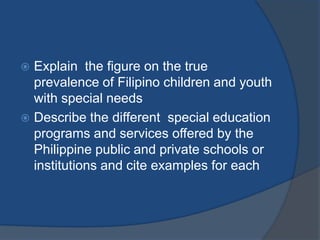
 Explain the figure on the true
  prevalence of Filipino children and youth
  with special needs
 Describe the different special education
  programs and services offered by the
  Philippine public and private schools or
  institutions and cite examples for each
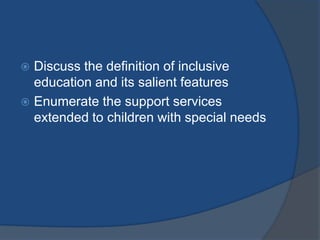
 Discuss the definition of inclusive
  education and its salient features
 Enumerate the support services
  extended to children with special needs
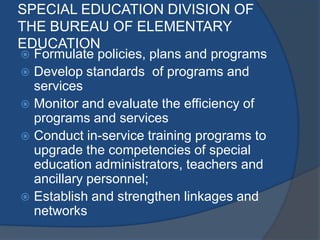
SPECIAL EDUCATION DIVISION OF
THE BUREAU OF ELEMENTARY
EDUCATION
 Formulate policies, plans and programs
 Develop standards of programs and
  services
 Monitor and evaluate the efficiency of
  programs and services
 Conduct in-service training programs to
  upgrade the competencies of special
  education administrators, teachers and
  ancillary personnel;
 Establish and strengthen linkages and
  networks
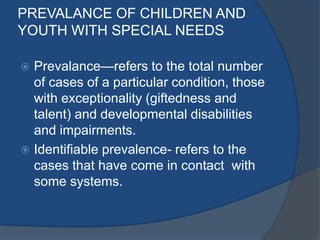
PREVALANCE OF CHILDREN AND
YOUTH WITH SPECIAL NEEDS

 Prevalance—refers to the total number
  of cases of a particular condition, those
  with exceptionality (giftedness and
  talent) and developmental disabilities
  and impairments.
 Identifiable prevalence- refers to the
  cases that have come in contact with
  some systems.
   True prevalence- assumes that there are
    a larger number of children and youth
    with special needs who are in school or
    in the community who have not been
    identified as such and are not in the
    special education programs of
    Department of Education.

RANGE OF SPECIAL EDUCATION
PROGRAMS AND SERVICES

 Special Education Center- is a service
  delivery system which operates on the “
  school within a school” concept.
 Special class or self- contained class- is
  the most popular type among the special
  education programs.
   Integration and mainstreaming
    programs- have followed children and
    youth with disabilities to study in regular
    classes and learn side by side with their
    peers for the last forty years.
 -Partial mainstreaming- children who
  have moderate or severe forms of
  disabilities are mainstreamed in a
  regular classes.
     - Full mainstreaming- children with
  disabilities are enrolled in regular
  classes and recite in all the subjects.
 Special day school- serves one or more
  types of disabilities.
 Residential school- provides both
  special education and dormitory
  services for its students.

Chapter 2 special program and services for special children

  • 1.
  • 2.
    TO THE COURSE PROFESSORSAND STUDENTS:  This is followed by the descriptions of the different special education ,programs and services with emphasis on inclusive education, its definition, salient features and support services.
  • 3.
    Course professors are encourageto use visual aids in presenting the different topics in this chapter:  Define the following terms: prevalence, identifiable prevalence, true prevalence, incidence  Compare the prevalence estimate of children with special needs done by the UNICEF and the World Health Organization
  • 4.
     Explain thefigure on the true prevalence of Filipino children and youth with special needs  Describe the different special education programs and services offered by the Philippine public and private schools or institutions and cite examples for each
  • 5.
     Discuss thedefinition of inclusive education and its salient features  Enumerate the support services extended to children with special needs
  • 6.
    SPECIAL EDUCATION DIVISIONOF THE BUREAU OF ELEMENTARY EDUCATION  Formulate policies, plans and programs  Develop standards of programs and services  Monitor and evaluate the efficiency of programs and services  Conduct in-service training programs to upgrade the competencies of special education administrators, teachers and ancillary personnel;  Establish and strengthen linkages and networks
  • 7.
    PREVALANCE OF CHILDRENAND YOUTH WITH SPECIAL NEEDS  Prevalance—refers to the total number of cases of a particular condition, those with exceptionality (giftedness and talent) and developmental disabilities and impairments.  Identifiable prevalence- refers to the cases that have come in contact with some systems.
  • 8.
    True prevalence- assumes that there are a larger number of children and youth with special needs who are in school or in the community who have not been identified as such and are not in the special education programs of Department of Education. 
  • 9.
    RANGE OF SPECIALEDUCATION PROGRAMS AND SERVICES  Special Education Center- is a service delivery system which operates on the “ school within a school” concept.  Special class or self- contained class- is the most popular type among the special education programs.
  • 10.
    Integration and mainstreaming programs- have followed children and youth with disabilities to study in regular classes and learn side by side with their peers for the last forty years.
  • 11.
     -Partial mainstreaming-children who have moderate or severe forms of disabilities are mainstreamed in a regular classes.  - Full mainstreaming- children with disabilities are enrolled in regular classes and recite in all the subjects.
  • 12.
     Special dayschool- serves one or more types of disabilities.  Residential school- provides both special education and dormitory services for its students.