Chapter 5
Components and
Levels of Abstraction
in Nursing Knowledge
Introduction
• Graduate students and advanced practice
nurses must be familiar with the components
and levels of abstraction in nursing
knowledge.
• One way to conceptualize this information is
by using the structural holarchy developed by
Jacqueline Fawcett.
Components of Nursing Knowledge
• Nursing knowledge is the cumulative, ever-
evolving result of prior learning, experience,
theory, and research.
• Fawcett (2005) places nursing knowledge into
a structural holarchy with five components:
– Metaparadigm
– Philosophy
– Conceptual model
– Theory
– Empirical indicator
Knowledge Holarchies
• A holarchy is a hierarchy in which each level is a
whole but is also part of a larger whole.
• Each holon or node functions independently but
also interacts with other holons or nodes.
• Within a holarchy, holons coordinate and include
holons on subordinate levels.
• Some holons also interact with other holons of
the same level.
• Can be viewed through either testing theory or
generating theory.
Metaparadigms
• A metaparadigm is the most abstract view of a
discipline, and it consists of the concepts that
define that discipline.
• In nursing, the most common metaparadigm
concepts are human beings, environment,
health, and nursing.
• Because it has a metaparadigm, nursing is
accurately classified as a discipline, or “a
distinct way of viewing all phenomena.”
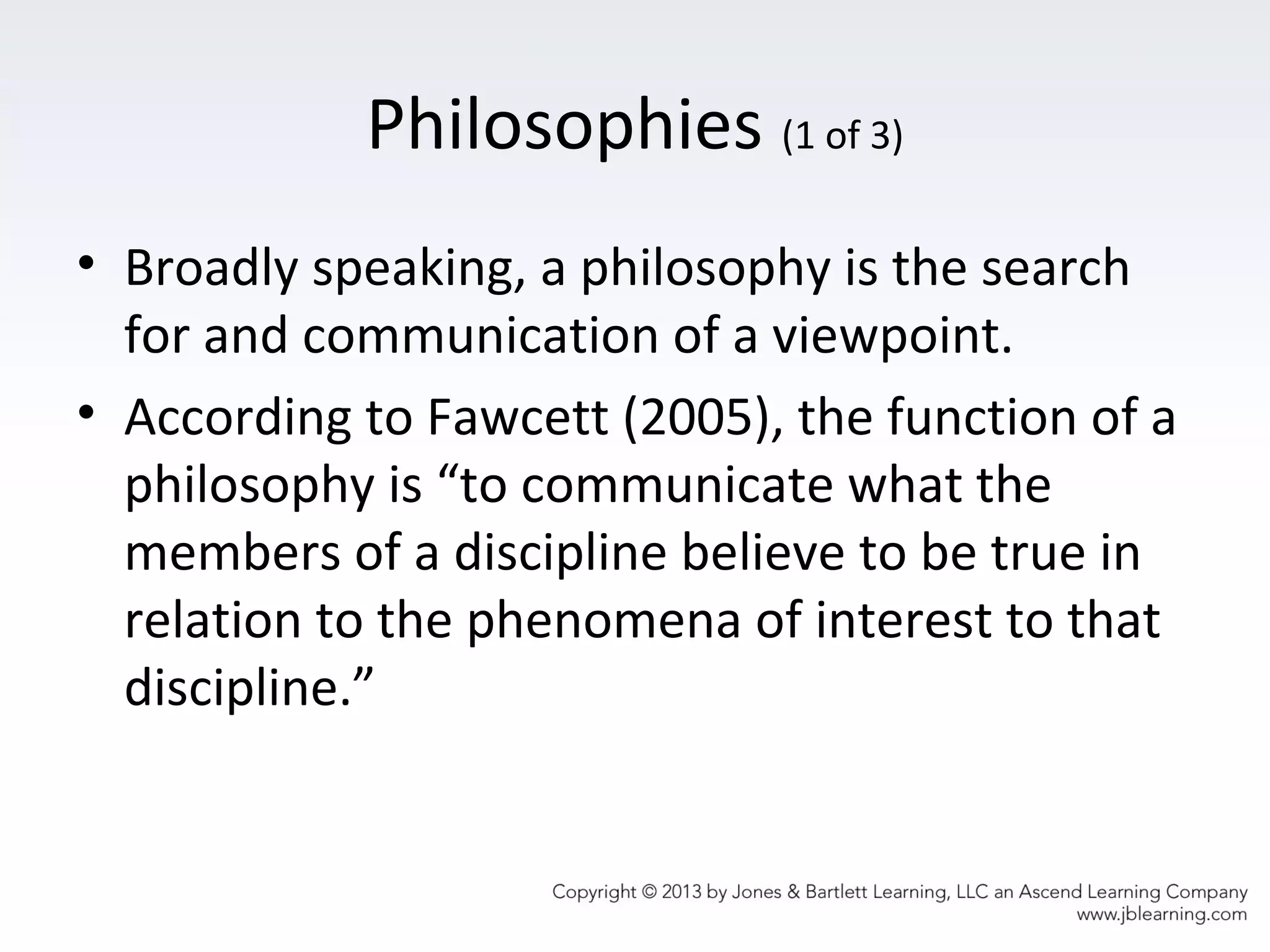
Philosophies (1 of 3)
• Broadly speaking, a philosophy is the search
for and communication of a viewpoint.
• According to Fawcett (2005), the function of a
philosophy is “to communicate what the
members of a discipline believe to be true in
relation to the phenomena of interest to that
discipline.”
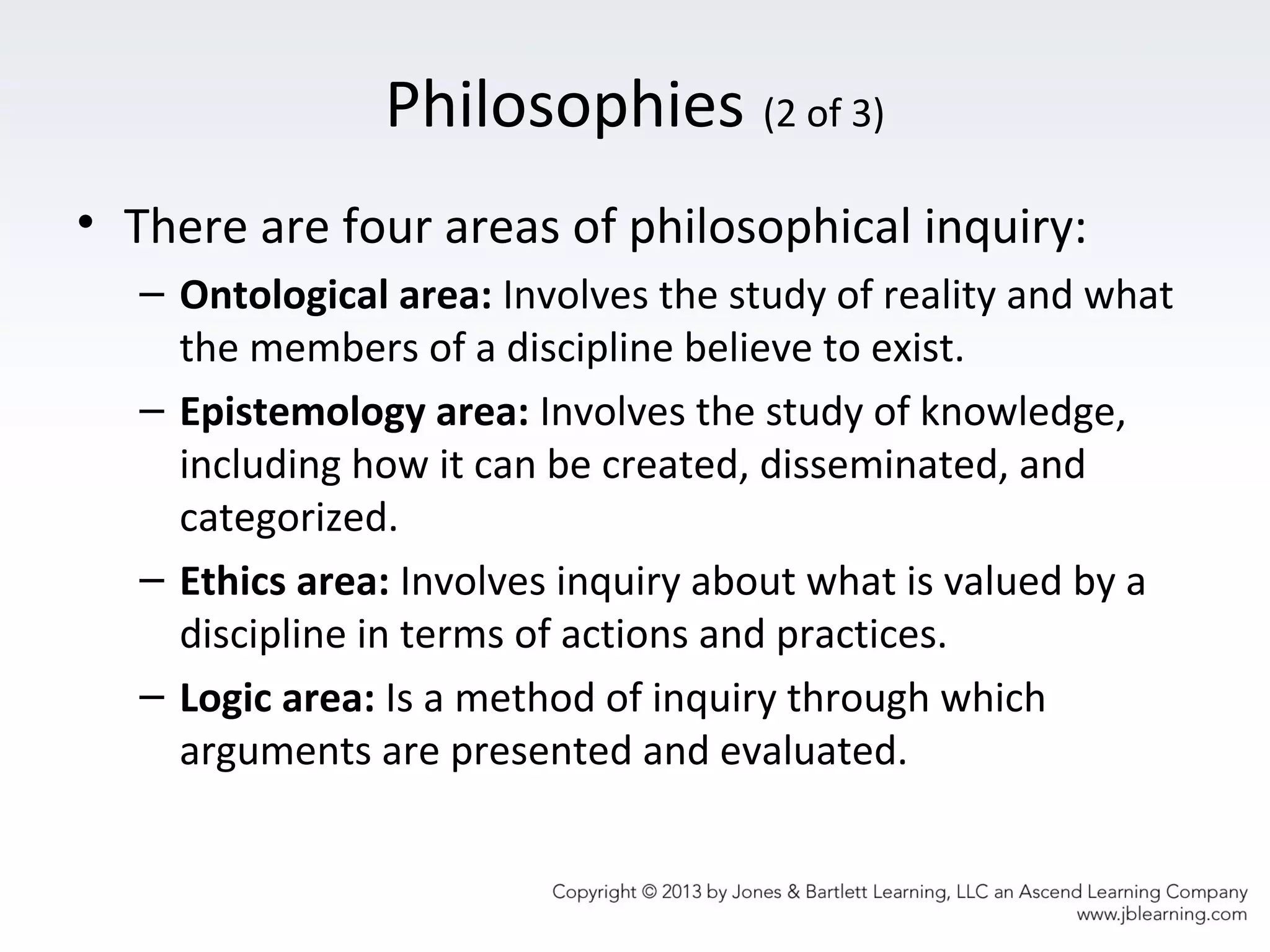
Philosophies (2 of 3)
• There are four areas of philosophical inquiry:
– Ontological area: Involves the study of reality and what
the members of a discipline believe to exist.
– Epistemology area: Involves the study of knowledge,
including how it can be created, disseminated, and
categorized.
– Ethics area: Involves inquiry about what is valued by a
discipline in terms of actions and practices.
– Logic area: Is a method of inquiry through which
arguments are presented and evaluated.
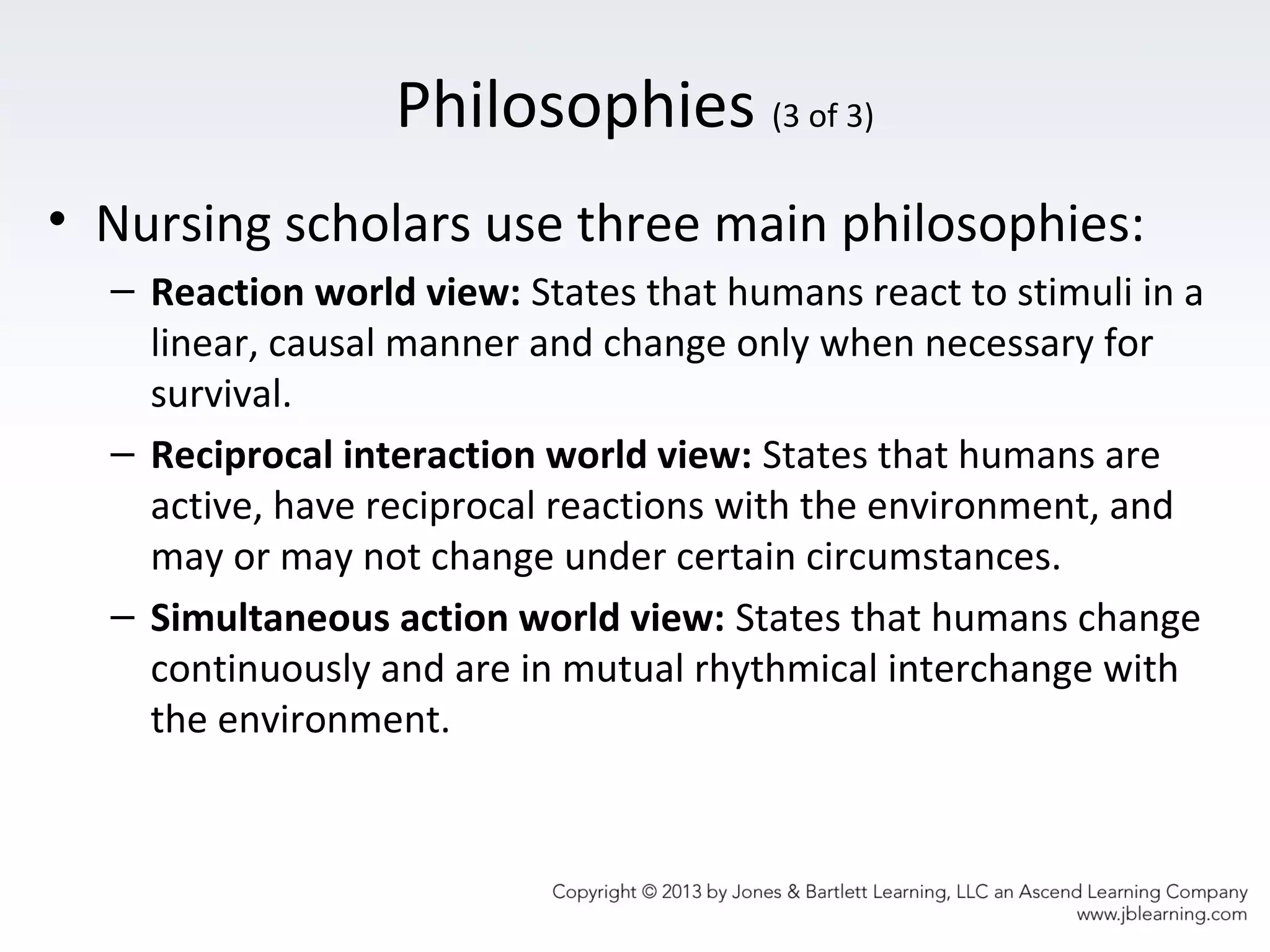
Philosophies (3 of 3)
• Nursing scholars use three main philosophies:
– Reaction world view: States that humans react to stimuli in a
linear, causal manner and change only when necessary for
survival.
– Reciprocal interaction world view: States that humans are
active, have reciprocal reactions with the environment, and
may or may not change under certain circumstances.
– Simultaneous action world view: States that humans change
continuously and are in mutual rhythmical interchange with
the environment.
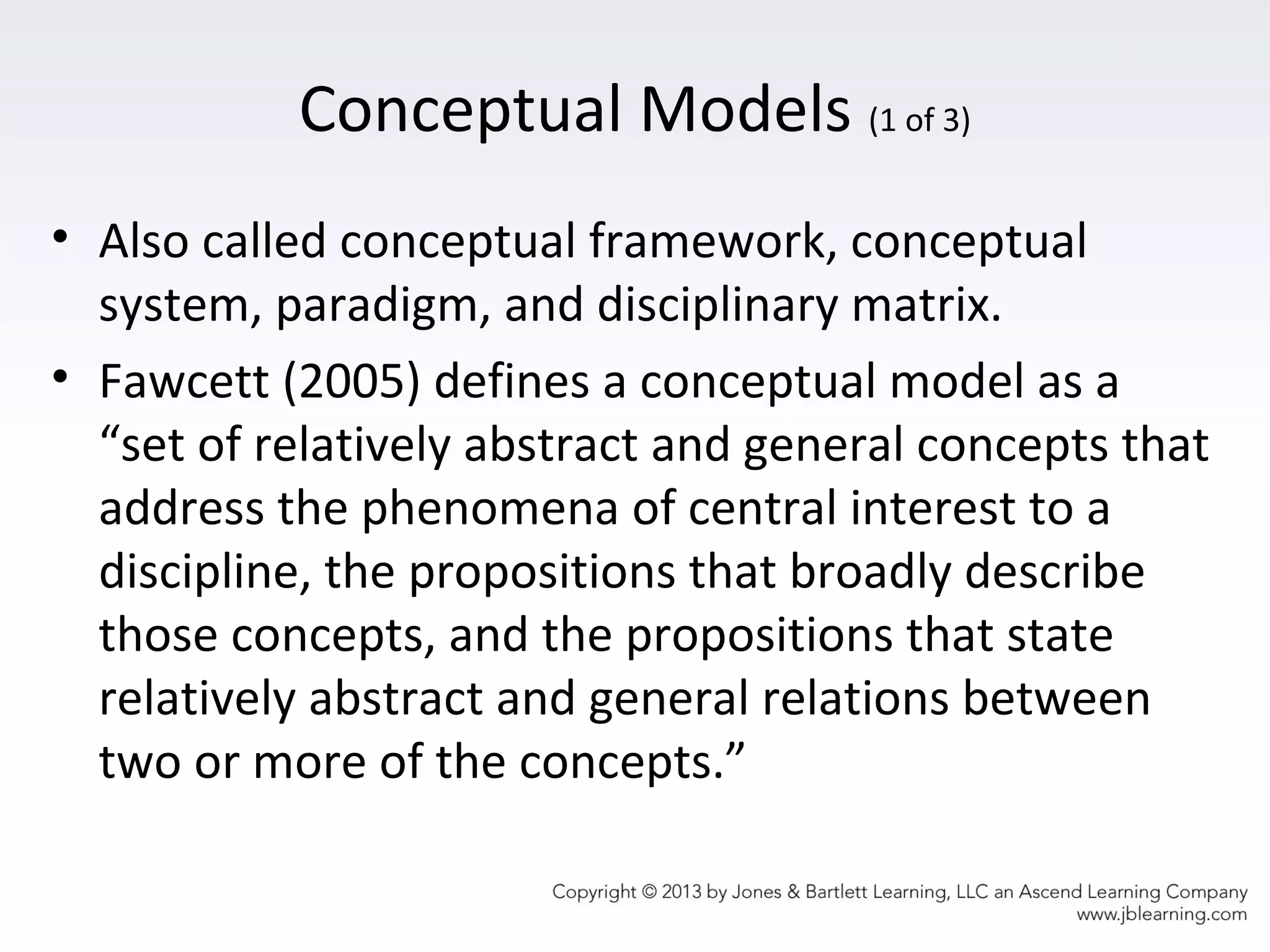
Conceptual Models (1 of 3)
• Also called conceptual framework, conceptual
system, paradigm, and disciplinary matrix.
• Fawcett (2005) defines a conceptual model as a
“set of relatively abstract and general concepts that
address the phenomena of central interest to a
discipline, the propositions that broadly describe
those concepts, and the propositions that state
relatively abstract and general relations between
two or more of the concepts.”
Conceptual Models (2 of 3)
• Conceptual models characterize relationships
among phenomena to shape a distinctive
frame of reference.
• Individuals can interpret and characterize the
same reality in different ways using different
conceptual models.
• These models have practical value because
they guide research and practice.
Conceptual Models (3 of 3)
• Fawcett recognizes seven conceptual models
of nursing.
• According to Fawcett, these models are the
foundation of nursing as a discipline.
• Conceptual models are more abstract than
theories, and they can be distinguished from
theories using a series of if-then
determinations.
Theories (1 of 2)
• According to Fawcett (2005), a theory is “one
or more relatively concrete and specific
concepts that are derived from a conceptual
model, the propositions that narrowly
describe those concepts, and the propositions
that state relatively concrete and specific
relations between two or more concepts.”
Theories (2 of 2)
• Theories can be defined in different ways:
– Based on structure
– Based on practice goals
– Based on tentativeness
– Based on research
– Based on creativity in developing and connecting
concepts
– Based on progression from conceptual models to
theory
Functions of Theory:
Theory to Practice
• The usefulness of a theory is closely connected to
“how good” the theory is.
• Theory development serves two functions:
– Testing and generating theories drives research
– Finding research-based evidence for theories drives
changes in practice
• The relationship of theory development to
practice is called the conceptual-theoretical-
empirical (C-T-E) formalization.
Theory by Levels of Abstractions
(1 of 2)
• Theories can be categorized as follows based
on their levels of abstraction and scope:
– Metatheory: A philosophical stance about theory
and its methods for generating knowledge
– Grand theory: A set of concepts that is less broad
than a conceptual model but too abstract to state
relationships or hypotheses in empirical terms
Theory by Levels of Abstractions
(2 of 2)
– Middle-range theory: A set of concepts that is not
as broad as a grand theory and is strongly
supported by empirical data.
– Practice theory: A narrow theory that results from
empirical testing; sometimes called situation-
specific theory or micro theory.
Middle-Range Theory and Nursing
• Middle-range theories are important because
they have specificity for nursing practice.
• A middle-range theory may be categorized as:
– Descriptive: “Information presenting”
– Explanatory: “Knowledge building”
– Predictive: “Knowledge confirming”
– Prescriptive: “Knowledge utilizing”
• Good middle-range theories are closely linked to
specific conceptual models.
Empirical Indicators
• Defined by Fawcett (2005) as “an actual
instrument, experimental condition, or
procedure that is used to observe or measure a
middle-range theory concept.”
• Information derived from these indicators is
commonly known as data.
• Empirical indicators provide a way to test or
generate middle-range theories.
Using the Components in Practice
(1 of 2)
• As mentioned, the C-T-E system can be used to
connect theory and practice.
• When applying the system, three elements must
be considered:
– Translation of the metaparadigm of nursing into
practice (e.g., via hospital mission statements)
– Translation of philosophies into practice (e.g., via codes
of ethics , patient bills of rights, and statements of
nursing philosophy)
Using the Components in Practice
(2 of 2)
– Translation of conceptual models, theories, and
empirical indictors into a “formal nursing
knowledge system” (e.g., via practice standards,
assessment designs, intervention protocols, and
evaluation programs).
Summary
• Fawcett’s holography connects five main
components of nursing knowledge:
metaparadigm, philosophy, conceptual model,
theory, and empirical indicator.
• Middle-range theories must be closely linked to
conceptual models if nursing is to retain its status
as a discipline.
• The C-T-E system is necessary for translating
nursing models and theories into practice.

Chapter 5 components and levels of abstraction in nursing knowledge

  • 1.
    Chapter 5 Components and Levelsof Abstraction in Nursing Knowledge
  • 2.
    Introduction • Graduate studentsand advanced practice nurses must be familiar with the components and levels of abstraction in nursing knowledge. • One way to conceptualize this information is by using the structural holarchy developed by Jacqueline Fawcett.
  • 3.
    Components of NursingKnowledge • Nursing knowledge is the cumulative, ever- evolving result of prior learning, experience, theory, and research. • Fawcett (2005) places nursing knowledge into a structural holarchy with five components: – Metaparadigm – Philosophy – Conceptual model – Theory – Empirical indicator
  • 4.
    Knowledge Holarchies • Aholarchy is a hierarchy in which each level is a whole but is also part of a larger whole. • Each holon or node functions independently but also interacts with other holons or nodes. • Within a holarchy, holons coordinate and include holons on subordinate levels. • Some holons also interact with other holons of the same level. • Can be viewed through either testing theory or generating theory.
  • 5.
    Metaparadigms • A metaparadigmis the most abstract view of a discipline, and it consists of the concepts that define that discipline. • In nursing, the most common metaparadigm concepts are human beings, environment, health, and nursing. • Because it has a metaparadigm, nursing is accurately classified as a discipline, or “a distinct way of viewing all phenomena.”
  • 6.
    Philosophies (1 of3) • Broadly speaking, a philosophy is the search for and communication of a viewpoint. • According to Fawcett (2005), the function of a philosophy is “to communicate what the members of a discipline believe to be true in relation to the phenomena of interest to that discipline.”
  • 7.
    Philosophies (2 of3) • There are four areas of philosophical inquiry: – Ontological area: Involves the study of reality and what the members of a discipline believe to exist. – Epistemology area: Involves the study of knowledge, including how it can be created, disseminated, and categorized. – Ethics area: Involves inquiry about what is valued by a discipline in terms of actions and practices. – Logic area: Is a method of inquiry through which arguments are presented and evaluated.
  • 8.
    Philosophies (3 of3) • Nursing scholars use three main philosophies: – Reaction world view: States that humans react to stimuli in a linear, causal manner and change only when necessary for survival. – Reciprocal interaction world view: States that humans are active, have reciprocal reactions with the environment, and may or may not change under certain circumstances. – Simultaneous action world view: States that humans change continuously and are in mutual rhythmical interchange with the environment.
  • 9.
    Conceptual Models (1of 3) • Also called conceptual framework, conceptual system, paradigm, and disciplinary matrix. • Fawcett (2005) defines a conceptual model as a “set of relatively abstract and general concepts that address the phenomena of central interest to a discipline, the propositions that broadly describe those concepts, and the propositions that state relatively abstract and general relations between two or more of the concepts.”
  • 10.
    Conceptual Models (2of 3) • Conceptual models characterize relationships among phenomena to shape a distinctive frame of reference. • Individuals can interpret and characterize the same reality in different ways using different conceptual models. • These models have practical value because they guide research and practice.
  • 11.
    Conceptual Models (3of 3) • Fawcett recognizes seven conceptual models of nursing. • According to Fawcett, these models are the foundation of nursing as a discipline. • Conceptual models are more abstract than theories, and they can be distinguished from theories using a series of if-then determinations.
  • 12.
    Theories (1 of2) • According to Fawcett (2005), a theory is “one or more relatively concrete and specific concepts that are derived from a conceptual model, the propositions that narrowly describe those concepts, and the propositions that state relatively concrete and specific relations between two or more concepts.”
  • 13.
    Theories (2 of2) • Theories can be defined in different ways: – Based on structure – Based on practice goals – Based on tentativeness – Based on research – Based on creativity in developing and connecting concepts – Based on progression from conceptual models to theory
  • 14.
    Functions of Theory: Theoryto Practice • The usefulness of a theory is closely connected to “how good” the theory is. • Theory development serves two functions: – Testing and generating theories drives research – Finding research-based evidence for theories drives changes in practice • The relationship of theory development to practice is called the conceptual-theoretical- empirical (C-T-E) formalization.
  • 15.
    Theory by Levelsof Abstractions (1 of 2) • Theories can be categorized as follows based on their levels of abstraction and scope: – Metatheory: A philosophical stance about theory and its methods for generating knowledge – Grand theory: A set of concepts that is less broad than a conceptual model but too abstract to state relationships or hypotheses in empirical terms
  • 16.
    Theory by Levelsof Abstractions (2 of 2) – Middle-range theory: A set of concepts that is not as broad as a grand theory and is strongly supported by empirical data. – Practice theory: A narrow theory that results from empirical testing; sometimes called situation- specific theory or micro theory.
  • 17.
    Middle-Range Theory andNursing • Middle-range theories are important because they have specificity for nursing practice. • A middle-range theory may be categorized as: – Descriptive: “Information presenting” – Explanatory: “Knowledge building” – Predictive: “Knowledge confirming” – Prescriptive: “Knowledge utilizing” • Good middle-range theories are closely linked to specific conceptual models.
  • 18.
    Empirical Indicators • Definedby Fawcett (2005) as “an actual instrument, experimental condition, or procedure that is used to observe or measure a middle-range theory concept.” • Information derived from these indicators is commonly known as data. • Empirical indicators provide a way to test or generate middle-range theories.
  • 19.
    Using the Componentsin Practice (1 of 2) • As mentioned, the C-T-E system can be used to connect theory and practice. • When applying the system, three elements must be considered: – Translation of the metaparadigm of nursing into practice (e.g., via hospital mission statements) – Translation of philosophies into practice (e.g., via codes of ethics , patient bills of rights, and statements of nursing philosophy)
  • 20.
    Using the Componentsin Practice (2 of 2) – Translation of conceptual models, theories, and empirical indictors into a “formal nursing knowledge system” (e.g., via practice standards, assessment designs, intervention protocols, and evaluation programs).
  • 21.
    Summary • Fawcett’s holographyconnects five main components of nursing knowledge: metaparadigm, philosophy, conceptual model, theory, and empirical indicator. • Middle-range theories must be closely linked to conceptual models if nursing is to retain its status as a discipline. • The C-T-E system is necessary for translating nursing models and theories into practice.