Copyright © 2017, Elsevier Inc. All Rights Reserved.
Managing Chemicals Safely
Chapter 27
1
Copyright © 2017, Elsevier Inc. All Rights Reserved.
Learning Objectives
Lesson 27.1: Managing
Chemicals Safely
1. Define the goal of a hazard communication
program and the terms that are important in
the development of a hazard communication
program.
2. Describe the process by which OSHA
monitors and helps improve safety conditions
in the workplace and provide a description of
their Hazard Communication Standard.
2
Copyright © 2017, Elsevier Inc. All Rights Reserved.
3. Develop a method to determine the hazard
potential of chemicals.
4. Design and maintain a written hazard
communication program.
5. Describe additional safety requirements used
to manage hazardous chemicals including
inventory, labels, other forms of warning, and
safety data sheets.
3
Learning Objectives
Lesson 27.1: Managing
Chemicals Safely (Cont.)
Copyright © 2017, Elsevier Inc. All Rights Reserved.
Learning Objectives
Lesson 27.1: Managing
Chemicals Safely (Cont.)
6. Outline an employee information and training
program for dealing with hazardous
chemicals in the workplace.
7. Identify the four ways “OSHA solves a
problem.”
8. List the seven sections/components of
maintaining compliance with the Safe Use of
Chemicals in the Laboratory Standard.
4
Copyright © 2017, Elsevier Inc. All Rights Reserved.
Learning Objectives
Lesson 27.1: Managing
Chemicals Safely (Cont.)
9. Describe the general principles for working
with laboratory chemicals, including prudent
practices.
10. List employee chemical hygiene
responsibilities, describe the chemical
hygiene safety requirements in laboratory
facilities, and design and maintain a written
chemical hygiene plan.
5
Copyright © 2017, Elsevier Inc. All Rights Reserved.
Hazard Communication Program
 Goal is to ensure employers and employees
know about work hazards and how to protect
themselves
 Adverse exposure to chemicals can have
serious health consequences
 Know the proper response if exposure does
occur
6
Copyright © 2017, Elsevier Inc. All Rights Reserved.
Hazard Communication Program
 Millions of workers in the United States are
occupationally at risk for exposure to one or
more hazardous chemicals.
 Almost 650,000 chemicals can be purchased
in the United States, and literally thousands of
new chemicals are introduced each year.
 The risk of exposure is increasing continually,
and the workplace use of toxic chemicals has
become commonplace.
7
Copyright © 2017, Elsevier Inc. All Rights Reserved.
Hazard Communication Program
 Health consequences include damage to the
heart, kidney, liver, and lung tissues.
 The result could be a variety of diseases that
range from short-term discomfort (e.g., burns
or rashes) to life threatening (e.g., cancer,
sterility, or organ failure).
 Preventing exposure to hazardous chemicals
is the ultimate goal.
 Also important is the proper response when
an exposure does occur.
8
Copyright © 2017, Elsevier Inc. All Rights Reserved.
Role of OSHA
 The Occupational Safety and Health
Administration (OSHA) monitors and helps
improve safety conditions in the workplace:
 Improves engineering controls
 Changes work practice controls
 Issues comprehensive standards that hold the
weight of law
 Generates standards for the development, use,
and review of PPE
9
Copyright © 2017, Elsevier Inc. All Rights Reserved.
Role of OSHA
 The greatest initial need (numbers of
employees and severity of injuries), as one
would expect, was (and remains) based in
large and naturally dangerous worksites.
 Overall goal is to minimize the chances of
occupationally related injuries.
 See Table 27.1 for important definitions for a
hazard communication program.
10
Copyright © 2017, Elsevier Inc. All Rights Reserved.
Hazard Communication Standard
 The main directive of OSHA is the protection
of employees
 OSHA develops new standards and broadens
the scope of others to fit current needs
 Bloodborne Pathogens Standard
 Hazard Communication Standard
11
Copyright © 2017, Elsevier Inc. All Rights Reserved.
 Most dental workers are aware of the OSHA
Occupational Exposure to Bloodborne Pathogens
Standard, but little attention is paid to other OSHA
standards.
 One particularly deficient area is the OSHA
Hazard Communication Standard (HCS), also
known as HazCom Standard, HazMat Program,
“Employee Right to Know.”
 Major portion of OSHA inspections involve
complaints associated with injuries involving the
handling, use, storage, and disposal of hazardous
materials.
12
Copyright © 2017, Elsevier Inc. All Rights Reserved.
Hazard Communication Standard
Updated in 2012
 The HCS was updated in 2012 to align with the
Globally Harmonized System of Classification and
Labeling of Chemicals (GHS)
 Major changes include:
 Hazard classification
 Labels
 Information and training
 The HCS was updated to be consistent with the
GHS and provides a common and coherent
approach to classifying chemicals and
communicating hazard information on labels and
safety data sheets. 13
Copyright © 2017, Elsevier Inc. All Rights Reserved.
Purpose of the Hazard
Communication Standard
 To ensure that hazards of all chemicals
produced or imported be evaluated and that
employers transmit the information
concerning such hazards directly to
employees
 Conveyed through a comprehensive hazard
communication program
14
Copyright © 2017, Elsevier Inc. All Rights Reserved.
Purpose of the Hazard
Communication Standard
 OSHA has a variety of materials and
publications to help employers and
employees develop and implement effective
hazard communication programs.
 The program includes a written clinic/office
program manual, container labeling, and
other forms of warning, SDSs, and employee
training.
 See Box 27.1 to view OSHA-Related
Publications.
15
Copyright © 2017, Elsevier Inc. All Rights Reserved.
Scope and Application of the Hazard
Communication Standard
 The chemical manufacturers and importers
are charged to assess the hazards
associated with the use of their products
 OSHA considers most health care facilities,
including dental clinics or offices, to be
“laboratories”
 Employers responsible for employee
information and training on hazardous
chemicals
16
Copyright © 2017, Elsevier Inc. All Rights Reserved.
Scope and Application of the Hazard
Communication Standard
 Hazardous chemicals involved in the
standard are limited to those present in the
workplace to which employees may be
exposed under normal working conditions
and in the case of a foreseeable emergency
(e.g., an employee may not directly use a
chemical but must be informed and trained
about the proper procedures to follow if
another employee were to drop and break
open a jar of the chemical).
17
Copyright © 2017, Elsevier Inc. All Rights Reserved.
Scope and Application of the Hazard
Communication Standard
 Employers must ensure that employees are
informed and trained considering the types
and amounts of hazardous materials present,
the labeling system and warning signs used,
the location and use of SDSs, and
procedures to be followed in case of
emergencies.
18
Copyright © 2017, Elsevier Inc. All Rights Reserved.
Hazard Classification
 Workplaces must have a list of hazardous
chemicals
 The list serves as an inventory of everything for which an
SDS must be maintained
 Hazardous chemicals are any chemicals that pose
a physical or health hazard
 The EPA designates which chemicals are hazardous
 What is an SDS?
 Safety Data Sheet
 The identification, evaluation, and notification of
any chemical as being hazardous are the initial
responsibility of its manufacturer or importer.
19
Copyright © 2017, Elsevier Inc. All Rights Reserved.
Written Hazard Communication
Program (WHCP)
 Employers must develop, implement, and
maintain a written, comprehensive hazard
communication program
 With a written plan, training and sharing of
information is made easier
20
Copyright © 2017, Elsevier Inc. All Rights Reserved.
Written Hazard Communication
Program (WHCP)
 The quality of a hazard communication program
depends on the adequacy and accuracy of the
hazard assessment.
 All workplaces where employees are exposed to
hazardous chemicals must have a written plan that
describes how the standard will be implemented in
that facility.
 The HCS commonly is referred to as the “Employee
Right to Know Rule.” Another way to look at the
standard is as the “No Surprises Rule.”
 See Table 27.2 for the nine steps involved in writing
a WHCP. 21
Copyright © 2017, Elsevier Inc. All Rights Reserved.
Written Hazard Communication
Program (WHCP): Nine Steps
1. Provide copies of the HCS to each employee
2. Determine who is responsible for
implementing the WHCP
3. List all chemicals used or produced in the
workplace
4. Describe the methods to be used to inform
employees of the hazards of nonroutine tasks
22
Copyright © 2017, Elsevier Inc. All Rights Reserved.
Written Hazard Communication
Program (WHCP): Nine Steps (Cont.)
5. Describe methods used to inform contract
employees of the hazardous chemicals to
which they could be exposed
6. Describe methods used to label containers
7. Collect and maintain SDSs
8. Describe employee information and training
9. Use of chemicals that involve trade secrets
23
Copyright © 2017, Elsevier Inc. All Rights Reserved.
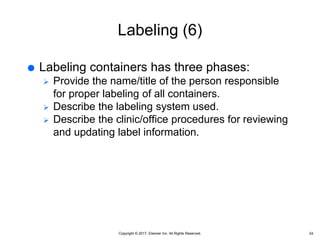
Labeling (6)
 Labeling containers has three phases:
 Provide the name/title of the person responsible
for proper labeling of all containers.
 Describe the labeling system used.
 Describe the clinic/office procedures for reviewing
and updating label information.
24
Copyright © 2017, Elsevier Inc. All Rights Reserved.
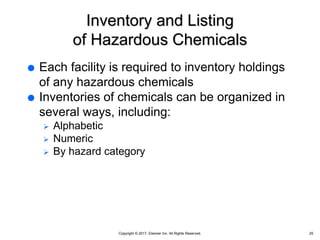
Inventory and Listing
of Hazardous Chemicals
 Each facility is required to inventory holdings
of any hazardous chemicals
 Inventories of chemicals can be organized in
several ways, including:
 Alphabetic
 Numeric
 By hazard category
25
Copyright © 2017, Elsevier Inc. All Rights Reserved.
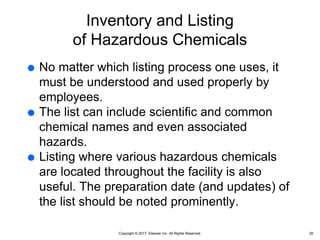
Inventory and Listing
of Hazardous Chemicals
 No matter which listing process one uses, it
must be understood and used properly by
employees.
 The list can include scientific and common
chemical names and even associated
hazards.
 Listing where various hazardous chemicals
are located throughout the facility is also
useful. The preparation date (and updates) of
the list should be noted prominently.
26
Copyright © 2017, Elsevier Inc. All Rights Reserved.
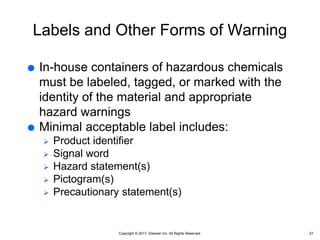
Labels and Other Forms of Warning
 In-house containers of hazardous chemicals
must be labeled, tagged, or marked with the
identity of the material and appropriate
hazard warnings
 Minimal acceptable label includes:
 Product identifier
 Signal word
 Hazard statement(s)
 Pictogram(s)
 Precautionary statement(s)
27
Copyright © 2017, Elsevier Inc. All Rights Reserved.
 What is a signal word?
 e.g. DANGER, WARNING, ASPHYXIANT
 What is a hazard statement?
 Describes the nature of the hazard
 What is a pictogram?
 See Figure 27.1.
 Ideally, the sources of the chemical will label all their
containers of hazardous chemicals properly. If an
employer determines that a container is labeled
properly, the container requires no additional
information.
28
Labels and Other Forms of Warning
Copyright © 2017, Elsevier Inc. All Rights Reserved.
Labels and Other Forms of Warning
 Some chemicals (especially dental materials
kits) are not labeled properly by their sources.
In such cases, the clinic/office must complete
the labeling process.
 What should be included in the new
containers?
 They must be labeled with
• [1] the identity of the hazardous chemical[s],
• [2] appropriate hazard warning, and
• [3] the name and address of the chemical manufacturer,
importer, or responsible party.)
29
Copyright © 2017, Elsevier Inc. All Rights Reserved.
Safety Data Sheets (SDSs)
 SDSs are written reports prepared by
manufacturers or importers that describe an
individual chemical or a group or collection of
chemicals
 Very important
 Include:
 Chemicals present
 Associated hazards
 Handling and cleanup procedures
 Special PPE that need to be in place
30
Copyright © 2017, Elsevier Inc. All Rights Reserved.
Safety Data Sheets (SDSs)
 Chemical manufacturers and importers must
obtain or develop an SDS for each product
containing hazardous chemicals.
 This rule applies to single chemicals and multiple-
chemical kits.
 The employer must obtain an SDS specific for
each hazardous chemical present in the
workplace.
 If a clinic/office uses three types of amalgam,
three specific (unique) SDSs are needed.
 Generic SDSs are not acceptable.
31
Copyright © 2017, Elsevier Inc. All Rights Reserved.
Safety Data Sheets (SDSs)
 Safety data sheets contain phone numbers
that are answered 24 hours a day, 7 days a
week.
 These contacts are trained to offer highly specific
and useful information about the product.
 Photocopies of SDSs are acceptable.
 Table 27.3 shows all 16 required sections of
the SDS.
32
Copyright © 2017, Elsevier Inc. All Rights Reserved.
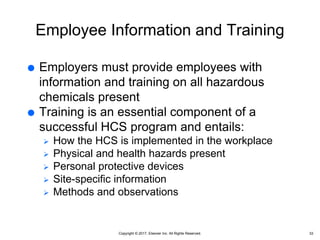
Employee Information and Training
 Employers must provide employees with
information and training on all hazardous
chemicals present
 Training is an essential component of a
successful HCS program and entails:
 How the HCS is implemented in the workplace
 Physical and health hazards present
 Personal protective devices
 Site-specific information
 Methods and observations
33
Copyright © 2017, Elsevier Inc. All Rights Reserved.
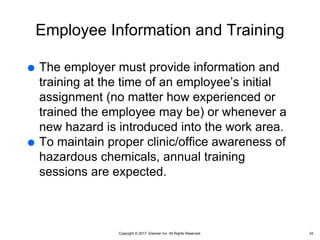
Employee Information and Training
 The employer must provide information and
training at the time of an employee’s initial
assignment (no matter how experienced or
trained the employee may be) or whenever a
new hazard is introduced into the work area.
 To maintain proper clinic/office awareness of
hazardous chemicals, annual training
sessions are expected.
34
Copyright © 2017, Elsevier Inc. All Rights Reserved.
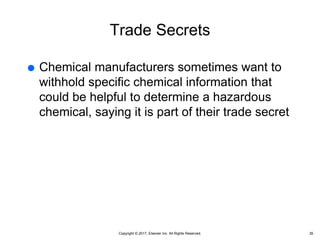
Trade Secrets
 Chemical manufacturers sometimes want to
withhold specific chemical information that
could be helpful to determine a hazardous
chemical, saying it is part of their trade secret
35
Copyright © 2017, Elsevier Inc. All Rights Reserved.
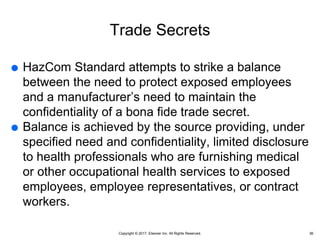
Trade Secrets
 HazCom Standard attempts to strike a balance
between the need to protect exposed employees
and a manufacturer’s need to maintain the
confidentiality of a bona fide trade secret.
 Balance is achieved by the source providing, under
specified need and confidentiality, limited disclosure
to health professionals who are furnishing medical
or other occupational health services to exposed
employees, employee representatives, or contract
workers.
36
Copyright © 2017, Elsevier Inc. All Rights Reserved.
How OSHA Solves a Problem
 Employee questions concerning OSHA
compliance and other employee health and
safety issues must be taken seriously by
employers
 OSHA resolution to problems is a four-step
process
 Determine whether a problem exists
 Engineering controls
 Work practices
 PPE
37
Copyright © 2017, Elsevier Inc. All Rights Reserved.
How OSHA Solves a Problem
 Employees who think their reasonable
requests are not being addressed properly
are far more likely to seek an answer outside
of the office or clinic.
 The first action the employer should take is to
determine whether a request is reasonable.
 This is probably more difficult than it sounds.
Some employees at times make and maintain
unreasonable requests.
38
Copyright © 2017, Elsevier Inc. All Rights Reserved.
How OSHA Solves a Problem
 What are engineering controls?
 Measures designed to isolate or remove the
chemical hazard from a workplace
 What are work practices?
 Methods that reduce the likelihood of exposure by
altering the manner in which a chemical is used
 Employers must do what is required and
proper, but they are not obligated to provide
more than what is necessary.
 Regular clinic/office meetings at which compliance
issues are discussed in an open manner are
central to clinic/office morale and compliance.
39
Copyright © 2017, Elsevier Inc. All Rights Reserved.
Occupational Exposure to Hazardous
Chemicals in Laboratories
 There are OSHA safety standards that help
protect employees engaged in the laboratory
use of hazardous chemicals
 The standard seeks to limit employee
exposures to specific permissible levels when
working in laboratories
40
Copyright © 2017, Elsevier Inc. All Rights Reserved.
 For some chemicals, stricter OSHA and EPA
standards apply.
 In some cases, absolutely no exposure is
permitted.
 Some chemicals, however, are exempt.
 These include chemicals that have no potential for
employee exposure.
 Limits are not known for all individual chemicals or
for groups of chemicals mixed to create a new end
product.
 However, complaints about odors, headaches, runny
noses and eyes, nausea, or skin hypersensitivities are
common.
 Refer to Table 27.4: Important Definitions for a
Chemical Hygiene Plan.
41
Copyright © 2017, Elsevier Inc. All Rights Reserved.
Compliance
 Compliance is mandatory for the laboratory
standard
 Seven components:
 General principles
 Responsibilities
 Laboratory facility
 Components of the chemical hygiene plan
 General principles of working with chemicals
 Safety recommendations
 SDSs
 The organization of these topics corresponds to
sections in the standard and the
recommendations made in Appendixes A and B
of the standard.
42
Copyright © 2017, Elsevier Inc. All Rights Reserved.
General Principles for Working
with Laboratory Chemicals
 An appropriate chemical hygiene plan must be
developed by every workplace
 No official form or format exists
 Recommendations were offered by the National
Research Council in 1981
 Called Prudent Practices
 The practices actually are an assessment of risk
and a listing of recommendations that have the
ultimate goal of limiting workplace exposure to
harmful chemicals.
 Refer back to Table 27.4 for important elements
of a chemical hygiene plan.
 Never underestimate risk.
43
Copyright © 2017, Elsevier Inc. All Rights Reserved.
Chemical Hygiene Responsibilities
 Every person working at a location responsible for
chemical hygiene
 A chemical hygiene officer can serve as a liaison between
employees and management
 Responsibilities include:
 Monitoring procurement, use, and disposal of lab chemicals
 Maintaining lists of chemicals present
 Being aware of current exposure limits for chemicals present
 Working with management to continually improve the
chemical hygiene plan
 Workers are responsible for planning and conducting
each operation according to the chemical hygiene
procedures of their office.
44
Copyright © 2017, Elsevier Inc. All Rights Reserved.
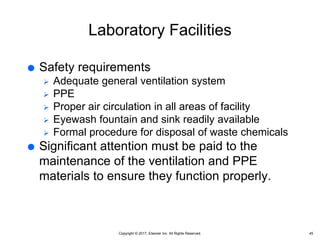
Laboratory Facilities
 Safety requirements
 Adequate general ventilation system
 PPE
 Proper air circulation in all areas of facility
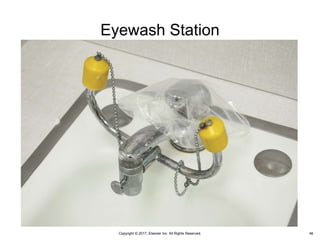
 Eyewash fountain and sink readily available
 Formal procedure for disposal of waste chemicals
 Significant attention must be paid to the
maintenance of the ventilation and PPE
materials to ensure they function properly.
45
Copyright © 2017, Elsevier Inc. All Rights Reserved.
Eyewash Station
46
Copyright © 2017, Elsevier Inc. All Rights Reserved.
Chemical Hygiene Plan
 The central element for compliance with the
Laboratory Standard
 Should be in writing
 Should begin with a list of the basic rules and
procedures to be used in the facility
 See Table 27.5 for the components of a
chemical hygiene plan.
 Each office must be prepared to provide a
medical program.
 Certain records need to be kept to be in
compliance.
47
Copyright © 2017, Elsevier Inc. All Rights Reserved.
Working with Chemicals
 Methods designed to avoid chemical contact
must be followed regularly
 Assume that exposures will occur, and adapt
preventive behaviors
 In the event of an exposure, prompt action is
necessary.
 Water rinsing and removal of soiled clothing
helps minimize skin contact.
 Personnel must avoid eating, smoking, and
drinking in the presence of hazardous laboratory
chemicals.
 Work to prevent injuries rather than manage
exposures.
48
Copyright © 2017, Elsevier Inc. All Rights Reserved.
Safety Recommendations
 Safety is a two-part equation
 Prevention
 Proper handling of accidents and emergencies
 If precautions fail, the chance of exposure
increases.
 Working hard to prevent injuries is always
better than managing exposures.
49

Chapter 27: Managing Chemicals Safely

  • 1.
    Copyright © 2017,Elsevier Inc. All Rights Reserved. Managing Chemicals Safely Chapter 27 1
  • 2.
    Copyright © 2017,Elsevier Inc. All Rights Reserved. Learning Objectives Lesson 27.1: Managing Chemicals Safely 1. Define the goal of a hazard communication program and the terms that are important in the development of a hazard communication program. 2. Describe the process by which OSHA monitors and helps improve safety conditions in the workplace and provide a description of their Hazard Communication Standard. 2
  • 3.
    Copyright © 2017,Elsevier Inc. All Rights Reserved. 3. Develop a method to determine the hazard potential of chemicals. 4. Design and maintain a written hazard communication program. 5. Describe additional safety requirements used to manage hazardous chemicals including inventory, labels, other forms of warning, and safety data sheets. 3 Learning Objectives Lesson 27.1: Managing Chemicals Safely (Cont.)
  • 4.
    Copyright © 2017,Elsevier Inc. All Rights Reserved. Learning Objectives Lesson 27.1: Managing Chemicals Safely (Cont.) 6. Outline an employee information and training program for dealing with hazardous chemicals in the workplace. 7. Identify the four ways “OSHA solves a problem.” 8. List the seven sections/components of maintaining compliance with the Safe Use of Chemicals in the Laboratory Standard. 4
  • 5.
    Copyright © 2017,Elsevier Inc. All Rights Reserved. Learning Objectives Lesson 27.1: Managing Chemicals Safely (Cont.) 9. Describe the general principles for working with laboratory chemicals, including prudent practices. 10. List employee chemical hygiene responsibilities, describe the chemical hygiene safety requirements in laboratory facilities, and design and maintain a written chemical hygiene plan. 5
  • 6.
    Copyright © 2017,Elsevier Inc. All Rights Reserved. Hazard Communication Program  Goal is to ensure employers and employees know about work hazards and how to protect themselves  Adverse exposure to chemicals can have serious health consequences  Know the proper response if exposure does occur 6
  • 7.
    Copyright © 2017,Elsevier Inc. All Rights Reserved. Hazard Communication Program  Millions of workers in the United States are occupationally at risk for exposure to one or more hazardous chemicals.  Almost 650,000 chemicals can be purchased in the United States, and literally thousands of new chemicals are introduced each year.  The risk of exposure is increasing continually, and the workplace use of toxic chemicals has become commonplace. 7
  • 8.
    Copyright © 2017,Elsevier Inc. All Rights Reserved. Hazard Communication Program  Health consequences include damage to the heart, kidney, liver, and lung tissues.  The result could be a variety of diseases that range from short-term discomfort (e.g., burns or rashes) to life threatening (e.g., cancer, sterility, or organ failure).  Preventing exposure to hazardous chemicals is the ultimate goal.  Also important is the proper response when an exposure does occur. 8
  • 9.
    Copyright © 2017,Elsevier Inc. All Rights Reserved. Role of OSHA  The Occupational Safety and Health Administration (OSHA) monitors and helps improve safety conditions in the workplace:  Improves engineering controls  Changes work practice controls  Issues comprehensive standards that hold the weight of law  Generates standards for the development, use, and review of PPE 9
  • 10.
    Copyright © 2017,Elsevier Inc. All Rights Reserved. Role of OSHA  The greatest initial need (numbers of employees and severity of injuries), as one would expect, was (and remains) based in large and naturally dangerous worksites.  Overall goal is to minimize the chances of occupationally related injuries.  See Table 27.1 for important definitions for a hazard communication program. 10
  • 11.
    Copyright © 2017,Elsevier Inc. All Rights Reserved. Hazard Communication Standard  The main directive of OSHA is the protection of employees  OSHA develops new standards and broadens the scope of others to fit current needs  Bloodborne Pathogens Standard  Hazard Communication Standard 11
  • 12.
    Copyright © 2017,Elsevier Inc. All Rights Reserved.  Most dental workers are aware of the OSHA Occupational Exposure to Bloodborne Pathogens Standard, but little attention is paid to other OSHA standards.  One particularly deficient area is the OSHA Hazard Communication Standard (HCS), also known as HazCom Standard, HazMat Program, “Employee Right to Know.”  Major portion of OSHA inspections involve complaints associated with injuries involving the handling, use, storage, and disposal of hazardous materials. 12
  • 13.
    Copyright © 2017,Elsevier Inc. All Rights Reserved. Hazard Communication Standard Updated in 2012  The HCS was updated in 2012 to align with the Globally Harmonized System of Classification and Labeling of Chemicals (GHS)  Major changes include:  Hazard classification  Labels  Information and training  The HCS was updated to be consistent with the GHS and provides a common and coherent approach to classifying chemicals and communicating hazard information on labels and safety data sheets. 13
  • 14.
    Copyright © 2017,Elsevier Inc. All Rights Reserved. Purpose of the Hazard Communication Standard  To ensure that hazards of all chemicals produced or imported be evaluated and that employers transmit the information concerning such hazards directly to employees  Conveyed through a comprehensive hazard communication program 14
  • 15.
    Copyright © 2017,Elsevier Inc. All Rights Reserved. Purpose of the Hazard Communication Standard  OSHA has a variety of materials and publications to help employers and employees develop and implement effective hazard communication programs.  The program includes a written clinic/office program manual, container labeling, and other forms of warning, SDSs, and employee training.  See Box 27.1 to view OSHA-Related Publications. 15
  • 16.
    Copyright © 2017,Elsevier Inc. All Rights Reserved. Scope and Application of the Hazard Communication Standard  The chemical manufacturers and importers are charged to assess the hazards associated with the use of their products  OSHA considers most health care facilities, including dental clinics or offices, to be “laboratories”  Employers responsible for employee information and training on hazardous chemicals 16
  • 17.
    Copyright © 2017,Elsevier Inc. All Rights Reserved. Scope and Application of the Hazard Communication Standard  Hazardous chemicals involved in the standard are limited to those present in the workplace to which employees may be exposed under normal working conditions and in the case of a foreseeable emergency (e.g., an employee may not directly use a chemical but must be informed and trained about the proper procedures to follow if another employee were to drop and break open a jar of the chemical). 17
  • 18.
    Copyright © 2017,Elsevier Inc. All Rights Reserved. Scope and Application of the Hazard Communication Standard  Employers must ensure that employees are informed and trained considering the types and amounts of hazardous materials present, the labeling system and warning signs used, the location and use of SDSs, and procedures to be followed in case of emergencies. 18
  • 19.
    Copyright © 2017,Elsevier Inc. All Rights Reserved. Hazard Classification  Workplaces must have a list of hazardous chemicals  The list serves as an inventory of everything for which an SDS must be maintained  Hazardous chemicals are any chemicals that pose a physical or health hazard  The EPA designates which chemicals are hazardous  What is an SDS?  Safety Data Sheet  The identification, evaluation, and notification of any chemical as being hazardous are the initial responsibility of its manufacturer or importer. 19
  • 20.
    Copyright © 2017,Elsevier Inc. All Rights Reserved. Written Hazard Communication Program (WHCP)  Employers must develop, implement, and maintain a written, comprehensive hazard communication program  With a written plan, training and sharing of information is made easier 20
  • 21.
    Copyright © 2017,Elsevier Inc. All Rights Reserved. Written Hazard Communication Program (WHCP)  The quality of a hazard communication program depends on the adequacy and accuracy of the hazard assessment.  All workplaces where employees are exposed to hazardous chemicals must have a written plan that describes how the standard will be implemented in that facility.  The HCS commonly is referred to as the “Employee Right to Know Rule.” Another way to look at the standard is as the “No Surprises Rule.”  See Table 27.2 for the nine steps involved in writing a WHCP. 21
  • 22.
    Copyright © 2017,Elsevier Inc. All Rights Reserved. Written Hazard Communication Program (WHCP): Nine Steps 1. Provide copies of the HCS to each employee 2. Determine who is responsible for implementing the WHCP 3. List all chemicals used or produced in the workplace 4. Describe the methods to be used to inform employees of the hazards of nonroutine tasks 22
  • 23.
    Copyright © 2017,Elsevier Inc. All Rights Reserved. Written Hazard Communication Program (WHCP): Nine Steps (Cont.) 5. Describe methods used to inform contract employees of the hazardous chemicals to which they could be exposed 6. Describe methods used to label containers 7. Collect and maintain SDSs 8. Describe employee information and training 9. Use of chemicals that involve trade secrets 23
  • 24.
    Copyright © 2017,Elsevier Inc. All Rights Reserved. Labeling (6)  Labeling containers has three phases:  Provide the name/title of the person responsible for proper labeling of all containers.  Describe the labeling system used.  Describe the clinic/office procedures for reviewing and updating label information. 24
  • 25.
    Copyright © 2017,Elsevier Inc. All Rights Reserved. Inventory and Listing of Hazardous Chemicals  Each facility is required to inventory holdings of any hazardous chemicals  Inventories of chemicals can be organized in several ways, including:  Alphabetic  Numeric  By hazard category 25
  • 26.
    Copyright © 2017,Elsevier Inc. All Rights Reserved. Inventory and Listing of Hazardous Chemicals  No matter which listing process one uses, it must be understood and used properly by employees.  The list can include scientific and common chemical names and even associated hazards.  Listing where various hazardous chemicals are located throughout the facility is also useful. The preparation date (and updates) of the list should be noted prominently. 26
  • 27.
    Copyright © 2017,Elsevier Inc. All Rights Reserved. Labels and Other Forms of Warning  In-house containers of hazardous chemicals must be labeled, tagged, or marked with the identity of the material and appropriate hazard warnings  Minimal acceptable label includes:  Product identifier  Signal word  Hazard statement(s)  Pictogram(s)  Precautionary statement(s) 27
  • 28.
    Copyright © 2017,Elsevier Inc. All Rights Reserved.  What is a signal word?  e.g. DANGER, WARNING, ASPHYXIANT  What is a hazard statement?  Describes the nature of the hazard  What is a pictogram?  See Figure 27.1.  Ideally, the sources of the chemical will label all their containers of hazardous chemicals properly. If an employer determines that a container is labeled properly, the container requires no additional information. 28 Labels and Other Forms of Warning
  • 29.
    Copyright © 2017,Elsevier Inc. All Rights Reserved. Labels and Other Forms of Warning  Some chemicals (especially dental materials kits) are not labeled properly by their sources. In such cases, the clinic/office must complete the labeling process.  What should be included in the new containers?  They must be labeled with • [1] the identity of the hazardous chemical[s], • [2] appropriate hazard warning, and • [3] the name and address of the chemical manufacturer, importer, or responsible party.) 29
  • 30.
    Copyright © 2017,Elsevier Inc. All Rights Reserved. Safety Data Sheets (SDSs)  SDSs are written reports prepared by manufacturers or importers that describe an individual chemical or a group or collection of chemicals  Very important  Include:  Chemicals present  Associated hazards  Handling and cleanup procedures  Special PPE that need to be in place 30
  • 31.
    Copyright © 2017,Elsevier Inc. All Rights Reserved. Safety Data Sheets (SDSs)  Chemical manufacturers and importers must obtain or develop an SDS for each product containing hazardous chemicals.  This rule applies to single chemicals and multiple- chemical kits.  The employer must obtain an SDS specific for each hazardous chemical present in the workplace.  If a clinic/office uses three types of amalgam, three specific (unique) SDSs are needed.  Generic SDSs are not acceptable. 31
  • 32.
    Copyright © 2017,Elsevier Inc. All Rights Reserved. Safety Data Sheets (SDSs)  Safety data sheets contain phone numbers that are answered 24 hours a day, 7 days a week.  These contacts are trained to offer highly specific and useful information about the product.  Photocopies of SDSs are acceptable.  Table 27.3 shows all 16 required sections of the SDS. 32
  • 33.
    Copyright © 2017,Elsevier Inc. All Rights Reserved. Employee Information and Training  Employers must provide employees with information and training on all hazardous chemicals present  Training is an essential component of a successful HCS program and entails:  How the HCS is implemented in the workplace  Physical and health hazards present  Personal protective devices  Site-specific information  Methods and observations 33
  • 34.
    Copyright © 2017,Elsevier Inc. All Rights Reserved. Employee Information and Training  The employer must provide information and training at the time of an employee’s initial assignment (no matter how experienced or trained the employee may be) or whenever a new hazard is introduced into the work area.  To maintain proper clinic/office awareness of hazardous chemicals, annual training sessions are expected. 34
  • 35.
    Copyright © 2017,Elsevier Inc. All Rights Reserved. Trade Secrets  Chemical manufacturers sometimes want to withhold specific chemical information that could be helpful to determine a hazardous chemical, saying it is part of their trade secret 35
  • 36.
    Copyright © 2017,Elsevier Inc. All Rights Reserved. Trade Secrets  HazCom Standard attempts to strike a balance between the need to protect exposed employees and a manufacturer’s need to maintain the confidentiality of a bona fide trade secret.  Balance is achieved by the source providing, under specified need and confidentiality, limited disclosure to health professionals who are furnishing medical or other occupational health services to exposed employees, employee representatives, or contract workers. 36
  • 37.
    Copyright © 2017,Elsevier Inc. All Rights Reserved. How OSHA Solves a Problem  Employee questions concerning OSHA compliance and other employee health and safety issues must be taken seriously by employers  OSHA resolution to problems is a four-step process  Determine whether a problem exists  Engineering controls  Work practices  PPE 37
  • 38.
    Copyright © 2017,Elsevier Inc. All Rights Reserved. How OSHA Solves a Problem  Employees who think their reasonable requests are not being addressed properly are far more likely to seek an answer outside of the office or clinic.  The first action the employer should take is to determine whether a request is reasonable.  This is probably more difficult than it sounds. Some employees at times make and maintain unreasonable requests. 38
  • 39.
    Copyright © 2017,Elsevier Inc. All Rights Reserved. How OSHA Solves a Problem  What are engineering controls?  Measures designed to isolate or remove the chemical hazard from a workplace  What are work practices?  Methods that reduce the likelihood of exposure by altering the manner in which a chemical is used  Employers must do what is required and proper, but they are not obligated to provide more than what is necessary.  Regular clinic/office meetings at which compliance issues are discussed in an open manner are central to clinic/office morale and compliance. 39
  • 40.
    Copyright © 2017,Elsevier Inc. All Rights Reserved. Occupational Exposure to Hazardous Chemicals in Laboratories  There are OSHA safety standards that help protect employees engaged in the laboratory use of hazardous chemicals  The standard seeks to limit employee exposures to specific permissible levels when working in laboratories 40
  • 41.
    Copyright © 2017,Elsevier Inc. All Rights Reserved.  For some chemicals, stricter OSHA and EPA standards apply.  In some cases, absolutely no exposure is permitted.  Some chemicals, however, are exempt.  These include chemicals that have no potential for employee exposure.  Limits are not known for all individual chemicals or for groups of chemicals mixed to create a new end product.  However, complaints about odors, headaches, runny noses and eyes, nausea, or skin hypersensitivities are common.  Refer to Table 27.4: Important Definitions for a Chemical Hygiene Plan. 41
  • 42.
    Copyright © 2017,Elsevier Inc. All Rights Reserved. Compliance  Compliance is mandatory for the laboratory standard  Seven components:  General principles  Responsibilities  Laboratory facility  Components of the chemical hygiene plan  General principles of working with chemicals  Safety recommendations  SDSs  The organization of these topics corresponds to sections in the standard and the recommendations made in Appendixes A and B of the standard. 42
  • 43.
    Copyright © 2017,Elsevier Inc. All Rights Reserved. General Principles for Working with Laboratory Chemicals  An appropriate chemical hygiene plan must be developed by every workplace  No official form or format exists  Recommendations were offered by the National Research Council in 1981  Called Prudent Practices  The practices actually are an assessment of risk and a listing of recommendations that have the ultimate goal of limiting workplace exposure to harmful chemicals.  Refer back to Table 27.4 for important elements of a chemical hygiene plan.  Never underestimate risk. 43
  • 44.
    Copyright © 2017,Elsevier Inc. All Rights Reserved. Chemical Hygiene Responsibilities  Every person working at a location responsible for chemical hygiene  A chemical hygiene officer can serve as a liaison between employees and management  Responsibilities include:  Monitoring procurement, use, and disposal of lab chemicals  Maintaining lists of chemicals present  Being aware of current exposure limits for chemicals present  Working with management to continually improve the chemical hygiene plan  Workers are responsible for planning and conducting each operation according to the chemical hygiene procedures of their office. 44
  • 45.
    Copyright © 2017,Elsevier Inc. All Rights Reserved. Laboratory Facilities  Safety requirements  Adequate general ventilation system  PPE  Proper air circulation in all areas of facility  Eyewash fountain and sink readily available  Formal procedure for disposal of waste chemicals  Significant attention must be paid to the maintenance of the ventilation and PPE materials to ensure they function properly. 45
  • 46.
    Copyright © 2017,Elsevier Inc. All Rights Reserved. Eyewash Station 46
  • 47.
    Copyright © 2017,Elsevier Inc. All Rights Reserved. Chemical Hygiene Plan  The central element for compliance with the Laboratory Standard  Should be in writing  Should begin with a list of the basic rules and procedures to be used in the facility  See Table 27.5 for the components of a chemical hygiene plan.  Each office must be prepared to provide a medical program.  Certain records need to be kept to be in compliance. 47
  • 48.
    Copyright © 2017,Elsevier Inc. All Rights Reserved. Working with Chemicals  Methods designed to avoid chemical contact must be followed regularly  Assume that exposures will occur, and adapt preventive behaviors  In the event of an exposure, prompt action is necessary.  Water rinsing and removal of soiled clothing helps minimize skin contact.  Personnel must avoid eating, smoking, and drinking in the presence of hazardous laboratory chemicals.  Work to prevent injuries rather than manage exposures. 48
  • 49.
    Copyright © 2017,Elsevier Inc. All Rights Reserved. Safety Recommendations  Safety is a two-part equation  Prevention  Proper handling of accidents and emergencies  If precautions fail, the chance of exposure increases.  Working hard to prevent injuries is always better than managing exposures. 49