Jacey Mitchell, RDH, MS
Fall 2018
1
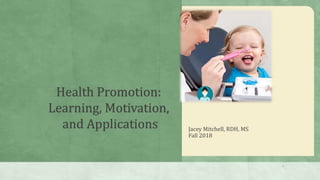
Health Promotion:
Learning, Motivation,
and Applications
Responsibility of the Dental Hygienist
• “Health promotion movement challenges each
health professional to realize that he or she is a
part of the whole….” (Darby and Walsh 2010)
• Dental hygienists are an integral part of the
health promotion movement.
• As a health professional, your patients will rely
on you to educate them about their oral health.
Providing tools and strategies to assess
readiness and facilitate change
• You are in a leadership position. So, we have a
primary responsibility of health education in
relation to health promotion.
2
3
Health Education
Health Education –Teaching health behaviors that bring an
individual to a state of health awareness;
In conjunction with health promotion its goals are:
1.Change health behaviors
• Encourage positive, informed changes in lifestyle
• Empower the individual
2. Improve health status
• Prevent acute and chronic disease
• Decrease disability
• Enhance wellness
Adapted from Health Promotion Throughout the Life Span 7th ed, ch. 20
Levels of Health Education
• Individualistic-A term describing an approach that focuses on individuals, such as
students and teachers in the classroom.
• Microsocial-tend to be interactionist, as they address social relationships and
everyday interactions.
• Macrosocial- A term describing an approach that looks at the “big picture”—that is, at
social structures and their role in the maintenance of a whole social system
4
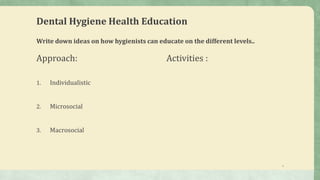
Dental Hygiene Health Education
Write down ideas on how hygienists can educate on the different levels..
Approach:
1. Individualistic
2. Microsocial
3. Macrosocial
Activities :
5
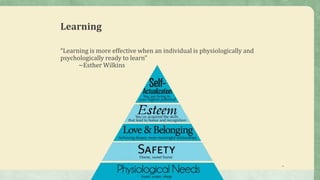
Learning
“Learning is more effective when an individual is physiologically and
psychologically ready to learn”
~Esther Wilkins
6
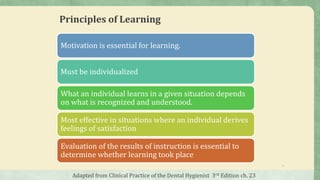
Principles of Learning
7
Adapted from Clinical Practice of the Dental Hygienist 3rd Edition ch. 23
Motivation is essential for learning.
Must be individualized
What an individual learns in a given situation depends
on what is recognized and understood.
Most effective in situations where an individual derives
feelings of satisfaction
Evaluation of the results of instruction is essential to
determine whether learning took place
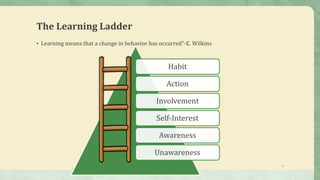
Habit
Action
Involvement
Self-Interest
Awareness
Unawareness
The Learning Ladder
8
• Learning means that a change in behavior has occurred”-E. Wilkins
Understanding Motivation
• “An individual is motivated to practice behavior that leads to achievement of
goals that are valued.”
E. Wilkins
• Values are a key factor in motivation.
• Qualities, principles, attitudes, beliefs about worth
• For example, you all value higher education, that’s why you are here pursuing a
career.
• Another example, happened in the clinic. One student’s patient told us that he
smoked cigars about once or twice a month while he goes out golfing. He valued the
habit because it was part of his social routine that he did with this friend while
golfing.
• Remember that we as hygienist’s must respect other’s values and try not to force our
own upon patients
• Theories:
• Health Belief Model
• Transtheoretical Model
9
10
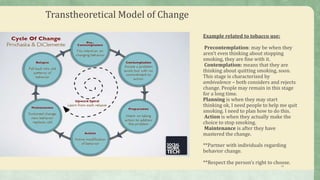
Transtheoretical Model of Change
Example related to tobacco use:
Precontemplation: may be when they
aren’t even thinking about stopping
smoking, they are fine with it.
Contemplation: means that they are
thinking about quitting smoking, soon.
This stage is characterized by
ambivalence – both considers and rejects
change. People may remain in this stage
for a long time.
Planning is when they may start
thinking ok, I need people to help me quit
smoking. I need to plan how to do this.
Action is when they actually make the
choice to stop smoking.
Maintenance is after they have
mastered the change.
**Partner with individuals regarding
behavior change.
**Respect the person’s right to choose.
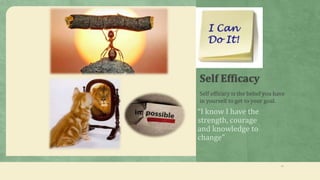
Self Efficacy
“I know I have the
strength, courage
and knowledge to
change”
11
Self efficacy is the belief you have
in yourself to get to your goal.
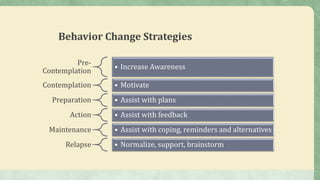
Behavior Change Strategies
Pre-
Contemplation
• Increase Awareness
Contemplation • Motivate
Preparation • Assist with plans
Action • Assist with feedback
Maintenance • Assist with coping, reminders and alternatives
Relapse • Normalize, support, brainstorm
13
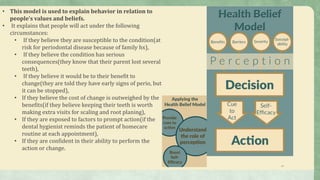
• This model is used to explain behavior in relation to
people’s values and beliefs.
• It explains that people will act under the following
circumstances:
• If they believe they are susceptible to the condition(at
risk for periodontal disease because of family hx),
• If they believe the condition has serious
consequences(they know that their parent lost several
teeth),
• If they believe it would be to their benefit to
change(they are told they have early signs of perio, but
it can be stopped),
• If they believe the cost of change is outweighed by the
benefits(if they believe keeping their teeth is worth
making extra visits for scaling and root planing),
• If they are exposed to factors to prompt action(if the
dental hygienist reminds the patient of homecare
routine at each appointment),
• If they are confident in their ability to perform the
action or change.
Everyone thinks of changing the world, but no one
thinks of changing himself. Leo Tolstoy
Take two minutes to:
1. Identify an unhealthy behavioral practice of your own. Identify the
behavioral belief (from the health belief model) that may prompt
you to change.
2. Now consider why you continue the unhealthy behavior.
3. Identify what stage of change you may be in (transtheoretical
model)
14
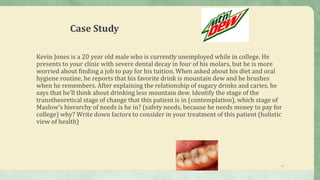
Case Study
Kevin Jones is a 20 year old male who is currently unemployed while in college. He
presents to your clinic with severe dental decay in four of his molars, but he is more
worried about finding a job to pay for his tuition. When asked about his diet and oral
hygiene routine, he reports that his favorite drink is mountain dew and he brushes
when he remembers. After explaining the relationship of sugary drinks and caries, he
says that he’ll think about drinking less mountain dew. Identify the stage of the
transtheoretical stage of change that this patient is in (contemplation), which stage of
Maslow’s hierarchy of needs is he in? (safety needs, because he needs money to pay for
college) why? Write down factors to consider in your treatment of this patient (holistic
view of health)
15
Health Education:
Practical Applications
16
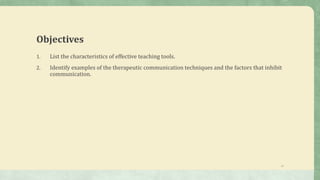
Objectives
1. List the characteristics of effective teaching tools.
2. Identify examples of the therapeutic communication techniques and the factors that inhibit
communication.
17
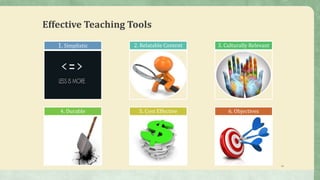
Effective Teaching Tools
18
1. Simplistic 2. Relatable Content 3. Culturally Relevant
4. Durable 5. Cost Effective 6. Objectives
Effective Teaching Tools
What are some examples of teaching tools that you already use in clinic?
 Do they meet the guidelines?
19
20
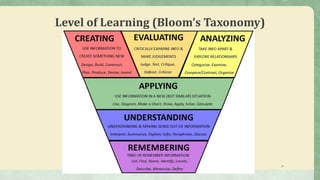
Level of Learning (Bloom’s Taxonomy)
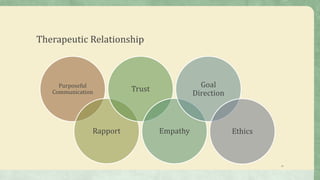
Therapeutic Relationship
21
Purposeful
Communication
Rapport
Trust
Empathy
Goal
Direction
Ethics
22
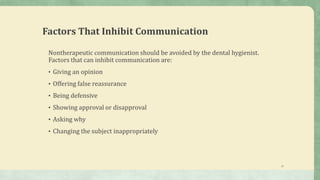
Factors That Inhibit Communication
Nontherapeutic communication should be avoided by the dental hygienist.
Factors that can inhibit communication are:
• Giving an opinion
• Offering false reassurance
• Being defensive
• Showing approval or disapproval
• Asking why
• Changing the subject inappropriately
References
• Darby, M., & Walsh, M. (2010). Dental hygiene theory and practice. (3rd ed.). St. Louis: Elsevier.
• Edelman, C., & Mandle, C. (2010). Health promotion throughout the life span. (7th ed.). St. Louis:
Elsevier.
• Ms. Green, definition for health education and health promotion
• Ms. Louise Schulhof, slides and youtube video references on stages on change
23

Learning, Motivation and Applications

  • 1.
    Jacey Mitchell, RDH,MS Fall 2018 1 Health Promotion: Learning, Motivation, and Applications
  • 2.
    Responsibility of theDental Hygienist • “Health promotion movement challenges each health professional to realize that he or she is a part of the whole….” (Darby and Walsh 2010) • Dental hygienists are an integral part of the health promotion movement. • As a health professional, your patients will rely on you to educate them about their oral health. Providing tools and strategies to assess readiness and facilitate change • You are in a leadership position. So, we have a primary responsibility of health education in relation to health promotion. 2
  • 3.
    3 Health Education Health Education–Teaching health behaviors that bring an individual to a state of health awareness; In conjunction with health promotion its goals are: 1.Change health behaviors • Encourage positive, informed changes in lifestyle • Empower the individual 2. Improve health status • Prevent acute and chronic disease • Decrease disability • Enhance wellness Adapted from Health Promotion Throughout the Life Span 7th ed, ch. 20
  • 4.
    Levels of HealthEducation • Individualistic-A term describing an approach that focuses on individuals, such as students and teachers in the classroom. • Microsocial-tend to be interactionist, as they address social relationships and everyday interactions. • Macrosocial- A term describing an approach that looks at the “big picture”—that is, at social structures and their role in the maintenance of a whole social system 4
  • 5.
    Dental Hygiene HealthEducation Write down ideas on how hygienists can educate on the different levels.. Approach: 1. Individualistic 2. Microsocial 3. Macrosocial Activities : 5
  • 6.
    Learning “Learning is moreeffective when an individual is physiologically and psychologically ready to learn” ~Esther Wilkins 6
  • 7.
    Principles of Learning 7 Adaptedfrom Clinical Practice of the Dental Hygienist 3rd Edition ch. 23 Motivation is essential for learning. Must be individualized What an individual learns in a given situation depends on what is recognized and understood. Most effective in situations where an individual derives feelings of satisfaction Evaluation of the results of instruction is essential to determine whether learning took place
  • 8.
    Habit Action Involvement Self-Interest Awareness Unawareness The Learning Ladder 8 •Learning means that a change in behavior has occurred”-E. Wilkins
  • 9.
    Understanding Motivation • “Anindividual is motivated to practice behavior that leads to achievement of goals that are valued.” E. Wilkins • Values are a key factor in motivation. • Qualities, principles, attitudes, beliefs about worth • For example, you all value higher education, that’s why you are here pursuing a career. • Another example, happened in the clinic. One student’s patient told us that he smoked cigars about once or twice a month while he goes out golfing. He valued the habit because it was part of his social routine that he did with this friend while golfing. • Remember that we as hygienist’s must respect other’s values and try not to force our own upon patients • Theories: • Health Belief Model • Transtheoretical Model 9
  • 10.
    10 Transtheoretical Model ofChange Example related to tobacco use: Precontemplation: may be when they aren’t even thinking about stopping smoking, they are fine with it. Contemplation: means that they are thinking about quitting smoking, soon. This stage is characterized by ambivalence – both considers and rejects change. People may remain in this stage for a long time. Planning is when they may start thinking ok, I need people to help me quit smoking. I need to plan how to do this. Action is when they actually make the choice to stop smoking. Maintenance is after they have mastered the change. **Partner with individuals regarding behavior change. **Respect the person’s right to choose.
  • 11.
    Self Efficacy “I knowI have the strength, courage and knowledge to change” 11 Self efficacy is the belief you have in yourself to get to your goal.
  • 12.
    Behavior Change Strategies Pre- Contemplation •Increase Awareness Contemplation • Motivate Preparation • Assist with plans Action • Assist with feedback Maintenance • Assist with coping, reminders and alternatives Relapse • Normalize, support, brainstorm
  • 13.
    13 • This modelis used to explain behavior in relation to people’s values and beliefs. • It explains that people will act under the following circumstances: • If they believe they are susceptible to the condition(at risk for periodontal disease because of family hx), • If they believe the condition has serious consequences(they know that their parent lost several teeth), • If they believe it would be to their benefit to change(they are told they have early signs of perio, but it can be stopped), • If they believe the cost of change is outweighed by the benefits(if they believe keeping their teeth is worth making extra visits for scaling and root planing), • If they are exposed to factors to prompt action(if the dental hygienist reminds the patient of homecare routine at each appointment), • If they are confident in their ability to perform the action or change.
  • 14.
    Everyone thinks ofchanging the world, but no one thinks of changing himself. Leo Tolstoy Take two minutes to: 1. Identify an unhealthy behavioral practice of your own. Identify the behavioral belief (from the health belief model) that may prompt you to change. 2. Now consider why you continue the unhealthy behavior. 3. Identify what stage of change you may be in (transtheoretical model) 14
  • 15.
    Case Study Kevin Jonesis a 20 year old male who is currently unemployed while in college. He presents to your clinic with severe dental decay in four of his molars, but he is more worried about finding a job to pay for his tuition. When asked about his diet and oral hygiene routine, he reports that his favorite drink is mountain dew and he brushes when he remembers. After explaining the relationship of sugary drinks and caries, he says that he’ll think about drinking less mountain dew. Identify the stage of the transtheoretical stage of change that this patient is in (contemplation), which stage of Maslow’s hierarchy of needs is he in? (safety needs, because he needs money to pay for college) why? Write down factors to consider in your treatment of this patient (holistic view of health) 15
  • 16.
  • 17.
    Objectives 1. List thecharacteristics of effective teaching tools. 2. Identify examples of the therapeutic communication techniques and the factors that inhibit communication. 17
  • 18.
    Effective Teaching Tools 18 1.Simplistic 2. Relatable Content 3. Culturally Relevant 4. Durable 5. Cost Effective 6. Objectives
  • 19.
    Effective Teaching Tools Whatare some examples of teaching tools that you already use in clinic?  Do they meet the guidelines? 19
  • 20.
    20 Level of Learning(Bloom’s Taxonomy)
  • 21.
  • 22.
    22 Factors That InhibitCommunication Nontherapeutic communication should be avoided by the dental hygienist. Factors that can inhibit communication are: • Giving an opinion • Offering false reassurance • Being defensive • Showing approval or disapproval • Asking why • Changing the subject inappropriately
  • 23.
    References • Darby, M.,& Walsh, M. (2010). Dental hygiene theory and practice. (3rd ed.). St. Louis: Elsevier. • Edelman, C., & Mandle, C. (2010). Health promotion throughout the life span. (7th ed.). St. Louis: Elsevier. • Ms. Green, definition for health education and health promotion • Ms. Louise Schulhof, slides and youtube video references on stages on change 23