The 1980s
Chapter 25
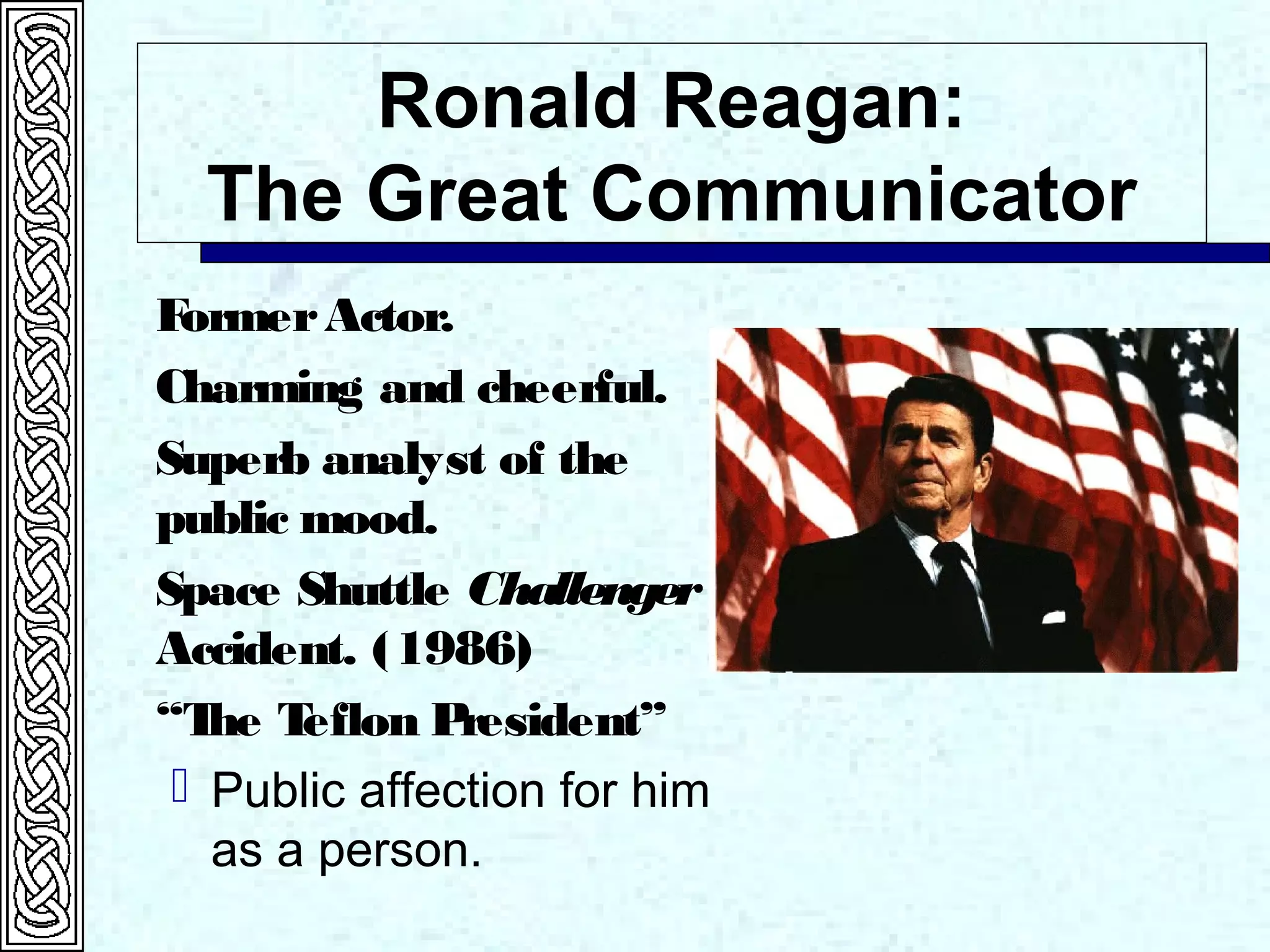
Ronald Reagan:
The Great Communicator
FormerActor.
Charming and cheerful.
Superb analyst of the
public mood.
Space Shuttle Challenger
Accident. (1986)
“The Teflon President”
 Public affection for him
as a person.
Reagan and the Economy
Economy changes role of government
 “Government is the problem”
 Market should control economy, not the
government (deregulation of business)
Supply-side economics
 Tax cuts will actually raise government
revenues that would help reduce the
budget deficit because wealth will be
increased.
 The wealthy would engage in productive
investment. “trickle down”
Reagan and the
Economy
Economic Recovery Act (1981)
 Cut personal income taxes by 25%
 Lowed max from 70% to 50%
Reagan tax cuts, however, were
accompanied by massive increases in
defense spending.
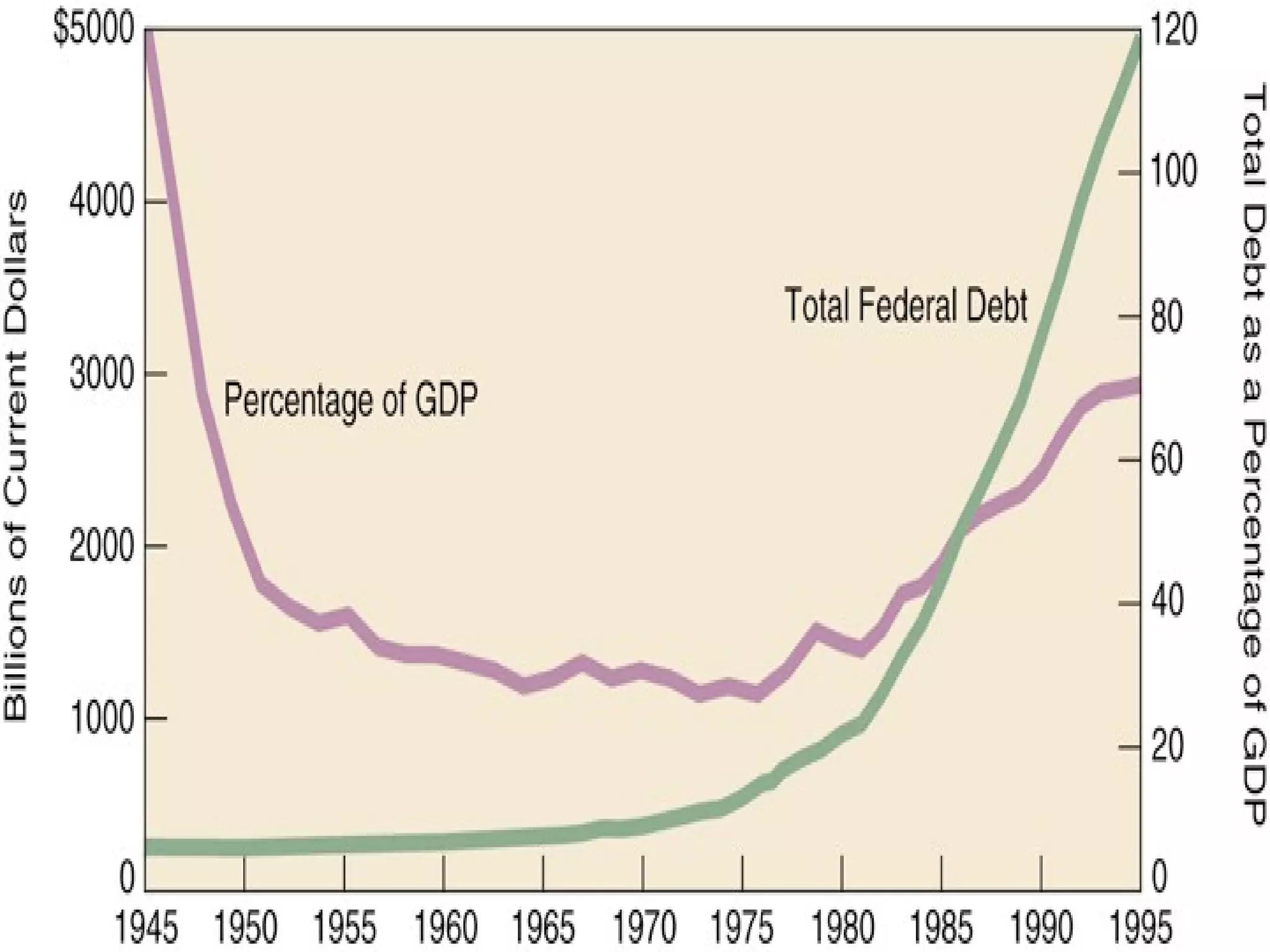
The combination of massive defense
spending and substantial tax cuts left the
federal government with massive deficits.
 The United States, a creditor nation since WWI,
had by 1986 become the world’s largest debtor.
The End of the Cold War
détente – In the 1970s, Nixon, Ford, and
Carterhad all followed a policy of détente (an
easing of tensions) in an effort to end the
rivalry between the Soviets and the Americans.
 Ever since the Cuban missile crisis in 1962, the
Soviets had steadily expanded their nuclear arsenal.
Reagan
 Peace through Strength
 The heart of the Reagan revolution was a sharp rise
in military spending. Defense spending jumped about
50%.
The Defense Buildup
Massive buildup of nuclearand conventional
weapons to close the gap between Soviet
and American military forces.
He also pushed the strategic defense
initiative (SDI)
 A space based anti-missile defense shield.
 “Star Wars”
 Forced the Soviets to launch an expensive
research and development program of their own to
keep pace.
Cold War Rhetoric
He combined the increases in spending with
strong rhetoric such as calling the Soviet Union
an evil empire and demanding that the Berlin
Wall come down.
 “Evil Empire”
By his second term, it was clearthat the
faltering Soviet economy would not be able to
match the spending of the United States.
Mikhail Gorbachev’s election in 1985 brought
a Soviet leaderwho wanted to bring domestic
reform within the Soviet Union and improve
relations with the U.S.
Reagan and Gorbachev
Geneva Summit (1985)
 Reagan and Gorbachev
met and signed several
cultural and scientific
agreements and promised
arms limitation talks.
INFTreaty (1987)
 A treaty to eliminate
intermediate-range nuclear
forces.
 First step toward the
eventual end of the arms
race.
U.S. in the 1980s
Sandra Day O’Connor- first woman justice of
the Supreme Court. (1981)
AIDS (Acquired Immune Deficiency Syndrome)
 Gay men and intravenous drug users were especially
at risk.
 No prospect of cure.
“Yuppies” (Young, upwardly mobile
professionals) caught up in the race for
materialism.
“Black Monday” (October1987)
 Stock market plummeted 22.6 percent
 1929 – 12.8 percent
Standing Tall in a Chaotic World
Terrorism in the Middle East
 Beirut, Lebanon
 French, Italian, and U.S. sent in as “peacekeepers”
 U.S. troops pull out in 1984.
 Iran-Iraq war had erupted in 1980
 U.S. funneled aid to Iraq.
Mounting Frustrations in Central America
 Grenada invasion (1983)
 The small Caribbean island had signed military
agreements with Communist-bloc countries.
 1,900 paratroopers and marines deposed leftist
government and evacuated American students.
 Growing Drug Trade (Cocaine)
The Iran-Contra Affair
Scandal surfaced in his second administration
(1986)
The Reagan administration had secretly and
against the expressed orders of Congress sold
weapons to Iran in an attempt to free U.S.
hostages held in Lebanon by terrorists.
They then used money from the sale of these
weapons to buy weapons forthe Contra rebels in
Nicaragua who were freedom fighters fighting
against communism.
 Marine Lieutenant-Colonel Oliver North had been
running secret operations from the basement of the
George H.W. Bush
Despite the scandal,
Reagan’s popularity
remained high because
of the improvement in
Soviet-American
relations and his V.P.
George Bush won the
1988 election largely
because of his
connection to Reagan.
Reagan Baggage
Savings and Loan Scandals
 Had been set up by Reagan to help people buy
homes.
 By 1989 hundreds of S&L’s had failed.
 Bush tried to close or sell ailing S&L’s and bail
out the depositors.
National Debt
 $2.6 trillion by 1988.
 “a horrendous fiscal mess”
 1990 - Bush approves a combination of tax
hikes and spending cuts to reduce deficit despite
“Read my lips, no new taxes” campaign pledge
Bush’s Domestic Agenda
Bush had difficulty
defining and
asserting his own
political identity on
domestic issues.
 “vision thing”
Americans with
Disabilities Act
(1990)
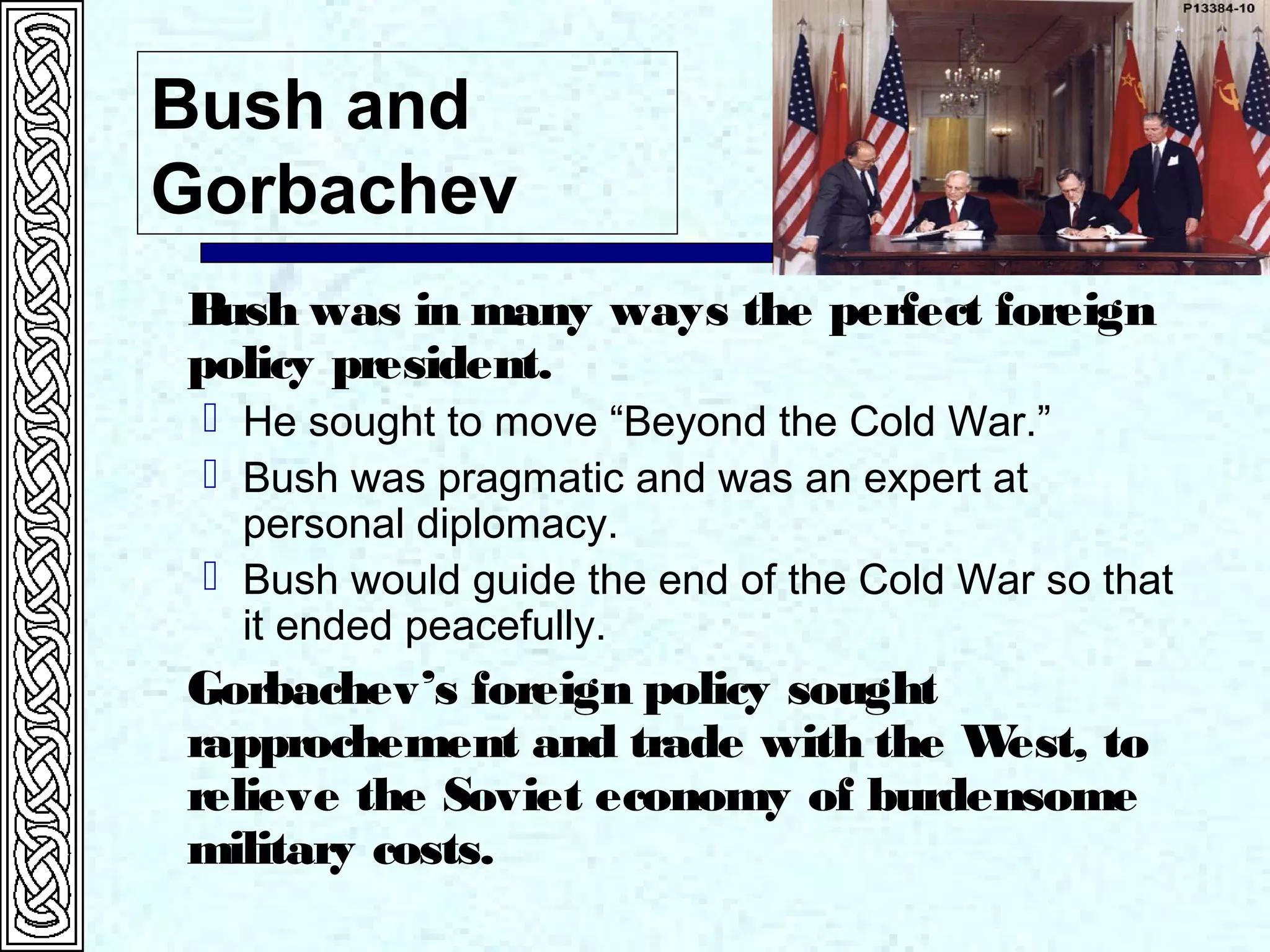
Bush and
Gorbachev
Bush was in many ways the perfect foreign
policy president.
 He sought to move “Beyond the Cold War.”
 Bush was pragmatic and was an expert at
personal diplomacy.
 Bush would guide the end of the Cold War so that
it ended peacefully.
Gorbachev’s foreign policy sought
rapprochement and trade with the West, to
relieve the Soviet economy of burdensome
military costs.
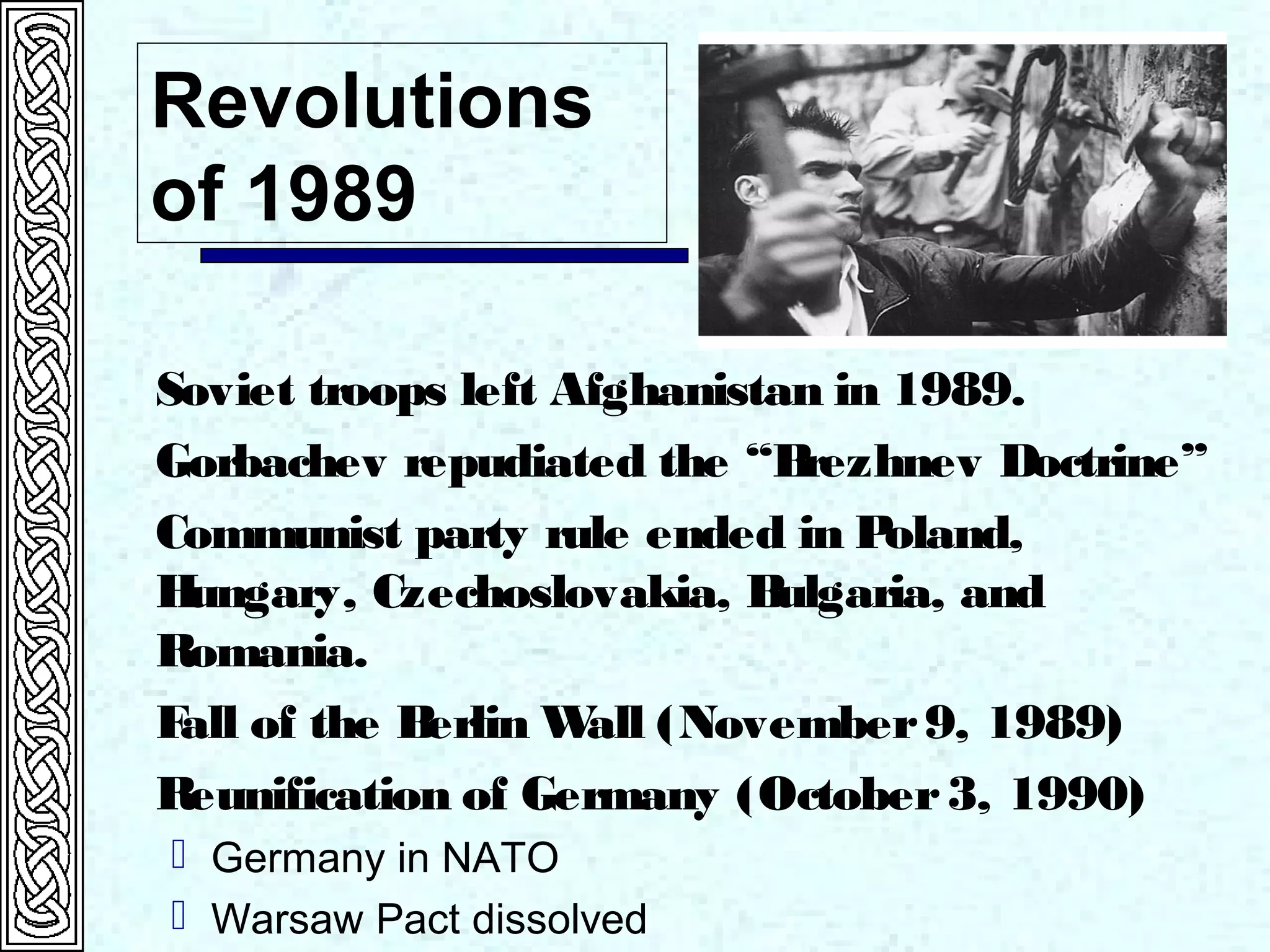
Revolutions
of 1989
Soviet troops left Afghanistan in 1989.
Gorbachev repudiated the “Brezhnev Doctrine”
Communist party rule ended in Poland,
Hungary, Czechoslovakia, Bulgaria, and
Romania.
Fall of the Berlin Wall (November9, 1989)
Reunification of Germany (October3, 1990)
 Germany in NATO
 Warsaw Pact dissolved
An End to the Cold War
Coup attempt against Gorbachev (August
1991)
 Bush and Boris Yeltsin put public pressure on the
coup leaders.
 Gorbachev released.
 The Communist party apparatus was dismantled.
Soviet Union Collapses
 December 25, 1991, Gorbachev resigns and
announces the end of the Soviet Union.
 A new Commonwealth of Independent States made
up of 12 autonomous republics.
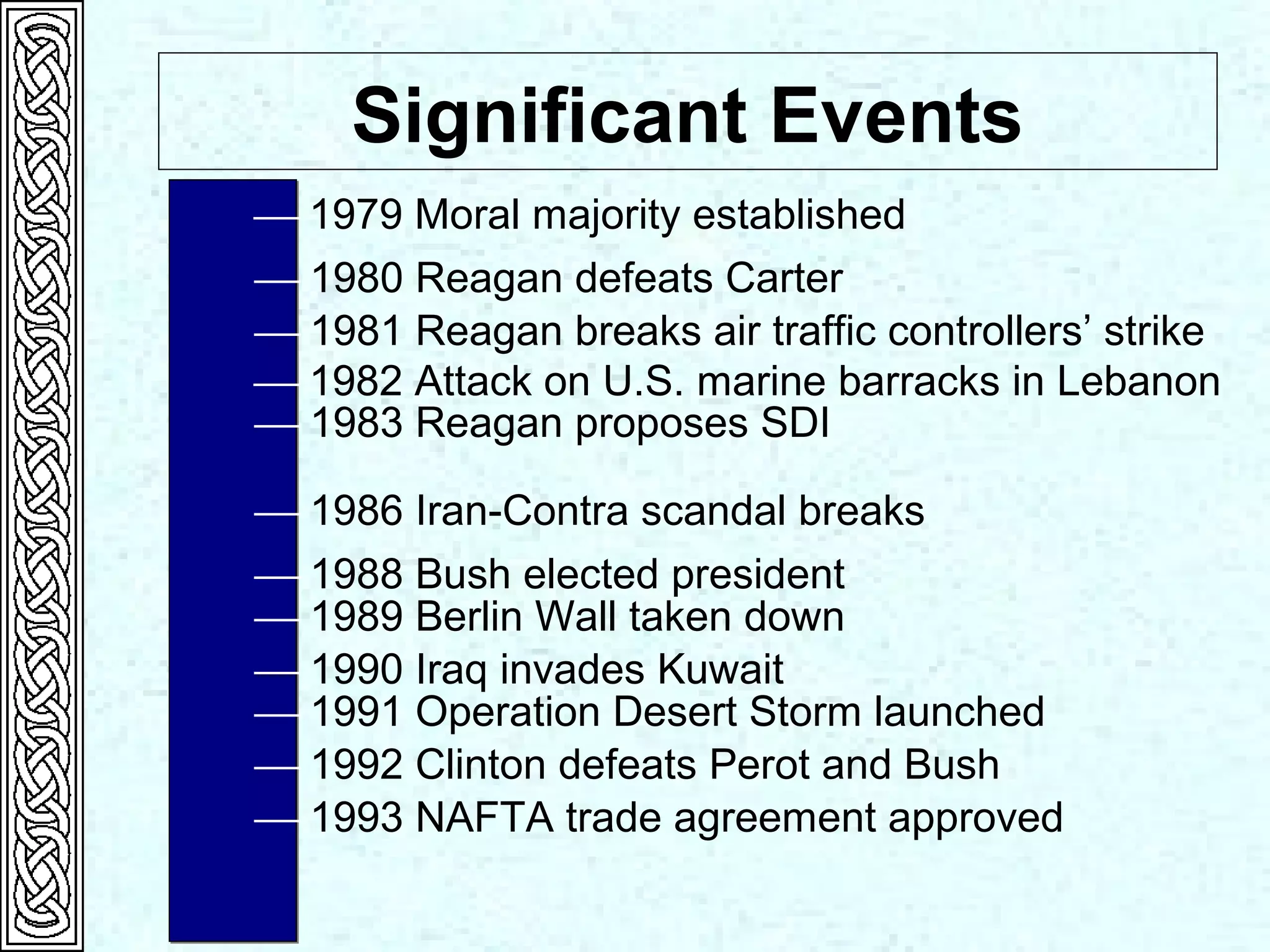
 1979 Moral majority established
Significant Events
 1980 Reagan defeats Carter
 1981 Reagan breaks air traffic controllers’ strike
 1982 Attack on U.S. marine barracks in Lebanon
 1983 Reagan proposes SDI
 1986 Iran-Contra scandal breaks
 1988 Bush elected president
 1989 Berlin Wall taken down
 1990 Iraq invades Kuwait
 1991 Operation Desert Storm launched
 1992 Clinton defeats Perot and Bush
 1993 NAFTA trade agreement approved

Chapter 25 1980s

  • 1.
  • 2.
    Ronald Reagan: The GreatCommunicator FormerActor. Charming and cheerful. Superb analyst of the public mood. Space Shuttle Challenger Accident. (1986) “The Teflon President”  Public affection for him as a person.
  • 3.
    Reagan and theEconomy Economy changes role of government  “Government is the problem”  Market should control economy, not the government (deregulation of business) Supply-side economics  Tax cuts will actually raise government revenues that would help reduce the budget deficit because wealth will be increased.  The wealthy would engage in productive investment. “trickle down”
  • 4.
    Reagan and the Economy EconomicRecovery Act (1981)  Cut personal income taxes by 25%  Lowed max from 70% to 50% Reagan tax cuts, however, were accompanied by massive increases in defense spending. The combination of massive defense spending and substantial tax cuts left the federal government with massive deficits.  The United States, a creditor nation since WWI, had by 1986 become the world’s largest debtor.
  • 6.
    The End ofthe Cold War détente – In the 1970s, Nixon, Ford, and Carterhad all followed a policy of détente (an easing of tensions) in an effort to end the rivalry between the Soviets and the Americans.  Ever since the Cuban missile crisis in 1962, the Soviets had steadily expanded their nuclear arsenal. Reagan  Peace through Strength  The heart of the Reagan revolution was a sharp rise in military spending. Defense spending jumped about 50%.
  • 7.
    The Defense Buildup Massivebuildup of nuclearand conventional weapons to close the gap between Soviet and American military forces. He also pushed the strategic defense initiative (SDI)  A space based anti-missile defense shield.  “Star Wars”  Forced the Soviets to launch an expensive research and development program of their own to keep pace.
  • 8.
    Cold War Rhetoric Hecombined the increases in spending with strong rhetoric such as calling the Soviet Union an evil empire and demanding that the Berlin Wall come down.  “Evil Empire” By his second term, it was clearthat the faltering Soviet economy would not be able to match the spending of the United States. Mikhail Gorbachev’s election in 1985 brought a Soviet leaderwho wanted to bring domestic reform within the Soviet Union and improve relations with the U.S.
  • 9.
    Reagan and Gorbachev GenevaSummit (1985)  Reagan and Gorbachev met and signed several cultural and scientific agreements and promised arms limitation talks. INFTreaty (1987)  A treaty to eliminate intermediate-range nuclear forces.  First step toward the eventual end of the arms race.
  • 10.
    U.S. in the1980s Sandra Day O’Connor- first woman justice of the Supreme Court. (1981) AIDS (Acquired Immune Deficiency Syndrome)  Gay men and intravenous drug users were especially at risk.  No prospect of cure. “Yuppies” (Young, upwardly mobile professionals) caught up in the race for materialism. “Black Monday” (October1987)  Stock market plummeted 22.6 percent  1929 – 12.8 percent
  • 11.
    Standing Tall ina Chaotic World Terrorism in the Middle East  Beirut, Lebanon  French, Italian, and U.S. sent in as “peacekeepers”  U.S. troops pull out in 1984.  Iran-Iraq war had erupted in 1980  U.S. funneled aid to Iraq. Mounting Frustrations in Central America  Grenada invasion (1983)  The small Caribbean island had signed military agreements with Communist-bloc countries.  1,900 paratroopers and marines deposed leftist government and evacuated American students.  Growing Drug Trade (Cocaine)
  • 13.
    The Iran-Contra Affair Scandalsurfaced in his second administration (1986) The Reagan administration had secretly and against the expressed orders of Congress sold weapons to Iran in an attempt to free U.S. hostages held in Lebanon by terrorists. They then used money from the sale of these weapons to buy weapons forthe Contra rebels in Nicaragua who were freedom fighters fighting against communism.  Marine Lieutenant-Colonel Oliver North had been running secret operations from the basement of the
  • 14.
    George H.W. Bush Despitethe scandal, Reagan’s popularity remained high because of the improvement in Soviet-American relations and his V.P. George Bush won the 1988 election largely because of his connection to Reagan.
  • 16.
    Reagan Baggage Savings andLoan Scandals  Had been set up by Reagan to help people buy homes.  By 1989 hundreds of S&L’s had failed.  Bush tried to close or sell ailing S&L’s and bail out the depositors. National Debt  $2.6 trillion by 1988.  “a horrendous fiscal mess”  1990 - Bush approves a combination of tax hikes and spending cuts to reduce deficit despite “Read my lips, no new taxes” campaign pledge
  • 17.
    Bush’s Domestic Agenda Bushhad difficulty defining and asserting his own political identity on domestic issues.  “vision thing” Americans with Disabilities Act (1990)
  • 18.
    Bush and Gorbachev Bush wasin many ways the perfect foreign policy president.  He sought to move “Beyond the Cold War.”  Bush was pragmatic and was an expert at personal diplomacy.  Bush would guide the end of the Cold War so that it ended peacefully. Gorbachev’s foreign policy sought rapprochement and trade with the West, to relieve the Soviet economy of burdensome military costs.
  • 19.
    Revolutions of 1989 Soviet troopsleft Afghanistan in 1989. Gorbachev repudiated the “Brezhnev Doctrine” Communist party rule ended in Poland, Hungary, Czechoslovakia, Bulgaria, and Romania. Fall of the Berlin Wall (November9, 1989) Reunification of Germany (October3, 1990)  Germany in NATO  Warsaw Pact dissolved
  • 20.
    An End tothe Cold War Coup attempt against Gorbachev (August 1991)  Bush and Boris Yeltsin put public pressure on the coup leaders.  Gorbachev released.  The Communist party apparatus was dismantled. Soviet Union Collapses  December 25, 1991, Gorbachev resigns and announces the end of the Soviet Union.  A new Commonwealth of Independent States made up of 12 autonomous republics.
  • 21.
     1979 Moralmajority established Significant Events  1980 Reagan defeats Carter  1981 Reagan breaks air traffic controllers’ strike  1982 Attack on U.S. marine barracks in Lebanon  1983 Reagan proposes SDI  1986 Iran-Contra scandal breaks  1988 Bush elected president  1989 Berlin Wall taken down  1990 Iraq invades Kuwait  1991 Operation Desert Storm launched  1992 Clinton defeats Perot and Bush  1993 NAFTA trade agreement approved