World War II  The Pacific
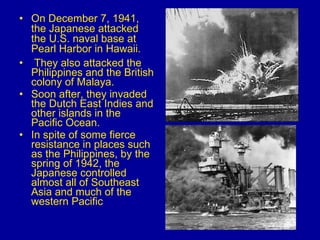
On December 7, 1941, the Japanese attacked the U.S. naval base at Pearl Harbor in Hawaii. They also attacked the Philippines and the British colony of Malaya.  Soon after, they invaded the Dutch East Indies and other islands in the Pacific Ocean.  In spite of some fierce resistance in places such as the Philippines, by the spring of 1942, the Japanese controlled almost all of Southeast Asia and much of the western Pacific .
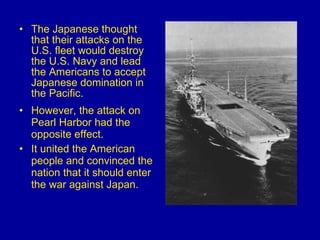
The Japanese thought that their attacks on the U.S. fleet would destroy the U.S. Navy and lead the Americans to accept Japanese domination in the Pacific.  However, the attack on Pearl Harbor had the opposite effect.  It united the American people and convinced the nation that it should enter the war against Japan.
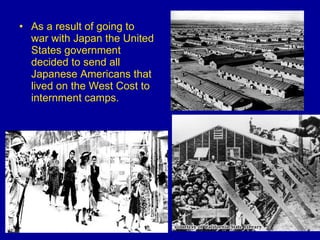
As a result of going to war with Japan the United States government decided to send all Japanese Americans that lived on the West Cost to internment camps.
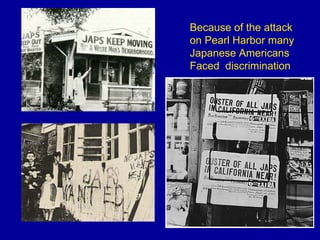
Because of the attack on Pearl Harbor many Japanese Americans Faced  discrimination
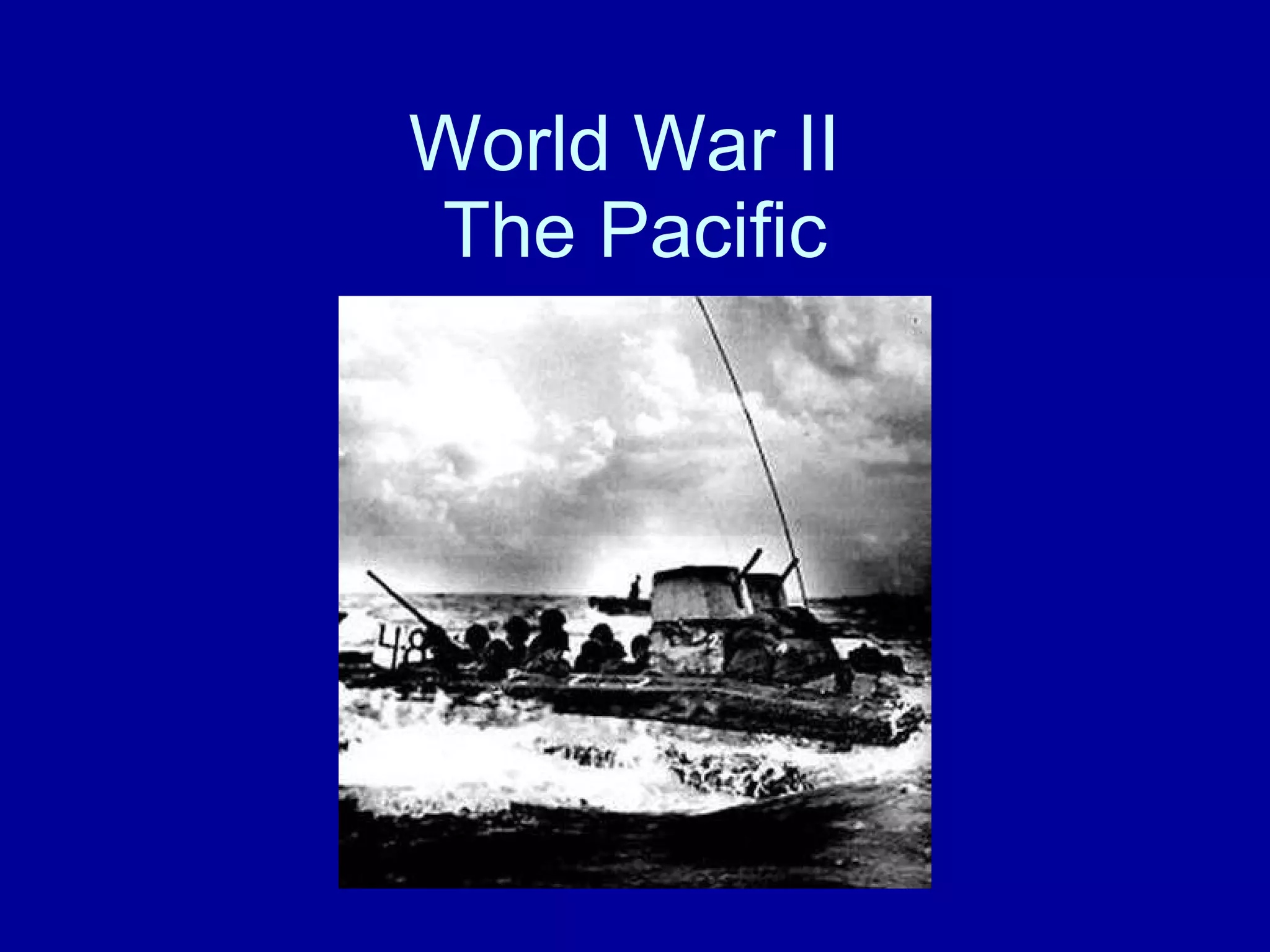
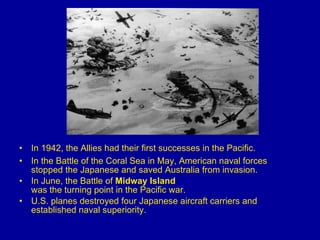
In 1942, the Allies had their first successes in the Pacific.  In the Battle of the Coral Sea in May, American naval forces stopped the Japanese and saved Australia from invasion.  In June, the Battle of  Midway Island   was the turning point in the Pacific war.  U.S. planes destroyed four Japanese aircraft carriers and established naval superiority.
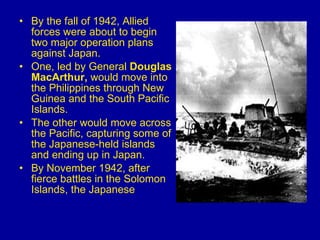
By the fall of 1942, Allied forces were about to begin two major operation plans against Japan.  One, led by General  Douglas MacArthur,  would move into the Philippines through New Guinea and the South Pacific Islands.  The other would move across the Pacific, capturing some of the Japanese-held islands and ending up in Japan.  By November 1942, after fierce battles in the Solomon Islands, the Japanese  power was diminishing
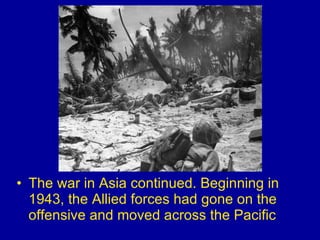
The war in Asia continued. Beginning in 1943, the Allied forces had gone on the offensive and moved across the Pacific
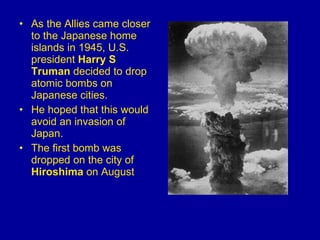
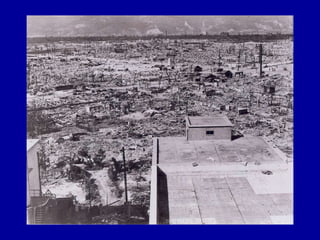
As the Allies came closer to the Japanese home islands in 1945, U.S. president  Harry S Truman  decided to drop atomic bombs on Japanese cities.  He hoped that this would avoid an invasion of Japan.  The first bomb was dropped on the city of  Hiroshima  on August  6.


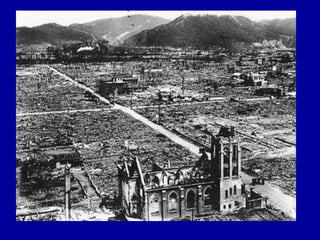
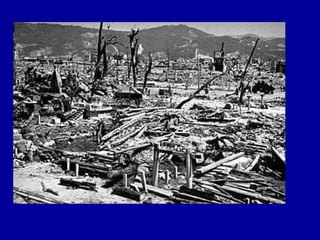
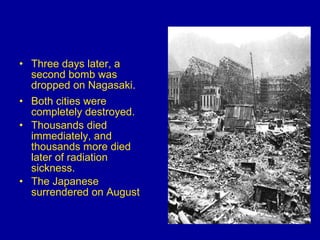
Three days later, a second bomb was dropped on Nagasaki.  Both cities were completely destroyed.  Thousands died immediately, and thousands more died later of radiation sickness.  The Japanese surrendered on August
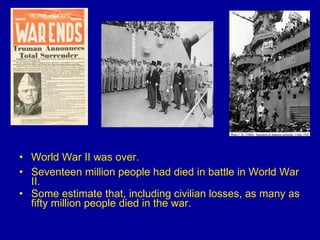
World War II was over.  Seventeen million people had died in battle in World War II.  Some estimate that, including civilian losses, as many as fifty million people died in the war.

World war ii the pacific

  • 1.
    World War II The Pacific
  • 2.
    On December 7,1941, the Japanese attacked the U.S. naval base at Pearl Harbor in Hawaii. They also attacked the Philippines and the British colony of Malaya. Soon after, they invaded the Dutch East Indies and other islands in the Pacific Ocean. In spite of some fierce resistance in places such as the Philippines, by the spring of 1942, the Japanese controlled almost all of Southeast Asia and much of the western Pacific .
  • 3.
    The Japanese thoughtthat their attacks on the U.S. fleet would destroy the U.S. Navy and lead the Americans to accept Japanese domination in the Pacific. However, the attack on Pearl Harbor had the opposite effect. It united the American people and convinced the nation that it should enter the war against Japan.
  • 4.
    As a resultof going to war with Japan the United States government decided to send all Japanese Americans that lived on the West Cost to internment camps.
  • 5.
    Because of theattack on Pearl Harbor many Japanese Americans Faced discrimination
  • 6.
    In 1942, theAllies had their first successes in the Pacific. In the Battle of the Coral Sea in May, American naval forces stopped the Japanese and saved Australia from invasion. In June, the Battle of Midway Island was the turning point in the Pacific war. U.S. planes destroyed four Japanese aircraft carriers and established naval superiority.
  • 7.
    By the fallof 1942, Allied forces were about to begin two major operation plans against Japan. One, led by General Douglas MacArthur, would move into the Philippines through New Guinea and the South Pacific Islands. The other would move across the Pacific, capturing some of the Japanese-held islands and ending up in Japan. By November 1942, after fierce battles in the Solomon Islands, the Japanese power was diminishing
  • 8.
    The war inAsia continued. Beginning in 1943, the Allied forces had gone on the offensive and moved across the Pacific
  • 9.
    As the Alliescame closer to the Japanese home islands in 1945, U.S. president Harry S Truman decided to drop atomic bombs on Japanese cities. He hoped that this would avoid an invasion of Japan. The first bomb was dropped on the city of Hiroshima on August 6.
  • 10.
  • 11.
  • 12.
  • 13.
    Three days later,a second bomb was dropped on Nagasaki. Both cities were completely destroyed. Thousands died immediately, and thousands more died later of radiation sickness. The Japanese surrendered on August
  • 14.
    World War IIwas over. Seventeen million people had died in battle in World War II. Some estimate that, including civilian losses, as many as fifty million people died in the war.