
APUSH Review: Key
Concept 4.1
Everything You Need To Know About Key
Concept 4.1 To Succeed In APUSH
www.Apushreview.com
Period 4: 1800 – 1848
Updated for the
2015 revisions
The New Curriculum
• Key Concept 4.1 “The United States began to develop a
modern democracy and celebrated a new national culture,
while Americans sought to define the nation’s democratic
ideals and change their society and institutions to match
them.”
o Page 44 of the Curriculum Framework
• Big ideas:
o What were the reasons for the development of political parties, and
characteristics of each party?
o How did the Second Great Awakening impact America?
o How did slaves adapt to their circumstances and create a new
culture?
Key Concept 4.1 I
• “The nation’s transition to a more participatory democracy was achieved by expanding suffrage
from a system based on property ownership to one based on voting by all adult white men, and
it was accompanied by the growth of political parties.” – page 44 of the curriculum framework
• A. Political Parties in the early 1800s (Federalists and
Jeffersonians)
o Federalists: favored stronger central government, supported by upper-class, merchants
and bankers, and Pro-British, loose interpretation of the Constitution
o Democratic-Republicans: states-rights, supporter by lower and middle classes, farmers,
Pro-French, strict interpretation of the Constitution
• Both parties developed out of Hamilton’s Financial Plan and the French Revolution
• B. The Supreme Court strengthened the power of the federal
government, often at the expense of state governments:
o Marbury v. Madison – established the principle of judicial review
o McCulloch v. Maryland – upheld constitutionality of 2nd BUS, federal government given
more power of states
o Gibbons v. Ogden – Congress, NOT states can control interstate commerce
Key Concept 4.1 I
• C. Democrats and Whigs
o Democrats: Led by Andrew Jackson, the “Common
Man”: against BUS and the American System
o Whigs: (Henry Clay!) Anti-Andrew Jackson;
favored stronger federal government, internal
improvements, tariffs, and the BUS
• D. Regional political and economic
loyalties overshadowed national
concerns:
• Nullification Crisis (1833)– South Carolina and
other southern states opposed the Tariffs of 1828
and 1832; South Carolina even nullified those
tariffs
• South Carolina threatened to secede if Jackson
collected the tariff by force
• Webster’s 2nd Reply to Hayne – Webster promoted
nationalism over sectionalism
Key Concept
4.1 II
• “While Americans embraced a new national culture,
various groups developed distinctive cultures of their
own.” – page 45 of the curriculum framework
• A. The 2nd Great Awakening sought to
inspire humans to achieve perfection:
o Charles G. Finney – massive sermons to convert individuals
o Utopian Societies – social experiments that hoped to
achieve perfection in communities – Oneidas, Brooke Farm,
etc.
o Inspired other reform movements:
• Temperance, Abolitionism
• B. The emergence of a new national
culture
o Was a combination of European and local culture
o New American Art, literature, and architectural ideas
emerged
• Examples: John James Audubon – made significant
contributions to the study of birds – prints of birds
• The Hudson River School – focused on landscape
paintings; believed nature was a great source of
wisdom and inspiration
Key Concept 4.1 II
• C. Literature, art, philosophy, and architecture reflected a belief
in human perfectibility
o Transcendentalism – 1830s movement that encouraged individuals to have
communication with God and nature
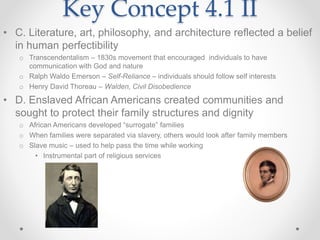
o Ralph Waldo Emerson – Self-Reliance – individuals should follow self interests
o Henry David Thoreau – Walden, Civil Disobedience
• D. Enslaved African Americans created communities and
sought to protect their family structures and dignity
o African Americans developed “surrogate” families
o When families were separated via slavery, others would look after family members
o Slave music – used to help pass the time while working
• Instrumental part of religious services
Key Concept 4.1 III
• “Increasing numbers of Americans, many inspired by new religious and intellectual
movements, worked primarily outside of government institutions to advance their
ideals.” – page 46 of the curriculum framework
• A. Organizations that attempted to improve society and
individual behavior
o American Temperance Society:
• Co-founded by Lyman Beecher (Harriet Beecher-Stowe’s father)
• Created 1,000s of chapters throughout the US
• Aligned with the abolitionist movement
o Dorothea Dix – sought to improve treatment for the mentally ill
o Horace Mann – “Father of Education”
o Shakers - practiced celibacy,; believed in sexual equality
Key Concept 4.1 III
• B. Abolitionist and Anti-Slavery Movements
o Achieved success in the North – many northern states gradually emancipated slaves
o Was an increasing number of free African Americans in the North AND the South:
• Eventually, many states made it illegal for slave owner to manumit (free) their slaves
• Antislavery in the South:
o Gag-order – prohibited the introduction of abolitionist bills in the House of Reps
o Unsuccessful rebellions in the South:
• Denmark Vesey (1820): largest planned rebellion, never materialized
o Vesey and followers were hanged -> more strict slave laws
• Nat Turner’s Rebellion (1831):
o Rebellion in VA, freed slaves and killed whites on plantations
o 100s of blacks killed in retaliation (some of which had nothing to do with rebellion)
o Coincided at the same year as William Lloyd Garrison’s The Liberator
• Called for the immediate and uncompensated end to slavery
• C. Women’s Rights Movement:
o Often connected to the abolitionist movement
o Hoped to achieve greater equality
o Seneca Falls Convention: women’s rights convention in NY - Elizabeth Cady Stanton and
Lucretia Mott
• Attended by Frederick Douglass
Test Tips
• Multiple-Choice and Short Answer
Questions:
o Examples of court cases that increased the power of the federal
government
o Characteristics of political parties
o Organizations and individuals that sought to improve society
o Ways slaves resisted their condition
• Essay Questions:
o Issues that led to the creation of political parties
o Impact of the 2nd Great Awakening on American society

Apush review-key-concept-4.1-revised-2015

  • 1.
    APUSH Review: Key Concept4.1 Everything You Need To Know About Key Concept 4.1 To Succeed In APUSH www.Apushreview.com Period 4: 1800 – 1848 Updated for the 2015 revisions
  • 2.
    The New Curriculum •Key Concept 4.1 “The United States began to develop a modern democracy and celebrated a new national culture, while Americans sought to define the nation’s democratic ideals and change their society and institutions to match them.” o Page 44 of the Curriculum Framework • Big ideas: o What were the reasons for the development of political parties, and characteristics of each party? o How did the Second Great Awakening impact America? o How did slaves adapt to their circumstances and create a new culture?
  • 3.
    Key Concept 4.1I • “The nation’s transition to a more participatory democracy was achieved by expanding suffrage from a system based on property ownership to one based on voting by all adult white men, and it was accompanied by the growth of political parties.” – page 44 of the curriculum framework • A. Political Parties in the early 1800s (Federalists and Jeffersonians) o Federalists: favored stronger central government, supported by upper-class, merchants and bankers, and Pro-British, loose interpretation of the Constitution o Democratic-Republicans: states-rights, supporter by lower and middle classes, farmers, Pro-French, strict interpretation of the Constitution • Both parties developed out of Hamilton’s Financial Plan and the French Revolution • B. The Supreme Court strengthened the power of the federal government, often at the expense of state governments: o Marbury v. Madison – established the principle of judicial review o McCulloch v. Maryland – upheld constitutionality of 2nd BUS, federal government given more power of states o Gibbons v. Ogden – Congress, NOT states can control interstate commerce
  • 4.
    Key Concept 4.1I • C. Democrats and Whigs o Democrats: Led by Andrew Jackson, the “Common Man”: against BUS and the American System o Whigs: (Henry Clay!) Anti-Andrew Jackson; favored stronger federal government, internal improvements, tariffs, and the BUS • D. Regional political and economic loyalties overshadowed national concerns: • Nullification Crisis (1833)– South Carolina and other southern states opposed the Tariffs of 1828 and 1832; South Carolina even nullified those tariffs • South Carolina threatened to secede if Jackson collected the tariff by force • Webster’s 2nd Reply to Hayne – Webster promoted nationalism over sectionalism
  • 5.
    Key Concept 4.1 II •“While Americans embraced a new national culture, various groups developed distinctive cultures of their own.” – page 45 of the curriculum framework • A. The 2nd Great Awakening sought to inspire humans to achieve perfection: o Charles G. Finney – massive sermons to convert individuals o Utopian Societies – social experiments that hoped to achieve perfection in communities – Oneidas, Brooke Farm, etc. o Inspired other reform movements: • Temperance, Abolitionism • B. The emergence of a new national culture o Was a combination of European and local culture o New American Art, literature, and architectural ideas emerged • Examples: John James Audubon – made significant contributions to the study of birds – prints of birds • The Hudson River School – focused on landscape paintings; believed nature was a great source of wisdom and inspiration
  • 6.
    Key Concept 4.1II • C. Literature, art, philosophy, and architecture reflected a belief in human perfectibility o Transcendentalism – 1830s movement that encouraged individuals to have communication with God and nature o Ralph Waldo Emerson – Self-Reliance – individuals should follow self interests o Henry David Thoreau – Walden, Civil Disobedience • D. Enslaved African Americans created communities and sought to protect their family structures and dignity o African Americans developed “surrogate” families o When families were separated via slavery, others would look after family members o Slave music – used to help pass the time while working • Instrumental part of religious services
  • 7.
    Key Concept 4.1III • “Increasing numbers of Americans, many inspired by new religious and intellectual movements, worked primarily outside of government institutions to advance their ideals.” – page 46 of the curriculum framework • A. Organizations that attempted to improve society and individual behavior o American Temperance Society: • Co-founded by Lyman Beecher (Harriet Beecher-Stowe’s father) • Created 1,000s of chapters throughout the US • Aligned with the abolitionist movement o Dorothea Dix – sought to improve treatment for the mentally ill o Horace Mann – “Father of Education” o Shakers - practiced celibacy,; believed in sexual equality
  • 8.
    Key Concept 4.1III • B. Abolitionist and Anti-Slavery Movements o Achieved success in the North – many northern states gradually emancipated slaves o Was an increasing number of free African Americans in the North AND the South: • Eventually, many states made it illegal for slave owner to manumit (free) their slaves • Antislavery in the South: o Gag-order – prohibited the introduction of abolitionist bills in the House of Reps o Unsuccessful rebellions in the South: • Denmark Vesey (1820): largest planned rebellion, never materialized o Vesey and followers were hanged -> more strict slave laws • Nat Turner’s Rebellion (1831): o Rebellion in VA, freed slaves and killed whites on plantations o 100s of blacks killed in retaliation (some of which had nothing to do with rebellion) o Coincided at the same year as William Lloyd Garrison’s The Liberator • Called for the immediate and uncompensated end to slavery • C. Women’s Rights Movement: o Often connected to the abolitionist movement o Hoped to achieve greater equality o Seneca Falls Convention: women’s rights convention in NY - Elizabeth Cady Stanton and Lucretia Mott • Attended by Frederick Douglass
  • 9.
    Test Tips • Multiple-Choiceand Short Answer Questions: o Examples of court cases that increased the power of the federal government o Characteristics of political parties o Organizations and individuals that sought to improve society o Ways slaves resisted their condition • Essay Questions: o Issues that led to the creation of political parties o Impact of the 2nd Great Awakening on American society