Multinational Financial
Management
Alan Shapiro
9th
Edition
J.Wiley & Sons
Power Points by
Joseph F. Greco, Ph.D.
California State University, Fullerton
CHAPTER 20
Managing the Multinational
Financial System
MANAGING THE MULTINATIONAL
FINANCIAL SYSTEM
I. THE VALUE OF THE MULTINATIONAL
FINANCIAL SYSTEM
Its value lies in its ability to arbitrage in the following
areas:
1. Tax systems
2. Financial markets
3. Regulatory systems
TAX ARBITRAGE
Tax Arbitrage is possible because we know:
1. Wide variations exist in global
tax systems
examples: Germany vs. Honk Kong
2. Firms want to reduce taxes paid
especially the “triple-
taxed” MNC
move funds to low-tax
jurisdiction
TAX ARBITRAGE
3. Tax Factors (triple taxation):
a. Triple Taxes may be levied on
1.) corporate income
2.) personal income
(includes dividends)
3.) subsidiary income
b. U.S. Tax System Provision
Offset:
Foreign tax credit given on
tax already paid abroad.
FINANCIAL MARKET ARBITRAGE
Financial Market Arbitrage
is possible if we
1. assume imperfect markets exist
because
a. Formal barriers to trade exist
b. Informal barriers also exist
c. Imperfections in domestic
capital markets exist
2. agree parity conditions not in effect, namely
a. interest rate parity
b. International Fisher Effect
REGULATORY ARBITRAGE
Regulatory Arbitrage:
1. Arises when subsidiary profits vary
due to local regulations.
2. Examples of local regulations:
a. Government price controls
b. Union wage pressures:
Firms may disguise true profits
in order to gain better
negotiations advantages
INTERCOMPANY FUND-FLOW
MECHANISMS
II. INTERCOMPANY FUND-FLOW
MECHANISMS:
the name given to the methods used to move funds
from one subsidiary to another.
INTERCOMPANY FUND-FLOW
MECHANISMS
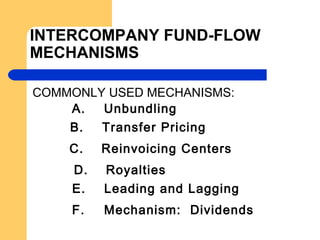
COMMONLY USED MECHANISMS:
A. Unbundling
B. Transfer Pricing
C. Reinvoicing Centers
D. Royalties
E. Leading and Lagging
F. Mechanism: Dividends
UNBUNDLING
A.Unbundling Mechanism
breaks up a total international transfer of
funds between pairs of affiliates into separate
components
Example:
Headquarters breaks down charges for
corporate overhead (wages, rent, utilities, etc.) by affiliate
TRANSFER PRICING
B.Transfer Pricing Mechanism
1. Definition: pricing internally traded goods of
the firm for the purpose of moving profits to a
more tax-friendly nation.
TRANSFER PRICING
2. Uses of Transfer Pricing
a. Reduces taxes paid
b. Reduces tariffs
c. Avoids exchange controls
TRANSFER PRICING:
An Example
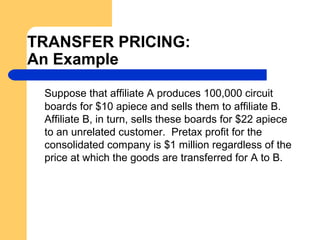
Suppose that affiliate A produces 100,000 circuit
boards for $10 apiece and sells them to affiliate B.
Affiliate B, in turn, sells these boards for $22 apiece
to an unrelated customer. Pretax profit for the
consolidated company is $1 million regardless of the
price at which the goods are transferred for A to B.
TRANSFER PRICING:
An Example
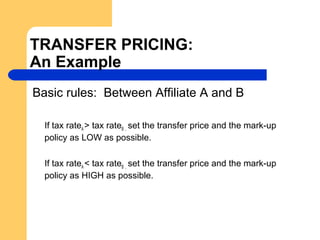
Basic rules: Between Affiliate A and B
If tax rateA > tax rateB , set the transfer price and the mark-up
policy as LOW as possible.
If tax rateA < tax rateB , set the transfer price and the mark-up
policy as HIGH as possible.
TRANSFER PRICING:
An Example
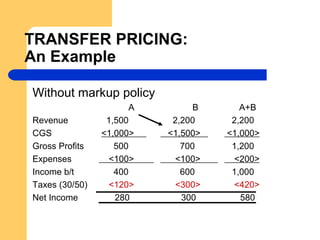
Without markup policy
A B A+B
Revenue 1,500 2,200 2,200
CGS <1,000> <1,500> <1,000>
Gross Profits 500 700 1,200
Expenses <100> <100> <200>
Income b/t 400 600 1,000
Taxes (30/50) <120> <300> <420>
Net Income 280 300 580
TRANSFER PRICING:
An Example
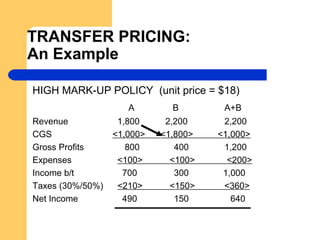
HIGH MARK-UP POLICY (unit price = $18)
A B A+B
Revenue 1,800 2,200 2,200
CGS <1,000> <1,800> <1,000>
Gross Profits 800 400 1,200
Expenses <100> <100> <200>
Income b/t 700 300 1,000
Taxes (30%/50%) <210> <150> <360>
Net Income 490 150 640
TRANSFER PRICING:
An Example
In effect:
Profits are shifted from a higher to a lower tax
jurisdiction
REINVOICING CENTERS
C. Mechanism: Reinvoicing Centers
1. Set up in low-tax nations.
2. Center takes title to all gods.
3. Center pays seller/paid by buyer
all within the MNC.
REINVOICING CENTERS
4. Advantages:
a. Easier control on currency
exposure
b. Invoice currency other than
local
REINVOICING CENTERS
5. Disadvantages of Reinvoicing
a. Increased communications
costs
b. Suspicion of tax evasion by
local governments.
FEES AND ROYALTIES
D. Mechanism: Royalties
1. Firms have control of payment
amounts.
2. Host governments less suspicious
LEADING AND LAGGING
E. Leading and Lagging
1. Highly favored by MNCs
2. Often used instead of formal debt:
may be prohibited by local government
3. Less chance of local government
suspicion.
DIVIDENDS!
F. Mechanism: Dividends
most important method used by MNCs to
transfer funds to parent

Chapter 20 IFM

  • 1.
    Multinational Financial Management Alan Shapiro 9th Edition J.Wiley& Sons Power Points by Joseph F. Greco, Ph.D. California State University, Fullerton
  • 2.
    CHAPTER 20 Managing theMultinational Financial System
  • 3.
    MANAGING THE MULTINATIONAL FINANCIALSYSTEM I. THE VALUE OF THE MULTINATIONAL FINANCIAL SYSTEM Its value lies in its ability to arbitrage in the following areas: 1. Tax systems 2. Financial markets 3. Regulatory systems
  • 4.
    TAX ARBITRAGE Tax Arbitrageis possible because we know: 1. Wide variations exist in global tax systems examples: Germany vs. Honk Kong 2. Firms want to reduce taxes paid especially the “triple- taxed” MNC move funds to low-tax jurisdiction
  • 5.
    TAX ARBITRAGE 3. TaxFactors (triple taxation): a. Triple Taxes may be levied on 1.) corporate income 2.) personal income (includes dividends) 3.) subsidiary income b. U.S. Tax System Provision Offset: Foreign tax credit given on tax already paid abroad.
  • 6.
    FINANCIAL MARKET ARBITRAGE FinancialMarket Arbitrage is possible if we 1. assume imperfect markets exist because a. Formal barriers to trade exist b. Informal barriers also exist c. Imperfections in domestic capital markets exist 2. agree parity conditions not in effect, namely a. interest rate parity b. International Fisher Effect
  • 7.
    REGULATORY ARBITRAGE Regulatory Arbitrage: 1.Arises when subsidiary profits vary due to local regulations. 2. Examples of local regulations: a. Government price controls b. Union wage pressures: Firms may disguise true profits in order to gain better negotiations advantages
  • 8.
    INTERCOMPANY FUND-FLOW MECHANISMS II. INTERCOMPANYFUND-FLOW MECHANISMS: the name given to the methods used to move funds from one subsidiary to another.
  • 9.
    INTERCOMPANY FUND-FLOW MECHANISMS COMMONLY USEDMECHANISMS: A. Unbundling B. Transfer Pricing C. Reinvoicing Centers D. Royalties E. Leading and Lagging F. Mechanism: Dividends
  • 10.
    UNBUNDLING A.Unbundling Mechanism breaks upa total international transfer of funds between pairs of affiliates into separate components Example: Headquarters breaks down charges for corporate overhead (wages, rent, utilities, etc.) by affiliate
  • 11.
    TRANSFER PRICING B.Transfer PricingMechanism 1. Definition: pricing internally traded goods of the firm for the purpose of moving profits to a more tax-friendly nation.
  • 12.
    TRANSFER PRICING 2. Usesof Transfer Pricing a. Reduces taxes paid b. Reduces tariffs c. Avoids exchange controls
  • 13.
    TRANSFER PRICING: An Example Supposethat affiliate A produces 100,000 circuit boards for $10 apiece and sells them to affiliate B. Affiliate B, in turn, sells these boards for $22 apiece to an unrelated customer. Pretax profit for the consolidated company is $1 million regardless of the price at which the goods are transferred for A to B.
  • 14.
    TRANSFER PRICING: An Example Basicrules: Between Affiliate A and B If tax rateA > tax rateB , set the transfer price and the mark-up policy as LOW as possible. If tax rateA < tax rateB , set the transfer price and the mark-up policy as HIGH as possible.
  • 15.
    TRANSFER PRICING: An Example Withoutmarkup policy A B A+B Revenue 1,500 2,200 2,200 CGS <1,000> <1,500> <1,000> Gross Profits 500 700 1,200 Expenses <100> <100> <200> Income b/t 400 600 1,000 Taxes (30/50) <120> <300> <420> Net Income 280 300 580
  • 16.
    TRANSFER PRICING: An Example HIGHMARK-UP POLICY (unit price = $18) A B A+B Revenue 1,800 2,200 2,200 CGS <1,000> <1,800> <1,000> Gross Profits 800 400 1,200 Expenses <100> <100> <200> Income b/t 700 300 1,000 Taxes (30%/50%) <210> <150> <360> Net Income 490 150 640
  • 17.
    TRANSFER PRICING: An Example Ineffect: Profits are shifted from a higher to a lower tax jurisdiction
  • 18.
    REINVOICING CENTERS C. Mechanism:Reinvoicing Centers 1. Set up in low-tax nations. 2. Center takes title to all gods. 3. Center pays seller/paid by buyer all within the MNC.
  • 19.
    REINVOICING CENTERS 4. Advantages: a.Easier control on currency exposure b. Invoice currency other than local
  • 20.
    REINVOICING CENTERS 5. Disadvantagesof Reinvoicing a. Increased communications costs b. Suspicion of tax evasion by local governments.
  • 21.
    FEES AND ROYALTIES D.Mechanism: Royalties 1. Firms have control of payment amounts. 2. Host governments less suspicious
  • 22.
    LEADING AND LAGGING E.Leading and Lagging 1. Highly favored by MNCs 2. Often used instead of formal debt: may be prohibited by local government 3. Less chance of local government suspicion.
  • 23.
    DIVIDENDS! F. Mechanism: Dividends mostimportant method used by MNCs to transfer funds to parent